Article

Fragility Fractures in End-Stage Chronic Kidney Disease (CKD) Population: Patient-Related and CKD-Related Factor Analysis—A Single-Center Experience

1
Orthopedics and Traumatology Unit, Department of Ageing, Orthopedics and Rheumatological Sciences, Fondazione Policlinico Universitario A. Gemelli IRCCS, L.go A. Gemelli, 8, 00168 Rome, Italy
2
Department of Orthopedics and Geriatric Sciences, Catholic University of the Sacred Heart, 00153 Rome, Italy
3
Orthopedic Unit, Department of Public Health, “Federico II” University, 80138 Naples, Italy
4
Nephrology Unit, Department of Medical and Surgical Sciences, Fondazione Policlinico Universitario A. Gemelli IRCCS, 00168 Rome, Italy
5
Orthopedic and Traumatology Unit, “Tor Vergata” University, 00133 Rome, Italy
6
Department of Emergency, Anesthesiological, and Resuscitation Sciences, Fondazione Policlinico Universitario A. Gemelli IRCCS, 00168 Rome, Italy
*
Author to whom correspondence should be addressed.
J. Clin. Med. 2024, 13(8), 2430; https://doi.org/10.3390/jcm13082430
Submission received: 11 March 2024 / Revised: 16 April 2024 / Accepted: 19 April 2024 / Published: 21 April 2024
(This article belongs to the Special Issue Recent Advances in the Management of Pathological Fractures)

Abstract

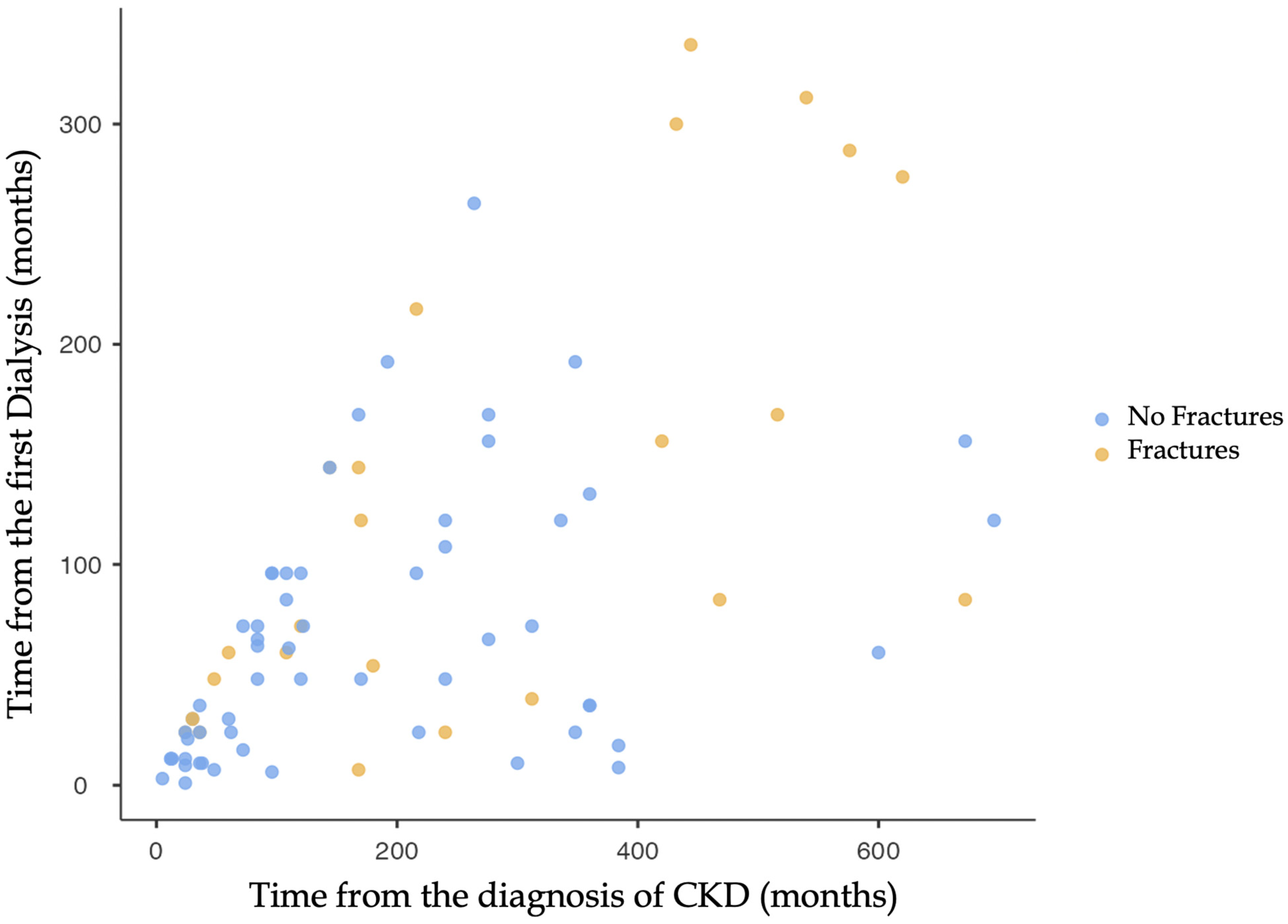
Background: Chronic kidney disease (CKD) stands as a prevalent global health concern, and mineral and bone disease are among the most impactful consequences. A severe complication arising from mineral and bone disease is the occurrence of fragility fractures, which disproportionately affect individuals with CKD compared to the general population. The prevalence of these fractures impacts both survival rates and quality of life. The aims of this study are analyzing and identifying (i) patient-related risk factors and (ii) CKD-related risk factors to contribute to the development of preventive measures for fragility fractures for this population. Methods: A retrospective, single-center observational study was conducted, encompassing patient data from the years 2021 to 2023. Registry data were recorded, including patient-related and CKD-related data. Patients were interviewed about traumatological history, and their answers were recorded. Logistic regression analysis was employed to investigate the association between independent variables and dependent variables. Results: Eighty-four patients, with a mean age of 64.3 ± 15.2 years and a male percentage of 58.3%, were included in this study. Among them, 19.5% exhibited smoking habits. The mean Charlson Comorbidity Index was 3.06 ± 1.21. All patients were diagnosed with end-stage chronic kidney disease, with mean durations of 208 months from the diagnosis and 84.5 months from the beginning of dialysis. The logistic regression analysis, adjusted for age, sex, and CCI, revealed that smoking habits play a significant role as a risk factor for fragility fractures in lower limbs (p: 0.011 *). The incidence of fragility fractures increases directly proportionally to the time since diagnosis (p-value: 0.021 *) and the beginning of dialysis treatment (p-value: 0.001 *). Conclusions: Among patient-related factors, smoking habits seem to significantly affect lower-limb fracture rates (p < 0.05), whereas among CKD-related factors, time since CKD diagnosis and time since the beginning of dialysis treatment are directly related to higher risks of fragility fractures. No relevant correlations emerged in the studied treatments, except for a reduction in proximal femur fracture occurrence when patients underwent a combined treatment of a calcimimetic and a vitamin D analog.
Keywords: fragility fractures; chronic kidney disease; dialysis; epidemiological study; mineral bone disease fragility fractures; chronic kidney disease; dialysis; epidemiological study; mineral bone disease