Article

Endodontic Treatment Outcomes in Cone Beam Computed Tomography Images—Assessment of the Diagnostic Accuracy of AI


1
Kazimierczak Private Medical Practice, Dworcowa 13/u6a, 85-009 Bydgoszcz, Poland
2
Department of Radiology and Diagnostic Imaging, University Hospital No. 1 in Bydgoszcz, Marii Skłodowskiej Curie 9, 85-094 Bydgoszcz, Poland
3
Department of Radiology and Diagnostic Imaging, Collegium Medicum, Nicolaus Copernicus University in Torun, Jagiellońska 13–15, 85-067 Bydgoszcz, Poland
4
Chair of Practical Clinical Dentistry, Department of Diagnostics, Poznań University of Medical Sciences, 61-701 Poznań, Poland
5
Dental Primus, Poznańska 18, 88-100 Inowrocław, Poland
*
Author to whom correspondence should be addressed.
J. Clin. Med. 2024, 13(14), 4116; https://doi.org/10.3390/jcm13144116
Submission received: 11 June 2024 / Revised: 9 July 2024 / Accepted: 12 July 2024 / Published: 14 July 2024
(This article belongs to the Special Issue Modern Patient-Centered Dental Care)

Abstract

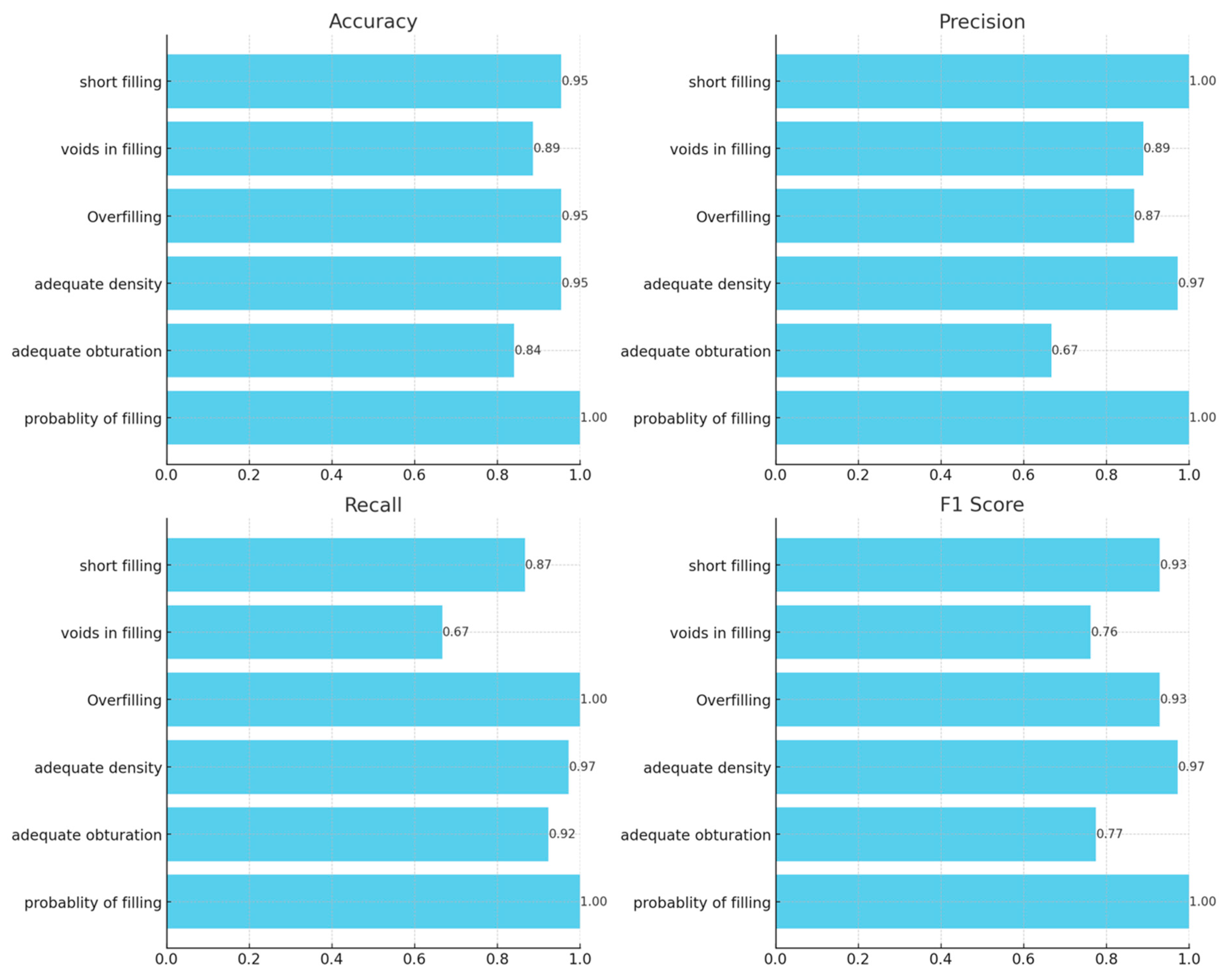
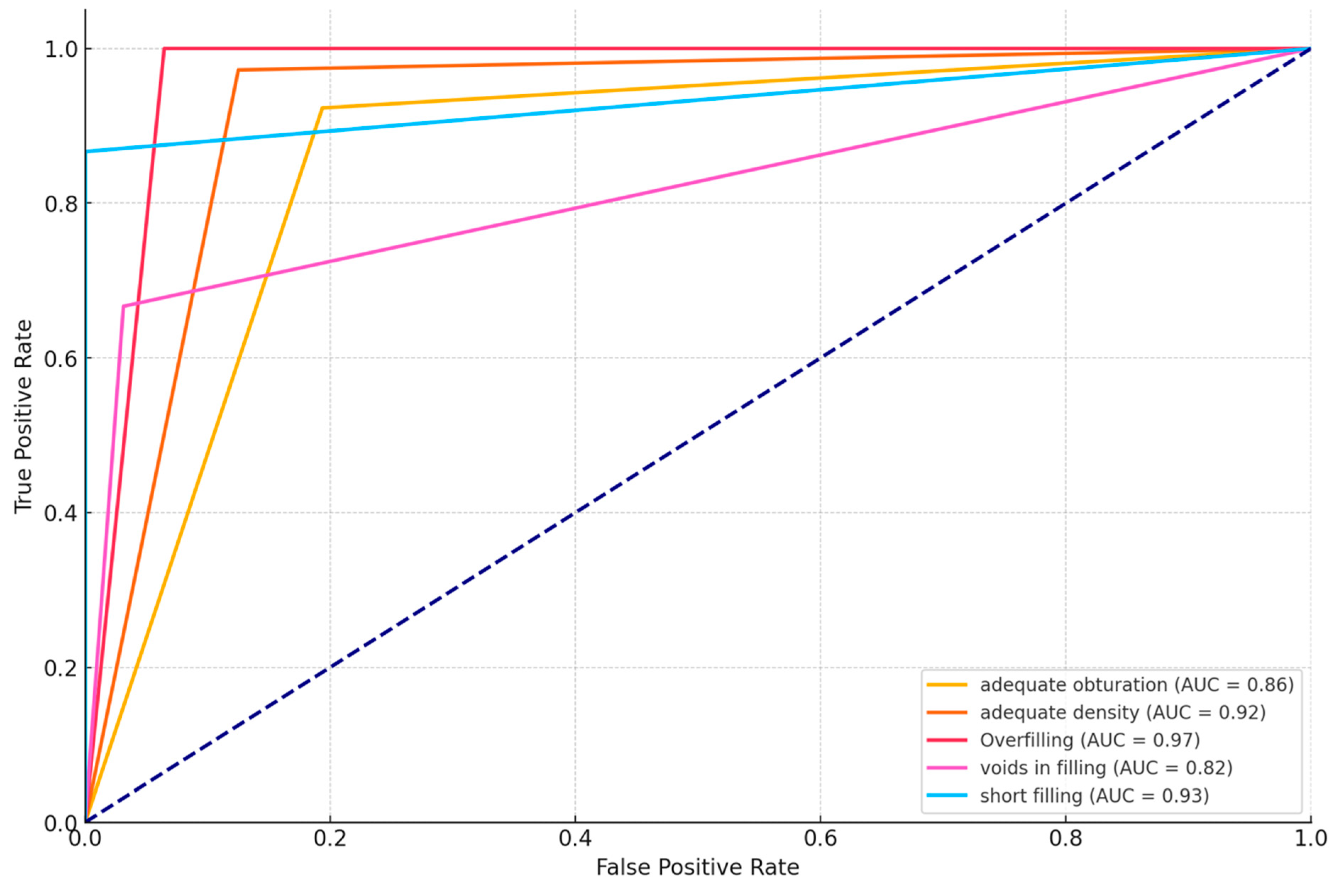
Background/Objectives: The aim of this study was to assess the diagnostic accuracy of the AI-driven platform Diagnocat for evaluating endodontic treatment outcomes using cone beam computed tomography (CBCT) images. Methods: A total of 55 consecutive patients (15 males and 40 females, aged 12–70 years) referred for CBCT imaging were included. CBCT images were analyzed using Diagnocat’s AI platform, which assessed parameters such as the probability of filling, adequate obturation, adequate density, overfilling, voids in filling, short filling, and root canal number. The images were also evaluated by two experienced human readers. Diagnostic accuracy metrics (accuracy, precision, recall, and F1 score) were assessed and compared to the readers’ consensus, which served as the reference standard. Results: The AI platform demonstrated high diagnostic accuracy for most parameters, with perfect scores for the probability of filling (accuracy, precision, recall, F1 = 100%). Adequate obturation showed moderate performance (accuracy = 84.1%, precision = 66.7%, recall = 92.3%, and F1 = 77.4%). Adequate density (accuracy = 95.5%, precision, recall, and F1 = 97.2%), overfilling (accuracy = 95.5%, precision = 86.7%, recall = 100%, and F1 = 92.9%), and short fillings (accuracy = 95.5%, precision = 100%, recall = 86.7%, and F1 = 92.9%) also exhibited strong performance. The performance of AI for voids in filling detection (accuracy = 88.6%, precision = 88.9%, recall = 66.7%, and F1 = 76.2%) highlighted areas for improvement. Conclusions: The AI platform Diagnocat showed high diagnostic accuracy in evaluating endodontic treatment outcomes using CBCT images, indicating its potential as a valuable tool in dental radiology.
Keywords: artificial intelligence (AI); automatic detection; diagnosis; diagnostic test accuracy; CBCT; cone beam computed tomography; endodontic treatment artificial intelligence (AI); automatic detection; diagnosis; diagnostic test accuracy; CBCT; cone beam computed tomography; endodontic treatment