Review

The Role of Rehabilitation after Spinal Mesotherapy in a Three-Stage Treatment Concept

by
Kamil Koszela
1,2,*,
Michał Słupiński
2 and
Marta Woldańska-Okońska
3
1
Department of Neuroorthopedics and Neurology Clinic and Polyclinic, National Institute of Geriatrics, Rheumatology and Rehabilitation, 02-637 Warsaw, Poland
2
Rehabilika—Centre for Rehabilitation and Adult Age Medicine, 93-029 Lodz, Poland
3
Department of Internal Medicine, Rehabilitation and Physical Medicine, Medical University of Lodz, 90-419 Lodz, Poland
*
Author to whom correspondence should be addressed.
J. Clin. Med. 2024, 13(11), 3195; https://doi.org/10.3390/jcm13113195
Submission received: 27 March 2024 / Revised: 20 May 2024 / Accepted: 28 May 2024 / Published: 29 May 2024
(This article belongs to the Section Clinical Rehabilitation)

Abstract

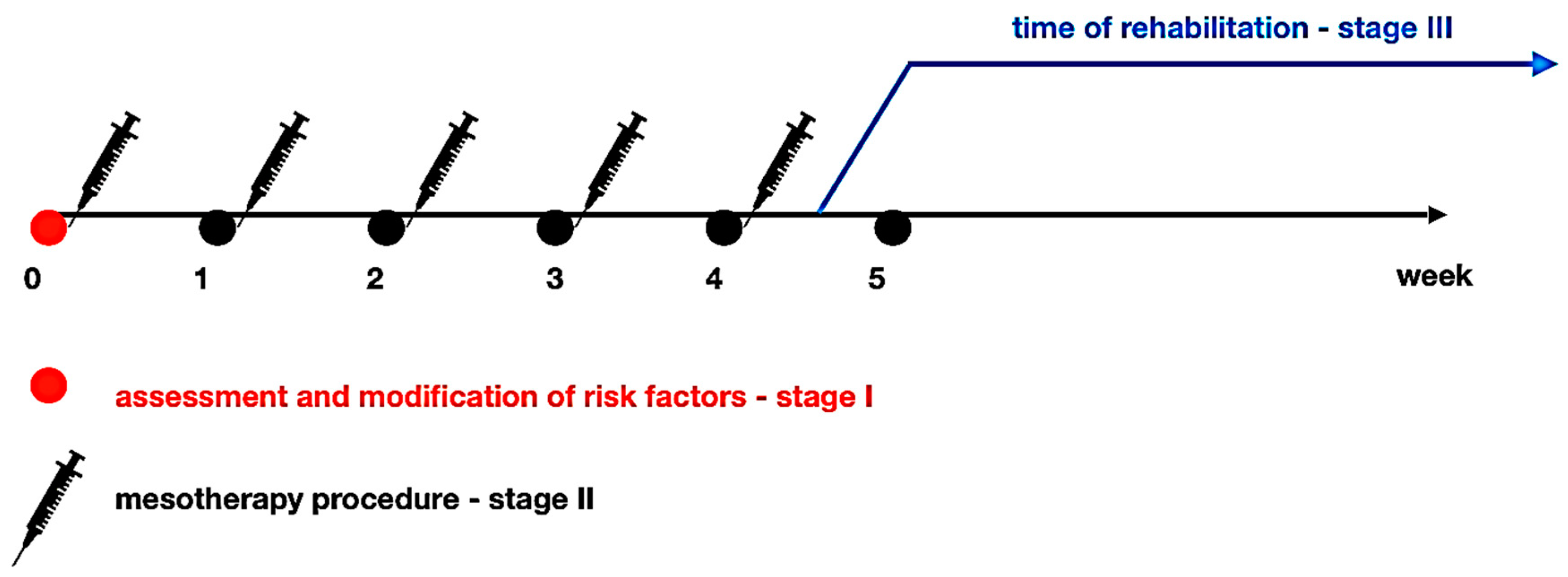
Sedentary lifestyles, work overload, and lack of regular physical activity are risk factors for spinal pain syndrome. In everyday medical practice, spinal pain syndrome of a muscular or myofascial, or non-neurogenic, nature is diagnosed. This problem affects a large group of patients and reaches about 70–80% of spinal pain cases. Usually, one of the primary treatments is with NSAIDs (Non-steroidal Anti-Inflammatory Drugs). In this case, one treatment method that is safe and has no side effects is spinal mesotherapy. This method consists of performing multi-point intradermal microinjections with the administration of drugs or medical devices. Based on a new perspective on the treatment of spinal pathology—the so-called three-stage treatment concept—it is necessary to deal with the risk factor(s) of spinal pain syndrome and reduce or at least modify them (stage I). This is followed by a broadly understood medical therapy, in this case spinal mesotherapy (stage II), which aims to relax tense tissues, improve mobility in the spine and thus reduce pain. As a result, conditions are created for the necessary process, which is rehabilitation in the broadest sense (stage III). Movement therapy, which is crucial in spinal pain syndrome, is performed with less pain, after obtaining better patient mobility. The purpose of this article is to evaluate the role of rehabilitation of patients after spinal mesotherapy in terms of the three-stage treatment concept for spinal pathology.
Keywords: mesotherapy; local intradermal therapy (LIT); rehabilitation; conservative treatment; myofascial pain syndrome (MPS); risk factors mesotherapy; local intradermal therapy (LIT); rehabilitation; conservative treatment; myofascial pain syndrome (MPS); risk factors