


Prognosis Impact of Diabetes in Elderly Women and Men with Non-ST Elevation Acute Coronary Syndrome

 ,
,  ,
,  , , ,
, , ,  , ,
, ,  and
and
Abstract
:1. Introduction
2. Material and Methods
2.1. Study Population
2.2. End Point
2.3. Statistical Analysis
2.4. Ethics
3. Results
Patient Population
4. Discussion
5. Conclusions
Supplementary Materials
Author Contributions
Funding
Institutional Review Board Statement
Informed Consent Statement
Data Availability Statement
Conflicts of Interest
References
- Díez-Villanueva, P.; Méndez, C.J.; Alfonso, F. Non-ST elevation acute coronary syndrome in the elderly. J. Geriatr. Cardiol. 2020, 17, 9–15. [Google Scholar] [PubMed]
- Dai, X.; Busby-Whitehead, J.; Alexander, K.P. Acute coronary syndrome in the older adults. J. Geriatr. Cardiol. 2016, 13, 101–108. [Google Scholar] [PubMed]
- Collet, J.-P.; Thiele, H.; Barbato, E.; Barthélémy, O.; Bauersachs, J.; Bhatt, D.L.; Dendale, P.; Dorobantu, M.; Edvardsen, T.; Folliguet, T.; et al. 2020 ESC Guidelines for the management of acute coronary syndromes in patients presenting without persistent ST-segment elevation. Eur. Heart J. 2021, 42, 1289–1367. [Google Scholar] [CrossRef] [PubMed]
- Engberding, N.; Wenger, N.K. Acute Coronary Syndromes in the Elderly. F1000Research 2017, 6, 1791. [Google Scholar] [CrossRef] [PubMed] [Green Version]
- Rosengren, A.; Wallentin, L.; Simoons, M.; Gitt, A.K.; Behar, S.; Battler, A.; Hasdai, D. Age, clinical presentation, and outcome of acute coronary syndromes in the Euroheart acute coronary syndrome survey. Eur. Heart J. 2006, 27, 789–795. [Google Scholar] [CrossRef] [PubMed] [Green Version]
- Freisinger, E.; Sehner, S.; Malyar, N.M.; Suling, A.; Reinecke, H.; Wegscheider, K. Nationwide Routine-Data Analysis of Sex Differences in Outcome of Acute Myocardial Infarction. Clin. Cardiol. 2018, 41, 1013–1021. [Google Scholar] [CrossRef] [Green Version]
- Hao, Y.; Liu, J.; Liu, J.; Yang, N.; Smith, C.S., Jr.; Huo, Y.; Fonarow, G.C.; Ge, J.; Taubert, K.A.; Morgan, L.; et al. Sex Differences in In-Hospital Management and Outcomes of Patients with Acute Coronary Syndrome. Circulation 2019, 139, 1776–1785. [Google Scholar] [CrossRef]
- Vogel, B.; Farhan, S.; Hahne, S.; Kozanli, I.; Kalla, K.; Freynhofer, M.K.; Jarai, R.; Kautzky-Willer, A.; Huber, K. Sex-related differences in baseline characteristics, management and outcome in patients with acute coronary syndrome without ST-segment elevation. Eur. Heart J. Acute Cardiovasc. Care 2016, 5, 347–353. [Google Scholar] [CrossRef]
- Pagidipati, N.J.; Peterson, E.D. Acute coronary syndromes in women and men. Nat. Rev. Cardiol. 2016, 13, 471–480. [Google Scholar] [CrossRef]
- Ruiz-Nodar, J.M.; Ferreiro, J.L.; Ribera, A.; Marsal, J.R.; Acuña, J.M.G.; Bermejo, R.A.; Raposeiras-Roubín, S.; Abu-Assi, E.; Cordero, A.; Bertomeu-González, V.; et al. Sex differences in the management of patients with acute coronary syndrome: A population-based ecological cross-sectional study in Spain. REC Cardiol. Clin. 2021, 56, 168–178. [Google Scholar]
- Vicent, L.; Ariza-Solé, A.; Alegre, O.; Sanchís, J.; López-Palop, R.; Formiga, F.; González-Salvado, V.; Bueno, H.; Vidán, M.T.; Díez-Villanueva, P.; et al. Octogenarian women with acute coronary syndrome present frailty and readmissions more frequently than men. Eur. Heart J. Acute Cardiovasc. Care 2019, 8, 252–263. [Google Scholar] [CrossRef]
- De Carlo, M.; Morici, N.; Savonitto, S.; Grassia, V.; Sbarzaglia, P.; Tamburrini, P.; Cavallini, C.; Galvani, M.; Ortolani, P.; De Servi, S.; et al. Sex-Related Outcomes in Elderly Patients Presenting with Non-ST-Segment Elevation Acute Coronary Syndrome: Insights from the Italian Elderly ACS Study. JACC Cardiovasc. Interv. 2015, 8, 791–796. [Google Scholar] [CrossRef]
- Pernias, V.; García Acuña, J.M.; Raposeiras-Roubín, S.; Barrabés, J.A.; Cordero, A.; Martínez-Sellés, M.; Bardají, A.; Díez-Villanueva, P.; Marín, F.; Ruiz-Nodar, J.M.; et al. Influencia de las comorbilidades en la decisión del tratamiento invasivo en ancianos con SCASEST. REC Interv. Cardiol. 2021, 3, 15–20. [Google Scholar] [CrossRef]
- Heer, T.; Gitt, A.K.; Juenger, C.; Schiele, R.; Wienbergen, H.; Towae, F.; Gottwitz, M.; Zahn, R.; Zeymer, U.; Senges, J. Gender Differences in Acute Non–ST-Segment Elevation Myocardial Infarction. Am. J. Cardiol. 2006, 98, 160–166. [Google Scholar] [CrossRef]
- Álvarez, B.Á.; Casas, C.A.J.; Bermejo, R.A.; Cordero, A.; Álvarez, A.B.C.; Mañero, M.R.; Cruz, N.B.; García Acuña, J.M.; Barreiro, A.S.; González-Juanatey, J.R. Sex-related differences in long-term mortality and heart failure in a contemporary cohort of patients with NSTEACS. The cardiochus-HSUJ registry. Eur. J. Intern. Med. 2020, 81, 26–31. [Google Scholar] [CrossRef] [PubMed]
- Gupta, T.; Kolte, D.; Khera, S.; Agarwal, N.; Villablanca, P.A.; Goel, K.; Patel, K.; Aronow, W.S.; Wiley, J.; Bortnick, A.E.; et al. Contemporary sex-based differences by age in presenting characteristics, use of an early invasive strategy, and inhospital mortality in patients with non-STsegment-elevation myocardial infarction in the United States. Circ. Cardiovasc. Interv. 2018, 11, e005735. [Google Scholar] [CrossRef] [PubMed]
- Alabas, O.A.; Gale, C.P.; Hall, M.; Rutherford, M.J.; Szummer, K.; Lawesson, S.S.; Alfredsson, J.; Lindahl, B.; Jernberg, T. Sex Differences in Treatments, Relative Survival, and Excess Mortality Following Acute Myocardial Infarction: National Cohort Study Using the SWEDEHEART Registry. J. Am. Heart Assoc. 2017, 6, e007123. [Google Scholar] [CrossRef] [PubMed] [Green Version]
- Alabas, O.A.; Hall, M.; Dondo, T.B.; Rutherford, M.J.; Szummer, K.; Lawesson, S.S.; Alfredsson, J.; Lindahl, B.; Jernberg, T. Long-term excess mortality associated with diabetes following acute myocardial infarction: A population-based cohort study. J. Epidemiol. Community Health 2017, 71, 25–32. [Google Scholar] [CrossRef]
- Bauters, C.; Lemesle, G.; de Groote, P.; Lamblin, N. A systematic review and meta-regression of temporal trends in the excess mortality associated with diabetes mellitus after myocardial infarction. Int. J. Cardiol. 2016, 217, 109–121. [Google Scholar] [CrossRef]
- Koek, H.L.; Soedamah-Muthu, S.S.; Kardaun, J.W.P.F.; Gevers, E.; de Bruin, A.; Reitsma, J.B.; Bots, M.L.; Grobbee, D.E. Short- and long-term mortality after acute myocardial infarction: Comparison of patients with and without diabetes mellitus. Eur. J. Epidemiol. 2007, 22, 883–888. [Google Scholar] [CrossRef] [Green Version]
- Icks, A.; Claessen, H.; Kirchberger, I.; Heier, M.; Peters, A.; Trentinaglia, I.; Giani, G.; Von Scheidt, W.; Meisinger, C. Mortality after first myocardial infarction in diabetic and non-diabetic people between 1985 and 2009. The MONICA/KORA registry. Eur. J. Epidemiol. 2014, 29, 899–909. [Google Scholar] [CrossRef]
- Sanchis, J.; Acuña, J.M.G.; Raposeiras, S.; Barrabés, J.A.; Cordero, A.; Martínez-Sellés, M.; Bardají, A.; Díez-Villanueva, P.; Marín, F.; Ruiz-Nodar, J.M.; et al. Comorbidity burden and revascularization benefit in elderly patients with acute coronary syndrome. Rev. Esp. Cardiol. 2021, 74, 765–772. [Google Scholar] [CrossRef]
- Díez-Villanueva, P.; Vicent, L.; Alfonso, F. Gender disparities in treatment response in octogenarians with acute coronary syndrome. J. Thorac. Dis. 2020, 12, 1277–1279. [Google Scholar] [CrossRef]
- Lee, P.Y.; Alexander, K.P.; Hammill, B.G.; Pasquali, S.K.; Peterson, E.D. Representation of Elderly Persons and Women in Published Randomized Trials of Acute Coronary Syndromes. JAMA 2001, 286, 708–713. [Google Scholar] [CrossRef] [PubMed] [Green Version]
- Harris, D.J.; Douglas, P.S. Enrollment of women in cardiovascular clinical trials funded by the National Heart, Lung, and Blood Institute. N. Eng. J. Med. 2000, 343, 475–480. [Google Scholar] [CrossRef]
- Tai, S.; Li, X.; Yang, H.; Zhu, Z.; Tang, L.; Fu, L.; Hu, X.; Fang, Z.; Guo, Y.; Zhou, S. Sex Differences in the Outcomes of Elderly Patients with Acute Coronary Syndrome. Cardiol. Res. Pract. 2020, 2020, 5091490. [Google Scholar] [CrossRef] [PubMed]
- Jánosi, A.; Ferenci, T.; Ofner, P.; Lupkovics, G.; Becker, D.; Faluközy, J.; Polgár, P.; Kőszegi, Z.; Horváth, I.; Jambrik, Z.; et al. Does Gender Have Prognostic Value Among Patients with Myocardial Infarction? Analysis of the Data from the Hungarian Myocardial Infarction Registry. J. Women’s Health 2018, 27, 1491–1498. [Google Scholar] [CrossRef]
- Bardaji, A.; Barrabés, J.A.; Ribera, A.; Bueno, H.; Fernández-Ortiz, A.; Marrugat, J.; Oristrell, G.; Ferreira-González, I. Revascularisation in older adult patients with non-ST-segment elevation acute coronary syndrome: Effect and impact on 6-month mortality. Eur. Heart J. Acute Cardiovasc. Care 2020, 9, 358–366. [Google Scholar] [CrossRef]
- Maric-Bilkan, C. Sex differences in micro- and macro-vascular complications of diabetes mellitus. Clin. Sci. 2017, 131, 833–846. [Google Scholar] [CrossRef] [PubMed]
- Peters, S.A.E.; Huxley, R.; Sattar, N.; Woodward, M. Sex Differences in the Excess Risk of Cardiovascular Diseases Associated with Type 2 Diabetes: Potential Explanations and Clinical Implications. Curr. Cardiovasc. Risk Rep. 2015, 9, 36. [Google Scholar] [CrossRef] [Green Version]
- Sarma, A.A.; Braunwald, E.; Cannon, C.P.; Guo, J.; Im, K.; Antman, E.M.; Gibson, C.M.; Newby, L.K.; Giugliano, R.P.; Morrow, D.A.; et al. Outcomes of Women Compared with Men After Non–ST-Segment Elevation Acute Coronary Syndromes. J. Am. Coll. Cardiol. 2019, 74, 3013–3022. [Google Scholar] [CrossRef]
- Dégano, I.R.; Subirana, I.; Fusco, D.; Tavazzi, L.; Kirchberger, I.; Farmakis, D.; Ferrières, J.; Azevedo, A.; Torre, M.; Garel, P.; et al. Percutaneous coronary intervention reduces mortality in myocardial infarction patients with comorbidities: Implications for elderly patients with diabetes or kidney disease. Int. J. Cardiol. 2017, 249, 83–89. [Google Scholar] [CrossRef] [PubMed] [Green Version]
- Lopez-De-Andres, A.; Jimenez-Garcia, R.; Hernández-Barrera, V.; de Miguel-Yanes, J.M.; Albaladejo-Vicente, R.; Villanueva-Orbaiz, R.; Carabantes-Alarcon, D.; Zamorano-Leon, J.J.; Lopez-Herranz, M.; de Miguel-Diez, J. Are there sex differences in the effect of type 2 diabetes in the incidence and outcomes of myocardial infarction? A matched-pair analysis using hospital discharge data. Cardiovasc. Diabetol. 2021, 20, 81. [Google Scholar] [CrossRef]
- Palau, P.; Bertomeu-González, V.; Sanchis, J.; Soler, M.; De la Espriella, R.; Domínguez, E.; Santas, E.; Núñez, E.; Chorro, F.J.; Miñana, G.; et al. Differential prognostic impact of type 2 diabetes mellitus in women and men with heart failure with preserved ejection fraction. Rev. Esp. Cardiol. 2020, 73, 463–470. [Google Scholar] [CrossRef]
- Alkhouli, M.; Alqahtani, F.; Jneid, H.; Al Hajji, M.; Boubas, W.; Lerman, A. Age-Stratified Sex-Related Differences in the Incidence, Management, and Outcomes of Acute Myocardial Infarction. Mayo Clin. Proc. 2021, 96, 332–341. [Google Scholar] [CrossRef]
- Díez-Villanueva, P.; Arizá-Solé, A.; Vidán, M.T.; Bonanad, C.; Formiga, F.; Sanchis, J.; Martín-Sánchez, F.J.; Ruiz Ros, V.; Sanmartín Fernández, M.; Bueno, H.; et al. Recommendations of the Geriatric Cardiology Section of the Spanish Society of Cardiology for the Assessment of Frailty in Elderly Patients with Heart Disease. Rev. Esp. Cardiol. 2019, 72, 63–71. [Google Scholar] [CrossRef]
- Llaó, I.; Ariza-Solé, A.; Sanchis, J.; Alegre, O.; López-Palop, R.; Formiga, F.; Marín, F.; Vidán, M.T.; Martínez-Sellés, M.; Sionis, A.; et al. Invasive strategy and frailty in very elderly patients with acute coronary syndromes. Euro Interv. 2018, 14, e336–e342. [Google Scholar] [CrossRef] [PubMed]
- Sanchis, J.; Ariza-Solé, A.; Abu-Assi, E.; Alegre, O.; Alfonso, F.; Barrabés, J.A.; Baz, J.A.; Carol, A.; Díez Villanueva, P.; García Del Blanco, B.; et al. Invasive Versus Conservative Strategy in Frail Patients with NSTEMI: The MOSCA-FRAIL Clinical Trial Study Design. Rev. Esp. Cardiol. 2019, 72, 154–159. [Google Scholar] [CrossRef] [PubMed]
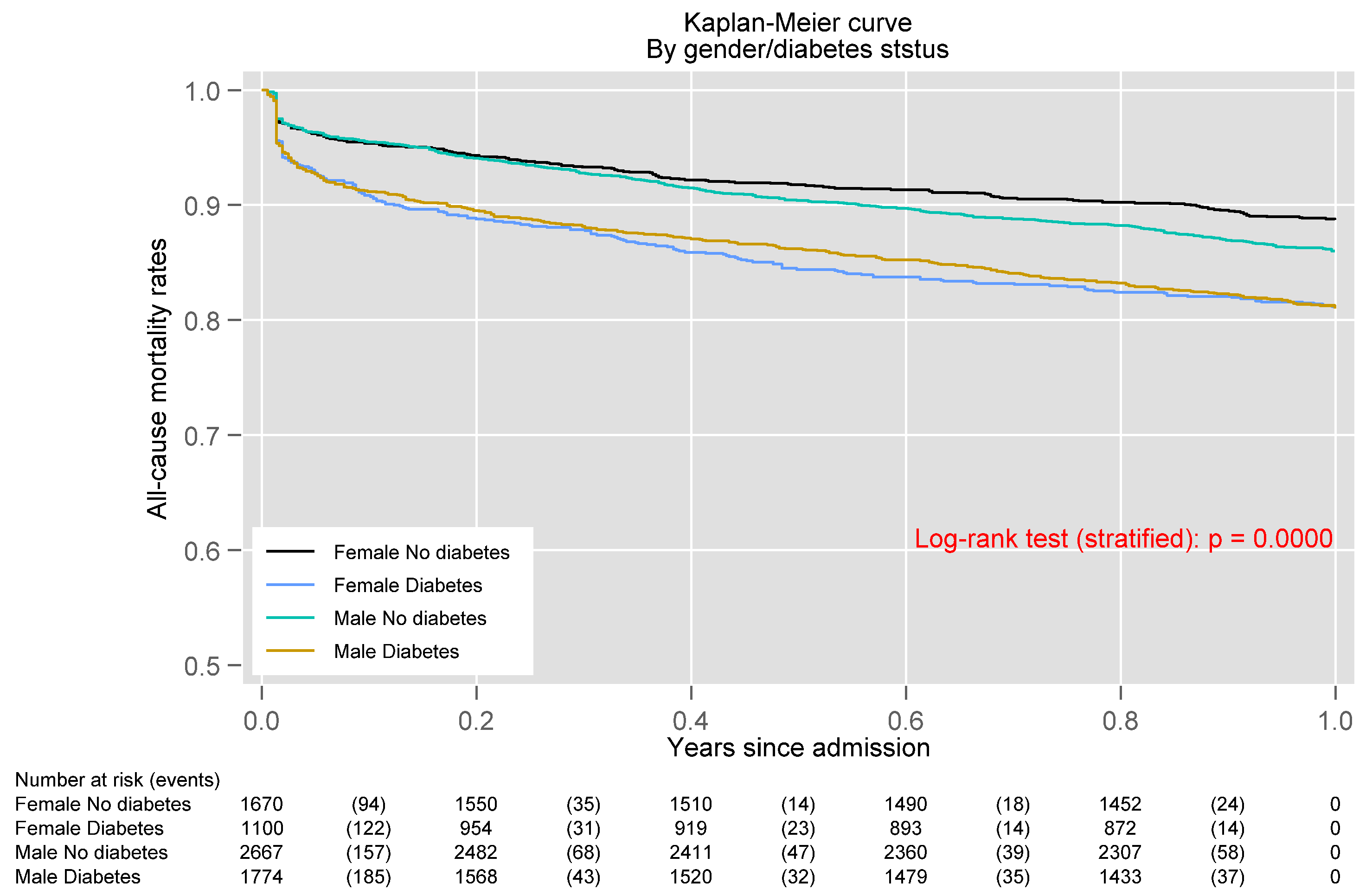
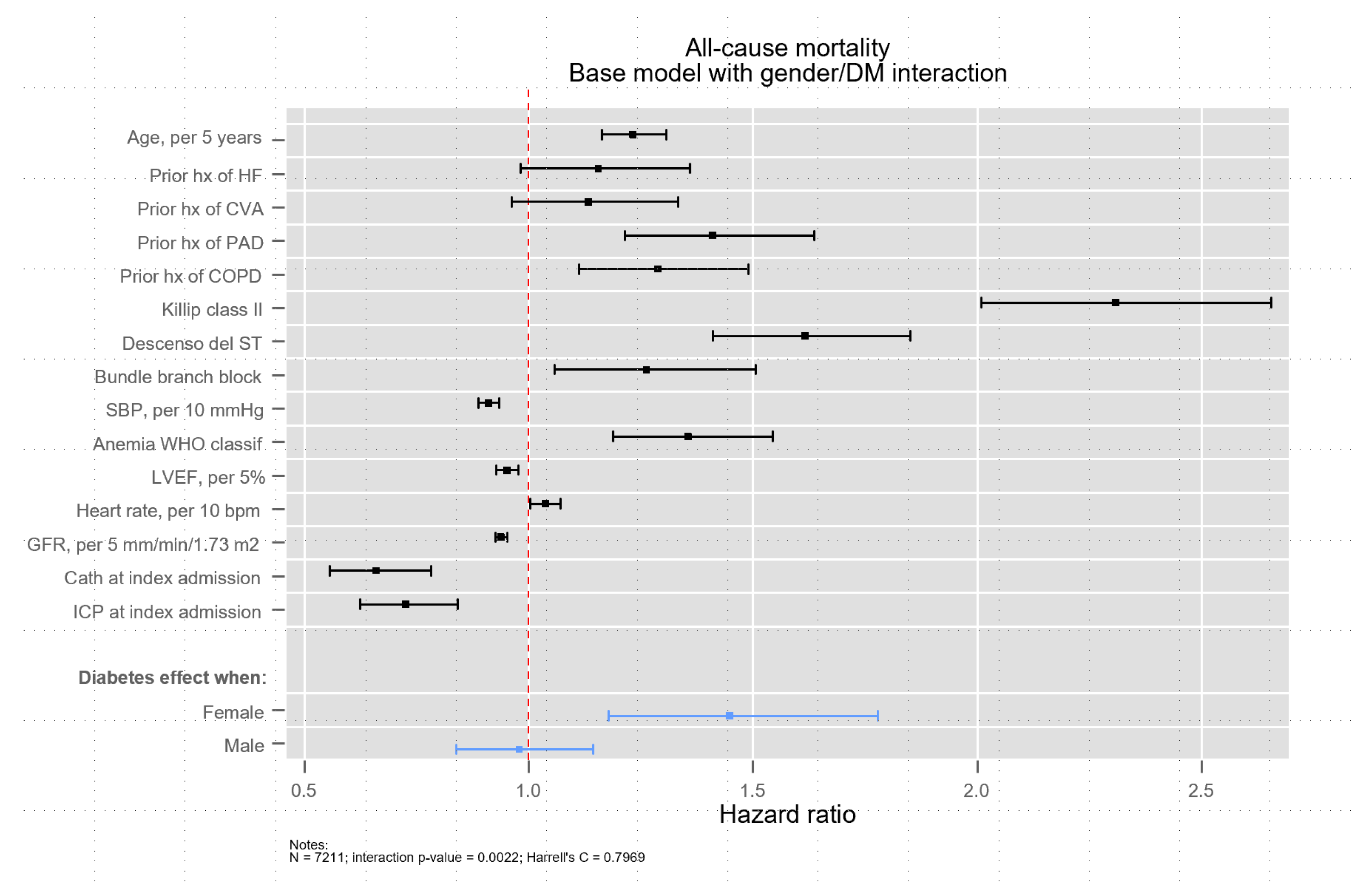

| Total (n = 7211) | Male n = 4443 (61.6%) | Female n = 2768 (38.4%) | p | |
|---|---|---|---|---|
| Baseline characteristics | ||||
| Age (years) | 79.03 ± 5.6 | 78.45 ± 5.43 | 79.95 ± 5.75 | <0.001 |
| Diabetes | 2874 (39.9) | 1774 (39.9) | 1100 (39.7) | 0.863 |
| Hypertension | 5723 (79.4) | 3420 (77) | 2303 (83.1) | <0.001 |
| Dyslipidemia | 4262 (59.1) | 2641 (59.5) | 1621 (58.5) | 0.431 |
| Smoking habit | 621 (8.6%) | 536 (12,1) | 85 (3.1) | <0.001 |
| Prior myocardial infarction | 1682 (23.3) | 1186 (26.7) | 496 (17.9) | <0.001 |
| Prior percutaneous coronary intervention | 1334 (18.5) | 943 (21.2) | 391 (14.1) | <0.001 |
| Prior coronary artery bypass graft | 573 (7.9) | 461 (10.4) | 112 (4) | <0.001 |
| Prior admission for heart failure | 641 (8.9) | 383 (8.6) | 258 (9.3) | 0.328 |
| Admission systolic blood pressure, mmHg | 141 ± 25 | 140 ± 24 | 143 ± 25 | <0.001 |
| Admission heart rate, bpm | 79 ± 19 | 77 ± 18 | 80 ± 18 | <0.001 |
| Admission Killip class ≥ II | 1889 (26.2) | 1118 (25.2) | 771 (27.8) | 0.013 |
| ST segment deviation | 2638 (37) | 1633 (36.8) | 1005 (36.3) | 0.688 |
| Left bundle branch block or permanent pacemaker | 1147 (16) | 774 (17.4) | 373 (13.5) | <0.001 |
| Troponin elevation | 5319 (74) | 3214 (72.4) | 2105 (76) | 0.001 |
| Left ventricular ejection fraction, % | 54 ± 11 | 53.7 ± 11 | 55.7 ± 10 | <0.001 |
| Comorbidities | ||||
| Prior stroke | 831 (11.5) | 524 (11.8) | 307 (11.1) | 0.363 |
| Peripheral arterial disease | 1006 (14) | 791 (17.8) | 215 (7.8) | <0.001 |
| Chronic pulmonary disease | 1161 (16.1) | 885 (19.9) | 276 (10) | <0.001 |
| Hemoglobin on admission, gr/dl | 12.9 ± 1.8 | 13.3 ± 1.9 | 12.6 ± 1.6 | <0.001 |
| Glomerular filtration rate (mL/min) | 66 ± 26 | 69 ± 27 | 61 ± 24 | <0.001 |
| Invasive management | ||||
| Invasive coronary angiography | 6032 (84) | 3844 (86.6) | 2188 (79) | <0.001 |
| Percutaneous coronary intervention | 3867 (53.6) | 2552 (57.5) | 1315 (47.5) | <0.001 |
| Coronary artery bypass graft | 491 (6.8) | 375 (8.4) | 116 (4.2) | <0.001 |
| In-hospital revascularization | 4339 (60.2) | 2914 (65.6) | 1425 (51.4) | <0.001 |
| Treatment at discharge | ||||
| Aspirin | 6194 (90.6) | 3882 (92.2) | 2312 (88.1) | <0.001 |
| Clopidogrel | 4341 (63.5) | 2764 (65.6) | 1577 (60.1) | <0.001 |
| Ticagrelor | 327 (4.8) | 238 (5.7) | 89 (3.4) | <0.001 |
| Prasugrel | 38 (0.6) | 31 (0.7) | 7 (0.3) | 0.011 |
| Statins | 5938 (86.9) | 3709 (88.1) | 2229 (84.9) | <0.001 |
| Variable | Univariate Analysis | Multivariate Analysis (without Interaction) | ||
|---|---|---|---|---|
| Hazard Ratio (95% CI) | p Value | Hazard Ratio (95% CI) | p Value | |
| Age (per year) | 1.07 (1.06–1.09) | <0.001 | 1.04 (1.03–1.05) | 0.0001 |
| Male sex | 1.12 (0.99–1.27) | 0.075 | 1.15 (1.01–1.32) | 0.035 |
| Diabetes mellitus | 1.53 (1.36–1.72) | <0.001 | 1.12 (0.99–1.27) | 0.071 |
| Prior admission for heart failure | 2.86 (2.47–3.32) | <0.001 | 1.16 (0.98–1.36) | 0.068 |
| Prior stroke | 1.67 (1.43–1.96) | <0.001 | 1.13 (0.96–1.34) | 0.121 |
| Peripheral arterial disease | 2.07 (1.80–2.38) | <0.001 | 1.39 (1.20–1.61) | 0.0001 |
| Chronic pulmonary disease | 1.67 (1.46–1.92) | <0.001 | 1.28 (1.11–1.49) | 0.001 |
| Admission Killip class ≥ II | 4.41 (3.91–4.97) | <0.001 | 2.29 (1.99–2.64) | 0.0001 |
| ST segment deviation | 1.95 (1.72–2.19) | <0.001 | 1.61 (1.41–1.85) | 0.0001 |
| Left bundle branch block or permanent pacemaker | 1.33 (1.15–1.55) | <0.001 | 1.26 (1.05–1.51) | 0.01 |
| Left ventricular ejection fraction, % | 0.96 (0.95–0.97) | <0.001 | 0.989 (0.985–0.995) | 0.0001 |
| Admission systolic blood pressure, mmHg | 0.985 (0.982–0.988) | <0.001 | 0.991 (0.988–0.993) | 0.0001 |
| Admission heart rate, bpm | 1.109 (1.017–1.022) | <0.001 | 1.003 (1.0002–1.0066) | 0.034 |
| Anemia on admission | 2.45 (2.17–2.76) | <0.001 | 1.35 (1.19–1.55) | 0.0001 |
| Glomerular filtration rate (mL/min) | 0.976 (0.974–0.979) | <0.001 | 0.987 (0.984–0.990) | 0.0001 |
| Invasive coronary angiography | 0.36 (0.32–0.41) | <0.001 | 0.66 (0.56–0.78) | 0.0001 |
| Percutaneous coronary intervention | 0.52 (0.46–0.59) | <0.001 | 0.73 (0.63–0.84) | 0.0001 |
Publisher’s Note: MDPI stays neutral with regard to jurisdictional claims in published maps and institutional affiliations. |
© 2021 by the authors. Licensee MDPI, Basel, Switzerland. This article is an open access article distributed under the terms and conditions of the Creative Commons Attribution (CC BY) license (https://creativecommons.org/licenses/by/4.0/).
Share and Cite
Díez-Villanueva, P.; García-Acuña, J.M.; Raposeiras-Roubin, S.; Barrabés, J.A.; Cordero, A.; Martínez-Sellés, M.; Bardají, A.; Marín, F.; Ruiz-Nodar, J.M.; Vicente-Ibarra, N.; et al. Prognosis Impact of Diabetes in Elderly Women and Men with Non-ST Elevation Acute Coronary Syndrome. J. Clin. Med. 2021, 10, 4403. https://doi.org/10.3390/jcm10194403
Díez-Villanueva P, García-Acuña JM, Raposeiras-Roubin S, Barrabés JA, Cordero A, Martínez-Sellés M, Bardají A, Marín F, Ruiz-Nodar JM, Vicente-Ibarra N, et al. Prognosis Impact of Diabetes in Elderly Women and Men with Non-ST Elevation Acute Coronary Syndrome. Journal of Clinical Medicine. 2021; 10(19):4403. https://doi.org/10.3390/jcm10194403
Chicago/Turabian StyleDíez-Villanueva, Pablo, Jose María García-Acuña, Sergio Raposeiras-Roubin, Jose A. Barrabés, Alberto Cordero, Manuel Martínez-Sellés, Alfredo Bardají, Francisco Marín, Juan M. Ruiz-Nodar, Nuria Vicente-Ibarra, and et al. 2021. "Prognosis Impact of Diabetes in Elderly Women and Men with Non-ST Elevation Acute Coronary Syndrome" Journal of Clinical Medicine 10, no. 19: 4403. https://doi.org/10.3390/jcm10194403
APA StyleDíez-Villanueva, P., García-Acuña, J. M., Raposeiras-Roubin, S., Barrabés, J. A., Cordero, A., Martínez-Sellés, M., Bardají, A., Marín, F., Ruiz-Nodar, J. M., Vicente-Ibarra, N., Alonso Salinas, G. L., Cid-Alvárez, B., Abu Assi, E., Formiga, F., Núñez, J., Núñez, E., Ariza-Solé, A., & Sanchis, J. (2021). Prognosis Impact of Diabetes in Elderly Women and Men with Non-ST Elevation Acute Coronary Syndrome. Journal of Clinical Medicine, 10(19), 4403. https://doi.org/10.3390/jcm10194403

