1. Introduction
Hydrogen peroxide (H
2O
2) is a versatile chemical with broad applications in chemical synthesis [
1], pulp and paper bleaching [
2], wastewater treatment [
3,
4], and, most notably, semiconductor manufacturing [
5,
6]. In the semiconductor industry, electronic-grade H
2O
2 is extensively employed for silicon wafer cleaning and etching, where ultrahigh purity is required to prevent contamination that can compromise device yield [
7,
8]. Global H
2O
2 production exceeds 5.5 million tons annually and is dominated by the anthraquinone autoxidation process [
9,
10]. The anthraquinone oxidation (AO) process is a mature cyclic liquid-phase route used for large-scale H
2O
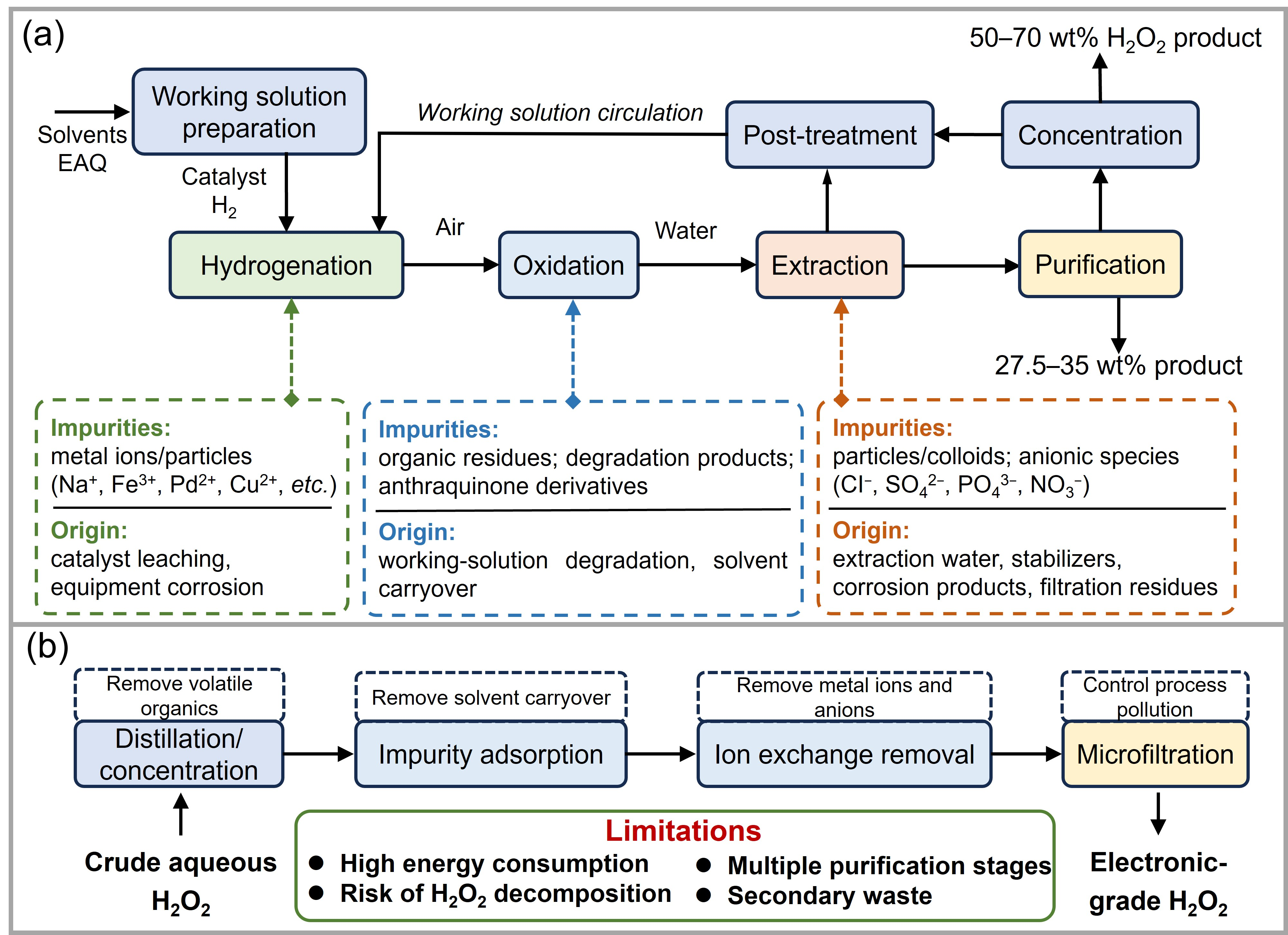
2 production. However, various impurities may be introduced into the product during hydrogenation, oxidation, extraction, and downstream processing (
Figure 1a). Trace metal ions, including Fe
3+, Na
+, Pd
2+, and Cu
2+, may originate from catalyst carryover or corrosion of reactors and pipelines. Anionic impurities, including phosphates, sulfates, nitrates, chlorides, and other oxygen-containing anions, can be introduced from stabilizers, pH regulators, extraction water, or auxiliary chemicals. In addition, residual organic impurities such as anthraquinone derivatives, solvent residues, and degradation products of the working solution may remain after phase separation and extraction. Particulate impurities and colloids may also originate from catalyst residues, filter aids, corrosion products, or suspended degradation products. These impurities prevent industrial-grade H
2O
2 from satisfying the stringent requirements of electronic-grade applications. Additional downstream is therefore required after conventional production and concentration [
11,
12]. For instance, industrial-grade 30–35 wt% H
2O
2 may contain metal ion impurities at parts-per-million (ppm) levels [
13], whereas electronic-grade H
2O
2 requires these contaminants to be reduced to parts-per-billion (ppb) or even parts-per-trillion (ppt) levels [
14,
15]. The Semiconductor Equipment and Materials International (SEMI) C30-1110 standard classifies H
2O
2 into five quality grades, as summarized in
Table 1 [
16]. Among them, the most stringent Grade 5 specification requires total metal cation concentrations below 10 ppt in a 30 wt% H
2O
2 solution. This purity requirement is far more stringent than that of conventional industrial-grade H
2O
2. Post-production purification to ultrahigh-purity levels is therefore indispensable.
Table 1.
SEMI C30-1110 electronic-grade H2O2 specifications.
Table 1.
SEMI C30-1110 electronic-grade H2O2 specifications.
| Grade (30% H2O2) | Max Anionic Impurity | Max Cationic Impurity |
|---|
| Grade 1 | <2 ppm | <10 ppb |
| Grade 2 | <0.2 ppm (200 ppb) | <5 ppb |
| Grade 3 | <0.2 ppm (200 ppb) | <1 ppb |
| Grade 4 | <30 ppb | <100 ppt |
| Grade 5 | <30 ppb | <10 ppt |
Electronic-grade H
2O
2 is commonly produced through a multistep process involving vacuum distillation or rectification, adsorption, ion exchange, and final filtration (
Figure 1b) [
17,
18,
19]. In a representative process, crude H
2O
2 solution is first subjected to vacuum distillation or rectification for bulk concentration and the removal of volatile or organic impurities. Vacuum operation lowers the boiling temperature and reduces thermal stress on H
2O
2, making it suitable for bulk concentration and volatile-impurity removal. The partially purified H
2O
2 is then treated by advanced ion-exchange processes, usually involving successive cation- and anion-exchange steps, to remove trace metallic and anionic impurities. Depending on product specifications, additional microfiltration steps may also be included to obtain high-purity or electronic-grade H
2O
2 [
20,
21]. Although such integrated processes can deliver high-purity products, they still have several limitations. Vacuum distillation/rectification is suitable for bulk concentration and volatile-impurity removal, but highly purified H
2O
2 production requires strict control of temperature, residence time, construction materials, and trace catalytic impurities to avoid decomposition under unfavorable thermal or catalytic conditions [
21,
22]. Ion-exchange resins can efficiently remove selected ionic species, with reported removal efficiencies exceeding 98% [
23]; however, simultaneous deep removal of cationic and anionic contaminants usually requires multiple resin beds, careful pretreatment, and additional conversion or washing steps, which may introduce secondary contamination [
19]. Resin degradation, particle shedding, possible organic leaching, and acidic or alkaline regeneration waste are also important concerns for ultrapure H
2O
2 production [
24]. Common adsorbents, such as stannic oxide [
25], zirconium phosphate [
26], alumina [
27], and activated carbon [
28], typically exhibit selectivity for a limited range of impurities, and their removal efficiency is often insufficient to meet increasingly stringent electronic-grade specifications. These limitations highlight the need for milder, more efficient, and inherently safer purification technologies that can meet the growing demand for ultrapure H
2O
2.
Membrane separation technology has attracted increasing attention as a complementary approach for H
2O
2 purification and concentration [
29,
30,
31]. For example, pressure-driven membrane processes such as nanofiltration (NF), ultrafiltration (UF), and reverse osmosis (RO) can be operated without chemical regenerants or precipitants, thereby minimizing secondary contamination and regenerant waste relative to conventional resin-based processes [
32,
33]. A previous modeling study estimated that an integrated countercurrent RO cascade could generate a profit of USD 76.6 million at a target production capacity of 9000 tons/year of electronic-grade H
2O
2 [
34]. Furthermore, the modular configuration of these systems facilitates incremental installation or parallel scale-up within existing purification lines. However, these potential benefits must be weighed against inherent membrane-specific challenges, including high operating pressures, membrane oxidative degradation, H
2O
2 loss via catalytic decomposition, module-material compatibility, stringent pretreatment requirements, and prohibitive membrane replacement costs. Typical membrane processes include microfiltration (MF), UF, NF, RO, pervaporation (PV), and membrane distillation (MD). However, it should be noted that different modalities target distinct impurity categories and are therefore not directly interchangeable. UF or MF can be implemented as front-end clarification steps to remove catalyst fines, colloids, suspended solids, and resin fragments [
35]. Subsequently, NF can reduce multivalent metal ions and larger organic residues, thereby mitigating the impurity and fouling loads on downstream units [
36]. RO is highly effective for deep removal of dissolved ionic species [
37], including trace metal cations and anionic pollutants, owing to its dense selective layer that operates via solution–diffusion and electrostatic-exclusion mechanisms, while allowing water and H
2O
2 to permeate. In contrast, PV and MD mainly contribute to H
2O
2 enrichment via preferential water removal through vapor-phase or sorption–diffusion transport [
38,
39]. Therefore, a single membrane process is unlikely to simultaneously meet both the purity and concentration requirements mandated for electronic-grade H
2O
2 production.
Accordingly, membrane technology should be conceptualized primarily as a complementary unit in hybrid purification systems rather than as a mere substitute for conventional vacuum distillation/rectification or ion exchange. The primary impetus for integrating membrane separation is not to replace these mature industrial operations, but to explore whether membrane units can mitigate impurity loads, diminish downstream resin consumption, enhance process flexibility, or afford milder polishing stages within existing purification trains. A viable industrial framework could combine the high-throughput concentration capability of vacuum distillation/rectification with the selective impurity-removal capability of membrane processes. The execution of this strategy hinges upon sufficient membrane oxidative stability, module compatibility, minimal H
2O
2 loss, and long-term operational safety. The application use of membrane technology for H
2O
2 purification dates back to patents from the 1980s [
40]. However, concerns regarding the chemical compatibility of membrane materials with this strong oxidant profoundly restricted the volume of peer-reviewed studies for several decades. Over the past 15 years, intensifying research efforts in H
2O
2 membrane purification have substantially deepened the understanding of process feasibility, attainable purity, and long-term membrane durability [
41,
42]. Regrettably, the preponderance of published literature remains confined to short-term laboratory tests, simplified feed solutions, or individual membrane processes. Critical issues such as long-term oxidative aging, module-scale safety, impurity accumulation, and compatibility with industrial H
2O
2 production lines have not yet been systematically evaluated.
This review systematically examines recent progress in membrane-based H
2O
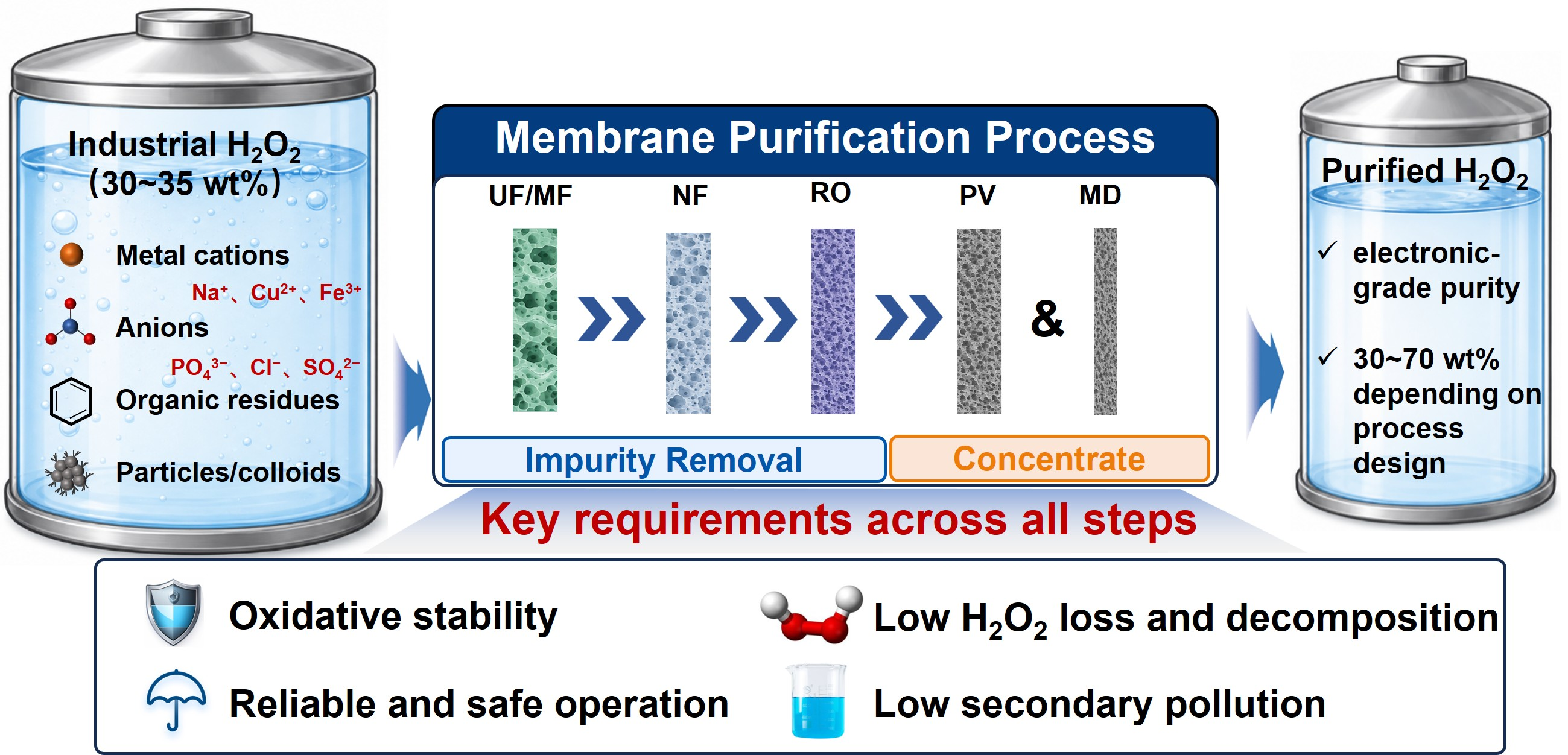
2 purification and concentration processes. As illustrated in
Figure 2, pressure-driven membrane processes, including RO, NF, and UF/MF, are discussed with an emphasis on their roles in removing trace ions, multivalent contaminants, particles, and colloids. Furthermore, phase-change or vapor-transport membrane processes, such as PV and MD, are evaluated for their potential in water removal and H
2O
2 enrichment. Recent innovations in membrane materials and modification strategies are also explored, encompassing oxidation-resistant polymeric membranes, inorganic membranes, metal–organic framework (MOF)-based hybrid membranes, and two-dimensional (2D) nanomaterial membranes. Moreover, key challenges associated with industrial implementation are critically addressed, including membrane lifetime, the mitigation of oxidative degradation, process integration, and underlying economic and safety considerations. Unlike previous reviews that primarily focus on H
2O
2 production or general membrane separation, this review specifically evaluates membrane-based purification and concentration strategies for electronic-grade H
2O
2, with a dedicated emphasis on oxidative stability, impurity control, and industrial scalability. This article is a narrative review informed by a structured literature search. Bibliographic databases (e.g., Web of Science and Scopus) and Google Scholar were systematically searched, together with relevant publisher platforms. Patent databases were queried separately. The final literature search was concluded on 9 April 2026. The search covered publications from approximately 1980 to 2026, with particular emphasis on the past 15 years. The main search terms included “hydrogen peroxide purification”, “electronic-grade hydrogen peroxide”, “reverse osmosis”, “nanofiltration”, “ultrafiltration”, “pervaporation”, “membrane distillation”, and “oxidation-resistant membranes”. Articles were selected based on relevance to membrane-based separation processes for hydrogen peroxide purification, methodological quality, and publication recency. Duplicates, irrelevant studies, and articles without accessible full texts were excluded. Peer-reviewed studies were utilized as the primary basis for assessing membrane mechanisms, performance, and stability, whereas patents were treated as supplementary evidence for industrial integration and process design. In total, approximately 180 peer-reviewed publications, 5 academic books and 15 patent documents were considered during manuscript preparation, of which 105 peer-reviewed articles, 3 academic books and 7 patent documents were finally included or discussed in the review.
2. Membrane Separation Processes for H2O2 Purification
Membrane separation processes for H
2O
2 purification and concentration can be better understood when evaluated according to their functional sequence rather than as isolated technologies [
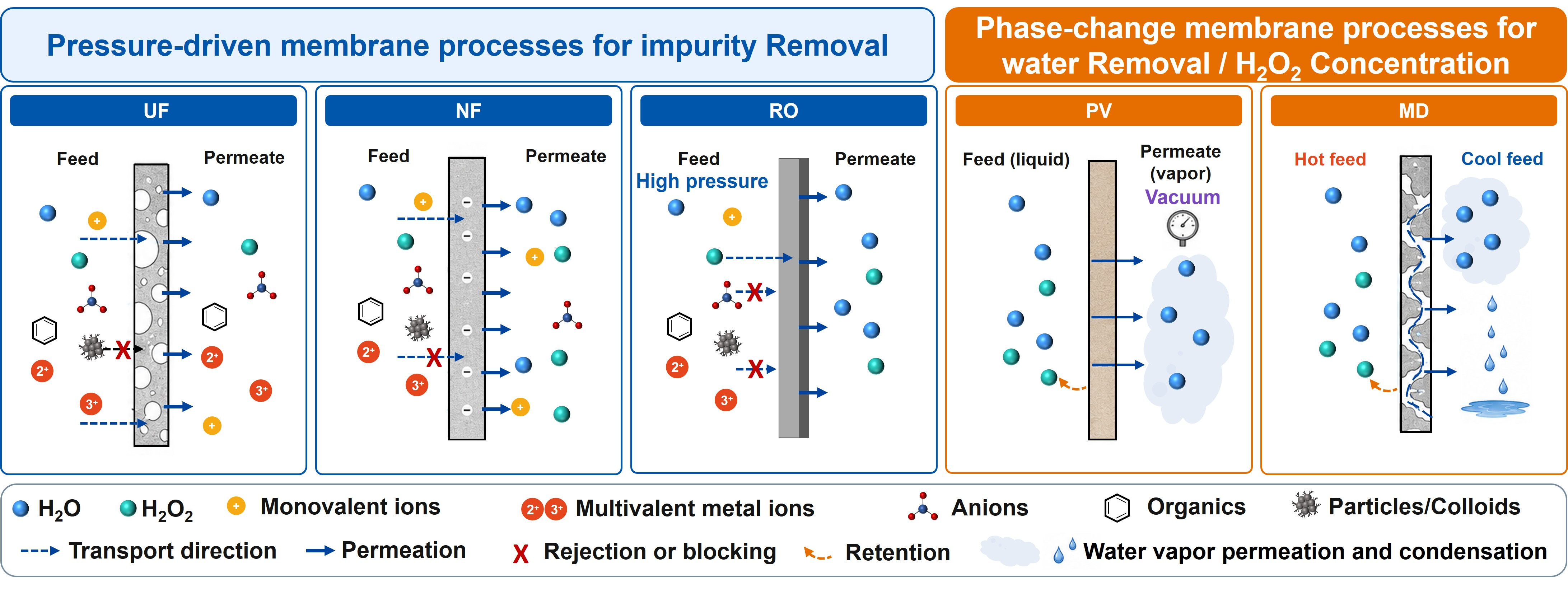
38]. As illustrated in
Figure 3, UF and MF feature relatively large pores and can therefore serve as front-end clarification steps to remove suspended particles, catalyst fines, colloids, resin fragments, and other particulate impurities from crude H
2O
2 streams [
35]. NF may then be employed as an intermediate impurity-load-reduction process because its relatively loose selective layer can reject multivalent metal ions, charged organic residues, and larger solutes, while allowing most water and H
2O
2 to permeate [
36]. RO, characterized by a dense selective layer and sub-nanometer free-volume elements, provides a tighter separation barrier and is therefore more suitable for the rigorous removal of trace dissolved ionic impurities, including metal cations and anionic species, while largely preserving the H
2O
2 concentration in the permeate [
37]. Following rigorous impurity removal, PV and MD can be implemented for water removal and H
2O
2 enrichment. These two processes differ from pressure-driven membranes in that separation is driven by sorption–diffusion coupled with vaporization or by a vapor-pressure gradient across a hydrophobic porous membrane [
38,
39]. Therefore, the sequence UF/MF → NF → RO → PV/MD reflects a staged purification and concentration paradigm, in which each membrane process addresses a distinct separation target. The representative pore-size range, driving force, operating pressure, separation capacity, suitable process position, and available quantitative performance of these membrane technologies are summarized in
Table 2. Because the reported studies differ substantially in feed H
2O
2 concentration, impurity species, membrane configuration, operating mode, analytical method, and testing duration,
Table 2 is not intended to provide a direct head-to-head performance ranking. Instead, it benchmarks the available information where reported and explicitly distinguishes direct membrane-performance data from integrated-process results, patent disclosures, modeling studies, oxidative-stability tests, and proof-of-concept demonstrations. For integrated purification processes, the final impurity level or claimed SEMI grade is interpreted as the combined effect of multiple unit operations and is not attributed solely to a single membrane step unless the original source provides single-unit performance data. In this section, we therefore discuss the separation mechanisms of the main membrane processes that have been applied or investigated for H
2O
2 purification, while also identifying the evidence limits associated with each process.
As summarized in
Table 2, the available evidence indicates that the maturity and validation level of different membrane processes vary considerably. MF and UF are mainly supported as clarification or guard-filtration steps, but they do not provide direct removal of dissolved ionic impurities. NF can reduce multivalent ions, larger charged species, and organic residues. However, convincing ppb- or ppt-level monovalent-ion removal under realistic 30–35 wt% H
2O
2 conditions has not yet been demonstrated. Among the reviewed processes, RO currently has the most direct quantitative evidence for metal-ion reduction in concentrated H
2O
2. For example, commercial RO membranes have been tested in 35 wt% H
2O
2, where Na
+ and Al
3+ concentrations were reduced from 20895 and 1067 μg/L to 1565 and 87 μg/L, respectively [
43]. However, such performance mainly supports lower electronic-grade purification and does not prove suitability for SEMI Grade 4 or Grade 5. Therefore, the reported RO performance should be interpreted as evidence of effective impurity reduction rather than as validation of the highest electronic-grade specifications. Regarding NF, existing studies mainly demonstrate oxidative stability and the partial rejection of multivalent ions and larger solutes; however, convincing ppb- or ppt-level monovalent-ion removal under realistic 30–35 wt% H
2O
2 conditions has not yet been unequivocally demonstrated. In the context of PV, the reported BN–GO membrane achieved a marginal H
2O
2 concentration increase merely from 0.25 wt% to 0.72 wt%, which should be regarded as proof-of-concept evidence rather than industrially relevant concentration performance [
44]. Similarly, while MD has shown potential for concentrating high-concentration H
2O
2 streams, electronic-grade impurity-control data remain distinctly limited. Consequently, the current body of evidence supports a staged membrane-assisted purification concept, while also indicating that only RO currently possesses relatively direct evidence for efficacious ionic impurity polishing within concentrated H
2O
2 environments.
Table 2.
Benchmark comparison of representative membrane processes for H2O2 purification and concentration.
Table 2.
Benchmark comparison of representative membrane processes for H2O2 purification and concentration.
| Membrane Process | Representative pore Size/Operating Pressure or Driving Force | Representative Membrane | Feed H2O2 Concentration/Feed Type | Target Impurity | Removal Efficiency or Concentration Factor | Membrane Stability and H2O2 Loss | Demonstrated SEMI Grade | Suitable role in an Integrated H2O2 Purification Train | Ref. |
|---|
| MF | ~0.1–10 μm/<2 bar | PVDF, PTFE, or other fluoropolymer microporous filters; | Industrial, crude, or pretreated H2O2 streams; commonly 30-35 wt% H2O2 | Suspended particles, catalyst fines, resin fragments, colloids, dust particles, and filtration residues | N.R. | N.R. | Not demonstrated for MF alone | Clarification before NF, RO, ion exchange, or final ultrapure filtration | [18,35,39,45] |
| UF | ~0.01–0.1 μm/1–5 bar | Polymeric UF membranes | Crude or pretreated H2O2 streams; exact feed concentration often not specified ed ions | Colloids, macromolecules, resin fragments, fine particles, and suspended degradation products | N.R. | N.R. | Not demonstrated | Pretreatment or guard membrane to protect downstream NF/RO membranes from particle fouling | [35,39,46,47,48,49,50] |
| UF combined with macroligands or chelating agents | Commonly around 30-35 wt% | Approximately 90.2% for Fe2+, 89.5% for Al3+, and 99.5% for Sn2+ in representative examples | H2O2 loss is N.R.; added ligands may introduce secondary contamination and require downstream removal | Not demonstrated as a complete SEMI Grade 4/5 process | [51] |
| SiO2-ZrO2 ceramic membranes and BTESE-derived organosilica membranes | 0.3 wt% and 30 wt% H2O2 exposure | High model-solute rejection retained after oxidative exposure; direct trace impurity removal in electronic-grade H2O2 was not demonstrated | Stable after exposure to 0.3wt% H2O2 for 450 h and 30wt% H2O2 for 120 h | Not demonstrated | [52] |
| NF | ~0.5–2 nm/5–20 bar | Commercial PES-based NF membranes | 1 wt% and 5 wt% H2O2 exposure | Multivalent ions, larger charged species, organic residues, and oxidative-stability evaluation | N.R. for ppb/ppt-level monovalent ion removal in concentrated H2O2 | Exposure to 5wt% H2O2 for 5 days | Not demonstrated | Intermediate impurity-load-reduction step before RO or ion exchange | [36,53,54,55,56,57,58,59,60] |
| modified PES/TiO2 NF membranes | Exposure to 5wt% H2O2 for 10 days | Not demonstrated | [56] |
| RO | <1 nm/20–60 bar | Commercial PA and CA RO membranes | 35 wt% H2O2 | Dissolved ionic impurities, especially metal cations such as Na+ and Al3+ | Approximately 92.5% removal for Na+ and 91.8% removal for Al3+ | Approximately 64 h | SEMI Grade 2/3, not demonstrated for SEMI Grade 4/5 | Final or near-final ionic polishing step, often combined with ion exchange or ultrapure filtration | [40,43,61,62,63,64,65,66] |
| Two-stage or multistage RO networks | Modeled H2O2 purification systems | Model-predicted improvement; no direct experimental removal value | 70 h,
require experimental verification | SEMI Grade 4/5,
require experimental verification | [34,67] |
| PV | no continuous pores/ vacuum, moderate temperature | BN-GO hybrid pervaporation membrane | Dilute H2O2 feed, approximately 0.25 wt% | Water removal for H2O2 enrichment | Approximately 2.9-fold H2O2 enrichment, from 0.25 wt% to 0.72 wt% | 168 h in dilute H2O2; H2O2 loss, swelling resistance, and performance in industrial 30-70 wt% H2O2 remain unverified | N.A.; impurity removal and SEMI grade not demonstrated | Potential mild concentration step after impurity removal | [44,68,69,70,71] |
| MD | ~0.1–1 μm/ near-atmospheric hydraulic pressure | Hydrophobic microporous membrane | 69.6 wt% H2O2 | Water vapor removal for H2O2 concentration | Concentration from 69.6% to 85.4%; yield approximately 80% | Requires strict control of membrane wetting, thermal conditions, material compatibility | N.A.; impurity removal and SEMI grade not demonstrated | Alternative or complementary concentration step for high-concentration H2O2, requiring strict wetting and safety control | [52,68,72,73,74,75,76] |
2.1. Ultrafiltration
UF membranes possess relatively large pores of approximately 0.01–0.1 µm and primarily reject colloids, particulate matter, and high-molecular-weight species [
46,
47]; however, they allow dissolved salts and low-molecular-weight species to pass through almost unhindered [
48,
49,
77]. Consequently, UF is not suitable as a primary purification technology for producing electronic-grade H
2O
2, which necessitates the rigorous removal of dissolved ionic impurities is required. Nevertheless, UF can fulfill an important auxiliary role within the H
2O
2 purification system. In the industrial anthraquinone process, the crude product may contain fine particles, filtration aids, catalyst residues, or degradation products. UF, or even microfiltration, can be introduced as a front-end clarification step to remove these suspended impurities prior to higher-selectivity membrane processes [
50], thereby protecting downstream NF or RO membranes from particle contamination and improving overall operational stability.
Another potential application of UF in H
2O
2 purification involves its integration with chelating agents [
78]. In this approach, chelating agents bind trace metal ions to form larger complexes, which can then be rejected more effectively by UF [
79]. For instance, Pb
2+ or Cu
2+ could, in principle, be converted into larger complexed species that are more readily rejected by UF [
80]. Although chelation-assisted UF may improve apparent metal rejection, this strategy is difficult to reconcile with ultrapure H
2O
2 production, as any added ligand introduces a new contamination source and necessitates additional downstream removal. Consequently, for electronic-grade applications, additive-free purification routes are highly preferred.
In summary, UF mainly serves as an auxiliary or pretreatment step in H2O2 purification rather than as a final polishing technology. Its principal function is to remove suspended solids, colloids, and other particulate contaminants, thereby protecting downstream NF or RO membranes from fouling. Owing to its low operating pressure and compatibility with high-surface-area hollow-fiber configurations, UF can be conveniently implemented as a front-end barrier within integrated membrane processes. However, to meet stringent final specifications for dissolved ionic contaminants, UF must invariably be followed by a tighter membrane process.
2.2. Nanofiltration
NF membranes typically feature pore sizes on the order of approximately 1 nm, slightly larger than those of RO membranes, and generally exhibit charge-based selectivity [
46]. NF is therefore often regarded as an intermediate process between UF and RO, or as a “loose RO” process. These membranes retain multivalent ions and larger organic molecules while allowing most monovalent ions and solvent molecules to permeate [
53], making them attractive for partial desalting or pretreatment applications. However, in the context of H
2O
2 purification, NF is generally insufficient to reduce all ionic impurities to ppt levels, particularly monovalent ions such as Na
+. Nevertheless, it can serve as an effective pre-purification step or be integrated with RO in a hybrid process [
54]. For example, NF could remove multivalent metal contaminants (e.g., Pb
2+, Fe
3+, and other transition metals) and larger organic residues from an H
2O
2 solution, thereby reducing the impurity burden and fouling potential of a downstream RO unit [
55]. Since most water and H
2O
2 can permeate through NF membranes, the retained impurities are concentrated in a smaller retentate stream, which can subsequently be further treated, recycled, or managed as waste. Therefore, NF should be regarded primarily as a load-reduction and pretreatment process rather than a final purification step. Its relatively loose selective layer and limited monovalent-ion rejection make it unsuitable as a stand-alone technology for producing high-grade electronic H
2O
2. Studies on NF-based H
2O
2 purification have provided experimental support for these concepts. For example, the study by Tsehaye et al. showed that commercial PES-based NF (PES 10 and NP030) still exhibited good filtration characteristics after soaking in 1 wt% H
2O
2 for 20 days [
56].
NF has also been investigated for treating H
2O
2-containing waste streams, such as spent semiconductor cleaning baths, with the aim of recovering both H
2O
2 and water [
57]. In such cases, NF membranes can retain heavy metal ions and organic contaminants in the concentrate stream while allowing H
2O
2 and water to permeate, thereby enabling the partial recovery and reuse of the oxidant. Optimized NF membranes have demonstrated the effective removal of multivalent metal ions from dilute H
2O
2-containing waste streams, highlighting the value of NF for bulk impurity reduction and resource recovery [
81]. However, NF has intrinsic limitations for producing electronic-grade H
2O
2. Given that conventional NF membranes generally exhibit limited rejection of monovalent ions, such as Na
+, as well as very small neutral molecules, single-stage NF is unlikely to meet the most stringent electronic-grade specifications by itself [
30,
58]. Therefore, NF is more appropriately positioned as a pretreatment or intermediate purification step prior to RO. By removing a portion of divalent ions and larger particles, NF reduces the impurity load and fouling potential of downstream RO membranes, thereby improving the robustness and efficiency of the overall membrane process.
The application of NF in H
2O
2 purification must also account for the highly oxidative nature of H
2O
2. Common NF membrane materials, including aromatic polyamides and PES, may undergo oxidative degradation during prolonged exposure to H
2O
2 [
59]. Research by Tsehaye et al. indicates that unmodified commercial NF membranes exhibited rapid performance deterioration after immersion in a 5 wt% H
2O
2 solution, whereas a modified PES/TiO
2 membrane remained stable for more than 20 days [
56]. These findings indicate that membrane material design and modification are essential for improving NF durability in oxidative environments, and they will be further discussed in the section on material improvements. Nevertheless, the use of catalytically active inorganic additives requires careful assessment, because improved membrane stability may be accompanied by partial H
2O
2 decomposition. In summary, while NF is a valuable component in the H
2O
2 purification process and can be used for partial purification, it alone is generally insufficient for reducing monovalent ions to the ppb or ppt level required for high-grade electronic applications [
60]. Owing to its relatively high flux and low operating pressure, NF is best suited for integration into hybrid membrane processes, especially as an auxiliary or pretreatment step before RO, where it can help balance system load, mitigate fouling, and enhance overall process efficiency. To date, modified NF membranes have not yet provided convincing evidence for deep monovalent-ion removal under realistic H
2O
2 purification conditions. Reported NF modifications mainly improve oxidative stability or multivalent-ion rejection, but they have not clearly demonstrated the reduction of Na
+, Cl
−, NO
3−, or other monovalent ionic impurities to ppb- or ppt- levels in concentrated 30–35 wt% H
2O
2 streams. Therefore, NF should fundamentally be regarded as a pretreatment or load-reduction unit rather than a final polishing process for electronic-grade H
2O
2.
2.3. Reverse Osmosis
RO represents one of the most pivotal membrane processes for the ultrapurification of H
2O
2 owing to its capacity to reject dissolved ionic impurities while allowing water and H
2O
2 to permeate through the membrane [
61,
62]. Unlike porous membranes, RO membranes rely predominantly on a dense selective layer, wherein separation is governed by solution–diffusion, electrostatic exclusion, and ion hydration effects rather than simple size exclusion [
82,
83]. In H
2O
2 purification, this mechanism is particularly critical because H
2O
2 exhibits a molecular size and transport behavior comparable to those of water, whereas hydrated metal ions and anionic species are much more robustly rejected [
43]. Therefore, RO can in principle mitigate trace cationic and anionic impurities without substantially inducing the dilution or concentration of H
2O
2 product. In addition, RO does not require the addition of chemical regenerants or precipitants, thereby minimizing the risk of secondary contamination. In principle, the impurity-rich concentrate stream can also be recycled or redirected to applications with lower purity requirements, thereby facilitating the minimization of waste emissions. Early experimental studies have validated the effectiveness of RO in eliminating metallic contaminants from H
2O
2 solutions. For a systematic overview, the documented RO studies and processes can be classified into three distinct categories.
The first category encompasses commercial RO membrane screening studies, wherein polyamide, cellulose acetate, or related dense composite membranes are evaluated for H
2O
2 transmission and metal-ion rejection. For instance, Abejón et al. investigated the impurity separation characteristics of six different commercial RO membranes in a 35 wt% H
2O
2 solution and identified that the BE membrane manufactured by Woongjin Chemical was the most suitable candidate for H
2O
2 ultrapurification [
43]. Specifically, the concentrations of
of Na
+ and Al
3+ concentrations decreased from 20895 and 1067 μg/L to 1565 and 87 μg/L, respectively. These studies provide direct experimental evidence supporting the feasibility of RO-based H
2O
2 ultrapurification.
The second category comprises multistage or cascade RO process designs, which employ mathematical modeling and system optimization to explore how single-stage limitations can be overcome via advanced process configuration. Although RO is capable of purifying H
2O
2, the reported performance was primarily associated with lower semiconductor-grade specifications, and the ability of a single RO stage to achieve the ppt-level impurity limits required for the highest electronic grades has yet to be demonstrated. To address this gap, several studies developed mathematical models and process-optimization strategies for multistage RO purification. Countercurrent cascade configurations were proposed to improve impurity removal while maintaining high H
2O
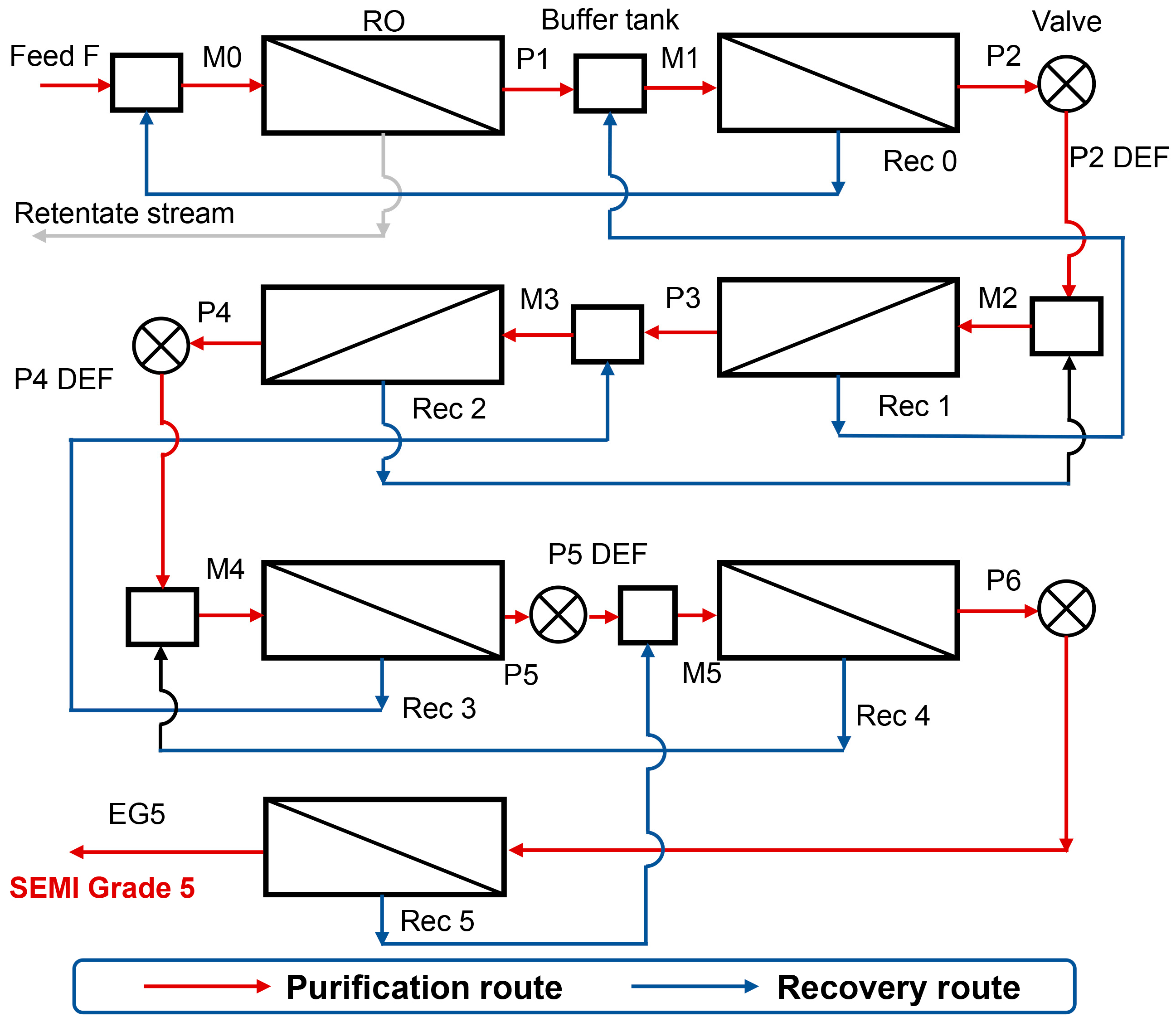
2 recovery. Modeling results suggested that relatively low electronic-grade specifications may be attainable using a limited number of RO stages, whereas achieving the highest purity grade may require up to seven RO stages, in tandem with larger membrane areas and more complex cycling configurations (
Figure 4) [
67]. Other studies optimized RO networks containing membrane modules, mixers, splitters, and recycle streams to minimize membrane area or operating costs and to enable the simultaneous production of H
2O
2 streams with different purity levels [
34]. While these studies are valuable for process design, they should be interpreted as computational assessments based on experimentally fitted transport parameters rather than as direct demonstrations of semiconductor-grade product quality.
The third category encompasses research on membrane lifetime and oxidation stability. The application of RO in H
2O
2 purification is strongly constrained by the oxidative stability of polymeric membranes, particularly polyamide selective layers [
84]. Ling et al. reported that the oxidative degradation of polyamide selective layers occurs rapidly under conditions of high H
2O
2 concentrations, prolonged exposure, elevated temperatures, or the presence of transition metal impurities that promote free radical formation [
63]. For prolonged RO operation in percent-level H
2O
2 solutions, protective measures or more oxidation-resistant membrane materials are imperative. Strategies such as surface coating, antioxidant incorporation, selective layer modification, and cascade operation optimization may help prolong the lifespan of the membrane [
64]. Furthermore, Lin et al. utilized a GO-modified polyamide selective layer, which demonstrated improved oxidative stability [
85].
The key performance characteristics of representative RO systems for H
2O
2 purification are summarized in
Table 3. Because detailed peer-reviewed studies directly targeting semiconductor-grade H
2O
2 remain limited, patent-disclosed industrial processes are also discussed as supplementary evidence for practical process integration, whereas general RO theory or modeling references are used exclusively to support mechanistic interpretation. Overall, RO is most effective as a deep ion removal unit, especially for the elimination of metal cations and anionic contaminants from pretreated H
2O
2 streams. However, its industrial application still depends on resolving several technical challenges, including the long-term oxidative stability of the selective layer, reliable operation in percent-level H
2O
2, the control of metal release from modules and auxiliary components, validation at ppt-level impurity specifications, and integration with final UF or other polishing units.
2.4. Pervaporation (PV) and Membrane Distillation (MD)
RO, NF, and UF are primarily employed for impurity removal and generally do not substantially alter the H
2O
2 concentration. In contrast, membrane processes such as PV and MD can concentrate H
2O
2 by selectively removing water from the solution. Conventionally, H
2O
2 has been concentrated from approximately 30 to 70 wt% via distillation. However, this thermal process is energy-intensive and requires stringent safety control [
89]. In this context, PV and MD have attracted increasing interest as membrane-based concentration technologies, as they enable water/H
2O
2 separation under relatively mild operating conditions [
68,
72].
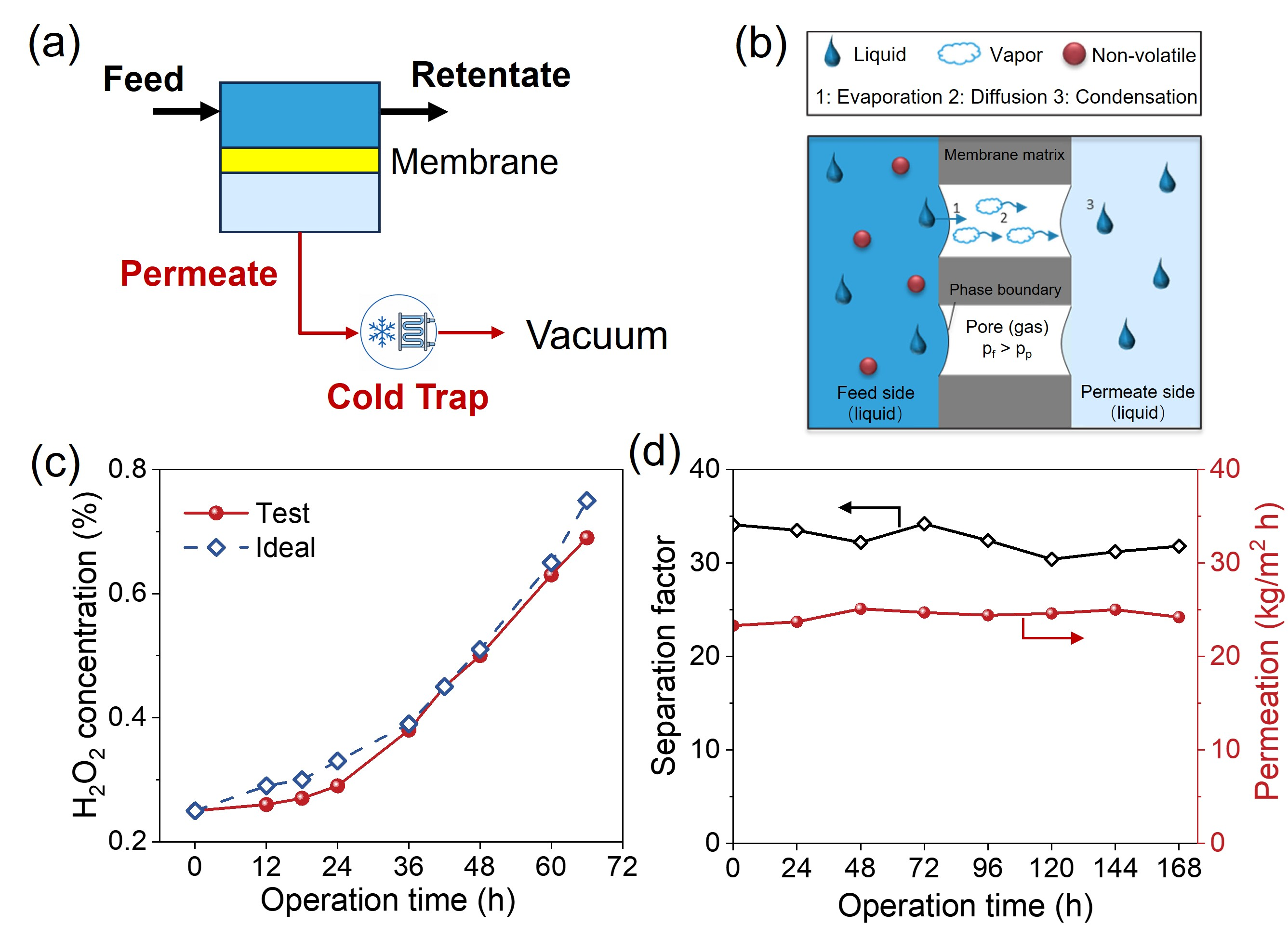
PV is a membrane separation process in which a liquid feed is brought into contact with one side of a dense selective membrane, while the permeate side is maintained under vacuum or swept with an inert gas to continuously remove the permeating vapor (
Figure 5a) [
90,
91]. Separation is governed by the preferential sorption and diffusion of specific components through the membrane, followed by evaporation on the permeate side. PV has been investigated as a means to enrich H
2O
2 by preferentially allowing water to permeate and evaporate through the membrane [
92,
93]. Operation at moderate temperatures (often 40–60 °C), combined with reduced pressure on the permeate side, can promote water removal while mitigating the thermal decomposition of H
2O
2.
Recently, graphene oxide (GO)-based membranes have shown promising performance for the PV concentration of H
2O
2 [
62]. GO laminates contain 2D nanochannels that can facilitate rapid water transport while restricting H
2O
2 permeation, thereby enabling effective H
2O/H
2O
2 separation [
69]. Wang et al. constructed a hybrid PV membrane based on biomimetic principles by co-assembling rigid hexagonal boron nitride (BN) nanosheets with flexible GO nanosheets [
44]. The resulting BN–GO membrane exhibited high water selectivity and robust stability in H
2O
2 solutions. In a 72 h test, the membrane concentrated a 0.25 wt% H
2O
2 solution to 0.72 wt%, corresponding to a nearly threefold enrichment, as shown in
Figure 5c. It achieved a water/H
2O
2 separation factor of approximately 35 and a permeation flux of 24.2 kg/m
2·h (
Figure 5d). The incorporation of BN nanosheets helped suppress GO swelling and improved oxidative stability, allowing the membrane to maintain a separation factor above 30 during a week-long operation. These results provide proof-of-concept evidence for water-selective PV. However, PV should currently be regarded as an early-stage proof-of-concept strategy for H
2O
2 concentration rather than a technology close to industrial deployment. Although the BN–GO membrane demonstrates selective water removal and provides useful mechanistic insight, the reported concentration increase from 0.25 wt% to 0.72 wt% remains far below the 30–70 wt% range relevant to industrial H
2O
2 production and purification. Future PV studies must verify performance using higher-concentration H
2O
2 feeds, evaluate H
2O
2 loss and decomposition, and demonstrate long-term membrane stability, swelling resistance, module compatibility, and safe operation before practical relevance can be established.
MD is another membrane-based concentration technique wherein a hydrophobic microporous membrane separates a heated liquid feed from a cooler permeate side. Unlike conventional distillation, MD can remove water from H
2O
2 solutions at temperatures well below the normal boiling point, since the driving force is the vapor pressure gradient rather than bulk boiling (
Figure 5b) [
71,
95]. This feature makes MD particularly attractive for gently concentrating H
2O
2 under near-ambient pressure while mitigating thermal stress and the risk of peroxide decomposition. A representative example was reported by Parrish et al., who proposed an MD-based method capable of concentrating H
2O
2 from 69.6% to 85.4% with a yield of approximately 80% [
76]. In principle, MD is less constrained by osmotic pressure than pressure-driven membrane processes and can therefore concentrate solutions to high solute levels [
73]. However, MD remains at the laboratory or pilot scale, primarily limited by the requirement that all component materials (membranes and modules) must exhibit sufficient tolerance to H
2O
2. Moreover, preventing membrane pore wetting by H
2O
2 is crucial, because any liquid breakthrough would compromise the vapor barrier and separation performance. Nevertheless, laboratory-scale studies have demonstrated the feasibility of MD for H
2O
2 concentration when appropriate membrane materials and temperature-control strategies are employed.
Overall, PV and MD provide promising but still immature alternatives to conventional distillation for producing concentrated H2O2 under milder conditions. By selectively removing water at moderate temperatures (often <60 °C), these processes can substantially reduce thermal stress, energy demand, and safety risks associated with H2O2 decomposition.
As discussed above, different membrane processes contribute to H
2O
2 purification and concentration through distinct separation mechanisms. However, their reported performances cannot be directly compared using a single numerical criterion, because the available studies differ substantially in feed composition, H
2O
2 concentration, impurity type, operating pressure, temperature, membrane configuration, and testing duration. More importantly, some reports are based on direct H
2O
2 purification experiments, whereas others provide only indirect evidence from oxidative stability tests, waste-stream treatment, patent-oriented studies, or analogous membrane systems. Therefore,
Table 4 summarizes these membrane processes in terms of their main process functions, evidence levels, suitable positions in an integrated purification train, major limitations, and current industrial readiness.
3. Membrane Materials and Modification Strategies
The efficient and stable implementation of membrane-based H
2O
2 purification depends not only on the separation process itself but also, critically, on the rational design and optimization of membrane materials. Owing to the strong oxidizing nature of H
2O
2, membranes must maintain structural integrity and oxidative stability during long-term operation, while simultaneously providing sufficient selectivity for trace impurity removal and adequate permeation flux. Therefore, the core issue in this field has shifted from whether membranes can be applied to H
2O
2 systems to how material design can enable a synergistic balance among stability, selectivity, permeability, and additional functionality. Recent efforts toward this objective have predominantly focused on several material strategies, including intrinsically stable inorganic membranes [
74], polymer composite membranes with antioxidant fillers [
56], MOF hybrid membranes with multiple adsorption or coordination sites [
15], and two-dimensional material membranes capable of regulating nanoscale transport channels [
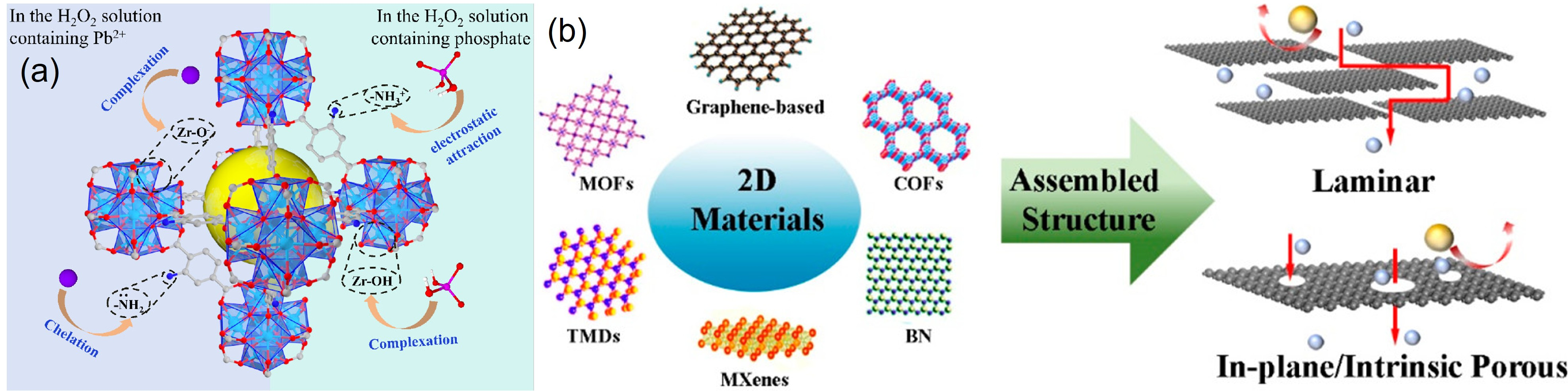
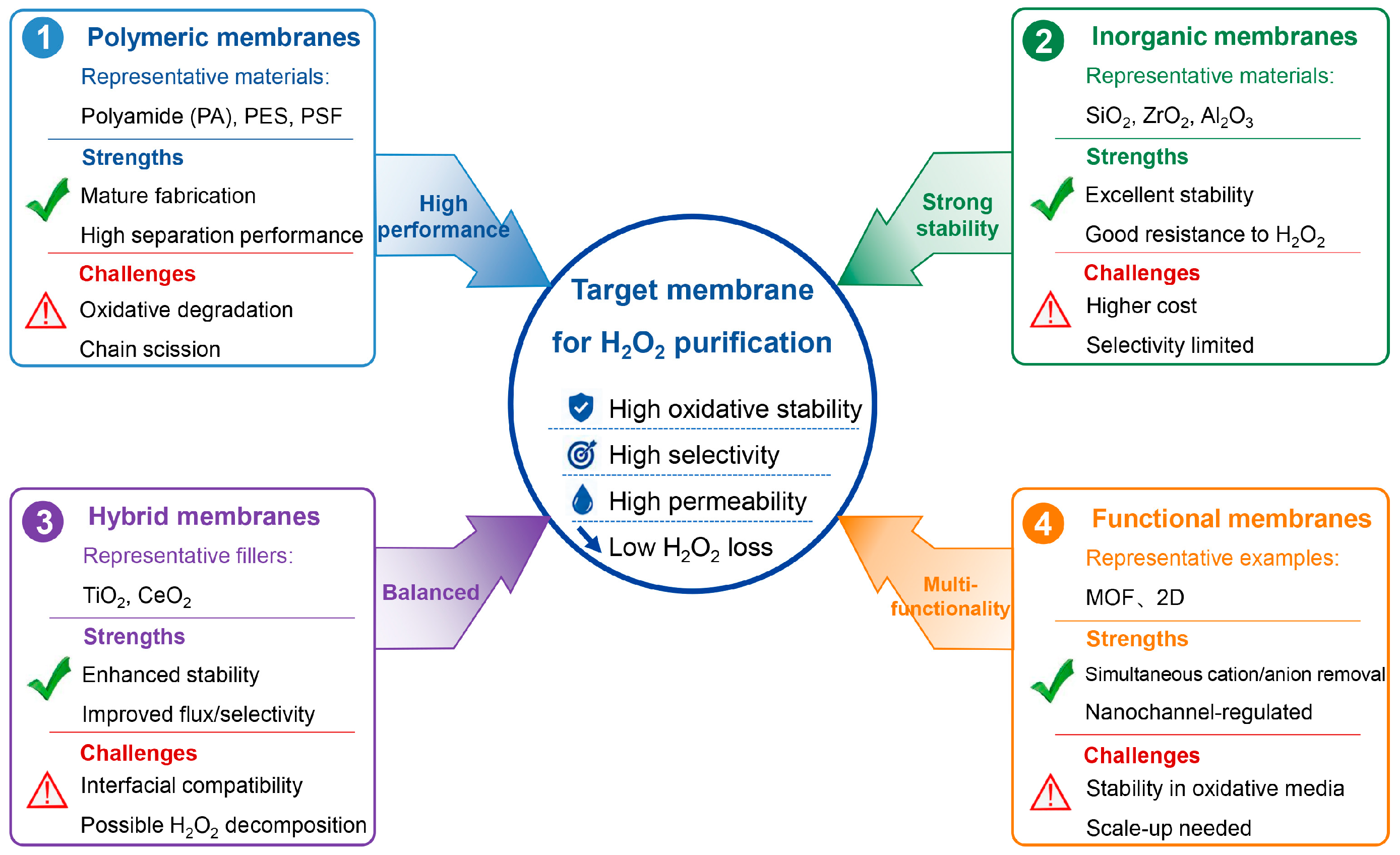
69], as illustrated in
Figure 6. A central challenge in membrane material design is that improvements in oxidative stability may not automatically translate into enhanced purification performance. Dense protective layers can reduce flux, catalytic fillers may consume H
2O
2, and highly porous structures may compromise selectivity. Therefore, material performance should be evaluated through multiple coupled metrics rather than a single stability indicator. This section discusses these material strategies and analyzes their specific roles in enhancing the feasibility, durability, and separation performance of membrane-based H
2O
2 purification.
3.1. Polymeric, Inorganic, and Hybrid Membranes: Practical Examples and Applicability
This section commences with a general comparison of polymeric, inorganic, and hybrid membrane systems, as this classification provides the foundational material framework for understanding subsequent membrane modification strategies. Conventional RO/NF membranes are predominantly polymer-based, most commonly aromatic polyamide thin-film composite membranes. However, polymeric materials are inherently vulnerable to oxidative degradation in H
2O
2-containing environments. For example, the amide bonds within polyamide selective layers may be attacked by hydroxyl radicals generated during H
2O
2 decomposition, leading to chain scission and the subsequent loss of selectivity [
96].
In contrast, inorganic membranes, including ceramic membranes based on silica, zirconia, or mixed oxides, generally exhibit substantially higher chemical and thermal stability than conventional polymeric membranes. A notable example was reported by Abejón et al., who evaluated non-commercial SiO
2–ZrO
2 ceramic membranes and organosilica membranes derived from bis(triethoxysilyl)ethane (BTES) for UF/NF applications in 30 wt% H
2O
2 [
52]. The BTES-derived organosilica membrane maintained high solute rejection coefficients, approximately 0.93 for NaCl and 0.97 for glucose, both before and after prolonged H
2O
2 exposure, demonstrating excellent oxidative resistance and structural stability in concentrated peroxide media. This example indicates that inorganic or organosilica membranes can be highly advantageous in H
2O
2-containing streams where conventional polymeric membranes may suffer from oxidative degradation.
Nevertheless, the practical role of inorganic membranes in electronic-grade H2O2 production should be defined carefully. Ceramic MF/UF membranes based on silica, zirconia, alumina, or related oxides are more suitable for front-end clarification, where they can remove catalyst fines, colloids, filtration residues, corrosion particles, and suspended degradation products from crude or pretreated H2O2 streams. However, most inorganic membranes reported to date have not demonstrated the capability to achieve the sub-ppb or ppt-level removal of dissolved ionic contaminants required for high-grade electronic H2O2. In addition, their relatively broad pore-size distribution, high fabrication costs, brittle mechanical behavior, sealing difficulties, and possible surface-catalyzed H2O2 decomposition may limit their application as stand-alone final polishing membranes. Therefore, inorganic membranes should be regarded more realistically as oxidation-resistant pretreatment membranes, guard membranes, or mechanically robust support layers in hybrid membrane systems rather than as universal replacements for polymeric RO membranes.
Consequently, increasing attention has been directed toward hybrid membrane systems that combine polymeric matrices with inorganic functional components in order to integrate the advantages of both material classes [
75]. Such hybrid strategies aim to simultaneously enhance oxidative stability and separation selectivity. Based on these considerations, current research is progressively shifting from conventional polymeric membranes toward functionalized and hybrid membrane systems specifically designed for the demanding conditions of H
2O
2 purification.
3.2. Antioxidant Fillers in Polymer Matrices: Stability Enhancement and Contamination Risks
Although functionalized or hybrid systems can improve intrinsic oxidative stability, polymer-based membranes remain dominant in practical pressure-driven separations because of their mature fabrication technologies, scalability, and high separation performance. Consequently, rather than replacing polymers entirely, considerable effort has been devoted to enhancing their resistance to oxidative degradation through the incorporation of functional additives. The main pathway for the chemical degradation of polymer membranes is the breakage of the main chain under strong oxidative conditions or attack by free radicals [
97,
98]. Integrating multiple components to synergistically enhance antioxidant resistance and mechanical stability is therefore necessary for the design of durable membranes. For example, Tsehaye et al. incorporated TiO
2-based antioxidant fillers into commercial PES membranes, thereby reducing H
2O
2-induced oxidative damage [
56]. However, this protection mechanism may rely partly on the catalytic decomposition of H
2O
2 into H
2O and O
2 at or near the membrane interface, which means that some H
2O
2 molecules may be irreversibly consumed during purification. Similarly, inorganic fillers such as CeO
2, which possess free-radical-scavenging or redox-cycling ability, may enhance membrane oxidative stability [
99,
100], but may also cause H
2O
2 decomposition. Their use therefore requires a delicate balance between improved membrane durability and the preservation of the H
2O
2 product. H
2O
2 retention and decomposition rates should therefore be considered mandatory performance indicators.
In addition to H2O2 decomposition, particle contamination is another critical issue for filler-modified membranes. For electronic-grade H2O2 purification, permeate quality is determined not only by ionic impurity rejection, but also by particle count, metal leaching, total organic carbon (TOC) release, and the absence of membrane-derived contaminants. If inorganic nanoparticles such as TiO2, CeO2, SiO2, or other oxide fillers are not sufficiently immobilized within the polymer matrix, they may detach during long-term operation under cross-flow shear, pressure cycling, oxidative aging, or membrane swelling. Released nanoparticles or filler-derived metal species may then enter the permeate and become unacceptable contaminants for semiconductor applications. Accordingly, antioxidant-filler-modified membranes should not be evaluated solely based on membrane flux, solute rejection, and oxidative stability. For H2O2 purification, the H2O2 decomposition rate, oxygen evolution, filler leaching, metal release, TOC contribution, and permeate particle contamination should also be treated as key performance indicators. A membrane that survives longer by catalytically consuming H2O2 may not be acceptable for industrial purification, because product loss, gas generation, and local safety risks may offset the apparent improvement in membrane durability. Therefore, future studies on TiO2-, CeO2-, or other oxide-filler-modified membranes should report both membrane aging behavior and H2O2 loss under realistic H2O2 concentration, impurity, temperature, and flow conditions. Such risks may be reduced by covalent anchoring, in situ growth, encapsulation beneath a dense selective layer, or post-treatment to remove loosely bound particles, but they require rigorous permeate cleanliness verification before application in ultrapure H2O2 production.
In contrast, directly improving the tolerance of polymer substrates through chemical modification is more aligned with practical industrial needs. Research has shown that introducing strong electron-withdrawing N-heterocyclic units can enhance polymer oxidative stability by reducing the affinity of the polymer chains for radicals. Based on this, Liu et al. prepared poly(aryl ether ketone) membranes containing N-heterocycles, and test results showed ninefold greater radical tolerance than the unmodified membrane [
101]. Nagarajan et al. classified this method of improving polymer oxidation stability through chemical modification into three major groups to facilitate clearer understanding and practical implementation [
102]. In the first approach, antioxidant molecules were functionalized with polymerizable groups, which can then be polymerized. The second approach involves the derivatization of a polymerizable monomer with an antioxidant molecule. In the third approach, graft polymerization was used to modify the surface properties of the polymer to tailor it for antioxidant applications. Researchers utilized grafting-to and grafting-from methods to link antioxidants using chemical synthesis or via melt processing.
Surface modification approaches have likewise been investigated to enhance the membrane’s resistance to degradation over time [
103,
104]. For example, plasma treatment has emerged as a promising technique for the surface modification of membranes, offering a solvent-free approach with potential for industrial-scale application and the ability to selectively alter surface properties without affecting the bulk characteristics of the material [
97,
105]. A recent study by Heo et al. successfully employed Ar/O
2 plasma treatment to improve the mechanical and chemical durability of polymer membranes [
106]. Meanwhile, Heo et al. emphasized that the Ar/O
2 plasma dose must be optimized to tailor membrane performance. Overall, both bulk blending and surface functionalization with antioxidant materials have proven effective for improving the long-term stability of polymeric membranes under H
2O
2 exposure.
3.3. Exploratory Functional Membranes: MOF- and 2D-Nanomaterial-Based Membranes
Beyond improving the intrinsic oxidative stability of conventional polymeric membranes, recent material-design studies have explored the introduction of specific adsorption sites and nanoscale transport channels. MOFs and 2D materials represent two conceptually different approaches. MOFs containing Lewis acidic metal centers together with basic or protonatable functional groups may enable concurrent adsorption of metal ions and oxyanions through coordination, electrostatic interaction, or hydrogen bonding (
Figure 7a) [
107,
108]. Two-dimensional layered materials can control the transport of molecules and ions by modulating restricted interlayer channels [
109,
110]. However, direct experimental evidence supporting their application in concentrated H
2O
2 purification remains limited. Therefore, these materials should currently be evaluated as exploratory design strategies rather than established membrane technologies for electronic-grade H
2O
2 production.
MOF-containing membranes have attracted attention because their metal nodes, organic linkers, and defect sites can potentially interact with both cationic and anionic impurities. This feature is potentially relevant to H
2O
2 purification, wherein the simultaneous removal of trace metal ions and oxyanions remains challenging. For example, defect-rich UiO-66-NH
2 materials incorporated into polysulfone hollow-fiber membranes have demonstrated simultaneous removal of Pb
2+ and phosphate from dilute aqueous model solutions [
15,
31,
111]. These results support the general feasibility of adsorption-assisted cation–anion removal. Nevertheless, the experiments were not conducted in concentrated H
2O
2, and the reported single-pass removal efficiencies (67.1% for phosphate and 60.1% for Pb
2+) do not demonstrate compliance with the ppb- or ppt-level impurity limits required for high-grade electronic chemicals.
The incorporation of MOFs may also introduce additional challenges that are less pronounced in conventional pressure-driven membranes. Exposure to H2O2 may compromise framework integrity, while exposed metal nodes may promote peroxide decomposition or radical generation. Moreover, trace leaching of metal ions, organic linkers, synthesis residues, or partially degraded framework components would be unacceptable in semiconductor-grade H2O2. Given that the number of adsorption sites is finite, adsorption saturation and regeneration must also be considered. Regeneration chemicals could introduce secondary contaminants and increase process complexity. Consequently, MOF-containing membranes should presently be regarded as adsorption-assisted candidates for pretreatment or polishing applications, rather than direct replacements for RO or ion-exchange processes.
Two-dimensional materials provide an alternative design route by regulating transport through confined nanochannels (
Figure 7b). The most relevant example for H
2O
2 treatment is a BN–GO hybrid pervaporation membrane, in which rigid boron nitride nanosheets suppress graphene oxide swelling and stabilize the lamellar structure [
44]. In a proof-of-concept test, this membrane increased the H
2O
2 concentration from approximately 0.25 wt% to 0.72 wt% while maintaining preferential water permeation, indicating that 2D nanochannels can distinguish water and H
2O
2 transport under dilute conditions. However, this concentration range is far below the 30–70 wt% H
2O
2 levels relevant to industrial and electronic-grade applications, and the result does not demonstrate industrial-scale concentration or trace ionic impurity removal. Moreover, the effectiveness of GO, layered double hydroxides, MoS
2, and related 2D materials in concentrated H
2O
2 remains unverified, and oxidative attack, swelling, delamination, defect formation, interlayer-spacing variation, and nanosheet release may affect long-term performance and product purity [
112].
Figure 7.
The mechanism of MOF adsorbing both phosphate and Pb
2+ simultaneously (
a) [
15] Copyright©2024, the American Chemical Society, and (
b) the regulation of impurity removal characteristics by 2D nanomaterial-based membranes [
113] Copyright©2021, the American Chemical Society.
Figure 7.
The mechanism of MOF adsorbing both phosphate and Pb
2+ simultaneously (
a) [
15] Copyright©2024, the American Chemical Society, and (
b) the regulation of impurity removal characteristics by 2D nanomaterial-based membranes [
113] Copyright©2021, the American Chemical Society.
MOF- and 2D-material-based membranes address different aspects of membrane design: MOFs introduce adsorption functionality, whereas 2D materials regulate transport pathways. However, neither approach has yet demonstrated a clear ability to overcome the principal limitations of conventional H2O2 membrane systems without introducing additional risks. Future studies should evaluate membrane performance under realistic H2O2 concentrations and impurity levels, with particular attention to H2O2 recovery and decomposition, impurity rejection, long-term stability, contaminant release, and compatibility with membrane modules and downstream polishing operations.
Beyond membrane separation performance, contamination control is equally critical for electronic-grade H
2O
2 production. Potential contamination sources include membrane polymers, inorganic fillers, MOF particles, metal nodes, organic linkers, adhesives, binders, spacers, seals, housings, and piping materials, all of which may release particles, trace metals, organics, or degradation products during long-term exposure to concentrated H
2O
2. Therefore, contamination risk should be considered alongside selectivity, permeability, and oxidative stability.
Table 5 summarizes the principal contamination sources and corresponding contamination-control considerations relevant to membrane-assisted production of electronic-grade H
2O
2. Until long-term pilot-scale validation becomes available, these materials should be regarded as complementary and exploratory candidates rather than mature alternatives to conventional RO, NF, PV, or MD membranes. More importantly, the industrial relevance of these emerging materials will depend not only on their laboratory-scale separation performance, but also on their lifetime, impurity-release behavior, module compatibility, safety, and economic feasibility, as discussed in the following section.
4. Towards Industrial Implementation
Membrane-based H2O2 purification has demonstrated considerable potential at the laboratory scale. However, translating these advances into industrial practice requires careful evaluation of several critical factors, including long-term membrane stability, compatibility with existing production infrastructure, operational safety under strongly oxidative conditions, and overall economic viability. Consequently, this section examines membrane-based H2O2 purification from four interrelated perspectives: membrane lifetime and replacement, process integration, safety considerations, and techno-economic feasibility. This analysis highlights the major constraints, practical challenges, and future development directions associated with the industrial implementation and scale-up of membrane-based H2O2 purification.
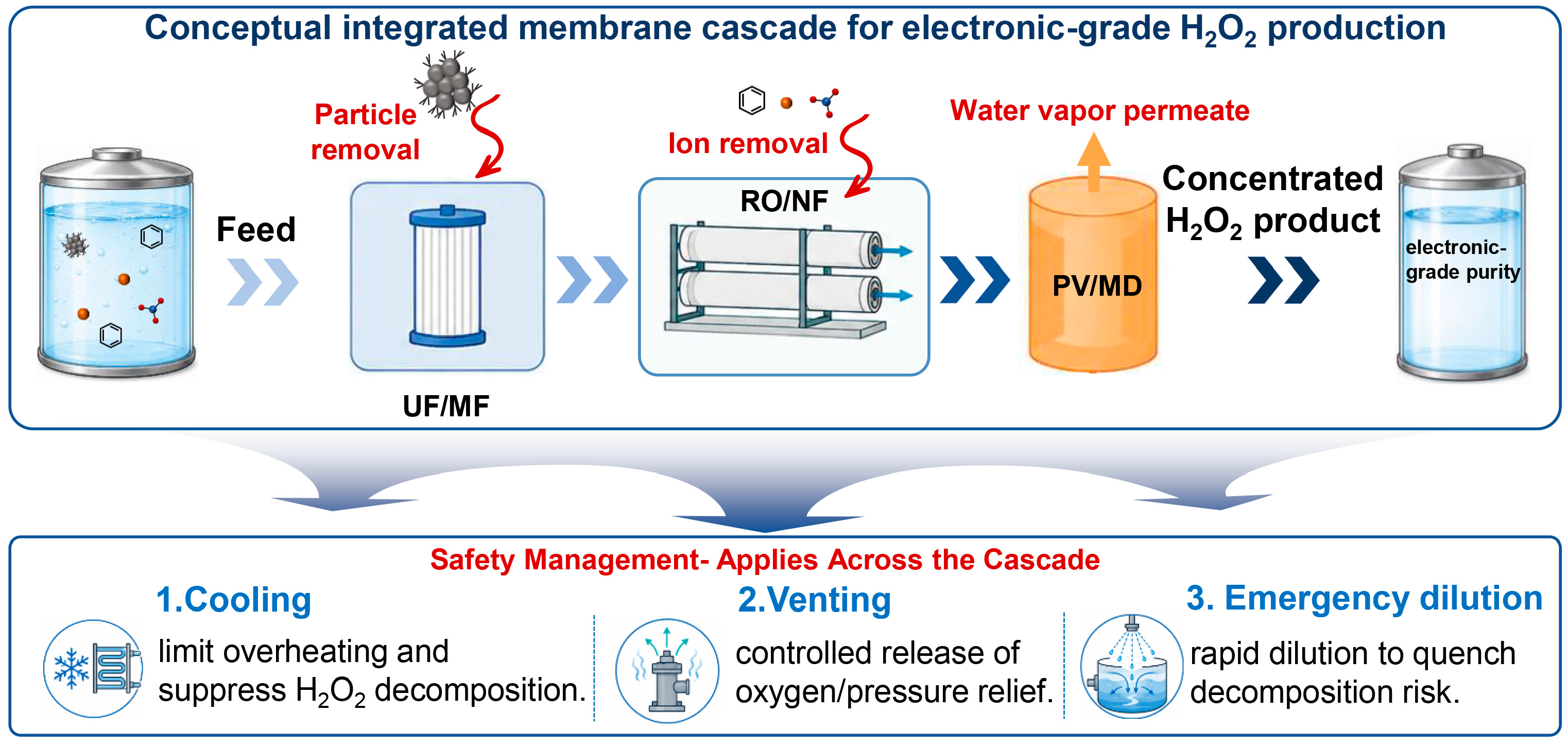
Leveraging the complementary functions of different membrane processes, a conceptual cascade membrane system for high-concentration H
2O
2 is proposed, as illustrated in
Figure 8. In this integrated configuration, front-end clarification, utilizing UF or MF, is initially deployed to remove particulate impurities, colloids, and suspended residues that may foul downstream units. Pressure-driven membrane processes, particularly NF and RO, are then employed for staged ionic impurity removal: NF effectively rejects multivalent metal ions and larger contaminants, whereas RO acts as the final high-selectivity polishing step for trace cations and anions. Subsequently, PV or MD is introduced as a mild water-removal unit to increase the H
2O
2 concentration while avoiding the high thermal load associated with conventional distillation. The impurity-enriched concentrate generated from the NF/RO stage may be recycled to lower-grade applications or treated separately, thereby reducing waste discharge. Importantly,
Figure 8 also emphasizes that industrial membrane implementation must be coupled with process safety controls, including continuous temperature monitoring, rapid cooling, oxygen venting, automatic shutdown, and emergency dilution, because localized H
2O
2 decomposition, oxygen accumulation, or pressure excursions could otherwise compromise safe operation. Therefore, the proposed cascade should be regarded not only as a separation flowsheet, but also as an integrated purification–concentration–safety framework for scalable electronic-grade H
2O
2 production.
More specifically, the individual elements shown in
Figure 8 exhibit varying levels of empirical support. UF/MF clarification is well-established for particle and colloid removal, while RO provides the most direct experimental evidence for mitigating ionic impurities in concentrated H
2O
2 streams. NF has been primarily investigated mainly as a pretreatment or impurity-load reduction step, whereas PV and MD have been explored as mild water-removal or H
2O
2 concentration methods. Nevertheless, the complete cascade configuration remains conceptual. Continuous integrated operation, impurity-accumulation control, concentrate recycling, safety interlocks, and validated Grade 4/5 production all necessitate pilot-scale demonstration. Therefore,
Figure 8 should be interpreted as a proposed integration roadmap rather than as a validated industrial process.
4.1. Membrane Lifetime and Replacement
A paramount concern for industry is the operational lifetime of membranes under H
2O
2 exposure and the associated replacement frequency. Economic models by Abejón et al. have identified the membrane replacement rate as a key factor governing the competitiveness of membrane-based purification relative to conventional technologies such as ion exchange [
65,
87]. In particular, the economic advantage of RO can rapidly diminish if membrane degradation necessitates frequent replacement. As previously highlighted, some unmodified polymeric membranes exhibit extremely limited stability in concentrated H
2O
2 environments, with effective operating lifetimes ranging from only several days to even a few hours under severe conditions. Abejón et al. analyzed the time-dependent performance of RO membranes in 35 wt% H
2O
2 and observed that membrane rejection followed a logistic decay trend, with a pronounced decline occurring after only a few days of continuous operation in the absence of protective strategies [
87]. Such short operational lifetimes render large-scale deployment economically impractical. As a practical benchmark, membrane lifetimes of merely hours to several days should be regarded as insufficient for commercial H
2O
2 purification. For industrial relevance, membrane modules should ideally operate for at least several months under representative H
2O
2 concentration, impurity profiles, temperatures, pressures, and flow conditions. A service life of several months is highly preferable because it aligns better with industrial maintenance cycles and reduces membrane replacement costs. Membrane failure should be defined not only by physical rupture or visible damage, but also by irreversible flux or permeance decline, the loss of impurity rejection, increased H
2O
2 decomposition, unacceptable particle or leachate release, excessive pressure drops, or the inability to maintain the target electronic-grade specification. Furthermore, the lack of standardized lifetime testing protocols presents an additional complication. Reported membrane stability may refer to unchanged flux, unchanged rejection, visual integrity, or short-term soaking resistance, which are not equivalent criteria. Future studies should therefore define membrane failure using combined thresholds for flux, selectivity, H
2O
2 loss, and impurity release.
4.2. Integration into Existing Processes
Once sufficient membrane durability is achieved, the subsequent challenge involves the effective integration of membrane units into practical H
2O
2 production and recycling systems. Currently, the production of electronic-grade H
2O
2 is dominated by a select number of large chemical manufacturers employing well-established distillation–ion-exchange process schemes [
114]. Any new membrane-based process must demonstrate not only high separation performance but also compatibility with existing industrial infrastructure and operational paradigms. One practical implementation strategy involves process retrofitting. As previously noted, RO units could be introduced downstream of conventional distillation columns as polishing steps to partially replace ion-exchange operations or reduce resin loadings. Owing to their modular nature, membrane systems can be readily scaled through parallel module configurations to accommodate industrial throughput requirements. In such hybrid process configurations, RO could serve as a final purification stage to reduce ionic impurities to ultralow levels, thereby decreasing the required size, regeneration frequency, or chemical consumption of ion-exchange units. Similarly, NF may be employed as a pretreatment step to remove multivalent metal contaminants and organic foulants upstream, thereby extending the service lives of both the resin and the RO membrane. Beyond integration into primary production lines, membrane technologies also offer substantial opportunities for H
2O
2 recovery and recycling. Specifically, NF could recover an H
2O
2-containing permeate from spent semiconductor cleaning solutions while retaining metals and organics within the concentrate. These approaches align with the principles of green manufacturing, waste minimization, and resource recovery, thereby enhancing the economic attractiveness of membrane-based technologies even when implemented as auxiliary recycling units rather than direct replacements for existing purification processes. Ultimately, successful industrial integration will depend on positioning membrane processes as complementary components within existing purification flowsheets rather than as immediate stand-alone replacements for mature industrial technologies. However, the integration of membrane units presents new operational complexities, including pretreatment requirements, pressure control, concentrate management, membrane replacement logistics, and the compatibility of module materials with high-purity chemical handling systems.
4.3. Safety Considerations
Safety represents a critical and independent criterion for the industrial deployment of membrane-based H2O2 purification technologies. Unlike ordinary liquid separation processes, H2O2 purification involves a strongly oxidative medium whose decomposition may be accelerated by elevated temperatures, catalytic surfaces, metal contaminants, or incompatible construction materials. Therefore, beyond membrane performance and process integration, industrial feasibility must also be evaluated in terms of hazard prevention, materials compatibility, module design, and emergency control strategies. Highly concentrated H2O2 is a powerful oxidizing agent capable of causing rapid decomposition, oxygen release, fire hazards, or even explosions under unfavorable conditions. This vulnerability is particularly acute for membrane systems because many membrane materials and module components are polymeric and may themselves become susceptible to oxidative degradation or combustion if uncontrolled peroxide decomposition occurs. Consequently, membrane-based purification systems must be carefully designed to maintain operating temperatures, peroxide concentrations, and residence times within safe limits to prevent thermal runaway or localized decomposition events. From an engineering perspective, uncontrolled H2O2 decomposition constitutes the primary hazard scenario that should be considered during membrane-process scale-up. H2O2 decomposition is exothermic and generates oxygen, which may lead to localized temperature rises, gas accumulation, oxygen-enriched atmospheres, pressure increases, and self-accelerating decomposition if heat removal or venting is insufficient. Therefore, membrane modules and auxiliary equipment should be equipped with continuous temperature and pressure monitoring, oxygen or gas detection, pressure-relief devices, rupture discs or relief valves, safe vent routing, and automatic shutdown interlocks. Emergency response protocols should include rapid cooling, isolation of the affected module, controlled venting, and emergency dilution with ultrapure water to mitigate H2O2 concentration and heat-generation risks. Before scale-up, the complete membrane process should undergo a formal process-safety assessment, such as hazard and operability analysis (HAZOP) and, where appropriate, layer of protection analysis (LOPA), to evaluate failure scenarios including membrane rupture, blocked permeate or retentate channels, pump failure, cooling failure, oxygen accumulation, overpressure, sudden H2O2 decomposition, and containment loss.
Material compatibility constitutes another paramount safety consideration. Compatibility screening should evaluate not only visual degradation or mechanical integrity, but also the H2O2 decomposition rate, metal leaching, TOC release, particle shedding, swelling, embrittlement, and changes in sealing performance during long-term exposure. Additionally, spacers, seals, adhesives, module housings, and piping components must all exhibit sufficient resistance toward long-term H2O2 exposure. Crucially, any catalytic additives or functional fillers incorporated into membranes should promote controlled and moderate peroxide decomposition pathways rather than induce rapid radical generation or localized heat accumulation. Rigorous system maintenance and membrane replacement procedures are equally essential. During shutdown, cleaning, or membrane replacement, residual H2O2 may come into contact with air, metallic surfaces, or incompatible organic materials; therefore, flushing, dilution, ventilation, and decontamination procedures are strictly required to minimize hazard risks.
Among the various membrane processes, MD presents distinct safety challenges because it deliberately operates at elevated temperatures, although still below the boiling point of H2O2 solutions. For MD systems, module designs incorporating low liquid hold-up volumes, chemically inert materials such as PTFE, temperature monitoring, and pressure-relief mechanisms are particularly critical for preventing uncontrolled peroxide decomposition. More broadly, membrane-based H2O2 purification systems should be subjected to hazard and operability analyses comparable to those used for conventional distillation units, including the evaluation of worst-case scenarios such as membrane rupture, sudden peroxide decomposition, oxygen accumulation, or pressure excursions. Appropriate mitigation measures, including emergency dilution, rapid cooling, oxygen venting, and automatic shutdown protocols, should therefore be rigorously incorporated into industrial system design.
Despite these challenges, membrane processes also offer several inherent safety advantages. Compared with conventional thermal concentration methods, most membrane separations operate under relatively mild conditions and typically involve lower liquid hold-up volumes, thereby limiting the quantity of H2O2 exposed to potential decomposition at any given moment. This intrinsic reduction in thermal and reactive inventory can significantly enhance overall process safety provided that membrane systems are appropriately designed and operated.
4.4. Cost and Economic Feasibility
A final consideration for industrial implementation is economic feasibility, as the overall cost competitiveness of membrane-based H
2O
2 purification is inextricably linked to the issues discussed above. The primary cost drivers for membrane systems encompass membrane module fabrication and replacement, energy consumption by pumping or vacuum systems, and the requisite pretreatment or cleaning chemicals. Several studies indicate that RO-based ultrapurification can be economically competitive for the production of high-purity H
2O
2, particularly at stringent purity levels where conventional distillation–ion-exchange processes become increasingly energy-intensive and chemically demanding [
86]. In pressure-driven processes such as RO and NF, energy consumption is primarily associated with pumping requirements; conversely, PV and MD may utilize waste heat or other low-grade thermal energy sources, thereby reducing the reliance on the high-grade steam required for conventional distillation. Furthermore, membrane systems present opportunities for low-waste or near-zero-waste operations. For example, impurity-enriched RO concentrate streams could potentially be repurposed for lower-grade H
2O
2 production rather than being discarded as waste [
115]. Such process integration strategies may improve overall process economics by minimizing material losses and generating recoverable technical-grade H
2O
2 streams. For the most stringent electronic-grade specifications, such as SEMI Grade 5, standalone membrane processes alone may still be insufficient, necessitating hybrid combinations with ion exchange or alternative polishing technologies. Nevertheless, membrane processes could substantially diminish the impurity load entering downstream purification units, thereby lowering resin consumption, regeneration frequencies, and overall operational complexity. Despite these promising prospects, membrane durability remains a paramount uncertainty in current economic assessments. Given that membrane replacement contributes substantially to operating costs, even moderate improvements in oxidative stability can profoundly influence process economics. Extending membrane service life from a mere few days to several months could substantially reduce replacement-related costs by an order of magnitude, fundamentally enhancing the commercial viability of membrane-based purification systems. However, current techno-economic evaluations must be regarded as preliminary, as reliable cost data for oxidation-resistant membranes, H
2O
2-compatible modules, safety instrumentation, and long-term replacement schedules remain scarce. The economic advantages of membrane systems could be entirely negated if frequent replacement or extensive safety-control infrastructure proves mandatory.
Consequently, the economic competitiveness of membrane-assisted H2O2 purification should be evaluated within a comprehensive techno-economic framework rather than relying on qualitative comparison. Key capital expenditure (CAPEX) components encompass membrane modules, pressure vessels, pumps, vacuum systems for PV, heat exchangers or temperature-control units, online sensors, pressure-relief systems, emergency dilution units, ultrapure piping, and peroxide-compatible module materials. Correspondingly, critical operating expenditure (OPEX) variables include pumping or vacuum energy requirements, membrane replacement frequencies, pretreatment and cleaning protocols, H2O2 losses via through permeation or decomposition, concentrate handling, waste-treatment costs, reductions in resin-regeneration, labor, maintenance, and process downtime. These costs should be rigorously benchmarked against conventional vacuum distillation/rectification, adsorption, ion exchange, microfiltration, and final polishing processes. Essential performance indicators should comprise the cost per kilogram of electronic-grade H2O2, specific energy consumption, H2O2 recovery rates, membrane lifespans, resin-regeneration frequencies, waste volumes, and product-grade stability. Until comprehensive pilot-scale techno-economic data become available, membrane systems are more accurately characterized as potentially advantageous upgrading or polishing units rather than as proven cost-competitive replacements for conventional distillation–ion-exchange routes.
In summary, the industrial viability of membrane-based H
2O
2 purification will not depend on a single performance metric, but rather on the synergistic optimization of membrane durability, process integration, operational safety, and economic performance. For successful industrial implementation, time-dependent pilot-scale operating data are vastly more informative than single-point membrane performance values. Ideally, the feasibility of a membrane-assisted H
2O
2 purification process should be evaluated by continuously monitoring normalized membrane permeance or flux, H
2O
2 concentration and recovery, representative cationic and anionic impurity levels, TOC, particle counts, pressure drops, temperatures, and gas evolution throughout long-term operation. However, publicly available pilot-plant datasets for membrane-based electronic-grade H
2O
2 production are conspicuously scarce. Therefore, rather than presenting unsupported operating curves,
Table 6 recommends pilot-scale monitoring parameters and indicative engineering targets for membrane-assisted electronic-grade H
2O
2 purification. Because no generally accepted pilot-scale acceptance criteria have yet been established for membrane-based electronic-grade H
2O
2 purification, the following targets should be regarded as indicative engineering objectives rather than formal industrial standards. Future pilot tests should demonstrate stable continuous operation, limited flux decline, negligible H
2O
2 decomposition, no progressive impurity breakthrough, no detectable membrane-derived leachable, acceptable pressure-drop stability, and sustained product quality under representative H
2O
2 concentrations, impurity profiles, temperatures, pressures, and flow conditions. These criteria should ultimately be refined in accordance with the target SEMI grade, specific plant configurations, analytical detection limits, and long-term industrial validation.
5. Conclusions and Future Outlook
Membrane-based treatment represents a promising complementary strategy for electronic-grade H2O2purification. MF/UF, NF, and RO can target distinct impurity classes, whereas PV or MD offers an alternative concentration pathway. However, to date, no integrated membrane configuration has simultaneously demonstrated ultrahigh purity, high H2O2 recovery, long membrane lifetime, and industrial safety.
A central advance highlighted in this review is the shift from process feasibility toward materials-enabled functionality. Antioxidant-filled polymer membranes, inorganic and organic–inorganic hybrid membranes, MOF-based adsorptive membranes, and two-dimensional lamellar membranes have broadened the range of material concepts under investigation for membrane systems operating in oxidative H2O2 environments. These material innovations not only improve membrane durability but may also offer additional functionalities, although empirical evidence in concentrated H2O2 remains limited. In particular, framework-based membranes, including MOF-derived and other emerging porous organic framework systems, offer a promising platform for engineering tailored binding sites and ordered transport channels for ultratrace impurity removal.
Despite these advances, the available evidence does not yet support the conclusion that membrane-based H2O2 purification is nearing widespread to broad industrial implementation. Many reported studies remain confined to short-term tests, simplified feed solutions, relatively low H2O2 concentrations, and proof-of-concept membrane configurations. Therefore, membrane technology should currently be regarded as a promising complementary strategy for upgrading existing H2O2 purification trains rather than as a mature replacement for conventional vacuum distillation/rectification, adsorption, or ion exchange. Its practical value will depend on whether membrane units can be seamlessly integrated into existing industrial processes while maintaining product purity, H2O2 recovery, long-term stability, safety, and economic feasibility.
Future work should focus on five priorities. (i) Membrane lifetime must be extended from days or short-term laboratory exposure to commercially meaningful operation (several months) under realistic and concentrated H2O2 conditions. (ii) Material and module compatibility must be verified across all components—including membranes, fillers, supports, adhesives, seals, spacers, housings, and piping, with particular attention devoted to metal leaching, TOC release, particle shedding, and H2O2-induced degradation. (iii) Membrane processes must demonstrate reliable impurity removal at SEMI Grade 4 or Grade 5 standards, especially achieving ppt-level control of both cationic and anionic contaminants. (iv) H2O2 loss must be minimized by rigorously monitoring permeation loss, decomposition rate, and oxygen generation. (v) Pilot-scale techno-economic validation is required, incorporating realistic industrial feeds, continuous operation, membrane replacement frequency, energy demand, CAPEX, OPEX, waste-treatment costs, safety controls, and rigorous comparisons with established distillation–ion-exchange purification routes. Addressing these priorities will determine whether membrane-assisted purification can evolve from laboratory feasibility toward practical industrial viability for electronic-grade H2O2 production.






 ,
,