Article

High-Selectivity Proton Exchange Membranes with Low Ion Exchange Capacity and Hydrophobic Side Chain-Induced Micro-Phase Separation for Vanadium Redox Flow Batteries


1
State Key Laboratory of Fine Chemicals, Research and Development Center of Membrane Science and Technology, School of Chemical Engineering, Dalian University of Technology, Dalian 116024, China
2
Panjin Institute of Industrial Technology, Dalian University of Technology, Panjin 124221, China
3
School of Chemical Engineering, Ocean and Life Sciences, Dalian University of Technology, Panjin 124221, China
*
Authors to whom correspondence should be addressed.
Membranes 2026, 16(5), 170; https://doi.org/10.3390/membranes16050170 (registering DOI)
Submission received: 7 March 2026 / Revised: 10 April 2026 / Accepted: 15 April 2026 / Published: 6 May 2026

Abstract

The proton (H+) and vanadium ion (Vn+) selectivity of proton-conductive membrane is one of the key components for vanadium redox flow batteries (VRFBs). In this work, a hydrophobic side chain was designed to accelerate proton conduction with high selectivity of H+ and Vn+ for the VRFB membrane. The grafting of hydrophobic butyl side chains into the membrane (PBIOSO3-But) induced the formation of a high microphase separation capacity to form large and connected ion conductive channels with low ion exchange capacity (IEC). As a result, the PBIOSO3-But membrane with low IEC of 1.26 mmol g−1 shows area resistance of 0.19 Ω cm2 as well as vanadium permeability of 3.2 × 10⁻⁹ cm2 s−1, leading to a high H+/Vn+ selectivity of 2.51 × 10¹⁰ mS s cm−3 (higher than Nafion 212, 4.62 × 10⁸ mS s cm−3). Notwithstanding its low ion-exchange capacity, this membrane demonstrates H+/Vn+ selectivity surpassing that of recently reported microphase separation membranes. Compared to the Nafion 212 membrane (74.3% EE; 0.81% per cycle), the PBIOSO3-But membrane exhibited superior VRFB performance, achieving an energy efficiency of 83.2% at 200 mA cm−2 and a low retention rate of 0.22% per cycle. These values compare favorably with those of recently reported membranes.

1. Introduction

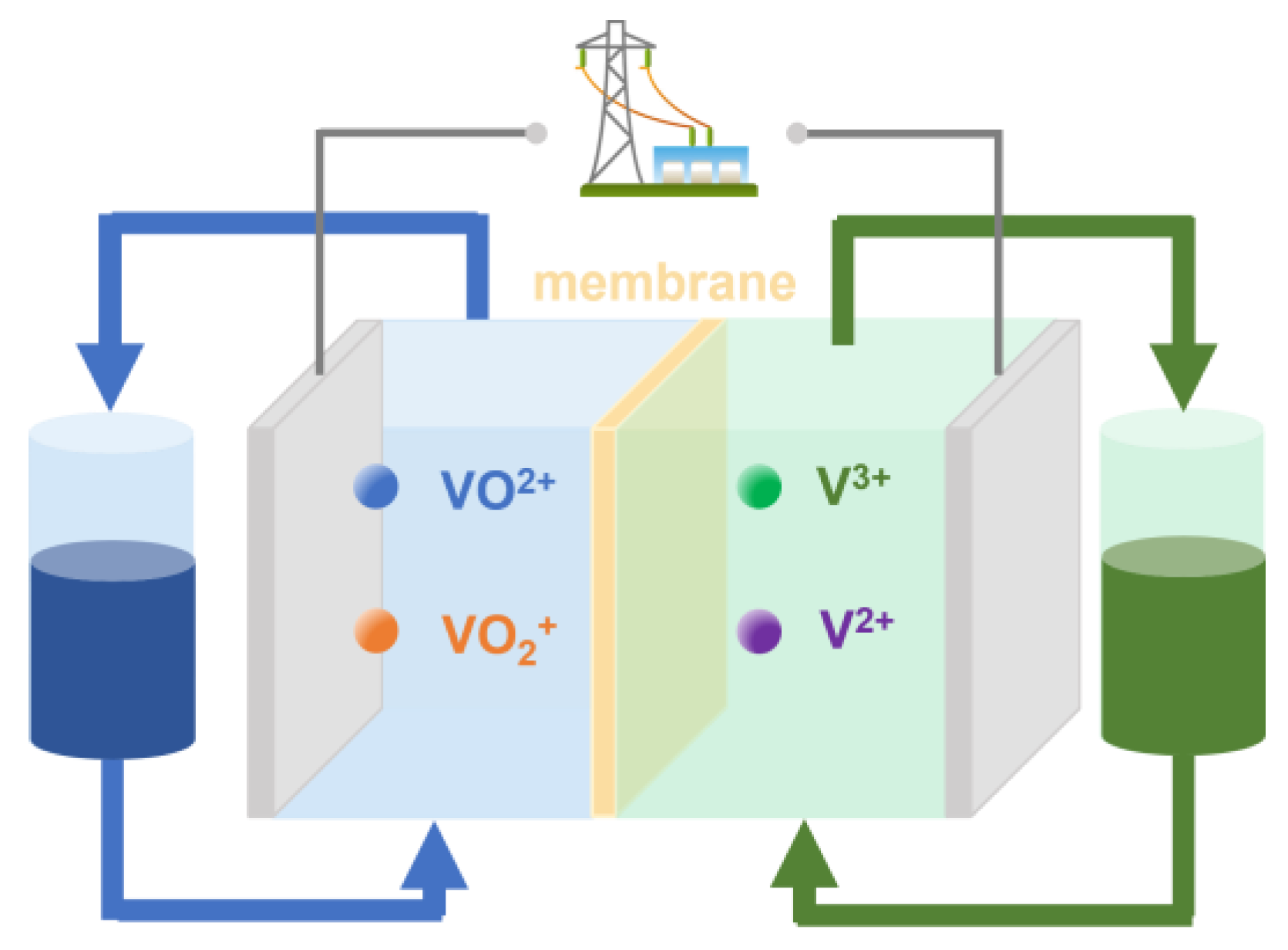
Vanadium redox flow batteries (VRFBs) have become a research focus in the field of large-scale energy storage technology due to their prominent advantages in design flexibility, operational safety, and life cycle. They are particularly suitable for addressing the inherent intermittency of renewable energy generation, such as wind and solar power, while ensuring grid stability and power quality [1,2,3]. In VRFBs, the energy can be stored and released by shuttling between the different oxidation states of vanadium ions. Featuring a scalable design, inherent safety, and decoupling of capacity and power, this technology effectively meets the requirements for integrating, storing, and regulating renewable energy [4,5,6]. A schematic diagram of the VRFB system is shown in Figure 1. The proton-conductive membrane is one of the crucial elements in VRFBs [7,8]. It enables high battery performance by simultaneously blocking the crossover of vanadium ions (Vn+) and conducting protons (H+) [9,10]. However, this trade-off effect between low Vn+ permeability and high H+ conductivity remains a fundamental bottleneck to simultaneously achieving high proton conductivity and selectivity in proton-conductive membranes [11,12]. Therefore, developing proton-conductive membranes that simultaneously achieve high proton conductivity and high H+/Vn+ selectivity to reduce ohmic polarization remains a key challenge for VRFBs.
To achieve high proton conductivity and high H+/Vn+ selectivity, a well-defined microphase-separated structure, composed of hydrophobic and hydrophilic domains, can be constructed within the membrane through rational side-chain chemical design. This architecture facilitates the formation of a hydrogen-bonding network. The interconnected hydrophilic domains provide rapid, low-resistance pathways for H+, the charge carriers, thereby mitigating ohmic polarization caused by impeded ionic conduction. Concurrently, the dense matrix of the hydrophobic domains serves as an effective support, enhancing the mechanical stability of the membrane [13,14,15,16]. Conventionally, hydrophilic domains can be designed via different ion conductive groups design in the side chain (-SO3H [15], -COOH [17], -OSO3H [18], etc.) to accelerate proton conduction with high H+/Vn+ selectivity. Furthermore, by designing the hydrophobic domains through the chemical structure design of hydrophobic side chains, the microphase separation formation ability can be synergistically enhanced with the hydrophilic ion-conductive groups to construct efficient conductive pathways, thereby improving both proton conductivity and H+/Vn+ selectivity [15,19,20,21,22]. For instance, Hu et al. [20] incorporated fluoroalkyl side chains with varying carbon numbers onto a poly (aryl piperidinium) backbone to construct interconnected hydrophilic channels for anion transport. As the fluorine content in the polymer increased, its hydrophilicity decreased significantly, while the anion transport capacity first increased and then decreased. Lindström et al. [21] modified poly (p-terphenyl) with fluorine-containing groups, synthesizing two polymers pendant with perfluoroalkyl and perfluorophenyl groups, respectively. Among these, the PEM containing perfluorophenyl groups exhibited a higher degree of microphase separation enhancement and a higher ion exchange capacity, leading to superior ionic conductivity. Unlike the conventional approach of direct graft modification onto polymer backbones, Li et al. [19] adopted a distinct strategy to enhance the performance of Nafion membranes by incorporating fluoroalkyl side chain-grafted polyoxometalates as supramolecular additives, which were precisely anchored within the ionic clusters of Nafion. Specifically, within the hydrophilic regions formed by the sulfonic acid groups of Nafion, the introduction of hydrophobic fluorine moieties significantly amplified the microphase separation between the hydrophilic and hydrophobic domains, promoting the formation of more defined and interconnected ionic clusters. This morphological optimization facilitated more efficient proton hopping and transport through the membrane, ultimately yielding a 56% enhancement in proton conductivity for the composite membrane compared to pristine Nafion. However, the introduction of hydrophobic side chains leads to discrete ion clusters and increases vanadium permeability, which consequently limits the enhancement of proton conductivity and H+/Vn+ selectivity.
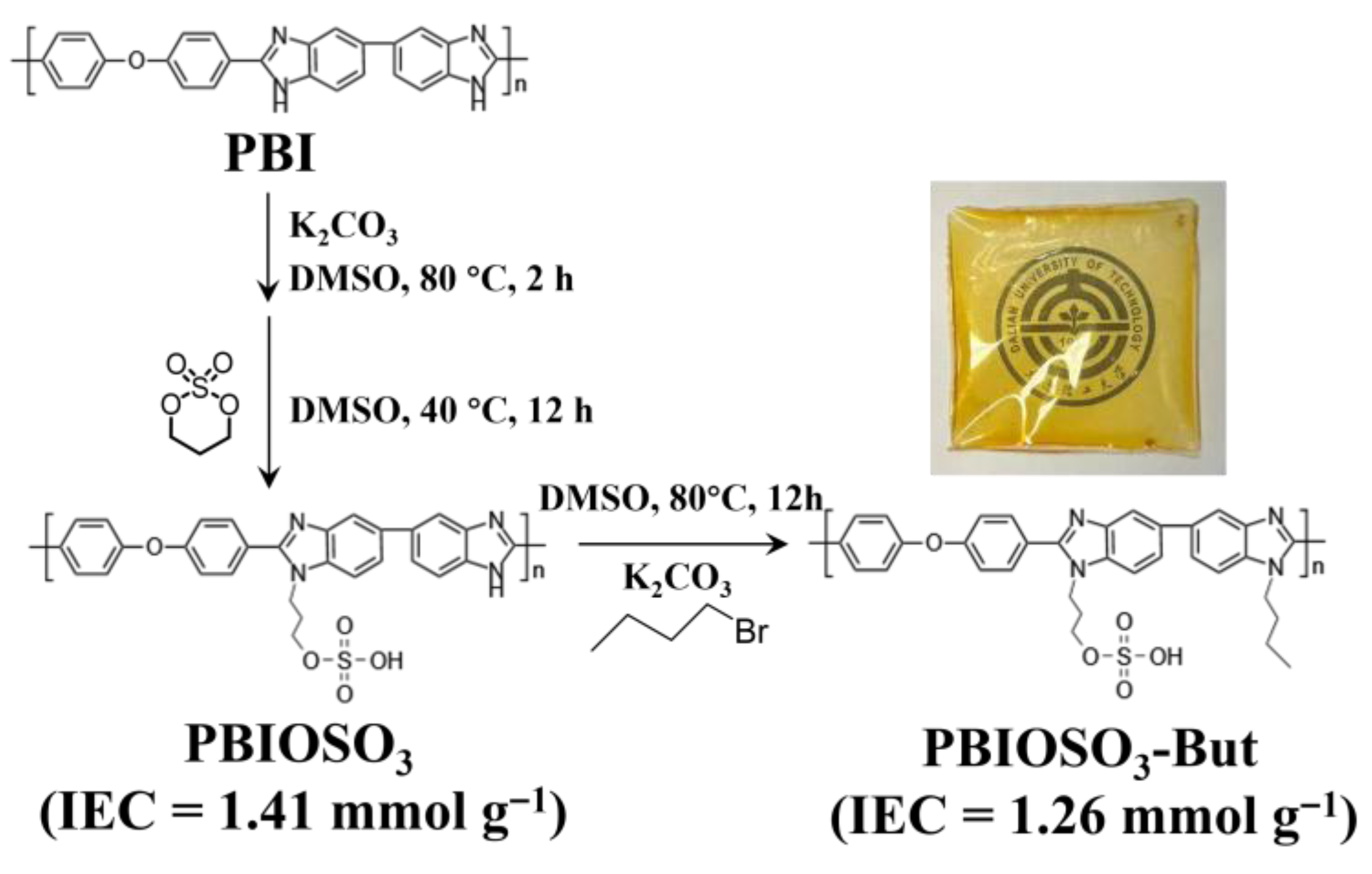
In this work, a hydrophobic butyl side chain was designed to enhance microphase separation capacity in the sulfated ion-conductive membrane with low ion exchange capacity (IEC, Scheme 1). After the introduction of the hydrophobic butyl side chain (-But), the ion cluster size increases from 7.14 nm to 7.85 nm. However, the IEC decreased from 1.41 mmol g−1 to 1.26 mmol g−1. The PBIOSO3-But membrane combines low area resistance of 0.19 Ω cm2 and low vanadium permeability of 3.2 × 10⁻⁹ cm2 s−1 due to its enlarged ion clusters and decreased IEC. As a result, it exhibits an exceptional selectivity of 2.51 × 10¹⁰ mS s cm−3, surpassing that of Nafion 212 (4.62 × 10⁸ mS s cm−3). Moreover, the VRFB performance of the PBIOSO3-But membrane presents 83.2% energy efficiency at 200 mA cm−2 and retention of 0.22% per cycle, better than Nafion 212 membrane (74.3% EE at 200 mA cm−2 and retention of 0.79% per cycle). These values compare favorably with those of recently reported microphase-separated membranes.

2. Materials and Experimental Methods

2.1. Materials

The materials and chemical reagents employed in this study were as follows. Polybenzimidazoles (PBI) were supplied from Shengjun Plastic (Shanghai, China). Anhydrous potassium carbonate (K2CO3), 1,3-propanediol cyclic sulfate, and 1-bromobutane were procured from Aladdin Scientific (Shanghai, China). The Nafion 212 membrane was obtained from DuPont (Wilmington, DE, USA). The vanadium solution used as the VRFB electrolyte was prepared from vanadium oxide sulfate hydrate, purchased from Aladdin Scientific (Shanghai, China). All organic solvents, including dimethyl sulfoxide (DMSO), anhydrous ethanol, and ethyl acetate, were purchased from Tianjin Damao Chemical Reagent Factory (Tianjin, China). All commercially available chemicals were of analytical grade and were used as received without any further purification.

2.2. Synthesis of Sulfate-Grafted PBI (PBIOSO3) and Butyl-Grafted PBIOSO3(PBIOSO3-But)

The synthesis of the sulfate-grafted PBI (PBIOSO3) followed our previous report [18], and the synthesis of butyl-grafted PBIOSO3 (PBIOSO3-But) was based on PBIOSO3. To prepare a solution, a 4 g portion of PBI was weighed and dissolved in DMSO (200 mL) (Scheme 1). An amount of 10.6 g of K2CO3 was added to the solution, and the mixture was stirred at 80 °C for 4 h. After the system was naturally cooled to 40 °C, 10.6 g of 1,3-propanediol cyclic sulfate was added under Ar, and the synthetic reaction was continued with stirring at this temperature for 12 h. After the reaction, the crude product was washed with ethyl acetate, ethanol, and deionized water, followed by collection as the solid target product, designated PBIOSO3. The product was dried under vacuum and then dissolved in DMSO to prepare the casting solution.
The synthesis of the butyl-grafted PBIOSO3 (PBIOSO3-But) requires the prior preparation of a PBIOSO3 casting solution. An amount of 100 mL of PBIOSO3 casting solution was placed under Ar, followed by the addition of 2.7 g of anhydrous potassium carbonate and 177 µL of 1-bromobutane. The solution was then stirred at 80 °C for 12 h. The same washing procedure was applied, giving the final PBIOSO3-But casting solution.
After being cast onto a clean glass plate, the PBIOSO3-But solution was subjected to thermal drying in an oven maintained at 80 °C for 24 h to ensure complete solvent evaporation. The resulting membranes were transparent and homogeneous, with a thickness measured to be approximately 20 ± 2 μm using a digital micrometer, confirming successful film formation and uniform thickness distribution.

2.3. Structural and Physical Characterization

Nuclear magnetic resonance spectroscopy (NMR; AVANCE NEO 600M, Karlsruhe, Germany) and Fourier transform infrared spectroscopy (FTIR; Thermo Fisher iS50, Waltham, MA, USA) confirmed the structure of the products. 1H NMR analysis allowed quantification of the grafted sulfate groups (the degree of substitution, DS), from which the IEC was calculated using the following equation. ( M ¯ P B I O S O 3 and M ¯ P B I represents the molar mass of the repeating unit of PBIOSO3 and PBI).
I E C = D S M ¯ P B I O S O 3 × D S + M ¯ P B I × 1 D S
The surface and cross-section of the membrane were observed by scanning electron microscopy (SEM; JSM 6300F, Tokyo, Japan), while the ion clusters were examined by transmission electron microscopy (TEM; JEM-F200, Tokyo, Japan) and small-angle X-ray scattering (SAXS; Xeuss 3.0, Grenoble, France). Prior to TEM imaging, the membrane was immersed in a 0.5 M AgNO3 solution at 25 °C for 24 h to enable the ion cluster imaging. A universal testing machine (Shimadzu; AGS-X, Kyoto, Japan) was employed to evaluate the mechanical properties of the membranes.
The water uptake of the membrane was determined through immersion experiments at room temperature [10]. The cast proton exchange membrane was first dried under vacuum at 60 °C for one day, and then immersed in deionized water at room temperature with stirring for one day. After removal, the membrane was gently wiped to remove surface moisture, and its thickness and mass were subsequently measured. The water uptake was calculated as the ratio of the mass difference before and after immersion to the mass of the dried membrane; the swelling ratio was determined as the ratio of the increase in diameter to the diameter of the dried membrane.
To evaluate the vanadium ion permeability (P), a diffusion cell was employed. One compartment was charged with 1.5 M VOSO4 in 3 M H2SO4, while the other contained 1.5 M MgSO4 in 3 M H2SO4 [11]. At 12 h intervals, the concentration of VO2+ in the MgSO4 solution was determined using a UV-Vis spectrophotometer (Shimadzu; UV-2600i, Kyoto, Japan). P was calculated using Equation (2). It is worth noting that the conversion between concentration and absorbance in 762 nm is carried out through a standard curve.
V B d C B t d t = A P L C A C B t
To evaluate the ex situ chemical stability, a membrane sample (2 cm × 2 cm) was immersed in 30 mL of 1.5 M VO2+ solution (in 3 M H2SO4) and kept at 25 °C for 30 days. During this period, every 10 days, the VO2+ concentration was determined using UV-Vis spectrophotometry at a wavelength of 762 nm.
Electrochemical impedance spectroscopy (EIS) was employed to determine the area resistance (AR) of the membrane [12]. Measurements were carried out at 25 °C in a diffusion cell containing 3 M H2SO4, using a Technologies electrochemical workstation (Ivium; Eindhoven, The Netherlands). AR was derived from Equation (3). Here, R1 and R2 represent the impedance with and without the membrane, respectively.
A R = R 1 R 2 S
The in-plane proton conductivity of the membrane was measured by EIS using a four-electrode system at room temperature. The measurement frequency ranged from 10 Hz to 107 Hz with an amplitude of 10 mV [12]. The direct current in-plane proton conductivity was determined from the Nyquist plot of the real part of the complex conductivity as a function of alternating current frequency.
The mechanical properties of the membranes were evaluated using a universal testing machine (AGS-X; Shimadzu, Kyoto, Japan). Prior to testing, the membrane samples were cut into a standardized rectangular shape with uniform width (1 cm) and were clamped to the testing grips at the same marked length to ensure proper alignment and avoid pre-stressing. During the test, the crosshead speed was set to 5 mm min−1. Stress–strain curves were obtained at room temperature, from which the tensile strength and elongation at break of the membranes were derived.
The performance of the VRFBs was tested by LANHE battery system (CT2001A; Wuhan, China). The membrane was pretreated by soaking in 1 M H2SO4 for 24 h before use. A single cell was then tested at 25 °C. Additionally, 1.5 M, 20 mL V2+ and V3+ in 3 M H2SO4 was used as the negative electrolyte, while 1.5 M, 20 mL VO2+ and VO2+ in the same H2SO4 served as the positive electrolyte. At a constant current density of 200 mA cm−2, the cell was subjected to 100 charge–discharge cycles within a voltage range of 0.8–1.65 V to evaluate its stability. The coulombic efficiency (CE) and voltage efficiency (VE) were determined using Equations (4) and (5). It is worth noting that the energy efficiency (EE) used to evaluate the overall performance of the battery is determined by Equation (6), which is the product of CE and VE. Here, I/V stands for current/voltage, and the subscripts c/d represent charging and discharging.
C E = I d d t I c d t × 100 %
V E = V d I d d t V c I c d t × 100 %
E E = V E × C E × 100 %

3. Results and Discussion

3.1. Chemical Structure of PBIOSO3-But Membrane

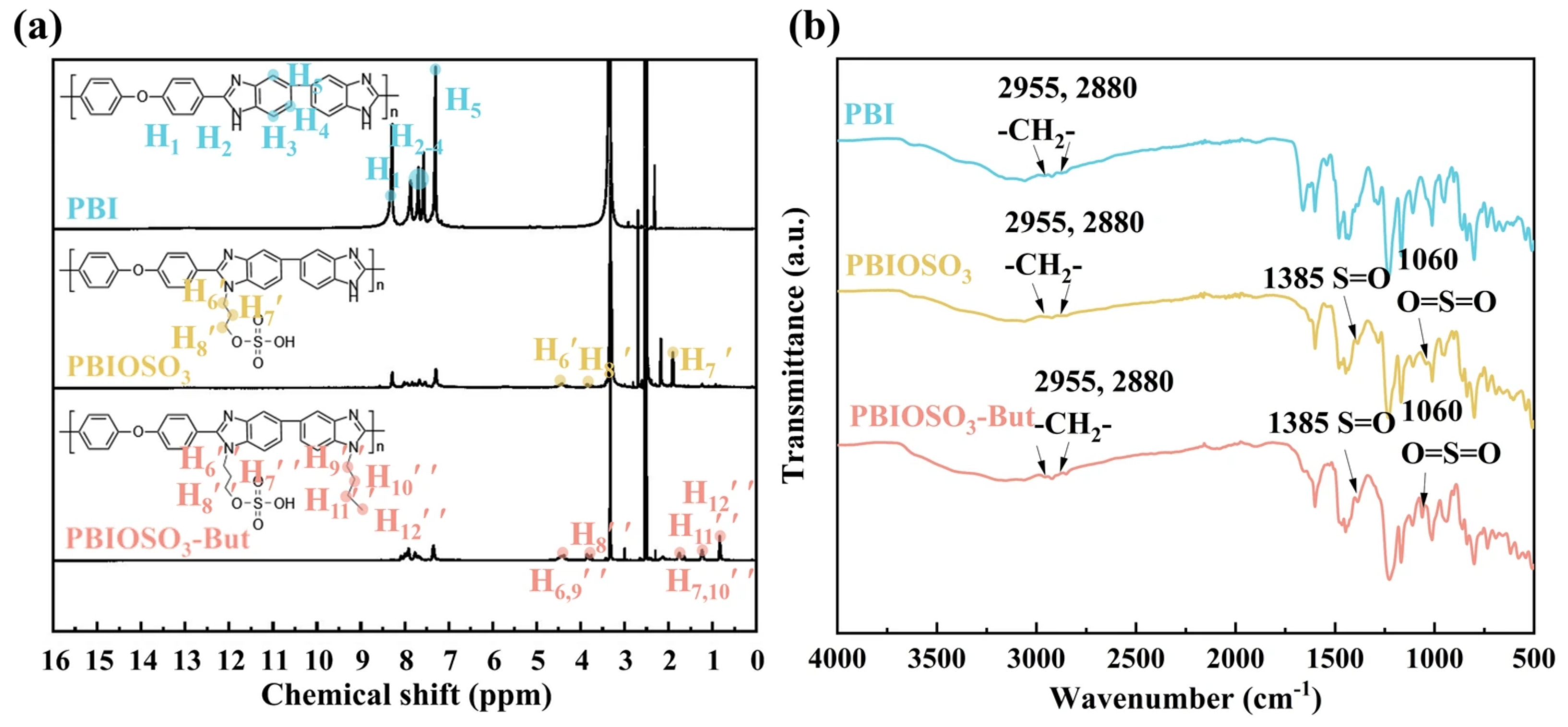
The 1H-NMR and FTIR were used to characterize the chemical structures of the PBI, PBIOSO3, and PBIOSO3-But membranes. As shown in Figure 2a, the new hydrogen signals H6′, H8′ and H7′ were arisen at 4.5, 3.9 and 1.9 ppm, which indicate the successful grafting of sulfate ester side chain in the membrane. After the grafting of hydrophobic butyl side chains, the characteristic peaks of H9″, H10″, H11″, H12″ appeared at 4.5, 1.9, 1.3 and 0.8 ppm. Thus, the degree of substitution (DS) for the sulfate ester side chains and the degree of grafting (GS) for the butyl side chains in the PBIOSO3-But membrane can be calculated by DS = 2 × S [H8″]/S [H1″] and GS = 2 × S [H11″]/S [H1″], respectively, where S [Hn] represents the integrated peak area of the corresponding hydrogen (Figure S1). Therefore, the DS was 70%, and the GS was calculated to be 102%. According to Equation 1, the IEC of PBIOSO3 was calculated to be 1.41 mmol g−1 and the IEC of PBIOSO3-But was calculated to be 1.26 mmol g−1. The successful preparation of PBIOSO3-But was further validated by characteristic peaks observed in the FTIR spectrum (Figure 2b). Compared with PBI and PBIOSO3 membranes, the characteristic peaks at 1385 cm−1 (S=O) and 1060 cm−1 (O=S=O) can be detected, which confirm the successful grafting of sulfate ester side chains onto the membrane. Moreover, the -CH2- peaks at 2955 cm−1, 2880 cm−1 can also be confirmed which indicates the successful co-grafting of hydrophobic butyl side chains and sulfate ester side chains onto the PBI main chain.

3.2. Membrane Morphology of PBIOSO3-But Membrane

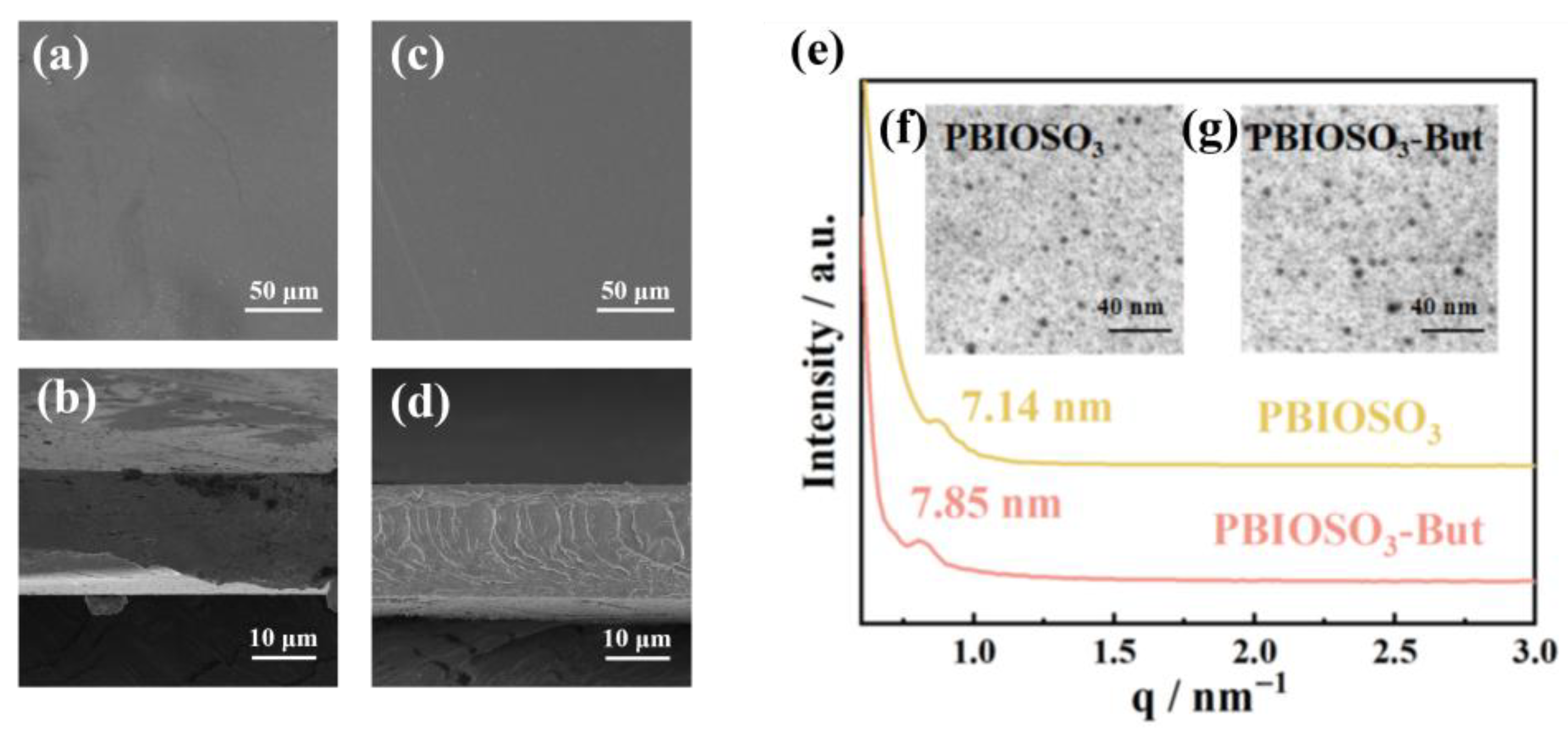
The surface and cross-sectional morphologies of the membranes were observed by SEM. As shown in Figure 3a–d, both the pristine PBIOSO3 membrane and PBIOSO3-But membrane exhibit smooth and homogeneous surfaces without any visible defects, pinholes, or cracks. The cross-sectional images further reveal a dense and uniform internal structure across the entire membrane thickness, confirming the formation of densely packed polymer matrices. To quantitatively investigate the nanoscale microphase-separated morphology, small-angle X-ray scattering (SAXS) analysis was conducted on the membranes. As shown in Figure 3e, both membranes exhibit characteristic scattering peaks corresponding to ionic aggregates. Notably, despite its lower IEC, the PBIOSO3-But membrane displays a scattering peak shifted to a smaller scattering vector (q) compared to the pristine PBIOSO3 membrane. According to Bragg’s law, the calculated ion cluster size increases from 7.14 nm for the PBIOSO3 membrane to 7.85 nm for the PBIOSO3-But membrane. This apparent contradiction—the formation of larger ion clusters despite a lower IEC—is attributed to the strategic introduction of hydrophobic butyl side chains. The presence of these hydrophobic moieties amplifies the thermodynamic incompatibility between the hydrophilic segments and the hydrophobic polymer backbone. This enhanced driving force for phase separation promotes more effective microphase separation, enabling the limited number of ionic groups to aggregate into larger and more well-defined ionic clusters. This microphase-separated morphology is further evidenced by TEM images (Figure 3f,g), where the dark spots represent hydrophilic ionic clusters and the bright regions correspond to the hydrophobic polymer matrix. The ion cluster sizes obtained from TEM are consistent with those from SAXS, and the size distribution is shown in Figure S2. Compared with the PBIOSO3 membrane, the PBIOSO3-But membrane displays larger ion cluster size, confirming its enhanced microphase separation capability upon the grafting of hydrophobic butyl side chains.
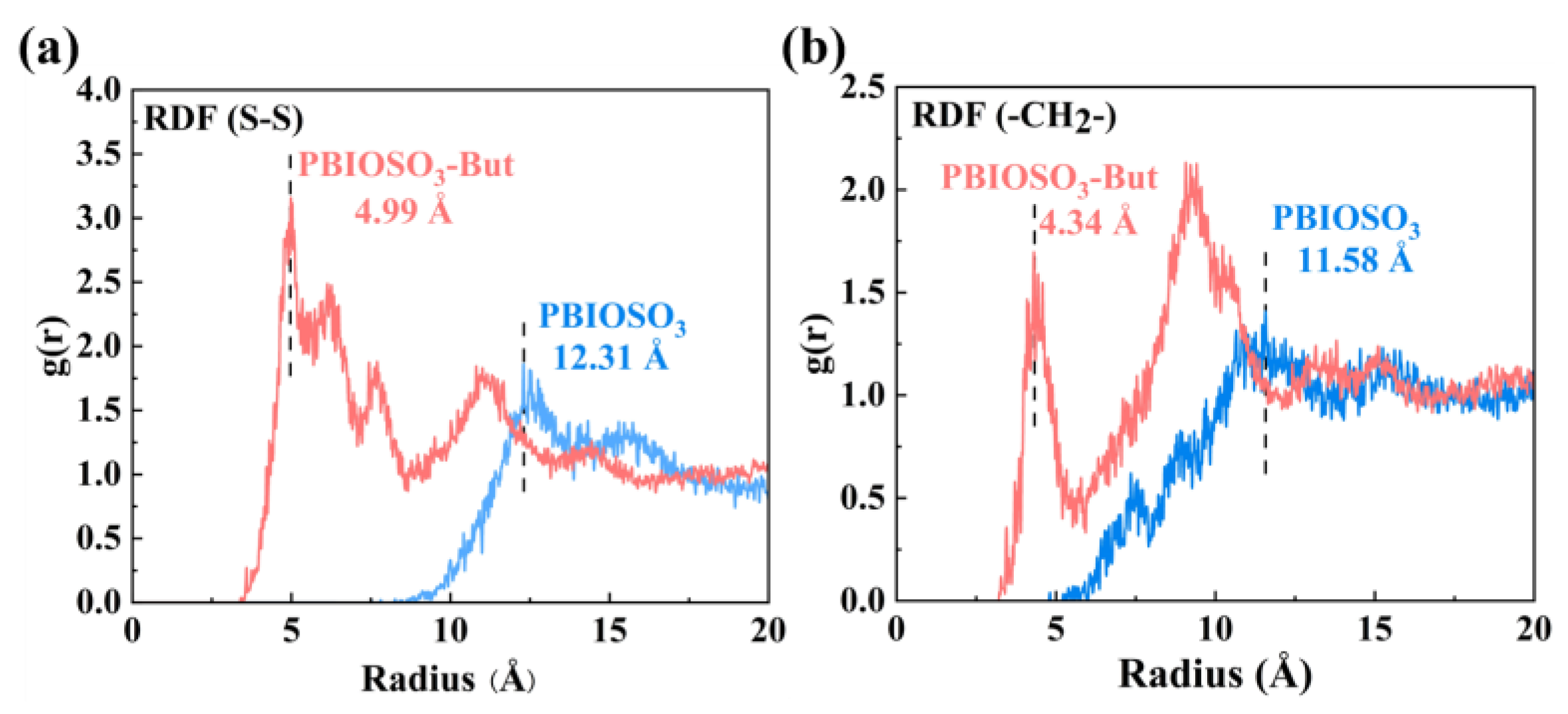
The PBIOSO3-But membrane achieves high microphase separation capability through the grafting of hydrophobic butyl side chains. As shown by the radial distribution function (RDF) in Figure 4, the PBIOSO3-But membrane exhibits enhanced characteristic peak signals compared to the PBIOSO3 membrane. The first prominent peaks indicate that the distance between sulfur atoms on adjacent hydrophilic side chains (S-S, Figure 4a) decreases to 4.99 Å, while the distance between methylene (-CH2-, Figure 4b) groups on neighboring hydrophilic segments reduces to 4.34 Å. These RDF results confirm that the hydrophilic sulfate ester groups are arranged more closely and orderly in space, providing direct evidence for enhanced microphase separation and the formation of ion-conductive channels. This optimized microstructure enables the PBIOSO3-But membrane to maintain a low IEC while forming highly efficient ion-conductive channels.

3.3. Properties of the PBIOSO3-But Membrane

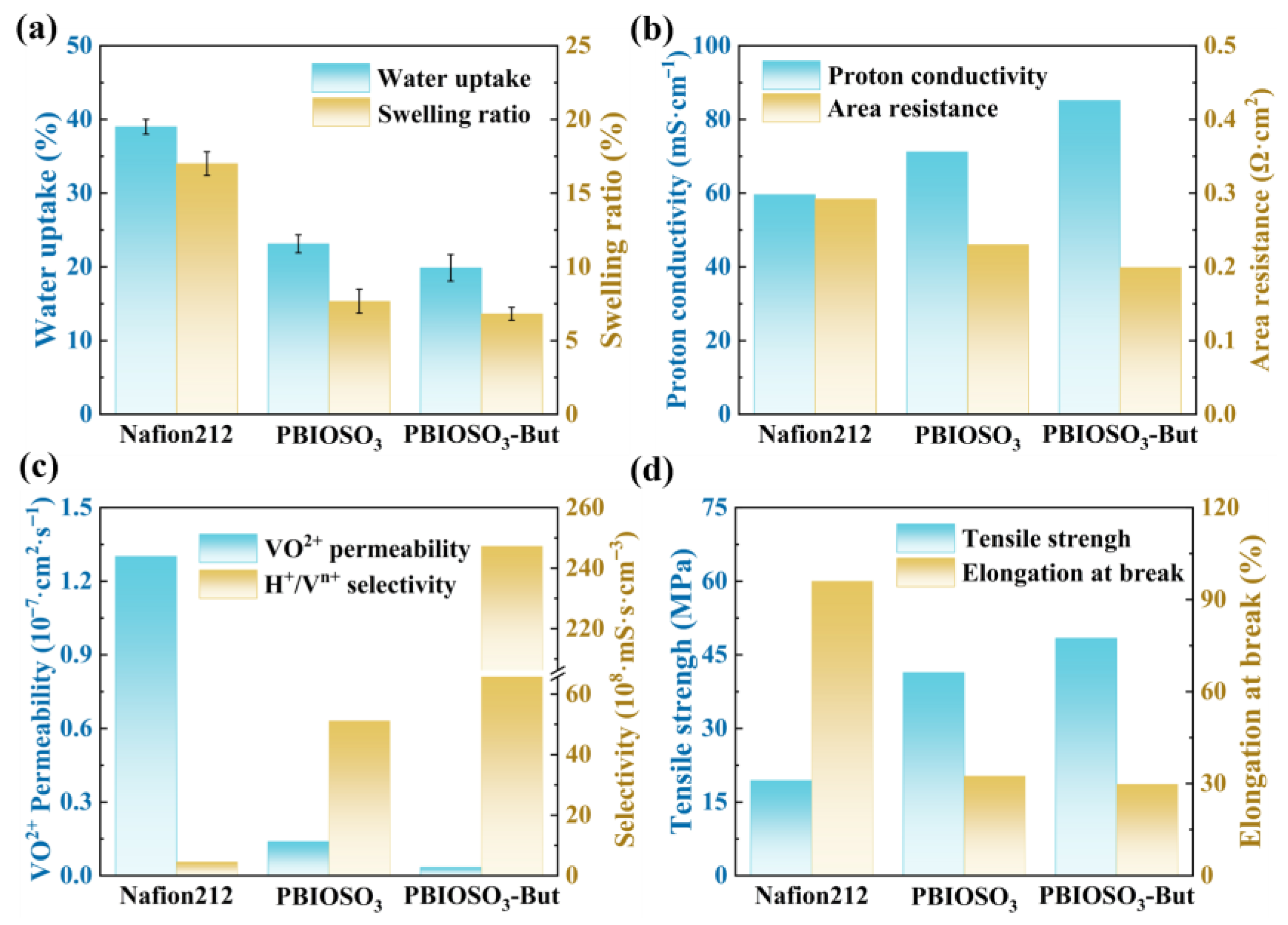
The incorporation of hydrophobic butyl side chains significantly altered the properties of the PBIOSO3 membrane, as shown in Figure 5. First, the water uptake and swelling ratio of the membranes were investigated to evaluate their dimensional stability (Figure 5a). Due to the decreased IEC resulting from butyl side chain grafting, the PBIOSO3-But membrane exhibited a reduced water uptake of 19.8% and a swelling ratio of 7%, demonstrating better dimensional stability compared to the unmodified PBIOSO3 membrane. This suppressed water absorption behavior is beneficial for maintaining the structural integrity of the membrane during operation.
In terms of in-plane proton conduction performance, despite its lower IEC, the PBIOSO3-But membrane achieved a high proton conductivity of 85.09 mS cm−1, outperforming both the Nafion 212 and PBIOSO3 membranes (Figure 5b). Correspondingly, its area resistance was as low as 0.19 Ω cm2, significantly lower than that of the reference samples. This result indicates that the enhanced microphase separation capability induced by the hydrophobic side chains effectively constructed interconnected hydrophilic ion transport channels, compensating for the adverse effects of reduced IEC and achieving improved proton conduction performance. Regarding vanadium ion barrier properties, the PBIOSO3-But membrane exhibited an extremely low Vn+ permeability of only 3.2 × 10⁻⁹ cm2 s−1. This represents a 97.4% reduction compared to Nafion 212 (1.30 × 10⁻⁷ cm2 s−1) and a 75.2% reduction compared to the PBIOSO3 membrane (1.39 × 10⁻⁸ cm2 s−1). This excellent vanadium barrier performance is primarily attributed to two factors: first, the reduced IEC leads to decreased water uptake and swelling; second, the dense hydrophobic domains effectively block the crossover of vanadium ions. Based on the aforementioned excellent proton conduction and vanadium ion barrier properties, the PBIOSO3-But membrane achieved a H+/Vn+ selectivity as high as 2.51 × 10¹⁰ mS s cm−3, which is 4.83 times that of the PBIOSO3 membrane and significantly superior to the Nafion 212 membrane (Figure 5c). In terms of mechanical properties, the introduction of hydrophobic side chains significantly reduced the water uptake and swelling ratio of the membrane, endowing the PBIOSO3-But membrane with excellent mechanical strength. Its tensile strength reached 47.4 MPa, much higher than that of Nafion 212 (19.3 MPa) and also superior to that of the PBIOSO3 membrane (41.4 MPa). Meanwhile, its elongation at break was 29.7%, lower than that of Nafion 212 (96.0%) and the PBIOSO3 membrane (32.5%). This indicates that the introduction of hydrophobic side chains enhances the interactions between polymer chains, forming a more rigid network structure that is beneficial for improving the durability of the membrane during long-term operation (Figure 5d).
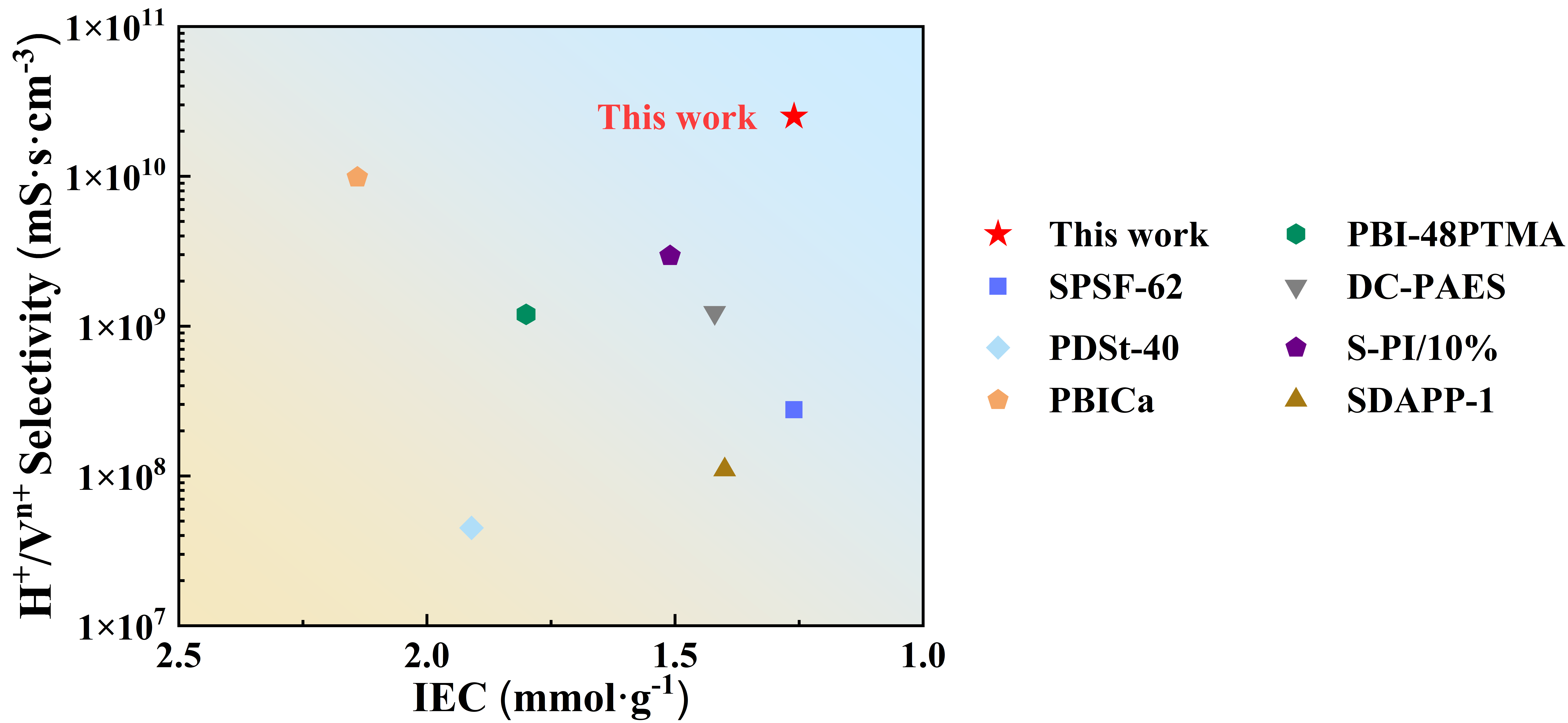
Notwithstanding its relatively low IEC of only 1.26 mmol g−1, the PBIOSO3-But membrane demonstrates exceptional H+/Vn+ selectivity that surpasses not only the pristine PBIOSO3 membrane and commercial Nafion 212 but also the majority of recently reported microphase-separated membranes in the literature (Figure 6) [22,23,24,25,26,27,28].

3.4. VRFB Performance Test

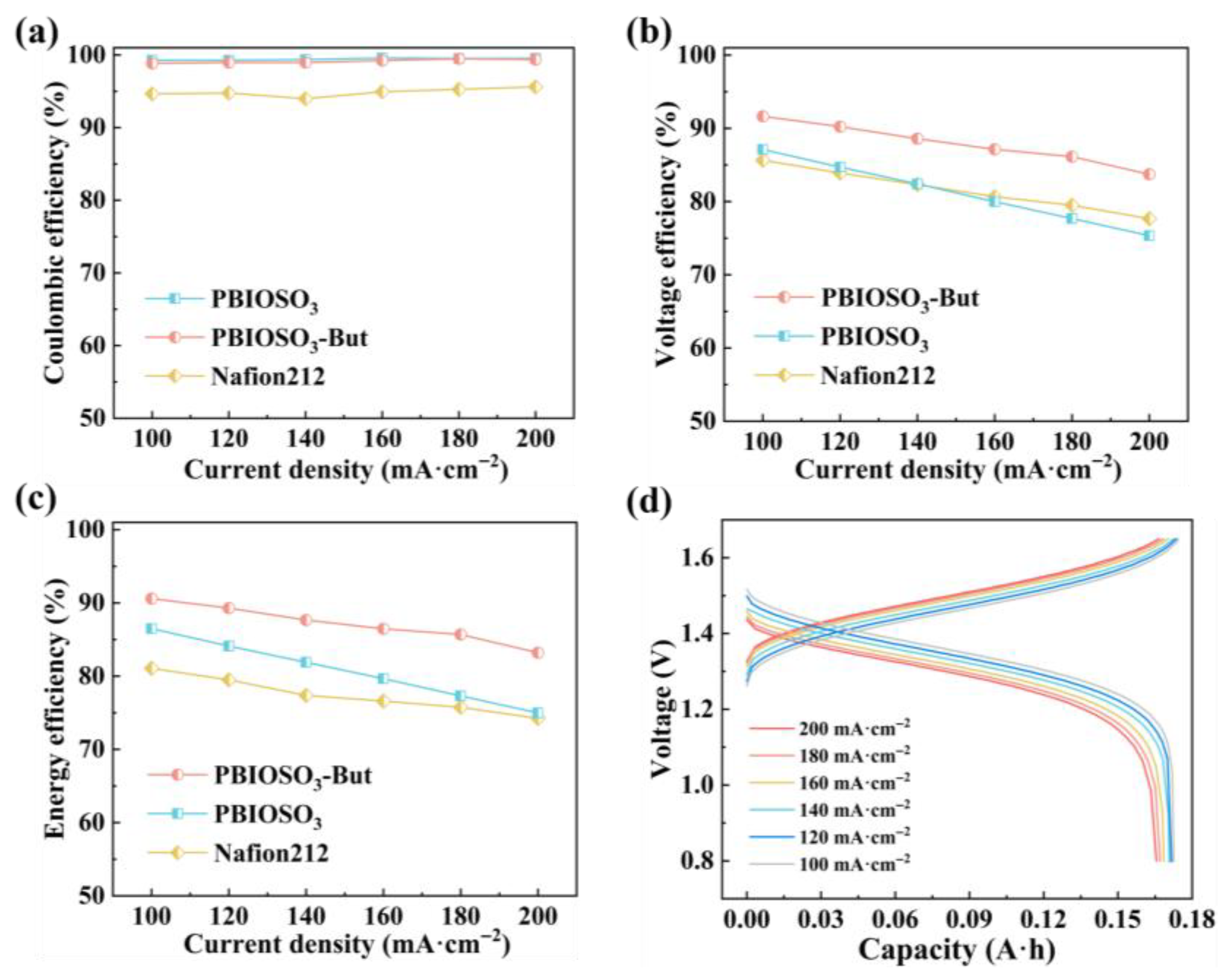
To validate the practical applicability of the as-prepared membranes, their VRFB performance was evaluated in a single-cell configuration. As shown in Figure 7, the coulombic efficiency (CE), voltage efficiency (VE), and energy efficiency (EE) of VRFB single cells assembled with Nafion 212, PBIOSO3, and PBIOSO3-But membranes were systematically compared over a current density range of 100 to 200 mA cm−2. Notably, both the pristine PBIOSO3 membrane and the PBIOSO3-But membrane exhibited coulombic efficiencies exceeding 99% across the entire current density range (100–200 mA cm−2), substantially higher than that of the Nafion 212 membrane (Figure 7a). As discussed previously, this superior CE performance is directly attributed to the exceptionally low vanadium ion permeability of the PBIOSO3-based membranes. The dense membrane structure effectively suppresses vanadium ion crossover, thereby minimizing self-discharge reactions during charge–discharge cycling. In particular, the incorporation of hydrophobic butyl side chains in the PBIOSO3-But membrane plays a crucial role in enhancing its voltage efficiency. The butyl side chains promote microphase separation, leading to the formation of well-connected hydrophilic domains that serve as efficient proton transport pathways. This optimized morphology facilitates rapid proton conduction and reduces ohmic polarization, resulting in the highest VE among all tested membranes (Figure 7b). The synergistic effect of high CE and enhanced VE enables the PBIOSO3-But membrane to achieve superior EE: 90.6% at 100 mA cm−2 and 83.2% at 200 mA cm−2 (Figure 7c). These EE values represent a significant improvement over both the unmodified PBIOSO3 membrane (86.5% at 100 mA cm−2 and 75.0% at 200 mA cm−2) and the Nafion 212 membrane (81.1% at 100 mA cm−2 and 74.3% at 200 mA cm−2). The charge–discharge curves of PBIOSO3-But at various current densities are shown in Figure 7d.
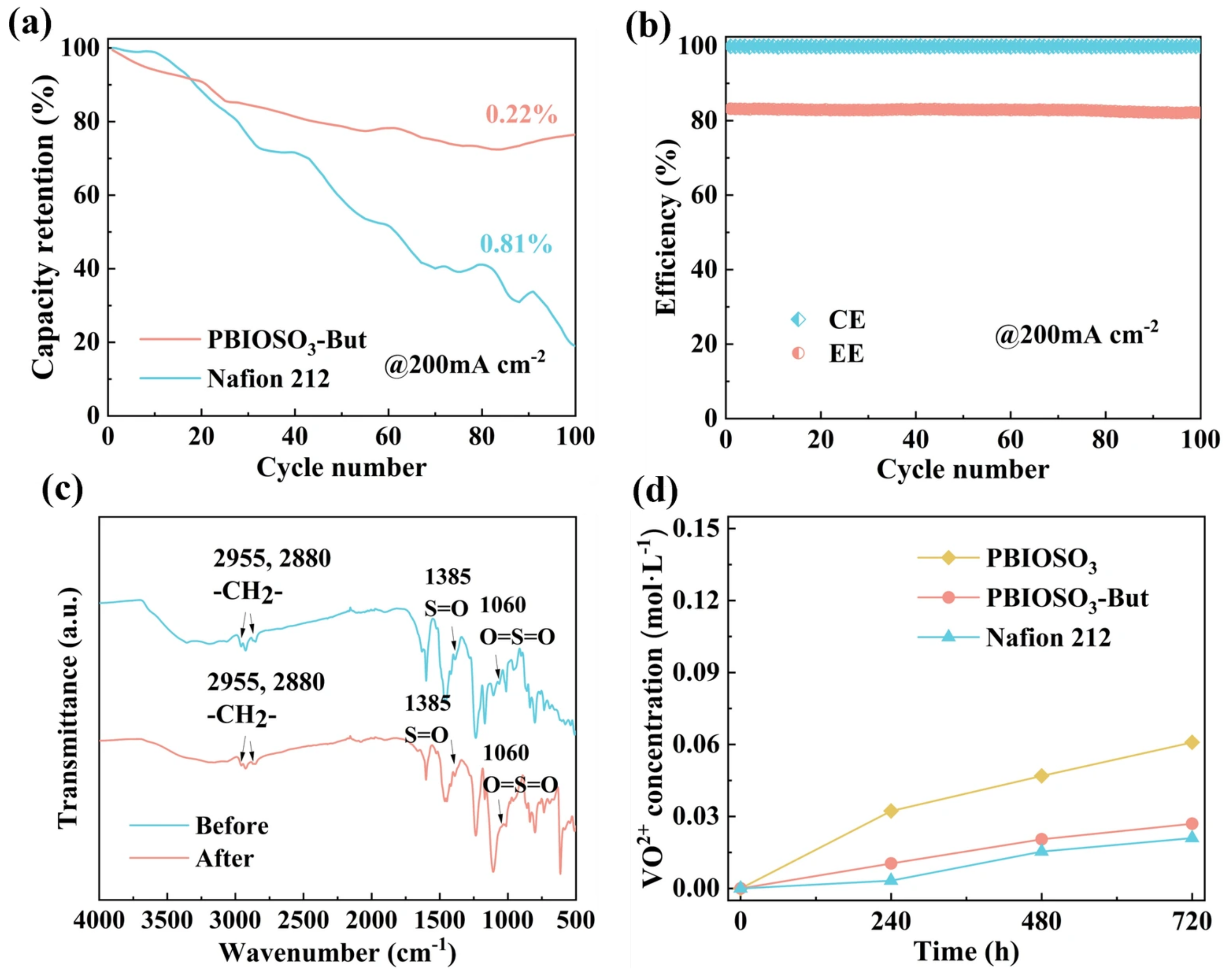
The PBIOSO3-But membrane demonstrated both a low capacity decay rate and high chemical stability. As shown in Figure 8a, after 100 charge–discharge cycles, the membrane retained 77.6% of its initial discharge capacity, corresponding to a minimal capacity decay rate of only 0.22% per cycle. This value is substantially lower than that of the Nafion 212 membrane, which exhibited a decay rate of 0.81% per cycle under identical testing conditions. The significantly suppressed capacity fade highlights the effectiveness of the PBIOSO3-But membrane in mitigating vanadium ion crossover and maintaining long-term cycling durability. Furthermore, even when subjected to a high current density of 200 mA cm−2, the PBIOSO3-But membrane maintained excellent cycling stability (Figure 8b). The chemical stability of the PBIOSO3-But membrane was systematically evaluated through post-cycling FTIR analysis and ex situ chemical stability tests. As shown in Figure 8c, the FTIR spectra of the PBIOSO3-But membrane after cycling were compared with those of the pristine membrane. The characteristic absorption bands corresponding to the sulfate ester groups—specifically the S=O stretching vibration at 1385 cm−1 and the O=S=O stretching vibration at 1060 cm−1—exhibited no obvious peak shift or intensity change. Similarly, the aliphatic C–H stretching vibrations originating from the grafted butyl side chains (-CH2- stretching at 2955 cm−1 and 2880 cm−1) remained virtually unchanged. This spectroscopic evidence confirms that the chemical structure of the PBIOSO3-But membrane, including both the hydrophilic sulfate ester groups and the hydrophobic butyl side chains, remains intact after prolonged electrochemical cycling, demonstrating its excellent structural stability under operating conditions. Furthermore, after immersion in a strongly oxidizing solution for 720 h, the PBIOSO3-But membrane exhibited superior oxidative stability compared to the pristine PBIOSO3 membrane, as evidenced by the lower VO2+ concentration. This enhanced resistance to oxidative degradation is attributed to the presence of the hydrophobic butyl side chains, which form a dense, protective hydrophobic matrix that effectively shields the polymer backbone from attack by highly oxidative vanadium ions.

4. Conclusions

In this study, we report a polybenzimidazole-based ion-conductive membrane grafted with hydrophobic side chains (PBIOSO3-But), which exhibits an enhanced microphase-separated structure and a low ion exchange capacity (IEC). Following the introduction of hydrophobic butyl side chains into the PBIOSO3 membrane (IEC of 1.41 mmol g−1), the incompatibility between the hydrophilic and hydrophobic components of the polymer is enhanced, leading to tighter aggregation of the hydrophilic domains and improved microphase separation. Consequently, even at a low IEC (1.26 mmol g−1), large-sized and continuously connected ion-conductive channels are constructed. After the introduction of the hydrophobic butyl side chain (-But), the ion cluster increases from 7.14 nm to 7.85 nm. This structural optimization results in a reduced area resistance (0.19 Ω cm2) and vanadium ion permeability (3.2 × 10⁻⁹ cm2 s−1), achieving an ultrahigh H+/Vn+ selectivity of 2.51 × 10¹⁰ mS s cm−3. This value is 54.3 times higher than that of the commercial benchmark Nafion 212 membrane (4.62 × 10⁸ mS s cm−3). Both the H+/Vn+ selectivity and IEC of this membrane surpass those of the majority of recently reported microphase-separated membranes. Remarkably, the PBIOSO3-But membrane demonstrates outstanding performance in vanadium redox flow batteries (VRFBs), achieving an energy efficiency (EE) of 83.2% at a current density of 200 mA cm−2 with a minimal decay rate of only 0.22% per cycle. This performance outperforms that of the Nafion 212 membrane (EE of 74.3% and a decay rate of 0.81% per cycle). This work provides critical insights into the rational chemical structural design of high-performance membrane materials for VRFB applications.

Supplementary Materials

The following supporting information can be downloaded at: https://www.mdpi.com/article/10.3390/membranes16050170/s1, Figure S1: The explanation of the meanings of the area ratios of each NMR peak, Figure S2: Size distribution of ion clusters in TEM images, Table S1: Through-plane swelling ratio of the PBIOSO3 and PBIOSO3-But membranes, Table S2: Mechanical properties of the PBIOSO3-But membrane under dry and wet conditions.

Author Contributions

Conceptualization, L.T., B.P. and Q.W.; methodology, L.T., B.P., W.C. and Y.G.; validation, L.T., H.Y., F.C. and W.C.; formal analysis, L.T.; investigation, L.T. and B.P.; resources, L.T.; data curation, L.T., H.Y., Q.W. and Y.G.; writing—original draft preparation, L.T.; writing—review and editing, L.T., B.P. and X.W.; supervision, W.C., F.C., X.W., X.J. and G.H.; project administration, X.W., X.J. and G.H.; funding acquisition, B.P. and G.H. All authors have read and agreed to the published version of the manuscript.

Funding

This research was funded by the National Natural Science Foundation of China [22408039, 22378042, 22021005], Key Program of the National Natural Science Foundation of China [22538002], Postdoctoral Fellowship Program [GZC20240184], Liaoning Provincial Natural Science Foundation Doctoral Scientific Research Startup Project [2025-BS-0042], Special Project of Basic Scientific Research Business Expenses of Dalian University of Technology [DUT25YG224, DUT25Z2775].

Data Availability Statement

The original contributions presented in this study are included in the article. Further inquiries can be directed to the corresponding authors.

Acknowledgments

The authors thank the National Natural Science Foundation of China (22408039, 22378042, 22021005), Key Program of the National Natural Science Foundation of China (22538002), Postdoctoral Fellowship Program (GZC20240184), Liaoning Provincial Natural Science Foundation Doctoral Scientific Research Startup Project (2025-BS-0042), Special Project of Basic Scientific Research Business Expenses of Dalian University of Technology (DUT25YG224, DUT25Z2775). The authors also thank the Supercomputing Center of Dalian University of Technology for providing the computing resources.

Conflicts of Interest

The authors declare no conflicts of interest.

References

  1. Talebian, R.; Pourian, A.; Zakerabbasi, P.; Maghsoudy, S.; Habibzadeh, S. Insights into energy efficiency for vanadium redox flow battery (VRFB) using the artificial intelligence technique. Appl. Energy 2025, 399, 126485. [Google Scholar] [CrossRef]
  2. Huang, H.-T.; Mani, S.; Ho, K.-C. Super-Hydrophilic Activated Carbon Chest Skeleton-like Structure with Self-Doped Heteroatoms (N, S, & O) Derived from Spring Onion Root for VRFB Applications. J. Energy Storage 2024, 84, 110943. [Google Scholar] [CrossRef]
  3. Demeku, A.M.; Guo, C.-H.; Kabtamu, D.M.; Huang, Z.-J.; Chen, G.-C.; Bayeh, A.W.; Wang, C.-H. Enhanced Electrochemical Performance of Copper-Doped Cobalt Oxide Nanowire-Modified Graphite Felt as Positive Electrode Material for Vanadium Redox Flow Batteries. Chem. Eng. J. 2025, 505, 159170. [Google Scholar] [CrossRef]
  4. Moon, H.-N.; Song, H.-B.; Kang, M.-S. Thin Reinforced Ion-Exchange Membranes Containing Fluorine Moiety for All-Vanadium Redox Flow Battery. Membranes 2021, 11, 867. [Google Scholar] [CrossRef] [PubMed]
  5. Jang, J.-K.; Kim, T.-H.; Yoon, S.J.; Lee, J.Y.; Lee, J.-C.; Hong, Y.T. Highly Proton Conductive, Dense Polybenzimidazole Membranes with Low Permeability to Vanadium and Enhanced H2SO4 Absorption Capability for Use in Vanadium Redox Flow Batteries. J. Mater. Chem. A 2016, 4, 14342–14355. [Google Scholar] [CrossRef]
  6. Sánchez-Díez, E.; Ventosa, E.; Guarnieri, M.; Trovò, A.; Flox, C.; Marcilla, R.; Soavi, F.; Mazur, P.; Aranzabe, E.; Ferret, R. Redox Flow Batteries: Status and Perspective towards Sustainable Stationary Energy Storage. J. Power Sources 2021, 481, 228804. [Google Scholar] [CrossRef]
  7. Lourenssen, K.; Williams, J.; Ahmadpour, F.; Clemmer, R.; Tasnim, S. Vanadium Redox Flow Batteries: A Comprehensive Review. J. Energy Storage 2019, 25, 100844. [Google Scholar] [CrossRef]
  8. Jiang, H.R.; Sun, J.; Wei, L.; Wu, M.C.; Shyy, W.; Zhao, T.S. A High Power Density and Long Cycle Life Vanadium Redox Flow Battery. Energy Storage Mater. 2020, 24, 529–540. [Google Scholar] [CrossRef]
  9. Liu, X.; Zeng, D.; Huang, W.; Li, J.; Chen, L.; Chen, Q.; Wang, M.; Zhang, Y. Porous Branched Polybenzimidazole Membranes with High Ion Conductivity and Selectivity for Vanadium Flow Battery. J. Membr. Sci. 2025, 736, 124725. [Google Scholar] [CrossRef]
  10. Jia, X.; He, K.; Liu, X.; Yang, Z.; Huang, R.; Liu, Y.; Lin, J.; Liu, X.; Wang, J.; He, S. Highly Selective Proton Exchange Membrane Enabled by Organically Modified MXENE for Vanadium Flow Battery. J. Polym. Sci. 2025, 63, 5094–5105. [Google Scholar] [CrossRef]
  11. Shi, Y.; Eze, C.; Xiong, B.; He, W.; Zhang, H.; Lim, T.M.; Ukil, A.; Zhao, J. Recent Development of Membrane for Vanadium Redox Flow Battery Applications: A Review. Appl. Energy 2019, 238, 202–224. [Google Scholar] [CrossRef]
  12. Jiang, B.; Wu, L.; Yu, L.; Qiu, X.; Xi, J. A Comparative Study of Nafion Series Membranes for Vanadium Redox Flow Batteries. J. Membr. Sci. 2016, 510, 18–26. [Google Scholar] [CrossRef]
  13. Gong, S.; Liu, A.; Qaisrani, N.A.; Han, L.; Yuan, M.; Ren, Y.; Yan, X.; He, G.; Zhang, F. Completely Methylene-Free Side Chain Enables Significant Microphase Separation at Medium IECs for Fuel-Cell Anion Exchange Membranes. ACS Appl. Mater. Interfaces 2024, 16, 27741–27749. [Google Scholar] [CrossRef] [PubMed]
  14. Xiong, P.; Li, A.; Xiao, S.; Jiang, Y.; Peng, S.; He, Q. Supramolecular Sidechain Topology Mediated Pseudo-Nanophase Separation Engineering for High-Performance Redox Flow Battery Membranes. Adv. Energy Mater. 2024, 14, 2302809. [Google Scholar] [CrossRef]
  15. Dong, Z.; Di, M.; Hu, L.; Gao, L.; Yan, X.; Ruan, X.; Wu, X.; He, G. Hydrophilic/Hydrophobic-Bi-Comb-Shaped Amphoteric Membrane for Vanadium Redox Flow Battery. J. Membr. Sci. 2020, 608, 118179. [Google Scholar] [CrossRef]
  16. Yang, C.; Long, M.; Ding, C.; Zhang, R.; Zhang, S.; Yuan, J.; Zhi, K.; Yin, Z.; Zheng, Y.; Liu, Y.; et al. Antifouling Graphene Oxide Membranes for Oil-Water Separation via Hydrophobic Chain Engineering. Nat. Commun. 2022, 13, 7334. [Google Scholar] [CrossRef]
  17. Chen, D.; Wang, S.; Xiao, M.; Meng, Y. Preparation and Properties of Sulfonated Poly(Fluorenyl Ether Ketone) Membrane for Vanadium Redox Flow Battery Application. J. Power Sources 2010, 195, 2089–2095. [Google Scholar] [CrossRef]
  18. Pang, B.; Zhang, Q.; Yan, X.; Wang, X.; Chen, W.; Du, R.; Wu, X.; Guo, M.; He, G.; Cui, F. Superior Acidic Sulfate Ester Group Based High Conductive Membrane for Vanadium Redox Flow Battery. J. Power Sources 2021, 506, 230203. [Google Scholar] [CrossRef]
  19. He, H.; Song, S.; Zhai, L.; Li, Z.; Wang, S.; Zuo, P.; Zhu, Y.; Li, H. Supramolecular Modifying Nafion with Fluoroalkyl-Functionalized Polyoxometalate Nanoclusters for High-Selective Proton Conduction. Angew. Chem. Int. Ed. 2024, 63, e202409006. [Google Scholar] [CrossRef]
  20. Wu, X.; Chen, N.; Hu, C.; Klok, H.; Lee, Y.M.; Hu, X. Fluorinated Poly(Aryl Piperidinium) Membranes for Anion Exchange Membrane Fuel Cells. Adv. Mater. 2023, 35, 2210432. [Google Scholar] [CrossRef]
  21. Khataee, A.; Nederstedt, H.; Jannasch, P.; Lindström, R.W. Poly(Arylene Alkylene)s Functionalized with Perfluorosulfonic Acid Groups as Proton Exchange Membranes for Vanadium Redox Flow Batteries. J. Membr. Sci. 2023, 671, 121390. [Google Scholar] [CrossRef]
  22. Tang, W.; Yang, Y.; Liu, X.; Dong, J.; Li, H.; Yang, J. Long Side-Chain Quaternary Ammonium Group Functionalized Polybenzimidazole Based Anion Exchange Membranes and Their Applications. Electrochim. Acta 2021, 391, 138919. [Google Scholar] [CrossRef]
  23. Zhang, Y.; Zheng, L.; Liu, B.; Wang, H.; Shi, H. Sulfonated Polysulfone Proton Exchange Membrane Influenced by a Varied Sulfonation Degree for Vanadium Redox Flow Battery. J. Membr. Sci. 2019, 584, 173–180. [Google Scholar] [CrossRef]
  24. Nagadarshan, S.S.; Harshitha, H.Y.; Pattar, J.; Halashankar Swamy, M.H.; Anil Rao, H.N. Anion Exchange Membrane Based on Poly(Arylene Ether Sulfone)s Functionalized with Quinuclidinium-Piperidinium Dual Cations for Vanadium Redox Flow Battery Applications. Polymer 2024, 302, 127025. [Google Scholar] [CrossRef]
  25. Sharma, P.P.; Yadav, V.; Gahlot, S.; Lebedeva, O.V.; Chesnokova, A.N.; Srivastava, D.N.; Raskulova, T.V.; Kulshrestha, V. Acid Resistant PVDF-Co-HFP Based Copolymer Proton Exchange Membrane for Electro-Chemical Application. J. Membr. Sci. 2019, 573, 485–492. [Google Scholar] [CrossRef]
  26. Li, A.; Wang, G.; Quan, Y.; Wei, X.; Li, F.; Zhang, M.; Ur, R.I.; Zhang, J.; Chen, J.; Wang, R. Sulfonated Poly(Ether Ether Ketone)/Polyimide Acid-Base Hybrid Membranes for Vanadium Redox Flow Battery Applications. Ionics 2020, 26, 2467–2475. [Google Scholar] [CrossRef]
  27. Guo, Y.; Pang, B.; Cui, F.; Fang, T.; Tian, L.; Yang, L.; Chen, Z.; Wu, X. A Camphorsulfonic Acid-Grafted Polybenzimidazole Ion Selectivity Membrane for Vanadium Redox Flow Battery. Membranes 2025, 15, 374. [Google Scholar] [CrossRef] [PubMed]
  28. Fujimoto, C.; Kim, S.; Stains, R.; Wei, X.; Li, L.; Yang, Z.G. Vanadium Redox Flow Battery Efficiency and Durability Studies of Sulfonated Diels Alder Poly(Phenylene)s. Electrochem. Commun. 2012, 20, 48–51. [Google Scholar] [CrossRef]
Figure 1. The schematic diagram of the VRFB system.
Membranes 16 00170 g001
Figure 2. (a) 1H-NMR and (b) FTIR spectra of the PBI, PBIOSO3, and PBIOSO3-But membranes.
Membranes 16 00170 g002
Figure 3. Morphology of PBIOSO3 and PBIOSO3-But. (a) PBIOSO3 membrane, SEM images, surface. (b) PBIOSO3 membrane, SEM images, cross-section. (c) PBIOSO3-But membrane, SEM images, surface. (d) PBIOSO3-But membrane, SEM images, cross-section. (e) SAXS of PBIOSO3 and PBIOSO3-But. (f,g) TEM images (f) PBIOSO3 and (g) PBIOSO3-But.
Membranes 16 00170 g003
Figure 4. Radial distribution function (RDF) simulations of the PBIOSO3 and PBIOSO3-But membrane. (a) RDF between the S groups and (b) RDF between the -CH2- groups on hydrophilic segments.
Membranes 16 00170 g004
Figure 5. Fundamental properties of the Nafion 212, PBIOSO3, PBIOSO3-But membrane. (a) Swelling ratio and water uptake, (b) conductivity of proton and AR, (c) permeability of vanadium and H+/Vn+ selectivity, (d) mechanical properties.
Membranes 16 00170 g005
Figure 6. Comparison of IEC and H+/Vn+ selectivity for recently reported microphase separation membranes [22,23,24,25,26,27,28].
Membranes 16 00170 g006
Figure 7. VRFB Performance of single cells with membranes. (ac) Efficiency: (a) CE, (b) VE, (c) EE, (d) charge–discharge curves.
Membranes 16 00170 g007
Figure 8. Chemical durability and cycling test of PBIOSO3-But. (a) Capacity retention of cycling test, (b) 100 cycles test at 200 mA cm−2, (c) FTIR spectra of PBIOSO3-But before and after the cycling test, (d) chemical stability test of membranes.
Membranes 16 00170 g008
Scheme 1. Preparation of butyl group-grafted PBIOSO3 [18] and PBIOSO3-But.
Membranes 16 00170 sch001
Disclaimer/Publisher’s Note: The statements, opinions and data contained in all publications are solely those of the individual author(s) and contributor(s) and not of MDPI and/or the editor(s). MDPI and/or the editor(s) disclaim responsibility for any injury to people or property resulting from any ideas, methods, instructions or products referred to in the content.