

Reverse Osmosis Membrane Cleaning Optimization from Textile Dyeing Wastewater Reuse Applications

 ,
,  ,
,
Abstract
1. Introduction
2. Materials and Methods
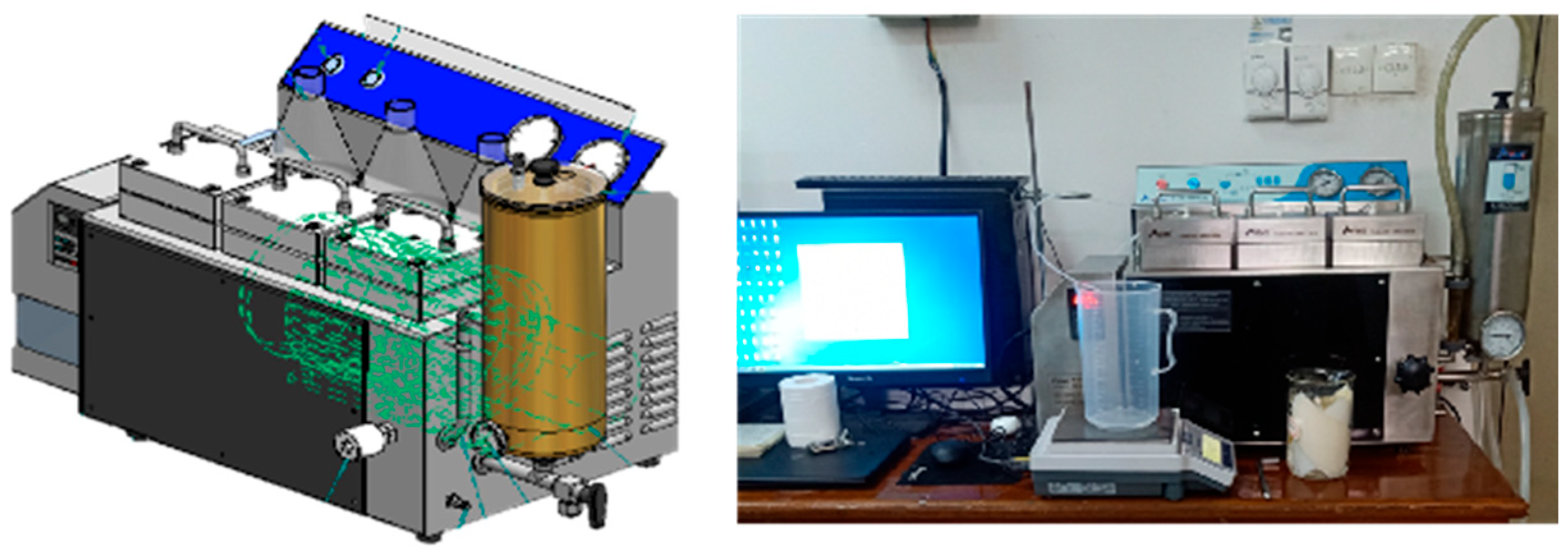
2.1. Laboratory-Scale RO Setup and RO Membranes
2.2. Wastewater Sample and Examination Methods
2.3. Batch RO Tests and Analytical Methods
- (1)
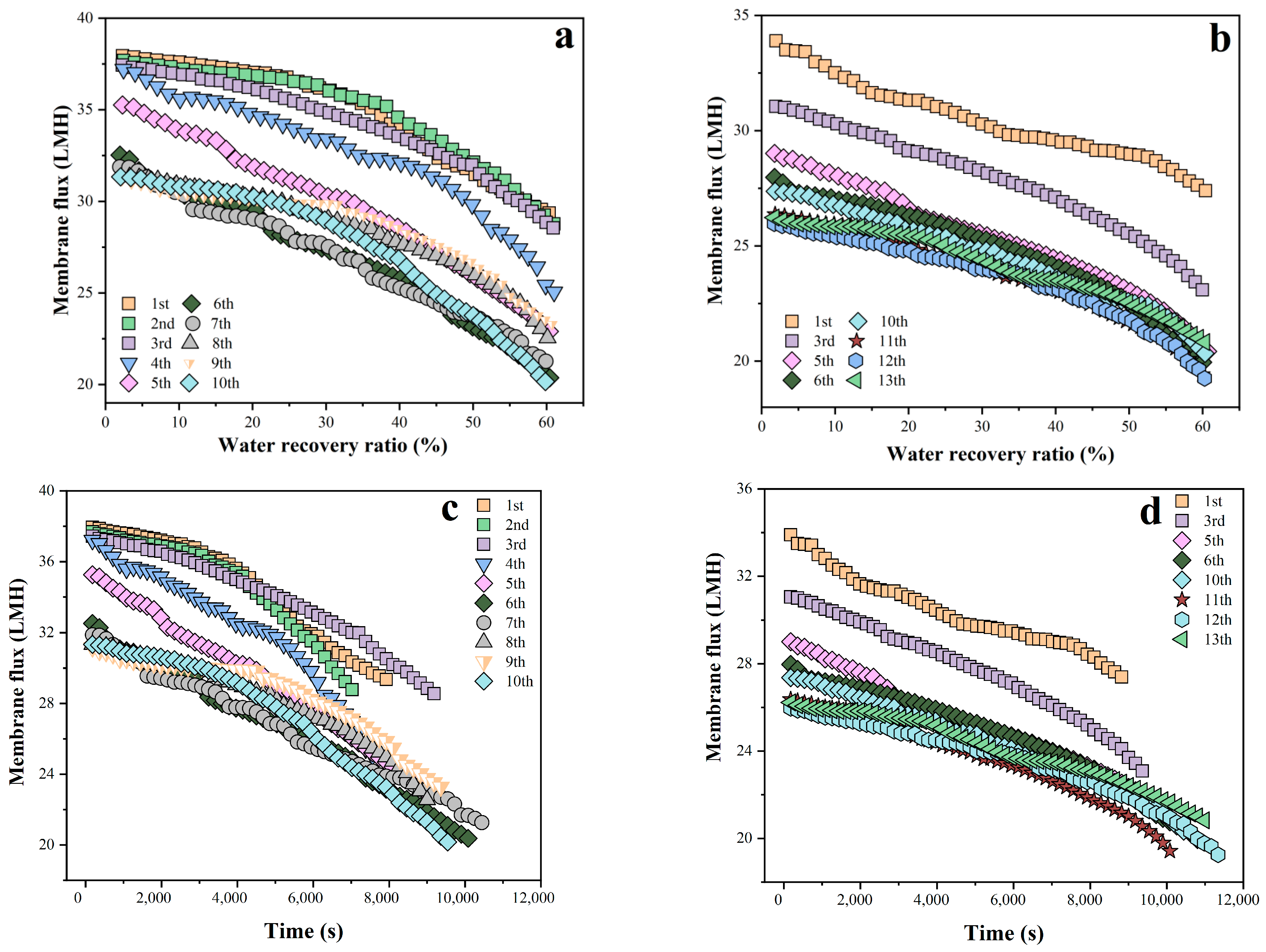
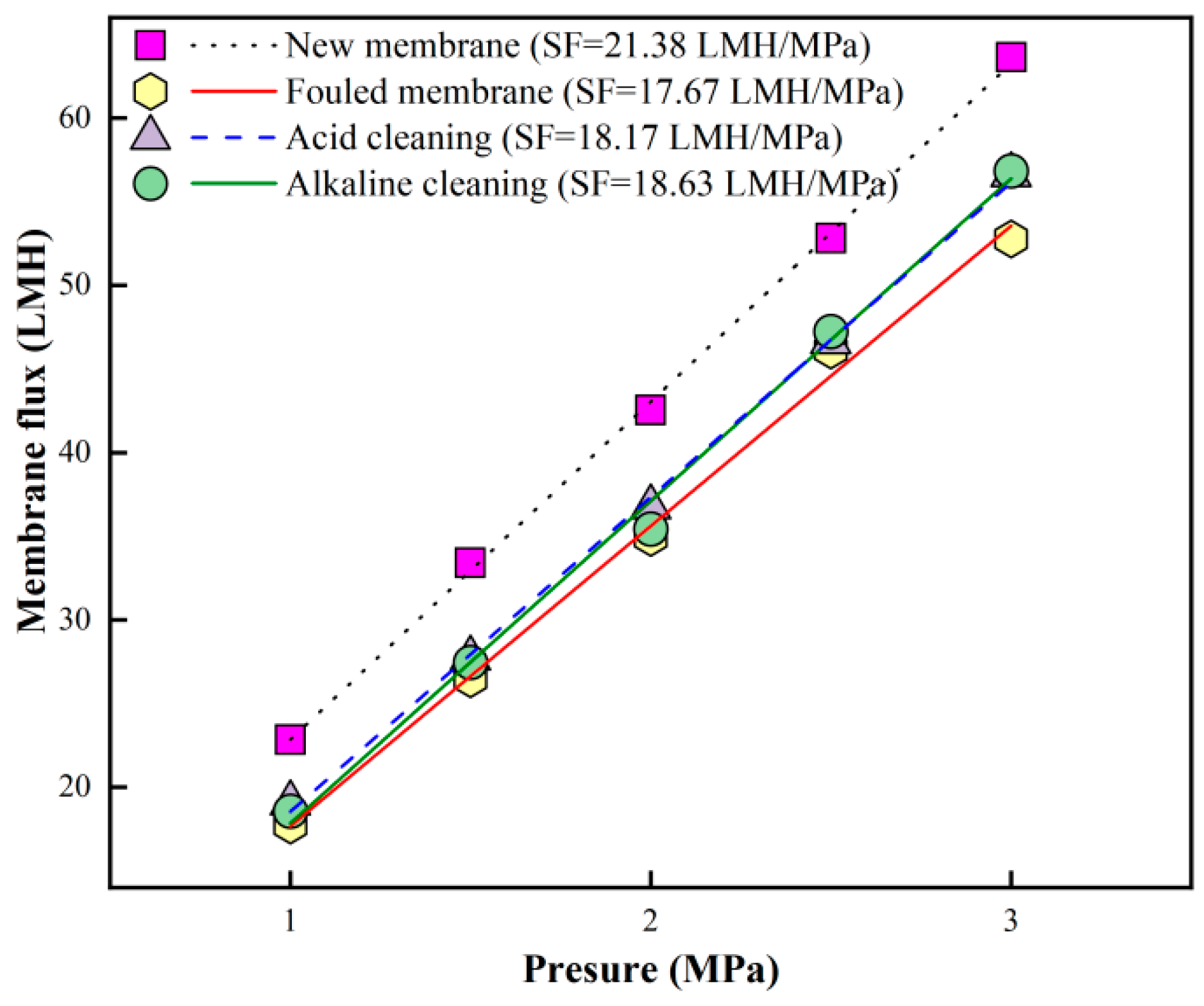
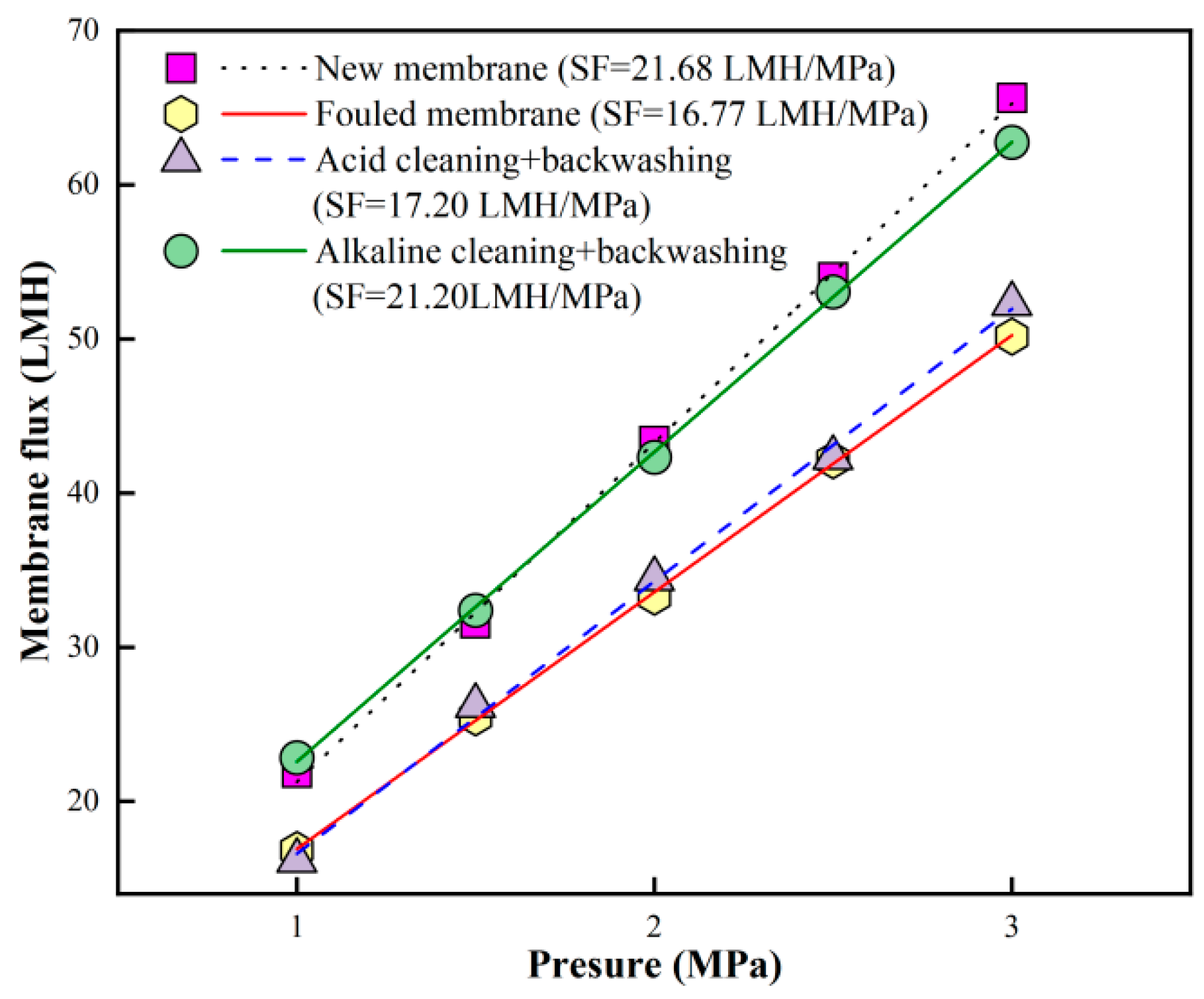
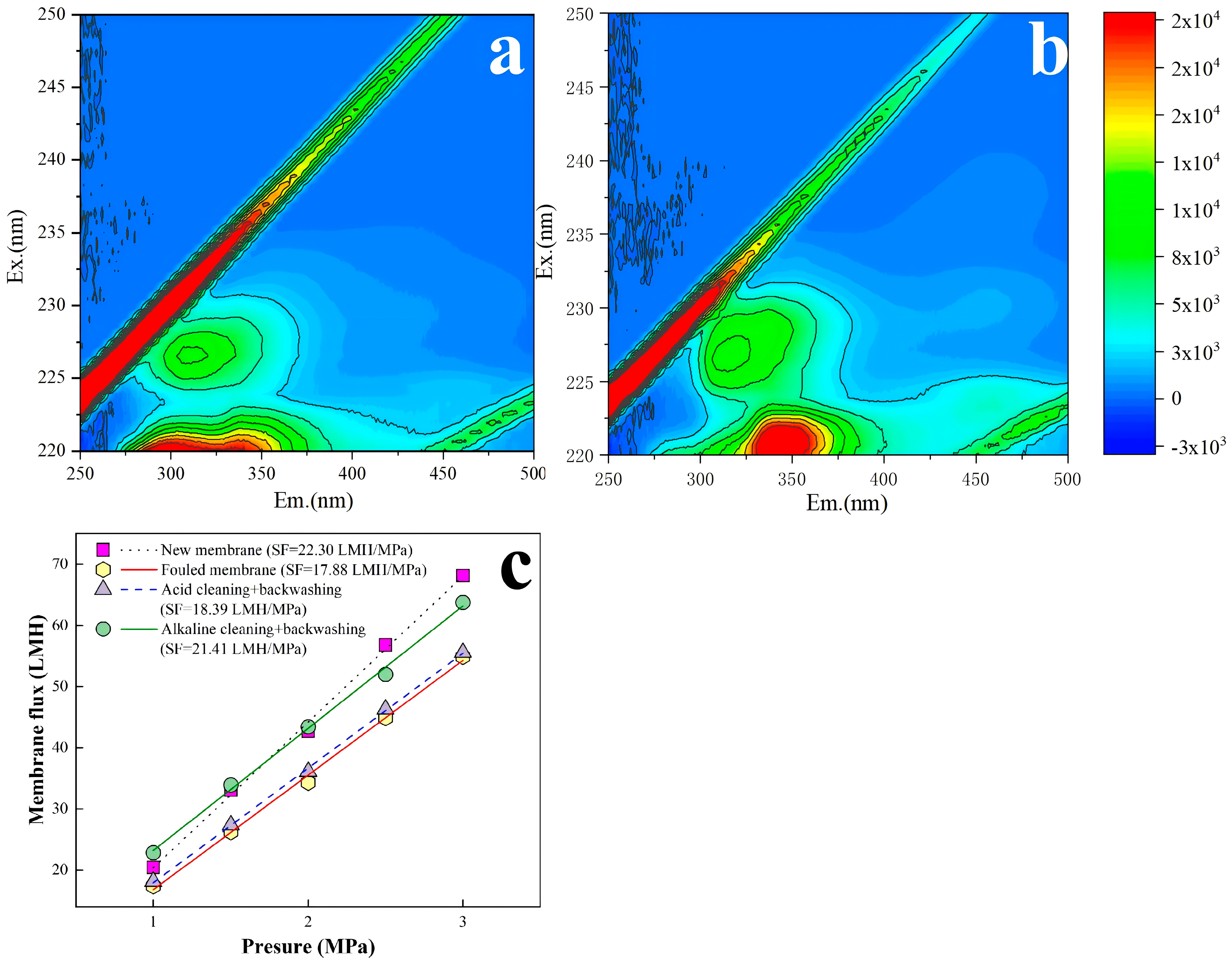
- RO Membrane Fouling Potential in TDFW Reuse. This stage focused on multi-batch filtration at an operating pressure (TMP) of 2 MPa, crossflow velocity (CFV) of 1.0 m/s, temperature of 20 °C, and each batch running until 60% water recovery. The aim was to identify the filtration volume per unit membrane area or filtration batches at which significant RO membrane fouling occurred (i.e., relative permeability decrease by 15% prior to membrane cleaning according to the general practice for RO industry) [28,29,30], thereby establishing an experimental basis for subsequent membrane cleaning studies. The specific flux (i.e., the linear slope of flux vs. TMP, SF) of new, fouled, and cleaned RO membranes was measured via filtration test using pure water, under a temperature of 20 °C, a CFV of 1 m/s, and different TMP of 0.5–2.5 MPa.
- (2)
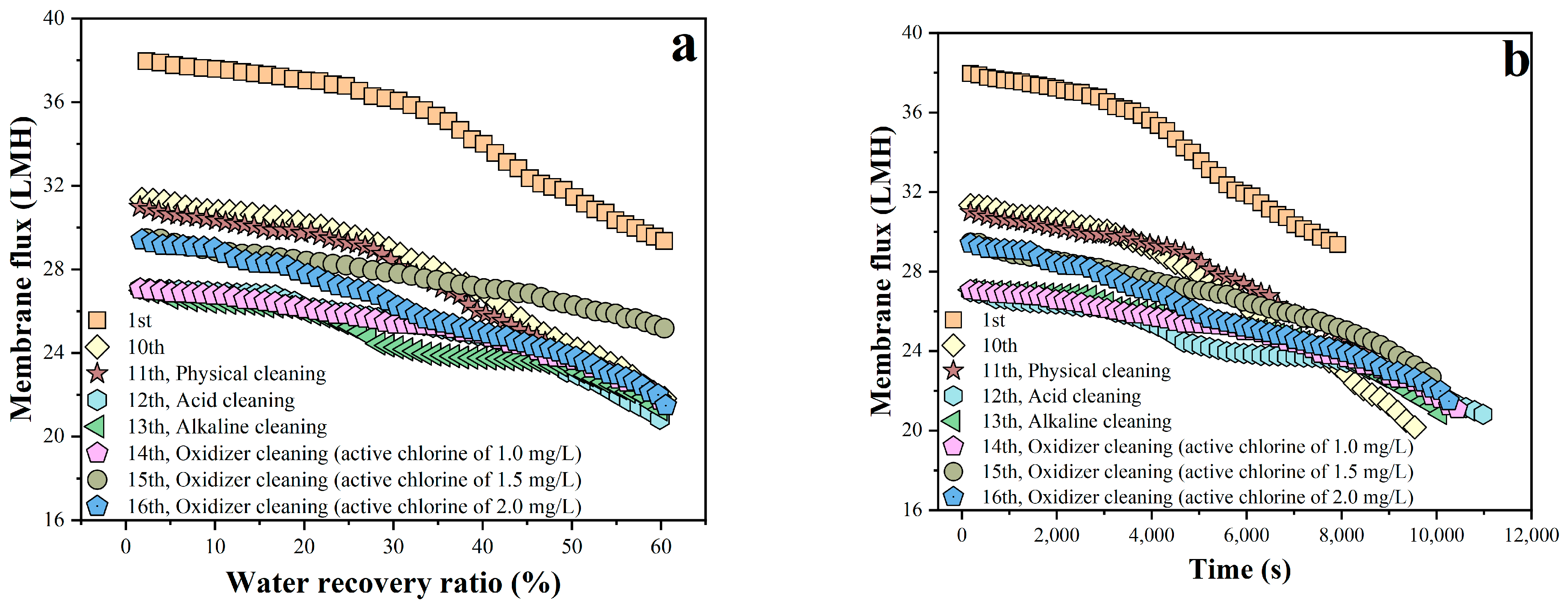
- Testing and Optimization of Membrane Cleaning Program. For the above-mentioned fouled RO membranes, the single forward flushing with pure water, acid solution, alkaline solution, and sodium hypochlorite with low active chlorine concentration was conducted with the details shown in Table 2. Combined forward flushing was further conducted, with the details shown in Table 3. The forward flushing was conducted via circulating cleaning solution along RO membrane surface and stopping filtration.
- (3)
- Exploration of Optimal Backwashing Conditions. Based on previous studies [31,32] and the above-mentioned backwashing results, backwashing with improper TMP or CFV could deteriorate RO membrane rejection capability. Therefore, further optimization of backwashing parameters was conducted. Under the constant conditions of 20 °C, CFV 1 m/s, and 40 min, different backwashing TMP of 0.5, 0.25, and 0.125 MPa were firstly compared to identify the optimal TMP. Then, under the constant conditions of 20 °C, 0.125 MPa, and 40 min, different CFV of 1.5, 1.0, and 0.5 m/s were further compared to determine the optimal CFV.
- (4)
- Demonstration of the Optimal Combined Cleaning Method. Following the above-mentioned investigation, the optimal combined acid → alkaline forward flushing with pure water backwashing was employed for the fouled RO membrane after 6 batches of filtration to demonstrate its cleaning performance.
3. Results and Discussion
3.1. RO Membrane Fouling Potential for TDFW Reuse Application
3.2. Testing and Optimization of Fouled RO Membrane Cleaning Program
3.3. Exploration of Optimal Backwashing Conditions
3.4. Demonstration of the Optimal Combined Cleaning Method
4. Conclusions
Author Contributions
Funding
Institutional Review Board Statement
Data Availability Statement
Acknowledgments
Conflicts of Interest
References
- Wang, J.; Xing, J.; Li, G.; Yao, Z.; Ni, Z.; Wang, J.; Liang, S.; Zhou, Z.; Zhang, L. How to extend the lifetime of RO membrane? From the perspective of the end-of-life RO membrane autopsy. Desalination 2023, 561, 116702. [Google Scholar] [CrossRef]
- Yu, W.; Song, D.; Chen, W.; Yang, H. Antiscalants in RO membrane scaling control. Water Res. 2020, 183, 115985. [Google Scholar] [CrossRef]
- Tay, M.F.; Liu, C.; Cornelissen, E.R.; Wu, B.; Chong, T.H. The feasibility of nanofiltration membrane bioreactor (NF-MBR) + reverse osmosis (RO) process for water reclamation: Comparison with ultrafiltration membrane bioreactor (UF-MBR) + RO process. Water Res. 2017, 129, 180–189. [Google Scholar] [CrossRef]
- Yamamoto, K.; Koge, S.; Gunji, T.; Kanezashi, M.; Tsuru, T.; Ohshita, J. Preparation of POSS-derived robust RO membranes for water desalination. Desalination 2017, 404, 322–327. [Google Scholar] [CrossRef]
- Zhou, C.Q.; Gu, H.K.; Wei, C.H.; Rong, H.W.; Ng, H.Y. Dyeing and finishing wastewater treatment via a low-cost hybrid process of hydrolysis-acidification and alternately anoxic/oxic sequencing batch reactor with synchronous coagulation. J. Water Process Eng. 2022, 49, 12. [Google Scholar] [CrossRef]
- Ewuzie, U.; Saliu, O.D.; Dulta, K.; Ogunniyi, S.; Bajeh, A.O.; Iwuozor, K.O.; Ighalo, J.O. A review on treatment technologies for printing and dyeing wastewater (PDW). J. Water Process Eng. 2022, 50, 103273. [Google Scholar] [CrossRef]
- Xu, H.; Zhang, H.; Huang, J.; Zhang, L.; Wang, F.; Liu, G.; Yu, X.; Liu, W.; Huang, C. Optimization of Fenton combined with membrane bioreactor in the treatment of printing and dyeing wastewater. Int. Biodeterior. Biodegrad. 2024, 196, 105945. [Google Scholar] [CrossRef]
- Myung, S.W.; Choi, I.H.; Lee, S.H.; Kim, I.C.; Lee, K.H. Use of fouling resistant nanofiltration and reverse osmosis membranes for dyeing wastewater effluent treatment. Water Sci. Technol. 2005, 51, 159–164. [Google Scholar] [CrossRef] [PubMed]
- Xu, L.; Li, W.; Lu, S.; Wang, Z.; Zhu, Q.; Ling, Y. Treating dyeing waste water by ceramic membrane in crossflow microfiltration. Desalination 2002, 149, 199–203. [Google Scholar] [CrossRef]
- Kim, I.-C.; Lee, K.-H. Dyeing process wastewater treatment using fouling resistant nanofiltration and reverse osmosis membranes. Desalination 2006, 192, 246–251. [Google Scholar] [CrossRef]
- Huang, C.; Zhang, H.; Huang, J.; Zhang, L.; Tong, S.; Wang, F.; Liu, G.; Yu, X.; Xu, H.; Liu, W. Performance of anoxic and aerobic flocs in anoxic/aerobic-membrane bioreactor (A/O–MBR) for the treatment of printing and dyeing wastewater (PDW). Biochem. Eng. J. 2025, 225, 109943. [Google Scholar] [CrossRef]
- Liu, G.; Zhang, H.; Huang, J.; Zhang, L.; Zhang, T.; Yu, X.; Liu, W.; Huang, C. Treatment of printing and dyeing wastewater using Fenton combined with ceramic microfiltration membrane bioreactor. Biochem. Eng. J. 2023, 201, 109143. [Google Scholar] [CrossRef]
- Lai, Y.; Xu, H.; Xiao, K.; Wei, C.; Huang, X. Unravelling essential factors of membrane organic fouling via source apportionment analysis of FTIR features. Sep. Purif. Technol. 2025, 380, 135464. [Google Scholar] [CrossRef]
- Wei, C.-H.; Sun, C.-X.; Chen, Z.-B.; Tang, X.; Kuang, K.; Yu, H.-R.; Rong, H.-W.; Xiao, K.; Ngo, H.H.; Huang, X. Membrane fouling analysis and chemical cleaning optimization via membrane autopsy for membrane bioreactor from lab to engineering application. Sep. Purif. Technol. 2025, 377, 134414. [Google Scholar] [CrossRef]
- Wei, C.-H.; Wang, Z.-W.; Dai, J.-H.; Xiao, K.; Yu, H.-R.; Qu, F.-S.; Rong, H.-W.; He, J.-G.; Ngo, H.H. Enhanced anaerobic digestion performance and sludge filterability by membrane microaeration for anaerobic membrane bioreactor application. Bioresour. Technol. 2024, 402, 130787. [Google Scholar] [CrossRef] [PubMed]
- Ćurić, I.; Dolar, D.; Bošnjak, J. Reuse of textile wastewater for dyeing cotton knitted fabric with hybrid treatment: Coagulation/sand filtration/UF/NF-RO. J. Environ. Manag. 2021, 295, 113133. [Google Scholar] [CrossRef] [PubMed]
- Srisukphun, T.; Chiemchaisri, C.; Urase, T.; Yamamoto, K. Experimentation and modeling of foulant interaction and reverse osmosis membrane fouling during textile wastewater reclamation. Sep. Purif. Technol. 2009, 68, 37–49. [Google Scholar] [CrossRef]
- Zeng, Q.; Wang, Y.; Zan, F.; Khanal, S.K.; Hao, T. Biogenic sulfide for azo dye decolorization from textile dyeing wastewater. Chemosphere 2021, 283, 131158. [Google Scholar] [CrossRef]
- Ma, H.; Yu, L.; Yang, L.; Yao, Y.; Shen, G.; Wang, Y.; Li, B.; Meng, J.; Miao, M.; Zhi, C. Graphene oxide composites for dye removal in textile, printing and dyeing wastewaters: A review. Environ. Chem. Lett. 2024, 23, 165–193. [Google Scholar] [CrossRef]
- Jang, Y.; Cho, H.; Shin, Y.; Choi, Y.; Lee, S.; Koo, J. Comparison of fouling propensity and physical cleaning effect in forward osmosis, reverse osmosis, and membrane distillation. Desalin. Water Treat. 2016, 57, 24532–24541. [Google Scholar] [CrossRef]
- Ma, Z.; Shu, G.; Lu, X. Preparation of an antifouling and easy cleaning membrane based on amphiphobic fluorine island structure and chemical cleaning responsiveness. J. Membr. Sci. 2020, 611, 118403. [Google Scholar] [CrossRef]
- Lee, E.-J.; An, A.K.J.; Hadi, P.; Yan, D.Y.S.; Kim, H.-S. A mechanistic study ofin situchemical cleaning-in-place for a PTFE flat sheet membrane: Fouling mitigation and membrane characterization. Biofouling 2016, 32, 301–312. [Google Scholar] [CrossRef]
- Malczewska, B.; Żak, A. Structural Changes and Operational Deterioration of the Uf Polyethersulfone (Pes) Membrane Due to Chemical Cleaning. Sci. Rep. 2019, 9, 422. [Google Scholar] [CrossRef] [PubMed]
- Ouyang, R.L.; Huang, B.; Wei, C.H.; Rong, H.W.; Yu, H.R.; Qu, F.S.; Xiao, K.; Huang, X. Cake Layer Fouling Potential Characterization for Wastewater Reverse Osmosis via Gradient Filtration. Membranes 2022, 12, 810. [Google Scholar] [CrossRef]
- Xi, D.L.; Lin, L.; Chen, J.H.; Ma, C.Y. FZ/T 01107-2011; Textile Industry Standards of the People’s Republic of China: Reusing Water for Textile Dyeing and Finishing. Standards Press of China: Beijing, China, 2011.
- Rice, E.W.; Baird, R.B.; Eaton, A.D. (Eds.) Standard Methods for the Examination of Water and Wastewater, 23rd ed.; American Public Health Association: Washington, DC, USA; American Water Works Association: Denver, CO, USA; Water Environment Federation: Alexandria, VA, USA, 2017. [Google Scholar]
- Jacquin, C.; Lesage, G.; Traber, J.; Pronk, W.; Heran, M. Three-dimensional excitation and emission matrix fluorescence (3DEEM) for quick and pseudo-quantitative determination of protein- and humic-like substances in full-scale membrane bioreactor (MBR). Water Res. 2017, 118, 82–92. [Google Scholar] [CrossRef]
- Burlace, L.; Davies, P.A. Fouling and fouling mitigation in batch reverse osmosis: Review and outlook. Desalin. Water Treat. 2022, 249, 1–22. [Google Scholar] [CrossRef]
- Wang, H.L.; Wang, L.N.; Li, E.C.; Dai, R.B.; Wang, Z.W. Efficacies and mechanisms of different cleaning strategies for NF and RO membranes in a full-scale zero liquid discharge system. J. Water Process Eng. 2023, 56, 11. [Google Scholar] [CrossRef]
- Tayeh, Y.A.; Alazaiza, M.Y.D.; Alzghoul, T.M.; Bashir, M.J.K. A comprehensive review of RO membrane fouling: Mechanisms, categories, cleaning methods and pretreatment technologies. J. Hazard. Mater. Adv. 2025, 18, 100684. [Google Scholar] [CrossRef]
- Hoek, E.M.V.; Weigand, T.M.; Edalat, A. Reverse osmosis membrane biofouling: Causes, consequences and countermeasures. Npj Clean Water 2022, 5, 45. [Google Scholar] [CrossRef]
- Zhang, W.; Xu, X.; Zhang, G.; Jin, S.; Dong, L.; Gu, P. Treatment of Membrane Cleaning Wastewater from Thermal Power Plant Using Membrane Bioreactor. Membranes 2022, 12, 755. [Google Scholar] [CrossRef] [PubMed]
- Yu, H.; Shangguan, S.; Xie, C.; Yang, H.; Wei, C.; Rong, H.; Qu, F. Chemical Cleaning and Membrane Aging in MBR for Textile Wastewater Treatment. Membranes 2022, 12, 704. [Google Scholar] [CrossRef]
- Verbeke, R.; Gómez, V.; Vankelecom, I.F.J. Chlorine-resistance of reverse osmosis (RO) polyamide membranes. Prog. Polym. Sci. 2017, 72, 1–15. [Google Scholar] [CrossRef]
- Liu, C.; Wang, W.J.; Yang, B.; Xiao, K.; Zhao, H.Z. Separation, anti-fouling, and chlorine resistance of the polyamide reverse osmosis membrane: From mechanisms to mitigation strategies. Water Res. 2021, 195, 116976. [Google Scholar] [CrossRef] [PubMed]
- Yao, Y.J.; Zhang, P.X.; Sun, F.; Zhang, W.; Li, M.; Sha, G.; Teng, L.; Wang, X.Z.; Huo, M.X.; DuChanois, R.M.; et al. More resilient polyester membranes for high-performance reverse osmosis desalination. Science 2024, 384, 333–338. [Google Scholar] [CrossRef]
- Gryta, M.; Woźniak, P. Impact of Long-Term Alkaline Cleaning on Ultrafiltration Tubular PVDF Membrane Performances. Membranes 2025, 15, 192. [Google Scholar] [CrossRef]
- Tshimange, M.; Xabela, S.; Enos, S.; Nguyen, T.-T.; Pocock, J.; Getahun, S.T.; Lee, J.; Gadkari, S. Advances in forward osmosis membrane cleaning: Strategies, challenges, and future directions. J. Water Process Eng. 2025, 75, 108004. [Google Scholar] [CrossRef]
- Ang, W.S.; Yip, N.Y.; Tiraferri, A.; Elimelech, M. Chemical cleaning of RO membranes fouled by wastewater effluent: Achieving higher efficiency with dual-step cleaning. J. Membr. Sci. 2011, 382, 100–106. [Google Scholar] [CrossRef]
- Daly, S.; Allen, A.; Koutsos, V.; Semião, A.J.C. Influence of organic fouling layer characteristics and osmotic backwashing conditions on cleaning efficiency of RO membranes. J. Membr. Sci. 2020, 616, 118604. [Google Scholar] [CrossRef]
- Das, A.; Rao, A.K.; Alnajdi, S.; Warsinger, D.M. Pressure exchanger batch reverse osmosis with zero downtime operation. Desalination 2024, 574, 16. [Google Scholar] [CrossRef]
- Chowdhury, M.R.; Steffes, J.; Huey, B.D.; McCutcheon, J.R. 3D printed polyamide membranes for desalination. Science 2018, 361, 682–686. [Google Scholar] [CrossRef]
- Freger, V.; Ramon, G.Z. Polyamide desalination membranes: Formation, structure, and properties. Prog. Polym. Sci. 2021, 122, 101451. [Google Scholar] [CrossRef]
- Di, H.; Martin, G.J.O.; Dunstan, D.E. Characterization of particle deposition during crossflow filtration as influenced by permeate flux and crossflow velocity using a microtiuidic filtration system. Front. Chem. Sci. Eng. 2020, 15, 552–561. [Google Scholar] [CrossRef]
- Suwarno, S.R.; Chen, X.; Chong, T.H.; McDougald, D.; Cohen, Y.; Rice, S.A.; Fane, A.G. Biofouling in reverse osmosis processes: The roles of flux, crossflow velocity and concentration polarization in biofilm development. J. Membr. Sci. 2014, 467, 116–125. [Google Scholar] [CrossRef]



| Water Type | pH | COD (mg/L) | TOC (mg/L) | SS (mg/L) | Chroma (Dilution Times) | Fe (mg/L) | Mn (mg/L) | Total Hardness as CaCO3 (mg/L) | Conductivity (mS/cm) |
|---|---|---|---|---|---|---|---|---|---|
| RO feed | 8.52 | 80 | 12 | 0 | 95 | 0.27 | 0.06 | 422 | 8.82 |
| Reuse standard | 6.5–8.5 | ≤50 | - | ≤30 | ≤25 | ≤0.3 | ≤0.2 | ≤450 | ≤2.5 |
| Cleaning Types | Physical Cleaning | Acid Cleaning | Alkaline Cleaning | Oxidizer Cleaning |
|---|---|---|---|---|
| Cleaning solution | Pure water | Nitric acid solution with a pH of 3.5 | Commercial alkaline cleaning agents with a mass concentration of approximately 0.5%, adjusted to a pH of 10.5 | Sodium hypochlorite solutions with active chlorine concentration of 1.0, 1.5, and 2.0 mg/L, respectively |
| Operating conditions | CFV 1.5 m/s, 20 °C, 40-min circulating cleaning | CFV 1.0 m/s, 35 °C, 40 min circulating cleaning | CFV 1.0 m/s, 30 °C, 40 min circulating cleaning | |
| Cleaning Types | Acid → Alkaline Forward Flushing (Plan 1) | Acid → Alkaline Forward Flushing with Pure Water Backwashing (Plan 2) | ||
|---|---|---|---|---|
| Cleaning solution | 1% citric acid, pH = 2, 30 ± 2 °C | 2% sodium tripolyphosphate (STPP), 1% EDTA, 0.3% NaOH, 0.02% sodium dodecylbenzenesulfonate (SDBS), pH = 11.5, 35 ± 2 °C | 1% citric acid, pH = 2, 30 ± 2 °C | 2% STPP, 1% EDTA, 0.3% NaOH, 0.02% SDBS, pH = 11.5, 35 ± 2 °C |
| Operating conditions | Circulating the fouled membrane in a low-flow acid/alkaline flushing at CFV 0.75 m/s for 30/60 min with pH 2/11.5. Subsequently, halting the system and immersing the fouled membrane in an acid/alkaline solution for 1/2 h). Then, restarting the system and circulating the membrane in a high-flow pure water flushing at CFV 1.5 m/s for 0.5/1 h. | Pure water backwashing for 40 min at 0.5 MPa, 20 °C and CFV 1.5 m/s serves as the subsequent step for each cleaning phase in Plan 1. | ||
| Batch No. | 1 | 2 | 3 | 4 | 5 | 6 | 7 | 8 | 9 | 10 | 11 | 12 | 13 |
|---|---|---|---|---|---|---|---|---|---|---|---|---|---|
| Average RO flux (LMH) | 34.52 | 34.69 | 33.95 | 32.34 | 29.35 | 26.52 | 26.50 | 28.16 | 28.45 | 27.13 | - | - | - |
| 30.38 | 28.30 | 27.71 | 25.97 | 25.03 | 24.59 | 25.89 | 25.90 | 25.72 | 24.35 | 23.60 | 23.43 | 24.02 |
| Batch No. | 1 | 10 | 11 | 12 | 13 | 14 | 15 | 16 |
|---|---|---|---|---|---|---|---|---|
| Cleaning method | - | - | Physical | Acid | Alkaline | Oxidizer with active chlorine of 1.0 mg/L | Oxidizer with active chlorine of 1.5 mg/L | Oxidizer with active chlorine of 2.0 mg/L |
| Average flux (LMH) | 34.52 | 27.13 | 28.31 | 24.36 | 25.11 | 24.90 | 26.77 | 25.92 |
| Chemicals | Concentration (g/L) | Volume per RO Membrane Area (L/m2) | Price * (CNY/kg) | Production per RO Membrane Area Before Cleaning (L/m2) | Cost per RO Production (CNY/m3) | Cost Ratio (%) |
|---|---|---|---|---|---|---|
| Critic acid | 10 | 2 | 3.5 | 750 | 0.093 | 12.2 |
| STPP | 20 | 6.1 | 0.325 | 42.6 | ||
| EDTA | 10 | 12 | 0.320 | 41.9 | ||
| NaOH | 3 | 2.1 | 0.017 | 2.2 | ||
| SDBS | 0.2 | 15 | 0.008 | 1.1 | ||
| Total | - | - | - | - | 0.763 | 100 |
Disclaimer/Publisher’s Note: The statements, opinions and data contained in all publications are solely those of the individual author(s) and contributor(s) and not of MDPI and/or the editor(s). MDPI and/or the editor(s) disclaim responsibility for any injury to people or property resulting from any ideas, methods, instructions or products referred to in the content. |
© 2026 by the authors. Licensee MDPI, Basel, Switzerland. This article is an open access article distributed under the terms and conditions of the Creative Commons Attribution (CC BY) license.
Share and Cite
Wang, Z.; Ouyang, R.; Zhang, G.; Wei, C.; Ji, S.; Li, Q.; Tao, C.; Rong, H. Reverse Osmosis Membrane Cleaning Optimization from Textile Dyeing Wastewater Reuse Applications. Membranes 2026, 16, 29. https://doi.org/10.3390/membranes16010029
Wang Z, Ouyang R, Zhang G, Wei C, Ji S, Li Q, Tao C, Rong H. Reverse Osmosis Membrane Cleaning Optimization from Textile Dyeing Wastewater Reuse Applications. Membranes. 2026; 16(1):29. https://doi.org/10.3390/membranes16010029
Chicago/Turabian StyleWang, Zhengwei, Rulu Ouyang, Guorui Zhang, Chunhai Wei, Shiming Ji, Qixuan Li, Chunyang Tao, and Hongwei Rong. 2026. "Reverse Osmosis Membrane Cleaning Optimization from Textile Dyeing Wastewater Reuse Applications" Membranes 16, no. 1: 29. https://doi.org/10.3390/membranes16010029
APA StyleWang, Z., Ouyang, R., Zhang, G., Wei, C., Ji, S., Li, Q., Tao, C., & Rong, H. (2026). Reverse Osmosis Membrane Cleaning Optimization from Textile Dyeing Wastewater Reuse Applications. Membranes, 16(1), 29. https://doi.org/10.3390/membranes16010029