
Perfluorooctanesulfonate Can Cause Negative Bias in Creatinine Measurement in Hemodialysis Patients Using Polysulfone Dialysis Membranes
 ,
,  ,
,  , , ,
, , ,
Abstract
:1. Introduction
2. Materials and Methods
2.1. Inclusion and Exclusion Criteria
2.2. Clinical and Biochemistry Data Collection
2.3. Statistical Analysis
3. Results
4. Discussion
5. Conclusions
Supplementary Materials
Author Contributions
Funding
Institutional Review Board Statement
Informed Consent Statement
Data Availability Statement
Conflicts of Interest
References
- Ocampo, J.H.; Rosales, A.T.; Castellanos, F.R. Comparison of Four Methods for Measuring Glomerular Filtration Rate by Inulin Clearance in Healthy Individuals and Patients with Renal Failure. Nefrologia 2010, 30, 324–330. [Google Scholar] [CrossRef]
- Schwartz, G.J.; Furth, S.L. Glomerular filtration rate measurement and estimation in chronic kidney disease. Pediatr. Nephrol. 2007, 22, 1839–1848. [Google Scholar] [CrossRef] [PubMed]
- Bjornsson, T.D. Use of serum creatinine concentrations to determine renal function. Clin. Pharmacokinet. 1979, 4, 200–222. [Google Scholar] [CrossRef]
- Weber, J.A.; Vanzanten, A.P. Interferences in current methods for measurements of creatinine. Clin. Chem. 1991, 37, 695–700. [Google Scholar] [CrossRef] [PubMed]
- Blass, K.G.; Thibert, R.J.; Lam, L.K. Study of Mechanism of Jaffe Reaction. Z. Fur Klin. Chem. Und Klin. Biochem. 1974, 12, 336–343. [Google Scholar] [CrossRef] [PubMed]
- Gottschalk, E.M.; Holdt-Lehmann, B.; Bastian, M.; Schmitz, R.A.; Schuff-Werner, P. Automatisation and interference testing of a new creatinine assay using recombinant creatinine deiminase. Clin. Chem. 2004, 50, A27. [Google Scholar]
- Tsikas, D.; Wolf, A.; Mitschke, A.; Gutzki, F.-M.; Will, W.; Bader, M. GC-MS determination of creatinine in human biological fluids as pentafluorobenzyl derivative in clinical studies and biomonitoring: Inter-laboratory comparison in urine with Jaffe, HPLC and enzymatic assays. J. Chromatogr. B 2010, 878, 2582–2592. [Google Scholar] [CrossRef]
- Booth, C.J.; Naidoo, D.; Rosenberg, A.R.; Kainer, G. Elevated creatinine after ingestion of model aviation fuel: Interference with the Jaffe reaction by nitromethane. J. Paediatr. Child Health 1999, 35, 503–504. [Google Scholar] [CrossRef]
- Bruns, D.E. Lactulose interferes in the alkaline picrate assay for creatinine. Clin. Chem. 1988, 34, 2592–2593. [Google Scholar] [CrossRef]
- Deleacy, E.A.; Brown, N.N.; Clague, A.E. Nitromethane interferes in assay of creatinine by the Jaffé reaction. Clin. Chem. 1989, 35, 1772–1774. [Google Scholar] [CrossRef]
- Feld, L.G.; Langford, D.J.; Schwartz, G.J. The effect of neonatal hyperbilirubinemia on the measurement of plasma creatinine. Clin. Pediatr. 1984, 23, 154–156. [Google Scholar] [CrossRef] [PubMed]
- Guy, J.M.; Legg, E.F. An improved cation exchange HPLC method for the measurement of serum creatinine. Ann. Clin. Biochem. 1990, 27, 223–226. [Google Scholar] [CrossRef] [PubMed]
- Linnet, K.; Bruunshuus, I. HPLC with enzymatic detection as a candidate reference method for serum creatinine. Clin. Chem. 1991, 37, 1669–1675. [Google Scholar] [CrossRef] [PubMed]
- Seronie-Vivien, S.; Galteau, M.M.; Carlier, M.C.; Hadj-Aissa, A.; Hanser, A.M.; Hym, B.; Marchal, A.; Michotey, O.; Pouteil-Noble, C.; Sternberg, M.; et al. Improving the interlaboratory variation for creatinine serum assay. Ann. Biol. Clin. 2004, 62, 165–175. [Google Scholar]
- Yuen, P.S.T.; Dunn, S.R.; Miyaji, T.; Yasuda, H.; Sharma, K.; Star, R.A. A simplified method for HPLC determination of creatinine in mouse serum. Am. J. Physiol.-Renal Physiol. 2004, 286, F1116–F1119. [Google Scholar] [CrossRef]
- Kikuchi, K.; Itoh, Y.; Tateoka, R.; Ezawa, A.; Murakami, K.; Niwa, T. Metabolomic search for uremic toxins as indicators of the effect of an oral sorbent AST-120 by liquid chromatography/tandem mass spectrometry. J. Chromatogr. B 2010, 878, 2997–3002. [Google Scholar] [CrossRef]
- Myers, G.L.; Miller, W.G.; Coresh, J.; Fleming, J.; Greenberg, N.; Greene, T.; Hostetter, T.; Levey, A.S.; Panteghini, M.; Welch, M.; et al. Recommendations for improving serum creatinine measurement: A report from the laboratory working group of the National Kidney Disease Education Program. Clin. Chem. 2006, 52, 5–18. [Google Scholar] [CrossRef]
- Liu, W.S.; Chung, Y.T.; Yang, C.Y.; Lin, C.C.; Tsai, K.H.; Yang, W.C.; Chen, T.W.; Lai, Y.T.; Li, S.Y.; Liu, T.Y. Serum creatinine determined by Jaffe, enzymatic method, and isotope dilution-liquid chromatography-mass spectrometry in patients under hemodialysis. J. Clin. Lab. Anal. 2012, 26, 206–214. [Google Scholar] [CrossRef]
- Liu, W.S.; Lai, Y.T.; Chan, H.L.; Li, S.Y.; Lin, C.C.; Liu, C.K.; Tsou, H.H.; Liu, T.Y. Associations between perfluorinated chemicals and serum biochemical markers and performance status in uremic patients under hemodialysis. PLoS ONE 2018, 13, e0200271. [Google Scholar] [CrossRef]
- Coperchini, F.; Awwad, O.; Rotondi, M.; Santini, F.; Imbriani, M.; Chiovato, L. Thyroid disruption by perfluorooctane sulfonate (PFOS) and perfluorooctanoate (PFOA). J. Endocrinol. Investig. 2017, 40, 105–121. [Google Scholar] [CrossRef]
- Liu, W.S.; Chan, H.L.; Lai, Y.T.; Lin, C.C.; Li, S.Y.; Liu, C.K.; Tsou, H.H.; Liu, T.Y. Dialysis Membranes Influence Perfluorochemical Concentrations and Liver Function in Patients on Hemodialysis. Int. J. Environ. Res. Public Health 2018, 15, 2574. [Google Scholar] [CrossRef] [PubMed]
- Levey, A.S.; Titan, S.M.; Powe, N.R.; Coresh, J.; Inker, L.A. Kidney Disease, Race, and GFR Estimation. Clin. J. Am. Soc. Nephrol. 2020, 15, 1203–1212. [Google Scholar] [CrossRef] [PubMed]
- Zhang, W.; Ye, G.; Bi, Z.; Chen, W.; Qian, J.; Zhang, M.; Ding, D.; Wang, M.; Chen, J. Higher one-year achievement rate of serum phosphate associated with lower cardiovascular mortality in hemodialysis patients. BMC Nephrol. 2021, 22, 398. [Google Scholar] [CrossRef] [PubMed]
- Derkits, D.R.; Meggs, W.J.; Parker Cote, J.L. Trending of a falsely elevated serum creatinine after a pediatric nitromethane ingestion: A case report. J. Am. Coll. Emerg. Physicians Open 2022, 3, e12689. [Google Scholar] [CrossRef]
- Tsuruoka, S.; Sugimoto, K.I.; Hayasaka, T.; Saito, T.; Fujimura, A. Ranitidine clearance during hemodialysis with high-flux membrane: Comparison of polysulfone and cellulose acetate hemodialyzers. Eur. J. Clin. Pharmacol. 2000, 56, 581–583. [Google Scholar] [CrossRef]


| Serum Cr n = 124 | Pre-HD Mean | ±SD | t-Test (p) | Post-HD Mean | ±SD | t-Test (p) |
|---|---|---|---|---|---|---|
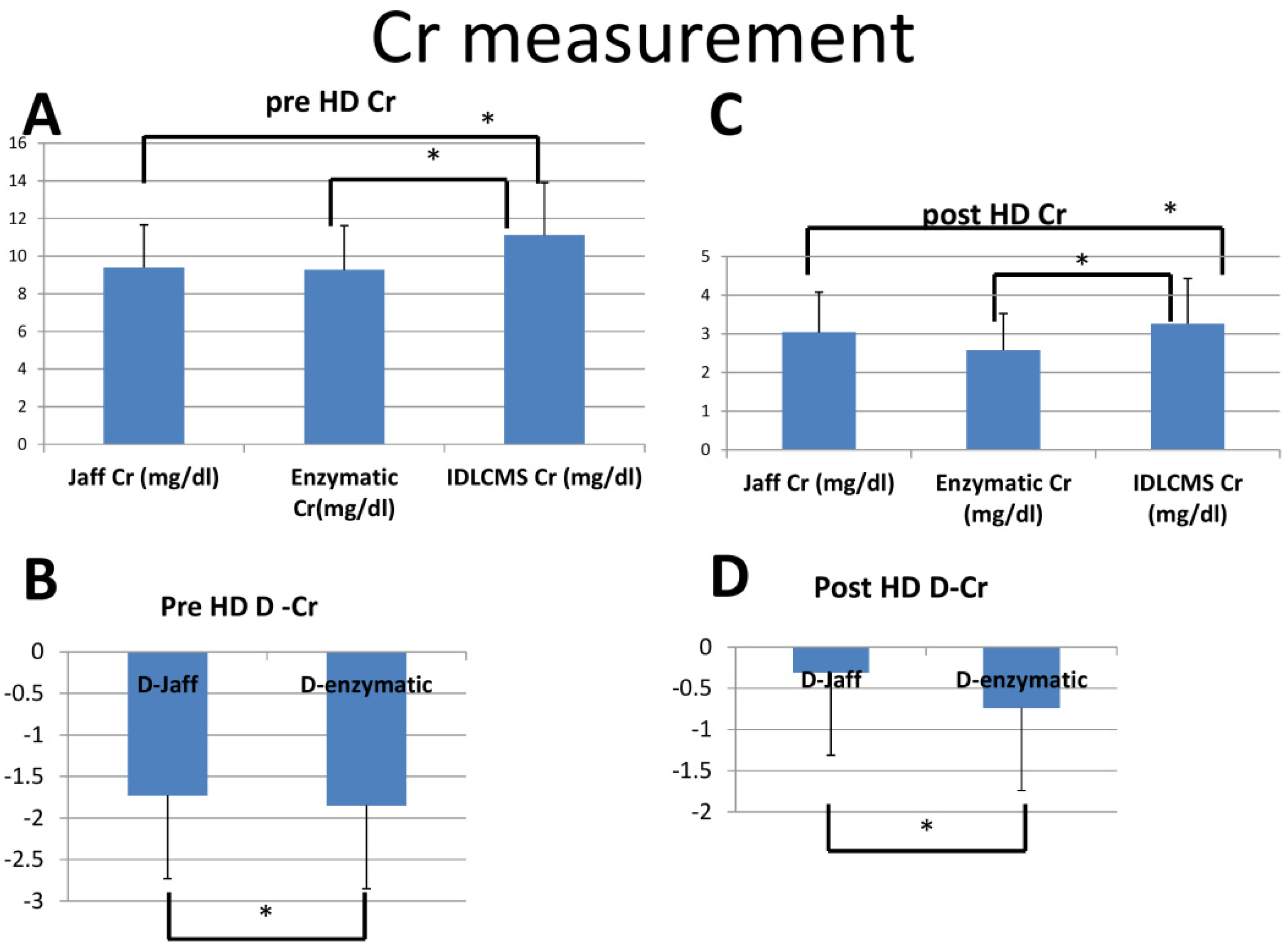
| Jaffe Cr (mg/dL) | 9.40 | 2.26 | <0.001 * | 3.04 | 1.04 | <0.001 * |
| Enzymatic Cr(mg/dL) | 9.27 | 2.34 | <0.001 * | 2.58 | 0.94 | <0.001 * |
| vs. IDLCMS Cr (mg/dL) as standard | 11.12 | 2.79 | 3.26 | 1.17 | ||
| D-Jaffe = Jaffe Cr − IDLCMS Cr | −1.73 | 0.86 | 0.023 * | −0.31 | 0.55 | <0.001 * |
| D-enzymatic = enzymatic Cr − IDLCMS Cr | −1.85 | 0.97 | −0.74 | 0.47 |
| N = 124 | n (%) | D-Jaffe | D-Enzymatic | |||
|---|---|---|---|---|---|---|
| Mean ± SD | p | Mean ± SD | p | |||
| Male | 72 (58.0%) | −1.79 ± 0.92 | 0.185 | −1.92 ± 1.06 | 0.172 | |
| Female | 52 (42.0%) | −1.59 ± 0.72 | −1.70 ± 0.77 | |||
| DM | 51 (41.1%) | −1.59 ± 0.81 | 0.126 | −1.73 ± 0.90 | 0.252 | |
| Non-DM | 73 (58.9%) | −1.82 ± 0.88 | −1.93 ± 1.01 | |||
| D-Jaffe | D-enzymatic | |||||
| Linear regression | Mean | ±SD | (β) | (p) | (β) | (p) |
| Dialysis duration (month) | 59.75 | 67.75 | 0.000 | 0.924 | 0.000 | 0.913 |
| Dialysis frequency (/week) | 2.98 | 0.12 | 0.423 | 0.483 | 0.679 | 0.702 |
| Dialysis time (hours) | 4.023 | 0.37 | −0.244 | 0.223 | −0.347 | 0.124 |
| Age (year) * | 59.75 | 14.79 | 0.018 | 0.001 * | 0.017 | 0.002 * |
| Jaffe Cr (mg/dL) * | 9.40 | 2.26 | −0.230 | 0.000 * | −0.186 | 0.000 * |
| Enzymatic Cr (mg/dL) * | 9.27 | 2.34 | −0.192 | 0.000 * | −0.120 | 0.001 * |
| IDLCMS Cr (mg/dL) * | 11.12 | 2.79 | −0.220 | 0.000 * | −0.206 | 0.000 * |
| Ccr (mL/min) * | 6.03 | 2.00 | 0.197 | 0.000 * | 0.166 | 0.000 * |
| WBC (×1000/μL) | 6.83 | 2.46 | 0.019 | 0.527 | 0.014 | 0.686 |
| RBC (×106/μL) | 3.36 | 0.50 | −0.242 | 0.099 | −0.285 | 0.084 |
| MCV (fl) | 91.17 | 7.23 | 0.002 | 0.856 | −0.009 | 0.429 |
| Hb (g/dL) * | 9.89 | 1.20 | −0.135 | 0.027 * | −0.246 | 0.000 * |
| Platelet (×1000/μL) | 195.71 | 68.31 | −0.001 | 0.529 | −0.001 | 0.391 |
| Cholesterol (mg/dL) * | 154.70 | 35.57 | −0.005 | 0.011 * | −0.006 | 0.010 |
| Glucose (mg/dL) | 136.81 | 56.86 | 0.001 | 0.280 | 0.002 | 0.186 |
| Total protein(gm/dL) | 6.94 | 3.98 | 0.013 | 0.490 | 0.007 | 0.744 |
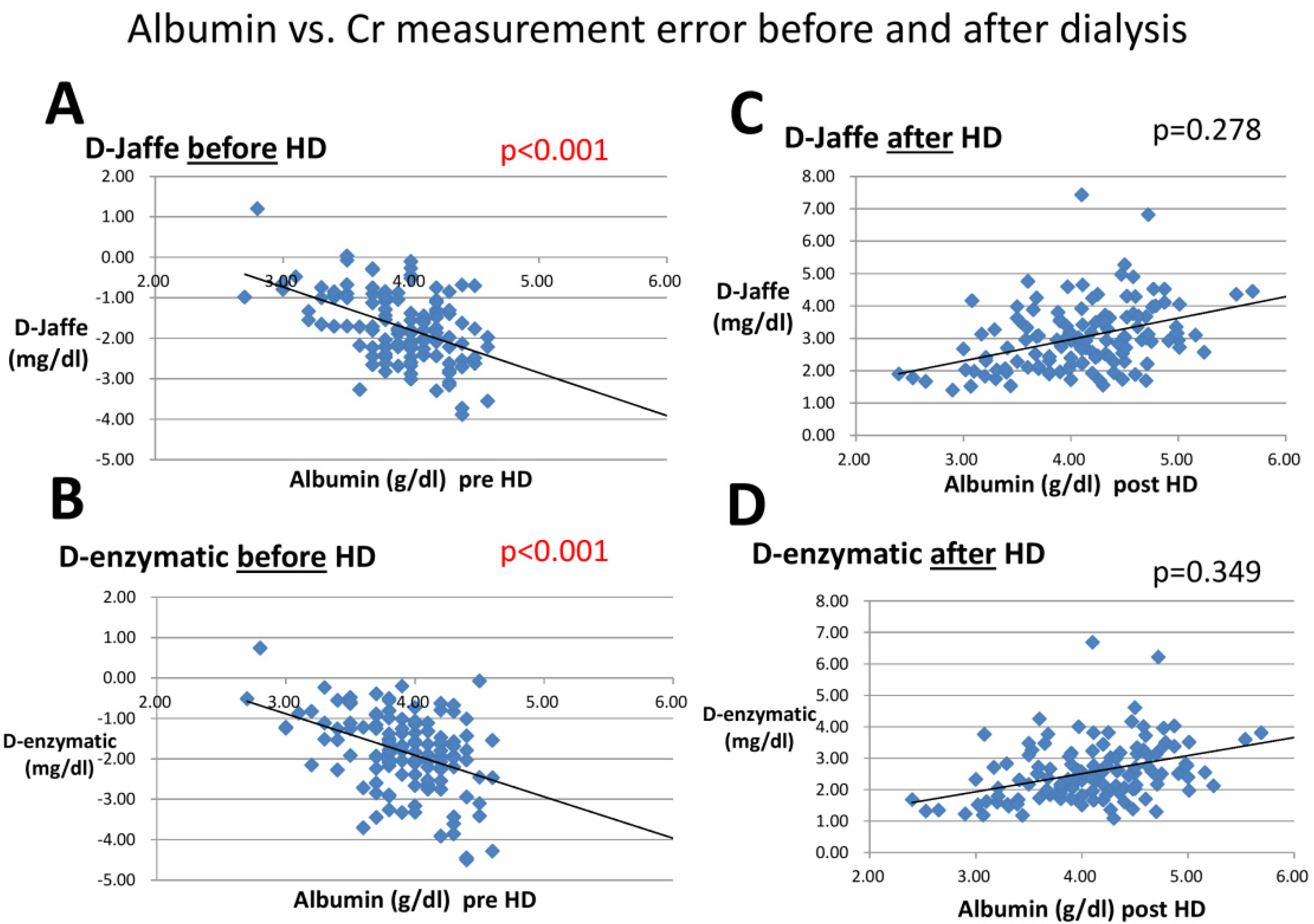
| Albumin (gm/dL) * | 3.92 | 0.37 | −1.058 | 0.000 * | −0.1026 | 0.000 * |
| Globulin | 2.95 | 4.02 | 0.009 | 0.613 | 0.006 | 0.799 |
| AST (IU/L) | 22.70 | 10.45 | 0.010 | 0.152 | 0.017 | 0.029 * |
| ALT (IU/L) | 18.77 | 10.88 | −0.001 | 0.891 | −0.002 | 0.838 |
| Alk-P (IU/L) | 93.72 | 83.06 | 0.001 | 0.100 | 0.001 | 0.409 |
| Total Bilirubin (mg/dL) | 0.54 | 0.15 | −0.034 | 0.947 | 0.548 | 0.340 |
| Na (mEq/L) * | 138.92 | 2.73 | −0.060 | 0.027 * | −0.040 | 0.200 |
| K (mEq/L) * | 4.56 | 0.66 | −0.232 | 0.041 * | −0.164 | 0.200 |
| Cl (mEq/L) | 98.83 | 5.62 | −0.020 | 0.144 | −0.016 | 0.297 |
| Ca (mg/dL) * | 9.27 | 0.86 | −0.205 | 0.018 * | −0.287 | 0.003 * |
| P (mg/dL) * | 4.69 | 1.33 | −0.138 | 0.013 * | −0.059 | 0.352 |
| BUN (mg/dL) | 61.69 | 17.09 | −0.010 | 0.021 | −0.011 | 0.020 * |
| Fe (ug/dL) | 59.39 | 22.15 | −0.006 | 0.067 | −0.010 | 0.007 * |
| TIBC (ug/dL) * | 248.38 | 48.10 | −0.003 | 0.029 * | 0.000 | 0.808 |
| Ferritin(ng/mL) | 488.95 | 422.60 | 0.000 | 0.603 | 0.000 | 0.059 |
| iPTH (pg/mL) | 118.40 | (44.17, 239.17) | 0.000 | 0.434 | 8.91 × 10⁻⁵ | 0.763 |
| Al (ng/mL) | 15.16 | 9.85 | −0.019 | 0.229 | −0.021 | 0.193 |
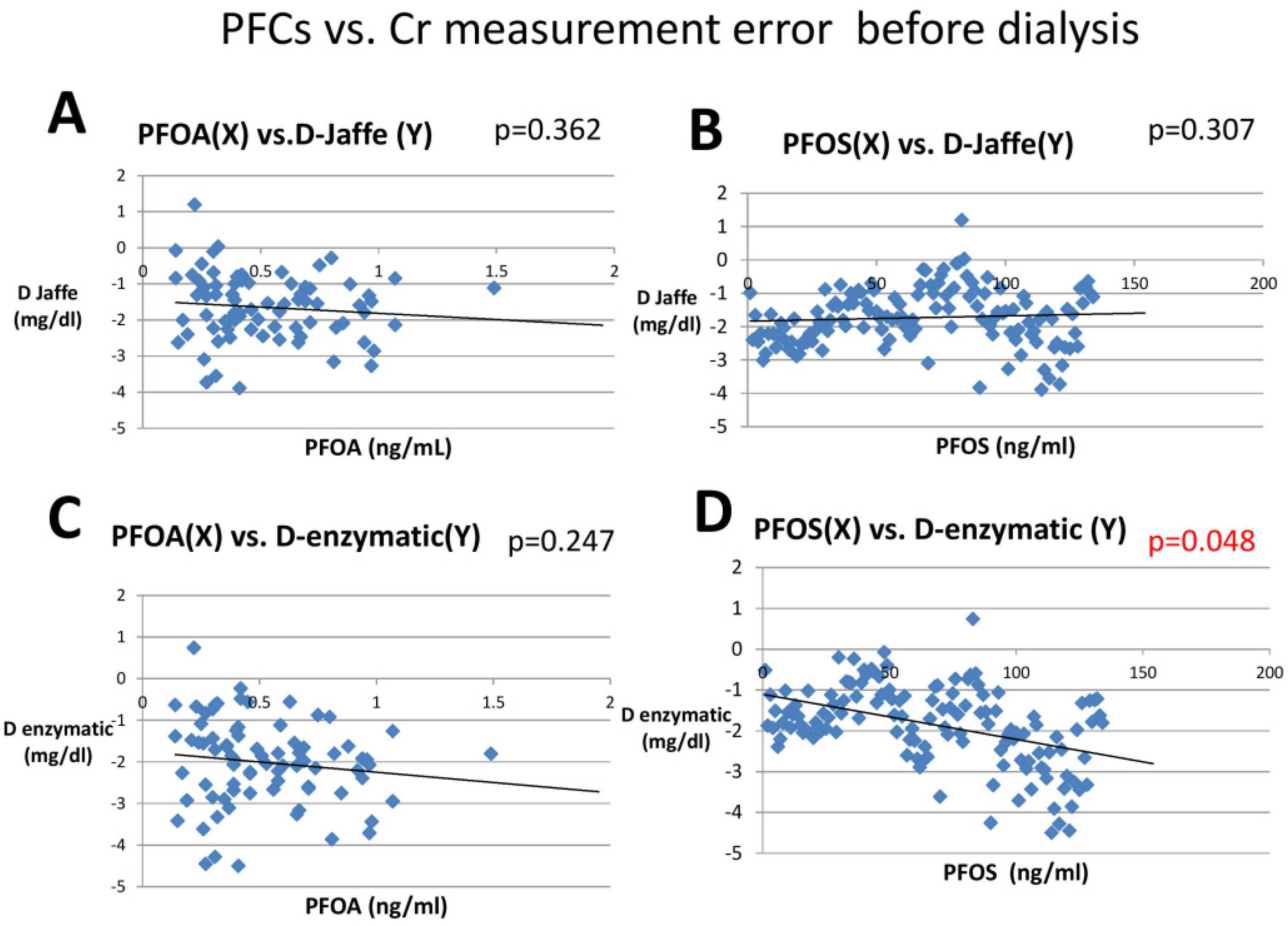
| PFOA (ng/mL) | 0.53 | 0.27 | −0.346 | 0.362 | −0.494 | 0.247 |
| PFOS (ng/mL) * | 5.50 | (1.17,24.7) | −0.002 | 0.307 | −0.005 | 0.048 * |
| D-Jaffe (r2 = 0.352, p < 0.001) | B Estimate | p | D-Enzymatic (r2 = 0.435, p < 0.001) | B Estimate | p |
|---|---|---|---|---|---|
| Jaffe Cr (mg/dL) * | −0.153 | 0.000 * | Albumin (gm/dL) * | −0.988 | 0.013 * |
| Albumin (gm/dL) * | −0.593 | 0.011 * | PFOS (ng/mL) * | −0.005 | 0.038 * |
| Cholesterol (mg/dL) | −0.003 | 0.112 | Jaffe Cr (mg/dL) * | −0.106 | 0.043 * |
| P (mg/dL) | 0.088 | 0.156 | Fe (μg/dL) | −0.007 | 0.130 |
| K (meq/L) | −0.087 | 0.410 | AST (IU/L) | 0.010 | 0.365 |
| Na (meq/L) | −0.010 | 0.697 | Total Ca (mg/dL) | 0.123 | 0.383 |
| Age | 0.002 | 0.760 | Hb (g/dL) | −0.075 | 0.427 |
| Hb (g/dL) | −0.005 | 0.927 | Cholesterol (mg/dL) | −0.001 | 0.634 |
| Total Ca (mg/dL) | 0.007 | 0.933 | BUN (mg/dL) | 0.003 | 0.660 |
| TIBC (ug/dL) | 0.000 | 0.950 | Age | 0.001 | 0.870 |
| BUN (mg/dL) | 0.000 | 0.954 |
| n = 124 Post-HD | Mean | ±SD | D-Jaffe | D-Enzymatic | ||
|---|---|---|---|---|---|---|
| (β) | (p) | (β) | (p) | |||
| Albumin (gm/dL) | 4.12 | 0.65 | 0.661 | 0.278 | 0.575 | 0.349 |
| Total protein (gm/dL) | 7.17 | 1.27 | 0.006 | 0.838 | −0.007 | 0.811 |
| Jaffe Cr (mg/dL) * | 3.04 | 1.04 | −0.096 | 0.000 * | −0.206 | 0.000 * |
| Enzymatic Cr (mg/dL) * | 2.58 | 0.94 | −0.146 | 0.000 * | −0.208 | 0.000 * |
| IDLCMS Cr (mg/dL) * | 3.26 | 1.17 | −0.126 | 0.002 * | −0.071 | 0.000 * |
| BUN (mg/dL) * | 15.86 | 5.66 | −0.107 | 0.048 * | −0.029 | 0.000 * |
| P (mg/dL) * | 1.85 | 0.61 | −0.109 | 0.009 | −0.208 | 0.000 * |
| K (mEq/L) | 3.86 | 1.04 | 0.004 | 0.909 | −0.024 | 0.522 |
| PFOA (ng/mL) | 0.53 | 0.34 | 0.012 | 0.927 | −0.151 | 0.202 |
| PFOS (ng/mL) | 2.00 | 1.13 | 0.000 | 0.993 | 0.022 | 0.552 |
| Dialysis Membrane | PFOS Concentration (ng/mL) | Linear Regression PFOS vs. D-Jaffe | Linear Regression PFOS vs. D-Enzymatic |
|---|---|---|---|
| β (p) | β (p) | ||
| Pre-HD All (n = 124) | 5.50 (1.17,24.7) | −0.002 (0.307) | −0.005 (0.048) * |
| PS (n = 93) | 2.37 (1.17, 15.47) | −0.002 (0.247) | −0.006 (0.035) * |
| Non-PS (n = 31) | 23.89 (5.93,55.53) | 0.103 (0.485) | −0.002 (0.687) |
| t-test | p = 0.026 * | ||
| Post-HD All (n = 124) | 2.00 ± 1.13 | 0.000 (0.993) | 0.022 (0.552) |
| PS (n = 93) | 2.08 ± 1.22 | −0.046 (0.430) | 0.008 (0.870) |
| Non-PS (n = 31) t-test | 1.74 ± 0.69 p = 0.055 | 0.082 (0.476) | 0.152 (0.180) |
Publisher’s Note: MDPI stays neutral with regard to jurisdictional claims in published maps and institutional affiliations. |
© 2022 by the authors. Licensee MDPI, Basel, Switzerland. This article is an open access article distributed under the terms and conditions of the Creative Commons Attribution (CC BY) license (https://creativecommons.org/licenses/by/4.0/).
Share and Cite
Liu, W.-S.; Lin, C.-H.; Li, S.-Y.; Lin, C.-C.; Liu, T.-Y.; Tan, A.C.; Tsou, H.-H.; Chan, H.-L.; Lai, Y.-T. Perfluorooctanesulfonate Can Cause Negative Bias in Creatinine Measurement in Hemodialysis Patients Using Polysulfone Dialysis Membranes. Membranes 2022, 12, 778. https://doi.org/10.3390/membranes12080778
Liu W-S, Lin C-H, Li S-Y, Lin C-C, Liu T-Y, Tan AC, Tsou H-H, Chan H-L, Lai Y-T. Perfluorooctanesulfonate Can Cause Negative Bias in Creatinine Measurement in Hemodialysis Patients Using Polysulfone Dialysis Membranes. Membranes. 2022; 12(8):778. https://doi.org/10.3390/membranes12080778
Chicago/Turabian StyleLiu, Wen-Sheng, Chien-Hung Lin, Szu-Yuan Li, Chih-Ching Lin, Tsung-Yun Liu, Ann Charis Tan, Han-Hsing Tsou, Hsiang-Lin Chan, and Yen-Ting Lai. 2022. "Perfluorooctanesulfonate Can Cause Negative Bias in Creatinine Measurement in Hemodialysis Patients Using Polysulfone Dialysis Membranes" Membranes 12, no. 8: 778. https://doi.org/10.3390/membranes12080778
APA StyleLiu, W.-S., Lin, C.-H., Li, S.-Y., Lin, C.-C., Liu, T.-Y., Tan, A. C., Tsou, H.-H., Chan, H.-L., & Lai, Y.-T. (2022). Perfluorooctanesulfonate Can Cause Negative Bias in Creatinine Measurement in Hemodialysis Patients Using Polysulfone Dialysis Membranes. Membranes, 12(8), 778. https://doi.org/10.3390/membranes12080778