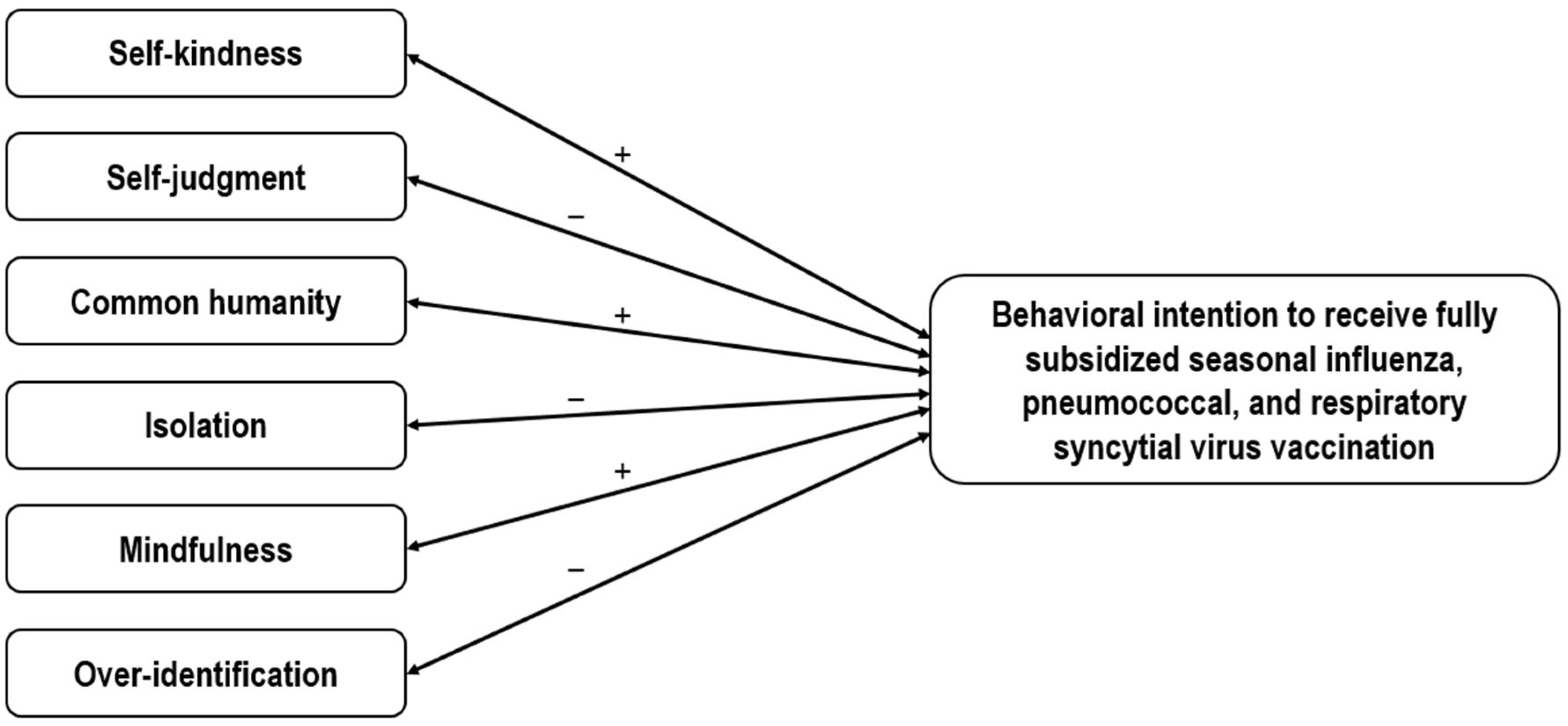
Associations Between Self-Compassion and Behavioural Intention to Receive Seasonal Influenza, Pneumococcal and Respiratory Syncytial Virus Vaccination Among Community-Living Older Adults in Western China: A Population-Based Cross-Sectional Survey

 , ,
, , 
Abstract
1. Introduction
2. Methods
2.1. Study Design
2.2. Participants and Recruitment
2.3. Sample Size Planning
2.4. Measurements
2.4.1. Development of the Questionnaire
2.4.2. Background Characteristics
2.4.3. Behavioral Intention to Receive Different Types of Vaccination
2.4.4. Self-Compassion
2.5. Statistical Analysis
3. Results
3.1. Background Characteristics of the Participants
3.2. Descriptive Statistics of Dependent Variables and Independent Variables of Interest
3.3. Factors Associated with Behavioral Intention to Receive Fully Subsidized SIV, PV and RSV Vaccination
4. Discussion
5. Conclusions
Author Contributions
Funding
Institutional Review Board Statement
Informed Consent Statement
Data Availability Statement
Conflicts of Interest
Abbreviations
| AOR | Adjusted odds ratio |
| CDC | Centers for Disease Control and Prevention |
| CI | Confidence interval |
| CNY | Chinese Yuan |
| IPD | Invasive pneumococcal diseases |
| OR | Crude odds ratio |
| PD | Pneumococcal diseases |
| PV | Pneumococcal vaccination |
| RSV | Respiratory syncytial virus |
| SCS-SF | Self-Compassion Scale–Short Form |
| SD | Standard deviation |
| SIV | Seasonal influenza vaccination |
| US$ | United States dollar |
| WHO | World Health Organization |
Appendix A

| Behavioral Intention to Receive a Fully Subsidized Seasonal Influenza Vaccination Provided by the Government in the Next Year (Among All 692 Participants) | Behavioral Intention to Receive a Fully Subsidized Pneumococcal Vaccination Provided by the Government in the Next Year (Among 587 Participants Who Have Never Received Such Vaccine) | Behavioral Intention to Receive a Fully Subsidized Respiratory Syncytial Virus Vaccination Provided by the Government in the Next Year (Among 692 Participants Who Have Never Received Such Vaccine) | ||||
|---|---|---|---|---|---|---|
| OR (95% CI) | p Values | OR (95% CI) | p Values | OR (95% CI) | p Values | |
| Socio-demographic characteristics | ||||||
| Age groups, years | ||||||
| 60–64 | Reference | Reference | Reference | |||
| 65–70 | 0.91 (0.59, 1.40) | 0.67 | 0.93 (0.61, 1.42) | 0.73 | 1.01 (0.66, 1.53) | 0.97 |
| 71–74 | 0.74 (0.43, 1.28) | 0.74 | 1.02 (0.60, 1.75) | 0.94 | 0.68 (0.42, 1.11) | 0.12 |
| 75 or above | 1.05 (0.62, 1.78) | 0.85 | 0.84 (0.50, 1.41) | 0.52 | 1.00 (0.61, 1.66) | 0.99 |
| Sex assigned at birth | ||||||
| Male | Reference | Reference | Reference | |||
| Female | 1.05 (0.78, 1.42) | 0.74 | 1.11 (0.81, 1.54) | 0.51 | 1.14 (0.84, 1.53) | 0.40 |
| Education level | ||||||
| Junior high or below | Reference | Reference | Reference | |||
| Senior high or equivalent | 1.45 (0.86, 2.45) | 0.17 | 1.07 (0.61, 1.90) | 0.81 | 1.01 (0.61, 1.67) | 0.98 |
| College and above | 2.30 (1.05, 5.01) | 0.04 | 0.80 (0.33, 1.94) | 0.63 | 0.90 (0.45, 1.79) | 0.75 |
| Marital status | ||||||
| Married | Reference | Reference | Reference | |||
| Single, divorced, or widowed | 1.01 (0.70, 1.45) | 0.96 | 0.89 (0.61, 1.31) | 0.55 | 0.80 (0.56, 1.15) | 0.23 |
| Employment status | ||||||
| Retired | Reference | Reference | Reference | |||
| Full-time/part-time/self-employed | 0.47 (0.33, 0.67) | <0.001 | 0.93 (0.64, 1.36) | 0.71 | 0.64 (0.45, 0.91) | 0.01 |
| Monthly personal income, CNY (US$) | ||||||
| Below 3000 CNY (US$426.1) | Reference | Reference | Reference | |||
| 3000–4999 CNY (US$426.1–710.1) | 1.34 (0.90, 2.00) | 0.15 | 1.06 (0.69, 1.63) | 0.78 | 1.17 (0.79, 1.73) | 0.44 |
| 5000 CNY or above (US$710.2) | 1.15 (0.71, 1.86) | 0.57 | 1.18 (0.69, 2.03) | 0.55 | 0.91 (0.56, 1.46) | 0.69 |
| Ethnicity | ||||||
| Uyghur | Reference | Reference | Reference | |||
| Han | 2.83 (1.42, 5.63) | 0.003 | 1.01 (0.50, 2.04) | 0.97 | 1.06 (0.59, 1.90) | 0.84 |
| Others | 0.41 (0.04, 3.53) | 0.47 | 1.08 (0.07, 12.28) | 0.96 | 2.04 (0.18, 22.59) | 0.56 |
| Living with the following people, yes | ||||||
| Spouse | 1.69 (1.24, 2.30) | <0.001 | 1.48 (1.06, 2.06) | 0.02 | 2.02 (1.48, 2.75) | <0.001 |
| Children | 1.10 (0.81, 1.49) | 0.53 | 1.25 (0.90, 1.73) | 0.18 | 1.68 (1.24, 2.28) | <0.001 |
| Grandchildren | 1.27 (0.89, 1.80) | 0.19 | 1.21 (0.83, 1.75) | 0.33 | 1.76 (1.24, 2.50) | 0.002 |
| Other relatives | 2.53 (0.92, 6.98) | 0.07 | 0.37 (0.13, 1.05) | 0.06 | 0.75 (0.31, 1.81) | 0.53 |
| Domestic helpers | N.A. | N.A. | 2.16 (0.19, 23.91) | 0.53 | 1.01 (0.14, 7.22) | 0.99 |
| Other people | 1.95 (0.61, 6.28) | 0.26 | 2.17 (0.54, 8.77) | 0.28 | 1.36 (0.47, 3.95) | 0.58 |
| Lifestyles and health conditions | ||||||
| Smoking in the past year | ||||||
| No | Reference | Reference | Reference | |||
| Yes | 0.94 (0.63, 1.41) | 0.77 | 1.04 (0.67, 1.60) | 0.87 | 1.15 (0.77, 1.72) | 0.50 |
| Binge drinking in the past year | ||||||
| No | Reference | Reference | Reference | |||
| Yes | 0.85 (0.44, 1.67) | 0.64 | 1.25 (0.59, 2.68) | 0.56 | 1.28 (0.65, 2.52) | 0.47 |
| Presence of any chronic conditions | ||||||
| No | Reference | Reference | Reference | |||
| Yes | 1.11 (0.80, 1.55) | 0.54 | 1.04 (0.73, 1.49) | 0.81 | 1.71 (1.22, 2.39) | 0.002 |
| History of confirmed SARS-CoV-2 infection | ||||||
| No | Reference | Reference | Reference | |||
| Yes | 1.01 (0.74, 1.38) | 0.97 | 0.89 (0.64, 1.25) | 0.51 | 0.69 (0.51, 0.94) | 0.02 |
| History of confirmed seasonal influenza infection since September 2025 | ||||||
| No/uncertain | Reference | Reference | Reference | |||
| Yes | 1.90 (1.20, 3.01) | 0.01 | 1.19 (0.73, 1.95) | 0.48 | 1.49 (0.97, 2.29) | 0.07 |
| History of confirmed invasive pneumococcal diseases | ||||||
| No/uncertain | Reference | Reference | Reference | |||
| Yes | 1.33 (0.52, 3.42) | 0.55 | 0.19 (0.04, 0.86) | 0.03 | 1.40 (0.56, 3.53) | 0.47 |
| History of confirmed respiratory syncytial virus infection | ||||||
| No/uncertain | Reference | Reference | Reference | |||
| Yes | 0.80 (0.43, 1.47) | 0.47 | 1.72 (0.66, 4.49) | 0.27 | 1.44 (0.77, 2.69) | 0.26 |
| Vaccination history | ||||||
| Uptake of seasonal influenza vaccination since September 2025 | ||||||
| No/uncertain | Reference | Reference | Reference | |||
| Yes | 1.81 (1.11, 2.95) | 0.02 | 4.01 (2.06, 7.81) | <0.001 | 1.45 (0.91, 2.31) | 0.12 |
| Uptake of pneumococcal vaccination in lifetime | ||||||
| No/uncertain | Reference | N.A. | Reference | |||
| Yes | 0.79 (0.52, 1.19) | 0.26 | N.A. | N.A. | 1.42 (0.94, 2.16) | 0.10 |
| Uptake of respiratory syncytial virus vaccines | ||||||
| No/uncertain | Reference | Reference | N.A. | |||
| Yes | N.A. | N.A. | N.A. | N.A. | N.A. | N.A. |
| Number of doses of COVID-19 vaccination received | ||||||
| 0–1 | Reference | Reference | Reference | |||
| 2 | 2.70 (1.67, 4.36) | <0.001 | 3.09 (1.80, 5.29) | <0.001 | 2.18 (1.36, 3.51) | 0.001 |
| 3 or above | 3.16 (2.06, 4.83) | <0.001 | 2.78 (1.72, 4.49) | <0.001 | 1.88 (1.24, 2.86) | 0.003 |
References
- Iuliano, A.; Roguski, K.; Chang, H.; Muscatello, D.; Palekar, R.; Tempia, S.; Cohen, C.; Gran, J.M.; Schanzer, D.; Cowling, B.J.; et al. Estimates of global seasonal influenza-associated respiratory mortality: A modelling study. Lancet 2018, 391, 1285–1300. [Google Scholar] [CrossRef]
- World Health Organization. Influenza (Seasonal) 2025. Available online: https://www.who.int/news-room/fact-sheets/detail/influenza-(seasonal) (accessed on 23 April 2026).
- Li, L.; Liu, Y.; Wu, P.; Peng, Z.; Wang, X.; Chen, T.; Wong, J.Y.T.; Yang, J.; Bond, H.S.; Wang, L.; et al. Influenza-associated excess respiratory mortality in China, 2010–15: A population-based study. Lancet Public Health 2019, 4, e473–e481. [Google Scholar] [CrossRef]
- Yin, Z.; Dong, Y.; Wang, Q.; Ma, Y.; Gao, Z.; Ling, Z.; Aihaiti, X.; Abudusaimaiti, X.; Qiu, R.; Chen, Z.; et al. Spatial-temporal evolution patterns of influenza incidence in Xinjiang Prefecture from 2014 to 2023 based on GIS. Sci. Rep. 2024, 14, 21496. [Google Scholar] [CrossRef]
- Varon, E.; Mainardi, J.L.; Gutmann, L. Streptococcus pneumoniae: Still a major pathogen. Clin. Microbiol. Infect. 2010, 16, 401. [Google Scholar] [CrossRef] [PubMed]
- U.S. Center for Disease Control and Prevention. Surveillance Reports. Available online: https://www.cdc.gov/abcs/reports/ (accessed on 23 April 2026).
- Morris, D.E.; Cleary, D.W.; Clarke, S.C. Secondary Bacterial Infections Associated with Influenza Pandemics. Front. Microbiol. 2017, 8, 1041. [Google Scholar] [CrossRef]
- Lai, X.; Wahl, B.; Yu, W.; Xu, T.; Zhang, H.; Garcia, C.; Qin, Y.; Guo, Y.; Yin, Z.; Knoll, M.D.; et al. National, regional, and provincial disease burden attributed to Streptococcus pneumoniae and Haemophilus influenzae type b in children in China: Modelled estimates for 2010–17. Lancet Reg. Health West. Pac. 2022, 22, 100430. [Google Scholar] [CrossRef]
- Cong, B.; Dighero, I.; Zhang, T.; Chung, A.; Nair, H.; Li, Y. Understanding the age spectrum of respiratory syncytial virus associated hospitalisation and mortality burden based on statistical modelling methods: A systematic analysis. BMC Med. 2023, 21, 224. [Google Scholar] [CrossRef]
- U.S. Centre for Disaease Control and Prevention. RSV in Older Adults. Available online: https://www.cdc.gov/rsv/older-adults/index.html (accessed on 23 April 2026).
- Li, Z.J.; Zhang, H.Y.; Ren, L.L.; Lu, Q.B.; Ren, X.; Zhang, C.H.; Wang, Y.F.; Lin, S.H.; Zhang, X.A.; Li, J.; et al. Etiological and epidemiological features of acute respiratory infections in China. Nat. Commun. 2021, 12, 5026. [Google Scholar] [CrossRef] [PubMed]
- Duan, Y.; He, J.; Cui, Y.; Li, W.; Jiang, Y. Characteristics and forecasting of respiratory viral epidemics among children in west China. Medicine 2021, 100, e25498. [Google Scholar] [CrossRef] [PubMed]
- Heo, J.Y.; Seo, Y.B.; Choi, W.S.; Kim, E.J.; Jeong, H.W.; Lee, J.; Yoon, J.G.; Noh, J.Y.; Cheong, H.J.; Kim, W.J.; et al. Effectiveness of Pneumococcal Vaccination Against Pneumococcal Pneumonia Hospitalization in Older Adults: A Prospective, Test-Negative Study. J. Infect. Dis. 2022, 225, 836–845. [Google Scholar] [CrossRef]
- Ding, H.; Huang, J.; Ngai, C.H.; Sun, Q.; Kwok, K.O.; Wang, H.H.; Chong, M.; Wong, M.C. The cost-effectiveness of starting 23-valent pneumococcal polysaccharide vaccine and influenza vaccination at 50 vs. 65 years: A comparative modelling study. Vaccine 2022, 40, 1282–1288. [Google Scholar] [CrossRef]
- Chinese Center for Disease Control and Prevention of People’s Republic of China. Facts about the Flu Vaccine 2023. Available online: https://en.chinacdc.cn/health_topics/immunization/202312/t20231226_271600.html (accessed on 23 April 2026).
- World Health Organization. Considerations for Pneumococcal Vaccination in Older Adults. Available online: https://iris.who.int/server/api/core/bitstreams/809bd3ad-0849-4a3e-8871-1c7baa90caa8/content (accessed on 21 April 2026).
- Zhao, P.; Xu, W.; Wang, J.; Liang, P.; Li, H.; Wang, C. Uptake and correlates of influenza vaccine among older adults residing in rural regions of south China: A cross-sectional study. Front. Public Health 2024, 12, 1383293. [Google Scholar] [CrossRef] [PubMed]
- Guo, J.; Jiao, X.; Yuan, S.; You, L. Factors Associated with Influenza Vaccination Among Urban Community-Dwelling Chinese Elderly: Results from a Multicity Cross-Sectional Study. Vaccines 2025, 13, 1171. [Google Scholar] [CrossRef]
- World Health Organization. Managing Seasonal Vaccination Policies and Coverage in the European Region. Available online: https://www.who.int/europe/activities/managing-seasonal-vaccination-policies-and-coverage-in-the-european-region (accessed on 14 May 2026).
- Shao, W.; Chen, X.; Zheng, C.; Wang, G.; Zhang, B.; Zhang, W. Pneumococcal vaccination coverage and willingness in mainland China. Trop. Med. Int. Health 2022, 27, 864–872. [Google Scholar] [CrossRef] [PubMed]
- Melgar, M.; Britton, A.; Roper, L.E.; Talbot, H.K.; Long, S.S.; Kotton, C.N.; Havers, F.P. Use of Respiratory Syncytial Virus Vaccines in Older Adults: Recommendations of the Advisory Committee on Immunization Practices—United States, 2023. MMWR Morb. Mortal Wkly. Rep. 2023, 72, 793–801. [Google Scholar] [CrossRef]
- Centre for Health Protection of Hong Kong SAR. Interim Consensus on the Use of Respiratory Syncytial Virus Vaccines in Hong Kong (As of 17 January 2025). Available online: https://www.chp.gov.hk/files/pdf/interim_consensus_on_the_use_of_respiratory_syncytial_virus_vaccines_in_hong_kong_jan2025.pdf (accessed on 23 April 2026).
- Wang, Q.; Xiu, S.; Yang, L.; Li, L.; Yang, M.; Wang, X.; Shen, Y.; Wang, W.; Lin, L. Perceptions about respiratory syncytial virus (RSV) and attitudes toward the RSV vaccine among the general public in China: A cross-sectional survey. Hum. Vaccines Immunother. 2024, 20, 2310916. [Google Scholar] [CrossRef]
- You, Y.; Li, X.; Chen, B.; Zou, X.; Liu, G.; Han, X. Knowledge, Attitude, and Practice towards Influenza Vaccination among Older Adults in Southern China during the COVID-19 Pandemic. Vaccines 2023, 11, 1197. [Google Scholar] [CrossRef]
- Sun, G.; Zhang, L.; Qiu, Y.; Jia, Y.; Wang, Y.; Xu, H.; Zhang, A.; Hao, L.; Zhu, W.; Ye, C. Changes of influenza vaccination rate and associated influencing factors after the COVID-19 pandemic in Shanghai, China. Hum. Vaccines Immunother. 2024, 20, 2287294. [Google Scholar] [CrossRef]
- Ye, L.; Chen, J.; Mei, Q.; Sun, Y.; Yang, T. The impact of the COVID-19 pandemic and the free vaccination policy on seasonal influenza vaccination uptake among older adults in Ningbo, Eastern China. Hum. Vaccines Immunother. 2024, 20, 2370999. [Google Scholar] [CrossRef]
- Liang, X.; Cai, C.; Yu, F.Y.; Ye, D.; Fang, Y.; Mo, P.K.H.; Wang, Z. Changes in seasonal influenza vaccination uptake among older adults during and after the COVID-19 pandemic: Repeated random telephone surveys. Hum. Vaccines Immunother. 2025, 21, 2449290. [Google Scholar] [CrossRef]
- Lu, X.; Lu, J.; Zhang, L.; Mei, K.; Guan, B.; Lu, Y. Gap between willingness and behavior in the vaccination against influenza, pneumonia, and herpes zoster among Chinese aged 50-69 years. Expert. Rev. Vaccines 2021, 20, 1147–1152. [Google Scholar] [CrossRef] [PubMed]
- Chan, P.S.; Poon, J.; Han, S.C.; Ye, D.; Yu, F.Y.; Fang, Y.; Wong, M.C.S.; Mo, P.K.H.; Wang, Z. Changes in the Pneumococcal Vaccination Uptake and Its Determinants before, during, and after the COVID-19 Pandemic among Community-Living Older Adults in Hong Kong, China: Repeated Random Telephone Surveys. Vaccines 2024, 12, 894. [Google Scholar] [CrossRef]
- Lai, X.; Lyu, Y.; Zhang, H.; Feng, H.; Fang, H. PPSV-23 recommendation and vaccination coverage in China: A cross-sectional survey among healthcare workers, older adults and chronic disease patients. Expert. Rev. Vaccines 2022, 21, 1343–1353. [Google Scholar] [CrossRef]
- Zhou, M.; Zhan, J.; Kong, N.; Campy, K.S.; Chen, Y. Factors associated with intention to uptake pneumococcal vaccines among Chinese elderly aged 60 years and older during the early stage of COVID-19 pandemic. Psychol. Health Med. 2022, 27, 91–105. [Google Scholar] [CrossRef]
- Liu, L.; Cao, H.; Ou, Z.; Peng, W.; Chen, H.; Fang, Y.; Chen, S.; Xu, S.; Wang, Z. Associations of altruistic factors and perceptions with intention to receive Respiratory Syncytial Virus (RSV) vaccination among older adults in China. Hum. Vaccines Immunother. 2025, 21, 2567705. [Google Scholar] [CrossRef] [PubMed]
- Neff, K.D. Self-Compassion: Theory, Method, Research, and Intervention. Annu. Rev. Psychol. 2023, 74, 193–218. [Google Scholar] [CrossRef] [PubMed]
- Neff, K.D. The Self-Compassion Scale is a Valid and Theoretically Coherent Measure of Self-Compassion. Mindfulness 2016, 7, 264–274. [Google Scholar] [CrossRef]
- Phillips, W.J.; Hine, D.W. Self-compassion, physical health, and health behaviour: A meta-analysis. Health Psychol. Rev. 2021, 15, 113–139. [Google Scholar] [CrossRef]
- Rahimi-Ardabili, H.; Reynolds, R.; Vartanian, L.R.; McLeod, L.V.D.; Zwar, N. A Systematic Review of the Efficacy of Interventions that Aim to Increase Self-Compassion on Nutrition Habits, Eating Behaviours, Body Weight and Body Image. Mindfulness 2018, 9, 388–400. [Google Scholar] [CrossRef]
- Heydari, M.S.; Shivandi, K.; Hassanzadeh, M.; Dortaj, Z. A comparative study of self-compassion and corona disease anxiety in adolescents receiving and not receiving COVID-19 vaccine. Int. J. Health Sci. 2022, 6, 443–452. [Google Scholar] [CrossRef]
- Zhao, Y.; Xu, J.; Zhang, X.; Xu, Y.; Yan, X.; Ren, S.; Wang, L. Impact of a Free Influenza Vaccination Policy on Older Adults in Zhejiang, China: Cross-Sectional Survey of Vaccination Willingness and Determinants. JMIR Hum. Factors 2025, 12, e73940. [Google Scholar] [CrossRef]
- Zhang, K.; Fang, Y.; Chan, P.S.; Cao, H.; Chen, H.; Hu, T.; Chen, Y.; Zhou, X.; Wang, Z. Behavioral Intention to Get a Booster Dose of COVID-19 Vaccine among Chinese Factory Workers. Int. J. Environ. Res. Public Health 2022, 19, 5245. [Google Scholar] [CrossRef] [PubMed]
- Raes, F.; Pommier, E.; Neff, K.D.; Van Gucht, D. Construction and factorial validation of a short form of the self-compassion scale. Clin. Psychol. Psychother. 2011, 18, 250–255. [Google Scholar] [CrossRef] [PubMed]
- Michie, S.; Johnston, M.; Francis, J.; Hardeman, W.; Eccle, M. From theory to intervention: Mapping theoretically derived behavioural determinants to behaviour change techniques. Appl. Psychol. 2008, 57, 660–680. [Google Scholar] [CrossRef]
- Sulis, G.; Basta, N.E.; Wolfson, C.; Kirkland, S.A.; McMillan, J.; Griffith, L.E.; Raina, P.; Canadian Longitudinal Study on Aging (CLSA) Team. Influenza vaccination uptake among Canadian adults before and during the COVID-19 pandemic: An analysis of the Canadian Longitudinal study on Aging (CLSA). Vaccine 2022, 40, 503–511. [Google Scholar] [CrossRef]
- Vogelsang, E.M.; Polonijo, A.N. Scarier than the flu shot?: The social determinants of shingles and influenza vaccinations among U.S. older adults. Vaccine 2022, 40, 6747–6755. [Google Scholar] [CrossRef] [PubMed]
- Singh, A.; Lai, A.H.Y.; Wang, J.; Asim, S.; Chan, P.S.; Wang, Z.; Yeoh, E.K. Multilevel Determinants of COVID-19 Vaccine Uptake Among South Asian Ethnic Minorities in Hong Kong: Cross-sectional Web-Based Survey. JMIR Public Health Surveill. 2021, 7, e31707. [Google Scholar] [CrossRef]
- Uğrak, U.; Aksungur, A.; Akyüz, S.; Şen, H.; Seyhan, F. Understanding the rise of vaccine refusal: Perceptions, fears, and influences. BMC Public Health 2025, 25, 2574. [Google Scholar] [CrossRef]
- Seki, M. Strategies for Geriatric Pneumonia in Healthcare Facilities—How Effective is Combined Influenza and Pneumococcal Vaccination? Int. J. Gen. Med. 2020, 13, 663–666. [Google Scholar] [CrossRef]
- Centre for Health Protection of Hong Kong SAR. Recommendation on Seasonal Influenza Vaccination for the 2024-25 Season in Hong Kong (As of 21 March 2024). Available online: https://www.chp.gov.hk/files/pdf/recommendations_on_seasonal_influenza_vaccination_for_the_2024_25_season_in_hong_kong_21mar.pdf (accessed on 23 April 2026).
- Terry, M.L.; Leary, M.R.; Mehta, S.; Henderson, K. Self-compassionate reactions to health threats. Pers. Soc. Psychol. Bull. 2013, 39, 911–926. [Google Scholar] [CrossRef] [PubMed]
- Sirois, F.M.; Kitner, R.; Hirsch, J.K. Self-compassion, affect, and health-promoting behaviors. Health Psychol. 2015, 34, 661–669. [Google Scholar] [CrossRef]
- Wilson, A.C.; Mackintosh, K.; Power, K.; Chan, S.W.Y. Effectivness of self-compassion related therapies: A systematic review and meta-analysis. Mindfulness 2019, 10, 979–995. [Google Scholar] [CrossRef]
- Kjeldstad, M.; Mundal, I.; Kingswick, I.; Tveit, H.H.; Lara-Cabrera, M. Feasibility and acceptability of a peer-led mindful self-compassion program for adults with eating disorder symptoms. BMC Psychiatry 2025, 25, 876. [Google Scholar] [CrossRef] [PubMed]
- Zarghamian, Z.; Bagherzadeh, R.; Bahreini, M.; Kamali, F. Effectiveness of self-compassion training on resilience and reflective thinking among nursing and midwifery students: A clinical trial. BMC Med. Edu. 2025, 25, 1679. [Google Scholar] [CrossRef]
- Xiao, W.; Wumaer, A.; Maimaitiwusiman, Z.; Liu, J.; Xuekelati, S.; Wang, H. Heat maps of cardiovascular disease risk factor clustering among community-dwelling older people in Xinjiang: A cross-sectional study. BMJ Open 2022, 12, e058400. [Google Scholar] [CrossRef]

| n | % | |
|---|---|---|
| Socio-demographic characteristics | ||
| Age groups, years | ||
| 60–64 | 124 | 17.9 |
| 65–70 | 351 | 50.7 |
| 71–74 | 99 | 14.3 |
| 75 or above | 118 | 17.1 |
| Sex assigned at birth | ||
| Male | 333 | 48.1 |
| Female | 359 | 51.9 |
| Education level | ||
| Junior high or below | 592 | 85.5 |
| Senior high or equivalent | 66 | 9.5 |
| College and above | 34 | 4.9 |
| Marital status | ||
| Married | 542 | 78.3 |
| Single, divorced, or widowed | 150 | 21.7 |
| Employment status | ||
| Retired | 527 | 76.2 |
| Full-time/part-time/self-employed | 165 | 23.8 |
| Monthly personal income, CNY (US$) | ||
| Below 3000 CNY (US$426.1) | 487 | 70.4 |
| 3000–4999 CNY (US$426.1–710.1) | 126 | 18.2 |
| 5000 CNY or above (US$710.2) | 79 | 11.4 |
| Ethnicity | ||
| Uyghur | 640 | 92.5 |
| Han | 49 | 7.1 |
| Others | 3 | 0.4 |
| Living with the following people, yes | ||
| Spouse | 417 | 60.3 |
| Children | 292 | 42.2 |
| Grandchildren | 171 | 24.7 |
| Other relatives | 21 | 3.0 |
| Domestic helpers | 4 | 0.6 |
| Other people | 14 | 2.0 |
| Lifestyles and health conditions | ||
| Smoking in the past year | ||
| No | 578 | 83.5 |
| Yes | 114 | 16.5 |
| Binge drinking in the past year | ||
| No | 656 | 94.8 |
| Yes | 36 | 5.2 |
| Presence of chronic conditions, yes | ||
| Hypertension | 422 | 61.0 |
| Other cardiovascular diseases | 158 | 22.8 |
| Chronic lung diseases | 81 | 11.7 |
| Chronic liver diseases | 60 | 8.7 |
| Chronic kidney diseases | 91 | 13.2 |
| Diabetes mellitus | 131 | 18.9 |
| Any of above | 500 | 72.3 |
| History of confirmed SARS-CoV-2 infection | ||
| No/uncertain | 250 | 36.1 |
| Yes | 442 | 63.9 |
| History of confirmed seasonal influenza infection since September 2025 | ||
| No/uncertain | 594 | 85.8 |
| Yes | 98 | 14.2 |
| History of confirmed invasive pneumococcal diseases | ||
| No/uncertain | 673 | 97.3 |
| Yes | 19 | 2.7 |
| History of confirmed respiratory syncytial virus infection | ||
| No/uncertain | 649 | 93.8 |
| Yes | 43 | 6.2 |
| Vaccination history | ||
| Uptake of seasonal influenza vaccination since September 2025 | ||
| No/uncertain | 609 | 88.0 |
| Yes | 83 | 12.0 |
| Uptake of pneumococcal vaccination in lifetime | ||
| No/uncertain | 587 | 84.8 |
| Yes | 105 | 15.2 |
| Uptake of respiratory syncytial virus vaccines | ||
| No/uncertain | 692 | 100.0 |
| Yes | 0 | 0.0 |
| Number of doses of COVID-19 vaccination received | ||
| 0–1 | 122 | 17.6 |
| 2 | 174 | 25.1 |
| 3 or above | 396 | 57.2 |
| N (%) | Mean (SD) | |
|---|---|---|
| Behavioral intention to receive different types of vaccinations | ||
| Likelihood of receiving a fully subsidized seasonal influenza vaccination provided by the government in the next year | ||
| Very unlikely/unlikely/neutral | 301 (43.5) | N.A. |
| Likely/very likely | 391 (56.5) | N.A. |
| Likelihood of receiving a fully subsidized pneumococcal vaccination provided by the government in the next year (among 587 participants who have never received such a vaccine) | ||
| Very unlikely/unlikely/neutral | 304 (51.8) | N.A. |
| Likely/very likely | 283 (48.2) | N.A. |
| Likelihood of receiving a fully subsidized respiratory syncytial virus vaccination provided by the government in the next year (among 692 participants who have never received such a vaccine) | ||
| Very unlikely/unlikely/neutral | 348 (50.3) | N.A. |
| Likely/very likely | 344 (49.7) | N.A. |
| Self-compassion Scale Short Form 1 | ||
| Self-kindness Items | N.A. | 4.8 (1.6) |
| Self-judgment Items | N.A. | 4.6 (1.7) |
| Common Humanity Items | N.A. | 4.7 (1.7) |
| Isolation Items | N.A. | 4.8 (1.6) |
| Mindfulness Items | N.A. | 5.0 (1.7) |
| Over-identification Items | N.A. | 4.6 (1.5) |
| Behavioral Intention to Receive a Fully Subsidized Seasonal Influenza Vaccination Provided by the Government in the Next Year (Among All 692 Participants) | Behavioral Intention to Receive a Fully Subsidized Pneumococcal Vaccination Provided by the Government in the Next year (Among 587 Participants Who Have Never Received Such Vaccine) | Behavioral Intention to Receive a Fully Subsidized Respiratory Syncytial Virus Vaccination Provided by the Government in the Next Year (Among 692 Participants Who Have Never Received Such Vaccine) | ||||
|---|---|---|---|---|---|---|
| OR (95% CI) | p Values | OR (95% CI) | p Values | OR (95% CI) | p Values | |
| Socio-demographic characteristics | ||||||
| Age groups, years | ||||||
| 60–64 | Reference | Reference | Reference | |||
| 65–70 | 0.91 (0.59, 1.40) | 0.67 | 0.93 (0.61, 1.42) | 0.73 | 1.01 (0.66, 1.53) | 0.97 |
| 71–74 | 0.74 (0.43, 1.28) | 0.74 | 1.02 (0.60, 1.75) | 0.94 | 0.68 (0.42, 1.11) | 0.12 |
| 75 or above | 1.05 (0.62, 1.78) | 0.85 | 0.84 (0.50, 1.41) | 0.52 | 1.00 (0.61, 1.66) | 0.99 |
| Sex assigned at birth | ||||||
| Male | Reference | Reference | Reference | |||
| Female | 1.05 (0.78, 1.42) | 0.74 | 1.11 (0.81, 1.54) | 0.51 | 1.14 (0.84, 1.53) | 0.40 |
| Education level | ||||||
| Junior high or below | Reference | Reference | Reference | |||
| Senior high or equivalent | 1.45 (0.86, 2.45) | 0.17 | 1.07 (0.61, 1.90) | 0.81 | 1.01 (0.61, 1.67) | 0.98 |
| College and above | 2.30 (1.05, 5.01) | 0.04 | 0.80 (0.33, 1.94) | 0.63 | 0.90 (0.45, 1.79) | 0.75 |
| Employment status | ||||||
| Retired | Reference | Reference | Reference | |||
| Full-time/part-time/self-employed | 0.47 (0.33, 0.67) | <0.001 | 0.93 (0.64, 1.36) | 0.71 | 0.64 (0.45, 0.91) | 0.01 |
| Monthly personal income, CNY (US$) | ||||||
| Below 3000 CNY (US$426.1) | Reference | Reference | Reference | |||
| 3000–4999 CNY (US$426.1–710.1) | 1.34 (0.90, 2.00) | 0.15 | 1.06 (0.69, 1.63) | 0.78 | 1.17 (0.79, 1.73) | 0.44 |
| 5000 CNY or above (US$710.2) | 1.15 (0.71, 1.86) | 0.57 | 1.18 (0.69, 2.03) | 0.55 | 0.91 (0.56, 1.46) | 0.69 |
| Ethnicity | ||||||
| Uyghur | Reference | Reference | Reference | |||
| Han | 2.83 (1.42, 5.63) | 0.003 | 1.01 (0.50, 2.04) | 0.97 | 1.06 (0.59, 1.90) | 0.84 |
| Others | 0.41 (0.04, 3.53) | 0.47 | 1.08 (0.07, 12.28) | 0.96 | 2.04 (0.18, 22.59) | 0.56 |
| Living with the following people, yes | ||||||
| Spouse | 1.69 (1.24, 2.30) | <0.001 | 1.48 (1.06, 2.06) | 0.02 | 2.02 (1.48, 2.75) | <0.001 |
| Children | 1.10 (0.81, 1.49) | 0.53 | 1.25 (0.90, 1.73) | 0.18 | 1.68 (1.24, 2.28) | <0.001 |
| Grandchildren | 1.27 (0.89, 1.80) | 0.19 | 1.21 (0.83, 1.75) | 0.33 | 1.76 (1.24, 2.50) | 0.002 |
| Lifestyles and health conditions | ||||||
| Presence of any chronic conditions | ||||||
| No | Reference | Reference | Reference | |||
| Yes | 1.11 (0.80, 1.55) | 0.54 | 1.04 (0.73, 1.49) | 0.81 | 1.71 (1.22, 2.39) | 0.002 |
| History of confirmed SARS-CoV-2 infection | ||||||
| No | Reference | Reference | Reference | |||
| Yes | 1.01 (0.74, 1.38) | 0.97 | 0.89 (0.64, 1.25) | 0.51 | 0.69 (0.51, 0.94) | 0.02 |
| History of confirmed seasonal influenza infection since September 2025 | ||||||
| No/uncertain | Reference | Reference | Reference | |||
| Yes | 1.90 (1.20, 3.01) | 0.01 | 1.19 (0.73, 1.95) | 0.48 | 1.49 (0.97, 2.29) | 0.07 |
| History of confirmed invasive pneumococcal diseases | ||||||
| No/uncertain | Reference | Reference | Reference | |||
| Yes | 1.33 (0.52, 3.42) | 0.55 | 0.19 (0.04, 0.86) | 0.03 | 1.40 (0.56, 3.53) | 0.47 |
| Vaccination history | ||||||
| Uptake of seasonal influenza vaccination since September 2025 | ||||||
| No/uncertain | Reference | Reference | Reference | |||
| Yes | 1.81 (1.11, 2.95) | 0.02 | 4.01 (2.06, 7.81) | <0.001 | 1.45 (0.91, 2.31) | 0.12 |
| Number of doses of COVID-19 vaccination received | ||||||
| 0–1 | Reference | Reference | Reference | |||
| 2 | 2.70 (1.67, 4.36) | <0.001 | 3.09 (1.80, 5.29) | <0.001 | 2.18 (1.36, 3.51) | 0.001 |
| 3 or above | 3.16 (2.06, 4.83) | <0.001 | 2.78 (1.72, 4.49) | <0.001 | 1.88 (1.24, 2.86) | 0.003 |
| Behavioral Intention to Receive a Fully Subsidized Seasonal Influenza Vaccination Provided by the Government in the Next Year (Among All 692 Participants) | Behavioral Intention to Receive a Fully Subsidized Pneumococcal Vaccination Provided by the Government in the Next Year (Among 587 Participants Who Have Never Received Such a Vaccine) | Behavioral Intention to Receive a Fully Subsidized Respiratory Syncytial Virus Vaccination Provided by the Government in the Next Year (Among 692 Participants Who Have Never Received Such a Vaccine) | |||||||
|---|---|---|---|---|---|---|---|---|---|
| AOR (95% CI) | p Values | Hosmer & Lemeshow Test | AOR (95% CI) | p Values | Hosmer & Lemeshow Test | AOR (95% CI) | p Values | Hosmer & Lemeshow Test | |
| Self-kindness Items | 1.28 (1.14, 1.42) | <0.001 | 0.73 | 1.22 (1.09, 1.37) | <0.001 | 0.99 | 1.03 (0.93, 1.13) | 0.61 | 0.13 |
| Self-judgment Items | 1.14 (1.03, 1.26) | 0.01 | 0.65 | 1.09 (0.98, 1.21) | 0.12 | 0.17 | 1.17 (1.06, 1.28) | 0.002 | 0.19 |
| Common Humanity Items | 1.18 (1.07, 1.30) | 0.001 | 0.17 | 1.11 (1.00, 1.23) | 0.053 | 0.16 | 1.04 (0.94, 1.14) | 0.47 | 0.13 |
| Isolation Items | 1.19 (1.07, 1.32) | 0.001 | 0.31 | 1.25 (1.11, 1.39) | <0.001 | 0.72 | 1.09 (0.99, 1.20) | 0.08 | 0.14 |
| Mindfulness Items | 1.26 (1.14, 1.39) | <0.001 | 0.75 | 1.21 (1.09, 1.34) | <0.001 | 0.15 | 1.15 (1.05, 1.26) | 0.004 | 0.46 |
| Over-identification Items | 1.30 (1.16, 1.47) | <0.001 | 0.78 | 1.18 (1.04, 1.33) | 0.01 | 0.27 | 1.23 (1.10, 1.38) | <0.001 | 0.09 |
Disclaimer/Publisher’s Note: The statements, opinions and data contained in all publications are solely those of the individual author(s) and contributor(s) and not of MDPI and/or the editor(s). MDPI and/or the editor(s) disclaim responsibility for any injury to people or property resulting from any ideas, methods, instructions or products referred to in the content. |
© 2026 by the authors. Licensee MDPI, Basel, Switzerland. This article is an open access article distributed under the terms and conditions of the Creative Commons Attribution (CC BY) license.
Share and Cite
Chen, H.; Abulimiti, S.; Wan, M.; Yu, F.-y.; Fang, Y.; Cao, H.; Chen, F.; Aini, J.; Deng, X.; Yan, H.; et al. Associations Between Self-Compassion and Behavioural Intention to Receive Seasonal Influenza, Pneumococcal and Respiratory Syncytial Virus Vaccination Among Community-Living Older Adults in Western China: A Population-Based Cross-Sectional Survey. Vaccines 2026, 14, 513. https://doi.org/10.3390/vaccines14060513
Chen H, Abulimiti S, Wan M, Yu F-y, Fang Y, Cao H, Chen F, Aini J, Deng X, Yan H, et al. Associations Between Self-Compassion and Behavioural Intention to Receive Seasonal Influenza, Pneumococcal and Respiratory Syncytial Virus Vaccination Among Community-Living Older Adults in Western China: A Population-Based Cross-Sectional Survey. Vaccines. 2026; 14(6):513. https://doi.org/10.3390/vaccines14060513
Chicago/Turabian StyleChen, Hongbiao, Sinawaer Abulimiti, Miaoqi Wan, Fuk-yuen Yu, Yuan Fang, He Cao, Fengjuan Chen, Jimileguli Aini, Xiaoqian Deng, Haiyan Yan, and et al. 2026. "Associations Between Self-Compassion and Behavioural Intention to Receive Seasonal Influenza, Pneumococcal and Respiratory Syncytial Virus Vaccination Among Community-Living Older Adults in Western China: A Population-Based Cross-Sectional Survey" Vaccines 14, no. 6: 513. https://doi.org/10.3390/vaccines14060513
APA StyleChen, H., Abulimiti, S., Wan, M., Yu, F.-y., Fang, Y., Cao, H., Chen, F., Aini, J., Deng, X., Yan, H., Yusup, A., Kahar, A., & Wang, Z. (2026). Associations Between Self-Compassion and Behavioural Intention to Receive Seasonal Influenza, Pneumococcal and Respiratory Syncytial Virus Vaccination Among Community-Living Older Adults in Western China: A Population-Based Cross-Sectional Survey. Vaccines, 14(6), 513. https://doi.org/10.3390/vaccines14060513