
Potential Public Health and Economic Impact of the Next-Generation COVID-19 Vaccine mRNA-1283 in The Netherlands

 ,
,  , ,
, ,
Abstract
1. Introduction
2. Materials and Methods
2.1. Target Population
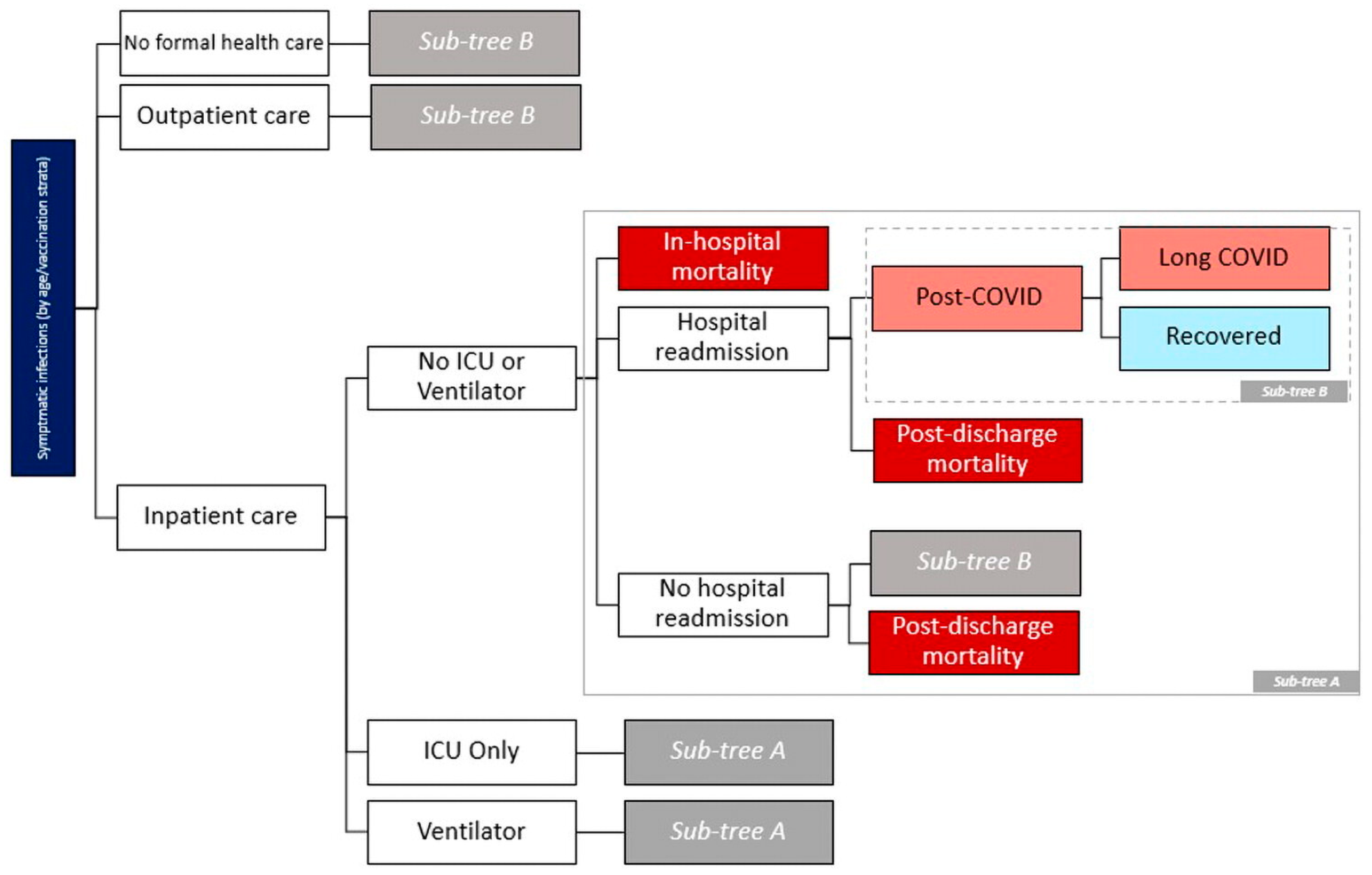
2.2. Model Structure and Inputs
2.3. Model Input Parameter Updates
2.4. Vaccine Characteristics
2.5. Vaccine Unit Costs
2.6. Sensitivity and Scenario Analyses
3. Results
3.1. Base Case Analysis: mRNA-1283 Versus No Vaccination
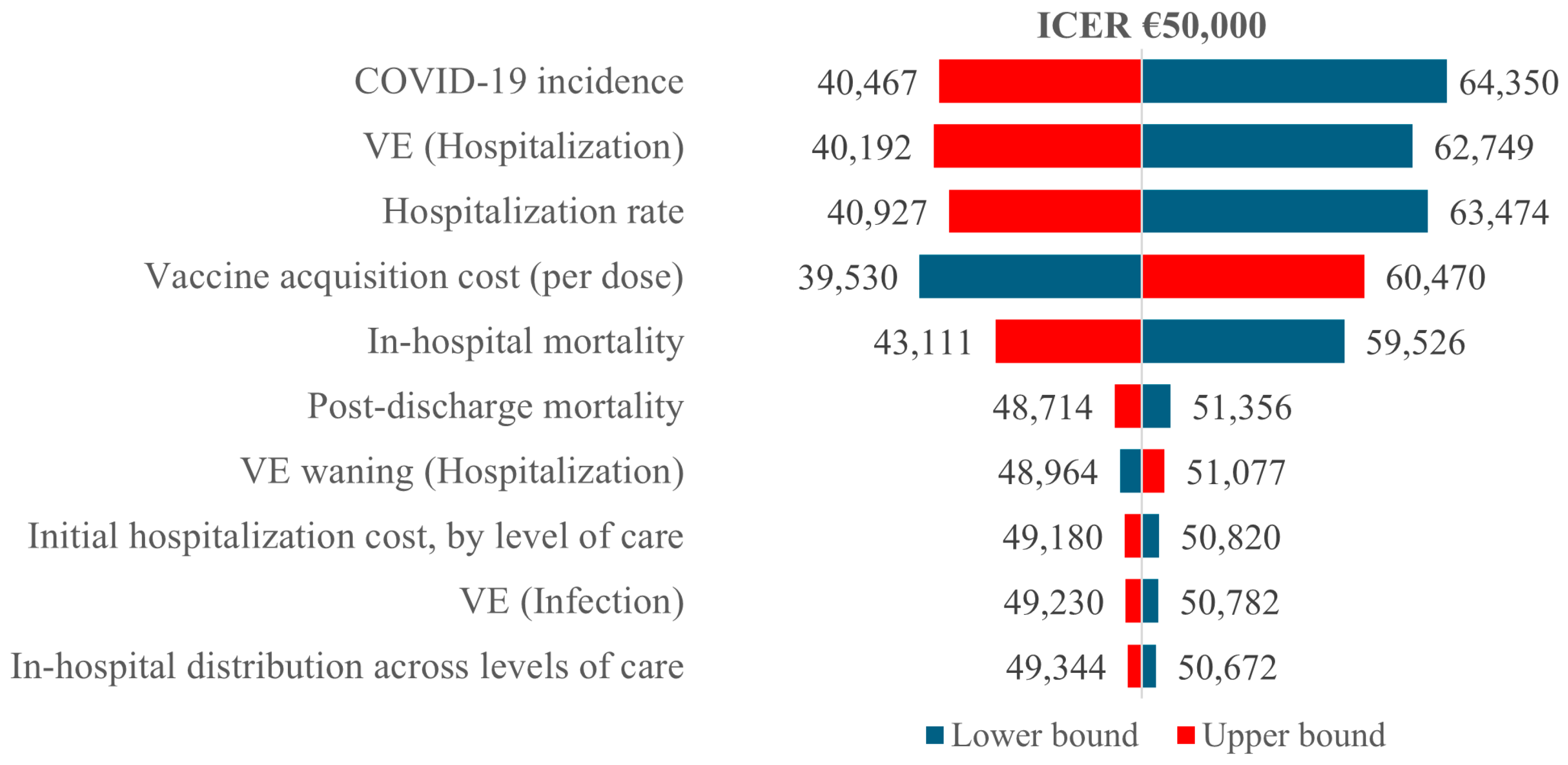
Additional Scenario Analyses and DSA Results
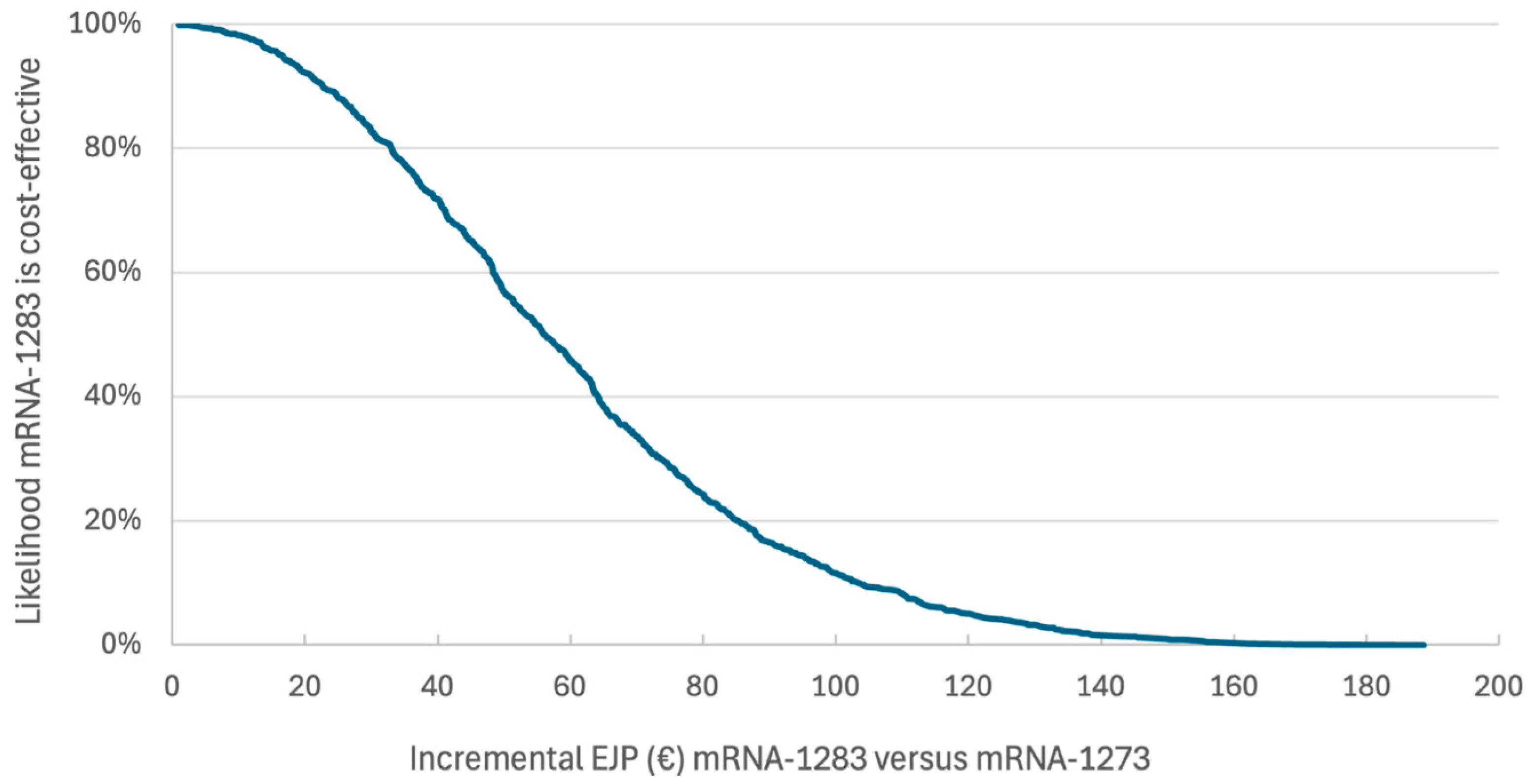
3.2. Analysis: mRNA-1283 Versus mRNA-1273
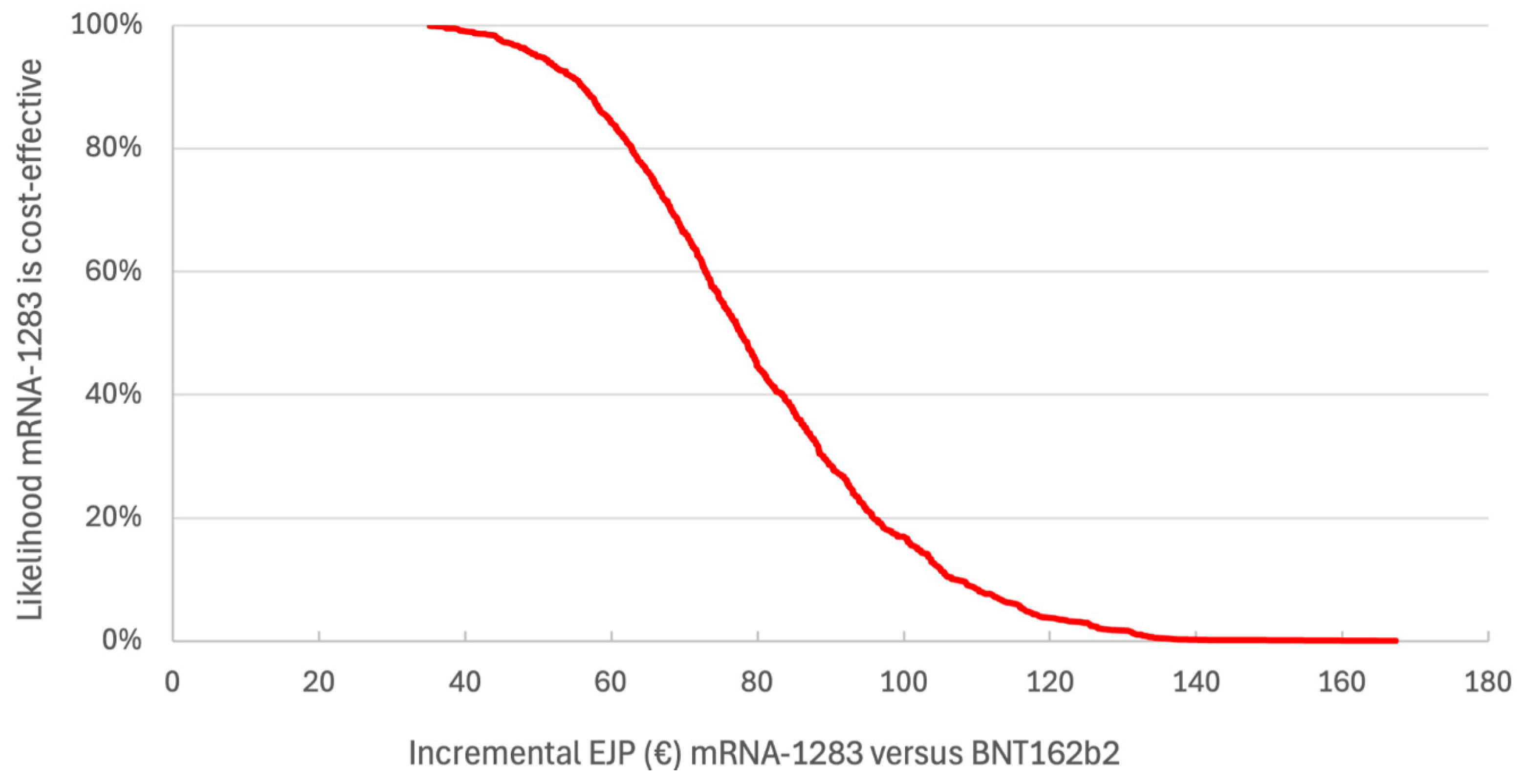
3.3. Analysis: mRNA-1283 Versus BNT162b2
4. Discussion
5. Conclusions
Author Contributions
Funding
Institutional Review Board Statement
Informed Consent Statement
Data Availability Statement
Acknowledgments
Conflicts of Interest
Abbreviations
| BNT162b2 | Comirnaty, Pfizer-BioNTech |
| CI | Confidence interval |
| DSA | Deterministic sensitivity analysis |
| EJP | Economically justifiable price |
| ICER | Incremental cost-effectiveness ratio |
| ICU | Intensive care unit |
| K | thousands |
| M | million |
| mRNA-1273 | Spikevax, Moderna |
| mRNA-1283 | mNEXSPIKE, Moderna |
| NNV | Number needed to vaccinate |
| PSA | Probabilistic sensitivity analysis |
| QALY | Quality-adjusted life-year |
| rVE | Relative vaccine effectiveness |
| US | United States |
| VCR | Vaccine coverage rate |
| VE | Vaccine effectiveness |
| WTP | Willingness-to-pay |
Appendix A


| Population | Source | ||||
|---|---|---|---|---|---|
| Total | 5,922,720 | High-risk | [36] | ||
| 60+ | 4,784,093 | Age-based | |||
| 50–59 | 298,007 | Yes | |||
| 18–49 | 840,620 | Yes | |||
| Incidence COVID-19 symptomatic infection | |||||
| Age- and month-dependent | Table A2 [9] | ||||
| Proportion of infected people seeking care at the general practitioner level | |||||
| 60+ | 28.46% | Age-adjusted [38] | |||
| 50 to 59 | 21.26% | ||||
| 18 to 49 | 19.69% | ||||
| Age-dependent COVID-19 hospitalization risk given COVID-19 symptomatic infection | |||||
| 60+ | 5.89% | Age-adjusted [9] | |||
| 50 to 59 | 0.68% | ||||
| 18 to 49 | 0.26% | ||||
| Percentage Intensive Care Unit (ICU) among hospitalized | |||||
| 60+ | 5.79% | Age-adjusted [9] | |||
| 50 to 59 | 11.72% | ||||
| 18 to 49 | 11.43% | ||||
| In-hospital mortality (no ICU) | |||||
| 60+ | 18.04% | Age-adjusted [9] | |||
| 50 to 59 | 2.10% | ||||
| 18 to 49 | 0.60% | ||||
| In-hospital mortality (ICU) | |||||
| 60+ | 43.68% | Age-adjusted [9] | |||
| 50 to 59 | 15.05% | ||||
| 18 to 49 | 6.74% | ||||
| Hospital readmission rate | 11.70% | [45,46] | |||
| Post-discharge mortality | 3.80% | [46] | |||
| Infection associated myocarditis | |||||
| Female | Male | ||||
| 60+ | 0.0847% | 0.1683% | Age-adjusted [9] | ||
| 50 to 59 | 0.1018% | 0.1881% | |||
| 18 to 49 | 0.0592% | 0.1682% | |||
| Vaccine characteristics | |||||
| Vaccine effectiveness (VE) | Age- and product-dependent | Table 1 (main manuscript) | |||
| Waning of VE (same for all products) | |||||
| Against infection | 4.75% | [32] | |||
| Against hospitalization | 2.46% | [33] | |||
| Vaccine related AEs | |||||
| Probabilities | mRNA-1283 | mRNA-1273 | BNT162b2 | ||
| Grade 3 local | 1.61% | 1.17% | 1.17% | [3] | |
| Grade 3 systemic | 7.16% | 5.77% | 5.77% | ||
| Anaphylaxis | 0.0005% | 0.0005% | 0.0005% | [47] | |
| Myocarditis/pericarditis * | 0.0008% | 0.0008% | 0.0008% | [34] | |
| Vaccination coverage | |||||
| Sep-25 | Oct-25 | Nov-25 | Dec-25 | [10] | |
| 60+ | 1.90% | 19.37% | 35.63% | 41.60% | |
| 50 to 59 | 11.68% | 18.51% | 23.55% | 26.93% | |
| 18 to 49 | 2.93% | 4.65% | 5.91% | 6.76% | |
| Costs (Euro) | |||||
| Vaccine administration cost | 13.67 | [48] inflated to 2025 | |||
| Direct healthcare cost | |||||
| Outpatient care (GP visit) | 43.22 | [49] inflated to 2025 | |||
| Hospital General Ward (same for readmission) | 7051.88 | [50] inflated to 2025 | |||
| Hospitalized—ICU (same for readmission) | 12,650.72 | ||||
| Hospitalization recovery (inpatient follow-up) | 119.20 | [49] inflated to 2025 | |||
| Post-infection period (long-COVID) (scenario) | 1206.29 | [51] inflated to 2025 | |||
| Myocarditis following infection | 3304.61 | Age-adjusted [9] inflated to 2025 | |||
| AEs | |||||
| Grade 3 local | 0.26 | [52] inflated to 2025 | |||
| Grade 3 systemic | 0.26 | ||||
| Anaphylaxis | 339.26 (1 ED visit) | [49] inflated to 2025 | |||
| Myocarditis/pericarditis (5.3 nursing days) | 6119.47 | [42,49] inflated to 2025 | |||
| Indirect costs | |||||
| Percentage in labor force | |||||
| 60+ | 22.5% | [9] | |||
| 50 to 59 | 83.0% | ||||
| 18 to 49 | 85.9% | ||||
| Daily wage | 208.74 | [49,53] inflated to 2025 | |||
| Productivity loss estimates (in days) | |||||
| Vaccine administration | 0.13 | 1 h assumption | |||
| COVID-19 non-hospitalized | 3.5 | [54] | |||
| COVID-19 hospitalized (non ICU) | 8.43 (SD 7.51) | [39] | |||
| COVID-19 hospitalized (ICU) | 16.64 (SD 13.69) | [39] | |||
| Recovery from hospitalization | 27 | [55] | |||
| Post-COVID (scenario) | 11 | [56] | |||
| Myocarditis (infection-induced) | 8.8 | Age-adjusted [9] | |||
| Myocarditis (adverse events) | 3 | [42] | |||
| Anaphylaxis (adverse event) | 1 | [42] | |||
| QALY loss | |||||
| Baseline utility data for each population group: age-dependent | |||||
| Grade 3 local | 0.0004 | [57] | |||
| Grade 3 systemic | 0.0004 | ||||
| Anaphylaxis | 0.02 | ||||
| Myocarditis/pericarditis | 0.0019 | ||||
| COVID-19 Infection related health states (>18 years) | |||||
| No formal care | 0.0046 | Assumed based on [58] (assumed same for readmission) | |||
| Outpatient care | 0.0046 | ||||
| Hospitalized/readmission | |||||
| No ICU | 0.0174 | ||||
| ICU only | 0.0394 | ||||
| Ventilator | 0.0394 | ||||
| Myocarditis (infection) | 0.0188 | Age-adjusted [9] | |||
| Post-COVID (scenario) | |||||
| No formal care | 0.0 | [59] adjusted for outpatient care QALY loss [60] | |||
| Outpatient care | 0.023 | ||||
| Hospitalization | 0.1026 | ||||
| Age Group | Sep-25 | Oct -25 | Nov-25 | Dec-25 | Jan -26 | Feb -26 | Mar -26 | Apr -26 | May-26 | Jun -26 | Jul -26 | Aug-26 |
|---|---|---|---|---|---|---|---|---|---|---|---|---|
| 18–49 years | 0.10 | 1.23 | 0.57 | 0.82 | 0.49 | 0.76 | 0.65 | 0.25 | 0.12 | 0.05 | 0.04 | 0.10 |
| 50–59 years | 0.06 | 1.23 | 0.52 | 0.81 | 0.57 | 0.55 | 0.64 | 0.23 | 0.13 | 0.05 | 0.05 | 0.06 |
| 60–100 years | 0.10 | 2.53 | 0.81 | 1.10 | 0.85 | 0.92 | 1.16 | 0.46 | 0.23 | 0.06 | 0.07 | 0.10 |
| Variable | Age Group | Point Estimate | Distribution | SE | Details |
|---|---|---|---|---|---|
| COVID incidence rates | All age groups | Age- and month-specific | Normal | 10% | Multiplier applied to all incidence rates to vary them all up or down for a certain percentage. A multiplier of 1.0 represents the base case values. 0.10 or 10% of the multiplier was used as the SE for the multiplier to vary incidence rates in the PSA. |
| Vaccine Waning (intervention): Infections | 18–100 years | 0.048 | N/A | N/A | Set equal to vaccine waning for comparator. Varies as the waning of the comparator varies following [21] |
| Vaccine Waning (intervention): Hospitalizations | 18–100 years | 0.025 | N/A | N/A | Set equal to vaccine waning for comparator. Varies as the waning of the comparator varies following [21] |
| Hospitalization rates | 18–49 years | 0.255% | Beta | 0.0002552 | SE estimated as 10% of the mean. |
| 50–59 years | 0.68% | Beta | 0.00068 | ||
| 60–100 years | 5.89% | Beta | 0.0059 | ||
| Proportion No formal care | NFC: 18–49 years | 80.0% | Beta | 0.0800 | SE estimated as 10% of the mean. |
| NFC: 50–59 years | 78.1% | Beta | 0.0781 | ||
| NFC: 60–100 years | 64.5% | Beta | 0.0645 | ||
| Proportion Outpatient care | OP: 18–49 years | 19.7% | N/A | Calculated as 1- Hospitalization rates—proportion outpatient care. | |
| OP: 50–64 years | 21.3% | N/A | |||
| OP: 65–100 years | 29.6% | N/A | |||
| In-Hospital Level of Care: No ICU or Ventilator, ICU including ICU only and ICU with Ventilator | ICU: 18–49 years | 11.3% | Dirichlet | Alpha = mean × 100 beta = 1 Gamma distribution used to select values for each of the 3 inputs across each age group and then converted to probabilities. Inputs for each age group add to 100%. | |
| ICU: 50–59 years | 11.72% | Dirichlet | |||
| ICU: 60–100 years | 5.79% | Dirichlet | |||
| No ICU or Vent: 18–49 years | 88.57% | Dirichlet | |||
| No ICU or Vent: 50–59 years | 88.28% | Dirichlet | |||
| No ICU or Vent: 60–100 years | 94.21% | Dirichlet | |||
| Probability Readmission | All age groups and level of care | 11.7% | Beta | 0.0117 | SE estimated as 10% of the mean |
| In-hospital mortality: ICU including ICU only and ICU with ventilator | 18–49 years | 0.067 | Dirichlet | alpha = mean × 100 beta = 1 Gamma distribution used to select values for each of the 2 inputs (in hospital mortality and no readmission) across an age group and level of care, then converted to probabilities in conjunction with the rate of readmission to add to 100%. These two probabilities will combine to represent 100%—% readmission. | |
| 50–59 years | 0.151 | Dirichlet | |||
| 60–100 years | 0.437 | Dirichlet | |||
| No readmission or mortality: ICU including ICU only and ICU with ventilator | 18–49 years | 0.816 | Dirichlet | ||
| 50–59 years | 0.733 | Dirichlet | |||
| 60–100 years | 0.446 | Dirichlet | |||
| In-hospital mortality: No ICU or ventilator | 18–49 years | 0.006 | Dirichlet | ||
| 50–59 years | 0.021 | Dirichlet | |||
| 60–100 years | 0.18 | Dirichlet | |||
| No readmission or mortality: No ICU or ventilator | 18–49 years | 0.877 | Dirichlet | ||
| 50–59 years | 0.862 | Dirichlet | |||
| 60–100 years | 0.703 | Dirichlet | |||
| Post-discharge mortality | All age groups and levels of care | 3.80% | Beta | 0.0039% | SE estimated from the upper and lower bounds of the 95%CI (approximated +/−20% of base case) and assuming an approximate normal distribution. |
| Vaccine administration cost | All age groups | €13.67 | Gamma | €1.367 | SE estimated as 10% of the mean. |
| AE related costs | All age groups | €0.26 | Gamma | €0.026 | SE estimated as 10% of the mean. |
| Grade 3 local | €0.26 | €0.026 | |||
| Grade 3 systemic | €339.30 | €33.93 | |||
| Anaphylaxis | €3304.6 | €330.46 | |||
| Myocarditis/Pericarditis | 0 | ||||
| COVID-19 caused myocarditis | All age groups | €6119.5 | Gamma | €611.95 | SE estimated as 10% of the mean. |
| Outpatient care costs | All age group: physician costs | €43.20 | Gamma | €4.32 | SE estimated as 10% of the mean. |
| Hospitalization costs | All age groups: No ICU or Vent | €7052 | Gamma | €705.20 | SE estimated as 10% of the mean. |
| All age groups: ICU including ICU only and ICU with ventilator | €12,650.70 | Gamma | €1260.51 | ||
| Time loss Adverse events (days) | All ages: Any Grade 3 local adverse events | 0 | N/A | 0 | N/A SE estimated as 10% of the mean. |
| All ages: Any Grade 3 systemic adverse events | 0 | N/A | 0 | ||
| All ages: Anaphylaxis | 1 | Gamma | 0.1 | ||
| All ages: Myocarditis/Pericarditis | 3 | Gamma | 0.3 | ||
| Time loss for Acute COVID phase (days) | All ages: Outpatient and not seeking care | 3.5 | Gamma | 0.035 | SE estimated as 10% of the mean. |
| All ages: Symptoms prior to hospitalization | 3.5 | Gamma | 0.035 | ||
| All ages: In hospital stay | 8.43 (no ICU) 16.64 (ICU) | Gamma | 0.0843 (no ICU) 1.664 (ICU) | ||
| All ages: Recovery | 27.0 | Gamma | 2.7 | ||
| All ages: Readmission | 8.43 (no ICU) 16.64 (ICU) | Gamma | 0.843 (no ICU) 1.664 (ICU) | ||
| Time loss due to COVID-19 caused myocarditis | All age groups | 8.82 days | Gamma | 0.882 | SE estimated as 10% of the mean. |
| Daily wage | €208.7 | All ages | Gamma | €20.87 | |
| QALY loss Adverse events | All ages: Any Grade 3 local adverse events | 0.0004 | Beta | 0.00004 | SE estimated as 10% of the mean. |
| All ages: Any Grade 4 local adverse events | 0.0019 | Beta | 0.00019 | ||
| All ages: Any Grade 3 systemic adverse events | 0.0004 | Beta | 0.00004 | ||
| All ages: Any Grade 4 systemic adverse events | 0.0019 | Beta | 0.00019 | ||
| All ages: Anaphylaxis | 0.0019 | Beta | 0.00019 | ||
| All ages: Myocarditis/Pericarditis | 0.0006 | Beta | 0.00006 | ||
| QALY lossCOVID-19 associated myocarditis | All ages | 0.02 | Beta | 0.0002 | SE estimated as 10% of the mean. |
| Non hospitalized patients QALY (18+) | 18+: No formal care | 0.0046 | Beta | 0.00046 | SE estimated as 10% of the mean. |
| 18+: Outpatient care | 0.0046 | Beta | 0.00046 | ||
| Hospitalization QALY losses (18+) | 18+: No ICU or Vent (Symptoms prior to hosp) | 0.000 | Beta | 0.000 | SE estimated as 10% of the mean. |
| 18+: ICU only (Symptoms prior to hosp) | 0.000 | Beta | 0.000 | ||
| 18+: Vent (Symptoms prior to hosp) | 0.000 | Beta | 0.000 | ||
| 18+: No ICU or Vent (In-hospital) | 0.017 | Beta | 0.031 | ||
| 18+: ICU only (In hospital) | 0.039 | Beta | 0.058 | ||
| 18+: Vent (In hospital) | 0.039 | Beta | 0.058 | ||
| Readmission QALY losses (18+) | 18+: No ICU or Vent | 0.0174 | Beta | 0.00174 | SE estimated as 10% of the mean. |
| 18+: ICU only | 0.0394 | Beta | 0.00394 | ||
| 18+: Vent | 0.0394 | Beta | 0.00394 |
| Scenario: mRNA-1273 Versus mRNA-1283 | |||||
| rVE: Infections | 18–49 years | 0.163 | Beta | 0.0686 | SE estimated from the upper and lower bounds of the 95%CI (including negative estimates for LB) and assuming an approximate normal distribution. |
| 50–59 years | 0.163 | Beta | 0.0686 | ||
| 60–100 years | 0.135 | Beta | 0.0977 | ||
| rVE: Hospitalizations | 18–49 years | 0.381 | Beta | 0.1804 | SE estimated from the upper and lower bounds of the 95%CI (including negative estimates for LB) and assuming an approximate normal distribution. |
| 50–59 years | 0.381 | Beta | 0.1804 | ||
| 60–100 years | 0.381 | Beta | 0.1804 | ||
| 1283 Vaccine Effectiveness: Infections | 18–49 years | 0.566 | N/A | N/A | Calculated based on comparator (i.e., mRNA-1273) VE and rVE selection. Varies as other values vary. Maximum value of 0.99 included in calculations. |
| 50–59 years | 0.566 | ||||
| 60–100 years | 0.607 | ||||
| 1283 Vaccine Effectiveness: Hospitalizations | 18–49 years | 0.694 | N/A | N/A | Calculated based on comparator (i.e., mRNA-1273) VE and rVE selection. Varies as other values vary. Maximum value of 0.99 included in calculations. |
| 50–59 years | 0.694 | ||||
| 60–100 years | 0.735 | ||||
| Scenario: mRNA-1283 versus BNT162b2 | |||||
| rVE: Infections | 18–49 years | 0.190 | Beta | 0.0190 | SE estimated as 10% of the mean. |
| 50–59 years | 0.190 | Beta | 0.0190 | ||
| 60–100 years | 0.228 | Beta | 0.0228 | ||
| rVE: Hospitalizations | 18–49 years | 0.441 | Beta | 0.0441 | SE estimated as 10% of the mean. |
| 50–59 years | 0.441 | Beta | 0.0441 | ||
| 60–100 years | 0.441 | Beta | 0.0441 | ||
| BNT162b2 Vaccine Effectiveness: Infections | 18–49 years | 0.465 | N/A | N/A | Calculated based on comparator (i.e., mRNA-1283) VE and rVE selection. Varies as other values vary. Maximum value of 0.99 included in calculations. |
| 50–59 years | 0.465 | ||||
| 60–100 years | 0.490 | ||||
| BNT162b2 Vaccine Effectiveness: Hospitalizations | 18–49 years | 0.452 | N/A | N/A | Calculated based on comparator (i.e., mRNA-1283) VE and rVE selection. Varies as other values vary. Maximum value of 0.99 included in calculations. |
| 50–59 years | 0.452 | ||||
| 60–100 years | 0.526 | ||||
References
- Baden, L.R.; El Sahly, H.M.; Essink, B.; Kotloff, K.; Frey, S.; Novak, R.; Diemert, D.; Spector, S.A.; Rouphael, N.; Creech, C.B.; et al. Efficacy and Safety of the mRNA-1273 SARS-CoV-2 Vaccine. N. Engl. J. Med. 2021, 384, 403–416. [Google Scholar] [CrossRef] [Scilit]
- Polack, F.P.; Thomas, S.J.; Kitchin, N.; Absalon, J.; Gurtman, A.; Lockhart, S.; Perez, J.L.; Pérez Marc, G.; Moreira, E.D.; Zerbini, C.; et al. Safety and Efficacy of the BNT162b2 mRNA COVID-19 Vaccine. N. Engl. J. Med. 2020, 383, 2603–2615. [Google Scholar] [CrossRef] [Scilit]
- Chalkias, S.; Dennis, P.; Petersen, D.; Radhakrishnan, K.; Vaughan, L.; Handforth, R.; Rossi, A.; Wahid, R.; Edwards, D.K.; Feng, J.; et al. Efficacy, immunogenicity, and safety of a next-generation mRNA-1283 COVID-19 vaccine compared with the mRNA-1273 vaccine (NextCOVE): Results from a phase 3, randomised, observer-blind, active-controlled trial. Lancet Infect. Dis. 2025, 25, 1230–1242. [Google Scholar] [CrossRef] [Scilit]
- Scott, J.; Abers, M.S.; Marwah, H.K.; McCann, N.C.; Meyerowitz, E.A.; Richterman, A.; Fleming, D.F.; Holmes, E.J.; Moat, L.E.; Redepenning, S.G.; et al. Updated Evidence for Covid-19, RSV, and Influenza Vaccines for 2025–2026. N. Engl. J. Med. 2025, 393, 2221–2242. [Google Scholar] [CrossRef] [Scilit] [PubMed]
- Zhou, G.; Dael, N.; Verweij, S.; Balafas, S.; Mubarik, S.; Oude Rengerink, K.; Pasmooij, A.M.G.; van Baarle, D.; Mol, P.G.M.; de Bock, G.H.; et al. Effectiveness of COVID-19 vaccines against SARS-CoV-2 infection and severe outcomes in adults: A systematic review and meta-analysis of European studies published up to 22 January 2024. Eur. Respir. Rev. 2025, 34, 240222. [Google Scholar] [CrossRef] [Scilit]
- van Werkhoven, C.H.; Valk, A.W.; Smagge, B.; de Melker, H.E.; Knol, M.J.; Hahné, S.J.; van den Hof, S.; de Gier, B. Early COVID-19 vaccine effectiveness of XBB.1.5 vaccine against hospitalisation and admission to intensive care, the Netherlands, 9 October to 5 December 2023. Eurosurveillance 2024, 29, 2300703. [Google Scholar] [CrossRef] [Scilit] [PubMed]
- Gezondheidsraad. COVID-19-Vaccinatie in 2025. Available online: https://www.gezondheidsraad.nl/site/binaries/site-content/collections/documents/2025/03/27/advies-covid-19-vaccinatie-in-2025/COVID-19-vaccinatie-in-2025-advies.pdf (accessed on 29 January 2026).
- Rijksinstituut voor Volksgezondheid en Milieu (RIVM). Staat van Infectieziekten in Nederland, 2024. RIVM Rapport 2025-0123. Available online: https://www.rivm.nl/bibliotheek/rapporten/2025-0123.pdf (accessed on 29 January 2026).
- Zeevat, F.; van der Pol, S.; Westra, T.; Beck, E.; Postma, M.J.; Boersma, C. Cost-effectiveness Analysis of COVID-19 mRNA XBB.1.5 Fall 2023 Vaccination in the Netherlands. Adv. Ther. 2025, 42, 1550–1569. [Google Scholar] [CrossRef] [Scilit] [PubMed]
- Rijksinstituut voor Volksgezondheid en Milieu (RIVM). Deelname COVID-19-Vaccinatie in Nederland. Available online: https://www.rivm.nl/sites/default/files/2025-12/Deelname-COVID-19-vaccinatie-in-Nederland_20251208.pdf (accessed on 29 January 2026).
- Rijksinstituut voor Volksgezondheid en Milieu (RIVM). Infectie Radar. Available online: https://www.infectieradar.nl/ (accessed on 2 February 2026).
- European Medicines Agency (EMA). mNexspike. Available online: https://www.ema.europa.eu/en/medicines/human/EPAR/mnexspike#overview (accessed on 13 February 2026).
- European Medicines Agency (EMA). Spikevax: Summary of Product Characteristics. Available online: https://www.ema.europa.eu/en/medicines/human/EPAR/spikevax#product-info (accessed on 2 February 2026).
- Food & Drug Administration (FDA). MNEXSPIKE—Package Insert. Available online: https://www.fda.gov/media/186738/download?attachment (accessed on 2 February 2026).
- Kopel, H.; Nguyen, V.H.; Boileau, C.; Bogdanov, A.; Winer, I.; Ducruet, T.; Zeng, N.; Bonafede, M.; Esposito, D.B.; Martin, D.; et al. Comparative Effectiveness of Bivalent (Original/Omicron BA.4/BA.5) COVID-19 Vaccines in Adults. Vaccines 2023, 11, 1711. [Google Scholar] [CrossRef] [Scilit]
- Dickerman, B.A.; Gerlovin, H.; Madenci, A.L.; Kurgansky, K.E.; Ferolito, B.R.; Figueroa Muñiz, M.J.; Gagnon, D.R.; Gaziano, J.M.; Cho, K.; Casas, J.P.; et al. Comparative Effectiveness of BNT162b2 and mRNA-1273 Vaccines in U.S. Veterans. N. Engl. J. Med. 2022, 386, 105–115. [Google Scholar] [CrossRef] [Scilit]
- Dickerman, B.A.; Madenci, A.L.; Gerlovin, H.; Kurgansky, K.E.; Wise, J.K.; Figueroa Muñiz, M.J.; Ferolito, B.R.; Gagnon, D.R.; Gaziano, J.M.; Cho, K.; et al. Comparative Safety of BNT162b2 and mRNA-1273 Vaccines in a Nationwide Cohort of US Veterans. JAMA Intern. Med. 2022, 182, 739–746. [Google Scholar] [CrossRef] [Scilit]
- Kavikondala, S.; Haeussler, K.; Wang, X.; Bausch-Jurken, M.T.; Nassim, M.; Mishra, N.K.; Malmenäs, M.; Sharma, P.; Van de Velde, N.; Green, N.; et al. Comparative Effectiveness of mRNA-1273 and BNT162b2 COVID-19 Vaccines Among Older Adults: Systematic Literature Review and Meta-Analysis Using the GRADE Framework. Infect. Dis. Ther. 2024, 13, 779–811. [Google Scholar] [CrossRef] [Scilit]
- Wang, X.; Pahwa, A.; Bausch-Jurken, M.T.; Chitkara, A.; Sharma, P.; Malmenäs, M.; Vats, S.; Whitfield, M.G.; Lai, K.Z.H.; Dasari, P.; et al. Comparative Effectiveness of mRNA-1273 and BNT162b2 COVID-19 Vaccines Among Adults with Underlying Medical Conditions: Systematic Literature Review and Pairwise Meta-Analysis Using GRADE. Adv. Ther. 2025, 42, 2040–2077. [Google Scholar] [CrossRef] [Scilit]
- Beck, E.; Georgieva, M.; Wang, W.J.; Gomez-Lievano, A.; Wang, H.; Gao, Y.; Kopel, H.; Bausch-Jurken, M.; Patterson-Lomba, O.; Mu, F.; et al. Indirect comparison of the relative vaccine effectiveness of mRNA-1283 vs. BNT162b2 vaccines against symptomatic COVID-19 among US adults. Curr. Med. Res. Opin. 2025, 41, 721–732. [Google Scholar] [CrossRef] [Scilit]
- Fust, K.; Kohli, M.; Joshi, K.; Cartier, S.; Lee, A.; Van de Velde, N.; Weinstein, M.; Beck, E. Modeling the Cost-Effectiveness of the Next-Generation COVID-19 mRNA-1283 vaccine in the United States. J. Med. Econ. 2026, 29, 574–593. [Google Scholar] [CrossRef] [Scilit]
- Fust, K.; Kohli, M.; Cartier, S.; Joshi, K.; Van de Velde, N.; Beck, E.; Blake, M. The potential impact of the next-generation COVID-19 mRNA-1283 vaccine in Canada. J. Med. Econ. 2025, 28, 1440–1450. [Google Scholar] [CrossRef] [Scilit]
- University of Michigan COVID-19 Vaccination Modeling Team. Economic Analysis of an Additional Dose of the 2024–2025 COVID-19 Vaccine. Available online: https://www.cdc.gov/acip/downloads/slides-2024-10-23-24/05-COVID-Prosser-508.pdf (accessed on 7 April 2026).
- Keeling, M.J.; Hill, E.M.; Petrou, S.; Tran, P.B.; Png, M.E.; Staniszewska, S.; Clark, C.; Hassel, K.; Stowe, J.; Andrews, N. Cost-effectiveness of routine COVID-19 adult vaccination programmes in England. Vaccine 2025, 53, 126948. [Google Scholar] [CrossRef] [Scilit]
- Centraal Bureau voor de Statistiek (CBS). Inflation. Available online: https://www.cbs.nl/nl-nl/visualisaties/dashboard-consumentenprijzen (accessed on 2 February 2026).
- Geuzinge, H.A.; El Alili, M.; Enzing, J.J.; Huis In ‘t Veld, L.M.; Knies, S.; de Wit, G.A. The New Dutch Guideline for Economic Evaluations in Healthcare: Taking the Societal Perspective to the Next Level. Value Health 2025, 28, 930–935. [Google Scholar] [CrossRef] [Scilit]
- Kim DeLuca, E.; Gebremariam, A.; Rose, A.; Biggerstaff, M.; Meltzer, M.I.; Prosser, L.A. Cost-effectiveness of routine annual influenza vaccination by age and risk status. Vaccine 2023, 41, 4239–4248. [Google Scholar] [CrossRef] [Scilit] [PubMed]
- de Bruijn, S.; Huiberts, A.J.; Andeweg, S.P.; Hoeve, C.E.; Schipper, M.; Grobbee, D.E.; de Melker, H.E.; van de Wijgert, J.; van den Hof, S.; Knol, M.J.; et al. Post-COVID-19 condition in individuals infected with SARS-CoV-2 in autumn 2023 in the Netherlands: A prospective cohort study with pre- and post-infection data. Lancet Reg. Health–Eur. 2025, 59, 101472. [Google Scholar] [CrossRef] [Scilit] [PubMed]
- Kawai, K.; Muhere, C.F.; Lemos, E.V.; Francis, J.M. Viral Infections and Risk of Cardiovascular Disease: Systematic Review and Meta-Analysis. J. Am. Heart Assoc. 2025, 14, e042670. [Google Scholar] [CrossRef] [Scilit] [PubMed]
- Xie, Y.; Choi, T.; Al-Aly, Z. Long-term outcomes following hospital admission for COVID-19 versus seasonal influenza: A cohort study. Lancet Infect. Dis. 2024, 24, 239–255. [Google Scholar] [CrossRef] [Scilit]
- Vicic, N.; Bogdanov, A.; Zheng, Z.; Ryan, T.; Zeng, N.; Joshi, K.; Lu, T.; Bonafede, M.; Araujo, A.B.; Wilson, A. Evaluating the Effectiveness of 2024–2025 Seasonal mRNA-1273 Vaccination Against COVID-19-Related Hospitalizations and Medically Attended COVID-19 Among Adults Aged ≥ 18 years in the United States: An Observational Matched Cohort Study. Infect. Dis. Ther. 2026, 15, 701–714. [Google Scholar] [CrossRef] [Scilit]
- Higdon, M.M.; Baidya, A.; Walter, K.K.; Patel, M.K.; Issa, H.; Espié, E.; Feikin, D.R.; Knoll, M.D. Duration of effectiveness of vaccination against COVID-19 caused by the omicron variant. Lancet Infect. Dis. 2022, 22, 1114–1116. [Google Scholar] [CrossRef] [Scilit]
- Andersson, N.W.; Thiesson, E.M.; Pihlström, N.; Perälä, J.; Faksová, K.; Gram, M.A.; Poukka, E.; Leino, T.; Ljung, R.; Hviid, A. Comparative effectiveness of monovalent XBB.1.5 containing covid-19 mRNA vaccines in Denmark, Finland, and Sweden: Target trial emulation based on registry data. BMJ Med. 2024, 3, e001074. [Google Scholar] [CrossRef] [Scilit]
- US Food & Drug Administration (FDA). Letters for Myocarditis. Available online: https://www.fda.gov/vaccines-blood-biologics/safety-availability-biologics/fda-approves-required-updated-warning-labeling-mrna-covid-19-vaccines-regarding-myocarditis-and (accessed on 29 January 2026).
- Pijpers, J.; van Roon, A.; van Roekel, C.; Labuschagne, L.; Smagge, B.; Ferreira, J.A.; de Melker, H.; Hahné, S. Determinants of COVID-19 Vaccine Uptake in The Netherlands: A Nationwide Registry-Based Study. Vaccines 2023, 11, 1409. [Google Scholar] [CrossRef] [Scilit] [PubMed]
- Centraal Bureau voor de Statistiek (CBS). Bevolking. Available online: https://www.cbs.nl/nl-nl/visualisaties/dashboard-bevolking (accessed on 2 February 2026).
- Zeevat, F.; Luttjeboer, J.; Paulissen, J.H.J.; van der Schans, J.; Beutels, P.; Boersma, C.; Postma, M.J. Exploratory Analysis of the Economically Justifiable Price of a Hypothetical RSV Vaccine for Older Adults in the Netherlands and the United Kingdom. J. Infect. Dis. 2022, 226, S102–S109. [Google Scholar] [CrossRef] [Scilit] [PubMed]
- Friesema, I.H.; Koppeschaar, C.E.; Donker, G.A.; Dijkstra, F.; van Noort, S.P.; Smallenburg, R.; van der Hoek, W.; van der Sande, M.A. Internet-based monitoring of influenza-like illness in the general population: Experience of five influenza seasons in the Netherlands. Vaccine 2009, 27, 6353–6357. [Google Scholar] [CrossRef] [Scilit]
- Bekker, R.; Uit Het Broek, M.; Koole, G. Modeling COVID-19 hospital admissions and occupancy in the Netherlands. Eur. J. Oper. Res. 2023, 304, 207–218. [Google Scholar] [CrossRef] [Scilit]
- van der Pol, S.; Zeevat, F.; Postma, M.J.; Boersma, C. Cost-effectiveness of high-dose influenza vaccination in the Netherlands: Incorporating the impact on both respiratory and cardiovascular hospitalizations. Vaccine 2024, 42, 3429–3436. [Google Scholar] [CrossRef] [Scilit] [PubMed]
- Zeevat, F.; Luttjeboer, J.; Korsten, K.; van Boven, M.; Postma, M.J.; van der Pol, S.; Boersma, C. Evaluating cost-effectiveness of RSV vaccination strategies for older adults in the Netherlands. Vaccine 2025, 65, 127735. [Google Scholar] [CrossRef] [Scilit]
- StatLine Opendata.CBS.NL. Ziekenhuisopnamen en-Patiënten; Diagnose-Indeling ICD-10 (3-Teken Niveau). Available online: https://opendata.cbs.nl/#/CBS/nl/dataset/84069NED/table?ts=1767789775076 (accessed on 29 January 2026).
- Gezondheidsraad. RSV-Vaccinatie Voor Ouderen. Available online: https://www.gezondheidsraad.nl/site/binaries/site-content/collections/documents/2025/03/27/advies-rsv-vaccinatie-voor-ouderen/RSV-vaccinatie-voor-ouderen_advies.pdf (accessed on 5 February 2026).
- Rijksinstituut voor Volksgezondheid en Milieu (RIVM). Staat van Infectieziekten in Nederland, 2023. RIVM-Rapport 2024-0135. Available online: https://www.rivm.nl/bibliotheek/rapporten/2024-0135.pdf (accessed on 5 February 2026).
- Leijte, W.; Wagemaker, N.M.M.; van Kraaij, T.D.A.; de Kruif, M.D.; Mostard, G.J.M. Sterfte en heropname na ziekenhuisopname met covid-19. Ned. Tijdschr. Geneeskd. 2020, 164, D5423. [Google Scholar]
- Ramzi, Z.S. Hospital readmissions and post-discharge all-cause mortality in COVID-19 recovered patients; A systematic review and meta-analysis. Am. J. Emerg. Med. 2022, 51, 267–279. [Google Scholar] [CrossRef] [Scilit] [PubMed]
- Klein, N. Rapid Cycle Analysis to Monitor the Safety of COVID-19 Vaccines in Near Real-Time Within the Vaccine Safety Datalink: Myocarditis and Anaphylaxis. Presentation to the Advisory Committee on Immunization Practices. Available online: https://stacks.cdc.gov/view/cdc/109493 (accessed on 2 February 2026).
- SNPG.nl. Vergoeding. Available online: https://www.snpg.nl/article/griep-ha-afronden/declareren-griepvaccinaties/vergoeding/ (accessed on 10 April 2026).
- Nederland, Z. Richtlijn voor Het Uitvoeren van Economische Evaluaties in de Gezondheidszorg. Available online: https://www.zorginstituutnederland.nl/documenten/2024/01/16/richtlijn-voor-het-uitvoeren-van-economische-evaluaties-in-de-gezondheidszorg (accessed on 20 June 2023).
- Rozenbaum, M.H.; Mangen, M.J.; Huijts, S.M.; van der Werf, T.S.; Postma, M.J. Incidence, direct costs and duration of hospitalization of patients hospitalized with community acquired pneumonia: A nationwide retrospective claims database analysis. Vaccine 2015, 33, 3193–3199. [Google Scholar] [CrossRef] [Scilit]
- Dagblad van het Noorden. Veel Mensen Die Ziek Zijn Door Post-COVID Gaan Gewoon Naar Hun Werk. Vooral Vrouwen en Hoogopgeleiden. Zo Zit Dat. Available online: https://dvhn.nl/meer/gezond/Een-op-vijf-pati%C3%ABnten-werkt-door-met-post-covid-blijkt-uit-Gronings-onderzoek.-Gezond-is-dat-niet.-Vooral-vrouwen-en-hogeropgeleiden-werken-met-klachten.-Hoe-kan-dat-43254815.html (accessed on 10 April 2026).
- Medicijnkosten.nl. Tramadol HCL/Paracetam Aur Tab Filmomh 37.5/325 mg. Available online: https://www.medicijnkosten.nl/medicijn?artikel=TRAMADOL+HCL%2FPARACETAM+AUR+TAB+FILMOMH+37%2C5%2F325MG&id=07d21c743d7c5877b89d9ef18330e005 (accessed on 10 April 2026).
- StatLine Opendata CBS NL. Werkzame Beroepsbevolking; Arbeidsduur, 2003–2022. Available online: https://opendata.cbs.nl/#/CBS/nl/dataset/82647NED/table (accessed on 10 April 2026).
- Postma, M.J.; Jansema, P.; Scheijbeler, H.W.; van Genugten, M.L. Scenarios on costs and savings of influenza treatment and prevention for Dutch healthy working adults. Vaccine 2005, 23, 5365–5371. [Google Scholar] [CrossRef] [Scilit]
- Chopra, V.; Flanders, S.A.; O’Malley, M.; Malani, A.N.; Prescott, H.C. Sixty-Day Outcomes Among Patients Hospitalized With COVID-19. Ann. Intern. Med. 2021, 174, 576–578. [Google Scholar] [CrossRef] [Scilit] [PubMed]
- van Zon, S. Presentation at ACTION Conference April 13, 2023. Werkfunctioneren en Ziekteverzuim Bij Post-COVID-Syndroom. Available online: https://www.actioncovid.nl/werkfunctioneren (accessed on 10 April 2026).
- Walter, E.B.; Schlaudecker, E.P.; Talaat, K.R.; Rountree, W.; Broder, K.R.; Duffy, J.; Grohskopf, L.A.; Poniewierski, M.S.; Spreng, R.L.; Staat, M.A.; et al. Safety of Simultaneous vs. Sequential mRNA COVID-19 and Inactivated Influenza Vaccines: A Randomized Clinical Trial. JAMA Netw. Open 2024, 7, e2443166. [Google Scholar] [CrossRef] [Scilit] [PubMed]
- University of Michigan COVID-19 Vaccination Modeling Team. Economic Analysis of COVID-19 Vaccination. Available online: https://www.cdc.gov/acip/downloads/slides-2024-06-26-28/05-COVID-Prosser-508.pdf (accessed on 2 February 2026).
- Sandmann, F.G.; Tessier, E.; Lacy, J.; Kall, M.; Van Leeuwen, E.; Charlett, A.; Eggo, R.M.; Dabrera, G.; Edmunds, W.J.; Ramsay, M.; et al. Long-Term Health-Related Quality of Life in Non-Hospitalized Coronavirus Disease 2019 (COVID-19) Cases with Confirmed Severe Acute Respiratory Syndrome Coronavirus 2 (SARS-CoV-2) Infection in England: Longitudinal Analysis and Cross-Sectional Comparison with Controls. Clin. Infect. Dis. 2022, 75, e962–e973. [Google Scholar] [CrossRef] [Scilit]
- PHOSP-COVID Collaborative Group. Clinical characteristics with inflammation profiling of long COVID and association with 1-year recovery following hospitalisation in the UK: A prospective observational study. Lancet Respir. Med. 2022, 10, 761–775. [Google Scholar] [CrossRef] [Scilit]


| Age Group (Years) | Comparison of mRNA-1273 & mRNA-1283 | Comparison of mRNA-1283 & BNT162b2 | ||||
|---|---|---|---|---|---|---|
| 2024/25 mRNA-1273 VE | rVE of mRNA-1283 vs mRNA-1273 (95% CI) | mRNA-1283 VE (Range) | mRNA-1283 VE | rVE of mRNA-1283 vs BNT162b2 (95% CI) | BNT162b2 VE (Range) | |
| Symptomatic Infection | ||||||
| 18–59 high-risk | 48.2% | 16.3% (1.8–28.7%) | 56.6% (49.1–63.0%) | 56.6% | 19.0% (4.9–31.0%) | 46.5% (37.2–54.4%) |
| ≥60 | 54.5% | 13.5% (−7.7–30.6%) | 60.7% (50.8–68.4%) | 60.7% | 22.8% (3.7–38.1%) | 49.0% (36.5–59.2%) |
| Hospitalization † | ||||||
| 18–59 high-risk | 50.5% | 38.1% (−6.6–64.1%) | 69.4% (46.3–82.2%) | 69.4% | 44.1% (3.2–67.7%) | 45.2% (5.1–68.3%) |
| ≥60 | 57.2% | 38.1% (−6.6–64.1%) | 73.5% (53.3–84.6%) | 73.5% | 44.1% (3.2–67.7%) | 52.6% (17.9–72.6%) |
| Base Case | High Incidence | Low Incidence | ||||
|---|---|---|---|---|---|---|
| No Vaccine | mRNA-1283 | No Vaccine | mRNA-1283 | No Vaccine | mRNA-1283 | |
| Symptomatic infections | 459,068 | 391,139 | 655,697 | 558,682 | 262,371 | 223,543 |
| Averted | 67,929 | 97,015 | 38,828 | |||
| Hospitalizations | 23,830 | 18,455 | 34,037 | 26,359 | 13,620 | 10,548 |
| Averted | 5375 | 7677 | 3072 | |||
| Deaths | 5348 | 4137 | 7638 | 5908 | 3057 | 2364 |
| Averted | 1211 | 1730 | 692 | |||
| Treatment costs (€) | 346,486,776 | 279,941,386 | 494,893,571 | 399,850,768 | 198,027,466 | 159,992,774 |
| Averted | 66,545,390 | 95,042,961 | 38,034,692 | |||
| QALY loss | 43,921 | 34,254 | 62,732 | 48,890 | 25,103 | 19,613 |
| QALY gain | 9667 | 13,842 | 5490 | |||
| EJP (WTP €50k) | €237.93 | €349.47 | €126.34 | |||
| Hospitalizations Averted | Deaths Averted | EJP (WTP €50,000/QALY) | |
|---|---|---|---|
| Base case | 5375 | 1211 | 237.93 |
| VE infection and hospitalization 95% CI lower bound | 3754 | 846 | 160.70 |
| VE infection and hospitalization 95% CI upper bound | 6693 | 1508 | 301.05 |
| rVE hospitalization = rVE infection | 4532 | 1021 | 199.27 |
| VCR − 20% | 4300 | 969 | 237.93 |
| VCR + 20% | 6451 | 1453 | 237.93 |
| Expand to all 50–59-year-olds | 5481 | 1219 | 186.54 |
| ≥75 years only | 2779 | 628 | 371.03 |
| Post-COVID-19 condition | Additional 2265 post-COVID-19 condition cases prevented | 241.96 | |
| Base c. | High Incidence | Low Incidence | Lower Bound rVE | Upper Bound rVE | ||||||
|---|---|---|---|---|---|---|---|---|---|---|
| mRNA-1273 | mRNA-1283 | mRNA-1273 | mRNA-1283 | mRNA-1273 | mRNA-1283 | mRNA-1273 | mRNA-1283 | mRNA-1273 | mRNA-1283 | |
| Symptomatic infections | 400,070 | 391,139 | 571,437 | 558,682 | 228,648 | 223,543 | 400,070 | 405,036 | 400,070 | 380,290 |
| Averted | 8931 | 12,755 | 5105 | −4966 | 19,780 | |||||
| Hospitalizations | 19,764 | 18,455 | 28,230 | 26,359 | 11,296 | 10,548 | 19,764 | 20,077 | 19,764 | 17,563 |
| Averted | 1309 | 1871 | 748 | −312 | 2201 | |||||
| Deaths | 4432 | 4137 | 6330 | 5908 | 2533 | 2364 | 4432 | 4502 | 4432 | 3936 |
| Averted | 295 | 422 | 169 | −70 | 496 | |||||
| Treatment costs | 294,856,989 | 280,113,088 | 421,155,221 | 400,096,059 | 168,517,334 | 160,090,990 | 294,856,989 | 298,821,108 | 294,856,989 | 269,157,438 |
| Averted | 14,743,901 | 21,059,162 | 8,426,344 | −3,964,119 | 25,699,552 | |||||
| QALY loss | 36,571 | 34,248 | 52,206 | 45,787 | 20,930 | 19,609 | 36,571 | 37,159 | 36,571 | 32,633 |
| QALY gain | 2323 | 3325 | 1321 | −588 | 3938 | |||||
| Incremental EJP (WTP 50k) | €61.53 | €88.06 | €35.00 | NA | €104.65 | |||||
| Incremental EJP (WTP 20k) | €28.77 | €41.16 | €16.37 | NA | €49.11 | |||||
| Base Case | High Incidence | Low Incidence | Lower Bound rVE | Upper Bound rVE | ||||||
|---|---|---|---|---|---|---|---|---|---|---|
| BNT162b2 | mRNA-1283 | BNT162b2 | mRNA-1283 | BNT162b2 | mRNA-1283 | BNT162b2 | mRNA-1283 | BNT162b2 | mRNA-1283 | |
| Symptomatic infections | 407,637 | 391,139 | 582,245 | 558,682 | 232,973 | 223,543 | 393,312 | 391,139 | 424,954 | 391,139 |
| Averted | 16,499 | 23,563 | 9430 | 2173 | 33,815 | |||||
| Hospitalizations | 20,134 | 18,455 | 28,757 | 26,359 | 11,507 | 10,548 | 18,527 | 18,455 | 21,424 | 18,455 |
| Averted | 1679 | 2398 | 959 | 72 | 2969 | |||||
| Deaths | 4515 | 4137 | 6448 | 5908 | 2580 | 2364 | 4153 | 4137 | 4806 | 4137 |
| Averted | 378 | 540 | 216 | 16 | 669 | |||||
| Treatment costs | 299,940,303 | 280,113,232 | 428,415,830 | 400,096,059 | 171,422,591 | 160,090,990 | 281,291,036 | 280,113,232 | 316,075,383 | 280,113,232 |
| Averted | €19,827,071 | €28,319,771 | €11,331,602 | €1,177,805 | €35,962,152 | |||||
| QALY loss | 37,253 | 34,248 | 53,181 | 48,881 | 21,319 | 19,609 | 34,368 | 34,248 | 39,598 | 34,248 |
| QALY gain | 3005 | 4300 | 1710 | 120 | 5350 | |||||
| Incremental EJP (WTP 50k) | €79.96 | €114.38 | €45.52 | €3.37 | €142.67 | |||||
| Incremental EJP (WTP 20k) | €37.57 | €53.74 | €21.40 | €1.68 | €67.21 | |||||
Disclaimer/Publisher’s Note: The statements, opinions and data contained in all publications are solely those of the individual author(s) and contributor(s) and not of MDPI and/or the editor(s). MDPI and/or the editor(s) disclaim responsibility for any injury to people or property resulting from any ideas, methods, instructions or products referred to in the content. |
© 2026 by the authors. Licensee MDPI, Basel, Switzerland. This article is an open access article distributed under the terms and conditions of the Creative Commons Attribution (CC BY) license.
Share and Cite
van der Pol, S.; Beck, E.; Westra, T.; Postma, M.; Boersma, C. Potential Public Health and Economic Impact of the Next-Generation COVID-19 Vaccine mRNA-1283 in The Netherlands. Vaccines 2026, 14, 364. https://doi.org/10.3390/vaccines14040364
van der Pol S, Beck E, Westra T, Postma M, Boersma C. Potential Public Health and Economic Impact of the Next-Generation COVID-19 Vaccine mRNA-1283 in The Netherlands. Vaccines. 2026; 14(4):364. https://doi.org/10.3390/vaccines14040364
Chicago/Turabian Stylevan der Pol, Simon, Ekkehard Beck, Tjalke Westra, Maarten Postma, and Cornelis Boersma. 2026. "Potential Public Health and Economic Impact of the Next-Generation COVID-19 Vaccine mRNA-1283 in The Netherlands" Vaccines 14, no. 4: 364. https://doi.org/10.3390/vaccines14040364
APA Stylevan der Pol, S., Beck, E., Westra, T., Postma, M., & Boersma, C. (2026). Potential Public Health and Economic Impact of the Next-Generation COVID-19 Vaccine mRNA-1283 in The Netherlands. Vaccines, 14(4), 364. https://doi.org/10.3390/vaccines14040364