Community Perceptions and Attitudes Toward Vaccination in Madagascar

 , and
, and
Abstract
1. Introduction
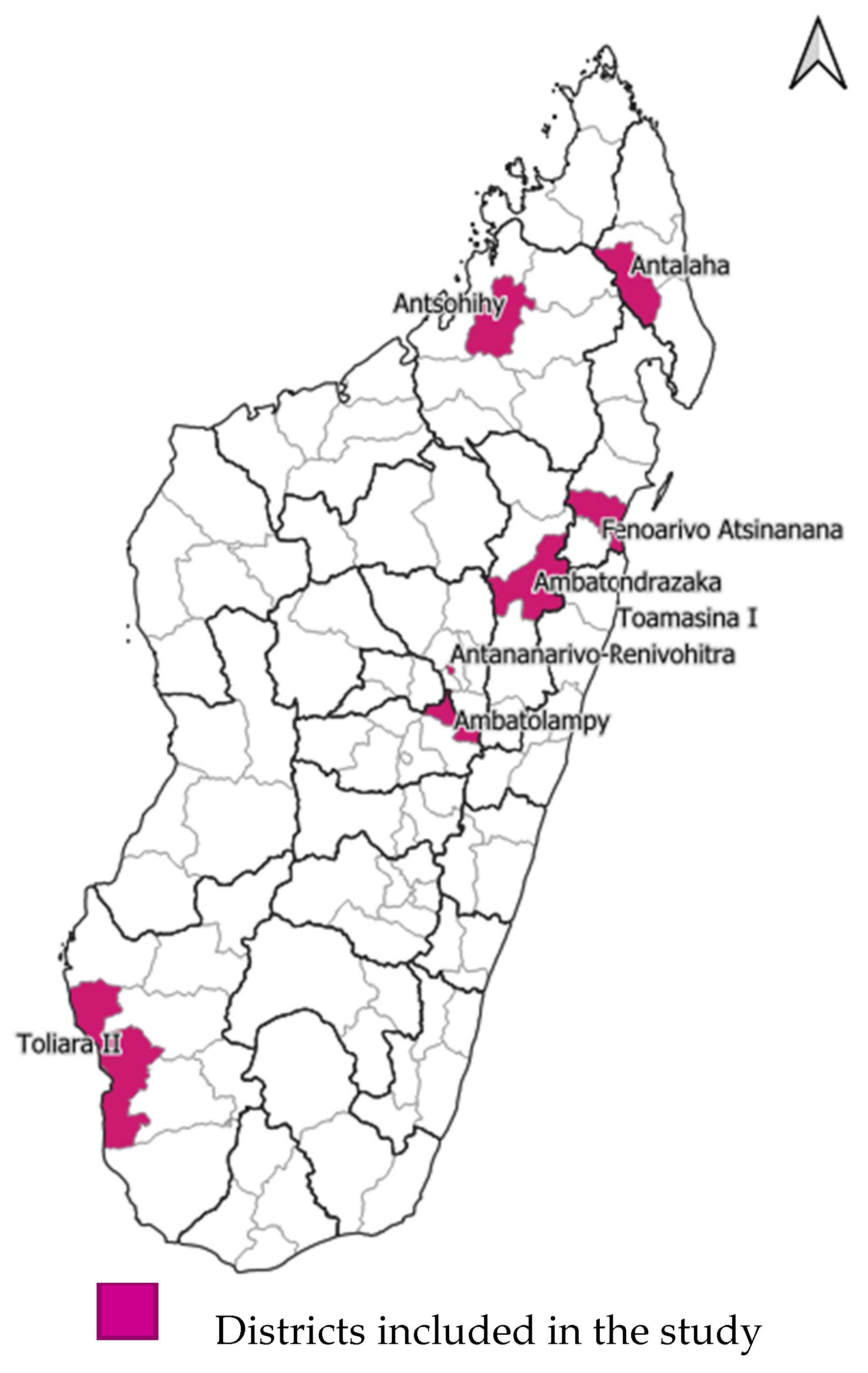
2. Materials and Methods
- Opinion leaders, including political–administrative, religious, and traditional authorities as well as traditional birth attendants and traditional healers (in French APART: Autorités Politico-Administratives, Religieuses et Traditionnelles), selected for their high level of influence within their communities. This category (APART) is widely found in official public health documents in Madagascar and seeks to map the most influential figures at the community level; see, for instance, [9,10].
- Healthcare workers (based in primary health centers) and community health workers (or CHWs, operating at the community level), selected due to their central and well-recognized roles in vaccination activities.
- Mothers of children under five years of age, both pro-vaccination and vaccine-hesitant, who are at the core of household vaccination decision-making.
3. Results
3.1. Widespread Recognition of the Importance of Vaccination Despite Persistent Misconceptions
“Nothing can fight malaria as effectively as the vaccine. Oral treatments do not work; only the vaccine does. If we had not taken my [other] son to get injected (nitsindrona), he probably would not have survived”.
3.2. Concerns About Adverse Events and Fear of Injections
3.3. Scattered Rumors and the Absence of a Unified Anti-Vaccine Movement or Ideology
“People say, for example, that vaccines were designed to reduce the number of people on Earth.”(Interview with a traditional healer, Toamasina I District)
“There is routine vaccination, but there are also mass vaccination campaigns, and whenever these occur, people are on their guard: they think it is a pretext to introduce new diseases. They say there are too many people in Madagascar and that this is how the excess will be eliminated”.(Interview with a traditional healer, Fenoarivo Atsinanana District)
“During the Covid pandemic, rumors were widespread: ‘This is something invented; it is not a natural disease. They want to reduce the population because there are too many of us. This vaccine causes sterility and shortens life expectancy”.(Interview with a traditional chief, Toamasina I District)
“[…] During a polio vaccination campaign, the rumor that the vaccine spread diseases intensified, and we therefore conducted a field visit to meet a man and a woman who were relaying these theories. After asking them to elaborate on their views, the man suddenly became agitated (…) He claimed that we were spreading harmful germs through the vaccine, hence his aggressive behaviour. We reassured him by explaining that this was a presidential initiative and that it was highly unlikely that the president would want to exterminate us all; he would rather aim to improve public health indicators, we reiterated. Eventually, the man ended up being convinced”.(Interview with a health worker, Ambatondrazaka District)
3.4. Ambiguous Stance of Certain Religious Movements and the Repeated Support of Traditional Authorities and Traditional Healers for Vaccination
“It is mainly the new religious groups—if not outright sects—that are hostile to vaccination: their members often invoke the pastor’s prohibition in this regard”(Interview with a traditional healer, Antananarivo-Renivohitra District)
“Personally, I believe that divine protection is sufficient and that vaccines are therefore unnecessary. I have been sick before and recovered without medical treatment, so I am convinced that my faith protects me”.(Interview with a pastor from an evangelical church)
“As for me, I have four children, but only the first was vaccinated, back when I had not yet converted. Once I truly discovered the faith, I realized that the blood of Christ is the only real vaccine and the ultimate remedy”.(Interview with a pastor from another evangelical movement)
3.5. Parental Hesitancy Toward Vaccination in Schools
3.6. Prioritization of Economic Concerns over Health Concerns
“If you take the time to really observe people in their daily lives, it becomes clear that health ranks second after the imperative of having something to eat. Lack of means is their main concern; daily sustenance is the priority. Health comes only afterwards… In fact, people are mainly taken up by their work activities, which is why health workers conducting community outreach often find only two or three households available during their rounds”.(Interview with a father, Antsohihy District)
“Yes, people are very careful (smiles), because they fear for their lives (smiles). They come to see me for treatment, and that already shows they take their health seriously. They are afraid of dying, so whether through traditional or modern medicine, they always look for a way to heal themselves”.(Interview with a traditional healer, Fenoarivo Atsinanana District)
3.7. A Major Structural Barrier to Vaccination: Fluctuating Motivation Among Community Health Workers and Their Limited Influence in Urban Areas
“Some CHWs are not interested in what they are assigned unless there is some [financial] motivation behind it”.(Interview with a health worker, Antananarivo-Renivohitra District).
“I admit that community health workers know their field well, but I don’t know… It seems to me that the community pays more attention when other actors intervene”.(Interview with a health worker, Antananarivo-Renivohitra District).
“The problem is that [community health workers] are people from the community, and that may be why they are not accepted. We see them every day. I don’t know if you understand: there is a kind of condescension, an underestimation of these workers!”
“The main difficulty is sensitizing parents, because they are often suspicious, or the wife invokes her husband’s categorical objection”.(Interview with a CHW, Antananarivo-Renivohitra District)
“We do not receive a salary. Therefore, we request more compensation because life is difficult while we must provide for our families. That is why we ask for support”.
3.8. Other Structural Barriers: Time and Distance Constraints
“Another barrier [to vaccination] that I haven’t mentioned yet is remoteness. In rural areas, the roads are poor and impassable by motorcycle. If they were at least passable by motorcycle, that would be better. But in some remote regions, such as Analanjirofo, where one cannot even access by motorcycle, this really prevents the majority of people from taking their children to be vaccinated”.(Interview with a traditional healer, Fenoarivo Atsinanana District)
3.9. Trust and Vaccine Literacy: Two Pillars of Uptake
“There are those who say that if it is them [the CHWs and health workers familiar to them] conducting the awareness, then this [the vaccine] can only be in favor of something safe. In such cases, people accept”.(Interview with a traditional healer, Toamasina I District).
“Persuasion is very simple: it is extremely difficult to find money nowadays, especially for healthcare, because medicine prices are simply exorbitant. It is inconceivably costly, so to prevent serious illness, we simply urge residents to bring their children for vaccination”.(Interview with an administrative official, Ambatondrazaka District)
4. Discussion and Recommendations
4.1. Discussion
4.1.1. Misconceptions About Vaccination and Threats to Herd Immunity
4.1.2. Philosophies and “Ready-Made” Anti-Vaccination Thinking
4.1.3. Injection Phobia, Biopolitics, and Risk Culture
4.1.4. Prohibition of Vaccination in Certain Faith-Based Schools: A Significant Barrier
4.1.5. Social Stratification and Multidimensional Marginalization of Community Health Workers
4.2. Recommendations
4.2.1. Financial and Symbolic Incentives for Community Health Workers
4.2.2. Engagement of Religious Leaders in Vaccination
4.2.3. Engagement of Schools in Vaccination
4.2.4. Strengthening Mobile and Outreach Strategies and Adapting Vaccination Schedules
4.2.5. Additional Recommendations
5. Conclusions
Supplementary Materials
Author Contributions
Funding
Institutional Review Board Statement
Informed Consent Statement
Data Availability Statement
Acknowledgments
Conflicts of Interest
Abbreviations
| CHW | Community Health Worker |
| CCDS | Comité Communal de Développement sanitaire (Communal Health Development Committee) |
| FGD | Focus Group Discussion |
| GAVI | Global Alliance for Vaccines and Immunization |
| GTS | Geospatial Tracking System |
| LQAS | Lot Quality Insurance Sampling |
| PHC | Primary Health Center |
| PIRI | Periodic Intensification of Routine Immunization |
| PSI | Population Services International |
| SLC | Structure Locale de Concertation (Local Consultation Structure) |
| UNICEF | United Nations Children’s Fund |
| WHO | World Health Organization |
References
- World Health Organization (WHO). Immunization Coverage. 2024. Available online: https://www.who.int/fr/news-room/fact-sheets/detail/immunization-coverage (accessed on 20 July 2025).
- UNICEF. In Africa, 12.7 Million Children Have Missed One or More Vaccines Over the Past Three Years. 2023. Available online: https://www.unicef.fr/article/en-afrique-127-millions-denfants-nont-pas-recu-un-ou-plusieurs-vaccins-au-cours-des-3-dernieres-annees/ (accessed on 24 July 2025).
- MSANP/DPEV. Routine Vaccination Data August 2020–August 2025; Internal Technical Report; MSANP/DPEV: Antananarivo, Madagascar, 2025. [Google Scholar]
- MSANP/DPEV. Routine Vaccination Data July 2024; Internal Technical Report; MSANP/DPEV: Antananarivo, Madagascar, 2024. [Google Scholar]
- World Health Organization (WHO). Household, Non-Household, and LQAS Monitoring Round 1 (Supplementary Vaccination Activities Against Polio); Internal Technical Report; WHO: Antananarivo, Madagascar, 2024. [Google Scholar]
- Ramaroson, H.J.V.; Pourette, D. Perception des Vaccinations de Routine et de Masse par les Mères. Cas du Fokontany de Namahora, Région Menabe. Femmes, Enfants et Santé à Madagascar. Approches Anthropologiques Comparées. Available online: https://hal.science/hal-02747544/document (accessed on 6 August 2025).
- Benin, A.L.; Wisler-Scher, D.J.; Colson, E.; Shapiro, E.D.; Holmboe, E.S. Qualitative Analysis of Mothers’ Decision-Making About Vaccines for Infants: The Importance of Trust. Pediatrics 2006, 117, 1532–1541. [Google Scholar] [CrossRef] [Scilit] [PubMed]
- Gallagher, F.; Marceau, M. Chapitre 1: La recherche descriptive interprétative: Exploration du concept de la validité en tant qu’impératif social dans le contexte de l’évaluation des apprentissages en pédagogie des sciences de la santé. In Méthodes Qualitatives, Quantitatives et Mixtes Dans la Recherche en Sciences Humaines, Sociales et de la Santé, 2nd ed.; Corbière, M., Larivière, N., Eds.; Presses de l’Université du Québec: Québec, QC, Canada, 2021. [Google Scholar]
- MSANP. Plan Directeur National de Lutte contre les Maladies Tropicales Négligées (PDMTN) 2023–2027, Madagascar. 2023. Available online: https://espen.afro.who.int/sites/default/files/content/document/PDMTN%20MADAGASCAR%20VALIDE%20Avril%202023.pdf (accessed on 1 January 2026).
- MSANP. Plan de Développement du Secteur Santé (PDSS) 2020–2024, Madagascar. 2020. Available online: https://www.sun-hina-madagascar.org/sites/default/files/fichiers/texte_lois/plan-de-developpement-du-secteur-sante-2020-2024_1.pdf (accessed on 1 January 2026).
- Rasamoelina, H. Croyances et Instrumentalisation à Madagascar. Friedrich Ebert Stiftung, Mars 2012. Available online: https://library.fes.de/pdf-files/bueros/madagaskar/15128.pdf (accessed on 17 August 2025).
- Organisation Panaméricaine de la Santé. Communication sur les Risques Liés à la Vaccination. 2023. Available online: https://iris.paho.org/bitstream/handle/10665.2/57725/OPSCIMCOVID19230003_fre.pdf?sequence=1&isAllowed=y (accessed on 10 October 2025).
- Jourdain, O. Enquête au Pays des Antivax; Plon: Paris, France, 2022. [Google Scholar]
- Aldrin, P. Penser la rumeur: Une question discutée des sciences sociales. Genèses 2003, 50, 126–141. [Google Scholar] [CrossRef] [Scilit]
- Larson, H.J. Stuck: How Vaccine Rumors Start—And Why They Don’t Go Away; Oxford University Press: New York, NY, USA, 2020. [Google Scholar]
- Mhazo, A.T.; Maponga, C.C. Governing a pandemic: Biopower and the COVID-19 response in Zimbabwe. BMJ Glob. Health 2022, 7, e009667. [Google Scholar] [CrossRef] [Scilit] [PubMed]
- Desclaux, A. Les rumeurs comme modèle explicatif des refus des vaccins: Une lecture anthropologique dans la santé globale. Lect. Anthropol. 2022, 9. [Google Scholar] [CrossRef] [Scilit]
- Peretti-Watel, P. La culture du risque, ses marqueurs sociaux et ses paradoxes: Une exploration empirique. Rev. Econ. 2005, 56, 371–392. [Google Scholar]
- Felouzis, G.; Maroy, C.; van Zanten, A. Les Marchés Scolaires. Sociologie d’une Politique Publique d’éducation; PUF: Paris, France, 2013. [Google Scholar]
- Huzarska-Ryzenko, D. Health Security in a Democratic State: Child Vaccination–Legal Obligation Versus the Right to Express Consent for a Medical Intervention. Stud. Logic Grammar Rhetor. 2019, 59, 237–255. [Google Scholar] [CrossRef] [Scilit]
- John Snow, Inc. (JSI). Introducing HPV Vaccine in Madagascar: Engaging Stakeholders; Technical Report, Madagascar, 2016. Available online: https://www.technet-21.org/en/resources/report/introducing-hpv-vaccine-in-madagascar-engaging-stakeholders (accessed on 20 December 2025).
- Alam, K.; Tasneem, S.; Oliveras, E. Retention of female volunteer community health workers in Dhaka urban slums: A case-control study. Health Policy Plan. 2012, 27, 477–486. [Google Scholar] [CrossRef] [Scilit] [PubMed]
- Community Health Impact Coalition. Rémunérer les ASC. Available online: https://joinchic.org/fr/resources/pay-chws/ (accessed on 20 July 2025).
- MSANP/DPEV. Résultats des AVII à Madagascar de Novembre 2023 à Juin 2025; Internal Technical Report; MSANP/DPEV: Antananarivo, Madagascar, 2025. [Google Scholar]
- World Health Organization (WHO). Directives de l’OMS sur la Politique de Santé et l’Accompagnement au Sein du Système en vue d’Optimiser les Programmes Relatifs aux Agents de Santé Communautaires. Available online: https://iris.who.int/bitstream/handle/10665/325564/9789242550368-fre.pdf?ua=1 (accessed on 10 August 2025).
- Ballard, M.; Westgate, C.; Alban, R.; Choudhury, N.; Adamjee, R.; Schwarz, R.; Bishop, J.; McLaughlin, M.; Flood, D.; Finnegan, K.; et al. Compensation Models for Community Health Workers: Comparison of Legal Frameworks Across Five Countries. J. Glob. Health 2021, 11, 04010. [Google Scholar] [CrossRef] [Scilit] [PubMed]
- Vera, J.; Bornstein, C.; López Castañeda, N.; Chen, N.; Gabani, J.; Giugliani, C.; Jones, T.; Lavor, C.; Muther, K.; Panjabi, R.; et al. Overview: Community Health Workers in Brazil. Available online: https://www.exemplars.health/topics/community-health-workers/brazil (accessed on 8 August 2025).
- Dotimi, D.A.; Atibinye, D.; Wamanyi, Y.; Usen, J.S. Community Health Practice: The Nigerian Model. Int. J. Community Med. Public Health 2024, 11, 560–565. [Google Scholar] [CrossRef] [Scilit]
- Saint Onge, J.M.; Brooks, J.V. The Exchange and Use of Cultural and Social Capital Among Community Health Workers in the United States. Soc. Health Illn. 2020, 43, 299–315. [Google Scholar] [CrossRef] [Scilit] [PubMed]
- World Health Organization (WHO). Engagement des Leaders Religieux pour la Vaccination Contre la COVID-19. Vaccination de Proximité Auprès des «Dorkasy», Association des Femmes Chrétiennes… [Video], 25 March 2022. Available online: https://www.facebook.com/OMSMadagascar/videos/496793165332254/?mibextid=rS40aB7S9Ucbxw6v (accessed on 12 August 2025).
- Rivonala Razafison, Gavi. Les Luthériens du Sud Malgache se Font Messagers de la Vaccination. 22 December 2022. Available online: https://www.gavi.org/fr/vaccineswork/lutheriens-sud-malgache-messagers-vaccination (accessed on 2 January 2026).
- Ministère de l’Éducation Nationale, de la Jeunesse et des Sports [Former Denomination] (France). Fiche Ressource–Mettre en Place une Activité de découverte de la Vaccination en Cycle 2 et 3. Available online: https://eduscol.education.fr/document/31945/download?attachment (accessed on 13 August 2025).
- Ministère de l’Éducation Nationale, de la Jeunesse et des Sports [Former Denomination] (France). Cartes de débat Vaccinations 2021: Guide Enseignant. Available online: https://eduscol.education.fr/document/11531/download (accessed on 13 August 2025).
- WHO Afro. Le Système de Géolocalisation Améliore la Riposte à la Polio au Congo. 27 June 2023. Available online: https://www.afro.who.int/fr/photo-story/le-systeme-de-geolocalisation-ameliore-la-riposte-la-polio-au-congo (accessed on 20 October 2025).
- WHO Madagascar. Rapport GTS: AVII du 02 au 06 Juin 2025; InternalTechnical Report; WHO: Antananarivo, Madagascar, 2025. [Google Scholar]
- Institut National de Santé Publique et Communautaire (INSPC). Acceptabilité et Faisabilité d’Adapter les Plages Temporelles de Vaccination aux Parents ou Tuteurs d’Enfants Zéro Dose à Mahanoro et Toamasina I, Madagascar; Internal Technical Report; ISPC: Antananarivo, Madagascar, 2025. [Google Scholar]
- Butori, R.; Parguel, B. Les biais de réponse-Impact du mode de collecte des données et de l’attractivité de l’enquêteur. AFM 2010. Available online: https://shs.hal.science/halshs-00636228v1/document (accessed on 29 October 2025).

Disclaimer/Publisher’s Note: The statements, opinions and data contained in all publications are solely those of the individual author(s) and contributor(s) and not of MDPI and/or the editor(s). MDPI and/or the editor(s) disclaim responsibility for any injury to people or property resulting from any ideas, methods, instructions or products referred to in the content. |
© 2026 by the authors. Licensee MDPI, Basel, Switzerland. This article is an open access article distributed under the terms and conditions of the Creative Commons Attribution (CC BY) license.
Share and Cite
Ralambosoa, M.; Oleffe, A.; Mandrosovololona, V.; Rasolomanana, Z.P.; Yasmine, L.L.; Tsivahiny, P.; Rakotondratsara, M.A.; Musango, L. Community Perceptions and Attitudes Toward Vaccination in Madagascar. Vaccines 2026, 14, 191. https://doi.org/10.3390/vaccines14020191
Ralambosoa M, Oleffe A, Mandrosovololona V, Rasolomanana ZP, Yasmine LL, Tsivahiny P, Rakotondratsara MA, Musango L. Community Perceptions and Attitudes Toward Vaccination in Madagascar. Vaccines. 2026; 14(2):191. https://doi.org/10.3390/vaccines14020191
Chicago/Turabian StyleRalambosoa, Maharisoa, Amandine Oleffe, Vatsiharizandry Mandrosovololona, Zo Patricia Rasolomanana, Lethicia Lydia Yasmine, Paubert Tsivahiny, Mamy Andrianirina Rakotondratsara, and Laurent Musango. 2026. "Community Perceptions and Attitudes Toward Vaccination in Madagascar" Vaccines 14, no. 2: 191. https://doi.org/10.3390/vaccines14020191
APA StyleRalambosoa, M., Oleffe, A., Mandrosovololona, V., Rasolomanana, Z. P., Yasmine, L. L., Tsivahiny, P., Rakotondratsara, M. A., & Musango, L. (2026). Community Perceptions and Attitudes Toward Vaccination in Madagascar. Vaccines, 14(2), 191. https://doi.org/10.3390/vaccines14020191