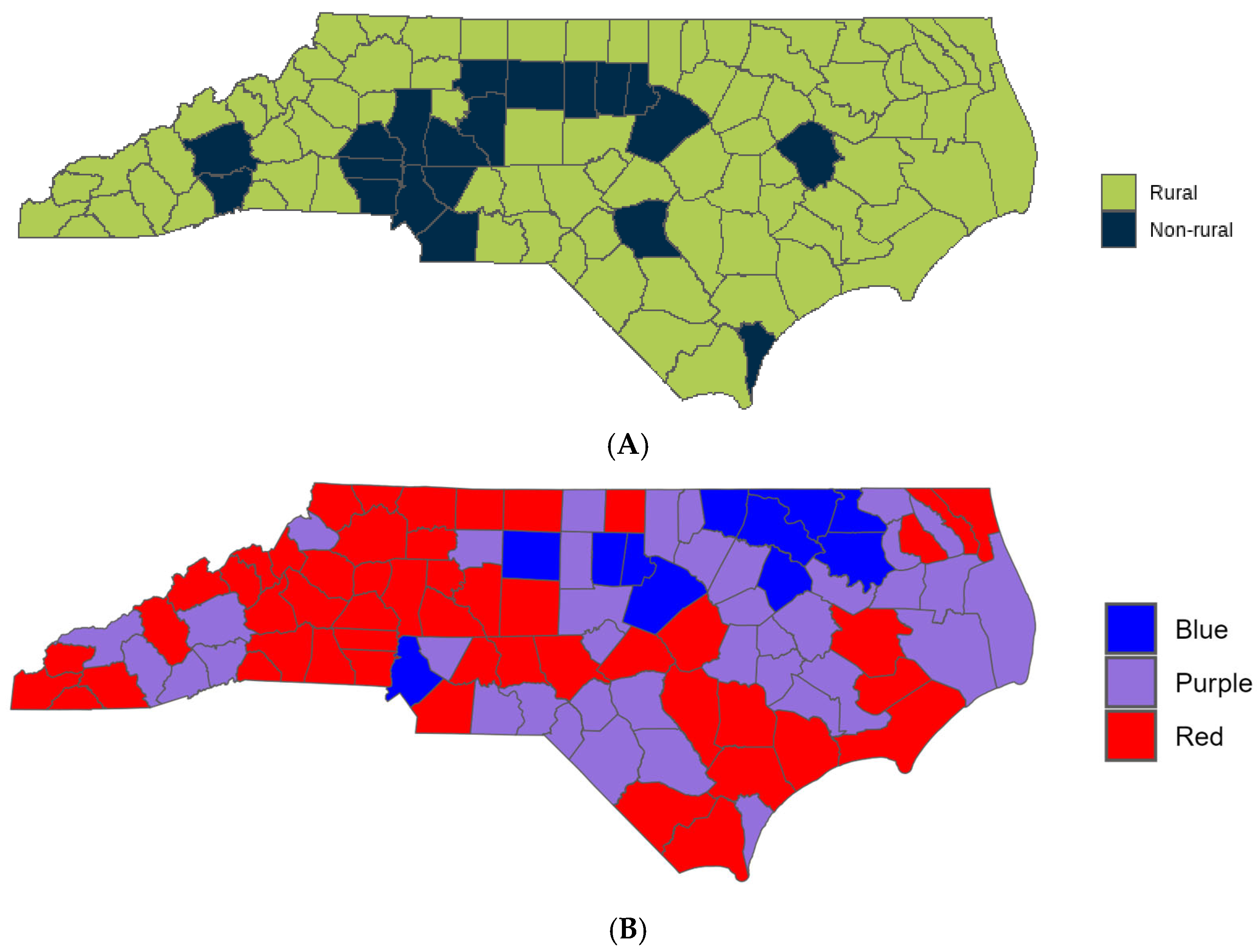
Trusted Sources of COVID-19 Vaccine Information by County Characteristics in North Carolina

 , , , and
Abstract
1. Introduction
2. Materials and Methods
3. Results
4. Discussion
5. Conclusions
Author Contributions
Funding
Institutional Review Board Statement
Informed Consent Statement
Data Availability Statement
Acknowledgments
Conflicts of Interest
Abbreviations
| NC | North Carolina |
| WHO | World Health Organization |
| CCRP | COVID-19 Community Research Partnership |
| IQR | Interquartile Ranges |
| SMD | Standardized Mean Differences |
| MVP | Meningitis Vaccine Project |
| CDC | Center for Disease Control and Prevention |
| NIH | National Institutes of Health |
| FDA | Food and Drug Administration |
Appendix A
- ○
- No; I have not received any doses of a COVID-19 vaccine
- ○
- Yes; I have received one or more doses of a COVID-19 vaccine
- ○
- Not sure; I am currently participating in a COVID-19 vaccine trial
- ○
- I will complete the survey now
- ○
- Remind me tomorrow
- ○
- I am not interested in taking part in this survey at this time
- How concerned are you about getting COVID-19?
- ○
- Not at all concerned
- ○
- A little concerned
- ○
- Moderately concerned
- ○
- Very concerned
- If a COVID-19 vaccine were available to you, would you get it?
- ○
- Yes, I would get it as soon as possible
- ○
- Yes, but I plan to wait to get it
- ○
- Not sure
- ○
- No
- If you have one or more children under 18 years old, how likely are you to get them a COVID-19 vaccine when they are eligible?
- ○
- Not at all likely
- ○
- Somewhat likely
- ○
- Extremely likely
- ○
- They are already vaccinated
- ○
- N/A
- Which of the following COVID-19 vaccines would you be willing to receive? (Select all that apply)
- ○
- Pfizer-BioNTech
- ○
- Moderna
- ○
- Johnson & Johnson/Janssen
- ○
- AstraZeneca
- ○
- Novavax
- ○
- Other
- ○
- None of the above
- With which of the following statements about COVID-19 vaccines do you agree? (Select all that apply)
- ○
- I am concerned about possible side effects
- ○
- Getting vaccinated would make me feel safe resuming my pre-COVID-19 activities
- ○
- I am concerned that the vaccines were developed too quickly
- ○
- Getting vaccinated is a good way to protect myself from getting sick with COVID-19
- ○
- I have ethical concerns about the vaccines
- ○
- I do not trust the science behind the vaccines
- ○
- I do not need a COVID-19 vaccine to keep me healthy
- ○
- Getting vaccinated is important for the health of my community
- ○
- I am concerned about the safety of the vaccines
- ○
- None of these apply
- ○
- Not sure
- At this point in time, how easy do you think it will be to get a COVID-19 vaccine?
- ○
- Very easy
- ○
- Somewhat easy
- ○
- Somewhat difficult
- ○
- Very difficult
- ○
- Not sure
- If you think getting a COVID-19 vaccine will not be very easy, what might make it difficult for you to get a COVID-19 vaccine? (Select all that apply. If you think getting a COVID-19 vaccine will be very easy, please select N/A)
- ○
- I have a medical reason that makes me ineligible to get vaccinated (e.g., I have had a severe allergy to vaccines in the past)
- ○
- It is difficult to find or make an appointment
- ○
- It is difficult to get to the vaccination site
- ○
- The hours of operation are inconvenient
- ○
- The waiting time is too long
- ○
- It is difficult to arrange for childcare
- ○
- It is difficult to get time off work
- ○
- Other
- ○
- I do not plan to get vaccinated
- ○
- N/A
- What would motivate you the most to get vaccinated? (Select up to three)
- ○
- To protect my health
- ○
- To protect health of people I care about (e.g., family, friends, co-workers, community)
- ○
- To get back to work/school
- ○
- To get the economy back on track
- ○
- To prevent spread of new variants or strains
- ○
- To resume social activities
- ○
- Receiving rewards or entry into a lottery
- ○
- To resume travel
- ○
- My healthcare provider recommending that I get vaccinated
- ○
- Local leaders (e.g., local representative, religious leader) encouraging me to get vaccinated
- ○
- Other
- ○
- Not sure
- ○
- Nothing would motivate me to get vaccinated
- In speaking with your healthcare provider, which of the following most closely matches their recommendation about COVID-19 vaccines?
- ○
- Strongly discouraged
- ○
- Discouraged
- ○
- Encouraged
- ○
- Strongly encouraged
- ○
- Encouraged, but with modified recommendations
- ○
- I have not spoken with a healthcare provider about COVID-19 vaccines
- What are your most trusted sources of information about COVID-19 vaccines? (Select up to three)
- ○
- Federal health agencies (e.g., Centers for Disease Control and Prevention (CDC), Food and Drug Administration (FDA), National Institutes of Health (NIH))
- ○
- State or local health officials
- ○
- My employer
- ○
- Family and friends
- ○
- Health insurers
- ○
- Hospital system websites (e.g., Kaiser Permanente)
- ○
- Healthcare providers
- ○
- News sources
- ○
- Professional organizations
- ○
- Community organizations
- ○
- Religious leaders
- ○
- Online publishers of medical information (e.g., WebMD, Mayo Clinic)
- ○
- Social media
- ○
- Other
- Do you know anyone who has received at least one dose of a COVID-19 vaccine? (Select all that apply)
- ○
- Yes, someone in my household
- ○
- Yes, most adults in my household
- ○
- Yes, at least one eligible child (less than 18 years old) in my household
- ○
- Yes, someone outside my household I spend time with each week
- ○
- Yes, most adults outside my household I spend time with each week
- ○
- Yes, someone I personally know but do not spend time with each week
- ○
- Not sure, I don’t know whether people I know have been vaccinated
- ○
- No, I don’t personally know anyone who has been vaccinated
References
- (Archive) COVID-19 Cases and Deaths Dashboard|NC COVID-19. Available online: https://covid19.ncdhhs.gov/dashboard/cases-and-deaths (accessed on 6 December 2023).
- Denslow, S.; Wingert, J.R.; Hanchate, A.D.; Rote, A.; Westreich, D.; Sexton, L.; Cheng, K.; Curtis, J.; Jones, W.S.; Lanou, A.J.; et al. Rural-urban outcome differences associated with COVID-19 hospitalizations in North Carolina. PLoS ONE 2022, 17, e0271755. [Google Scholar] [CrossRef] [Scilit] [PubMed]
- North Carolina Coronavirus Cases and Deaths|USAFacts. Available online: https://usafacts.org/visualizations/coronavirus-covid-19-spread-map/state/north-carolina/ (accessed on 3 January 2025).
- NCDHHS_COVID-19_Dashboard_Vaccinations. Tableau Software. Available online: https://public.tableau.com/views/NCDHHS_COVID-19_Dashboard_Vaccinations/All?%3Aembed=y&%3AapiID=embhost0&%3AshowVizHome=n&%3AapiInternalVersion=1.142.0&%3AapiExternalVersion=3.8.0&navType=0&navSrc=Opt&%3AdisableUrlActionsPopups=n&%3Atabs=y&%3Atoolbar=bottom&%3Adevice=default&mobile=n&%3AhideEditButton=n&%3AhideEditInDesktopButton=n&%3AsuppressDefaultEditBehavior=n&%3Ajsdebug=n (accessed on 5 December 2023).
- Citizen-Times. North Carolina COVID-19 Vaccine Tracker. Citizen-Times. Available online: https://data.citizen-times.com/covid-19-vaccine-tracker/north-carolina/37/ (accessed on 9 August 2023).
- Enwezor, C.H.; Peacock, J.E.; Seals, A.L.; Edelstein, S.L.; Hinkelman, A.N.; Wierzba, T.F.; Munawar, I.; Maguire, P.D.; Lagarde, W.H.; Runyon, M.S.; et al. Changing Attitudes toward the COVID-19 Vaccine Among North Carolina Participants in the COVID-19 Community Research Partnership. Vaccines 2021, 9, 916. [Google Scholar] [CrossRef] [Scilit] [PubMed]
- Dubé, E.; Gagnon, D.; Nickels, E.; Jeram, S.; Schuster, M. Mapping vaccine hesitancy—Country-specific characteristics of a global phenomenon. Vaccine 2014, 32, 6649–6654. [Google Scholar] [CrossRef] [Scilit] [PubMed]
- Datar, R.S.; Fette, L.M.; Hinkelman, A.N.; Hammershaimb, E.A.; Friedman-Klabanoff, D.J.; Mongraw-Chaffin, M.; Weintraub, W.S.; Ahmed, N.; Gibbs, M.A.; Runyon, M.S.; et al. Factors associated with COVID-19 vaccination during June–October 2021: A multi-site prospective study. Vaccine 2023, 41, 3204–3214. [Google Scholar] [CrossRef] [Scilit] [PubMed]
- Stoner, M.C.; Tweedy, D.; Comello, M.G.L.; Toval, C.; Pettifor, A.E.; Larsen, M.A.; Baez, A.; Maragh-Bass, A.C.; Tolley, E.E.; Browne, E.N.; et al. Using narratives to inform the development of a digital health intervention related to COVID-19 vaccination in Black young adults in Georgia, North Carolina and Alabama. Vaccine 2022, 40, 6908–6916. [Google Scholar] [CrossRef] [Scilit] [PubMed]
- NCCU ACCORD Research on COVID-19 Vaccine Hesitancy Informs North Carolina’s Strategy for Equitable Outreach and Distribution|NCDHHS. Available online: https://www.ncdhhs.gov/news/press-releases/2021/02/12/nccu-accord-research-covid-19-vaccine-hesitancy-informs-north-carolinas-strategy-equitable-outreach (accessed on 6 December 2023).
- The COVID-19 Community Research Partnership. The COVID-19 Community Research Partnership: A multistate surveillance platform for characterizing the epidemiology of the SARS-CoV-2 pandemic. Biol. Methods Protoc. 2022, 7, bpac033. [Google Scholar] [CrossRef] [Scilit] [PubMed]
- Ingram, D.D.; Franco, S.J. 2013 NCHS Urban–Rural Classification Scheme for Counties; National Center for Health Statistics: Hyattsville, MD, USA, 2014; Volume 2. Available online: https://www.cdc.gov/nchs/data/series/sr_02/sr02_166.pdf (accessed on 7 July 2025).
- NC Rural Center—Building Vibrant Rural Communities. Available online: https://www.ncruralcenter.org/ (accessed on 29 December 2024).
- Austin, P.C. Balance diagnostics for comparing the distribution of baseline covariates between treatment groups in propensity-score matched samples. Stat. Med. 2009, 28, 3083–3107. [Google Scholar] [CrossRef] [Scilit] [PubMed]
- Benjamini, Y.; Hochberg, Y. Controlling the false discovery rate: A practical and powerful approach to multiple testing. J. R. Stat. Soc. Ser. B 1995, 57, 289–300. [Google Scholar] [CrossRef] [Scilit]
- Koskan, A.M.; LoCoco, I.E.; Daniel, C.L.; Teeter, B.S. Rural Americans’ COVID-19 Vaccine Perceptions and Willingness to Vaccinate against COVID-19 with Their Community Pharmacists: An Exploratory Study. Vaccines 2023, 11, 171. [Google Scholar] [CrossRef] [Scilit] [PubMed]
- Hardt, K.; Bonanni, P.; King, S.; Santos, J.I.; El-Hodhod, M.; Zimet, G.D.; Preiss, S. Vaccine strategies: Optimising outcomes. Vaccine 2016, 34, 6691–6699. [Google Scholar] [CrossRef] [Scilit] [PubMed]
- Valckx, S.; Crèvecoeur, J.; Verelst, F.; Vranckx, M.; Hendrickx, G.; Hens, N.; Van Damme, P.; Pepermans, K.; Beutels, P.; Neyens, T. Individual factors influencing COVID-19 vaccine acceptance in between and during pandemic waves (July–December 2020). Vaccine 2022, 40, 151–161. [Google Scholar] [CrossRef] [Scilit] [PubMed]
- Markovitz, N.H.; Strome, A.L.; Patel, P.K. Commentary: “The vaccine Selfie” and its influence on COVID-19 vaccine acceptance. Vaccine 2022, 40, 3085–3086. [Google Scholar] [CrossRef] [Scilit] [PubMed]
- Guidry, J.P.; Miller, C.A.; Perrin, P.B.; Laestadius, L.I.; Zurlo, G.; Savage, M.W.; Stevens, M.; Fuemmeler, B.F.; Burton, C.W.; Gültzow, T.; et al. Between Healthcare Practitioners and Clergy: Evangelicals and COVID-19 Vaccine Hesitancy. Int. J. Environ. Res. Public Health 2022, 19, 11120. [Google Scholar] [CrossRef] [Scilit] [PubMed]
- Rodrigues, F.; Ziade, N.; Jatuworapruk, K.; Caballero-Uribe, C.V.; Khursheed, T.; Gupta, L. The Impact of Social Media on Vaccination: A Narrative Review. J. Korean Med. Sci. 2023, 38, e326. [Google Scholar] [CrossRef] [Scilit] [PubMed]
- Pew Research Center Report, September 2023. Americans’ Dismal Views of the Nation’s Politics. Available online: https://www.pewresearch.org/politics/2023/09/19/americans-dismal-views-of-the-nations-politics/ (accessed on 7 July 2025).


| County Classification | |||||
|---|---|---|---|---|---|
| Characteristic | Overall N = 17,869 1 | Rural N = 3141 1 | Non-Rural N = 14,728 1 | Difference 2 | 95% CI 2 |
| Age, years | 53 (42, 64) | 56 (44, 65) | 53 (41, 63) | 0.16 | 0.12, 0.20 |
| Sex | 0.10 | 0.06, 0.14 | |||
| Female | 13,136 (73.5%) | 2420 (77.1%) | 10,716 (72.8%) | ||
| Male | 4731 (26.5%) | 720 (22.9%) | 4011 (27.2%) | ||
| Unknown | 2 | 1 | 1 | ||
| Race/Ethnicity | 0.08 | 0.04, 0.12 | |||
| Black | 561 (3.1%) | 78 (2.5%) | 483 (3.3%) | ||
| Hispanic or Latino | 273 (1.5%) | 29 (0.9%) | 244 (1.7%) | ||
| White | 16,539 (92.6%) | 2953 (94.0%) | 13,586 (92.2%) | ||
| Other or Unspecified | 496 (2.8%) | 81 (2.6%) | 415 (2.8%) | ||
| Highest Education Level | 0.38 | 0.34, 0.42 | |||
| Less than high school | 24 (0.1%) | 6 (0.2%) | 18 (0.1%) | ||
| High school or equivalent | 591 (3.5%) | 178 (6.0%) | 413 (2.9%) | ||
| Some college but no degree | 1731 (10.2%) | 420 (14.2%) | 1311 (9.3%) | ||
| Associate | 1697 (10.0%) | 481 (16.3%) | 1216 (8.6%) | ||
| Bachelor | 5684 (33.4%) | 931 (31.5%) | 4753 (33.8%) | ||
| Graduate | 7301 (42.9%) | 940 (31.8%) | 6361 (45.2%) | ||
| Unknown | 841 | 185 | 656 | ||
| Before receiving a COVID-19 vaccine, how concerned were you about getting COVID-19? | 0.03 | −0.01, 0.07 | |||
| Not at all concerned | 2291 (12.8%) | 380 (12.1%) | 1911 (13.0%) | ||
| A little concerned | 3390 (19.0%) | 606 (19.3%) | 2784 (18.9%) | ||
| Moderately concerned | 4803 (26.9%) | 829 (26.4%) | 3974 (27.0%) | ||
| Very concerned | 7385 (41.3%) | 1326 (42.2%) | 6059 (41.1%) | ||
| Vaccination Status | 0.17 | 0.13, 0.21 | |||
| Unvaccinated | 1051 (5.9%) | 297 (9.5%) | 754 (5.1%) | ||
| Vaccinated | 16,818 (94.1%) | 2844 (90.5%) | 13,974 (94.9%) | ||
| County Classification | ||||||
|---|---|---|---|---|---|---|
| Characteristic | Rural N = 3141 1 | Non-Rural N = 14,728 1 | Difference 2 | 95% CI 2 | p-Value 3 | q-Value 4 |
| Community organizations | 13 (0.4%) | 35 (0.2%) | 0.03 | −0.01, 0.07 | 0.083 | 0.15 |
| Family and friends | 258 (8.2%) | 1190 (8.1%) | 0.00 | −0.03, 0.04 | 0.8 | 0.9 |
| Federal health agencies (e.g., Centers for Disease Control and Prevention (CDC), Food and Drug Administration (FDA), National Institutes of Health (NIH)) | 2271 (72.3%) | 11,747 (79.8%) | −0.18 | −0.21, −0.14 | <0.001 | <0.001 |
| Health insurers | 40 (1.3%) | 145 (1.0%) | 0.03 | −0.01, 0.07 | 0.15 | 0.2 |
| Healthcare providers | 1319 (42.0%) | 6098 (41.4%) | 0.01 | −0.03, 0.05 | 0.5 | 0.6 |
| Hospital system websites (e.g., Kaiser Permanente) | 265 (8.4%) | 1482 (10.1%) | −0.06 | −0.09, −0.02 | 0.005 | 0.025 |
| My employer | 374 (11.9%) | 2100 (14.3%) | −0.07 | −0.11, −0.03 | <0.001 | 0.004 |
| News sources | 341 (10.9%) | 1851 (12.6%) | −0.05 | −0.09, −0.01 | 0.008 | 0.028 |
| Online publishers of medical information (e.g., WebMD, Mayo Clinic) | 446 (14.2%) | 1896 (12.9%) | 0.04 | 0.00, 0.08 | 0.046 | 0.091 |
| Other | 140 (4.5%) | 664 (4.5%) | 0.00 | −0.04, 0.04 | 0.9 | 0.9 |
| Professional organizations | 159 (5.1%) | 887 (6.0%) | −0.04 | −0.08, 0.00 | 0.037 | 0.087 |
| Religious leaders | 30 (1.0%) | 84 (0.6%) | 0.04 | 0.01, 0.08 | 0.014 | 0.039 |
| Social media | 35 (1.1%) | 137 (0.9%) | 0.02 | −0.02, 0.06 | 0.3 | 0.4 |
| State or local health officials | 1464 (46.6%) | 7046 (47.8%) | −0.02 | −0.06, 0.01 | 0.2 | 0.3 |
| County Classification | |||||
|---|---|---|---|---|---|
| Characteristic | Overall N = 17,869 1 | Rural N = 3141 1 | Non-Rural N = 14,728 1 | Difference 2 | 95% CI 2 |
| Red (Voted Republican, %) | 42 (36, 58) | 66 (60, 75) | 42 (36, 42) | 2.2 | 2.2, 2.3 |
| Blue (Voted Democrat, %) | 56 (41, 62) | 33 (24, 38) | 56 (56, 62) | −2.2 | −2.2, −2.2 |
| Vaccination Status | ||||||
|---|---|---|---|---|---|---|
| Characteristic | Unvaccinated N = 297 1 | Vaccinated N = 2844 1 | Difference 2 | 95% CI 2 | p-Value 3 | q-Value 4 |
| Community organizations | 2 (0.7%) | 11 (0.4%) | 0.04 | −0.08, 0.16 | 0.4 | 0.4 |
| Family and friends | 33 (11.1%) | 225 (7.9%) | 0.11 | −0.01, 0.23 | 0.056 | 0.074 |
| Federal health agencies (e.g., Centers for Disease Control and Prevention (CDC), Food and Drug Administration (FDA), National Institutes of Health (NIH)) | 126 (42.4%) | 2145 (75.4%) | −0.71 | −0.83, −0.59 | <0.001 | <0.001 |
| Health insurers | 5 (1.7%) | 35 (1.2%) | 0.04 | −0.08, 0.16 | 0.4 | 0.4 |
| Healthcare providers | 101 (34.0%) | 1218 (42.8%) | −0.18 | −0.30, −0.06 | 0.003 | 0.007 |
| Hospital system websites (e.g., Kaiser Permanente) | 8 (2.7%) | 257 (9.0%) | −0.27 | −0.39, −0.15 | <0.001 | <0.001 |
| My employer | 27 (9.1%) | 347 (12.2%) | −0.10 | −0.22, 0.02 | 0.12 | 0.13 |
| News sources | 12 (4.0%) | 329 (11.6%) | −0.28 | −0.40, −0.16 | <0.001 | <0.001 |
| Online publishers of medical information (e.g., WebMD, Mayo Clinic) | 59 (19.9%) | 387 (13.6%) | 0.17 | 0.05, 0.29 | 0.003 | 0.007 |
| Other | 52 (17.5%) | 88 (3.1%) | 0.49 | 0.37, 0.61 | <0.001 | <0.001 |
| Professional organizations | 24 (8.1%) | 135 (4.7%) | 0.14 | 0.02, 0.26 | 0.013 | 0.020 |
| Religious leaders | 6 (2.0%) | 24 (0.8%) | 0.10 | −0.02, 0.22 | 0.058 | 0.074 |
| Social media | 9 (3.0%) | 26 (0.9%) | 0.15 | 0.03, 0.27 | 0.004 | 0.007 |
| State or local health officials | 49 (16.5%) | 1415 (49.8%) | −0.76 | −0.88, −0.63 | <0.001 | <0.001 |
| County of Residence Political Leaning | |||||||
|---|---|---|---|---|---|---|---|
| Characteristic | Blue N = 6678 1 | Purple N = 6928 1 | Red N = 4263 1 | Difference Between Blue vs. Red 2 | 95% CI 2 | p-Value 3 | q-Value 4 |
| Community organizations | 13 (0.2%) | 21 (0.3%) | 14 (0.3%) | −0.03 | −0.06, 0.01 | 0.2 | 0.3 |
| Family and friends | 514 (7.7%) | 599 (8.6%) | 335 (7.9%) | −0.01 | −0.04, 0.03 | 0.8 | 0.9 |
| Federal health agencies (e.g., Centers for Disease Control and Prevention (CDC), Food and Drug Administration (FDA), National Institutes of Health (NIH)) | 5480 (82.1%) | 5464 (78.9%) | 3074 (72.1%) | 0.24 | 0.20, 0.28 | <0.001 | <0.001 |
| Health insurers | 68 (1.0%) | 59 (0.9%) | 58 (1.4%) | −0.03 | −0.07, 0.01 | 0.10 | 0.2 |
| Healthcare providers | 2782 (41.7%) | 2843 (41.0%) | 1792 (42.0%) | −0.01 | −0.05, 0.03 | 0.7 | 0.9 |
| Hospital system websites (e.g., Kaiser Permanente) | 650 (9.7%) | 681 (9.8%) | 416 (9.8%) | 0.00 | −0.04, 0.04 | >0.9 | >0.9 |
| My employer | 927 (13.9%) | 917 (13.2%) | 630 (14.8%) | −0.03 | −0.06, 0.01 | 0.2 | 0.3 |
| News sources | 903 (13.5%) | 902 (13.0%) | 387 (9.1%) | 0.14 | 0.10, 0.18 | <0.001 | <0.001 |
| Online publishers of medical information (e.g., WebMD, Mayo Clinic) | 885 (13.3%) | 889 (12.8%) | 568 (13.3%) | 0.00 | −0.04, 0.04 | >0.9 | >0.9 |
| Other | 275 (4.1%) | 333 (4.8%) | 196 (4.6%) | −0.02 | −0.06, 0.01 | 0.2 | 0.4 |
| Professional organizations | 444 (6.6%) | 358 (5.2%) | 244 (5.7%) | 0.04 | 0.00, 0.08 | 0.052 | 0.15 |
| Religious leaders | 38 (0.6%) | 36 (0.5%) | 40 (0.9%) | −0.04 | −0.08, 0.00 | 0.025 | 0.088 |
| Social media | 64 (1.0%) | 73 (1.1%) | 35 (0.8%) | 0.01 | −0.02, 0.05 | 0.5 | 0.6 |
| State or local health officials | 3239 (48.5%) | 3414 (49.3%) | 1857 (43.6%) | 0.10 | 0.06, 0.14 | <0.001 | <0.001 |
| County Classification | |||
|---|---|---|---|
| Characteristic | OR | 95% CI | p-Value 1 |
| Age, years | 1.04 | 1.03, 1.04 | <0.001 |
| Sex | |||
| Female | - | - | |
| Male | 1.50 | 1.27, 1.77 | <0.001 |
| Race/Ethnicity | |||
| Black | - | - | |
| Hispanic or Latino | 1.87 | 1.00, 3.65 | 0.057 |
| White | 1.74 | 1.23, 2.40 | 0.001 |
| Other or Unspecified | 2.17 | 1.27, 3.77 | 0.005 |
| County Rural Classification | |||
| Rural | - | - | |
| Non-rural | 1.19 | 0.99, 1.44 | 0.065 |
| County 2020 Election Classification | |||
| Blue | - | - | |
| Purple | 0.89 | 0.75, 1.05 | 0.2 |
| Red | 0.53 | 0.43, 0.65 | <0.001 |
| Trusted Sources of Vaccine Information | |||
| Federal health agencies (e.g., Centers for Disease Control and Prevention (CDC), Food and Drug Administration (FDA), National Institutes of Health (NIH)) | 4.68 | 4.05, 5.40 | <0.001 |
| State or local health officials | 3.37 | 2.82, 4.05 | <0.001 |
| Healthcare providers | 1.84 | 1.60, 2.11 | <0.001 |
| My employer | 4.09 | 3.14, 5.43 | <0.001 |
| Online publishers of medical information (e.g., WebMD, Mayo Clinic) | 1.01 | 0.85, 1.20 | >0.9 |
| News sources | 2.12 | 1.64, 2.78 | <0.001 |
| Hospital system websites (e.g., Kaiser Permanente) | 2.42 | 1.82, 3.29 | <0.001 |
| Family and friends | 1.17 | 0.95, 1.46 | 0.15 |
| Professional Organizations | 1.32 | 1.03, 1.71 | 0.031 |
Disclaimer/Publisher’s Note: The statements, opinions and data contained in all publications are solely those of the individual author(s) and contributor(s) and not of MDPI and/or the editor(s). MDPI and/or the editor(s) disclaim responsibility for any injury to people or property resulting from any ideas, methods, instructions or products referred to in the content. |
© 2026 by the authors. Licensee MDPI, Basel, Switzerland. This article is an open access article distributed under the terms and conditions of the Creative Commons Attribution (CC BY) license.
Share and Cite
Staley, B.T.; DeWitt, M.E.; Wenner, J.J.; Sanders, J.W.; Wierzba, T.F.; Poehling, K. Trusted Sources of COVID-19 Vaccine Information by County Characteristics in North Carolina. Vaccines 2026, 14, 96. https://doi.org/10.3390/vaccines14010096
Staley BT, DeWitt ME, Wenner JJ, Sanders JW, Wierzba TF, Poehling K. Trusted Sources of COVID-19 Vaccine Information by County Characteristics in North Carolina. Vaccines. 2026; 14(1):96. https://doi.org/10.3390/vaccines14010096
Chicago/Turabian StyleStaley, Bryson T., Michael E. DeWitt, Jennifer J. Wenner, John W. Sanders, Thomas F. Wierzba, and Katherine Poehling. 2026. "Trusted Sources of COVID-19 Vaccine Information by County Characteristics in North Carolina" Vaccines 14, no. 1: 96. https://doi.org/10.3390/vaccines14010096
APA StyleStaley, B. T., DeWitt, M. E., Wenner, J. J., Sanders, J. W., Wierzba, T. F., & Poehling, K. (2026). Trusted Sources of COVID-19 Vaccine Information by County Characteristics in North Carolina. Vaccines, 14(1), 96. https://doi.org/10.3390/vaccines14010096