
Shifting Perspective in Influenza Vaccines Efficacy: How Risk Difference Shows an Alternative View of the Comparative Efficacy Profile of Newer and Enhanced Influenza Vaccines Compared to Standard, Egg-Based Vaccines

Highlights
- Novel influenza vaccines—including HD-IIV, rIV, cIV, and aIV—show superior relative vaccine efficacy (rVE) compared with standard-dose inactivated influenza vaccines (SD-IIV).
- However, when examined through the risk difference (ΔRD) and the number needed to vaccinate (ΔNNV), the absolute benefit at the population level is modest, with fewer than 10 additional cases prevented per 1000 vaccinations.
- Although newer influenza vaccines offer improved relative efficacy, the modest absolute benefit highlights that standard-dose influenza vaccines remain highly relevant and valuable for public health.
- This suggests that while enhanced vaccines provide incremental improvements, broadening immunization continues to be an important and effective strategy, irrespective of vaccine type, especially when considering cost, availability, and overall impact at the population level.
Abstract
1. Introduction
2. Materials and Methods
3. Results
3.1. Population Benefits Comparison of HD-IIV vs. SD-IIV
3.2. Population Benefits Comparison of rIV vs. SD-IIV
3.3. Population Benefits Comparison of cIV vs. SD-IIV
3.4. Population Benefits Comparison of aIV vs. Non-Adjuvanted SD-IIV
4. Discussion
5. Conclusions
Author Contributions
Funding
Data Availability Statement
Acknowledgments
Conflicts of Interest
References
- Vaccines Against Influenza: WHO Position Paper. 2022. Available online: https://www.who.int/publications/i/item/who-wer9719 (accessed on 12 December 2025).
- Influenza Vaccination Coverage and Effectiveness. Available online: https://www.who.int/europe/news-room/fact-sheets/item/influenza-vaccination-coverage-and-effectiveness (accessed on 12 December 2025).
- Osterholm, M.T.; Kelley, N.S.; Sommer, A.; Belongia, E.A. Efficacy and effectiveness of influenza vaccines: A systematic review and meta-analysis. Lancet Infect. Dis. 2012, 12, 36–44. [Google Scholar] [PubMed]
- DiazGranados, C.A.; Dunning, A.J.; Kimmel, M. Efficacy of High-Dose versus Standard-Dose Influenza Vaccine in Older Adults. N. Engl. J. Med. 2014, 371, 635–645. [Google Scholar]
- Gaglani, M.; Kim, S.S.; Naleway, A.L.; Levine, M.Z.; Edwards, L.; Murthy, K.; Dunnigan, K.; Zunie, T.; Groom, H.; Ball, S.; et al. Effect of Repeat Vaccination on Immunogenicity of Quadrivalent Cell-Culture and Recombinant Influenza Vaccines Among Healthcare Personnel Aged 18–64 Years: A Randomized, Open-Label Trial. Clin. Infect. Dis. 2023, 76, e1168–e1176. [Google Scholar] [CrossRef]
- Dunkle, L.M.; Izikson, R.; Patriarca, P.; Goldenthal, K.L.; Muse, D.; Callahan, J.; Cox, M.M. Efficacy of Recombinant Influenza Vaccine in Adults 50 Years of Age or Older. N. Engl. J. Med. 2017, 376, 2427–2436. [Google Scholar]
- Wu, N.C.; Lv, H.; Thompson, A.J.; Wu, D.C.; Ng, W.W.; Kadam, R.U.; Lin, C.-W.; Nycholat, C.M.; McBride, R.; Liang, W.; et al. Preventing an Antigenically Disruptive Mutation in Egg-Based H3N2 Seasonal Influenza Vaccines by Mutational Incompatibility. Cell Host Microbe 2019, 25, 836–844.e5. [Google Scholar]
- O’hAgan, D.; Ott, G.; De Gregorio, E.; Seubert, A. The mechanism of action of MF59—An innately attractive adjuvant formulation. Vaccine 2012, 30, 4341–4348. [Google Scholar] [CrossRef] [PubMed]
- Ranganathan, P.; Pramesh, C.S.; Aggarwal, R. Common pitfalls in statistical analysis: Absolute risk reduction, relative risk reduction, and number needed to treat. Perspect. Clin. Res. 2016, 7, 51–53. [Google Scholar] [CrossRef]
- Hashim, A.; Dang, V.; Bolotin, S.; Crowcroft, N.S. How and why researchers use the number needed to vaccinate to inform decision making--a systematic review. Vaccine 2015, 33, 753–758. [Google Scholar] [PubMed]
- ECDC. Systematic Review Update on the Efficacy, Effectiveness and Safety of Newer and Enhanced Seasonal Influenza Vaccines for the Prevention of Laboratory-Confirmed Influenza in Individuals Aged 18 Years and Over; ECDC: Stockholm, Sweden, 2024.
- Ioannidis, J.P.A. Integration of evidence from multiple meta-analyses: A primer on umbrella reviews, treatment networks and multiple treatments meta-analyses. Can. Med Assoc. J. 2009, 181, 488–493. [Google Scholar] [CrossRef]
- McConeghy, K.W.; Davidson, H.E.; Canaday, D.H.; Han, L.; Saade, E.; Mor, V.; Gravenstein, S. Cluster-randomized Trial of Adjuvanted Versus Nonadjuvanted Trivalent Influenza Vaccine in 823 US Nursing Homes. Clin. Infect. Dis. 2021, 73, e4237–e4243. [Google Scholar] [CrossRef]
- Frey, S.; Vesikari, T.; Szymczakiewicz-Multanowska, A.; Lattanzi, M.; Izu, A.; Groth, N.; Holmes, S. Clinical Efficacy of Cell Culture–Derived and Egg-Derived Inactivated Subunit Influenza Vaccines in Healthy Adults. Clin. Infect. Dis. 2010, 51, 997–1004. [Google Scholar] [CrossRef] [PubMed]
- Vardeny, O.; Kim, K.; Udell, J.A.; Joseph, J.; Desai, A.S.; Farkouh, M.E.; Hegde, S.M.; Hernandez, A.F.; McGeer, A.; Talbot, H.K.; et al. Effect of High-Dose Trivalent vs Standard-Dose Quadrivalent Influenza Vaccine on Mortality or Cardiopulmonary Hospitalization in Patients With High-risk Cardiovascular Disease: A Randomized Clinical Trial. JAMA 2021, 325, 39–49. [Google Scholar] [CrossRef]
- Williams, L.R.; Ferguson, N.M.; Donnelly, C.A.; Grassly, N.C. Measuring Vaccine Efficacy Against Infection and Disease in Clinical Trials: Sources and Magnitude of Bias in Coronavirus Disease 2019 (COVID-19) Vaccine Efficacy Estimates. Clin. Infect. Dis. 2022, 75, e764–e773. [Google Scholar] [CrossRef]
- Yaron, S.; Yechezkel, M.; Yamin, D.; Razi, T.; Borochov, I.; Shmueli, E.; Arbel, R.; Netzer, D. Incremental benefit of high dose compared to standard dose influenza vaccine in reducing hospitalizations. npj Vaccines 2025, 10, 3. [Google Scholar] [PubMed]
- Hsiao, A.; Yee, A.; Fireman, B.; Hansen, J.; Lewis, N.; Klein, N.P. Recombinant or Standard-Dose Influenza Vaccine in Adults under 65 Years of Age. N. Engl. J. Med. 2023, 389, 2245–2255. [Google Scholar] [CrossRef] [PubMed]
- Ebell, M.H. High-Dose Recombinant Influenza Vaccine: NNT = 3,000 to Prevent One More Infection, No Impact on Hospitalization. Am. Fam. Physician. 2024, 109, 372. [Google Scholar]
- Lee, J.K.; Lam, G.K.; Yin, J.K.; Loiacono, M.M.; Samson, S.I. High-dose influenza vaccine in older adults by age and seasonal characteristics: Systematic review and meta-analysis update. Vaccine X 2023, 14, 100327. [Google Scholar] [CrossRef]
- Yedlapati, S.H.; Khan, S.U.; Talluri, S.; Lone, A.N.; Khan, M.Z.; Khan, M.S.; Navar, A.M.; Gulati, M.; Johnson, H.; Baum, S.; et al. Effects of Influenza Vaccine on Mortality and Cardiovascular Outcomes in Patients With Cardiovascular Disease: A Systematic Review and Meta-Analysis. J. Am. Heart Assoc. 2021, 10, e019060. [Google Scholar] [CrossRef]
- Tuite, A.R.; Fisman, D.N. Number-needed-to-vaccinate calculations: Fallacies associated with exclusion of transmission. Vaccine 2013, 31, 973–978. [Google Scholar] [CrossRef]
- Pahmeier, K.; Speckemeier, C.; Neusser, S.; Wasem, J.; Biermann-Stallwitz, J. Vaccinating the German Population Aged 60 Years and Over with a Quadrivalent High-Dose Inactivated Influenza Vaccine Compared to Standard-Dose Vaccines: A Transmission and Budget Impact Model. Pharmacoeconomics 2023, 41, 1539–1550. [Google Scholar] [CrossRef]
- Molnar, D.; Anastassopoulou, A.; Nautrup, B.P.; Schmidt-Ott, R.; Eichner, M.; Schwehm, M.; Dos Santos, G.; Ultsch, B.; Bekkat-Berkani, R.; von Krempelhuber, A.; et al. Cost-utility analysis of increasing uptake of universal seasonal quadrivalent influenza vaccine (QIV) in children aged 6 months and older in Germany. Hum. Vaccines Immunother. 2022, 18, 2058304. [Google Scholar] [CrossRef] [PubMed]
- Heidecker, B.; Libby, P.; Vassiliou, V.S.; Roubille, F.; Vardeny, O.; Hassager, C.; Gatzoulis, M.A.; Mamas, M.A.; Cooper, L.T.; Schoenrath, F.; et al. Vaccination as a new form of cardiovascular prevention: A European Society of Cardiology clinical consensus statement. Eur. Heart J. 2025, 46, 3518–3531. [Google Scholar] [CrossRef] [PubMed]



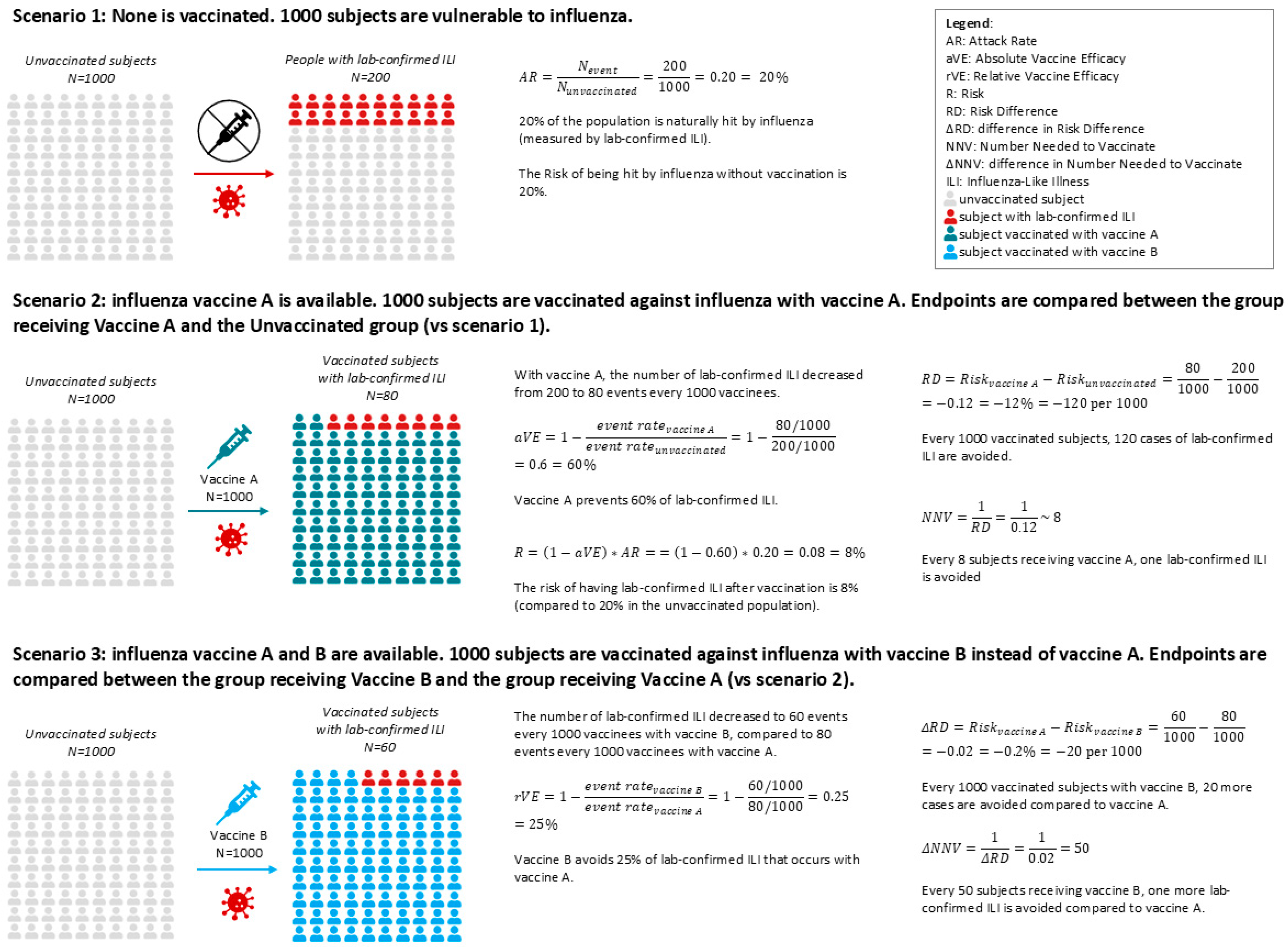
| Parameter | Definition | Formula |
|---|---|---|
| Attack Rate (AR) | The attack rate AR describes how many unvaccinated subjects are naturally hit by influenza (disease measures with a specific outcome). | |
| Absolute Vaccine Efficacy (aVE) | The Absolute Vaccine Efficacy aVE represents how effective the vaccine is in preventing a specific outcome. | |
| Risk (R) | The risk expresses the risk of having the disease (measured with a specific outcome) in the vaccinated population compared to the unvaccinated population. | |
| Risk Difference (RD) | The risk difference RD expresses how much the risk is diminished in the vaccinated population compared with the unvaccinated population. | |
| Number Needed to Vaccinate (NNV) | The number needed to vaccinate NNV represents the number of people to be vaccinated to avoid one specific outcome. | |
| Relative Vaccine Efficacy (rVE) | The Relative Vaccine Efficacy rVE represents the proportion of outcomes avoided by vaccine B compared to vaccine A. | |
| Difference in Risk Difference (ΔRD) | The difference in risk difference ΔRD expresses how much further the risk is diminished with vaccine B compared to vaccine A. | |
| Difference in Number Needed to Vaccinate (ΔNNV) | The difference in number needed to vaccinate ΔNNV represents the number of subjects to be vaccinated with vaccine B to avoid one additional outcome compared to vaccine A. |
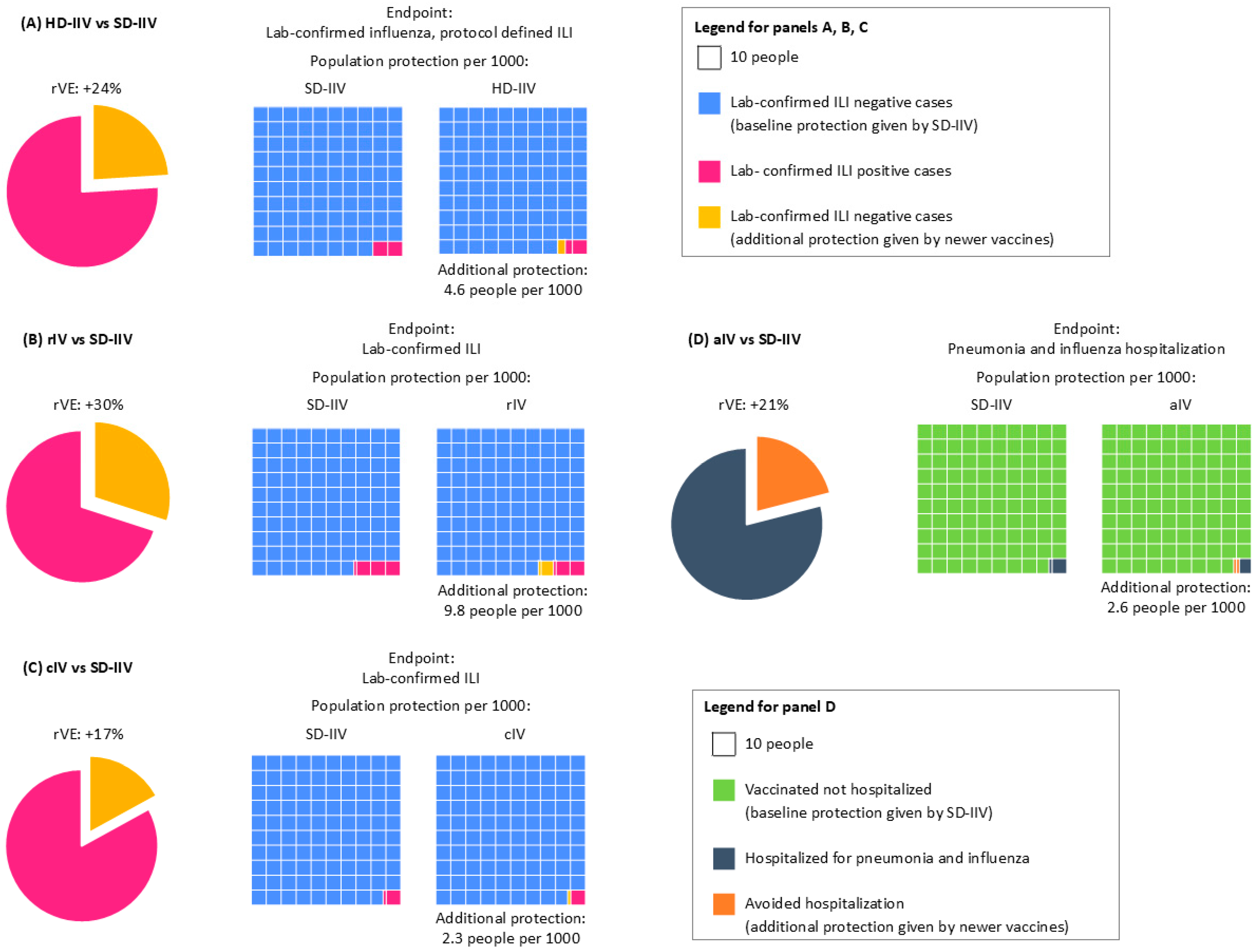
| A | SD-IIV | HD-IIV | ||||||||
| Clinical Endpoint | Vaccinated | Positive | Event Rate | Vaccinated | Positive | Event Rate | rVE (95%CI) | ΔRD % (95%CI) | ΔRD per 1000 | ΔNNV (95%CI) |
| Lab-confirmed influenza, protocol-defined ILI [4] | 15,991 | 301 | 1.9% | 15,998 | 228 | 1.4% | 24% (9.7 to 36) | 0.46% (0.18 to 0.74) | 4.6 (1.8 to 7.4) | 219 (136 to 565) |
| Lab-confirmed influenza, modified CDC ILI definition [4] | 15,991 | 121 | 0.8% | 15,998 | 96 | 0.6% | 21% (−4.6 to 40) | 0.16% (−0.24 to 0.34) | 1.6 (−2.4 to 3.4) | 639 (298 to ∞) |
| Lab-confirmed influenza, any respiratory illness (all strains) [4] | 15,991 | 387 | 2.4% | 15,998 | 316 | 2.0% | 18% (5.0 to 30) | 0.44% (0.12 to 0.77) | 4.4 (1.2 to 7.7) | 225 (131 to 820) |
| Season 2012-13, predominantly antigenically matched B [4] | 8749 | 65 | 0.7% | 8737 | 45 | 0.5% | 31% (−1.0 to 53) | 0.23% (−0.0064 to 0.46) | 2.3 (−0.064 to 4.6) | 436 (22 to ∞) |
| Season 2012-13, predominantly antigenically unmatched H3N2 [4] | 8749 | 243 | 2.8% | 8737 | 204 | 2.3% | 15.9% (−1.0 to 30) | 0.44% (−0.025 to 0.91) | 4.4 (−0.2 to 9.1) | 222 (11 to ∞) |
| B | SD-IIV | rIV | ||||||||
| Clinical endpoint | vaccinated | positive | event rate | vaccinated | positive | event rate | rVE (95%CI) | ΔRD % | ΔRD per 1000 | ΔNNV |
| Lab-confirmed influenza ILI [6] | 4301 | 138 | 3.2% | 4303 | 96 | 2.2% | 30% (10 to 47) | 0.98% (0.29 to 1.7) | 9.8 (2.9 to 17) | 102 (59 to 345) |
| Any H3N2 (predominantly antigenically mismatched) [6] | 4301 | 110 | 2.66% | 4303 | 71 | 1.65% | 36% (14 to 53) | 0.91% (0.30 to 1.5) | 9.1 (3.0 to 15) | 110 (66 to 332) |
| Any B (antigenically matched) [6] | 4301 | 24 | 0.56% | 4303 | 23 | 0.53% | 4.2% (−72 to 46) | 0.023% (−0.029 to 0.33) | 0.23 (−0.29 to 3.3) | 4256 (303 to ∞) |
| C | SD-IIV | cIV | ||||||||
| Clinical endpoint | vaccinated | positive | event rate | vaccinated | positive | event rate | rVE (95%CI) | ΔRD % | ΔRD per 1000 | ΔNNV |
| Lab-confirmed influenza ILI [14] | 3638 | 49 | 1.3% | 3776 | 42 | 1.1% | 17% (−24 to 45) | 0.23% (−0.27 to 0.74) | 2.3 (−2.7 to 7.4) | 426 (13 to ∞) |
| H1N1 predominantly antigenically matched [14] | 3638 | 8 | 0.22% | 3776 | 5 | 0.13% | 40% (−84 to 80) | 0.087% (−0.0010 to 0.28) | 0.87 (−0.010 to 2.8) | 1143 (358 to ∞) |
| B predominantly antigenically mismatched [14] | 3638 | 27 | 0.74% | 3776 | 29 | 0.77% | −3.5% (−74 to 39) | −0.026% (−0.42 to 0.37) | −0.26 (−4.2 to 3.7) | <0 |
| D | SD-IIV | aIV | ||||||||
| Clinical endpoint | vaccinated | hospitalized | event rate | vaccinated | hospitalized | event rate | rVE (95%CI) | ΔRD % | ΔRD per 1000 | ΔNNV |
| Pneumonia and influenza hospitalization [13] | 25,086 | 309 | 1.2% | 24,926 | 242 | 0.9% | 21% (6.7 to 33) | 0.26% (0.08 to 0.44) | 2.6 (0.8 to 4.4) | 383 (225 to 1282) |
Disclaimer/Publisher’s Note: The statements, opinions and data contained in all publications are solely those of the individual author(s) and contributor(s) and not of MDPI and/or the editor(s). MDPI and/or the editor(s) disclaim responsibility for any injury to people or property resulting from any ideas, methods, instructions or products referred to in the content. |
© 2026 by the authors. Licensee MDPI, Basel, Switzerland. This article is an open access article distributed under the terms and conditions of the Creative Commons Attribution (CC BY) license.
Share and Cite
Colombo, L.; Palache, A.; Hadigal, S. Shifting Perspective in Influenza Vaccines Efficacy: How Risk Difference Shows an Alternative View of the Comparative Efficacy Profile of Newer and Enhanced Influenza Vaccines Compared to Standard, Egg-Based Vaccines. Vaccines 2026, 14, 108. https://doi.org/10.3390/vaccines14010108
Colombo L, Palache A, Hadigal S. Shifting Perspective in Influenza Vaccines Efficacy: How Risk Difference Shows an Alternative View of the Comparative Efficacy Profile of Newer and Enhanced Influenza Vaccines Compared to Standard, Egg-Based Vaccines. Vaccines. 2026; 14(1):108. https://doi.org/10.3390/vaccines14010108
Chicago/Turabian StyleColombo, Laura, Abraham Palache, and Sanjay Hadigal. 2026. "Shifting Perspective in Influenza Vaccines Efficacy: How Risk Difference Shows an Alternative View of the Comparative Efficacy Profile of Newer and Enhanced Influenza Vaccines Compared to Standard, Egg-Based Vaccines" Vaccines 14, no. 1: 108. https://doi.org/10.3390/vaccines14010108
APA StyleColombo, L., Palache, A., & Hadigal, S. (2026). Shifting Perspective in Influenza Vaccines Efficacy: How Risk Difference Shows an Alternative View of the Comparative Efficacy Profile of Newer and Enhanced Influenza Vaccines Compared to Standard, Egg-Based Vaccines. Vaccines, 14(1), 108. https://doi.org/10.3390/vaccines14010108