Review

ROS Generation in Microglia: Understanding Oxidative Stress and Inflammation in Neurodegenerative Disease


by
Dominic S. A. Simpson
1,2 and
Peter L. Oliver
1,2,*
1
Mammalian Genetics Unit, MRC Harwell Institute, Harwell, Oxfordshire OX11 0RD, UK
2
Department of Physiology, Anatomy and Genetics, University of Oxford, Parks Road, Oxford OX1 3PT, UK
*
Author to whom correspondence should be addressed.
Antioxidants 2020, 9(8), 743; https://doi.org/10.3390/antiox9080743
Submission received: 17 July 2020 / Revised: 6 August 2020 / Accepted: 8 August 2020 / Published: 13 August 2020
(This article belongs to the Special Issue Oxidative Stress and Neurodegenerative Disorders)

Abstract

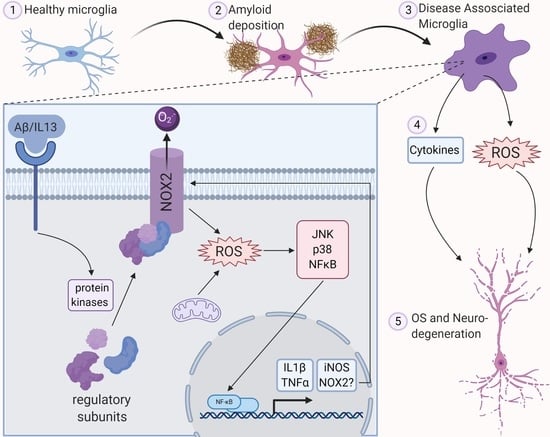
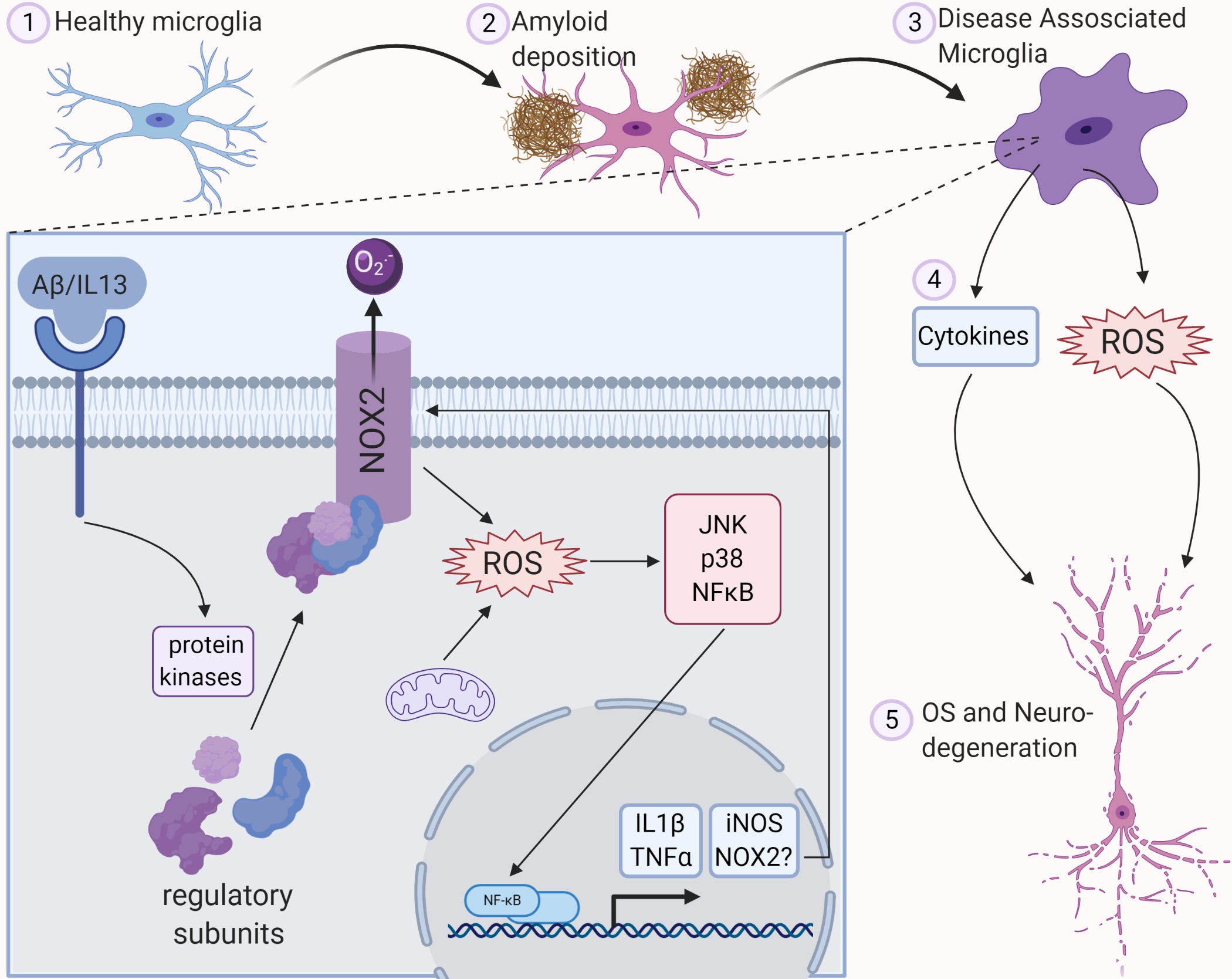
Neurodegenerative disorders, such as Alzheimer’s disease, are a global public health burden with poorly understood aetiology. Neuroinflammation and oxidative stress (OS) are undoubtedly hallmarks of neurodegeneration, contributing to disease progression. Protein aggregation and neuronal damage result in the activation of disease-associated microglia (DAM) via damage-associated molecular patterns (DAMPs). DAM facilitate persistent inflammation and reactive oxygen species (ROS) generation. However, the molecular mechanisms linking DAM activation and OS have not been well-defined; thus targeting these cells for clinical benefit has not been possible. In microglia, ROS are generated primarily by NADPH oxidase 2 (NOX2) and activation of NOX2 in DAM is associated with DAMP signalling, inflammation and amyloid plaque deposition, especially in the cerebrovasculature. Additionally, ROS originating from both NOX and the mitochondria may act as second messengers to propagate immune activation; thus intracellular ROS signalling may underlie excessive inflammation and OS. Targeting key kinases in the inflammatory response could cease inflammation and promote tissue repair. Expression of antioxidant proteins in microglia, such as NADPH dehydrogenase 1 (NQO1), is promoted by transcription factor Nrf2, which functions to control inflammation and limit OS. Lipid droplet accumulating microglia (LDAM) may also represent a double-edged sword in neurodegenerative disease by sequestering peroxidised lipids in non-pathological ageing but becoming dysregulated and pro-inflammatory in disease. We suggest that future studies should focus on targeted manipulation of NOX in the microglia to understand the molecular mechanisms driving inflammatory-related NOX activation. Finally, we discuss recent evidence that therapeutic target identification should be unbiased and founded on relevant pathophysiological assays to facilitate the discovery of translatable antioxidant and anti-inflammatory therapeutics.
Keywords: neuroinflammation; Alzheimer’s disease; microglia; oxidative stress; neurodegeneration; NADPH oxidase (NOX); lipid droplets neuroinflammation; Alzheimer’s disease; microglia; oxidative stress; neurodegeneration; NADPH oxidase (NOX); lipid droplets
Graphical Abstract