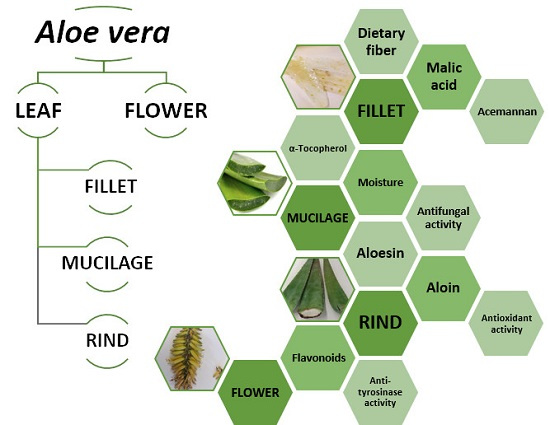
Compositional Features and Bioactive Properties of Aloe vera Leaf (Fillet, Mucilage, and Rind) and Flower


 ,
,  ,
,  ,
, 
 ,
,  ,
,  , ,
, ,  and
and 
Abstract
Share and Cite
Añibarro-Ortega, M.; Pinela, J.; Barros, L.; Ćirić, A.; Silva, S.P.; Coelho, E.; Mocan, A.; Calhelha, R.C.; Soković, M.; Coimbra, M.A.; et al. Compositional Features and Bioactive Properties of Aloe vera Leaf (Fillet, Mucilage, and Rind) and Flower. Antioxidants 2019, 8, 444. https://doi.org/10.3390/antiox8100444
Añibarro-Ortega M, Pinela J, Barros L, Ćirić A, Silva SP, Coelho E, Mocan A, Calhelha RC, Soković M, Coimbra MA, et al. Compositional Features and Bioactive Properties of Aloe vera Leaf (Fillet, Mucilage, and Rind) and Flower. Antioxidants. 2019; 8(10):444. https://doi.org/10.3390/antiox8100444
Chicago/Turabian StyleAñibarro-Ortega, Mikel, José Pinela, Lillian Barros, Ana Ćirić, Soraia P. Silva, Elisabete Coelho, Andrei Mocan, Ricardo C. Calhelha, Marina Soković, Manuel A. Coimbra, and et al. 2019. "Compositional Features and Bioactive Properties of Aloe vera Leaf (Fillet, Mucilage, and Rind) and Flower" Antioxidants 8, no. 10: 444. https://doi.org/10.3390/antiox8100444
APA StyleAñibarro-Ortega, M., Pinela, J., Barros, L., Ćirić, A., Silva, S. P., Coelho, E., Mocan, A., Calhelha, R. C., Soković, M., Coimbra, M. A., & Ferreira, I. C. F. R. (2019). Compositional Features and Bioactive Properties of Aloe vera Leaf (Fillet, Mucilage, and Rind) and Flower. Antioxidants, 8(10), 444. https://doi.org/10.3390/antiox8100444