Mitochondrial and Epigenetic Drivers of Skeletal Muscle Dysfunction in Chronic Obstructive Pulmonary Disease


Abstract
1. Introduction
2. The Multifaceted Pathophysiology of COPD-Related Muscle Dysfunction
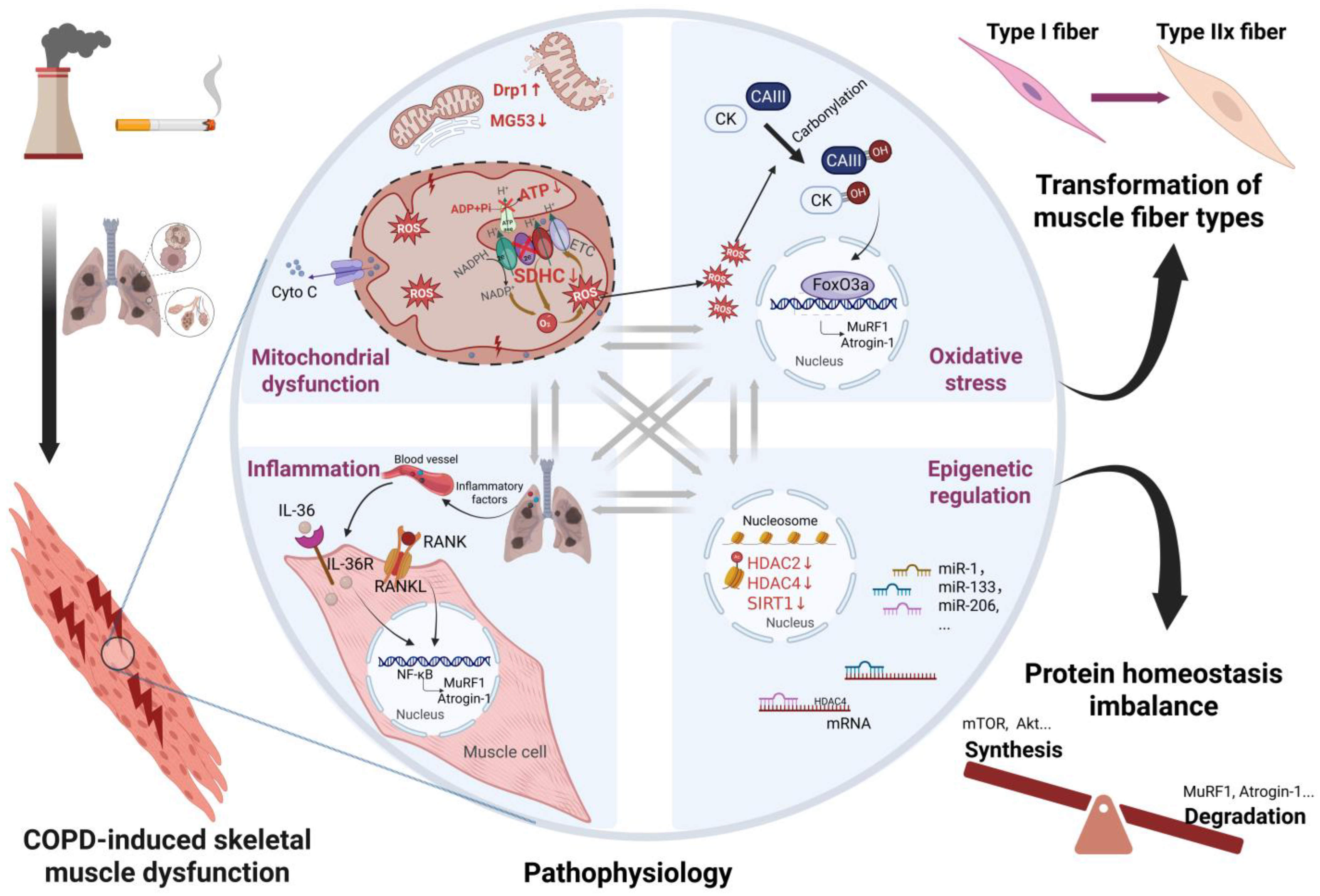
2.1. Mitochondrial Dysfunction: The Core Energetic Crisis
2.1.1. Bioenergetic Failure and Inefficient Compensation
2.1.2. Structural Decay and Dysregulated Dynamics
2.1.3. Integration with Broader Pathophysiology
2.2. Oxidative Stress: A Perpetuating Insult
2.3. Systemic and Local Inflammation: The Catabolic Drive
2.4. Epigenetic Regulation: The Emerging Orchestrator
2.4.1. Histone Modification
2.4.2. miRNAs as Key Regulators and Biomarkers
2.5. Altered Protein Homeostasis: Synthesis and Degradation
2.6. Other Contributing Mechanisms
3. Diagnostic and Prognostic Biomarkers
3.1. Conventional Functional and Morphological Assessments
3.2. Novel Circulating Biomarkers
3.2.1. Neuromuscular and Epigenetic Regulators
3.2.2. Systemic Inflammatory, Metabolic, and Catabolic Mediators
3.2.3. Emerging Myokines and Muscle-Derived Factors

| Category | Biomarker(s) | Primary Pathophysiological Role | Correlation with Muscle Parameters | Evidence Source | Key References |
|---|---|---|---|---|---|
| Neuromuscular and epigenetic | CAF | NMJ instability, synaptotoxicity | Negative with muscle strength and mass | Human (serum) | [27,28] |
| BDNF, GDNF | Neurotrophic support for NMJ integrity and axonal regeneration | Positive with muscle health; reduced in COPD | Human (serum) | [28] | |
| MyomiRs (e.g., miR-206, miR-133, miR-1) | Epigenetic regulation of muscle phenotype, regeneration, and inflammation | Altered levels correlate with disease severity, muscle mass, and strength | Human (plasma, serum, EVs) | [21,66,67] | |
| Systemic and metabolic | GDF-15 | Stress-responsive cytokine, mediator of catabolic stress | Negative with muscle CSA | Human (serum) | [75] |
| Zonulin | Marker of intestinal permeability, gut–muscle axis mediator | Negative with muscle strength and function | Human (plasma) | [70] | |
| Lp-PLA2 | Enzyme in inflammatory lipid metabolism | Negative with muscle mass and function | Human (plasma), murine model | [50] | |
| Calprotectin | Damage-associated molecular pattern; drives TLR4/RAGE-mediated inflammation, promotes proteolysis | Negative with muscle strength, mass, and physical function | Human (serum), murine model | [78] | |
| DKK3 | Inhibitor of Wnt signaling, induces mitochondrial dysfunction | Negative with muscle strength, mass, and exercise capacity | Human (plasma), in vitro | [77] | |
| GHK-Cu | Tripeptide with antioxidative and anti-inflammatory properties | Positive with muscle mass and antioxidative capacity | Human (plasma), murine model | [42] | |
| GLP-1 | A negative predictor and potential pathophysiological mediator of muscle wasting | Negative with muscle mass and function | Human (plasma) | [79] | |
| Muscle-derived and angiogenic | MG53 | Muscle-specific myokine, crucial for mitochondrial integrity and repair | Positive with muscle strength, mass, and physical performance | Human (plasma), murine model | [7] |
| Angiopoietin-2 | Marker of vascular dysregulation and impaired angiogenesis | Negative (upregulated in muscle wasting) | Human (muscle biopsies, plasma) | [80] |
3.3. Emerging Imaging Biomarkers: Shear Wave Elastography for Assessing Muscle Quality
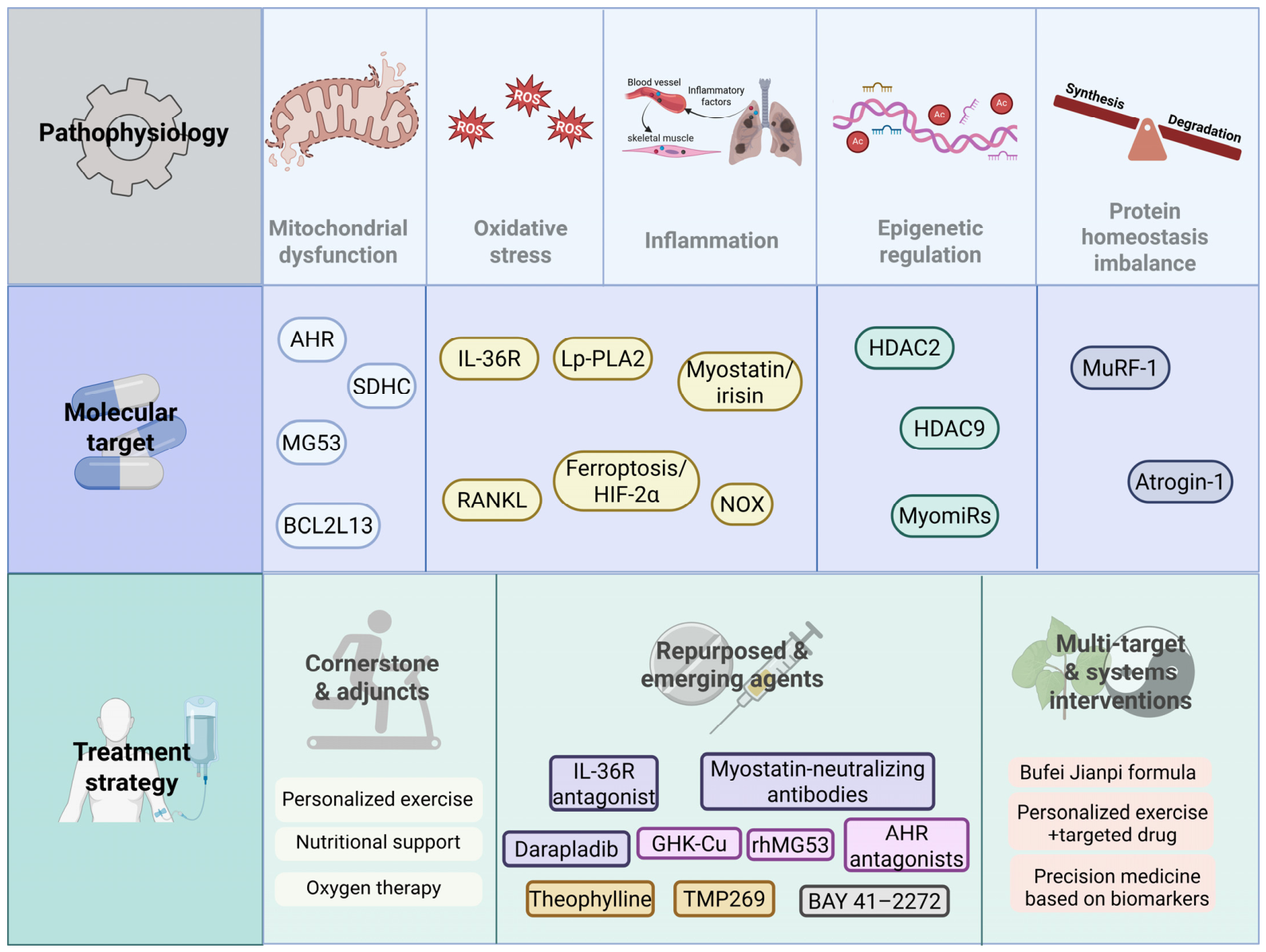
4. Therapeutic Interventions: From Rehabilitation to Targeted Therapy
4.1. Exercise Training: The Cornerstone with Limitations
4.2. Nutritional and Pharmacological Strategies
4.3. Novel Targeted Agents and Future Directions
5. Conclusions and Future Perspectives
Author Contributions
Funding
Institutional Review Board Statement
Informed Consent Statement
Data Availability Statement
Acknowledgments
Conflicts of Interest
Abbreviations
| AHR | Aryl hydrocarbon receptor |
| BDNF | Brain-derived neurotrophic factor |
| BMI | Body mass index |
| CAF | C-terminal agrin fragment |
| CAIII | Carbonic anhydrase III |
| CK | Creatine kinase |
| cGMP | Cyclic guanosine monophosphate |
| COPD | Chronic obstructive pulmonary disease |
| CSA | Cross-sectional area |
| CS | Cigarette smoke |
| DKK3 | Dickkopf-related protein 3 |
| FFMI | Fat-free mass index |
| GDF-15 | Growth differentiation factor-15 |
| GDNF | Glial cell line-derived neurotrophic factor |
| GHK-Cu | Glycine–histidine–lysine with Cu |
| GLP-1 | Glucagon-like peptide-1 |
| HDACs | Histone deacetylases |
| IGF-1 | Insulin-like growth factor-1 |
| IL-36R | IL-36 receptor |
| LC PUFAs | Long-chain polyunsaturated fatty acids |
| Lp-PLA2 | Lipoprotein-associated phospholipase A2 |
| MG53 | Mitsugumin 53 |
| miRNA/miR | MicroRNA |
| mPTP | Mitochondrial permeability transition pore |
| MRTF | Myocardin-related transcription factor |
| Mstn | Myostatin |
| MVC | Maximum voluntary contraction |
| MuRF1 | Muscle ring-finger protein-1 |
| NMJ | Neuromuscular junction |
| Nox | NADPH oxidase |
| OXPHOS | Oxidative phosphorylation |
| RANK | Receptor activator of nuclear factor kappa-B |
| RANKL | Receptor activator of nuclear factor kappa-B ligand |
| ROS | Reactive oxygen species |
| SDH | Succinate dehydrogenase |
| SDHC | Succinate dehydrogenase subunit C |
| sGC | Soluble guanylate cyclase |
| SMD | Skeletal muscle dysfunction |
| SRF | Serum response factor |
| SWE | Shear wave elastography |
| UPS | Ubiquitin–proteasome system |
References
- Global Initiative for Chronic Obstructive Lung Disease (GOLD). Global Strategy for the Diagnosis, Management, and Prevention of Chronic Obstructive Pulmonary Disease: 2026 Report. Available online: https://goldcopd.org/wp-content/uploads/2026/01/GOLD-REPORT-2026-v1.3-8Dec2025_WMV2.pdf (accessed on 17 April 2026).
- Thawanaphong, S.; Nair, P. Contemporary Concise Review 2024: Chronic Obstructive Pulmonary Disease. Respirology 2025, 30, 574–586. [Google Scholar] [CrossRef] [PubMed]
- Polverino, F.; Sin, D.D. The Developmental Origins of Asthma and COPD. Annu. Rev. Physiol. 2026, 88, 513–535. [Google Scholar] [CrossRef] [PubMed]
- Calverley, P.M.A.; Walker, P.P. Contemporary Concise Review 2022: Chronic obstructive pulmonary disease. Respirology 2023, 28, 428–436. [Google Scholar] [CrossRef] [PubMed]
- Gale, C.P.; Hurst, J.R.; Hawkins, N.M.; Bourbeau, J.; Han, M.K.; Lam, C.S.P.; Marciniuk, D.D.; Price, D.; Stolz, D.; Gluckman, T.; et al. Identification and management of cardiopulmonary risk in patients with chronic obstructive pulmonary disease: A multidisciplinary consensus and modified Delphi study. Eur. J. Prev. Cardiol. 2025, 32, 1445–1460. [Google Scholar] [CrossRef] [PubMed]
- Furukawa, Y.; Miyamoto, A.; Asai, K.; Tsutsumi, M.; Hirai, K.; Ueda, T.; Toyokura, E.; Nishimura, M.; Sato, K.; Yamada, K.; et al. Respiratory Muscle Strength as a Predictor of Exacerbations in Patients with Chronic Obstructive Pulmonary Disease. Respirology 2025, 30, 408–416. [Google Scholar] [CrossRef] [PubMed]
- Liao, L.; Zheng, Z.; Deng, M.; Xu, W.; Zhang, Q.; Wang, Z.; Li, C.; Li, J.; Bian, Y.; Wang, K.; et al. MG53 deficiency mediated skeletal muscle dysfunction in chronic obstructive pulmonary disease via impairing mitochondrial fission. Redox Biol. 2025, 83, 103663. [Google Scholar] [CrossRef] [PubMed]
- Jaitovich, A.; Barreiro, E. Skeletal Muscle Dysfunction in Chronic Obstructive Pulmonary Disease. What We Know and Can Do for Our Patients. Am. J. Respir. Crit. Care Med. 2018, 198, 175–186, Erratum in Am. J. Respir. Crit. Care Med. 2018, 198, 824–825. https://doi.org/10.1164/rccm.v198erratum3. [Google Scholar] [CrossRef] [PubMed]
- Mohamad Zani, R.A.; Ahmad Yusof, H.; Azizan, N.; Hyder Ali, I.A.; Ismail, S.; Mohd Shariff, N. Sarcopenia and it’s influencing factors among adults with asthma, chronic obstructive pulmonary disease, and tuberculosis in Penang, Malaysia. BMC Public Health 2025, 25, 1572. [Google Scholar] [CrossRef] [PubMed]
- Abdellaoui, A.; Gouzi, F.; Notarnicola, C.; Bourret, A.; Suc, A.; Laoudj-Chenivesse, D.; Héraud, N.; Mercier, J.; Préfaut, C.; Hayot, M.; et al. Mitochondrial Dysfunction and Defects in Mitochondrial Adaptation to Exercise Training in the Muscle of Patients with COPD: Disease Versus Disuse. Acta Physiol. 2025, 241, e70079. [Google Scholar] [CrossRef] [PubMed]
- Constantin, D.; Menon, M.K.; Houchen-Wolloff, L.; Morgan, M.D.; Singh, S.J.; Greenhaff, P.; Steiner, M.C. Skeletal muscle molecular responses to resistance training and dietary supplementation in COPD. Thorax 2013, 68, 625–633. [Google Scholar] [CrossRef] [PubMed]
- MacMillan, N.J.; Kapchinsky, S.; Konokhova, Y.; Gouspillou, G.; de Sousa Sena, R.; Jagoe, R.T.; Baril, J.; Carver, T.E.; Andersen, R.E.; Richard, R.; et al. Eccentric Ergometer Training Promotes Locomotor Muscle Strength but Not Mitochondrial Adaptation in Patients with Severe Chronic Obstructive Pulmonary Disease. Front. Physiol. 2017, 8, 114. [Google Scholar] [CrossRef] [PubMed]
- Hopkinson, N.S.; Man, W.D.; Dayer, M.J.; Ross, E.T.; Nickol, A.H.; Hart, N.; Moxham, J.; Polkey, M.I. Acute effect of oral steroids on muscle function in chronic obstructive pulmonary disease. Eur. Respir. J. 2004, 24, 137–142. [Google Scholar] [CrossRef] [PubMed]
- Balnis, J.; Drake, L.A.; Vincent, C.E.; Korponay, T.C.; Singer, D.V.; Lacomis, D.; Lee, C.G.; Elias, J.A.; Jourd’heuil, D.; Singer, H.A.; et al. SDH Subunit C Regulates Muscle Oxygen Consumption and Fatigability in an Animal Model of Pulmonary Emphysema. Am. J. Respir. Cell Mol. Biol. 2021, 65, 259–271. [Google Scholar] [CrossRef] [PubMed]
- Fitzgerald, L.F.; Lackey, J.; Moussa, A.; Shah, S.V.; Castellanos, A.M.; Khan, S.; Schonk, M.; Thome, T.; Salyers, Z.R.; Jakkidi, N.; et al. Chronic aryl hydrocarbon receptor activity impairs muscle mitochondrial function with tobacco smoking. J. Cachexia Sarcopenia Muscle 2024, 15, 646–659. [Google Scholar] [CrossRef] [PubMed]
- Puente-Maestu, L.; Pérez-Parra, J.; Godoy, R.; Moreno, N.; Tejedor, A.; Torres, A.; Lázaro, A.; Ferreira, A.; Agustí, A. Abnormal transition pore kinetics and cytochrome C release in muscle mitochondria of patients with chronic obstructive pulmonary disease. Am. J. Respir. Cell Mol. Biol. 2009, 40, 746–750. [Google Scholar] [CrossRef] [PubMed]
- Zhang, Y.B.; Zuo, H.Y.; Tian, D.H.; Ouyang, X.H.; Wang, X.A. Correlation between peripheral skeletal muscle functions and the stable phase of COPD in older patients. Eur. Rev. Med. Pharmacol. Sci. 2018, 22, 5317–5326. [Google Scholar] [CrossRef] [PubMed]
- Barreiro, E.; Gea, J.; Matar, G.; Hussain, S.N. Expression and carbonylation of creatine kinase in the quadriceps femoris muscles of patients with chronic obstructive pulmonary disease. Am. J. Respir. Cell Mol. Biol. 2005, 33, 636–642. [Google Scholar] [CrossRef] [PubMed]
- Chan, S.M.H.; Bernardo, I.; Mastronardo, C.; Mou, K.; De Luca, S.N.; Seow, H.J.; Dobric, A.; Brassington, K.; Selemidis, S.; Bozinovski, S.; et al. Apocynin prevents cigarette smoking-induced loss of skeletal muscle mass and function in mice by preserving proteostatic signalling. Br. J. Pharmacol. 2021, 178, 3049–3066. [Google Scholar] [CrossRef] [PubMed]
- Bin, Y.; Xiao, Y.; Huang, D.; Ma, Z.; Liang, Y.; Bai, J.; Zhang, W.; Liang, Q.; Zhang, J.; Zhong, X.; et al. Theophylline inhibits cigarette smoke-induced inflammation in skeletal muscle by upregulating HDAC2 expression and decreasing NF-κB activation. Am. J. Physiol. Lung Cell. Mol. Physiol. 2019, 316, L197–L205. [Google Scholar] [CrossRef] [PubMed]
- Donaldson, A.; Natanek, S.A.; Lewis, A.; Man, W.D.; Hopkinson, N.S.; Polkey, M.I.; Kemp, P.R. Increased skeletal muscle-specific microRNA in the blood of patients with COPD. Thorax 2013, 68, 1140–1149. [Google Scholar] [CrossRef] [PubMed]
- Puig-Vilanova, E.; Ausin, P.; Martinez-Llorens, J.; Gea, J.; Barreiro, E. Do epigenetic events take place in the vastus lateralis of patients with mild chronic obstructive pulmonary disease? PLoS ONE 2014, 9, e102296. [Google Scholar] [CrossRef] [PubMed]
- To, M.; Swallow, E.B.; Akashi, K.; Haruki, K.; Natanek, S.A.; Polkey, M.I.; Ito, K.; Barnes, P.J. Reduced HDAC2 in skeletal muscle of COPD patients. Respir. Res. 2017, 18, 99. [Google Scholar] [CrossRef] [PubMed]
- Puig-Vilanova, E.; Aguiló, R.; Rodríguez-Fuster, A.; Martínez-Llorens, J.; Gea, J.; Barreiro, E. Epigenetic mechanisms in respiratory muscle dysfunction of patients with chronic obstructive pulmonary disease. PLoS ONE 2014, 9, e111514. [Google Scholar] [CrossRef] [PubMed]
- Silva, L.I.; Gonzalez-Zambrano, C.M.; Ferreira, V.; Corrêa, F.C.; Dias-Melicio, L.A. MicroRNAs in Acute COVID-19 and Long COVID: Dysregulation, Pathogenic Roles, and Clinical Implications. J. Immunol. Res. 2026, 2026, e5862241. [Google Scholar] [CrossRef] [PubMed]
- Gea, J.; Orozco-Levi, M.; Pascual-Guàrdia, S.; Casadevall, C.; Enríquez-Rodríguez, C.J.; Camps-Ubach, R.; Barreiro, E. Biological Mechanisms Involved in Muscle Dysfunction in COPD: An Integrative Damage-Regeneration-Remodeling Framework. Cells 2025, 14, 1731. [Google Scholar] [CrossRef] [PubMed]
- Qaisar, R.; Karim, A.; Muhammad, T. Plasma CAF22 Levels as a Useful Predictor of Muscle Health in Patients with Chronic Obstructive Pulmonary Disease. Biology 2020, 9, 166. [Google Scholar] [CrossRef] [PubMed]
- Karim, A.; Muhammad, T.; Qaisar, R. Prediction of Sarcopenia Using Multiple Biomarkers of Neuromuscular Junction Degeneration in Chronic Obstructive Pulmonary Disease. J. Pers. Med. 2021, 11, 919. [Google Scholar] [CrossRef] [PubMed]
- Zheng, G.; Li, C.; Chen, X.; Deng, Z.; Xie, T.; Huo, Z.; Wei, X.; Huang, Y.; Zeng, X.; Luo, Y.; et al. HDAC9 inhibition reduces skeletal muscle atrophy and enhances regeneration in mice with cigarette smoke-induced COPD. Biochim. Biophys. Acta Mol. Basis Dis. 2024, 1870, 167023. [Google Scholar] [CrossRef] [PubMed]
- Puig-Vilanova, E.; Martínez-Llorens, J.; Ausin, P.; Roca, J.; Gea, J.; Barreiro, E. Quadriceps muscle weakness and atrophy are associated with a differential epigenetic profile in advanced COPD. Clin. Sci. 2015, 128, 905–921. [Google Scholar] [CrossRef] [PubMed]
- Chiles, J.W., 3rd; Wilson, A.C.; Tindal, R.; Lavin, K.; Windham, S.; Rossiter, H.B.; Casaburi, R.; Thalacker-Mercer, A.; Buford, T.W.; Patel, R.; et al. Differentially co-expressed myofibre transcripts associated with abnormal myofibre proportion in chronic obstructive pulmonary disease. J. Cachexia Sarcopenia Muscle 2024, 15, 1016–1029. [Google Scholar] [CrossRef] [PubMed]
- Peñailillo, L.; Gutiérrez, S.; Monsalves-Álvarez, M. Muscle Mitochondrial Dysfunction in COPD: Beyond Oxygen Consumption. Acta Physiol. 2025, 241, e70097. [Google Scholar] [CrossRef] [PubMed]
- Behan, M.; Yen, K.; Cohen, P.; Kliment, C.R. Mitochondrial-derived microproteins in lung disease: Insights and implications. Am. J. Physiol. Lung Cell. Mol. Physiol. 2026, 330, L222–L231. [Google Scholar] [CrossRef] [PubMed]
- Balnis, J.; Korponay, T.C.; Vincent, C.E.; Singer, D.V.; Adam, A.P.; Lacomis, D.; Lee, C.G.; Elias, J.A.; Singer, H.A.; Jaitovich, A. IL-13-driven pulmonary emphysema leads to skeletal muscle dysfunction attenuated by endurance exercise. J. Appl. Physiol. 2020, 128, 134–148. [Google Scholar] [CrossRef] [PubMed]
- Pérez-Rial, S.; Barreiro, E.; Fernández-Aceñero, M.J.; Fernández-Valle, M.E.; González-Mangado, N.; Peces-Barba, G. Early detection of skeletal muscle bioenergetic deficit by magnetic resonance spectroscopy in cigarette smoke-exposed mice. PLoS ONE 2020, 15, e0234606. [Google Scholar] [CrossRef] [PubMed]
- Tan, Z.; Zhao, M.; Li, J.; Li, S.; Zhu, S.; Yao, X.; Gao, X.; Yang, S. Myostatin is involved in skeletal muscle dysfunction in chronic obstructive pulmonary disease via Drp-1 mediated abnormal mitochondrial division. Ann. Transl. Med. 2022, 10, 162, Erratum in Ann. Transl. Med. 2025, 13, e4. https://doi.org/10.21037/atm-2024b-56. [Google Scholar] [CrossRef] [PubMed]
- Alway, S.E.; Paez, H.G.; Pitzer, C.R. The Role of Mitochondria in Mediation of Skeletal Muscle Repair. Muscles 2023, 2, 119–163. [Google Scholar] [CrossRef] [PubMed]
- Jaitovich, A. Impaired regenerative capacity contributes to skeletal muscle dysfunction in chronic obstructive pulmonary disease. Am. J. Physiol. Cell Physiol. 2022, 323, C974–C989. [Google Scholar] [CrossRef] [PubMed]
- Song, Y.; Han, X.; Wang, Y.; Li, K.; Li, H.; Tian, Y.; Ma, X.; Wu, W.; Wang, J. Mitochondrial Quality Control: A New Perspective in Skeletal Muscle Dysfunction of Chronic Obstructive Pulmonary Disease. Aging Dis. 2024, 16, 3291–3310. [Google Scholar] [CrossRef] [PubMed]
- Jiang, M.; Li, P.; Han, X.; Jiang, L.; Han, L.; He, Q.; Yang, C.; Sun, Z.; Wang, Y.; Cao, Y.; et al. Marine-Derived Bioactive Compounds: A Promising Strategy for Ameliorating Skeletal Muscle Dysfunction in COPD. Mar. Drugs 2025, 23, 158. [Google Scholar] [CrossRef] [PubMed]
- Sireno, L.; Dimauro, I.; Caporossi, D. Reactive oxygen species in exercise biology: From adaptive stress response to cell signaling and beyond. Free Radic. Biol. Med. 2026, 245, 447–462. [Google Scholar] [CrossRef] [PubMed]
- Deng, M.; Zhang, Q.; Yan, L.; Bian, Y.; Li, R.; Gao, J.; Wang, Y.; Miao, J.; Li, J.; Zhou, X.; et al. Glycyl-l-histidyl-l-lysine-Cu(2+) rescues cigarette smoking-induced skeletal muscle dysfunction via a sirtuin 1-dependent pathway. J. Cachexia Sarcopenia Muscle 2023, 14, 1365–1380. [Google Scholar] [CrossRef] [PubMed]
- Sies, H. Oxidative stress: A concept in redox biology and medicine. Redox Biol. 2015, 4, 180–183. [Google Scholar] [CrossRef] [PubMed]
- Liao, S.; Chen, D.; Long, H.; Jiang, S.; Fan, J.; Li, S.; Qi, Y.; Xue, L.; Ding, Y.; Chen, Y. Hydrogen sulfide attenuates oxidative stress-induced cellular senescence via the Sirt3/SOD2 signaling pathway in chronic obstructive pulmonary disease. Chin. Med. J. 2026, 139, 866–879. [Google Scholar] [CrossRef] [PubMed]
- Powers, S.K.; Radak, Z.; Ji, L.L.; Jackson, M. Reactive oxygen species promote endurance exercise-induced adaptations in skeletal muscles. J. Sport. Health Sci. 2024, 13, 780–792. [Google Scholar] [CrossRef] [PubMed]
- Thoma, A.; Lightfoot, A.P. NF-kB and Inflammatory Cytokine Signalling: Role in Skeletal Muscle Atrophy. Adv. Exp. Med. Biol. 2018, 1088, 267–279. [Google Scholar] [CrossRef] [PubMed]
- Lewis, A.; Riddoch-Contreras, J.; Natanek, S.A.; Donaldson, A.; Man, W.D.; Moxham, J.; Hopkinson, N.S.; Polkey, M.I.; Kemp, P.R. Downregulation of the serum response factor/miR-1 axis in the quadriceps of patients with COPD. Thorax 2012, 67, 26–34. [Google Scholar] [CrossRef] [PubMed]
- Xiong, G.; Xie, Y.; Tan, Y.; Ye, Y.; Tan, X.; Jiang, L.; Qin, E.; Wei, X.; Li, J.; Liang, T.; et al. HMGB1-mediated pyroptosis promotes inflammation and contributes to skeletal muscle atrophy induced by cigarette smoke. Am. J. Physiol. Cell Physiol. 2025, 329, C325–C340. [Google Scholar] [CrossRef] [PubMed]
- Luan, X.; Zhu, D.; Hao, Y.; Xie, J.; Wang, X.; Li, Y.; Zhu, J. Qibai Pingfei Capsule ameliorated inflammation in chronic obstructive pulmonary disease (COPD) via HIF-1 α/glycolysis pathway mediated of BMAL1. Int. Immunopharmacol. 2025, 144, 113636. [Google Scholar] [CrossRef] [PubMed]
- Liao, L.; Deng, M.; Gao, Q.; Zhang, Q.; Bian, Y.; Wang, Z.; Li, J.; Xu, W.; Li, C.; Wang, K.; et al. Predictive and therapeutic value of lipoprotein-associated phospholipaseA2 in sarcopenia in chronic obstructive pulmonary disease. Int. J. Biol. Macromol. 2024, 275, 133741. [Google Scholar] [CrossRef] [PubMed]
- Li, D.; Qu, J.; Pei, Y.; Rao, Y.; Zhang, Y.; Chen, Y.; Sun, Y. IL-36R deletion mitigates cigarette smoke-induced airway inflammation and skeletal muscle dysfunction. Int. Immunopharmacol. 2025, 164, 115317. [Google Scholar] [CrossRef] [PubMed]
- Xiong, J.; Le, Y.; Rao, Y.; Zhou, L.; Hu, Y.; Guo, S.; Sun, Y. RANKL Mediates Muscle Atrophy and Dysfunction in a Cigarette Smoke-induced Model of Chronic Obstructive Pulmonary Disease. Am. J. Respir. Cell Mol. Biol. 2021, 64, 617–628. [Google Scholar] [CrossRef] [PubMed]
- Huang, Z.; Hu, L.; Liu, Z.; Wang, S. The Functions and Regulatory Mechanisms of Histone Modifications in Skeletal Muscle Development and Disease. Int. J. Mol. Sci. 2025, 26, 3644. [Google Scholar] [CrossRef] [PubMed]
- Yang, S.; Chen, L.; Lin, M.; Shen, C.; Reheman, A. Histone Modifications as Individual-Specific Epigenetic Regulators: Opportunities for Forensic Genetics and Postmortem Analysis. Genes 2025, 16, 940. [Google Scholar] [CrossRef] [PubMed]
- Maruyama, S.; Kawano, F. Phosphorylation-mimicking histone H3.3 rescues exercise-induced gene responses in an epigenetic aging model of mouse skeletal muscle. Lab. Anim. Res. 2025, 41, 25. [Google Scholar] [CrossRef] [PubMed]
- Bonnet, J.; Triantopoulou, E.; Birnhäupl, J.; Lu, C.; Fuller, M.T.; Müller, J. Histone modification cross-talk and protein complex diversification confer plasticity to Polycomb repression. Genes Dev. 2026, 40, 43–55. [Google Scholar] [CrossRef] [PubMed]
- Li, C.; Deng, Z.; Zheng, G.; Xie, T.; Wei, X.; Huo, Z.; Bai, J. Histone Deacetylase 2 Suppresses Skeletal Muscle Atrophy and Senescence via NF-κB Signaling Pathway in Cigarette Smoke-Induced Mice with Emphysema. Int. J. Chronic Obstr. Pulm. Dis. 2021, 16, 1661–1675. [Google Scholar] [CrossRef] [PubMed]
- Feng, J.; Liu, Y.; Li, K.; Wu, Y. Challenges and opportunities in targeting epigenetic mechanisms for pulmonary arterial hypertension treatment. Int. J. Pharm. 2025, 672, 125332. [Google Scholar] [CrossRef] [PubMed]
- Li, C.; Ou, M.; Zheng, G.; Jiang, G.; Hu, X.; Jiang, Y. USP47 stabilizes HDAC2 to ameliorate cigarette smoke-induced skeletal muscle atrophy by suppressing CYP1A1/ROS-mediated autophagy. Free Radic. Biol. Med. 2026, 246, 107–125. [Google Scholar] [CrossRef] [PubMed]
- Jurj, A.; Dragomir, M.P.; Li, Z.; Calin, G.A. MicroRNAs in oncology: A translational perspective in the era of AI. Nat. Rev. Clin. Oncol. 2026, 23, 239–259. [Google Scholar] [CrossRef] [PubMed]
- Rheims, S.; Kouchi, H.; Busato, F.; Lagarde, S.; Derbala, D.; Boulogne, S.; Leclercq, M.; Chenais, J.; Bouvard, S.; Bartolomei, F.; et al. Extracellular vesicle microRNAs are biomarkers of focal epilepsy but not epilepsy-related respiratory dysfunction. Epilepsia 2026, 67, 408–423. [Google Scholar] [CrossRef] [PubMed]
- Barreiro, E. The role of MicroRNAs in COPD muscle dysfunction and mass loss: Implications on the clinic. Expert. Rev. Respir. Med. 2016, 10, 1011–1022. [Google Scholar] [CrossRef] [PubMed]
- Zhao, H.; Li, P.; Wang, J. The role of muscle-specific MicroRNAs in patients with chronic obstructive pulmonary disease and skeletal muscle dysfunction. Front. Physiol. 2022, 13, 954364. [Google Scholar] [CrossRef] [PubMed]
- Wu, W.T.; Setiawan, D.; Glatt, S.J.; Chi, J.T.; Lin, P.I. MicroRNAs in metabolic effects with atypical antipsychotics-a scoping review. Ther. Adv. Psychopharmacol. 2026, 16, 20451253261430603. [Google Scholar] [CrossRef] [PubMed]
- Jin, J.; Li, F.; Fan, C.; Wu, Y.; He, C. Elevated mir-145-5p is associated with skeletal muscle dysfunction and triggers apoptotic cell death in C2C12 myotubes. J. Muscle Res. Cell Motil. 2022, 43, 135–145. [Google Scholar] [CrossRef] [PubMed]
- Qaisar, R.; Karim, A.; Muhammad, T.; Shah, I. Circulating Biomarkers of Accelerated Sarcopenia in Respiratory Diseases. Biology 2020, 9, 322. [Google Scholar] [CrossRef] [PubMed]
- Carpi, S.; Polini, B.; Nieri, D.; Dubbini, N.; Celi, A.; Nieri, P.; Neri, T. Expression Analysis of Muscle-Specific miRNAs in Plasma-Derived Extracellular Vesicles from Patients with Chronic Obstructive Pulmonary Disease. Diagnostics 2020, 10, 502. [Google Scholar] [CrossRef] [PubMed]
- Pan, L.L.; Ke, J.Q.; Zhao, C.C.; Huang, S.Y.; Shen, J.; Jiang, X.X.; Wang, X.T. Electrical Stimulation Improves Rat Muscle Dysfunction Caused by Chronic Intermittent Hypoxia-Hypercapnia via Regulation of miRNA-Related Signaling Pathways. PLoS ONE 2016, 11, e0152525. [Google Scholar] [CrossRef] [PubMed]
- Mao, J.; Li, Y.; Feng, S.; Liu, X.; Tian, Y.; Bian, Q.; Li, J.; Hu, Y.; Zhang, L.; Ji, H.; et al. Bufei Jianpi Formula Improves Mitochondrial Function and Suppresses Mitophagy in Skeletal Muscle via the Adenosine Monophosphate-Activated Protein Kinase Pathway in Chronic Obstructive Pulmonary Disease. Front. Pharmacol. 2020, 11, 587176. [Google Scholar] [CrossRef] [PubMed]
- Karim, A.; Muhammad, T.; Ustrana, S.; Qaisar, R. Intestinal permeability marker zonulin as a predictor of sarcopenia in chronic obstructive pulmonary disease. Respir. Med. 2021, 189, 106662. [Google Scholar] [CrossRef] [PubMed]
- Attaway, A.H.; Bellar, A.; Welch, N.; Sekar, J.; Kumar, A.; Mishra, S.; Hatipoğlu, U.; McDonald, M.L.; Regan, E.A.; Smith, J.D.; et al. Gene polymorphisms associated with heterogeneity and senescence characteristics of sarcopenia in chronic obstructive pulmonary disease. J. Cachexia Sarcopenia Muscle 2023, 14, 1083–1095. [Google Scholar] [CrossRef] [PubMed]
- Cebollero, P.; Zambom-Ferraresi, F.; Hernández, M.; Hueto, J.; Cascante, J.; Anton, M.M. Inspiratory fraction as a marker of skeletal muscle dysfunction in patients with COPD. Rev. Port. Pneumol. 2017, 23, 3–9. [Google Scholar] [CrossRef] [PubMed]
- Li, P.; Li, J.; Wang, Y.; Xia, J.; Liu, X. Effects of Exercise Intervention on Peripheral Skeletal Muscle in Stable Patients with COPD: A Systematic Review and Meta-Analysis. Front. Med. 2021, 8, 766841. [Google Scholar] [CrossRef] [PubMed]
- Qaisar, R.; Khan, I.U.; Ahmad, F.; Karim, A. Asthma-chronic obstructive pulmonary disease overlap is associated with a higher degree of neuromuscular junction degradation than either disease alone. Heart Lung 2026, 75, 164–170. [Google Scholar] [CrossRef] [PubMed]
- Li, Y.; Xie, Y.P.; Li, X.M.; Lu, T. Effects of early standardized enteral nutrition on preventing acute muscle loss in the acute exacerbation of chronic obstructive pulmonary disease patients with mechanical ventilation. World J. Emerg. Med. 2023, 14, 193–197. [Google Scholar] [CrossRef] [PubMed]
- Li, R.; Adami, A.; Chang, C.C.; Tseng, C.H.; Hsiai, T.K.; Rossiter, H.B. Serum Acylglycerols Inversely Associate with Muscle Oxidative Capacity in Severe COPD. Med. Sci. Sports Exerc. 2021, 53, 10–18. [Google Scholar] [CrossRef] [PubMed]
- Wang, Z.; Deng, M.; Xu, W.; Li, C.; Zheng, Z.; Li, J.; Liao, L.; Zhang, Q.; Bian, Y.; Li, R.; et al. DKK3 as a diagnostic marker and potential therapeutic target for sarcopenia in chronic obstructive pulmonary disease. Redox Biol. 2024, 78, 103434. [Google Scholar] [CrossRef] [PubMed]
- Liao, L.; Li, J.; Xu, W.; Yin, Y.; Wang, Z.; Li, C.; Li, Y.; Zhou, X.; Deng, M.; Hou, G. Calprotectin Is a Circulating Biomarker and Potential Therapeutic Target for Sarcopenia in Chronic Obstructive Pulmonary Disease. J. Cachexia Sarcopenia Muscle 2026, 17, e70196. [Google Scholar] [CrossRef] [PubMed]
- Shang, L.; Li, Q.; Su, N. Correlation between Plasma Glucagon-Like Peptide-1 and Sarcopenia in Elderly Patients with Chronic Obstructive Pulmonary Disease. Clin. Lab. 2025, 71, 1180–1888. [Google Scholar] [CrossRef] [PubMed]
- Mofarrahi, M.; Sigala, I.; Vassilokopoulos, T.; Harel, S.; Guo, Y.; Debigare, R.; Maltais, F.; Hussain, S.N. Angiogenesis-related factors in skeletal muscles of COPD patients: Roles of angiopoietin-2. J. Appl. Physiol. 2013, 114, 1309–1318. [Google Scholar] [CrossRef] [PubMed][Green Version]
- Wang, X.; Gao, L.; Xiong, J.; Cheng, H.; Liu, L.; Dong, H.; Huang, Y.; Fan, H.; Wang, X.; Shan, X.; et al. The life-course changes in muscle mass using dual-energy X-ray absorptiometry: The China BCL study and the US NHANES study. J. Cachexia Sarcopenia Muscle 2024, 15, 1687–1695. [Google Scholar] [CrossRef] [PubMed]
- Cheng, K.Y.; Chow, S.K.; Hung, V.W.; Wong, C.H.; Wong, R.M.; Tsang, C.S.; Kwok, T.; Cheung, W.H. Diagnosis of sarcopenia by evaluating skeletal muscle mass by adjusted bioimpedance analysis validated with dual-energy X-ray absorptiometry. J. Cachexia Sarcopenia Muscle 2021, 12, 2163–2173. [Google Scholar] [CrossRef] [PubMed]
- An, L.; Shi, J.; Pan, Y.; Ding, Y.; Gao, W.; Ren, L.; Wang, J.; Wang, Y. The role of shear wave elastography in diagnosing sarcopenia in patients with type 2 diabetes. J. Endocrinol. Investig. 2025, 48, 2177–2185. [Google Scholar] [CrossRef] [PubMed]
- Zhou, J.; Lin, Y.; Zhang, J.; Si’tu, X.; Wang, J.; Pan, W.; Wang, Y. Reliability of shear wave elastography for the assessment of gastrocnemius fascia elasticity in healthy individual. Sci. Rep. 2022, 12, 8698. [Google Scholar] [CrossRef] [PubMed]
- Liu, K.; Zhao, T.; Zhang, Y.; Chen, L.; Zhang, H.; Xu, X.; Yuan, Z.; Zhang, Q.; Dong, J. Shear wave elastography based analysis of changes in fascial and muscle stiffness in patients with chronic non-specific low back pain. Front. Bioeng. Biotechnol. 2024, 12, 1476396. [Google Scholar] [CrossRef] [PubMed]
- Götschi, T.; Snedeker, J.G.; Fitze, D.P.; Sarto, F.; Spörri, J.; Franchi, M.V. Three-dimensional mapping of ultrasound-derived skeletal muscle shear wave velocity. Front. Bioeng. Biotechnol. 2023, 11, 1330301. [Google Scholar] [CrossRef] [PubMed]
- Deng, M.; Zhou, X.; Li, Y.; Yin, Y.; Liang, C.; Zhang, Q.; Lu, J.; Wang, M.; Wang, Y.; Sun, Y.; et al. Ultrasonic Elastography of the Rectus Femoris, a Potential Tool to Predict Sarcopenia in Patients with Chronic Obstructive Pulmonary Disease. Front. Physiol. 2021, 12, 783421. [Google Scholar] [CrossRef] [PubMed]
- Yue, Y.; Niu, Y.; Tang, W.; Li, S.; Xu, L.; Chen, Z.; Chen, C. Shear wave elastography, as a feasible tool, can be used to reflect the lower limb dysfunction in patients with chronic obstructive pulmonary disease? Sci. Rep. 2025, 15, 6532. [Google Scholar] [CrossRef] [PubMed]
- Lazarus, N.R.; Harridge, S.D.R. Exercise and functional integrity in non-disease and disease states during human ageing: The relevance of VO(2max). Free Radic. Biol. Med. 2026, 246, 305–315. [Google Scholar] [CrossRef] [PubMed]
- Aucoin, R.; Nguyen, D.; Ross, B.; Bourbeau, J.; Lewthwaite, H.; Ekström, M.; von Leupoldt, A.; Jensen, D. Facial airflow enhances the benefits of exercise training in people with chronic lung disease: A randomised controlled trial. Eur. Respir. J. 2026, 67, 2501109. [Google Scholar] [CrossRef] [PubMed]
- Passerieux, E.; Desplanche, E.; Alburquerque, L.; Wynands, Q.; Bellanger, A.; Virsolvy, A.; Gouzi, F.; Cazorla, O.; Bourdin, A.; Hayot, M.; et al. Altered skeletal muscle function and beneficial effects of exercise training in a rat model of induced pulmonary emphysema. Acta Physiol. 2024, 240, e14165. [Google Scholar] [CrossRef] [PubMed]
- Liu, S.; Yang, A.; Yu, Y.; Xu, B.; Yu, G.; Wang, H. Exercise Prescription Training in Chronic Obstructive Pulmonary Disease: Benefits and Mechanisms. Int. J. Chronic Obstr. Pulm. Dis. 2025, 20, 1071–1082. [Google Scholar] [CrossRef] [PubMed]
- Troosters, T.; Probst, V.S.; Crul, T.; Pitta, F.; Gayan-Ramirez, G.; Decramer, M.; Gosselink, R. Resistance training prevents deterioration in quadriceps muscle function during acute exacerbations of chronic obstructive pulmonary disease. Am. J. Respir. Crit. Care Med. 2010, 181, 1072–1077. [Google Scholar] [CrossRef] [PubMed]
- Mei, Y.; Wang, X.; Ren, R.; Wang, F.; Tan, C. Development and Application of a Multi-Component Exercise Training Program for Elderly COPD Patients with Skeletal Muscle Dysfunction. Altern. Ther. Health Med. 2023, 29, 624–630. [Google Scholar] [PubMed]
- Mujaddadi, A.; Moiz, J.A.; Singla, D.; Naqvi, I.H.; Ali, M.S.; Talwar, D. Effect of eccentric exercise on markers of muscle damage in patients with chronic obstructive pulmonary disease. Physiother. Theory Pract. 2021, 37, 801–807. [Google Scholar] [CrossRef] [PubMed]
- Zhu, C.; Peng, W.; Yang, L.; Zhang, W. High-intensity interval training alleviates COPD-induced gastrocnemius muscle dysfunction via the BRD4/PGC-1α axis through restoring mitochondrial function and oxidative fiber composition. J. Muscle Res. Cell Motil. 2026, 47, 9. [Google Scholar] [CrossRef] [PubMed]
- Neunhäuserer, D.; Hudelmaier, M.; Niederseer, D.; Vecchiato, M.; Wirth, W.; Steidle-Kloc, E.; Kaiser, B.; Lamprecht, B.; Ermolao, A.; Studnicka, M.; et al. The Impact of Exercise Training and Supplemental Oxygen on Peripheral Muscles in Chronic Obstructive Pulmonary Disease: A Randomized Controlled Trial. Med. Sci. Sports Exerc. 2023, 55, 2123–2131. [Google Scholar] [CrossRef] [PubMed]
- Muge, Q.; Suriguga; Yuqing; Aronggaowa; Taojin; Chen, L. A meta-analysis of the effects of long-term oxygen therapy combined with exercise rehabilitation on exercise capacity, cardiopulmonary function, and quality of life in patients with COPD. Front. Med. 2025, 12, 1640084. [Google Scholar] [CrossRef] [PubMed]
- Tuna, T.; Samur, G. The Role of Nutrition and Nutritional Supplements in the Prevention and Treatment of Malnutrition in Chronic Obstructive Pulmonary Disease: Current Approaches in Nutrition Therapy. Curr. Nutr. Rep. 2025, 14, 21. [Google Scholar] [CrossRef] [PubMed]
- Chen, S.P.; Hsu, J.E.; Wu, Y.C.; Lin, P.T. Associations of chronic obstructive pulmonary disease with sarcopenia and related factors: Nutritional status, body composition, antioxidant capacity, and inflammatory profile. Nutrition 2026, 143, 113016. [Google Scholar] [CrossRef] [PubMed]
- Borghi-Silva, A.; Baldissera, V.; Sampaio, L.M.; Pires-DiLorenzo, V.A.; Jamami, M.; Demonte, A.; Marchini, J.S.; Costa, D. L-carnitine as an ergogenic aid for patients with chronic obstructive pulmonary disease submitted to whole-body and respiratory muscle training programs. Braz. J. Med. Biol. Res. 2006, 39, 465–474. [Google Scholar] [CrossRef] [PubMed]
- Hoang, B.X.; Han, B.O.; Fang, W.H.; Nguyen, A.K.; Shaw, D.G.; Hoang, C.; Tran, H.D. Targeting Skeletal Muscle Dysfunction with L-Carnitine for the Treatment of Patients with Chronic Obstructive Pulmonary Disease. Vivo 2023, 37, 1399–1411. [Google Scholar] [CrossRef] [PubMed]
- Rossman, M.J.; Garten, R.S.; Groot, H.J.; Reese, V.; Zhao, J.; Amann, M.; Richardson, R.S. Ascorbate infusion increases skeletal muscle fatigue resistance in patients with chronic obstructive pulmonary disease. Am. J. Physiol. Regul. Integr. Comp. Physiol. 2013, 305, R1163–R1170. [Google Scholar] [CrossRef] [PubMed]
- Bird, J.K.; Troesch, B.; Warnke, I.; Calder, P.C. The effect of long chain omega-3 polyunsaturated fatty acids on muscle mass and function in sarcopenia: A scoping systematic review and meta-analysis. Clin. Nutr. ESPEN 2021, 46, 73–86. [Google Scholar] [CrossRef] [PubMed]
- Russo, C.; Valle, M.S.; Casabona, A.; Spicuzza, L.; Sambataro, G.; Malaguarnera, L. Vitamin D Impacts on Skeletal Muscle Dysfunction in Patients with COPD Promoting Mitochondrial Health. Biomedicines 2022, 10, 898. [Google Scholar] [CrossRef] [PubMed]
- Cielen, N.; Heulens, N.; Maes, K.; Carmeliet, G.; Mathieu, C.; Janssens, W.; Gayan-Ramirez, G. Vitamin D deficiency impairs skeletal muscle function in a smoking mouse model. J. Endocrinol. 2016, 229, 97–108. [Google Scholar] [CrossRef] [PubMed]
- Dong, Y.; Li, Y.; Sun, Y.; Mao, J.; Yao, F.; Tian, Y.; Wang, L.; Li, L.; Li, S.; Li, J. Bufei Jianpi granules improve skeletal muscle and mitochondrial dysfunction in rats with chronic obstructive pulmonary disease. BMC Complement. Altern. Med. 2015, 15, 51. [Google Scholar] [CrossRef] [PubMed]
- Mao, J.; Li, Y.; Li, S.; Li, J.; Tian, Y.; Feng, S.; Liu, X.; Bian, Q.; Li, J.; Hu, Y.; et al. Bufei Jianpi Granules Reduce Quadriceps Muscular Cell Apoptosis by Improving Mitochondrial Function in Rats with Chronic Obstructive Pulmonary Disease. Evid. Based Complement. Altern. Med. 2019, 2019, 1216305. [Google Scholar] [CrossRef] [PubMed]
- Shrikrishna, D.; Tanner, R.J.; Lee, J.Y.; Natanek, A.; Lewis, A.; Murphy, P.B.; Hart, N.; Moxham, J.; Montgomery, H.E.; Kemp, P.R.; et al. A randomized controlled trial of angiotensin-converting enzyme inhibition for skeletal muscle dysfunction in COPD. Chest 2014, 146, 932–940. [Google Scholar] [CrossRef] [PubMed]
- Zhang, L.; Li, C.; Xiong, J.; Chang, C.; Sun, Y. Dysregulated myokines and signaling pathways in skeletal muscle dysfunction in a cigarette smoke-induced model of chronic obstructive pulmonary disease. Front. Physiol. 2022, 13, 929926. [Google Scholar] [CrossRef] [PubMed]
- Zhang, L.; Li, D.; Chang, C.; Sun, Y. Myostatin/HIF2α-Mediated Ferroptosis is Involved in Skeletal Muscle Dysfunction in Chronic Obstructive Pulmonary Disease. Int. J. Chronic Obstr. Pulm. Dis. 2022, 17, 2383–2399. [Google Scholar] [CrossRef] [PubMed]
- Wang, K.; Deng, M.; Zheng, Z.; Hou, G. C98-02 Hdac6 Mediated Phb2 Degradation via Acetylation Ubiquitination Crosstalk Drives Mitophagy Failure and Muscle Atrophy in COPD Models. Am. J. Respir. Crit. Care Med. 2026, 212, aamag162.2011. [Google Scholar] [CrossRef]
- Peinado, V.I.; Guitart, M.; Blanco, I.; Tura-Ceide, O.; Paul, T.; Barberà, J.A.; Barreiro, E. Atrophy signaling pathways in respiratory and limb muscles of guinea pigs exposed to chronic cigarette smoke: Role of soluble guanylate cyclase stimulation. Am. J. Physiol. Lung Cell. Mol. Physiol. 2023, 324, L677–L693. [Google Scholar] [CrossRef] [PubMed]


| HDAC Isoform | Change in COPD Muscle | Proposed Mechanisms and Consequences | Clinical/Therapeutic Correlation | Evidence Source |
|---|---|---|---|---|
| HDAC2 | Downregulated | Loss of repression on NF-κB, leading to its hyperacetylation and activation. | Correlates with disease severity and muscle weakness. | Human (quadriceps biopsies) |
| Increased transcription of pro-inflammatory cytokines (TNF-α, IL-8). | Theophylline exerts anti-inflammatory effects via HDAC2 upregulation. | Murine model | ||
| Promotes inflammation-driven atrophy and apoptosis. | / | Murine model, human correlational | ||
| HDAC3 | Downregulated | Contributes to the overall hyperacetylated state in limb muscle. | Associated with advanced disease and muscle wasting. | Human (vastus lateralis) |
| May disrupt normal protein turnover and energy metabolism. | Human | |||
| HDAC4 | Upregulated in diaphragm (mild-severe COPD) | Diaphragm: Upregulation may be an adaptive response to chronic loading. | Represents muscle-specific and disease-stage-specific regulation. | Human (diaphragm) |
| Downregulated in limb muscle (severe COPD) | Limb Muscle: Downregulation contributes to global hyperacetylation, potentially activating catabolic pathways. | Correlates with muscle strength and fat-free mass index. | Human (vastus lateralis) | |
| HDAC5 | Downregulated | Specific mechanistic role in muscle is less defined but implicated in transcriptional repression. | Correlates with the degree of lung function impairment. | Human (quadriceps) |
| HDAC9 | Upregulated | Impairs myogenic differentiation and myotube formation. | Pharmacological inhibition ameliorates muscle atrophy and enhances regeneration in experimental models. | Murine myoblasts, in vivo murine model |
| Suppresses satellite cell-mediated regeneration. | Murine model | |||
| Acts via inhibition of AKT/mTOR and activation of P53/P21 signaling. | Murine model | |||
| SIRT1 | Downregulated | As a NAD+-dependent deacetylase, its loss may link metabolic stress to epigenetic dysregulation and impaired mitochondrial function. | Associated with muscle weakness and cachexia. | Human (vastus lateralis) |
| miRNA | Source of Samples | Expression Pattern in COPD | Major Targets | Functional Consequences | Clinical Implications/Biomarker Potential |
|---|---|---|---|---|---|
| miR-1 | Human (diaphragm) | Consistently downregulated | HDAC4, IGF-1, MRTFs | Regulates myogenesis, differentiation, and fiber-type switching (slow-twitch maintenance). Downregulation may promote growth pathways; upregulation linked to maladaptive catabolism. | Circulating levels inversely correlate with fat-free mass index and correlate with forced expiratory volume in 1 s and quadriceps force. A potential biomarker for muscle mass and function. |
| Human (quadriceps) | Mild COPD: Upregulated (potentially compensatory) | ||||
| Advanced COPD: Conflicting reports | |||||
| miR-133a | Human (diaphragm) | Downregulated | SRF (involved in myocyte proliferation) | Balances myoblast proliferation and differentiation. | Circulating levels may be downregulated. Part of an EV-encapsulated “triple signature” (with miR-206) for identifying patient phenotypes. |
| Human (quadriceps) | Upregulated in advanced COPD | ||||
| miR-206 | Human (diaphragm) | Downregulated | HDAC4, IGF-1, Connexin 43 | Promotes muscle differentiation and regeneration; chronic upregulation may drive atrophy. | Circulating levels are elevated in severe COPD with dysfunction and correlate with handgrip strength, CRP, and oxidative stress markers. |
| Human (quadriceps) | Upregulated in advanced COPD | ||||
| miR-499 | Human (limb muscle) | Altered in limb muscle, associated with fiber-type shift | SOX6 | Promotes and maintains type I (slow-twitch) muscle fibers. | Circulating levels correlate with preserved type I fiber proportion and better exercise performance. A potential biomarker for favorable fiber-type status. |
| miR-145-5p | Human (serum), in vitro (C2C12 myotubes) | Elevated in COPD patients with muscle atrophy | PI3K/Akt/mTOR pathway | Inhibits cell survival signaling, promotes myotube apoptosis, and exacerbates muscle wasting. | A novel circulating biomarker and therapeutic target specifically linked to apoptotic pathways in COPD muscle atrophy. |
| Specific Agent/Class | Primary Molecular Targets and Mechanisms | Key Demonstrated Outcomes | Evidence Source | Key References |
|---|---|---|---|---|
| L-carnitine | Fatty acid transport into mitochondria; Enhances β-oxidation; Reduces oxidative stress | Improved exercise tolerance, reduced blood lactate, enhanced respiratory muscle strength, reduced exacerbations | Human RCT | [101,102] |
| Antioxidants (Vitamin C) | Systemic antioxidant capacity; Mitigates oxidant-mediated contractile impairment and improves perfusion | Attenuated quadriceps fatigue during exercise, improved femoral vascular conductance | Human RCT | [103] |
| Omega-3 long-chain polyunsaturated fatty acids (LC PUFAs) (EPA and DHA) | Cell membrane composition; Suppresses pro-inflammatory eicosanoids and cytokines | Increased lean body mass, improved skeletal muscle mass and quadriceps strength | Human RCT/meta-analysis | [104] |
| Vitamin D | Vitamin D receptor (VDR); Enhances mitochondrial OXPHOS and antioxidant defense; Promotes myogenic differentiation | Improved muscle strength, exercise capacity, and mitochondrial function | Human observational, murine model | [105,106] |
| Theophylline/aminophylline | Epigenetic regulation (upregulates HDAC2); Suppresses NF-κB-mediated inflammation | Reduced muscle levels of IL-8 and TNF-α in preclinical models | Murine model | [20] |
| Bufei Jianpi formula | AMPK signaling pathway; Enhances mitochondrial biogenesis (PGC-1α), suppresses mitophagy (PINK1/Parkin), inhibits apoptosis | Improved mitochondrial function and morphometry, increased ATP production, reduced apoptosis in limb and respiratory muscles | Murine/rat models | [69,107,108] |
| Category | Therapeutic Target | Representative Agent(s) | Key Mechanism of Action | Research Stage | Evidence Source | Reference |
|---|---|---|---|---|---|---|
| Inflammatory and proteolytic signaling | IL-36R | IL-36R antagonist (theoretical) | Inhibits NF-κB pathway, downregulates E3 ubiquitin ligases (FBXO32, TRIM63) | Preclinical | Murine model | [42] |
| Lp-PLA2 | Darapladib | Reduces oxidative stress and NF-κB activation, suppresses atrogin-1/MuRF1 | Preclinical | Murine model | [41] | |
| Calprotectin | Paquinimod | Prevents calprotectin from binding TLR4/RAGE; suppresses NF-κB activation, downregulates atrogin-1/MuRF1, reduces oxidative stress and pro-inflammatory cytokines | Preclinical (biomarker validated in human cohorts) | Murine model, human serum validation | [71] | |
| Myokine network and cell death | Mstn | Mstn-neutralizing antibodies | Blocks atrophic signaling, restores anabolic capacity | Preclinical | Murine model | [100] |
| Irisin | Irisin mimetics | Compensates for suppressed irisin, promotes muscle protection | Preclinical | Murine model | [100] | |
| Ferroptosis/HIF-2α | HIF-2α inhibitors, UAMC-3203 | Inhibits iron-dependent cell death, reduces lipid peroxidation | Preclinical | Murine model | [101] | |
| Mitochondrial quality control | SIRT1 activation | GHK-Cu | Enhances mitochondrial biogenesis (via PGC-1α), boosts antioxidant defenses (via Nrf2), inhibits proteolysis | Preclinical | Murine model | [34] |
| MG53 | Recombinant human MG53 | Stabilizes mitochondrial membranes, promotes degradation of fission protein BCL2L13 | Preclinical | Murine model, human plasma | [7] | |
| AHR | AHR antagonists | Ameliorates mitochondrial dysfunction, improves OXPHOS | Preclinical | Murine model | [15] | |
| Epigenetic and signaling modulation | HDAC9 | TMP269 (HDAC9 inhibitor) | Promotes satellite cell differentiation via AKT/mTOR, suppresses cellular senescence | Preclinical | Murine model | [51] |
| Soluble guanylate cyclase (sGC) | BAY 41–2272 (sGC stimulator) | Elevates cyclic guanosine monophosphate (cGMP) levels, attenuates proteolysis and muscle atrophy | Preclinical | Guinea pig model | [102] |
Disclaimer/Publisher’s Note: The statements, opinions and data contained in all publications are solely those of the individual author(s) and contributor(s) and not of MDPI and/or the editor(s). MDPI and/or the editor(s) disclaim responsibility for any injury to people or property resulting from any ideas, methods, instructions or products referred to in the content. |
© 2026 by the authors. Licensee MDPI, Basel, Switzerland. This article is an open access article distributed under the terms and conditions of the Creative Commons Attribution (CC BY) license.
Share and Cite
Gao, Q.; Mao, Y.; Xie, S.; Wang, W.; Xia, J.; Wu, W. Mitochondrial and Epigenetic Drivers of Skeletal Muscle Dysfunction in Chronic Obstructive Pulmonary Disease. Antioxidants 2026, 15, 837. https://doi.org/10.3390/antiox15070837
Gao Q, Mao Y, Xie S, Wang W, Xia J, Wu W. Mitochondrial and Epigenetic Drivers of Skeletal Muscle Dysfunction in Chronic Obstructive Pulmonary Disease. Antioxidants. 2026; 15(7):837. https://doi.org/10.3390/antiox15070837
Chicago/Turabian StyleGao, Qian, Yayun Mao, Shu Xie, Wendi Wang, Jun Xia, and Weibing Wu. 2026. "Mitochondrial and Epigenetic Drivers of Skeletal Muscle Dysfunction in Chronic Obstructive Pulmonary Disease" Antioxidants 15, no. 7: 837. https://doi.org/10.3390/antiox15070837
APA StyleGao, Q., Mao, Y., Xie, S., Wang, W., Xia, J., & Wu, W. (2026). Mitochondrial and Epigenetic Drivers of Skeletal Muscle Dysfunction in Chronic Obstructive Pulmonary Disease. Antioxidants, 15(7), 837. https://doi.org/10.3390/antiox15070837