Review

Redox Network Failure in Chronic Kidney Disease: Hydrogen Sulfide Deficiency, Reactive Sulfur Species Dysregulation and the Uremic Toxin–AhR–Mitochondrial Axis

1
Division of Nephrology, Department of Medicine, Taipei Tzu Chi Hospital, Buddhist Tzu Chi Medical Foundation, New Taipei City 23142, Taiwan
2
Division of Nephrology, Department of Internal Medicine, Fu Jen Catholic University Hospital, Fu Jen Catholic University, New Taipei City 24352, Taiwan
3
Division of Nephrology, Department of Internal Medicine, Tri-Service General Hospital, National Defense Medical Center, Taipei 11490, Taiwan
4
Division of Nephrology, Department of Internal Medicine, School of Medicine, College of Medicine, Taipei Medical University, Taipei 11031, Taiwan
5
Division of Nephrology, Department of Internal Medicine, Taipei Medical University Hospital, Taipei Medical University, Taipei 11031, Taiwan
6
TMU Research Center of Urology and Kidney, Taipei Medical University, Taipei 11031, Taiwan
7
Division of Nephrology, Department of Internal Medicine, Cardinal-Tien Hospital, New Taipei City 23155, Taiwan
8
School of Medicine, College of Medicine, Fu Jen Catholic University, New Taipei City 24205, Taiwan
9
Division of Nephrology, Department of Internal Medicine, Shuang Ho Hospital, Taipei Medical University, New Taipei City 23561, Taiwan
*
Author to whom correspondence should be addressed.
Antioxidants 2026, 15(6), 746; https://doi.org/10.3390/antiox15060746 (registering DOI)
Submission received: 30 April 2026 / Revised: 31 May 2026 / Accepted: 9 June 2026 / Published: 12 June 2026

Abstract

Chronic kidney disease (CKD) affects approximately 700 million people worldwide and is a major contributor to end-stage renal disease (ESRD), cardiovascular morbidity, and premature mortality. Although oxidative stress has long been considered central to CKD progression, conventional antioxidant strategies have not consistently improved clinical outcomes, suggesting that excess reactive oxygen species (ROS) alone cannot fully account for the underlying disease pathophysiology. Emerging evidence supports a broader paradigm of redox network failure, characterized by the disruption of coordinated signaling among ROS, nitric oxide (NO), and reactive sulfur species (RSS). Within this framework, hydrogen sulfide (H2S), a major endogenous RSS, functions as a key regulator of renal redox homeostasis. CKD is consistently associated with systemic and renal H2S deficiency, accompanied by downregulation of cystathionine β-synthase (CBS), cystathionine γ-lyase (CSE), and 3-mercaptopyruvate sulfurtransferase (3-MST), as well as impaired transsulfuration and disrupted mitochondrial sulfide oxidation. Importantly, this deficiency cannot be explained solely by reduced renal function but instead reflects active suppression of H2S biosynthesis. Uremic toxins, particularly indoxyl sulfate (IS), contribute to this process through activation of the aryl hydrocarbon receptor (AhR), which inhibits specificity protein 1 (Sp1)-dependent transcription of H2S-producing enzymes. This IS–AhR–Sp1 axis provides a mechanistic link between toxin accumulation and disruption of the sulfur arm of the redox network, amplifying oxidative stress, endothelial dysfunction, mitochondrial impairment, ferroptotic vulnerability, and fibrotic remodeling. Beyond H2S itself, downstream RSS, including persulfides, polysulfides, and thiosulfate, may represent the principal bioactive mediators of sulfur-dependent redox signaling, and their coordinated depletion in CKD may impair redox buffering capacity beyond what H2S measurement alone reflects. This review integrates current evidence to propose a conceptual model in which CKD progression involves failure of coordinated redox signaling—characterized by feed-forward network collapse and threshold-dependent transition to a self-sustaining high-ROS state—with H2S deficiency representing one mechanistically supported component of this broader network disruption. This framework highlights the therapeutic potential of targeting redox network restoration rather than isolated oxidative pathways in CKD.

1. Redox Network Failure in CKD

Chronic kidney disease (CKD) is a major global health burden, affecting approximately 700 million individuals worldwide and contributing substantially to end-stage renal disease (ESRD), cardiovascular morbidity, and premature mortality [1]. Despite diverse etiologies, a shared feature across CKD subtypes is progressive disruption of redox homeostasis [2]. Oxidative stress, defined as an imbalance between pro-oxidant generation and antioxidant defenses, has long been implicated in renal injury, vascular dysfunction, and systemic complications [3].
This framework, centered on excessive reactive oxygen species (ROS), does not fully explain persistent disease progression or the limited efficacy of antioxidant therapies. Clinical and experimental evidence suggests that nonspecific antioxidant strategies have not consistently improved renal or cardiovascular outcomes, indicating that ROS excess alone does not capture the underlying pathophysiology [4]. Redox regulation is now understood as an integrated network involving coordinated interactions among ROS, nitric oxide (NO), and reactive sulfur species (RSS) [5]. This shift emphasizes dysregulation of redox signaling rather than simple accumulation of oxidants.
Within this network, hydrogen sulfide (H2S), a major endogenous RSS, functions as a key regulator of renal redox homeostasis. It is produced in the kidney by cystathionine β-synthase (CBS), cystathionine γ-lyase (CSE), and 3-mercaptopyruvate sulfurtransferase (3-MST), and participates in the regulation of mitochondrial metabolism, tubular transport, and redox signaling [6]. H2S modulates antioxidant defense primarily through activation of nuclear factor erythroid 2-related factor 2 (Nrf2) and regulates inflammatory and fibrotic pathways [7]. Accumulating evidence indicates that CKD is characterized by systemic and renal H2S deficiency, associated with reduced expression of H2S-producing enzymes and impaired biosynthesis [8]. Importantly, this deficiency is not solely explained by reduced renal excretory function but reflects active suppression of H2S production. Uremic toxins, particularly indoxyl sulfate (IS), contribute to this process through activation of the aryl hydrocarbon receptor (AhR), which inhibits specificity protein 1 (Sp1)-dependent transcription of H2S-producing enzymes, thereby linking toxin accumulation to the disruption of sulfur-mediated redox signaling [9]. It should be noted that circulating H2S levels represent only one component of a broader sulfur signaling network that includes free sulfide, bound sulfane sulfur, persulfides, and oxidized sulfur metabolites such as thiosulfate; disruption across these interconnected pools may collectively contribute to impaired redox regulation in CKD [10,11].
This review proposes that H2S deficiency may represent functional failure of the sulfur arm of the redox network, contributing to loss of coordinated redox regulation in CKD—a framework that provides a mechanistic basis for persistent disease progression, cardiovascular vulnerability, and the limited efficacy of conventional antioxidant approaches. To develop this framework, the following sections focus primarily on molecular and experimental evidence linking H2S deficiency to sulfur-mediated redox dysregulation in CKD, including the IS–AhR–Sp1 axis, mitochondrial sulfide oxidation, protein persulfidation, endothelial dysfunction, and inflammatory signaling. Translational and clinical findings are incorporated to support the biological relevance of these mechanisms, while therapeutic implications are discussed from a mechanistic and translational perspective rather than as a comprehensive clinical treatment review.
This narrative review was conducted through literature searches in PubMed and Google Scholar up to March 2026 using combinations of keywords including “hydrogen sulfide,” “chronic kidney disease,” “indoxyl sulfate,” “aryl hydrocarbon receptor,” “oxidative stress,” and “redox signaling.” Priority was given to original experimental and translational studies related to renal H2S biology and CKD-associated redox dysregulation. Studies were included if they reported original experimental or clinical data relevant to H2S biology, uremic toxin signaling, or redox regulation in CKD. Review articles were included only for broad conceptual background and were not used as primary mechanistic sources.

2. Renal H2S Biology and Redox Regulation

2.1. Enzymatic Sources and Compartmental Control of Renal H2S Production

H2S is an endogenous gasotransmitter in the kidney, alongside NO and carbon monoxide (CO), and contributes to renal hemodynamics, tubular transport, mitochondrial metabolism, and redox regulation [6]. It is generated from cysteine and homocysteine through three enzymatic systems: CBS, CSE, and 3-MST [10]. CBS and CSE operate within the transsulfuration pathway, whereas 3-MST produces H2S via cytosolic and mitochondrial routes coupled to cysteine aminotransferase or D-amino acid oxidase [12,13,14,15].
The kidney is a major site of H2S production with distinct intrarenal distribution. CBS and CSE are predominantly expressed in proximal tubular cells, while CSE is also detected in glomerular structures, supporting compartment-specific H2S generation [12,16,17,18]. 3-MST contributes primarily to mitochondrial H2S production, particularly through the 3-MST/D-amino acid oxidase pathway [6]. H2S bioavailability is determined not only by enzyme expression but also by substrate availability, subcellular localization, and mitochondrial catabolism via sulfide:quinone oxidoreductase (SQR) and downstream oxidation pathways [19].
This multilayer regulation renders H2S production highly sensitive to metabolic stress and uremic toxins, providing a mechanistic basis for the reduction in H2S biosynthesis observed in CKD.
Beyond proximal tubular cells, H2S-producing enzymes are expressed across multiple renal cell types with distinct distributions and functional implications. CSE is the predominant H2S source in glomerular compartments, expressed in podocytes, mesangial cells, and glomerular endothelial cells, whereas CBS is enriched in proximal tubular epithelium and 3-MST contributes primarily through mitochondrial routes in both tubular and glomerular fractions [20,21]. This cell-type specificity confers differential vulnerability to H2S depletion: in mesangial cells, high-glucose conditions suppress CSE and increase transforming growth factor-beta 1 (TGF-β1)-driven matrix accumulation and proliferation, effects reversed by H2S supplementation [20,22]; in podocytes, CSE downregulation amplifies homocysteine- and adriamycin-induced oxidative injury and glomerulosclerosis [23]. In renal fibroblasts, H2S donors inhibit TGF-β1/Smad-dependent myofibroblast differentiation and collagen deposition, positioning H2S deficiency as a permissive factor for interstitial fibrosis independently of tubular injury [22,23]. These findings indicate that H2S depletion in CKD does not affect all renal cell types uniformly: the relative contribution of impaired glomerular CSE, tubular CBS suppression via the IS–AhR–Sp1 axis, and loss of fibroblast H2S signaling to overall disease progression likely varies by CKD etiology and stage, and cell-type-specific targeting may be required for optimal therapeutic efficacy.

2.2. H2S-Dependent Regulation of Renal Microvascular and Tubular Function

H2S regulates cellular signaling primarily through protein persulfidation, a reversible modification of cysteine residues that alters protein activity and interaction networks [24]. This mechanism enables H2S to modulate pathways governing vascular tone, ion transport, and cellular stress responses.
In the kidney, H2S promotes vasodilation through activation of potassium channels, thereby influencing renal blood flow and glomerular filtration [25]. It also interacts with the renin–angiotensin–aldosterone system (RAAS) and NO signaling, forming part of an integrated gasotransmitter network that regulates endothelial and microvascular function [26]. At the tubular level, H2S inhibits sodium transport and reduces Na+ reabsorption, contributing to natriuresis and fluid balance [27]. Collectively, these effects position H2S as an integrative regulator linking redox signaling to renal vascular and tubular function.

2.3. Mitochondrial Sulfide Oxidation and Oxygen-Sensitive H2S Signaling

H2S is tightly coupled to mitochondrial function in renal tubular cells, which have high energy demands. At physiological concentrations, H2S is oxidized via SQR-dependent pathways and donates electrons to the electron transport chain, thereby supporting adenosine triphosphate (ATP) production, particularly under conditions of limited oxygen availability [6,19]. This coupling links H2S metabolism directly to cellular bioenergetics and redox balance.
The renal medulla represents a physiologically hypoxic environment in which H2S signaling is particularly relevant. Oxygen-dependent H2S oxidation permits sulfide accumulation in low-oxygen regions, where it regulates medullary blood flow and tubular transport [12]. In addition, H2S limits mitochondrial electron leakage, reduces oxidative stress, and supports adaptive responses such as autophagy and the unfolded protein response [28]. These coordinated effects integrate perfusion, metabolism, and redox control, highlighting the vulnerability of H2S-dependent mitochondrial regulation to disruption in CKD. Beyond this physiological coupling, mitochondrial H2S catabolism proceeds through a sequentially organized oxidation system downstream of SQR. The persulfide intermediate generated by SQR—primarily glutathione persulfide (GSSH)—is subsequently oxidized to sulfite by ethylmalonic encephalopathy protein 1 (ETHE1), a persulfide dioxygenase, in an oxygen-dependent reaction, and sulfite is then converted to thiosulfate by rhodanese/thiosulfate sulfurtransferase (TST) or to sulfate by sulfite oxidase [29,30]. The importance of this pathway is underscored by ETHE1 deficiency, which causes sulfide accumulation, cytochrome c oxidase inhibition, and fatal systemic disease, demonstrating that impaired sulfide oxidation is as pathologically significant as impaired biosynthesis [30]. In the context of CKD, this oxidation system may be independently compromised: in diabetic kidney disease, reduced TST expression impairs mitochondrial fatty acid oxidation and worsens tubular injury, whereas TST overexpression is protective [31]. These findings indicate that disruption of the SQR–ETHE1–TST axis in CKD may contribute to altered sulfur homeostasis through impaired clearance, complementing the biosynthetic deficits mediated by CBS, CSE, and 3-MST downregulation.
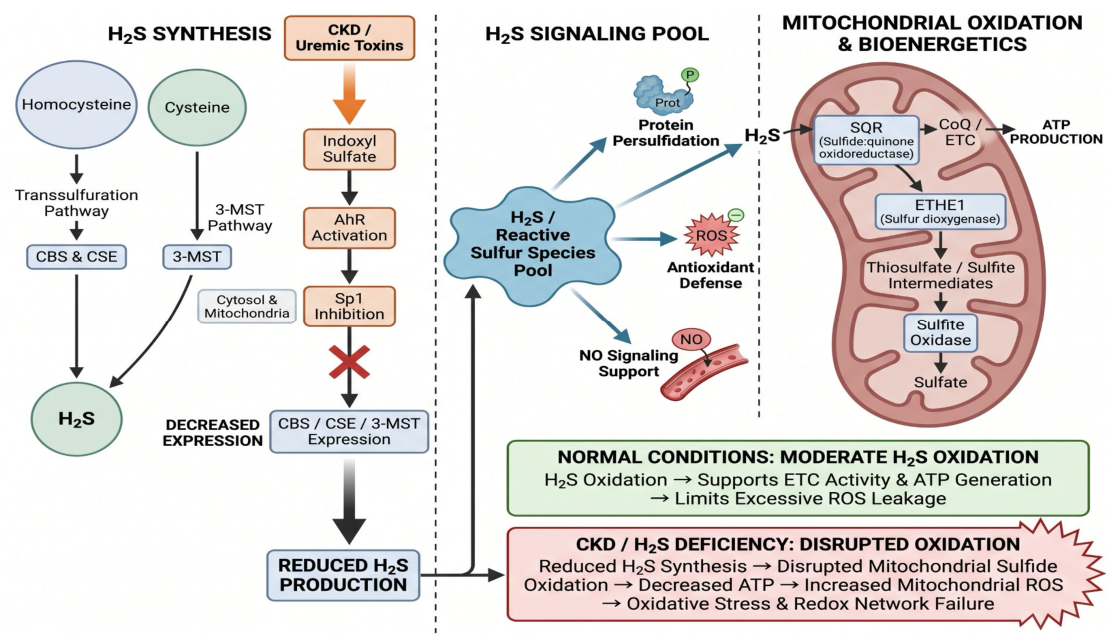
Figure 1 integrates the biosynthetic, signaling, and mitochondrial oxidation dimensions of renal H2S biology discussed in this section, and illustrates how uremic toxin-driven suppression of H2S production disrupts each of these functional axes in CKD.

3. H2S Deficiency in CKD: Clinical, Experimental, and Metabolic Evidence

3.1. Cellular and In Vitro Evidence

Cellular studies indicate that impaired H2S biosynthesis develops early in response to metabolic and uremic stress. In renal tubular cells, IS suppresses expression of CBS, CSE, and 3-MST and reduces endogenous H2S production through AhR-dependent inhibition of Sp1 transcriptional activity [9]. This effect is accompanied by increased superoxide generation, glutathione depletion, and tubular cell injury, whereas pharmacological AhR inhibition or supplementation with H2S donors partially restores antioxidant capacity and cell viability [9]. High-glucose conditions also impair H2S-generating pathways. In proximal tubular cells, hyperglycemia promotes ubiquitin–proteasome-mediated degradation of CBS, leading to reduced H2S production and increased oxidative stress [32]. Experimental studies further suggest that suppression of H2S signaling alters mitochondrial homeostasis and redox regulation. In human tubular cells and murine kidneys, IS induced mitochondrial fragmentation, impaired mitochondrial biogenesis, and disrupted cellular metabolic activity—changes associated with oxidative stress and tubular dysfunction [33]. Together, these findings support a direct mechanistic link between metabolic stress, uremic toxins, impaired H2S biosynthesis, and cellular redox imbalance in CKD.

3.2. Animal Evidence

Animal models consistently demonstrate reduced H2S production capacity in CKD and support impaired biosynthesis, rather than reduced clearance, as a major mechanism underlying H2S deficiency. In 5/6-nephrectomized rats, plasma H2S concentration, renal and hepatic H2S-producing capacity, and renal CBS, CSE, and 3-MST expression were markedly reduced, accompanied by increased oxidative stress and progressive renal functional deterioration [8]. AhR blockade in 5/6-nephrectomized rats restored Sp1 activity, increased renal CBS, CSE, and 3-MST expression, improved glutathione redox balance, and attenuated tubular injury and renal hypoperfusion [34]. The sulfur metabolic disturbance was not confined to the kidney: renal and hepatic H2S-producing enzymes were reduced, whereas brain expression was relatively preserved, supporting tissue-specific remodeling of sulfur metabolism during CKD [8].
In diabetic kidney disease models, renal H2S changes appear context-dependent. In db/db mice and glucose-exposed renal tubular cells, CBS expression and H2S production were reduced, and high glucose promoted ubiquitin–proteasome-mediated CBS degradation, linking hyperglycemia to impaired H2S biosynthesis and oxidative renal injury [32]. In an early diabetic kidney disease model, renal H2S levels were also reduced despite heterogeneous enzyme changes, including lower CBS, relatively preserved CSE, increased 3-MST, and altered sulfide oxidation pathways [35]. Functional studies support a protective role of H2S supplementation in renal injury models. In unilateral ureteral obstruction (UUO) kidneys, reduced H2S production occurred together with macrophage infiltration, nuclear factor kappa B (NF-κB) activation, NOD-like receptor family pyrin domain containing 3 (NLRP3) signaling, and fibrosis; NaHS attenuated inflammatory and fibrotic injury [36]. In LPS-induced acute kidney injury (AKI) and ischemia–reperfusion injury models, exogenous H2S suppressed oxidative stress, inflammatory cytokine production, NLRP3/caspase-1 activation, and tubular apoptosis [37,38].

3.3. Clinical and Metabolic Evidence

Clinical studies consistently demonstrate reduced circulating H2S levels across multiple CKD populations. In a cohort of 157 non-dialysis CKD patients, plasma H2S concentrations were approximately 48% lower than those of healthy controls (7.3 vs. 14.1 μmol/L) and showed a positive correlation with estimated glomerular filtration rate (eGFR) (ρ = 0.577), indicating progressive decline with worsening renal function [39]. In maintenance hemodialysis patients, plasma H2S and sulfhemoglobin levels were reduced, whereas homocysteine and cysteine concentrations were elevated, accompanied by downregulation of CSE expression in peripheral blood cells [40]. These findings indicate that disruption of sulfur-mediated redox regulation persists across advanced CKD and dialysis populations rather than being confined to early-stage disease.
Metabolic studies further demonstrate coordinated disruption of the transsulfuration pathway in CKD. Under physiological conditions, homocysteine is converted to cysteine through CBS- and CSE-mediated reactions that also generate H2S. A remnant kidney study showed marked downregulation of CBS, CSE, and 3-MST expression in renal tissue, together with reduced hepatic CBS and CSE expression, indicating systemic loss of H2S-producing capacity during CKD progression [8]. CKD is also associated with accumulation of sulfur metabolites linked to impaired transsulfuration. In hemodialysis patients, lanthionine and homolanthionine concentrations increased by up to two orders of magnitude in parallel with low plasma H2S and hyperhomocysteinemia [41]. Experimental studies further demonstrated that lanthionine interferes with CBS-dependent sulfur metabolism and disrupts transsulfuration pathway activity, suggesting a potential feed-forward mechanism contributing to persistent H2S deficiency in uremia [42]. Together, these findings indicate that CKD is accompanied by coordinated disruption of sulfur amino acid metabolism extending beyond a single H2S-producing pathway.

3.4. Conceptual Integration: H2S-Deficient, Toxin-Driven Redox State

Clinical, experimental, and metabolic evidence collectively support the concept that CKD represents an H2S-deficient state. Reduced circulating H2S levels, downregulation of CBS, CSE, and 3-MST, and impaired transsulfuration collectively indicate coordinated disruption of H2S homeostasis rather than an isolated biochemical abnormality [34,39]. These abnormalities are observed across renal tubular cells, animal CKD models, and dialysis populations, suggesting that impaired sulfur-mediated redox regulation develops throughout CKD progression.
Uremic toxins, particularly IS, appear to play a central role in this process by suppressing H2S biosynthesis through AhR-dependent inhibition of Sp1 activity [9]. Reduced H2S availability is accompanied by oxidative stress, inflammatory signaling, mitochondrial dysfunction, and tubular injury, whereas restoration of H2S-producing pathways or H2S supplementation partially improves these abnormalities [9,34]. It should be noted, however, that whether H2S deficiency functions as a primary upstream driver or primarily as a downstream marker of broader uremic and oxidative stress remains to be directly established. Most supporting evidence is derived from experimental models, and direct causal evidence in human CKD tissues is limited. The proposed relationship between H2S deficiency and coordinated redox dysregulation should therefore be interpreted as a mechanistically supported framework rather than an established causal conclusion.
Beyond this causal uncertainty, the pathological significance of H2S deficiency may not be uniform across all CKD contexts. H2S exerts concentration-dependent biphasic effects on mitochondrial function: while low-to-moderate concentrations support oxidative phosphorylation and confer cytoprotection, excessive sulfide inhibits cytochrome c oxidase and promotes oxidative injury, as demonstrated in studies using mitochondria-targeted H2S donors [43]. This biphasic profile implies that the consequences of H2S depletion depend in part on the prevailing mitochondrial and metabolic state. Furthermore, H2S system responses are not uniformly suppressive across CKD subtypes or stages. In early diabetic kidney disease models, 3-MST expression was paradoxically increased despite overall reductions in renal H2S levels, suggesting stage- and context-specific remodeling of sulfur metabolism rather than a simple linear decline [35]. In the physiologically hypoxic renal medulla, H2S functions as an oxygen-sensitive signaling molecule, and context-dependent regulation of its synthesis may carry adaptive significance under conditions of altered oxygen tension [18]. Whether such responses represent transient compensatory adjustments or contribute to sustained redox dysregulation remains to be determined. Taken together, while existing evidence predominantly supports H2S deficiency as a pathological rather than compensatory phenomenon in established CKD, its functional significance should be interpreted in light of disease stage, oxygen tension, mitochondrial status, and sulfur substrate availability. These considerations reinforce the need for stage-specific and mechanistically informed approaches when evaluating H2S as a therapeutic target in CKD.
A further dimension of complexity is that CKD is not a homogeneous condition, and the pattern of sulfur metabolic disruption varies across disease stages, etiologies, and treatment modalities. In non-dialysis CKD, plasma H2S declines progressively with eGFR and correlates positively with residual renal function, while IS accumulates in a reciprocal fashion from stage III onward, suggesting that biosynthetic suppression and toxin-driven enzyme inhibition intensify in parallel as renal function deteriorates [39,44]. In diabetic kidney disease, the mechanism of H2S depletion differs from that in non-diabetic CKD: hyperglycemia promotes ubiquitin–proteasome-mediated CBS degradation and increases renal SQR expression, indicating that oxidative clearance as well as biosynthetic suppression contributes to H2S deficiency in this context [35]. In maintenance hemodialysis populations, IS and p-cresyl sulfate (pCS) reach their highest circulating concentrations, yet high-volume hemodiafiltration achieves only modest and transient reductions in pre-dialysis IS levels, reflecting the dominant contribution of ongoing gut production and protein binding to toxin burden rather than dialytic clearance alone [44,45]. Across modalities, kidney transplantation normalizes IS concentrations toward control levels, whereas peritoneal dialysis and hemodialysis leave them substantially elevated [46]. These stage- and modality-specific differences suggest that the relative contributions of impaired biosynthesis, toxin-driven enzyme suppression, and altered sulfide oxidation to sulfur metabolic disruption may vary across the CKD continuum, with implications for the timing and targeting of H2S-based therapeutic strategies. These abnormalities establish the mechanistic context for the uremic toxin-driven suppression of H2S biosynthesis examined in the following section.

4. Uremic Toxin-Driven Suppression of H2S in CKD

4.1. Uremic Toxin Accumulation and Sustained AhR Activation

CKD is characterized by progressive accumulation of uremic toxins due to impaired renal clearance and altered tubular secretion. Protein-bound uremic toxins are of particular relevance because they are poorly removed by conventional dialysis. IS is one of the most extensively studied toxins and is strongly associated with renal and cardiovascular injury, with circulating levels increasing markedly as renal function declines [47,48]. In advanced CKD and ESRD, plasma IS concentrations can rise up to ~100-fold compared with those in individuals with normal renal function, reflecting both reduced excretion and ongoing production [49,50]. Its high protein-binding capacity (>90% bound to albumin) further limits dialytic removal and promotes systemic retention [51].
IS is generated through the gut–liver–kidney axis. Dietary tryptophan is metabolized by intestinal microbiota into indole, which is subsequently converted to IS in the liver before entering the circulation [51]. Under physiological conditions, IS is actively secreted by proximal tubular cells via organic anion transporters, whereas in CKD, reduced tubular function and transporter activity lead to progressive accumulation in the circulation and tissues [52]. Beyond its retention, IS induces oxidative stress, inflammatory signaling, mitochondrial dysfunction, and fibrosis, thereby contributing to CKD progression [53,54].
IS also functions as an endogenous ligand of the AhR, linking toxin accumulation to transcriptional reprogramming. Upon activation, AhR translocates to the nucleus, heterodimerizes with the aryl hydrocarbon receptor nuclear translocator (ARNT), and regulates target genes such as cytochrome P450 family 1 subfamily A member 1 (CYP1A1) and aryl hydrocarbon receptor repressor (AHRR) [55,56]. In addition to canonical detoxification pathways, AhR interacts with signaling networks including NF-κB, activator protein 1 (AP-1), and mitogen-activated protein kinase (MAPK) cascades, extending its role to inflammation, oxidative stress, and cellular stress responses [57,58]. Sustained toxin exposure results in persistent AhR activation across renal, vascular, and immune compartments, establishing a chronic signaling state that promotes oxidative stress and inflammation [56,58].
While IS is the most extensively studied uremic toxin in the context of H2S suppression, CKD is characterized by simultaneous accumulation of multiple AhR-activating toxins that may collectively amplify redox network disruption beyond what IS alone produces. Indole-3-acetic acid (IAA), another tryptophan-derived gut microbial metabolite, activates AhR through p38 MAPK and NF-κB-dependent pathways in endothelial cells, induces COX-2-mediated oxidative stress, and independently predicts cardiovascular mortality in CKD populations [59]. Kynurenine-pathway metabolites generated through host tryptophan catabolism similarly activate AhR and suppress Wnt/β-catenin signaling, contributing to impaired angiogenesis and CKD progression through mechanisms that converge with IS-driven AhR activation [60]. pCS, derived from gut microbial tyrosine metabolism, promotes renal tubular oxidative stress and fibrosis through ROS-dependent pathways and epigenetic suppression of Klotho, and among protein-bound toxins shows the strongest independent association with cardiovascular events after mutual adjustment with IS [61]. These toxins accumulate in parallel as eGFR declines and share the capacity to activate AhR, generate endothelial ROS, and suppress antioxidant defenses, suggesting that the net burden of AhR-driven H2S suppression and redox network disruption in CKD reflects a multi-toxin network effect rather than the action of IS in isolation.

4.2. The IS–AhR–Sp1 Axis: A Mechanistic Link to H2S Deficiency

Sp1 is a key transcription factor that maintains basal expression of H2S-producing enzymes. It binds GC-rich promoter regions of CBS and CSE and supports transcriptional activity in renal tubular and endothelial cells [62,63,64]. Loss of Sp1 activity reduces expression of these enzymes and limits H2S production [65].
In CKD, IS-driven activation of AhR disrupts this transcriptional program by suppressing Sp1-dependent gene expression. In LLC-PK1 proximal tubular cells, exposure to IS markedly reduced endogenous H2S release, accompanied by downregulation of CBS, CSE, and 3-MST at both the mRNA and protein levels [9]. Functional inhibition of endogenous H2S synthesis using aminooxyacetic acid further aggravated IS-induced tubular injury, whereas supplementation with H2S donors including NaHS and GYY4137 attenuated lactate dehydrogenase release and improved cell viability, supporting a protective role of endogenous H2S against uremic toxin-mediated tubular damage. Mechanistically, IS significantly reduced Sp1 DNA-binding activity without substantially altering total Sp1 protein expression, indicating functional impairment of Sp1-dependent transcription rather than transcription factor depletion [9]. Importantly, pharmacological blockade of AhR with CH-223191 restored Sp1 activity and rescued expression of H2S-producing enzymes, identifying AhR-dependent suppression of Sp1 as a direct upstream mechanism linking IS exposure to impaired H2S biosynthesis [9]. IS-mediated suppression of H2S formation was also associated with increased superoxide production and depletion of intracellular glutathione, whereas exogenous H2S supplementation partially restored antioxidant capacity and attenuated tubular oxidative injury [9].
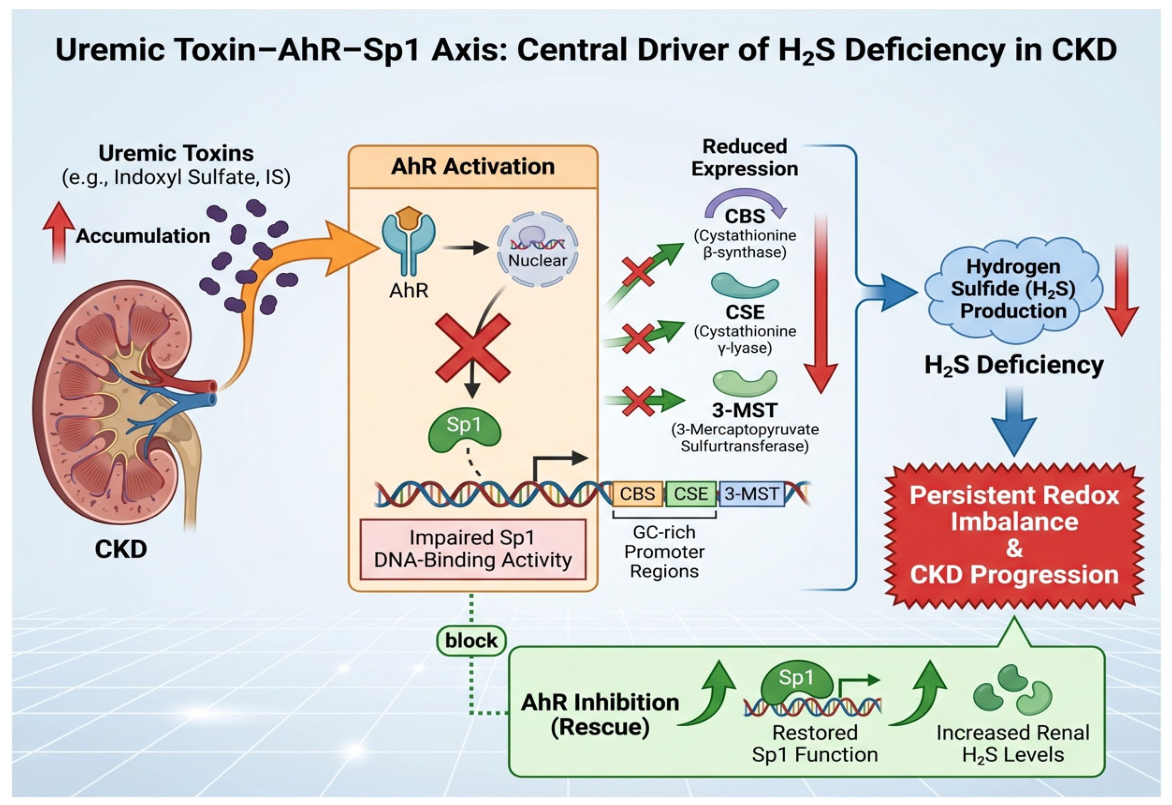
Similar findings were observed in vivo in 5/6-nephrectomized rats, where CKD was associated with accumulation of IS and homocysteine, reduced renal H2S levels, and marked downregulation of CBS, CSE, and 3-MST expression in remnant kidneys [34]. These changes were accompanied by reduced Sp1 protein expression and DNA-binding activity, increased superoxide generation, glutathione depletion, impaired renal perfusion, and tubular injury [34]. Chronic AhR inhibition with CH-223191 restored Sp1 activity, increased expression of H2S-producing enzymes, normalized renal H2S levels, improved glutathione redox balance, and partially reversed renal functional impairment and cortical microvascular hypoperfusion [34]. Notably, AhR blockade also reduced homocysteine accumulation, suggesting that suppression of the transsulfuration pathway contributes to the H2S-deficient phenotype observed in CKD [34]. Collectively, these findings support a mechanistic model in which IS-driven AhR activation contributes to suppression of Sp1-dependent H2S biosynthesis and disruption of sulfur-mediated redox regulation in CKD. Figure 2 illustrates AhR activation, Sp1 inhibition, and reduced transcription of H2S-producing enzymes.
Beyond the kidney, IS–AhR signaling mediates redox dysregulation through mechanisms that are largely independent of Sp1-dependent H2S suppression. In vascular endothelial cells, IS activates AhR and induces downstream CYP1A1- and NADPH oxidase (NOX)-related pathways, leading to increased ROS production, nitrotyrosine formation, reduced endothelial nitric oxide synthase (eNOS) expression, and decreased NO bioavailability [47,66]. In rat aortic rings, IS exposure impaired endothelium-dependent vasorelaxation, whereas AhR inhibition partially restored endothelial responsiveness and reduced oxidative stress signaling [66]. These alterations promote endothelial dysfunction and impair vascular homeostasis in CKD.
In cardiac tissue, IS-induced AhR activation similarly promotes oxidative stress through CYP1-mediated pathways, leading to increased ROS production and cardiomyocyte hypertrophy [67]. Experimental studies further demonstrate associated mitochondrial dysfunction and redox imbalance in uremic cardiomyopathy models [67]. Together, these findings suggest that persistent AhR activation functions as a broad cross-tissue regulator of oxidative stress signaling in CKD.
Collectively, the IS–AhR pathway appears to function as an important upstream regulator of redox dysregulation in CKD. In renal tubular cells, this effect is mediated primarily through Sp1-dependent suppression of H2S biosynthesis, whereas in vascular and cardiac tissues, AhR signaling promotes oxidative stress through CYP1- and NOX-dependent mechanisms that extend beyond the canonical IS–AhR–Sp1–H2S axis (Table 1).
Table 1. Tissue-specific effects of indoxyl sulfate (IS)–aryl hydrocarbon receptor (AhR) signaling on redox dysregulation and organ injury in CKD.
Biological ContextMechanistic AxisImpact on H2S Homeostasis and Redox SignalingPathophysiological ConsequenceReferences
Renal tubular cellsIS activates AhR, suppressing Sp1-dependent transcription of CBS, CSE, and 3-MSTDecreased H2S bioavailability; glutathione depletion; increased oxidative stressTubular injury and progression of tubulointerstitial fibrosis[9]
Animal models (5/6-nephrectomy)AhR activation impairs transsulfuration pathway flux and reduces Sp1 DNA-binding activityReduced renal H2S levels; disrupted sulfide oxidation and redox signalingProgressive renal dysfunction and imbalance of mitochondrial redox regulation[34]
Vascular endotheliumIS-induced AhR activation upregulates CYP1A1 and NOX, promoting endothelial oxidative stressReduced NO bioavailability; eNOS uncoupling; disrupted endothelial redox balanceEndothelial dysfunction, vascular injury, and impaired vasorelaxation[47,66]
CardiomyocytesIS–AhR signaling activates CYP1-mediated ROS generation and mitochondrial oxidative pathwaysOxidative stress amplification; impaired mitochondrial bioenergeticsCardiac hypertrophy and uremic cardiomyopathy[67]
Abbreviations: IS, indoxyl sulfate; AhR, aryl hydrocarbon receptor; Sp1, specificity protein 1; H2S, hydrogen sulfide; CBS, cystathionine β-synthase; CSE, cystathionine γ-lyase; 3-MST, 3-mercaptopyruvate sulfurtransferase; CYP1A1, cytochrome P450 1A1; NOX, NADPH oxidase; ROS, reactive oxygen species; NO, nitric oxide; eNOS, endothelial nitric oxide synthase.

4.3. Integration with Inflammatory and Metabolic Stress Pathways

The IS–AhR–Sp1 axis does not function in isolation but interacts closely with inflammatory and metabolic stress pathways that are persistently activated in CKD. Experimental studies have shown that reduced H2S availability amplifies inflammatory signaling through NF-κB- and NLRP3-dependent mechanisms. In UUO kidneys, reduced endogenous H2S production was accompanied by increased NF-κB activation, enhanced NLRP3 inflammasome signaling, and marked M1/M2 macrophage infiltration, together with progressive renal fibrosis [36]. Administration of NaHS suppressed NF-κB and NLRP3 activation, reduced macrophage accumulation, and attenuated tubulointerstitial injury and fibrosis [36]. Similar findings were observed in lipopolysaccharide-induced AKI, where loss of endogenous H2S and reduced 3-MST expression occurred together with increased Toll-like receptor 4 (TLR4), NLRP3, caspase-1, IL-1β, and tumor necrosis factor-alpha (TNF-α) expression, while NaHS treatment improved renal injury and suppressed inflammatory signaling [37]. In renal ischemia–reperfusion models, exogenous H2S also reduced NLRP3/apoptosis-associated speck-like protein containing a CARD (ASC)/caspase-1 activation and limited cytokine release and tubular apoptosis through Nrf2-dependent mechanisms [38,68]. These studies indicate that impaired H2S signaling not only weakens antioxidant defense but also facilitates inflammasome priming and sustained cytokine activation during renal injury.
Inflammatory stress further intersects with metabolic dysregulation and uremic toxin signaling in CKD. Hyperhomocysteinemia and impaired transsulfuration flux reduce substrate availability for H2S synthesis, whereas hyperglycemia and oxidative stress suppress CBS and CSE expression. In parallel, IS activates AhR-dependent inflammatory pathways in macrophages and endothelial cells. In THP-1-derived macrophages, IS increased pro-IL-1β transcription together with activation of AhR, NF-κB p65, and MAPK signaling cascades, although full NLRP3 inflammasome activation was not observed [69]. In vascular endothelial cells, AhR activation mediated IS-induced leukocyte adhesion and E-selectin expression through AP-1-dependent transcriptional signaling [70]. Experimental studies also showed that H2S donors suppress monocyte chemoattractant protein-1 (MCP-1), TNF-α, IL-1β, and IL-6 production through inhibition of NF-κB signaling in macrophages and chronic renal injury models [28,71].
These inflammatory interactions acquire deeper mechanistic significance when considered within an immunometabolic framework. Macrophage polarization is tightly coupled to cellular redox and metabolic state: M1 activation is supported by glycolytic reprogramming and mitochondrial ROS generation through the ROS–ataxia telangiectasia mutated kinase (ATM)–checkpoint kinase 2 (Chk2)–pyruvate kinase M2 (PKM2) axis, whereas M2 polarization depends on oxidative phosphorylation and fatty acid oxidation [72]. H2S directly modulates this balance—in myocardial infarction models, NaHS promotes M2 polarization by enhancing mitochondrial biogenesis and fatty acid oxidation, reducing inflammatory remodeling [73]. At the molecular level, widespread protein persulfidation in activated macrophages inhibits NLRP3 inflammasome assembly and protects against oxidative-inflammatory cell death, suggesting that H2S deficiency in CKD may lower the threshold for inflammasome activation by reducing this endogenous persulfidation-dependent brake [74]. In the uremic context, IS drives macrophages toward chronic M1-like states at high concentrations through AhR–NOX–ROS pathways, while at moderate CKD-stage concentrations it may instead promote mixed profibrotic M2-like phenotypes with concurrent pro-inflammatory cytokine secretion—a pattern consistent with the immune reprogramming observed in CKD-associated inflammaging [75]. Collectively, these findings suggest that H2S deficiency and IS accumulation cooperatively dysregulate macrophage immunometabolism in CKD, shifting innate immune cells toward self-sustaining inflammatory states that extend the impact of redox network failure beyond tubular and vascular compartments.

4.4. Gut Microbiota and Dysbiosis-Driven Modulation of Sulfur Metabolism in CKD

The gut microbiota represents an important but underappreciated contributor to systemic sulfur homeostasis. Intestinal H2S is generated through two principal microbial routes: dissimilatory sulfate reduction by sulfate-reducing bacteria such as Desulfovibrio, and cysteine-based amino acid degradation pathways that are now recognized as quantitatively more important and phylogenetically widespread across the gut microbiome [76,77]. The capacity for cysteine-derived H2S production is present in essentially all individuals and exceeds that of classical sulfate reduction under physiological dietary conditions [77].
In CKD, this microbiota-dependent sulfur network intersects with uremic toxin biology in mechanistically relevant ways. In a murine CKD model, a high sulfur amino acid diet enhanced microbial protein S-sulfhydration, suppressed bacterial tryptophanase activity, reduced IS production, and attenuated CKD progression—demonstrating that dietary sulfur intake can modulate the gut–liver–kidney toxin axis through post-translational modification of microbial enzymes [78]. Conversely, gut microbiota also reinforce host antioxidant capacity through generation of RSS that support epithelial redox defense [79]. In human CKD, however, circulating H2S is reduced and lanthionine elevated despite the presence of sulfidogenic taxa, suggesting that systemic sulfur metabolite changes in CKD reflect host metabolic dysfunction rather than increased microbial H2S overproduction [80]. Collectively, these findings indicate that CKD-associated dysbiosis may disrupt the normal balance between microbiota-derived sulfur species and host sulfur metabolism, contributing to systemic RSS depletion through mechanisms that extend beyond impaired endogenous biosynthesis.

5. H2S in Redox Network Integration

5.1. ROS–NO–H2S Interactions

H2S participates in vascular redox regulation primarily through interactions with NO and ROS signaling rather than direct free radical scavenging. In endothelial cells, H2S increases NO bioavailability by enhancing eNOS activity through multiple mechanisms, including Akt-dependent phosphorylation, stabilization of eNOS dimers, and protein persulfidation [81]. In endothelial-specific experiments, H2S-induced vasorelaxation and angiogenesis were markedly attenuated in eNOS-deficient mice, indicating functional dependence of H2S signaling on intact NO pathways [82]. H2S also promotes eNOS protein stability through microRNA-455-3p-dependent regulation, resulting in sustained NO production and improved endothelial signaling under oxidative stress conditions [83]. In parallel, chemical interactions between H2S and NO generate intermediates such as thionitrous acid and nitrosopersulfide, which function as reactive sulfur–nitrogen signaling species capable of modulating NO-responsive soluble guanylate cyclase signaling [84]. These findings support the concept that H2S and NO function as interdependent signaling systems within vascular redox regulation.
Excess ROS disrupts this coordinated signaling network. Increased oxidative stress promotes eNOS uncoupling, reduces NO bioavailability, and shifts endothelial signaling toward vasoconstrictive and proinflammatory states. Experimental studies further show that reduced H2S availability is accompanied by glutathione depletion, increased superoxide generation, and impaired endothelial relaxation in CKD-related and hyperglycemic models [9,85]. In hyperglycemic vascular tissue, the H2S donor AP123 restored eNOS phosphorylation, improved endothelium-dependent vasorelaxation, and reduced oxidative stress markers through cAMP response element-binding protein (CREB)-dependent signaling pathways [85]. These observations indicate that ROS, NO, and H2S operate as interconnected signaling systems that collectively regulate endothelial homeostasis and vascular redox balance.

5.2. Protein Persulfidation and Redox Signaling

Protein persulfidation is a major downstream mechanism through which H2S regulates redox-sensitive signaling pathways. This reversible post-translational modification converts reactive cysteine thiols into persulfides and alters protein activity, protein–protein interactions, and susceptibility to oxidative injury. Experimental studies indicate that persulfidation preferentially targets oxidized cysteine residues and may protect proteins from irreversible overoxidation during oxidative stress [86]. One of the best-characterized targets is Kelch-like ECH-associated protein 1 (Keap1), a suppressor of Nrf2 signaling. In experimental injury models, H2S-induced Keap1 persulfidation disrupted the Keap1–Nrf2 interaction and promoted Nrf2-dependent antioxidant gene transcription, thereby increasing cellular resistance to oxidative stress [86]. These findings support persulfidation as a direct molecular link between H2S signaling and endogenous antioxidant defense systems.
Persulfidation also regulates proteins involved in endothelial signaling, mitochondrial metabolism, and cellular stress adaptation. In endothelial cells, H2S induces persulfidation of eNOS at Cys443 and enhances Akt-dependent eNOS activation, leading to increased NO production and improved vasodilatory signaling [81]. Experimental studies further demonstrate that H2S-mediated persulfidation modulates mitochondrial and metabolic pathways. ATP synthase persulfidation increases mitochondrial respiratory activity under low-concentration H2S exposure, whereas glyceraldehyde-3-phosphate dehydrogenase (GAPDH) persulfidation alters glycolytic signaling and redirects cellular metabolism toward antioxidant NADPH-generating pathways [11]. Persulfidation-dependent regulation of autophagy and stress-response pathways has also been reported in multiple experimental systems [87]. Reduced H2S availability during CKD progression may therefore impair several persulfidation-dependent pathways involved in antioxidant defense, endothelial homeostasis, mitochondrial bioenergetics, and metabolic adaptation.
An emerging and mechanistically significant extension of persulfidation biology concerns epigenetic regulatory proteins. H2S inhibits histone deacetylase (HDAC) activity through persulfidation of reactive cysteine residues within the HDAC catalytic domain, shifting chromatin toward a more acetylated, transcriptionally permissive state—an effect demonstrated in experimental neurodegeneration models and potentially relevant to renal gene regulation [88,89]. This HDAC-suppressive mechanism intersects with the AhR signaling axis in CKD: AhR recruits coactivator complexes that alter local histone acetylation and methylation at target gene promoters, and HDAC inhibition can in turn suppress AhR expression, suggesting a reciprocal chromatin-level feedback between uremic toxin signaling and sulfur-mediated epigenetic control [90]. A directly CKD-relevant example is provided by renal ischemia–reperfusion injury, in which CSE promoter hypermethylation reduces CSE expression and H2S bioavailability; pharmacological demethylation of the CSE promoter restores H2S production and attenuates oxidative renal injury, demonstrating that epigenetic silencing of H2S-producing enzymes is a functionally significant mechanism of H2S deficiency beyond transcriptional suppression via the IS–AhR–Sp1 axis [91]. Collectively, these findings suggest that H2S deficiency in CKD may be self-reinforcing at the epigenetic level: reduced persulfidation capacity permits HDAC overactivation and promoter hypermethylation, further suppressing CBS and CSE expression and perpetuating sulfur metabolic disruption through chromatin-level mechanisms.

5.3. RSS Signaling Network: Polysulfides, Persulfides, and Thiosulfate as Bioactive Mediators

Although H2S is the most studied RSS, its downstream oxidation products—cysteine persulfides (CysSSH), GSSH, and polysulfides—may represent the principal bioactive mediators of sulfur-dependent redox signaling. These species are generated via SQR-dependent H2S oxidation and are present at concentrations exceeding 100 μM in mammalian cells, exhibiting greater nucleophilicity and reducing capacity than their thiol counterparts [92,93]. Polysulfides can directly transfer sulfane sulfur to reactive cysteine residues, and many effects previously attributed to H2S are now understood to be mediated by these more oxidized intermediates [94]. Key downstream targets include Keap1, whose persulfidation disrupts Nrf2 suppression and activates antioxidant gene transcription, and metabolic enzymes such as GAPDH and ATP synthase, whose persulfidation redirects metabolism toward NADPH generation and supports mitochondrial bioenergetics [93,95]. In CKD, coordinated depletion across these interconnected RSS pools—including the bound sulfane sulfur reservoir and thiosulfate as a terminal sulfur oxidation product—may impair redox buffering capacity beyond what H2S measurement alone reflects, underscoring the need to consider the broader RSS network when interpreting sulfur-mediated redox dysregulation in this disease.

5.4. Mitochondrial Integration and Network-Level Redox Control

H2S links mitochondrial respiration with redox regulation in a concentration-dependent manner. At physiological concentrations, H2S functions as an electron donor to the electron transport chain through SQR, supporting oxidative phosphorylation and ATP generation. In endothelial cells, GYY4137-derived H2S increased mitochondrial oxygen consumption and transferred electrons into the electron transport chain through SQR-dependent mechanisms, whereas pharmacological SQR inhibition abolished these effects [96]. Experimental studies further demonstrated that intramitochondrial H2S production by 3-MST maintained electron transport and cellular bioenergetics under basal conditions [6]. Low concentrations of mitochondria-targeted H2S donors also increased ATP production, preserved mitochondrial membrane potential, and reduced oxidative injury in stressed endothelial cells [97]. These findings indicate that physiological H2S supports mitochondrial respiration while limiting excessive ROS accumulation during electron transport.
At higher concentrations, H2S exerts opposite effects on mitochondrial function. Excess H2S inhibits cytochrome c oxidase (Complex IV), disrupts oxidative phosphorylation, and promotes ROS generation and metabolic stress [98]. In colon cells, high H2S exposure impaired mitochondrial bioenergetics, increased reverse electron transport, altered NAD+/NADH and CoQ/CoQH2 balance, and induced broader metabolic reprogramming through SQR-dependent pathways [99]. Experimental studies further showed that SQR-dependent H2S oxidation regulates mitochondrial redox balance by coupling sulfide metabolism to electron transport and mitochondrial redox cycling pathways [99].

6. Redox Triad Failure in CKD: A Network Model of Disease Progression

6.1. Conceptual Framework: Loss of Coordinated Redox Regulation

In CKD, redox imbalance reflects disruption of interconnected signaling systems rather than isolated excess of ROS. ROS, NO, and sulfur-based redox pathways are concurrently altered, and impaired crosstalk among these systems disrupts cellular signaling, mitochondrial function, vascular tone, and metabolic regulation [2,100,101]. Physiological levels of ROS and NO are required for normal signaling, and both deficiency and excess are detrimental, underscoring the importance of coordinated redox regulation rather than global suppression [102].
Redox triad failure therefore denotes loss of coordinated regulation among ROS, NO, and reactive sulfur systems [24,101]. From a systems-biology perspective, these three axes do not operate as parallel but independent pathways; rather, they form a coupled regulatory network governed by mutual feedback interactions. Under physiological conditions, H2S enhances NO bioavailability through eNOS activation and protein persulfidation, while NO and H2S together limit ROS accumulation via Nrf2-dependent antioxidant gene transcription [5,81,101]. This network maintains redox homeostasis through dynamic, reciprocal regulation rather than simple additive effects.
In CKD, this coupled network is destabilized by feed-forward amplification. Uremic toxin-driven AhR activation suppresses H2S biosynthesis, which in turn reduces glutathione availability and Nrf2 activity, permitting further ROS accumulation [9,34]. Excess ROS promotes eNOS uncoupling, shifting NO synthase from NO generation toward superoxide production and further depleting NO bioavailability [102]. Reduced NO signaling impairs the cooperative H2S–NO axis, diminishing the capacity for persulfidation-dependent Nrf2 activation and amplifying oxidative injury [81,101]. These interactions constitute a self-reinforcing cycle in which loss of any single axis propagates dysfunction across the network, a property consistent with the positive feedback architecture described in redox systems-biology models.
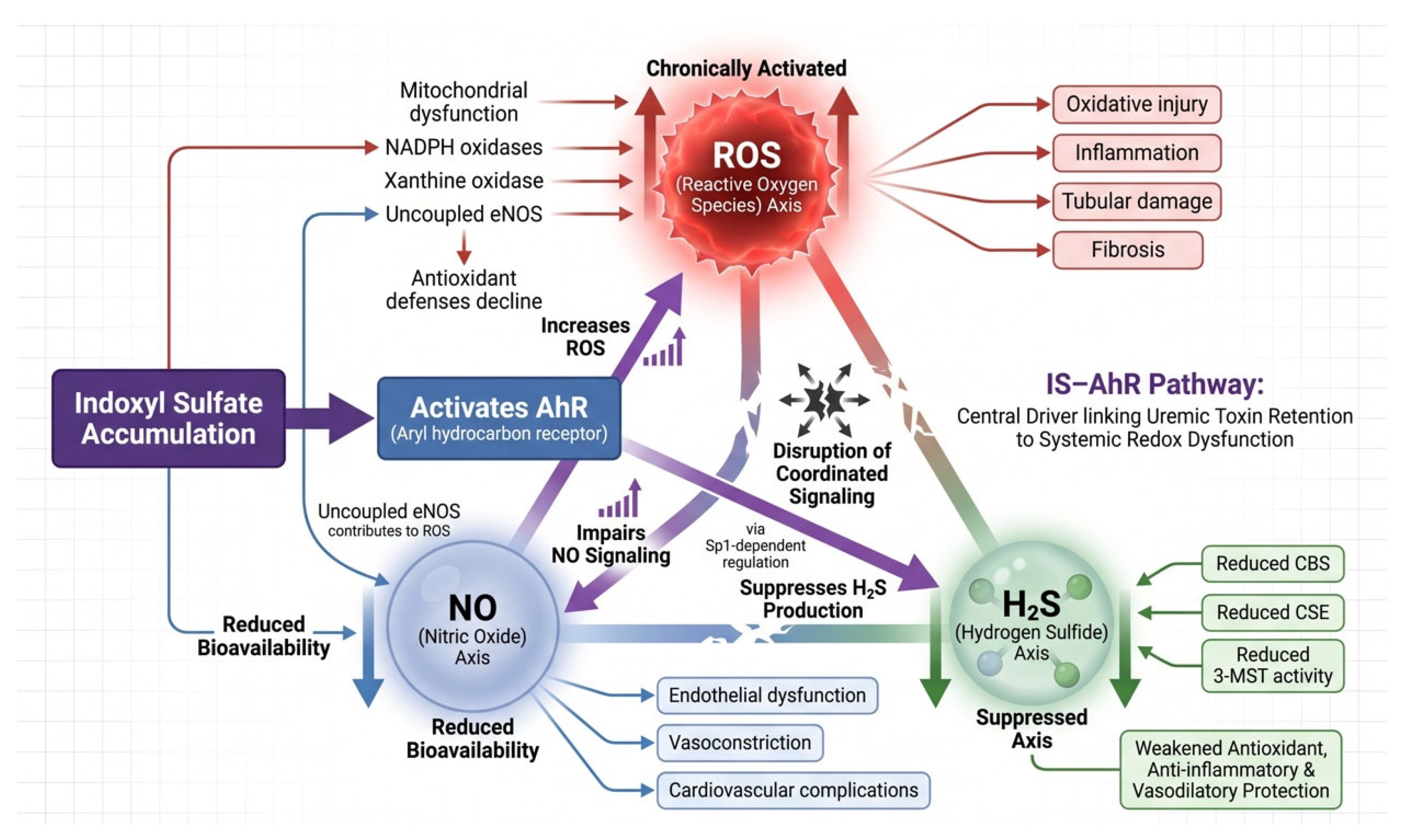
A critical feature of such coupled networks is the existence of threshold behavior. Under conditions of moderate oxidative stress, Nrf2-dependent compensatory responses can maintain redox balance within an adaptive range. However, experimental and clinical evidence indicates that Nrf2 activity is progressively suppressed in advanced CKD, associated with Keap1 upregulation and sustained NF-κB activation, suggesting that the compensatory capacity of the antioxidant network diminishes as disease progresses [103]. Computational modeling of redox networks further demonstrates that mutual inhibition between glutathione and ROS can generate bistability, in which the system transitions from a low-ROS adaptive state to a high-ROS self-sustaining state once a critical threshold is crossed [104]. In the context of CKD, progressive H2S depletion, eNOS uncoupling, and Nrf2 repression may collectively represent the molecular basis for such a tipping point—a transition beyond which redox dysregulation becomes self-perpetuating and less amenable to single-target interventions. Figure 3 illustrates the coordinated disruption of ROS activation, NO impairment, and H2S suppression within this network.

6.2. Coordinated Dysregulation of ROS, NO, and H2S Axes

Persistent activation of the ROS axis is a central feature of CKD and is driven by multiple enzymatic and mitochondrial sources. Experimental studies have shown that mitochondrial dysfunction and NOX activation markedly increase ROS production in renal tubular and vascular cells, leading to oxidative injury and fibrotic remodeling. In diabetic kidney disease models, NOX4 overexpression increased mitochondrial ROS generation, DNA damage, and tubulointerstitial fibrosis, whereas genetic or pharmacological NOX inhibition attenuated oxidative injury and renal fibrosis [105]. In remnant kidney models, impaired antioxidant defense was accompanied by reduced Nrf2 activity and depletion of endogenous antioxidant systems, contributing to sustained oxidative stress and progressive renal injury [8]. Experimental CKD studies further demonstrated increased lipid peroxidation, protein oxidation, and inflammatory activation together with mitochondrial structural abnormalities, indicating that excessive ROS production extends beyond isolated oxidant accumulation and disrupts broader cellular signaling networks [106].
The NO axis is concurrently impaired through reduced NO bioavailability and endothelial dysfunction. In experimental endothelial models, IS reduced eNOS expression, increased superoxide generation, and impaired endothelium-dependent vasorelaxation, together with increased NOX4 expression and nitrotyrosine formation [47]. Subsequent studies further suggested that AhR activation contributes to IS-mediated endothelial oxidative stress and vascular dysfunction [70,107]. Oxidative stress additionally promotes eNOS uncoupling, shifting eNOS from NO generation toward superoxide production and amplifying vascular oxidative stress. In isolated vascular tissue, IS exposure increased nitrotyrosine formation and markedly reduced acetylcholine-mediated endothelial relaxation, indicating direct disruption of NO-dependent vascular signaling [47]. Similar abnormalities have been observed in CKD and hyperhomocysteinemia models, where impaired eNOS activity was accompanied by endothelial dysfunction, vascular stiffness, and reduced renovascular relaxation [108]. These findings support a mechanistic link between oxidative stress, impaired NO signaling, and progressive vascular injury in CKD.
The sulfur axis, represented by H2S, is also diminished during CKD progression. In 5/6-nephrectomized rats, plasma H2S levels, together with renal and hepatic H2S-producing capacity, were markedly reduced, accompanied by downregulation of CBS, CSE, and 3-MST expression [8]. Experimental studies further showed that IS suppresses H2S biosynthesis through AhR-dependent inhibition of Sp1 activity, resulting in glutathione depletion, increased superoxide generation, and tubular injury [9]. Importantly, mitochondrial dysfunction and NOX-dependent ROS generation can sustain oxidative injury and renal fibrosis independently of H2S status, as demonstrated in NOX4 overexpression and fatty acid oxidation-deficient models [105,109]. H2S deficiency may therefore amplify rather than initiate redox dysregulation, and the relative contribution of each axis is likely to vary across CKD etiology, disease stage, and tissue compartment.

6.3. Network Amplification: The IS–AhR Axis as an Upstream Driver

Redox triad failure in CKD is sustained by feed-forward interactions within this network. As renal function declines, IS accumulates and activates the AhR, positioning uremic toxins as upstream drivers of redox disruption [55]. AhR activation enhances ROS generation and inflammatory signaling, reinforcing oxidative stress and tissue injury [58].
The IS–AhR axis directly suppresses the sulfur pathway by downregulating CBS, CSE, and 3-MST through inhibition of Sp1 activity, leading to reduced H2S production [9]. At the same time, AhR signaling promotes ROS generation and impairs NO signaling, thereby destabilizing all three components of the redox system [47,56]. Beyond the kidney, IS–AhR signaling reduces NO bioavailability and promotes endothelial dysfunction in vascular tissue, whereas in cardiac tissue it contributes to hypertrophy and uremic cardiomyopathy [56]. The IS–AhR axis therefore functions as a central network amplifier that translates uremic toxin accumulation into systemic redox failure and multiorgan injury in CKD.
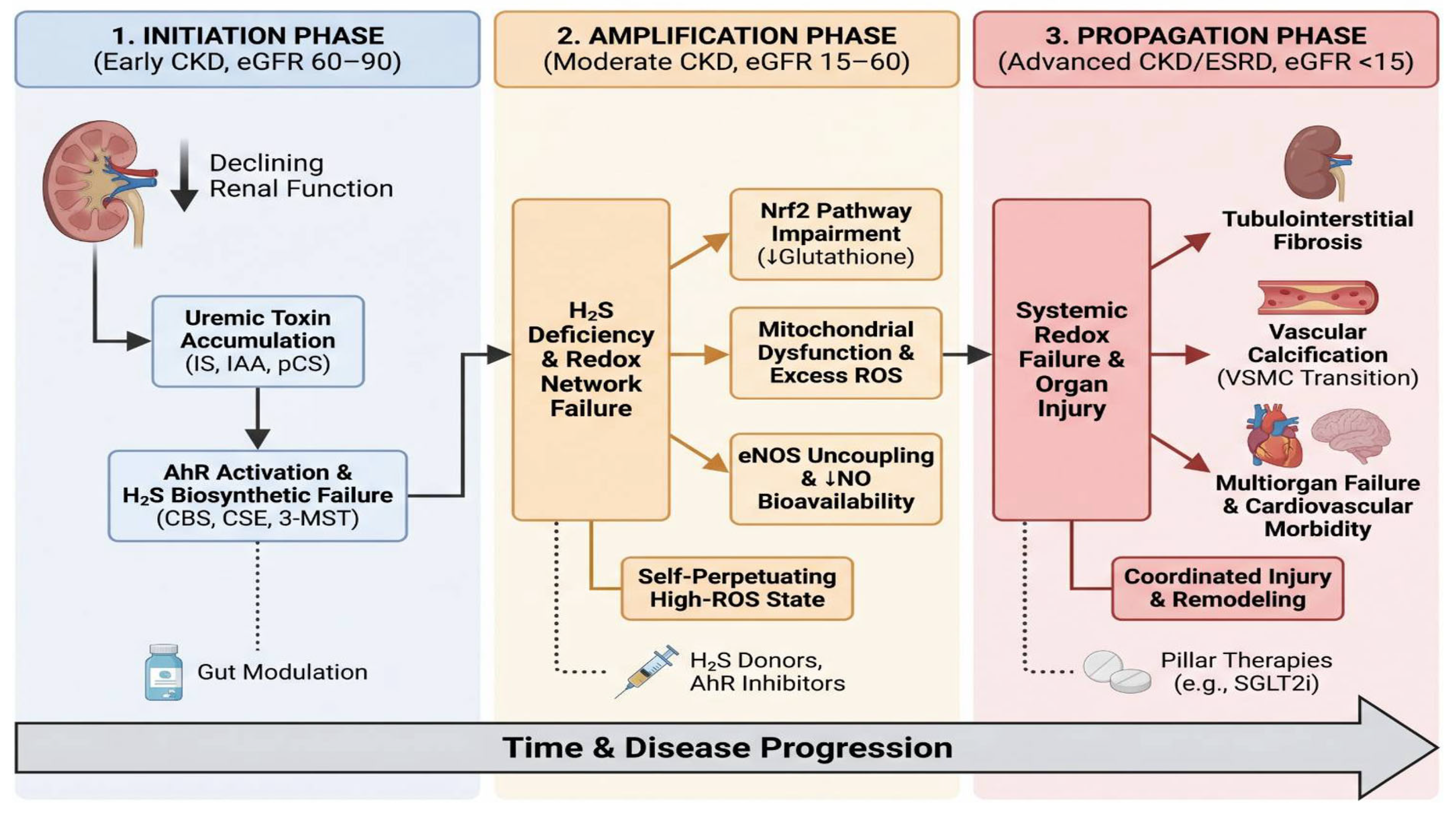
Figure 4 integrates the mechanistic elements described above into a unified temporal framework of redox network failure and CKD progression, from uremic toxin-driven initiation through redox amplification to systemic organ injury.

7. Pathophysiological Consequences of Redox Network Failure

7.1. Mitochondrial Dysfunction and Metabolic Reprogramming

Mitochondrial dysfunction is increasingly recognized as a central feature of tubular injury in CKD, particularly under conditions of oxidative stress and impaired sulfur metabolism. Experimental studies have shown that reduced H2S availability disrupts mitochondrial homeostasis and weakens antioxidant defense in renal tubular cells. In LLC-PK1 proximal tubular cells, IS markedly reduced endogenous H2S production through suppression of CBS, CSE, and 3-MST, accompanied by increased superoxide generation and depletion of intracellular glutathione [9]. These findings suggest that impaired H2S biosynthesis contributes to loss of redox buffering capacity in uremic tubular injury. In a separate study using mouse kidneys and human tubular cells, IS induced mitochondrial fragmentation, reduced mitochondrial mass and biogenesis, and impaired both aerobic and anaerobic metabolism, whereas antioxidant treatment partially restored mitochondrial integrity [33]. More recently, Xie et al. demonstrated that AhR activation promoted ubiquitin-dependent degradation of peroxisome proliferator-activated receptor gamma coactivator 1-alpha, leading to suppression of mitochondrial biogenesis, tubular senescence, and renal fibrosis in CKD models [54]. Genetic or pharmacological inhibition of AhR attenuated these mitochondrial abnormalities and improved renal injury phenotypes. Evidence supporting a direct mitochondrial protective role of H2S was further provided by Ahmad et al., who showed that the mitochondria-targeted H2S donor AP39 preserved ATP generation, reduced mitochondrial ROS production, and attenuated necrotic cell death in oxidatively stressed renal epithelial cells, while partially improving ischemia–reperfusion injury in vivo [110]. In diabetic kidney disease, exogenous H2S supplementation also prevented mitochondrial apoptosis by blocking Lon-mediated degradation of mitochondrial superoxide dismutase 2, thereby reducing ROS accumulation and improving renal function [43].
An emerging and mechanistically relevant dimension of tubular redox injury in CKD is ferroptosis, an iron-dependent form of cell death driven by uncontrolled lipid peroxidation. The central regulatory axis governing ferroptosis susceptibility is the system Xc/cysteine–glutathione (GSH)–glutathione peroxidase 4 (GPX4) pathway: cystine import via system Xc provides cysteine for GSH synthesis, which in turn supports GPX4-mediated reduction of lipid hydroperoxides to non-toxic lipid alcohols [111,112]. In diabetic kidney disease models, tubular solute carrier family 7 member 11 (SLC7A11) and GPX4 expression are reduced alongside decreased GSH and increased lipid peroxidation, and pharmacological ferroptosis inhibition attenuates tubular injury and nephropathy phenotypes [111,113]. In 5/6-nephrectomy CKD rats, tubular GPX4 and SLC7A11 are similarly downregulated with concurrent iron deposition and mitochondrial structural defects, and ferroptosis inhibition reduces fibrosis progression [114]. The connection to H2S signaling is mechanistically plausible: H2S deficiency in CKD reduces GSH availability and impairs Nrf2-dependent antioxidant gene transcription, potentially lowering the threshold for GPX4 inactivation and ferroptotic cell death. Furthermore, cysteine serves as the shared substrate for both H2S biosynthesis via CBS and CSE and for GSH synthesis via the system Xc pathway. Impaired transsulfuration in CKD may therefore simultaneously compromise H2S production and ferroptosis defense, representing a dual vulnerability at the intersection of sulfur metabolism and redox-regulated cell death. Together, these studies support a mechanistic link between impaired H2S signaling, mitochondrial dysfunction, and metabolic stress in CKD progression.

7.2. Fibrotic Remodeling and Redox-Driven Renal Injury

Progressive fibrosis is a major downstream consequence of sustained oxidative stress and impaired sulfur metabolism in CKD. Experimental studies indicate that H2S deficiency promotes fibroblast activation, extracellular matrix accumulation, and inflammatory remodeling through redox-sensitive signaling pathways. In a UUO model, Song et al. demonstrated that plasma H2S levels and renal CBS expression were markedly reduced in obstructed kidneys, whereas treatment with NaHS significantly attenuated collagen deposition, extracellular matrix accumulation, and α-smooth muscle actin (α-SMA) expression [23]. In the same study, NaHS also reduced macrophage infiltration and lowered expression of IL-1β, TNF-α, and MCP-1, suggesting that H2S modulates both fibrotic and inflammatory responses. Mechanistically, pretreatment with NaHS in NRK-49F renal fibroblasts abolished TGF-β1-induced phosphorylation of SMAD family member 3 (Smad3), p38, c-Jun N-terminal kinase (JNK), and extracellular signal-regulated kinase (ERK), while suppressing expression of collagen I, fibronectin, and α-SMA [23]. Additional UUO studies further showed that exogenous H2S reduced oxidative stress and tubulointerstitial fibrosis while preserving antioxidant enzyme activity [115,116]. In chronic obstructive nephropathy, the slow-releasing H2S donor GYY4137 reduced epithelial–mesenchymal transition, decreased vimentin and fibronectin expression, and restored E-cadherin expression in obstructed kidneys [117]. Similar findings were observed in HK-2 tubular cells, where NaHS suppressed TGF-β1-induced α-SMA and fibronectin expression through ERK- and β-catenin-dependent pathways while preserving epithelial phenotype markers [20]. More recently, Zhou et al. reported that H2S attenuated UUO-induced renal fibrosis through inhibition of NLRP3 signaling and reduction in both M1 and M2 macrophage infiltration [36]. Collectively, these studies support a mechanistic role for H2S deficiency in promoting redox-sensitive fibrotic remodeling and tubulointerstitial injury in CKD.

7.3. Vascular and Endothelial Dysfunction

Redox triad imbalance alters endothelial signaling through simultaneous disruption of ROS, NO, and sulfur-mediated pathways. Experimental studies indicate that retained uremic solutes directly injure endothelial cells through oxidative mechanisms. In human umbilical vein endothelial cells (HUVECs), IS increased intracellular ROS production by 43% and 74% at concentrations of 125 and 250 μg/mL, respectively, while intracellular glutathione levels declined substantially [47]. Blocking NOX with apocynin reduced IS-induced ROS generation by nearly 71%, whereas inhibition of mitochondrial electron transport or xanthine oxidase produced little effect, indicating that NOX is a major contributor to endothelial oxidative stress in this model [47]. In isolated rat aortic rings, IS (300 μM) reduced acetylcholine-mediated endothelium-dependent relaxation by 42%, accompanied by marked increases in CYP1A1, NOX4, nitrotyrosine, and superoxide expression, together with a 75% reduction in endothelial eNOS staining [66]. Treatment with the AhR antagonist CH223191 restored vascular relaxation and normalized multiple oxidative stress markers, including NOX4 and superoxide levels [66]. These findings place IS–AhR signaling at the center of endothelial redox disturbance and impaired NO bioavailability in CKD.
Persistent ROS excess also reshapes vascular reactivity and endothelial phenotype in experimental vascular disease models. In diabetic db/db mouse aortas, impaired acetylcholine-induced vasorelaxation occurred together with increased vascular ROS accumulation, whereas pharmacological enhancement of eNOS activity restored NO production and improved endothelial responses [118]. Comparable findings were reported in chronic anemia and metabolic stress models, where antioxidant treatment partially recovered endothelium-dependent relaxation in isolated aortic rings [119,120]. Taken together, these studies indicate that sustained oxidative stress and defective NO signaling directly contribute to endothelial dysfunction, altered microvascular regulation, and progressive vascular injury during CKD progression. These endothelial abnormalities may contribute to arterial stiffness, impaired microvascular perfusion, and increased cardiovascular vulnerability observed in CKD populations, although direct causal evidence in humans remains limited.

7.4. Vascular Calcification as a Downstream Consequence of Redox Network Failure and Sulfur Metabolic Disruption

Vascular calcification represents a critical but underappreciated downstream consequence of redox network failure in CKD, linking oxidative stress, uremic toxin accumulation, and H2S deficiency to active osteogenic reprogramming of vascular smooth muscle cells (VSMCs). H2S exerts direct anti-calcific effects through multiple complementary mechanisms: it suppresses phosphate-induced osteoblastic differentiation and mineralization of human aortic VSMCs by inhibiting Pit-1-dependent phosphate uptake and downregulating osteogenic transcription factors including runt-related transcription factor 2 (RUNX2) [121,122]. In calciprotein particle models, H2S reduces VSMC calcium loading and oxidative stress through NRF2–NAD(P)H quinone oxidoreductase 1 activation, while in high-glucose and diabetic nephropathy models it prevents elastin degradation and osteogenic transition by suppressing Stat3/cathepsin S signaling through persulfidation of Stat3 Cys259 [123,124]. In calcific aortic valve disease, H2S biogenesis and mitochondrial sulfide metabolism are impaired, further supporting the concept that sulfur metabolic disruption contributes directly to pathological mineralization [125].
The accumulation of lanthionine, a CBS/CSE transsulfuration byproduct that rises markedly in CKD, adds a further pro-calcific dimension. At concentrations observed in uremic patients, lanthionine induces bone morphogenetic protein 2 (BMP-2), RUNX2, and alkaline phosphatase expression in endothelial cells, downregulates the pyrophosphate regulator progressive ankylosis protein homolog, and activates ERK1/2 under pro-calcifying conditions, directly promoting vascular mineralization [42]. Clinically, serum lanthionine rises with declining eGFR and parallels CT-based vascular calcium scores, with higher levels associated with elevated pro-inflammatory cytokines in calcified versus non-calcified CKD patients [41]. IS further amplifies this process: IS-treated endothelial cells release microvesicles that induce vascular calcification in vitro and promote Klotho hypermethylation, accelerating the osteogenic transition [126,127]. Together, these findings position vascular calcification as an integrated consequence of the redox triad failure model proposed in this review, in which H2S deficiency, lanthionine accumulation, and IS-driven oxidative signaling converge to drive pathological VSMC and endothelial mineralization in CKD.

7.5. Integrated Progression: From Redox Failure to Multiorgan Disease

Renal injury, mitochondrial dysfunction, vascular impairment, and inflammation form an interconnected network driven by redox dysregulation. Disruption of coordinated ROS, NO, and sulfur-based signaling propagates across nephron segments and vascular systems, linking oxidative injury, metabolic reprogramming, and endothelial dysfunction into a unified disease process [101].
Feed-forward interactions sustain and amplify this progression. Mitochondrial dysfunction increases ROS production, vascular dysfunction reduces tissue perfusion, and inflammatory signaling maintains fibrotic remodeling [109]. These processes reinforce one another, transforming localized molecular disturbances into systemic organ injury.

8. Clinical Implications of Redox Network Failure

8.1. H2S as an Integrative Functional Marker

Reduced H2S bioavailability is a consistent feature of CKD and reflects integrated disturbances in redox regulation and sulfur metabolism rather than an isolated biochemical abnormality [39]. Clinical studies indicate that circulating H2S levels are reduced by approximately 40–60% in CKD compared with healthy controls and correlate with declining eGFR, increasing proteinuria, and impaired tubular function [39]. These observations suggest that H2S captures dimensions of disease severity not fully represented by conventional clinical markers.
H2S plays a central role in regulating vascular tone, tubular transport, and renal hemodynamics, linking redox balance to functional adaptation [128]. Reduced H2S bioavailability reflects impaired antioxidant capacity, heightened inflammatory signaling, and diminished adaptive responses, indicating a state of increased biological vulnerability rather than structural damage alone [5]. Experimental studies further demonstrate that restoration of H2S signaling attenuates fibrosis and improves renal outcomes in CKD models [34].
Despite these associations, clinical application remains limited. Most available data are observational, and variability in measurement techniques and the presence of multiple circulating sulfur pools limit standardization and reproducibility [129]. Accordingly, H2S is best considered a translational indicator of redox network status rather than a routine clinical biomarker at present.
A critical and underappreciated challenge concerns the analytical validity of H2S measurements themselves. Plasma sulfide exists across multiple distinct pools—free dissolved H2S, acid-labile sulfur bound to proteins and metal centers, and sulfane sulfur species—each with different biological relevance, yet most clinical studies measure only one pool without clearly specifying which [130,131]. H2S is highly volatile and rapidly oxidized under aerobic conditions, meaning that losses during sample collection, storage, and processing can introduce systematic underestimation that is difficult to distinguish from true biological deficiency [132]. Methodological discrepancies compound this problem: the widely used methylene blue colorimetric assay substantially overestimates free sulfide by reacting with bound sulfur pools, whereas monobromobimane–HPLC methods, although more sensitive, yield substantially different values depending on pretreatment conditions and alkylating agent choice [133,134]. Electrode-based approaches require strongly alkaline conditions that can liberate acid-labile sulfur, further confounding speciation, while LC-MS/MS with isotope-labeled internal standards currently provides the most accurate quantification but remains technically demanding for routine clinical use [135,136]. Reported plasma H2S concentrations across clinical studies consequently span nanomolar to hundreds of micromolar ranges, reflecting methodological heterogeneity as much as biology [130]. These limitations do not invalidate the consistent directional finding of reduced sulfide bioavailability in CKD, but they underscore that cross-study comparisons and absolute threshold values should be interpreted with caution until standardized, pool-specific analytical protocols are adopted.

8.2. Cardiorenal and Metabolic Implications

H2S deficiency has implications that extend beyond renal function and encompasses cardiovascular risk in CKD [39]. Reduced H2S signaling impairs endothelial protection, promotes oxidative stress, and disrupts vascular tone, thereby contributing to endothelial dysfunction, hypertension, and atherosclerosis [39,101]. These effects support a cardiorenal framework in which redox network disruption links renal impairment to systemic vascular injury.
Alterations in sulfur metabolism further contribute to metabolic instability. CKD is characterized by hyperhomocysteinemia and impaired transsulfuration, reflecting disrupted coupling between homocysteine metabolism and H2S production [8]. This imbalance promotes oxidative stress, inflammation, and endothelial dysfunction [47,102]. However, some sulfur metabolites appear to correlate more closely with renal function than with independent cardiovascular risk, suggesting that they may serve primarily as markers of disease severity rather than direct causal mediators [137].
These findings support the concept of CKD as a systemic cardiorenal–metabolic disorder driven in part by redox network dysfunction. H2S signaling intersects with NO pathways, RAAS activation, oxidative stress, and gut-derived toxins, positioning H2S deficiency as an integrative indicator of systemic dysregulation [101].
Two underappreciated sources of biological variability in sulfur-mediated redox regulation are sex and age, both of which have direct implications for precision medicine approaches in CKD. Estrogen upregulates CBS expression in vascular endothelial and smooth muscle cells through estrogen receptor-dependent promoter activation, enhancing H2S-mediated vasodilation and contributing to the relative cardiovascular protection observed in premenopausal women [138,139]. Consistent with this, female prediabetic rats demonstrate better-preserved endothelial function associated with higher H2S-producing enzyme expression in perivascular tissue, while circulating sulfane sulfur pools show sex-specific reductions in human cardiovascular disease [140,141]. With advancing age, renal H2S levels decline despite compensatory upregulation of CBS and CSE in some tissues, and this decline is functionally significant: exogenous H2S restores AMP-activated protein kinase (AMPK) activity, reduces senescence-associated secretory phenotype markers, and attenuates age-related renal fibrosis, while dietary restriction-mediated increases in CBS and CSE expression delay renal senescence in aged rats [142,143]. At the cellular level, H2S deficiency accelerates senescence through loss of Keap1 S-sulfhydration and Nrf2-dependent antioxidant defense, while restoration of H2S signaling improves mitophagy and mitochondrial function in aging glomerular mesangial cells via the AMPK–unc-51-like autophagy activating kinase 1 (ULK1)–PTEN-induced kinase 1–parkin axis [5,144]. These findings suggest that the magnitude of H2S deficiency and its pathological consequences in CKD may vary substantially by sex and age, and that therapeutic strategies targeting sulfur metabolism should account for these biological variables in trial design and patient stratification.

8.3. Clinical Translation and Future Directions

Despite substantial mechanistic evidence linking H2S deficiency to redox dysregulation, its clinical role remains incompletely defined. Measurement represents a major challenge due to the presence of multiple circulating sulfur pools and variability in analytical methods [129]. In addition, most available human data are cross-sectional, with limited prospective studies evaluating longitudinal changes or predictive value for clinical outcomes [39].
Future research should prioritize validation of H2S as a prognostic marker in well-characterized CKD cohorts and development of standardized assays capable of distinguishing biologically relevant sulfur species. Integration of H2S with redox-related biomarkers and uremic toxin profiles may improve risk stratification and provide mechanistic insight into disease progression.
Importantly, interventional studies are required to determine whether modulation of H2S signaling translates into improved renal and cardiovascular outcomes. Such studies will be essential to define the therapeutic relevance of targeting redox network dysfunction and to establish H2S-based strategies within precision medicine approaches for CKD. In this context, future studies should also address whether H2S deficiency is uniformly pathogenic across CKD stages or whether context-dependent biphasic effects—modulated by oxygen tension, mitochondrial status, and sulfur substrate availability—define a therapeutic window that varies with disease progression. Characterizing these stage- and context-specific responses will be critical for translating mechanistic insights into targeted interventions and avoiding unintended consequences of H2S modulation in heterogeneous CKD populations.
Operationalizing the redox network failure concept clinically will require a multimodal biomarker strategy that extends beyond H2S alone. A panel approach integrating markers across the three redox axes could capture the coordinated nature of network disruption: oxidative stress markers including malondialdehyde, F2-isoprostanes, and advanced oxidation protein products reflect ROS axis status and correlate with CKD stage and cardiovascular risk [145,146]; asymmetric dimethylarginine (ADMA), a circulating inhibitor of endothelial NO synthase that accumulates in CKD, provides an accessible index of NO axis impairment and independently predicts cardiovascular outcomes [147]; and sulfur metabolomics encompassing H2S, thiosulfate, lanthionine, and homocysteine can characterize the breadth of sulfur axis disruption beyond what H2S measurement alone reflects. Uremic toxin profiling of IS and pCS anchors the upstream driver dimension, while emerging mitochondrial stress markers such as growth differentiation factor 15 may capture the downstream bioenergetic consequences of redox network failure [148]. Such a composite panel would not only improve risk stratification beyond conventional eGFR and proteinuria but also provide mechanistically interpretable endpoints for interventional studies targeting redox network restoration—a prerequisite for moving beyond the surrogate marker limitations that have constrained prior antioxidant trials in CKD.

8.4. Unresolved Controversies and Critical Knowledge Gaps

Despite the mechanistic framework developed in this review, several fundamental uncertainties limit the strength of current conclusions and warrant explicit acknowledgment. First, the relationship between circulating H2S and intrarenal sulfur signaling remains incompletely established. Although plasma H2S correlates with eGFR and cardiac dysfunction in CKD cohorts [39], renal H2S biology is inherently spatiotemporally compartmentalized—CBS, CSE, and 3-MST operate in distinct subcellular and nephron-segment-specific contexts, and tissue-specific dysregulation can occur independently of circulating levels, as demonstrated by the preservation of brain H2S-producing capacity despite renal and hepatic enzyme downregulation in CKD [8]. Whether plasma H2S accurately reflects the local persulfidation tone, mitochondrial sulfide flux, or glomerular versus tubular H2S signaling in individual patients remains unknown, and this uncertainty constrains the interpretability of clinical biomarker data.
Second, it is unclear whether H2S donor therapy can selectively restore physiological signaling rather than simply producing broad pharmacological effects. Experimental studies demonstrate that donors such as NaHS inhibit TLR4/NLRP3 signaling and suppress inflammatory cascades through mechanisms that extend beyond H2S replacement per se [37], raising the question of whether observed benefits reflect restoration of endogenous sulfur signaling or nonspecific cytoprotective pharmacology. Given the narrow therapeutic window discussed in the following section, and the altered sulfide oxidation capacity in CKD kidneys, the concentration–response relationship between exogenous donor administration and biologically relevant local H2S levels in target tissues remains poorly characterized.
Third, AhR inhibition as a therapeutic strategy carries unresolved immunological risks. AhR functions as a homeostatic sensor integrating dietary, microbial, and metabolic ligands to regulate gut barrier integrity, Treg and Th17 differentiation, macrophage polarization, and tonic restraint of microbiota-driven inflammatory signaling in monocytes [149,150]. Systemic AhR blockade therefore risks disrupting immune tolerance, promoting dysbiosis-driven inflammation, and interfering with xenobiotic metabolism—consequences that have not been evaluated in the context of CKD, where immune dysregulation and gut dysbiosis are already present. Selective, tissue- or cell-type-restricted AhR modulation may be necessary to dissociate therapeutic from adverse effects, but the tools to achieve this specificity in vivo remain at an early stage of development [151]. These unresolved questions do not invalidate the proposed framework but define the boundaries of current evidence and the priorities for future mechanistic and translational investigation.

9. Therapeutic Implications: Restoring Redox Network Balance in CKD

Recognition of H2S deficiency within the framework of redox triad failure supports a shift from nonspecific antioxidant supplementation toward restoration of coordinated redox regulation. In CKD, excessive ROS production and impaired endogenous antioxidant responses contribute to disease progression, while conventional antioxidant strategies have not consistently improved clinical outcomes [100]. H2S plays a central role in endogenous redox control through regulation of glutathione availability, antioxidant enzyme activity, and Nrf2 signaling [5]. Therapeutic strategies should therefore aim to restore balance among ROS, NO, and sulfur-based pathways rather than relying on isolated ROS scavenging.
Restoration of H2S bioavailability represents a direct downstream approach. In 5/6-nephrectomy models, NaHS improves renal function, reduces oxidative stress, restores antioxidant capacity, and suppresses NF-κB-mediated inflammation and apoptosis [152]. Across experimental kidney disease models, H2S donors attenuate oxidative stress, inflammation, autophagy dysregulation, and fibrosis through pathways including TLR4/NLRP3, AMPK–mechanistic target of rapamycin (mTOR), and TGF-β1–Smad3 signaling [153]. Donor compounds differ in pharmacokinetics: NaHS and Na2S release H2S rapidly, whereas GYY4137 and newer slow-release or activatable donors provide sustained or stimulus-responsive delivery that may better approximate physiological signaling [154,155]. Despite this preclinical promise, the therapeutic application of H2S donors is constrained by a narrow concentration-dependent window. In rat models, NaHS at higher doses induces hepatic Complex IV inhibition, increased ROS generation, and apoptosis, whereas lower doses are well tolerated, indicating that the transition from benefit to toxicity occurs within a modest dose range [156]. At the cellular level, sulfide oxidation capacity mediated by SQR determines the threshold below which H2S is metabolized safely; loss of SQR activity renders cells susceptible to mitochondrial poisoning at concentrations that would otherwise be tolerated [157]. In CKD, where both H2S-producing enzyme activity and sulfur substrate availability are reduced, the metabolic handling of exogenous H2S may be substantially altered, potentially narrowing the margin between therapeutic and toxic exposure [158]. Context-dependent risks are further illustrated by the observation that GYY4137 exacerbated cisplatin-induced nephrotoxicity in mice, underscoring that donor safety cannot be assumed across all renal disease contexts [159]. The pharmacological distinctions among donor classes have direct implications for therapeutic design. Fast-releasing inorganic donors such as NaHS generate transient supraphysiological H2S peaks that risk cytochrome c oxidase inhibition, whereas slow-hydrolyzing donors such as GYY4137 sustain sub-toxic H2S concentrations over hours to days, more closely approximating endogenous production kinetics and demonstrating superior organ protection in ischemia–reperfusion models [160,161]. Glutathione-responsive nanoparticle systems extend this further by providing sustained plasma H2S with enhanced cardioprotection compared with both NaHS and GYY4137, illustrating that release kinetics rather than total H2S dose may determine therapeutic outcome [161]. Mitochondria-targeted donors incorporating triphenylphosphonium moieties achieve greater than 1000-fold enrichment at the site of ROS generation, conferring potent endothelial and renal epithelial protection at doses orders of magnitude lower than systemic donors, and attenuating cellular senescence through selective modulation of splicing factors [162,163]. Stimulus-responsive donors that activate under pathological conditions such as elevated ROS or reduced pH offer an additional layer of spatial and temporal control, potentially limiting off-target H2S release in non-diseased tissue—a property particularly relevant in CKD where systemic sulfide handling is already impaired. Optimal dosing strategies, donor selection, and long-term safety profiling in CKD therefore represent essential prerequisites for clinical translation.
Targeting upstream suppression of endogenous H2S production represents a complementary strategy. IS reduces H2S synthesis by downregulating CBS, CSE, and 3-MST through AhR-dependent inhibition of Sp1 activity, accompanied by glutathione depletion and increased oxidative stress [9]. While H2S donors can partially restore redox balance, approaches that reduce uremic toxin burden or modulate AhR signaling may more effectively address the underlying drivers of H2S deficiency.
A broader translational concern is whether H2S-based strategies may encounter the barriers that have limited conventional antioxidant therapies in CKD. Clinical trials of nonspecific antioxidants including bardoxolone methyl demonstrated that indiscriminate modulation of redox pathways can produce unexpected off-target effects, and that surrogate biochemical endpoints do not reliably predict hard clinical outcomes [4]. H2S donors share some of these vulnerabilities: they act on multiple pathways simultaneously, lack validated clinical biomarkers for target engagement, and have not yet been tested in prospective CKD outcome trials. The narrow therapeutic window described above, combined with altered sulfide oxidation capacity in CKD kidneys, means that dosing strategies validated in experimental models may not translate directly to patients with advanced renal impairment. Avoiding the failures of prior antioxidant approaches will therefore require not only improved donor chemistry but also rigorous pharmacokinetic characterization in CKD populations, identification of responsive patient subgroups, and selection of mechanistically justified clinical endpoints that reflect redox network restoration rather than isolated oxidative stress markers.
An integrated therapeutic framework should therefore combine downstream restoration of H2S signaling with upstream modulation of uremic toxin pathways, together with broader strategies aimed at re-establishing redox network balance. Future studies should prioritize in vivo assessment of H2S bioavailability, integration with uremic toxin profiling, and evaluation of renal and cardiovascular outcomes in well-designed CKD trials. These efforts will be essential to determine whether targeting redox network dysfunction can be translated into clinically meaningful therapeutic benefit.
Integration of H2S-targeted strategies with established CKD therapeutics remains an important but largely unaddressed translational question. Sodium-glucose cotransporter 2 inhibitors improve mitochondrial biogenesis and reduce NOX4-driven ROS through AMPK- and sirtuin 1-dependent mechanisms, while glucagon-like peptide-1 (GLP-1) receptor agonists and non-steroidal mineralocorticoid receptor antagonists confer overlapping mitochondrial and anti-inflammatory renal benefits [164,165]. Since these pathways converge on mitochondrial ROS reduction and Nrf2-related antioxidant defenses—which directly intersect with H2S-mediated redox regulation—it is plausible that H2S deficiency may limit their full therapeutic potential, or that combination approaches could produce additive renoprotection. However, no direct evidence currently links any of these drug classes to renal CBS, CSE, or 3-MST activity or H2S bioavailability in CKD, representing a critical knowledge gap that future mechanistic and clinical studies should address.

10. Conclusions

Growing evidence suggests that H2S deficiency in CKD reflects a broader impairment of sulfur-mediated redox regulation rather than simple antioxidant depletion. Cellular and animal studies consistently show downregulation of CBS, CSE, and 3-MST, disruption of protein persulfidation and mitochondrial sulfide oxidation, and suppression of H2S biosynthesis through IS–AhR–Sp1-dependent mechanisms. These molecular disturbances interact with oxidative stress, mitochondrial dysfunction, and inflammatory signaling across renal, vascular, and cardiac experimental models.
At a systems level, concurrent dysregulation of ROS, NO, and H2S signaling appears to amplify endothelial dysfunction, fibrotic remodeling, and inflammatory activation in a self-reinforcing manner, supporting the concept of CKD as a condition of coordinated redox imbalance. Loss of sulfur-mediated signaling may therefore contribute to progression of renal and cardiovascular injury, though many proposed mechanisms still lack direct validation in human CKD tissues. Expanding the scope of this framework to incorporate reactive sulfur species beyond H2S, cell-type-specific vulnerabilities, and stage-dependent metabolic heterogeneity will be important for refining its translational relevance. Additional translational and clinical studies will be needed to define the therapeutic potential of H2S-targeted approaches in CKD.

Author Contributions

Conceptualization, C.-L.L. and K.-C.L.; methodology, C.-L.L.; investigation, C.-L.L. and Y.-C.H.; resources, C.-C.W., T.-C.F. and C.-M.Z.; writing—original draft preparation, C.-L.L. and K.-C.L.; writing—review and editing, C.-L.L., K.-C.L., C.-C.W., T.-C.F. and C.-M.Z.; supervision, C.-L.L. All authors have read and agreed to the published version of the manuscript.

Funding

This research received no external funding.

Institutional Review Board Statement

Not applicable.

Informed Consent Statement

Not applicable.

Data Availability Statement

No new data were created or analyzed in this study. Data sharing is not applicable to this article.

Acknowledgments

During the preparation of this manuscript, the authors used ChatGPT (GPT-5.5; OpenAI, San Francisco, CA, USA) solely for English language editing and grammar refinement. The authors reviewed and approved all content and take full responsibility for this publication.

Conflicts of Interest

The authors declare no conflicts of interest.

Abbreviations

The following abbreviations are used in this manuscript:
ADMAasymmetric dimethylarginine
AhRaryl hydrocarbon receptor
AHRRaryl hydrocarbon receptor repressor
AKIacute kidney injury
AMPKAMP-activated protein kinase
AP-1activator protein 1
ARNTaryl hydrocarbon receptor nuclear translocator
ASCapoptosis-associated speck-like protein containing a CARD
ATMataxia telangiectasia mutated kinase
ATPadenosine triphosphate
BMP-2bone morphogenetic protein 2
CBScystathionine β-synthase
CKDchronic kidney disease
COcarbon monoxide
CREBcAMP response element-binding protein
CSEcystathionine γ-lyase
CYP1A1cytochrome P450 family 1 subfamily A member 1
CysSSHcysteine persulfide
eGFRestimated glomerular filtration rate
eNOSendothelial nitric oxide synthase
ERKextracellular signal-regulated kinase
ESRDend-stage renal disease
ETHE1ethylmalonic encephalopathy protein 1
GAPDHglyceraldehyde-3-phosphate dehydrogenase
GLP-1glucagon-like peptide-1
GPX4glutathione peroxidase 4
GSHglutathione
GSSHglutathione persulfide
H2Shydrogen sulfide
HDAChistone deacetylase
IAAindole-3-acetic acid
ISindoxyl sulfate
JNKc-Jun N-terminal kinase
Keap1Kelch-like ECH-associated protein 1
MAPKmitogen-activated protein kinase
MCP-1monocyte chemoattractant protein-1
3-MST3-mercaptopyruvate sulfurtransferase
mTORmechanistic target of rapamycin
NAD+nicotinamide adenine dinucleotide (oxidized)
NADHnicotinamide adenine dinucleotide (reduced)
NADPHnicotinamide adenine dinucleotide phosphate
NF-κBnuclear factor kappa B
NLRP3NOD-like receptor family pyrin domain containing 3
NOnitric oxide
NOXNADPH oxidase
NOX4NADPH oxidase 4
Nrf2nuclear factor erythroid 2-related factor 2
pCSp-cresyl sulfate
RAASrenin–angiotensin–aldosterone system
ROSreactive oxygen species
RSSreactive sulfur species
RUNX2runt-related transcription factor 2
SLC7A11solute carrier family 7 member 11
α-SMAalpha-smooth muscle actin
Sp1specificity protein 1
SQRsulfide:quinone oxidoreductase
TGF-β1transforming growth factor-beta 1
TLR4Toll-like receptor 4
TNF-αtumor necrosis factor-alpha
TSTthiosulfate sulfurtransferase
ULK1unc-51-like autophagy activating kinase 1
UUOunilateral ureteral obstruction
VSMCvascular smooth muscle cell

References

  1. GBD Chronic Kidney Disease Collaboration. Global, regional, and national burden of chronic kidney disease, 1990–2017: A systematic analysis for the Global Burden of Disease Study 2017. Lancet 2020, 395, 709–733. [Google Scholar] [CrossRef]
  2. Vaziri, N.D.; Ni, Z.; Wang, X.Q.; Oveisi, F.; Zhou, X.J. Downregulation of nitric oxide synthase in chronic renal insufficiency: Role of excess PTH. Am. J. Physiol. 1998, 274, F642–F649. [Google Scholar] [CrossRef]
  3. Go, A.S.; Chertow, G.M.; Fan, D.; McCulloch, C.E.; Hsu, C.Y. Chronic kidney disease and the risks of death, cardiovascular events, and hospitalization. N. Engl. J. Med. 2004, 351, 1296–1305. [Google Scholar] [CrossRef]
  4. Pergola, P.E.; Raskin, P.; Toto, R.D.; Meyer, C.J.; Huff, J.W.; Grossman, E.B.; Krauth, M.; Ruiz, S.; Audhya, P.; Christ-Schmidt, H.; et al. Bardoxolone methyl and kidney function in CKD with type 2 diabetes. N. Engl. J. Med. 2011, 365, 327–336. [Google Scholar] [CrossRef]
  5. Yang, G.; Zhao, K.; Ju, Y.; Mani, S.; Cao, Q.; Puukila, S.; Khaper, N.; Wu, L.; Wang, R. Hydrogen sulfide protects against cellular senescence via S-sulfhydration of Keap1 and activation of Nrf2. Antioxid. Redox Signal. 2013, 18, 1906–1919. [Google Scholar] [CrossRef] [PubMed]
  6. Módis, K.; Coletta, C.; Erdélyi, K.; Papapetropoulos, A.; Szabo, C. Intramitochondrial hydrogen sulfide production by 3-mercaptopyruvate sulfurtransferase maintains mitochondrial electron flow and supports cellular bioenergetics. FASEB J. 2013, 27, 601–611. [Google Scholar] [CrossRef]
  7. Hourihan, J.M.; Kenna, J.G.; Hayes, J.D. The gasotransmitter hydrogen sulfide induces nrf2-target genes by inactivating the keap1 ubiquitin ligase substrate adaptor through formation of a disulfide bond between cys-226 and cys-613. Antioxid. Redox Signal. 2013, 19, 465–481. [Google Scholar] [CrossRef]
  8. Aminzadeh, M.A.; Vaziri, N.D. Downregulation of the renal and hepatic hydrogen sulfide (H2S)-producing enzymes and capacity in chronic kidney disease. Nephrol. Dial. Transplant. 2012, 27, 498–504. [Google Scholar] [CrossRef] [PubMed]
  9. Lu, C.L.; Liao, C.H.; Wu, W.B.; Zheng, C.M.; Lu, K.C.; Ma, M.C. Uremic Toxin Indoxyl Sulfate Impairs Hydrogen Sulfide Formation in Renal Tubular Cells. Antioxidants 2022, 11, 361. [Google Scholar] [CrossRef] [PubMed]
  10. Chiku, T.; Padovani, D.; Zhu, W.; Singh, S.; Vitvitsky, V.; Banerjee, R. H2S biogenesis by human cystathionine γ-lyase leads to the novel sulfur metabolites lanthionine and homolanthionine and is responsive to the grade of hyperhomocysteinemia. J. Biol. Chem. 2009, 284, 11601–11612. [Google Scholar] [CrossRef]
  11. Kumar, R.; Banerjee, R. Regulation of the redox metabolome and thiol proteome by hydrogen sulfide. Crit. Rev. Biochem. Mol. Biol. 2021, 56, 221–235. [Google Scholar] [CrossRef]
  12. Bełtowski, J. Synthesis, Metabolism, and Signaling Mechanisms of Hydrogen Sulfide: An Overview. In Vascular Effects of Hydrogen Sulfide; Methods in Molecular Biology; Humana: New York, NY, USA, 2019; Volume 2007, pp. 1–8. [Google Scholar] [CrossRef]
  13. Huang, D.; Jing, G.; Zhu, S. Regulation of Mitochondrial Respiration by Hydrogen Sulfide. Antioxidants 2023, 12, 1644. [Google Scholar] [CrossRef]
  14. Rao, S.P.; Dobariya, P.; Bellamkonda, H.; More, S. Role of 3-Mercaptopyruvate Sulfurtransferase (3-MST) in Physiology and Disease. Antioxidants 2023, 12, 603. [Google Scholar] [CrossRef]
  15. Shibuya, N.; Tanaka, M.; Yoshida, M.; Ogasawara, Y.; Togawa, T.; Ishii, K.; Kimura, H. 3-Mercaptopyruvate sulfurtransferase produces hydrogen sulfide and bound sulfane sulfur in the brain. Antioxid. Redox Signal. 2009, 11, 703–714. [Google Scholar] [CrossRef] [PubMed]
  16. Cao, X.; Bian, J. The Role of Hydrogen Sulfide in Renal System. Front. Pharmacol. 2016, 7, 385. [Google Scholar] [CrossRef]
  17. Chen, P.H.; Fu, Y.S.; Wang, Y.M.; Yang, K.H.; Wang, D.L.; Huang, B. Hydrogen sulfide increases nitric oxide production and subsequent S-nitrosylation in endothelial cells. Sci. World J. 2014, 2014, 480387. [Google Scholar] [CrossRef]
  18. Roorda, M.; Miljkovic, J.L.; van Goor, H.; Henning, R.H.; Bouma, H.R. Spatiotemporal regulation of hydrogen sulfide signaling in the kidney. Redox Biol. 2021, 43, 101961. [Google Scholar] [CrossRef]
  19. Paul, B.D.; Snyder, S.H.; Kashfi, K. Effects of hydrogen sulfide on mitochondrial function and cellular bioenergetics. Redox Biol. 2021, 38, 101772. [Google Scholar] [CrossRef]
  20. Guo, L.; Peng, W.; Tao, J.; Lan, Z.; Hei, H.; Tian, L.; Pan, W.; Wang, L.; Zhang, X. Hydrogen Sulfide Inhibits Transforming Growth Factor-β1-Induced EMT via Wnt/Catenin Pathway. PLoS ONE 2016, 11, e0147018. [Google Scholar] [CrossRef] [PubMed]
  21. Zhou, X.; Feng, Y.; Zhan, Z.; Chen, J. Hydrogen sulfide alleviates diabetic nephropathy in a streptozotocin-induced diabetic rat model. J. Biol. Chem. 2014, 289, 28827–28834. [Google Scholar] [CrossRef] [PubMed]
  22. Yuan, P.; Xue, H.; Zhou, L.; Qu, L.; Li, C.; Wang, Z.; Ni, J.; Yu, C.; Yao, T.; Huang, Y.; et al. Rescue of mesangial cells from high glucose-induced over-proliferation and extracellular matrix secretion by hydrogen sulfide. Nephrol. Dial. Transplant. 2011, 26, 2119–2126. [Google Scholar] [CrossRef]
  23. Song, K.; Wang, F.; Li, Q.; Shi, Y.B.; Zheng, H.F.; Peng, H.; Shen, H.Y.; Liu, C.F.; Hu, L.F. Hydrogen sulfide inhibits the renal fibrosis of obstructive nephropathy. Kidney Int. 2014, 85, 1318–1329. [Google Scholar] [CrossRef] [PubMed]
  24. Mustafa, A.K.; Gadalla, M.M.; Sen, N.; Kim, S.; Mu, W.; Gazi, S.K.; Barrow, R.K.; Yang, G.; Wang, R.; Snyder, S.H. H2S signals through protein S-sulfhydration. Sci. Signal. 2009, 2, ra72. [Google Scholar] [CrossRef]
  25. Wu, D.; Wang, J.; Li, H.; Xue, M.; Ji, A.; Li, Y. Role of Hydrogen Sulfide in Ischemia-Reperfusion Injury. Oxid. Med. Cell. Longev. 2015, 2015, 186908. [Google Scholar] [CrossRef]
  26. Nagpure, B.V.; Bian, J.S. Interaction of Hydrogen Sulfide with Nitric Oxide in the Cardiovascular System. Oxid. Med. Cell. Longev. 2016, 2016, 6904327. [Google Scholar] [CrossRef] [PubMed]
  27. Luo, R.; Hu, S.; Liu, Q.; Han, M.; Wang, F.; Qiu, M.; Li, S.; Li, X.; Yang, T.; Fu, X.; et al. Hydrogen sulfide upregulates renal AQP-2 protein expression and promotes urine concentration. FASEB J. 2019, 33, 469–483. [Google Scholar] [CrossRef] [PubMed]
  28. Wu, D.; Luo, N.; Wang, L.; Zhao, Z.; Bu, H.; Xu, G.; Yan, Y.; Che, X.; Jiao, Z.; Zhao, T.; et al. Hydrogen sulfide ameliorates chronic renal failure in rats by inhibiting apoptosis and inflammation through ROS/MAPK and NF-κB signaling pathways. Sci. Rep. 2017, 7, 455. [Google Scholar] [CrossRef]
  29. Libiad, M.; Yadav, P.K.; Vitvitsky, V.; Martinov, M.; Banerjee, R. Organization of the human mitochondrial hydrogen sulfide oxidation pathway. J. Biol. Chem. 2014, 289, 30901–30910. [Google Scholar] [CrossRef]
  30. Tiranti, V.; Viscomi, C.; Hildebrandt, T.; Di Meo, I.; Mineri, R.; Tiveron, C.; Levitt, M.D.; Prelle, A.; Fagiolari, G.; Rimoldi, M.; et al. Loss of ETHE1, a mitochondrial dioxygenase, causes fatal sulfide toxicity in ethylmalonic encephalopathy. Nat. Med. 2009, 15, 200–205. [Google Scholar] [CrossRef]
  31. Zhang, J.X.; Chen, P.P.; Li, X.Q.; Li, L.; Wu, Q.Y.; Wang, G.H.; Ruan, X.Z.; Ma, K.L. Deficiency of thiosulfate sulfurtransferase mediates the dysfunction of renal tubular mitochondrial fatty acid oxidation in diabetic kidney disease. Cell Death Differ. 2024, 31, 1636–1649. [Google Scholar] [CrossRef]
  32. Yu, Y.; Xiao, L.; Ren, Z.; Zhu, G.; Wang, W.; Jia, Y.; Peng, A.; Wang, X. Glucose-induced decrease of cystathionine β-synthase mediates renal injuries. FASEB J. 2021, 35, e21576, Erratum in FASEB J. 2023, 37, e22991. https://doi.org/10.1096/fj.202300951. [Google Scholar] [CrossRef] [PubMed]
  33. Sun, C.Y.; Cheng, M.L.; Pan, H.C.; Lee, J.H.; Lee, C.C. Protein-bound uremic toxins impaired mitochondrial dynamics and functions. Oncotarget 2017, 8, 77722–77733. [Google Scholar] [CrossRef] [PubMed]
  34. Lu, C.L.; Tseng, Y.S.; Wu, W.B.; Liao, C.H.; Ma, M.C. Blockade of Aryl Hydrocarbon Receptor Ameliorates Functional Insufficiency in 5/6 Nephrectomized Rat Kidneys by Restoring Hydrogen Sulfide Formation. Antioxid. Redox Signal. 2025, 43, 448–464. [Google Scholar] [CrossRef] [PubMed]
  35. Bushell, C.J.; Forgan, L.G.; Aston-Mourney, K.; Connor, T.; McGee, S.L.; McNeill, B.A. Characterisation of the hydrogen sulfide system in early diabetic kidney disease. J. Mol. Endocrinol. 2023, 71, e230065. [Google Scholar] [CrossRef]
  36. Zhou, Y.; Zhu, X.; Wang, X.; Peng, Y.; Du, J.; Yin, H.; Yang, H.; Ni, X.; Zhang, W. H2S alleviates renal injury and fibrosis in response to unilateral ureteral obstruction by regulating macrophage infiltration via inhibition of NLRP3 signaling. Exp. Cell Res. 2020, 387, 111779. [Google Scholar] [CrossRef]
  37. Chen, Y.; Jin, S.; Teng, X.; Hu, Z.; Zhang, Z.; Qiu, X.; Tian, D.; Wu, Y. Hydrogen Sulfide Attenuates LPS-Induced Acute Kidney Injury by Inhibiting Inflammation and Oxidative Stress. Oxid. Med. Cell. Longev. 2018, 2018, 6717212. [Google Scholar] [CrossRef]
  38. Su, Y.; Wang, Y.; Liu, M.; Chen, H. Hydrogen sulfide attenuates renal I/R-induced activation of the inflammatory response and apoptosis via regulating Nrf2-mediated NLRP3 signaling pathway inhibition. Mol. Med. Rep. 2021, 24, 518. [Google Scholar] [CrossRef]
  39. Kuang, Q.; Xue, N.; Chen, J.; Shen, Z.; Cui, X.; Fang, Y.; Ding, X. Low Plasma Hydrogen Sulfide Is Associated with Impaired Renal Function and Cardiac Dysfunction. Am. J. Nephrol. 2018, 47, 361–371. [Google Scholar] [CrossRef]
  40. Perna, A.F.; Luciano, M.G.; Ingrosso, D.; Pulzella, P.; Sepe, I.; Lanza, D.; Violetti, E.; Capasso, R.; Lombardi, C.; De Santo, N.G. Hydrogen sulphide-generating pathways in haemodialysis patients: A study on relevant metabolites and transcriptional regulation of genes encoding for key enzymes. Nephrol. Dial. Transplant. 2009, 24, 3756–3763. [Google Scholar] [CrossRef]
  41. Perna, A.F.; Russo, L.; D’Esposito, V.; Formisano, P.; Bruzzese, D.; Vigorito, C.; Coppola, A.; Lombari, P.; Russo, D.; Ingrosso, D. Lanthionine, a Novel Uremic Toxin, in the Vascular Calcification of Chronic Kidney Disease: The Role of Proinflammatory Cytokines. Int. J. Mol. Sci. 2021, 22, 6875. [Google Scholar] [CrossRef]
  42. Vigorito, C.; Anishchenko, E.; Mele, L.; Capolongo, G.; Trepiccione, F.; Zacchia, M.; Lombari, P.; Capasso, R.; Ingrosso, D.; Perna, A.F. Uremic Toxin Lanthionine Interferes with the Transsulfuration Pathway, Angiogenetic Signaling and Increases Intracellular Calcium. Int. J. Mol. Sci. 2019, 20, 2269. [Google Scholar] [CrossRef]
  43. Yang, Q.; Wang, M.; Wang, H.; Ren, C.; Li, Y. Exogenous hydrogen sulfide prevents SOD2 degradation to safeguard renal function in diabetic kidney disease. Biochem. Cell Biol. 2024, 102, 252–261. [Google Scholar] [CrossRef]
  44. Lin, C.J.; Chen, H.H.; Pan, C.F.; Chuang, C.K.; Wang, T.J.; Sun, F.J.; Wu, C.J. p-Cresylsulfate and indoxyl sulfate level at different stages of chronic kidney disease. J. Clin. Lab. Anal. 2011, 25, 191–197. [Google Scholar] [CrossRef] [PubMed]
  45. Krieter, D.H.; Kerwagen, S.; Rüth, M.; Lemke, H.D.; Wanner, C. Differences in Dialysis Efficacy Have Limited Effects on Protein-Bound Uremic Toxins Plasma Levels over Time. Toxins 2019, 11, 47. [Google Scholar] [CrossRef] [PubMed]
  46. Chen, M.C.; Kuo, C.H.; Lin, Y.L.; Hsu, B.G. Gut-derived uremic toxins and cardiovascular health in chronic kidney disease. Tzu Chi Med. J. 2025, 37, 264–274. [Google Scholar] [CrossRef] [PubMed]
  47. Dou, L.; Jourde-Chiche, N.; Faure, V.; Cerini, C.; Berland, Y.; Dignat-George, F.; Brunet, P. The uremic solute indoxyl sulfate induces oxidative stress in endothelial cells. J. Thromb. Haemost. 2007, 5, 1302–1308. [Google Scholar] [CrossRef]
  48. Lin, C.J.; Liu, H.L.; Pan, C.F.; Chuang, C.K.; Jayakumar, T.; Wang, T.J.; Chen, H.H.; Wu, C.J. Indoxyl sulfate predicts cardiovascular disease and renal function deterioration in advanced chronic kidney disease. Arch. Med. Res. 2012, 43, 451–456. [Google Scholar] [CrossRef]
  49. Lim, Y.; Sidor, N.; Tonial, N.; Che, A.; Urquhart, B. Uremic Toxins in the Progression of Chronic Kidney Disease and Cardiovascular Disease: Mechanisms and Therapeutic Targets. Toxins 2021, 13, 142. [Google Scholar] [CrossRef]
  50. Lano, G.; Burtey, S.; Sallée, M. Indoxyl Sulfate, a Uremic Endotheliotoxin. Toxins 2020, 12, 229. [Google Scholar] [CrossRef]
  51. Meyer, T.W.; Lee, S.; Whitmer, L.C.; Blanco, I.J.; Suba, J.K.; Sirich, T.L. Increasing the Clearance of Protein-Bound Solutes by Recirculating Dialysate through Activated Carbon. Kidney360 2023, 4, e744–e750. [Google Scholar] [CrossRef]
  52. Wu, W.; Bush, K.T.; Nigam, S.K. Key Role for the Organic Anion Transporters, OAT1 and OAT3, in the in vivo Handling of Uremic Toxins and Solutes. Sci. Rep. 2017, 7, 4939. [Google Scholar] [CrossRef]
  53. Enomoto, A.; Kimura, H.; Chairoungdua, A.; Shigeta, Y.; Jutabha, P.; Cha, S.H.; Hosoyamada, M.; Takeda, M.; Sekine, T.; Igarashi, T.; et al. Molecular identification of a renal urate anion exchanger that regulates blood urate levels. Nature 2002, 417, 447–452. [Google Scholar] [CrossRef] [PubMed]
  54. Xie, H.; Yang, N.; Lu, L.; Sun, X.; Li, J.; Wang, X.; Guo, H.; Zhou, L.; Liu, J.; Wu, H.; et al. Uremic Toxin Receptor AhR Facilitates Renal Senescence and Fibrosis via Suppressing Mitochondrial Biogenesis. Adv. Sci. 2024, 11, e2402066. [Google Scholar] [CrossRef] [PubMed]
  55. Schroeder, J.C.; Dinatale, B.C.; Murray, I.A.; Flaveny, C.A.; Liu, Q.; Laurenzana, E.M.; Lin, J.M.; Strom, S.C.; Omiecinski, C.J.; Amin, S.; et al. The uremic toxin 3-indoxyl sulfate is a potent endogenous agonist for the human aryl hydrocarbon receptor. Biochemistry 2010, 49, 393–400. [Google Scholar] [CrossRef] [PubMed]
  56. Lano, G.; Laforêt, M.; Von Kotze, C.; Perrin, J.; Addi, T.; Brunet, P.; Poitevin, S.; Burtey, S.; Dou, L. Aryl Hydrocarbon Receptor Activation and Tissue Factor Induction by Fluid Shear Stress and Indoxyl Sulfate in Endothelial Cells. Int. J. Mol. Sci. 2020, 21, 2392. [Google Scholar] [CrossRef] [PubMed]
  57. Vogel, C.F.; Wu, D.; Goth, S.R.; Baek, J.; Lollies, A.; Domhardt, R.; Grindel, A.; Pessah, I.N. Aryl hydrocarbon receptor signaling regulates NF-κB RelB activation during dendritic-cell differentiation. Immunol. Cell Biol. 2013, 91, 568–575. [Google Scholar] [CrossRef]
  58. Dou, L.; Poitevin, S.; Sallée, M.; Addi, T.; Gondouin, B.; McKay, N.; Denison, M.S.; Jourde-Chiche, N.; Duval-Sabatier, A.; Cerini, C.; et al. Aryl hydrocarbon receptor is activated in patients and mice with chronic kidney disease. Kidney Int. 2018, 93, 986–999. [Google Scholar] [CrossRef]
  59. Dou, L.; Sallée, M.; Cerini, C.; Poitevin, S.; Gondouin, B.; Jourde-Chiche, N.; Fallague, K.; Brunet, P.; Calaf, R.; Dussol, B.; et al. The cardiovascular effect of the uremic solute indole-3 acetic acid. J. Am. Soc. Nephrol. 2015, 26, 876–887. [Google Scholar] [CrossRef]
  60. Liu, J.R.; Miao, H.; Deng, D.Q.; Vaziri, N.D.; Li, P.; Zhao, Y.Y. Gut microbiota-derived tryptophan metabolism mediates renal fibrosis by aryl hydrocarbon receptor signaling activation. Cell. Mol. Life Sci. 2021, 78, 909–922. [Google Scholar] [CrossRef]
  61. Glorieux, G.; Vanholder, R.; Van Biesen, W.; Pletinck, A.; Schepers, E.; Neirynck, N.; Speeckaert, M.; De Bacquer, D.; Verbeke, F. Free p-cresyl sulfate shows the highest association with cardiovascular outcome in chronic kidney disease. Nephrol. Dial. Transplant. 2021, 36, 998–1005. [Google Scholar] [CrossRef]
  62. Renga, B. Hydrogen sulfide generation in mammals: The molecular biology of cystathionine-β- synthase (CBS) and cystathionine-γ-lyase (CSE). Inflamm. Allergy Drug Targets 2011, 10, 85–91. [Google Scholar] [CrossRef]
  63. Bai, J.; Chen, D.-B. Enhanced Sp1/YY1 Expression Directs CBS Transcription to Mediate VEGF-Stimulated Pregnancy-Dependent H2S Production in Human Uterine Artery Endothelial Cells. Hypertension 2021, 78, 1902–1913. [Google Scholar] [CrossRef]
  64. Yang, G.; Pei, Y.; Cao, Q.; Wang, R. MicroRNA-21 represses human cystathionine gamma-lyase expression by targeting at specificity protein-1 in smooth muscle cells. J. Cell. Physiol. 2012, 227, 3192–3200. [Google Scholar] [CrossRef]
  65. Zhang, L.; Yang, G.; Tang, G.; Wu, L.; Wang, R. Rat pancreatic level of cystathionine γ-lyase is regulated by glucose level via specificity protein 1 (SP1) phosphorylation. Diabetologia 2011, 54, 2615–2625. [Google Scholar] [CrossRef]
  66. Nguyen, C.; Edgley, A.J.; Kelly, D.J.; Kompa, A.R. Aryl Hydrocarbon Receptor Inhibition Restores Indoxyl Sulfate-Mediated Endothelial Dysfunction in Rat Aortic Rings. Toxins 2022, 14, 100. [Google Scholar] [CrossRef]
  67. Lu, W.; Cheng, S.; Xu, J.; Xiao, Z.; Yu, Y.; Xie, Q.; Fang, Y.; Chen, R.; Shen, B.; Xie, Y.-Q.; et al. Roles of AhR/CYP1s Signaling Pathway Mediated ROS Production in Uremic Cardiomyopathy. Toxicol. Lett. 2024, 396, 81–93. [Google Scholar] [CrossRef]
  68. Ni, J.; Jiang, L.; Shen, G.; Xia, Z.; Zhang, L.; Xu, J.; Feng, Q.; Qu, H.; Xu, F.; Li, X. Hydrogen sulfide reduces pyroptosis and alleviates ischemia-reperfusion-induced acute kidney injury by inhibiting NLRP3 inflammasome. Life Sci. 2021, 284, 119466. [Google Scholar] [CrossRef]
  69. Wakamatsu, T.; Yamamoto, S.; Ito, T.; Sato, Y.; Matsuo, K.; Takahashi, Y.; Kaneko, Y.; Goto, S.; Kazama, J.J.; Gejyo, F.; et al. Indoxyl Sulfate Promotes Macrophage IL-1β Production by Activating Aryl Hydrocarbon Receptor/NF-κ/MAPK Cascades, but the NLRP3 inflammasome Was Not Activated. Toxins 2018, 10, 124. [Google Scholar] [CrossRef]
  70. Ito, S.; Osaka, M.; Edamatsu, T.; Itoh, Y.; Yoshida, M. Crucial Role of the Aryl Hydrocarbon Receptor (AhR) in Indoxyl Sulfate-Induced Vascular Inflammation. J. Atheroscler. Thromb. 2016, 23, 960–975. [Google Scholar] [CrossRef]
  71. Du, J.; Huang, Y.; Yan, H.; Zhang, Q.; Zhao, M.; Zhu, M.; Liu, J.; Chen, S.X.; Bu, D.; Tang, C.; et al. Hydrogen sulfide suppresses oxidized low-density lipoprotein (ox-LDL)-stimulated monocyte chemoattractant protein 1 generation from macrophages via the nuclear factor κB (NF-κB) pathway. J. Biol. Chem. 2014, 289, 9741–9753. [Google Scholar] [CrossRef]
  72. Li, C.; Deng, C.; Wang, S.; Dong, X.; Dai, B.; Guo, W.; Guo, Q.; Feng, Y.; Xu, H.; Song, X.; et al. A novel role for the ROS-ATM-Chk2 axis mediated metabolic and cell cycle reprogramming in the M1 macrophage polarization. Redox Biol. 2024, 70, 103059. [Google Scholar] [CrossRef]
  73. Miao, L.; Shen, X.; Whiteman, M.; Xin, H.; Shen, Y.; Xin, X.; Moore, P.K.; Zhu, Y.Z. Hydrogen Sulfide Mitigates Myocardial Infarction via Promotion of Mitochondrial Biogenesis-Dependent M2 Polarization of Macrophages. Antioxid. Redox Signal. 2016, 25, 268–281. [Google Scholar] [CrossRef]
  74. Salti, T.; Braunstein, I.; Haimovich, Y.; Ziv, T.; Benhar, M. Widespread S-persulfidation in activated macrophages as a protective mechanism against oxidative-inflammatory stress. Redox Biol. 2024, 72, 103125. [Google Scholar] [CrossRef]
  75. Ribeiro, A.; Liu, F.; Srebrzynski, M.; Rother, S.; Adamowicz, K.; Wadowska, M.; Steiger, S.; Anders, H.J.; Schmaderer, C.; Koziel, J.; et al. Uremic Toxin Indoxyl Sulfate Promotes Macrophage-Associated Low-Grade Inflammation and Epithelial Cell Senescence. Int. J. Mol. Sci. 2023, 24, 8031. [Google Scholar] [CrossRef]
  76. Teigen, L.M.; Kaiser-Powers, T.; Matson, M.; Elkin, B.; Kabage, A.J.; Hamilton, M.; Vaughn, B.P.; Sadowsky, M.J.; Staley, C.; Khoruts, A. Contribution of Common Sulfur-Containing Substrates to Hydrogen Sulfide Production By Human Gut Microbiota Using an In Vitro Model Standardized For Bacterial Counts. Gut Microbes Rep. 2024, 1, 2361246. [Google Scholar] [CrossRef]
  77. Braccia, D.J.; Jiang, X.; Pop, M.; Hall, A.B. The Capacity to Produce Hydrogen Sulfide (H2S) via Cysteine Degradation Is Ubiquitous in the Human Gut Microbiome. Front. Microbiol. 2021, 12, 705583. [Google Scholar] [CrossRef]
  78. Lobel, L.; Cao, Y.G.; Fenn, K.; Glickman, J.N.; Garrett, W.S. Diet posttranslationally modifies the mouse gut microbial proteome to modulate renal function. Science 2020, 369, 1518–1524. [Google Scholar] [CrossRef]
  79. Uchiyama, J.; Akiyama, M.; Hase, K.; Kumagai, Y.; Kim, Y.G. Gut microbiota reinforce host antioxidant capacity via the generation of reactive sulfur species. Cell Rep. 2022, 38, 110479. [Google Scholar] [CrossRef]
  80. Garcia-Martinez, Y.; Alexandrova, E.; Iebba, V.; Ferravante, C.; Spinelli, M.; Franci, G.; Amoresano, A.; Weisz, A.; Trepiccione, F.; Borriello, M.; et al. Does gut microbiota dysbiosis impact the metabolic alterations of hydrogen sulfide and lanthionine in patients with chronic kidney disease? BMC Microbiol. 2024, 24, 436. [Google Scholar] [CrossRef]
  81. Kondo, K.; Bhushan, S.; King, A.L.; Prabhu, S.D.; Hamid, T.; Koenig, S.; Murohara, T.; Predmore, B.L.; Gojon, G., Sr.; Gojon, G., Jr.; et al. H2S protects against pressure overload-induced heart failure via upregulation of endothelial nitric oxide synthase. Circulation 2013, 127, 1116–1127. [Google Scholar] [CrossRef]
  82. King, A.L.; Polhemus, D.J.; Bhushan, S.; Otsuka, H.; Kondo, K.; Nicholson, C.K.; Bradley, J.M.; Islam, K.N.; Calvert, J.W.; Tao, Y.X.; et al. Hydrogen sulfide cytoprotective signaling is endothelial nitric oxide synthase-nitric oxide dependent. Proc. Natl. Acad. Sci. USA 2014, 111, 3182–3187. [Google Scholar] [CrossRef]
  83. Li, X.H.; Xue, W.L.; Wang, M.J.; Zhou, Y.; Zhang, C.C.; Sun, C.; Zhu, L.; Liang, K.; Chen, Y.; Tao, B.B.; et al. H2S regulates endothelial nitric oxide synthase protein stability by promoting microRNA-455-3p expression. Sci. Rep. 2017, 7, 44807. [Google Scholar] [CrossRef]
  84. Cortese-Krott, M.M.; Fernandez, B.O.; Kelm, M.; Butler, A.R.; Feelisch, M. On the chemical biology of the nitrite/sulfide interaction. Nitric Oxide 2015, 46, 14–24. [Google Scholar] [CrossRef]
  85. Montanaro, R.; Vellecco, V.; Torregrossa, R.; Casillo, G.M.; Manzo, O.L.; Mitidieri, E.; Bucci, M.; Castaldo, S.; Sorrentino, R.; Whiteman, M.; et al. Hydrogen sulfide donor AP123 restores endothelial nitric oxide-dependent vascular function in hyperglycemia via a CREB-dependent pathway. Redox Biol. 2023, 62, 102657. [Google Scholar] [CrossRef]
  86. Dóka, É.; Ida, T.; Dagnell, M.; Abiko, Y.; Luong, N.C.; Balog, N.; Takata, T.; Espinosa, B.; Nishimura, A.; Cheng, Q.; et al. Control of protein function through oxidation and reduction of persulfidated states. Sci. Adv. 2020, 6, eaax8358. [Google Scholar] [CrossRef]
  87. Filipovic, M.R.; Zivanovic, J.; Alvarez, B.; Banerjee, R. Chemical Biology of H2S Signaling through Persulfidation. Chem. Rev. 2018, 118, 1253–1337. [Google Scholar] [CrossRef]
  88. Sun, Y.; Li, D.; Su, Y.; Zhao, H.; Pang, W.; Zhao, W.; Wu, S. Protective effect of hydrogen sulfide is mediated by negative regulation of epigenetic histone acetylation in Parkinson’s disease. Arch. Med. Sci. 2023, 19, 1124–1135. [Google Scholar] [CrossRef]
  89. Slaughter, M.J.; Shanle, E.K.; Khan, A.; Chua, K.F.; Hong, T.; Boxer, L.D.; Allis, C.D.; Josefowicz, S.Z.; Garcia, B.A.; Rothbart, S.B.; et al. HDAC inhibition results in widespread alteration of the histone acetylation landscape and BRD4 targeting to gene bodies. Cell Rep. 2021, 34, 108638. [Google Scholar] [CrossRef]
  90. Wajda, A.; Łapczuk-Romańska, J.; Paradowska-Gorycka, A. Epigenetic Regulations of AhR in the Aspect of Immunomodulation. Int. J. Mol. Sci. 2020, 21, 6404. [Google Scholar] [CrossRef]
  91. Jiang, J.; Wen, C.; Li, Y.; Liu, G.; Chen, Z.; Zheng, D. IFC-305 attenuates renal ischemia-reperfusion injury by promoting the production of hydrogen sulfide (H2S) via suppressing the promoter methylation of cystathionine γ-lyase (CSE). Bioengineered 2022, 13, 12045–12054. [Google Scholar] [CrossRef]
  92. Mishanina, T.V.; Libiad, M.; Banerjee, R. Biogenesis of reactive sulfur species for signaling by hydrogen sulfide oxidation pathways. Nat. Chem. Biol. 2015, 11, 457–464. [Google Scholar] [CrossRef]
  93. Ida, T.; Sawa, T.; Ihara, H.; Tsuchiya, Y.; Watanabe, Y.; Kumagai, Y.; Suematsu, M.; Motohashi, H.; Fujii, S.; Matsunaga, T.; et al. Reactive cysteine persulfides and S-polythiolation regulate oxidative stress and redox signaling. Proc. Natl. Acad. Sci. USA 2014, 111, 7606–7611. [Google Scholar] [CrossRef]
  94. Greiner, R.; Pálinkás, Z.; Bäsell, K.; Becher, D.; Antelmann, H.; Nagy, P.; Dick, T.P. Polysulfides link H2S to protein thiol oxidation. Antioxid. Redox Signal. 2013, 19, 1749–1765. [Google Scholar] [CrossRef]
  95. Kasamatsu, S.; Nishimura, A.; Morita, M.; Matsunaga, T.; Abdul Hamid, H.; Akaike, T. Redox Signaling Regulated by Cysteine Persulfide and Protein Polysulfidation. Molecules 2016, 21, 1721. [Google Scholar] [CrossRef]
  96. Star, B.S.; van der Slikke, E.C.; Ransy, C.; Schmitt, A.; Henning, R.H.; Bouillaud, F.; Bouma, H.R. GYY4137-Derived Hydrogen Sulfide Donates Electrons to the Mitochondrial Electron Transport Chain via Sulfide: Quinone Oxidoreductase in Endothelial Cells. Antioxidants 2023, 12, 587. [Google Scholar] [CrossRef]
  97. Szczesny, B.; Módis, K.; Yanagi, K.; Coletta, C.; Le Trionnaire, S.; Perry, A.; Wood, M.E.; Whiteman, M.; Szabo, C. AP39, a novel mitochondria-targeted hydrogen sulfide donor, stimulates cellular bioenergetics, exerts cytoprotective effects and protects against the loss of mitochondrial DNA integrity in oxidatively stressed endothelial cells in vitro. Nitric Oxide 2014, 41, 120–130. [Google Scholar] [CrossRef]
  98. Borisov, V.B.; Forte, E. Impact of Hydrogen Sulfide on Mitochondrial and Bacterial Bioenergetics. Int. J. Mol. Sci. 2021, 22, 12688. [Google Scholar] [CrossRef]
  99. Kumar, R.; Landry, A.P.; Guha, A.; Vitvitsky, V.; Lee, H.J.; Seike, K.; Reddy, P.; Lyssiotis, C.A.; Banerjee, R. A redox cycle with complex II prioritizes sulfide quinone oxidoreductase-dependent H2S oxidation. J. Biol. Chem. 2022, 298, 101435. [Google Scholar] [CrossRef]
  100. Himmelfarb, J.; Stenvinkel, P.; Ikizler, T.A.; Hakim, R.M. The elephant in uremia: Oxidant stress as a unifying concept of cardiovascular disease in uremia. Kidney Int. 2002, 62, 1524–1538. [Google Scholar] [CrossRef]
  101. Coletta, C.; Papapetropoulos, A.; Erdelyi, K.; Olah, G.; Módis, K.; Panopoulos, P.; Asimakopoulou, A.; Gerö, D.; Sharina, I.; Martin, E.; et al. Hydrogen sulfide and nitric oxide are mutually dependent in the regulation of angiogenesis and endothelium-dependent vasorelaxation. Proc. Natl. Acad. Sci. USA 2012, 109, 9161–9166. [Google Scholar] [CrossRef]
  102. Landmesser, U.; Dikalov, S.; Price, S.R.; McCann, L.; Fukai, T.; Holland, S.M.; Mitch, W.E.; Harrison, D.G. Oxidation of tetrahydrobiopterin leads to uncoupling of endothelial cell nitric oxide synthase in hypertension. J. Clin. Investig. 2003, 111, 1201–1209. [Google Scholar] [CrossRef]
  103. Kim, H.J.; Vaziri, N.D. Contribution of impaired Nrf2-Keap1 pathway to oxidative stress and inflammation in chronic renal failure. Am. J. Physiol. Ren. Physiol. 2010, 298, F662–F671. [Google Scholar] [CrossRef]
  104. Huang, J.H.; Co, H.K.; Lee, Y.C.; Wu, C.C.; Chen, S.H. Multistability maintains redox homeostasis in human cells. Mol. Syst. Biol. 2021, 17, e10480. [Google Scholar] [CrossRef]
  105. Jha, J.C.; Banal, C.; Chow, B.S.; Cooper, M.E.; Jandeleit-Dahm, K. Diabetes and Kidney Disease: Role of Oxidative Stress. Antioxid. Redox Signal. 2016, 25, 657–684. [Google Scholar] [CrossRef]
  106. Kishi, S.; Nagasu, H.; Kidokoro, K.; Kashihara, N. Oxidative stress and the role of redox signalling in chronic kidney disease. Nat. Rev. Nephrol. 2024, 20, 101–119. [Google Scholar] [CrossRef] [PubMed]
  107. Koizumi, M.; Tatebe, J.; Watanabe, I.; Yamazaki, J.; Ikeda, T.; Morita, T. Aryl hydrocarbon receptor mediates indoxyl sulfate-induced cellular senescence in human umbilical vein endothelial cells. J. Atheroscler. Thromb. 2014, 21, 904–916. [Google Scholar] [CrossRef] [PubMed]
  108. Pushpakumar, S.; Kundu, S.; Sen, U. Hydrogen Sulfide Protects Hyperhomocysteinemia-Induced Renal Damage by Modulation of Caveolin and eNOS Interaction. Sci. Rep. 2019, 9, 2223. [Google Scholar] [CrossRef]
  109. Kang, H.M.; Ahn, S.H.; Choi, P.; Ko, Y.A.; Han, S.H.; Chinga, F.; Park, A.S.; Tao, J.; Sharma, K.; Pullman, J.; et al. Defective fatty acid oxidation in renal tubular epithelial cells has a key role in kidney fibrosis development. Nat. Med. 2015, 21, 37–46. [Google Scholar] [CrossRef]
  110. Ahmad, A.; Olah, G.; Szczesny, B.; Wood, M.E.; Whiteman, M.; Szabo, C. AP39, A Mitochondrially Targeted Hydrogen Sulfide Donor, Exerts Protective Effects in Renal Epithelial Cells Subjected to Oxidative Stress in Vitro and in Acute Renal Injury In Vivo. Shock 2016, 45, 88–97. [Google Scholar] [CrossRef]
  111. Kim, S.; Kang, S.W.; Joo, J.; Han, S.H.; Shin, H.; Nam, B.Y.; Park, J.; Yoo, T.H.; Kim, G.; Lee, P.; et al. Characterization of ferroptosis in kidney tubular cell death under diabetic conditions. Cell Death Dis. 2021, 12, 160. [Google Scholar] [CrossRef] [PubMed]
  112. Wang, Y.; Bi, R.; Quan, F.; Cao, Q.; Lin, Y.; Yue, C.; Cui, X.; Yang, H.; Gao, X.; Zhang, D. Ferroptosis involves in renal tubular cell death in diabetic nephropathy. Eur. J. Pharmacol. 2020, 888, 173574. [Google Scholar] [CrossRef]
  113. Feng, X.; Wang, S.; Sun, Z.; Dong, H.; Yu, H.; Huang, M.; Gao, X. Ferroptosis Enhanced Diabetic Renal Tubular Injury via HIF-1α/HO-1 Pathway in db/db Mice. Front. Endocrinol. 2021, 12, 626390. [Google Scholar] [CrossRef] [PubMed]
  114. Wang, J.; Wang, Y.; Liu, Y.; Cai, X.; Huang, X.; Fu, W.; Wang, L.; Qiu, L.; Li, J.; Sun, L. Ferroptosis, a new target for treatment of renal injury and fibrosis in a 5/6 nephrectomy-induced CKD rat model. Cell Death Discov. 2022, 8, 127. [Google Scholar] [CrossRef]
  115. Jung, K.J.; Jang, H.S.; Kim, J.I.; Han, S.J.; Park, J.W.; Park, K.M. Involvement of hydrogen sulfide and homocysteine transsulfuration pathway in the progression of kidney fibrosis after ureteral obstruction. Biochim. Biophys. Acta 2013, 1832, 1989–1997. [Google Scholar] [CrossRef]
  116. Dursun, M.; Otunctemur, A.; Ozbek, E.; Sahin, S.; Besiroglu, H.; Ozsoy, O.D.; Cekmen, M.; Somay, A.; Ozbay, N. Protective effect of hydrogen sulfide on renal injury in the experimental unilateral ureteral obstruction. Int. Braz. J. Urol. 2015, 41, 1185–1193. [Google Scholar] [CrossRef] [PubMed]
  117. Lin, S.; Visram, F.; Liu, W.; Haig, A.; Jiang, J.; Mok, A.; Lian, D.; Wood, M.E.; Torregrossa, R.; Whiteman, M.; et al. GYY4137, a Slow-Releasing Hydrogen Sulfide Donor, Ameliorates Renal Damage Associated with Chronic Obstructive Uropathy. J. Urol. 2016, 196, 1778–1787. [Google Scholar] [CrossRef] [PubMed]
  118. Cheang, W.S.; Wong, W.T.; Tian, X.Y.; Yang, Q.; Lee, H.K.; He, G.W.; Yao, X.; Huang, Y. Endothelial nitric oxide synthase enhancer reduces oxidative stress and restores endothelial function in db/db mice. Cardiovasc. Res. 2011, 92, 267–275. [Google Scholar] [CrossRef]
  119. Chennupati, R.; Solga, I.; Wischmann, P.; Dahlmann, P.; Celik, F.G.; Pacht, D.; Şahin, A.; Yogathasan, V.; Hosen, M.R.; Gerdes, N.; et al. Chronic anemia is associated with systemic endothelial dysfunction. Front. Cardiovasc. Med. 2023, 10, 1099069. [Google Scholar] [CrossRef]
  120. Alaaeddine, R.; Elkhatib, M.A.W.; Mroueh, A.; Fouad, H.; Saad, E.I.; El-Sabban, M.E.; Plane, F.; El-Yazbi, A.F. Impaired Endothelium-Dependent Hyperpolarization Underlies Endothelial Dysfunction during Early Metabolic Challenge: Increased ROS Generation and Possible Interference with NO Function. J. Pharmacol. Exp. Ther. 2019, 371, 567–582. [Google Scholar] [CrossRef]
  121. Zavaczki, E.; Jeney, V.; Agarwal, A.; Zarjou, A.; Oros, M.; Katkó, M.; Varga, Z.; Balla, G.; Balla, J. Hydrogen sulfide inhibits the calcification and osteoblastic differentiation of vascular smooth muscle cells. Kidney Int. 2011, 80, 731–739. [Google Scholar] [CrossRef]
  122. Sikura, K.; Potor, L.; Szerafin, T.; Oros, M.; Nagy, P.; Méhes, G.; Hendrik, Z.; Zarjou, A.; Agarwal, A.; Posta, N.; et al. Hydrogen sulfide inhibits calcification of heart valves; implications for calcific aortic valve disease. Br. J. Pharmacol. 2020, 177, 793–809. [Google Scholar] [CrossRef] [PubMed]
  123. Zhou, Y.B.; Zhou, H.; Li, L.; Kang, Y.; Cao, X.; Wu, Z.Y.; Ding, L.; Sethi, G.; Bian, J.S. Hydrogen Sulfide Prevents Elastin Loss and Attenuates Calcification Induced by High Glucose in Smooth Muscle Cells through Suppression of Stat3/Cathepsin S Signaling Pathway. Int. J. Mol. Sci. 2019, 20, 4202. [Google Scholar] [CrossRef] [PubMed]
  124. Wang, F.Z.; Zhou, H.; Wang, H.Y.; Dai, H.B.; Gao, Q.; Qian, P.; Zhou, Y.B. Hydrogen sulfide prevents arterial medial calcification in rats with diabetic nephropathy. BMC Cardiovasc. Disord. 2021, 21, 495. [Google Scholar] [CrossRef] [PubMed]
  125. Combi, Z.; Potor, L.; Nagy, P.; Sikura, K.; Ditrói, T.; Jurányi, E.P.; Galambos, K.; Szerafin, T.; Gergely, P.; Whiteman, M.; et al. Hydrogen sulfide as an anti-calcification stratagem in human aortic valve: Altered biogenesis and mitochondrial metabolism of H2S lead to H2S deficiency in calcific aortic valve disease. Redox Biol. 2023, 60, 102629. [Google Scholar] [CrossRef]
  126. Alique, M.; Bodega, G.; Corchete, E.; García-Menéndez, E.; de Sequera, P.; Luque, R.; Rodríguez-Padrón, D.; Marqués, M.; Portolés, J.; Carracedo, J.; et al. Microvesicles from indoxyl sulfate-treated endothelial cells induce vascular calcification in vitro. Comput. Struct. Biotechnol. J. 2020, 18, 953–966. [Google Scholar] [CrossRef]
  127. Chen, J.; Zhang, X.; Zhang, H.; Liu, T.; Zhang, H.; Teng, J.; Ji, J.; Ding, X. Indoxyl Sulfate Enhance the Hypermethylation of Klotho and Promote the Process of Vascular Calcification in Chronic Kidney Disease. Int. J. Biol. Sci. 2016, 12, 1236–1246. [Google Scholar] [CrossRef]
  128. Yang, G.; Wu, L.; Jiang, B.; Yang, W.; Qi, J.; Cao, K.; Meng, Q.; Mustafa, A.K.; Mu, W.; Zhang, S.; et al. H2S as a physiologic vasorelaxant: Hypertension in mice with deletion of cystathionine gamma-lyase. Science 2008, 322, 587–590. [Google Scholar] [CrossRef]
  129. Olson, K.R. A practical look at the chemistry and biology of hydrogen sulfide. Antioxid. Redox Signal. 2012, 17, 32–44. [Google Scholar] [CrossRef]
  130. Shen, X.; Peter, E.A.; Bir, S.; Wang, R.; Kevil, C.G. Analytical measurement of discrete hydrogen sulfide pools in biological specimens. Free Radic. Biol. Med. 2012, 52, 2276–2283. [Google Scholar] [CrossRef]
  131. Levitt, M.D.; Abdel-Rehim, M.S.; Furne, J. Free and acid-labile hydrogen sulfide concentrations in mouse tissues: Anomalously high free hydrogen sulfide in aortic tissue. Antioxid. Redox Signal. 2011, 15, 373–378. [Google Scholar] [CrossRef]
  132. Shen, X.; Pattillo, C.B.; Pardue, S.; Bir, S.C.; Wang, R.; Kevil, C.G. Measurement of plasma hydrogen sulfide in vivo and in vitro. Free Radic. Biol. Med. 2011, 50, 1021–1031. [Google Scholar] [CrossRef] [PubMed]
  133. Ditrói, T.; Nagy, A.; Martinelli, D.; Rosta, A.; Kožich, V.; Nagy, P. Comprehensive analysis of how experimental parameters affect H2S measurements by the monobromobimane method. Free Radic. Biol. Med. 2019, 136, 146–158. [Google Scholar] [CrossRef]
  134. Mhatre, S.; Rai, A.; Ali, H.; Patil, A.; Singh, N.; Verma, R.; Auden, J.; Chandler, C.; Dash, A.; Opere, C.; et al. Comparison of colorimetric, spectroscopic and electrochemical techniques for quantification of hydrogen sulfide. Biotechniques 2024, 76, 71–80. [Google Scholar] [CrossRef]
  135. Sutton, T.R.; Minnion, M.; Barbarino, F.; Koster, G.; Fernandez, B.O.; Cumpstey, A.F.; Wischmann, P.; Madhani, M.; Frenneaux, M.P.; Postle, A.D.; et al. A robust and versatile mass spectrometry platform for comprehensive assessment of the thiol redox metabolome. Redox Biol. 2018, 16, 359–380. [Google Scholar] [CrossRef]
  136. Tan, B.; Jin, S.; Sun, J.; Gu, Z.; Sun, X.; Zhu, Y.; Huo, K.; Cao, Z.; Yang, P.; Xin, X.; et al. New method for quantification of gasotransmitter hydrogen sulfide in biological matrices by LC-MS/MS. Sci. Rep. 2017, 7, 46278. [Google Scholar] [CrossRef]
  137. Perna, A.F.; Ingrosso, D.; Lombardi, C.; Cesare, C.M.; Acantora, F.; Satta, E.; De Santo, N.G. Homocysteine in uremia. Am. J. Kidney Dis. 2003, 41, S123–S126. [Google Scholar] [CrossRef]
  138. Bai, J.; Lechuga, T.J.; Makhoul, J.; Yan, H.; Major, C.; Hameed, A.; Chen, D.B. ERα/ERβ-directed CBS transcription mediates E2β-stimulated hUAEC H2S production. J. Mol. Endocrinol. 2023, 70, e220175. [Google Scholar] [CrossRef] [PubMed]
  139. Lechuga, T.J.; Zhang, H.H.; Sheibani, L.; Karim, M.; Jia, J.; Magness, R.R.; Rosenfeld, C.R.; Chen, D.B. Estrogen Replacement Therapy in Ovariectomized Nonpregnant Ewes Stimulates Uterine Artery Hydrogen Sulfide Biosynthesis by Selectively Up-Regulating Cystathionine β-Synthase Expression. Endocrinology 2015, 156, 2288–2298. [Google Scholar] [CrossRef]
  140. Cacanyiova, S.; Berenyiova, A.; Malinska, H.; Huttl, M.; Markova, I.; Aydemir, B.G.; Garaiova, V.; Cebova, M. Female prediabetic rats are protected from vascular dysfunction: The role of nitroso and sulfide signaling. Biol. Res. 2024, 57, 91. [Google Scholar] [CrossRef]
  141. Rajpal, S.; Katikaneni, P.; Deshotels, M.; Pardue, S.; Glawe, J.; Shen, X.; Akkus, N.; Modi, K.; Bhandari, R.; Dominic, P.; et al. Total sulfane sulfur bioavailability reflects ethnic and gender disparities in cardiovascular disease. Redox Biol. 2018, 15, 480–489. [Google Scholar] [CrossRef] [PubMed]
  142. Lee, H.J.; Feliers, D.; Barnes, J.L.; Oh, S.; Choudhury, G.G.; Diaz, V.; Galvan, V.; Strong, R.; Nelson, J.; Salmon, A.; et al. Hydrogen sulfide ameliorates aging-associated changes in the kidney. Geroscience 2018, 40, 163–176. [Google Scholar] [CrossRef]
  143. Wang, W.J.; Cai, G.Y.; Ning, Y.C.; Cui, J.; Hong, Q.; Bai, X.Y.; Xu, X.M.; Bu, R.; Sun, X.F.; Chen, X.M. Hydrogen sulfide mediates the protection of dietary restriction against renal senescence in aged F344 rats. Sci. Rep. 2016, 6, 30292. [Google Scholar] [CrossRef] [PubMed]
  144. Yaqi, E.; Lin, Y.; Yan, G.; Yang, J.; Jiao, L.; Wu, R.; Yan, Q.; Chen, Y.; Chen, Y.; Yan, X.; et al. Exogenous H2S alleviates senescence of glomerular mesangial cells through up-regulating mitophagy by activation of AMPK-ULK1-PINK1-parkin pathway in mice. Biochim. Biophys. Acta Mol. Cell Res. 2023, 1870, 119568. [Google Scholar] [CrossRef]
  145. Tomás-Simó, P.; D’Marco, L.; Romero-Parra, M.; Tormos-Muñoz, M.C.; Sáez, G.; Torregrosa, I.; Estañ-Capell, N.; Miguel, A.; Gorriz, J.L.; Puchades, M.J. Oxidative Stress in Non-Dialysis-Dependent Chronic Kidney Disease Patients. Int. J. Environ. Res. Public Health 2021, 18, 7806. [Google Scholar] [CrossRef] [PubMed]
  146. Quetglas-Llabrés, M.M.; Díaz-López, A.; Bouzas, C.; Monserrat-Mesquida, M.; Salas-Salvadó, J.; Ruiz-Canela, M.; Martínez, J.A.; Santos-Lozano, J.M.; García, S.; Estruch, R.; et al. Association Between Oxidative-Inflammation Biomarkers and Incident Chronic Kidney Disease in People with High Cardiovascular Risk: A Nested Case-Control Study. Antioxidants 2025, 14, 975. [Google Scholar] [CrossRef]
  147. Duni, A.; Liakopoulos, V.; Rapsomanikis, K.P.; Dounousi, E. Chronic Kidney Disease and Disproportionally Increased Cardiovascular Damage: Does Oxidative Stress Explain the Burden? Med. Cell. Longev. 2017, 2017, 9036450. [Google Scholar] [CrossRef]
  148. Bai, F.; Wang, C.; Fan, X.; Fang, L.; Li, L.; Zhang, X.; Yu, K.; Liu, L.; Guo, L.; Yang, X. Novel biomarkers related to oxidative stress and immunity in chronic kidney disease. Heliyon 2024, 10, e27754. [Google Scholar] [CrossRef]
  149. Stockinger, B.; Di Meglio, P.; Gialitakis, M.; Duarte, J.H. The aryl hydrocarbon receptor: Multitasking in the immune system. Annu. Rev. Immunol. 2014, 32, 403–432. [Google Scholar] [CrossRef]
  150. Kenison, J.E.; Quintana, F.J. Braking the system: The aryl hydrocarbon receptor controls monocytes in homeostasis. J. Clin. Investig. 2025, 135, e199952. [Google Scholar] [CrossRef]
  151. Kober, C.; Roewe, J.; Schmees, N.; Roese, L.; Roehn, U.; Bader, B.; Stoeckigt, D.; Prinz, F.; Gorjánácz, M.; Roider, H.G.; et al. Targeting the aryl hydrocarbon receptor (AhR) with BAY 2416964: A selective small molecule inhibitor for cancer immunotherapy. J. Immunother. Cancer 2023, 11, e007495. [Google Scholar] [CrossRef]
  152. Askari, H.; Seifi, B.; Kadkhodaee, M.; Sanadgol, N.; Elshiekh, M.; Ranjbaran, M.; Ahghari, P. Protective effects of hydrogen sulfide on chronic kidney disease by reducing oxidative stress, inflammation and apoptosis. EXCLI J. 2018, 17, 14–23. [Google Scholar] [CrossRef]
  153. Ngowi, E.; Sarfraz, M.; Afzal, A.; Khan, N.; Khattak, S.; Zhang, X.; Li, T.; Duan, S.-F.; Ji, X.-Y.; Wu, D.-D. Roles of Hydrogen Sulfide Donors in Common Kidney Diseases. Front. Pharmacol. 2020, 11, 564281. [Google Scholar] [CrossRef]
  154. Szabó, C.; Papapetropoulos, A. International Union of Basic and Clinical Pharmacology. CII: Pharmacological Modulation of H2S Levels: H2S Donors and H2S Biosynthesis Inhibitors. Pharmacol. Rev. 2017, 69, 497–564. [Google Scholar] [CrossRef]
  155. Levinn, C.; Cerda, M.; Pluth, M. Activatable Small-Molecule Hydrogen Sulfide Donors. Antioxid. Redox Signal. 2019, 32, 96–109. [Google Scholar] [CrossRef]
  156. Feng, X.; Zhang, H.; Shi, M.; Chen, Y.; Yang, T.; Fan, H. Toxic effects of hydrogen sulfide donor NaHS induced liver apoptosis is regulated by complex IV subunits and reactive oxygen species generation in rats. Environ. Toxicol. 2020, 35, 322–332. [Google Scholar] [CrossRef]
  157. Libiad, M.; Vitvitsky, V.; Bostelaar, T.; Bak, D.W.; Lee, H.J.; Sakamoto, N.; Fearon, E.; Lyssiotis, C.A.; Weerapana, E.; Banerjee, R. Hydrogen sulfide perturbs mitochondrial bioenergetics and triggers metabolic reprogramming in colon cells. J. Biol. Chem. 2019, 294, 12077–12090. [Google Scholar] [CrossRef]
  158. Koniukh, S.; Voloshchuk, N.; Melnyk, A.; Domin, I. Hydrogen sulfide metabolism and its role in kidney function in a rat model of chronic kidney disease. Health Probl. Civiliz. 2020, 14, 289–297. [Google Scholar] [CrossRef]
  159. Liu, M.; Jia, Z.; Sun, Y.; Zhang, A.; Yang, T. A H 2 S Donor GYY4137 Exacerbates Cisplatin-Induced Nephrotoxicity in Mice. Mediat. Inflamm. 2016, 2016, 8145785. [Google Scholar] [CrossRef]
  160. Lee, Z.W.; Zhou, J.; Chen, C.S.; Zhao, Y.; Tan, C.H.; Li, L.; Moore, P.K.; Deng, L.W. The slow-releasing hydrogen sulfide donor, GYY4137, exhibits novel anti-cancer effects in vitro and in vivo. PLoS ONE 2011, 6, e21077. [Google Scholar] [CrossRef]
  161. Sun, X.; Wang, W.; Dai, J.; Jin, S.; Huang, J.; Guo, C.; Wang, C.; Pang, L.; Wang, Y. A Long-Term and Slow-Releasing Hydrogen Sulfide Donor Protects against Myocardial Ischemia/Reperfusion Injury. Sci. Rep. 2017, 7, 3541. [Google Scholar] [CrossRef]
  162. Le Trionnaire, S.; Perry, A.; Szczesny, B.; Szabo, C.; Winyard, P.G.; Whatmore, J.L.; Wood, M.E.; Whiteman, M. The synthesis and functional evaluation of a mitochondria-targeted hydrogen sulfide donor, (10-oxo-10-(4-(3-thioxo-3H-1,2-dithiol-5-yl)phenoxy)decyl)triphenylphosphonium bromide (AP39). MedChemComm 2014, 5, 728–736. [Google Scholar] [CrossRef]
  163. Latorre, E.; Torregrossa, R.; Wood, M.E.; Whiteman, M.; Harries, L.W. Mitochondria-targeted hydrogen sulfide attenuates endothelial senescence by selective induction of splicing factors HNRNPD and SRSF2. Aging 2018, 10, 1666–1681. [Google Scholar] [CrossRef]
  164. Tsai, K.F.; Chen, Y.L.; Chiou, T.T.; Chu, T.H.; Li, L.C.; Ng, H.Y.; Lee, W.C.; Lee, C.T. Emergence of SGLT2 Inhibitors as Powerful Antioxidants in Human Diseases. Antioxidants 2021, 10, 1166. [Google Scholar] [CrossRef]
  165. Luna-Marco, C.; Iannantuoni, F.; Hermo-Argibay, A.; Devos, D.; Salazar, J.D.; Víctor, V.M.; Rovira-Llopis, S. Cardiovascular benefits of SGLT2 inhibitors and GLP-1 receptor agonists through effects on mitochondrial function and oxidative stress. Free Radic. Biol. Med. 2024, 213, 19–35. [Google Scholar] [CrossRef]
Figure 1. H2S biosynthesis, RSS signaling, and mitochondrial sulfide oxidation in CKD redox dysregulation. H2S is synthesized from homocysteine and cysteine through CBS- and CSE-dependent transsulfuration and 3-MST-dependent cytosolic and mitochondrial pathways. In CKD, indoxyl sulfate (IS) activates AhR, which suppresses Sp1-dependent transcription of CBS, CSE, and 3-MST, reducing H2S production and depleting the H2S/RSS pool. Under physiological conditions, H2S supports protein persulfidation, antioxidant defense, and NO signaling, while mitochondrial SQR-dependent oxidation donates electrons to the ETC, supporting ATP synthesis and limiting ROS leakage. In CKD, H2S deficiency disrupts this oxidation pathway, reducing ATP generation, increasing mitochondrial ROS, and promoting redox network failure. Inhibitory symbols indicate pathways suppressed by uremic toxin signaling; black arrows indicate normal biosynthetic and signaling pathways. Abbreviations: AhR, aryl hydrocarbon receptor; ATP, adenosine triphosphate; CBS, cystathionine β-synthase; CKD, chronic kidney disease; CoQ, coenzyme Q; CSE, cystathionine γ-lyase; ETC, electron transport chain; ETHE1, ethylmalonic encephalopathy protein 1; H2S, hydrogen sulfide; 3-MST, 3-mercaptopyruvate sulfurtransferase; NO, nitric oxide; ROS, reactive oxygen species; SQR, sulfide:quinone oxidoreductase; Sp1, specificity protein 1.
Antioxidants 15 00746 g001
Figure 2. Uremic toxin–AhR–Sp1 axis in H2S deficiency in CKD. In CKD, indoxyl sulfate (IS) activates the aryl hydrocarbon receptor (AhR), which suppresses specificity protein 1 (Sp1)-dependent transcription of hydrogen sulfide (H2S)-producing enzymes, including cystathionine β-synthase (CBS), cystathionine γ-lyase (CSE), and 3-mercaptopyruvate sulfurtransferase (3-MST). This suppresses H2S biosynthesis and disrupts redox network integration. AhR inhibition restores Sp1 activity and H2S signaling. Abbreviations: AhR, aryl hydrocarbon receptor; CBS, cystathionine β-synthase; CSE, cystathionine γ-lyase; CKD, chronic kidney disease; H2S, hydrogen sulfide; IS, indoxyl sulfate; Sp1, specificity protein 1; 3-MST, 3-mercaptopyruvate sulfurtransferase.
Antioxidants 15 00746 g002
Figure 3. Redox triad failure in CKD: disruption of coordinated ROS–NO–H2S signaling. In CKD, redox imbalance reflects disruption of coordinated regulation among reactive oxygen species (ROS), nitric oxide (NO), and H2S pathways. Uremic toxin-mediated activation of AhR increases ROS generation, impairs NO bioavailability, and suppresses H2S production through Sp1-dependent mechanisms. This network disruption promotes mitochondrial dysfunction, endothelial impairment, inflammation, and fibrosis, linking redox dysregulation to progressive renal and cardiovascular injury. Abbreviations: AhR, aryl hydrocarbon receptor; CKD, chronic kidney disease; eNOS, endothelial nitric oxide synthase; H2S, hydrogen sulfide; IS, indoxyl sulfate; NO, nitric oxide; ROS, reactive oxygen species.
Antioxidants 15 00746 g003
Figure 4. Integrative temporal framework of redox network failure and disease progression in chronic kidney disease. CKD progression is organized into three phases along a temporal axis. In the initiation phase (eGFR 60–90 mL/min/1.73 m2), uremic toxin accumulation—including IS, IAA, and pCS—drives AhR-dependent suppression of CBS, CSE, and 3-MST, initiating H2S biosynthetic failure. In the amplification phase (eGFR 15–60 mL/min/1.73 m2), H2S deficiency propagates redox network failure through impaired Nrf2-dependent antioxidant defense, mitochondrial dysfunction with excess ROS generation, and eNOS uncoupling with reduced NO bioavailability, culminating in a self-perpetuating high-ROS state. In the propagation phase (eGFR < 15 mL/min/1.73 m2), systemic redox failure drives tubulointerstitial fibrosis, vascular calcification, and multiorgan cardiovascular morbidity. Dashed lines indicate therapeutic intervention points at each phase. Abbreviations: AhR, aryl hydrocarbon receptor; CBS, cystathionine β-synthase; CSE, cystathionine γ-lyase; eGFR, estimated glomerular filtration rate; eNOS, endothelial nitric oxide synthase; H2S, hydrogen sulfide; IAA, indole-3-acetic acid; IS, indoxyl sulfate; 3-MST, 3-mercaptopyruvate sulfurtransferase; NO, nitric oxide; Nrf2, nuclear factor erythroid 2-related factor 2; pCS, p-cresyl sulfate; ROS, reactive oxygen species; VSMC, vascular smooth muscle cell.
Antioxidants 15 00746 g004
Disclaimer/Publisher’s Note: The statements, opinions and data contained in all publications are solely those of the individual author(s) and contributor(s) and not of MDPI and/or the editor(s). MDPI and/or the editor(s) disclaim responsibility for any injury to people or property resulting from any ideas, methods, instructions or products referred to in the content.