HDL-Associated Specific Paraoxonase-1 Activity Is Linked to Atherogenic Lipoprotein Measures in a High Cardiovascular Risk Population: A Cross-Sectional Study
 , , , , , , and
Abstract
1. Introduction
2. Materials and Methods
2.1. Study Participants and Sample Collection
2.2. Health-Related Data and Anthropometric Measure Collection
2.3. Lipid Metabolism Parameter Measurements
2.4. HDL-Associated Fraction Separation Using Density-Gradient Ultracentrifugation
2.5. DGC Fraction Analysis
2.6. PON1 Activity, and Specific Activity
2.7. Statistical Analysis
3. Results
3.1. Sample Characteristics
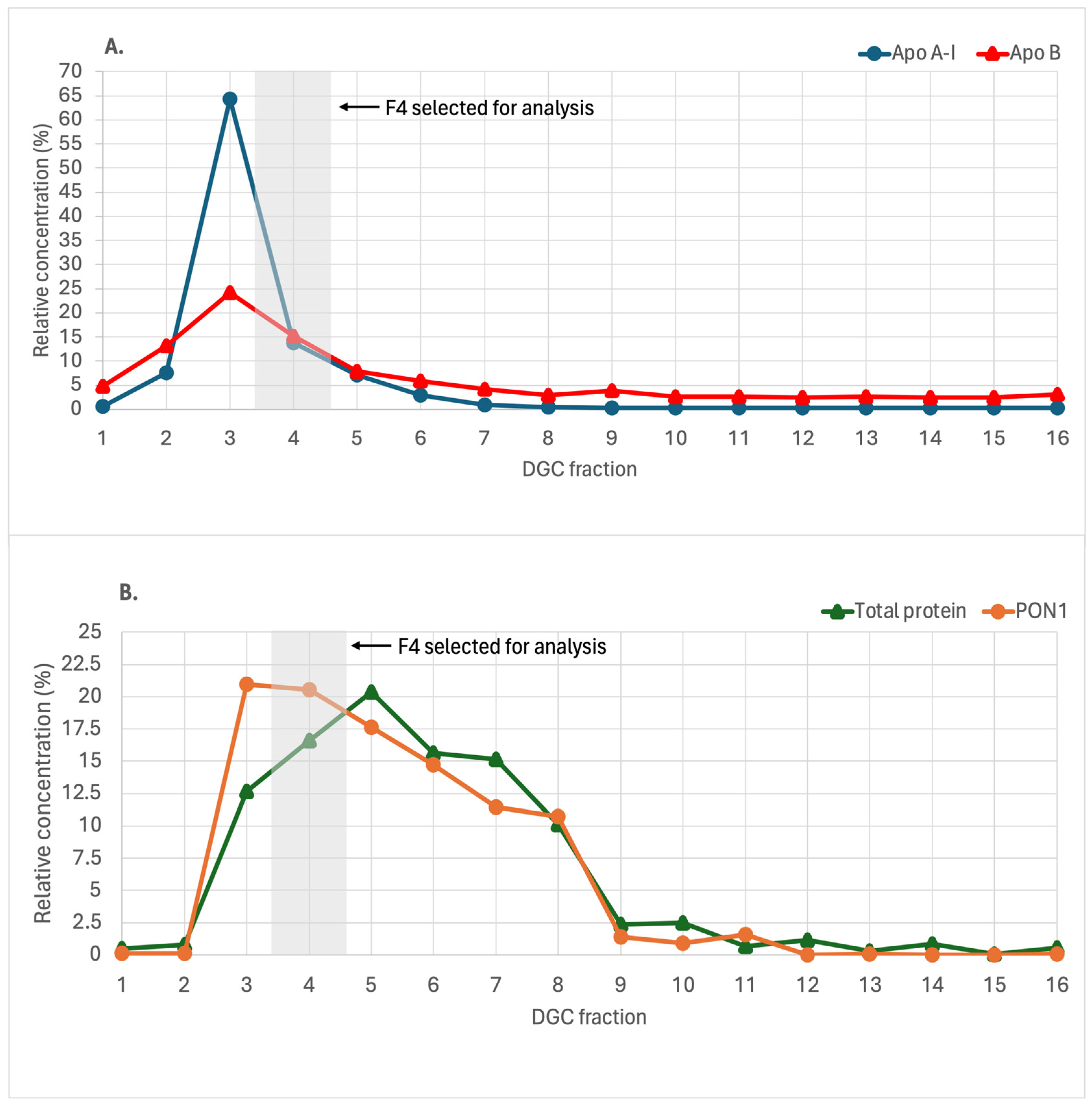
3.2. Protein Distributions in DGC Fractions
3.3. Clinical Variables Across Specific PON1 Activity Tertiles
3.4. Association Between Specific PON1 Activity and Demographic, Anthropometric, and Blood Pressure Measures
3.5. Association Between Specific PON1 Activity and Lipid Metabolism Parameters
3.6. Specific PON1 Activity Association with Atherogenic Lipid Metabolism Measures
4. Discussion
Supplementary Materials
Author Contributions
Funding
Institutional Review Board Statement
Informed Consent Statement
Data Availability Statement
Acknowledgments
Conflicts of Interest
Abbreviations
| Apo A-I | Apolipoprotein A-I |
| Apo B | Apolipoprotein B |
| Apo B/Apo A-I | Apolipoprotein B and apolipoprotein A-I ratio |
| BMI | Body Mass Index |
| CVD | Cardiovascular disease |
| DBP | Diastolic Blood Pressure |
| DGC | Density Gradient Centrifugation |
| FDR | False Discovery Rate |
| HDL | High-density lipoprotein |
| HDL-C | High-density lipoprotein cholesterol |
| LDL-C | Low-density lipoprotein cholesterol |
| Lp(a) | Lipoprotein(a) |
| MABP | Mean Arterial Blood Pressure |
| Non-HDL-C | Non-High-density lipoprotein cholesterol |
| pNP | p-nitrophenol |
| pNPA | p-nitrophenyl acetate |
| PON1 | Paraoxonase 1 |
| Rw Apo B | Risk-weighted Apolipoprotein B |
| SBP | Systolic Blood Pressure |
| TE | Tris-EDTA |
| TG | Triglycerides |
References
- OECD. The State of Cardiovascular Health in the European Union; OECD Publishing: Paris, France, 2025. [Google Scholar] [CrossRef]
- Higienos Institutas. Available online: https://www.hi.lt/naujienos/skelbiami-galutiniai-duomenys-apie-2024-m-mirusiu-lietuvos-gyventoju-mirties-priezastis/ (accessed on 2 April 2026).
- SCORE2 Working Group; ESC Cardiovascular Risk Collaboration. SCORE2 Risk Prediction Algorithms: New Models to Estimate 10-Year Risk of Cardiovascular Disease in Europe. Eur. Heart J. 2021, 42, 2439–2454. [Google Scholar] [CrossRef] [PubMed]
- Nowak, W.N.; Deng, J.; Ruan, X.Z.; Xu, Q. Reactive Oxygen Species Generation and Atherosclerosis. Arterioscler. Thromb. Vasc. Biol. 2017, 37, e41–e52. [Google Scholar] [CrossRef]
- Sniderman, A.D.; Navar, A.M.; Thanassoulis, G. Apolipoprotein B vs. Low-Density Lipoprotein Cholesterol and Non–High-Density Lipoprotein Cholesterol as the Primary Measure of Apolipoprotein B Lipoprotein-Related Risk: The Debate Is Over. JAMA Cardiol. 2022, 7, 257–258. [Google Scholar] [CrossRef]
- Mach, F.; Koskinas, K.C.; Roeters van Lennep, J.E.; Tokgözoğlu, L.; Badimon, L.; Baigent, C.; Benn, M.; Binder, C.J.; Catapano, A.L.; De Backer, G.G.; et al. 2025 Focused Update of the 2019 ESC/EAS Guidelines for the Management of Dyslipidaemias: Developed by the Task Force for the Management of Dyslipidaemias of the European Society of Cardiology (ESC) and the European Atherosclerosis Society (EAS). Eur. Heart J. 2025, 46, 4359–4378. [Google Scholar] [CrossRef]
- Koschinsky, M.L.; Boffa, M.B. Oxidized Phospholipid Modification of Lipoprotein(a): Epidemiology, Biochemistry and Pathophysiology. Atherosclerosis 2022, 349, 92–100. [Google Scholar] [CrossRef]
- Rehman, M.B.; Tudrej, B.V. Lipoprotein(a) and Risk-Weighted Apolipoprotein B: A Novel Metric for Atherogenic Risk. Lipids Health Dis. 2024, 23, 316. [Google Scholar] [CrossRef]
- Björnson, E.; Adiels, M.; Taskinen, M.-R.; Burgess, S.; Chapman, M.J.; Packard, C.J.; Borén, J. Lipoprotein(a) Is Markedly More Atherogenic than LDL: An Apolipoprotein B-Based Genetic Analysis. J. Am. Coll. Cardiol. 2024, 83, 385–395. [Google Scholar] [CrossRef]
- Holmes, M.V.; Asselbergs, F.W.; Palmer, T.M.; Drenos, F.; Lanktree, M.B.; Nelson, C.P.; Dale, C.E.; Padmanabhan, S.; Finan, C.; Swerdlow, D.I.; et al. Mendelian Randomization of Blood Lipids for Coronary Heart Disease. Eur. Heart J. 2015, 36, 539–550. [Google Scholar] [CrossRef] [PubMed]
- Richardson, T.G.; Sanderson, E.; Palmer, T.M.; Ala-Korpela, M.; Ference, B.A.; Smith, G.D.; Holmes, M.V. Evaluating the Relationship between Circulating Lipoprotein Lipids and Apolipoproteins with Risk of Coronary Heart Disease: A Multivariable Mendelian Randomisation Analysis. PLoS Med. 2020, 17, e1003062. [Google Scholar] [CrossRef] [PubMed]
- Kaur, N.; Pandey, A.; Negi, H.; Shafiq, N.; Reddy, S.; Kaur, H.; Chadha, N.; Malhotra, S. Effect of HDL-Raising Drugs on Cardiovascular Outcomes: A Systematic Review and Meta-Regression. PLoS ONE 2014, 9, e94585. [Google Scholar] [CrossRef]
- Ouyang, F.W.; Chiang, H.-H.; Hsu, W.-L.; Tsai, M.-H.; Huang, C.-Y.; Remaley, A.T.; Akyol, O.; Chen, C.-H. Dysfunctional High-Density Lipoprotein: An Updated Review. Front. Cardiovasc. Med. 2025, 12, 1713387. [Google Scholar] [CrossRef]
- von Eckardstein, A.; Nordestgaard, B.G.; Remaley, A.T.; Catapano, A.L. High-Density Lipoprotein Revisited: Biological Functions and Clinical Relevance. Eur. Heart J. 2022, 44, 1394–1407. [Google Scholar] [CrossRef]
- Durrington, P.N.; Bashir, B.; Soran, H. Paraoxonase 1 and Atherosclerosis. Front. Cardiovasc. Med. 2023, 10, 1065967. [Google Scholar] [CrossRef] [PubMed]
- Vavlukis, M.; Vavlukis, A.; Krsteva, K.; Topuzovska, S. Paraoxonase 1 Gene Polymorphisms in Lipid Oxidation and Atherosclerosis Development. Front. Genet. 2022, 13, 966413. [Google Scholar] [CrossRef] [PubMed]
- Ceron, J.J.; Tecles, F.; Tvarijonaviciute, A. Serum Paraoxonase 1 (PON1) Measurement: An Update. BMC Vet. Res. 2014, 10, 74. [Google Scholar] [CrossRef]
- Bhattacharyya, T.; Nicholls, S.J.; Topol, E.J.; Zhang, R.; Yang, X.; Schmitt, D.; Fu, X.; Shao, M.; Brennan, D.M.; Ellis, S.G.; et al. Relationship of Paraoxonase 1 (PON1) Gene Polymorphisms and Functional Activity with Systemic Oxidative Stress and Cardiovascular Risk. JAMA 2008, 299, 1265–1276. [Google Scholar] [CrossRef]
- Kawaguchi, R.; Miyakoshi, T.; Yoshimoto, A.; Hosoya, S.; Kugii, Y.; Sasaki, T.; Suzuki, N.; Ohkawa, R. Homocysteine Thiolactone Affects Paraoxonase 1 Activity via Altered Paraoxonase 1 Distribution on High-Density Lipoprotein Particles. Biosci. Rep. 2026, 46, BSR20253768. [Google Scholar] [CrossRef] [PubMed]
- Jakubowski, H. The Molecular Bases of Anti-Oxidative and Anti-Inflammatory Properties of Paraoxonase 1. Antioxidants 2024, 13, 1292. [Google Scholar] [CrossRef]
- Harman, N.L.; Griffin, B.A.; Davies, I.G. Separation of the Principal HDL Subclasses by Iodixanol Ultracentrifugation. J. Lipid Res. 2013, 54, 2273–2281. [Google Scholar] [CrossRef][Green Version]
- Webb, R.J.; Lodge, J.K.; Scott, S.S.; Davies, I.G. Metabolomic Characterisation of Low-Density Lipoproteins Isolated from Iodixanol and KBr-Based Density Gradient Ultracentrifugation. Metabolites 2025, 15, 68. [Google Scholar] [CrossRef]
- Lacroix, R.; Judicone, C.; Mooberry, M.; Boucekine, M.; Key, N.S.; Dignat-George, F. Standardization of Pre-Analytical Variables in Plasma Microparticle Determination: Results of the International Society on Thrombosis and Haemostasis SSC Collaborative Workshop. J. Thromb. Haemost. JTH 2013, 11, 1190–1193. [Google Scholar] [CrossRef]
- Obesity and Overweight. Available online: https://www.who.int/news-room/fact-sheets/detail/obesity-and-overweight (accessed on 17 March 2026).
- McEvoy, J.W.; McCarthy, C.P.; Bruno, R.M.; Brouwers, S.; Canavan, M.D.; Ceconi, C.; Christodorescu, R.M.; Daskalopoulou, S.S.; Ferro, C.J.; Gerdts, E.; et al. 2024 ESC Guidelines for the Management of Elevated Blood Pressure and Hypertension: Developed by the Task Force on the Management of Elevated Blood Pressure and Hypertension of the European Society of Cardiology (ESC) and Endorsed by the European Society of Endocrinology (ESE) and the European Stroke Organisation (ESO). Eur. Heart J. 2024, 45, 3912–4018. [Google Scholar]
- Grundy, S.M.; Cleeman, J.I.; Daniels, S.R.; Donato, K.A.; Eckel, R.H.; Franklin, B.A.; Gordon, D.J.; Krauss, R.M.; Savage, P.J.; Smith, S.C.; et al. Diagnosis and Management of the Metabolic Syndrome. Circulation 2005, 112, 2735–2752. [Google Scholar] [CrossRef] [PubMed]
- Tvarijonaviciute, A.; Tecles, F.; Caldin, M.; Tasca, S.; Cerón, J. Validation of Spectrophotometric Assays for Serum Paraoxonase Type-1 Measurement in Dogs. Am. J. Vet. Res. 2012, 73, 34–41. [Google Scholar] [CrossRef]
- Akoglu, H. User’s Guide to Correlation Coefficients. Turk. J. Emerg. Med. 2018, 18, 91–93. [Google Scholar] [CrossRef]
- Kunitake, S.T.; Kane, J.P. Factors Affecting the Integrity of High Density Lipoproteins in the Ultracentrifuge. J. Lipid Res. 1982, 23, 936–940. [Google Scholar] [CrossRef] [PubMed]
- Hafiane, A.; Genest, J. High Density Lipoproteins: Measurement Techniques and Potential Biomarkers of Cardiovascular Risk. BBA Clin. 2015, 3, 175–188. [Google Scholar] [CrossRef]
- Brennan, K.; Martin, K.; FitzGerald, S.P.; O’Sullivan, J.; Wu, Y.; Blanco, A.; Richardson, C.; Mc Gee, M.M. A Comparison of Methods for the Isolation and Separation of Extracellular Vesicles from Protein and Lipid Particles in Human Serum. Sci. Rep. 2020, 10, 1039. [Google Scholar] [CrossRef]
- Kulka, M. A Review of Paraoxonase 1 Properties and Diagnostic Applications. Pol. J. Vet. Sci. 2016, 19, 225–232. [Google Scholar] [CrossRef]
- Gugliucci, A.; Menini, T. Paraoxonase 1 and HDL Maturation. Clin. Chim. Acta 2015, 439, 5–13. [Google Scholar] [CrossRef] [PubMed]
- Djekic, S.; Vekic, J.; Zeljkovic, A.; Kotur-Stevuljevic, J.; Kafedzic, S.; Zdravkovic, M.; Ilic, I.; Hinic, S.; Cerovic, M.; Stefanovic, M.; et al. HDL Subclasses and the Distribution of Paraoxonase-1 Activity in Patients with ST-Segment Elevation Acute Myocardial Infarction. Int. J. Mol. Sci. 2023, 24, 9384. [Google Scholar] [CrossRef] [PubMed]
- Miljkovic, M.; Stefanovic, A.; Vekic, J.; Zeljkovic, A.; Gojkovic, T.; Simic-Ogrizovic, S.; Bogavac-Stanojevic, N.; Cerne, D.; Ilic, J.; Stefanovic, I.; et al. Activity of Paraoxonase 1 (PON1) on HDL2 and HDL3 Subclasses in Renal Disease. Clin. Biochem. 2018, 60, 52–58. [Google Scholar] [CrossRef]
- Rosenblat, M.; Karry, R.; Aviram, M. Paraoxonase 1 (PON1) Is a More Potent Antioxidant and Stimulant of Macrophage Cholesterol Efflux, When Present in HDL than in Lipoprotein-Deficient Serum: Relevance to Diabetes. Atherosclerosis 2006, 187, 74.e1–74.e10. [Google Scholar] [CrossRef]
- Taler-Verčič, A.; Goličnik, M.; Bavec, A. The Structure and Function of Paraoxonase-1 and Its Comparison to Paraoxonase-2 and -3. Molecules 2020, 25, 5980. [Google Scholar] [CrossRef]
- Henao, J.; Beltrán, L.; Loango, N.; Landázuri, P. Arylesterase Activity of Paraoxonase 1 (PON1) on HDL3 and HDL2: Relationship with Q192R, C-108T, and L55M Polymorphisms. Biochem. Biophys. Rep. 2021, 26, 100971. [Google Scholar] [CrossRef]
- Bains, Y.; Caccavello, R.; Kotani, K.; Gugliucci, A. Paraoxonase 1, HDL Subclasses and Post Surgery Acute Inflammation: A Pilot Study. Antioxidants 2019, 8, 192. [Google Scholar] [CrossRef]
- González, F.E.M.; Ponce-RuÍz, N.; Rojas-GarcÍa, A.E.; Bernal-Hernández, Y.Y.; Mackness, M.; Ponce-Gallegos, J.; Cardoso-Saldaña, G.; Jorge-Galarza, E.; Torres-Tamayo, M.; Medina-Díaz, I.M. PON1 Concentration and High-Density Lipoprotein Characteristics as Cardiovascular Biomarkers. Arch. Med. Sci. Atheroscler. Dis. 2019, 4, e47–e54. [Google Scholar] [CrossRef]
- Bhat, M.A.; Singh, J.; Lone, G.M.; Goyal, S. Association of Paraoxonase-1 (p.L55M) and Paraoxonase-2 (p.S311C) Polymorphisms with Coronary Artery Disease in North Indian Punjabi Population. Front. Endocrinol. 2025, 16, 319. [Google Scholar] [CrossRef]
- Trentini, A.; Bellini, T.; Bonaccorsi, G.; Cavicchio, C.; Hanau, S.; Passaro, A.; Cervellati, C. Sex Difference: An Important Issue to Consider in Epidemiological and Clinical Studies Dealing with Serum Paraoxonase-1. J. Clin. Biochem. Nutr. 2019, 64, 250–256. [Google Scholar] [CrossRef] [PubMed]
- Rosta, V.; Trentini, A.; Passaro, A.; Zuliani, G.; Sanz, J.M.; Bosi, C.; Bonaccorsi, G.; Bellini, T.; Cervellati, C. Sex Difference Impacts on the Relationship between Paraoxonase-1 (PON1) and Type 2 Diabetes. Antioxidants 2020, 9, 683. [Google Scholar] [CrossRef]
- Meisinger, C.; Freuer, D.; Bub, A.; Linseisen, J. Association between Inflammatory Markers and Serum Paraoxonase and Arylesterase Activities in the General Population: A Cross-Sectional Study. Lipids Health Dis. 2021, 20, 81. [Google Scholar] [CrossRef]
- Saxena, T.; Agarwal, B.K.; Sharma, V.K.; Naz, S. Paraoxonase Activity in Prehypertension and Its Relation to Oxidative Stress. Biomed. Pharmacol. J. 2015, 6, 389–394. [Google Scholar] [CrossRef]
- Longo, A.; Veiga, G.B.; Cousen, M.I.S.; Karpinski, C.; Schneider, A.; Weber, B.; Bertoldi, E.G.; Borges, L.R.; Bertacco, R.T.A. Factors Associated to Serum Paraoxonase 1 Activity in Patients with Cardiovascular Disease. Arch. Endocrinol. Metab. 2021, 65, 676–683. [Google Scholar] [CrossRef]
- Kwiatkowska, M.; Mickiewicz, A.; Krzesińska, A.; Kuchta, A.; Jankowski, M.; Gruchała, M.; Fijałkowski, M. The Role of Paraoxonase-1 Activity, Apolipoprotein B Levels, and Apolipoprotein B/Apolipoprotein A-I Ratio as Risk Markers for Aortic Stenosis in Patients with a Bicuspid Aortic Valve. Antioxidants 2025, 14, 167. [Google Scholar] [CrossRef]
- Shahsavari, G.; Nouryazdan, N.; Adibhesami, G.; Birjandi, M. Genetic Associations and Serum Paraoxonase Levels with Atherosclerosis in Western Iranian Patients. Mol. Biol. Rep. 2020, 47, 5137–5144. [Google Scholar] [CrossRef]
- de la Iglesia, R.; Mansego, M.L.; Sánchez-Muniz, F.J.; Zulet, M.A.; Martinez, J.A. Arylesterase Activity Is Associated with Antioxidant Intake and Paraoxonase-1 (PON1) Gene Methylation in Metabolic Syndrome Patients Following an Energy Restricted Diet. EXCLI J. 2014, 13, 416–426. [Google Scholar] [PubMed]
- Mehdi, M.M.; Rizvi, S.I. Human Plasma Paraoxonase 1 (PON1) Arylesterase Activity During Aging: Correlation with Susceptibility of LDL Oxidation. Arch. Med. Res. 2012, 43, 438–443. [Google Scholar] [CrossRef]
- Istratoaie, S.; Boroş, B.; Vesa, Ş.C.; Maria Pop, R.; Cismaru, G.; Pop, D.; Vasile Milaciu, M.; Ciumărnean, L.; Văcăraş, V.; Dana Buzoianu, A. Paraoxonase 1 and Atrial Fibrillation: Is There a Relationship? Medicine 2022, 101, e31553. [Google Scholar] [CrossRef]
- van der Valk, F.M.; Bekkering, S.; Kroon, J.; Yeang, C.; Van den Bossche, J.; van Buul, J.D.; Ravandi, A.; Nederveen, A.J.; Verberne, H.J.; Scipione, C.; et al. Oxidized Phospholipids on Lipoprotein(a) Elicit Arterial Wall Inflammation and an Inflammatory Monocyte Response in Humans. Circulation 2016, 134, 611–624. [Google Scholar] [CrossRef] [PubMed]
- Yeang, C.; Witztum, J.L.; Tsimikas, S. Novel Method for Quantification of Lipoprotein(a)-Cholesterol: Implications for Improving Accuracy of LDL-C Measurements. J. Lipid Res. 2021, 62, 100053. [Google Scholar] [CrossRef]
- Narasimhan, M.; Cao, J.; Meeusen, J.W.; Remaley, A.T.; Martin, S.S.; Muthukumar, A. Fatigued with Friedewald: Why Isn’t Everyone Onboard yet with the New LDL-C Equations? Front. Cardiovasc. Med. 2025, 12, 1534460. [Google Scholar] [CrossRef]
- Permpongpaiboon, T.; Nagila, A.; Pidetcha, P.; Tuangmungsakulchai, K.; Tantrarongroj, S.; Porntadavity, S. Decreased Paraoxonase 1 Activity and Increased Oxidative Stress in Low Lead–exposed Workers. Hum. Exp. Toxicol. 2011, 30, 1196–1203. [Google Scholar] [CrossRef]
- Zhang, J.; He, L. Relationship between Small Dense Low Density Lipoprotein and Cardiovascular Events in Patients with Acute Coronary Syndrome Undergoing Percutaneous Coronary Intervention. BMC Cardiovasc. Disord. 2021, 21, 169. [Google Scholar] [CrossRef] [PubMed]
- Sevanian, A.; Hwang, J.; Hodis, H.; Cazzolato, G.; Avogaro, P.; Bittolo-Bon, G. Contribution of an In Vivo Oxidized LDL to LDL Oxidation and Its Association With Dense LDL Subpopulations. Arterioscler. Thromb. Vasc. Biol. 1996, 16, 784–793. [Google Scholar] [CrossRef] [PubMed]
- Sniderman, A.D. ApoB vs Non-HDL-C vs LDL-C as Markers of Cardiovascular Disease. Clin. Chem. 2021, 67, 1440–1442. [Google Scholar] [CrossRef] [PubMed]


| Variable | Value (n = 100) |
|---|---|
| Demographic and anthropometric measures | |
| Age (years) | 52.0 (9.5) |
| Female sex, n (%) | 50 (50.0) |
| BMI (kg/m2) | 28.76 (7.63) |
| Waist circumference (cm) | 101.65 ± 13.84 |
| Blood pressure measures | |
| SBP (mmHg) | 137.00 (22.25) |
| DBP (mmHg) | 84.14 ± 10.57 |
| MABP (mmHg) | 101.17 (16.83) |
| Lipid metabolism measures | |
| Total cholesterol (mmol/L) | 5.73 ± 1.27 |
| LDL-C (mmol/L) | 3.61 ± 1.18 |
| HDL-C (mmol/L) | 1.34 (0.45) |
| Non-HDL-C (mmol/L) | 4.31 ± 1.22 |
| Triglycerides (mmol/L) | 1.35 (0.89) |
| Apo B (g/L) | 0.95 ± 0.25 |
| Apo A-I (g/L) | 1.65 (0.41) |
| Apo B/Apo A-I | 0.57 ± 0.18 |
| Lp(a) (nmol/L) | 18.45 (36.45) |
| Rw Apo B (µmol/L) | 2.11 (0.75) |
| PON1-related measures | |
| PON1 (ng/mL) | 8.69 (11.48) |
| PON1 activity (U/mL) | 0.08 ± 0.03 |
| Other characteristics | |
| Smoking status, n (%) | 50 (50.0) |
| Statin use, n (%) | 38 (38.0) |
| Hypertension, n (%) | 57 (57.0) |
| Diabetes mellitus, n (%) | 13 (13.0) |
| Metabolic Syndrome, n (%) | 50 (50.0) |
| Family history of CVD, n (%) | 40 (40.0) |
| Variable | T1 (n = 34) * | T2 (n = 33) * | T3 (n = 33) * | p-Value | q-Value | p-for Trend |
|---|---|---|---|---|---|---|
| Demographic and anthropometric measures | ||||||
| Age (years) | 52.0 (9.5) | 54.0 (6.0) | 52.0 (10.0) | 0.569 | 0.642 | 0.363 |
| Female sex, n (%) | 17 (50.0) | 14 (42.4) | 19 (57.6) | 0.469 | 0.642 | - |
| BMI (kg/m2) | 28.86 (6.70) | 29.40 (8.50) | 27.94 (7.60) | 0.390 | 0.642 | 0.716 |
| Waist circumference (cm) | 102.03 ± 13.32 | 104.52 ± 12.99 | 98.34 ± 14.89 | 0.214 | - | 0.288 |
| Blood pressure measures | ||||||
| SBP (mmHg) | 139.00 (21.50) | 137.00 (14.00) | 135.00 (29.00) | 0.652 | 0.642 | 0.185 |
| DBP (mmHg) | 84.03 ± 12.18 | 85.79 ± 9.70 | 82.61 ± 9.66 | 0.418 | - | 0.591 |
| MABP (mmHg) | 101.00 (18.83) | 103.33 (9.00) | 96.67 (15.67) | 0.478 | 0.642 | 0.327 |
| Lipid metabolism measures | ||||||
| Total cholesterol (mmol/L) | 5.94 ± 1.25 | 5.58 ± 1.36 | 5.65 ± 1.21 | 0.466 | - | 0.340 |
| LDL-C (mmol/L) | 3.97 ± 1.07 | 3.46 ± 1.22 | 3.41 ± 1.19 | 0.081 | - | 0.048 |
| HDL-C (mmol/L) | 1.31 (0.43) | 1.31 (0.35) | 1.42 (0.37) | 0.282 | 0.642 | 0.094 |
| Non-HDL-C (mmol/L) | 4.61 ± 1.08 | 4.18 ± 1.35 | 4.15 ± 1.22 | 0.199 | - | 0.127 |
| Triglycerides (mmol/L) | 1.29 (0.64) | 1.38 (0.99) | 1.36 (0.96) | 0.700 | 0.642 | 0.182 |
| Apo B (g/L) | 1.00 ± 0.22 | 0.93 ± 0.30 | 0.91 ± 0.23 | 0.258 | - | 0.152 |
| Apo A-I (g/L) | 1.61 (0.48) | 1.66 (0.37) | 1.77 (0.46) | 0.323 | 0.642 | 0.114 |
| Apo B/Apo A-I | 0.62 ± 0.15 | 0.56 ± 0.20 | 0.53 ± 0.17 | 0.101 | - | 0.052 |
| Lp(a) (nmol/L) | 25.95 (101.70) | 15.00 (24.20) | 13.50 (33.80) | 0.095 | 0.348 | 0.051 |
| Rw Apo B (µmol/L) | 2.31(0.82) | 2.02 (0.70) | 2.03 (0.69) | 0.023 | 0.127 | 0.015 |
| PON1-related measures | ||||||
| PON1 (ng/mL) | 25.10 (30.99) | 8.80 (5.52) | 5.46 (1.63) | <0.001 | <0.001 | <0.001 |
| PON1 activity (U/mL) | 0.05 ± 0.03 | 0.08 ± 0.02 | 0.10 ± 0.02 | <0.001 | - | <0.001 |
| Other characteristics | ||||||
| Smoking status, n (%) | 17 (50.0) | 15 (45.5) | 18 (54.5) | 0.761 | 0.761 | - |
| Statin use, n (%) | 11 (32.4) | 15 (45.5) | 12 (36.4) | 0.528 | 0.676 | - |
| Hypertension, n (%) | 17 (50.0) | 21 (63.6) | 19 (57.6) | 0.528 | 0.676 | - |
| Diabetes mellitus, n (%) | 2 (5.9) | 6 (18.2) | 5 (15.2) | 0.295 | 0.676 | - |
| Metabolic Syndrome, n (%) | 16 (47.1) | 19 (57.6) | 15 (45.5) | 0.563 | 0.676 | - |
| Family history of CVD, n (%) | 8 (23.5) | 16 (48.5) | 16 (48.5) | 0.054 | 0.324 | - |
| Variable | Spearman rs with Specific PON1 Activity (U/mg) | p-Value | q-Value |
|---|---|---|---|
| Demographic and anthropometric measures | |||
| Age (years) | −0.103 | 0.310 | 0.680 |
| BMI (kg/m2) | −0.061 | 0.548 | 0.658 |
| Waist circumference (cm) | −0.133 | 0.189 | 0.680 |
| Blood pressure measures | |||
| SBP (mmHg) | −0.089 | 0.377 | 0.680 |
| DBP (mmHg) | −0.042 | 0.680 | 0.680 |
| MABP (mmHg) | −0.070 | 0.491 | 0.680 |
| Variable | Spearman rs with Specific PON1 Activity (kU/mg) | p-Value | q-Value |
|---|---|---|---|
| Lipid metabolism measures | |||
| Total cholesterol (mmol/L) | −0.120 | 0.235 | 0.261 |
| LDL-C (mmol/L) | −0.225 | 0.025 | 0.083 |
| HDL-C (mmol/L) | 0.139 | 0.167 | 0.209 |
| Non-HDL-C (mmol/L) | −0.165 | 0.100 | 0.167 |
| Triglycerides (mmol/L) | 0.023 | 0.820 | 0.820 |
| Apo B (g/L) | −0.189 | 0.059 | 0.118 |
| Apo A-I (g/L) | 0.152 | 0.132 | 0.189 |
| Apo B/Apo A-I | −0.240 | 0.016 | 0.209 |
| Lp(a) (nmol/L) | −0.192 | 0.045 | 0.113 |
| Rw Apo B (nmol/L) | −0.287 | 0.004 | 0.040 |
| Dependent Variable | Model * | β [95% CI] *** | Adjusted R2 | p-Value | q-Value |
|---|---|---|---|---|---|
| Apo B (g/L) | Model 1 | −0.007 [−0.014; 0.000] | 0.025 | 0.064 | 0.069 |
| Model 2 | −0.007 [−0.014; 0.000] | 0.042 | 0.052 | 0.066 | |
| Model 3 | −0.007 [−0.014; 0.000] | 0.038 | 0.063 | 0.069 | |
| Model 4 | −0.006 [−0.013; 0.001] | 0.115 | 0.086 | 0.086 | |
| Apo B/Apo A-I | Model 1 | −0.006 [−0.011; −0.001] | 0.043 | 0.021 | 0.043 |
| Model 2 | −0.005 [−0.010; −0.001] | 0.163 | 0.023 | 0.043 | |
| Model 3 | −0.005 [−0.009; −0.000] | 0.205 | 0.036 | 0.058 | |
| Model 4 | −0.004 [−0.009; 0.000] | 0.238 | 0.051 | 0.066 | |
| ln (Rw Apo B) | Model 1 | −0.013 [−0.022; −0.004] | 0.071 | 0.004 | 0.032 |
| Model 2 | −0.014 [−0.022; −0.005] | 0.075 | 0.003 | 0.032 | |
| Model 3 | −0.013 [−0.022; −0.004] | 0.067 | 0.004 | 0.032 | |
| Model 4 | −0.012 [−0.021; −0.004] | 0.101 | 0.006 | 0.034 | |
| LDL-C (mmol/L) | Model 1 | −0.038 [−0.071; −0.006] | 0.053 | 0.021 | 0.043 |
| Model 2 | −0.042 [−0.074; −0.009] | 0.082 | 0.013 | 0.033 | |
| Model 3 | −0.045 [−0.077; −0.012] | 0.110 | 0.007 | 0.034 | |
| Model 4 | −0.041 [−0.071; −0.010] | 0.230 | 0.010 | 0.040 | |
| Non-HDL-C (mmol/L) | Model 1 | −0.032 [−0.066; 0.002] | 0.024 | 0.066 | 0.069 |
| Model 2 | −0.035 [−0.069; −0.001] | 0.040 | 0.045 | 0.064 | |
| Model 3 | −0.035 [−0.070; −0.001] | 0.030 | 0.045 | 0.064 | |
| Model 4 | −0.031 [−0.063; 0.002] | 0.146 | 0.064 | 0.079 | |
| ln (Lp(a)) ** | Model 1 | −0.039 [−0.074; −0.003] | 0.032 | 0.034 | 0.058 |
| Model 2 | −0.043 [−0.078; −0.008] | 0.040 | 0.016 | 0.043 | |
| Model 3 | −0.044 [−0.079; −0.009] | 0.032 | 0.015 | 0.043 | |
| Model 4 | −0.042 [−0.078; −0.006] | 0.030 | 0.023 | 0.043 |
Disclaimer/Publisher’s Note: The statements, opinions and data contained in all publications are solely those of the individual author(s) and contributor(s) and not of MDPI and/or the editor(s). MDPI and/or the editor(s) disclaim responsibility for any injury to people or property resulting from any ideas, methods, instructions or products referred to in the content. |
© 2026 by the authors. Licensee MDPI, Basel, Switzerland. This article is an open access article distributed under the terms and conditions of the Creative Commons Attribution (CC BY) license.
Share and Cite
Černiauskas, L.; Palšytė, V.; Aleknavičiūtė, G.; Mazgelytė, E.; Bikulčienė, I.; Badarienė, J.; Rinkūnienė, E.; Arbačiauskaitė, S.; Allelein, S.; Karčiauskaitė, D. HDL-Associated Specific Paraoxonase-1 Activity Is Linked to Atherogenic Lipoprotein Measures in a High Cardiovascular Risk Population: A Cross-Sectional Study. Antioxidants 2026, 15, 731. https://doi.org/10.3390/antiox15060731
Černiauskas L, Palšytė V, Aleknavičiūtė G, Mazgelytė E, Bikulčienė I, Badarienė J, Rinkūnienė E, Arbačiauskaitė S, Allelein S, Karčiauskaitė D. HDL-Associated Specific Paraoxonase-1 Activity Is Linked to Atherogenic Lipoprotein Measures in a High Cardiovascular Risk Population: A Cross-Sectional Study. Antioxidants. 2026; 15(6):731. https://doi.org/10.3390/antiox15060731
Chicago/Turabian StyleČerniauskas, Linas, Viktorija Palšytė, Goda Aleknavičiūtė, Eglė Mazgelytė, Inga Bikulčienė, Jolita Badarienė, Egidija Rinkūnienė, Skaistė Arbačiauskaitė, Susann Allelein, and Dovilė Karčiauskaitė. 2026. "HDL-Associated Specific Paraoxonase-1 Activity Is Linked to Atherogenic Lipoprotein Measures in a High Cardiovascular Risk Population: A Cross-Sectional Study" Antioxidants 15, no. 6: 731. https://doi.org/10.3390/antiox15060731
APA StyleČerniauskas, L., Palšytė, V., Aleknavičiūtė, G., Mazgelytė, E., Bikulčienė, I., Badarienė, J., Rinkūnienė, E., Arbačiauskaitė, S., Allelein, S., & Karčiauskaitė, D. (2026). HDL-Associated Specific Paraoxonase-1 Activity Is Linked to Atherogenic Lipoprotein Measures in a High Cardiovascular Risk Population: A Cross-Sectional Study. Antioxidants, 15(6), 731. https://doi.org/10.3390/antiox15060731