Modern Trends in Alternative Proteins and Processing Technologies for Sustainable Food Systems with Antioxidant Implications
 ,
,  , ,
, ,  , , and
Abstract
1. Introduction
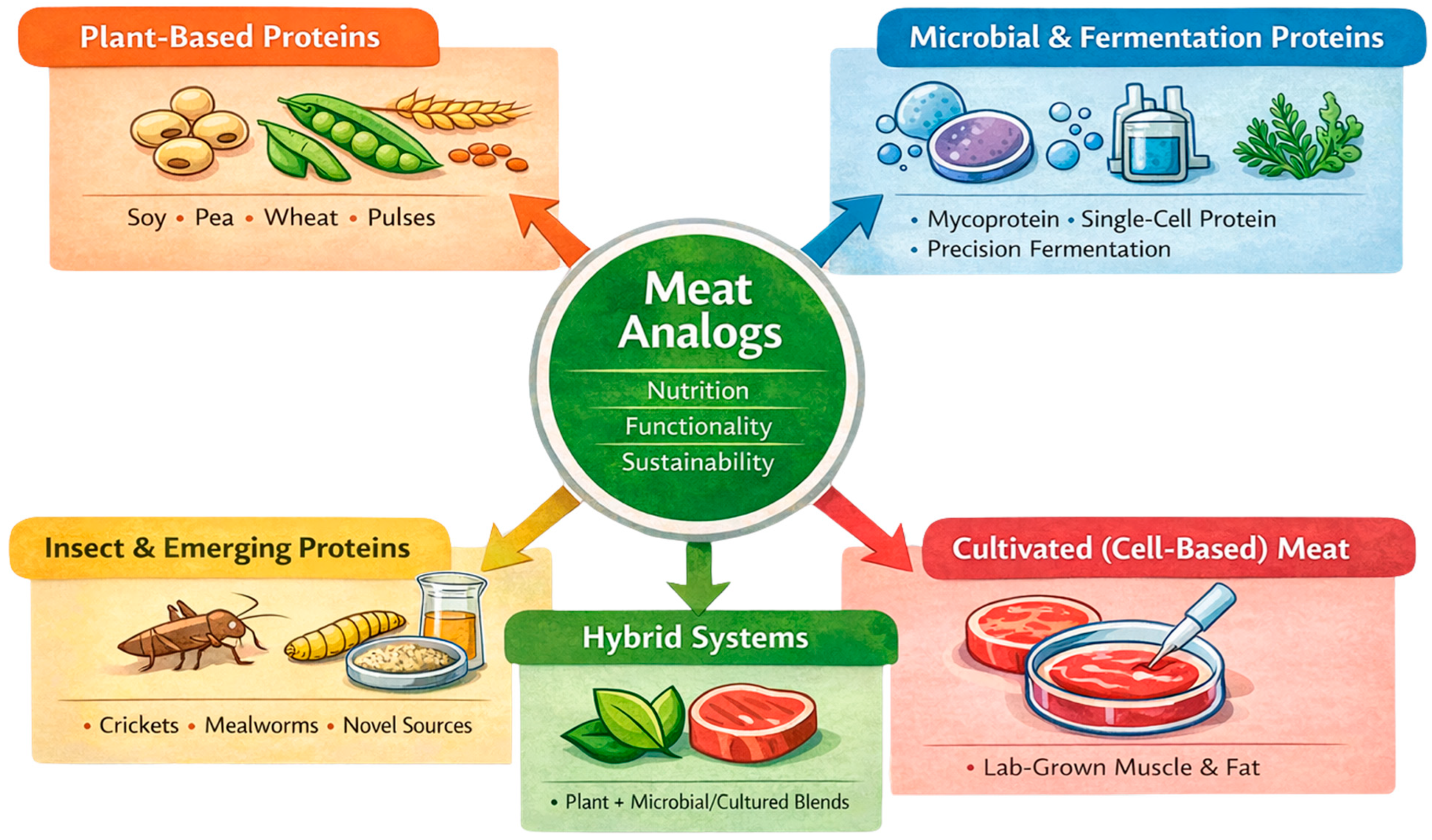
2. Alternative Protein Sources for Sustainable Food Systems

| Protein Source | Texture Potential | Flavor Contribution | Industrial Scalability | Key Limitation | Best Application | References |
|---|---|---|---|---|---|---|
| Plant proteins | Moderate to high | Neutral/beany | Very high | Allergenicity | Base matrix | [31] |
| Microbial proteins | High (fibrous) | Umami | Medium | Cost | Hybrid systems | [32] |
| Fermentation proteins | Low | Strong flavor | Medium | Regulatory | Flavor enhancers | [33] |
| Insect proteins | Moderate | Nutty | Low | Acceptance | Protein enrichment | [34] |
| Cultivated meat | Very high | Authentic | Low | Cost/scale | Hybrid premium | [35] |
| Hybrid proteins | High | Balanced | High | Formulation complexity | Commercial products | [28] |
2.1. Plant-Based Protein Ingredients
2.2. Microbial and Fermentation-Derived Proteins
2.3. Insect and Other Emerging Protein Sources
2.4. Cultivated (Cell-Based) Meat and Hybrid Products
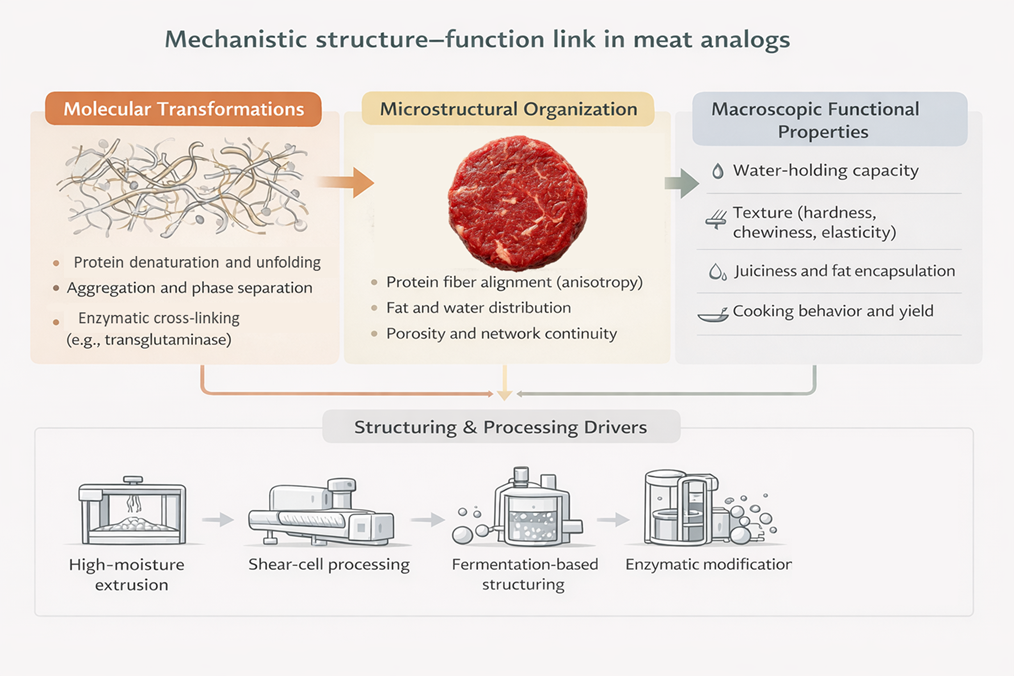
3. Modern Structuring and Processing Technologies
3.1. Spinning and Fiber Forming Methods
3.2. Innovative Thermal and Non-Thermal Technology
3.3. Structuring Approaches Based on Shear and Advanced Ones
3.4. 3D Printing
3.5. Fermentation and Enzymatic Modification as Structuring Means
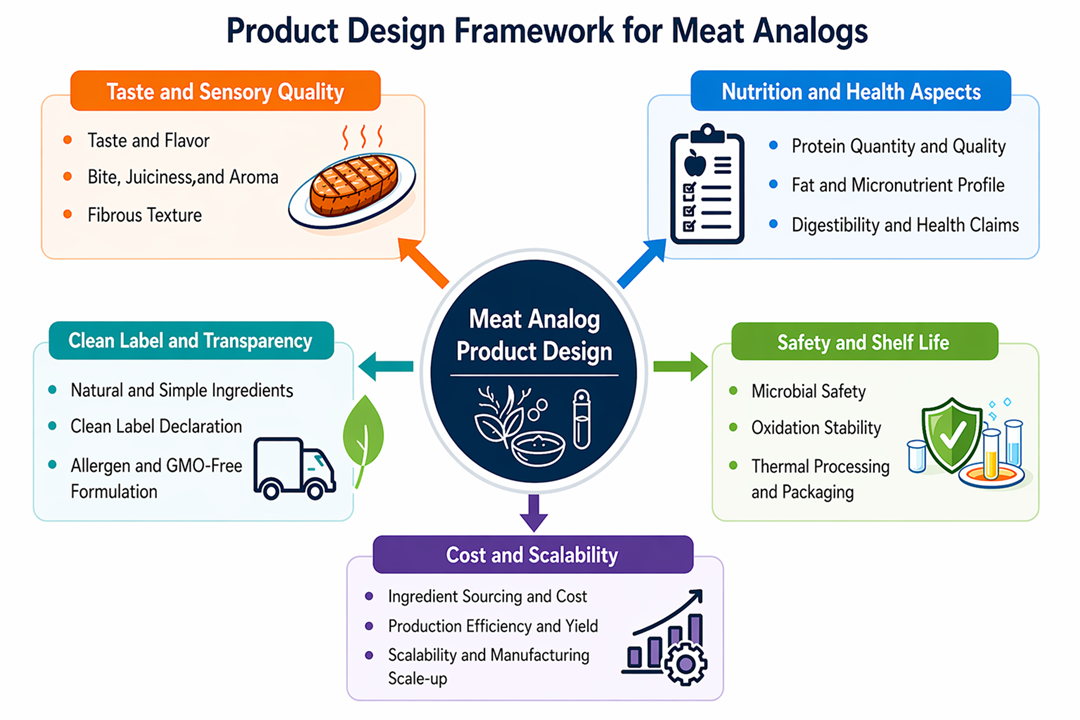
4. Product Design and Quality of Meat Analogs
4.1. Physicochemical and Structural Characteristics
4.2. Sensory Properties and Consumer Perception
4.3. Nutritional Quality and Health
4.4. Safety, Shelf Life, and Packaging Issues
4.5. Lipid Oxidation and Antioxidant Strategies in Meat Analogs
4.6. Antioxidant Potential of Alternative Protein Sources
4.6.1. Plant-Based Proteins as Polyphenol-Rich Antioxidant Sources
4.6.2. Microbial Proteins: Engineered Antioxidant Sources
4.6.3. Insect Proteins: Emerging Sources of Antioxidant Peptides
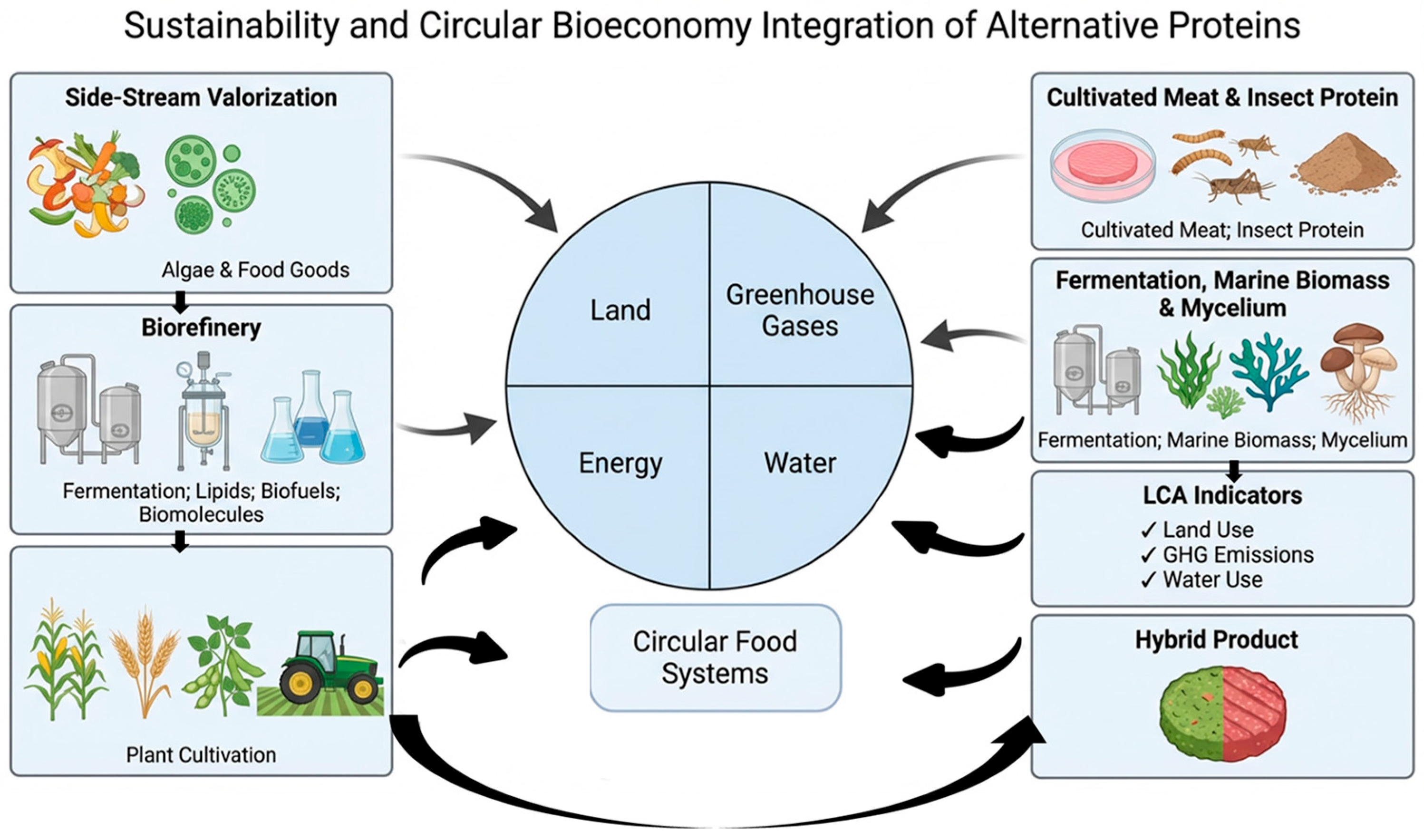
5. Sustainability, Circularity, and Systems Perspective
5.1. Environmental Impacts and Life Cycle Assessment
5.2. Circular and Regenerative Food System Integration
5.3. Socioeconomic, Ethical and Regulatory Dimensions
6. Challenges, Knowledge Gaps, and Future Directions
6.1. Technological and Scale-Up Challenges
6.2. Multi-Criteria Optimization of Next-Generation Products
6.3. Research Priorities and Research Roadmap
7. Conclusions
Author Contributions
Funding
Institutional Review Board Statement
Informed Consent Statement
Data Availability Statement
Acknowledgments
Conflicts of Interest
References
- Nirmal, N.; Anyimadu, C.F.; Khanashyam, A.C.; Bekhit, A.E.d.A.; Dhar, B.K. Alternative protein sources: Addressing global food security and environmental sustainability. Sustain. Dev. 2025, 33, 3958–3969. [Google Scholar] [CrossRef] [Scilit]
- Acosta, A. World livestock: Transforming the livestock sector through the sustainable development goals. In World Livestock: Transforming the Livestock Sector Through the Sustainable Development Goals; Food and Agriculture Organization of the United Nations: Rome, Italy, 2018. [Google Scholar]
- Samad, A.; Kim, S.-H.; Kim, C.-J.; Lee, E.-Y.; Kumari, S.; Hossain, M.J.; Alam, A.N.; Muazzam, A.; Hwang, Y.-H.; Joo, S.-T. From farms to labs: The new trend of sustainable meat alternatives. Food Sci. Anim. Resour. 2025, 45, 13. [Google Scholar] [CrossRef] [Scilit] [PubMed]
- Bakhsh, A.; Lee, E.-Y.; Bakry, A.M.; Rathnayake, D.; Son, Y.-M.; Kim, S.-W.; Hwang, Y.-H.; Joo, S.-T. Synergistic effect of lactoferrin and red yeast rice on the quality characteristics of novel plant-based meat analog patties. LWT 2022, 171, 114095. [Google Scholar] [CrossRef] [Scilit]
- Samad, A.; Kumari, S.; Hossain, M.J.; Alam, A. Recent market analysis of plant protein-based meat alternatives and future prospect. J. Anim. Plant Sci. 2024, 34, 781. [Google Scholar] [CrossRef] [Scilit]
- Muazzam, A.; Samad, A.; Alam, A.N.; Hwang, Y.-H.; Joo, S.-T. Microbial Proteins: A Green Approach Towards Zero Hunger. Foods 2025, 14, 2636. [Google Scholar] [CrossRef] [Scilit]
- Krawczyk, A.; Fernández-López, J.; Zimoch-Korzycka, A. Insect protein as a component of meat analogue burger. Foods 2024, 13, 1806. [Google Scholar] [CrossRef] [Scilit]
- Samad, A.; Kim, S.; Kim, C.J.; Lee, E.-Y.; Kumari, S.; Hossain, M.J.; Alam, A.N.; Muazzam, A.; Bilal, U.; Hwang, Y.-H. Revolutionizing cell-based protein: Innovations, market dynamics, and future prospects in the cultivated meat industry. J. Agric. Food Res. 2024, 18, 101345. [Google Scholar] [CrossRef] [Scilit]
- Alam, A.N.; Kim, C.-J.; Kim, S.-H.; Kumari, S.; Lee, S.-Y.; Hwang, Y.-H.; Joo, S.-T. Trends in hybrid cultured meat manufacturing technology to improve sensory characteristics. Food Sci. Anim. Resour. 2024, 44, 39. [Google Scholar] [CrossRef] [Scilit]
- Samad, A.; Alam, A.N.; Kumari, S.; Hossain, M.J.; Lee, E.-Y.; Hwang, Y.-H.; Joo, S.-T. Modern concepts of restructured meat production and market opportunities. Food Sci. Anim. Resour. 2024, 44, 284. [Google Scholar] [CrossRef] [Scilit]
- Grossmann, L.; Weiss, J. Alternative protein sources as technofunctional food ingredients. Annu. Rev. Food Sci. Technol. 2021, 12, 93–117. [Google Scholar] [CrossRef] [Scilit]
- Varayil, H.; Meena, D.; Mitra, J. Plant-Based Foods: Advanced Structuring Techniques. In Structured Foods; CRC Press: Boca Raton, FL, USA, 2024; pp. 45–63. [Google Scholar]
- Schmid, E.M.; Farahnaky, A.; Adhikari, B.; Torley, P.J. High moisture extrusion cooking of meat analogs: A review of mechanisms of protein texturization. Compr. Rev. Food Sci. Food Saf. 2022, 21, 4573–4609. [Google Scholar] [CrossRef] [Scilit]
- Sägesser, C.; Mair, T.; Braun, A.; Dumpler, J.; Fischer, P.; Mathys, A. Application of a shear cell for the simulation of extrusion to test the structurability of raw materials. Food Hydrocoll. 2025, 160, 110736. [Google Scholar] [CrossRef] [Scilit]
- Kim, J.-H.; Choi, Y.-J.; Kim, Y.-J.; Cha, J.Y.; Kim, T.-K.; Kim, D.-H.; Choi, Y.-S. Effect of ultra-high pressure treatment on the physico-chemical properties of emulsified meat analogs. Food Sci. Biotechnol. 2025, 34, 2489–2496. [Google Scholar] [CrossRef] [Scilit] [PubMed]
- Jung, A.H.; Hwang, J.H.; Jun, S.; Park, S.H. Application of ohmic cooking to produce a soy protein-based meat analogue. LWT 2022, 160, 113271. [Google Scholar] [CrossRef] [Scilit]
- Guo, L.; Nie, X.-M.; Yang, Y.-H.; Ren, Y.; Ding, X.; Qian, J.-Y. Using electric field to modify wet gluten as meat analogue material: A comparative study between pulsed and direct current electric fields. Innov. Food Sci. Emerg. Technol. 2023, 84, 103300. [Google Scholar] [CrossRef] [Scilit]
- Bhuiyan, M.H.R.; Yeasmen, N.; Orsat, V. Plant-proteins based 3D meat analog printing: A review. Food Chem. 2025, 482, 144157. [Google Scholar] [CrossRef] [Scilit] [PubMed]
- Rice, D.; Singh, R.; Priya, H.; Valerozo, J.; Anal, A.K. Transforming plant-based alternatives by harnessing precision fermentation for next-generation ingredients. J. Sci. Food Agric. 2025, 105, 6296–6305. [Google Scholar] [CrossRef] [Scilit]
- Kiokias, S.; Gordon, M.H.; Oreopoulou, V. Effects of composition and processing variables on the oxidative stability of protein-based and oil-in-water food emulsions. Crit. Rev. Food Sci. Nutr. 2017, 57, 549–558. [Google Scholar] [CrossRef] [Scilit] [PubMed]
- Al-Shibli, M.A.; Al-Ali, R.M.; Hashim, A.Z.; Altemimi, A.B.; Elsayed, N.; Abedelmaksoud, T.G. Evaluation of meat and meat product oxidation and off-flavor formation: Managing oxidative changes. Theory and Practice of Meat Processing 2023, 8, 302–315. [Google Scholar] [CrossRef] [Scilit]
- Gulzar, S.; Hosseini, A.F.; Martín-Belloso, O.; Soliva-Fortuny, R.; Rizvi, S.S. Engineering Processes for Plant-Based Meat Analogs: Current Status and Future Outlook. Compr. Rev. Food Sci. Food Saf. 2025, 24, e70322. [Google Scholar] [CrossRef] [Scilit]
- Isleroglu, H. Processing Technologies for Plant Protein Products. In The Future of Plant Protein: Innovations, Challenges, and Opportunities; Springer: Berlin, Germany, 2025; pp. 121–162. [Google Scholar]
- Sharifian, P.; Amiri, A.; McClements, D.J.; Kubiak, M.; Favaro, L.; Maggo, S.; Singh, A.; Pratap-Singh, A. Single-cell proteins: Fermentation pathways, nutritional quality and digestibility, and a techno-economic and environmental outlook for sustainable scale-up. Crit. Rev. Food Sci. Nutr. 2025, 65, 1–29. [Google Scholar] [CrossRef] [Scilit]
- Rout, S.; Srivastav, P.P. Recent trends in the production of proteins by precision fermentation for improving the quality and attributes of food: Role of genetic engineering towards next generation of food production. Microbe 2025, 8, 100551. [Google Scholar] [CrossRef] [Scilit]
- Lisboa, H.M.; Andrade, R.; Lima, J.; Batista, L.; Costa, M.E.; Sarinho, A.; Pasquali, M.B. Harnessing insects as novel food ingredients: Nutritional, functional, and processing perspectives. Insects 2025, 16, 783. [Google Scholar] [CrossRef] [Scilit] [PubMed]
- Khan, I.; Sun, J.; Liang, W.; Li, R.; Cheong, K.-L.; Qiu, Z.; Xia, Q. Innovations, Challenges, and Regulatory Pathways in Cultured Meat for a Sustainable Future. Foods 2025, 14, 3183. [Google Scholar] [CrossRef] [Scilit]
- Kaplan, D.L.; McClements, D.J. Hybrid alternative protein-based foods: Designing a healthier and more sustainable food supply. Front. Sci. 2025, 3, 1599300. [Google Scholar] [CrossRef] [Scilit]
- Alasi, S.O.; Sanusi, M.S.; Sunmonu, M.O.; Odewole, M.M.; Adepoju, A.L. Exploring recent developments in novel technologies and AI integration for plant-based protein functionality: A review. J. Agric. Food Res. 2024, 15, 101036. [Google Scholar] [CrossRef] [Scilit]
- Singh, R.; Ktil, N.; Park, Y.-L.; Shen, C.; Matak, K.E.; Jaczynski, J. Lipids from Insects: Extraction, Identification, and Characterization. In Edible Insects; CRC Press: Boca Raton, FL, USA, 2026; pp. 171–188. [Google Scholar]
- Gasparre, N.; van den Berg, M.; Oosterlinck, F.; Sein, A. High-moisture shear processes: Molecular changes of wheat gluten and potential plant-based proteins for its replacement. Molecules 2022, 27, 5855. [Google Scholar] [CrossRef] [Scilit]
- Nath, S. Integration of microbial proteins into traditional food systems: Innovations, challenges, and future perspectives. Food Rev. Int. 2025, 42, 1532–1557. [Google Scholar] [CrossRef] [Scilit]
- Hilgendorf, K.; Wang, Y.; Miller, M.J.; Jin, Y.-S. Precision fermentation for improving the quality, flavor, safety, and sustainability of foods. Curr. Opin. Biotechnol. 2024, 86, 103084. [Google Scholar] [CrossRef] [Scilit]
- Kowalski, S.; Oracz, J.; Skotnicka, M.; Mikulec, A.; Gumul, D.; Mickowska, B.; Mazurek, A.; Sabat, R.; Wywrocka-Gurgul, A.; Żyżelewicz, D. Chemical composition, nutritional value, and acceptance of nut bars with the addition of edible insect powder. Molecules 2022, 27, 8472. [Google Scholar] [CrossRef] [Scilit]
- Bakhsh, A.; Kim, B.; Ishamri, I.; Choi, S.; Li, X.; Li, Q.; Hur, S.J.; Park, S. Cell-based meat safety and regulatory approaches: A comprehensive Review. Food Sci. Anim. Resour. 2025, 45, 145. [Google Scholar] [CrossRef] [Scilit]
- Baig, M.A.; Ajayi, F.F.; Hamdi, M.; Baba, W.; Brishti, F.H.; Khalid, N.; Zhou, W.; Maqsood, S. Recent research advances in meat analogues: A comprehensive review on production, protein sources, quality attributes, analytical techniques used, and consumer perception. Food Rev. Int. 2025, 41, 236–267. [Google Scholar] [CrossRef] [Scilit]
- Benković, M.; Jurinjak Tušek, A.; Sokač Cvetnić, T.; Jurina, T.; Valinger, D.; Gajdoš Kljusurić, J. An overview of ingredients used for plant-based meat analogue production and their influence on structural and textural properties of the final product. Gels 2023, 9, 921. [Google Scholar] [CrossRef] [Scilit]
- Riley, W.W. Plant proteins. In Alternative Proteins; CRC Press: Boca Raton, FL, USA, 2022; pp. 17–47. [Google Scholar]
- Liu, J.; Klebach, M.; Visser, M.; Hofman, Z. Amino acid availability of a dairy and vegetable protein blend compared to single casein, whey, soy, and pea proteins: A double-blind, cross-over trial. Nutrients 2019, 11, 2613. [Google Scholar] [CrossRef] [Scilit]
- Ogrodowczyk, A.M.; Drabińska, N. Crossroad of tradition and innovation—The application of lactic acid fermentation to increase the nutritional and health-promoting potential of plant-based food products—A review. Pol. J. Food Nutr. Sci. 2021, 71, 107–134. [Google Scholar]
- De Angelis, D.; Latrofa, V.; Caponio, F.; Pasqualone, A.; Summo, C. Techno-functional properties of dry-fractionated plant-based proteins and application in food product development. J. Sci. Food Agric. 2023, 104, 1884–1896. [Google Scholar] [CrossRef] [Scilit] [PubMed]
- Xu, S.; Falsafi, S.R. Juiciness of meat, meat products, and meat analogues: Definition, evaluation methods, and influencing factors. Food Rev. Int. 2024, 40, 2344–2377. [Google Scholar] [CrossRef] [Scilit]
- Peng, Y.; Zhao, D.; Li, M.; Wen, X.; Ni, Y. The interactions of soy protein and wheat gluten for the development of meat-like fibrous structure. Molecules 2023, 28, 7431. [Google Scholar] [CrossRef] [Scilit] [PubMed]
- Mioduszewski, Ł; Cieplak, M. Viscoelastic properties of wheat gluten in a molecular dynamics study. PLoS Comput. Biol. 2021, 17, e1008840. [Google Scholar] [CrossRef] [Scilit]
- Schreuders, F.K.; Dekkers, B.L.; Bodnár, I.; Erni, P.; Boom, R.M.; van der Goot, A.J. Comparing structuring potential of pea and soy protein with gluten for meat analogue preparation. J. Food Eng. 2019, 261, 32–39. [Google Scholar] [CrossRef] [Scilit]
- Finnigan, T.J.; Wall, B.T.; Wilde, P.J.; Stephens, F.B.; Taylor, S.L.; Freedman, M.R. Mycoprotein: The future of nutritious nonmeat protein, a symposium review. Curr. Dev. Nutr. 2019, 3, nzz021. [Google Scholar] [CrossRef] [Scilit]
- Matassa, S.; Boon, N.; Pikaar, I.; Verstraete, W. Microbial protein: Future sustainable food supply route with low environmental footprint. Microb. Biotechnol. 2016, 9, 568–575. [Google Scholar] [CrossRef] [Scilit] [PubMed]
- Coronel-León, J.; Maza, D.; García-Álvarez de Toledo, I.; Jofré, A.; Martín, B.; Serra, X.; Bover-Cid, S. Fermentation technologies to produce and improve alternative protein sources. Foods 2025, 15, 117. [Google Scholar] [CrossRef] [Scilit] [PubMed]
- Augustin, M.A.; Hartley, C.J.; Maloney, G.; Tyndall, S. Innovation in precision fermentation for food ingredients. Crit. Rev. Food Sci. Nutr. 2024, 64, 6218–6238. [Google Scholar] [CrossRef] [Scilit] [PubMed]
- Fernández-Varela, R.; Hansen, A.H.; Svendsen, B.A.; Moghadam, E.G.; Bas, A.; Kračun, S.K.; Harlé, O.; Poulsen, V.K. Harnessing fermentation by Bacillus and lactic acid bacteria for enhanced texture, flavor, and nutritional value in plant-based matrices. Fermentation 2024, 10, 411. [Google Scholar] [CrossRef] [Scilit]
- Boukid, F.; Fanari, F.; Mefleh, M. Plant-based fermented foods and microbial ingredients in meat analogs. In Handbook of Plant-Based Meat Analogs; Elsevier: Amsterdam, The Netherlands, 2024; pp. 169–186. [Google Scholar]
- Verni, M.; Pontonio, E.; Montemurro, M.; Giuseppe Rizzello, C. Fermentation as strategy for improving nutritional, functional, technological, and sensory properties of legumes. In Legumes Research-Volume 2; IntechOpen: Landon, UK, 2022. [Google Scholar]
- Malila, Y.; Owolabi, I.O.; Chotanaphuti, T.; Sakdibhornssup, N.; Elliott, C.T.; Visessanguan, W.; Karoonuthaisiri, N.; Petchkongkaew, A. Current challenges of alternative proteins as future foods. npj Sci. Food 2024, 8, 53. [Google Scholar] [CrossRef] [Scilit]
- Nesic, K.; Zagon, J. Insects–a promising feed and food protein source? Sci. J. Meat Technol. 2019, 60, 56–67. [Google Scholar] [CrossRef] [Scilit]
- Thrastardottir, R.; Olafsdottir, H.T.; Thorarinsdottir, R.I. Yellow mealworm and black soldier fly larvae for feed and food production in Europe, with emphasis on Iceland. Foods 2021, 10, 2744. [Google Scholar] [CrossRef] [Scilit]
- Rojas, L.F.; Restrepo, M.I. Proteins and enzymes production from agri-food waste: A sustainable route for industrial products. In Microbial Cell Factories in Food Waste Biorefinery; Elsevier: Amsterdam, The Netherlands, 2026; pp. 227–250. [Google Scholar]
- Ahmad, T.; Esposito, F.; Cirillo, T. Valorization of agro-food by-products: Advancing sustainability and sustainable development goals 2030 through functional compounds recovery. Food Biosci. 2024, 62, 105194. [Google Scholar] [CrossRef] [Scilit]
- Samad, A.; Muazzam, A.; Alam, A.N.; Hwang, Y.-H.; Joo, S.-T. Synergistic Effects of mTG-Induced Protein Crosslinking and Methyl Cellulose Polymer in Modulating the Quality Parameters of Hybrid Meat Patties. Appl. Sci. 2026, 16, 1187. [Google Scholar] [CrossRef] [Scilit]
- Meijer, G.W.; Lähteenmäki, L.; Stadler, R.H.; Weiss, J. Issues surrounding consumer trust and acceptance of existing and emerging food processing technologies. Crit. Rev. Food Sci. Nutr. 2021, 61, 97–115. [Google Scholar] [CrossRef] [Scilit]
- Ng’ang’a, J.; Fombong, F.; Kiiru, S.; Kipkoech, C.; Kinyuru, J. Food safety concerns in edible grasshoppers: A review of microbiological and heavy metal hazards. Int. J. Trop. Insect Sci. 2021, 41, 2103–2111. [Google Scholar] [CrossRef] [Scilit]
- Precup, G.; Ververis, E.; Azzollini, D.; Rivero-Pino, F.; Zakidou, P.; Germini, A. The safety assessment of insects and products thereof as novel foods in the European Union. In Novel Foods and Edible Insects in the European Union: An Interdisciplinary Analysis; Springer: Berlin, Germany, 2022; pp. 123–146. [Google Scholar]
- Onwezen, M.C.; Bouwman, E.P.; Reinders, M.J.; Dagevos, H. A systematic review on consumer acceptance of alternative proteins: Pulses, algae, insects, plant-based meat alternatives, and cultured meat. Appetite 2021, 159, 105058. [Google Scholar] [CrossRef] [Scilit]
- Hussain, M.A.; Li, L. Novel proteins for future foods: Current status, challenges, and perspectives. Foods 2025, 14, 862. [Google Scholar] [CrossRef] [Scilit] [PubMed]
- Mujawar, N.K.; Kumbhar, P.S. Risk Assessment of the Cultured Meat. In Innovative Technologies for Meat Processing; CRC Press: Boca Raton, FL, USA, 2025; pp. 150–169. [Google Scholar]
- Gil, M.; Rudy, M.; Duma-Kocan, P.; Stanisławczyk, R.; Dziki, D. Nutritional, Ethical and Ecological Aspects of Cultured Meat with Particular Emphasis on Functional Food Production: A Comprehensive Literature Review. Foods 2026, 15, 891. [Google Scholar] [CrossRef] [Scilit] [PubMed]
- Bomkamp, C.; Skaalure, S.C.; Fernando, G.F.; Ben-Arye, T.; Swartz, E.W.; Specht, E.A. Scaffolding biomaterials for 3D cultivated meat: Prospects and challenges. Adv. Sci. 2022, 9, 2102908. [Google Scholar]
- Park, S.-M.; Ryoo, J.-H.; Kwon, H.C.; Han, S.G. Scaffold biomaterials in the development of cultured meat: A review. Food Sci. Anim. Resour. 2025, 45, 688. [Google Scholar] [CrossRef] [Scilit]
- Xing, J.; Liu, N.; Xu, N.; Chen, W.; Xing, D. Engineering complex anisotropic scaffolds beyond simply uniaxial alignment for tissue engineering. Adv. Funct. Mater. 2022, 32, 2110676. [Google Scholar] [CrossRef] [Scilit]
- Shanmugam, K.; Bryngelsson, S.; Östergren, K.; Hallström, E. Climate impact of plant-based meat analogues: A review of life cycle assessments. Sustain. Prod. Consum. 2023, 36, 328–337. [Google Scholar] [CrossRef] [Scilit]
- Schmid, E.-M. Development of Soy Protein Meat Analogues Using High Moisture Extrusion Cooking. Ph.D. Thesis, RMIT University, Melbourne, Australia, 2024. [Google Scholar]
- Bakhsh, A.; Lee, S.-J.; Lee, E.-Y.; Hwang, Y.-H.; Joo, S.-T. Characteristics of beef patties substituted by different levels of textured vegetable protein and taste traits assessed by electronic tongue system. Foods 2021, 10, 2811. [Google Scholar] [CrossRef] [Scilit]
- Dekkers, B.L.; Boom, R.M.; van der Goot, A.J. Structuring processes for meat analogues. Trends Food Sci. Technol. 2018, 81, 25–36. [Google Scholar] [CrossRef] [Scilit]
- Wang, Y.; Wang, Y.; Ji, X.; Guo, J.; Guan, F.; Sun, J.; Li, M.; Yang, Q. Phase-separation wet spinning for fabricating composite fibers with protein-polysaccharide multicrosslinked structures: From plant proteins to livestock meat. Food Bioprod. Process. 2025, 154, 229–238. [Google Scholar] [CrossRef] [Scilit]
- Dinali, M.; Liyanage, R.; Silva, M.; Newman, L.; Adhikari, B.; Wijesekara, I.; Chandrapala, J. Fibrous structure in plant-based meat: High-moisture extrusion factors and sensory attributes in production and storage. Food Rev. Int. 2024, 40, 2940–2968. [Google Scholar] [CrossRef] [Scilit]
- Zhang, X.; Shen, A.; Zhang, Z.; Zhang, T.; Jiang, L.; Zhou, W.; Zhang, Y.; Sui, X. Advancing molecular understanding in high moisture extrusion for plant-based meat analogs: Challenges and perspectives. Food Chem. 2024, 460, 140458. [Google Scholar] [CrossRef] [Scilit]
- Du, L.; Zhao, Y.; Shen, A.; Liu, P.; Zhang, X.; Lan, T.; Wang, J.; Sui, X. Effect of cooling die length on texture and fiber properties of meat analogues during high-moisture extrusion process. Food Res. Int. 2026, 230, 118557. [Google Scholar] [CrossRef] [Scilit] [PubMed]
- Aghagholizadeh, R.; Rigi, A.A. High-Moisture Extrusion in Plant-Based Meat: Challenges and Emerging Trends. J. Food Process Eng. 2025, 48, e70107. [Google Scholar] [CrossRef] [Scilit]
- Degrasi, S. Use of Whey Protein in Meat Analogues Produced by High Moisture Extrusion: Impact on Texture, Physicochemical Properties, and Sensory Attributes. Ph.D. Thesis, University of Padova, Padova, Italy, 2024. [Google Scholar]
- Raghav Hegde, K.; Sarvanan, S.; Hema, V. Shear Cell Technology and the Role of Ingredients in Developing Fibrous Plant-Based Meat Analogs. ACS Food Sci. Technol. 2025, 5, 2877–2891. [Google Scholar] [CrossRef] [Scilit]
- Chemjong, M.; Aganovic, K.; Ivanovic, J.; Lammers, V. Impact of High-Pressure Processing on Shelf-Life of High-Moisture Meat Analogues. Cereal Technol. Getreidetechnol. 2024, 78, 147. [Google Scholar]
- Srikanlaya, C.; Therdthai, N. Characterization of plant-based meat treated with hot air and microwave heating. Foods 2024, 13, 2697. [Google Scholar] [CrossRef] [Scilit]
- Zhang, Y.; Choi, H.-W.; Lee, Y.; Ryu, G.-H.; Gu, B.-J. Effects of Formulation and Extrusion Conditions for Isolated Pea Protein-Based High-Moisture Meat Analogs: Insights into Gelation and Structural Development. Gels 2026, 12, 42. [Google Scholar] [CrossRef] [Scilit]
- Bolumar, T.; Orlien, V.; Sikes, A.; Aganovic, K.; Bak, K.H.; Guyon, C.; Stübler, A.S.; de Lamballerie, M.; Hertel, C.; Brüggemann, D.A. High-pressure processing of meat: Molecular impacts and industrial applications. Compr. Rev. Food Sci. Food Saf. 2021, 20, 332–368. [Google Scholar] [CrossRef] [Scilit]
- dos Santos, I.F.; Pimentel, T.C.; da Cruz, A.G.; Stringheta, P.C.; Martins, E.; Campelo, P.H. Ohmic heating in food processing: An overview of plant-based protein modification. Processes 2024, 12, 1800. [Google Scholar] [CrossRef] [Scilit]
- Cheng, Y.; Meng, Y.; Liu, S. Diversified techniques for restructuring meat protein-derived products and analogues. Foods 2024, 13, 1950. [Google Scholar] [CrossRef] [Scilit]
- Cornet, S.H.; Snel, S.J.; Schreuders, F.K.; van der Sman, R.G.; Beyrer, M.; van der Goot, A.J. Thermo-mechanical processing of plant proteins using shear cell and high-moisture extrusion cooking. Crit. Rev. Food Sci. Nutr. 2022, 62, 3264–3280. [Google Scholar] [CrossRef] [Scilit]
- Jang, J.; Lee, D.-W. Advancements in plant based meat analogs enhancing sensory and nutritional attributes. npj Sci. Food 2024, 8, 50. [Google Scholar] [CrossRef] [Scilit]
- Preetham, G.S. Practical Application of Modified Starch as Edible Ink in 3D/4D Printing in Food Industry. In Advanced Starch Modification; CRC Press: Boca Raton, FL, USA, 2025; pp. 213–239. [Google Scholar]
- Nowacka, M.; Trusinska, M.; Chraniuk, P.; Drudi, F.; Lukasiewicz, J.; Nguyen, N.P.; Przybyszewska, A.; Pobiega, K.; Tappi, S.; Tylewicz, U. Developments in plant proteins production for meat and fish analogues. Molecules 2023, 28, 2966. [Google Scholar] [CrossRef] [Scilit] [PubMed]
- Khezerlou, A.; Yekta, R.; Abedi-Firoozjah, R.; Alizadeh-Sani, M.; McClements, D.J. Advances in sensory and nutritional innovation for sustainable plant-based meat analogs: A comprehensive review. Food Rev. Int. 2025, 42, 1506–1531. [Google Scholar] [CrossRef] [Scilit]
- Elhalis, H.; See, X.Y.; Osen, R.; Chin, X.H.; Chow, Y. The potentials and challenges of using fermentation to improve the sensory quality of plant-based meat analogs. Front. Microbiol. 2023, 14, 1267227. [Google Scholar] [CrossRef] [Scilit]
- Sun, W.; Shahrajabian, M.H.; Lin, M. Research progress of fermented functional foods and protein factory-microbial fermentation technology. Fermentation 2022, 8, 688. [Google Scholar] [CrossRef] [Scilit]
- Rawat, S.; Pavithra, T.; Sunil, C. Discover Food. Discov. Food 2024, 4, 149. [Google Scholar] [CrossRef] [Scilit]
- Petrick, I.J.; Simpson, T.W. 3D printing disrupts manufacturing: How economies of one create new rules of competition. Res. Technol. Manag. 2013, 56, 12–16. [Google Scholar] [CrossRef] [Scilit]
- Hong, S.; Shen, Y.; Li, Y. Physicochemical and functional properties of texturized vegetable proteins and cooked patty textures: Comprehensive characterization and correlation analysis. Foods 2022, 11, 2619. [Google Scholar] [CrossRef] [Scilit]
- Bakhsh, A.; Cho, C.; Baritugo, K.A.; Kim, B.; Ullah, Q.; Rahman, A.; Park, S. Characterization of plant-based meat alternatives blended with anthocyanins, chlorophyll, and various edible natural pigments. Int. J. Food Prop. 2023, 26, 1546–1565. [Google Scholar] [CrossRef] [Scilit]
- Correia, B.S.B.; Nielsen, S.D.-H.; Jorkowski, J.; Jakobsen, L.M.A.; Zacherl, C.; Bertram, H.C. Maillard reaction products and metabolite profile of plant-based meat burgers compared with traditional meat burgers and cooking-induced alterations. Food Chem. 2024, 445, 138705. [Google Scholar] [CrossRef] [Scilit] [PubMed]
- Wittek, P.; Zeiler, N.; Karbstein, H.P.; Emin, M.A. High Moisture Extrusion of Soy Protein: Investigations on the Formation of Anisotropic Product Structure. Foods 2021, 10, 102. [Google Scholar] [CrossRef] [Scilit]
- Bakhsh, A.; Lee, S.-J.; Lee, E.-Y.; Sabikun, N.; Hwang, Y.-H.; Joo, S.-T. A novel approach for tuning the physicochemical, textural, and sensory characteristics of plant-based meat analogs with different levels of methylcellulose concentration. Foods 2021, 10, 560. [Google Scholar] [CrossRef] [Scilit]
- Ferdaus, M.J.; Barman, B.; Mahmud, N.; da Silva, R.C. Oleogels as a promising alternative to animal fat in saturated fat-reduced meat products: A review. Gels 2024, 10, 92. [Google Scholar] [CrossRef] [Scilit]
- Sun, C.; Fu, J.; Chang, Y.; Li, S.; Fang, Y. Structure design for improving the characteristic attributes of extruded plant-based meat analogues. Food Biophys. 2022, 17, 137–149. [Google Scholar] [CrossRef] [Scilit]
- Cheng, Z.; Zhang, C.; Li, S.; Xu, Y.; Wan, Y.; Yu, H.; Wang, F.; Cheng, J. Water-Holding Capacity Regulation of Dietary Fibers in Soybean Residue: From Modification Strategies, to Function Improvement and Food Texture Optimization. Food Front. 2026, 7, e70170. [Google Scholar] [CrossRef] [Scilit]
- Münch, K.; Schroën, K.; Berton-Carabin, C. Relevance of various components present in plant protein ingredients for lipid oxidation in emulsions. J. Am. Oil Chem. Soc. 2024, 101, 1065–1084. [Google Scholar] [CrossRef] [Scilit]
- Starowicz, M.; Zieliński, H. How Maillard reaction influences sensorial properties (color, flavor and texture) of food products? Food Rev. Int. 2019, 35, 707–725. [Google Scholar] [CrossRef] [Scilit]
- Zhu, X.; Liu, X.; Ouyang, Z.; Shi, Y.; Weng, M.; Li, X.; Kumar, N.; Li, Y.; Yuan, Y.; Dong, Z. Co-stabilization effects of gluten/carrageenan to the over-heated myofibrillar protein: Inhibit the undesirable gel weakening and protein over-aggregations. Int. J. Biol. Macromol. 2024, 282, 136722. [Google Scholar] [CrossRef] [Scilit]
- Starowicz, M.; Poznar, K.K.; Zieliński, H. What are the main sensory attributes that determine the acceptance of meat alternatives? Curr. Opin. Food Sci. 2022, 48, 100924. [Google Scholar] [CrossRef] [Scilit]
- Shahidi, F.; Hossain, A. Role of lipids in food flavor generation. Molecules 2022, 27, 5014. [Google Scholar] [CrossRef] [Scilit]
- Tao, A.; Zhang, H.; Duan, J.; Xiao, Y.; Liu, Y.; Li, J.; Huang, J.; Zhong, T.; Yu, X. Mechanism and application of fermentation to remove beany flavor from plant-based meat analogs: A mini review. Front. Microbiol. 2022, 13, 1070773. [Google Scholar] [CrossRef] [Scilit]
- Kirtil, E. Molecular strategies to overcome sensory challenges in alternative protein foods. Food Bioprocess Technol. 2025, 18, 6964–6996. [Google Scholar] [CrossRef] [Scilit]
- Stajić, S.; Vasilev, D. Encapsulation of meat product ingredients and influence on product quality. In Encapsulation in Food Processing and Fermentation; CRC Press: Boca Raton, FL, USA, 2022; pp. 255–280. [Google Scholar]
- Ilieva, G.; Yankova, T.; Ruseva, M.; Dzhabarova, Y.; Klisarova-Belcheva, S.; Dimitrov, A. Consumer perceptions and attitudes towards ultra-processed foods. Appl. Sci. 2025, 15, 3739. [Google Scholar] [CrossRef] [Scilit]
- Szenderák, J.; Fróna, D.; Rákos, M. Consumer Acceptance of Plant-Based Meat Substitutes: A Narrative Review. Foods 2022, 11, 1274. [Google Scholar] [CrossRef] [Scilit] [PubMed]
- Appiani, M.; Cattaneo, C.; Laureati, M. Sensory properties and consumer acceptance of plant-based meat, dairy, fish and eggs analogs: A systematic review. Front. Sustain. Food Syst. 2023, 7, 1268068. [Google Scholar] [CrossRef] [Scilit]
- Mistry, K.; Sardar, S.D.; Alim, H.; Patel, N.; Thakur, M.; Jabbarova, D.; Ali, A. Plant based proteins: Sustainable alternatives. Plant Sci. Today 2022, 9, 820–828. [Google Scholar] [CrossRef] [Scilit]
- Broucke, K.; Van De Walle, S.; Mefleh, M.; Duquenne, B.; Van Royen, G.; Boukid, F. Optimizing protein quality: Synergies and comparisons of single and combined alternative proteins from diverse sources. Eur. Food Res. Technol. 2025, 251, 31–43. [Google Scholar] [CrossRef] [Scilit]
- Badjona, A.; Bradshaw, R.; Millman, C.; Howarth, M.; Dubey, B. Faba bean processing: Thermal and non-thermal processing on chemical, antinutritional factors, and pharmacological properties. Molecules 2023, 28, 5431. [Google Scholar] [CrossRef] [Scilit]
- Opaluwa, C.; De Angelis, D.; Summo, C.; Karbstein, H.P. Effect of different vegetable oils on extruded plant-based meat analogs: Evaluation of oxidative degradation, textural, rheological, tribological and sensory properties. Food Hydrocoll. 2025, 163, 111038. [Google Scholar] [CrossRef] [Scilit]
- Inguglia, E.S.; Song, Z.; Kerry, J.P.; O’Sullivan, M.G.; Hamill, R.M. Addressing clean label trends in commercial meat processing: Strategies, challenges and insights from consumer perspectives. Foods 2023, 12, 2062. [Google Scholar] [CrossRef] [Scilit] [PubMed]
- Rehman, A.U.; Sarwar, M.S.; Ahmad, W.; Khan, A.U.; Raza, Q.; Iqbal, T. In Vitro Study for The Bio accessibility of Micronutrients in Fortified Plant-Based Products and Meat Analogues. Grand Asian J. Food Nutr. 2025, 1, 9–22. [Google Scholar]
- Demarquoy, J. Nutrient Equivalence of Plant-Based and Cultured Meat: Gaps, Bioavailability, and Health Perspectives. Nutrients 2025, 17, 3860. [Google Scholar] [CrossRef] [Scilit]
- Li, S.; Luo, M.; Wong, S.; Zhang, Y.; Xiao, H.; McClements, D.J. Iron bioavailability: A comparative study of plant-based and animal-based burgers. Food Biophys. 2025, 20, 53. [Google Scholar] [CrossRef] [Scilit]
- Del Carmen Fernández-Fígares Jiménez, M.; López-Moreno, M. Ultra-processed Plant Foods: Are They Worse than their Unprocessed Animal-Based Counterparts? Curr. Nutr. Rep. 2025, 14, 115. [Google Scholar] [CrossRef] [Scilit]
- St. Pierre, S.R.; Kuhl, E. Mimicking mechanics: A comparison of meat and meat analogs. Foods 2024, 13, 3495. [Google Scholar] [CrossRef] [Scilit]
- Kumar, Y. Development of low-fat/reduced-fat processed meat products using fat replacers and analogues. Food Rev. Int. 2021, 37, 296–312. [Google Scholar] [CrossRef] [Scilit]
- Mishra, B.P.; Mishra, J.; Paital, B.; Rath, P.K.; Jena, M.K.; Reddy, B.V.; Pati, P.K.; Panda, S.K.; Sahoo, D.K. Properties and physiological effects of dietary fiber-enriched meat products: A review. Front. Nutr. 2023, 10, 1275341. [Google Scholar] [CrossRef] [Scilit] [PubMed]
- Yang, Y.; Zheng, Y.; Ma, W.; Zhang, Y.; Sun, C.; Fang, Y. Meat and plant-based meat analogs: Nutritional profile and in vitro digestion comparison. Food Hydrocoll. 2023, 143, 108886. [Google Scholar] [CrossRef] [Scilit]
- Benimana, F.; Huang, Y.; Mohan, A. Packaging and shelf life studies of plant-based meat analogs. In Handbook of Plant-Based Meat Analogs; Elsevier: Amsterdam, The Netherlands, 2024; pp. 379–394. [Google Scholar]
- Smigic, N.; Rajkovic, A. Hurdle technology. In Microbial Food Safety and Preservation Techniques; CRC Press: Boca Raton, FL, USA, 2014; pp. 383–399. [Google Scholar]
- Tóth, A.J.; Dunay, A.; Battay, M.; Illés, C.B.; Bittsánszky, A.; Süth, M. Microbial spoilage of plant-based meat analogues. Appl. Sci. 2021, 11, 8309. [Google Scholar] [CrossRef] [Scilit]
- Protudjer, J.L.; Roth-Walter, F.; Meyer, R. Nutritional considerations of plant-based diets for people with food allergy. Clin. Exp. Allergy 2024, 54, 895–908. [Google Scholar] [CrossRef] [Scilit]
- Hu, M.; Jacobsen, C. Oxidative Stability and Shelf Life of Foods Containing Oils and Fats; Elsevier: Amsterdam, The Netherlands, 2016. [Google Scholar]
- Alam, A.N.; Hwang, Y.-H.; Samad, A.; Joo, S.-T. Meat quality traits using Gelatin–Green tea extract hybrid electrospun nanofiber active packaging. Foods 2025, 14, 1734. [Google Scholar] [CrossRef] [Scilit]
- Martín-Miguélez, J.M.; Martín, I.; Peromingo, B.; Delgado, J.; Córdoba, J.J. Pathogen and Spoilage Microorganisms in Meat and Dairy Analogues: Occurrence and Control Strategies. Foods 2025, 14, 1819. [Google Scholar] [CrossRef] [Scilit]
- Olvera-Aguirre, G.; Piñeiro-Vázquez, ÁT.; Sanginés-García, J.R.; Zárate, A.S.; Ochoa-Flores, A.A.; Segura-Campos, M.R.; Vargas-Bello-Pérez, E.; Chay-Canul, A.J. Using plant-based compounds as preservatives for meat products: A review. Heliyon 2023, 9, e17071. [Google Scholar] [CrossRef] [Scilit]
- Aunon-Lopez, A.; Strauss, M.; Hinterreiter-Kern, E.; Klein, A.; Varga, E.; Pignitter, M. Influence of processing of seitan, tempeh, and firm regular tofu on protein and lipid oxidation and Maillard reaction products formation. Food Chem. 2025, 467, 142273. [Google Scholar] [CrossRef] [Scilit]
- Han, J.H.; Keum, D.H.; Kothuri, V.; Kim, Y.-J.; Kwon, H.C.; Kim, D.H.; Jung, H.S.; Han, S.G. Enhancing emulsion, texture, rheological and sensory properties of plant-based meat analogs with green tea extracts. Food Chem. X 2024, 24, 101807. [Google Scholar] [CrossRef] [Scilit]
- Nichita, A.; Sordini, B.; Al-Olayan, E.; Esposto, S.; Costanzi, E.; Cenci-Goga, B.; Popa, M.E.; Servili, M.; Veneziani, G. Physicochemical, Microbiological and Sensory Evaluation of Plant-Based Meat Analogs Supplemented with Phenolic Extracts from Olive Mill By-Products. Foods 2025, 14, 3347. [Google Scholar] [CrossRef] [Scilit]
- Shi, X.; Wang, Z.; Fang, Z. Effects of incorporating caramel, carrot, and tomato powder on the quality characteristics of soy protein-based meat patties. Foods 2024, 13, 2224. [Google Scholar] [CrossRef] [Scilit]
- Zhu, Y.; Gu, M.; Su, Y.; Li, Z.; Xie, T.; Zhang, Y.; Qiao, G.; Lu, F.; Han, C. Effect of litsea cubeba and cinnamon essential oil nanoemulsion coatings on the preservation of plant-based meat analogs. Foods 2024, 13, 3365. [Google Scholar] [CrossRef] [Scilit]
- Elgadir, M.A.; Alhudhaibi, A.M.; Abdallah, E.M.; Adiletta, G. Plant-based preservation of meat: A critical narrative review of bioactive extracts, essential oils, and next-generation delivery systems. Front. Sustain. Food Syst. 2025, 9, 1722227. [Google Scholar] [CrossRef] [Scilit]
- Lu, J.; Wu, L.; Wang, R.; Chen, X.; Cai, K.; Xu, B. Dual antioxidant delivery based on liposome sustained release system: Molecular mechanisms for inhibiting lipid oxidation and benzo [a] pyrene formation in Chinese sausage. Food Chem. 2025, 494, 146060. [Google Scholar] [CrossRef] [Scilit]
- Wang, X.; Zeng, X.; Li, J. Improving Freeze–Thaw Stability of High-Moisture Extruded Plant-Based Meat: A Synergistic Strategy Combining Glucose Oxidase, Phytase and Tamarind Gum. Foods 2025, 14, 4270. [Google Scholar] [CrossRef] [Scilit] [PubMed]
- Abeyrathne, E.D.N.S.; Nam, K.; Ahn, D.U. Analytical methods for lipid oxidation and antioxidant capacity in food systems. Antioxidants 2021, 10, 1587. [Google Scholar] [CrossRef] [Scilit] [PubMed]
- Le, T.H. Tracking Lipid Oxidation and Antioxidant Activity in Foods Using Calorimetry: Methods, Mechanisms, and Applications. Eur. J. Lipid Sci. Technol. 2025, 128, e70093. [Google Scholar] [CrossRef] [Scilit]
- Miller, O.; Scarlett, C.J.; Akanbi, T.O. Fatty Acid Composition and Lipid Oxidation in Plant-Based Meat Analogue Chicken Schnitzels Under Different Cooking Conditions. Lipidology 2025, 2, 23. [Google Scholar] [CrossRef] [Scilit]
- Miller, O.; Scarlett, C.J.; Akanbi, T.O. The Effect of Cold-Temperature Storage on Lipid Stability, Physicochemical Characteristics and Texture Profiles of Plant-Based Meat Analogues. Food Chem. Int. 2026, 2, 58–72. [Google Scholar] [CrossRef] [Scilit]
- Subramanian, G.S.; Ling, J.; Soh, R.; Ning, Q.; See, X.Y.; Man, S.M.; Aw, J.W.; Lim, K.G.; Lee, D.; Gorelik, S. Unlocking the Potential of Adzuki Bean: A Sustainable Red Protein with Techno-Functional and Antioxidant Properties for Plant-Based Meat. Sustain. Food Proteins 2026, 4, e70054. [Google Scholar] [CrossRef] [Scilit]
- Zhang, J.; Li, Y. Berry pomace as a potential ingredient for plant-based meat analogs. Food Biomacromol. 2024, 1, 127–139. [Google Scholar] [CrossRef] [Scilit]
- Han, D.; Deng, S.; Wang, H.; Huang, F.; Fauconnier, M.-L.; Li, H.; Zheng, J.; Meng, L.; Zhang, C.; Li, X. Lipid oxidation and flavor changes in saturated and unsaturated fat fractions from chicken fat during a thermal process. Food Funct. 2023, 14, 6554–6569. [Google Scholar] [CrossRef] [Scilit]
- Souza, F.E.B.; Rodrigues, S.; Fonteles, T.V. Non-Thermal Technologies in Food Fermentation: Mechanisms, Benefits, and Industrial Perspectives for Sustainable Development. Processes 2025, 13, 2988. [Google Scholar] [CrossRef] [Scilit]
- Han, Y. Optimization of the Flavor Simulation Technology for Plant-based Meat. MedScien 2025, 1. [Google Scholar] [CrossRef] [Scilit]
- Wu, H.; Sakai, K.; Zhang, J.; McClements, D.J. Plant-based meat analogs: Color challenges and coloring agents. Food Nutr. Health 2024, 1, 4. [Google Scholar] [CrossRef] [Scilit]
- Rhee, K.; Krahl, L.; Lucia, L.; Acuff, G. Antioxidative/antimicrobial effects and TBARS in aerobically refrigerated beef as related to microbial growth. J. Food Sci. 1997, 62, 1205–1210. [Google Scholar] [CrossRef] [Scilit]
- Nieto, G.; Martínez-Zamora, L.; Peñalver, R.; Marín-Iniesta, F.; Taboada-Rodríguez, A.; López-Gómez, A.; Martínez-Hernández, G.B. Applications of plant bioactive compounds as replacers of synthetic additives in the food industry. Foods 2023, 13, 47. [Google Scholar] [CrossRef] [Scilit]
- Soyuçok, A.; Kılıç, B.; Başyiğit Kılıç, G. Assessment of in vitro antioxidant capacity of ginseng extract and its effect on inhibiting lipid oxidation and physicochemical properties of cooked ground beef during refrigerated storage. Food Technol. Biotechnol. 2024, 62, 140–149. [Google Scholar] [CrossRef] [Scilit]
- Dilek, N.M.; Gümrükçüoğlu, A.; Demirel, G.; Durmaz, A.; Torunoğlu, E.I.; Aytar, E.C.; Ünal, K. Antioxidant and preservative effects of epilobium angustifolium extract in beef burgers products: Physicochemical properties, color stability, lipid oxidation, and molecular docking analyses. Food Sci. Nutr. 2025, 13, e70125. [Google Scholar] [CrossRef] [Scilit]
- Wang, Y.; Chang, X.; Wang, Y.; Xie, J.; Han, G.; Qi, H. Seaweed, Used as a Water-Retaining Agent, Improved the Water Distribution and Myofibrillar Protein Properties of Plant-Based Yak Meat Burgers Before and After Freeze–Thaw Cycles. Foods 2025, 14, 2541. [Google Scholar] [CrossRef] [Scilit] [PubMed]
- Salgado-Ramos, M.; Castagnini, J.M.; Dar, B.N.; Gharibzahedi, S.M.T.; Phimolsiripol, Y.; Rimac-Brnčić, S.; Martínez-Culebras, P.V.; Altintas, Z.; Barba, F.J. Edible insects as sustainable and nutrient-rich food sources: Exploring innovations and advancements for future food practices—A comprehensive review. Food Rev. Int. 2024, 40, 3103–3128. [Google Scholar] [CrossRef] [Scilit]
- Multescu, M.; Culetu, A.; Susman, I.E. Screening of the nutritional properties, bioactive components, and antioxidant properties in legumes. Foods 2024, 13, 3528. [Google Scholar] [CrossRef] [Scilit]
- Tomassi, E.; Gabriele, M.; Sgalippa, A.; Gul, M.R.; Tas, O.; Oztop, M.H.; Pucci, L. Antioxidant, Antidiabetic, Anti-Obesity, and Anti-Inflammatory Activity of Tomato-Based Functional Snack Bars Enriched with Pea and RuBisCO Proteins. Foods 2025, 14, 3340. [Google Scholar] [CrossRef] [Scilit]
- Amanipour, A.; Samaei, Y.; Böök, O.; Granfeldt, Y.; Lazarte, C.E. Impact of dehulling, germination and fermentation on the bioactive and functional properties of grey pea flour. Front. Nutr. 2024, 11, 1478399. [Google Scholar] [CrossRef] [Scilit]
- Magro, A.E.A.; Silva, L.C.; Rasera, G.B.; De Castro, R.J.S. Solid-state fermentation as an efficient strategy for the biotransformation of lentils: Enhancing their antioxidant and antidiabetic potentials. Bioresour. Bioprocess. 2019, 6, 38. [Google Scholar] [CrossRef] [Scilit]
- de Camargo, A.C.; Favero, B.T.; Morzelle, M.C.; Franchin, M.; Alvarez-Parrilla, E.; de la Rosa, L.A.; Geraldi, M.V.; Maróstica Júnior, M.R.; Shahidi, F.; Schwember, A.R. Is chickpea a potential substitute for soybean? Phenolic bioactives and potential health benefits. Int. J. Mol. Sci. 2019, 20, 2644. [Google Scholar] [CrossRef] [Scilit]
- Zhang, B.; Peng, H.; Deng, Z.; Tsao, R. Phytochemicals of lentil (Lens culinaris) and their antioxidant and anti-inflammatory effects. J. Food Bioact. 2018, 1, 93–103. [Google Scholar] [CrossRef] [Scilit]
- Alexander, R.; Khaja, A.; Debiec, N.; Fazioli, A.; Torrance, M.; Razzaque, M.S. Health-promoting benefits of lentils: Anti-inflammatory and anti-microbial effects. Curr. Res. Physiol. 2024, 7, 100124. [Google Scholar] [CrossRef] [Scilit] [PubMed]
- Wu, D.-T.; Li, W.-X.; Wan, J.-J.; Hu, Y.-C.; Gan, R.-Y.; Zou, L. A comprehensive review of pea (Pisum sativum L.): Chemical composition, processing, health benefits, and food applications. Foods 2023, 12, 2527. [Google Scholar] [CrossRef] [Scilit] [PubMed]
- Flachowsky, G.; Meyer, U.; Waehner, M. Protein of Animal Origin: Are There Any Alternatives to Animal Products? In Carotenoids from Rhodotorula and Phaffia: Yeasts of Biotechnological Importance; Behl, R.K., Achim Ibenthal, M.S., Merbach, A.W., Eds.; Springer: Berlin, Germany, 2019; pp. 55–70. [Google Scholar]
- Miazek, K.; Iwanek, W.; Remacle, C.; Richel, A.; Goffin, D. Effect of metals, metalloids and metallic nanoparticles on microalgae growth and industrial product biosynthesis: A review. Int. J. Mol. Sci. 2015, 16, 23929–23969. [Google Scholar] [CrossRef] [Scilit] [PubMed]
- Assalve, G.; Lunetti, P.; Fai, A.; Terlizzi, A.; Zara, V.; Ferramosca, A. Marine Algal Metabolites as Cellular Antioxidants: A Study of Caulerpin and Caulerpinic Acid in Saccharomyces cerevisiae. Mar. Drugs 2025, 23, 338. [Google Scholar] [CrossRef] [Scilit] [PubMed]
- Galasso, C.; Corinaldesi, C.; Sansone, C. Carotenoids from marine organisms: Biological functions and industrial applications. Antioxidants 2017, 6, 96. [Google Scholar] [CrossRef] [Scilit] [PubMed]
- Saini, R.K.; Prasad, P.; Lokesh, V.; Shang, X.; Shin, J.; Keum, Y.-S.; Lee, J.-H. Carotenoids: Dietary sources, extraction, encapsulation, bioavailability, and health benefits—A review of recent advancements. Antioxidants 2022, 11, 795. [Google Scholar] [CrossRef] [Scilit] [PubMed]
- Frengova, G.I.; Beshkova, D.M. Carotenoids from Rhodotorula and Phaffia: Yeasts of biotechnological importance. J. Ind. Microbiol. Biotechnol. 2009, 36, 163. [Google Scholar] [CrossRef] [Scilit]
- da Silva, C.B.; De Troyer, T.; De Paepe, E.; Hesta, M.; Vanhaecke, L.; Hemeryck, L. A systematic review of the health effects of edible insects in human and mammalian nutrition. J. Insects Food Feed. 2026, 1, 1–20. [Google Scholar] [CrossRef] [Scilit]
- Brai, A.; Pasqualini, C.; Poggialini, F.; Vagaggini, C.; Dreassi, E. Insects as source of nutraceuticals with antioxidant, antihypertensive, and antidiabetic properties: Focus on the Species Approved in Europe up to 2024. Foods 2025, 14, 1383. [Google Scholar] [CrossRef] [Scilit]
- de Matos, F.M.; de Castro, R.J.S. Characterization and identification of potential antioxidant, antidiabetic, and antihypertensive peptides from hydrolysates of Tenebrio molitor flour and its protein concentrate. J. Food Sci. 2025, 90, e70595. [Google Scholar] [CrossRef] [Scilit]
- Jiménez-Pichardo, R.; Santos, E.M.; Lorenzo, J.M.; Agregán, R.; Fernández-López, J.; Sánchez-Ortega, I. Nutritional quality of edible insects protein. Food Sci. Process 2025, 1, 5. [Google Scholar] [CrossRef] [Scilit]
- McClements, D.J.; Grossmann, L. Next-generation plant-based foods. Next-Gener. Plant-Based Foods 2022, 57, 198–207. [Google Scholar]
- Bonales, J.; Barrera-Ramirez, J.; Sojo, A.; Ayer, N.; Global, E. Comparative Life Cycle Assessment of Plant-Based Meats and Conventional Animal Meats; Technical report; The Good Food Institute: Rome, Italy, 2024. [Google Scholar]
- Tang, M.; Miri, T.; Soltani, F.; Onyeaka, H.; Al-Sharify, Z.T. Life cycle assessment of plant-based vs. beef burgers: A case study in the UK. Sustainability 2024, 16, 4417. [Google Scholar] [CrossRef] [Scilit]
- Tom Chapman, S.M. Life Cycle Assessment Guide for Alternative Protein Manufacturers. Available online: https://gfi.org/wp-content/uploads/2023/01/Life-Cycle-Assessment-LCA-Guide-for-Alternative-Protein-Manufacturers.pdf (accessed on 3 March 2026).
- Karp, S.G.; de Oliveira Penha, R.; Soccol, V.T.; Weber, M.Z.; Fusaro, T.; Aguiar, A.B.; Thuma, S.S.; Biagini, G.; Guieseler, B.S.; Manzoki, M.C. Circular economy approaches in the production of alternative proteins. Syst. Microbiol. Biomanuf. 2026, 6, 43. [Google Scholar] [CrossRef] [Scilit]
- Xu, X.; Sharma, P.; Shu, S.; Lin, T.-S.; Ciais, P.; Tubiello, F.N.; Smith, P.; Campbell, N.; Jain, A.K. Global greenhouse gas emissions from animal-based foods are twice those of plant-based foods. Nat. Food 2021, 2, 724–732. [Google Scholar] [CrossRef] [Scilit]
- Prabhakar, C.P. Sustainable Protein Alternatives: Algae, Insect, and Fermentation-Derived Feeds in Livestock Production. Natl. J. Anim. Health Sustain. Livest. 2025, 3, 34–41. [Google Scholar]
- Johannes, H.P.; Akbar, M.R. Water consumption analysis across the life cycle of beef: Environmental impacts and mitigation strategies. J. Inov. Pangan Dan Gizi 2025, 2, 19–34. [Google Scholar]
- Bulgaru, V.; Mazur, M.; Netreba, N.; Paiu, S.; Dragancea, V.; Gurev, A.; Sturza, R.; Şensoy, İ; Ghendov-Mosanu, A. Characterization of plant-based raw materials used in meat analog manufacture. Foods 2025, 14, 483. [Google Scholar] [CrossRef] [Scilit] [PubMed]
- Harrison, C.; Gokoglan, E.; Day, R.M. Bacterial cellulose scaffolds derived from brewing waste for cultivated meat applications. Front. Nutr. 2025, 12, 1656960. [Google Scholar] [CrossRef] [Scilit] [PubMed]
- Eastham, P.P.L.; Costa, S.; Bess, A.; Quoc Le, B.; Radovanović, V.; Mijušković, V. Cultivating Alternative Proteins from Commodity Crop Sidestreams. Available online: https://gfi.org/wp-content/uploads/2023/10/SCI23036_Sidestreams-analysis-report.pdf (accessed on 1 March 2026).
- Gu, H.; Kong, Y.; Huang, D.; Wang, Y.; Raghavan, V.; Wang, J. Scaling cultured meat: Challenges and solutions for affordable mass production. Compr. Rev. Food Sci. Food Saf. 2025, 24, e70221. [Google Scholar] [CrossRef] [Scilit]
- Samandari, M.; Saeedinejad, F.; Quint, J.; Chuah, S.X.Y.; Farzad, R.; Tamayol, A. Repurposing biomedical muscle tissue engineering for cellular agriculture: Challenges and opportunities. Trends Biotechnol. 2023, 41, 887–906. [Google Scholar] [CrossRef] [Scilit]
- Choręziak, A.; Rosiejka, D.; Michałowska, J.; Bogdański, P. Nutritional quality, safety and environmental benefits of alternative protein sources—An overview. Nutrients 2025, 17, 1148. [Google Scholar] [CrossRef] [Scilit]


| Protein Source | Key Techno-Functional Properties | Sustainability Advantages | Key Limitations | Sources | References |
|---|---|---|---|---|---|
| Plant-based proteins | Gelling, emulsification, water/fat binding, fiber formation under shear | Low GHG emissions, scalable, established supply chains | Beany off-flavors, anti-nutritional factors, allergenicity | Soy, pea, wheat gluten, lentils | [23] |
| Microbial proteins | Natural fibrous texture, umami contribution, emulsification | Minimal land use, high productivity, side-stream utilization | Regulatory approval, consumer perception | Mycoprotein, yeast SCP, microalgae | [24] |
| Fermentation-derived proteins | Flavor enhancement, color development, binding | Efficient resource use, targeted functionality | Cost, regulatory complexity | Precision-fermented heme, enzymes | [25] |
| Insect proteins | Emulsification, protein enrichment | High feed efficiency, waste valorization | Consumer acceptance, allergenicity | Mealworm, cricket, BSF larvae | [26] |
| Cultivated meat | Authentic flavor, species-specific identity | Reduced land-use potential | High cost, scale-up, regulatory barriers | Muscle and fat cells | [27] |
| Hybrid meat analogs | Improved texture, flavor, nutrition | Cost reduction, scalability | Formulation complexity | Plant + microbial or cultivated | [28] |
| Quality Attribute | Engineering/Processing Strategies | References |
|---|---|---|
| Microstructure & Fiber Alignment | High-moisture extrusion, shear-cell processing, and controlled cooling to promote protein alignment | [86] |
| Porosity & Fat Distribution | Controlled mixing, extrusion structuring, and stabilization of fat emulsions | [101] |
| Water Holding Capacity (WHC) | Protein gelation, addition of hydrocolloids and dietary fibers to improve moisture retention | [102] |
| Fat Binding Capacity | Protein–lipid interactions and emulsion stabilization during processing | [103] |
| Texture Profile (Hardness, Cohesiveness, Chewiness, Springiness) | Adjustment of protein source, extrusion conditions and post-processing (cooling, storage) | [70] |
| Color Development | Use of natural colorants and controlled Maillard reactions during thermal processing | [104] |
| Matrix Integrity | Use of binders such as proteins, starches, and fibers to strengthen the protein network | [58] |
| Gelation & Thermal Stability | Hydrocolloid addition (e.g., methylcellulose, carrageenan) and heat-induced gel formation | [105] |
| Attribute | Meat Analogs | Conventional Meat | Reference |
|---|---|---|---|
| Protein content | High (formulation-dependent) | High | [123] |
| Fat profile | Higher unsaturated fats | Higher saturated fats | [124] |
| Dietary fiber | Present | Absent | [125] |
| Sodium | Often elevated | Moderate | [126] |
| Micronutrients | Fortified (B12, Fe, Zn) | Naturally present | [119] |
| Antioxidant Source | Key Bioactive Compounds | Mechanism of Action | Oxidative Stability | Color Retention | Effective Concentration/Dose |
|---|---|---|---|---|---|
| Green Tea Extracts | L-theanine, Tannins | Reduces protein deterioration & lipid oxidation | Stable over 28-day storage [136] | Improved emulsion stability & texture | 1.0% (GEE optimal) |
| Olive Mill By-products | Oleacein, Verbascoside, Hydroxytyrosol | Maintains phenolic concentration, inhibits microbial growth | High & stable throughout shelf life [137] | Maintained color during storage | 30 g/kg powder |
| Carrot & Tomato Powder | Polyphenols, Flavonoids | Increases TPC, prevents lipid oxidation during cooking [138] | Increased antioxidant stability | Tomato > carrot (color stability) | 0.025–2.5% w/w |
| Ginseng Extract | Polyphenols (FRAP, DPPH) | FRAP & DPPH scavenging, controls TBARS & LPO [155] | Reduced TBARS & LPO after 30 days | pH decrease, color parameters affected | 1% + (ground beef) |
| Epilobium angustifolium Extract | Gallic acid, Phenolics | Antioxidant & antimicrobial, reduces MDA formation [156] | Moderate (prooxidant at >9 g) | Color effects at different concentrations | 1–9 g (optimal ~3–9 g) |
| Litsea cubeba & Cinnamon Essential Oils | Terpenoids, Phenolics | Inhibits E. coli & S. aureus, reduces TBARS [139] | Significant reduction in TBARS | Improved color & pH balance | Nanoemulsion coating applied |
| Rosemary, Oregano, Thyme, Clove Oils | Phenolics, Terpenoids, Flavonoids | Free-radical scavenging, prevents oxidation [140] | Extended shelf life, controlled spoilage | Prevents discoloration, maintains L* (Lightness), a* (Redness), b* (Yellowness) | 0.025–2.5% w/w |
| Liposome-Based GA/Res System | Gallic Acid + Resveratrol | Suppresses LOOH & MDA, reduces B(a)P formation [141] | Effective LOOH & MDA suppression | Delays browning, maintains color | GA/Res-L encapsulated |
| Adzuki Bean Protein | Polyphenols, Natural colorants | Radical scavenging, intrinsic stability [147] | Stable for 1 year at 25 °C | Natural red hue, intrinsic stability | Protein isolate 84.5% |
| Berry Pomace | Polyphenols, Dietary fiber | Enhanced antioxidant capacity & color stability [148] | Enhanced shelf stability | Natural colorants, enhanced appeal | Direct addition or extract |
| Seaweed (40% addition) | Polyphenols, Polysaccharides | Radical scavenging & water management [157] | Significant oxidative damage reduction | Restricted water migration, color preserved | 40% seaweed addition optimal |
| Glucose Oxidase + Tamarind Gum | Enzymatic + Polymer network | Cross-linking + steric stabilization [142] | Excellent protein & lipid protection | Minimal color variation, texture maintained | GO + TG combination |
| Product Type | GHG Emissions | Land Use | Water Use | Relative Impact vs. Beef | References |
|---|---|---|---|---|---|
| Plant-based meat | Lower | Lower | Lower | Substantially lower | [5,182] |
| Fermentation-derived protein | ↓ 60–70% | Minimal | Lower | Substantially lower | [6,183] |
| Cultivated meat | Variable | Potentially higher than other meat analogs but lower than conventional beef | Variable | Energy-dependent | [8] |
| Conventional beef | High | Very high | High | Reference | [184] |
Disclaimer/Publisher’s Note: The statements, opinions and data contained in all publications are solely those of the individual author(s) and contributor(s) and not of MDPI and/or the editor(s). MDPI and/or the editor(s) disclaim responsibility for any injury to people or property resulting from any ideas, methods, instructions or products referred to in the content. |
© 2026 by the authors. Licensee MDPI, Basel, Switzerland. This article is an open access article distributed under the terms and conditions of the Creative Commons Attribution (CC BY) license.
Share and Cite
Hwang, Y.-H.; Samad, A.; Muazzam, A.; Alam, A.N.; Kim, S.; Kim, C.; Joo, S.-T. Modern Trends in Alternative Proteins and Processing Technologies for Sustainable Food Systems with Antioxidant Implications. Antioxidants 2026, 15, 535. https://doi.org/10.3390/antiox15050535
Hwang Y-H, Samad A, Muazzam A, Alam AN, Kim S, Kim C, Joo S-T. Modern Trends in Alternative Proteins and Processing Technologies for Sustainable Food Systems with Antioxidant Implications. Antioxidants. 2026; 15(5):535. https://doi.org/10.3390/antiox15050535
Chicago/Turabian StyleHwang, Young-Hwa, Abdul Samad, Ayesha Muazzam, AMM Nurul Alam, SoHee Kim, ChanJin Kim, and Seon-Tea Joo. 2026. "Modern Trends in Alternative Proteins and Processing Technologies for Sustainable Food Systems with Antioxidant Implications" Antioxidants 15, no. 5: 535. https://doi.org/10.3390/antiox15050535
APA StyleHwang, Y.-H., Samad, A., Muazzam, A., Alam, A. N., Kim, S., Kim, C., & Joo, S.-T. (2026). Modern Trends in Alternative Proteins and Processing Technologies for Sustainable Food Systems with Antioxidant Implications. Antioxidants, 15(5), 535. https://doi.org/10.3390/antiox15050535