Temporal Phenolic Profile and Bioactivity of Endemic Salvia transsylvanica (Transylvanian Sage) During Flowering


 , ,
, ,  ,
, 

Abstract
1. Introduction
2. Materials and Methods
2.1. Reagents and Standards
2.2. Plant Material
2.3. Extraction Procedure
2.4. Phytochemical Screening
2.5. Determination of Antioxidant Capacity
2.6. HPLC-MS Analysis of Phenolic Compounds
2.7. In Vitro Enzyme Inhibition Assays
2.8. Statistical Analysis and Software
3. Results and Discussion
3.1. Phytochemical Screening
3.2. HPLC-MS Separation and Identification of Phenolics
3.2.1. Phenolic Acids and Derivatives
3.2.2. Flavonoid Compounds
3.3. HPLC-MS Quantification of Phenolics
3.3.1. Total Phenolic Compounds
3.3.2. Total Phenolic Acids
3.3.3. Total Flavonoid Species
3.3.4. Qualitative and Quantitative Differences
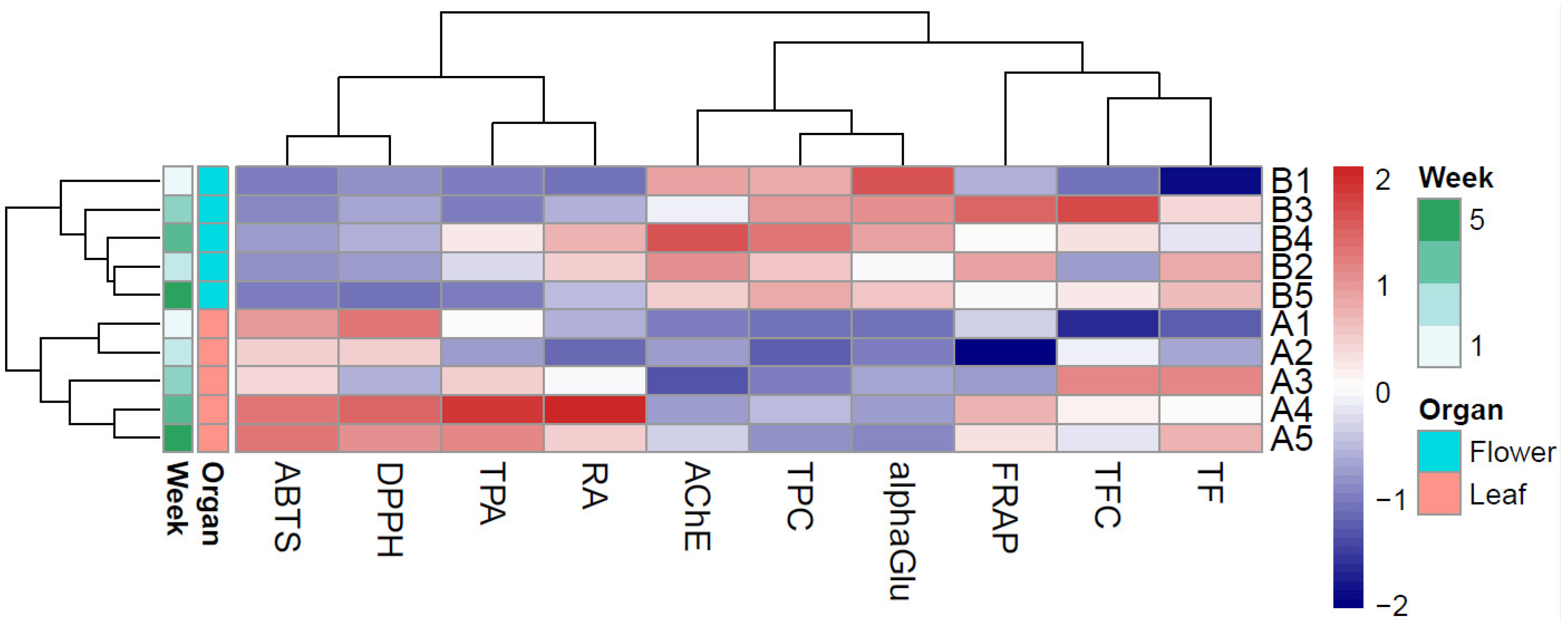
3.4. Antioxidant Activity
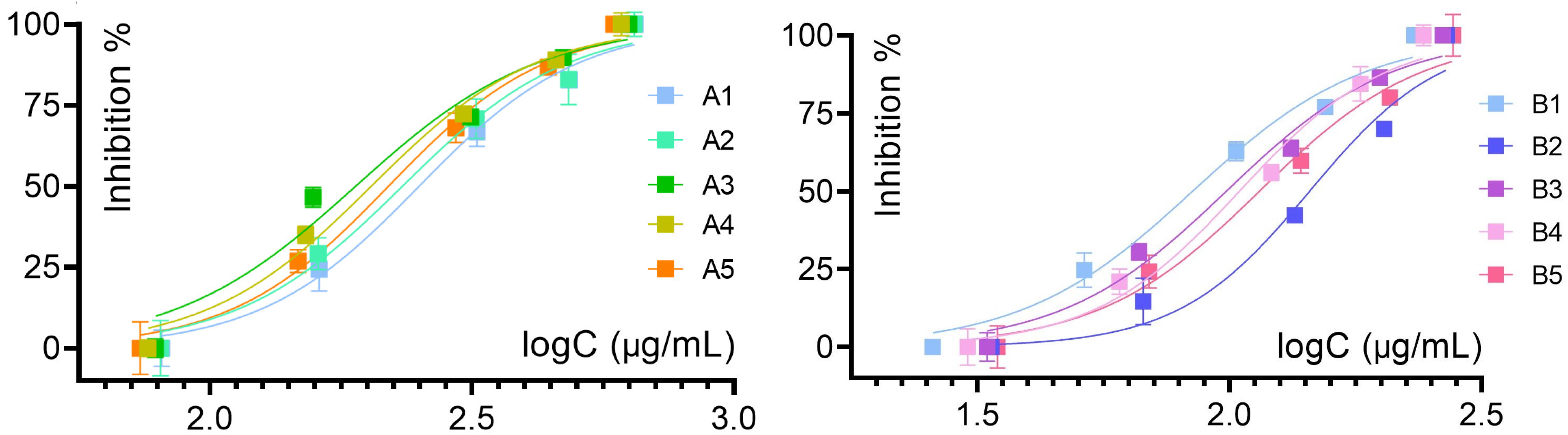
3.5. Enzyme Inhibition Activities
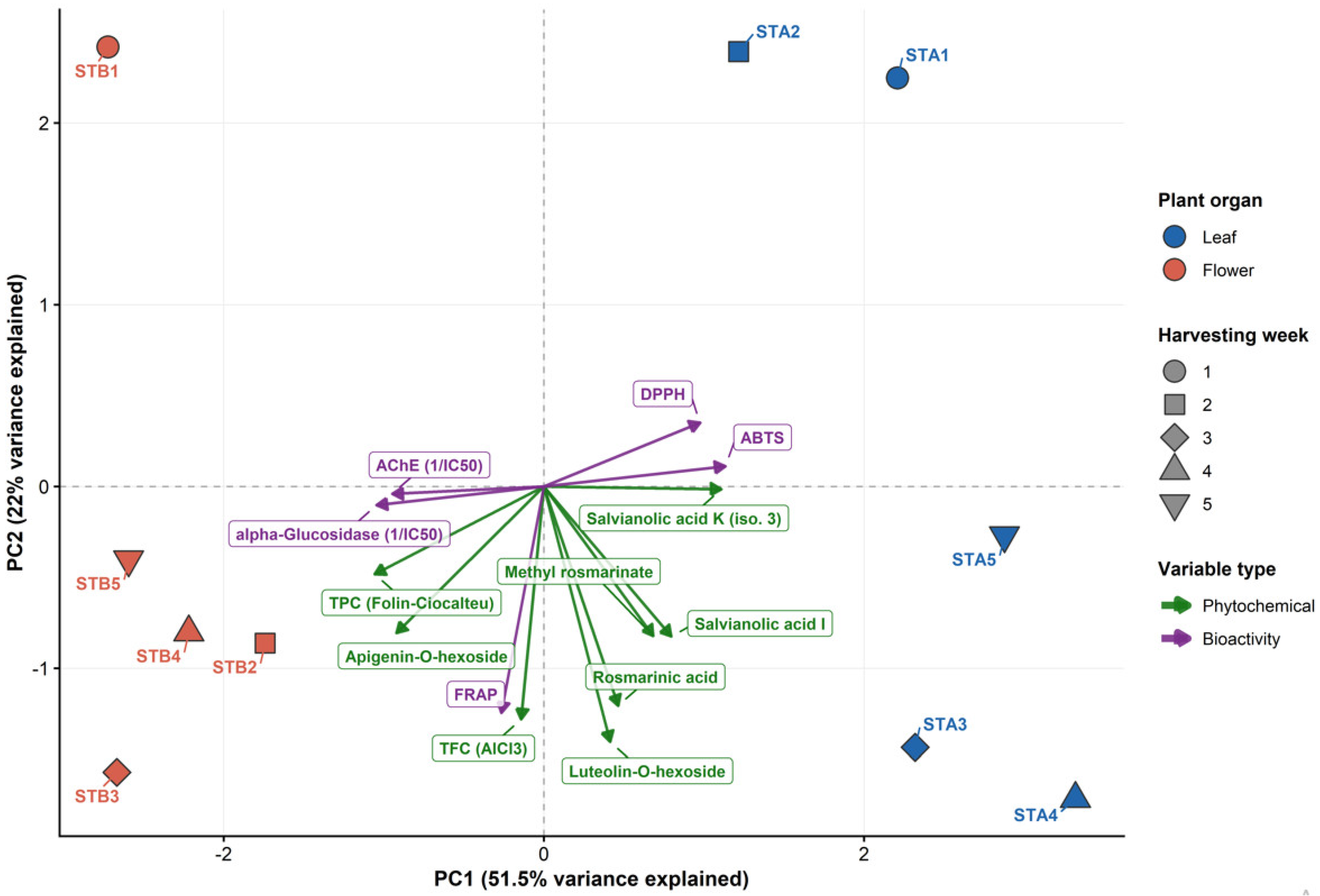
3.6. Multivariate Statistical Analysis
3.7. Transylvanian Sage as a Source of Antioxidant Metabolites
4. Conclusions
Author Contributions
Funding
Institutional Review Board Statement
Data Availability Statement
Acknowledgments
Conflicts of Interest
Abbreviations
| ABTS | 2,2′-azino-bis(3-ethylbenzothiazoline-6-sulfonic acid) |
| AChE | Acetylcholinesterase |
| DMSO | dimethyl sulfoxide |
| DPPH | 2,2-diphenyl-1-picrylhydrazyl |
| DW | dry weight |
| FRAP | ferric-reducing antioxidant power |
| HPLC | high-performance liquid chromatography |
| PCA | principal component analysis |
| RA | rosmarinic acid |
| TFC | total flavonoid content (AlCl3 method) |
| TF | total flavonoids (cumulative, HPLC) |
| TPA | total phenolic acids (cumulative, HPLC) |
| TPC | total phenolic content (Folin–Ciocalteu) |
References
- Ciocârlan, V. Flora Ilustrată a României: Pteridophyta et Spermatophyta, 3rd ed.; Editura Ceres: București, Romania, 2009. [Google Scholar]
- Sârbu, A.; Smarandache, D.; Pascale, G. Protected Areas and Climate Change. Contrib. Bot. 2014, XLIX, 209–222. [Google Scholar]
- Bachman, S.P.; Brown, M.J.M.; Leão, T.C.C.; Nic Lughadha, E.; Walker, B.E. Extinction Risk Predictions for the World’s Flowering Plants to Support Their Conservation. New Phytol. 2024, 242, 797–808. [Google Scholar] [CrossRef]
- Nachychko, V.O.; Sosnovsky, Y.V. On the Romanian Endemic Species of Salvia (Lamiaceae) and Its Natural Hybrids: Nomenclatural and Taxonomic Aspects. Phytotaxa 2020, 434, 270–280. [Google Scholar] [CrossRef]
- Tychonievich, J.; Warner, R.M. Interspecific Crossability of Selected Salvia Species and Potential Use for Crop Improvement. J. Am. Soc. Hortic. Sci. 2011, 136, 41–47. [Google Scholar] [CrossRef]
- Mátis, A.; Malkócs, T.; Kuhn, T.; Laczkó, L.; Moysiyenko, I.; Szabó, A.; Bădărău, A.S.; Sramkó, G. Hiding in Plain Sight: Integrative Analyses Uncover a Cryptic Salvia Species in Europe. Taxon 2023, 72, 78–97. [Google Scholar] [CrossRef]
- Nicolescu, A.; Frumuzachi, O.; Mocan, A. Ethnobotanical Diversity of the Genus Salvia L. (Lamiaceae): From Medicinal and Culinary Applications to Cultural Importance of Sage Species across the Globe. J. Ethnopharmacol. 2026, 359, 121049. [Google Scholar] [CrossRef]
- Maklad, Y.A.; Aboutabl, E.A.; El-Sherei, M.M.; Meselhy, K.M. Bioactivity Studies of Salvia transsylvanica (Schur ex Griseb) Grown in Egypt. Phyther. Res. 1999, 13, 147–150. [Google Scholar] [CrossRef]
- Mocan, A.; Babotă, M.; Pop, A.; Fizeșan, I.; Diuzheva, A.; Locatelli, M.; Carradori, S.; Campestre, C.; Menghini, L.; Sisea, C.R.; et al. Chemical Constituents and Biologic Activities of Sage Species: A Comparison between Salvia officinalis L., S. glutinosa L. and S. transsylvanica (Schur ex Griseb. & Schenk) Schur. Antioxidants 2020, 9, 480. [Google Scholar] [CrossRef]
- Janicsák, G.; Zupkó, I.; Máthe, I.; Hohmann, J. Comparative Study of the Antioxidant Activities of Eleven Salvia Species. Nat. Prod. Commun. 2010, 5, 227–230. [Google Scholar] [CrossRef]
- Chakraborty, A.; Chaudhury, R.; Dutta, S.; Basak, M.; Dey, S.; Schäffner, A.R.; Das, M. Role of Metabolites in Flower Development and Discovery of Compounds Controlling Flowering Time. Plant Physiol. Biochem. 2022, 190, 109–118. [Google Scholar] [CrossRef]
- Singh, D.; Mittal, N.; Mittal, P.; Siddiqui, M.H. Transcriptome Sequencing of Medical Herb Salvia rosmarinus (Rosemary) Revealed the Phenylpropanoid Biosynthesis Pathway Genes and Their Phylogenetic Relationships. Mol. Biol. Rep. 2024, 51, 757. [Google Scholar] [CrossRef]
- Stafiniak, M.; Ślusarczyk, S.; Pencakowski, B.; Matkowski, A.; Rahimmalek, M.; Bielecka, M. Seasonal Variations of Rosmarinic Acid and Its Glucoside and Expression of Genes Related to Their Biosynthesis in Two Medicinal and Aromatic Species of Salvia Subg. Perovskia. Biology 2021, 10, 458. [Google Scholar] [CrossRef]
- Generalić, I.; Skroza, D.; Šurjak, J.; Možina, S.S.; Ljubenkov, I.; Katalinić, A.; Šimat, V.; Katalinić, V. Seasonal Variations of Phenolic Compounds and Biological Properties in Sage (Salvia officinalis L.). Chem. Biodivers. 2012, 9, 441–457. [Google Scholar] [CrossRef] [PubMed]
- Generalić, I.; Skroza, D.; Ljubenkov, I.; Katalinić, A.; Burčul, F.; Katalinić, V. Influence of the Phenophase on the Phenolic Profile and Antioxidant Properties of Dalmatian Sage. Food Chem. 2011, 127, 427–433. [Google Scholar] [CrossRef]
- Piatti, D.; Marconi, R.; Caprioli, G.; Angeloni, S.; Ricciutelli, M.; Zengin, G.; Maggi, F.; Pagni, L.; Sagratini, G. Assessment and Comparison of Phytochemical Constituents and Biological Activities between Full Flowering and Late Flowering of Hypericum perforatum L. Appl. Sci. 2023, 13, 13304. [Google Scholar] [CrossRef]
- Nicolescu, A.; Babotă, M.; Ilea, M.; Dias, M.I.; Calhelha, R.C.; Gavrilaș, L.; Rocchetti, G.; Crișan, G.; Mocan, A.; Barros, L.; et al. Potential Therapeutic Applications of Infusions and Hydroalcoholic Extracts of Romanian Glutinous Sage (Salvia glutinosa L.). Front. Pharmacol. 2022, 13, 975800. [Google Scholar] [CrossRef]
- Hudz, N.; Makowicz, E.; Shanaida, M.; Białoń, M.; Jasicka-Misiak, I.; Yezerska, O.; Svydenko, L.; Wieczorek, P.P. Phytochemical Evaluation of Tinctures and Essential Oil Obtained from Satureja Montana Herb. Molecules 2020, 25, 4763. [Google Scholar] [CrossRef]
- Mungwari, C.P.; King’ondu, C.K.; Sigauke, P.; Obadele, B.A. Conventional and Modern Techniques for Bioactive Compounds Recovery from Plants: Review. Sci. African 2025, 27, e02509. [Google Scholar] [CrossRef]
- Lu, W.; Bennett, B.D.; Rabinowitz, J.D. Analytical Strategies for LC–MS-Based Targeted Metabolomics. J. Chromatogr. B 2008, 871, 236–242. [Google Scholar] [CrossRef]
- Nicolescu, A.; Babotă, M.; Aranda Cañada, E.; Ines Dias, M.; Añibarro-Ortega, M.; Cornea-Cipcigan, M.; Tanase, C.; Radu Sisea, C.; Mocan, A.; Barros, L.; et al. Association of Enzymatic and Optimized Ultrasound-Assisted Aqueous Extraction of Flavonoid Glycosides from Dried Hippophae rhamnoides L. (Sea Buckthorn) Berries. Ultrason. Sonochem. 2024, 108, 106955. [Google Scholar] [CrossRef] [PubMed]
- Kolde, R. Pheatmap: Pretty Heatmaps. Available online: https://cran.r-project.org/web/packages/pheatmap/index.html (accessed on 10 February 2026).
- Wickham, H.; Chang, W.; Henry, L.; Pedersen, T.L.; Takahashi, K.; Wilke, C.; Woo, K.; Yutani, H.; Dunnington, D.; van den Brand, T. Ggplot2: Create Elegant Data Visualisations Using the Grammar of Graphics. CRAN Contrib. Packag. 2007. Available online: https://cran.r-project.org/web/packages/ggplot2/index.html (accessed on 10 February 2026).
- Luca, S.V.; Skalicka-Woźniak, K.; Mihai, C.-T.; Gradinaru, A.C.; Mandici, A.; Ciocarlan, N.; Miron, A.; Aprotosoaie, A.C. Chemical Profile and Bioactivity Evaluation of Salvia Species from Eastern Europe. Antioxidants 2023, 12, 1514. [Google Scholar] [CrossRef]
- Nicolescu, A.; Bunea, C.I.; Mocan, A. Total Flavonoid Content Revised: An Overview of Past, Present, and Future Determinations in Phytochemical Analysis. Anal. Biochem. 2025, 700, 115794. [Google Scholar] [CrossRef]
- Moshari-Nasirkandi, A.; Iaccarino, N.; Romano, F.; Graziani, G.; Alirezalu, A.; Alipour, H.; Amato, J. Chemometrics-Based Analysis of the Phytochemical Profile and Antioxidant Activity of Salvia Species from Iran. Sci. Rep. 2024, 14, 17317. [Google Scholar] [CrossRef]
- Zeng, G.; Xiao, H.; Liu, J.; Liang, X. Identification of Phenolic Constituents in Radix Salvia miltiorrhizae by Liquid Chromatography/Electrospray Ionization Mass Spectrometry. Rapid Commun. Mass Spectrom. 2006, 20, 499–506. [Google Scholar] [CrossRef] [PubMed]
- Barros, L.; Dueñas, M.; Dias, M.I.; Sousa, M.J.; Santos-Buelga, C.; Ferreira, I.C.F.R. Phenolic Profiles of Cultivated, in Vitro Cultured and Commercial Samples of Melissa officinalis L. Infusions. Food Chem. 2013, 136, 1–8. [Google Scholar] [CrossRef] [PubMed]
- Soong, Y.Y.; Barlow, P.J. Isolation and Structure Elucidation of Phenolic Compounds from Longan (Dimocarpus Longan Lour.) Seed by High-Performance Liquid Chromatography–Electrospray Ionization Mass Spectrometry. J. Chromatogr. A 2005, 1085, 270–277. [Google Scholar] [CrossRef] [PubMed]
- Celli, N.; Dragani, L.K.; Murzilli, S.; Pagliani, T.; Poggi, A. In Vitro and in Vivo Stability of Caffeic Acid Phenethyl Ester, a Bioactive Compound of Propolis. J. Agric. Food Chem. 2007, 55, 3398–3407. [Google Scholar] [CrossRef] [PubMed]
- Grzegorczyk-Karolak, I.; Krzemińska, M.; Kiss, A.K.; Olszewska, M.A.; Owczarek, A. Phytochemical Profile and Antioxidant Activity of Aerial and Underground Parts of Salvia Bulleyana Diels. Plants. Metabolites 2020, 10, 497. [Google Scholar] [CrossRef]
- Serrano, C.A.; Villena, G.K.; Rodríguez, E.F. Phytochemical Profile and Rosmarinic Acid Purification from Two Peruvian Lepechinia Willd. Species (Salviinae, Mentheae, Lamiaceae). Sci. Rep. 2021, 11, 7260. [Google Scholar] [CrossRef] [PubMed]
- Tanaka, T.; Nishimura, A.; Kouno, I.; Nonaka, G.; Yang, C.-R. Four New Caffeic Acid Metabolites, Yunnaneic Acids E-H, from Salvia Yunnanensis. Chem. Pharm. Bull. 1997, 45, 1596–1600. [Google Scholar] [CrossRef]
- Katanić Stanković, J.S.; Srećković, N.; Mišić, D.; Gašić, U.; Imbimbo, P.; Monti, D.M.; Mihailović, V. Bioactivity, Biocompatibility and Phytochemical Assessment of Lilac Sage, Salvia verticillata L. (Lamiaceae)—A Plant Rich in Rosmarinic Acid. Ind. Crops Prod. 2020, 143, 111932. [Google Scholar] [CrossRef]
- Ribeiro, A.; Caleja, C.; Barros, L.; Santos-Buelga, C.; Barreiro, M.F.; Ferreira, I.C.F.R. Rosemary Extracts in Functional Foods: Extraction, Chemical Characterization and Incorporation of Free and Microencapsulated Forms in Cottage Cheese. Food Funct. 2016, 7, 2185–2196. [Google Scholar] [CrossRef]
- Escuredo, O.; Silva, L.R.; Valentão, P.; Seijo, M.C.; Andrade, P.B. Assessing Rubus Honey Value: Pollen and Phenolic Compounds Content and Antibacterial Capacity. Food Chem. 2012, 130, 671–678. [Google Scholar] [CrossRef]
- Taghouti, M.; Martins-Gomes, C.; Schäfer, J.; Santos, J.A.; Bunzel, M.; Nunes, F.M.; Silva, A.M. Chemical Characterization and Bioactivity of Extracts from Thymus Mastichina: A Thymus with a Distinct Salvianolic Acid Composition. Antioxidants 2019, 9, 34. [Google Scholar] [CrossRef]
- Afonso, A.F.; Pereira, O.R.; Fernandes, Â.; Calhelha, R.C.; Silva, A.M.S.; Ferreira, I.C.F.R.; Cardoso, S.M. Phytochemical Composition and Bioactive Effects of Salvia Africana, Salvia officinalis ‘Icterina’ and Salvia Mexicana Aqueous Extracts. Molecules 2019, 24, 4327. [Google Scholar] [CrossRef] [PubMed]
- Zimmermann, B.F.; Walch, S.G.; Tinzoh, L.N.; Stühlinger, W.; Lachenmeier, D.W. Rapid UHPLC Determination of Polyphenols in Aqueous Infusions of Salvia officinalis L. (Sage Tea). J. Chromatogr. B 2011, 879, 2459–2464, Corrigendum in J. Chromatogr. B 2011, 879, 3949. https://doi.org/10.1016/j.jchromb.2011.11.004. [Google Scholar] [CrossRef] [PubMed]
- Liu, A.-H.; Lin, Y.-H.; Yang, M.; Guo, H.; Guan, S.-H.; Sun, J.-H.; Guo, D.-A. Development of the Fingerprints for the Quality of the Roots of Salvia miltiorrhiza and Its Related Preparations by HPLC-DAD and LC–MSn. J. Chromatogr. B 2007, 846, 32–41. [Google Scholar] [CrossRef]
- Barros, L.; Dueñas, M.; Ferreira, I.C.F.R.; Maria Carvalho, A.; Santos-Buelga, C. Use of HPLC–DAD–ESI/MS to Profile Phenolic Compounds in Edible Wild Greens from Portugal. Food Chem. 2011, 127, 169–173. [Google Scholar] [CrossRef]
- Cvetkovikj, I.; Stefkov, G.; Acevska, J.; Stanoeva, J.P.; Karapandzova, M.; Stefova, M.; Dimitrovska, A.; Kulevanova, S. Polyphenolic Characterization and Chromatographic Methods for Fast Assessment of Culinary Salvia Species from South East Europe. J. Chromatogr. A 2013, 1282, 38–45. [Google Scholar] [CrossRef] [PubMed]
- Lee, S.-H.; Kim, H.-W.; Lee, M.-K.; Kim, Y.J.; Asamenew, G.; Cha, Y.-S.; Kim, J.-B. Phenolic Profiling and Quantitative Determination of Common Sage (Salvia Plebeia R. Br.) by UPLC-DAD-QTOF/MS. Eur. Food Res. Technol. 2018, 244, 1637–1646. [Google Scholar] [CrossRef]
- Sánchez-Rangel, J.C.; Benavides, J.; Heredia, J.B.; Cisneros-Zevallos, L.; Jacobo-Velázquez, D.A. The Folin–Ciocalteu Assay Revisited: Improvement of Its Specificity for Total Phenolic Content Determination. Anal. Methods 2013, 5, 5990. [Google Scholar] [CrossRef]
- Raposo, F.; Borja, R.; Gutiérrez-González, J.A. A Comprehensive and Critical Review of the Unstandardized Folin-Ciocalteu Assay to Determine the Total Content of Polyphenols: The Conundrum of the Experimental Factors and Method Validation. Talanta 2024, 272, 125771. [Google Scholar] [CrossRef]
- Li, W.; Zhou, S.-P.; Jin, Y.-P.; Huang, X.-F.; Zhou, W.; Han, M.; Yu, Y.; Yan, K.; Li, S.-M.; Ma, X.-H.; et al. Salvianolic Acids T and U: A Pair of Atropisomeric Trimeric Caffeic Acids Derivatives from Root of Salvia miltiorrhiza. Fitoterapia 2014, 98, 248–253. [Google Scholar] [CrossRef]
- Eberle, D.; Ullmann, P.; Werck-Reichhart, D.; Petersen, M. CDNA Cloning and Functional Characterisation of CYP98A14 and NADPH:Cytochrome P450 Reductase from Coleus Blumei Involved in Rosmarinic Acid Biosynthesis. Plant Mol. Biol. 2009, 69, 239–253. [Google Scholar] [CrossRef]
- Petersen, M. Rosmarinic Acid. Phytochemistry 2003, 62, 121–125. [Google Scholar] [CrossRef]
- Zhou, Z.; Li, Q.; Xiao, L.; Wang, Y.; Feng, J.; Bu, Q.; Xiao, Y.; Hao, K.; Guo, M.; Chen, W.; et al. Multiplexed CRISPR/Cas9-Mediated Knockout of Laccase Genes in Salvia miltiorrhiza Revealed Their Roles in Growth, Development, and Metabolism. Front. Plant Sci. 2021, 12, 647768. [Google Scholar] [CrossRef] [PubMed]
- Wang, J.; Xu, J.; Gong, X.; Yang, M.; Zhang, C.; Li, M. Biosynthesis, Chemistry, and Pharmacology of Polyphenols from Chinese Salvia Species: A Review. Molecules 2019, 24, 155. [Google Scholar] [CrossRef] [PubMed]
- Yan, C.; Li, C.; Jiang, M.; Xu, Y.; Zhang, S.; Hu, X.; Chen, Y.; Lu, S. Systematic Characterization of Gene Families and Functional Analysis of PvRAS3 and PvRAS4 Involved in Rosmarinic Acid Biosynthesis in Prunella vulgaris. Front. Plant Sci. 2024, 15, 1374912. [Google Scholar] [CrossRef] [PubMed]
- Deng, Y.; Lu, S. Biosynthesis and Regulation of Phenylpropanoids in Plants. CRC. Crit. Rev. Plant Sci. 2017, 36, 257–290. [Google Scholar] [CrossRef]
- Lu, Y.; Yeap Foo, L. Flavonoid and Phenolic Glycosides from Salvia officinalis. Phytochemistry 2000, 55, 263–267. [Google Scholar] [CrossRef]
- Velamuri, R.; Sharma, Y.; Fagan, J.; Schaefer, J. Application of UHPLC-ESI-QTOF-MS in Phytochemical Profiling of Sage (Salvia officinalis) and Rosemary (Rosmarinus officinalis). Planta Medica Int. Open 2020, 07, e133–e144. [Google Scholar] [CrossRef]
- Exarchou, V.; Kanetis, L.; Charalambous, Z.; Apers, S.; Pieters, L.; Gekas, V.; Goulas, V. HPLC-SPE-NMR Characterization of Major Metabolites in Salvia fruticosa Mill. Extract with Antifungal Potential: Relevance of Carnosic Acid, Carnosol, and Hispidulin. J. Agric. Food Chem. 2015, 63, 457–463. [Google Scholar] [CrossRef]
- Gruľová, D.; Baranová, B.; Eliašová, A.; Brun, C.; De Martino, L.; Caputo, L.; Poračová, J.; Nastišin, Ľ.; Fejér, J.; Elshafie, H.S.; et al. Salvia pratensis L. Extracts as Potential Eco-Friendly Herbicides for Sustainable Agricultural Applications. Sci. Rep. 2025, 15, 659. [Google Scholar] [CrossRef]
- Srećković, N.; Mišić, D.; Gašić, U.; Matić, S.L.; Katanić Stanković, J.S.; Mihailović, N.R.; Monti, D.M.; D’Elia, L.; Mihailović, V. Meadow Sage (Salvia pratensis L.): A Neglected Sage Species with Valuable Phenolic Compounds and Biological Potential. Ind. Crops Prod. 2022, 189, 115841. [Google Scholar] [CrossRef]
- Moshari-Nasirkandi, R.; Alirezalu, A.; Chamanabad, H.R.M.; Amato, J.; Alipour, H.; Asghari, A.; Moshari-Nasirkandi, A. Screening of Native Wild Salvia nemorosa Populations for Chemical Compositions, Antioxidant Activity and UHPLC-HRMS Profiling. Sci. Rep. 2024, 14, 32064. [Google Scholar] [CrossRef] [PubMed]
- Bahadori, M.B.; Asghari, B.; Dinparast, L.; Zengin, G.; Sarikurkcu, C.; Abbas-Mohammadi, M.; Bahadori, S. Salvia nemorosa L.: A Novel Source of Bioactive Agents with Functional Connections. LWT 2017, 75, 42–50. [Google Scholar] [CrossRef]
- Mervić, M.; Bival Štefan, M.; Kindl, M.; Blažeković, B.; Marijan, M.; Vladimir-Knežević, S. Comparative Antioxidant, Anti-Acetylcholinesterase and Anti-α-Glucosidase Activities of Mediterranean Salvia Species. Plants 2022, 11, 625. [Google Scholar] [CrossRef]
- Farhat, M.B.; Landoulsi, A.; Chaouch-Hamada, R.; Sotomayor, J.A.; Jordán, M.J. Characterization and Quantification of Phenolic Compounds and Antioxidant Properties of Salvia Species Growing in Different Habitats. Ind. Crops Prod. 2013, 49, 904–914. [Google Scholar] [CrossRef]
- Rice-Evans, C.A.; Miller, N.J.; Paganga, G. Structure-Antioxidant Activity Relationships of Flavonoids and Phenolic Acids. Free Radic. Biol. Med. 1996, 20, 933–956. [Google Scholar] [CrossRef]
- Leopoldini, M.; Russo, N.; Toscano, M. The Molecular Basis of Working Mechanism of Natural Polyphenolic Antioxidants. Food Chem. 2011, 125, 288–306. [Google Scholar] [CrossRef]
- Eidi, A.; Eidi, M. Antidiabetic Effects of Sage (Salvia officinalis L.) Leaves in Normal and Streptozotocin-Induced Diabetic Rats. Diabetes Metab. Syndr. Clin. Res. Rev. 2009, 3, 40–44. [Google Scholar] [CrossRef]
- Shojaeifard, Z.; Moheimanian, N.; Jassbi, A.R. Comparison of Inhibitory Activities of 50 Salvia Species against α-Glucosidase. J. Diabetes Metab. Disord. 2023, 22, 1685–1693. [Google Scholar] [CrossRef]
- Inui, A.; Cheng, K.-C.; Asakawa, A.; Amitani, H.; Amitani, M.; Morinaga, A.; Takimoto, Y.; Kairupan, B.H.R.; Runtuwene, J. Rosmarinic Acid Ameliorates Hyperglycemia and Insulin Sensitivity in Diabetic Rats, Potentially by Modulating the Expression of PEPCK and GLUT4. Drug Des. Devel. Ther. 2016, 10, 2193–2202. [Google Scholar] [CrossRef]
- Den Hartogh, D.J.; Vlavcheski, F.; Tsiani, E. Muscle Cell Insulin Resistance Is Attenuated by Rosmarinic Acid: Elucidating the Mechanisms Involved. Int. J. Mol. Sci. 2023, 24, 5094. [Google Scholar] [CrossRef]
- Chen, J.; Yang, J.; Ma, L.; Li, J.; Shahzad, N.; Kim, C.K. Structure-Antioxidant Activity Relationship of Methoxy, Phenolic Hydroxyl, and Carboxylic Acid Groups of Phenolic Acids. Sci. Rep. 2020, 10, 2611, Correction in Sci. Rep. 2020, 10, 5666. https://doi.org/10.1038/s41598-020-62493-y. [Google Scholar] [CrossRef]
- Kejík, Z.; Kaplánek, R.; Masařík, M.; Babula, P.; Matkowski, A.; Filipenský, P.; Veselá, K.; Gburek, J.; Sýkora, D.; Martásek, P.; et al. Iron Complexes of Flavonoids-Antioxidant Capacity and Beyond. Int. J. Mol. Sci. 2021, 22, 646. [Google Scholar] [CrossRef]
- Miličević, A. Flavonoid Oxidation Potentials and Antioxidant Activities-Theoretical Models Based on Oxidation Mechanisms and Related Changes in Electronic Structure. Int. J. Mol. Sci. 2024, 25, 5011. [Google Scholar] [CrossRef] [PubMed]
- Nikolova, M.; Aneva, I. European Species of Genus Salvia: Distribution, Chemodiversity and Biological Activity. In Salvia Biotechnology; Springer International Publishing: Cham, Germany, 2017; pp. 1–30. [Google Scholar]
- Bălășoiu, R.M.; Biță, A.; Stănciulescu, E.C.; Rău, G.; Bejenaru, C.; Bejenaru, L.E.; Pisoschi, C.G. UHPLC/MS Assessment of Polyphenolic Acids and Radical Scavenging Activity of Salvia Species from the South-West of Romania Flora. Farmacia 2023, 71, 697–703. [Google Scholar] [CrossRef]
- Adomako-Bonsu, A.G.; Chan, S.L.; Pratten, M.; Fry, J.R. Antioxidant Activity of Rosmarinic Acid and Its Principal Metabolites in Chemical and Cellular Systems: Importance of Physico-Chemical Characteristics. Toxicol. Vitr. 2017, 40, 248–255. [Google Scholar] [CrossRef]
- Amoah, S.; Sandjo, L.; Kratz, J.; Biavatti, M. Rosmarinic Acid—Pharmaceutical and Clinical Aspects. Planta Med. 2016, 82, 388–406. [Google Scholar] [CrossRef]
- Gil, E.; Enache, T.; Oliveira-Brett, A. Redox Behaviour of Verbascoside and Rosmarinic Acid. Comb. Chem. High Throughput Screen. 2013, 16, 92–97. [Google Scholar] [CrossRef]
- Khojasteh, A.; Mirjalili, M.H.; Alcalde, M.A.; Cusido, R.M.; Eibl, R.; Palazon, J. Powerful Plant Antioxidants: A New Biosustainable Approach to the Production of Rosmarinic Acid. Antioxidants 2020, 9, 1273. [Google Scholar] [CrossRef]
- Bors, W.; Christa, M.; Stettmaier, K.; Yinrong, L.; Yeap, F. Antioxidant Mechanisms of Polyphenolic Caffeic Acid Oligomers, Constituents of Salvia officinalis. Biol. Res. 2004, 37, 301–311. [Google Scholar] [CrossRef] [PubMed]
- Mladěnka, P.; Macáková, K.; Filipský, T.; Zatloukalová, L.; Jahodář, L.; Bovicelli, P.; Silvestri, I.P.; Hrdina, R.; Saso, L. In Vitro Analysis of Iron Chelating Activity of Flavonoids. J. Inorg. Biochem. 2011, 105, 693–701. [Google Scholar] [CrossRef] [PubMed]
- Zakarya, A.Y.; Rasheed, D.M.; Emad, A.M.; Farag, M.A.; Goda, Z.M.; Riad, O.K.M.; Tohamy, S.T.K.; Elbanna, A.H. Comparative Metabolomic Profiling and Chemometric Correlation of Salvia rosmarinus Spenn. and Origanum vulgare L. with Antibacterial, Antioxidant and Anti-Inflammatory Activities. Sci. Rep. 2025, 16, 990. [Google Scholar] [CrossRef]
- Tang, J.; Zhao, X. Research Progress on Regulation of Immune Response by Tanshinones and Salvianolic Acids of Danshen (Salvia miltiorrhiza Bunge). Molecules 2024, 29, 1201. [Google Scholar] [CrossRef] [PubMed]



| Plant Material | Sample ID | Harvesting Date |
|---|---|---|
| Folium (Leaves) | ST A1 | 16 May 2018 |
| ST A2 | 23 May 2018 | |
| ST A3 | 30 May 2018 | |
| ST A4 | 6 June 2018 | |
| ST A5 | 13 June 2018 | |
| Flos (Flowers) | ST B1 | 16 May 2018 |
| ST B2 | 23 May 2018 | |
| ST B3 | 30 May 2018 | |
| ST B4 | 6 June 2018 | |
| ST B5 | 13 June 2018 |
| Peak | Rt (min) | λmax (nm) | [M-H]− (m/z) | MSn (m/z) | Tentative Identification | Level 1 | Metabolite Presence in ST Sample | |||||||||
|---|---|---|---|---|---|---|---|---|---|---|---|---|---|---|---|---|
| A1 | A2 | A3 | A4 | A5 | B1 | B2 | B3 | B4 | B5 | |||||||
| 1 | 4.48 | 281 | 197 | 179 *, 135 * | Danshensu (salvianic acid A) | 2 | + | + | + | + | + | + | + | + | + | + |
| 2 | 5.71 | 260 | 417 | 265(40), 221(28), 211 *, 169(100) | Gallic acid derivative | 3 | + | + | + | + | + | + | + | + | + | + |
| 3 | 9.16 | 321 | 297 | 179(52), 161 *, 135(100) | Caffeoyl-threonic acid | 2 | + | + | + | + | + | + | + | + | + | + |
| 4 | 10.52 | 323 | 179 | 135(100) | Caffeic acid | 1 | + | + | + | + | + | + | + | + | + | + |
| 5 | 11.38 | 276 | 571 | 553(26), 527(99), 179(23) | Yunnaneic acid E | 2 | + | – | – | – | – | – | – | – | – | – |
| 6 | 14.54 | 231, 285, 315 | 555 | 395 *, 357(100), 313(100), 269 *, 197 * | Salvianolic acid K (isomer 1) | 2 | – | – | – | – | – | – | + | + | + | – |
| 7 | 16.83 | 234, 284, 319 | 555 | 493(43), 359(25), 313(100), 295 * | Salvianolic acid K (isomer 2) | 2 | + | + | + | + | + | + | – | – | + | – |
| 8 | 17.68 | 285, 320 | 521 | 359(100), 197(100), 179(6), 161(100) | Rosmarinyl hexoside (isomer 1) | 2 | + | + | + | + | + | + | – | + | + | + |
| 9 | 18.04 | 291, 321 | 521 | 359(100), 197(100), 179(6), 161(100) | Rosmarinyl hexoside (isomer 2) | 2 | – | – | – | – | – | + | – | – | + | – |
| 10 | 19.23 | 266, 347 | 447 | 285(100), 199(100), 175(62), 151(11) | Luteolin-O-hexoside | 2 | + | + | + | + | + | + | + | + | + | + |
| 11 | 21.83 | 233, 288, 322 | 555 | 537(4), 493(100), 359(5), 197(75), 179(100), 161(100) | Salvianolic acid K (isomer 3) | 2 | + | + | + | + | + | + | + | + | + | + |
| 12 | 22.51 | 328 | 359 | 197(100), 179(83), 161(100), 135(14), 123(100) | Rosmarinic acid | 1 | + | + | + | + | + | + | + | + | + | + |
| 13 | 23.50 | 223, 268, 334 | 431 | 269(100), 227(32) | Apigenin-O-hexoside | 1 | + | + | + | + | + | + | + | + | + | + |
| 14 | 24.61 | 268, 339 | 489 | 447(100), 285(100), 175(70) | Kaempferol-O-acetyl-hexoside | 2 | + | + | + | + | + | – | + | + | + | + |
| 15 | 25.08 | 337 | 461 | 299(100), 284(100), 227(40) | Hispidulin-O-hexoside (isomer) | 2 | – | – | + | + | + | – | + | + | + | + |
| 16 | 26.30 | 322 | 489 | 447(9), 285(100) | Luteolin-O-acetyl-hexoside (isomer 1) | 2 | + | + | + | + | + | – | + | – | – | – |
| 17 | 28.43 | 276, 316 | 489 | 447(9), 285(100) | Luteolin-O-acetyl-hexoside (isomer 2) | 2 | – | – | – | – | + | – | – | – | – | + |
| 18 | 28.63 | 325 | 473 | 431(100), 269(100), 227(20) | Apigenin-O-acetyl-hexoside | 2 | – | – | – | – | – | – | + | + | + | – |
| 19 | 29.30 | 328 | 373 | 197(20), 179(100), 161(88), 135(73) | Methyl rosmarinate | 2 | + | + | + | + | + | + | + | + | + | + |
| 20 | 31.54 | 242, 301, 325 | 537 | 493(100), 359(100), 197(27), 179(38), 161(100), 135 * | Salvianolic acid I | 2 | + | + | + | + | + | + | + | + | + | + |
| A1 | A2 | A3 | A4 | A5 | B1 | B2 | B3 | B4 | B5 | |||||||
| Quantification (mg/g of ST Extract) | ||||||||||
|---|---|---|---|---|---|---|---|---|---|---|
| Peak | A1 | A2 | A3 | A4 | A5 | B1 | B2 | B3 | B4 | B5 |
| 1 | 1.49 ± 0.02 c | 1.18 ± 0.04 d | 1.20 ± 0.04 d | 1.74 ± 0.01 bc | 1.37 ± 0.04 d | 1.43 ± 0.02 cd | 1.84 ± 0.04 b | 3.10 ± 0.10 a | 1.87 ± 0.04 b | 1.44 ± 0.03 c |
| 2 | 2.70 ± 0.10 c | 2.69 ± 0.04 c | 2.99 ± 0.06 bc | 3.20 ± 0.10 b | 3.90 ± 0.02 a | 3.16 ± 0.00 b | 1.95 ± 0.02 e | 2.20 ± 0.03 de | 2.49 ± 0.03 cd | 1.70 ± 0.01 e |
| 3 | 0.98 ± 0.02 c | 1.07 ± 0.02 c | 1.75 ± 0.01 a | 1.51 ± 0.04 ab | 1.58 ± 0.04 ab | 0.58 ± 0.02 d | 1.45 ± 0.02 ab | 1.28 ± 0.00 bc | 1.44 ± 0.02 ab | 1.07 ± 0.02 c |
| 4 | 0.92 ± 0.01 c | 1.17 ± 0.01 bc | 1.26 ± 0.02 b | 2.04 ± 0.01 a | 1.72 ± 0.05 a | 1.33 ± 0.01 b | 1.14 ± 0.01 bc | 0.72 ± 0.01 c | 1.32 ± 0.02 b | 1.15 ± 0.02 bc |
| 5 | 1.48 ± 0.03 | – | – | – | – | – | – | – | – | – |
| 6 | – | – | – | – | – | – | 0.76 ± 0.01 b | 0.39 ± 0.01 c | 3.47 ± 0.01 a | – |
| 7 | 3.04 ± 0.04 a | 2.50 ± 0.10 bc | 2.11 ± 0.01 d | 2.80 ± 0.02 a | 2.45 ± 0.02 c | 2.78 ± 0.03 ab | – | – | 1.20 ± 0.04 e | – |
| 8 | 4.40 ± 0.10 b | 2.19 ± 0.00 e | 3.17 ± 0.03 d | 5.53 ± 0.01 a | 3.90 ± 0.10 c | 1.47 ± 0.02 f | – | 0.61 ± 0.02 h | 0.94 ± 0.01 g | 0.62 ± 0.00 h |
| 9 | – | – | – | – | – | 2.70 ± 0.10 a | – | – | 0.91 ± 0.02 b | – |
| 10 | 3.27 ± 0.01 f | 4.31 ± 0.04 d | 6.30 ± 0.10 a | 5.28 ± 0.04 b | 4.81 ± 0.01 c | 2.28 ± 0.04 g | 4.90 ± 0.10 c | 5.03 ± 0.01 bc | 3.96 ± 0.01 e | 4.72 ± 0.02 c |
| 11 | 17.60 ± 0.20 c | 14.50 ± 0.10 d | 17.50 ± 0.10 c | 22.40 ± 0.60 b | 26.50 ± 0.20 a | 7.15 ± 0.02 f | 6.90 ± 0.10 f | 4.70 ± 0.10 h | 7.60 ± 0.10 e | 5.96 ± 0.04 g |
| 12 | 39.92 ± 0.16 f | 33.30 ± 0.10 i | 45.80 ± 0.10 d | 68.60 ± 0.30 a | 51.60 ± 0.40 c | 33.93 ± 0.02 h | 51.38 ± 0.03 c | 39.39 ± 0.01 g | 53.51 ± 0.04 b | 40.52 ± 0.01 e |
| 13 | 1.25 ± 0.02 g | 1.59 ± 0.03 f | 1.79 ± 0.02 f | 1.80 ± 0.10 f | 1.64 ± 0.01 f | 2.20 ± 0.03 e | 6.40 ± 0.02 c | 6.80 ± 0.10 b | 5.50 ± 0.10 d | 7.70 ± 0.20 a |
| 14 | 1.42 ± 0.00 b | 2.34 ± 0.05 a | 2.25 ± 0.04 a | 2.03 ± 0.03 a | 2.20 ± 0.01 a | – | 0.88 ± 0.01 c | 0.76 ± 0.01 c | 0.74 ± 0.01 c | 0.85 ± 0.01 c |
| 15 | – | – | 5.02 ± 0.04 a | 2.14 ± 0.03 c | 3.98 ± 0.01 b | – | 1.48 ± 0.01 d | 0.82 ± 0.00 e | 0.75 ± 0.00 e | 0.87 ± 0.01 e |
| 16 | 1.26 ± 0.00 a | 1.27 ± 0.01 a | 1.28 ± 0.01 a | 1.13 ± 0.01 a | 1.12 ± 0.00 a | – | 0.76 ± 0.00 b | – | – | – |
| 17 | – | – | – | – | 1.21 ± 0.01 a | – | – | – | – | 0.75 ± 0.00 b |
| 18 | – | – | – | – | – | – | 1.13 ± 0.01 a | 0.35 ± 0.00 b | 0.59 ± 0.00 b | – |
| 19 | 13.43 ± 0.04 b | 9.50 ± 0.10 f | 16.40 ± 0.30 a | 12.40 ± 0.10 d | 13.10 ± 0.10 c | 8.34 ± 0.04 g | 12.43 ± 0.01 d | 10.31 ± 0.10 e | 12.50 ± 0.20 d | 10.30 ± 0.10 e |
| 20 | 3.57 ± 0.01 de | 3.74 ± 0.03 cd | 5.60 ± 0.20 b | 6.88 ± 0.03 a | 5.30 ± 0.02 b | 3.96 ± 0.05 cd | 3.70 ± 0.10 d | 3.36 ± 0.04 e | 4.21 ± 0.04 c | 3.75 ± 0.03 d |
| TPA 1 | 89.60 ± 0.30 d | 71.80 ± 0.10 f | 97.80 ± 0.30 c | 127.00 ± 0.20 a | 111.50 ± 0.20 b | 66.78 ± 0.02 g | 81.62 ± 0.02 e | 66.00 ± 0.30 h | 91.50 ± 0.40 d | 66.50 ± 0.10 i |
| TF 2 | 7.20 ± 0.01 h | 9.51 ± 0.01 g | 16.60 ± 0.10 a | 12.40 ± 0.10 e | 14.97 ± 0.01 c | 4.50 ± 0.10 i | 15.50 ± 0.20 b | 13.70 ± 0.10 d | 11.50 ± 0.10 f | 14.80 ± 0.20 c |
| TPC 3 | 96.80 ± 0.30 f | 81.33 ± 0.10 g | 114.40 ± 0.40 c | 139.41 ± 0.04 a | 126.40 ± 0.20 b | 71.30 ± 0.10 i | 97.20 ± 0.30 e | 79.80 ± 0.20 h | 103.00 ± 0.40 d | 81.40 ± 0.10 g |
| Sample 1 | ABTS (mg TE/g DW) | DPPH (mg TE/g DW) | FRAP (mg TE/g DW) |
|---|---|---|---|
| ST A1 | 131.00 ± 2.45 b | 91.23 ± 0.64 ab | 276.28 ± 5.11 cd |
| ST A2 | 119.43 ± 1.59 c | 85.76 ± 0.95 c | 236.67 ± 6.70 f |
| ST A3 | 117.07 ± 2.08 c | 77.71 ± 0.49 d | 266.95 ± 7.96 de |
| ST A4 | 139.44 ± 0.58 a | 92.24 ± 0.33 a | 302.32 ± 5.85 abc |
| ST A5 | 138.83 ± 0.67 a | 89.73 ± 0.29 b | 292.62 ± 6.57 abce |
| ST B1 | 85.03 ± 0.85 e | 76.46 ± 0.67 d | 269.75 ± 4.94 de |
| ST B2 | 88.01 ± 0.08 de | 76.66 ± 1.05 d | 305.14 ± 1.00 ab |
| ST B3 | 86.90 ± 0.51 de | 77.43 ± 0.42 d | 319.88 ± 4.03 a |
| ST B4 | 90.36 ± 1.15 d | 77.94 ± 0.39 d | 285.32 ± 26.48 bd |
| ST B5 | 84.29 ± 1.45 e | 74.43 ± 0.49 e | 283.86 ± 2.94 bd |
| Sample 1 | Enzyme Inhibition Activity (IC50, μg/mL) | |
|---|---|---|
| α-Glucosidase | Acetylcholinesterase | |
| ST A1 | 250.57 ± 6.46 g | 829.50 ± 22.65 cd |
| ST A2 | 232.90 ± 8.02 fg | 760.67 ± 22.93 cd |
| ST A3 | 189.50 ± 7.15 d | 885.73 ± 57.32 d |
| ST A4 | 202.97 ± 4.56 de | 792.60 ± 40.26 cd |
| ST A5 | 219.23 ± 7.59 ef | 732.67 ± 64.15 bc |
| ST B1 | 84.48 ± 2.89 a | 592.70 ± 33.21 ab |
| ST B2 | 143.17 ± 5.09 c | 584.30 ± 75.35 ab |
| ST B3 | 98.82 ± 5.75 ab | 696.43 ± 4.70 bc |
| ST B4 | 104.95 ± 5.63 ab | 535.50 ± 27.39 a |
| ST B5 | 114.47 ± 6.27 b | 630.53 ± 26.23 ab |
| Standard | Acarbose: 122.27 | Galantamine: 0.002 |
Disclaimer/Publisher’s Note: The statements, opinions and data contained in all publications are solely those of the individual author(s) and contributor(s) and not of MDPI and/or the editor(s). MDPI and/or the editor(s) disclaim responsibility for any injury to people or property resulting from any ideas, methods, instructions or products referred to in the content. |
© 2026 by the authors. Licensee MDPI, Basel, Switzerland. This article is an open access article distributed under the terms and conditions of the Creative Commons Attribution (CC BY) license.
Share and Cite
Brudiu, M.-D.; Nicolescu, A.; Paschoalinotto, B.H.; Dias, M.I.; Crișan, G.; Mocan, A. Temporal Phenolic Profile and Bioactivity of Endemic Salvia transsylvanica (Transylvanian Sage) During Flowering. Antioxidants 2026, 15, 417. https://doi.org/10.3390/antiox15040417
Brudiu M-D, Nicolescu A, Paschoalinotto BH, Dias MI, Crișan G, Mocan A. Temporal Phenolic Profile and Bioactivity of Endemic Salvia transsylvanica (Transylvanian Sage) During Flowering. Antioxidants. 2026; 15(4):417. https://doi.org/10.3390/antiox15040417
Chicago/Turabian StyleBrudiu, Maria-Doroteia, Alexandru Nicolescu, Beatriz H. Paschoalinotto, Maria Inês Dias, Gianina Crișan, and Andrei Mocan. 2026. "Temporal Phenolic Profile and Bioactivity of Endemic Salvia transsylvanica (Transylvanian Sage) During Flowering" Antioxidants 15, no. 4: 417. https://doi.org/10.3390/antiox15040417
APA StyleBrudiu, M.-D., Nicolescu, A., Paschoalinotto, B. H., Dias, M. I., Crișan, G., & Mocan, A. (2026). Temporal Phenolic Profile and Bioactivity of Endemic Salvia transsylvanica (Transylvanian Sage) During Flowering. Antioxidants, 15(4), 417. https://doi.org/10.3390/antiox15040417