Oxidative Stress-Driven Mechanisms and Biomarkers of Drug-Induced Nephrotoxicity: Translational Insights and Therapeutic Implications
 , , , and
Abstract
1. Introduction
2. Methodology
2.1. Literature Search Strategy
- Nephrotoxicity, acute kidney injury, drug-induced kidney injury
- Oxidative stress, reactive oxygen species, redox imbalance, mitochondrial dysfunction
- Antioxidants, redox signaling, MAPK, p53, inflammation
2.2. Study Selection and Inclusion Criteria
- Experimental studies (in vitro and in vivo) elucidating ROS-dependent renal injury pathways.
- Clinical and translational studies linking oxidative stress biomarkers to kidney dysfunction.
- Review articles providing mechanistic frameworks relevant to redox biology in kidney disease.
2.3. Data Extraction and Thematic Organization
- Source and type of nephrotoxic agent
- Renal cell types affected (with emphasis on proximal tubular epithelium)
- Mechanisms of ROS generation and redox imbalance
- Activation of stress-responsive signaling pathways (e.g., MAPK, p53)
- Links between oxidative stress, inflammation, and cell death
- Reported effects of antioxidant or redox-modulating interventions
2.4. Focus on Oxidative Stress and Antioxidant Pathways
- Mitochondrial sources of ROS in renal injury
- Dysregulation of endogenous antioxidant systems
- Redox-sensitive inflammatory and apoptotic signaling
- Biomarkers reflect oxidative damage in kidney disease
3. Factors Causing Drug-Induced Nephrotoxicity
3.1. Renal Hemodynamic
3.2. Renal Tubular Toxicity
3.3. Nephron Inflammation
3.4. Crystal Nephropathy
3.5. Rhabdomyolysis
3.6. Thrombotic Microangiopathy (TMA)
4. The Mechanisms of Renal Injuries Caused by Medicinal Agents and Their Metabolites
4.1. Anticancer Drugs
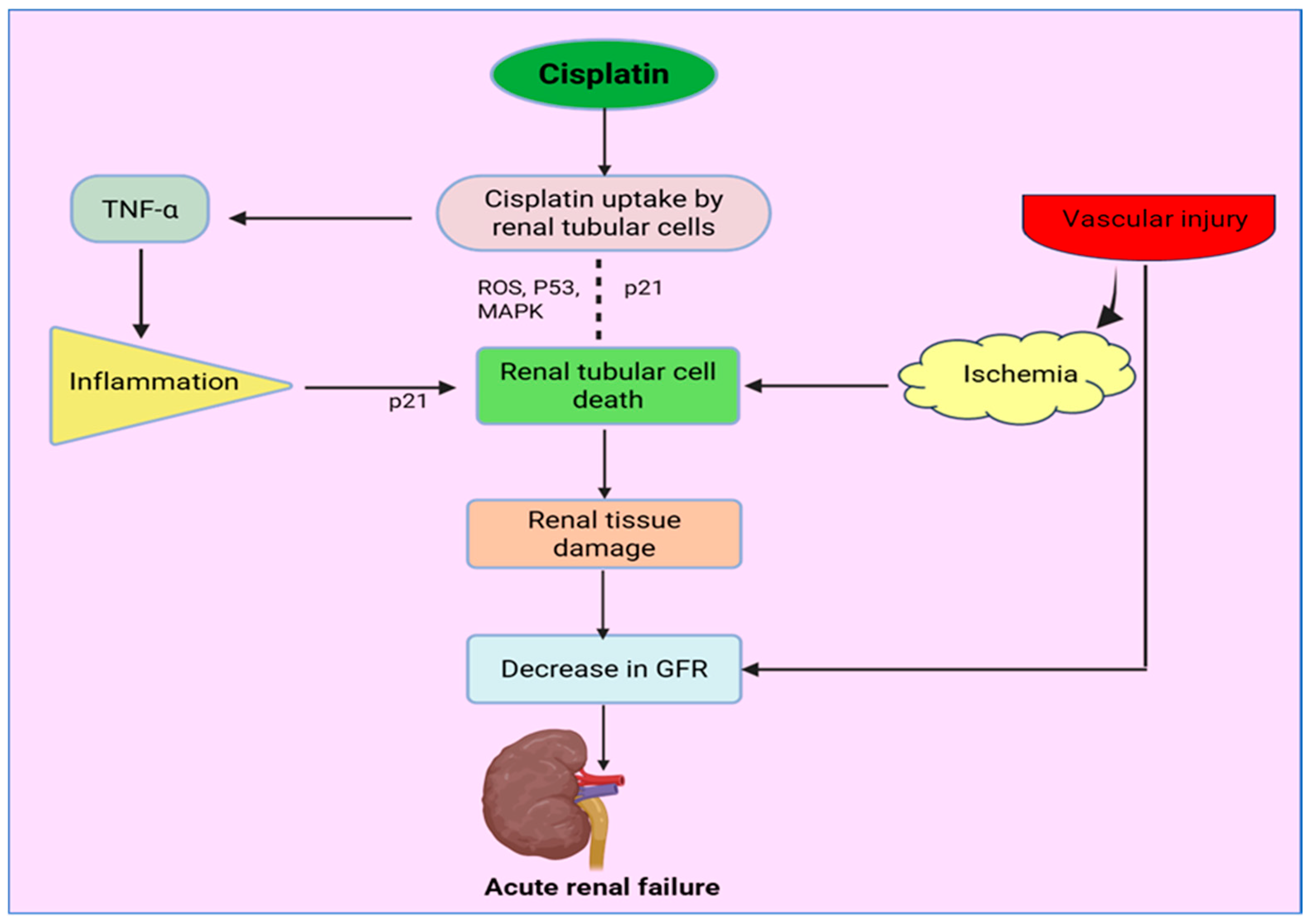
4.1.1. Cisplatin
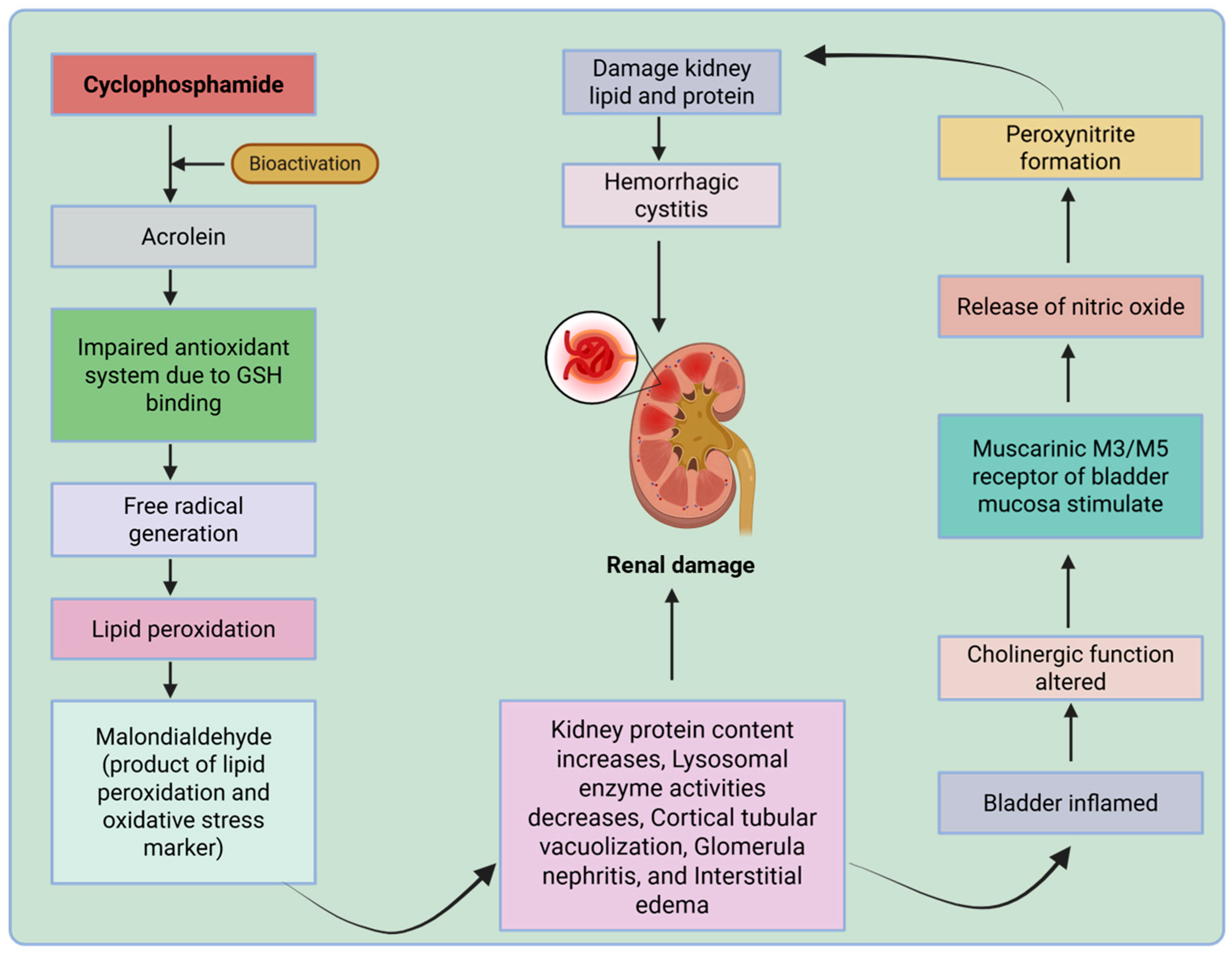
4.1.2. Cyclophosphamide

4.2. Antibiotics
4.3. Antiviral Drugs
4.4. Nonsteroidal Anti-Inflammatory Drugs (NSAIDs)
4.5. Immunosuppressant
4.6. Contrast Agents
5. Biomarkers for Assessment of Drug-Induced Nephrotoxicity
5.1. Kidney Injury Molecule-1 (KIM-1)
5.2. Proteinuria and Albuminuria
5.3. Neutrophil Gelatinase-Associated Lipocalin (NGAL)
5.4. Urinary Proteins with Enzymatic Activity
5.5. Beta-2 Microglobulin (B2M)
5.6. Clusterin
5.7. Trefoil Factor 3 (TFF3)
5.8. Netrin
5.9. Interleukin-18 (IL-18)
5.10. Cystatin C
5.11. Emerging Biomarkers of Drug-Induced Nephrotoxicity
6. Treatment for a Drug Causing Nephrotoxicity
Antioxidant-Based Strategies to Prevent or Mitigate Drug-Induced Nephrotoxicity
7. Strategies for Drug-Induced Nephrotoxicity Study: Preclinical Prediction of Nephrotoxicity
7.1. Two-Dimensional Cell Culture Models
7.2. Three-Dimensional Organoid Models
7.3. In Vivo Preclinical Animal Models
7.4. Clinical Monitor of Nephrotoxicity
8. Conclusions with Future Perspectives
Author Contributions
Funding
Institutional Review Board Statement
Informed Consent Statement
Data Availability Statement
Acknowledgments
Conflicts of Interest
Abbreviations
| ARF | Acute renal failure |
| AKI | Acute kidney injury |
| ESRD | End-stage renal disease |
| CKD | chronic kidney disease |
| NGAL | Neutrophil gelatinase-associated lipocalin |
| KIM-1 | Kidney injury molecule-1 |
| NAG | N-acetyl-glucosaminidase |
| B2M | Beta-2 microglobulin |
| TFF3 | Trefoil factor 3 |
| TMA | Thrombotic microangiopathy |
| GFR | Glomerular filtration rate |
| NSAIDs | Nonsteroidal anti-inflammatory drugs |
| ACEIs | Angiotensin-converting enzyme inhibitors |
| ARBs | Angiotensin receptor blockers |
| GBHP | Glomerular blood hydrostatic pressure |
| AMGs | Aminoglycosides |
| ATP | Adenosine triphosphate |
| ATN | Acute tubular necrosis |
| TNF-α | Tumor necrosis factor-alpha |
| MAPK | Mitogen-Activated Protein Kinase |
| ROS | Reactive oxygen species |
| GSH | Glutathione |
| AMG | Aminoglycoside |
| PAF | Platelet-activating factor |
| AIDS | Acquired immunodeficiency syndrome |
| DNA | Deoxyribonucleic acid |
| HBV | Hepatitis B virus |
| HIV | Human immunodeficiency virus |
| OAT1 | Organic anion transporter 1 |
| OTC | Over-the-counter |
| COX-1 | Ccyclooxygenase-1 |
| BUN | Blood urea nitrogen |
| ROC | Receiver operating characteristic |
| PKD | Polycystic kidney disease |
| FSGS | Focal segmental glomerulosclerosis |
| IL-18 | Interleukin-18 |
| CIN | Contrast-induced nephropathy |
| KDIGO | Kidney disease: Improving Global Outcomes |
| 3D | Three-dimensional |
| 2D | Two-dimensional |
| OCT2 | Organic cation transporter 2 |
References
- Dalal, R.; Bruss, Z.S.; Sehdev, J.S. Physiology, Renal Blood Flow and Filtration. In StatPearls; StatPearls Publishing: Treasure Island, FL, USA, 2025. [Google Scholar]
- Huang, J.; Gretz, N.; Weinfurter, S. Filtration markers and determination methods for the assessment of kidney function. Eur. J. Pharmacol. 2016, 790, 92–98. [Google Scholar] [CrossRef]
- Tiong, H.Y.; Huang, P.; Xiong, S.; Li, Y.; Vathsala, A.; Zink, D. Drug-Induced Nephrotoxicity: Clinical Impact and Preclinical In Vitro Models. Mol. Pharm. 2014, 11, 1933–1948. [Google Scholar] [CrossRef]
- Piko, N.; Bevc, S.; Hojs, R.; Ekart, R. The Role of Oxidative Stress in Kidney Injury. Antioxidants 2023, 12, 1772. [Google Scholar] [CrossRef]
- Al-Kuraishy, H.M.; Al-Gareeb, A.I.; Sadek Al-Naimi, M.S. Pomegranate Attenuates Acute Gentamicin-Induced Nephrotoxicity in Sprague-Dawley Rats: The Potential Antioxidant and Anti-Inflammatory Effects. Asian J. Pharm. Clin. Res. 2019, 12, 484–486. [Google Scholar] [CrossRef]
- Stevens, L.A.; Coresh, J.; Greene, T.; Levey, A.S. Assessing Kidney Function—Measured and Estimated Glomerular Filtration Rate. N. Engl. J. Med. 2006, 354, 2473–2483. [Google Scholar] [CrossRef] [PubMed]
- Ho, H.J.; Shirakawa, H. Oxidative Stress and Mitochondrial Dysfunction in Chronic Kidney Disease. Cells 2022, 12, 88. [Google Scholar] [CrossRef]
- Sadasivam, N.; Kim, Y.J.; Radhakrishnan, K.; Kim, D.K. Oxidative Stress, Genomic Integrity, and Liver Diseases. Molecules 2022, 27, 3159. [Google Scholar] [CrossRef]
- Connor, S.; Li, T.; Qu, Y.; Roberts, R.A.; Tong, W. Generation of a drug-induced renal injury list to facilitate the development of new approach methodologies for nephrotoxicity. Drug Discov. Today 2024, 29, 103938. [Google Scholar] [CrossRef] [PubMed]
- Chen, Z.; Li, C.; Huang, H.; Shi, Y.L.; Wang, X. Research Progress of Aging-related MicroRNAs. Curr. Stem Cell Res. Ther. 2024, 19, 334–350. [Google Scholar] [CrossRef]
- Wu, H.; Huang, J. Drug-Induced Nephrotoxicity: Pathogenic Mechanisms, Biomarkers and Prevention Strategies. Curr. Drug Metab. 2018, 19, 559–567. [Google Scholar] [CrossRef] [PubMed]
- Kwiatkowska, E.; Domanski, L.; Dziedziejko, V.; Kajdy, A.; Stefanska, K.; Kwiatkowski, S. The Mechanism of Drug Nephrotoxicity and the Methods for Preventing Kidney Damage. Int. J. Mol. Sci. 2021, 22, 6109. [Google Scholar] [CrossRef]
- Huang, J. Drug-Induced Nephrotoxicity and Drug Metabolism in Renal Failure. Curr. Drug Metab. 2018, 19, 558. [Google Scholar] [CrossRef]
- Gao, C.; Liu, C.; Chen, Y.; Wang, Q.; Hao, Z. Protective effects of natural products against drug-induced nephrotoxicity: A review in recent years. Food Chem. Toxicol. 2021, 153, 112255. [Google Scholar] [CrossRef]
- Garza, A.Z.; Park, S.B.; Kocz, R. Drug Elimination. In StatPearls; StatPearls Publishing: Treasure Island, FL, USA, 2025. [Google Scholar]
- Thompson, L.E.; Joy, M.S. Endogenous markers of kidney function and renal drug clearance processes of filtration, secretion, and reabsorption. Curr. Opin. Toxicol. 2022, 31, 100344. [Google Scholar] [CrossRef]
- Chen, W.; Wang, B.; Liang, S.; Wang, M.; Zheng, L.; Xu, S.; Wang, J.; Fang, H.; Yang, P.; Feng, W. Renal clearance of graphene oxide: Glomerular filtration or tubular secretion and selective kidney injury association with its lateral dimension. J. Nanobiotechnol. 2023, 21, 51. [Google Scholar] [CrossRef]
- Radi, Z.A. Kidney Pathophysiology, Toxicology, and Drug-Induced Injury in Drug Development. Int. J. Toxicol. 2019, 38, 215–227. [Google Scholar] [CrossRef]
- Turgut, F.; Awad, A.S.; Abdel-Rahman, E.M. Acute Kidney Injury: Medical Causes and Pathogenesis. J. Clin. Med. 2023, 12, 375. [Google Scholar] [CrossRef] [PubMed]
- Naughton, C.A. Drug-induced nephrotoxicity. Am. Fam. Physician 2008, 78, 743–750. [Google Scholar] [PubMed]
- Olyaei, A.J.; De Mattos, A.M.; Bennett, W.M. Immunosuppressant-Induced Nephropathy: Pathophysiology, Incidence and Management. Drug Saf. 1999, 21, 471–488. [Google Scholar] [CrossRef] [PubMed]
- Palmer, B.F. Renal Dysfunction Complicating the Treatment of Hypertension. N. Engl. J. Med. 2002, 347, 1256–1261. [Google Scholar] [CrossRef]
- Rayner, H.C.; Thomas, M.E.; Milford, D.V. Understanding Kidney Diseases; Springer International Publishing: Cham, Switzerland, 2020. [Google Scholar]
- Secomb, T.W. Hemodynamics. In Comprehensive Physiology, 1st ed.; Prakash, Y.S., Ed.; Wiley: Hoboken, NJ, USA, 2016; pp. 975–1003. [Google Scholar]
- Tsuda, A.; Ishimura, E.; Machiba, Y.; Uedono, H.; Nakatani, S.; Mori, K.; Uchida, J.; Emoto, M. Increased Glomerular Hydrostatic Pressure is Associated with Tubular Creatinine Reabsorption in Healthy Subjects. Kidney Blood Press. Res. 2020, 45, 996–1008. [Google Scholar] [CrossRef] [PubMed]
- Pottel, H. Measuring and estimating glomerular filtration rate in children. Pediatr. Nephrol. 2017, 32, 249–263. [Google Scholar] [CrossRef]
- Milanesi, S.; Verzola, D.; Cappadona, F.; Bonino, B.; Murugavel, A.; Pontremoli, R.; Garibotto, G.; Viazzi, F. Uric acid and angiotensin II additively promote inflammation and oxidative stress in human proximal tubule cells by activation of toll-like receptor 4. J. Cell. Physiol. 2019, 234, 10868–10876. [Google Scholar] [CrossRef]
- Koch, C.A.; Fulop, T. Clinical aspects of changes in water and sodium homeostasis in the elderly. Rev. Endocr. Metab. Disord. 2017, 18, 49–66. [Google Scholar] [CrossRef]
- Sudjarwo, S.A.; Eraiko, K.; Sudjarwo, G.W.; Koerniasari. The potency of chitosan-Pinus merkusii extract nanoparticle as the antioxidant and anti-caspase 3 on lead acetate-induced nephrotoxicity in rat. J. Adv. Pharm. Technol. Res. 2019, 10, 27–32. [Google Scholar] [CrossRef] [PubMed]
- Wołyniec, W.; Kasprowicz, K.; Rita-Tkachenko, P.; Renke, M.; Ratkowski, W. Biochemical Markers of Renal Hypoperfusion, Hemoconcentration, and Proteinuria after Extreme Physical Exercise. Medicina 2019, 55, 154. [Google Scholar] [CrossRef] [PubMed]
- Lucas, G.N.C.; Leitão, A.C.C.; Alencar, R.L.; Xavier, R.M.F.; Daher, E.D.F.; da Silva, G.B., Jr. Pathophysiological aspects of nephropathy caused by non-steroidal anti-inflammatory drugs. Braz. J. Nephrol. 2019, 41, 124–130. [Google Scholar] [CrossRef]
- Bicalho, M.; Soares, D.; Botoni, F.; Reis, A.; Martins, M. Drug-Induced Nephrotoxicity and Dose Adjustment Recommendations: Agreement Among Four Drug Information Sources. Int. J. Environ. Res. Public Health 2015, 12, 11227–11240. [Google Scholar] [CrossRef] [PubMed]
- Sharma, V.; Singh, T.G. Drug induced nephrotoxicity—A mechanistic approach. Mol. Biol. Rep. 2023, 50, 6975–6986. [Google Scholar] [CrossRef] [PubMed]
- Hall, A.M.; Trepiccione, F.; Unwin, R.J. Drug toxicity in the proximal tubule: New models, methods and mechanisms. Pediatr. Nephrol. 2022, 37, 973–982. [Google Scholar] [CrossRef]
- Perazella, M.A. Drug-induced nephropathy: An update. Expert. Opin. Drug Saf. 2005, 4, 689–706. [Google Scholar] [CrossRef]
- Zager, R.A. Pathogenetic mechanisms in nephrotoxic acute renal failure. Semin. Nephrol. 1997, 17, 3–14. [Google Scholar] [PubMed]
- Markowitz, G.S.; Perazella, M.A. Drug-induced renal failure: A focus on tubulointerstitial disease. Clin. Chim. Acta 2005, 351, 31–47. [Google Scholar] [CrossRef]
- Lian, C.Y.; Xia, W.H.; Sun, M.C.; Wan, X.M.; Zhou, X.L.; Wang, L. Cadmium targeting MLKL-Drp1 axis to trigger mitochondrial oxidative stress contributes to necroinflammation in rat kidney. J. Adv. Res. 2025, 81, 1079–1093. [Google Scholar] [CrossRef] [PubMed]
- Vormann, M.K.; Vriend, J.; Lanz, H.L.; Gijzen, L.; Van Den Heuvel, A.; Hutter, S.; Joore, J.; Trietsch, S.J.; Stuut, C.; Nieskens, T.T.G.; et al. Implementation of a Human Renal Proximal Tubule on a Chip for Nephrotoxicity and Drug Interaction Studies. J. Pharm. Sci. 2021, 110, 1601–1614. [Google Scholar] [CrossRef] [PubMed]
- Li, S.; Zhao, J.; Huang, R.; Steiner, T.; Bourner, M.; Mitchell, M.; Thompson, D.C.; Zhao, B.; Xia, M. Development and Application of Human Renal Proximal Tubule Epithelial Cells for Assessment of Compound Toxicity. Curr. Chem. Genom. Transl. Med. 2017, 11, 19–30. [Google Scholar] [CrossRef]
- Cabral, B.M.I.; Edding, S.N.; Portocarrero, J.P.; Lerma, E.V. Rhabdomyolysis. Dis.-a-Mon. 2020, 66, 101015. [Google Scholar] [CrossRef]
- Imig, J.D.; Khan, M.A.H. Cytochrome P450 and Lipoxygenase Metabolites on Renal Function. In Comprehensive Physiology, 1st ed.; Prakash, Y.S., Ed.; Wiley: Hoboken, NJ, USA, 2015; pp. 423–441. [Google Scholar]
- Mahadeo, A.; Yeung, C.K.; Himmelfarb, J.; Kelly, E.J. Kidney microphysiological models for nephrotoxicity assessment. Curr. Opin. Toxicol. 2022, 30, 100341. [Google Scholar] [CrossRef]
- Rossert, J. Drug-induced acute interstitial nephritis. Kidney Int. 2001, 60, 804–817. [Google Scholar] [CrossRef]
- Rodríguez-Iturbe, B.; García, G. The Role of Tubulointerstitial Inflammation in the Progression of Chronic Renal Failure. Nephron Clin. Pract. 2010, 116, c81–c88. [Google Scholar] [CrossRef] [PubMed]
- Tjon, J.; Teoh, C.W. Medication-Induced Nephrotoxicity in Children. Curr. Pediatr. Rep. 2020, 8, 122–133. [Google Scholar] [CrossRef]
- Kim, S.-Y.; Moon, A.R. Drug-Induced Nephrotoxicity and Its Biomarkers. Biomol. Ther. 2012, 20, 268–272. [Google Scholar] [CrossRef] [PubMed]
- Anders, H.J.; Kitching, A.R.; Leung, N.; Romagnani, P. Glomerulonephritis: Immunopathogenesis and immunotherapy. Nat. Rev. Immunol. 2023, 23, 453–471. [Google Scholar] [CrossRef]
- Haller, H. Thrombotische Mikroangiopathie und Niere. Nephrologe 2019, 14, 100–107. [Google Scholar] [CrossRef]
- Liu, J.; Han, X.; Zhang, T.; Tian, K.; Li, Z.; Luo, F. Reactive oxygen species (ROS) scavenging biomaterials for anti-inflammatory diseases: From mechanism to therapy. J. Hematol. Oncol. 2023, 16, 116. [Google Scholar] [CrossRef] [PubMed]
- Zheng, L.; Ni, Y.; Xie, S.; Ji, Y.; Dong, J.; Fu, L.; Fu, Z.; Jin, J.; He, Q. Germacrone Alleviates Cisplatin-Induced Nephrotoxicity by Activating PI3K/Akt Signaling, Inhibiting Ras/MAPK Signaling, and Regulating Macrophage Polarization. FASEB J. 2026, 40, e71580. [Google Scholar] [CrossRef]
- Pawar, A.; Vyawahare, N. Anti-urolithiatic activity of standardized extract of Biophytum sensitivum against zinc disc implantation induced urolithiasis in rats. J. Adv. Pharm. Technol. Res. 2015, 6, 176–182. [Google Scholar] [CrossRef]
- Dong, C.; Zhou, J.; Su, X.; He, Z.; Song, Q.; Song, C.; Ke, H.; Wang, C.; Liao, W.; Yang, S. Understanding formation processes of calcareous nephrolithiasis in renal interstitium and tubule lumen. J. Cell Mol. Med. 2024, 28, e18235. [Google Scholar] [CrossRef]
- Mohajeri, S.; Jouneghani, A.S.; Heidari-Soureshjani, S.; Sherwin, C.M.; Beigi, F. Emerging Therapeutic Potential of Fisetin for Nephrotoxicity, Kidney Injury, and Nephropathy: A Systematic Review. Curr. Diabetes Rev. 2025, 21, 1–20. [Google Scholar] [CrossRef]
- Sigurjonsdottir, V.K.; Runolfsdottir, H.L.; Indridason, O.S.; Palsson, R.; Edvardsson, V.O. Impact of nephrolithiasis on kidney function. BMC Nephrol. 2015, 16, 149. [Google Scholar] [CrossRef] [PubMed]
- Mei, Y.; Dong, B.; Geng, Z.; Xu, L. Excess Uric Acid Induces Gouty Nephropathy Through Crystal Formation: A Review of Recent Insights. Front. Endocrinol. 2022, 13, 911968. [Google Scholar] [CrossRef]
- Nicolaysen, A. Nephrotoxic Chemotherapy Agents: Old and New. Adv. Chronic Kidney Dis. 2020, 27, 38–49. [Google Scholar] [CrossRef] [PubMed]
- Yang, B.F.; Li, D.; Liu, C.L.; Luo, Y.; Shi, J.; Guo, X.Q.; Fan, H.J.; Lyu, Q. Advances in rhabdomyolysis: A review of pathogenesis, diagnosis, and treatment. Chin. J. Traumatol. 2026, 29, 21–31. [Google Scholar] [CrossRef]
- Coco, T.J.; Klasner, A.E. Drug-induced rhabdomyolysis. Curr. Opin. Pediatr. 2004, 16, 206–210. [Google Scholar] [CrossRef]
- Huerta-Alardín, A.L.; Varon, J.; Marik, P.E. Bench-to-bedside review: Rhabdomyolysis—An overview for clinicians. Crit. Care 2004, 9, 158. [Google Scholar] [CrossRef]
- Furman, J. When exercise causes exertional rhabdomyolysis. J. Am. Acad. Physician Assist. 2015, 28, 38–43. [Google Scholar] [CrossRef] [PubMed]
- Rawson, E.S.; Clarkson, P.M.; Tarnopolsky, M.A. Perspectives on Exertional Rhabdomyolysis. Sports Med. 2017, 47, 33–49. [Google Scholar] [CrossRef] [PubMed]
- Bäcker, H.C.; Busko, M.; Krause, F.G.; Exadaktylos, A.K.; Klukowska-Roetzler, J.; Deml, M.C. Exertional rhabdomyolysis and causes of elevation of creatine kinase. Physician Sportsmed. 2020, 48, 179–185. [Google Scholar] [CrossRef]
- Li, J.; Duan, J.; Hua, C.; Pan, S.; Li, G.; Feng, Q.; Liu, D.; Liu, Z. Nanomedicine embraces the treatment and prevention of acute kidney injury to chronic kidney disease transition: Evidence, challenges, and opportunities. Burn. Trauma 2024, 12, tkae044. [Google Scholar] [CrossRef] [PubMed]
- Pannu, N.; Nadim, M.K. An overview of drug-induced acute kidney injury. Crit. Care Med. 2008, 36, S216–S223. [Google Scholar] [CrossRef] [PubMed]
- Manor, S.M.; Guillory, G.S.; Jain, S.P. Clopidogrel-Induced Thrombotic Thrombocytopenic Purpura–Hemolytic Uremic Syndrome After Coronary Artery Stenting. Pharmacother. J. Hum. Pharmacol. Drug Ther. 2004, 24, 664–667. [Google Scholar] [CrossRef] [PubMed]
- Shatzel, J.J.; Taylor, J.A. Syndromes of Thrombotic Microangiopathy. Med. Clin. N. Am. 2017, 101, 395–415. [Google Scholar] [CrossRef]
- Shyam, M.; Pal, A.; Dey, D.; Sharma, V.; Wadhwa, J.; Srirangan, P.; Prince, S.E. Natural Compounds as Nephroprotective Agents: Therapeutic Potential Against Drug-Induced Kidney Injury. J. Biochem. Mol. Toxicol. 2025, 39, e70649. [Google Scholar] [CrossRef] [PubMed]
- Kwiatkowska, E.; Kwiatkowski, S.; Dziedziejko, V.; Tomasiewicz, I.; Domanski, L. Renal Microcirculation Injury as the Main Cause of Ischemic Acute Kidney Injury Development. Biology 2023, 12, 327. [Google Scholar] [CrossRef]
- Eck, P.; Silver, S.M.; Clark, E.C. Acute Renal Failure and Coma after a High Dose of Oral Acyclovir. N. Engl. J. Med. 1991, 325, 1178–1179. [Google Scholar] [CrossRef]
- Zoccali, C.; Agarwal, R.; Mallamaci, F.; Jager, K.J.; Stel, V.; Kanbay, M.; Pollock, C.; Kalantar-Zadeh, K.; Ronco, C.; Vanholder, R. Inter-organ crosstalk: The kidney’s role in systemic health and disease. J. Intern. Med. 2025, 298, 368–391. [Google Scholar] [CrossRef] [PubMed]
- Perazella, M.A. Drug-induced acute kidney injury: Diverse mechanisms of tubular injury. Curr. Opin. Crit. Care 2019, 25, 550–557. [Google Scholar] [CrossRef]
- Luque, Y.; Louis, K.; Jouanneau, C.; Placier, S.; Esteve, E.; Bazin, D.; Rondeau, E.; Letavernier, E.; Wolfromm, A.; Gosset, C.; et al. Vancomycin-Associated Cast Nephropathy. J. Am. Soc. Nephrol. 2017, 28, 1723–1728. [Google Scholar] [CrossRef]
- Praga, M.; González, E. Acute interstitial nephritis. Kidney Int. 2010, 77, 956–961. [Google Scholar] [CrossRef]
- Ahmad, A.; Mallela, S.K.; Ansari, S.; Alnukhali, M.; Ali, M.; Merscher, S.; Pollack, A.; Zeidan, Y.H.; Fornoni, A.; Marples, B. Radiation-Induced Nephrotoxicity: Role of Sphingomyelin Phosphodiesterase Acid-like 3b. Int. J. Radiat. Oncol. Biol. Phys. 2025, 121, 1271–1281. [Google Scholar] [CrossRef] [PubMed]
- Fontecha-Barriuso, M.; Lopez-Diaz, A.M.; Guerrero-Mauvecin, J.; Miguel, V.; Ramos, A.M.; Sanchez-Nino, M.D.; Ruiz-Ortega, M.; Ortiz, A.; Sanz, A.B. Tubular Mitochondrial Dysfunction, Oxidative Stress, and Progression of Chronic Kidney Disease. Antioxidants 2022, 11, 1356. [Google Scholar] [CrossRef]
- Xue, R.; Xiao, H.; Kumar, V.; Lan, X.; Malhotra, A.; Singhal, P.C.; Chen, J. The Molecular Mechanism of Renal Tubulointerstitial Inflammation Promoting Diabetic Nephropathy. Int. J. Nephrol. Renov. Dis. 2023, 16, 241–252. [Google Scholar] [CrossRef]
- Miller, R.P.; Tadagavadi, R.K.; Ramesh, G.; Reeves, W.B. Mechanisms of Cisplatin Nephrotoxicity. Toxins 2010, 2, 2490–2518. [Google Scholar] [CrossRef]
- Nolin, T.D.; Himmelfarb, J. Mechanisms of Drug-Induced Nephrotoxicity. In Adverse Drug Reactions; Uetrecht, J., Ed.; Springer: Berlin/Heidelberg, Germany, 2010; Volume 196, pp. 111–130. [Google Scholar]
- Komers, R.; Anderson, S.; Epstein, M. Renal and cardiovascular effects of selective cyclooxygenase-2 inhibitors. Am. J. Kidney Dis. 2001, 38, 1145–1157. [Google Scholar] [CrossRef]
- Deray, G. Amphotericin B nephrotoxicity. J. Antimicrob. Chemother. 2002, 49, 37–41. [Google Scholar] [CrossRef]
- Lanese, D.M.; Conger, J.D. Effects of endothelin receptor antagonist on cyclosporine-induced vasoconstriction in isolated rat renal arterioles. J. Clin. Investig. 1993, 91, 2144–2149. [Google Scholar] [CrossRef]
- Ortiz, A.; Justo, P.; Sanz, A.; Melero, R.; Caramelo, C.; Guerrero, M.F.; Strutz, F.; Müller, G.; Barat, A.; Egido, J. Tubular Cell Apoptosis and Cidofovir-Induced Acute Renal Failure. Antivir. Ther. 2005, 10, 185–190. [Google Scholar] [CrossRef] [PubMed]
- McSweeney, K.R.; Gadanec, L.K.; Qaradakhi, T.; Ali, B.A.; Zulli, A.; Apostolopoulos, V. Mechanisms of Cisplatin-Induced Acute Kidney Injury: Pathological Mechanisms, Pharmacological Interventions, and Genetic Mitigations. Cancers 2021, 13, 1572. [Google Scholar] [CrossRef] [PubMed]
- Brilleta, G.; Demya, G.; Jacquiauda, C.; Mignotb, L.; Bunkera, D.; Meilletc, D.; Raymond, F.; Jacobs, C. Long-Term Renal Effect of Cisplatin in Man. Am. J. Nephrol. 1994, 14, 81–84. [Google Scholar] [CrossRef] [PubMed]
- El Mouedden, M.; Laurent, G.; Mingeot-Leclercq, M.-P.; Taper, H.S.; Cumps, J.; Tulkens, P.M. Apoptosis in Renal Proximal Tubules of Rats Treated with Low Doses of Aminoglycosides. Antimicrob. Agents Chemother. 2000, 44, 665–675. [Google Scholar] [CrossRef]
- Klotman, P.E.; Yarger, W.E. Reduction of renal blood flow and proximal bicarbonate reabsorption in rats by gentamicin. Kidney Int. 1983, 24, 638–643. [Google Scholar] [CrossRef] [PubMed]
- De Mattos, A.M.; Olyaei, A.J.; Bennett, W.M. Nephrotoxicity of immunosuppressive drugs: Long-term consequences and challenges for the future. Am. J. Kidney Dis. 2000, 35, 333–346. [Google Scholar] [CrossRef]
- Arany, I.; Safirstein, R.L. Cisplatin nephrotoxicity. Semin. Nephrol. 2003, 23, 460–464. [Google Scholar] [CrossRef]
- Pabla, N.; Dong, Z. Cisplatin nephrotoxicity: Mechanisms and renoprotective strategies. Kidney Int. 2008, 73, 994–1007. [Google Scholar] [CrossRef]
- Luo, P.; Chen, J.; An, Y.; Meng, K.; Zhou, W.; Li, W.; Liu, J.; Zhao, W.; He, W.; Cao, T.; et al. Icaritin Ameliorates Cisplatin-Induced Mitochondrial Metabolic Dysfunction-Associated Nephrotoxicity and Synergistically Potentiates Its Antitumor Efficacy. Adv. Sci. 2026, 13, e06712. [Google Scholar] [CrossRef] [PubMed]
- Tang, C.; Livingston, M.J.; Safirstein, R.; Dong, Z. Cisplatin nephrotoxicity: New insights and therapeutic implications. Nat. Rev. Nephrol. 2023, 19, 53–72. [Google Scholar] [CrossRef] [PubMed]
- Shinke, H.; Masuda, S.; Togashi, Y.; Ikemi, Y.; Ozawa, A.; Sato, T.; Kim, Y.H.; Mishima, M.; Ichimura, T.; Bonventre, J.V.; et al. Urinary kidney injury molecule-1 and monocyte chemotactic protein-1 are noninvasive biomarkers of cisplatin-induced nephrotoxicity in lung cancer patients. Cancer Chemother. Pharmacol. 2015, 76, 989–996. [Google Scholar] [CrossRef] [PubMed]
- Hosohata, K.; Washino, S.; Kubo, T.; Natsui, S.; Fujisaki, A.; Kurokawa, S.; Ando, H.; Fujimura, A.; Morita, T. Early prediction of cisplatin-induced nephrotoxicity by urinary vanin-1 in patients with urothelial carcinoma. Toxicology 2016, 359–360, 71–75. [Google Scholar] [CrossRef]
- Suk, M.; Kummerer, K. Environmental degradation of human metabolites of cyclophosphamide leads to toxic and non-biodegradable transformation products. Sci. Total Environ. 2023, 857, 159454. [Google Scholar] [CrossRef]
- Akbel, E.; Kucukkurt, I.; Ince, S.; Demirel, H.H.; Acaroz, D.A.; Zemheri-Navruz, F.; Kan, F. Investigation of protective effect of resveratrol and coenzyme Q(10) against cyclophosphamide-induced lipid peroxidation, oxidative stress and DNA damage in rats. Toxicol. Res. 2024, 13, tfad123. [Google Scholar] [CrossRef]
- Abraham, P.; Rabi, S. Nitrosative stress, protein tyrosine nitration, PARP activation and NAD depletion in the kidneys of rats after single dose of cyclophosphamide. Clin. Exp. Nephrol. 2009, 13, 281–287. [Google Scholar] [CrossRef]
- Kim, S.-H.; Lee, I.-C.; Lim, J.-H.; Moon, C.; Bae, C.-S.; Shin, D.-H.; Park, S.-C.; Kim, H.-C.; Kim, J.-C. Protective effects of pine bark extract on developmental toxicity of cyclophosphamide in rats. Food Chem. Toxicol. 2012, 50, 109–115. [Google Scholar] [CrossRef] [PubMed]
- Bhatia, K.; Ahmad, F.; Rashid, H.; Raisuddin, S. Protective effect of S-allylcysteine against cyclophosphamide-induced bladder hemorrhagic cystitis in mice. Food Chem. Toxicol. 2008, 46, 3368–3374. [Google Scholar] [CrossRef] [PubMed]
- Abraham, P.; Sugumar, E. Enhanced PON1 activity in the kidneys of cyclophosphamide treated rats may play a protective role as an antioxidant against cyclophosphamide induced oxidative stress. Arch. Toxicol. 2008, 82, 237–238. [Google Scholar] [CrossRef] [PubMed]
- Wang, L.; Wei, C.; Jing, J.; Shao, M.; Wang, Z.; Wen, B.; Lu, M.; Jia, Z.; Zhang, Y. The Effects of Polyphenols on Doxorubicin-Induced Nephrotoxicity by Modulating Inflammatory Cytokines, Apoptosis, Oxidative Stress, and Oxidative DNA Damage. Phytother. Res. 2025, 39, 2147–2164. [Google Scholar] [CrossRef] [PubMed]
- Alhaithloul, H.A.S.; Alotaibi, M.F.; Bin-Jumah, M.; Elgebaly, H.; Mahmoud, A.M. Olea europaea leaf extract up-regulates Nrf2/ARE/HO-1 signaling and attenuates cyclophosphamide-induced oxidative stress, inflammation and apoptosis in rat kidney. Biomed. Pharmacother. 2019, 111, 676–685. [Google Scholar] [CrossRef]
- Singh, R.K.; Kumar, S.; Prasad, D.N.; Bhardwaj, T.R. Therapeutic journery of nitrogen mustard as alkylating anticancer agents: Historic to future perspectives. Eur. J. Med. Chem. 2018, 151, 401–433. [Google Scholar] [CrossRef]
- Chaudhary, S.; Kashani, K.B. Acute Kidney Injury Management Strategies Peri-Cardiovascular Interventions. Interv. Cardiol. Clin. 2023, 12, 555–572. [Google Scholar] [CrossRef]
- Lopez-Novoa, J.M.; Quiros, Y.; Vicente, L.; Morales, A.I.; Lopez-Hernandez, F.J. New insights into the mechanism of aminoglycoside nephrotoxicity: An integrative point of view. Kidney Int. 2011, 79, 33–45. [Google Scholar] [CrossRef]
- Priyam, J.; Saxena, U. Therapeutic applications of carbon nanomaterials in renal cancer. Biotechnol. Lett. 2023, 45, 1395–1416. [Google Scholar] [CrossRef] [PubMed]
- Zhang, Y.; Wu, Y.; Zhang, M.; Li, Z.; Liu, B.; Liu, H.; Hao, J.; Li, X. Synergistic mechanism between the endoplasmic reticulum and mitochondria and their crosstalk with other organelles. Cell Death Discov. 2023, 9, 51. [Google Scholar] [CrossRef]
- Coca, S.G.; Singanamala, S.; Parikh, C.R. Chronic kidney disease after acute kidney injury: A systematic review and meta-analysis. Kidney Int. 2012, 81, 442–448. [Google Scholar] [CrossRef] [PubMed]
- Wargo, K.A.; Edwards, J.D. Aminoglycoside-Induced Nephrotoxicity. J. Pharm. Pract. 2014, 27, 573–577. [Google Scholar] [CrossRef]
- Dai, J.; Chen, H.; Fang, J.; Wu, S.; Jia, Z. Vascular Remodeling: The Multicellular Mechanisms of Pulmonary Hypertension. Int. J. Mol. Sci. 2025, 26, 4265. [Google Scholar] [CrossRef]
- Valdivielso, J.M.; Rivas-Cabañero, L.; Morales, A.I.; Arévalo, M.; López-Novoa, J.M.; Pérez-Barriocanal, F. Increased renal glomerular endothelin-1 release in gentamicin-induced nephrotoxicity. Int. J. Exp. Pathol. 1999, 80, 265–270. [Google Scholar] [CrossRef] [PubMed]
- Luft, F.C. Clinical significance of renal changes engendered by aminoglycosides in man. J. Antimicrob. Chemother. 1984, 13, 23–28. [Google Scholar] [CrossRef] [PubMed]
- De Clercq, E. Hydrogen Bonding (Base Pairing) in Antiviral Activity. Viruses 2023, 15, 1145. [Google Scholar] [CrossRef] [PubMed]
- Roediger, R.; Smyth, E.K.; Dieterich, D. Adefovir for lamivudine-resistant hepatitis B. Antivir. Ther. 2022, 27, 13596535211067605. [Google Scholar] [CrossRef]
- Izzedine, H.; Hulot, J.S.; Launay-Vacher, V.; Marcellini, P.; Hadziyannis, S.J.; Currie, G.; Brosgart, C.L.; Westland, C.; Arterbrun, S.; Deray, G. Renal safety of adefovir dipivoxil in patients with chronic hepatitis B: Two double-blind, randomized, placebo-controlled studies. Kidney Int. 2004, 66, 1153–1158. [Google Scholar] [CrossRef] [PubMed][Green Version]
- Kahn, J.; Lagakos, S.; Wulfsohn, M.; Cherng, D.; Miller, M.; Cherrington, J.; Hardy, D.; Beall, G.; Cooper, R.; Murphy, R.; et al. Efficacy and Safety of Adefovir Dipivoxil with Antiretroviral TherapyA Randomized Controlled Trial. JAMA 1999, 282, 2305–2312. [Google Scholar] [CrossRef]
- Uwai, Y.; Ida, H.; Tsuji, Y.; Katsura, T.; Inui, K.-i. Renal Transport of Adefovir, Cidofovir, and Tenofovir by SLC22A Family Members (hOAT1, hOAT3, and hOCT2). Pharm. Res. 2007, 24, 811–815. [Google Scholar] [CrossRef] [PubMed]
- Tanji, N.; Tanji, K.; Kambham, N.; Markowitz, G.S.; Bell, A.; D’Agati, V.D. Adefovir nephrotoxicity: Possible role of mitochondrial DNA depletion. Hum. Pathol. 2001, 32, 734–740. [Google Scholar] [CrossRef] [PubMed]
- Shivakumar, Y.M.; Burra, E.; Shahid, K.; Tamene, Y.; Mody, S.P.; Sadiq, K.O.; Penumetcha, S.S. Tenofovir-Induced Renal Dysfunction Among HIV-Infected Patients: A Systematic Review. Cureus 2023, 15, e45787. [Google Scholar] [CrossRef] [PubMed]
- Herlitz, L.C.; Mohan, S.; Stokes, M.B.; Radhakrishnan, J.; D’Agati, V.D.; Markowitz, G.S. Tenofovir nephrotoxicity: Acute tubular necrosis with distinctive clinical, pathological, and mitochondrial abnormalities. Kidney Int. 2010, 78, 1171–1177. [Google Scholar] [CrossRef]
- Jafari, A.; Khalili, H.; Dashti-Khavidaki, S. Tenofovir-induced nephrotoxicity: Incidence, mechanism, risk factors, prognosis and proposed agents for prevention. Eur. J. Clin. Pharmacol. 2014, 70, 1029–1040. [Google Scholar] [CrossRef] [PubMed]
- Karimzadeh, I.; Kane-Gill, S.L.; Ma, B. Anti-Infective-Associated AKI: A Narrative Review of the Epidemiology, Mechanisms, Risk Factors, Biomarkers, Clinical Course, Monitoring, Prevention, and Therapeutic Strategies. Antibiotics 2025, 14, 1138. [Google Scholar] [CrossRef]
- Sawyer, M.H.; Webb, D.E.; Balow, J.E.; Straus, S.E. Acyclovir-induced renal failure. Am. J. Med. 1988, 84, 1067–1071. [Google Scholar] [CrossRef]
- Singh, G.; Triadafilopoulos, G. Epidemiology of NSAID induced gastrointestinal complications. J. Rheumatol. Suppl. 1999, 56, 18–24. [Google Scholar]
- Conaghan, P.G. A turbulent decade for NSAIDs: Update on current concepts of classification, epidemiology, comparative efficacy, and toxicity. Rheumatol. Int. 2012, 32, 1491–1502. [Google Scholar] [CrossRef]
- Panwar, R.; McNicholas, B.; Teixeira, J.P.; Kansal, A. Renal perfusion pressure: Role and implications in critical illness. Ann. Intensive Care 2025, 15, 115. [Google Scholar] [CrossRef]
- LaForge, J.M.; Urso, K.; Day, J.M.; Bourgeois, C.W.; Ross, M.M.; Ahmadzadeh, S.; Shekoohi, S.; Cornett, E.M.; Kaye, A.M.; Kaye, A.D. Non-steroidal Anti-inflammatory Drugs: Clinical Implications, Renal Impairment Risks, and AKI. Adv. Ther. 2023, 40, 2082–2096. [Google Scholar] [CrossRef]
- Katari, S.R.; Magnone, M.; Shapiro, R.; Jordan, M.; Scantlebury, V.; Vivas, C.; Gritsch, A.; McCauley, J.; Starzl, T.; Demetris, A.J.; et al. Clinical features of acute reversible tacrolimus (FK 506) nephrotoxicity in kidney transplant recipients. Clin. Transpl. 1997, 11, 237–242. [Google Scholar] [CrossRef]
- Correa, L.P.; Gatto, F.R.; Bressani, G.Y.S.; Lanza, K.; Simoes, E.S.A.C. Nephrogenesis, Renal Function, and Biomarkers in Preterm Newborns. Curr. Med. Chem. 2022, 29, 4097–4112. [Google Scholar] [CrossRef]
- Gossmann, J.; Radounikli, A.; Bernemann, A.; Schellinski, O.; Raab, H.-P.; Bickeböller, R.; Scheuermann, E.-H. Pathophysiology of Cyclosporine-Induced Nephrotoxicity in Humans: A Role for Nitric Oxide? Kidney Blood Press. Res. 2001, 24, 111–115. [Google Scholar] [CrossRef] [PubMed]
- Olyaei, A.J.; de Mattos, A.M.; Bennett, W.M. Nephrotoxicity of immunosuppressive drugs: New insight and preventive strategies. Curr. Opin. Crit. Care 2001, 7, 384–389. [Google Scholar] [CrossRef] [PubMed]
- Shrestha, B.M. Two Decades of Tacrolimus in Renal Transplant: Basic Science and Clinical Evidences. Exp. Clin. Transpl. 2017, 15, 1–9. [Google Scholar] [CrossRef][Green Version]
- Leroy, S.; Isapof, A.; Fargue, S.; Fakhoury, M.; Bensman, A.; Deschênes, G.; Jacqz-Aigrain, E.; Ulinski, T. Tacrolimus nephrotoxicity: Beware of the association of diarrhea, drug interaction and pharmacogenetics. Pediatr. Nephrol. 2010, 25, 965–969. [Google Scholar] [CrossRef]
- Hesselink, D.; van Schaik, R.H.; van der Heiden, I.P.; van der Werf, M.; Gregoor, P.J.; Lindemans, J.; Weimar, W.; van Gelder, T. Genetic polymorphisms of the CYP3A4, CYP3A5, and MDR-1 genes and pharmacokinetics of the calcineurin inhibitors cyclosporine and tacrolimus. Clin. Pharmacol. Ther. 2003, 74, 245–254. [Google Scholar] [CrossRef]
- De Jonge, H.; De Loor, H.; Verbeke, K.; Vanrenterghem, Y.; Kuypers, D.R. Impact of CYP3A5 Genotype on Tacrolimus Versus Midazolam Clearance in Renal Transplant Recipients: New Insights in CYP3A5-Mediated Drug Metabolism. Pharmacogenomics 2013, 14, 1467–1480. [Google Scholar] [CrossRef]
- De Wildt, S.N.; Gijsen, V.M.; Madadi, P.; Dube, M.-P.; Hesselink, D.A.; Koren, G. Tacrolimus-induced nephrotoxicity and genetic variability: A review. Ann. Transpl. 2012, 17, 111–121. [Google Scholar] [CrossRef]
- Dobrek, L. A Synopsis of Current Theories on Drug-Induced Nephrotoxicity. Life 2023, 13, 325. [Google Scholar] [CrossRef]
- Schetz, M.; Dasta, J.; Goldstein, S.; Golper, T. Drug-induced acute kidney injury. Curr. Opin. Crit. Care 2005, 11, 555–565. [Google Scholar] [CrossRef] [PubMed]
- Sorrell, T.C.; Collignon, P.J. A prospective study of adverse reactions associated with vancomycin therapy. J. Antimicrob. Chemother. 1985, 16, 235–241. [Google Scholar] [CrossRef] [PubMed]
- Nash, K.; Hafeez, A.; Hou, S. Hospital-acquired renal insufficiency. Am. J. Kidney Dis. 2002, 39, 930–936. [Google Scholar] [CrossRef] [PubMed]
- Persson, P.B.; Hansell, P.; Liss, P. Pathophysiology of contrast medium–induced nephropathy. Kidney Int. 2005, 68, 14–22. [Google Scholar] [CrossRef]
- Krishnan, N.; Perazella, M.A. Biology of drug-induced acute nephrotoxicity: Focus on the tubulointerstitium. Nephrol. Dial. Transpl. 2025, 40, gfaf266. [Google Scholar] [CrossRef]
- Sendeski, M.; Patzak, A.; Pallone, T.L.; Cao, C.; Persson, A.E.; Persson, P.B. Iodixanol, Constriction of Medullary Descending Vasa Recta, and Risk for Contrast Medium–induced Nephropathy. Radiology 2009, 251, 697–704. [Google Scholar] [CrossRef]
- Chang, C.-F.; Lin, C.-C. Current concepts of contrast-induced nephropathy: A brief review. J. Chin. Med. Assoc. 2013, 76, 673–681. [Google Scholar] [CrossRef] [PubMed][Green Version]
- Mariajoseph, F.P.; Lai, L.; Moore, J.; Chandra, R.; Goldschlager, T.; Praeger, A.J.; Slater, L.A. Pathophysiology of Contrast-Induced Neurotoxicity: A Narrative Review of Possible Mechanisms. Eur. Neurol. 2024, 87, 26–35. [Google Scholar] [CrossRef] [PubMed]
- Sendeski, M.M. Pathophysiology of renal tissue damage by iodinated contrast media. Clin. Exp. Pharmacol. Physiol. 2011, 38, 292–299. [Google Scholar] [CrossRef]
- Heyman, S.N.; Khamaisi, M.; Zorbavel, D.; Rosen, S.; Abassi, Z. Role of Hypoxia in Renal Failure Caused by Nephrotoxins and Hypertonic Solutions. Semin. Nephrol. 2019, 39, 530–542. [Google Scholar] [CrossRef] [PubMed]
- Bernal-Barquero, C.E.; Vazquez-Zapien, G.J.; Mata-Miranda, M.M. Review of alterations in gene expression and apoptotic pathways caused in nephrotoxicity induced by cisplatin. Nefrologia 2019, 39, 362–371. [Google Scholar] [CrossRef] [PubMed]
- Iqbal, M.J.; Kabeer, A.; Abbas, Z.; Siddiqui, H.A.; Calina, D.; Sharifi-Rad, J.; Cho, W.C. Interplay of oxidative stress, cellular communication and signaling pathways in cancer. Cell Commun. Signal. 2024, 22, 7. [Google Scholar] [CrossRef]
- Trask-Marino, A.L.; Marino, B.; Lancefield, T.F.; See, E.J.; May, C.N.; Booth, L.C.; Raman, J.; Lankadeva, Y.R. Renal macro- and microcirculatory perturbations in acute kidney injury and chronic kidney disease associated with heart failure and cardiac surgery. Am. J. Physiol. Ren. Physiol. 2025, 328, F452–F469. [Google Scholar] [CrossRef] [PubMed]
- Huang, J.; Weinfurter, S.; Pinto, P.C.; Pretze, M.; Kränzlin, B.; Pill, J.; Federica, R.; Perciaccante, R.; Ciana, L.D.; Masereeuw, R.; et al. Fluorescently Labeled Cyclodextrin Derivatives as Exogenous Markers for Real-Time Transcutaneous Measurement of Renal Function. Bioconj. Chem. 2016, 27, 2513–2526. [Google Scholar] [CrossRef]
- Ahmad, A.; Mallela, S.K.; Ansari, S.; Alnukhali, M.; Merscher, S.; Mitrofanova, A.; Zeidan, Y.H.; Pollack, A.; Fornoni, A.; Marples, B. Targeting SMPDL3B to Ameliorate Radiation- and Cisplatin-Induced Renal Toxicity. Cells 2026, 15, 205. [Google Scholar] [CrossRef]
- Shen, S.; Yan, X.; Xu, B. The blood urea nitrogen/creatinine (BUN/cre) ratio was U-shaped associated with all-cause mortality in general population. Ren. Fail. 2022, 44, 184–190. [Google Scholar] [CrossRef]
- Zsom, L.; Zsom, M.; Salim, S.A.; Fulop, T. Estimated Glomerular Filtration Rate in Chronic Kidney Disease: A Critical Review of Estimate-Based Predictions of Individual Outcomes in Kidney Disease. Toxins 2022, 14, 127. [Google Scholar] [CrossRef]
- Gu, X.; Yang, B. Methods for Assessment of the Glomerular Filtration Rate in Laboratory Animals. Kidney Dis. 2022, 8, 381–391. [Google Scholar] [CrossRef]
- Jha, V.; Garcia-Garcia, G.; Iseki, K.; Li, Z.; Naicker, S.; Plattner, B.; Saran, R.; Wang, A.Y.-M.; Yang, C.-W. Chronic kidney disease: Global dimension and perspectives. Lancet 2013, 382, 260–272. [Google Scholar] [CrossRef]
- Chawla, L.S.; Eggers, P.W.; Star, R.A.; Kimmel, P.L. Acute Kidney Injury and Chronic Kidney Disease as Interconnected Syndromes. N. Engl. J. Med. 2014, 371, 58–66. [Google Scholar] [CrossRef]
- Huang, J.; Weinfurter, S.; Daniele, C.; Perciaccante, R.; Federica, R.; Della Ciana, L.; Pill, J.; Gretz, N. Zwitterionic near infrared fluorescent agents for noninvasive real-time transcutaneous assessment of kidney function. Chem. Sci. 2017, 8, 2652–2660. [Google Scholar] [CrossRef] [PubMed]
- Lopez-Giacoman, S.; Madero, M. Biomarkers in chronic kidney disease, from kidney function to kidney damage. World J. Nephrol. 2015, 4, 57. [Google Scholar] [CrossRef]
- Devarajan, P. Neutrophil gelatinase-associated lipocalin (NGAL): A new marker of kidney disease. Scand. J. Clin. Lab. Investig. 2008, 68, 89–94. [Google Scholar] [CrossRef]
- Brilland, B.; Boud’hors, C.; Wacrenier, S.; Blanchard, S.; Cayon, J.; Blanchet, O.; Piccoli, G.B.; Henry, N.; Djema, A.; Coindre, J.P.; et al. Kidney injury molecule 1 (KIM-1): A potential biomarker of acute kidney injury and tubulointerstitial injury in patients with ANCA-glomerulonephritis. Clin. Kidney J. 2023, 16, 1521–1533. [Google Scholar] [CrossRef]
- Chen, J.; Tang, T.T.; Cao, J.Y.; Li, Z.L.; Zhong, X.; Wen, Y.; Shen, A.R.; Liu, B.C.; Lv, L.L. KIM-1 augments hypoxia-induced tubulointerstitial inflammation through uptake of small extracellular vesicles by tubular epithelial cells. Mol. Ther. 2023, 31, 1437–1450. [Google Scholar] [CrossRef] [PubMed]
- Vaidya, V.S.; Ferguson, M.A.; Bonventre, J.V. Biomarkers of Acute Kidney Injury. Annu. Rev. Pharmacol. Toxicol. 2008, 48, 463–493. [Google Scholar] [CrossRef] [PubMed]
- Balasar, M.; Pişkin, M.M.; Topcu, C.; Demir, L.S.; Gürbilek, M.; Kandemir, A.; Öztürk, A. Urinary kidney injury molecule-1 levels in renal stone patients. World J. Urol. 2016, 34, 1311–1316. [Google Scholar] [CrossRef] [PubMed]
- Shao, X.; Tian, L.; Xu, W.; Zhang, Z.; Wang, C.; Qi, C.; Ni, Z.; Mou, S. Diagnostic Value of Urinary Kidney Injury Molecule 1 for Acute Kidney Injury: A Meta-Analysis. PLoS ONE 2014, 9, e84131. [Google Scholar] [CrossRef]
- Ichimura, T.; Bonventre, J.V.; Bailly, V.; Wei, H.; Hession, C.A.; Cate, R.L.; Sanicola, M. Kidney Injury Molecule-1 (KIM-1), a Putative Epithelial Cell Adhesion Molecule Containing a Novel Immunoglobulin Domain, Is Up-regulated in Renal Cells after Injury. J. Biol. Chem. 1998, 273, 4135–4142. [Google Scholar] [CrossRef]
- Vaidya, V.S.; Ramirez, V.; Ichimura, T.; Bobadilla, N.A.; Bonventre, J.V. Urinary kidney injury molecule-1: A sensitive quantitative biomarker for early detection of kidney tubular injury. Am. J. Physiol. Ren. Physiol. 2006, 290, F517–F529. [Google Scholar] [CrossRef] [PubMed]
- Bonventre, J.V. Kidney injury molecule-1 (KIM-1): A urinary biomarker and much more. Nephrol. Dial. Transplant. 2009, 24, 3265–3268. [Google Scholar] [CrossRef]
- Ichimura, T.; Hung, C.C.; Yang, S.A.; Stevens, J.L.; Bonventre, J.V. Kidney injury molecule-1: A tissue and urinary biomarker for nephrotoxicant-induced renal injury. Am. J. Physiol. Ren. Physiol. 2004, 286, F552–F563. [Google Scholar] [CrossRef]
- Zhou, Y.; Vaidya, V.S.; Brown, R.P.; Zhang, J.; Rosenzweig, B.A.; Thompson, K.L.; Miller, T.J.; Bonventre, J.V.; Goering, P.L. Comparison of Kidney Injury Molecule-1 and Other Nephrotoxicity Biomarkers in Urine and Kidney Following Acute Exposure to Gentamicin, Mercury, and Chromium. Toxicol. Sci. 2008, 101, 159–170. [Google Scholar] [CrossRef]
- Wang, E.-J.; Snyder, R.D.; Fielden, M.R.; Smith, R.J.; Gu, Y.-Z. Validation of putative genomic biomarkers of nephrotoxicity in rats. Toxicology 2008, 246, 91–100. [Google Scholar] [CrossRef]
- Pavkovic, M.; Robinson-Cohen, C.; Chua, A.S.; Nicoara, O.; Cárdenas-González, M.; Bijol, V.; Ramachandran, K.; Hampson, L.; Pirmohamed, M.; Antoine, D.J.; et al. Detection of Drug-Induced Acute Kidney Injury in Humans Using Urinary KIM-1, miR-21, -200c, and -423. Toxicol. Sci. 2016, 152, 205–213. [Google Scholar] [CrossRef]
- George, B.; Wen, X.; Mercke, N.; Gomez, M.; O’Bryant, C.; Bowles, D.; Hu, Y.; Hogan, S.; Joy, M.; Aleksunes, L. Profiling of Kidney Injury Biomarkers in Patients Receiving Cisplatin: Time-dependent Changes in the Absence of Clinical Nephrotoxicity. Clin. Pharmacol. Ther. 2017, 101, 510–518. [Google Scholar] [CrossRef] [PubMed]
- McWilliam, S.J.; Antoine, D.J.; Sabbisetti, V.; Turner, M.A.; Farragher, T.; Bonventre, J.V.; Park, B.K.; Smyth, R.L.; Pirmohamed, M. Mechanism-Based Urinary Biomarkers to Identify the Potential for Aminoglycoside-Induced Nephrotoxicity in Premature Neonates: A Proof-of-Concept Study. PLoS ONE 2012, 7, e43809. [Google Scholar] [CrossRef] [PubMed]
- Seegmiller, J.C.; Bachmann, L.M. Urine Albumin Measurements in Clinical Diagnostics. Clin. Chem. 2024, 70, 382–391. [Google Scholar] [CrossRef]
- Molitoris, B.A.; Sandoval, R.M.; Yadav, S.P.S.; Wagner, M.C. Albumin uptake and processing by the proximal tubule: Physiological, pathological, and therapeutic implications. Physiol. Rev. 2022, 102, 1625–1667. [Google Scholar] [CrossRef] [PubMed]
- Peterson, P.A.; Evrin, P.-E.; Berggård, I. Differentiation of glomerular, tubular, and normal proteinuria: Determinations of urinary excretion of β2-microglobulin, albumin, and total protein. J. Clin. Investig. 1969, 48, 1189–1198. [Google Scholar] [CrossRef] [PubMed]
- Lin, H.Y.H.; Lee, S.C.; Lin, S.F.; Hsiao, H.H.; Liu, Y.C.; Yang, W.C.; Hwang, D.Y.; Hung, C.C.; Chen, H.C.; Guh, J.Y. Urinary neutrophil gelatinase-associated lipocalin levels predict cisplatin-induced acute kidney injury better than albuminuria or urinary cystatin C levels. Kaohsiung J. Med. Sci 2013, 29, 304–311. [Google Scholar] [CrossRef]
- Daugaard, G.; Abildgaard, U.; Holstein-Rathlou, N.-H.; Bruunshuus, I.; Bucher, D.; Leyssac, P.P. Renal tubular function in patients treated with high-dose cisplatin. Clin. Pharmacol. Ther. 1988, 44, 164–172. [Google Scholar] [CrossRef]
- Slabiak-Blaz, N.; Adamczak, M.; Gut, N.; Grajoszek, A.; Nyengaard, J.R.; Ritz, E.; Wiecek, A. Administration of Cyclosporine A in Pregnant Rats—The Effect on Blood Pressure and on the Glomerular Number in Their Offspring. Kidney Blood Press. Res. 2015, 40, 413–423. [Google Scholar] [CrossRef]
- Abdel-latif, R.G.; Morsy, M.A.; El-Moselhy, M.A.; Khalifa, M.A. Sildenafil protects against nitric oxide deficiency-related nephrotoxicity in cyclosporine A treated rats. Eur. J. Pharmacol. 2013, 705, 126–134, Erratum in Eur. J. Pharmacol. 2014, 723, 515. [Google Scholar] [CrossRef]
- Park, H.S.; Kim, E.N.; Kim, M.Y.; Lim, J.H.; Kim, H.W.; Park, C.W.; Yang, C.W.; Jin, D.C.; Choi, B.S. The protective effect of neutralizing high-mobility group box1 against chronic cyclosporine nephrotoxicity in mice. Transpl. Immunol. 2016, 34, 42–49. [Google Scholar] [CrossRef]
- Chandrasekaran, P.; Weiskirchen, S.; Weiskirchen, R. Structure, Functions, and Implications of Selected Lipocalins in Human Disease. Int. J. Mol. Sci. 2024, 25, 4290. [Google Scholar] [CrossRef]
- Schmidt-Ott, K.M.; Mori, K.; Li, J.Y.; Kalandadze, A.; Cohen, D.J.; Devarajan, P.; Barasch, J. Dual Action of Neutrophil Gelatinase–Associated Lipocalin. J. Am. Soc. Nephrol. 2007, 18, 407–413. [Google Scholar] [CrossRef]
- Mishra, J.; Ma, Q.; Prada, A.; Mitsnefes, M.; Zahedi, K.; Yang, J.; Barasch, J.; Devarajan, P. Identification of Neutrophil Gelatinase-Associated Lipocalin as a Novel Early Urinary Biomarker for Ischemic Renal Injury. J. Am. Soc. Nephrol. 2003, 14, 2534–2543. [Google Scholar] [CrossRef] [PubMed]
- Parikh, C.R.; Devarajan, P.; Zappitelli, M.; Sint, K.; Thiessen-Philbrook, H.; Li, S.; Kim, R.W.; Koyner, J.L.; Coca, S.G.; Edelstein, C.L.; et al. Postoperative Biomarkers Predict Acute Kidney Injury and Poor Outcomes after Pediatric Cardiac Surgery. J. Am. Soc. Nephrol. 2011, 22, 1737–1747. [Google Scholar] [CrossRef] [PubMed]
- Parikh, C.R.; Coca, S.G.; Thiessen-Philbrook, H.; Shlipak, M.G.; Koyner, J.L.; Wang, Z.; Edelstein, C.L.; Devarajan, P.; Patel, U.D.; Zappitelli, M.; et al. Postoperative Biomarkers Predict Acute Kidney Injury and Poor Outcomes after Adult Cardiac Surgery. J. Am. Soc. Nephrol. 2011, 22, 1748–1757. [Google Scholar] [CrossRef]
- Daugaard, G.; Rossing, N.; Rørth, M. Effects of cisplatin on different measures of glomerular function in the human kidney with special emphasis on high-dose. Cancer Chemother. Pharmacol. 1988, 21, 163–167. [Google Scholar] [CrossRef]
- George, B.; Joy, M.S.; Aleksunes, L.M. Urinary protein biomarkers of kidney injury in patients receiving cisplatin chemotherapy. Exp. Biol. Med. 2018, 243, 272–282. [Google Scholar] [CrossRef]
- Luo, Q.-h.; Chen, M.-l.; Sun, F.-j.; Chen, Z.-l.; Li, M.-y.; Zeng, W.; Gong, L.; Cheng, A.-c.; Peng, X.; Fang, J.; et al. KIM-1 and NGAL as biomarkers of nephrotoxicity induced by gentamicin in rats. Mol. Cell Biochem. 2014, 397, 53–60. [Google Scholar] [CrossRef]
- Kai, K.; Yamaguchi, T.; Yoshimatsu, Y.; Kinoshita, J.; Teranishi, M.; Takasaki, W. Neutrophil gelatinase-associated lipocalin, a sensitive urinary biomarker of acute kidney injury in dogs receiving gentamicin. J. Toxicol. Sci. 2013, 38, 269–277. [Google Scholar] [CrossRef]
- He, L.; Peng, X.; Zhu, J.; Liu, G.; Chen, X.; Tang, C.; Liu, H.; Liu, F.; Peng, Y. Protective effects of curcumin on acute gentamicin-induced nephrotoxicity in rats. Can. J. Physiol. Pharmacol. 2015, 93, 275–282. [Google Scholar] [CrossRef] [PubMed]
- Desai, R.J.; Kazarov, C.L.; Wong, A.; Kane-Gill, S.L. Kidney Damage and Stress Biomarkers for Early Identification of Drug-Induced Kidney Injury: A Systematic Review. Drug Saf. 2022, 45, 839–852. [Google Scholar] [CrossRef] [PubMed]
- Rocha, P.N.; Macedo, M.N.; Kobayashi, C.D.; Moreno, L.; Guimarães, L.H.S.; Machado, P.R.L.; Badaró, R.; Carvalho, E.M.; Glesby, M.J. Role of Urine Neutrophil Gelatinase-Associated Lipocalin in the Early Diagnosis of Amphotericin B-Induced Acute Kidney Injury. Antimicrob. Agents Chemother. 2015, 59, 6913–6921. [Google Scholar] [CrossRef] [PubMed]
- Romejko, K.; Markowska, M.; Niemczyk, S. The Review of Current Knowledge on Neutrophil Gelatinase-Associated Lipocalin (NGAL). Int. J. Mol. Sci. 2023, 24, 10470. [Google Scholar] [CrossRef]
- Thawkar, B.; Rizwani, F.; Jain, K. Drug-Induced Acute Kidney Injury: Mechanisms, Biomarkers, and Therapeutic Strategies. Curr. Drug Saf. 2025, 20, 1–14. [Google Scholar] [CrossRef]
- Ferguson, M.A.; Vaidya, V.S.; Bonventre, J.V. Biomarkers of nephrotoxic acute kidney injury. Toxicology 2008, 245, 182–193. [Google Scholar] [CrossRef]
- Pan, Q.; Xie, F.; Hu, H.; Huang, L.; Zhou, Y.; Jing, J.; Song, L.; Li, L.; Xiao, P. An NAG-Activatable Glow-Type Chemiluminescent Probe for Sensitive and Early Diagnosis of Acute Kidney Injury through Urinalysis. Anal. Chem. 2025, 97, 11269–11278. [Google Scholar] [CrossRef]
- Price, R.G. The role of NAG (N-acetyl-beta-D-glucosaminidase) in the diagnosis of kidney disease including the monitoring of nephrotoxicity. Clin. Nephrol. 1992, 38, S14–S19. [Google Scholar] [PubMed]
- Kim, S.R.; Lee, Y.-h.; Lee, S.-G.; Kang, E.S.; Cha, B.-S.; Kim, J.-H.; Lee, B.-W. Urinary N-acetyl-β-D-glucosaminidase, an early marker of diabetic kidney disease, might reflect glucose excursion in patients with type 2 diabetes. Medicine 2016, 95, e4114. [Google Scholar] [CrossRef] [PubMed]
- Rustom, R.; Costigan, M.; Shenkin, A.; Bone, J.M. Proteinuria and Renal Tubular Damage: Urinary N-Acetyl- β-D-Glucosaminidase and Isoenzymes in Dissimilar Renal Disease. Am. J. Nephrol. 1998, 18, 179–185. [Google Scholar] [CrossRef]
- Liangos, O.; Perianayagam, M.C.; Vaidya, V.S.; Han, W.K.; Wald, R.; Tighiouart, H.; MacKinnon, R.W.; Li, L.; Balakrishnan, V.S.; Pereira, B.J.G.; et al. Urinary N-Acetyl-β-(D)-Glucosaminidase Activity and Kidney Injury Molecule-1 Level Are Associated with Adverse Outcomes in Acute Renal Failure. J. Am. Soc. Nephrol. 2007, 18, 904–912. [Google Scholar] [CrossRef]
- Sheira, G.; Noreldin, N.; Tamer, A.; Saad, M. Urinary biomarker N-acetyl-β-D-glucosaminidase can predict severity of renal damage in diabetic nephropathy. J. Diabetes Metab. Disord. 2015, 14, 4. [Google Scholar] [CrossRef]
- de Rooij, E.N.M.; Hoogeveen, E.K.; Romijn, F.; van der Kooy, S.W.; Veighey, K.V.; Dekker, F.W.; van Kooten, C.; Cobbaert, C.M.; de Fijter, J.W. Urinary beta-2 microglobulin increases whereas TIMP-2 and IGFBP7 decline after unilateral nephrectomy in healthy kidney donors. Sci. Rep. 2024, 14, 12901. [Google Scholar] [CrossRef] [PubMed]
- Van Meer, L.; Moerland, M.; Cohen, A.F.; Burggraaf, J. Urinary kidney biomarkers for early detection of nephrotoxicity in clinical drug development: Biomarkers for nephrotoxicity in clinical trials. Br. J. Clin. Pharmacol. 2014, 77, 947–957. [Google Scholar] [CrossRef]
- Tirelli, A.S.; Colombo, N.; Cavanna, G.; Mangioni, C.; Assael, B.M. Follow-up study of enzymuria and ? 2 microglobulinuria during cis-platinum treatment. Eur. J. Clin. Pharmacol. 1985, 29, 313–318. [Google Scholar] [CrossRef] [PubMed]
- Buamah, P.; Howell, A.; Whitby, H.; Harpur, E.; Gescher, A. Assessment of renal function during high-dose cis-platinum therapy in patients with ovarian carcinoma. Cancer Chemother. Pharmacol. 1982, 8, 281–284. [Google Scholar] [CrossRef] [PubMed]
- Duraj, F.F.; Bäckman, L.; Dati, F.; Ringdén, O. Serum levels of alpha-1 microglobulin and beta-2 microglobulin in bone marrow transplant recipients treated with cyclosporin A. Transpl. Int. 1991, 4, 146–150. [Google Scholar] [CrossRef]
- Berg, K.J.; Førre, Ø.; Bjerkhoel, F.; Amundsen, E.; Djøseland, O.; Rugstad, H.E.; Westre, B. Side effects of cyclosporin A treatment in patients with rheumatoid arthritis. Kidney Int. 1986, 29, 1180–1187. [Google Scholar] [CrossRef]
- Prischl, F.; Gremmel, F.; Schwabe, M.; Schindler, J.; Balcke, P.; Kopsa, H.; Pinter, G.; Schwarzmeier, J.; Zazgornik, J. Beta-2-Microglobulin for Differentiation between Ciclosporin A Nephrotoxicity and Graft Rejection in Renal Transplant Recipients. Nephron 1989, 51, 330–337. [Google Scholar] [CrossRef]
- Oetting, W.S.; Rogers, T.B.; Krick, T.P.; Matas, A.J.; Ibrahim, H.N. Urinary β2-Microglobulin Is Associated with Acute Renal Allograft Rejection. Am. J. Kidney Dis. 2006, 47, 898–904. [Google Scholar] [CrossRef] [PubMed]
- Argyropoulos, C.P.; Chen, S.S.; Ng, Y.H.; Roumelioti, M.E.; Shaffi, K.; Singh, P.P.; Tzamaloukas, A.H. Rediscovering Beta-2 Microglobulin as a Biomarker across the Spectrum of Kidney Diseases. Front. Med. 2017, 4, 73. [Google Scholar] [CrossRef] [PubMed]
- Schaub, S.; Wilkins, J.A.; Antonovici, M.; Krokhin, O.; Weiler, T.; Rush, D.; Nickerson, P. Proteomic-Based Identification of Cleaved Urinary β2-microglobulin as a Potential Marker for Acute Tubular Injury in Renal Allografts. Am. J. Transplant. 2005, 5, 729–738. [Google Scholar] [CrossRef] [PubMed]
- Gautier, J.-C.; Gury, T.; Guffroy, M.; Masson, R.; Khan-Malek, R.; Hoffman, D.; Pettit, S.; Harpur, E. Comparison between Male and Female Sprague-Dawley Rats in the Response of Urinary Biomarkers to Injury Induced by Gentamicin. Toxicol. Pathol. 2014, 42, 1105–1116. [Google Scholar] [CrossRef]
- Gouyon, J.B.; Aujard, Y.; Abisror, A.; Laudignon, N.; d’Athis, P.; Jacqza, E.; Biou, D.; Demelier, J.F.; Mathieu, H. Urinary Excretion of N-Acetyl-Glucosaminidase and Beta-2-Microglobulin as Early Markers of Gentamicin Nephrotoxicity in Neonates. Dev. Pharmacol. Ther. 1987, 10, 145–152. [Google Scholar] [CrossRef]
- Schentag, J.J.; Plaut, M.E. Patterns of urinary β2-microglobulin excretion by patients treated with aminoglycosides. Kidney Int. 1980, 17, 654–661. [Google Scholar] [CrossRef]
- Skinner, R.; Pearson, A.D.; Price, L.; Coulthard, M.G.; Craft, A.W. Nephrotoxicity after ifosfamide. Arch. Dis. Child. 1990, 65, 732–738. [Google Scholar] [CrossRef]
- Nishijima, T.; Kurosawa, T.; Tanaka, N.; Kawasaki, Y.; Kikuchi, Y.; Oka, S.; Gatanaga, H. Urinary β2 microglobulin can predict tenofovir disoproxil fumarate-related renal dysfunction in HIV-1-infected patients who initiate tenofovir disoproxil fumarate-containing antiretroviral therapy. AIDS 2016, 30, 1563–1571. [Google Scholar] [CrossRef]
- Janiszewska, E.; Kmieciak, A.; Kacperczyk, M.; Witkowska, A.; Kratz, E.M. The Influence of Clusterin Glycosylation Variability on Selected Pathophysiological Processes in the Human Body. Oxidative Med. Cell. Longev. 2022, 2022, 7657876. [Google Scholar] [CrossRef]
- Shannan, B.; Seifert, M.; Boothman, D.A.; Tilgen, W.; Reichrath, J. Clusterin and DNA repair: A new function in cancer for a key player in apoptosis and cell cycle control. J. Mol. Hist. 2006, 37, 183–188. [Google Scholar] [CrossRef]
- Van Nynatten, L.R.; Miller, M.R.; Patel, M.A.; Daley, M.; Filler, G.; Badrnya, S.; Miholits, M.; Webb, B.; McIntyre, C.W.; Fraser, D.D. A novel multiplex biomarker panel for profiling human acute and chronic kidney disease. Sci. Rep. 2023, 13, 21210. [Google Scholar] [CrossRef] [PubMed]
- Rosenberg, M.E.; Silkensen, J. Clusterin: Physiologic and pathophysiologic considerations. Int. J. Biochem. Cell Biol. 1995, 27, 633–645. [Google Scholar] [CrossRef]
- Zhou, Z.; Zhang, D.; Wang, Y.; Liu, C.; Wang, L.; Yuan, Y.; Xu, X.; Jiang, Y. Urinary exosomes: A promising biomarker of drug-induced nephrotoxicity. Front. Med. 2023, 10, 1251839. [Google Scholar] [CrossRef] [PubMed]
- Dieterle, F.; Perentes, E.; Cordier, A.; Roth, D.R.; Verdes, P.; Grenet, O.; Pantano, S.; Moulin, P.; Wahl, D.; Mahl, A.; et al. Urinary clusterin, cystatin C, β2-microglobulin and total protein as markers to detect drug-induced kidney injury. Nat. Biotechnol. 2010, 28, 463–469. [Google Scholar] [CrossRef] [PubMed]
- Vlasakova, K.; Erdos, Z.; Troth, S.P.; McNulty, K.; Chapeau-Campredon, V.; Mokrzycki, N.; Muniappa, N.; Gu, Y.-Z.; Holder, D.; Bailey, W.J.; et al. Evaluation of the Relative Performance of 12 Urinary Biomarkers for Renal Safety Across 22 Rat Sensitivity and Specificity Studies. Toxicol. Sci. 2014, 138, 3–20. [Google Scholar] [CrossRef]
- Wu, D.; Kong, L.; Zhang, L.; Ding, F. Differences in Urine Protein Profiles between Preterm and Full-Term Infants Based on Urine Proteomic Analysis. Kidney Blood Press. Res. 2025, 50, 772–785. [Google Scholar] [CrossRef]
- Hidaka, S.; Kränzlin, B.; Gretz, N.; Witzgall, R. Urinary clusterin levels in the rat correlate with the severity of tubular damage and may help to differentiate between glomerular and tubular injuries. Cell Tissue Res. 2002, 310, 289–296. [Google Scholar] [CrossRef]
- Harpur, E.; Ennulat, D.; Hoffman, D.; Betton, G.; Gautier, J.-C.; Riefke, B.; Bounous, D.; Schuster, K.; Beushausen, S.; Guffroy, M.; et al. Biological Qualification of Biomarkers of Chemical-Induced Renal Toxicity in Two Strains of Male Rat. Toxicol. Sci. 2011, 122, 235–252. [Google Scholar] [CrossRef] [PubMed]
- Shu, Z.; Pu, X.; Xiong, X.; Li, Q.; Wang, Y.; Zhai, S. Differential Expression of Plasma Proteins in Cyclosporine A-Induced Rat Acute Nephrotoxicity. Biosci. Biotechnol. Biochem. 2009, 73, 592–598. [Google Scholar] [CrossRef] [PubMed]
- Vinken, P.; Starckx, S.; Barale-Thomas, E.; Looszova, A.; Sonee, M.; Goeminne, N.; Versmissen, L.; Buyens, K.; Lampo, A. Tissue Kim-1 and Urinary Clusterin as Early Indicators of Cisplatin-Induced Acute Kidney Injury in Rats. Toxicol. Pathol. 2012, 40, 1049–1062. [Google Scholar] [CrossRef] [PubMed]
- Eti, S.; Cheng, C.Y.; Marshall, A.; Reidenberg, M.M. Urinary Clusterin in Chronic Nephrotoxicity in the Rat. Exp. Biol. Med. 1993, 202, 487–490. [Google Scholar] [CrossRef] [PubMed]
- Saleem, W.; Aslam, A.; Tariq, M.; Nauwynck, H. Intestinal mucus: The unsung hero in the battle against viral gastroenteritis. Gut Pathog. 2025, 17, 11. [Google Scholar] [CrossRef]
- Lebherz-Eichinger, D.; Tudor, B.; Ankersmit, H.J.; Reiter, T.; Haas, M.; Roth-Walter, F.; Krenn, C.G.; Roth, G.A. Trefoil Factor 1 Excretion Is Increased in Early Stages of Chronic Kidney Disease. PLoS ONE 2015, 10, e0138312. [Google Scholar] [CrossRef] [PubMed]
- Du, T.-y.; Luo, H.-m.; Qin, H.-c.; Wang, F.; Wang, Q.; Xiang, Y.; Zhang, Y. Circulating Serum Trefoil Factor 3 (TFF3) Is Dramatically Increased in Chronic Kidney Disease. PLoS ONE 2013, 8, e80271. [Google Scholar] [CrossRef]
- O’Seaghdha, C.M.; Hwang, S.-J.; Larson, M.G.; Meigs, J.B.; Vasan, R.S.; Fox, C.S. Analysis of a Urinary Biomarker Panel for Incident Kidney Disease and Clinical Outcomes. J. Am. Soc. Nephrol. 2013, 24, 1880–1888. [Google Scholar] [CrossRef] [PubMed]
- Wadey, R.M.; Pinches, M.G.; Jones, H.B.; Riccardi, D.; Price, S.A. Tissue Expression and Correlation of a Panel of Urinary Biomarkers Following Cisplatin-induced Kidney Injury. Toxicol. Pathol. 2014, 42, 591–602. [Google Scholar] [CrossRef]
- Zhang, Y.; Yan, L.; An, N.; Geng, J.; Zhao, W.; Feng, B.; Zheng, Y.; Liang, S.; Yang, L. TFF3 sensitizes cervical carcinoma cells to cisplatin toxicity by binding to IGF2R. Cancer Gene Ther. 2026, 33, 155–168. [Google Scholar] [CrossRef] [PubMed]
- Bradford, D.; Cole, S.J.; Cooper, H.M. Netrin-1: Diversity in development. Int. J. Biochem. Cell Biol. 2009, 41, 487–493. [Google Scholar] [CrossRef] [PubMed]
- Ramesh, G.; Kwon, O.; Ahn, K. Netrin-1: A Novel Universal Biomarker of Human Kidney Injury. Transplant. Proc. 2010, 42, 1519–1522. [Google Scholar] [CrossRef]
- Feinstein, J.; Ramkhelawon, B. Netrins & Semaphorins: Novel regulators of the immune response. Biochim. Biophys. Acta BBA Mol. Basis Dis. 2017, 1863, 3183–3189. [Google Scholar] [CrossRef]
- Xu, Y.; Xie, Y.; Shao, X.; Ni, Z.; Mou, S. L-FABP: A novel biomarker of kidney disease. Clin. Chim. Acta 2015, 445, 85–90. [Google Scholar] [CrossRef]
- Ihim, S.A.; Abubakar, S.D.; Zian, Z.; Sasaki, T.; Saffarioun, M.; Maleknia, S.; Azizi, G. Interleukin-18 cytokine in immunity, inflammation, and autoimmunity: Biological role in induction, regulation, and treatment. Front. Immunol. 2022, 13, 919973. [Google Scholar] [CrossRef] [PubMed]
- Shimizu, M.; Takei, S.; Mori, M.; Yachie, A. Pathogenic roles and diagnostic utility of interleukin-18 in autoinflammatory diseases. Front. Immunol. 2022, 13, 951535. [Google Scholar] [CrossRef] [PubMed]
- Szumilas, D.; Owczarek, A.J.; Brzozowska, A.; Niemir, Z.I.; Olszanecka-Glinianowicz, M.; Chudek, J. The Value of Urinary NGAL, KIM-1, and IL-18 Measurements in the Early Detection of Kidney Injury in Oncologic Patients Treated with Cisplatin-Based Chemotherapy. Int. J. Mol. Sci. 2024, 25, 1074. [Google Scholar] [CrossRef] [PubMed]
- Melnikov, V.Y.; Ecder, T.; Fantuzzi, G.; Siegmund, B.; Lucia, M.S.; Dinarello, C.A.; Schrier, R.W.; Edelstein, C.L. Impaired IL-18 processing protects caspase-1–deficient mice from ischemic acute renal failure. J. Clin. Investig. 2001, 107, 1145–1152. [Google Scholar] [CrossRef]
- He, Z.; Lu, L.; Altmann, C.; Hoke, T.S.; Ljubanovic, D.; Jani, A.; Dinarello, C.A.; Faubel, S.; Edelstein, C.L. Interleukin-18 binding protein transgenic mice are protected against ischemic acute kidney injury. Am. J. Physiol. Ren. Physiol. 2008, 295, F1414–F1421. [Google Scholar] [CrossRef]
- Wu, H.; Craft, M.L.; Wang, P.; Wyburn, K.R.; Chen, G.; Ma, J.; Hambly, B.; Chadban, S.J. IL-18 Contributes to Renal Damage after Ischemia-Reperfusion. J. Am. Soc. Nephrol. 2008, 19, 2331–2341. [Google Scholar] [CrossRef]
- Edelstein, C.L. Biomarkers in Acute Kidney Injury. In Biomarkers of Kidney Disease; Elsevier: Amsterdam, The Netherlands, 2017; pp. 241–315. [Google Scholar]
- Faubel, S.; Lewis, E.C.; Reznikov, L.; Ljubanovic, D.; Hoke, T.S.; Somerset, H.; Oh, D.J.; Lu, L.; Klein, C.L.; Dinarello, C.A.; et al. Cisplatin-induced acute renal failure is associated with an increase in the cytokines interleukin (IL)-β, IL-18, IL-6, and neutrophil infiltration in the kidney. J. Pharmacol. Exp. Ther. 2007, 322, 8–15. [Google Scholar] [CrossRef]
- Nozaki, Y.; Kinoshita, K.; Yano, T.; Asato, K.; Shiga, T.; Hino, S.; Niki, K.; Nagare, Y.; Kishimoto, K.; Shimazu, H.; et al. Signaling through the interleukin-18 receptor α attenuates inflammation in cisplatin-induced acute kidney injury. Kidney Int. 2012, 82, 892–902. [Google Scholar] [CrossRef]
- Bunel, V.; Tournay, Y.; Baudoux, T.; De Prez, E.; Marchand, M.; Mekinda, Z.; Maréchal, R.; Roumeguère, T.; Antoine, M.-H.; Nortier, J.L. Early detection of acute cisplatin nephrotoxicity: Interest of urinary monitoring of proximal tubular biomarkers. Clin. Kidney J. 2017, 10, 639–647. [Google Scholar] [CrossRef] [PubMed]
- Sterling, M.; Al-Ismaili, Z.; McMahon, K.R.; Piccioni, M.; Pizzi, M.; Mottes, T.; Lands, L.C.; Abish, S.; Fleming, A.J.; Bennett, M.R.; et al. Urine biomarkers of acute kidney injury in noncritically ill, hospitalized children treated with chemotherapy. Pediatr. Blood Cancer 2017, 64, e26538. [Google Scholar] [CrossRef]
- West, M.; Kirby, A.; Stewart, R.A.; Blankenberg, S.; Sullivan, D.; White, H.D.; Hunt, D.; Marschner, I.; Janus, E.; Kritharides, L.; et al. Circulating Cystatin C Is an Independent Risk Marker for Cardiovascular Outcomes, Development of Renal Impairment, and Long-Term Mortality in Patients with Stable Coronary Heart Disease: The LIPID Study. J. Am. Heart Assoc. 2022, 11, e020745. [Google Scholar] [CrossRef]
- O’Riordan, S.; Ouldred, E.; Brice, S.; Jackson, S.H.D.; Swift, C.G. Serum cystatin C is not a better marker of creatinine or digoxin clearance than serum creatinine. Br. J. Clin. Pharmacol. 2002, 53, 398–402. [Google Scholar] [CrossRef] [PubMed]
- Grubb, A.; Nyman, U.; Björk, J.; Lindström, V.; Rippe, B.; Sterner, G.; Christensson, A. Simple Cystatin C–Based Prediction Equations for Glomerular Filtration Rate Compared with the Modification of Diet in Renal Disease Prediction Equation for Adults and the Schwartz and the Counahan–Barratt Prediction Equations for Children. Clin. Chem. 2005, 51, 1420–1431. [Google Scholar] [CrossRef] [PubMed]
- Uzun, H.; Ozmen Keles, M.; Ataman, R.; Aydin, S.; Kalender, B.; Uslu, E.; Simsek, G.; Halac, M.; Kaya, S. Serum cystatin C level as a potentially good marker for impaired kidney function. Clin. Biochem. 2005, 38, 792–798. [Google Scholar] [CrossRef]
- Artunc, F.H.; Fischer, I.U.; Risler, T.; Erley, C.M. Improved estimation of GFR by serum cystatin C in patients undergoing cardiac catheterization. Int. J. Cardiol. 2005, 102, 173–178. [Google Scholar] [CrossRef]
- Filler, G.; Bökenkamp, A.; Hofmann, W.; Le Bricon, T.; Martínez-Brú, C.; Grubb, A. Cystatin C as a marker of GFR—History, indications, and future research. Clin. Biochem. 2005, 38, 1–8. [Google Scholar] [CrossRef]
- Pianta, T.J.; Pickering, J.W.; Succar, L.; Chin, M.; Davidson, T.; Buckley, N.A.; Mohamed, F.; Endre, Z.H. Dexamethasone Modifies Cystatin C-Based Diagnosis of Acute Kidney Injury During Cisplatin-Based Chemotherapy. Kidney Blood Press. Res. 2017, 42, 62–75. [Google Scholar] [CrossRef] [PubMed]
- Benöhr, P.; Grenz, A.; Hartmann, J.T.; Müller, G.A.; Blaschke, S. Cystatin C—A Marker for Assessment of the Glomerular Filtration Rate in Patients with Cisplatin Chemotherapy. Kidney Blood Press. Res. 2006, 29, 32–35. [Google Scholar] [CrossRef]
- Dodgshun, A.J.; Quinlan, C.; Sullivan, M.J. Cystatin C Based Equation Accurately Estimates Glomerular Filtration Rate in Children with Solid and Central Nervous System Tumours: Enough Evidence to Change Practice? Pediatr. Blood Cancer 2016, 63, 1535–1538. [Google Scholar] [CrossRef]
- Oc, M.A.; Demir, H.; Cekmen, M.B.; Isgoren, S.; Gorur, G.D.; Bilgili, U. Correlation of Cystatin-C and radionuclidic measurement method of glomerular filtration rate in patients with lung cancer receiving cisplatin treatment. Ren. Fail. 2014, 36, 1043–1050. [Google Scholar] [CrossRef]
- Kos, F.T.; Sendur, M.A.N.; Aksoy, S.; Sezer, S.; Civelek, B.; Yazici, O.; Yaman, S.; Eren, T.; Zengin, N. Evaluation of the Renal Function Using Cystatin C Level in the Patients Receiving Cisplatin-Based Chemotherapy. Ren. Fail. 2013, 35, 705–710. [Google Scholar] [CrossRef] [PubMed]
- The Cystatin C in Childhood Cancer Collaboration Group; Whiting, P.; Birnie, K.; Sterne, J.A.C.; Jameson, C.; Skinner, R.; Phillips, B. Accuracy of cystatin C for the detection of abnormal renal function in children undergoing chemotherapy for malignancy: A systematic review using individual patient data. Support. Care Cancer 2017, 26, 1635–1644. [Google Scholar] [CrossRef]
- Karimzadeh, I.; Khalili, H. Comparison between a serum creatinine-and a cystatin C-based glomerular filtration rate equation in patients receiving amphotericin B. DARU J. Pharm. Sci. 2016, 24, 16. [Google Scholar] [CrossRef] [PubMed]
- Poletti, P.-A.; Saudan, P.; Platon, A.; Mermillod, B.; Sautter, A.-M.; Vermeulen, B.; Sarasin, F.P.; Becker, C.D.; Martin, P.-Y. IV N-Acetylcysteine and Emergency CT: Use of Serum Creatinine and Cystatin C as Markers of Radiocontrast Nephrotoxicity. Am. J. Roentgenol. 2007, 189, 687–692. [Google Scholar] [CrossRef] [PubMed]
- Rickli, H.; Benou, K.; Ammann, P.; Fehr, T.; Rocca, H.P.B.-L.; Petridis, H.; Riesen, W.; Wüthrich, R.P. Time course of serial cystatin C levels in comparison with serum creatinine after application of radiocontrast media. Clin. Nephrol. 2004, 61, 98–102. [Google Scholar] [CrossRef] [PubMed]
- Ylinen, E.; Jahnukainen, K.; Saarinen-Pihkala, U.M.; Jahnukainen, T. Assessment of renal function during high-dose methotrexate treatment in children with acute lymphoblastic leukemia. Pediatr. Blood Cancer 2014, 61, 2199–2202. [Google Scholar] [CrossRef]
- Halacova, M.; Kotaska, K.; Kukacka, J.; Vavrova, V.; Kuzelova, M.; Ticha, J.; Prusa, R. Serum cystatin C level for better assessment of glomerular filtration rate in cystic fibrosis patients treated by amikacin. J. Clin. Pharm. Ther. 2008, 33, 409–417. [Google Scholar] [CrossRef]
- Ghlissi, Z.; Hakim, A.; Mnif, H.; Ayadi, F.M.; Zeghal, K.; Rebai, T.; Sahnoun, Z. Evaluation of colistin nephrotoxicity administered at different doses in the rat model. Ren. Fail. 2013, 35, 1130–1135. [Google Scholar] [CrossRef] [PubMed]
- Lau, L.; Al-Ismaili, Z.; Harel-Sterling, M.; Pizzi, M.; Caldwell, J.S.; Piccioni, M.; Lands, L.C.; Mottes, T.; Devarajan, P.; Goldstein, S.L.; et al. Serum cystatin C for acute kidney injury evaluation in children treated with aminoglycosides. Pediatr. Nephrol. 2017, 32, 163–171. [Google Scholar] [CrossRef] [PubMed]
- Barreto, E.F.; Rule, A.D.; Voils, S.A.; Kane-Gill, S.L. Innovative Use of Novel Biomarkers to Improve the Safety of Renally Eliminated and Nephrotoxic Medications. Pharmacother. J. Hum. Pharmacol. Drug Ther. 2018, 38, 794–803. [Google Scholar] [CrossRef] [PubMed]
- Calabrese, E.; Hayes, A.W.; Pressman, P.; Kapoor, R.; Dhawan, G.; Calabrese, V.; Agathokleous, E. Polyamines and hormesis: Making sense of a dose response dichotomy. Chem. Biol. Interact. 2023, 386, 110748. [Google Scholar] [CrossRef]
- Kizhedath, A.; Wilkinson, S.; Glassey, J. Applicability of predictive toxicology methods for monoclonal antibody therapeutics: Status Quo and scope. Arch. Toxicol. 2017, 91, 1595–1612. [Google Scholar] [CrossRef] [PubMed]
- Miao, J.; Duriseti, P.; Radhakrishnan, Y.; Vaughan, L.; Fervenza, F.C.; Zand, L. Mycophenolate Mofetil and Steroid for Treatment of Patients with IgA Nephropathy. Kidney Int. Rep. 2024, 9, 182–185. [Google Scholar] [CrossRef]
- Brilland, B.; Augusto, J.F.; Jouve, T.; Jourde-Chiche, N.; Couchoud, C.; Renal Epidemiology and Information Network (REIN) registry. Kidney Transplantation Improves Survival in Antineutrophil Cytoplasmic Antibody-Associated Vasculitides with End-Stage Kidney Disease. Kidney Int. Rep. 2025, 10, 1415–1427. [Google Scholar] [CrossRef]
- Boyer, N.; Horne, K.; Selby, N.M.; Forni, L.G. Renal medicine in the intensive care unit: A narrative review. Anaesthesia 2023, 78, 861–873. [Google Scholar] [CrossRef]
- Wang, P.; Sun, Y.; Shi, X.; Shen, H.; Ning, H.; Liu, H. 3D printing of tissue engineering scaffolds: A focus on vascular regeneration. Biodes. Manuf. 2021, 4, 344–378. [Google Scholar] [CrossRef]
- Rahman, M.; Shad, F.; Smith, M.C. Acute kidney injury: A guide to diagnosis and management. Am. Fam. Physician 2012, 86, 631–639. [Google Scholar]
- Kellum, J.A.; Lameire, N.; KDIGO AKI Guideline Work Group. Diagnosis, evaluation, and management of acute kidney injury: A KDIGO summary (Part 1). Crit. Care 2013, 17, 204. [Google Scholar] [CrossRef]
- Murugan, R.; Kellum, J.A. Acute kidney injury: What’s the prognosis? Nat. Rev. Nephrol. 2011, 7, 209–217. [Google Scholar] [CrossRef] [PubMed]
- Senthilkumar, S.; Yogeeta, S.K.; Subashini, R.; Devaki, T. Attenuation of cyclophosphamide induced toxicity by squalene in experimental rats. Chem.-Biol. Interact. 2006, 160, 252–260. [Google Scholar] [CrossRef] [PubMed]
- Molaei, E.; Molaei, A.; Abedi, F.; Hayes, A.W.; Karimi, G. Nephroprotective activity of natural products against chemical toxicants: The role of Nrf2/ARE signaling pathway. Food Sci. Nutr. 2021, 9, 3362–3384. [Google Scholar] [CrossRef] [PubMed]
- Aranda-Rivera, A.K.; Cruz-Gregorio, A.; Pedraza-Chaverri, J.; Scholze, A. Nrf2 Activation in Chronic Kidney Disease: Promises and Pitfalls. Antioxidants 2022, 11, 1112. [Google Scholar] [CrossRef] [PubMed]
- Huang, S.; You, J.; Wang, K.; Li, Y.; Zhang, Y.; Wei, H.; Liang, X.; Liu, Y. N-Acetylcysteine Attenuates Cisplatin-Induced Acute Kidney Injury by Inhibiting the C5a Receptor. Biomed. Res. Int. 2019, 2019, 4805853. [Google Scholar] [CrossRef]
- Yu, P.; Luo, J.; Song, H.; Qian, T.; He, X.; Fang, J.; Dong, W.; Bian, X. N-acetylcysteine Ameliorates Vancomycin-induced Nephrotoxicity by Inhibiting Oxidative Stress and Apoptosis in the in vivo and In Vitro Models. Int. J. Med. Sci. 2022, 19, 740–752. [Google Scholar] [CrossRef] [PubMed]
- Fang, C.Y.; Lou, D.Y.; Zhou, L.Q.; Wang, J.C.; Yang, B.; He, Q.J.; Wang, J.J.; Weng, Q.J. Natural products: Potential treatments for cisplatin-induced nephrotoxicity. Acta Pharmacol. Sin. 2021, 42, 1951–1969, Erratum in Acta Pharmacol. Sin. 2023, 44, 488. [Google Scholar] [CrossRef]
- Guerreiro, I.; Ferreira-Pego, C.; Carregosa, D.; Santos, C.N.; Menezes, R.; Fernandes, A.S.; Costa, J.G. Polyphenols and Their Metabolites in Renal Diseases: An Overview. Foods 2022, 11, 1060. [Google Scholar] [CrossRef]
- Uzunhisarcikli, M.; Apaydin, F.G.; Bas, H.; Kalender, Y. The ameliorative effects of quercetin and curcumin against subacute nephrotoxicity of fipronil induced in Wistar rats. Toxicol. Res. 2023, 12, 493–502. [Google Scholar] [CrossRef]
- Fouad, A.A.; Al-Sultan, A.I.; Refaie, S.M.; Yacoubi, M.T. Coenzyme Q10 treatment ameliorates acute cisplatin nephrotoxicity in mice. Toxicology 2010, 274, 49–56. [Google Scholar] [CrossRef]
- Kola, I.; Landis, J. Can the pharmaceutical industry reduce attrition rates? Nat. Rev. Drug Discov. 2004, 3, 711–716. [Google Scholar] [CrossRef] [PubMed]
- Chunduri, V.; Maddi, S. Role of in vitro two-dimensional (2D) and three-dimensional (3D) cell culture systems for ADME-Tox screening in drug discovery and development: A comprehensive review. ADMET DMPK 2023, 11, 1–32. [Google Scholar] [CrossRef] [PubMed]
- Astashkina, A.; Mann, B.; Grainger, D.W. A critical evaluation of in vitro cell culture models for high-throughput drug screening and toxicity. Pharmacol. Ther. 2012, 134, 82–106. [Google Scholar] [CrossRef] [PubMed]
- Roth, A.; Singer, T. The application of 3D cell models to support drug safety assessment: Opportunities & challenges. Adv. Drug Deliv. Rev. 2014, 69–70, 179–189. [Google Scholar] [CrossRef]
- Valverde, M.G.; Mille, L.S.; Figler, K.P.; Cervantes, E.; Li, V.Y.; Bonventre, J.V.; Masereeuw, R.; Zhang, Y.S. Biomimetic models of the glomerulus. Nat. Rev. Nephrol. 2022, 18, 241–257. [Google Scholar] [CrossRef]
- Morizane, R.; Lam, A.Q.; Freedman, B.S.; Kishi, S.; Valerius, M.T.; Bonventre, J.V. Nephron organoids derived from human pluripotent stem cells model kidney development and injury. Nat. Biotechnol. 2015, 33, 1193–1200. [Google Scholar] [CrossRef]
- DesRochers, T.M.; Suter, L.; Roth, A.; Kaplan, D.L. Bioengineered 3D Human Kidney Tissue, a Platform for the Determination of Nephrotoxicity. PLoS ONE 2013, 8, e59219, Erratum in PLoS ONE 2013, 8. https://doi.org/10.1371/annotation/fb32f1b8-7397-40be-bbf9-b80e67763043. [Google Scholar]
- Jang, K.-J.; Mehr, A.P.; Hamilton, G.A.; McPartlin, L.A.; Chung, S.; Suh, K.-Y.; Ingber, D.E. Human kidney proximal tubule-on-a-chip for drug transport and nephrotoxicity assessment. Integr. Biol. 2013, 5, 1119–1129. [Google Scholar] [CrossRef]
- Kim, S.; LesherPerez, S.C.; Kim, B.C.C.; Yamanishi, C.; Labuz, J.M.; Leung, B.; Takayama, S. Pharmacokinetic profile that reduces nephrotoxicity of gentamicin in a perfused kidney-on-a-chip. Biofabrication 2016, 8, 015021. [Google Scholar] [CrossRef] [PubMed]
- Cusumano, J.A.; Klinker, K.P.; Huttner, A.; Luther, M.K.; Roberts, J.A.; LaPlante, K.L. Towards precision medicine: Therapeutic drug monitoring-guided dosing of vancomycin and β-lactam antibiotics to maximize effectiveness and minimize toxicity. Am. J. Health Syst. Pharm. 2020, 77, 1104–1112. [Google Scholar] [CrossRef]
- Hanigan, M.H.; Devarajan, P. Cisplatin nephrotoxicity: Molecular mechanisms. Cancer Ther. 2003, 1, 47–61. [Google Scholar]
- Alnukhali, M.; Fornoni, A.; Pollack, A.; Ahmad, A. Lipid dysregulation in renal cancer: Drivers of tumor growth and determinants of treatment-induced toxicity. Semin. Cancer Biol. 2026, 119, 54–64. [Google Scholar] [CrossRef]
- Antognini, N.; Portman, R.; Dong, V.; Webb, N.J.; Chand, D.H. Detection, Monitoring, and Mitigation of Drug-Induced Nephrotoxicity: A Pragmatic Approach. Ther. Innov. Regul. Sci. 2024, 58, 286–302. [Google Scholar] [CrossRef]
- Fusco, S.; Garasto, S.; Corsonello, A.; Vena, S.; Mari, V.; Gareri, P.; Ruotolo, G.; Luciani, F.; Roncone, A.; Maggio, M.; et al. Medication-Induced Nephrotoxicity in Older Patients. Curr. Drug Metab. 2016, 17, 608–625. [Google Scholar] [CrossRef]
- Franke, R.M.; Kosloske, A.M.; Lancaster, C.S.; Filipski, K.K.; Hu, C.; Zolk, O.; Mathijssen, R.H.; Sparreboom, A. Influence of Oct1/Oct2-Deficiency on Cisplatin-Induced Changes in Urinary N-Acetyl-β-D-Glucosaminidase. Clin. Cancer Res. 2010, 16, 4198–4206. [Google Scholar] [CrossRef]
- Apetoh, L.; Ghiringhelli, F.; Tesniere, A.; Obeid, M.; Ortiz, C.; Criollo, A.; Mignot, G.; Maiuri, M.C.; Ullrich, E.; Saulnier, P.; et al. Toll-like receptor 4–dependent contribution of the immune system to anticancer chemotherapy and radiotherapy. Nat. Med. 2007, 13, 1050–1059. [Google Scholar] [CrossRef] [PubMed]
- Ginsburg, G.; McCarthy, J.J. Personalized medicine: Revolutionizing drug discovery and patient care. Trends Biotechnol. 2001, 19, 491–496. [Google Scholar] [CrossRef]



| Drugs Class | Drugs Name Active Ingredients (Generic Name) | Clinical Symptoms Primary Sites of Renal Injury | The Pathophysiological Process That Governs Renal Damage | References |
|---|---|---|---|---|
| Analgesics | Aspirin, Acetaminophen, Nonsteroidal anti-inflammatory drugs (NSAIDs) | Glomerular disease, Hemodynamic alteration, Acute allergic interstitial nephritis | Changing intraglomerular hemodynamics, acute interstitial nephritis, glomerulonephritis, prolonged interstitial nephritis | [78] |
| Aminoglycosides | Gentamicin, Tobramycin, Amikacin | Acute tubular necrosis and reduced GFR | Proximal tubular accumulation, acute interstitial nephritis, lysosomal rupture, oxidative stress, mitochondrial dysfunction, tubular epithelial cell apoptosis, and necrosis | [79] |
| β-lactam antibiotics | Cephalosporins, Penicillin’s | Acute interstitial nephritis, mild proteinuria | Inflammatory infiltration of the interstitium, tubular and glomerular inflammation, Immune-mediated hypersensitivityreactions, | [79] |
| Immunosuppressive agents | Tacrolimus, Cyclosporine | Hemodynamic alteration, Distal tubule injury, chronic kidney disease | Prolonged intraglomerular hemodynamics, oxidative stress, tubular atrophy, and interstitial fibrosis | [80,81] |
| Antiretrovirals | Adefovir, Cidofovir, Tenofovir, Indinavir | Proximal Tubule injury, Fanconi syndrome, reduced GFR | Tubular cell toxicity, crystal precipitation (Indinavir), Mitochondrial toxicity, proximal tubular transporter dysfunction, oxidative tubular stress | [82] |
| Chemotherapeutics | Cisplatin, Carboplatin, Ifosfamide, Methotrexate, Doxorubicin | Acute tubular necrosis, hemodynamic changes, Mild acute tubular injury, reduced GFR, Proximal tubular dysfunction, Fanconi-like syndrome Acute kidney injury, crystal nephropathy, Glomerular and tubular injury | Tubular cell toxicity, Prolonged interstitial nephritis, Tubular precipitation, oxidative tubular stress, and inflammatory injury, ROS-mediated mitochondrial damage, endothelial dysfunction | [83,84,85] |
| Radio Contrast Agents | Iodinated contrast media | Hemodynamic alteration | Tubular cell toxicity | [83] |
| Biomarker | Source | Primary Site of Injury | Mechanism Reflected | Drugs | Clinical Utility | Limitations |
|---|---|---|---|---|---|---|
| Serum creatinine | Blood | Global kidney | Reduced GFR | All nephrotoxic drugs | Routine renal monitoring | Late marker, low sensitivity |
| BUN | Blood | Global kidney | Impaired excretion | All nephrotoxic drugs | Supportive indicator | Non-specific |
| GFR (Inulin, DTPA, Iothalamate) | Blood /Urine | Global kidney | Filtration capacity | All nephrotoxic drugs | Accurate function assessment | Invasive, costly |
| KIM-1 | Urine | Proximal tubule | Tubular Apoptosis /necrosis | Cisplatin, Gentamicin, Cyclosporine | Early tubular injury detection | Time-dependent variability |
| Albuminurea/Proteinuria | Urine | Glomerulus/Tubule | Barrier dysfunction | Cisplatin, Cyclosporine | Glomerular involvement | Poor AKI prediction |
| NGAL | Urine/Blood | Tubule | Oxidative stress, inflammation | Cisplatin, Aminoglycosides, Amphotericin B | Early AKI marker | Variable specificity |
| NAG | Urine | Proximal tubule | Lysosomal damage | Contrast media, Aminoglycosides | Tubular injury indicator | Low specificity |
| β2- Microglobulin | Urine /Blood | Proximal tubule | Reabsorption defect | Cisplatin, Cyclosporine, Tenofovir | Early tubular dysfunction | Affected by systemic levels |
| Clusterin | Urine | Tubule | Cellular stress, repair | Cisplatin, Gentamicin, Vancomycin | Sensitive tubular marker | Limited human data |
| TFF3 | Urine /Plasma | Collecting duct | Epithelial remodeling | Cisplatin | CKD progression marker | Inconsistent in AKI |
| Netrin-1 | Urine | Tubule | Inflammation, repair | Cisplatin, Contrast agents | Early injury marker | Limited clinical validation |
| IL-18 | Urine | Tubulointerstitium | Inflammatory injury | Cisplatin, Ifosfamide | Early AKI indicator | Not disease- specific |
| Cystatin C | Blood /Urine | Glomerulus/Tubule | GFR reduction, uptake failure | Aminoglycosides, Methotrexate, Contrast | Sensitive GFR marker | Variable in cisplatin |
| Drugs/Agents | Nephrotoxic Effect | Associated Conditions | Management |
|---|---|---|---|
| EGFR inhibitors (Cetuximab, Panitumumab) | Inhibition of EGFR signaling at the distal convoluted tubule, which functions in the transepithelial magnesium transport, fails to maintain tubular integrity through EGFR. | Electrolyte disturbance (hypomagnesemia, hypophosphatemia, hypokalemia), diffuse proliferative glomerulonephritis, nephrotic syndrome, hypoalbuminemia | Nephrotic syndrome management through fluid and sodium restriction, oral or IV diuretics, and ACE inhibitors; magnesium wasting management by IV magnesium infusion and oral magnesium supplementation; discontinuation |
| mTOR inhibitors (Temsirolimus) | Inconclusive and multifactorial mechanism with possible iincreased glomerular permeability and injury, and suppression of tubular renal cell compensatory proliferation/survival/repair processes. | Glomerulopathy, AKI, proteinuria | Close monitoring of proteinuria and renal damage; early use of ACE inhibitors and ARBs with sirolimus; discontinuation |
| B-Raf inhibitors (Vemurafenib) | Damage to proximal tubules, inhibiting tubular secretion; reduction in GFR and creatinine clearance | Acute interstitial nephritis, acute tubular necrosis, AKI, Fanconi’s syndrome, hypertension | Routine monitoring of serum creatinine and electrolytes; discontinuation |
| Anti-angiogenesis (VEGF and VEGFR inhibitors) (Bevacizumab, Sorafenib, Sunitinib) | Anti-VEGF antibodies inhibit endothelial cell proliferation and blood vessel formation, resulting in loss of the filtration barrier; nitric oxide pathway inhibition and oxidative stress induce endothelial dysfunction and capillary rarefaction. | Nephrotic syndrome with high-grade proteinuria, AKI, TMA, and hypertension | Hypertension management through ACE inhibitors, ARBs, and discontinuation |
| Immune Checkpoint Inhibitors (Ipilimumab, Pembrolizumab, Nivolumab) | Enhanced T cell response with migration of activated T cells into the kidney; immune responses leading to inflammatory cell infiltrates; podocyte effacement | Acute tubulointerstitial nephritis, immune complex glomerulonephritis, TMA, AKI with possible granulomas | Corticosteroids; discontinuation |
| CAR-T therapy | CAR-T cell expansion and stimulation of the immune cell-secreting cytokines; fever, hypotension, renal failure | CRS; AKI | Tocilizumab |
| Cytokine therapy (IL-2) | Activation of TNF-alpha and other cytokines to induce capillary leak syndrome and renal hypoperfusion | Pre-renal azotemia; AKI | Fluid bolus; intermediate-dose dopamine; discontinuation |
| Patient Risk Factors and Agent-Specific Prevention Measured | References | ||
|---|---|---|---|
| Medication | Risk Factors | Prevention Strategies | |
| The pharmacological manipulation of intraglomerular hemodynamics (ACE inhibitors, ARBs, NSAID) | Acute renal injury can result from several identifiable factors. Concurrent administration of ACE inhibitors, ARBs, NSAIDs, cyclosporine, or tacrolimus, together with underlying renal insufficiency, decreased intravascular volume, advanced age (particularly in those aged 60 and beyond), and specific medications. | The prolonged use of acetaminophen, Aspirin, sulindac, and nabumetone is advised due to their pain-relieving effects. Prior consideration of replacing lost volume before the commencement of pharmaceutical management is recommended, especially when the drug is to be used long-term. Careful monitoring of renal function and vital signs is required when the drug is used in patients at high risk. | [22,35] |
| Cyclosporine, Tacrolimus | Furthermore, it is crucial to take into account the possible hazards linked to high dosage and the simultaneous use of other nephrotoxic medications or inhibitors of cyclosporine or tacrolimus metabolism. | Vigilant observation and analysis of medication concentrations in serum, together with monitoring renal function, is highly advised. Administering the minimal effective dosage is advised. | [128,180] |
| Drugs associated with tubular cell toxicity (Aminoglycosides) | Multiple variables can contribute to the onset of renal insufficiency, such as extended treatment (>10 days), aminoglycoside levels >2 µg/mL, the existence of liver disease, and hypoalbuminemia. | Administer drugs at long dose intervals.The drug should be administered at the time of peak activity during the day. Attempt to minimize therapy duration and add monitoring of serum drug concentrations and renal function every 2 to 3 weeks. To keep trough concentrations below 1 mcg/mL. | [37,86,138] |
| Amphotericin B (Fungizone; brand not available in the United States) | Extended treatment durations, frequent administration of high doses, formulations rich in deoxycholate rather than lipids, and established renal failure. | Prior to and following administration, hydration with salt water. Administering it to the patient as a 24 h infusion may be the optimal approach. Formulate in liposomes. Reduce the duration of the therapy. | [81,194] |
| Contrast dye | Renal impairment, advanced age, diabetes, congestive heart failure, volume depletion, or experience of multiple exposures. | Administer the minimum effective dosage of low-osmolar contrast and strive to avoid performing multiple procedures within a 24–48 h timeframe. Participants will be administered a 0.9% saline or a sodium bicarbonate infusion (154 mEq/L) before and after the treatment. Abstain from using any NSAIDs or diuretics for a minimum of 24 h before and after the procedure. Assess the patient’s renal function within 24 to 48 h following the surgery. Incorporate acetylcysteine into the preoperative considerations. | [125] |
| Medications that have been linked to chronic interstitial nephritis (Acetaminophen, aspirin, NSAIDs) | Patients satisfying the listed criteria: A medical history of persistent pain; age above 60 years; female gender; sustained use of analgesic medication over 1 g per day for a duration exceeding two years. | Avoid prolonged use of analgesics, particularly if you are utilizing multiple agents. It is recommended that patients experiencing persistent discomfort be treated with alternative pharmaceuticals. | [20] |
| Lithium | An increase in drug levels | Medication levels should always be maintained within the approved therapeutic range—Abstain from volume depletion. | |
| Crystal nephropathy and the drugs that cause it (Acyclovir, methotrexate, sulfa- antibiotics, triamterene) | Volume deficiency, underlying renal impairment, excessive dosage, and given by the intravenous route. | It is advisable to either cease or reduce the suggested dosage. Maintaining adequate hydration is of utmost importance. Facilitate enhanced urine flow. The medicine should be administered orally. | [35,37] |
Disclaimer/Publisher’s Note: The statements, opinions and data contained in all publications are solely those of the individual author(s) and contributor(s) and not of MDPI and/or the editor(s). MDPI and/or the editor(s) disclaim responsibility for any injury to people or property resulting from any ideas, methods, instructions or products referred to in the content. |
© 2026 by the authors. Licensee MDPI, Basel, Switzerland. This article is an open access article distributed under the terms and conditions of the Creative Commons Attribution (CC BY) license.
Share and Cite
Ahamad, R.; Mubin, N.; Alnukhali, M.; Akhtar, M.; Aqil, M.; Mujeeb, M.; Ahmad, A. Oxidative Stress-Driven Mechanisms and Biomarkers of Drug-Induced Nephrotoxicity: Translational Insights and Therapeutic Implications. Antioxidants 2026, 15, 412. https://doi.org/10.3390/antiox15040412
Ahamad R, Mubin N, Alnukhali M, Akhtar M, Aqil M, Mujeeb M, Ahmad A. Oxidative Stress-Driven Mechanisms and Biomarkers of Drug-Induced Nephrotoxicity: Translational Insights and Therapeutic Implications. Antioxidants. 2026; 15(4):412. https://doi.org/10.3390/antiox15040412
Chicago/Turabian StyleAhamad, Rizwan, Nida Mubin, Mohammed Alnukhali, Mohd Akhtar, Mohd Aqil, Mohd Mujeeb, and Anis Ahmad. 2026. "Oxidative Stress-Driven Mechanisms and Biomarkers of Drug-Induced Nephrotoxicity: Translational Insights and Therapeutic Implications" Antioxidants 15, no. 4: 412. https://doi.org/10.3390/antiox15040412
APA StyleAhamad, R., Mubin, N., Alnukhali, M., Akhtar, M., Aqil, M., Mujeeb, M., & Ahmad, A. (2026). Oxidative Stress-Driven Mechanisms and Biomarkers of Drug-Induced Nephrotoxicity: Translational Insights and Therapeutic Implications. Antioxidants, 15(4), 412. https://doi.org/10.3390/antiox15040412