1. Introduction
Intrauterine exposure to adverse conditions, such as malnutrition or environmental toxins, can significantly impair fetal development and lead to long-term health consequences for children. For example, maternal smoking during pregnancy (MSDP) is consistently identified as a risk factor for several pediatric conditions, including low birthweight and vision disorders such as strabismus, refractive errors, and retinopathy [
1,
2]. However, many epidemiological and public health studies have relied on self-reported data and maternal biomarker measurements that may not accurately reflect fetal exposure levels. For instance, self-reported smoking by pregnant women often underestimates the true extent of MSDP [
3]. Cotinine, a metabolite of nicotine, has been studied as the primary biomarker for smoking exposure [
4], but its short half-life of approximately 24 h limits its utility in capturing cumulative smoking exposure [
5].
Recent advances in high-resolution and high-throughput technologies have enabled the development of methodology to systematically measure protein adducts to human serum albumin (HSA) in biospecimens [
6]. With a half-life of around 20 days, HSA allows a longer window for the measurement of protein adducts during chronic exposures [
7]. Most studies on HSA adducts have focused on adducts to the Cys
34 loci, the primary scavenger of reactive electrophiles in circulating blood. This approach has contributed to disentangling the complex exposure profiles associated with smoking and air pollution [
8]. For example, Grigoryan et al. characterized 43 Cys
34 adducts using archived plasma from healthy volunteers aged 18–35 years. They reported that adducts of the ethylene oxide and acrylonitrile—two suspected human carcinogens found in cigarette smoking, marijuana, and e-cigarettes—were significantly higher in smokers, making them potential biomarkers for distinguishing smokers from nonsmokers [
8]. Conversely, S-Sulfinic acid and S-Cys (a biomarker of antioxidant defense) adducts were lower in smokers compared to nonsmokers.
A few studies have also applied adductomics to newborn dried blood spots (DBS), which have emerged as a cost-effective resource for biomarkers of intrauterine exposure in large-scale public health and epidemiological research. Despite the limited blood volume from DBS, Funk et al. [
9] reliably detected a targeted panel of 15 adducts in newborn DBS. They found that exposure to air pollution in the last 30 days of pregnancy was associated with lower levels of S-sulfinic acid and S-γ-GluCys and a higher level of S-crotonaldehyde, all indicative of increased oxidative stress. Yano et al. [
10] measured 26 untargeted Cys
34 adducts in 46 newborn DBS and found that Cys
34 adducts of cyanide were significantly higher among newborns of smoking mothers compared to those of nonsmoking mothers. However, contrary to observations from the study of plasma samples from young healthy adults [
8], this study did not detect Cys
34 adducts of ethylene oxide and acrylonitrile in newborn DBS from smoking mothers. It is suspected that these mothers might have ceased smoking during the third trimester or before the last month of pregnancy. Additionally, the study found that an adduct with m/z of 830.43, suspected to represent addition of acrolein to Cys
34, was lower in newborns of smoking mothers. This finding contradicts prior reports of higher levels of acrolein metabolites in the urine of users of conventional cigarette and e-cigarette-only users [
11,
12]. Further investigations are needed to validate these observations and explore the conflicting findings.
In this study, we present new findings from a high-throughput, targeted triple-quadrupole (QqQ) assay with enhanced sensitivity and specificity for detecting low-abundance HSA adducts. By utilizing a targeted approach rather than previous untargeted methods, we were able to quantify 55 specific Cys
34 adducts in newborn DBS from 110 children. This same panel of adducts has also been successfully detected in cord blood [
13]. We evaluated their associations with detailed parent-reported MSDP data and cotinine levels quantified in DBS samples. DBS has several practical advantages: low cost, minimal invasiveness, easy collection, and high storage efficiency. Because DBS collection is standard practice among newborns in the U.S., it is a readily available matrix for large-scale biomonitoring and research [
14]. Despite challenges such as variable blood volume, higher sample complexity, and biomarker stability issues, Liquid Chromatography–Tandem Mass Spectrometry (LC-MS/MS)-based assays for DBS have been shown to be highly specific and multiplexable. Our investigation into highly sensitive and high-throughput adductomics offers new insights into the impact of MSDP.
2. Materials and Methods
2.1. Study Population and Samples
The study protocol was reviewed and approved by the Institutional Review Board (IRB)/Ethics Committee of the Los Angeles County/University of Southern California Medical Center and the California Health and Human Services Agency. The study complied with the Health Insurance Portability and Accountability Act (HIPAA) regulations. A parent or guardian of each study participant gave written informed consent for participating in the Multiethnic Pediatric Eye Disease Study (MEPEDS).
Subjects were selected from the MEPEDS, a population-based study of vision disorders in children between the ages of 6–72 months from Los Angeles County, CA, USA. The study obtained informed consent from the parents or guardians of each eligible participant. A study interviewer administered a questionnaire to each child’s parent at the time of the clinical examination or by telephone if the child was accompanied to the exam by someone other than a parent. The questionnaire included sociodemographic, maternal factors during pregnancy, and children’s factors during early childhood questions. Specifically, questions about maternal smoking during pregnancy were only asked if the biological mother of the child was answering the questionnaire. Mothers were asked whether they smoked at any time during the pregnancy of the participating child, and if yes, during which months of the pregnancy and how many cigarettes per day on average. Based on the information, status of maternal smoking during pregnancy was coded as nonsmokers, smoking in the 1st or 2nd trimester pregnancy only, and smoking persisting into the 3rd trimester.
Neonatal blood specimens (as dried blood spots) from MEPEDS children were obtained from California’s Biobank Program (SIS request # 1422) with a waiver of consent from the Committee for the Protection of Human Subjects of the State of California. The program archives biospecimens from the California Genetic Disease Screening Program (GDSP). GDSP screens newborns in California for genetic and congenital disorders. Newborn blood was stored as DBS collected on cards known as Guthrie cards. Newborn DBS were retrieved from 1456 children who participated in the MEPEDS, including equal numbers with common ocular diseases (e.g., hyperopia, astigmatism, strabismus) and with normal vision, individually matched on age, sex, and race/ethnicity. Out of these children, 46 had parent-reported maternal smoking throughout all three trimesters of pregnancy, 44 had maternal smoking during the first and/or second trimester only. DBS from these children were selected for the adductomics analyses. Additionally, we randomly selected DBS from 20 children without parent-reported maternal smoking during pregnancy for comparison.
2.2. HSA Isolation from Newborn DBS
HSA was isolated from DBS samples using the methods described previously [
9]. Briefly, 3.2 mm DBS punches were extracted in a 45% methanol solution to precipitate hemoglobin and other interfering proteins. Samples were then agitated at room temperature for 30 min and centrifuged for 15 min at 4 °C to remove precipitates and cellulose fibers. The supernatant was diluted with digestion buffer, filtered, and then trypsin digested. Protein digestion was performed using a Barozyme HT48 (Pressure Biosciences™, Canton, MA, USA). After digestion, 10% formic acid was added to denature the trypsin and samples were centrifuged for 15 min at 14,000×
g. A 100 μL aliquot of the digest was used for targeted adductomics analyses.
2.3. Targeted Adductomics
Adduct quantification and data processing have been described in detail previously [
9,
13]. A panel of 55 adducts (
Table S1) was chosen based on previous associations with tobacco smoking and oxidative stress-related processes [
9,
13]. Our panel included adducts of toxicants found in tobacco smoke (acrylonitrile and ethylene oxide), direct oxidation products (e.g., S-sulfinic acid and S-sulfonic acid) that are directly formed through reactions with reactive oxygen species (ROS), reactive aldehydes (e.g., acrolein, crotonaldehyde) generated when ROS interact with polyunsaturated fatty acids, and small thiol compounds (e.g., Cys, GSH, γ-GluCys, and CysGly) that can serve as biomarkers of antioxidant defense.
LC–MS/MS analyses were performed on an Agilent 1260 Infinity HPLC system coupled to an Agilent 6490 triple-quadrupole mass spectrometer, following the method described by Funk et al. (2021) [
9]. Chromatographic separations were achieved on Agilent Poroshell 120 column (3 × 50 mm, 2.7 μm) with a 10-min gradient at a flow rate of 0.7 mL/min. The mobile phase consisted of solvent A (0.1%
v/
v formic acid in water) and solvent B (100% acetonitrile). The column was maintained at 37 °C and the injection volume was 10 µL. The mass spectrometer operated with an iFunnel electrospray ionization source and JetStream technology using dynamic Multiple Reaction Monitoring mode (dMRM). dMRM transitions, collision energies, and all other mass spectrometric parameters were applied as described by Funk et al. [
9]. Adduct levels were derived based on the summed peak areas of three transitions per adduct species and normalized to the combined peak areas of the three transition peaks of the housekeeping peptide, which is an HSA peptide adjacent to the T3 peptide where the adducts are formed.
The limit of quantification for each adduct was calculated as 10 times the standard deviation of ion intensities from multiple blank samples. Blank samples were analyzed within each sample batch. Levels below the limit of detection (3 times the noise) were retained for statistical analyses. These values represent meaningful biological signals rather than random noise, as they are supported by consistent detection across three specific ion transitions.
Adduct stability has been rigorously evaluated, and adductomics has been successfully applied to DBS samples stored for up to 20 years. During analytical runs, following extraction and preparation, adducts remained highly stable for at least 24 h, corresponding to the maximum runtime required for a batch of 30 samples. Nonetheless, to account for variability related to storage conditions and batch effects, pooled quality control samples were included and monitored in each analytical batch.
2.4. Cotinine Extraction from Dried Blood Spots
DBS samples were processed following the extraction and LC–MS/MS conditions described in Ladror et al. (2017) [
15]. Briefly, 3.2 mm DBS punches were extracted in 100 µL of methanol with 25 ng/mL of d3-cotinine added as an internal standard. Extraction was performed using a Barozyme HT48 cycled between atmospheric pressure and 20 kpsi. Chromatographic separation was carried out on an Agilent Poroshell 120 column (EC-C
18, 3 × 50 mm, 2.7 µm, Agilent Technologies, Santa Clara, CA, USA) using the mobile-phase gradient reported previously, and cotinine was quantified on an Agilent 6490 triple-quadrupole mass spectrometer coupled to an Agilent 1260 Infinity HPLC (Agilent Technologies, Santa Clara, CA, USA). Mass-spectrometric parameters, including MRM transitions and collision energies, followed those described in Ladror et al. [
15]. This method has been shown to reliably classify smoking status, demonstrating 100% sensitivity and 94% specificity for distinguishing smokers from nonsmokers in adult DBS samples.
2.5. Statistical Analysis
Quantitation of adducts is achieved by calculating the Peak Area Ratio (PAR), which is the ratio of the adduct peak area to that of a housekeeping (HK) peptide. The PAR provides a reliable measure of adduct concentration across a wide dynamic range [
8]. Data on adducts were log-transformed before analyses. Parent-reported MSDP was analyzed based on (1) the timing of smoking—nonsmoker, smoked during 1st/2nd trimester only, and smoked through three trimesters—and (2) based on the dose of smoking—no maternal smoking, mother smoked less than 5 cigarettes/day during pregnancy, and mother smoked greater than 5 cigarettes/day.
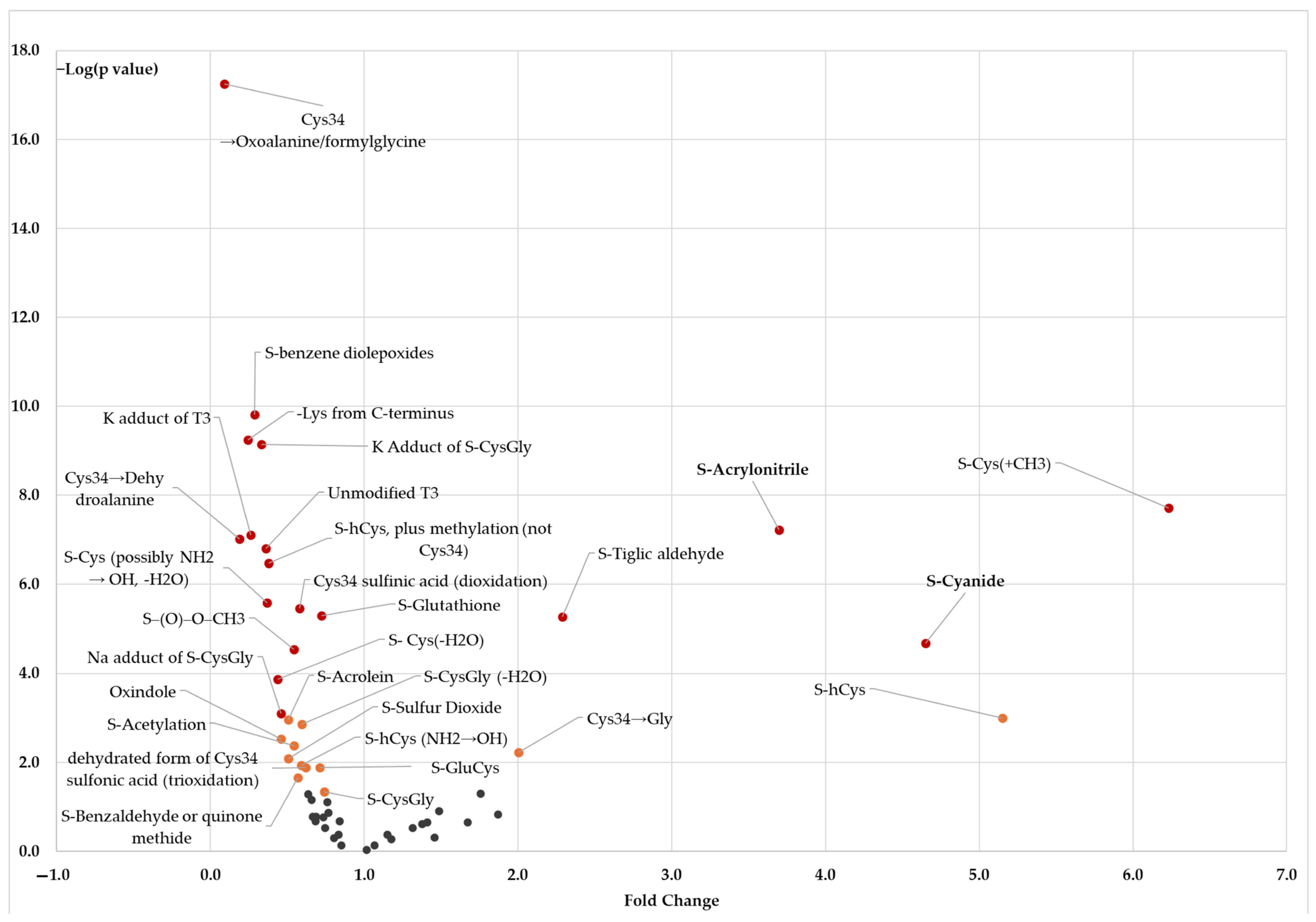
Differences in adducts between two groups (e.g., with and without MSDP, MSDP in 1st/2nd vs. 3rd trimester) were compared using t-tests. Volcano plots were generated based on t-test results. We also applied Wilcoxon rank sum tests for between-group differences, and results were similar to those from generalized linear regression. Generalized linear regression tests were used to evaluate the individual associations of Cys34 adducts with MSDP, cotinine level in DBS, and gestational age of the children.
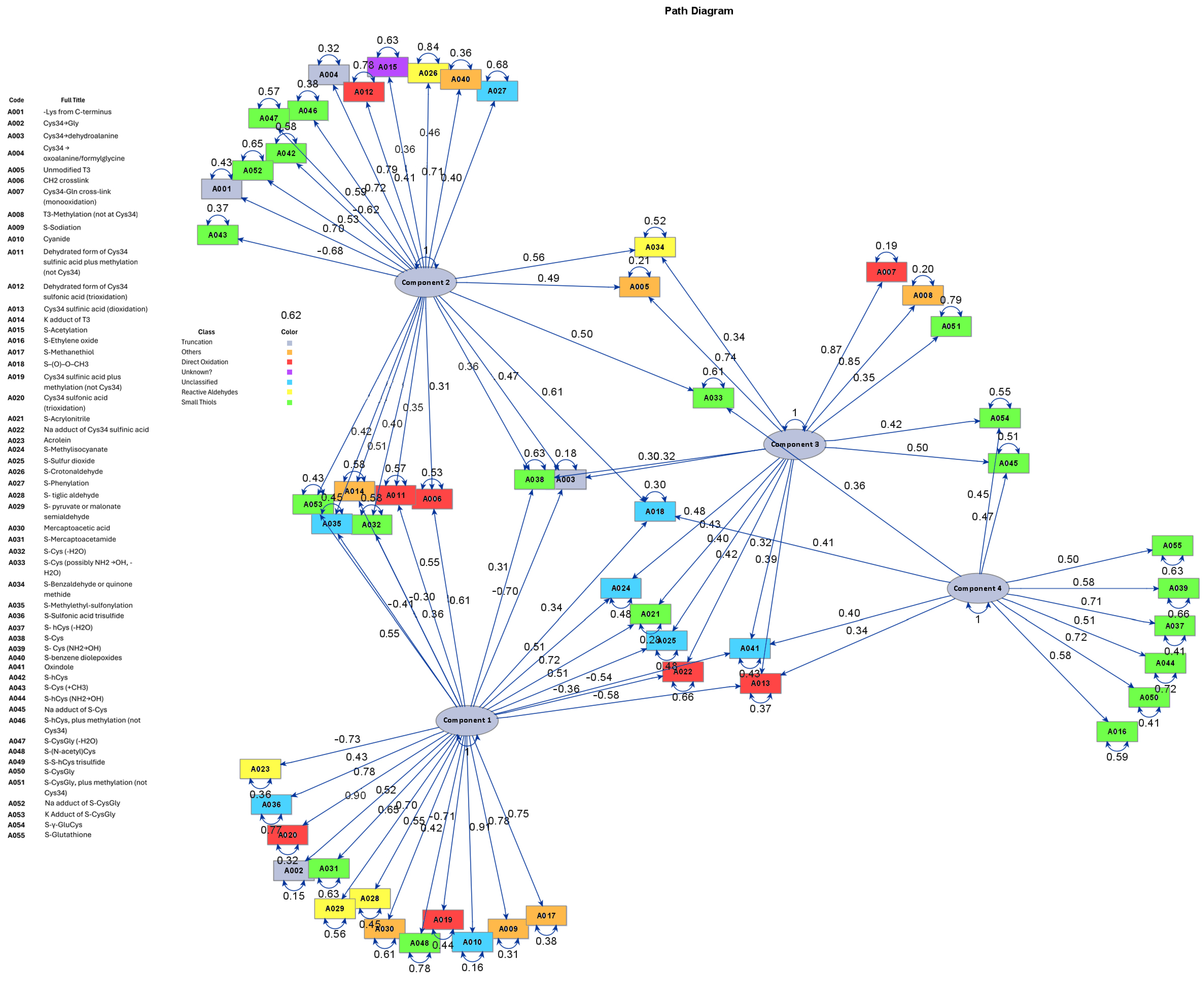
To reduce the dimensionality of the Cys34 adduct data (excluding acrylonitrile, cotinine, and ethylene oxide), we applied principal component (PC) analysis to identify patterns in the correlations between adducts. We extracted linear composites (i.e., factors) of the adducts that explain the largest proportion of total variance in the adducts. Factors with Eigenvalues greater than or equal to 2.0 were further analyzed for their associations with MSDP, cotinine, and acrylonitrile.
All statistical analyses were conducted using SAS 9.4 (SAS Institute Inc., Cary, NC, USA). Bonferroni correction was applied for tests across all HSA adducts. Statistical significance was defined as p-values less than 0.05 for all other tests.
4. Discussion
In this study, we detected a broad range of Cys
34 adducts in dried blood spots from newborns using advanced mass spectrometry and analytical methods. While some of these chemicals have been studied in blood and urinary samples from adults or adolescents [
16], our study contributes essential data on their presence in newborn blood, where the mother serves as a metabolic intermediary for external exposures such as tobacco smoke. Our findings indicate that measurement of acrylonitrile adducts may allow more precise quantification of MSDP exposure, while oxidative stress-related Cys
34 adducts reflect correlated biological responses. Together, these complementary indicators offer a more comprehensive understanding of the impact of MSDP on fetal metabolic profiles.
Using a targeted, high-sensitivity QqQ method, we detected two constituents of cigarette smoke—ethylene oxide and acrylonitrile—in newborn blood. They were also identified in the cord blood of both preterm and full-term infants in another study that employed similar adductomics technologies [
13]. The challenges of detecting these compounds in newborn DBS may help explain why they were not observed in the earlier study by Yano et al. [
10] More importantly, we demonstrated that Cys
34 adducts of acrylonitrile were significantly more abundant in newborns of formerly and currently smoking mothers. These elevated levels of acrylonitrile associated with MSDP are consistent with findings from previous studies in adolescents and adults [
8]. We also found that acrylonitrile levels were elevated in some newborns of former smoking mothers, indicating possible exposure to environmental smoke from secondary (other household smokers) or tertiary (contaminated household furnishings) sources. Because of the addictiveness of nicotine, the self-report of quitting smoking among our former smokers could be doubted, but the low cotinine levels in the blood of these former smoking mothers compared to current smokers support a lack of active smoking in these subjects. Unfortunately, information regarding household smoking by individuals other than mothers was not available in our study. Consequently, we could not account for the potential confounding effects of total environmental tobacco smoke exposure.
Conversely, we found no association between ethylene oxide and parent-reported MSDP exposure, a finding that contrasts with studies in older populations. Elevated levels of ethylene oxide adducts have been found in the blood of smokers [
8], including both adolescents and adults [
17]. One possible explanation is that the placenta may act as a barrier, filtering out elevated ethylene oxide present in smoking mothers. The lack of association between ethylene oxide and acrylonitrile adducts, coupled with its association with other Cys
34 adducts in newborn blood, suggests that the ethylene oxide adducts detected in newborns may instead result from endogenous production, potentially as a byproduct of ethylene metabolism.
Consistent with Yano et al. [
10], we found that the putative acrolein adduct (m/z = 830.97) was lower among newborns with parent-reported MSDP. Furthermore, we found that the putative acrolein adduct was negatively associated with acrylonitrile levels and not associated with cotinine level. However, acrolein, a known component of cigarette smoke, has been found at elevated levels in the urine of smokers [
12,
16,
18]. These discrepancies highlight the need for further research to better understand the behavior of acrolein-related adducts in the fetal environment and their relationship to prenatal exposure to tobacco smoke.
The Cys
34 adduct of cyanide, which results from exposure to maternal inhalation of hydrogen cyanide in tobacco smoke, has been shown to be a reliable biomarker to discriminate between newborns of smoking and nonsmoking mothers [
10]. Consistent with earlier findings, we also observed elevated Cys
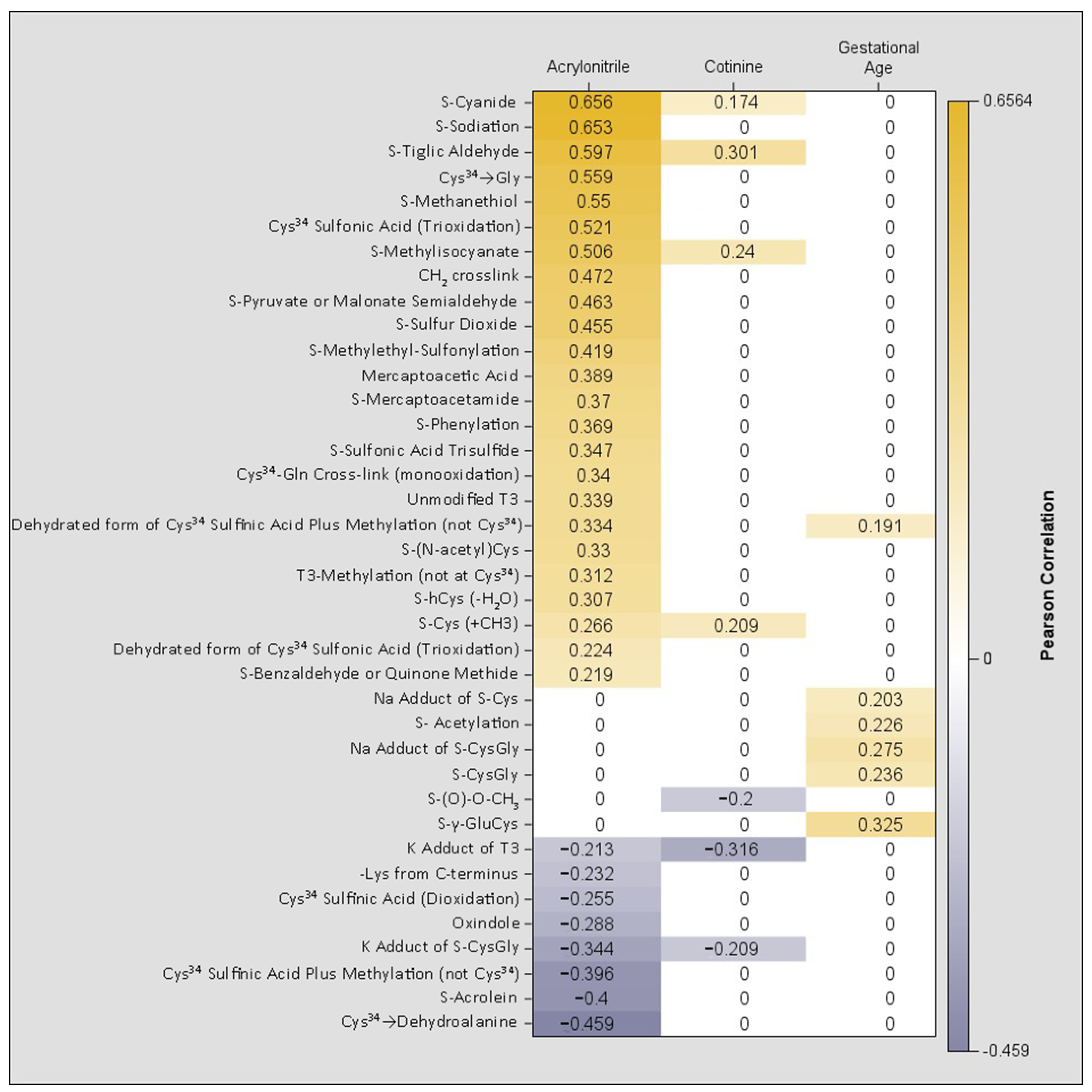
34 adducts of cyanide in newborns with parent-reported MSDP. Furthermore, S-cyanide levels were strongly associated with acrylonitrile levels and only mildly associated with cotinine levels, suggesting that this adduct may reflect chronic rather than recent exposure to tobacco smoke during pregnancy.
The adducts detected in newborn DBS also reflected ROS responses correlated with MSDP, consistent with previous studies. Specifically, we observed reduced levels of S-Sulfinic acid, and S-γGluCys, and elevated levels of S-(N-acetyl) Cys in newborns with MSDP exposure. These observations align with the findings of Grigoryan et al. [
8], who reported reduced S-Sulfinic acid and elevated S-(N-acetyl) Cys in adult smokers, as well as with a previous report linking reduced levels S-sulfinic acid and S-γ-GluCys in association with prenatal air pollution exposure [
9]. Interestingly, our data further demonstrated that S-Sulfinic acid levels were negatively associated and sulfonic acid and S-(N-acetyl) Cys levels positively associated with acrylonitrile levels, but were not associated with gestational age. In contrast, S-γ-GluCys was not associated with acrylonitrile but was positively associated with gestational age. These findings suggest that alterations in S-Sulfinic acid, sulfonic acid, and S-(N-acetyl) Cys may reflect biological responses to chronic MSDP exposure, whereas changes in S-γ-GluCys may be influenced by other MSDP-related factors, such as preterm birth. Notably, we identified five additional adducts, including S-CysGly and S-acetylation, that were also significantly associated with gestational age. This suggests that these specific adducts may serve as biomarkers for the metabolic maturity of newborns. However, further research is needed to better understand the dynamic relationships among the various Cys
34 adducts. Our analyses revealed distinct underlying structures in the adduct profile, suggesting coordinated biological responses.
In assessing biological responses to MSDP, acrylonitrile adduct levels may serve as a more comprehensive and supportable indicator than cotinine levels. In our study, acrylonitrile exhibited a broader range of significant associations with Cys34 adducts compared to cotinine. Notably, the PCs of Cys34 adducts associated with cotinine were also associated with acrylonitrile and parent-reported MSDP. In other words, acrylonitrile, in conjunction with parent-reported MSDP, was associated with the top four PCs of the Cys34 adduct profile, which collectively accounted for over 50% of the total variance. This difference between acrylonitrile and cotinine may reflect the longer biological half-life of acrylonitrile, allowing it to capture cumulative in utero exposure more effectively, whereas cotinine, a short-lived metabolite, primarily reflects more recent exposure.
Our findings may also inform public health policies and future research on the impact of emerging tobacco products. Although e-cigarettes are often marketed as safer alternatives to combustible tobacco, they still lead to exposure to harmful compounds such as acrylonitrile [
11]. A study of urinary metabolites in adolescent users found that while poly-users (those using both e-cigarettes and combustible cigarettes) had the highest levels of toxic volatile compounds, exclusive e-cigarette users also showed significantly elevated concentrations [
19]. For example, metabolites of acrylonitrile, acrolein, and crotonaldehyde were found to be 341%, 20%, and 20% higher, respectively, compared to nonsmoking controls. Notably, fruit-flavored e-cigarettes—which are popular among teens—were associated with even greater acrylonitrile levels [
11]. As this demographic ages, the potential for fetal exposure via maternal e-cigarette use may increase [
20].
This study has several strengths, including measurement of a large panel of adducts in newborn blood and the ability to compare these biomarkers with both self-reported maternal smoking during pregnancy and cotinine levels in newborn blood. However, several limitations should be considered. First, the analysis was based on a relatively small sample (n = 110), drawn from a convenience sample of children with and without ocular diseases. In addition, the majority of participants were African American. These factors may limit generalizability and statistical power. In addition, although we adjusted for gestational age when evaluating associations between adducts and maternal smoking, we could not account for other potential confounders, including secondhand smoke exposure, maternal diet, and ambient air pollution, all of which may influence adduct levels.




 ,
,