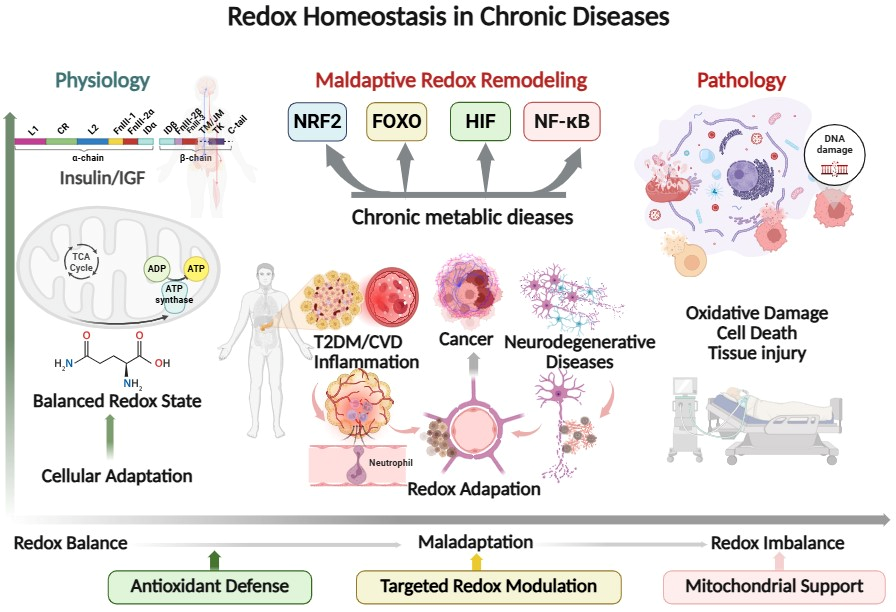
Redox Homeostasis as a Therapeutic Target in Chronic Oxidative Diseases: Implications for Cancer Treatment

 , , , and
Abstract
1. Introduction
Redox Signaling vs. Oxidative Stress
2. Redox Homeostasis in Chronic Disease
2.1. Chronic Disease as Disorders of Maladaptive Redox Homeostasis
2.2. Metabolic Diseases: Adaptive Redox Remodeling Under Chronic Nutrient Stress
2.3. Neurodegenerative Diseases
2.4. Cardiovascular and Inflammatory Diseases
2.5. Redox Homeostasis Breakdown as a Unifying Principle of Chronic Disease
3. Redox Signaling Nodes Governing Chronic Disease Adaptation
3.1. NRF2 as a Master Regulator of Redox Adaptation
3.2. FOXO Transcription Factors: Redox Sensors Linking Stress Resistance and Cell Fate
3.3. HIF Signaling: Redox–Hypoxia Coupling in Chronic Adaptation
3.4. NF-κB as a Redox-Inflammatory Integrator
3.5. Network-Level Integration of Redox Nodes
4. Cancer as a Model of Redox Homeostatic Failure
4.1. Redox Homeostasis in Cancer
4.2. NRF2 Signaling Dysregulation and Redox Addiction in Cancer
4.3. Metabolic Rewiring, ROS Production, and Redox Dependency
4.4. Mitochondrial Redox Imbalance as a Driver of Malignant Plasticity
4.5. Redox Signaling Plasticity and Therapeutic Implications
4.6. Is Cancer a Redox Disease?
5. Therapeutic Redox Reprogramming in Cancer
5.1. Redox Set-Point and Tumor Vulnerability
5.2. Restoring vs. Disrupting Redox Balance: A False Dichotomy
5.3. Combination Redox Modulation as a Therapeutic Principle
5.4. Context-Dependent Redox Therapy and Precision Stratification
5.5. Conceptual Shift: From Oxidative Stress to Redox Reprogramming
6. Natural Compounds as Redox Modulators
7. Clinical Implications and Future Directions
7.1. Patient Stratification Based on Redox States
7.2. Redox Biomarkers as Decision-Making Tools
7.3. Disease-Stage–Specific Redox Targeting
7.4. Toward Personalized Redox Therapy
7.5. Translational Redox Medicine: From Concept to Clinic
7.6. Implications Beyond Cancer: Cardiometabolic and Neurodegenerative Diseases
8. Limitations
9. Conclusions
Author Contributions
Funding
Institutional Review Board Statement
Informed Consent Statement
Data Availability Statement
Conflicts of Interest
References
- Schieber, M.; Chandel, N.S. ROS function in redox signaling and oxidative stress. Curr. Biol. 2014, 24, R453–R462. [Google Scholar] [CrossRef]
- Lee, J.; Giordano, S.; Zhang, J. Autophagy, mitochondria and oxidative stress: Cross-talk and redox signalling. Biochem. J. 2012, 441, 523–540. [Google Scholar] [CrossRef]
- Forman, H.J.; Fukuto, J.M.; Torres, M. Redox signaling: Thiol chemistry defines which reactive oxygen and nitrogen species can act as second messengers. Am. J. Physiol.-Cell Physiol. 2004, 287, C246–C256. [Google Scholar] [CrossRef]
- Ray, P.D.; Huang, B.-W.; Tsuji, Y. Reactive oxygen species (ROS) homeostasis and redox regulation in cellular signaling. Cell. Signal. 2012, 24, 981–990. [Google Scholar] [CrossRef]
- Sies, H.; Jones, D.P. Reactive oxygen species (ROS) as pleiotropic physiological signalling agents. Nat. Rev. Mol. Cell Biol. 2020, 21, 363–383. [Google Scholar] [CrossRef]
- Kostenko, V.; Akimov, O.; Gutnik, O.; Kostenko, H.; Kostenko, V.; Romantseva, T.; Morhun, Y.; Nazarenko, S.; Taran, O. Modulation of redox-sensitive transcription factors with polyphenols as pathogenetically grounded approach in therapy of systemic inflammatory response. Heliyon 2023, 9, e15551. [Google Scholar] [CrossRef]
- Surh, Y.-J.; Kundu, J.K.; Na, H.-K.; Lee, J.-S. Redox-Sensitive Transcription Factors as Prime Targets for Chemoprevention with Anti-Inflammatory and Antioxidative Phytochemicals. J. Nutr. 2005, 135, 2993S–3001S. [Google Scholar] [CrossRef] [PubMed]
- Persson, T.; Popescu, B.O.; Cedazo-Minguez, A. Oxidative stress in Alzheimer’s disease: Why did antioxidant therapy fail? Oxidative Med. Cell. Longev. 2014, 2014, 427318. [Google Scholar] [CrossRef]
- Davies, A.M.; Holt, A.G. Why antioxidant therapies have failed in clinical trials. J. Theor. Biol. 2018, 457, 1–5. [Google Scholar] [CrossRef] [PubMed]
- Jomova, K.; Raptova, R.; Alomar, S.Y.; Alwasel, S.H.; Nepovimova, E.; Kuca, K.; Valko, M. Reactive oxygen species, toxicity, oxidative stress, and antioxidants: Chronic diseases and aging. Arch. Toxicol. 2023, 97, 2499–2574. [Google Scholar] [CrossRef] [PubMed]
- Sharifi-Rad, M.; Anil Kumar, N.V.; Zucca, P.; Varoni, E.M.; Dini, L.; Panzarini, E.; Rajkovic, J.; Tsouh Fokou, P.V.; Azzini, E.; Peluso, I. Lifestyle, oxidative stress, and antioxidants: Back and forth in the pathophysiology of chronic diseases. Front. Physiol. 2020, 11, 552535. [Google Scholar] [CrossRef]
- Li, X.; Cao, Z.; Chen, M.; Wang, S. Redox signaling and homeostasis. Oral Sci. Homeost. Med. 2025, 1, 9610003. [Google Scholar] [CrossRef]
- Wang, S.; Qin, L. Homeostatic medicine: A strategy for exploring health and disease. Curr. Med. 2022, 1, 16. [Google Scholar] [CrossRef]
- Abramov, A.Y.; Jacobson, J.; Wientjes, F.; Hothersall, J.; Canevari, L.; Duchen, M.R. Expression and modulation of an NADPH oxidase in mammalian astrocytes. J. Neurosci. 2005, 25, 9176–9184. [Google Scholar] [CrossRef]
- Walker, C.L.; Pomatto, L.C.D.; Tripathi, D.N.; Davies, K.J.A. Redox Regulation of Homeostasis and Proteostasis in Peroxisomes. Physiol. Rev. 2018, 98, 89–115. [Google Scholar] [CrossRef] [PubMed]
- Bener Aksam, E.; Jungwirth, H.; Kohlwein, S.D.; Ring, J.; Madeo, F.; Veenhuis, M.; van der Klei, I.J. Absence of the peroxiredoxin Pmp20 causes peroxisomal protein leakage and necrotic cell death. Free Radic. Biol. Med. 2008, 45, 1115–1124. [Google Scholar] [CrossRef] [PubMed]
- Yan, Z.; Banerjee, R. Redox remodeling as an immunoregulatory strategy. Biochemistry 2010, 49, 1059–1066. [Google Scholar] [CrossRef] [PubMed]
- Raut, S.K.; Khullar, M. Oxidative stress in metabolic diseases: Current scenario and therapeutic relevance. Mol. Cell. Biochem. 2023, 478, 185–196. [Google Scholar] [CrossRef]
- Shadfar, S.; Parakh, S.; Jamali, M.S.; Atkin, J.D. Redox dysregulation as a driver for DNA damage and its relationship to neurodegenerative diseases. Transl. Neurodegener. 2023, 12, 18. [Google Scholar] [CrossRef]
- Lynch, D.R.; Chin, M.P.; Delatycki, M.B.; Subramony, S.H.; Corti, M.; Hoyle, J.C.; Boesch, S.; Nachbauer, W.; Mariotti, C.; Mathews, K.D.; et al. Safety and Efficacy of Omaveloxolone in Friedreich Ataxia (MOXIe Study). Ann. Neurol. 2021, 89, 212–225, Erratum in Ann. Neurol. 2023, 94, 1190. [Google Scholar] [CrossRef]
- Moreau, C.; Danel, V.; Devedjian, J.C.; Grolez, G.; Timmerman, K.; Laloux, C.; Petrault, M.; Gouel, F.; Jonneaux, A.; Dutheil, M.; et al. Could Conservative Iron Chelation Lead to Neuroprotection in Amyotrophic Lateral Sclerosis? Antioxid. Redox Signal. 2018, 29, 742–748. [Google Scholar] [CrossRef] [PubMed]
- Saklayen, M.G. The Global Epidemic of the Metabolic Syndrome. Curr. Hypertens. Rep. 2018, 20, 12. [Google Scholar] [CrossRef] [PubMed]
- Sbodio, J.I.; Snyder, S.H.; Paul, B.D. Redox Mechanisms in Neurodegeneration: From Disease Outcomes to Therapeutic Opportunities. Antioxid. Redox Signal. 2019, 30, 1450–1499. [Google Scholar] [CrossRef] [PubMed]
- Devos, D.; Moreau, C.; Devedjian, J.C.; Kluza, J.; Petrault, M.; Laloux, C.; Jonneaux, A.; Ryckewaert, G.; Garçon, G.; Rouaix, N.; et al. Targeting chelatable iron as a therapeutic modality in Parkinson’s disease. Antioxid. Redox Signal. 2014, 21, 195–210. [Google Scholar] [CrossRef]
- Seet, R.C.; Lim, E.C.; Tan, J.J.; Quek, A.M.; Chow, A.W.; Chong, W.L.; Ng, M.P.; Ong, C.N.; Halliwell, B. Does high-dose coenzyme Q10 improve oxidative damage and clinical outcomes in Parkinson’s disease? Antioxid. Redox Signal. 2014, 21, 211–217. [Google Scholar] [CrossRef]
- Prat-Ortega, G.; Ensel, S.; Donadio, S.; Borda, L.; Boos, A.; Yadav, P.; Verma, N.; Ho, J.; Carranza, E.; Frazier-Kim, S.; et al. First-in-human study of epidural spinal cord stimulation in individuals with spinal muscular atrophy. Nat. Med. 2025, 31, 1246–1256. [Google Scholar] [CrossRef]
- Chun, H.; Yoon, M.L.; Lee, H.W.; Lee, J.Y.; Hong, S.B.; Ha, S.S.; Yoon, K.J. The Efficacy and Safety of Transcranial Photobiomodulation for Mild Cognitive Impairment Due to Alzheimer’s Disease: A Randomized, Double-Blind, Sham-Controlled Study. Photobiomodulation Photomed. Laser Surg. 2025, 43, 411–416. [Google Scholar] [CrossRef]
- Sultana, Y.; Kaur Lang, D.; Santosh Alex, T.; Khabiya, R.; Dwivedi, A.; Sen, S.; Chakraborty, R. Redox-signalling and Redox Biomarkers in Cardiovascular Health and Disease. Cardiovasc. Hematol. Agents Med. Chem. 2025, 23, 99–111. [Google Scholar] [CrossRef]
- Ang, L.; Gunaratnam, S.; Huang, Y.; Dillon, B.R.; Martin, C.L.; Burant, A.; Reiss, J.; Blakely, P.; Vasbinder, A.; Zhao, L.; et al. Inflammatory Markers and Measures of Cardiovascular Autonomic Neuropathy in Type 1 Diabetes. J. Am. Heart Assoc. 2025, 14, e036787. [Google Scholar] [CrossRef]
- Linsley, V.G.; Bishop, N.C.; Roberts, M.J.; Hamrouni, M.; Demashkieh, M.; Paine, N.J. Inflammatory and Cardiovascular Responses to Active and Passive Acute Psychological Stress. Biopsychosoc. Sci. Med. 2025, 87, 107–117. [Google Scholar] [CrossRef]
- Zhu, S.; Pan, W.; Yao, Y.; Shi, K. The efficacy of colchicine compared to placebo for preventing ischemic stroke among individuals with established atherosclerotic cardiovascular diseases: A systematic review and meta-analysis. Scand. Cardiovasc. J. 2025, 59, 2441112. [Google Scholar] [CrossRef]
- Davison, B.A.; Abbate, A.; Cotter, G.; Pascual-Figal, D.; Van Tassell, B.; Villota, J.N.; Atabaeva, L.; Freund, Y.; Aimo, A.; Biegus, J.; et al. Effects of anti-inflammatory therapy in acute heart failure: A systematic review and meta-analysis. Heart Fail. Rev. 2025, 30, 575–587. [Google Scholar] [CrossRef]
- Liu, L.F.; Fan, Y.W.; Lv, Y.; Liu, Z.X.; Dai, X.C. Strategies for assessing and preventing cardiovascular disease risk in inflammatory bowel disease patients: A meta-analysis and meta-regression and bibliometric review. PLoS ONE 2025, 20, e0327734. [Google Scholar] [CrossRef]
- Ahmed, M.; Fahim, M.A.A.; Humayun, M.; Sajid, B.; Ahmad, S.; Asghar, M.S. Efficacy and Safety of Colchicine for Secondary Prevention of Cardiovascular Disease: A Systematic Review and Meta-Analysis. Catheter. Cardiovasc. Interv. 2025, 106, 3675–3689. [Google Scholar] [CrossRef]
- Abolhassani, N.; Leon, J.; Sheng, Z.; Oka, S.; Hamasaki, H.; Iwaki, T.; Nakabeppu, Y. Molecular pathophysiology of impaired glucose metabolism, mitochondrial dysfunction, and oxidative DNA damage in Alzheimer’s disease brain. Mech. Ageing Dev. 2017, 161, 95–104. [Google Scholar] [CrossRef]
- Alkemade, F.E.; van Vliet, P.; Henneman, P.; van Dijk, K.W.; Hierck, B.P.; van Munsteren, J.C.; Scheerman, J.A.; Goeman, J.J.; Havekes, L.M.; Gittenberger-de Groot, A.C.; et al. Prenatal exposure to apoE deficiency and postnatal hypercholesterolemia are associated with altered cell-specific lysine methyltransferase and histone methylation patterns in the vasculature. Am. J. Pathol. 2010, 176, 542–548. [Google Scholar] [CrossRef][Green Version]
- Panieri, E.; Telkoparan-Akillilar, P.; Suzen, S.; Saso, L. The NRF2/KEAP1 Axis in the Regulation of Tumor Metabolism: Mechanisms and Therapeutic Perspectives. Biomolecules 2020, 10, 791. [Google Scholar] [CrossRef] [PubMed]
- Hatem, E.; El Banna, N.; Huang, M.E. Multifaceted Roles of Glutathione and Glutathione-Based Systems in Carcinogenesis and Anticancer Drug Resistance. Antioxid. Redox Signal. 2017, 27, 1217–1234. [Google Scholar] [CrossRef] [PubMed]
- Selvaraj, N.R.; Nandan, D.; Nair, B.G.; Nair, V.A.; Venugopal, P.; Aradhya, R. Oxidative Stress and Redox Imbalance: Common Mechanisms in Cancer Stem Cells and Neurodegenerative Diseases. Cells 2025, 14, 511. [Google Scholar] [CrossRef] [PubMed]
- Jo, Y.; Kim, B.Y.; Lee, S.M.; Park, J.; Kim, W.; Shim, J.A.; Park, J.H.; Park, J.E.; Shin, Y.I.; Ryu, J.H.; et al. Particulate matter exposure induces pulmonary T(H)2 responses and oxidative stress-mediated NRF2 activation in mice. Redox Biol. 2025, 82, 103632. [Google Scholar] [CrossRef]
- Nuszkiewicz, J.; Wróblewska, J.; Wróblewski, M.; Woźniak, A. Anthocyanin-Rich Purple Plant Foods: Bioavailability, Antioxidant Mechanisms, and Functional Roles in Redox Regulation and Exercise Recovery. Nutrients 2025, 17, 2453. [Google Scholar] [CrossRef]
- Șerban, M.; Toader, C.; Covache-Busuioc, R.A. The Redox Revolution in Brain Medicine: Targeting Oxidative Stress with AI, Multi-Omics and Mitochondrial Therapies for the Precision Eradication of Neurodegeneration. Int. J. Mol. Sci. 2025, 26, 7498. [Google Scholar] [CrossRef]
- Alfonso-Prieto, M.; Biarnés, X.; Vidossich, P.; Rovira, C. The molecular mechanism of the catalase reaction. J. Am. Chem. Soc. 2009, 131, 11751–11761. [Google Scholar] [CrossRef]
- Wu, T.; Gu, W.; Hong, L.; Cao, Y.; Zhao, H.; Guo, X.; Yang, X.; Yi, G.; Fu, M. Exploration of shared TF-miRNA–mRNA and mRNA-RBP-pseudogene networks in type 2 diabetes mellitus and breast cancer. Front. Immunol. 2022, 13, 915017. [Google Scholar] [CrossRef]
- Bernardo, V.S.; Torres, F.F.; da Silva, D.G.H. FoxO3 and oxidative stress: A multifaceted role in cellular adaptation. J. Mol. Med. 2023, 101, 83–99. [Google Scholar] [CrossRef]
- Rodriguez-Colman, M.J.; Dansen, T.B.; Burgering, B.M.T. FOXO transcription factors as mediators of stress adaptation. Nat. Rev. Mol. Cell Biol. 2024, 25, 46–64. [Google Scholar] [CrossRef] [PubMed]
- Furukawa-Hibi, Y.; Kobayashi, Y.; Chen, C.; Motoyama, N. FOXO transcription factors in cell-cycle regulation and the response to oxidative stress. Antioxid. Redox Signal. 2005, 7, 752–760. [Google Scholar] [CrossRef]
- Klotz, L.O.; Steinbrenner, H. Cellular adaptation to xenobiotics: Interplay between xenosensors, reactive oxygen species and FOXO transcription factors. Redox Biol. 2017, 13, 646–654. [Google Scholar] [CrossRef] [PubMed]
- Krafczyk, N.; Klotz, L.-O. FOXO transcription factors in antioxidant defense. IUBMB Life 2022, 74, 53–61. [Google Scholar] [CrossRef]
- Link, W.; Fernandez-Marcos, P.J. FOXO transcription factors at the interface of metabolism and cancer. Int. J. Cancer 2017, 141, 2379–2391. [Google Scholar] [CrossRef]
- Murtaza, G.; Khan, A.K.; Rashid, R.; Muneer, S.; Hasan, S.M.F.; Chen, J. FOXO Transcriptional Factors and Long-Term Living. Oxidative Med. Cell. Longev. 2017, 2017, 3494289. [Google Scholar] [CrossRef]
- Sengupta, A.; Molkentin, J.D.; Paik, J.H.; DePinho, R.A.; Yutzey, K.E. FoxO transcription factors promote cardiomyocyte survival upon induction of oxidative stress. J. Biol. Chem. 2011, 286, 7468–7478. [Google Scholar] [CrossRef]
- Sakaguchi, S.; Yamaguchi, T.; Nomura, T.; Ono, M. Regulatory T cells and immune tolerance. Cell 2008, 133, 775–787. [Google Scholar] [CrossRef]
- Tormos, K.V.; Chandel, N.S. Inter-connection between mitochondria and HIFs. J. Cell. Mol. Med. 2010, 14, 795–804. [Google Scholar] [CrossRef]
- Zhang, X.; Yang, Y.; Shi, Q. DNA methylation in adaptation to high-altitude environments and pathogenesis of related diseases. Hum. Genom. 2025, 19, 100. [Google Scholar] [CrossRef]
- Arnaud, C.; Billoir, E.; de Melo Junior, A.F.; Pereira, S.A.; O’Halloran, K.D.; Monteiro, E.C. Chronic intermittent hypoxia-induced cardiovascular and renal dysfunction: From adaptation to maladaptation. J. Physiol. 2023, 601, 5553–5577. [Google Scholar] [CrossRef] [PubMed]
- Prabhakar, N.R.; Semenza, G.L. Adaptive and maladaptive cardiorespiratory responses to continuous and intermittent hypoxia mediated by hypoxia-inducible factors 1 and 2. Physiol. Rev. 2012, 92, 967–1003. [Google Scholar] [CrossRef] [PubMed]
- Yin, X.; Zheng, Y.; Liu, Q.; Cai, J.; Cai, L. Cardiac Response to Chronic Intermittent Hypoxia with a Transition from Adaptation to Maladaptation: The Role of Hydrogen Peroxide. Oxidative Med. Cell. Longev. 2012, 2012, 569520. [Google Scholar] [CrossRef] [PubMed]
- Packer, M. Intensity, Duration, and Context Dependency of the Responses to Nutrient Surplus and Deprivation Signaling in the Heart: Insights Into the Complexities of Cardioprotection. Circulation 2025, 152, 802–835. [Google Scholar] [CrossRef]
- Bakleh, M.Z.; Al Haj Zen, A. The Distinct Role of HIF-1α and HIF-2α in Hypoxia and Angiogenesis. Cells 2025, 14, 673. [Google Scholar] [CrossRef]
- Thapa, R.; Marianesan, A.B.; Rekha, A.; Ganesan, S.; Kumari, M.; Bhat, A.A.; Ali, H.; Singh, S.K.; Chakraborty, A.; MacLoughlin, R.; et al. Hypoxia-inducible factor and cellular senescence in pulmonary aging and disease. Biogerontology 2025, 26, 64. [Google Scholar] [CrossRef] [PubMed]
- Madamanchi, N.R.; Runge, M.S. Redox signaling in cardiovascular health and disease. Free Radic. Biol. Med. 2013, 61, 473–501. [Google Scholar] [CrossRef] [PubMed]
- Kumari, M.; Sharma, A.; Tirpude, N.V. Herbacetin ameliorates lipopolysaccharide-elicited inflammatory response by suppressing NLRP-3/AIM-2 inflammasome activation, PI3K/Akt/MAPKs/NF-κB redox inflammatory signalling, modulating autophagy and macrophage polarization imbalance. Mol. Biol. Rep. 2024, 51, 1159. [Google Scholar] [CrossRef] [PubMed]
- Chirumbolo, S.; Valdenassi, L.; Bertossi, D.; Loprete, F.; Tirelli, U.; Franzini, M. A conceptual model of oxygen-ozone therapy as a modulator of aging via the HMGB1 pathway. Biogerontology 2025, 27, 28. [Google Scholar] [CrossRef]
- Burdan, O.; Picheta, N.; Piekarz, J.; Daniłowska, K.; Gajewski, F.; Kułak, K.; Tarkowski, R. Mechanistic Insights into the Anti-Inflammatory and Anti-Proliferative Effects of Selected Medicinal Plants in Endometriosis. Int. J. Mol. Sci. 2025, 26, 10947. [Google Scholar] [CrossRef]
- Cao, Z.; Xin, R.; Ma, Q.; Wang, Q.; Feng, S.; Su, H.; Zhao, A.; Li, K.; Liu, S.; He, L.; et al. Nanobiocatalyst-Driven Spatiotemporal Hydrogen Delivery Induces Dormancy Potentiated Catalytic Tumor Therapy. ACS Nano 2025, 19, 33496–33509. [Google Scholar] [CrossRef]
- Sammad, A.; Luo, H.; Hu, L.; Zhu, H.; Wang, Y. Transcriptome Reveals Granulosa Cells Coping through Redox, Inflammatory and Metabolic Mechanisms under Acute Heat Stress. Cells 2022, 11, 1443. [Google Scholar] [CrossRef]
- Saleh, D.O.; Abo El Nasr, N.M.E.; Elbaset, M.A.; Shabana, M.E.; Esatbeyoglu, T.; Afifi, S.M.; Hashad, I.M. Role of rosuvastatin and pitavastatin in alleviating diabetic cardiomyopathy in rats: Targeting of RISK, NF-κB/ NLRP3 inflammasome and TLR4/NF-κB signaling cascades. PLoS ONE 2025, 20, e0325767. [Google Scholar] [CrossRef]
- Dawane, J.S.; Pandit, V.A. Understanding redox homeostasis and its role in cancer. J. Clin. Diagn. Res. 2012, 6, 1796–1802. [Google Scholar] [CrossRef]
- Marengo, B.; Nitti, M.; Furfaro, A.L.; Colla, R.; Ciucis, C.D.; Marinari, U.M.; Pronzato, M.A.; Traverso, N.; Domenicotti, C. Redox Homeostasis and Cellular Antioxidant Systems: Crucial Players in Cancer Growth and Therapy. Oxidative Med. Cell. Longev. 2016, 2016, 6235641. [Google Scholar] [CrossRef]
- Shah, V.; Lam, H.Y.; Leong, C.H.; Sakaizawa, R.; Shah, J.S.; Kumar, A.P. Epigenetic Control of Redox Pathways in Cancer Progression. Antioxid. Redox Signal. 2025, 42, 848–867. [Google Scholar] [CrossRef]
- Pan, Y.; Matsunaga, T.; Zhang, T.; Akaike, T. The Therapeutic Potential of Supersulfides in Oxidative Stress-Related Diseases. Biomolecules 2025, 15, 172. [Google Scholar] [CrossRef]
- Bae, T.; Hallis, S.P.; Kwak, M.K. Hypoxia, oxidative stress, and the interplay of HIFs and NRF2 signaling in cancer. Exp. Mol. Med. 2024, 56, 501–514. [Google Scholar] [CrossRef]
- Davies, K.J.A.; Forman, H.J. Does Bach1 & c-Myc dependent redox dysregulation of Nrf2 & adaptive homeostasis decrease cancer risk in ageing? Free Radic. Biol. Med. 2019, 134, 708–714. [Google Scholar] [CrossRef]
- Zhang, W.; Wang, M.; Ma, P.; Lin, J. Redox-Active Nanozymes in Metabolic Modulation for Precision Therapeutics. Adv. Healthc. Mater. 2025, 15, e02110. [Google Scholar] [CrossRef] [PubMed]
- Aoyama, Y.; Yamazaki, H.; Inoue, D. Emerging paradigms in redox regulation: The role of selenoproteins in normal and malignant hematopoiesis. Exp. Hematol. 2025, 155, 105346. [Google Scholar] [CrossRef]
- Baptista, S.N.; Faria, A.V.S.; Ferreira-Halder, C.V. Keratinocyte organelle reprogramming as a key player in melanocyte biology in health and disease. Biochim. Biophys. Acta Rev. Cancer 2025, 1880, 189495. [Google Scholar] [CrossRef] [PubMed]
- Peng, M.H.; Zhang, K.L.; Ma, Z.W.; Zhang, H.W.; Guan, S.W.; Yu, H.B. SQOR as a metabolic rheostat of H(2)S: Structure, redox homeostasis, and disease therapy. Front. Cell Dev. Biol. 2025, 13, 1685252. [Google Scholar] [CrossRef]
- Vučetić, M.; Cormerais, Y.; Parks, S.K.; Pouysségur, J. The Central Role of Amino Acids in Cancer Redox Homeostasis: Vulnerability Points of the Cancer Redox Code. Front. Oncol. 2017, 7, 319. [Google Scholar] [CrossRef] [PubMed]
- Halliwell, B. The antioxidant paradox: Less paradoxical now? Br. J. Clin. Pharmacol. 2013, 75, 637–644. [Google Scholar] [CrossRef]
- Li, Y.; Zhang, X.; Wang, Z.; Li, B.; Zhu, H. Modulation of redox homeostasis: A strategy to overcome cancer drug resistance. Front. Pharmacol. 2023, 14, 1156538. [Google Scholar] [CrossRef]
- Serrano, J.J.; Medina, M. Metabolic Reprogramming at the Edge of Redox: Connections Between Metabolic Reprogramming and Cancer Redox State. Int. J. Mol. Sci. 2025, 26, 498. [Google Scholar] [CrossRef]
- Hyun, D.H. Insights into the New Cancer Therapy through Redox Homeostasis and Metabolic Shifts. Cancers 2020, 12, 1822. [Google Scholar] [CrossRef]
- Khan, S.U.; Fatima, K.; Aisha, S.; Hamza, B.; Malik, F. Redox balance and autophagy regulation in cancer progression and their therapeutic perspective. Med. Oncol. 2022, 40, 12. [Google Scholar] [CrossRef] [PubMed]
- Jose, C.; Bellance, N.; Rossignol, R. Choosing between glycolysis and oxidative phosphorylation: A tumor’s dilemma? Biochim. Biophys. Acta 2011, 1807, 552–561. [Google Scholar] [CrossRef] [PubMed]
- Tang, Y.; Zhang, Z.; Chen, Y.; Qin, S.; Zhou, L.; Gao, W.; Shen, Z. Metabolic Adaptation-Mediated Cancer Survival and Progression in Oxidative Stress. Antioxidants 2022, 11, 1324. [Google Scholar] [CrossRef] [PubMed]
- Nakamura, H.; Takada, K. Reactive oxygen species in cancer: Current findings and future directions. Cancer Sci. 2021, 112, 3945–3952. [Google Scholar] [CrossRef]
- Mortezaee, K. Redox tolerance and metabolic reprogramming in solid tumors. Cell Biol. Int. 2021, 45, 273–286. [Google Scholar] [CrossRef]
- Pervaiz, S. Redox Dichotomy in Cell Fate Decision: Evasive Mechanism or Achilles Heel? Antioxid. Redox Signal. 2018, 29, 1191–1195. [Google Scholar] [CrossRef]
- Semenza, G.L. Hypoxia-inducible factors: Coupling glucose metabolism and redox regulation with induction of the breast cancer stem cell phenotype. EMBO J. 2017, 36, 252–259. [Google Scholar] [CrossRef]
- Sutkowy, P.; Czeleń, P. Redox Balance in Cancer in the Context of Tumor Prevention and Treatment. Biomedicines 2025, 13, 1149. [Google Scholar] [CrossRef]
- Wang, Y.; He, J.; Lian, S.; Zeng, Y.; He, S.; Xu, J.; Luo, L.; Yang, W.; Jiang, J. Targeting Metabolic–Redox Nexus to Regulate Drug Resistance: From Mechanism to Tumor Therapy. Antioxidants 2024, 13, 828. [Google Scholar] [CrossRef]
- Nazari, A.; Osati, P.; Seifollahy Fakhr, S.; Faghihkhorasani, F.; Ghanaatian, M.; Faghihkhorasani, F.; Rezaei-Tazangi, F.; Pazhouhesh Far, N.; Shourideh, A.; Ebrahimi, N.; et al. New Emerging Therapeutic Strategies Based on Manipulation of the Redox Regulation Against Therapy Resistance in Cancer. Antioxid. Redox Signal. 2024. [Google Scholar] [CrossRef]
- Park, M.N.; Kim, M.; Lee, S.; Kang, S.; Ahn, C.H.; Tallei, T.E.; Kim, W.; Kim, B. Targeting Redox Signaling Through Exosomal MicroRNA: Insights into Tumor Microenvironment and Precision Oncology. Antioxidants 2025, 14, 501. [Google Scholar] [CrossRef]
- Park, M.N.; Choi, J.; Ribeiro, R.; Delfino, D.V.; Ko, S.G.; Kim, B. The Redox-Adhesion-Exosome (RAX) Hub in Cancer: Lipid Peroxidation-Driven EMT Plasticity and Ferroptosis Defense with HNE/MDA Signaling and Lipidomic Perspectives. Antioxidants 2025, 14, 1474. [Google Scholar] [CrossRef] [PubMed]
- Wang, K.; Jiang, J.; Lei, Y.; Zhou, S.; Wei, Y.; Huang, C. Targeting Metabolic-Redox Circuits for Cancer Therapy. Trends Biochem. Sci. 2019, 44, 401–414. [Google Scholar] [CrossRef]
- Atalay Ekiner, S.; Gęgotek, A.; Skrzydlewska, E. Natural compounds modulating redox metabolism and Inflammation: New insights in skin cancer prevention and therapy. Redox Biol. 2025, 88, 103913. [Google Scholar] [CrossRef] [PubMed]
- Li, X.; Li, D. Natural compounds targeting cellular redox homeostasis in malignancies. Cell. Mol. Biol. 2023, 69, 255–265. [Google Scholar] [CrossRef] [PubMed]
- Fernandes, A.S. Redox-Active Molecules as Therapeutic Agents. Antioxidants 2022, 11, 1004. [Google Scholar] [CrossRef]
- Rousseau, P.N.; Bazin, P.L.; Steele, C.J. Pontine Functional Connectivity Gradients. Cerebellum 2025, 25, 1. [Google Scholar] [CrossRef] [PubMed]
- Santolini, J.; Wootton, S.A.; Jackson, A.A.; Feelisch, M. The Redox architecture of physiological function. Curr. Opin. Physiol. 2019, 9, 34–47. [Google Scholar] [CrossRef] [PubMed]
- Truong, T.T.; Singh, A.A.; Tak, S.; Na, S.; Choi, J.; Oh, J.; Mondal, S. Plant-Derived Antioxidants as Modulators of Redox Signaling and Epigenetic Reprogramming in Cancer. Cells 2025, 14, 1948. [Google Scholar] [CrossRef] [PubMed]
- Makinde, E.; Ma, L.; Mellick, G.D.; Feng, Y. Mitochondrial Modulators: The Defender. Biomolecules 2023, 13, 226. [Google Scholar] [CrossRef]
- Cort, A.; Ozben, T.; Saso, L.; De Luca, C.; Korkina, L. Redox Control of Multidrug Resistance and Its Possible Modulation by Antioxidants. Oxidative Med. Cell. Longev. 2016, 2016, 4251912. [Google Scholar] [CrossRef]
- Pandey, A.K.; Kumar, S.; Pandey, A.K.; Reis, F. Editorial: Combating Redox Imbalance-Associated Complications with Natural Products. Front. Pharmacol. 2021, 12, 802750. [Google Scholar] [CrossRef]
- Nitti, M.; Marengo, B.; Furfaro, A.L.; Pronzato, M.A.; Marinari, U.M.; Domenicotti, C.; Traverso, N. Hormesis and Oxidative Distress: Pathophysiology of Reactive Oxygen Species and the Open Question of Antioxidant Modulation and Supplementation. Antioxidants 2022, 11, 1613. [Google Scholar] [CrossRef]
- Tyuryaeva, I.; Lyublinskaya, O. Expected and Unexpected Effects of Pharmacological Antioxidants. Int. J. Mol. Sci. 2023, 24, 9303. [Google Scholar] [CrossRef]
- Bevere, M.; Di Cola, G.; Santangelo, C.; Grazioli, E.; Marramiero, L.; Pignatelli, P.; Bondi, D.; Mrakic-Sposta, S. Redox-based Disruption of Cellular Hormesis and Promotion of Degenerative Pathways: Perspectives on Aging Processes. J. Gerontol. A Biol. Sci. Med. Sci. 2022, 77, 2195–2206. [Google Scholar] [CrossRef]
- Henning, T.; Weber, D. Redox biomarkers in dietary interventions and nutritional observation studies—From new insights to old problems. Redox Biol. 2021, 41, 101922. [Google Scholar] [CrossRef] [PubMed]
- Alum, E.U.; Uti, D.E.; Offor, C.E. Redox Signaling Disruption and Antioxidants in Toxicology: From Precision Therapy to Potential Hazards. Cell Biochem. Biophys. 2025, 83, 4253–4274. [Google Scholar] [CrossRef]
- Altanam, S.Y.; Darwish, N.; Bakillah, A. Exploring the Interplay of Antioxidants, Inflammation, and Oxidative Stress: Mechanisms, Therapeutic Potential, and Clinical Implications. Diseases 2025, 13, 309. [Google Scholar] [CrossRef]
- Cortese-Krott, M.M.; Koning, A.; Kuhnle, G.G.C.; Nagy, P.; Bianco, C.L.; Pasch, A.; Wink, D.A.; Fukuto, J.M.; Jackson, A.A.; van Goor, H.; et al. The Reactive Species Interactome: Evolutionary Emergence, Biological Significance, and Opportunities for Redox Metabolomics and Personalized Medicine. Antioxid. Redox Signal. 2017, 27, 684–712. [Google Scholar] [CrossRef] [PubMed]
- Frohlich, J.; Chaldakov, G.N.; Vinciguerra, M. Cardio- and Neurometabolic Adipobiology: Consequences and Implications for Therapy. Int. J. Mol. Sci. 2021, 22, 4137. [Google Scholar] [CrossRef] [PubMed]
- Cecerska-Heryć, E.; Zoń, M.; Budkowska, M.; Serwin, N.; Michalczyk, A.; Goszka, M.; Polikowska, A.; Wojciuk, B.; Dołęgowska, B. Redox on the Clock: Sex-Dependent Dynamics of Xanthine Oxidoreductase Isoforms and Melatonin. Int. J. Mol. Sci. 2025, 26, 11272. [Google Scholar] [CrossRef]
- Deledda, A.; Annunziata, G.; Tenore, G.C.; Palmas, V.; Manzin, A.; Velluzzi, F. Diet-Derived Antioxidants and Their Role in Inflammation, Obesity and Gut Microbiota Modulation. Antioxidants 2021, 10, 708. [Google Scholar] [CrossRef]
- Duan, Q.Q.; Su, W.M.; Gu, X.J.; Long, J.; Jiang, Z.; Yin, K.F.; Cai, W.C.; Cao, B.; Chi, L.Y.; Gao, X.; et al. Genetically Predict Diet-derived Antioxidants and Risk of Neurodegenerative Diseases Among Individuals of European Descent: A Mendelian Randomization Study. Brain Behav. 2025, 15, e70766. [Google Scholar] [CrossRef]
- Morén, C.; deSouza, R.M.; Giraldo, D.M.; Uff, C. Antioxidant Therapeutic Strategies in Neurodegenerative Diseases. Int. J. Mol. Sci. 2022, 23, 9328. [Google Scholar] [CrossRef]
- Butcko, A.J.; Putman, A.K.; Mottillo, E.P. The Intersection of Genetic Factors, Aberrant Nutrient Metabolism and Oxidative Stress in the Progression of Cardiometabolic Disease. Antioxidants 2024, 13, 87. [Google Scholar] [CrossRef]
- Chan, J.Y.; Chan, S.H. Activation of endogenous antioxidants as a common therapeutic strategy against cancer, neurodegeneration and cardiovascular diseases: A lesson learnt from DJ-1. Pharmacol. Ther. 2015, 156, 69–74. [Google Scholar] [CrossRef] [PubMed]
- Claro-Cala, C.M.; Rivero-Pino, F.; Torrecillas-López, M.; Jimenez-Gonzalez, V.; Montserrat-de la Paz, S. Immunonutrition: Future perspective in neurodegenerative disorders. Nutr. Neurosci. 2025, 28, 807–818. [Google Scholar] [CrossRef]
- Liu, Y.; Wu, G.; Feng, L.; Li, J.; Xia, Y.; Guo, W.; Zhao, K. Harnessing Antioxidants in Cancer Therapy: Opportunities, Challenges, and Future Directions. Antioxidants 2025, 14, 674. [Google Scholar] [CrossRef] [PubMed]
- Garcia-Llorens, G.; El Ouardi, M.; Valls-Belles, V. Oxidative Stress Fundamentals: Unraveling the Pathophysiological Role of Redox Imbalance in Non-Communicable Diseases. Appl. Sci. 2025, 15, 10191. [Google Scholar] [CrossRef]


| Disease Context | Dominant Redox State | Key Signaling Features | Adaptive/Maladaptive Outcome | Therapeutic Redox Strategy | Refs |
|---|---|---|---|---|---|
| Cancer | Redox-adapted high ROS (buffered) | NRF2 activation, metabolic rewiring, mitochondrial ROS buffering | Therapy resistance, survival under stress | Redox disruption/set-point destabilization | [69,70,73,74,88] |
| Cardiometabolic diseases (T2DM, CVD) | Chronically shifted redox set-point | Insulin/IGF signaling, mitochondrial dysfunction, inflammatory redox signaling | Metabolic inflexibility, endothelial dysfunction | Redox recalibration/restoration of flexibility | [113,114,115,116,117] |
| Neurodegenerative diseases | Failed redox buffering | Mitochondrial impairment, impaired antioxidant signaling, redox–protein aggregation | Progressive neuronal loss | Redox restoration/mitochondrial support | [118,119,120] |
| Clinical Context | Dominant Redox Feature | Representative Biomarkers | Therapeutic Redox Direction | Refs |
|---|---|---|---|---|
| Redox-adapted tumors | Buffered high ROS, elevated antioxidant capacity | NRF2-high, SLC7A11-high, GPX4-high | Redox destabilization/ferroptosis sensitization | [69,70,73,88,89] |
| Metabolic inflexibility (T2DM, obesity) | Chronically shifted redox set-point | Insulin-high, mitochondrial ROS, inflammatory cytokines | Redox recalibration/metabolic restoration | [113,114,115,116,117] |
| Neurodegenerative disorders | Failed redox buffering | Mitochondrial dysfunction markers, oxidized proteins | Redox restoration/mitochondrial support | [118,119,120] |
| Early-stage disease/pre-adaptive state | Preserved redox plasticity | Balanced ROS, intact antioxidant signaling | Adaptive redox modulation | [97,98,103,106,107] |
Disclaimer/Publisher’s Note: The statements, opinions and data contained in all publications are solely those of the individual author(s) and contributor(s) and not of MDPI and/or the editor(s). MDPI and/or the editor(s) disclaim responsibility for any injury to people or property resulting from any ideas, methods, instructions or products referred to in the content. |
© 2026 by the authors. Licensee MDPI, Basel, Switzerland. This article is an open access article distributed under the terms and conditions of the Creative Commons Attribution (CC BY) license.
Share and Cite
Park, M.N.; Choi, M.; Syahputra, R.A.; Delfino, D.V.; Ko, S.-G.; Kim, B. Redox Homeostasis as a Therapeutic Target in Chronic Oxidative Diseases: Implications for Cancer Treatment. Antioxidants 2026, 15, 203. https://doi.org/10.3390/antiox15020203
Park MN, Choi M, Syahputra RA, Delfino DV, Ko S-G, Kim B. Redox Homeostasis as a Therapeutic Target in Chronic Oxidative Diseases: Implications for Cancer Treatment. Antioxidants. 2026; 15(2):203. https://doi.org/10.3390/antiox15020203
Chicago/Turabian StylePark, Moon Nyeo, Min Choi, Rony Abdi Syahputra, Domenico V. Delfino, Seong-Gyu Ko, and Bonglee Kim. 2026. "Redox Homeostasis as a Therapeutic Target in Chronic Oxidative Diseases: Implications for Cancer Treatment" Antioxidants 15, no. 2: 203. https://doi.org/10.3390/antiox15020203
APA StylePark, M. N., Choi, M., Syahputra, R. A., Delfino, D. V., Ko, S.-G., & Kim, B. (2026). Redox Homeostasis as a Therapeutic Target in Chronic Oxidative Diseases: Implications for Cancer Treatment. Antioxidants, 15(2), 203. https://doi.org/10.3390/antiox15020203