Impact of a Longer-Term Physical Activity Intervention on Inflammatory and Oxidative Stress Biomarkers in Older People with Metabolic Syndrome

 ,
,  ,
,  , , ,
, , ,  ,
, 
Abstract
1. Introduction
2. Methods
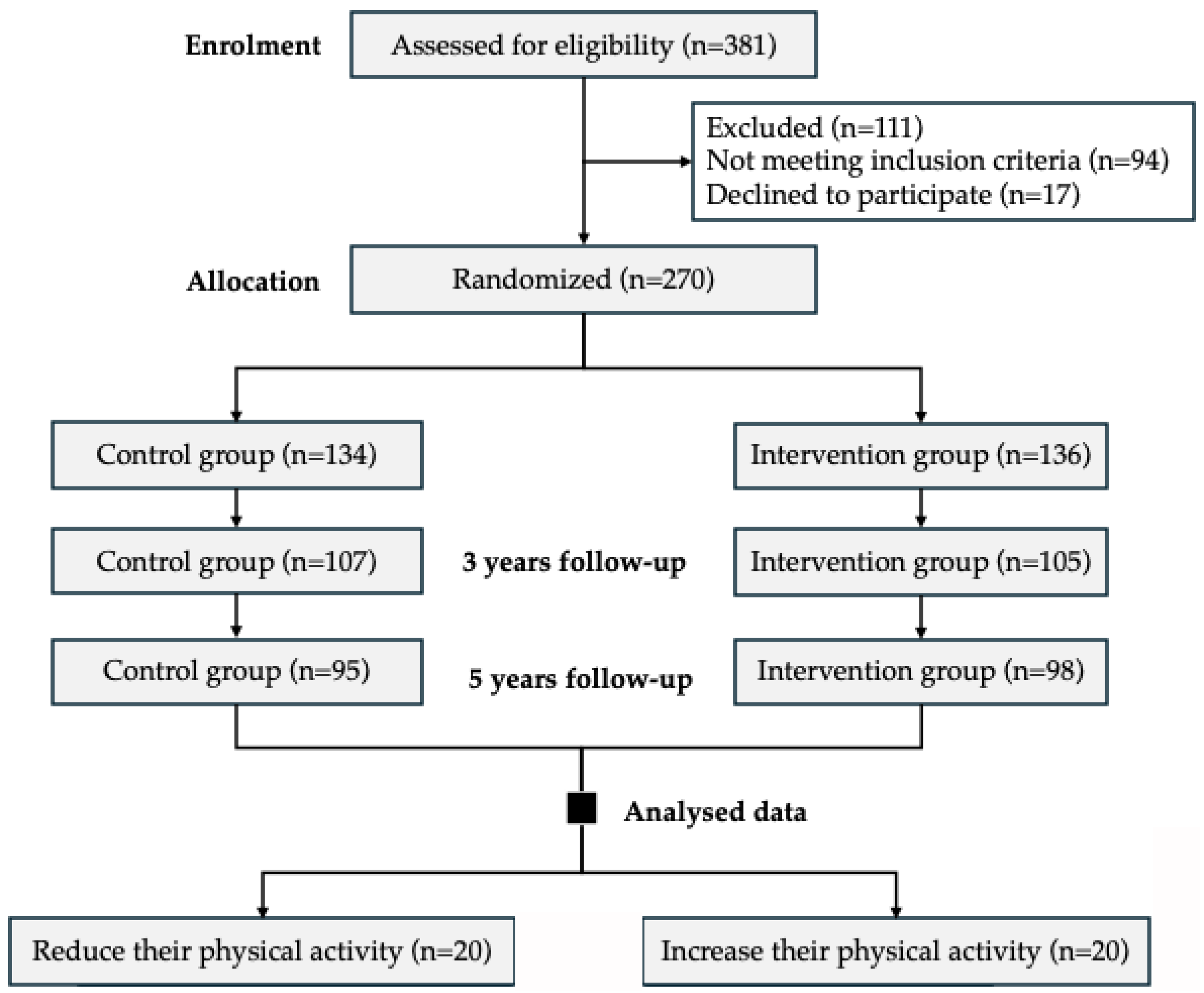
2.1. Study Design and Participants
2.2. Physical Activity Assessment
2.3. Anthropometrics and Clinical Assessments
2.4. Blood Collection and Analysis
2.5. Dietary Assessment
2.6. Oxidative Stress and Inflammatory Parameters
2.7. Statistics
3. Results
4. Discussion
5. Strengths and Limitations of the Study
6. Conclusions
Author Contributions
Funding
Institutional Review Board Statement
Informed Consent Statement
Data Availability Statement
Acknowledgments
Conflicts of Interest
References
- Saklayen, M.G. The Global Epidemic of the Metabolic Syndrome. Curr. Hypertens. Rep. 2018, 20, 12. [Google Scholar] [CrossRef] [Scilit]
- O’Neill, S.; O’Driscoll, L. Metabolic syndrome: A closer look at the growing epidemic and its associated pathologies. Obes. Rev. 2015, 16, 1–12. [Google Scholar]
- Virani, S.S.; Alonso, A.; Benjamin, E.J.; Bittencourt, M.S.; Callaway, C.W.; Carson, A.P.; Chamberlain, A.M.; Chang, A.R.; Cheng, S.; Delling, F.N.; et al. Heart Disease and Stroke Statistics—2020 Update: A Report From the American Heart Association. Circulation 2020, 141, e139–e596. [Google Scholar] [CrossRef] [Scilit]
- Bellia, A.; Giardina, E.; Lauro, D.; Tesauro, M.; Di Fede, G.; Cusumano, G.; Federici, M.; Rini, G.B.; Novelli, G.; Lauro, R.; et al. “The Linosa Study”: Epidemiological and heritability data of the metabolic syndrome in a Caucasian genetic isolate. Nutr. Metab. Cardiovasc. Dis. 2009, 19, 455–461. [Google Scholar] [CrossRef] [Scilit]
- Gupta, A.; Gupta, V. Metabolic syndrome: What are the risks for humans? Biosci. Trends 2010, 4, 204–212. [Google Scholar]
- Wu, J.; Zhang, H.; Yang, L.; Shao, J.; Chen, D.; Cui, N.; Tang, L.; Fu, Y.; Xue, E.; Lai, C.; et al. Sedentary time and the risk of metabolic syndrome: A systematic review and dose–response meta-analysis. Obes. Rev. 2022, 23, e13510. [Google Scholar]
- Ang, J.-H.C.; Sun, L.; Foo, S.-Y.R.; Leow, M.K.-S.; Vidal-Puig, A.; Fontana, L.; Dalakoti, M. Perspectives on whole body and tissue-specific metabolic flexibility and implications in cardiometabolic diseases. Cell Rep. Med. 2025, 6, 102354. [Google Scholar] [CrossRef] [Scilit]
- Lemos, G.d.O.; Torrinhas, R.S.; Waitzberg, D.L. Nutrients, Physical Activity, and Mitochondrial Dysfunction in the Setting of Metabolic Syndrome. Nutrients 2023, 15, 1217. [Google Scholar] [CrossRef] [Scilit]
- Onu, A.; Trofin, D.-M.; Tutu, A.; Onu, I.; Galaction, A.-I.; Sardaru, D.-P.; Trofin, D.; Onita, C.A.; Iordan, D.-A.; Matei, D.-V. Integrative Strategies for Preventing and Managing Metabolic Syndrome: The Impact of Exercise and Diet on Oxidative Stress Reduction—A Review. Life 2025, 15, 757. [Google Scholar] [CrossRef] [Scilit]
- Birben, E.; Sahiner, U.M.; Sackesen, C.; Erzurum, S.; Kalayci, O. Oxidative Stress and Antioxidant Defense. World Allergy Organ. J. 2012, 5, 9–19. [Google Scholar] [CrossRef] [Scilit]
- Monserrat-Mesquida, M.; Quetglas-Llabrés, M.; Capó, X.; Bouzas, C.; Mateos, D.; Pons, A.; Tur, J.A.; Sureda, A. Metabolic Syndrome Is Associated with Oxidative Stress and Proinflammatory State. Antioxidants 2020, 9, 236. [Google Scholar] [CrossRef] [Scilit]
- Fahed, G.; Aoun, L.; Zerdan, M.B.; Allam, S.; Zerdan, M.B.; Bouferraa, Y.; Assi, H.I. Metabolic Syndrome: Updates on Pathophysiology and Management in 2021. Int. J. Mol. Sci. 2022, 23, 786. [Google Scholar] [CrossRef] [Scilit]
- Wu, J.; Fu, Y.; Chen, D.; Zhang, H.; Xue, E.; Shao, J.; Tang, L.; Zhao, B.; Lai, C.; Ye, Z. Sedentary behavior patterns and the risk of non-communicable diseases and all-cause mortality: A systematic review and meta-analysis. Int. J. Nurs. Stud. 2023, 146, 104563. [Google Scholar] [CrossRef] [Scilit]
- Myers, J.; Kokkinos, P.; Nyelin, E. Physical Activity, Cardiorespiratory Fitness, and the Metabolic Syndrome. Nutrients 2019, 11, 1652. [Google Scholar] [CrossRef] [Scilit]
- Allard-Chamard, H.; Mishra, H.K.; Nandi, M.; Mayhue, M.; Menendez, A.; Ilangumaran, S.; Ramanathan, S. Interleukin-15 in autoimmunity. Cytokine 2020, 136, 155258. [Google Scholar] [CrossRef] [Scilit]
- Leal, L.G.; Lopes, M.A.; Batista, M.L. Physical exercise-induced myokines and muscle-adipose tissue crosstalk: A review of current knowledge and the implications for health and metabolic diseases. Front. Physiol. 2018, 9, 409337. [Google Scholar] [CrossRef] [Scilit]
- Ainsworth, B.E.; Haskell, W.L.; Leon, A.S.; Jacobs, D.R., Jr.; Montoye, H.J.; Sallis, J.F.; Paffenbarger, R.S., Jr. Compendium of physical activities: Classification of energy costs of human physical activities. Med. Sci. Sports Exerc. 1993, 25, 71–74. [Google Scholar] [CrossRef] [Scilit]
- Fernández-Ballart, J.D.; Piñol, J.L.; Zazpe, I.; Corella, D.; Carrasco, P.; Toledo, E.; Perez-Bauer, M.; Martínez-González, M.Á.; Salas-Salvadó, J.; Martn-Moreno, J.M. Relative validity of a semi-quantitative food-frequency questionnaire in an elderly Mediterranean population of Spain. Br. J. Nutr. 2010, 103, 1808–1816. [Google Scholar] [CrossRef] [Scilit]
- Moreiras, O.; Carbajal, A.; Cabrera, L.; Cuadrado, C. Tablas de Composicion de Alimentos (Ciencia y Tecnica). Guía de Prácticas, 19th ed.; Ediciones Pirámide: Madrid, Spain, 2018; pp. 37–46. [Google Scholar]
- Bouzas, C.; Bibiloni, M.D.M.; Julibert, A.; Ruiz-Canela, M.; Salas-Salvadó, J.; Corella, D.; Zomeño, M.D.; Romaguera, D.; Vioque, J.; Alonso-Gómez, Á.M.; et al. Adherence to the Mediterranean Lifestyle and Desired Body Weight Loss in a Mediterranean Adult Population with Overweight: A PREDIMED-Plus Study. Nutrients 2020, 12, 2114. [Google Scholar] [CrossRef] [Scilit]
- Aebi, H. Catalase in Vitro. Methods Enzym. Anal. 1984, 105, 121–126. [Google Scholar]
- McCord, J.M.; Fridovich, I. Superoxide dismutase. An enzymic function for erythrocuprein (hemocuprein). J. Biol. Chem. 1969, 244, 6049–6055. [Google Scholar] [CrossRef] [Scilit]
- Capeillère-Blandin, C. Oxidation of guaiacol by myeloperoxidase: A two-electron-oxidized guaiacol transient species as a mediator of NADPH oxidation. Biochem. J. 1998, 336, 395–404. [Google Scholar] [CrossRef] [Scilit]
- Ekelund, U.; Tarp, J.; Steene-Johannessen, J.; Hansen, B.H.; Jefferis, B.; Fagerland, M.W.; Whincup, P.; Diaz, K.M.; Hooker, S.P.; Chernofsky, A.; et al. Dose-response associations between accelerometry measured physical activity and sedentary time and all cause mortality: Systematic review and harmonised meta-analysis. BMJ 2019, 366, l4570. [Google Scholar] [CrossRef] [Scilit]
- Matta, L.; de Faria, C.C.; De Oliveira, D.F.; Andrade, I.S.; Lima-Junior, N.C.; Gregório, B.M.; Takiya, C.M.; Ferreira, A.C.F.; Nascimento, J.H.M.; de Carvalho, D.P.; et al. Exercise Improves Redox Homeostasis and Mitochondrial Function in White Adipose Tissue. Antioxidants 2022, 11, 1689. [Google Scholar] [CrossRef] [Scilit]
- Clemente-Suárez, V.J.; Rubio-Zarapuz, A.; Belinchón-deMiguel, P.; Beltrán-Velasco, A.I.; Martín-Rodríguez, A.; Tornero-Aguilera, J.F. Impact of Physical Activity on Cellular Metabolism Across Both Neurodegenerative and General Neurological Conditions: A Narrative Review. Cells 2024, 13, 1940. [Google Scholar] [CrossRef] [Scilit]
- Kolodziej, F.; O’Halloran, K.D. Re-Evaluating the Oxidative Phenotype: Can Endurance Exercise Save the Western World? Antioxidants 2021, 10, 609. [Google Scholar] [CrossRef] [Scilit]
- Pesta, D.; Roden, M. The Janus Head of Oxidative Stress in Metabolic Diseases and During Physical Exercise. Curr. Diab. Rep. 2017, 17, 41. [Google Scholar]
- Gómez-Cabrera, M.C.; Salvador-Pascual, A.; Cabo, H.; Ferrando, B.; Viña, J. Redox modulation of mitochondriogenesis in exercise. Does antioxidant supplementation blunt the benefits of exercise training? Free Radic. Biol. Med. 2015, 86, 37–46. [Google Scholar]
- Powers, S.K.; Deminice, R.; Ozdemir, M.; Yoshihara, T.; Bomkamp, M.P.; Hyatt, H. Exercise-induced oxidative stress: Friend or foe? J. Sport Health Sci. 2020, 9, 415–425. [Google Scholar]
- El Assar, M.; Álvarez-Bustos, A.; Sosa, P.; Angulo, J.; Rodríguez-Mañas, L. Effect of Physical Activity/Exercise on Oxidative Stress and Inflammation in Muscle and Vascular Aging. Int. J. Mol. Sci. 2022, 23, 8713. [Google Scholar] [CrossRef] [Scilit]
- Scarfò, G.; Daniele, S.; Chelucci, E.; Rizza, A.; Fusi, J.; Freggia, G.; Costa, B.; Taliani, S.; Artini, P.; Martini, C.; et al. Regular exercise delays microvascular endothelial dysfunction by regulating antioxidant capacity and cellular metabolism. Sci. Rep. 2023, 13, 17671. [Google Scholar] [CrossRef] [Scilit]
- Nani, A.; Murtaza, B.; Sayed Khan, A.; Khan, N.A.; Hichami, A. Antioxidant and Anti-Inflammatory Potential of Polyphenols Contained in Mediterranean Diet in Obesity: Molecular Mechanisms. Molecules 2021, 26, 985. [Google Scholar] [CrossRef] [Scilit]
- Chen, S.-J.J.; Yen, C.-H.H.; Huang, Y.-C.C.; Lee, B.-J.J.; Hsia, S.; Lin, P.-T.T. Relationships between Inflammation, Adiponectin, and Oxidative Stress in Metabolic Syndrome. PLoS ONE 2012, 7, e45693. [Google Scholar]
- Quetglas-Llabrés, M.M.; Monserrat-Mesquida, M.; Bouzas, C.; García, S.; Mateos, D.; Ugarriza, L.; Gómez, C.; Sureda, A.; Tur, J.A. Long-Term Impact of Nutritional Intervention with Increased Polyphenol Intake and Physical Activity Promotion on Oxidative and Inflammatory Profiles in Patients with Metabolic Syndrome. Nutrients 2024, 16, 2121. [Google Scholar] [CrossRef] [Scilit]
- Moreto, F.; Kano, H.T.; Torezan, G.A.; de Oliveira, E.P.; Manda, R.M.; Teixeira, O.; Michelin, E.; Correa, C.R.; Burini, R.C. Changes in malondialdehyde and C-reactive protein concentrations after lifestyle modification are related to different metabolic syndrome-associated pathophysiological processes. Diabetes Metab. Syndr. Clin. Res. Rev. 2015, 9, 218–222. [Google Scholar] [CrossRef] [Scilit]
- Rytz, C.L.; Pialoux, V.; Mura, M.; Martin, A.; Hogan, D.B.; Hill, M.D.; Poulin, M.J. Impact of aerobic exercise, sex, and metabolic syndrome on markers of oxidative stress: Results from the Brain in Motion study. J. Appl. Physiol. 2020, 128, 748–756. [Google Scholar] [CrossRef] [Scilit]
- Klebanoff, S.J. Myeloperoxidase: Friend and foe. J. Leukoc. Biol. 2005, 77, 598–625. [Google Scholar] [CrossRef] [Scilit]
- Tumova, E.; Sun, W.; Jones, P.H.; Vrablik, M.; Ballantyne, C.M.; Hoogeveen, R.C. The Impact of Rapid Weight Loss on Oxidative Stress Markers and the Expression of the Metabolic Syndrome in Obese Individuals. J. Obes. 2013, 2013, 729515. [Google Scholar] [CrossRef] [Scilit]
- Mathew, A.V.; Li, L.; Byun, J.; Guo, Y.; Michailidis, G.; Jaiswal, M.; Chen, Y.E.; Pop-Busui, R.; Pennathur, S. Therapeutic Lifestyle Changes Improve HDL Function by Inhibiting Myeloperoxidase-Mediated Oxidation in Patients With Metabolic Syndrome. Diabetes Care 2018, 41, 2431–2437. [Google Scholar] [CrossRef] [Scilit]
- Li, F.; Li, Y.; Tang, Y.; Lin, B.; Kong, X.; Oladele, O.A.; Yin, Y. Protective effect of myokine IL-15 against H2O2-mediated oxidative stress in skeletal muscle cells. Mol. Biol. Rep. 2014, 41, 7715–7722. [Google Scholar] [CrossRef] [Scilit]
- Gonzalez-Gil, A.M.; Elizondo-Montemayor, L. The Role of Exercise in the Interplay between Myokines, Hepatokines, Osteokines, Adipokines, and Modulation of Inflammation for Energy Substrate Redistribution and Fat Mass Loss: A Review. Nutrients 2020, 12, 1899. [Google Scholar] [CrossRef] [Scilit]
- Pérez-López, A.; Valadés, D.; Vázquez Martínez, C.; de Cos Blanco, A.I.; Bujan, J.; García-Honduvilla, N. Serum IL-15 and IL-15Rα levels are decreased in lean and obese physically active humans. Scand. J. Med. Sci. Sports 2018, 28, 1113–1120. [Google Scholar]
- Cho, E.; Chodzko, M.; Compton, S.L.E.; Yang, S.; Heymsfield, S.; Spielmann, G.; Brown, J.C. Effects of aerobic exercise on body composition and exerkines in colorectal cancer survivors. Front. Sport. Act. Living 2025, 7, 1579221. [Google Scholar]
- Luo, Z.; He, Z.; Qin, H.; Chen, Y.; Qi, B.; Lin, J.; Sun, Y.; Sun, J.; Su, X.; Long, Z.; et al. Exercise-induced IL-15 acted as a positive prognostic implication and tumor-suppressed role in pan-cancer. Front. Pharmacol. 2022, 13, 1053137. [Google Scholar]
- Della Guardia, L.; Codella, R. Exercise tolls the bell for key mediators of low-grade inflammation in dysmetabolic conditions. Cytokine Growth Factor Rev. 2021, 62, 83–93. [Google Scholar] [CrossRef] [Scilit]
- Bellicha, A.; van Baak, M.A.; Battista, F.; Beaulieu, K.; Blundell, J.E.; Busetto, L.; Carraça, E.V.; Dicker, D.; Encantado, J.; Ermolao, A.; et al. Effect of exercise training on weight loss, body composition changes, and weight maintenance in adults with overweight or obesity: An overview of 12 systematic reviews and 149 studies. Obes. Rev. 2021, 22, e13256. [Google Scholar] [CrossRef] [Scilit]
- Richter, E.A. Is GLUT4 translocation the answer to exercise-stimulated muscle glucose uptake? Am. J. Physiol. Metab. 2021, 320, E240–E243. [Google Scholar]
- Ostman, C.; Jewiss, D.; Smart, N.A. The Effect of Exercise Training Intensity on Quality of Life in Heart Failure Patients: A Systematic Review and Meta-Analysis. Cardiology 2017, 136, 79–89. [Google Scholar]
- Okura, T.; Nakata, Y.; Ohkawara, K.; Numao, S.; Katayama, Y.; Matsuo, T.; Tanaka, K. Effects of Aerobic Exercise on Metabolic Syndrome Improvement in Response to Weight Reduction. Obesity 2007, 15, 2478–2484. [Google Scholar] [CrossRef] [Scilit]
- Share, B.L.; Naughton, G.A.; Obert, P.; Peat, J.K.; Aumand, E.A.; Kemp, J.G. Effects of a Multi-Disciplinary Lifestyle Intervention on Cardiometabolic Risk Factors in Young Women with Abdominal Obesity: A Randomised Controlled Trial. PLoS ONE 2015, 10, e0130270. [Google Scholar]
- Gondim, O.S.; de Camargo, V.T.N.; Gutierrez, F.A.; Martins, P.F.d.O.; Passos, M.E.P.; Momesso, C.M.; Santos, V.C.; Gorjão, R.; Pithon-Curi, T.C.; Cury-Boaventura, M.F. Benefits of Regular Exercise on Inflammatory and Cardiovascular Risk Markers in Normal Weight, Overweight and Obese Adults. PLoS ONE 2015, 10, e0140596. [Google Scholar] [CrossRef] [Scilit] [PubMed]
- Brandt, C.; Pedersen, B.K. Physical Activity, Obesity and Weight Loss Maintenance. In From Obesity to Diabetes; Springer: Berlin/Heidelberg, Germany, 2022; pp. 349–369. [Google Scholar]
- Liu, Y.; Wang, X.; Fang, Z. Evaluating the impact of exercise on intermediate disease markers in overweight and obese individuals through a network meta-analysis of randomized controlled trials. Sci. Rep. 2024, 14, 12137. [Google Scholar] [CrossRef] [Scilit] [PubMed]
- Xing, S.; Zhang, Y.; Chen, Y.; Feng, S.; Zhang, Y.; Moreira, P. Comparing the impacts of different exercise interventions on patients with type 2 diabetes mellitus: A literature review and meta-analysis. Front. Endocrinol. 2025, 16, 1495131. [Google Scholar] [CrossRef] [Scilit] [PubMed]
- Franczyk, B.; Gluba-Brzózka, A.; Ciałkowska-Rysz, A.; Ławiński, J.; Rysz, J. The Impact of Aerobic Exercise on HDL Quantity and Quality: A Narrative Review. Int. J. Mol. Sci. 2023, 24, 4653. [Google Scholar] [CrossRef] [Scilit]
- Sayón-Orea, C.; Razquin, C.; Bulló, M.; Corella, D.; Fitó, M.; Romaguera, D.; Vioque, J.; Alonso-Gómez, Á.M.; Wärnberg, J.; Martínez, J.A.; et al. Effect of a Nutritional and Behavioral Intervention on Energy-Reduced Mediterranean Diet Adherence Among Patients With Metabolic Syndrome. JAMA 2019, 322, 1486. [Google Scholar] [CrossRef] [Scilit]
- Martucci, M.; Ostan, R.; Biondi, F.; Bellavista, E.; Fabbri, C.; Bertarelli, C.; Salvioli, S.; Capri, M.; Franceschi, C.; Santoro, A. Mediterranean diet and inflammaging within the hormesis paradigm. Nutr. Rev. 2017, 75, 442–455. [Google Scholar] [CrossRef] [Scilit]



| Reduce Their Physical Activity (n = 20) | Increase Their Physical Activity (n = 20) | p-Value | ||
|---|---|---|---|---|
| General characteristics | ||||
| baseline | 90.1 ± 17.0 | 83.8 ± 12.4 | ||
| Weight, kg | 3-year | 86.1 ± 17.5 * | 85.7 ± 12.3 | |
| 5-year | 88.0 ± 17.2 *,$ | 81.4 ± 11.0 *,$ | <0.001 | |
| baseline | 32.9 ± 3.5 | 32.2 ± 4.0 | ||
| BMI, kg/m2 | 3-year | 32.6 ± 3.6 | 33.1 ± 4.5 * | |
| 5-year | 33.4 ± 3.5 $ | 31.5 ± 3.9 *,$ | <0.001 | |
| baseline | 111.7 ± 8.9 | 107.1 ± 9.69 | ||
| Abdominal obesity, cm | 3-year | 109.5 ± 9.8 | 108.5 ± 10.6 | |
| 5-year | 109.2 ± 8.6 | 106.2 ± 8.60 | 0.074 | |
| baseline | 0.678 ± 0.05 | 0.664 ± 0.059 | ||
| WHtR | 3-year | 0.664 ± 0.05 | 0.673 ± 0.067 | |
| 5-year | 0.663 ± 0.05 | 0.659 ± 0.056 | 0.082 | |
| Systolic pressure, mmHg | baseline | 141.9 ± 20.0 | 138.5 ± 19.9 | |
| 3-year | 133.2 ± 14.9 | 138.9 ± 17.0 | ||
| 5-year | 142.0 ± 14.7 | 150.5 ± 18.6 | 0.213 | |
| Diastolic pressure, mmHg | baseline | 79.5 ± 9.7 | 81.1 ± 7.4 | |
| 3-year | 76.1 ± 11.6 | 79.9 ± 8.0 | ||
| 5-year | 79.2 ± 10.3 | 82.6 ± 8.8 | 0.733 | |
| Blood parameters | ||||
| baseline | 122.4 ± 41.5 | 114.3 ± 19.3 | ||
| Glucose, mg/dL | 3-year | 112.1 ± 27.8 | 112.8 ± 20.6 | |
| 5-year | 121.7 ± 27.5 | 99.8 ± 18.7 #,$ | <0.001 | |
| baseline | 6.27 ± 1.15 | 6.10 ± 0.55 | ||
| HbA1c, % | 3-year | 6.07 ± 0.72 | 6.04 ± 0.80 | |
| 5-year | 6.47 ± 0.73 # | 5.76 ± 0.66 $ | 0.002 | |
| baseline | 149.5 ± 66.6 | 121.1 ± 38.2 | ||
| Triglycerides, mg/dL | 3-year | 128.4 ± 56.7 | 130.5 ± 43.8 | |
| 5-year | 138.0 ± 45.6 | 122.3 ± 33.5 | 0.077 | |
| HDL-cholesterol, mg/dL | baseline | 45.7 ± 13.4 | 45.5 ± 8.3 | |
| 3-year | 47.1 ± 8.6 | 47.3 ± 8.6 | ||
| 5-year | 46.7 ± 9.6 | 48.5 ± 11.0 | 0.709 | |
| LDL-cholesterol, mg/dL | baseline | 111.6 ± 42.2 | 111.2 ± 32.8 | |
| 3-year | 113.2 ± 44.2 | 116.6 ± 30.7 | ||
| 5-year | 111.5 ± 36.3 | 102.8 ± 30.7 # | 0.161 | |
| Dietary assessment | ||||
| baseline | 40.0 ± 7.9 | 38.3 ± 8.0 | ||
| Carbohydrates, % | 3-year | 40.8 ± 6.7 | 38.9 ± 5.7 | |
| 5-year | 37.7 ± 7.7 | 37.8 ± 6.6 | 0.790 | |
| baseline | 15.9 ± 3.4 | 17.3 ± 4.1 | ||
| Proteins, % | 3-year | 17.3 ± 2.1 | 17.4 ± 2.7 | |
| 5-year | 16.7 ± 2.1 | 16.6 ± 2.1 | 0.425 | |
| baseline | 39.9 ± 7.5 | 41.4 ± 7.4 | ||
| Lipids, % | 3-year | 39.3 ± 7.5 | 41.0 ± 7.3 | |
| 5-year | 43.1 ± 6.9 | 42.7 ± 6.0 | 0.800 |
| Reduce Their Physical Activity (n = 20) | Increase Their Physical Activity (n = 20) | p-Value | ||
|---|---|---|---|---|
| PBMCs biomarkers | ||||
| ROS production stimulated with LPS (RLU/min·103 cells) | baseline | 1159.6 ± 567.9 | 1275.4 ± 814.9 | |
| 3-year | 786.2 ± 790.4 | 961.8 ± 769.8 | ||
| 5-year | 423.8 ± 308.1 * | 351.6 ± 144.7 *,$ | <0.001 | |
| Plasma biomarkers | ||||
| baseline | 47.7 ± 17.9 | 58.2 ± 50.0 | ||
| CAT activity (k/L plasma) | 3-year | 28.7 ± 3.8 * | 28.8 ± 6.6 * | |
| 5-year | 29.1 ± 5.3 * | 33.6 ± 6.0 *,# | <0.001 | |
| SOD activity (pkat/L plasma) | baseline | 70.7 ± 69.1 | 112.6 ± 98.5 | |
| 3-year | 268.4 ± 60.9 * | 263.5 ± 49.0 * | ||
| 5-year | 271.8 ± 49.5 * | 311.5 ± 49.9 *,# | <0.001 | |
| baseline | 1.1 ± 1.4 | 2.1 ± 2.9 | ||
| MDA (nM) | 3-year | 0.6 ± 0.2 | 0.6 ± 0.2 * | |
| 5-year | 0.6 ± 0.1 | 0.4 ± 0.1 *,# | 0.001 |
Disclaimer/Publisher’s Note: The statements, opinions and data contained in all publications are solely those of the individual author(s) and contributor(s) and not of MDPI and/or the editor(s). MDPI and/or the editor(s) disclaim responsibility for any injury to people or property resulting from any ideas, methods, instructions or products referred to in the content. |
© 2026 by the authors. Licensee MDPI, Basel, Switzerland. This article is an open access article distributed under the terms and conditions of the Creative Commons Attribution (CC BY) license.
Share and Cite
Quetglas-Llabrés, M.M.; Monserrat-Mesquida, M.; García, S.; Ródenas-Munar, M.; Mateos, D.; Ugarriza, L.; Gómez, C.; Sureda, A.; Bouzas, C.; Tur, J.A. Impact of a Longer-Term Physical Activity Intervention on Inflammatory and Oxidative Stress Biomarkers in Older People with Metabolic Syndrome. Antioxidants 2026, 15, 151. https://doi.org/10.3390/antiox15020151
Quetglas-Llabrés MM, Monserrat-Mesquida M, García S, Ródenas-Munar M, Mateos D, Ugarriza L, Gómez C, Sureda A, Bouzas C, Tur JA. Impact of a Longer-Term Physical Activity Intervention on Inflammatory and Oxidative Stress Biomarkers in Older People with Metabolic Syndrome. Antioxidants. 2026; 15(2):151. https://doi.org/10.3390/antiox15020151
Chicago/Turabian StyleQuetglas-Llabrés, Maria Magdalena, Margalida Monserrat-Mesquida, Silvia García, Marina Ródenas-Munar, David Mateos, Lucía Ugarriza, Cristina Gómez, Antoni Sureda, Cristina Bouzas, and Josep A. Tur. 2026. "Impact of a Longer-Term Physical Activity Intervention on Inflammatory and Oxidative Stress Biomarkers in Older People with Metabolic Syndrome" Antioxidants 15, no. 2: 151. https://doi.org/10.3390/antiox15020151
APA StyleQuetglas-Llabrés, M. M., Monserrat-Mesquida, M., García, S., Ródenas-Munar, M., Mateos, D., Ugarriza, L., Gómez, C., Sureda, A., Bouzas, C., & Tur, J. A. (2026). Impact of a Longer-Term Physical Activity Intervention on Inflammatory and Oxidative Stress Biomarkers in Older People with Metabolic Syndrome. Antioxidants, 15(2), 151. https://doi.org/10.3390/antiox15020151