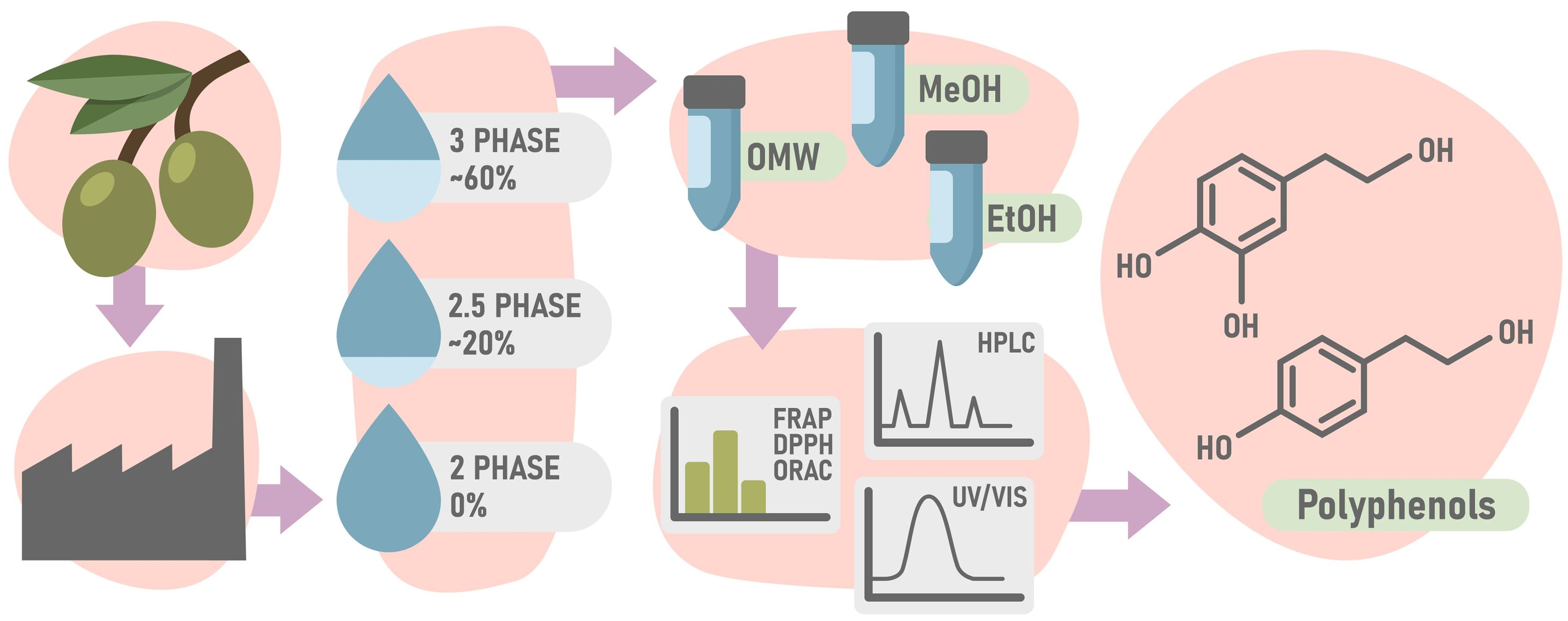
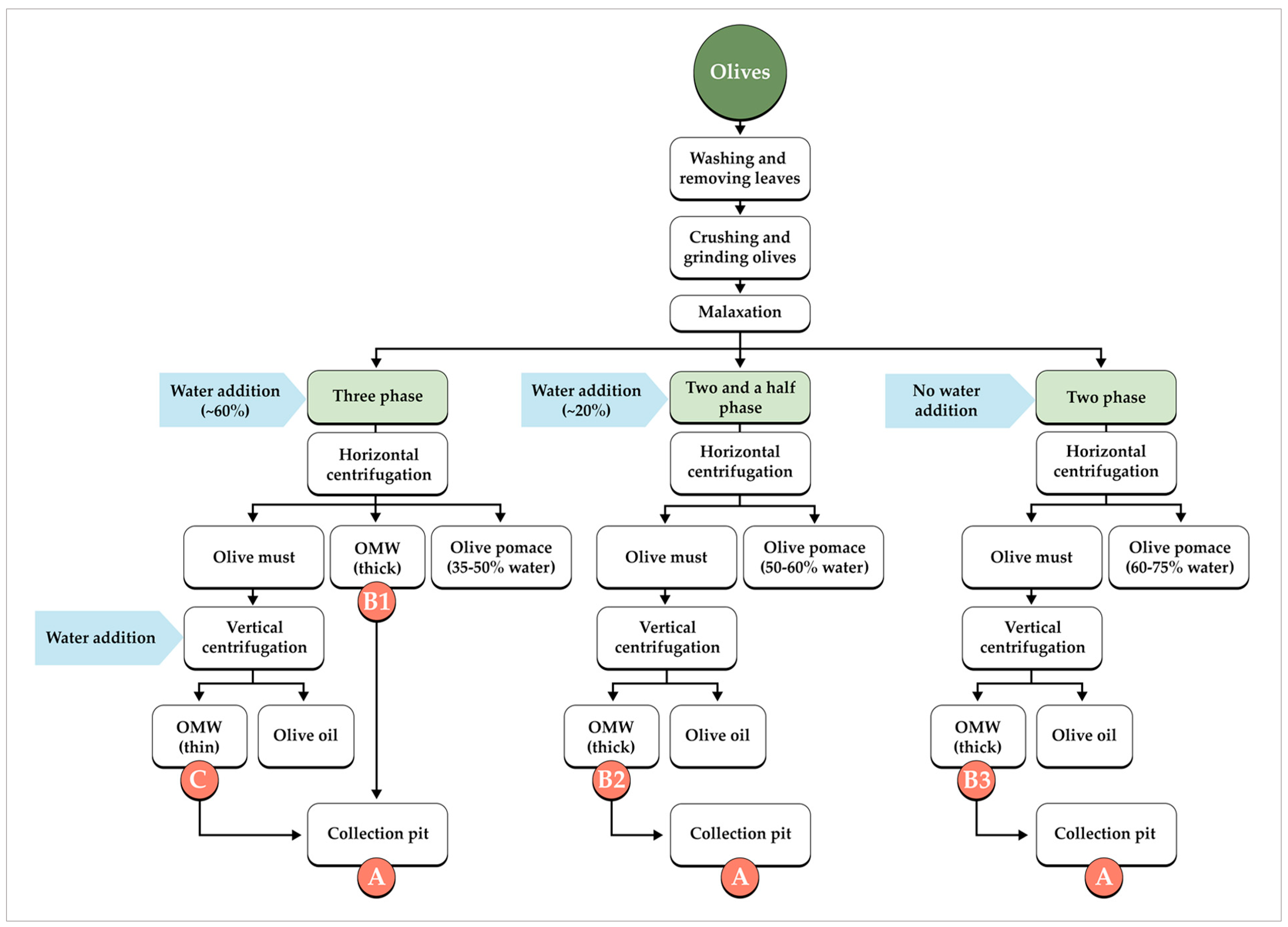
From Waste to Resource: Extraction and Characterization of Polyphenols from Dalmatian Olive Mill Wastewater

 , , , , , and
Abstract
1. Introduction
2. Materials and Methods
2.1. Samples
2.2. Sample Preparation
2.3. Characterization of OMW
2.4. Determination of Total Phenolic Content (TPC)
2.5. Characterization of Phenolic Content
2.6. Determination of Antioxidant Activity
2.6.1. DPPH Assay
2.6.2. FRAP Assay
2.6.3. ORAC Assay
2.6.4. Statistical Analysis
3. Results and Discussion
3.1. Characteristics of OMW Samples
3.2. Total Phenol Content (TPC)
3.3. HPLC Determination of Phenolic Content
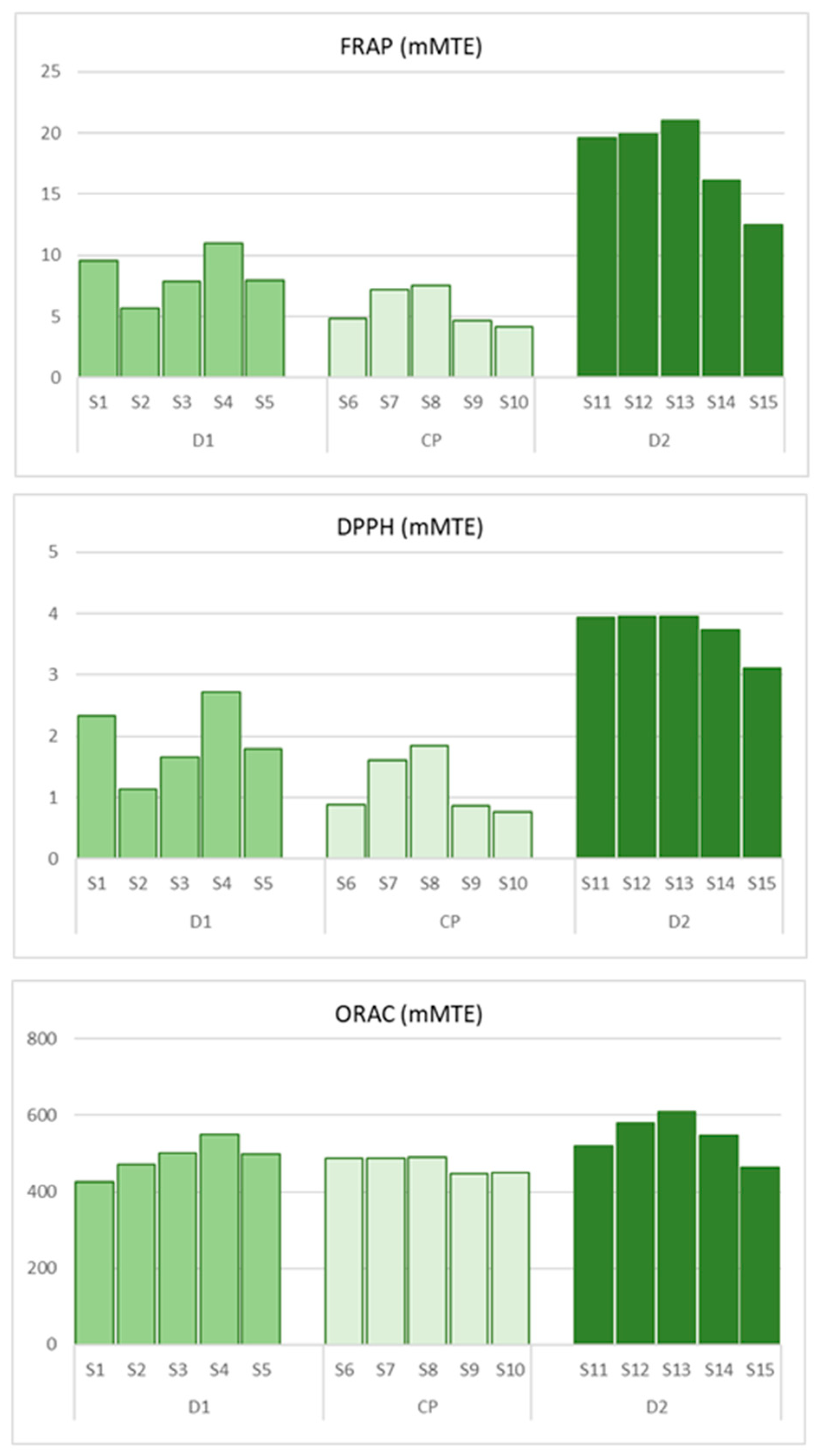
3.4. Antioxidant Activity
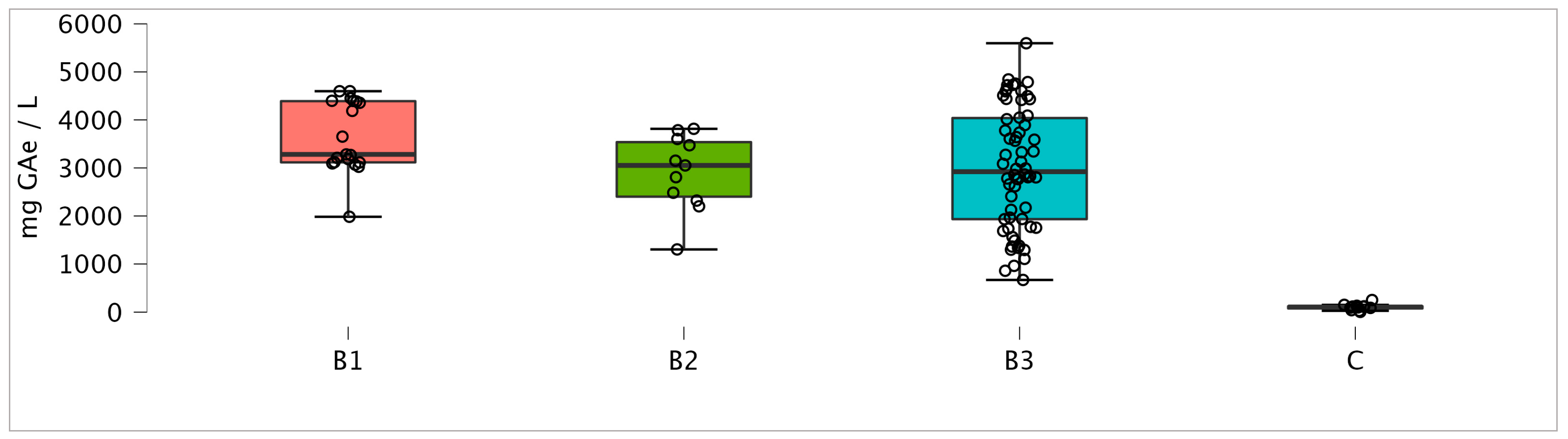
3.5. Polyphenol Content Depending on the Type of Decanter
4. Conclusions
Supplementary Materials
Author Contributions
Funding
Institutional Review Board Statement
Informed Consent Statement
Data Availability Statement
Conflicts of Interest
References
- Mandal, M.K.; Domb, A.J. Antimicrobial Activities of Natural Bioactive Polyphenols. Pharmaceutics 2024, 16, 718. [Google Scholar] [CrossRef] [Scilit]
- Cory, H.; Passarelli, S.; Szeto, J.; Tamez, M.; Mattei, J. The Role of Polyphenols in Human Health and Food Systems: A Mini-Review. Front. Nutr. 2018, 5, 370438. [Google Scholar] [CrossRef] [Scilit]
- Ciupei, D.; Colişar, A.; Leopold, L.; Stănilă, A.; Diaconeasa, Z.M. Polyphenols: From Classification to Therapeutic Potential and Bioavailability. Foods 2024, 13, 4131. [Google Scholar] [CrossRef] [Scilit] [PubMed]
- Yu, W.; Zhang, Y.; Lu, Y.; Ouyang, Z.; Peng, J.; Tu, Y.; He, B. Recent research on the bioactivity of polyphenols derived from edible fungi and their potential in chronic disease prevention. J. Funct. Foods 2025, 124, 106627. [Google Scholar] [CrossRef] [Scilit]
- Finicelli, M.; Squillaro, T.; Galderisi, U.; Peluso, G. Polyphenols, the Healthy Brand of Olive Oil: Insights and Perspectives. Nutrients 2021, 13, 3831. [Google Scholar] [CrossRef] [Scilit]
- de la Torre-Carbot, K.; Jauregui, O.; Gimeno, E.; Castellote, A.I.; Lamuela-Raventós, R.M.; López-Sabater, M.C. Characterization and Quantification of Phenolic Compounds in Olive Oils by Solid-Phase Extraction, HPLC-DAD, and HPLC-MS/MS. J. Agric. Food Chem. 2005, 53, 4331–4340. [Google Scholar] [CrossRef] [Scilit] [PubMed]
- Polić Pasković, M.; Vidović, N.; Lukić, I.; Žurga, P.; Majetić Germek, V.; Goreta Ban, S.; Kos, T.; Čoga, L.; Tomljanović, T.; Simoni-Kocijan, S. Phenolic Potential of Olive Leaves from Different Istrian Cultivars in Croatia. Horticulturae 2023, 9, 594. [Google Scholar] [CrossRef] [Scilit]
- Filardo, S.; Roberto, M.; Di Risola, D.; Mosca, L.; Di Pietro, M.; Sessa, R. Olea europaea L-derived secoiridoids: Beneficial health effects and potential therapeutic approaches. Pharmacol. Ther. 2024, 254, 108595. [Google Scholar] [CrossRef] [Scilit]
- Francioso, A.; Federico, R.; Maggiore, A.; Fontana, M.; Boffi, A.; D’Erme, M.; Mosca, L. Green Route for the Isolation and Purification of Hyrdoxytyrosol, Tyrosol, Oleacein and Oleocanthal from Extra Virgin Olive Oil. Molecules 2020, 25, 3654. [Google Scholar] [CrossRef] [Scilit]
- Mehany, T.; González-Sáiz, J.M.; Pizarro, C. Hydroxytyrosol-Infused Extra Virgin Olive Oil: A Key to Minimizing Oxidation, Boosting Antioxidant Potential, and Enhancing Physicochemical Stability During Frying. Antioxidants 2025, 14, 368. [Google Scholar] [CrossRef] [Scilit]
- Frumuzachi, O.; Gavrilaș, L.I.; Vodnar, D.C.; Rohn, S.; Mocan, A. Systemic Health Effects of Oleuropein and Hydroxytyrosol Supplementation: A Systematic Review of Randomized Controlled Trials. Antioxidants 2024, 13, 1040. [Google Scholar] [CrossRef] [Scilit] [PubMed]
- Gabbia, D. Beneficial Effects of Tyrosol and Oleocanthal from Extra Virgin Olive Oil on Liver Health: Insights into Their Mechanisms of Action. Biology 2024, 13, 760. [Google Scholar] [CrossRef] [Scilit] [PubMed]
- Burin, T.; Grohar, M.C.; Jakopic, J.; Hudina, M. Phenolic and Fatty Acid Changes in ‘Leccino’ Olives (Olea europaea L.) Under Different Postharvest Conditions. Agriculture 2025, 15, 1951. [Google Scholar] [CrossRef] [Scilit]
- Jukić Špika, M.; Liber, Z.; Montemurro, C.; Miazzi, M.M.; Ljubenkov, I.; Soldo, B.; Žanetić, M.; Vitanović, E.; Politeo, O.; Škevin, D. Quantitatively Unraveling Hierarchy of Factors Impacting Virgin Olive Oil Phenolic Profile and Oxidative Stability. Antioxidants 2022, 11, 594. [Google Scholar] [CrossRef] [Scilit]
- Žanetić, M.; Jukić Špika, M.; Ožić, M.M.; Brkić Bubola, K. Comparative Study of Volatile Compounds and Sensory Characteristics of Dalmatian Monovarietal Virgin Olive Oils. Plants 2021, 10, 1995. [Google Scholar] [CrossRef] [Scilit] [PubMed]
- Ministry of Agriculture. 2025. Available online: https://poljoprivreda.gov.hr/maslinarstvo/194 (accessed on 11 November 2025).
- Marx, Í.M.G.; Priego-Capote, F. Importance of malaxation conditions to virgin olive oil polar phenolic compounds content. Food Chem. 2025, 480, 143884. [Google Scholar] [CrossRef] [Scilit]
- Gómez-Caravaca, A.M.; Cerretani, L.; Bendini, A.; Segura-Carretero, A.; Fernández-Gutiérrez, A.; Del Carlo, M.; Compagnone, D.; Cichelli, A. Effects of Fly Attack (Bactrocera oleae) on the Phenolic Profile and Selected Chemical Parameters of Olive Oil. J. Agric. Food Chem. 2008, 56, 4577–4583. [Google Scholar] [CrossRef] [Scilit]
- Diamantakos, P.; Giannara, T.; Skarkou, M.; Melliou, E.; Magiatis, P. Influence of Harvest Time and Malaxation Conditions on the Concentration of Individual Phenols in Extra Virgin Olive Oil Related to Its Healthy Properties. Molecules 2020, 25, 2449. [Google Scholar] [CrossRef] [Scilit]
- Miho, H.; Moral, J.; López-González, M.A.; Díez, C.M.; Priego-Capote, F. The phenolic profile of virgin olive oil is influenced by malaxation conditions and determines the oxidative stability. Food Chem. 2020, 314, 126183. [Google Scholar] [CrossRef] [Scilit]
- Di Giovacchino, L.; Costantini, N.; Serraiocco, A.; Surricchio, G.; Basti, C. Natural antioxidants and volatile compounds of virgin olive oils obtained by two or three-phases centrifugal decanters. Eur. J. Lipid Sci. Technol. 2001, 103, 279–285. [Google Scholar] [CrossRef]
- Tamasi, G.; Bonechi, C.; Belyakova, A.; Pardini, A.; Rossi, C. The olive tree, a source of antioxidant compounds. J. Siena Acad. Sci. 2017, 8, 10–29. [Google Scholar] [CrossRef] [Scilit]
- Roig, A.; Cayuela, M.L.; Sánchez-Monedero, M.A. An overview on olive mill wastes and their valorisation methods. Waste Manag. 2006, 26, 960–969. [Google Scholar] [CrossRef] [Scilit]
- Mekki, A.; Dhouib, A.; Sayadi, S. Polyphenols dynamics and phytotoxicity in a soil amended by olive mill wastewaters. J. Environ. Manag. 2007, 84, 134–140. [Google Scholar] [CrossRef] [Scilit]
- Shabir, S.; Ilyas, N.; Saeed, M.; Bibi, F.; Sayyed, R.Z.; Almalki, W.H. Treatment technologies for olive mill wastewater with impacts on plants. Environ. Res. 2023, 216, 114399. [Google Scholar] [CrossRef] [Scilit]
- Akratos, C.S.; Tekerlekopoulou, A.G.; Vasiliadou, I.A.; Vayenas, D.V. Cocomposting of olive mill waste for the production of soil amendments. In Olive Mill Waste; Elsevier: Amsterdam, The Netherlands, 2017; pp. 161–182. [Google Scholar]
- Hernández-Fernández, A.; Garrido, Y.; Iniesta-López, E.; Pérez de los Ríos, A.; Quesada-Medina, J.; Hernández-Fernández, F.J. Recovering Polyphenols in Aqueous Solutions from Olive Mill Wastewater and Olive Leaf for Biological Applications. Processes 2023, 11, 2668. [Google Scholar] [CrossRef] [Scilit]
- EN ISO 10523:2012; Water Quality—Determination of pH. International Organization for Standardization: Geneva, Switzerland, 2012.
- Standard Methods Committee of the American Public Health Association AWWA and WEF. 2120 color. In Standard Methods for the Examination of Water and Wastewater; Lipps, W.C., Baxter, T.E., Braun-Howland, E., Eds.; APHA Press: Washington, DC, USA, 2024. [Google Scholar]
- Standard Methods Committee of the American Public Health Association AWWA and WEF. 2150 odor. In Standard Methods for the Examination of Water and Wastewater; Lipps, W.C., Baxter, T.E., Braun-Howland, E., Eds.; APHA Press: Washington, DC, USA, 2024. [Google Scholar]
- EN 872:2005; Water Quality—Determination of Suspended Solids—Method by Filtration Through Glass Fibre Filters. International Organization for Standardization: Geneva, Switzerland, 2008.
- ISO 15705:2002; Water Quality—Determination of the Chemical Oxygen Demand Index (ST-COD)—Small-Scale Sealed-Tube Method. International Organization for Standardization: Geneva, Switzerland, 2002.
- EN ISO 5815-1:2019; Water Quality—Determination of Biochemical Oxygen Demand After n Days (BODn)—Part 1: Dilution and Seeding Method with Allylthiourea Addition. International Organization for Standardization: Geneva, Switzerland, 2019.
- Singleton, V.L.; Orthofer, R.; Lamuela-Raventós, R.M. Analysis of total phenols and other oxidation substrates and antioxidants by means of Folin-Ciocalteu reagent. In Methods in Enzymology; Academic Press Ltd.: London, UK; Elsevier Science Ltd.: London, UK, 1999; pp. 152–178. [Google Scholar]
- International Olive Council. COI/T.20/Doc. No 29—Determination of Phenolic Compounds; International Olive Council: Madrid, Spain, 2022. [Google Scholar]
- Čagalj, M.; Skroza, D.; Razola-Díaz, M.d.C.; Verardo, V.; Bassi, D.; Frleta, R.; Generalić Mekinić, I.; Tabanelli, G.; Šimat, V. Variations in the Composition, Antioxidant and Antimicrobial Activities of Cystoseira compressa During Seasonal Growth. Mar. Drugs 2022, 20, 64. [Google Scholar] [CrossRef] [Scilit] [PubMed]
- Vaz, T.; Quina, M.M.J.; Martins, R.C.; Gomes, J. Olive mill wastewater treatment strategies to obtain quality water for irrigation: A review. Sci. Total Environ. 2024, 931, 172676. [Google Scholar] [CrossRef] [Scilit]
- Brglez Mojzer, E.; Knez Hrnčič, M.; Škerget, M.; Knez, Ž.; Bren, U. Polyphenols: Extraction Methods, Antioxidative Action, Bioavailability and Anticarcinogenic Effects. Molecules 2016, 21, 901. [Google Scholar] [CrossRef] [Scilit]
- Cuffaro, D.; Bertolini, A.; Bertini, S.; Ricci, C.; Cascone, M.G.; Danti, S.; Saba, A.; Macchia, M.; Digiacomo, M. Olive Mill Wastewater as Source of Polyphenols with Nutraceutical Properties. Nutrients 2023, 15, 3746. [Google Scholar] [CrossRef] [Scilit]
- López-Salas, L.; Díaz-Moreno, J.; Ciulu, M.; Borrás-Linares, I.; Quirantes-Piné, R.; Lozano-Sánchez, J. Monitoring the Phenolic and Terpenic Profile of Olives, Olive Oils and By-Products throughout the Production Process. Foods 2024, 13, 1555. [Google Scholar] [CrossRef] [Scilit] [PubMed]
- López-Huertas, E.; Lozano-Sánchez, J.; Segura-Carretero, A. Olive oil varieties and ripening stages containing the antioxidants hydroxytyrosol and derivatives in compliance with EFSA health claim. Food Chem. 2021, 342, 128291. [Google Scholar] [CrossRef] [Scilit]
- Lukić, I.; Lukić, M.; Žanetić, M.; Krapac, M.; Godena, S.; Brkić Bubola, K. Inter-Varietal Diversity of Typical Volatile and Phenolic Profiles of Croatian Extra Virgin Olive Oils as Revealed by GC-IT-MS and UPLC-DAD Analysis. Foods 2019, 8, 565. [Google Scholar] [CrossRef] [Scilit]
- D’Antuono, I.; Kontogianni, V.G.; Kotsiou, K.; Linsalata, V.; Logrieco, A.F.; Tasioula-Margari, M.; Cardinali, A. Polyphenolic characterization of olive mill wastewaters, coming from Italian and Greek olive cultivars, after membrane technology. Food Res. Int. 2014, 65, 301–310. [Google Scholar] [CrossRef] [Scilit]
- Pareja-Sánchez, E.; García-Moreno, A.J.; Martínez-García, M.; Pérez-Colodrero, L.; García-Zapata, L.; García-Ruiz, R. Bio-based solvents for polyphenol recovery: Transforming olive mill wastewater into high-value resources. J. Water Process Eng. 2025, 71, 107238. [Google Scholar] [CrossRef] [Scilit]
- Russo, E.; Spallarossa, A.; Comite, A.; Pagliero, M.; Guida, P.; Belotti, V.; Caviglia, D.; Schito, A.M. Valorization and Potential Antimicrobial Use of Olive Mill Wastewater (OMW) from Italian Olive Oil Production. Antioxidants 2022, 11, 903. [Google Scholar] [CrossRef] [Scilit] [PubMed]
- Cuffaro, D.; Bertolini, A.; Silva, A.M.; Rodrigues, F.; Gabbia, D.; De Martin, S.; Saba, A.; Bertini, S.; Digiacomo, M.; Macchia, M. Comparative Analysis on Polyphenolic Composition of Different Olive Mill Wastewater and Related Extra Virgin Olive Oil Extracts and Evaluation of Nutraceutical Properties by Cell-Based Studies. Foods 2024, 13, 3312. [Google Scholar] [CrossRef] [Scilit]
- Olmo-Cunillera, A.; Pérez, M.; López-Yerena, A.; Abuhabib, M.M.; Ninot, A.; Romero-Aroca, A.; Vallverdu-Queralt, A.; Lamuela-Raventos, R.M. Targeted metabolic profiling of the revived ancient ‘Corbella’ olive cultivar during early maturation. Food Chem. 2024, 430, 137024. [Google Scholar] [CrossRef] [Scilit]
- Fernández-Poyatos, M.d.P.; Llorent-Martínez, E.J.; Ruiz-Medina, A. Effect of Ripening on the Phenolic Composition and Mineral Content of Three Varieties of Olive Fruits. Foods 2021, 10, 380. [Google Scholar] [CrossRef] [Scilit]
- Girometti, E.; Frascari, D.; Pinelli, D.; Di Federico, V.; Libero, G.; Ciriello, V. Polyphenol adsorption and recovery from olive mill wastewater: A model reduction-based optimization and economic assessment. J. Environ. Chem. Eng. 2025, 13, 116370. [Google Scholar] [CrossRef] [Scilit]
- Kalogerakis, N.; Politi, M.; Foteinis, S.; Chatzisymeon, E.; Mantzavinos, D. Recovery of antioxidants from olive mill wastewaters: A viable solution that promotes their overall sustainable management. J. Environ. Manag. 2013, 128, 749–758. [Google Scholar] [CrossRef] [Scilit]
- Athanasiadis, V.; Voulgaris, A.; Katsoulis, K.; Lalas, S.I.; Roussis, I.G.; Gortzi, O. Development of Enriched Oil with Polyphenols Extracted from Olive Mill Wastewater. Foods 2023, 12, 497. [Google Scholar] [CrossRef] [Scilit] [PubMed]
- Martínez-Terol, S.; Ferrer, E.; Martínez-Culebras, P.V.; Berrada, H.; Pallarés, N.; Saez-Tovar, J.; Orden, L.; Martinez-Gallardo, M.R.; Toribio, A.J.; Barba, F.J. Phenolic Fingerprints of Spanish Olive Mill Wastewaters (Alpechin): A Step Toward Regional Valorization Through Antioxidant Recovery. Antioxidants 2025, 14, 1371. [Google Scholar] [CrossRef] [Scilit] [PubMed]



| Harvest Year (Nb. of Samples) | Sampling Location (Figure 1) | Methanol | Ethanol | Methanol | Ethanol | ||
|---|---|---|---|---|---|---|---|
| Median | IQR | Median | IQR | Concentration range * | |||
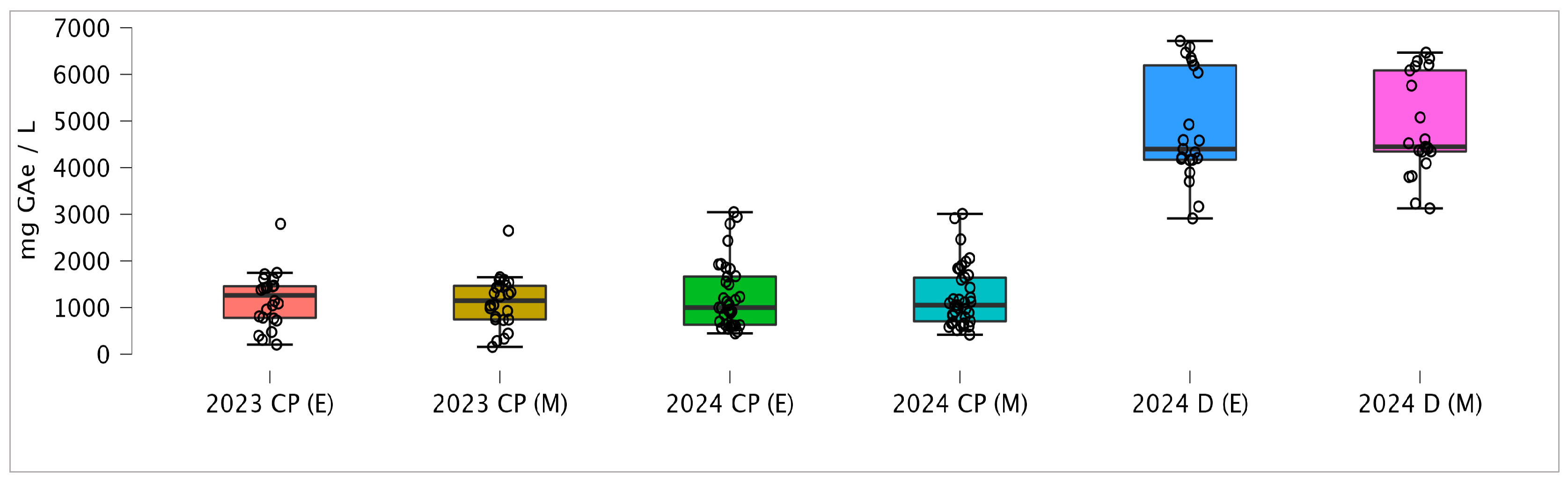
| 2023 (CP) (N = 24) | A | 1147.7 | 745.6–1466.6 | 1261.8 | 779.5–1457.3 | 156.8–2647.8 | 205.8–2794.7 |
| 2024 (CP) (N = 37) | A | 1042.4 | 705.7–1641.9 | 997.3 | 632.2–1665.8 | 417.8–3008.8 | 446.9–3045.2 |
| 2024 (D) (N = 21) | B1 | 4447.8 | 4346.3–6085.0 | 4398.8 | 4169.6–6193.4 | 3126.9–6466.9 | 2911.7–6717.2 |
| Polyphenolic Compound | Samples from Decanter B1/1 | ||||
|---|---|---|---|---|---|
| Sample 1 | Sample 2 | Sample 3 | Sample 4 | Sample 5 | |
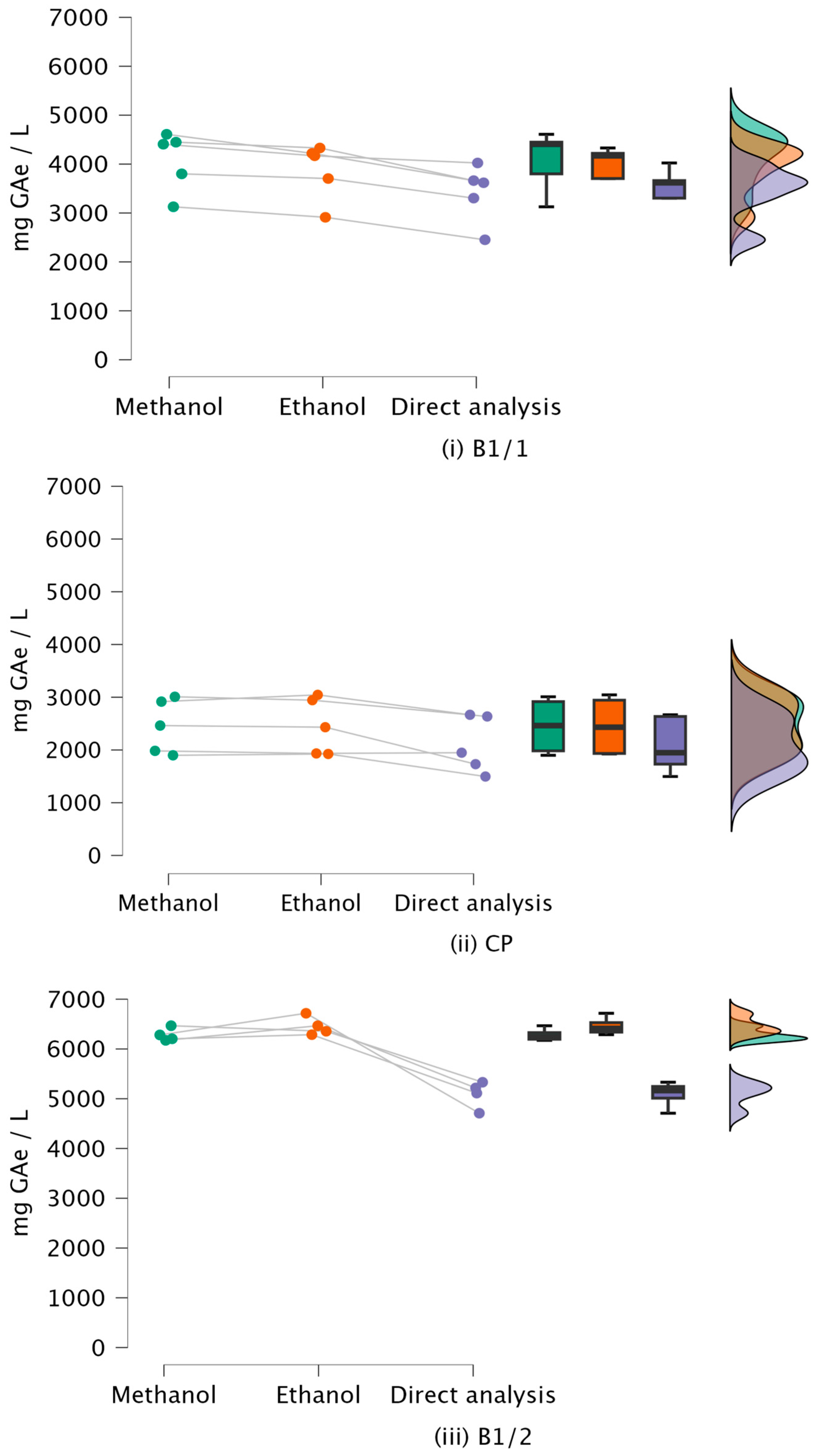
| TPC | 3704.5 | 2911.7 | 4219.6 | 4328.9 | 4169.57 |
| Hydroxytyrosol | 981.33 | 614.89 | 1163.97 | 1368.19 | 1366.47 |
| Tyrosol | 160.52 | 135.24 | 148.31 | 164.69 | 184.84 |
| Oleoeuropein | n.d. | n.d. | n.d. | n.d. | n.d. |
| 3,4-hydroxybenzoic acid | 48.02 | 10.34 | 4.23 | 3.81 | 4.50 |
| Vanillic acid | 4.22 | 10.79 | 17.82 | 16.56 | 15.70 |
| Caffeic acid | 9.55 | 10.76 | 12.76 | 16.51 | 22.93 |
| p-Coumarin acid | n.d. | n.d. | n.d. | n.d. | n.d. |
| t-Ferulic acid | 6.65 | 10.90 | 6.53 | 14.82 | 15.91 |
| o-Coumarin acid | 6.27 | 3.21 | n.d. | 3.04 | 5.94 |
| Cinamic acid | n.d. | 3.50 | n.d. | n.d. | n.d. |
| Samples from Collection pits A | |||||
| Sample 6 | Sample 7 | Sample 8 | Sample 9 | Sample 10 | |
| TPC | 1934.0 | 3045.2 | 2944.3 | 1924.4 | 2431.6 |
| Hydroxytyrosol | 474.06 | 890.06 | 715.28 | 327.25 | 399.42 |
| Tyrosol | 128.27 | 240.98 | 198.11 | 86.08 | 70.07 |
| Oleoeuropein | n.d. | n.d. | n.d. | n.d. | n.d. |
| 3,4-hydroxybenzoic acid | 56.45 | n.d. | n.d. | n.d. | n.d. |
| Vanillic acid | 3.17 | 9.48 | 6.95 | n.d. | n.d. |
| Caffeic acid | n.d. | n.d. | n.d. | n.d. | 8.34 |
| p-Coumarin acid | 14.09 | 21.03 | 30.05 | 16.26 | 3.56 |
| t-Ferulic acid | 1.71 | n.d. | 5.38 | n.d. | 2.48 |
| o-Coumarin acid | 2.00 | 3.18 | 8.91 | 2.38 | 1.17 |
| Cinamic acid | 2.82 | 2.66 | 3.26 | 2.88 | 3.06 |
| Samples from Decanter B1/2 | |||||
| Sample 11 | Sample 12 | Sample 13 | Sample 14 | Sample 15 | |
| TPC | 6355.6 | 6287.2 | 6466.6 | 6717.2 | 6583.8 |
| Hydroxytyrosol | 2718.44 | 2610.28 | 2247.88 | 2174.48 | 1590.52 |
| Tyrosol | 201.48 | 262.42 | 186.70 | 358.16 | 227.42 |
| Oleoeuropein | n.d. | n.d. | n.d. | n.d. | n.d. |
| 3,4-hydroxybenzoic acid | n.d. | n.d. | n.d. | n.d. | n.d. |
| Vanillic acid | 31.42 | 18.02 | 20.28 | 12.36 | 11.82 |
| Caffeic acid | 16.84 | 12.52 | n.d. | 8.06 | 6.18 |
| p-Coumarin acid | n.d. | n.d. | n.d. | n.d. | n.d. |
| t-Ferulic acid | n.d. | n.d. | n.d. | n.d. | n.d. |
| o-Coumarin acid | n.d. | n.d. | n.d. | n.d. | n.d. |
| Cinamic acid | 10.50 | 19.82 | 20.66 | 16.52 | 21.22 |
Disclaimer/Publisher’s Note: The statements, opinions and data contained in all publications are solely those of the individual author(s) and contributor(s) and not of MDPI and/or the editor(s). MDPI and/or the editor(s) disclaim responsibility for any injury to people or property resulting from any ideas, methods, instructions or products referred to in the content. |
© 2025 by the authors. Licensee MDPI, Basel, Switzerland. This article is an open access article distributed under the terms and conditions of the Creative Commons Attribution (CC BY) license.
Share and Cite
Knezovic, N.; Pribisalic, A.; Jurcic, K.; Ljubenkov, I.; Soldo, B.; Skroza, D.; Sarolic, M.; Luetic, S.; Sutlovic, D.; Knezovic, Z. From Waste to Resource: Extraction and Characterization of Polyphenols from Dalmatian Olive Mill Wastewater. Antioxidants 2026, 15, 12. https://doi.org/10.3390/antiox15010012
Knezovic N, Pribisalic A, Jurcic K, Ljubenkov I, Soldo B, Skroza D, Sarolic M, Luetic S, Sutlovic D, Knezovic Z. From Waste to Resource: Extraction and Characterization of Polyphenols from Dalmatian Olive Mill Wastewater. Antioxidants. 2026; 15(1):12. https://doi.org/10.3390/antiox15010012
Chicago/Turabian StyleKnezovic, Nina, Ajka Pribisalic, Katarina Jurcic, Ivica Ljubenkov, Barbara Soldo, Danijela Skroza, Mladenka Sarolic, Sanja Luetic, Davorka Sutlovic, and Zlatka Knezovic. 2026. "From Waste to Resource: Extraction and Characterization of Polyphenols from Dalmatian Olive Mill Wastewater" Antioxidants 15, no. 1: 12. https://doi.org/10.3390/antiox15010012
APA StyleKnezovic, N., Pribisalic, A., Jurcic, K., Ljubenkov, I., Soldo, B., Skroza, D., Sarolic, M., Luetic, S., Sutlovic, D., & Knezovic, Z. (2026). From Waste to Resource: Extraction and Characterization of Polyphenols from Dalmatian Olive Mill Wastewater. Antioxidants, 15(1), 12. https://doi.org/10.3390/antiox15010012