

Chronic Stress and Astrocyte Dysfunction in Depression: Molecular Mechanisms and Gene Expression Changes



Abstract
1. Introduction
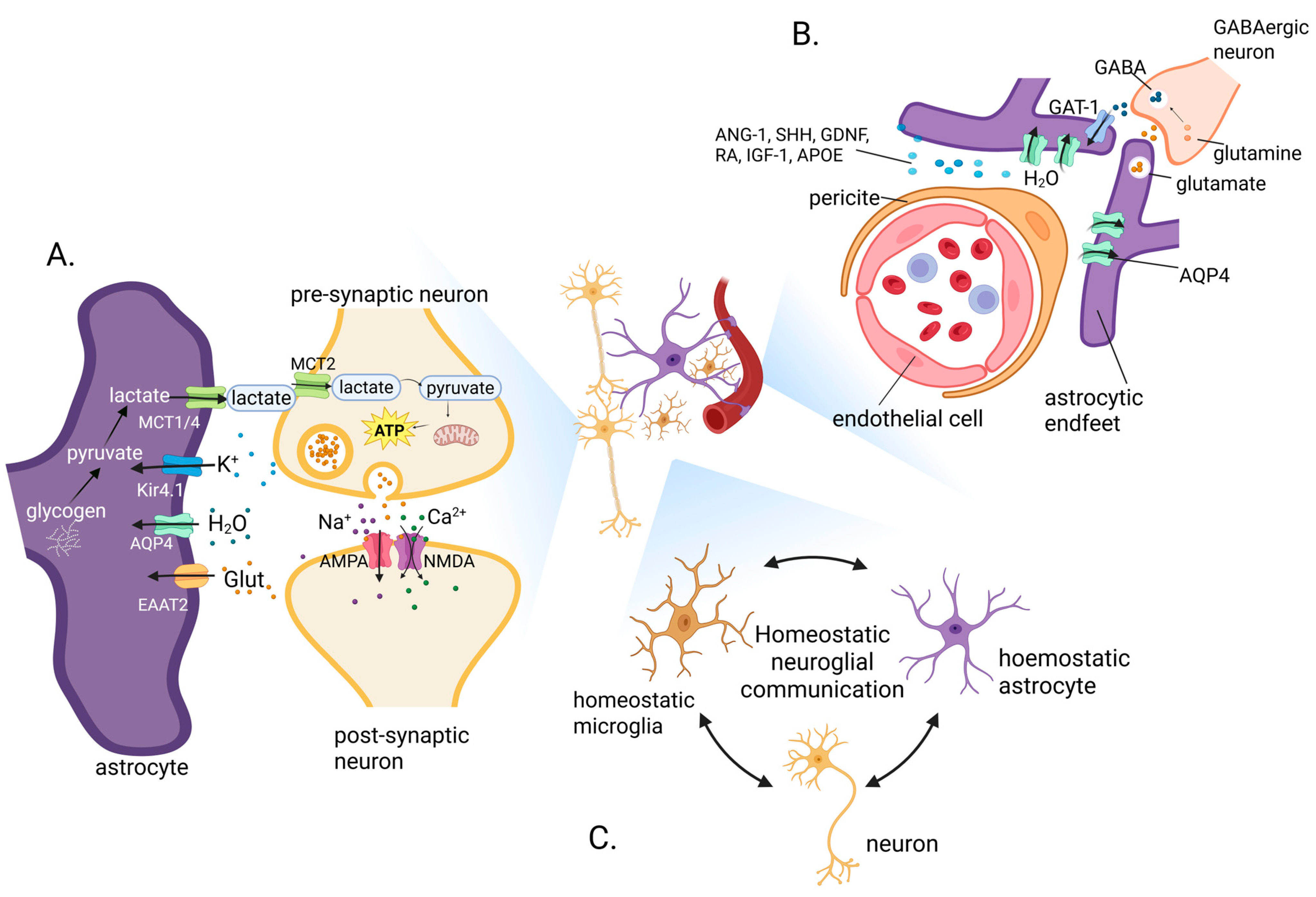
2. Astrocytes in Brain Homeostasis and Mood Regulation
2.1. Astrocytes Neurotransmission Regulation
2.2. Gliotransmission
2.3. Astrocyte’s Metabolism
2.4. Neurovascular Unit and Blood–Brain Barrier
2.5. Astrocytic Neurotrophic Support
2.6. Astrocyte Antioxidant Mechanisms and Their Implications for Cognitive, Emotional, and Learning Functions
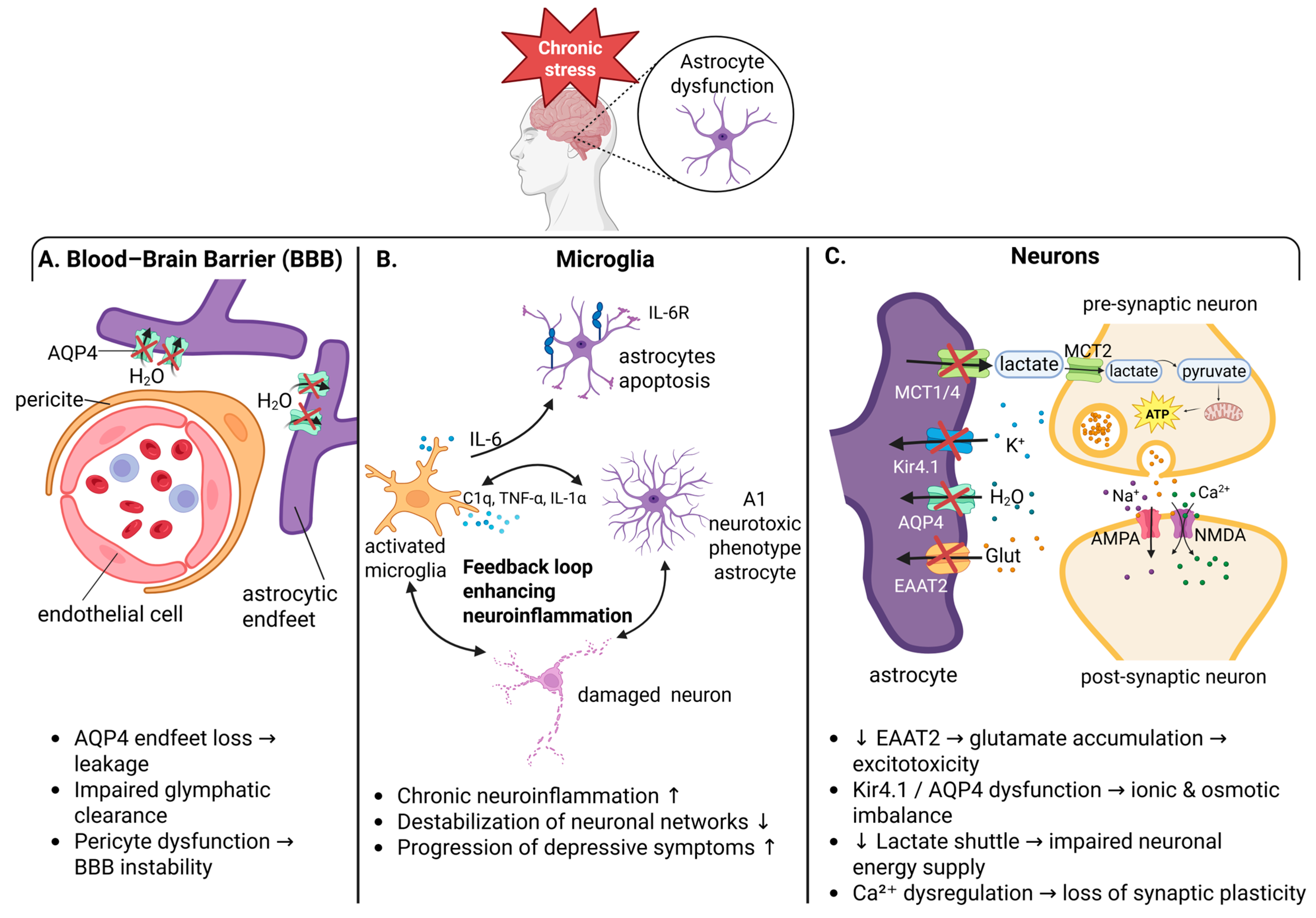
3. Molecular Mechanisms Linking Chronic Stress to Astrocyte Dysfunction in the Pathophysiology of Depression
3.1. Astrocytic Glucocorticoid Dysregulation
3.2. Neuroinflammatory Pathways Linking Chronic Stress to Depressive Pathophysiology
3.3. Mitochondrial Vulnerability and Epigenetic Reprogramming as Convergent Mechanisms in Stress-Related Brain Pathophysiology
4. Astrocyte-Specific Gene Expression Changes in Depression
4.1. Astrocytic Dysregulation of Glutamatergic, GABAergic, and Purinergic Signaling in Major Depressive Disorder
4.2. Astrocytic Markers, Epigenetic Alterations, and Structural Network Dysfunction
4.3. AQP4 and Water Homeostasis in Depression
4.4. Astrocytic Metabolic and Calcium Signaling Dysregulation in MDD
4.5. Sex-Specific Astrocytic Stress Responses, Molecular Vulnerabilities, and Their Impact on BBB Integrity in MDD
5. Therapeutic Implications and Future Directions
6. Conclusions
Author Contributions
Funding
Institutional Review Board Statement
Informed Consent Statement
Data Availability Statement
Conflicts of Interest
Abbreviations
| MDD | Major Depressive Disorder |
| HPA | Hypothalamic–Pituitary–Adrenal |
| MDEs | Major Depressive Episodes |
| CNS | Central Nervous System |
| NVU | Neurovascular Unit |
| BBB | Blood–Brain Barrier |
| EAAT1 | Excitatory Amino Acid Transporter 1 |
| EAAT2 | Excitatory Amino Acid Transporter 2 |
| GLT-1 | Glutamate Transporter 1 |
| GLAST | Glutamate Aspartate Transporter |
| SLC1A3 | Solute Carrier Family 1 Member 3 |
| SLC1A2 | Solute Carrier Family 1 Member 2 |
| GABA | Gamma-Aminobutyric Acid |
| GAT-1 | Gaba Transporter 1 |
| GAT-3 | Gaba Transporter 3 |
| ATP | Adenosine Triphosphate |
| LTP | Long-Term Potentiation |
| LTD | Long-Term Depression |
| NMDA | N-Methyl-D-Aspartate |
| CB1R | Type 1 Cannabinoid Receptors |
| OT | Oxytocin |
| OTRs | Oxytocin Receptors |
| CeA | Central Amygdala |
| TGOT | Threonine-4, Glycine-7 Oxytocin |
| ANLS | Astrocyte–Neuron Lactate Shuttle |
| MCT1 | Monocarboxylate Transporter 1 |
| MCT4 | Monocarboxylate Transporter 4 |
| cAMP | Cyclic Adenosine 3′,5′-Monophosphate |
| PKA | Protein Kinase A |
| PGE2 | Prostaglandin E2 |
| EETs | Epoxyeicosatrienoic Acids |
| NO | Nitric Oxide |
| GDNF | Glial-Derived Neurotrophic Factor |
| AQP4 | Aquaporin-4 |
| BDNF | Brain-Derived Neurotrophic Factor |
| NGF | Nerve Growth Factor |
| CNTF | Neurotrophic Factor |
| TSP-1 | Thrombospondin 1 |
| TSP-2 | Thrombospondin 2 |
| ANG-1 | Angiopoietin-1 |
| SHH | Sonic Hedgehog |
| RA | Retinoid Acid |
| IGF-1 | Insulin-Like Growth Factor 1 |
| APOE | Apolipoprotein E |
| GSH | glutathione |
| Nrf2 | nuclear factor erythroid 2–related factor 2 |
| SOD1/2 | superoxide dismutases |
| GPx | glutathione peroxidase |
| GSTs | glutathione-S-transferases |
| ROS | Reactive Oxygen Species |
| GRs | Glucocorticoid Receptors |
| IL-1β | Interleukin-1β |
| IL-6 | Interleukin-6 |
| TNF-α | Tumor Necrosis Factor-A |
| IL-1α | Interleukin-1α |
| mPFC | Medial Prefrontal Cortex |
| CA3 | Cornu Ammonis Area 3 |
| GFAP | Glial Fibrillary Acidic Protein |
| FGF2 | Fibroblast Growth Factor 2 |
| AGT | Angiotensinogen |
| ANGPT1 | Angiopoietin-1 |
| FABP7 | Fatty Acid-Binding Protein 7 |
| ALS | Amyotrophic Lateral Sclerosis |
| NF-κB | Nuclear Factor Kappa-Light-Chain-Enhancer of Activated B Cells |
| CREB | Camp Response Element-Binding Protein |
| Zbtb7a | Zinc Finger and Btb Domain-Containing Protein 7a |
| C1q | Complement Component 1q |
| Kir4.1 | Inwardly Rectifying Potassium Channel 4.1 |
| CUMS | Chronic Unpredictable Mild Stress |
| SGK1 | Serum- And Glucocorticoid-Regulated Kinase 1 |
| FOXO3a | Forkhead Box O3a |
| LKB1 | Liver Kinase B1 |
| HDAC5 | Histone Deacetylase 5 |
| AMPK | Amp-Activated Protein Kinase |
| STAT3 | Signal Transducer and Activator of Transcription 3 |
| SCI | Spinal Cord Injury |
| Cldn5 | Claudin-5 |
| ZO-1 | Zonula Occludens-1 |
| ER | Endoplasmic Reticulum |
| mPTP | Mitochondrial Permeability Transition Pore |
| miRNAs | Micrornas |
| miR-124 | Microrna-124 |
| GSK3β | Glycogen Synthase Kinase 3 Beta |
| LHPA | Limbic–Hypothalamic–Pituitary–Adrenal |
| PFC | Prefrontal Cortex |
| LC | Locus Coeruleus |
| CMS | Chronic Mild Stress |
| CUS | Chronic Unpredictable Stress |
| ACC | Anterior Cingulate Cortex |
| FSL | Flinders Sensitive Line |
| MAO-B | Monoamine Oxidase-B |
| GRIK2 | Glutamate Ionotropic Receptor Kainate Type Subunit 2 |
| BEGAIN | Brain-Enriched Guanylate Kinase-Associated Protein |
| LPS | Lipopolysaccharide |
| OPCs | Oligodendrocyte Precursor Cells |
| KO | Knockout |
| CSF | Cerebrospinal Fluid |
| SSRIs | Selective Serotonin Reuptake Inhibitors |
| TMS | Transcranial Magnetic Stimulation |
| NSAIDs | Non-Steroidal Anti-Inflammatory Drugs |
References
- Zhou, J.; Zhang, Y.; He, S.; Xu, S.; Sun, Q.; Zhao, T.; Daj, Y. Accelerated global burden of depressive disorders during the COVID-19 pandemic from 2019 to 2021. Sci. Rep. 2025, 15, 9529. [Google Scholar] [CrossRef]
- Gelenberg, A.J. The Prevalence and Impact of Depression. J. Clin. Psychiatry 2010, 71, e06. [Google Scholar] [CrossRef]
- McCusker, S.; Koola, M.M. Association of Ophthalmologic Disorders and Depression in the Elderly. Prim. Care Companion J. Clin. Psychiatry 2015, 17, 26671. [Google Scholar] [CrossRef]
- Balatif, R.; Sukma, A.A.M. Depression and Its Impact on Various Aspects of Life—A Narrative Review. Curr. Psychiatry Res. Rev. 2024, 20, 83–93. [Google Scholar] [CrossRef]
- García-Montero, C.; Ortega, M.A.; Alvarez-Mon, M.A.; Fraile-Martinez, O.; Romero-Bazán, A.; Lahera, G.; Montes-Rodríguez, J.M.; Molina-Ruiz, R.M.; Mora, F.; Rodriguez-Jimenez, R.; et al. The Problem of Malnutrition Associated with Major Depressive Disorder from a Sex-Gender Perspective. Nutrients 2022, 14, 1107. [Google Scholar] [CrossRef]
- Patel, M.; Minglani, V.V.; Vaddadi, H.; Jha, L.L.; Patel, L.D.; Huanbutta, K.; Sangnim, T. Advancements in Nanotherapeutics for the Treatment of Depression via Intranasal Pathway: A Review. Int. J. Nanomed. 2025, 20, 7323–7342. [Google Scholar] [CrossRef] [PubMed]
- Hammen, C.; Kim, E.Y.; Eberhart, N.K.; Brennan, P.A. Chronic and acute stress and the prediction of major depression in women. Depress. Anxiety 2009, 26, 718–723. [Google Scholar] [CrossRef] [PubMed]
- Campbell, E.; Irving, R.; Bailey, J.; Dilworth, L.; Abel, W. Overview of Psychophysiological Stress and the Implications for Junior Athletes. Am. J. Sports Sci. Med. 2018, 6, 72–78. [Google Scholar] [CrossRef]
- González-Arias, C.; Perea, G. When the Stars Misfire: Astrocytic Dysfunctions in Major Depressive Disorder. Neurochem. Res. 2025, 50, 231. [Google Scholar] [CrossRef] [PubMed]
- Wang, J.; Wu, X.; Lai, W.; Long, E.; Zhang, X.; Li, W.; Zhu, Y.; Chen, C.; Zhong, X.; Liu, Z.; et al. Prevalence of depression and depressive symptoms among outpatients: A systematic review and meta-analysis. BMJ Open 2017, 7, e017173. [Google Scholar] [CrossRef]
- Shen, S.; Liang, L.; Shi, T.; Shen, Z.; Yin, S.; Zhang, J.; Li, W.; Mi, W.; Wang, Y.; Zhang, Q.; et al. Microglia-Derived Interleukin-6 Triggers Astrocyte Apoptosis in the Hippocampus and Mediates Depression-Like Behavior. Adv. Sci. 2025, 12, e2412556. [Google Scholar] [CrossRef] [PubMed]
- Lin, L.; Guo, Z.; Ren, Z.; Feng, Y.; Fang, P.; Wang, T.; Chen, M. Bibliometric insights into astrocytic roles in depression and treatment. Front. Cell. Neurosci. 2025, 18, 1521398. [Google Scholar] [CrossRef] [PubMed]
- Verkhratsky, A.; Butt, A.; Li, B.; Illes, P.; Zorec, R.; Semyanov, A.; Tang, Y.; Sofroniew, M.V. Astrocytes in human central nervous system diseases: A frontier for new therapies. Signal Transduct. Target. Ther. 2023, 8, 396. [Google Scholar] [CrossRef] [PubMed]
- Manu, D.R.; Slevin, M.; Barcutean, L.; Forro, T.; Boghitoiu, T.; Balasa, R. Astrocyte Involvement in Blood–Brain Barrier Function: A Critical Update Highlighting Novel, Complex, Neurovascular Interactions. Int. J. Mol. Sci. 2023, 24, 17146. [Google Scholar] [CrossRef]
- Verkhratsky, A.; Parpura, V.; Li, B.; Scuderi, C. Astrocytes: The Housekeepers and Guardians of the CNS. Adv. Neurobiol. 2021, 26, 21–53. [Google Scholar] [CrossRef]
- Sun, W.; Liu, Z.; Jiang, X.; Chen, M.B.; Dong, H.; Liu, J.; Südhof, T.C.; Quake, S.R. Spatial transcriptomics reveal neuron–astrocyte synergy in long-term memory. Nature 2024, 627, 374–381. [Google Scholar] [CrossRef]
- Batiuk, M.Y.; Mastirosyan, A.; Wahis, J.; Vin, F.; Marneffe, C.; Kusserow, C.; Koeppen, J.; Viana, J.F.; Oliviera, J.F.; Voet, T.; et al. Identification of region-specific astrocyte subtypes at single cell resolution. Nat. Commun. 2020, 11, 1220. [Google Scholar] [CrossRef]
- Gradisnik, L.; Velnar, T. Astrocytes in the central nervous system and their functions in health and disease: A review. World J. Clin. Cases 2023, 11, 3385–3394. [Google Scholar] [CrossRef]
- Oliveira, J.F.; Sardinha, V.M.; Guerra-Gomes, S.; Araque, A.; Sousa, N. Do stars govern our actions? Astrocyte involvement in rodent behavior. Trends Neurosci. 2015, 38, 535–549. [Google Scholar] [CrossRef]
- Anderson, C.M.; Swanson, R.A. Astrocyte glutamate transport: Review of properties, regulation, and physiological functions. Glia 2000, 32, 1–14. [Google Scholar] [CrossRef]
- Khakh, B.S.; Sofroniew, M.V. Diversity of astrocyte functions and phenotypes in neural circuits. Nat. Neurosci. 2015, 18, 942–952. [Google Scholar] [CrossRef] [PubMed]
- Liu, J.; Feng, X.; Wang, Y.; Xia, X.; Zheng, J.C. Astrocytes: GABAceptive and GABAergic Cells in the Brain. Front. Cell. Neurosci. 2022, 16, 892497. [Google Scholar] [CrossRef] [PubMed]
- Naffaa, M.M. Mechanisms of astrocytic and microglial purinergic signaling in homeostatic regulation and implications for neurological disease. Explor. Neurosci. 2025, 4, 100676. [Google Scholar] [CrossRef]
- Perea, G.; Araque, A. Astrocytes Potentiate Transmitter Release at Single Hippocampal Synapses. Science 2007, 317, 1083–1086. [Google Scholar] [CrossRef]
- Henneberger, C.; Papouin, T.; Oliet, S.H.R.; Rusakov, D.A. Long-term potentiation depends on release of d-serine from astrocytes. Nature 2010, 463, 232–236. [Google Scholar] [CrossRef]
- Halassa, M.M.; Florian, C.; Fellin, T.; Munoz, J.R.; Lee, S.; Abel, T.; Haydon, P.; Frank, M.G. Astrocytic Modulation of Sleep Homeostasis and Cognitive Consequences of Sleep Loss. Neuron 2009, 61, 213–219. [Google Scholar] [CrossRef]
- Yoon, B.; Jo, S.; Woo, J.; Lee, J.; Kim, T.; Kim, D.; Lee, J. The amount of astrocytic GABA positively correlates with the degree of tonic inhibition in hippocampal CA1 and cerebellum. Mol. Brain 2011, 4, 42. [Google Scholar] [CrossRef] [PubMed]
- Jimenez-Blasco, D.; Busquets-Garcia, A.; Hebert-Chatelain, E.; Serrat, R.; Vincente-Gutierrez, C.; Ioannidou, C.; Gómez-Sotres, P.; Lopez-Fabuel, I.; Resch-Beusher, M.; Resel, E.; et al. Glucose metabolism links astroglial mitochondria to cannabinoid effects. Nature 2020, 583, 603–608. [Google Scholar] [CrossRef]
- Covelo, A.; Eraso-Pichot, A.; Fernández-Moncada, I.; Serrat, R.; Marsicano, G. CB1R-dependent regulation of astrocyte physiology and astrocyte-neuron interactions. Neuropharmacology 2021, 195, 108678. [Google Scholar] [CrossRef]
- Robin, L.M.; Oliveira da Cruz, J.F.; Langlais, V.C.; Martin-Fernandez, M.; Metna-Laurent, M.; Busquets-Garcia, A.; Bellocchio, L.; Soria-Gomez, E.; Papouin, T.; Varilh, M.; et al. Astroglial CB1 Receptors Determine Synaptic D-Serine Availability to Enable Recognition Memory. Neuron 2018, 98, 935–944.e5. [Google Scholar] [CrossRef]
- Bohmbach, K.; Masala, N.; Schönhense, E.M.; Hill, K.; Haubrich, A.N.; Zimmer, A.; Optiz, T.; Beck, H.; Henneberger, C. An astrocytic signaling loop for frequency-dependent control of dendritic integration and spatial learning. Nat. Commun. 2022, 13, 7932. [Google Scholar] [CrossRef] [PubMed]
- Wahis, J.; Baudon, A.; Althammer, F.; Kerspern, D.; Goyon, S.; Hagiwara, D.; Lefevre, A.; Barteczko, L.; Boury-Jamot, B.; Bellanger, B.; et al. Astrocytes mediate the effect of oxytocin in the central amygdala on neuronal activity and affective states in rodents. Nat. Neurosci. 2021, 24, 529–541. [Google Scholar] [CrossRef] [PubMed]
- Baudon, A.; Creusot, E.C.; Althammer, F.; Schaaf, C.P.; Charlet, A. Emerging role of astrocytes in oxytocin-mediated control of neural circuits and brain functions. Prog. Neurobiol. 2022, 217, 102328. [Google Scholar] [CrossRef]
- Barnett, D.; Bohmbach, K.; Grelot, V.; Charlet, A.; Dallérac, G.; Ju, Y.H.; Nagai, J.; Orr, A.G. Astrocytes as Drivers and Disruptors of Behavior: New Advances in Basic Mechanisms and Therapeutic Targeting. J. Neurosci. 2023, 43, 7463–7471. [Google Scholar] [CrossRef]
- Pellerin, L.; Magistretti, P.J. Glutamate uptake into astrocytes stimulates aerobic glycolysis: A mechanism coupling neuronal activity to glucose utilization. Proc. Natl. Acad. Sci. USA 1994, 91, 10625–10629. [Google Scholar] [CrossRef]
- Dembitskaya, Y.; Piette, C.; Perez, S.; Berry, H.; Magistretti, P.J.; Venance, L. Lactate supply overtakes glucose when neural computational and cognitive loads scale up. Proc. Natl. Acad. Sci. USA 2022, 119, e2212004119. [Google Scholar] [CrossRef]
- Suzuki, A.; Stern, S.A.; Bozdagi, O.; Huntley, G.W.; Walker, R.H.; Magistretti, P.J.; Alberini, C.M. Astrocyte-Neuron Lactate Transport Is Required for Long-Term Memory Formation. Cell 2011, 144, 810–823. [Google Scholar] [CrossRef] [PubMed]
- Theparambil, S.M.; Kopach, O.; Braga, A.; Nizari, S.; Hosford, P.S.; Sagi-Kiss, V.; Hadjihambi, A.; Konstantinou, C.; Esteras, N.; Del Arroyo, A.G.; et al. Adenosine signalling to astrocytes coordinates brain metabolism and function. Nature 2024, 632, 139–146. [Google Scholar] [CrossRef]
- Wang, X.; Takano, T.; Nedergaard, M. Astrocytic Calcium Signaling: Mechanism and Implications for Functional Brain Imaging; Humana Press: Totowa, NJ, USA, 2009; pp. 93–109. [Google Scholar] [CrossRef]
- Attwell, D.; Buchan, A.M.; Charpak, S.; Lauritzen, M.; MacVicar, B.A.; Newman, E.A. Glial and neuronal control of brain blood flow. Nature 2010, 468, 232–243. [Google Scholar] [CrossRef]
- Poskanzer, K.E.; Yuste, R. Astrocytes regulate cortical state switching in vivo. Proc. Natl. Acad. Sci. USA 2016, 113, E2675–E2684. [Google Scholar] [CrossRef]
- Abbott, N.J.; Rönnbäck, L.; Hansson, E. Astrocyte–endothelial interactions at the blood–brain barrier. Nat. Rev. Neurosci. 2006, 7, 41–53. [Google Scholar] [CrossRef] [PubMed]
- Peng, S.; Liu, J.; Liang, C.; Yang, L.; Wang, G. Aquaporin-4 in glymphatic system, and its implication for central nervous system disorders. Neurobiol. Dis. 2023, 179, 106035. [Google Scholar] [CrossRef]
- Müller, H. Astroglial neurotrophic and neurite-promoting factors. Pharmacol. Ther. 1995, 65, 1–18. [Google Scholar] [CrossRef]
- Albini, M.; Krawczun-Rygmaczewska, A.; Cesca, F. Astrocytes and brain-derived neurotrophic factor (BDNF). Neurosci. Res. 2023, 197, 42–51. [Google Scholar] [CrossRef]
- Vignoli, B.; Battistini, G.; Melani, R.; Blum, R.; Santi, S.; Berardi, N.; Canossa, M. Peri-Synaptic Glia Recycles Brain-Derived Neurotrophic Factor for LTP Stabilization and Memory Retention. Neuron 2016, 92, 873–887. [Google Scholar] [CrossRef] [PubMed]
- Allen, S.J.; Watson, J.J.; Shoemark, D.K.; Barua, N.U.; Patel, N.K. GDNF, NGF and BDNF as therapeutic options for neurodegeneration. Pharmacol. Ther. 2013, 138, 155–175. [Google Scholar] [CrossRef]
- Christopherson, K.S.; Ullian, E.M.; Stokes, C.C.A.; Mullowney, C.E.; Hell, J.W.; Agah, A.; Lawler, J.; Mosher, D.F.; Bornstein, P.; Barres, B.A. Thrombospondins Are Astrocyte-Secreted Proteins that Promote CNS Synaptogenesis. Cell 2005, 120, 421–433. [Google Scholar] [CrossRef] [PubMed]
- Liu, Y.; Wang, L.; Long, Z.; Zeng, L.; Wu, Y. Protoplasmic Astrocytes Enhance the Ability of Neural Stem Cells to Differentiate into Neurons In Vitro. PLoS ONE 2012, 7, e38243. [Google Scholar] [CrossRef][Green Version]
- Fulmer, C.G.; VonDran, M.W.; Stillman, A.A.; Huang, Y.; Hempstead, B.L.; Dreyfus, C.F. Astrocyte-Derived BDNF Supports Myelin Protein Synthesis after Cuprizone-Induced Demyelination. J. Neurosci. 2014, 34, 8186–8196. [Google Scholar] [CrossRef]
- Chen, Y.; Qin, C.; Huang, J.; Tang, X.; Liu, C.; Huang, K.; Xu, J.; Guo, G.; Tong, A.; Zhou, L. The role of astrocytes in oxidative stress of central nervous system: A mixed blessing. Cell Prolif. 2020, 53, e12781. [Google Scholar] [CrossRef]
- McBean, G. Cysteine, Glutathione, and Thiol Redox Balance in Astrocytes. Antioxidants 2017, 6, 62. [Google Scholar] [CrossRef]
- Mulica, P.; Grünewald, A.; Pereira, S.L. Astrocyte-Neuron Metabolic Crosstalk in Neurodegeneration: A Mitochondrial Perspective. Front. Endocrinol. 2021, 12, 668517. [Google Scholar] [CrossRef]
- Roumes, H.; Pellerin, L.; Bouzier-Sore, A.-K. Astrocytes as metabolic suppliers to support neuronal activity and brain functions. Essays Biochem. 2023, 67, 27–37. [Google Scholar] [CrossRef]
- Verkhratsky, A.; Semyanov, A. Astrocytes in Ageing; Springer International Publishing: Cham, Switzerland, 2023; pp. 253–277. [Google Scholar] [CrossRef]
- Navarro, E.; Esteras, N. Multitarget Effects of Nrf2 Signalling in the Brain: Common and Specific Functions in Different Cell Types. Antioxidants 2024, 13, 1502. [Google Scholar] [CrossRef]
- Zhang, M.; An, C.; Gao, Y.; Leak, R.K.; Chen, J.; Zhang, F. Emerging roles of Nrf2 and phase II antioxidant enzymes in neuroprotection. Prog. Neurobiol. 2013, 100, 30–47. [Google Scholar] [CrossRef] [PubMed]
- Beckhauser, T.F.; Francis-Oliveira, J.; De Pasquale, R. Reactive Oxygen Species: Physiological and Physiopathological Effects on Synaptic Plasticity. J. Exp. Neurosci. 2016, 10, 23–48. [Google Scholar] [CrossRef] [PubMed]
- Robillard, J.M.; Gordon, G.R.; Choi, H.B.; Christie, B.R.; MacVicar, B.A. Glutathione Restores the Mechanism of Synaptic Plasticity in Aged Mice to That of the Adult. PLoS ONE 2011, 6, e20676. [Google Scholar] [CrossRef] [PubMed]
- González-Fraguela, M.E.; Blanco, L.; Fernández, C.I.; Lorigados, L.; Serrano, T.; Fernández, J.L. Glutathione depletion: Starting point of brain metabolic stress, neuroinflammation and cognitive impairment in rats. Brain Res. Bull. 2018, 137, 120–131. [Google Scholar] [CrossRef]
- Bansal, Y.; Codeluppi, S.A.; Banasr, M. Astroglial Dysfunctions in Mood Disorders and Rodent Stress Models: Consequences on Behavior and Potential as Treatment Target. Int. J. Mol. Sci. 2024, 25, 6357. [Google Scholar] [CrossRef]
- Di Benedetto, B.; Malik, V.A.; Begum, S.; Jablonowski, L.; Gómez-González, G.B.; Neumann, I.D.; Rupprecht, R. Fluoxetine Requires the Endfeet Protein Aquaporin-4 to Enhance Plasticity of Astrocyte Processes. Front. Cell. Neurosci. 2016, 10, 8. [Google Scholar] [CrossRef]
- Miguel-Hidalgo, J.J. Role of stress-related glucocorticoid changes in astrocyte-oligodendrocyte interactions that regulate myelin production and maintenance. Histol. Histopathol. 2023, 38, 1–8. [Google Scholar] [CrossRef]
- Tafet, G.E.; Bernardini, R. Psychoneuroendocrinological links between chronic stress and depression. Prog. Neuro-Psychopharmacol. Biol. Psychiatry 2003, 27, 893–903. [Google Scholar] [CrossRef]
- Aten, S.; Du, Y.; Taylor, O.; Dye, C.; Collins, K.; Thomas, M.; Kiyoshi, C.; Zhou, M. Chronic Stress Impairs the Structure and Function of Astrocyte Networks in an Animal Model of Depression. Neurochem. Res. 2023, 48, 1191–1210. [Google Scholar] [CrossRef]
- Sun, J.-D.; Liu, Y.; Yuan, Y.-H.; Li, J.; Chen, N.-H. Gap Junction Dysfunction in the Prefrontal Cortex Induces Depressive-Like Behaviors in Rats. Neuropsychopharmacology 2012, 37, 1305–1320. [Google Scholar] [CrossRef]
- Lu, C.-L.; Ren, J.; Mo, J.-W.; Xiong, C. Glucocorticoid Receptor–Dependent Astrocytes Mediate Stress Vulnerability. Biol. Psychiatry 2022, 92, 204–215. [Google Scholar] [CrossRef]
- Tertil, M.; Skupio, U.; Barut, J.; Wawrzczak-Bargiela, A.; Golda, S.; Kudla, L.; Wiktorowska, L.; Szklarczyk, K.; Korostyński, M.; Przewłocki, R.; et al. Glucocorticoid receptor signaling in astrocytes is required for aversive memory formation. Transl. Psychiatry 2018, 8, 255. [Google Scholar] [CrossRef]
- Heard, K.J.; Shokhirev, M.N.; Becronis, C.; Frendlender, C.; Zahid, N.; Le, A.T.; Ji, Y.; Skime, M.; Nelson, T.; Hall-Flavin, D.; et al. Chronic cortisol differentially impacts stem cell-derived astrocytes from major depressive disorder patients. Transl. Psychiatry 2021, 11, 608. [Google Scholar] [CrossRef]
- Mason, S. Lactate Shuttles in Neuroenergetics—Homeostasis, Allostasis and Beyond. Front. Neurosci. 2017, 11, 43. [Google Scholar] [CrossRef] [PubMed]
- González-Herrera, F.; Catalán, M.; Anfossi, R.; Maya, J.D.; Pedrozo, Z.; Díaz-Araya, G.; Vivar, R. SGK1 is necessary to FoxO3a negative regulation, oxidative stress and cardiac fibroblast activation induced by TGF-β1. Cell. Signal. 2023, 109, 110778. [Google Scholar] [CrossRef] [PubMed]
- Jin, H.; Zhang, L.; He, J.; Wu, M.; Jia, L.; Guo, J. Role of FOXO3a Transcription Factor in the Regulation of Liver Oxidative Injury. Antioxidants 2022, 11, 2478. [Google Scholar] [CrossRef] [PubMed]
- Yuan, S.-Y.; Liu, J.; Zhou, J.; Lu, W.; Zhou, H.-Y.; Long, L.-H.; Hu, Z.-L.; Ni, L.; Wang, Y.; Chen, J.-G.; et al. AMPK Mediates Glucocorticoids Stress-Induced Downregulation of the Glucocorticoid Receptor in Cultured Rat Prefrontal Cortical Astrocytes. PLoS ONE 2016, 11, e0159513. [Google Scholar] [CrossRef] [PubMed]
- van der Knaap, L.J.; Oldehinkel, A.J.; Verhulst, F.C.; van Oort, F.V.A.; Riese, H. Glucocorticoid receptor gene methylation and HPA-axis regulation in adolescents. The TRAILS study. Psychoneuroendocrinology 2015, 58, 46–50. [Google Scholar] [CrossRef]
- Unemura, K.; Kume, T.; Kondo, M.; Maeda, Y.; Izumi, Y.; Akaike, A. Glucocorticoids Decrease Astrocyte Numbers by Reducing Glucocorticoid Receptor Expression In Vitro and In Vivo. J. Pharmacol. Sci. 2012, 119, 30–39. [Google Scholar] [CrossRef]
- Ageeva, T.; Rizvanov, A.; Mukhamedshina, Y. NF-κB and JAK/STAT Signaling Pathways as Crucial Regulators of Neuroinflammation and Astrocyte Modulation in Spinal Cord Injury. Cells 2024, 13, 581. [Google Scholar] [CrossRef] [PubMed]
- Karki, P.; Smith, K.; Johnson, J.; Aschner, M.; Lee, E.Y. Genetic Dys-regulation of Astrocytic Glutamate Transporter EAAT2 and its Implications in Neurological Disorders and Manganese Toxicity. Neurochem. Res. 2015, 40, 380–388. [Google Scholar] [CrossRef] [PubMed]
- Jiang, S.; Zhang, Q.; Guo, Q.; Di, Z. The glutamatergic system and astrocytic impairment in rat hippocampus: A comparative study of underlying etiology and pathophysiology of depression. J. Integr. Neurosci. 2019, 18, 387–392. [Google Scholar] [CrossRef]
- Mayhew, J.; Beart, P.M.; Walker, F.R. Astrocyte and Microglial Control of Glutamatergic Signalling: A Primer on Understanding the Disruptive Role of Chronic Stress. J. Neuroendocrinol. 2015, 27, 498–506. [Google Scholar] [CrossRef]
- Joëls, M.; Karst, H.; Krugers, H.J.; Lucassen, P.J. Chronic stress: Implications for neuronal morphology, function and neurogenesis. Front. Neuroendocrinol. 2007, 28, 72–96. [Google Scholar] [CrossRef]
- Duman, R.S.; Sanacora, G.; Krystal, J.H. Altered Connectivity in Depression: GABA and Glutamate Neurotransmitter Deficits and Reversal by Novel Treatments. Neuron 2019, 102, 75–90. [Google Scholar] [CrossRef]
- Hassamal, S. Chronic stress, neuroinflammation, and depression: An overview of pathophysiological mechanisms and emerging anti-inflammatories. Front. Psychiatry 2023, 14, 1130989. [Google Scholar] [CrossRef]
- Raison, C.L.; Capuron, L.; Miller, A.H. Cytokines sing the blues: Inflammation and the pathogenesis of depression. Trends Immunol. 2006, 27, 24–31. [Google Scholar] [CrossRef]
- Hodes, G.E.; Kana, V.; Menard, C.; Merad, M.; Russo, S.J. Neuroimmune mechanisms of depression. Nat. Neurosci. 2015, 18, 1386–1393. [Google Scholar] [CrossRef]
- Knezevic, E.; Nenic, K.; Milanovic, V.; Knezevic, N.N. The Role of Cortisol in Chronic Stress, Neurodegenerative Diseases, and Psychological Disorders. Cells 2023, 12, 2726. [Google Scholar] [CrossRef]
- Acarin, L.; Gonz, B.; Castellano, B. STAT3 and NFκB Activation Precedes Glial Reactivity in the Excitotoxically Injured Young Cortex but not in the Corresponding Distal Thalamic Nuclei. J. Neuropathol. Exp. Neurol. 2000, 59, 151–163. [Google Scholar] [CrossRef][Green Version]
- Leng, K.; Rose, I.V.L.; Kim, H.; Xia, W.; Romero-Fernandez, W.; Rooney, B.; Koontz, M.; Li, E.; Ao, Y.; Wang, S.; et al. CRISPRi screens in human iPSC-derived astrocytes elucidate regulators of distinct inflammatory reactive states. Nat. Neurosci. 2022, 25, 1528–1542. [Google Scholar] [CrossRef]
- Greene, C.; Kealy, J.; Humphries, M.M.; Gong, Y.; Hou, J.; Hudson, N.; Cassidy, L.M.; Martiniano, R.; Shashi, V.; Hooper, S.R.; et al. Dose-dependent expression of claudin-5 is a modifying factor in schizophrenia. Mol. Psychiatry 2018, 23, 2156–2166. [Google Scholar] [CrossRef] [PubMed]
- Ouyang, Y.-B.; Giffard, R.G. Changes in astrocyte mitochondrial function with stress: Effects of Bcl-2 family proteins. Neurochem. Int. 2004, 45, 371–379. [Google Scholar] [CrossRef] [PubMed]
- Macías, F.; Ulloa, M.; Clapp, C.; de la Escalera, G.M.; Arnold, E. Prolactin protects hippocampal neurons against H2O2-induced neurotoxicity by suppressing BAX and NOX4 via the NF-κB signaling pathway. PLoS ONE 2024, 19, e0313328. [Google Scholar] [CrossRef] [PubMed]
- Jacobson, J.; Duchen, M.R. Mitochondrial oxidative stress and cell death in astrocytes—Requirement for stored Ca2+ and sustained opening of the permeability transition pore. J. Cell. Sci. 2002, 115, 1175–1188. [Google Scholar] [CrossRef]
- Fiskum, G.; Danilov, C.A.; Mehrabian, Z.; Bambrick, L.L.; Kristian, T.; McKenna, M.C.; Hopkins, I.; Richards, E.M.; Rosenthal, R.E. Postischemic Oxidative Stress Promotes Mitochondrial Metabolic Failure in Neurons and Astrocytes. Ann. N. Y. Acad. Sci. 2008, 1147, 129–138. [Google Scholar] [CrossRef]
- Chakravarty, S.; Pathak, S.S.; Maitra, S.; Khandelwal, N.; Chandra, K.B.; Kumar, A. Epigenetic Regulatory Mechanisms in Stress-Induced Behavior. Int. Rev. Neurobiol. 2014, 115, 117–154. [Google Scholar] [CrossRef]
- Higuchi, F.; Uchida, S.; Yamagata, H.; Abe-Higuchi, N.; Hobara, T.; Hara, K.; Kobayashi, A.; Shintaku, T.; Itoh, Y.; Suzuki, T.; et al. Hippocampal MicroRNA-124 Enhances Chronic Stress Resilience in Mice. J. Neurosci. 2016, 36, 7253–7267. [Google Scholar] [CrossRef] [PubMed]
- Stankiewicz, A.M.; Swiergiel, A.H.; Lisowski, P. Epigenetics of stress adaptations in the brain. Brain Res. Bull. 2013, 98, 76–92. [Google Scholar] [CrossRef]
- Peng, L.; Verkhratsky, A.; Gu, L.; Li, B. Targeting astrocytes in major depression. Expert Rev. Neurother. 2015, 15, 1299–1306. [Google Scholar] [CrossRef]
- Poletti, S.; Locatelli, C.; Falini, A.; Colombo, C.; Benedetti, F. Adverse childhood experiences associate to reduced glutamate levels in the hippocampus of patients affected by mood disorders. Prog. Neuro-Psychopharmacol. Biol. Psychiatry 2016, 71, 117–122. [Google Scholar] [CrossRef]
- Moriguchi, S.; Takamiya, A.; Noda, Y.; Horita, N.; Wada, M.; Tsugawa, S.; Plitman, E.; Sano, Y.; Tarumi, R.; ElSalhy, M.; et al. Glutamatergic neurometabolite levels in major depressive disorder: A systematic review and meta-analysis of proton magnetic resonance spectroscopy studies. Mol. Psychiatry 2019, 24, 952–964. [Google Scholar] [CrossRef]
- González-Arias, C.; Sánchez-Ruiz, A.; Esparza, J.; Sánchez-Puelles, C.; Arancibia, L.; Ramírez-Franco, J.; Gobbo, D.; Kirchhoff, F.; Perea, G. Dysfunctional serotonergic neuron-astrocyte signaling in depressive-like states. Mol. Psychiatry 2023, 28, 3856–3873. [Google Scholar] [CrossRef] [PubMed]
- Gómez-Galán, M.; De Bundel, D.; Van Eeckhaut, A.; Smolders, I.; Lindskog, M. Dysfunctional astrocytic regulation of glutamate transmission in a rat model of depression. Mol. Psychiatry 2013, 18, 582–594. [Google Scholar] [CrossRef]
- Fullana, M.N.; Ruiz-Bronchal, E.; Ferrés-Coy, A.; Juárez-Escoto, E.; Artigas, F.; Bortolozzi, A. Regionally selective knockdown of astroglial glutamate transporters in infralimbic cortex induces a depressive phenotype in mice. Glia 2019, 67, 1122–1137. [Google Scholar] [CrossRef]
- Duarte, Y.; Quintana-Donoso, D.; Moraga-Amaro, R.; Dinamarca, I.; Lemunao, Y.; Cárdenas, K.; Bahamonde, T.; Barrientos, T.; Olivares, P.; Navas, C.; et al. The role of astrocytes in depression, its prevention, and treatment by targeting astroglial gliotransmitter release. Proc. Natl. Acad. Sci. USA 2024, 121, e2307953121. [Google Scholar] [CrossRef] [PubMed]
- Choudary, P.V.; Molnar, M.; Evans, S.J.; Tomita, H.; Li, J.Z.; Vawter, M.P.; Myers, R.M.; Bunney, W.E., Jr.; Akil, H.; Watson, S.J.; et al. Altered cortical glutamatergic and GABAergic signal transmission with glial involvement in depression. Proc. Natl. Acad. Sci. USA 2005, 102, 15653–15658. [Google Scholar] [CrossRef]
- Czéh, B.; Vardya, I.; Varga, Z.; Febbraro, F.; Csabai, D.; Martis, L.-S.; Højgaard, K.; Henningsen, K.; Bouzinova, E.V.; Miseta, A.; et al. Long-Term Stress Disrupts the Structural and Functional Integrity of GABAergic Neuronal Networks in the Medial Prefrontal Cortex of Rats. Front. Cell. Neurosci. 2018, 12, 148. [Google Scholar] [CrossRef]
- Abraham, M.; Schmerder, K.; Hedtstück, M.; Bösing, K.; Mundorf, A.; Freund, N. Maternal separation and its developmental consequences on anxiety and parvalbumin interneurons in the amygdala. J. Neural Transm. 2023, 130, 1167–1175. [Google Scholar] [CrossRef] [PubMed]
- Srivastava, I.; Vazquez-Juarez, E.; Henning, L.; Gómez-Galán, M.; Lindskog, M. Blocking Astrocytic GABA Restores Synaptic Plasticity in Prefrontal Cortex of Rat Model of Depression. Cells 2020, 9, 1705. [Google Scholar] [CrossRef]
- Araque, A.; Carmignoto, G.; Haydon, P.G.; Oliet, S.H.R.; Robitaille, R.; Volterra, A. Gliotransmitters Travel in Time and Space. Neuron 2014, 81, 728–739. [Google Scholar] [CrossRef]
- Zhao, Y.F.; Verkhratsky, A.; Tang, Y.; Illes, P. Astrocytes and major depression: The purinergic avenue. Neuropharmacology 2022, 220, 109252. [Google Scholar] [CrossRef]
- Renshaw, P.F.; Parow, A.M.; Hirashima, F.; Ke, Y.; Moore, C.M.; Frederick, B.d.B.; Fava, M.; Hennen, J.; Cohen, B.M. Multinuclear Magnetic Resonance Spectroscopy Studies of Brain Purines in Major Depression. Am. J. Psychiatry 2001, 158, 2048–2055. [Google Scholar] [CrossRef]
- Sahay, S.; Lundh, A.E.; Sirole, R.P.; McCullumsmith, R.E.; O’Donovan, S.M. Purinergic System Transcript Changes in the Dorsolateral Prefrontal Cortex in Suicide and Major Depressive Disorder. Int. J. Mol. Sci. 2025, 26, 1826. [Google Scholar] [CrossRef]
- Cao, X.; Li, L.-P.; Wang, Q.; Wu, Q.; Hu, H.-H.; Zhang, M.; Fang, Y.-Y.; Zhang, J.; Li, S.-J.; Xiong, W.-C.; et al. Astrocyte-derived ATP modulates depressive-like behaviors. Nat. Med. 2013, 19, 773–777. [Google Scholar] [CrossRef] [PubMed]
- Cai, W.; Xue, C.; Sakaguchi, M.; Konishi, M.; Shirazian, A.; Ferris, H.A.; Li, M.E.; Yu, R.; Kleinridders, A.; Pothos, E.N.; et al. Insulin regulates astrocyte gliotransmission and modulates behavior. J. Clin. Investig. 2018, 128, 2914–2926. [Google Scholar] [CrossRef] [PubMed]
- Xiong, W.; Cao, X.; Zeng, Y.; Qin, X.; Zhu, M.; Ren, J.; Wu, Z.; Huang, Q.; Zhang, Y.; Wang, M.; et al. Astrocytic Epoxyeicosatrienoic Acid Signaling in the Medial Prefrontal Cortex Modulates Depressive-like Behaviors. J. Neurosci. 2019, 39, 4606–4623. [Google Scholar] [CrossRef] [PubMed]
- Miguel-Hidalgo, J.J.; Moulana, M.; Deloach, P.H.; Rajkowska, G. Chronic Unpredictable Stress Reduces Immunostaining for Connexins 43 and 30 and Myelin Basic Protein in the Rat Prelimbic and Orbitofrontal Cortices. Chronic Stress 2018, 2, 2470547018814186. [Google Scholar] [CrossRef] [PubMed]
- Wang, M.-L.; Song, Y.-L.; Wu, D.-Y.; Li, H.; Li, Z.-M.; Xiong, X.-X.; Hu, N.-Y.; Hu, J.; Li., J.-T.; Wang, Y.-X.; et al. Astrocytic connexin43 in the medial prefrontal cortex regulates depressive- and anxiety-like behaviors via ATP release. Pharmacol. Res. 2025, 217, 107798. [Google Scholar] [CrossRef]
- Etiévant, A.; Oosterhof, C.; Bétry, C.; Abrial, E.; Novo-Perez, M.; Rovera, R.; Scarna, H.; Devader, C.; Mazella, J.; Wegener, G.; et al. Astroglial Control of the Antidepressant-Like Effects of Prefrontal Cortex Deep Brain Stimulation. eBioMedicine 2015, 2, 898–908. [Google Scholar] [CrossRef]
- Etiévant, A.; Lucas, G.; Dkhissi-Benyahya, O.; Haddjeri, N. The Role of Astroglia in the Antidepressant Action of Deep Brain Stimulation. Front. Cell. Neurosci. 2016, 9, 509. [Google Scholar] [CrossRef]
- Nagy, C.; Suderman, M.; Yang, J.; Szyf, M.; Mechawar, N.; Ernst, C.; Turecki, G. Astrocytic abnormalities and global DNA methylation patterns in depression and suicide. Mol. Psychiatry 2015, 20, 320–328. [Google Scholar] [CrossRef]
- Koga, Y.; Kajitani, N.; Miyako, K.; Takizawa, H.; Boku, S.; Takebayashi, M. TCF7L2: A potential key regulator of antidepressant effects on hippocampal astrocytes in depression model mice. J. Psychiatr. Res. 2024, 170, 375–386. [Google Scholar] [CrossRef] [PubMed]
- Chandley, M.J.; Szebeni, K.; Szebeni, A.; Crawford, J.; Stockmeier, C.A.; Turecki, G.; Miguel-Hidalgo, J.J.; Ordway, G.A. Gene expression deficits in pontine locus coeruleus astrocytes in men with major depressive disorder. J. Psychiatry Neurosci. 2013, 38, 276–284. [Google Scholar] [CrossRef]
- Wang, Q.; Jie, W.; Liu, J.; Yang, J.; Gao, T. An astroglial basis of major depressive disorder? An overview. Glia 2017, 65, 1227–1250. [Google Scholar] [CrossRef]
- Medina, A.; Watson, S.J.; Bunney, W.; Myers, R.M.; Schatzberg, A.; Barchas, J.; Akil, H.; Thompson, R.C. Evidence for alterations of the glial syncytial function in major depressive disorder. J. Psychiatr. Res. 2016, 72, 15–21. [Google Scholar] [CrossRef]
- Huang, D.; Li, C.; Zhang, W.; Qin, J.; Jiang, W.; Hu, C. Dysfunction of astrocytic connexins 30 and 43 in the medial prefrontal cortex and hippocampus mediates depressive-like behaviours. Behav. Brain Res. 2019, 372, 111950. [Google Scholar] [CrossRef]
- Mader, S.; Brimberg, L. Aquaporin-4 Water Channel in the Brain and Its Implication for Health and Disease. Cells 2019, 8, 90. [Google Scholar] [CrossRef] [PubMed]
- Rajkowska, G.; Stockmeier, C. Astrocyte Pathology in Major Depressive Disorder: Insights from Human Postmortem Brain Tissue. Curr. Drug Targets 2013, 14, 1225–1236. [Google Scholar] [CrossRef]
- Taler, M.; Aronovich, R.; Henry Hornfeld, S.; Dar, S.; Sasson, E.; Weizman, A.; Hochman, E. Regulatory effect of lithium on hippocampal blood-brain barrier integrity in a rat model of depressive-like behavior. Bipolar Disord. 2021, 23, 55–65. [Google Scholar] [CrossRef] [PubMed]
- Skucas, V.A.; Mathews, I.B.; Yang, J.; Cheng, Q.; Treister, A.; Duffy, A.M.; Verkman, A.S.; Hempstead, B.L.; Wood, M.A.; Binder, D.K.; et al. Impairment of Select Forms of Spatial Memory and Neurotrophin-Dependent Synaptic Plasticity by Deletion of Glial Aquaporin-4. J. Neurosci. 2011, 31, 6392–6397. [Google Scholar] [CrossRef]
- Wen, J.; Chen, C.H.; Stock, A.; Doerner, J.; Gulinello, M.; Putterman, C. Intracerebroventricular administration of TNF-like weak inducer of apoptosis induces depression-like behavior and cognitive dysfunction in non-autoimmune mice. Brain Behav. Immun. 2021, 54, 27–37. [Google Scholar] [CrossRef]
- Haj-Yasein, N.N.; Bugge, C.E.; Jensen, V.; Østby, I.; Ottersen, O.P.; Hvalby, Ø.; Nagelhus, E.A. Deletion of aquaporin-4 increases extracellular K+ concentration during synaptic stimulation in mouse hippocampus. Brain Struct. Funct. 2015, 220, 2469–2474. [Google Scholar] [CrossRef] [PubMed]
- Yang, J.; Li, M.-X.; Luo, Y.; Chen, T.; Liu, J.; Fang, P.; Jiang, B.; Hu, Z.-L.; Jin, Y.; Chen, J.-G.; et al. Chronic ceftriaxone treatment rescues hippocampal memory deficit in AQP4 knockout mice via activation of GLT-1. Neuropharmacology 2013, 75, 213–222. [Google Scholar] [CrossRef]
- Dai, W.; Yan, J.; Chen, G.; Hu, G.; Zhou, X.; Zeng, X. AQP4-knockout alleviates the lipopolysaccharide-induced inflammatory response in astrocytes via SPHK1/MAPK/AKT signaling. Int. J. Mol. Med. 2018, 42, 1716–1722. [Google Scholar] [CrossRef]
- Gu, S.; Li, Y.; Jiang, Y.; Huang, J.H.; Wang, F. Glymphatic Dysfunction Induced Oxidative Stress and Neuro-Inflammation in Major Depression Disorders. Antioxidants 2022, 11, 2296. [Google Scholar] [CrossRef]
- Li, X.-Y.; Yin, X.; Lu, J.; Li, Q.-R.; Xing, W.-Q.; Han, Q.; Ji, H.; Li, S.; Yang, H.-M.; Guo, J.-R.; et al. Ubiquitinome Analysis Uncovers Alterations in Synaptic Proteins and Glucose Metabolism Enzymes in the Hippocampi of Adolescent Mice Following Cold Exposure. Cells 2024, 13, 570. [Google Scholar] [CrossRef]
- Pastis, I.; Santos, M.G.; Paruchuri, A. Exploring the role of inflammation in major depressive disorder: Beyond the monoamine hypothesis. Front. Behav. Neurosci. 2024, 17, 1282242. [Google Scholar] [CrossRef]
- Kouba, B.R.; de Araujo Borba, L.; de Souza, P.B.; Gil-Mohapel, J.; Rodrigues, A.L.S. Role of Inflammatory Mechanisms in Major Depressive Disorder: From Etiology to Potential Pharmacological Targets. Cells 2024, 13, 423. [Google Scholar] [CrossRef]
- Vainchtein, I.D.; Molofsky, A.V. Astrocytes and Microglia: In Sickness and in Health. Trends Neurosci. 2020, 43, 144–154. [Google Scholar] [CrossRef] [PubMed]
- Hao, T.; Du, X.; Yang, S.; Zhang, Y.; Liang, F. Astrocytes-induced neuronal inhibition contributes to depressive-like behaviors during chronic stress. Life Sci. 2020, 378, 118099. [Google Scholar] [CrossRef]
- Li, S.; Fang, Y.; Zhang, Y.; Song, M.-M.; Zhang, X.; Ding, X.; Yao, H.; Chen, M.; Sun, Y.; Ding, J.; et al. Microglial NLRP3 inflammasome activates neurotoxic astrocytes in depression-like mice. Cell Rep. 2022, 41, 111532. [Google Scholar] [CrossRef] [PubMed]
- Luo, R.; Zhou, B.; Liao, P.; Zuo, Y.; Jiang, R. Disrupting cortical astrocyte Ca2+ signaling in developing brain induces social deficits and depressive-like behaviors. Glia 2023, 71, 1592–1606. [Google Scholar] [CrossRef]
- Liu, J.; Mo, J.-W.; Wang, X.; An, Z.; Zhang, S.-Y.; Zhang, C.-Y.; Yi, P.-W.; Leong, A.T.L.; Ren, J.; Chen, L.-Y.; et al. Astrocyte dysfunction drives abnormal resting-state functional connectivity in depression. Sci. Adv. 2022, 8, eabo2098. [Google Scholar] [CrossRef] [PubMed]
- Novakovic, M.M.; Korshunov, K.S.; Grant, R.A.; Martin, M.E.; Valencia, H.A.; Budinger, G.R.S.; Radulovic, J.; Prakriya, M. Astrocyte reactivity and inflammation-induced depression-like behaviors are regulated by Orai1 calcium channels. Nat. Commun. 2023, 14, 5500. [Google Scholar] [CrossRef]
- Araque, A.; Parpura, V.; Sanzgiri, R.P.; Haydon, P.G. Tripartite synapses: Glia, the unacknowledged partner. Trends Neurosci. 1999, 22, 208–215. [Google Scholar] [CrossRef]
- Nagai, J.; Yu, X.; Papouin, T.; Cheong, E.; Freeman, M.R.; Monk, K.R.; Hastings, M.H.; Haydon, P.G.; Rowitch, D.; Shaham, S.; et al. Behaviorally consequential astrocytic regulation of neural circuits. Neuron 2021, 109, 576–596. [Google Scholar] [CrossRef] [PubMed]
- Aramideh, J.A.; Vidal-Itriago, A.; Morsch, M.; Graeber, M.B. Cytokine Signalling at the Microglial Penta-Partite Synapse. Int. J. Mol. Sci. 2021, 22, 13186. [Google Scholar] [CrossRef]
- Yi, C.; Verkhratsky, A.; Niu, J. Pathological potential of oligodendrocyte precursor cells: Terra incognita. Trends Neurosci. 2023, 46, 581–596. [Google Scholar] [CrossRef]
- Liu, Y.; Shen, X.; Zhang, Y.; Zheng, X.; Cepeda, C.; Wang, Y.; Duan, S.; Tong, X. Interactions of glial cells with neuronal synapses, from astrocytes to microglia and oligodendrocyte lineage cells. Glia 2023, 71, 1383–1401. [Google Scholar] [CrossRef] [PubMed]
- Dion-Albert, L.; Cadoret, A.; Doney, E.; Kaufmann, F.N.; Dudek, K.A.; Daigle, B.; Parise, L.F.; Cathomas, F.; Samba, N.; Hudson, N.; et al. Vascular and blood-brain barrier-related changes underlie stress responses and resilience in female mice and depression in human tissue. Nat. Commun. 2022, 13, 164. [Google Scholar] [CrossRef]
- Bollinger, J.L.; Johnsamuel, S.; Vollmer, L.L.; Kuhn, A.M.; Wohleb, E.S. Stress-induced dysfunction of neurovascular astrocytes in the prefrontal cortex contributes to sex-dependent deficits in cognition and behavior. Mol. Psychiatry 2025, 30, 4128–4141. [Google Scholar] [CrossRef] [PubMed]
- Geng, Z.; Peng, F.; Cheng, Z.; Su, J.; Song, J.; Han, X.; Li, R.; Li, X.; Cui, R.; Li, B. Astrocytic FABP7 Alleviates Depression-Like Behaviors of Chronic Unpredictable Mild Stress Mice by Regulating Neuroinflammation and Hippocampal Spinogenesis. FASEB J. 2025, 39, e70606. [Google Scholar] [CrossRef]
- Killoy, K.M.; Harlan, B.A.; Pehar, M.; Vargas, M.R. FABP7 upregulation induces a neurotoxic phenotype in astrocytes. Glia 2020, 68, 2693–2704. [Google Scholar] [CrossRef]
- Islam, A.; Kagawa, Y.; Miyazaki, H.; Yamamoto, Y.; Owada, Y. FABP7 Protects Astrocytes Against ROS Toxicity via Lipid Droplet Formation. Mol. Neurobiol. 2019, 56, 5763–5779. [Google Scholar] [CrossRef]
- Ebrahimi, M.; Yamamoto, Y.; Sharifi, K.; Kida, H.; Kagawa, Y.; Yasumoto, Y.; Islam, A.; Miyazaki, H.; Shimamoto, C.; Maekawa, M.; et al. Astrocyte-expressed FABP7 regulates dendritic morphology and excitatory synaptic function of cortical neurons. Glia 2016, 64, 48–62. [Google Scholar] [CrossRef]
- Holt, L.M.; Gyles, T.M.; Parise, E.M.; Minier-Toribio, A.M.; Rivera, M.; Markovic, T.; Yeh, S.-Y.; Nestler, E.J. Astrocytic CREB in Nucleus Accumbens Promotes Susceptibility to Chronic Stress. Biol. Psychiatry 2025, 97, 862–873. [Google Scholar] [CrossRef]
- Fulton, S.L.; Bendl, J.; Di Salvo, G.; Fullard, J.F.; Al-Kachak, A.; Lepack, A.E.; Stewart, A.F.; Singh, S.; Poller, W.C.; Bastle, R.M.; et al. Major-depressive-disorder-associated dysregulation of ZBTB7A in orbitofrontal cortex promotes astrocyte-mediated stress susceptibility. Neuron 2025, 113, 2656–2672.e13. [Google Scholar] [CrossRef]
- Miguel-Hidalgo, J.J. Astroglia in the Vulnerability to and Maintenance of Stress-Mediated Neuropathology and Depression. Front. Cell. Neurosci. 2022, 16, 869779. [Google Scholar] [CrossRef]
- Khoodoruth, M.A.S.; Estudillo-Guerra, M.A.; Pacheco-Barrios, K.; Nyundo, A.; Chapa-Koloffon, G.; Ouanes, S. Glutamatergic System in Depression and Its Role in Neuromodulatory Techniques Optimization. Front. Psychiatry 2022, 13, 886918. [Google Scholar] [CrossRef] [PubMed]
- Liu, Y.; Chen, L.; Lin, L.; Xu, C.; Xiong, Y.; Qiu, H.; Li, X.; Li, S.; Cao, H. Unveiling the hidden pathways: Exploring astrocytes as a key target for depression therapy. J. Psychiatr. Res. 2024, 174, 101–113. [Google Scholar] [CrossRef] [PubMed]
- Zaitsev, A.V.; Malkin, S.L.; Postnikova, T.Y.; Smolensky, I.V.; Zubareva, O.E.; Romanova, I.V.; Zakharova, M.V.; Karyakin, V.B.; Zavyalov, V. Ceftriaxone Treatment Affects EAAT2 Expression and Glutamatergic Neurotransmission and Exerts a Weak Anticonvulsant Effect in Young Rats. Int. J. Mol. Sci. 2019, 20, 5852. [Google Scholar] [CrossRef]
- Park, B.; Choi, G.E. Changes in astrocyte function induced by stress-induced glucocorticoid exacerbate major depressive disorder. Prog. Neurobiol. 2025, 251, 102786. [Google Scholar] [CrossRef]
- Dalbeyler, S.; Herud, A.; Zgliński, B.; Ziuzia, P.; Piechota, M.; Hoinkis, D.; Bergauer, L.; Pando, C.M.; Soltys, Z.; Hanus, P.; et al. Glucocorticoid receptors mediate reprogramming of astrocytes in depression. bioRxiv 2025. [Google Scholar] [CrossRef]
- Singhal, G.; Singhal, S.; Baune, B.T. Role of astrocyte in neuroinflammation-induced loss in neuroplasticity and subsequent onset of depression: A systematic review. Neuroprotection 2025, 3, 206–225. [Google Scholar] [CrossRef]
- Saksena, J.; Hamilton, A.E.; Gilbert, R.J.; Zuidema, J.M. Nanomaterial payload delivery to central nervous system glia for neural protection and repair. Front. Cell. Neurosci. 2023, 17, 1266019. [Google Scholar] [CrossRef] [PubMed]
- Padti, A.C.; Bhavi, S.M.; Thokchom, B.; Singh, S.R.; Bhat, S.S.; Harini, B.P.; Sillanpää, M.; Yarajarla, R.B. Nanoparticle Interactions with the Blood Brain Barrier: Insights from Drosophila and Implications for Human Astrocyte Targeted Therapies. Neurochem. Res. 2025, 50, 80. [Google Scholar] [CrossRef] [PubMed]
- Dwivedi, Y. Emerging role of microRNAs in major depressive disorder: Diagnosis and therapeutic implications. Dialogues Clin. Neurosci. 2014, 16, 43–61. [Google Scholar] [CrossRef] [PubMed]
- Ramírez, A.E.; Gil-Jaramillo, N.; Tapias, M.A.; González-Giraldo, Y.; Pinzón, A.; Puentes-Rozo, P.J.; Aristizábal-Pachón, A.F.; González, J. MicroRNA: A Linking between Astrocyte Dysfunction, Mild Cognitive Impairment, and Neurodegenerative Diseases. Life 2022, 12, 1439. [Google Scholar] [CrossRef] [PubMed]



| Gene/Protein | Function | Change in MDD | Evidence/Model | References |
|---|---|---|---|---|
| SLC1A2/GLT-1 | Glutamate transporter (astrocytic glutamate clearance) | ↓ Expression (PFC, hippocampus, LC) | Postmortem, neuroimaging, animal models; blockade induces depressive-like behavior | [129] |
| SLC1A3/GLAST | Astrocytic glutamate transporter | ↓ Expression (PFC, hippocampus, LC) | Postmortem and chronic stress models | [156] |
| GFAP | Structural astrocyte marker | ↓ Expression (LC and others) | Postmortem studies, rodent models | [65,120] |
| GABAA receptor subunits | Inhibitory neurotransmission (β3, δ, γ2, α1, etc.) | ↓ Expression (PFC, ACC, hippocampus) | Postmortem (suicidal patients), stress models | [103,105] |
| MAO-B | GABA synthesis in reactive astrocytes | ↑ Activity (FSL rats) | FSL depression model; blockade restores plasticity | [106] |
| S100Β | Astrocyte calcium-binding protein/injury marker | ↑ in CSF/serum, ↓ in brain tissue | Clinical samples | [82] |
| GRIK2, BEGAIN | Glutamatergic signaling, synaptic plasticity | ↓ Methylation → altered expression | Epigenetic analyses in postmortem tissue | [118] |
| TCF7L2 | Astrocyte differentiation and inflammation regulation | ↓ Expression (hippocampus) | Mouse models; restored by antidepressants | [119] |
| Connexins (CX43, CX30) | Gap junction proteins for astrocyte-astrocyte communication | ↓ Expression (PFC, hippocampus, LC) | Postmortem and chronic stress animal models | [65,66,123] |
| Claudin-5 (CLDN5) | Tight junction protein (BBB integrity) | ↓ Expression (PFC, Nucleus Accumbens; sex-specific) | CSDS model in female rodents | [147] |
| Cytokines (IL-1 B, IL-6, TNF-A) | Neuroinflammation | ↑ Expression (astrocyte-mediated) | Clinical data and LPS-induced inflammation in models | [82,83] |
| PMCA2, ITPR2 | Astrocytic calcium signaling | PMCA2 ↑ (early stress); Itpr2−/− → ↓ Ca2+ transients | Mouse models; linked to depressive-like behavior | [111] |
| ENTPD2 | ATP hydrolysis (purinergic signaling) | ↓ Expression (gray matter) | Postmortem (suicidal individuals) | [110] |
| AQP4 | Astrocytic water channel, BBB and K+ regulation | ↓ Expression (PFC, hippocampus, LC) | Postmortem, CMS/CUS models, knockout studies | [122,125] |
| GAT-1, GAT-3 | Astrocytic GABA uptake; regulates inhibitory tone | Impaired uptake; altered inhibitory signaling | Preclinical stress models | [22] |
| FABP7 | Lipid metabolism, oxidative protection, BBB stability | ↑ Protective in stress; ↑ pro-inflammatory in ALS context | Stress models; ALS models | [70,71,72,73] |
| BDNF | Trophic support; plasticity; emotional regulation | ↓ Astrocytic trophic signaling in stress and MDD | Hippocampus, PFC studies | [45,46] |
| Zbtb7a | Switch between metabolic vs. inflammatory astrocyte state | ↑ Expression → depressive-like phenotype | Overexpression studies | [75] |
| Astrocytic glucocorticoid receptor | Integrates stress signals, regulates metabolism | ↓ Expression in MDD; impaired ATP release and glucose metabolism | Postmortem, iPSC, conditional knockout | [66,67,68] |
Disclaimer/Publisher’s Note: The statements, opinions and data contained in all publications are solely those of the individual author(s) and contributor(s) and not of MDPI and/or the editor(s). MDPI and/or the editor(s) disclaim responsibility for any injury to people or property resulting from any ideas, methods, instructions or products referred to in the content. |
© 2025 by the authors. Licensee MDPI, Basel, Switzerland. This article is an open access article distributed under the terms and conditions of the Creative Commons Attribution (CC BY) license (https://creativecommons.org/licenses/by/4.0/).
Share and Cite
Bochenska, N.; Tomczak, J.; Lisek, M. Chronic Stress and Astrocyte Dysfunction in Depression: Molecular Mechanisms and Gene Expression Changes. Antioxidants 2025, 14, 1464. https://doi.org/10.3390/antiox14121464
Bochenska N, Tomczak J, Lisek M. Chronic Stress and Astrocyte Dysfunction in Depression: Molecular Mechanisms and Gene Expression Changes. Antioxidants. 2025; 14(12):1464. https://doi.org/10.3390/antiox14121464
Chicago/Turabian StyleBochenska, Natalia, Julia Tomczak, and Malwina Lisek. 2025. "Chronic Stress and Astrocyte Dysfunction in Depression: Molecular Mechanisms and Gene Expression Changes" Antioxidants 14, no. 12: 1464. https://doi.org/10.3390/antiox14121464
APA StyleBochenska, N., Tomczak, J., & Lisek, M. (2025). Chronic Stress and Astrocyte Dysfunction in Depression: Molecular Mechanisms and Gene Expression Changes. Antioxidants, 14(12), 1464. https://doi.org/10.3390/antiox14121464