Article

Fingertip-Measured Skin Carotenoids and Advanced Glycation End Product Levels in Glaucoma
Department of Ophthalmology, Shimane University Faculty of Medicine, Izumo 693-8501, Japan
*
Author to whom correspondence should be addressed.
Antioxidants 2022, 11(6), 1138; https://doi.org/10.3390/antiox11061138

Submission received: 4 May 2022 / Revised: 30 May 2022 / Accepted: 8 June 2022 / Published: 9 June 2022

Abstract

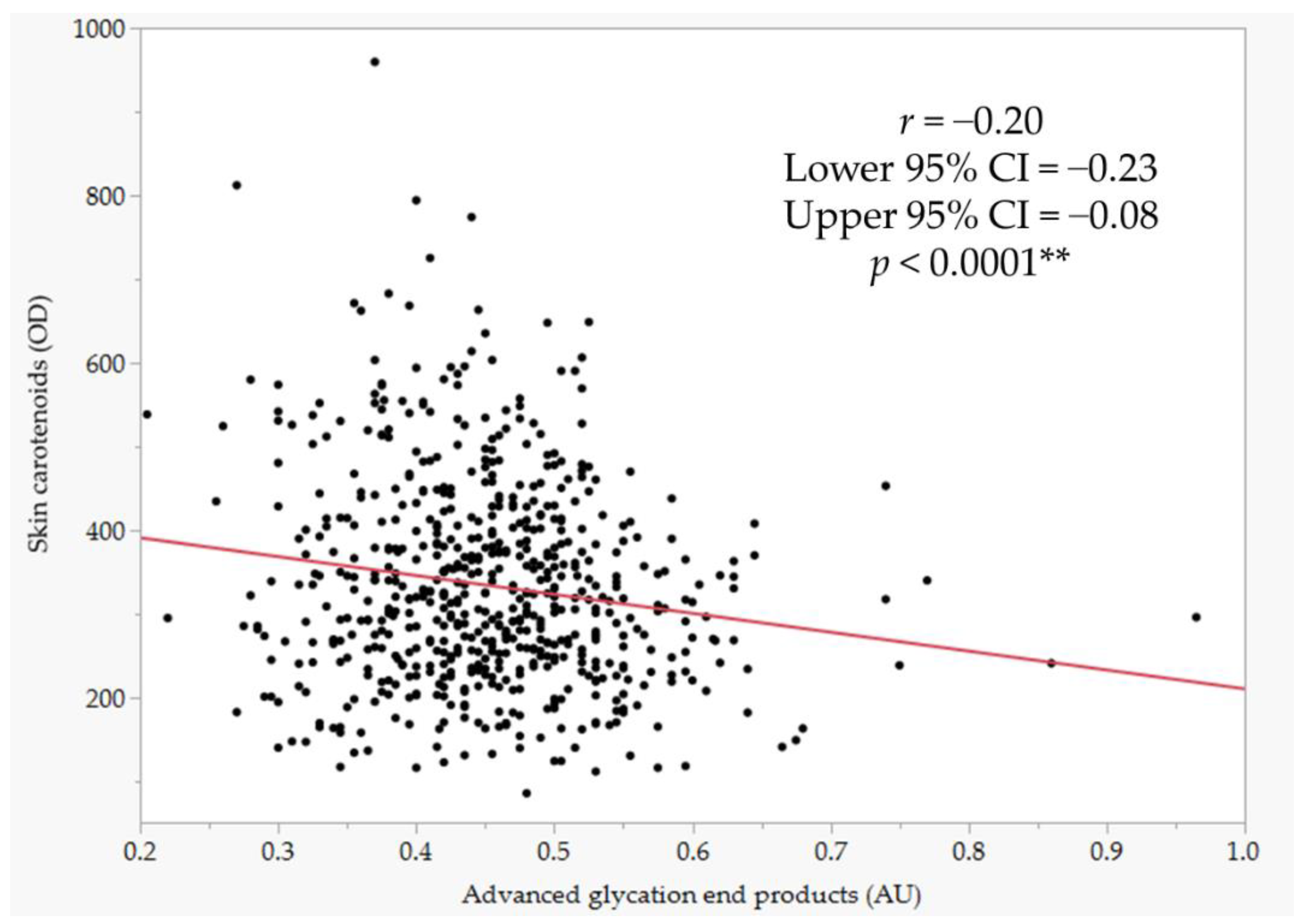
Carotenoids have antioxidant properties, and the accumulation of advanced glycation end products (AGEs) is associated with reactive oxygen species production; they have attracted attention as factors predictive of the onset and progression in glaucoma. Fingertip measurement is applicable for carotenoids and AGEs due to its noninvasiveness and simplicity. The study included 663 eyes of 663 Japanese subjects (357 males, 306 females). The mean age was 69.9 years with a standard deviation of 11.0. The study population comprised participants with primary open-angle glaucoma (PG) (n = 358), exfoliation glaucoma (EG) (n = 168), and controls (n = 137). Multivariate models suggested that lower skin carotenoid (SC) levels were associated with male gender (standard β = −0.14), AGE scores (−0.24), and a history of intraocular surgery (−0.22). Higher SC levels were associated with higher vegetable intake scores (0.21 for score 3) and diabetes (0.10). However, no association was seen between SCs and glaucoma type. AGEs levels were negatively associated with carotenoid scores (−0.25), PG (−0.15), and smoking habits (−0.26) and positively correlated with EG (0.14). SCs and AGEs were negatively correlated in the single regression analysis (r = −0.20, p < 0.0001). In conclusion, higher levels of AGEs may be candidates for systemic biomarkers of glaucoma associated with the exfoliation syndrome. SC levels can reflect self-reported daily vegetable intake.
Keywords: skin carotenoid; fingertip sensor; Veggie Meter; advanced glycation end products (AGEs); AGE sensor; reactive oxygen species; oxidative stress; antioxidants; primary open-angle glaucoma; exfoliation glaucoma skin carotenoid; fingertip sensor; Veggie Meter; advanced glycation end products (AGEs); AGE sensor; reactive oxygen species; oxidative stress; antioxidants; primary open-angle glaucoma; exfoliation glaucoma