

Deep Brain Stimulation—Possible Treatment Strategy for Pathologically Altered Body Weight?


Abstract
1. Introduction
2. Effects of DBS on Food Intake and Body Weight Gain
3. Potential Application of DBS in Obesity
4. Potential Application of DBS in Binge-Eating Disorder
5. Potential Application of DBS in Anorexia Nervosa
6. Challenges of DBS in the Treatment of Eating Disorders
7. Conclusions
Acknowledgments
Author Contributions
Conflicts of Interest
References
- Ng, M.; Fleming, T.; Robinson, M.; Thomson, B.; Graetz, N.; Margono, C.; Mullany, E.C.; Biryukov, S.; Abbafati, C.; Abera, S.F.; et al. Global, regional, and national prevalence of overweight and obesity in children and adults during 1980–2013: A systematic analysis for the global burden of disease study 2013. Lancet 2014, 384, 766–781. [Google Scholar] [CrossRef] [Scilit]
- James, P.T.; Leach, R.; Kalamara, E.; Shayeghi, M. The worldwide obesity epidemic. Obes. Res. 2001, 9 (Suppl. 4), 228S–233S. [Google Scholar] [CrossRef] [Scilit] [PubMed]
- Lopresti, A.L.; Drummond, P.D. Obesity and psychiatric disorders: Commonalities in dysregulated biological pathways and their implications for treatment. Prog. Neuropsychopharmacol. Biol. Psychiatry 2013, 45, 92–99. [Google Scholar] [CrossRef] [Scilit] [PubMed]
- Yoshimoto, S.; Loo, T.M.; Atarashi, K.; Kanda, H.; Sato, S.; Oyadomari, S.; Iwakura, Y.; Oshima, K.; Morita, H.; Hattori, M.; et al. Obesity-induced gut microbial metabolite promotes liver cancer through senescence secretome. Nature 2013, 499, 97–101. [Google Scholar] [CrossRef] [Scilit] [PubMed]
- Wyatt, H.R. Update on treatment strategies for obesity. J. Clin. Endocrinol. Metab. 2013, 98, 1299–1306. [Google Scholar] [CrossRef] [Scilit] [PubMed]
- Valsamakis, G.; Konstantakou, P.; Mastorakos, G. New targets for drug treatment of obesity. Annu. Rev. Pharmacol. Toxicol. 2017, 57, 585–605. [Google Scholar] [CrossRef] [Scilit] [PubMed]
- Schauer, P.R.; Bhatt, D.L.; Kirwan, J.P.; Wolski, K.; Aminian, A.; Brethauer, S.A.; Navaneethan, S.D.; Singh, R.P.; Pothier, C.E.; Nissen, S.E.; et al. Bariatric surgery versus intensive medical therapy for diabetes—5-year outcomes. N. Engl. J. Med. 2017, 376, 641–651. [Google Scholar] [CrossRef] [Scilit] [PubMed]
- Mustelin, L.; Bulik, C.M.; Kaprio, J.; Keski-Rahkonen, A. Prevalence and correlates of binge eating disorder related features in the community. Appetite 2017, 109, 165–171. [Google Scholar] [CrossRef] [Scilit] [PubMed]
- Hutson, P.H.; Balodis, I.M.; Potenza, M.N. Binge-eating disorder: Clinical and therapeutic advances. Pharmacol. Ther. 2017. [CrossRef] [Scilit] [PubMed]
- Treasure, J.; Zipfel, S.; Micali, N.; Wade, T.; Stice, E.; Claudino, A.; Schmidt, U.; Frank, G.K.; Bulik, C.M.; Wentz, E. Anorexia nervosa. Nat. Rev. Dis. Prim. 2015, 1, 15074. [Google Scholar] [CrossRef] [Scilit] [PubMed]
- American Psychiatric Association. Diagnostic and Statistical Manual of Mental Disorders, 5th ed.; American Psychiatric Association Publishing: Arlington, VA, USA, 2013. [Google Scholar]
- Zipfel, S.; Wild, B.; Gross, G.; Friederich, H.C.; Teufel, M.; Schellberg, D.; Giel, K.E.; de Zwaan, M.; Dinkel, A.; Herpertz, S.; et al. Focal psychodynamic therapy, cognitive behaviour therapy, and optimised treatment as usual in outpatients with anorexia nervosa (ANTOP study): Randomised controlled trial. Lancet 2014, 383, 127–137. [Google Scholar] [CrossRef] [Scilit]
- Nagl, M.; Jacobi, C.; Paul, M.; Beesdo-Baum, K.; Hofler, M.; Lieb, R.; Wittchen, H.U. Prevalence, incidence, and natural course of anorexia and bulimia nervosa among adolescents and young adults. Eur. Child Adolesc. Psychiatry 2016, 25, 903–918. [Google Scholar] [CrossRef] [Scilit] [PubMed]
- Zipfel, S.; Giel, K.E.; Bulik, C.M.; Hay, P.; Schmidt, U. Anorexia nervosa: Aetiology, assessment, and treatment, Lancet. Psychiatry 2015, 2, 1099–1111. [Google Scholar] [CrossRef] [Scilit]
- Delgado, J.M.; Hamlin, H.; Chapman, W.P. Technique of intracranial electrode implacement for recording and stimulation and its possible therapeutic value in psychotic patients. Confin. Neurol. 1952, 12, 315–319. [Google Scholar] [CrossRef] [Scilit] [PubMed]
- Bekhtereva, N.P.; Grachev, K.V.; Orlova, A.N.; Iatsuksl. Utilization of multiple electrodes implanted in the subcortical structure of the human brain for the treatment of hyperkinesis. Zh. Nevropatol. Psikhiatr. Im. S. S. Korsakova 1963, 63, 3–8. [Google Scholar] [PubMed]
- Sem-Jacobsen, C.W. Depth electrographic stimulation and treatment of patients with Parkinson’s disease including neurosurgical technique. Acta Neurol. Scand. Suppl. 1965, 1 Pt 13, 365–377. [Google Scholar] [CrossRef] [Scilit]
- Hosobuchi, Y.; Adams, J.E.; Rutkin, B. Chronic thalamic stimulation for the control of facial anesthesia dolorosa. Arch Neurol. 1973, 29, 158–161. [Google Scholar] [CrossRef] [Scilit] [PubMed]
- Hassler, R.; Ore, G.D.; Bricolo, A.; Dieckmann, G.; Dolce, G. EEG and clinical arousal induced by bilateral long-term stimulation of pallidal systems in traumatic vigil coma. Electroencephalogr. Clin. Neurophysiol. 1969, 27, 689–690. [Google Scholar] [PubMed]
- Riklan, M.; Cullinan, T.; Shulman, M.; Cooper, I.S. A psychometric study of chronic cerebellar stimulation in man. Biol. Psychiatry 1976, 11, 543–574. [Google Scholar] [PubMed]
- Martinez-Ramirez, D.; Hu, W.; Bona, A.R.; Okun, M.S.; Shukla, A.W. Update on deep brain stimulation in Parkinson’s disease. Transl. Neurodegener. 2015, 4, 12. [Google Scholar] [CrossRef] [Scilit] [PubMed]
- Benabid, A.L.; Chabardes, S.; Mitrofanis, J.; Pollak, P. Deep brain stimulation of the subthalamic nucleus for the treatment of Parkinson’s disease. Lancet Neurol. 2009, 8, 67–81. [Google Scholar] [CrossRef] [Scilit]
- Odekerken, V.J.; Boel, J.A.; Schmand, B.A.; de Haan, R.J.; Figee, M.; van den Munckhof, P.; Schuurman, P.R.; de Bie, R.M.; NSTAPS Study Group. GPi vs. STN deep brain stimulation for Parkinson disease: Three-year follow-up. Neurology 2016, 86, 755–761. [Google Scholar] [CrossRef] [Scilit] [PubMed]
- Lizarraga, K.J.; Jagid, J.R.; Luca, C.C. Comparative effects of unilateral and bilateral subthalamic nucleus deep brain stimulation on gait kinematics in Parkinson’s disease: A randomized, blinded study. J. Neurol. 2016, 263, 1652–1656. [Google Scholar] [CrossRef] [Scilit] [PubMed]
- Martinez-Fernandez, R.; Zrinzo, L.; Aviles-Olmos, I.; Hariz, M.; Martinez-Torres, I.; Joyce, E.; Jahanshahi, M.; Limousin, P.; Foltynie, T. Deep brain stimulation for Gilles de la Tourette syndrome: A case series targeting subregions of the globus pallidus internus. Mov. Disord. 2011, 26, 1922–1930. [Google Scholar] [CrossRef] [Scilit] [PubMed]
- Huys, D.; Bartsch, C.; Koester, P.; Lenartz, D.; Maarouf, M.; Daumann, J.; Mai, J.K.; Klosterkotter, J.; Hunsche, S.; Visser-Vandewalle, V.; et al. Motor improvement and emotional stabilization in patients with Tourette syndrome after deep brain stimulation of the ventral anterior and ventrolateral motor part of the thalamus. Biol. Psychiatry 2016, 79, 392–401. [Google Scholar] [CrossRef] [Scilit] [PubMed]
- Lega, B.C.; Halpern, C.H.; Jaggi, J.L.; Baltuch, G.H. Deep brain stimulation in the treatment of refractory epilepsy: Update on current data and future directions. Neurobiol. Dis. 2010, 38, 354–360. [Google Scholar] [CrossRef] [Scilit] [PubMed]
- Salanova, V.; Witt, T.; Worth, R.; Henry, T.R.; Gross, R.E.; Nazzaro, J.M.; Labar, D.; Sperling, M.R.; Sharan, A.; Sandok, E.; et al. Long-term efficacy and safety of thalamic stimulation for drug-resistant partial epilepsy. Neurology 2015, 84, 1017–1025. [Google Scholar] [CrossRef] [Scilit] [PubMed]
- Schlaepfer, T.E.; Cohen, M.X.; Frick, C.; Kosel, M.; Brodesser, D.; Axmacher, N.; Joe, A.Y.; Kreft, M.; Lenartz, D.; Sturm, V. Deep brain stimulation to reward circuitry alleviates anhedonia in refractory major depression. Neuropsychopharmacology 2008, 33, 368–377. [Google Scholar] [CrossRef] [Scilit] [PubMed]
- Bergfeld, I.O.; Mantione, M.; Hoogendoorn, M.L.; Ruhe, H.G.; Notten, P.; van Laarhoven, J.; Visser, I.; Figee, M.; de Kwaasteniet, B.P.; Horst, F.; et al. Deep brain stimulation of the ventral anterior limb of the internal capsule for treatment-resistant depression: A randomized clinical trial. JAMA Psychiatry 2016, 73, 456–464. [Google Scholar] [CrossRef] [Scilit] [PubMed]
- Whiting, D.M.; Tomycz, N.D.; Bailes, J.; de Jonge, L.; Lecoultre, V.; Wilent, B.; Alcindor, D.; Prostko, E.R.; Cheng, B.C.; Angle, C.; et al. Lateral hypothalamic area deep brain stimulation for refractory obesity: A pilot study with preliminary data on safety, body weight, and energy metabolism. J. Neurosurg. 2013, 119, 56–63. [Google Scholar] [CrossRef] [Scilit] [PubMed]
- Hamani, C.; McAndrews, M.P.; Cohn, M.; Oh, M.; Zumsteg, D.; Shapiro, C.M.; Wennberg, R.A.; Lozano, A.M. Memory enhancement induced by hypothalamic/fornix deep brain stimulation. Ann. Neurol. 2008, 63, 119–123. [Google Scholar] [CrossRef] [Scilit] [PubMed]
- Lipsman, N.; Lam, E.; Volpini, M.; Sutandar, K.; Twose, R.; Giacobbe, P.; Sodums, D.J.; Smith, G.S.; Woodside, D.B.; Lozano, A.M. Deep brain stimulation of the subcallosal cingulate for treatment-refractory anorexia nervosa: 1 year follow-up of an open-label trial. Lancet Psychiatry 2017, 4, 285–294. [Google Scholar] [CrossRef] [Scilit]
- Prinz, P.; Kobelt, P.; Scharner, S.; Goebel-Stengel, M.; Harnack, D.; Faust, K.; Winter, Y.; Rose, M.; Stengel, A. Deep brain stimulation alters light phase food intake microstructure in rats. J. Physiol. Pharmacol. 2017, 68, 345–354. [Google Scholar] [PubMed]
- Zhang, C.; Wei, N.L.; Wang, Y.; Wang, X.; Zhang, J.G.; Zhang, K. Deep brain stimulation of the nucleus accumbens shell induces anti-obesity effects in obese rats with alteration of dopamine neurotransmission. Neurosci. Lett. 2015, 589, 1–6. [Google Scholar] [CrossRef] [Scilit] [PubMed]
- van der Plasse, G.; Schrama, R.; van Seters, S.P.; Vanderschuren, L.J.; Westenberg, H.G. Deep brain stimulation reveals a dissociation of consummatory and motivated behaviour in the medial and lateral nucleus accumbens shell of the rat. PLoS ONE 2012, 7, e33455. [Google Scholar] [CrossRef] [Scilit] [PubMed]
- Soto-Montenegro, M.L.; Pascau, J.; Desco, M. Response to deep brain stimulation in the lateral hypothalamic area in a rat model of obesity: In vivo assessment of brain glucose metabolism. Mol. Imaging Biol. 2014, 16, 830–837. [Google Scholar] [CrossRef] [Scilit] [PubMed]
- Lehmkuhle, M.J.; Mayes, S.M.; Kipke, D.R. Unilateral neuromodulation of the ventromedial hypothalamus of the rat through deep brain stimulation. J. Neural Eng. 2010, 7, 036006. [Google Scholar] [CrossRef] [Scilit] [PubMed]
- Melega, W.P.; Lacan, G.; Gorgulho, A.A.; Behnke, E.J.; de Salles, A.A. Hypothalamic deep brain stimulation reduces weight gain in an obesity-animal model. PLoS ONE 2012, 7, e30672. [Google Scholar] [CrossRef] [Scilit] [PubMed]
- Lacan, G.; de Salles, A.A.; Gorgulho, A.A.; Krahl, S.E.; Frighetto, L.; Behnke, E.J.; Melega, W.P. Modulation of food intake following deep brain stimulation of the ventromedial hypothalamus in the vervet monkey. Laboratory investigation. J. Neurosurg. 2008, 108, 336–342. [Google Scholar] [PubMed]
- Lipsman, N.; Woodside, D.B.; Giacobbe, P.; Hamani, C.; Carter, J.C.; Norwood, S.J.; Sutandar, K.; Staab, R.; Elias, G.; Lyman, C.H.; et al. Subcallosal cingulate deep brain stimulation for treatment-refractory anorexia nervosa: A phase 1 pilot trial. Lancet 2013, 381, 1361–1370. [Google Scholar] [CrossRef] [Scilit]
- Prinz, P.; Stengel, A. Control of food intake by gastrointestinal peptides: Mechanisms of action and possible modulation in the treatment of obesity. J. Neurogastroenterol. Motil. 2017, 23, 180–196. [Google Scholar] [CrossRef] [Scilit] [PubMed]
- Sauleau, P.; Drapier, S.; Duprez, J.; Houvenaghel, J.F.; Dondaine, T.; Haegelen, C.; Drapier, D.; Jannin, P.; Robert, G.; Le Jeune, F.; et al. Weight gain following pallidal deep brain stimulation: A PET study. PLoS ONE 2016, 11, e0153438. [Google Scholar] [CrossRef] [Scilit] [PubMed]
- Aiello, M.; Eleopra, R.; Foroni, F.; Rinaldo, S.; Rumiati, R.I. Weight gain after STN-DBS: The role of reward sensitivity and impulsivity. Cortex 2017, 92, 150–161. [Google Scholar] [CrossRef] [Scilit] [PubMed]
- Millan, S.H.; Hacker, M.L.; Turchan, M.; Molinari, A.L.; Currie, A.D.; Charles, D. Subthalamic nucleus deep brain stimulation in early stage Parkinson's disease is not associated with increased body mass index. Parkinsons Dis. 2017, 2017, 7163801. [Google Scholar] [CrossRef] [Scilit] [PubMed]
- Melse, M.; Temel, Y.; Tan, S.K.; Jahanshahi, A. Deep brain stimulation of the rostromedial tegmental nucleus: An unanticipated, selective effect on food intake. Brain Res. Bull. 2016, 127, 23–28. [Google Scholar] [CrossRef] [Scilit] [PubMed]
- Kelley, A.E.; Swanson, C.J. Feeding induced by blockade of AMPA and kainate receptors within the ventral striatum: A microinfusion mapping study. Behav. Brain Res. 1997, 89, 107–113. [Google Scholar] [CrossRef] [Scilit]
- Rosenwasser, A.M.; Boulos, Z.; Terman, M. Circadian organization of food intake and meal patterns in the rat. Physiol. Behav. 1981, 27, 33–39. [Google Scholar] [CrossRef] [Scilit]
- Lean, M.E.J.; Malkova, D. Altered gut and adipose tissue hormones in overweight and obese individuals: Cause or consequence? Int. J. Obes. 2016, 40, 622–632. [Google Scholar] [CrossRef] [Scilit] [PubMed]
- Halpern, C.H.; Tekriwal, A.; Santollo, J.; Keating, J.G.; Wolf, J.A.; Daniels, D.; Bale, T.L. Amelioration of binge eating by nucleus accumbens shell deep brain stimulation in mice involves D2 receptor modulation. J. Neurosci. 2013, 33, 7122–7129. [Google Scholar] [CrossRef] [Scilit] [PubMed]
- Dunn, J.P.; Cowan, R.L.; Volkow, N.D.; Feurer, I.D.; Li, R.; Williams, D.B.; Kessler, R.M.; Abumrad, N.N. Decreased dopamine type 2 receptor availability after bariatric surgery: Preliminary findings. Brain Res. 2010, 1350, 123–130. [Google Scholar] [CrossRef] [Scilit] [PubMed]
- Doucette, W.T.; Khokhar, J.Y.; Green, A.I. Nucleus accumbens deep brain stimulation in a rat model of binge eating. Transl. Psychiatry 2015, 5, e695. [Google Scholar] [CrossRef] [Scilit] [PubMed]
- Sani, S.; Jobe, K.; Smith, A.; Kordower, J.H.; Bakay, R.A. Deep brain stimulation for treatment of obesity in rats. J. Neurosurg. 2007, 107, 809–813. [Google Scholar] [CrossRef] [PubMed]
- Torres, N.; Chabardes, S.; Piallat, B.; Devergnas, A.; Benabid, A.L. Body fat and body weight reduction following hypothalamic deep brain stimulation in monkeys: An intraventricular approach. Int. J. Obes. 2012, 36, 1537–1544. [Google Scholar] [CrossRef] [Scilit] [PubMed]
- Brown, F.D.; Fessler, R.G.; Rachlin, J.R.; Mullan, S. Changes in food intake with electrical stimulation of the ventromedial hypothalamus in dogs. J. Neurosurg. 1984, 60, 1253–1257. [Google Scholar] [CrossRef] [Scilit] [PubMed]
- Ross, S.E.; Levin, E.L.; Itoga, C.A.; Schoen, C.B.; Selmane, R.; Aldridge, J.W. Deep brain stimulation in the central nucleus of the amygdala decreases ‘wanting’ and ‘liking’ of food rewards. Eur. J. Neurosci. 2016, 44, 2431–2445. [Google Scholar] [CrossRef] [Scilit] [PubMed]
- Mills, K.A.; Scherzer, R.; Starr, P.A.; Ostrem, J.L. Weight change after globus pallidus internus or subthalamic nucleus deep brain stimulation in Parkinson’s disease and dystonia. Stereotact. Funct. Neurosurg. 2012, 90, 386–393. [Google Scholar] [CrossRef] [Scilit] [PubMed]
- Barichella, M.; Marczewska, A.M.; Mariani, C.; Landi, A.; Vairo, A.; Pezzoli, G. Body weight gain rate in patients with Parkinson's disease and deep brain stimulation. Mov. Disord. 2003, 18, 1337–1340. [Google Scholar] [CrossRef] [Scilit] [PubMed]
- Novakova, L.; Ruzicka, E.; Jech, R.; Serranova, T.; Dusek, P.; Urgosik, D. Increase in body weight is a non-motor side effect of deep brain stimulation of the subthalamic nucleus in Parkinson’s disease. Neuro Endocrinol. Lett. 2007, 28, 21–25. [Google Scholar] [PubMed]
- Mantione, M.; van de Brink, W.; Schuurman, P.R.; Denys, D. Smoking cessation and weight loss after chronic deep brain stimulation of the nucleus accumbens: Therapeutic and research implications: Case report. Neurosurgery 2010, 66, E218. [Google Scholar] [CrossRef] [Scilit] [PubMed]
- Harat, M.; Rudas, M.; Zielinski, P.; Birska, J.; Sokal, P. Nucleus accumbens stimulation in pathological obesity. Neurol. Neurochir. Pol. 2016, 50, 207–210. [Google Scholar] [CrossRef] [Scilit] [PubMed]
- Israël, M.; Steiger, H.; Kolivakis, T.; McGregor, L.; Sadikot, A.F. Deep brain stimulation in the subgenual cingulate cortex for an intractable eating disorder. Biol. Psychiatry 2010, 67, e53–e54. [Google Scholar] [CrossRef] [Scilit] [PubMed]
- McLaughlin, N.C.; Didie, E.R.; Machado, A.G.; Haber, S.N.; Eskandar, E.N.; Greenberg, B.D. Improvements in anorexia symptoms after deep brain stimulation for intractable obsessive-compulsive disorder. Biol. Psychiatry 2013, 73, e29–e31. [Google Scholar] [CrossRef] [Scilit] [PubMed]
- Wu, H.; van Dyck-Lippens, P.J.; Santegoeds, R.; van Kuyck, K.; Gabriels, L.; Lin, G.; Pan, G.; Li, Y.; Li, D.; Zhan, S.; et al. Deep-brain stimulation for anorexia nervosa. World Neurosurg. 2013, 80, S29.e1–S29.e10. [Google Scholar] [CrossRef] [Scilit] [PubMed]
- Wang, J.; Chang, C.; Geng, N.; Wang, X.; Gao, G. Treatment of intractable anorexia nervosa with inactivation of the nucleus accumbens using stereotactic surgery. Stereotact. Funct. Neurosurg. 2013, 91, 364–372. [Google Scholar] [CrossRef] [Scilit] [PubMed]
- Blomstedt, P.; Naesström, M.; Bodlund, O. Deep brain stimulation in the bed nucleus of the stria terminalis and medial forebrain bundle in a patient with major depressive disorder and anorexia nervosa. Clin. Case Rep. 2017, 5, 679–684. [Google Scholar] [CrossRef] [Scilit] [PubMed]
- Moro, E.; Scerrati, M.; Romito, L.M.; Roselli, R.; Tonali, P.; Albanese, A. Chronic subthalamic nucleus stimulation reduces medication requirements in Parkinson’s disease. Neurology 1999, 53, 85–90. [Google Scholar] [CrossRef] [Scilit] [PubMed]
- Routtenberg, A.; Kuznesof, A.W. Self-starvation of rats living in activity wheels on a restricted feeding schedule. J. Comp. Physiol. Psychol. 1967, 64, 414–421. [Google Scholar] [CrossRef] [Scilit] [PubMed]
- Dietz, J.; Noecker, A.M.; McIntyre, C.C.; Mikos, A.; Bowers, D.; Foote, K.D.; Okun, M.S. Stimulation region within the globus pallidus does not affect verbal fluency performance. Brain Stimul. 2013, 6, 248–253. [Google Scholar] [CrossRef] [Scilit] [PubMed]
- Liu, Y.; Li, W.; Tan, C.; Liu, X.; Wang, X.; Gui, Y.; Qin, L.; Deng, F.; Hu, C.; Chen, L. Meta-analysis comparing deep brain stimulation of the globus pallidus and subthalamic nucleus to treat advanced Parkinson disease. J. Neurosurg. 2014, 121, 709–718. [Google Scholar] [CrossRef] [Scilit] [PubMed]
- Combs, H.L.; Folley, B.S.; Berry, D.T.; Segerstrom, S.C.; Han, D.Y.; Anderson-Mooney, A.J.; Walls, B.D.; van Horne, C. Cognition and depression following deep brain stimulation of the subthalamic nucleus and globus pallidus pars internus in Parkinson’s disease: A meta-analysis. Neuropsychol. Rev. 2015, 25, 439–454. [Google Scholar] [CrossRef] [Scilit] [PubMed]
- Okun, M.S.; Fernandez, H.H.; Wu, S.S.; Kirsch-Darrow, L.; Bowers, D.; Bova, F.; Suelter, M.; Jacobson, C.E.T.; Wang, X.; Gordon, C.W., Jr.; et al. Cognition and mood in Parkinson’s disease in subthalamic nucleus versus globus pallidus interna deep brain stimulation: The COMPARE trial. Ann. Neurol. 2009, 65, 586–595. [Google Scholar] [CrossRef] [Scilit] [PubMed]
- Groiss, S.J.; Wojtecki, L.; Sudmeyer, M.; Schnitzler, A. Deep brain stimulation in Parkinson’s disease. Ther. Adv. Neurol. Disord. 2009, 2, 20–28. [Google Scholar] [CrossRef] [Scilit] [PubMed]
- Péron, J.; Fruhholz, S.; Verin, M.; Grandjean, D. Subthalamic nucleus: A key structure for emotional component synchronization in humans. Neurosci. Biobehav. Rev. 2013, 37, 358–373. [Google Scholar] [CrossRef] [Scilit] [PubMed]
- Smeding, H.M.; Speelman, J.D.; Koning-Haanstra, M.; Schuurman, P.R.; Nijssen, P.; van Laar, T.; Schmand, B. Neuropsychological effects of bilateral STN stimulation in Parkinson disease: A controlled study. Neurology 2006, 66, 1830–1836. [Google Scholar] [CrossRef] [Scilit] [PubMed]
- Voon, V.; Krack, P.; Lang, A.E.; Lozano, A.M.; Dujardin, K.; Schupbach, M.; D’Ambrosia, J.; Thobois, S.; Tamma, F.; Herzog, J.; et al. A multicentre study on suicide outcomes following subthalamic stimulation for Parkinson’s disease. Brain 2008, 131 Pt 10, 2720–2728. [Google Scholar] [CrossRef] [Scilit]
- Julien, C.L.; Rimes, K.A.; Brown, R.G. Rumination and behavioural factors in Parkinson’s disease depression. J. Psychosom. Res. 2016, 82, 48–53. [Google Scholar] [CrossRef] [Scilit] [PubMed]
- Volkow, N.D.; Wang, G.J.; Baler, R.D. Reward, dopamine and the control of food intake: Implications for obesity. Trends Cogn. Sci. 2011, 15, 37–46. [Google Scholar] [CrossRef] [Scilit] [PubMed]
- Russo, S.J.; Nestler, E.J. The brain reward circuitry in mood disorders. Nat. Rev. Neurosci. 2013, 14, 609–625. [Google Scholar] [CrossRef] [Scilit] [PubMed]
- Ho, A.L.; Sussman, E.S.; Zhang, M.; Pendharkar, A.V.; Azagury, D.E.; Bohon, C.; Halpern, C.H. Deep brain stimulation for obesity. Cureus 2015, 7, e259. [Google Scholar] [CrossRef] [Scilit] [PubMed]
- Park, R.J.; Singh, I.; Pike, A.C.; Tan, J.O. Deep brain stimulation in anorexia nervosa: Hope for the hopeless or exploitation of the vulnerable? The Oxford neuroethics gold standard framework. Front. Psychiatry 2017, 8, 44. [Google Scholar] [CrossRef] [Scilit] [PubMed]
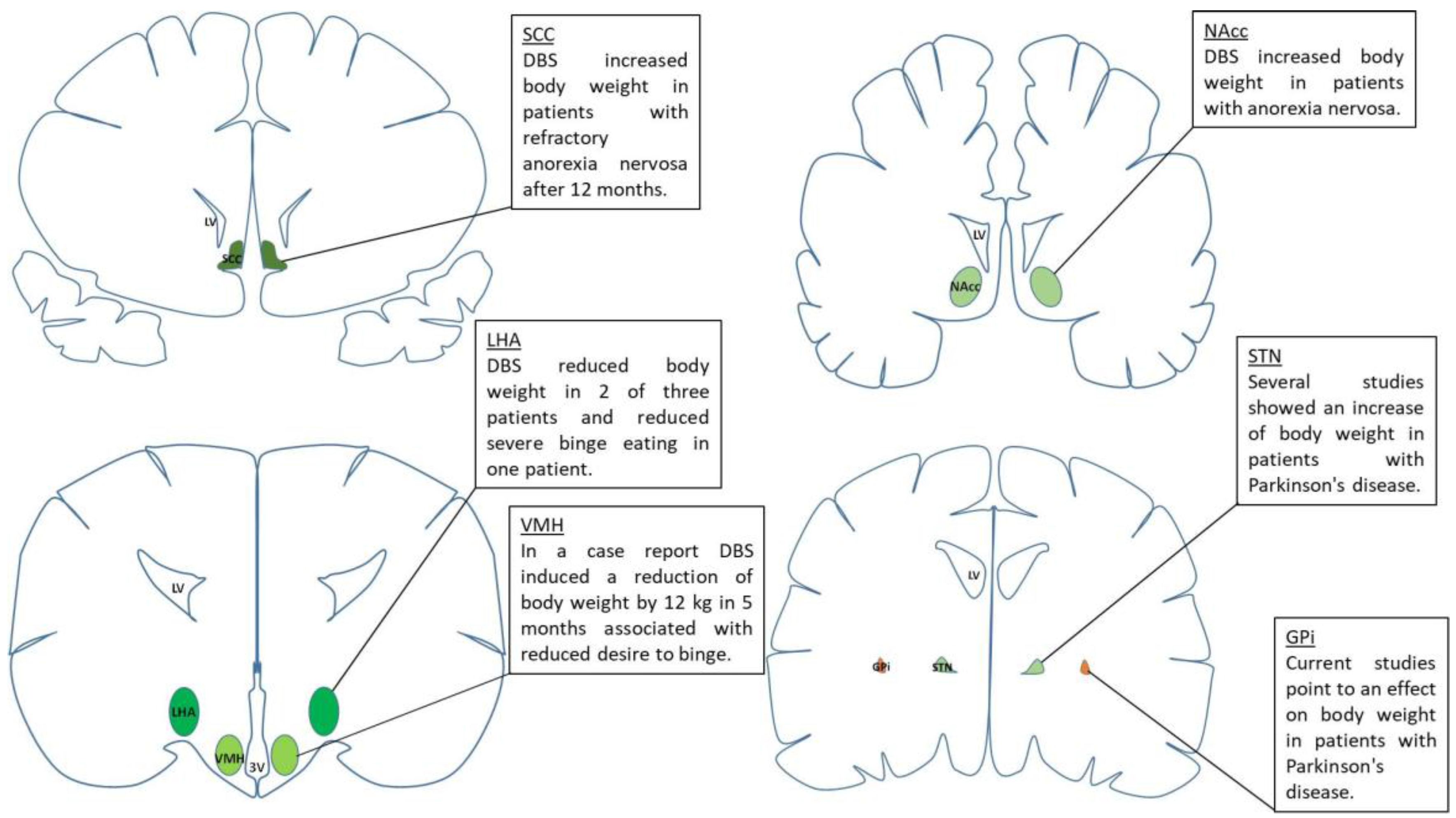

| Disease | Brain area | Mode | Species | Effect | Reference |
|---|---|---|---|---|---|
| Obesity | Nucleus accumbens shell | Unilateral, 160 Hz, 150 µA | Diet-induced obese mice | ↓ food intake; ↓ body weight | [50] |
| Nucleus accumbens shell | Unilateral, 130 Hz, 500 µA | Diet-induced obese rats | ↓ food intake; ↓ body weight | [35] | |
| Nucleus accumbens | Bilateral, 185 Hz, 3.5 V | Obese patient | ↓ body weight | [60] | |
| Nucleus accumbens | Bilateral, 130 Hz, 5 mA | Obese patient | ↓ body weight | [61] | |
| Lateral hypothalamus | Bilateral, 180-200 Hz, 2 V | Diet-induced obese rats | - food intake; ↓ body weight | [53] | |
| Lateral hypothalamus | Bilateral, 130 Hz, 300 µA | Obese Zucker rats | ↓ food intake; ↓ body weight | [37] | |
| Lateral hypothalamus | Bilateral, 185 Hz, 1–7 V | Obese patients | ↓ body weight | [31] | |
| Ventromedial hypothalamus | Unilateral, 150/500 Hz, 10 µA | Sprague-Dawley rats | ↓ body weight | [38] | |
| Ventromedial hypothalamus | Unilateral, 100 Hz | Dogs | ↓ food intake | [55] | |
| Ventromedial hypothalamus | Bilateral, 50 Hz, 0.5–1.5 mA | Göttingen minipigs | ↓ body weight | [39] | |
| Ventromedial hypothalamus | Unilateral, 80 Hz, 2V | Macaca fascicularis monkey | ↓ meal size; body weight; ↓ body fat | [54] | |
| Ventromedial hypothalamus | Bilateral, 50 Hz | Obese patient | - food intake; ↓ body weight | [32] | |
| Central nucleus of amygdala | Bilateral, 20/130 Hz, 125 µA | Sprague-Dawley rats | ↓ palatable food (sucrose) | [56] | |
| Rostromedial tegmental nucleus | Bilateral, 10 Hz, 20 µA | Sprague-Dawley rats | ↓ food intake | [46] | |
| Binge-eating disorder | Nucleus accumbens shell | Unilateral, 160 Hz, 150 µA | Mouse model of binge eating | ↓ binge eating | [50] |
| Nucleus accumbens core | Bilateral, 150 Hz, 150 µA | Rat model of binge eating | ↓ binge eating | [52] | |
| Lateral hypothalamus | Bilateral, 185 Hz, 1–7 V | Obese patients | ↓ severe binge eating | [31] | |
| Ventromedial hypothalamus | Bilateral, 50 Hz | Obese patient | ↓ tendency to binge | [32] | |
| Anorexia nervosa | Subcallosal cingulate | Bilateral, 130 Hz, 5–7 V | Anorexic patients | ↑ body weight | [33,41] |
| Subgenual cingulate cortex | Bilateral, 130 Hz, 5 mA | Anorexic patient | ↑ body weight | [62] | |
| Subgenual cingulate cortex | Bilateral, 120 Hz, 5 V | Underweight patient | ↑ body weight | [63] | |
| Nucleus accumbens | Bilateral, 180 Hz, 6 V | Anorexic patients | ↑ body weight | [64] | |
| Nucleus accumbens | Bilateral, 100 Hz, 6–8 V | Anorexic patients | ↑ body weight | [65] | |
| Bed nucleus of stria terminalis | Bilateral, 130 Hz, 4.3 V | Anorexic patient | - body weight, ↓ anxiety of food and eating | [66] | |
| Nucleus accumbens shell | Bilateral, 130 Hz, 100 µA | Sprague-Dawley rats | ↑ food intake (first hour) | [36] | |
| Nucleus accumbens shell | Bilateral, 130 Hz, 100 µA | Sprague-Dawley rats | - food intake; ↑body weight | [34] | |
| Internal globus pallidus | Bilateral, 130 Hz, 2.6 V | Patients with PD | ↑ body weight | [43] | |
| Ventromedial hypothalamus | Bilateral, 185 Hz, 2.5 -3.5 V | Vervet monkeys | ↑ food intake | [40] | |
| Subthalamic nucleus | Bilateral, 240 Hz, 2.4 mA | Patients with PD | ↑ high caloric and tasty food, ↑ body weight | [44] | |
| Subthalamic nucleus | Bilateral, 185 Hz, 2.9 V | Patients with PD | ↑ body weight, ↑ appetite | [67] | |
| Subthalamic nucleus | Not mentioned | Patients with PD | ↑ body weight | [57,58,59] |
© 2018 by the authors. Licensee MDPI, Basel, Switzerland. This article is an open access article distributed under the terms and conditions of the Creative Commons Attribution (CC BY) license (http://creativecommons.org/licenses/by/4.0/).
Share and Cite
Prinz, P.; Stengel, A. Deep Brain Stimulation—Possible Treatment Strategy for Pathologically Altered Body Weight? Brain Sci. 2018, 8, 19. https://doi.org/10.3390/brainsci8010019
Prinz P, Stengel A. Deep Brain Stimulation—Possible Treatment Strategy for Pathologically Altered Body Weight? Brain Sciences. 2018; 8(1):19. https://doi.org/10.3390/brainsci8010019
Chicago/Turabian StylePrinz, Philip, and Andreas Stengel. 2018. "Deep Brain Stimulation—Possible Treatment Strategy for Pathologically Altered Body Weight?" Brain Sciences 8, no. 1: 19. https://doi.org/10.3390/brainsci8010019
APA StylePrinz, P., & Stengel, A. (2018). Deep Brain Stimulation—Possible Treatment Strategy for Pathologically Altered Body Weight? Brain Sciences, 8(1), 19. https://doi.org/10.3390/brainsci8010019

