Theta and Alpha Oscillations Reflect Distinct Control and Stabilization Processes Across Working Memory
 , , ,
, , , 

Highlights

- During the retrieval, where the participants responded to the probe, theta power was higher than in earlier working memory stages.

- Upper alpha power was associated with increased probability of correct responses, highlighting the role of specific oscillatory activity in performance.
- Theta oscillations may index the coordination of processes involved in task responses, such as accessing stored information and decision-making.
- Upper alpha activity may support performance in demanding cognitive tasks.
Abstract
1. Introduction
2. Materials and Methods
2.1. Participants
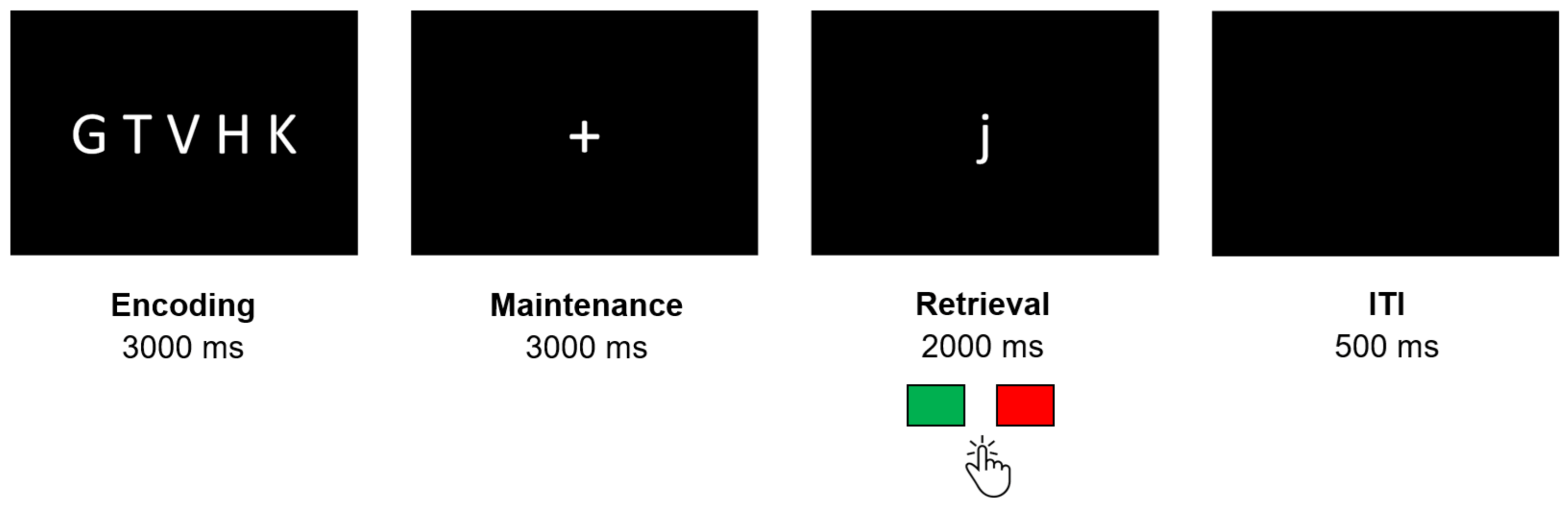
2.2. Sternberg Item Recognition Task
2.3. EEG Recording and Processing
2.4. Analysis
3. Results
3.1. Behavioral Data
3.2. Electrophysiological Data
3.2.1. Theta
3.2.2. Lower Alpha
3.2.3. Upper Alpha
4. Discussion
4.1. Theta Oscillations and Retrieval-Related Processing
4.2. Alpha Oscillations and Maintenance-Related Stabilization
4.3. Functional Dissociation Between Theta and Alpha Oscillations
4.4. Limitations and Future Directions
Author Contributions
Funding
Institutional Review Board Statement
Informed Consent Statement
Data Availability Statement
Conflicts of Interest
References
- D’Esposito, M.; Postle, B.R. The cognitive neuroscience of working memory. Annu. Rev. Psychol. 2015, 66, 115–142. [Google Scholar] [CrossRef] [PubMed]
- Baddeley, A. Working memory: Theories, models, and controversies. Annu. Rev. Psychol. 2012, 63, 1–29. [Google Scholar] [CrossRef]
- Fuster, J.M. The prefrontal cortex: An update: Time is of the essence. Neuron 2001, 30, 319–333. [Google Scholar] [CrossRef]
- Stroud, J.P.; Duncan, J.; Lengyel, M. The computational foundations of dynamic coding in working memory. Trends Cogn. Sci. 2024, 28, 614–627. [Google Scholar] [CrossRef] [PubMed]
- Cowan, N.; Morey, C.C.; Naveh-Benjamin, M. An embedded-processes approach to working memory: How is it distinct from other approaches, and to what ends? In Working Memory: State of the Science; Logie, R.H., Camos, V., Cowan, N., Eds.; Oxford Academic: Oxford, UK, 2020; pp. 44–84. [Google Scholar]
- Sweller, J. Cognitive load during problem solving: Effects on learning. Cogn. Sci. 1988, 12, 257–285. [Google Scholar] [CrossRef]
- Miller, G.A. The magical number seven, plus or minus two: Some limits on our capacity for processing information. Psychol. Rev. 1956, 63, 81–97. [Google Scholar] [CrossRef]
- Lavie, N. Distracted and confused?: Selective attention under load. Trends Cogn. Sci. 2005, 9, 75–82. [Google Scholar] [CrossRef]
- Brockhoff, L.; Schindlevr, S.; Bruchmann, M.; Straube, T. Effects of perceptual and working memory load on brain responses to task-irrelevant stimuli: Review and implications for future research. Neurosci. Biobehav. Rev. 2022, 135, 104580. [Google Scholar] [CrossRef] [PubMed]
- Murphy, G.; Groeger, J.A.; Greene, C.M. Twenty years of load theory—Where are we now, and where should we go next? Psychon. Bull. Rev. 2016, 23, 1316–1340. [Google Scholar] [CrossRef]
- Nee, D.E.; D’Esposito, M. The representational basis of working memory. Curr. Top. Behav. Neurosci. 2018, 37, 213–230. [Google Scholar]
- Pavlov, Y.G.; Kotchoubey, B. Oscillatory brain activity and maintenance of verbal and visual working memory: A systematic review. Psychophysiology 2022, 59, e13735. [Google Scholar] [CrossRef] [PubMed]
- Howard, M.W.; Rizzuto, D.S.; Caplan, J.B.; Madsen, J.R.; Lisman, J.; Aschenbrenner-Scheibe, R.; Schulze-Bonhage, A.; Kahana, M.J. Gamma oscillations correlate with working memory load in humans. Cereb. Cortex 2003, 13, 1369–1374. [Google Scholar] [CrossRef]
- Klimesch, W. EEG alpha and theta oscillations reflect cognitive and memory performance: A review and analysis. Brain Res. Rev. 1999, 29, 169–195. [Google Scholar] [CrossRef]
- Sauseng, P.; Griesmayr, B.; Freunberger, R.; Klimesch, W. Control mechanisms in working memory: A possible function of EEG theta oscillations. Neurosci. Biobehav. Rev. 2010, 34, 1015–1022. [Google Scholar] [CrossRef]
- Klimesch, W.; Schack, B.; Sauseng, P. The functional significance of theta and upper alpha oscillations. Exp. Psychol. 2005, 52, 99–108. [Google Scholar] [CrossRef]
- Tsoneva, T.; Baldo, D.; Lema, V.; Garcia-Molina, G. EEG-rhythm dynamics during a 2-back working memory task and performance. Annu. Int. Conf. IEEE Eng. Med. Biol. Soc. 2011, 2011, 3828–3831. [Google Scholar] [PubMed]
- Jaiswal, N.; Ray, W.; Slobounov, S. Encoding of visual-spatial information in working memory requires more cerebral efforts than retrieval: Evidence from an EEG and virtual reality study. Brain Res. 2010, 1347, 80–89. [Google Scholar] [CrossRef] [PubMed]
- Chen, Y.G.; Chen, X.; Kuang, C.W.; Huang, X.T. Neural oscillatory correlates of duration maintenance in working memory. Neuroscience 2015, 290, 389–397. [Google Scholar] [CrossRef] [PubMed]
- Grissmann, S.; Faller, J.; Scharinger, C.; Spüler, M.; Gerjets, P. Electroencephalography based analysis of working memory load and affective valence in an n-back task with emotional stimuli. Front. Hum. Neurosci. 2017, 11, 616. [Google Scholar] [CrossRef]
- Brzezicka, A.; Kamiński, J.; Reed, C.M.; Chung, J.M.; Mamelak, A.N.; Rutishauser, U. Working memory load-related theta power decreases in dorsolateral prefrontal cortex predict individual differences in performance. J. Cogn. Neurosci. 2019, 31, 1290–1307. [Google Scholar] [CrossRef]
- Brouwer, A.M.; Hogervorst, M.A.; van Erp, J.B.; Heffelaar, T.; Zimmerman, P.H.; Oostenveld, R. Estimating workload using EEG spectral power and ERPs in the n-back task. J. Neural Eng. 2012, 9, 045008. [Google Scholar] [CrossRef]
- Nenert, R.; Viswanathan, S.; Dubuc, D.M.; Visscher, K.M. Modulations of ongoing alpha oscillations predict successful short-term visual memory encoding. Front. Hum. Neurosci. 2012, 6, 127. [Google Scholar] [CrossRef]
- Sauseng, P.; Klimesch, W.; Doppelmayr, M.; Pecherstorfer, T.; Freunberger, R.; Hanslmayr, S. EEG alpha synchronization and functional coupling during top-down processing in a working memory task. Hum. Brain Mapp. 2005, 26, 148–155. [Google Scholar] [CrossRef]
- Klimesch, W.; Doppelmayr, M.; Röhm, D.; Pöllhuber, D.; Stadler, W. Simultaneous desynchronization and synchronization of different alpha responses in the human electroencephalograph: A neglected paradox? Neurosci. Lett. 2000, 284, 97–100. [Google Scholar] [CrossRef]
- Fink, A.; Benedek, M. EEG alpha power and creative ideation. Neurosci. Biobehav. Rev. 2014, 44, 111–123. [Google Scholar] [CrossRef] [PubMed]
- Jensen, O.; Gelfand, J.; Kounios, J.; Lisman, J.E. Oscillations in the alpha band (9–12 Hz) increase with memory load during retention in a short-term memory task. Cereb. Cortex 2002, 12, 877–882. [Google Scholar] [CrossRef] [PubMed]
- Owen, A.M.; McMillan, K.M.; Laird, A.R.; Bullmore, E. N-back working memory paradigm: A meta-analysis of normative functional neuroimaging studies. Hum. Brain Mapp. 2005, 25, 46–59. [Google Scholar] [CrossRef] [PubMed]
- Jaeggi, S.M.; Buschkuehl, M.; Perrig, W.J.; Meier, B. The concurrent validity of the N-back task as a working memory measure. Memory 2010, 18, 394–412. [Google Scholar] [CrossRef]
- Delorme, A.; Makeig, S. EEGLAB: An open source toolbox for analysis of single-trial EEG dynamics including independent component analysis. J. Neurosci. Methods 2004, 134, 9–21. [Google Scholar] [CrossRef]
- Winkler, I.; Debener, S.; Müller, K.R.; Tangermann, M. On the influence of high-pass filtering on ICA-based artifact reduction in EEG-ERP. Annu. Int. Conf. IEEE Eng. Med. Biol. Soc. 2015, 2015, 4101–4105. [Google Scholar]
- Eriksson, J.; Vogel, E.K.; Lansner, A.; Bergström, F.; Nyberg, L. Neurocognitive architecture of working memory. Neuron 2015, 88, 33–46. [Google Scholar] [CrossRef]
- Mitchell, D.J.; McNaughton, N.; Flanagan, D.; Kirk, I.J. Frontal-midline theta from the perspective of hippocampal “theta”. Prog. Neurobiol. 2008, 86, 156–185. [Google Scholar] [CrossRef]
- Cavanagh, J.F.; Zambrano-Vazquez, L.; Allen, J.J.B. Theta lingua franca: A common mid-frontal substrate for action monitoring processes. Psychophysiology 2012, 49, 220–238. [Google Scholar] [CrossRef]
- Hsieh, L.T.; Ekstrom, A.D.; Ranganath, C. Neural oscillations associated with item and temporal order maintenance in working memory. J. Neurosci. 2011, 31, 10803–10810. [Google Scholar] [CrossRef] [PubMed]
- Onton, J.; Delorme, A.; Makeig, S. Frontal midline EEG dynamics during working memory. Neuroimage 2005, 27, 341–356. [Google Scholar] [CrossRef]
- Cavanagh, J.F.; Frank, M.J. Frontal theta as a mechanism for cognitive control. Trends Cogn. Sci. 2014, 18, 414–421. [Google Scholar] [CrossRef]
- Cohen, M.X. A neural microcircuit for cognitive conflict detection and signaling. Trends Neurosci. 2014, 37, 480–490. [Google Scholar] [CrossRef] [PubMed]
- Körmendi, J.; Ferentzi, E.; Weiss, B.; Nagy, Z. Topography of movement-related delta and theta brain oscillations. Brain Topogr. 2021, 34, 608–617. [Google Scholar] [CrossRef]
- Gevins, A.; Smith, M.E.; McEvoy, L.; Yu, D. High-resolution EEG mapping of cortical activation related to working memory: Effects of task difficulty, type of processing, and practice. Cereb. Cortex 1997, 7, 374–385. [Google Scholar] [CrossRef]
- Jensen, O.; Tesche, C.D. Frontal theta activity in humans increases with memory load in a working memory task. Eur. J. Neurosci. 2002, 15, 1395–1399. [Google Scholar] [CrossRef] [PubMed]
- Zakrzewska, M.Z.; Brzezicka, A. Working memory capacity as a moderator of load-related frontal midline theta variability in Sternberg task. Front. Hum. Neurosci. 2014, 8, 399. [Google Scholar] [CrossRef] [PubMed]
- Raghavachari, S.; Lisman, J.E.; Tully, M.; Madsen, J.R.; Bromfield, E.B.; Kahana, M.J. Theta oscillations in human cortex during a working-memory task: Evidence for local generators. J. Neurophysiol. 2006, 95, 1630–1638. [Google Scholar] [CrossRef] [PubMed]
- Hsieh, L.T.; Ranganath, C. Frontal midline theta oscillations during working memory maintenance and episodic encoding and retrieval. Neuroimage 2014, 85, 721–729. [Google Scholar] [CrossRef]
- Herweg, N.A.; Solomon, E.A.; Kahana, M.J. Theta oscillations in human memory. Trends Cogn. Sci. 2020, 24, 208–227. [Google Scholar] [CrossRef] [PubMed]
- Tuladhar, A.M.; ter Huurne, N.; Schoffelen, J.M.; Maris, E.; Oostenveld, R.; Jensen, O. Parieto-occipital sources account for the increase in alpha activity with working memory load. Hum. Brain Mapp. 2007, 28, 785–792. [Google Scholar] [CrossRef]
- Jensen, O.; Mazaheri, A. Shaping functional architecture by oscillatory alpha activity: Gating by inhibition. Front. Hum. Neurosci. 2010, 4, 186. [Google Scholar] [CrossRef]
- Foxe, J.J.; Snyder, A.C. The role of alpha-band brain oscillations as a sensory suppression mechanism during selective attention. Front. Psychol. 2011, 2, 154. [Google Scholar] [CrossRef]
- Klimesch, W.; Doppelmayr, M.; Schimke, H.; Ripper, B. Theta synchronization and alpha desynchronization in a memory task. Psychophysiology 1997, 34, 169–176. [Google Scholar] [CrossRef]
- Doppelmayr, M.; Klimesch, W.; Stadler, W.; Pöllhuber, D.; Heine, C. EEG alpha power and intelligence. Intelligence 2002, 30, 289–302. [Google Scholar] [CrossRef]
- Fink, A.; Neubauer, A.C. EEG alpha oscillations during the performance of verbal creativity tasks: Differential effects of sex and verbal intelligence. Int. J. Psychophysiol. 2006, 62, 46–53. [Google Scholar] [CrossRef]
- Proskovec, A.L.; Heinrichs-Graham, E.; Wilson, T.W. Load modulates the alpha and beta oscillatory dynamics serving verbal working memory. Neuroimage 2019, 184, 256–265. [Google Scholar] [CrossRef]
- Kriegeskorte, N.; Simmons, W.K.; Bellgowan, P.S.F.; Baker, C.I. Circular analysis in systems neuroscience: The dangers of double dipping. Nat. Neurosci. 2009, 12, 535–540. [Google Scholar] [CrossRef]
- Vul, E.; Harris, C.; Winkielman, P.; Pashler, H. Puzzlingly high correlations in fMRI studies of emotion, personality, and social cognition. Perspect. Psychol. Sci. 2009, 4, 274–290. [Google Scholar] [CrossRef]
- Poldrack, R.A.; Mumford, J.A.; Nichols, T.E. Handbook of Functional MRI Data Analysis; Cambridge University Press: Cambridge, UK, 2011. [Google Scholar]



| Comparison | Memory Load | Direction of Effect | Main Topography | t-Sum | p | d |
|---|---|---|---|---|---|---|
| Encoding vs. Retrieval | 3 letters | Encoding < Retrieval | Bilateral and midline fronto-central-parietal | −21.32–−14.54 | <0.001–0.008 | 0.55–0.75 |
| 5 letters | Left and midline fronto-central-parietal | −17.24–−12.31 | 0.001–0.036 | 0.53–0.71 | ||
| 6 letters | Left fronto-central | −14.02 | 0.013 | 0.66 | ||
| Maintenance vs. Retrieval | 3 letters | Maintenance < Retrieval | Left and midline fronto-central-parietal | −22.84–−16.51 | <0.001–0.002 | 0.67–0.69 |
| Encoding vs. Maintenance | 6 letters | Encoding < Maintenance | Right and midline fronto-central-parietal | −14.49–−13.09 | 0.009–0.024 | 0.58–0.60 |
| Memory load effect (Maintenance) | 3 < 6 letters | Higher theta at 6 letters | Midline fronto-central | −12.38 | 0.035 | 0.56 |
| Memory load effect (Retrieval) | 3 > 6 letters | Higher theta at 3 letters | Right fronto-central | 11.36 | 0.049 | 0.38 |
| Brain–behavior association | 3 letters (Retrieval) | Higher theta-lower reaction time | FCz (fronto-central) | <0.001 | r2 = 0.27 |

| Comparison | Memory Load | Direction of Effect | Main Topography | t-Sum | p | d |
|---|---|---|---|---|---|---|
| Encoding vs. Maintenance | 3 letters | Encoding < Maintenance | Midline fronto-central-parietal | −16.7 | 0.006 | 0.54 |
| Encoding vs. Retrieval | 5 letters | Encoding > Retrieval | Left fronto-central-parietal | 23.2 | <0.001 | 0.85 |
| 6 letters | Bilateral fronto-central-parietal | 14.7–20.4 | 0.03–<0.001 | 0.59–0.76 | ||
| Maintenance vs. Retrieval | 3 letters | Maintenance > Retrieval | Bilateral and midline fronto-central-parietal | 19.1–27.8 | ≤0.001 | 0.65–0.95 |
| 5 letters | 16.5–20.6 | 0.01 | 0.47–0.67 | |||
| 6 letters | 24.3–27.1 | <0.001 | 0.56–0.72 | |||
| Memory load effect (Maintenance) | 3 > 6 letters | Higher lower alpha at 3 letters | Occipital | 15.0 | 0.02 | 0.63 |
| Comparison | Memory Load | Direction of Effect | Main Topography | t-Sum | p | d |
|---|---|---|---|---|---|---|
| Encoding vs. Maintenance | 3 letters | Encoding < Maintenance | Midline fronto-central-parietal; occipital | −23.31–−23.28 | <0.001 | 0.82–1.23 |
| 5 letters | Midline and right fronto-central-parietal; occipital | −23.31–−20.59 | <0.001 | 0.65–1.11 | ||
| 6 letters | −18.94–−17.45 | 0.002–0.005 | 0.60–0.98 | |||
| Maintenance vs. Retrieval | 3 letters | Maintenance > Retrieval | Bilateral and midline fronto-central-parietal; occipital | 22.42–41.23 | <0.001 | 0.95–1.54 |
| 5 letters | 22.41–43.96 | <0.001 | 0.94–1.52 | |||
| 6 letters | 24.77–48.19 | <0.001 | 0.92–1.38 | |||
| Encoding vs. Retrieval | 3 letters | Encoding > Retrieval | Left fronto-central-parietal | 26.06 | <0.001 | 1.39 |
| 5 letters | 29.66 | <0.001 | 1.16 | |||
| 6 letters | 29.43 | <0.001 | 1.16 | |||
| Memory load effect (Retrieval) | 3 > 6 letters | Higher upper alpha at 3 letters | Midline fronto-central-parietal | 17.07 | 0.006 | 0.38 |
| Brain–behavior association | 5 letters | Higher upper alpha higher accuracy | Left fronto-central and occipital | ≤0.044 (FDR) | OR = 1.08–1.18 |
Disclaimer/Publisher’s Note: The statements, opinions and data contained in all publications are solely those of the individual author(s) and contributor(s) and not of MDPI and/or the editor(s). MDPI and/or the editor(s) disclaim responsibility for any injury to people or property resulting from any ideas, methods, instructions or products referred to in the content. |
© 2026 by the authors. Licensee MDPI, Basel, Switzerland. This article is an open access article distributed under the terms and conditions of the Creative Commons Attribution (CC BY) license.
Share and Cite
Ávila-Garibay, A.; Gallardo-Moreno, G.B.; Gómez-Velázquez, F.R.; Woltering, S.; González-Garrido, A.A. Theta and Alpha Oscillations Reflect Distinct Control and Stabilization Processes Across Working Memory. Brain Sci. 2026, 16, 625. https://doi.org/10.3390/brainsci16060625
Ávila-Garibay A, Gallardo-Moreno GB, Gómez-Velázquez FR, Woltering S, González-Garrido AA. Theta and Alpha Oscillations Reflect Distinct Control and Stabilization Processes Across Working Memory. Brain Sciences. 2026; 16(6):625. https://doi.org/10.3390/brainsci16060625
Chicago/Turabian StyleÁvila-Garibay, Adrián, Geisa B. Gallardo-Moreno, Fabiola R. Gómez-Velázquez, Steven Woltering, and Andrés A. González-Garrido. 2026. "Theta and Alpha Oscillations Reflect Distinct Control and Stabilization Processes Across Working Memory" Brain Sciences 16, no. 6: 625. https://doi.org/10.3390/brainsci16060625
APA StyleÁvila-Garibay, A., Gallardo-Moreno, G. B., Gómez-Velázquez, F. R., Woltering, S., & González-Garrido, A. A. (2026). Theta and Alpha Oscillations Reflect Distinct Control and Stabilization Processes Across Working Memory. Brain Sciences, 16(6), 625. https://doi.org/10.3390/brainsci16060625