Article

Differences in Spatial Cognition and Motor–Cognitive Integration by Side of Onset in People with Parkinson’s Disease


by
Ejew Beyla Kim
1,
Morgan Brianna Patrick
1,
Liang Ni
1,
J. Lucas McKay
2,3 and
Madeleine Eve Hackney
1,4,5,6,*
1
Department of Medicine, Division of Geriatrics and Gerontology, School of Medicine, Emory University, Atlanta, GA 30322, USA
2
Department of Biomedical Engineering, Emory University and the Georgia Institute of Technology, Atlanta, GA 30332, USA
3
Department of Biomedical Informatics, School of Medicine, Emory University, Atlanta, GA 30322, USA
4
Department of Rehabilitation Medicine, School of Medicine, Emory University, Atlanta, GA 30322, USA
5
Atlanta VA Center for Visual & Neurocognitive Rehabilitation, Atlanta, GA 30033, USA
6
Birmingham/Atlanta VA Geriatric Research Education and Clinical Center, Atlanta, GA 30319, USA
*
Author to whom correspondence should be addressed.
Brain Sci. 2026, 16(6), 619; https://doi.org/10.3390/brainsci16060619

Submission received: 2 May 2026 / Revised: 2 June 2026 / Accepted: 3 June 2026 / Published: 10 June 2026
(This article belongs to the Section Sensory and Motor Neuroscience)

Abstract

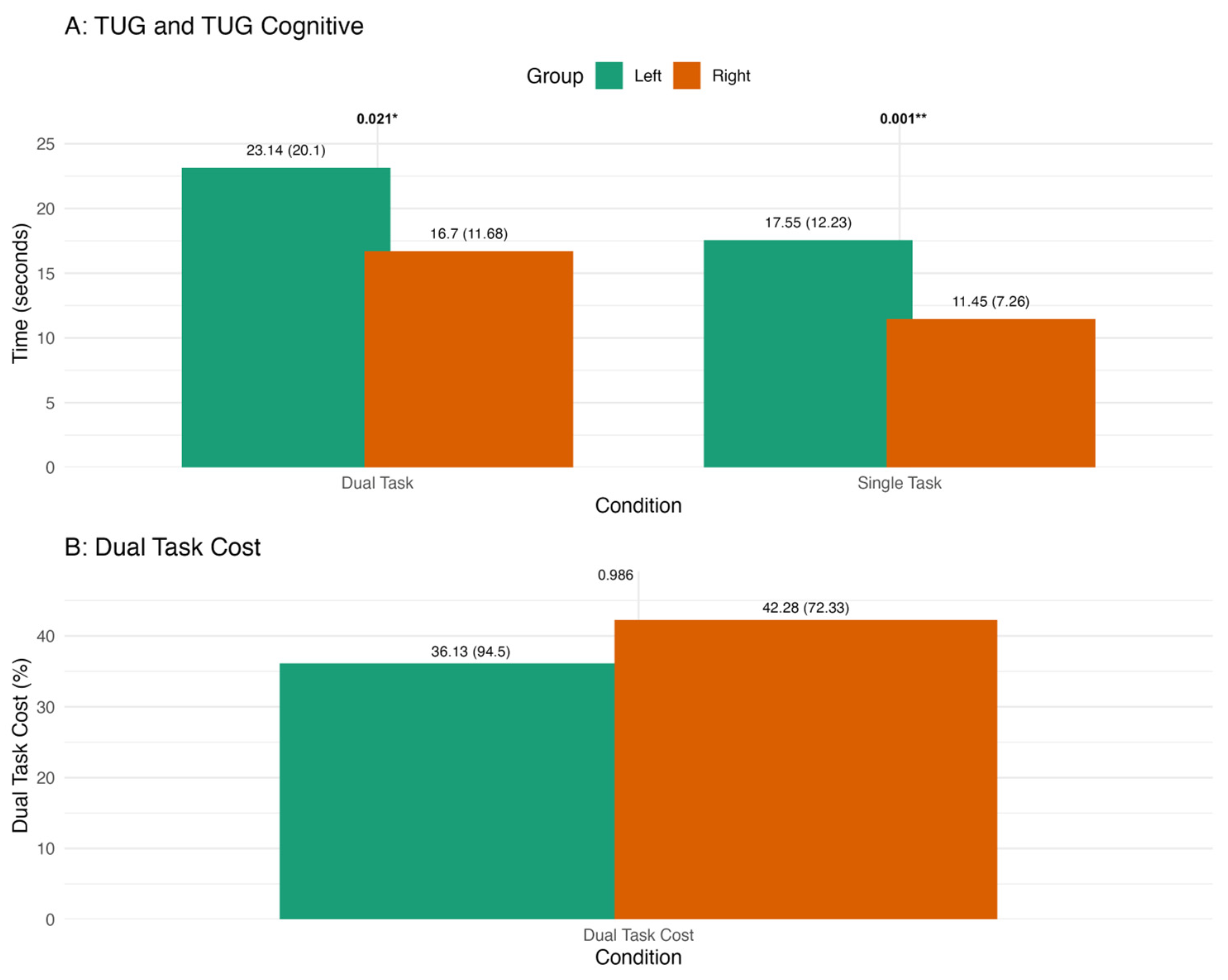
Background: Spatial cognition, a skill paramount to survival, is impaired in Parkinson’s disease (PD) but has been little researched. Spatial cognition is utilized during motor–cognitive integration, which impacts daily functioning and quality of life in PD. As PD is a unilateral-onset condition, spatial–cognitive and motor–cognitive ability may differ by side of onset. Spatial cognition is suggested to be modulated by the right hemisphere; thus, we hypothesize to observe worse spatial and motor–cognitive performance by people with left-onset PD (LOPD) than right-onset PD (ROPD). Methods: 216 participants with PD were recruited (LOPD = 107; M = 62; mean age = 69.80 ± 8.5). Spatial outcomes were collected via the body position spatial task (BPST), Reverse Corsi Blocks, and visuospatial items of the Montreal Cognitive Assessment (MoCA); motor–cognitive outcomes were collected by a Trails test, a Four Square Step Test (FSST), and a Timed Up and Go test. An independent t-test and the Mann–Whitney U test compared outcome variables between onset groups. Results: No significant differences were found between onset groups. Exploratory subgroup analyses revealed differences. Significantly worse performance by LOPD in single- and dual-task TUG was found within people with bilateral symptoms and postural instability (Hoehn & Yahr stage, >2; LOPD, N = 33; single, p = 0.001; dual, p = 0.021) and worse performance in single-task TUG in people with MoCA < 18 (LOPD, N = 5; single, p = 0.036) and people with freezing of gait (FOGQ, >0; LOPD, N = 14, p = 0.048). Significantly larger DTC by LOPD was found within frequent freezers (FOGQ, >3; LOPD, N = 9; p = 0.003). Conclusions: LOPD may tend to perform worse in motor–cognitive tasks among subgroups of those with more severe symptoms, i.e., those at later stages of disease. These findings may have implications for prognoses of those with LOPD versus ROPD and suggest that those with LOPD may have worse long-term outcomes in spatial cognition and motor–cognitive integration.
Keywords: Parkinson’s disease; side of onset; spatial cognition; aging; unilateral Parkinson’s disease; side of onset; spatial cognition; aging; unilateral