Differences in Spatial Cognition and Motor–Cognitive Integration by Side of Onset in People with Parkinson’s Disease

 ,
, 
Highlights
- •
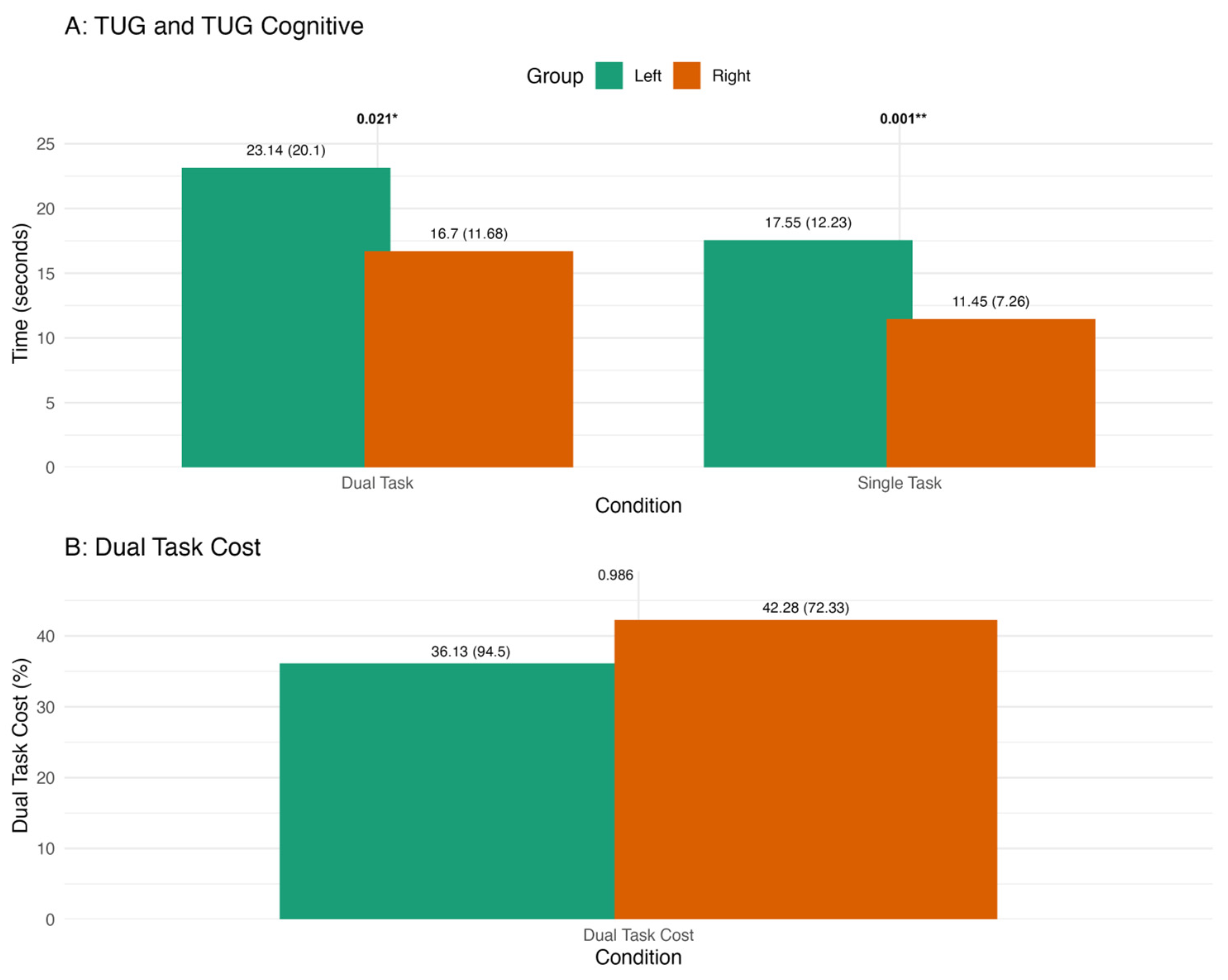
- LOPD tends to perform worse in single-task, dual-task, and/or dual-task cost TUG tasks within people with bilateral symptoms and postural instability, moderate to severe dementia, and more frequent freezing of gait.
- •
- No significant differences were found in other spatial–cognitive, cognitive, or motor tasks, nor between unstratified onset groups.
- •
- The level of impairment in PD may be a factor in revealing the side of onset differences in the TUG task.
- •
- The effect of the side of PD onset may be detectable only by specific motor–cognitive tasks that utilize spatial cognition, rather than direct and traditional visuospatial tasks.
Abstract
1. Introduction
1.1. Spatial–Cognitive Decline in PD
1.2. Motor–Cognitive Integration and Spatial Cognition
1.3. Unilateral Onset in PD
1.4. Spatial Cognition and Motor–Cognitive Integration by Side of PD Onset
1.5. Objective
1.6. Hypothesis
2. Materials and Methods
2.1. Statistical Analysis
Exploratory Stratified Analysis Based on Level of Functional Impairment
3. Results
4. Discussion
Author Contributions
Funding
Institutional Review Board Statement
Informed Consent Statement
Data Availability Statement
Conflicts of Interest
Abbreviations
| UPDRS | Unified Parkinson’s Disease Rating Scale |
| FOGQ | Freezing of Gait Questionnaire |
| PD | Parkinson’s Disease |
| TUG | Timed Up and Go |
Appendix A
Appendix A.1. Spatial Cognition Task Description
Appendix A.2. Motor Cognition Task Description
Appendix B
Appendix B.1. UPDRS 3.11 Scoring Criteria
- 0: Normal: No freezing.
- 1: Slight: Freezes on starting, turning, or walking through the doorway with a single halt during any of these events but then continues smoothly without freezing during straight walking.
- 2: Mild: Freezes on starting, turning, or walking through the doorway with more than one halt during any of these activities but continues smoothly without freezing during straight walking.
- 3: Moderate: Freezes once during straight walking.
- 4: Severe: Freezes multiple times during straight walking.
Appendix B.2. FOGQ #3 Scoring Criteria
- Question: “Do you feel that your feet get glued to the floor while walking, making a turn or when trying to initiate walking?”
- 0: Never.
- 1: Rarely (e.g., 1–2 times a month).
- 2: Often (e.g., about once a day).
- 3: Very often (e.g., more than once a day).
- 4: Always (e.g., whenever walking).
References
- Su, D.; Cui, Y.; He, C.; Yin, P.; Bai, R.; Zhu, J.; Lam, J.S.T.; Zhang, J.; Yan, R.; Zheng, X.; et al. Projections for prevalence of Parkinson’s disease and its driving factors in 195 countries and territories to 2050: Modelling study of Global Burden of Disease Study 2021. BMJ 2025, 388, e080952. [Google Scholar] [CrossRef] [Scilit] [PubMed]
- Kempster, P.A.; Williams, D.R.; Selikhova, M.; Holton, J.; Revesz, T.; Lees, A.J. Patterns of levodopa response in Parkinson’s disease: A clinico-pathological study. Brain J. Neurol. 2007, 130, 2123–2128. [Google Scholar] [CrossRef] [Scilit] [PubMed]
- Fang, C.; Lv, L.; Mao, S.; Dong, H.; Liu, B. Cognition Deficits in Parkinson’s Disease: Mechanisms and Treatment. Park. Dis. 2020, 2020, 2076942. [Google Scholar] [CrossRef] [Scilit] [PubMed]
- Leroi, I.; McDonald, K.; Pantula, H.; Harbishettar, V. Cognitive impairment in Parkinson disease: Impact on quality of life, disability, and caregiver burden. J. Geriatr. Psychiatry Neurol. 2012, 25, 208–214. [Google Scholar] [CrossRef] [Scilit]
- Chandler, J.M.; Nair, R.; Biglan, K.; Ferries, E.A.; Munsie, L.M.; Changamire, T.; Patel, N. Characteristics of Parkinson’s Disease in Patients with and without Cognitive Impairment. J. Park. Dis. 2021, 11, 1381–1392. [Google Scholar] [CrossRef] [Scilit]
- Battisto, J.; Echt, K.V.; Wolf, S.L.; Weiss, P.; Hackney, M.E. The Body Position Spatial Task, a Test of Whole-Body Spatial Cognition: Comparison Between Adults With and Without Parkinson Disease. Neurorehabilit. Neural Repair 2018, 32, 961–975. [Google Scholar] [CrossRef] [Scilit]
- Oliveira, H.S.D.; Camargos, S.T.; Cardoso, F.; Caramelli, P. Visuospatial impairment in Parkinson’s Disease: Why we should keep an eye on it. Park. Relat. Disord. 2025, 140, 108064. [Google Scholar] [CrossRef] [Scilit]
- Medeiros, K.Q.M.; Araújo-Leite, M.A. Integrative Review of Visuospatial Dysfunction in Parkinson’s Disease. Ann. Mov. Disord. 2025, 8, 104–112. [Google Scholar] [CrossRef] [Scilit]
- Epstein, R.A. Parahippocampal and retrosplenial contributions to human spatial navigation. Trends Cogn. Sci. 2008, 12, 388–396. [Google Scholar] [CrossRef] [Scilit]
- García-Navarra, S.; Llana, T.; Méndez, M. Spatial memory deficits in Parkinson’s disease: Neural mechanisms and assessment. Am. J. Neurodegener. Dis. 2025, 14, 67–81. [Google Scholar] [CrossRef] [Scilit]
- Patel, R.; Stebbins, G.; Bernard, B.; Goldman, J. Hippocampal and entorhinal cortex atrophy across the Parkinson’s disease cognitive impairment spectrum (S39.004). Neurology 2017, 88, S39.004. [Google Scholar] [CrossRef] [Scilit]
- Moustafa, A.A.; Chakravarthy, S.; Phillips, J.R.; Crouse, J.J.; Gupta, A.; Frank, M.J.; Hall, J.M.; Jahanshahi, M. Interrelations between cognitive dysfunction and motor symptoms of Parkinson’s disease: Behavioral and neural studies. Rev. Neurosci. 2016, 27, 535–548. [Google Scholar] [CrossRef] [Scilit] [PubMed]
- Amboni, M.; Cozzolino, A.; Longo, K.; Picillo, M.; Barone, P. Freezing of gait and executive functions in patients with Parkinson’s disease. Mov. Disord. Off. J. Mov. Disord. Soc. 2008, 23, 395–400. [Google Scholar] [CrossRef] [Scilit]
- Peterson, D.S.; King, L.A.; Cohen, R.G.; Horak, F.B. Cognitive Contributions to Freezing of Gait in Parkinson Disease: Implications for Physical Rehabilitation. Phys. Ther. 2016, 96, 659–670. [Google Scholar] [CrossRef] [Scilit]
- Walton, C.C.; Shine, J.M.; Mowszowski, L.; Naismith, S.L.; Lewis, S.J. Freezing of gait in Parkinson’s disease: Current treatments and the potential role for cognitive training. Restor. Neurol. Neurosci. 2014, 32, 411–422. [Google Scholar] [CrossRef] [Scilit]
- Yogev, G.; Plotnik, M.; Peretz, C.; Giladi, N.; Hausdorff, J.M. Gait asymmetry in patients with Parkinson’s disease and elderly fallers: When does the bilateral coordination of gait require attention? Exp. Brain Res. 2007, 177, 336–346. [Google Scholar] [CrossRef] [Scilit] [PubMed]
- Wang, Y.; Wang, S.; Mei, J.; Zhou, Y.; Tang, Y.; Wei, Z.; Tao, Q.; Han, X.; Hu, J.; Shi, Y.; et al. Cognitive and motor dual task costs reveal distinct gait impairment phenotypes in Parkinson’s disease. Park. Relat. Disord. 2026, 144, 108203. [Google Scholar] [CrossRef] [Scilit]
- Yogev, G.; Giladi, N.; Peretz, C.; Springer, S.; Simon, E.S.; Hausdorff, J.M. Dual tasking, gait rhythmicity, and Parkinson’s disease: Which aspects of gait are attention demanding? Eur. J. Neurosci. 2005, 22, 1248–1256. [Google Scholar] [CrossRef] [Scilit] [PubMed]
- Tan, X.; Wang, K.; Sun, W.; Li, X.; Wang, W.; Tian, F. A Review of Recent Advances in Cognitive-Motor Dual-Tasking for Parkinson’s Disease Rehabilitation. Sensors 2024, 24, 6353. [Google Scholar] [CrossRef] [Scilit]
- Kim, S.M.; Kim, D.H.; Yang, Y.; Ha, S.W.; Han, J.H. Gait Patterns in Parkinson’s Disease with or without Cognitive Impairment. Dement. Neurocogn. Disord. 2018, 17, 57–65. [Google Scholar] [CrossRef] [Scilit]
- Maeshima, S.; Itakura, T.; Nakagawa, M.; Nakai, K.; Komai, N. Visuospatial impairment and activities of daily living in patients with Parkinson’s disease: A quantitative assessment of the cube-copying task. Am. J. Phys. Med. Rehabil. 1997, 76, 383–388. [Google Scholar] [CrossRef] [Scilit] [PubMed]
- Davidsdottir, S.; Cronin-Golomb, A.; Lee, A. Visual and spatial symptoms in Parkinson’s disease. Vis. Res. 2005, 45, 1285–1296. [Google Scholar] [CrossRef] [Scilit] [PubMed]
- Young, D.E.; Wagenaar, R.C.; Lin, C.C.; Chou, Y.H.; Davidsdottir, S.; Saltzman, E.; Cronin-Golomb, A. Visuospatial perception and navigation in Parkinson’s disease. Vis. Res. 2010, 50, 2495–2504. [Google Scholar] [CrossRef] [Scilit] [PubMed]
- Harrington, D.L.; Shen, Q.; Wei, X.; Litvan, I.; Huang, M.; Lee, R.R. Functional topologies of spatial cognition predict cognitive and motor progression in Parkinson’s. Front. Aging Neurosci. 2022, 14, 987225. [Google Scholar] [CrossRef] [Scilit]
- Nantel, J.; McDonald, J.C.; Tan, S.; Bronte-Stewart, H. Deficits in visuospatial processing contribute to quantitative measures of freezing of gait in Parkinson’s disease. Neuroscience 2012, 221, 151–156. [Google Scholar] [CrossRef] [Scilit]
- Chung, S.J.; Yoo, H.S.; Lee, H.S.; Lee, Y.H.; Baik, K.; Jung, J.H.; Ye, B.S.; Sohn, Y.H.; Lee, P.H. Baseline cognitive profile is closely associated with long-term motor prognosis in newly diagnosed Parkinson’s disease. J. Neurol. 2021, 268, 4203–4212. [Google Scholar] [CrossRef] [Scilit]
- Ofori, E.; Delgado, F.; James, D.L.; Wilken, J.; Hancock, L.M.; Doniger, G.M.; Gudesblatt, M. Impact of distinct cognitive domains on gait variability in individuals with mild cognitive impairment and dementia. Exp. Brain Res. 2024, 242, 1573–1581. [Google Scholar] [CrossRef] [Scilit] [PubMed]
- Harrie, A.; Hampstead, B.M.; Lewis, C.; Herreshoff, E.; Kotagal, V. Cognitive correlates of dual tasking costs on the timed up and go test in Parkinson disease. Clin. Park. Relat. Disord. 2022, 7, 100158. [Google Scholar] [CrossRef] [Scilit]
- Lima, L.C.; Ansai, J.H.; Andrade, L.P.; Takahashi, A.C. The relationship between dual-task and cognitive performance among elderly participants who exercise regularly. Braz. J. Phys. Ther. 2015, 19, 159–166. [Google Scholar] [CrossRef] [Scilit]
- Mitra, S.; Vernon, M.; Boulton, H. The role of spatial alignment in posture-cognition dual task interaction. Gait Posture 2022, 93, 54–58. [Google Scholar] [CrossRef] [Scilit]
- Marinus, J.; van Hilten, J.J. The significance of motor (a)symmetry in Parkinson’s disease. Mov. Disord. Off. J. Mov. Disord. Soc. 2015, 30, 379–385. [Google Scholar] [CrossRef] [Scilit]
- Hoehn, M.M.; Yahr, M.D. Parkinsonism: Onset, progression and mortality. Neurology 1967, 17, 427–442. [Google Scholar] [CrossRef] [Scilit] [PubMed]
- Liu, Y.; Yuan, J.; Tan, C.; Wang, M.; Zhou, F.; Song, C.; Tang, Y.; Li, X.; Liu, Q.; Shen, Q.; et al. Exploring brain asymmetry in early-stage Parkinson’s disease through functional and structural MRI. CNS Neurosci. Ther. 2024, 30, e14874. [Google Scholar] [CrossRef] [Scilit]
- Hansen, F.O.; Knudsen, K.; Damholdt, M.F.; Bek, T.; Borghammer, P.; Okkels, N. Non-motor asymmetry and dopamine degeneration in Parkinson’s disease. Brain Commun. 2025, 7, fcaf002. [Google Scholar] [CrossRef] [Scilit] [PubMed]
- Bay, A.A.; Hart, A.R.; Michael Caudle, W.; Corcos, D.M.; Hackney, M.E. The association between Parkinson’s disease symptom side-of-onset and performance on the MDS-UPDRS scale part IV: Motor complications. J. Neurol. Sci. 2019, 396, 262–265. [Google Scholar] [CrossRef] [Scilit] [PubMed]
- Munhoz, R.P.; Espay, A.J.; Morgante, F.; Li, J.Y.; Teive, H.A.; Dunn, E.; Gallin, E.; Litvan, I. Long-duration Parkinson’s disease: Role of lateralization of motor features. Park. Relat. Disord. 2013, 19, 77–80. [Google Scholar] [CrossRef] [Scilit]
- Foster, P.S.; Drago, V.; Yung, R.C.; Skidmore, F.M.; Skoblar, B.; Shenal, B.V.; Rhodes, R.D.; Heilman, K.M. Anxiety affects working memory only in left hemibody onset Parkinson disease patients. Cogn. Behav. Neurol. Off. J. Soc. Behav. Cogn. Neurol. 2010, 23, 14–18. [Google Scholar] [CrossRef] [Scilit]
- Modestino, E.J.; Amenechi, C.; Reinhofer, A.; O’Toole, P. Side-of-onset of Parkinson’s disease in relation to neuropsychological measures. Brain Behav. 2016, 7, e00590. [Google Scholar] [CrossRef] [Scilit]
- DeGutis, J.; Aul, C.; Barthelemy, O.J.; Davis, B.L.; Alshuaib, S.; Marin, A.; Kinger, S.B.; Ellis, T.D.; Cronin-Golomb, A. Side of motor symptom onset predicts sustained attention deficits and motor improvements after attention training in Parkinson’s disease. Neuropsychologia 2023, 190, 108698. [Google Scholar] [CrossRef] [Scilit]
- Marano, N.; Lindell, A.K. Does the side of onset influence symptom severity in Parkinson’s disease? A systematic review and meta-analysis. Appl. Neuropsychol. Adult 2026, 33, 567–577. [Google Scholar] [CrossRef] [Scilit]
- Voruz, P.; Guérin, D.; Péron, J.A. Impact of motor symptom asymmetry on non-motor outcomes in Parkinson’s disease: A systematic review. npj Park. Dis. 2025, 11, 188. [Google Scholar] [CrossRef] [Scilit]
- Seichepine, D.R.; Neargarder, S.; Davidsdottir, S.; Reynolds, G.O.; Cronin-Golomb, A. Side and type of initial motor symptom influences visuospatial functioning in Parkinson’s disease. J. Park. Dis. 2015, 5, 75–83. [Google Scholar] [CrossRef] [Scilit] [PubMed]
- Yoon, J.E.; Kim, J.S.; Seo, J.Y.; Cho, J.W.; Sunwoo, J.S.; Lee, K.B.; Roh, H.; Ahn, M.Y. The Association between Motor Laterality and Cognitive Impairment in Parkinson’s Disease. Dement. Neurocogn. Disord. 2016, 15, 142–146. [Google Scholar] [CrossRef] [Scilit]
- Karádi, K.; Lucza, T.; Aschermann, Z.; Komoly, S.; Deli, G.; Bosnyák, E.; Acs, P.; Horváth, R.; Janszky, J.; Kovács, N. Visuospatial impairment in Parkinson’s disease: The role of laterality. Laterality 2015, 20, 112–127. [Google Scholar] [CrossRef] [Scilit]
- Adwani, S.; Yadav, R.; Kumar, K.; Chandra, S.R.; Pal, P.K. Neuropsychological profile in early Parkinson’s disease: Comparison between patients with right side onset versus left side onset of motor symptoms. Ann. Indian Acad. Neurol. 2016, 19, 74–78. [Google Scholar] [CrossRef] [Scilit] [PubMed]
- Garduno, A.; Pedraza, N.; Smith, M.; Bateni, H. Fall Risk Factors in Parkinson’s Disease. Arch. Phys. Med. Rehabil. 2022, 103, e198. [Google Scholar] [CrossRef] [Scilit]
- Park, J.H.; Kang, Y.J.; Horak, F.B. What Is Wrong with Balance in Parkinson’s Disease? J. Mov. Disord. 2015, 8, 109–114. [Google Scholar] [CrossRef] [Scilit]
- Heilman, K.M.; Bowers, D.; Valenstein, E.; Watson, R.T. The right hemisphere: Neuropsychological functions. J. Neurosurg. 1986, 64, 693–704. [Google Scholar] [CrossRef] [Scilit]
- Shulman, G.L.; Pope, D.L.; Astafiev, S.V.; McAvoy, M.P.; Snyder, A.Z.; Corbetta, M. Right hemisphere dominance during spatial selective attention and target detection occurs outside the dorsal frontoparietal network. J. Neurosci. Off. J. Soc. Neurosci. 2010, 30, 3640–3651. [Google Scholar] [CrossRef] [Scilit]
- Li, X.; Tang, L.; Zhang, Y.; Ye, L.; Zhou, L.; Tang, M. The impact of interactive motor-cognitive dual tasking on brain activation, functional connectivity, and behavioral performance in healthy adults: An fNIRS study. Front. Hum. Neurosci. 2025, 19, 1464617. [Google Scholar] [CrossRef] [Scilit]
- Prasad, S.; Saini, J.; Yadav, R.; Pal, P.K. Motor asymmetry and neuromelanin imaging: Concordance in Parkinson’s disease. Park. Relat. Disord. 2018, 53, 28–32. [Google Scholar] [CrossRef] [Scilit] [PubMed]
- Scherfler, C.; Seppi, K.; Mair, K.J.; Donnemiller, E.; Virgolini, I.; Wenning, G.K.; Poewe, W. Left hemispheric predominance of nigrostriatal dysfunction in Parkinson’s disease. Brain J. Neurol. 2012, 135, 3348–3354. [Google Scholar] [CrossRef] [Scilit]
- Goetz, C.G.; Tilley, B.C.; Shaftman, S.R.; Stebbins, G.T.; Fahn, S.; Martinez-Martin, P.; Poewe, W.; Sampaio, C.; Stern, M.B.; Dodel, R.; et al. Movement Disorder Society UPDRSRevision Task Force Movement Disorder Society-sponsored revision of the Unified Parkinson’s Disease Rating Scale (MDS-UPDRS): Scale presentation clinimetric testing results. Mov. Disord. Off. J. Mov. Disord. Soc. 2008, 23, 2129–2170. [Google Scholar] [CrossRef] [Scilit] [PubMed]
- Kessels, R.P.; van den Berg, E.; Ruis, C.; Brands, A.M. The backward span of the Corsi Block-Tapping Task and its association with the WAIS-III Digit Span. Assessment 2008, 15, 426–434. [Google Scholar] [CrossRef] [Scilit] [PubMed]
- Nasreddine, Z.S.; Phillips, N.A.; Bédirian, V.; Charbonneau, S.; Whitehead, V.; Collin, I.; Cummings, J.L.; Chertkow, H. The Montreal Cognitive Assessment, MoCA: A brief screening tool for mild cognitive impairment. J. Am. Geriatr. Soc. 2005, 53, 695–699. [Google Scholar] [CrossRef] [Scilit]
- Kelly, V.E.; Eusterbrock, A.J.; Shumway-Cook, A. A review of dual-task walking deficits in people with Parkinson’s disease: Motor and cognitive contributions, mechanisms, and clinical implications. Park. Dis. 2012, 2012, 918719. [Google Scholar] [CrossRef] [Scilit]
- Hofheinz, M.; Mibs, M. The Prognostic Validity of the Timed Up and Go Test With a Dual Task for Predicting the Risk of Falls in the Elderly. Gerontol. Geriatr. Med. 2016, 2, 2333721416637798. [Google Scholar] [CrossRef] [Scilit]
- Dite, W.; Temple, V.A. A clinical test of stepping and change of direction to identify multiple falling older adults. Arch. Phys. Med. Rehabil. 2002, 83, 1566–1571. [Google Scholar] [CrossRef] [Scilit]
- Sánchez-Cubillo, I.; Periáñez, J.A.; Adrover-Roig, D.; Rodríguez-Sánchez, J.M.; Ríos-Lago, M.; Tirapu, J.; Barceló, F. Construct validity of the Trail Making Test: Role of task-switching, working memory, inhibition/interference control, and visuomotor abilities. J. Int. Neuropsychol. Soc. 2009, 15, 438–450. [Google Scholar] [CrossRef] [Scilit]
- Podsiadlo, D.; Richardson, S. The timed “Up & Go”: A test of basic functional mobility for frail elderly persons. J. Am. Geriatr. Soc. 1991, 39, 142–148. [Google Scholar] [CrossRef] [Scilit]
- Giladi, N.; Tal, J.; Azulay, T.; Rascol, O.; Brooks, D.J.; Melamed, E.; Oertel, W.; Poewe, W.H.; Stocchi, F.; Tolosa, E. Validation of the freezing of gait questionnaire in patients with Parkinson’s disease. Mov. Disord. Off. J. Mov. Disord. Soc. 2009, 24, 655–661. [Google Scholar] [CrossRef] [Scilit]
- Baek, C.Y.; Yoon, H.S.; Kim, H.D.; Kang, K.Y. The effect of the degree of dual-task interference on gait, dual-task cost, cognitive ability, balance, and fall efficacy in people with stroke: A cross-sectional study. Medicine 2021, 100, e26275. [Google Scholar] [CrossRef] [Scilit] [PubMed]
- Bhatt, T.; Espy, D.; Yang, F.; Pai, Y.C. Dynamic gait stability, clinical correlates, and prognosis of falls among community-dwelling older adults. Arch. Phys. Med. Rehabil. 2011, 92, 799–805. [Google Scholar] [CrossRef] [Scilit]
- Johansson, H.; Löfgren, N.; Porciuncula, F.; Leavy, B. Impact of dual-tasking and balance confidence on turns and transitions: A cross-sectional study in Parkinson’s disease. Sci. Rep. 2026, 16, 1953. [Google Scholar] [CrossRef] [Scilit] [PubMed]
- Galrinho, J.; Batista, M.; Gonçalves-Montera, M.; Fernandes, O.; Matias, A.R. Gait and Dual-Task Performance in Older Adults with Suspected Cognitive Impairment: Effects of an 8-Week Exercise Program. Healthcare 2025, 13, 3190. [Google Scholar] [CrossRef] [Scilit]
- Katsumata, Y.; Todoriki, H.; Yasura, S.; Dodge, H.H. Timed up and go test predicts cognitive decline in healthy adults aged 80 and older in Okinawa: Keys to Optimal Cognitive Aging (KOCOA) Project. J. Am. Geriatr. Soc. 2011, 59, 2188–2189. [Google Scholar] [CrossRef] [Scilit]
- Çekok, K.; Kahraman, T.; Duran, G.; Dönmez Çolakoğlu, B.; Yener, G.; Yerlikaya, D.; Genç, A. Timed Up and Go Test With a Cognitive Task: Correlations With Neuropsychological Measures in People With Parkinson’s Disease. Cureus 2020, 12, e10604. [Google Scholar] [CrossRef] [Scilit]
- Orhan Varoğlu, A.; Aydin, A. An Evaluation of Right-Sided Symptom Onset as a Predictor of Poor Parkinson’s Disease Prognosis. Cureus 2021, 13, e13493. [Google Scholar] [CrossRef] [Scilit]
- Vance, R.C.; Healy, D.G.; Galvin, R.; French, H.P. Dual tasking with the timed “up & go” test improves detection of risk of falls in people with Parkinson disease. Phys. Ther. 2015, 95, 95–102. [Google Scholar] [CrossRef] [Scilit]


| Left | Right | p-Value | |
|---|---|---|---|
| N (%) | 107 (49.54) | 109 (50.46) | |
| Age (Years) | 69.80 ± 8.5 | 69.60 ± 7.8 | 0.858 |
| Education Level (Years) | 16.57 ± 2.2 | 15.94 ± 2.6 | 0.060 |
| BMI | 26.61 ± 5.6 | 26.82 ± 5.0 | 0.774 |
| Year with PD | 6.81 ± 4.9 | 8.06 ± 6.1 | 0.103 |
| Number of Comorbidities | 3.48 ± 1.7 | 3.68 ± 2.2 | 0.464 |
| Composite Physical Function (/24) | 19.55 ± 5.5 | 19.21 ± 4.9 | 0.632 |
| MDS-UPDRS I | 10.38 ± 7.3 | 10.73 ± 8.0 | 0.742 |
| MDS-UPDRS II | 12.54 ± 8.9 | 14.53 ± 8.6 | 0.102 |
| MDS-UPDRS III | 33.75 ± 15.7 | 33.15 ± 13.0 | 0.760 |
| MDS-UPDRS IV | 4.48 ± 3.6 | 5.13 ± 3.8 | 0.200 |
| Freezing of Gait Questionnaire #3 (/4) * | 0.91 ± 1.3 | 1.37 ± 1.3 | 0.008 |
| Hoehn & Yahr, Median (IQR) *^ | 2 (1.0) | 2 (0.5) | 0.166 |
| Sex | 0.062 | ||
| Female (%) | 44 (41.5) | 32 (29.4) | |
| Male (%) | 62 (58.5) | 77 (70.6) | |
| Ethnicity | 0.290 | ||
| White | 78 (73.6%) | 80 (74.1%) | |
| Black | 19 (17.9%) | 19 (17.6%) | |
| Asian | 3 (2.8%) | 0 (0.0%) | |
| Hispanic/Latino | 0 (0.0%) | 3 (2.8%) | |
| Native American | 0 (0.0%) | 1 (0.9%) | |
| Multiracial | 4 (3.8%) | 4 (3.7%) | |
| Other | 2 (1.9%) | 1 (0.9%) | |
| Handedness | 0.062 | ||
| Left | 17 (16.2) | 8 (7.8) | |
| Right | 88 (83.8) | 95 (92.2) | |
| Use of Assistive Device, n (%) | 0.291 | ||
| No | 60 (57.7) | 72 (66.7) | |
| Sometimes | 18 (17.3) | 18 (16.7) | |
| Yes | 26 (21.1) | 18 (16.7) |
| Left | Right | p-Value | d | |
|---|---|---|---|---|
| Body Position Spatial Task (BPST) Correct Trials | 4.48 (1.4) | 4.27 (1.6) | 0.793 | 0.131 |
| BPST Span | 3.78 (0.9) | 3.77 (1.1) | 1.000 | 0.017 |
| Corsi Blocks Correct Trials | 5.82 (1.9) | 5.97 (2.3) | 0.830 | 0.073 |
| Corsi Blocks Span | 4.32 (1.1) | 4.52 (1.5) | 0.793 | 0.146 |
| MoCA Visuospatial Score | 3.91 (1.3) | 3.79 (1.1) | 0.817 | 0.100 |
| MoCA Clock Drawing Total Score | 2.48 (0.81) | 2.48 (0.75) | 1.000 | 0 |
| MoCA Cube Drawing Score | 0.58 (0.50) | 0.49 (0.50) | 0.793 | 0.170 |
| MoCA Total Score | 25.68 (3.7) | 25.47 (3.5) | 0.673 | 0.058 |
| Four Square Step Test (FSST) (s) | 11.55 (4.4) | 12.86 (7.1) | 0.672 | 0.219 |
| TUG-Simple (s) | 13.78 (16.6) | 11.80 (7.2) | 0.262 | 0.155 |
| TUG-Cognitive (s) | 18.73 (18.6) | 17.97 (14.3) | 0.846 | 0.046 |
| TUG-DTC (%) | 49.97 (54.0) | 48.46 (57.9) | 0.846 | 0.027 |
| Trail A (s) | 42.09 (21.1) | 40.85 (21.7) | 0.846 | 0.058 |
| Trail B (s) | 111.46 (80.5) | 118.31 (80.7) | 0.846 | 0.085 |
| Trail B − Trail A (s) | 68.03 (64.5) | 74.81 (62.5) | 0.846 | 0.107 |
| (a) | |||||
| Left (n = 28) | Right (n = 21) | W | p-Value | r | |
| BPST Correct Trials | 4.75 (1.43) | 4.33 (1.77) | 331.5 | 0.442 | 0.128 |
| BPST Span | 3.82 (0.72) | 3.76 (1.09) | 289.5 | 0.932 | −0.015 |
| Corsi Blocks Correct Trials | 6.57 (1.71) | 5.86 (2.56) | 348.0 | 0.274 | 0.184 |
| Corsi Blocks Span | 4.79 (1.23) | 4.43 (1.5) | 329.5 | 0.466 | 0.121 |
| MoCA Visuospatial Score | 4.43 (1.14) | 4.05 (1.02) | 373.0 | 0.073 | 0.269 |
| MoCA Clock Drawing Total Score | 2.67 (0.78) | 2.67 (0.48) | 315.0 | 0.394 | 0.111 |
| MoCA Cube Drawing Score | 0.74 (0.45) | 0.65 (0.50) | 318.0 | 0.379 | 0.122 |
| MoCA Total Score | 27.64 (2.33) | 26.62 (2.87) | 358.5 | 0.190 | 0.219 |
| FSST (s) | 9.35 (1.77) | 10.02 (3) | 273.5 | 0.686 | −0.070 |
| TUG-Simple (s) | 8.54 (1.88) | 9.01 (2.32) | 272.0 | 0.667 | −0.075 |
| TUG-Cognitive (s) | 12.53 (4.62) | 12.12 (4.03) | 291.0 | 0.828 | 0.039 |
| TUG-DTC | 51.19 (65.06) | 32.1 (21.19) | 312.0 | 0.514 | 0.114 |
| Trail A (s) | 29.4 (11.02) | 28.91 (14.65) | 324.0 | 0.551 | 0.102 |
| Trail B (s) | 67.95 (30.19) | 77.76 (60.94) | 300.0 | 0.912 | 0.020 |
| Trail B − Trail A (s) | 38.55 (26.27) | 48.85 (48.4) | 287.0 | 0.897 | −0.024 |
| (b) | |||||
| Left (n = 77) | Right (n = 83) | W | p-Value | r | |
| BPST Correct Trials | 4.33 (1.41) | 4.29 (1.62) | 3272.0 | 0.579 | 0.050 |
| BPST Span | 3.74 (0.88) | 3.77 (1.07) | 3200.0 | 0.76 | 0.027 |
| Corsi Blocks Correct Trials | 5.57 (1.90) | 6.05 (2.26) | 2682.0 | 0.128 | −0.138 |
| Corsi Blocks Span | 4.16 (1.07) | 4.59 (1.59) | 2622.0 | 0.075 | −0.158 |
| MoCA Visuospatial Score | 3.71 (1.28) | 3.76 (1.16) | 3145.5 | 0.969 | −0.004 |
| MoCA Clock Drawing Total Score | 2.43 (0.80) | 2.43 (0.81) | 3104.0 | 0.956 | −0.005 |
| MoCA Cube Drawing Score | 0.51 (0.50) | 0.48 (0.50) | 3196.5 | 0.756 | 0.025 |
| MoCA Total Score | 24.99 (3.94) | 25.51 (3.28) | 2994.0 | 0.574 | −0.052 |
| FSST (s) | 12.42 (4.84) | 13.65 (7.86) | 2694.0 | 0.504 | −0.063 |
| TUG-Simple (s) | 15.8 (19.21) | 12.22 (7.7) | 3465.5 | 0.132 | 0.140 |
| TUG-Cognitive (s) | 21.17 (21.41) | 18.73 (15.4) | 3245.5 | 0.24 | 0.110 |
| TUG-DTC | 49.4 (49.19) | 50.6 (63.2) | 2993.0 | 0.8 | 0.024 |
| Trail A (s) | 47.03 (22.08) | 42.94 (22.23) | 3643.5 | 0.126 | 0.140 |
| Trail B (s) | 128.59 (87.75) | 124.76 (79.82) | 3199.5 | 0.877 | 0.014 |
| Trail B − Trail A (s) | 79.64 (71.36) | 79.05 (62.84) | 3048.0 | 0.716 | −0.034 |
| (c) | |||||
| Left (n = 33) | Right (n = 45) | W | p-Value | r | |
| BPST Correct Trials | 4.09 (1.33) | 3.93 (1.34) | 762.5 | 0.529 | 0.083 |
| BPST Span | 3.59 (0.91) | 3.52 (0.88) | 737.5 | 0.712 | −0.199 |
| Corsi Blocks Correct Trials | 5.06 (1.48) | 5.82 (2) | 569.5 | 0.073 | −0.233 |
| Corsi Blocks Span | 3.88 (0.82) | 4.33 (1.4) | 595.0 | 0.116 | −0.199 |
| MoCA Visuospatial Score | 3.33 (1.47) | 3.41 (1.21) | 715.5 | 0.916 | −0.014 |
| MoCA Clock Drawing Total Score | 2.09 (2.30) | 0.95 (0.85) | 641.0 | 0.348 | −0.117 |
| MoCA Cube Drawing Score | 0.52 (0.36) | 0.51 (0.49) | 836.0 | 0.189 | 0.152 |
| MoCA Total Score | 23.76 (4.71) | 24.95 (3.31) | 643.0 | 0.394 | −0.144 |
| FSST (s) | 15.8 (6.01) | 15.86 (9.47) | 661.5 | 0.331 | 0.140 |
| TUG-Simple (s) ** | 24.29 (27.44) | 14.49 (9.8) | 963.5 | 0.001 | 0.434 |
| TUG-Cognitive (s) * | 32.49 (30.03) | 23.77 (19.52) | 832.0 | 0.021 | 0.321 |
| TUG-DTC | 61.17 (64.94) | 61.56 (76.81) | 632.0 | 0.986 | 0.003 |
| Trail A (s) | 55.59 (22.47) | 50.42 (24.56) | 883.0 | 0.157 | 0.189 |
| Trail B (s) | 163.13 (90.98) | 157.01 (84.92) | 742.0 | 0.824 | 0.031 |
| Trail B − Trail A (s) | 102.94 (74.47) | 101.5 (68.59) | 706.0 | 0.890 | −0.019 |
| Left (n = 5) | Right (n = 4) | W | p-Value | r | |
|---|---|---|---|---|---|
| BPST Correct Trials | 2.75 (1.0) | 2.75 (1.0) | 8 | 1.000 | 0 |
| BPST Span | 2.75 (1.0) | 2.75 (1.0) | 8 | 1.000 | 0 |
| Corsi Blocks Correct Trials | 4.40 (2.2) | 4.25 (0.5) | 12.5 | 0.602 | 0.250 |
| Corsi Blocks Span | 3.60 (1.1) | 3.50 (0.6) | 11 | 0.896 | 0.100 |
| MoCA Visuospatial Score | 1.20 (1.3) | 2.00 (0.8) | 6 | 0.377 | −0.400 |
| MoCA Clock Drawing Total Score | 1.00 (1.00) | 2.00 (0.82) | 4.5 | 0.197 | −0.550 |
| MoCA Cube Drawing Score | 0.20 (0.45) | 0.00 (0.00) | 12 | 0.502 | 0.200 |
| MoCA Total Score | 15.20 (1.8) | 15.25 (2.2) | 8.5 | 0.770 | −0.150 |
| FSST (s) | 31.97 (NA ^) | 17.18 (6.7) | 4 | 0.400 | 1.000 |
| TUG-Simple (s) * | 32.98 (9.9) | 12.61 (1.5) | 15 | 0.036 | 1.000 |
| TUG-Cognitive (s) | 23.14 (20.1) | 18.10 (4.2) | 12 | 0.057 | 1.000 |
| TUG-DTC | 36.13 (94.5) | 42.28 (72.33) | 6 | 1.000 | 0.000 |
| Trail A (s) | 54.33 (30.55) | 44.9 (26.57) | 12 | 0.687 | 0.200 |
| Trail B (s) | 133.63 (172.56) | 134.18 (119.46) | 8.5 | 1.000 | 0.062 |
| Trail B − Trail A (s) | 81.33 (120.74) | 84.93 (104.54) | 8 | 1.000 | 0.000 |
| (a) | |||||
| Left (n = 14) | Right (n = 34) | W | p-Value | r | |
| BPST Correct Trials | 4.36 (1.34) | 4.36 (1.64) | 244.0 | 0.766 | 0.056 |
| BPST Span | 3.64 (0.84) | 3.67 (1.02) | 236.0 | 0.912 | 0.022 |
| Corsi Blocks Trial | 5.00 (1.3) | 5.47 (2.3) | 199.5 | 0.378 | −0.162 |
| Corsi Blocks Span | 3.79 (0.7) | 4.09 (1.33) | 194.0 | 0.298 | −0.185 |
| MoCA Visuospatial Score | 3.64 (1.08) | 3.67 (0.92) | 232.5 | 0.98 | 0.006 |
| MoCA Clock Drawing Total Score | 2.21 (0.89) | 2.52 (0.62) | 192.5 | 0.322 | −0.167 |
| MoCA Cube Drawing Score | 0.57 (0.51) | 0.42 (0.50) | 265.0 | 0.367 | 0.147 |
| MoCA Total Score | 25.00 (2.75) | 25.24 (2.96) | 206.0 | 0.564 | −0.108 |
| FSST (s) | 15.54 (6.25) | 15.30 (11.1) | 228.5 | 0.343 | 0.190 |
| TUG-Simple (s) * | 28.39 (41.88) | 14.48 (11.07) | 279.0 | 0.048 | 0.385 |
| TUG-Cognitive (s) | 35.44 (42.5) | 21.96 (16.89) | 257.0 | 0.056 | 0.382 |
| TUG-Dual-Task Cost | 85.73 (76.41) | 52.67 (46.20) | 218.0 | 0.394 | 0.172 |
| Trail A (s) | 52.50 (25.78) | 42.94 (18.09) | 306.0 | 0.126 | 0.286 |
| Trail B (s) | 148.32 (82.25) | 131.97 (76) | 268.0 | 0.503 | 0.126 |
| Trail B − Trail A (s) | 97.16 (66.88) | 88.46 (61.41) | 253.0 | 0.742 | 0.063 |
| (b) | |||||
| Left (n = 9) | Right (n = 14) | W | p-Value | r | |
| BPST Correct Trials | 4.11 (1.54) | 4.31 (1.93) | 58 | 0.802 | −0.009 |
| BPST Span | 3.56 (1.01) | 3.54 (1.13) | 60 | 0.971 | 0.026 |
| Corsi Blocks Trial | 5.11 (1.27) | 6.36 (2.13) | 45.0 | 0.255 | −0.286 |
| Corsi Blocks Span | 3.78 (0.67) | 4.50 (0.94) | 36.5 | 0.069 | −0.421 |
| MoCA Visuospatial Score | 3.78 (0.97) | 3.69 (1.11) | 60.0 | 0.944 | 0.026 |
| MoCA Clock Drawing Total Score | 2.33 (0.87) | 2.38 (0.77) | 57.5 | 0.970 | −0.017 |
| MoCA Cube Drawing Score | 0.67 (0.50) | 0.46 (0.52) | 70.5 | 0.374 | 0.205 |
| MoCA Total Score | 25.11 (2.93) | 25.54 (2.76) | 52 | 0.731 | −0.111 |
| FSST (s) | 15.84 (6.41) | 14.55 (8.03) | 52.0 | 0.432 | 0.238 |
| TUG-Simple (s) | 36.23 (52.73) | 16.95 (15.46) | 68.0 | 0.135 | 0.417 |
| TUG-Cognitive (s) | 46.29 (54.07) | 22.47 (16.56) | 62.0 | 0.1 | 0.476 |
| TUG-Dual-Task Cost * | 120.62 (70.34) | 42.64 (28.92) | 72.0 | 0.01 | 0.714 |
| Trail A (s) | 50.19 (19.07) | 39.19 (16) | 92.0 | 0.072 | 0.460 |
| Trail B (s) | 139.57 (87.61) | 141.76 (89.4) | 60.5 | 0.9 | −0.040 |
| Trail B − Trail A (s) | 91.45 (79.28) | 102.57 (75.68) | 55.0 | 0.643 | −0.127 |
Disclaimer/Publisher’s Note: The statements, opinions and data contained in all publications are solely those of the individual author(s) and contributor(s) and not of MDPI and/or the editor(s). MDPI and/or the editor(s) disclaim responsibility for any injury to people or property resulting from any ideas, methods, instructions or products referred to in the content. |
© 2026 by the authors. Licensee MDPI, Basel, Switzerland. This article is an open access article distributed under the terms and conditions of the Creative Commons Attribution (CC BY) license.
Share and Cite
Kim, E.B.; Patrick, M.B.; Ni, L.; McKay, J.L.; Hackney, M.E. Differences in Spatial Cognition and Motor–Cognitive Integration by Side of Onset in People with Parkinson’s Disease. Brain Sci. 2026, 16, 619. https://doi.org/10.3390/brainsci16060619
Kim EB, Patrick MB, Ni L, McKay JL, Hackney ME. Differences in Spatial Cognition and Motor–Cognitive Integration by Side of Onset in People with Parkinson’s Disease. Brain Sciences. 2026; 16(6):619. https://doi.org/10.3390/brainsci16060619
Chicago/Turabian StyleKim, Ejew Beyla, Morgan Brianna Patrick, Liang Ni, J. Lucas McKay, and Madeleine Eve Hackney. 2026. "Differences in Spatial Cognition and Motor–Cognitive Integration by Side of Onset in People with Parkinson’s Disease" Brain Sciences 16, no. 6: 619. https://doi.org/10.3390/brainsci16060619
APA StyleKim, E. B., Patrick, M. B., Ni, L., McKay, J. L., & Hackney, M. E. (2026). Differences in Spatial Cognition and Motor–Cognitive Integration by Side of Onset in People with Parkinson’s Disease. Brain Sciences, 16(6), 619. https://doi.org/10.3390/brainsci16060619