Ecological Momentary Assessment of Fatigue in Adults with Cerebral Palsy: Feasibility, Reliability, and Validity
 ,
,
Highlights
- High-frequency ecological momentary assessment of fatigue is feasible in adults with cerebral palsy, with no evidence of reactivity to self-monitoring;
- More than half of the total variability in fatigue occurred within persons, and nearly three quarters of these fluctuations were systematic rather than measurement error.
- Intensive real-time monitoring is justified in this population, as retrospective assessments cannot capture the temporal dynamics of fatigue in everyday life;
- These findings inform a future large-scale study in cerebral palsy, with implications for understanding symptom mechanisms and advancing fatigue management.
Abstract
1. Introduction
2. Materials and Methods
2.1. Study Design and Participants
2.2. Development of the Prototype EMA Items
2.3. The EMA Sampling Protocol
2.4. Retrospective Fatigue Questionnaire
2.5. Feasibility and Acceptability Outcomes
2.5.1. Quantitative Feasibility Indicators
- Consent rate (% consenting to participate);
- Retention rate (% completing the study);
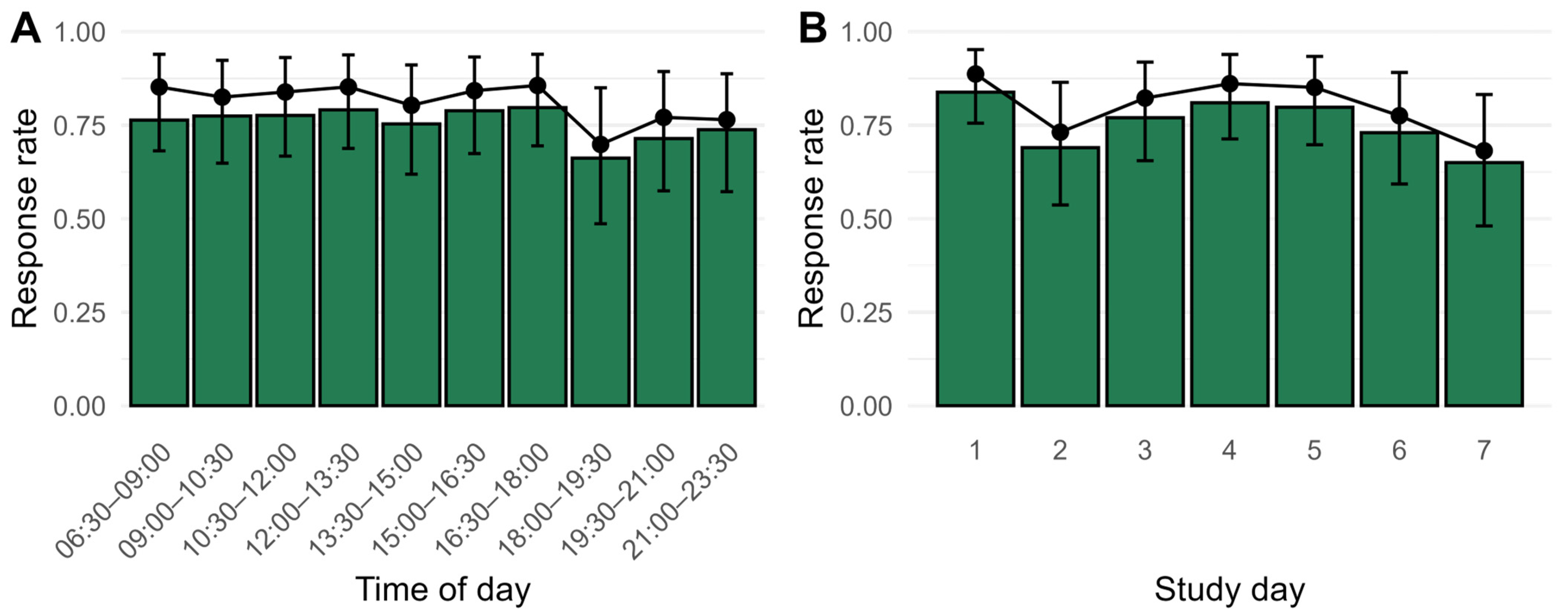
- Response rate (% of EMA surveys initiated);
- Completion rate (% of EMA surveys fully completed);
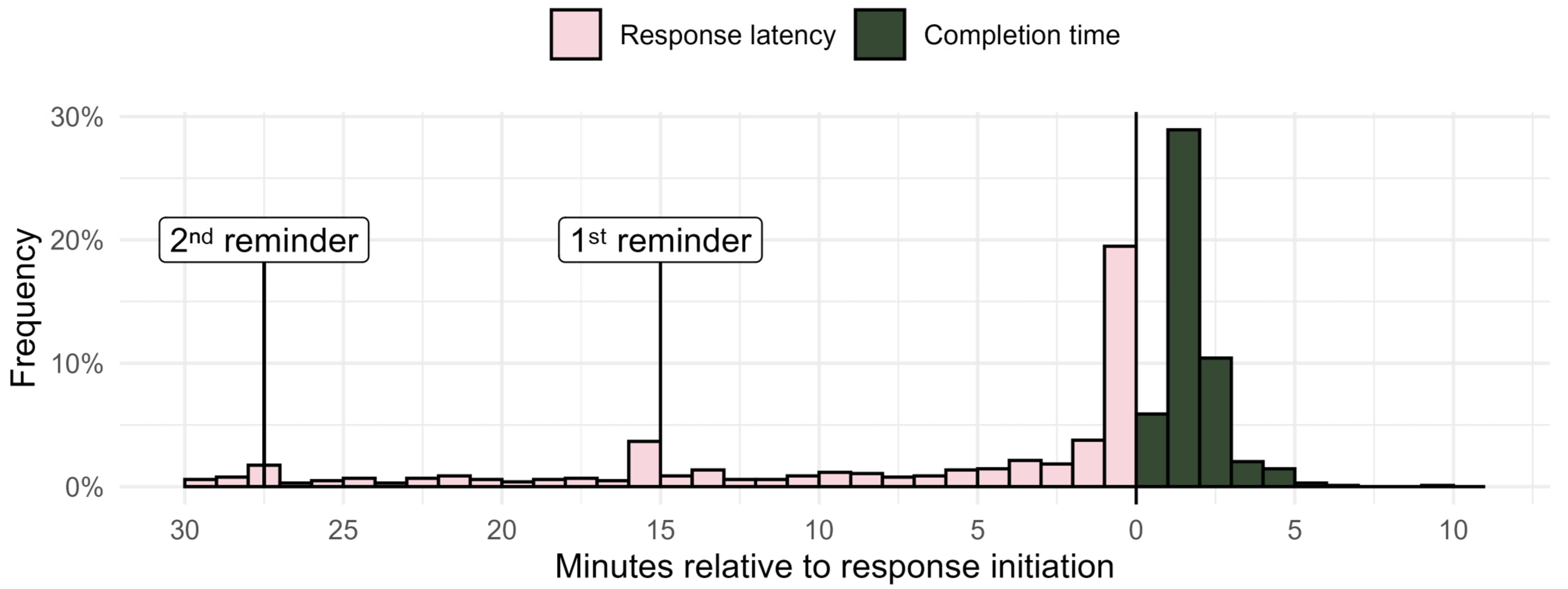
- Response latency (time from prompt to response initiation, based on time stamps);
- Completion time (time from response initiation to submission, in milliseconds).
2.5.2. Follow-Up Interviews
2.6. Statistical Analysis
2.6.1. Intra-Individual Variability
2.6.2. Within-Person Reliability
2.6.3. Measurement Reactivity
2.6.4. Construct Validity
2.6.5. Software
2.7. Qualitative Analysis
2.8. Patient and Public Involvement
3. Results
3.1. Feasibility
3.1.1. Response Compliance
3.1.2. Observed Response Times
3.1.3. Acceptability, Perceived Burden, Relevance, Clarity, and Comprehensiveness
3.2. Intraindividual Variability
3.3. Reliabilities
3.4. Measurement Reactivity
3.5. Construct Validity
4. Discussion
4.1. Feasibility
4.2. Intraindividual Variability and Reliability
4.3. Measurement Reactivity and Validity
4.4. Proposed Amendments for the Main Large-Scale Study
4.5. Limitations
5. Conclusions
Supplementary Materials
Author Contributions
Funding
Institutional Review Board Statement
Informed Consent Statement
Data Availability Statement
Acknowledgments
Conflicts of Interest
Abbreviations
| CP | Cerebral palsy |
| EMA | Ecological Momentary Assessment |
| MEAR | Measurement Error Autoregressive Model |
| GMFCS | Gross Motor Function Classification System |
| CFCS | Communication Function Classification System |
| FSS | Fatigue Severity Scale |
| ICC | Intraclass correlation coefficient |
| SEM | Standard error of measurement |
| SD | Standard deviation |
| SE | Standard error |
| AIC | Akaike Information Criterion |
| MCID | Minimal clinical important difference |
Appendix A
Appendix A.1. EMA Items

| No. | Item | Response Scale | Anchors (0; 10) | Ref. |
|---|---|---|---|---|
| 1 | How much energy do you have right now? | Slider (0–10) | Pictorial (empty/full battery) | [36] |
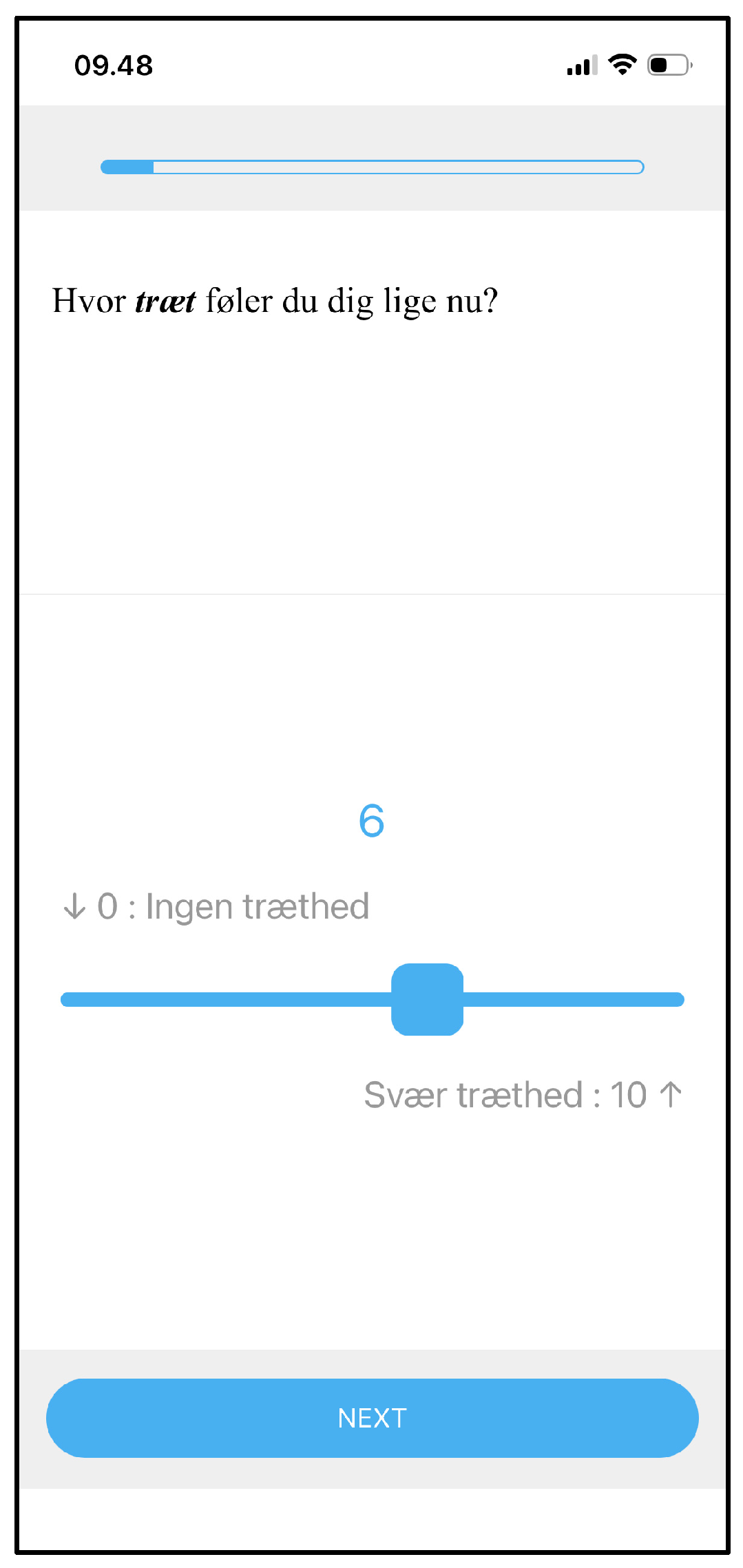
| 2 | How fatigued do you feel right now? | Slider (0–10) | No fatigue; Severe fatigue | [18,19,37] |
| 3 | How does fatigue feel right now? | Multiple choice | N/A | |
| 4 | How exhausted do you feel right now? | Slider (0–10) | Not at all; Very much | [37] |
| 5 | How much of an effort is it to do anything right now? | Slider (0–10) | None; Very much | [37] |
| 6 | How much pain do you have right now? | Slider (0–10) | No pain; Worst pain imaginable | NRS |
| 7 | How sleepy do you feel right now? | Slider (0–10) | Not at all; Very much | [37] |
| 8 | How well are you able to concentrate right now? | Slider (0–10) | Not at all; Very much | [37] |
| 9 | How happy do you feel right now? | Slider (0–10) | Not at all; Very much | [37] |
| 10 | How relaxed do you feel right now? | Slider (0–10) | Not at all; Very much | [37] |
| 11 | How sad do you feel right now? | Slider (0–10) | Not at all; Very much | [37] |
| 12 | How stressed do you feel right now? | Slider (0–10) | Not at all; Very much | [37] |
| 13 | How anxious do you feel right now? | Slider (0–10) | Not at all; Very much | [37] |
| 14 | What were you doing when you got the notification? | Multiple choice | N/A | [38] |
| 15 | Why were you doing this particular activity? | Multiple choice | N/A | [38] |
| 16 | How physically demanding is what you were doing? | Slider (0–10) | Not at all; Very much | [39] |
| 17 | How mentally demanding is what you were doing? | Slider (0–10) | Not at all; Very much | [39] |
| 18 | Where were you when you got the notification? | Multiple choice | N/A | [41] |
| 19 | How many sensory impressions were around you when you got the notification? | Likert-type | N/A | |
| 20 | Who were with you when you got the notification? | Multiple choice | N/A | [40] |
Appendix A.2. Response Options for Multiple Choice and Likert-Type Questions
References
- Dan, B.; Rosenbaum, P.; Carr, L.; Gough, M.; Coughlan, J.; Nweke, N. Proposed Updated Description of Cerebral Palsy. Dev. Med. Child. Neurol. 2025, 67, 700–709. [Google Scholar] [CrossRef]
- Gross, P.H.; Bailes, A.F.; Horn, S.D.; Hurvitz, E.A.; Kean, J.; Shusterman, M. Setting a Patient-Centered Research Agenda for Cerebral Palsy: A Participatory Action Research Initiative. Dev. Med. Child. Neurol. 2018, 60, 1278–1284. [Google Scholar] [CrossRef]
- Brunton, L.K.; Bartlett, D.J. The Bodily Experience of Cerebral Palsy: A Journey to Self-Awareness. Disabil. Rehabil. 2013, 35, 1981–1990. [Google Scholar] [CrossRef]
- Ghatamaneni, D.; Kohli, S.; Peters, S.; MacDermid, J.; Brunton, L.K. Prevalence of Fatigue in Adolescents and Adults with Cerebral Palsy: A Systematic Review and Meta-Analysis. Fatigue 2023, 11, 157–175. [Google Scholar] [CrossRef]
- Multiple Sclerosis Council for Clinical Practice Guidelines. Fatigue and Multiple Sclerosis: Evidence-Based Management Strategies for Fatigue in Multiple Sclerosis; Paralyzed Veterans of America: Washington, DC, USA, 1998. [Google Scholar]
- Brunton, L.K.; McPhee, P.G.; Gorter, J.W. Self-Reported Factors Contributing to Fatigue and Its Management in Adolescents and Adults with Cerebral Palsy. Disabil. Rehabil. 2021, 43, 929–935. [Google Scholar] [CrossRef] [PubMed]
- Shiffman, S.; Stone, A.A.; Hufford, M.R. Ecological Momentary Assessment. Annu. Rev. Clin. Psychol. 2008, 4, 1–32. [Google Scholar] [CrossRef]
- Beames, J.R.; Uyttebroek, L.; Schat, E.; Kiekens, G.; Myin-Germeys, I. ESM as a Clinical Tool and Foundation for Intervention: From Research to Clinical Practice. In The Open Handbook of Experience Sampling Methodology, 3rd ed.; Universitaire Pers Leuven: Leuven, Belgium, 2026; pp. 241–258. [Google Scholar]
- Ezekiel, L.; Wilding, H.; Dearling, J.; Collett, J.; Dawes, H. Exploring the Usefulness of Real-Time Digitally Supported Fatigue Monitoring in Fatigue Management: Perspectives from Occupational Therapists and Brain Injury Survivors. Br. J. Occup. Ther. 2024, 87, 783–792. [Google Scholar] [CrossRef] [PubMed]
- Terhorst, L.; Juengst, S.B.; Beck, K.B.; Shiffman, S. People Can Change: Measuring Individual Variability in Rehabilitation Science. Rehabil. Psychol. 2018, 63, 468–473. [Google Scholar] [CrossRef]
- Palisano, R.J.; Rosenbaum, P.; Walter, S.; Russell, D.; Wood, E.; Galuppi, B. Development and Reliability of a System to Classify Gross Motor Function in Children with Cerebral Palsy. Dev. Med. Child. Neurol. 1997, 39, 214–223. [Google Scholar] [CrossRef]
- Hidecker, M.J.C.; Paneth, N.; Rosenbaum, P.L.; Kent, R.D.; Lillie, J.; Eulenberg, J.B.; Chester, K.; Johnson, B.; Michalsen, L.; Evatt, M.; et al. Developing and Validating the Communication Function Classification System for Individuals with Cerebral Palsy. Dev. Med. Child Neurol. 2011, 53, 704–710. [Google Scholar] [CrossRef]
- Harris, P.A.; Taylor, R.; Thielke, R.; Payne, J.; Gonzalez, N.; Conde, J.G. Research Electronic Data Capture (REDCap)—A Metadata-Driven Methodology and Workflow Process for Providing Translational Research Informatics Support. J. Biomed. Inform. 2009, 42, 377–381. [Google Scholar] [CrossRef] [PubMed]
- Harris, P.A.; Taylor, R.; Minor, B.L.; Elliott, V.; Fernandez, M.; O’Neal, L.; McLeod, L.; Delacqua, G.; Delacqua, F.; Kirby, J.; et al. The REDCap Consortium: Building an International Community of Software Platform Partners. J. Biomed. Inform. 2019, 95, 103208. [Google Scholar] [CrossRef] [PubMed]
- Myin-Germeys, I.; Kuppens, P. The Open Handbook of Experience Sampling Methodology: A Step-by-Step Guide to Designing, Conducting, and Analyzing ESM Studies, 2nd ed.; Center for Research on Experience Sampling and Ambulatory Methods Leuven (REAL): Leuven, Belgium, 2022. [Google Scholar]
- Palmier-Claus, J.E.; Myin-Germeys, I.; Barkus, E.; Bentley, L.; Udachina, A.; Delespaul, P.A.E.G.; Lewis, S.W.; Dunn, G. Experience Sampling Research in Individuals with Mental Illness: Reflections and Guidance. Acta Psychiatr. Scand. 2011, 123, 12–20. [Google Scholar] [CrossRef]
- Kirtley, O.J.; Hiekkaranta, A.P.; Kunkels, Y.K.; Eisele, G.; Verhoeven, D.; Van Nierop, M.; Myin-Germeys, I. The Experience Sampling Method (ESM) Item Repository. Available online: https://esmitemrepositoryinfo.com/ (accessed on 9 January 2026).
- Heine, M.; van den Akker, L.E.; Blikman, L.J.M.; Hoekstra, T.; van Munster, E.T.L.; Verschuren, O.; Visser-Meily, A.; Kwakkel, G.; de Groot, V.; Beckerman, H.; et al. Real-Time Assessment of Fatigue in Patients with Multiple Sclerosis: How Does It Relate to Commonly Used Self-Report Fatigue Questionnaires? Arch. Phys. Med. Rehabil. 2016, 97, 1887–1894.e1. [Google Scholar] [CrossRef]
- Verschuren, O.; Benner, J.L.; Balemans, A.C.J.; Horemans, H.; Van Den Berg-Emons, R.J.G.; Van Der Slot, W.M.A. Real-Time Daily Fatigue, Sleep, Physical Activity, and Health-Related Fitness in Adults with Cerebral Palsy. Dev. Med. Child Neurol. 2023, 65, 509–516. [Google Scholar] [CrossRef]
- O’Brien, S.T.; Dozo, N.; Hinton, J.D.X.; Moeck, E.K.; Susanto, R.; Jayaputera, G.T.; Sinnott, R.O.; Vu, D.; Alvarez-Jimenez, M.; Gleeson, J.; et al. SEMA3: A Free Smartphone Platform for Daily Life Surveys. Behav. Res. Methods 2024, 56, 7691–7706. [Google Scholar] [CrossRef]
- Krupp, L.B. The Fatigue Severity Scale: Application to Patients with Multiple Sclerosis and Systemic Lupus Erythematosus. Arch. Neurol. 1989, 46, 1121. [Google Scholar] [CrossRef]
- Lorentzen, K.; Danielsen, M.A.; Due Kay, S.; Voss, A. Validation of the Fatigue Severity Scale in Danish Patients with Systemic Lupus Erythematosus. Dan. Med. J. 2014, 61, A4808. [Google Scholar]
- Monsalves, M.J.; Bangdiwala, A.S.; Thabane, A.; Bangdiwala, S.I. LEVEL (Logical Explanations & Visualizations of Estimates in Linear Mixed Models): Recommendations for Reporting Multilevel Data and Analyses. BMC Med. Res. Methodol. 2020, 20, 3. [Google Scholar] [CrossRef]
- Schuurman, N.K.; Houtveen, J.H.; Hamaker, E.L. Incorporating Measurement Error in n = 1 Psychological Autoregressive Modeling. Front. Psychol. 2015, 6, 1038. [Google Scholar] [CrossRef] [PubMed]
- Schuurman, N.K.; Hamaker, E.L. Measurement Error and Person-Specific Reliability in Multilevel Autoregressive Modeling. Psychol. Methods 2019, 24, 70–91. [Google Scholar] [CrossRef]
- Berkhout, S.W.; Schuurman, N.K.; Hamaker, E.L. Let Sleeping Dogs Lie? How to Deal with the Night Gap Problem in Experience Sampling Method Data. Psychol. Methods 2025. Epub ahead of printing. [Google Scholar] [CrossRef] [PubMed]
- Leertouwer, I.; Keijsers, L.; Van Roekel, E.; Schuurman, N.K. A Practical Guide to Estimating Reliability of Intensive Longitudinal Data; Erasmus University Rotterdam: Rotterdam, The Netherlands, 2025; Available online: https://osf.io/yqg6r/files/8udt6 (accessed on 3 October 2025).
- French, D.P.; Sutton, S. Reactivity of Measurement in Health Psychology: How Much of a Problem Is It? What Can Be Done about It? Br. J. Health Psychol. 2010, 15, 453–468. [Google Scholar] [CrossRef]
- König, L.M.; Allmeta, A.; Christlein, N.; Van Emmenis, M.; Sutton, S. A Systematic Review and Meta-Analysis of Studies of Reactivity to Digital in-the-Moment Measurement of Health Behaviour. Health Psychol. Rev. 2022, 16, 551–575. [Google Scholar] [CrossRef] [PubMed]
- R Core Team. R: A Language and Environment for Statistical Computing, R Core Team: Vienna, Austria, 2025.
- Wrzus, C.; Neubauer, A.B. Ecological Momentary Assessment: A Meta-Analysis on Designs, Samples, and Compliance Across Research Fields. Assessment 2023, 30, 825–846. [Google Scholar] [CrossRef] [PubMed]
- Burnett, J.; Cobden, A.L.; Firman-Sadler, L.; Fuller-Tyszkiewicz, M.; Akhlaghi, H.; Domínguez D, J.F.; Caeyenberghs, K. Ecological Momentary Assessment in Acquired Brain Injury: A Scoping Review. J. Neurotrauma 2025, 42, 1465–1490. [Google Scholar] [CrossRef]
- Toth, R.; Parry, D.; Emmer, M. From Screen Time to Daily Rhythms. J. Quant. Descr. Digit. Media 2025, 5, 1–63. [Google Scholar] [CrossRef]
- Sharma, S.; Braley, T.J.; Alschuler, K.N.; Ehde, D.M.; Kratz, A.L. Determining Minimal Clinically Important Differences in Ecological Momentary Assessment Measures of Fatigue in People with Multiple Sclerosis. Qual. Life Res. 2025, 34, 1749–1760. [Google Scholar] [CrossRef]
- Lenaert, B.; van Kampen, N.; van Heugten, C.; Ponds, R. Real-Time Measurement of Post-Stroke Fatigue in Daily Life and Its Relationship with the Retrospective Fatigue Severity Scale. Neuropsychol. Rehabil. 2022, 32, 992–1006. [Google Scholar] [CrossRef]
- Lambusch, F.; Weigelt, O.; Fellmann, M.; Siestrup, K. Application of a Pictorial Scale of Human Energy in Ecological Momentary Assessment Research. In Engineering Psychology and Cognitive Ergonomics. Mental Workload, Human Physiology, and Human Energy; Lecture Notes in Computer; Springer: Berlin/Heidelberg, Germany, 2020; Volume 12186, pp. 171–189. [Google Scholar] [CrossRef]
- Buysse, D.J.; Thompson, W.; Scott, J.; Franzen, P.L.; Germain, A.; Hall, M.; Moul, D.E.; Nofzinger, E.A.; Kupfer, D.J. Daytime Symptoms in Primary Insomnia: A Prospective Analysis Using Ecological Momentary Assessment. Sleep Med. 2007, 8, 198–208. [Google Scholar] [CrossRef]
- Csikszentmihalyi, M. Flow and the Foundations of Positive Psychology; Springer: Berlin/Heidelberg, Germany, 2014. [Google Scholar]
- Hart, S.G.; Staveland, L.E. Development of NASA-TLX (Task Load Index): Results of Empirical and Theoretical Research. In Advances in Psychology; North Holland Press: Amsterdam, The Netherlands, 1988; Volume 52, pp. 139–183. [Google Scholar]
- Neff, A.J.; Lee, Y.; Metts, C.L.; Wong, A.W.K.K. Ecological Momentary Assessment of Social Interactions: Associations with Depression, Anxiety, Pain, and Fatigue in Individuals with Mild Stroke. Arch. Phys. Med. Rehabil. 2021, 102, 395–405. [Google Scholar] [CrossRef]
- Lenaert, B.; Colombi, M.; van Heugten, C.M.; Rasquin, S.; Kasanova, Z.; Ponds, R. Exploring the Feasibility and Usability of the Experience Sampling Method to Examine the Daily Lives of Patients with Acquired Brain Injury. Neuropsychol. Rehabil. 2019, 29, 754–766. [Google Scholar] [CrossRef]


| Variable | Total Sample (N = 18) | By Group | ||
|---|---|---|---|---|
| Cerebral Palsy (n = 10) | Control (n = 8) | p | ||
| Gender, female, n (%) | 11 (61%) | 6 (60%) | 5 (62%) | 1.00 |
| Age, M (SD) | 41.4 (10.6) | 43.7 (11.8) | 38.6 (8.7) | 0.35 |
| Level of education, n (%) a | 0.05 | |||
| Elementary education | 2 (12%) | 1 (10%) | 1 (14%) | |
| Upper secondary education | 5 (29%) | 5 (50%) | 0 (0%) | |
| Higher education | 10 (59%) | 4 (40%) | 6 (86%) | |
| Occupation, n (%) a | 0.06 | |||
| Ordinary employment | 11 (65%) | 4 (40%) | 7 (100%) | |
| Supported employment | 2 (12%) | 2 (20%) | 0 (0%) | |
| Unemployed | 2 (12%) | 2 (20%) | 0 (0%) | |
| Retired | 2 (12%) | 2 (20%) | 0 (0%) | |
| Civil status, n (%) a | 0.62 | |||
| Married/partner | 10 (59%) | 5 (50%) | 5 (71%) | |
| Single | 7 (41%) | 5 (50%) | 2 (29%) | |
| Living arrangement, n (%) a | 0.42 | |||
| Living alone | 5 (29%) | 4 (40%) | 1 (14%) | |
| Living with others | 11 (65%) | 5 (50%) | 6 (86%) | |
| Housing facility | 1 (6%) | 1 (10%) | 0 (0%) | |
| FSS, mean (SD) a | 3.5 (1.5) | 4.1 (1.6) | 2.7 (0.9) | 0.07 |
| GMFCS, n (%) | ||||
| Level I | - | 6 (60%) | - | |
| Level II | - | 2 (20%) | - | |
| Level III | - | 2 (20%) | - | |
| CFCS, n (%) | ||||
| Level I | - | 10 (100%) | - | |
| Item | N (Level 1) | Fixed Effect | Random Effects, SD | Intraclass Correlation Coefficient (ICC) | Model Fit | |||
|---|---|---|---|---|---|---|---|---|
| Intercept, Est. (SE) | Person Intercepts | Person: Day Intercepts | Residual | Person (Level 3) | Person: Day (Level 2) | AIC | ||
| Fatigued | 524 | 3.62 (0.60) | 1.86 | 0.64 | 2.29 | 0.38 | 0.04 | 2424.31 |
| Energy | 525 | 6.47 (0.58) | 1.81 | 0.50 | 1.88 | 0.46 | 0.04 | 2223.99 |
| Exhausted | 524 | 3.02 (0.75) | 2.32 | 0.84 | 2.01 | 0.53 | 0.07 | 2317.94 |
| Effort | 520 | 4.42 (0.71) | 2.23 | 0.53 | 1.97 | 0.54 | 0.03 | 2253.66 |
| Sleepy | 524 | 3.19 (0.64) | 1.95 | 0.82 | 2.36 | 0.38 | 0.07 | 2467.17 |
| Pain | 523 | 1.31 (0.45) | 1.38 | 0.63 | 1.02 | 0.57 | 0.12 | 1633.27 |
| Concentration | 523 | 6.42 (0.48) | 1.49 | 0.38 | 1.68 | 0.43 | 0.03 | 2092.04 |
| Happy | 522 | 7.50 (0.71) | 2.20 | 0.87 | 1.07 | 0.72 | 0.11 | 1717.71 |
| Relaxed | 523 | 6.38 (0.56) | 1.74 | 0.54 | 1.95 | 0.43 | 0.04 | 2250.28 |
| Sad | 522 | 1.77 (0.71) | 2.24 | 0.69 | 0.79 | 0.82 | 0.08 | 1413.12 |
| Stressed | 521 | 2.37 (0.68) | 2.12 | 0.36 | 1.44 | 0.67 | 0.02 | 1935.16 |
| Anxious | 521 | 2.39 (0.80) | 2.52 | 0.62 | 1.11 | 0.80 | 0.05 | 1715.28 |
| Physical demand | 513 | 2.70 (0.46) | 1.40 | 0.11 | 2.46 | 0.24 | 0.00 | 2417.00 |
| Mental demand | 512 | 3.93 (0.61) | 1.90 | 0.40 | 2.28 | 0.41 | 0.02 | 2348.61 |
| Sensory load a | 511 | 1.36 (0.21) | 0.65 | 0.14 | 0.90 | 0.33 | 0.02 | 1397.76 |
| Item | CP (n = 9) a | Control (n = 8) | ||||
|---|---|---|---|---|---|---|
| Fatigued | 0.73 | 1.13 | 0.52 | 0.50 | 1.12 | 0.59 |
| Energy | 0.64 | 1.10 | 0.61 | 0.56 | 0.81 | 0.36 |
| Exhausted | 0.61 | 1.14 | 0.63 | 0.55 | 0.90 | 0.74 |
| Effort | 0.41 | 1.51 | 0.65 | 0.36 | 1.33 | 0.52 |
| Sleepy | 0.74 | 1.17 | 0.51 | 0.57 | 1.11 | 0.56 |
| Pain b | 0.59 | 0.71 | 0.66 | 0.56 | 0.51 | 0.61 |
| Concentration | 0.53 | 1.13 | 0.60 | 0.24 | 1.17 | 0.49 |
| Happy | 0.47 | 0.80 | 0.75 | 0.55 | 0.74 | 0.44 |
| Relaxed | 0.47 | 1.35 | 0.59 | 0.50 | 1.02 | 0.60 |
| Sad c | 0.63 | 0.68 | 0.79 | 0.58 | 0.45 | 0.26 |
| Stressed | 0.45 | 1.02 | 0.77 | 0.47 | 0.74 | 0.49 |
| Anxious | 0.41 | 0.89 | 0.88 | 0.29 | 0.85 | 0.70 |
| Physical demand | 0.59 | 1.34 | 0.29 | 0.43 | 1.44 | 0.31 |
| Mental demand | 0.63 | 1.31 | 0.54 | 0.50 | 1.51 | 0.33 |
Disclaimer/Publisher’s Note: The statements, opinions and data contained in all publications are solely those of the individual author(s) and contributor(s) and not of MDPI and/or the editor(s). MDPI and/or the editor(s) disclaim responsibility for any injury to people or property resulting from any ideas, methods, instructions or products referred to in the content. |
© 2026 by the authors. Licensee MDPI, Basel, Switzerland. This article is an open access article distributed under the terms and conditions of the Creative Commons Attribution (CC BY) license.
Share and Cite
Dornonville de la Cour, F.H.; Christensen, S.-H.S.; Hansen, S.F.; Norup, A. Ecological Momentary Assessment of Fatigue in Adults with Cerebral Palsy: Feasibility, Reliability, and Validity. Brain Sci. 2026, 16, 515. https://doi.org/10.3390/brainsci16050515
Dornonville de la Cour FH, Christensen S-HS, Hansen SF, Norup A. Ecological Momentary Assessment of Fatigue in Adults with Cerebral Palsy: Feasibility, Reliability, and Validity. Brain Sciences. 2026; 16(5):515. https://doi.org/10.3390/brainsci16050515
Chicago/Turabian StyleDornonville de la Cour, Frederik Have, Sun-Hee Skovgaard Christensen, Stine Flensburg Hansen, and Anne Norup. 2026. "Ecological Momentary Assessment of Fatigue in Adults with Cerebral Palsy: Feasibility, Reliability, and Validity" Brain Sciences 16, no. 5: 515. https://doi.org/10.3390/brainsci16050515
APA StyleDornonville de la Cour, F. H., Christensen, S.-H. S., Hansen, S. F., & Norup, A. (2026). Ecological Momentary Assessment of Fatigue in Adults with Cerebral Palsy: Feasibility, Reliability, and Validity. Brain Sciences, 16(5), 515. https://doi.org/10.3390/brainsci16050515