
Firefighters’ Expertise in Locating Sounds


Abstract
1. Introduction
- (i)
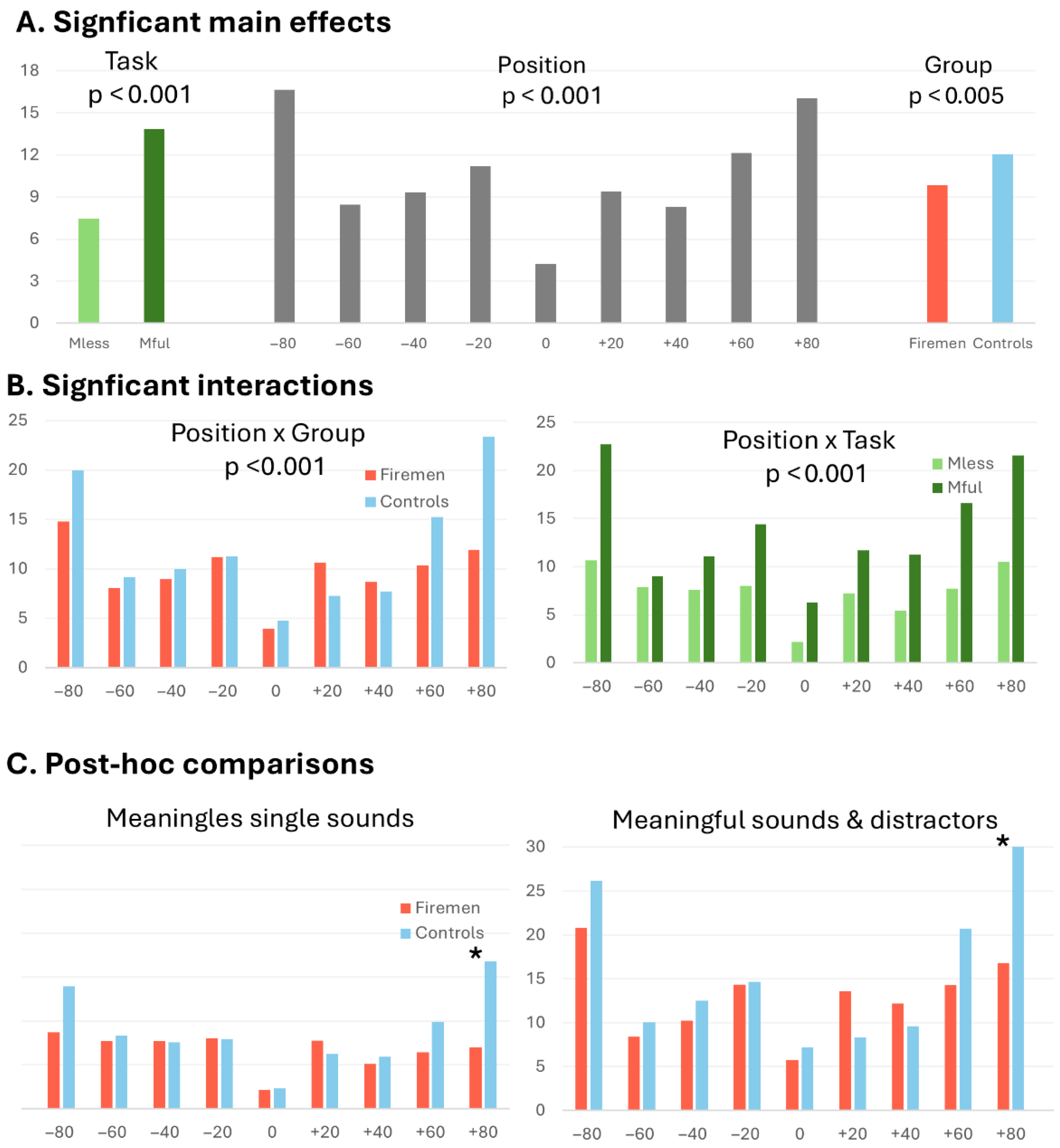
- Professional firefighters perform better than control subjects at localising meaningless sounds that are presented individually in a dark environment.
- (ii)
- Professional firefighters perform better than control subjects at localising meaningful target sounds that are presented in a dark environment at the same time as distractor sounds.
2. Methods
2.1. Participants
2.2. Experimental Design
2.3. Auditory–Spatial Tasks
- (i)
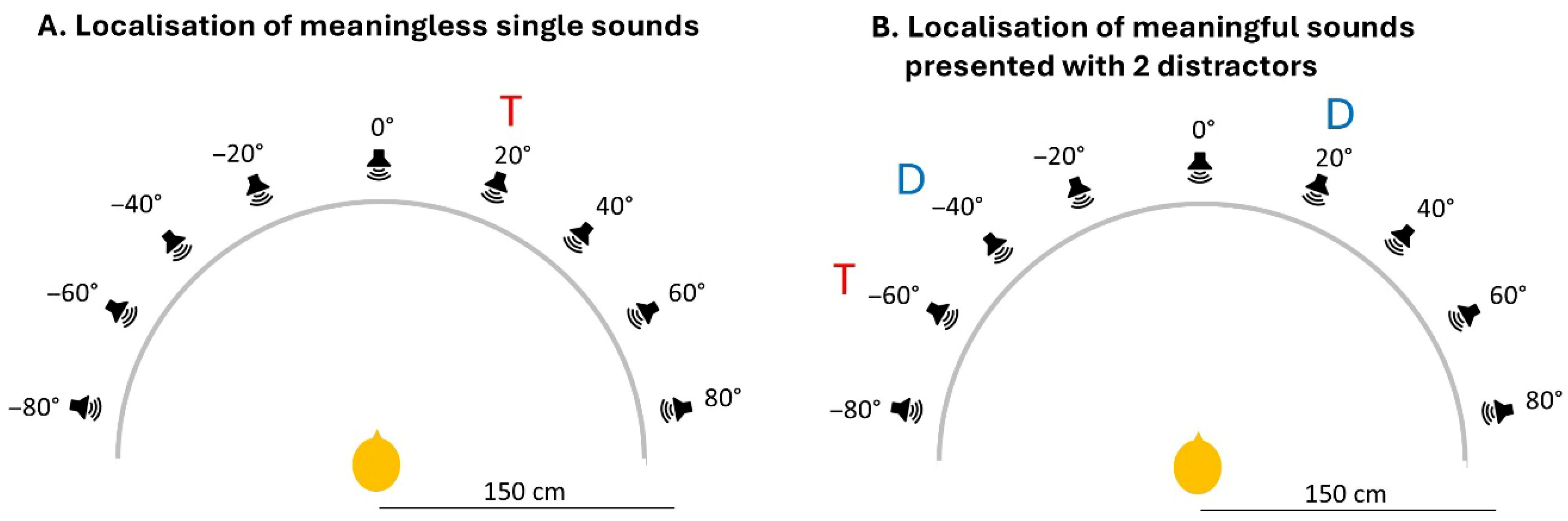
- Localisation of meaningless, single sounds, taken from a battery of 8 different broadband noise samples, all 500 ms in duration, including 10 ms linear rise and fall time. Throughout the trial, sounds were presented in a pseudo-randomised fashion 8 times at each of the 9 positions. The task lasted 6 min and 30 s.
- (ii)
- Localisation of meaningful target sounds, which were presented with two simultaneous distractors. Targets were sounds produced by humans (baby crying, woman screaming, man coughing, woman sneezing, man and woman laughing, man saying “ah” (the vowel), woman saying “la” (the consonant-vowel), baby cooing, woman singing) and distractors—environmental non-human sounds (paper being crumpled, gunshot, door slamming, dog barking, police siren, gong sounding, helicopter, doorbell, glass breaking, food frying, zip being closed). Both sets are part of a validated battery of environmental sounds [16]. Each sound was 500 ms in duration, including 10 ms linear rise and fall time (Audacity 2.1.0 http://audacity.sourceforge.net/ (accessed on 28 April 2026)). The target sound was presented in a pseudo-randomised fashion 9 times at each of the 9 positions. The task lasted 7 min and 40 s.
2.4. Visuo-Spatial and Attentional Tasks
- -
- The phasic alert task, with or without alerting sound, lasting 4.5 min: response times were analysed.
- -
- The Go/No-go task, which lasted 2.75 min: accuracy and response times were analysed.
- -
- The 2-back task, with visually presented numbers, lasting 5 min: accuracy and response times were analysed.
2.5. Statistical Analyses
3. Results
3.1. TAP and Corsi Block Tasks
3.2. Auditory Spatial Tasks
3.3. Explicit Localisation of Meaningless, Single Sounds in a Dark Environment
3.4. Explicit Localisation of Meaningful Target Sounds in a Dark Environment, While Two Simultaneous Distractors Are Presented at Other Positions
4. Discussion
4.1. Firefighters’ Expertise in Locating Sounds
4.2. Auditory Spatial Expertise in Professional Groups
4.3. Dual Contribution of Auditory Spatial Cues
5. Conclusions
Author Contributions
Funding
Institutional Review Board Statement
Informed Consent Statement
Data Availability Statement
Acknowledgments
Conflicts of Interest
References
- Hsiao, G.L.-K.; Tang, C.-H.; Huang, T.-C.; Lin, C.-Y. Firefighter Wayfinding in Dark Environments Monitored by RFID. Fire Technol. 2016, 52, 273–279. [Google Scholar] [CrossRef] [Scilit]
- Shi, Y.; Kang, J.; Xia, P.; Tyagi, O.; Mehta, R.K.; Du, J. Spatial Knowledge and Firefighters’ Wayfinding Performance: A Virtual Reality Search and Rescue Experiment. Saf. Sci. 2021, 139, 105231. [Google Scholar] [CrossRef] [Scilit]
- Lin, B.S.-M.; Lin, C.-Y.; Kung, C.-W.; Lin, Y.-J.; Chou, C.-C.; Chuang, Y.-J.; Hsiao, G.L.-K. Wayfinding of Firefighters in Dark and Complex Environments. Int. J. Environ. Res. Public Health 2021, 18, 8014. [Google Scholar] [CrossRef] [Scilit]
- Clarke, S.; Da Costa, S.; Crottaz-Herbette, S. Dual Representation of the Auditory Space. Brain Sci. 2024, 14, 535. [Google Scholar] [CrossRef] [Scilit]
- Akeroyd, M.A. An Overview of the Major Phenomena of the Localization of Sound Sources by Normal-Hearing, Hearing-Impaired, and Aided Listeners. Trends Hear. 2014, 18, 2331216514560442. [Google Scholar] [CrossRef] [Scilit]
- Blauert, J. Spatial Hearing: The Psychophysics of Human Sound Localization; MIT Press: Cambridge, MA, USA, 1997. [Google Scholar]
- Bregman, A.S. Auditory Scene Analysis: The Perceptual Organization of Sound; MIT Press: Cambridge, MA, USA, 1990. [Google Scholar]
- Drennan, W.R.; Gatehouse, S.; Lever, C. Perceptual Segregation of Competing Speech Sounds: The Role of Spatial Location. J. Acoust. Soc. Am. 2003, 114, 2178–2189. [Google Scholar] [CrossRef] [Scilit]
- Wright, B.A.; Fitzgerald, M.B. Different Patterns of Human Discrimination Learning for Two Interaural Cues to Sound-Source Location. Proc. Natl. Acad. Sci. USA 2001, 98, 12307–12312. [Google Scholar] [CrossRef] [Scilit]
- Rowan, D.; Lutman, M.E. Learning to Discriminate Interaural Time Differences: An Exploratory Study with Amplitude-Modulated Stimuli. Int. J. Audiol. 2006, 45, 513–520. [Google Scholar] [CrossRef] [Scilit]
- Spierer, L.; Tardif, E.; Sperdin, H.; Murray, M.M.; Clarke, S. Learning-Induced Plasticity in Auditory Spatial Representations Revealed by Electrical Neuroimaging. J. Neurosci. 2007, 27, 5474–5483. [Google Scholar] [CrossRef] [Scilit] [PubMed]
- Carlile, S. The Plastic Ear and Perceptual Relearning in Auditory Spatial Perception. Front. Neurosci. 2014, 8, 237. [Google Scholar] [CrossRef] [Scilit] [PubMed]
- Mendonça, C. A Review on Auditory Space Adaptations to Altered Head-Related Cues. Front. Neurosci. 2014, 8, 219. [Google Scholar] [CrossRef] [Scilit]
- Hofman, P.M.; Van Riswick, J.G.; Van Opstal, A.J. Relearning Sound Localization with New Ears. Nat. Neurosci. 1998, 1, 417–421. [Google Scholar] [CrossRef] [Scilit]
- Parise, C.; Gori, M.; Finocchietti, S.; Ernst, M.; Esposito, D.; Tonelli, A. Happy New Ears: Rapid Adaptation to Novel Spectral Cues in Vertical Sound Localization. iScience 2024, 27, 111308. [Google Scholar] [CrossRef] [Scilit]
- Marcell, M.M.; Borella, D.; Greene, M.; Kerr, E.; Rogers, S. Confrontation Naming of Environmental Sounds. J. Clin. Exp. Neuropsychol. 2000, 22, 830–864. [Google Scholar] [CrossRef] [Scilit]
- Zimmermann, P.; Fimm, B. A Test Battery for Attentional Performance. In Applied Neuropsychology of Attention; Psychology Press: East Sussex, UK, 2002. [Google Scholar]
- Corsi, P. Memory and the Medial Temporal Region of the Brain. Ph.D. Thesis, McGill University, Montreal, QB, Canada, 1972. [Google Scholar]
- Holm, S. A Simple Sequentially Rejective Multiple Test Procedure. Scand. J. Stat. 1979, 6, 65–70. [Google Scholar]
- Münte, T.F.; Kohlmetz, C.; Nager, W.; Altenmüller, E. Neuroperception. Superior Auditory Spatial Tuning in Conductors. Nature 2001, 409, 580. [Google Scholar] [CrossRef] [Scilit]
- Münte, T.F.; Nager, W.; Beiss, T.; Schroeder, C.; Altenmüller, E. Specialization of the Specialized: Electrophysiological Investigations in Professional Musicians. Ann. N. Y. Acad. Sci. 2003, 999, 131–139. [Google Scholar] [CrossRef] [Scilit] [PubMed]
- Wright, B.A.; Dai, H. Musicians Have an Advantage on a Spatial-Hearing Task Only When They Are Highly Trained, Start Training Early, and Continue to Play. Hear. Res. 2024, 451, 109078. [Google Scholar] [CrossRef] [Scilit]
- Sherwin, J.; Gaston, J. Soldiers and Marksmen under Fire: Monitoring Performance with Neural Correlates of Small Arms Fire Localization. Front. Hum. Neurosci. 2013, 7, 40771. [Google Scholar] [CrossRef] [Scilit] [PubMed]
- Sherwin, J.S.; Gaston, J.R. Experience Does Not Equal Expertise in Recognizing Infrequent Incoming Gunfire: Neural Markers for Experience and Task Expertise at Peak Behavioral Performance. PLoS ONE 2015, 10, e0115629. [Google Scholar] [CrossRef] [Scilit]
- Ahveninen, J.; Jääskeläinen, I.P.; Raij, T.; Bonmassar, G.; Devore, S.; Hämäläinen, M.; Levänen, S.; Lin, F.-H.; Sams, M.; Shinn-Cunningham, B.G.; et al. Task-Modulated “What” and “Where” Pathways in Human Auditory Cortex. Proc. Natl. Acad. Sci. USA 2006, 103, 14608–14613. [Google Scholar] [CrossRef] [Scilit]
- Alain, C.; Arnott, S.R.; Hevenor, S.; Graham, S.; Grady, C.L. “What” and “Where” in the Human Auditory System. Proc. Natl. Acad. Sci. USA 2001, 98, 12301–12306. [Google Scholar] [CrossRef] [Scilit]
- Anourova, I.; Nikouline, V.V.; Ilmoniemi, R.J.; Hotta, J.; Aronen, H.J.; Carlson, S. Evidence for Dissociation of Spatial and Nonspatial Auditory Information Processing. Neuroimage 2001, 14, 1268–1277. [Google Scholar] [CrossRef] [Scilit]
- Arnott, S.R.; Binns, M.A.; Grady, C.L.; Alain, C. Assessing the Auditory Dual-Pathway Model in Humans. Neuroimage 2004, 22, 401–408. [Google Scholar] [CrossRef] [Scilit]
- Barrett, D.J.K.; Hall, D.A. Response Preferences for “What” and “Where” in Human Non-Primary Auditory Cortex. NeuroImage 2006, 32, 968–977. [Google Scholar] [CrossRef] [Scilit] [PubMed]
- Bergerbest, D.; Ghahremani, D.G.; Gabrieli, J.D.E. Neural Correlates of Auditory Repetition Priming: Reduced fMRI Activation in the Auditory Cortex. J. Cogn. Neurosci. 2004, 16, 966–977. [Google Scholar] [CrossRef] [Scilit] [PubMed]
- De Santis, L.; Clarke, S.; Murray, M.M. Automatic and Intrinsic Auditory “What” and “Where” Processing in Humans Revealed by Electrical Neuroimaging. Cereb. Cortex 2007, 17, 9–17. [Google Scholar] [CrossRef] [Scilit]
- Doehrmann, O.; Naumer, M.J.; Volz, S.; Kaiser, J.; Altmann, C.F. Probing Category Selectivity for Environmental Sounds in the Human Auditory Brain. Neuropsychologia 2008, 46, 2776–2786. [Google Scholar] [CrossRef] [Scilit]
- Griffiths, T.D.; Kumar, S.; Warren, J.D.; Stewart, L.; Stephan, K.E.; Friston, K.J. Approaches to the Cortical Analysis of Auditory Objects. Hear. Res. 2007, 229, 46–53. [Google Scholar] [CrossRef] [Scilit] [PubMed]
- Hall, A.J.; Butler, B.E.; Lomber, S.G. The Cat’s Meow: A High-Field fMRI Assessment of Cortical Activity in Response to Vocalizations and Complex Auditory Stimuli. Neuroimage 2016, 127, 44–57. [Google Scholar] [CrossRef] [Scilit]
- Hart, H.C.; Palmer, A.R.; Hall, D.A. Different Areas of Human Non-Primary Auditory Cortex Are Activated by Sounds with Spatial and Nonspatial Properties. Hum. Brain Mapp. 2004, 21, 178–190. [Google Scholar] [CrossRef] [Scilit]
- Johnson, B.W.; Hautus, M.J.; Hayns, A.L.; Fitzgibbon, B.M. Differential Cortical Processing of Location and Pitch Changes in Dichotic Pitch. NeuroReport 2006, 17, 389. [Google Scholar] [CrossRef] [Scilit]
- Maeder, P.P.; Meuli, R.A.; Adriani, M.; Bellmann, A.; Fornari, E.; Thiran, J.P.; Pittet, A.; Clarke, S. Distinct Pathways Involved in Sound Recognition and Localization: A Human fMRI Study. Neuroimage 2001, 14, 802–816. [Google Scholar] [CrossRef] [Scilit] [PubMed]
- Warren, J.D.; Griffiths, T.D. Distinct Mechanisms for Processing Spatial Sequences and Pitch Sequences in the Human Auditory Brain. J. Neurosci. 2003, 23, 5799–5804. [Google Scholar] [CrossRef] [Scilit]
- Adriani, M.; Maeder, P.; Meuli, R.; Thiran, A.B.; Frischknecht, R.; Villemure, J.-G.; Mayer, J.; Annoni, J.-M.; Bogousslavsky, J.; Fornari, E.; et al. Sound Recognition and Localization in Man: Specialized Cortical Networks and Effects of Acute Circumscribed Lesions. Exp. Brain Res. 2003, 153, 591–604. [Google Scholar] [CrossRef] [Scilit] [PubMed]
- Clarke, S.; Bellmann, A.; Meuli, R.A.; Assal, G.; Steck, A.J. Auditory Agnosia and Auditory Spatial Deficits Following Left Hemispheric Lesions: Evidence for Distinct Processing Pathways. Neuropsychologia 2000, 38, 797–807. [Google Scholar] [CrossRef] [Scilit] [PubMed]
- Clarke, S.; Bellmann Thiran, A.; Maeder, P.; Adriani, M.; Vernet, O.; Regli, L.; Cuisenaire, O.; Thiran, J.-P. What and Where in Human Audition: Selective Deficits Following Focal Hemispheric Lesions. Exp. Brain Res. 2002, 147, 8–15. [Google Scholar] [CrossRef] [Scilit]
- Rey, B.; Frischknecht, R.; Maeder, P.; Clarke, S. Patterns of Recovery Following Focal Hemispheric Lesions: Relationship between Lasting Deficit and Damage to Specialized Networks. Restor. Neurol. Neurosci. 2007, 25, 285–294. [Google Scholar] [CrossRef] [Scilit]
- Zatorre, R.J.; Penhune, V.B. Spatial Localization after Excision of Human Auditory Cortex. J. Neurosci. 2001, 21, 6321–6328. [Google Scholar] [CrossRef] [Scilit]
- Zündorf, I.C.; Lewald, J.; Karnath, H.-O. Testing the Dual-Pathway Model for Auditory Processing in Human Cortex. Neuroimage 2016, 124, 672–681. [Google Scholar] [CrossRef] [Scilit]
- Thiran, A.B.; Clarke, S. Preserved Use of Spatial Cues for Sound Segregation in a Case of Spatial Deafness. Neuropsychologia 2003, 41, 1254–1261. [Google Scholar] [CrossRef] [Scilit]
- Tissieres, I.; Crottaz-Herbette, S.; Clarke, S. Implicit Representation of the Auditory Space: Contribution of the Left and Right Hemispheres. Brain Struct. Funct. 2019, 224, 1569–1582. [Google Scholar] [CrossRef] [Scilit]
- Clarke, S.; Geiser, E. Roaring Lions and Chirruping Lemurs: How the Brain Encodes Sound Objects in Space. Neuropsychologia 2015, 75, 304–313. [Google Scholar] [CrossRef] [Scilit]
- Da Costa, S.; Clarke, S.; Crottaz-Herbette, S. Keeping Track of Sound Objects in Space: The Contribution of Early-Stage Auditory Areas. Hear. Res. 2018, 366, 17–31. [Google Scholar] [CrossRef] [Scilit]
- Brunetti, M.; Belardinelli, P.; Caulo, M.; Del Gratta, C.; Della Penna, S.; Ferretti, A.; Lucci, G.; Moretti, A.; Pizzella, V.; Tartaro, A.; et al. Human Brain Activation during Passive Listening to Sounds from Different Locations: An fMRI and MEG Study. Hum. Brain Mapp. 2005, 26, 251–261. [Google Scholar] [CrossRef] [Scilit]
- Grady, C.L.; Charlton, R.; He, Y.; Alain, C. Age Differences in FMRI Adaptation for Sound Identity and Location. Front. Hum. Neurosci. 2011, 5, 24. [Google Scholar] [CrossRef] [Scilit]
- Smith, K.R.; Hsieh, I.-H.; Saberi, K.; Hickok, G. Auditory Spatial and Object Processing in the Human Planum Temporale: No Evidence for Selectivity. J. Cogn. Neurosci. 2010, 22, 632–639. [Google Scholar] [CrossRef] [Scilit]
- Altmann, C.F.; Bledowski, C.; Wibral, M.; Kaiser, J. Processing of Location and Pattern Changes of Natural Sounds in the Human Auditory Cortex. Neuroimage 2007, 35, 1192–1200. [Google Scholar] [CrossRef] [Scilit]
- Bourquin, N.M.-P.; Murray, M.M.; Clarke, S. Location-Independent and Location-Linked Representations of Sound Objects. Neuroimage 2013, 73, 40–49. [Google Scholar] [CrossRef] [Scilit]
- Grisendi, T.; Clarke, S.; Da Costa, S. Emotional Sounds in Space: Asymmetrical Representation within Early-Stage Auditory Areas. Front. Neurosci. 2023, 17, 1164334. [Google Scholar] [CrossRef] [Scilit]
- Kryklywy, J.H.; Macpherson, E.A.; Greening, S.G.; Mitchell, D.G.V. Emotion Modulates Activity in the “what” but Not “Where” Auditory Processing Pathway. Neuroimage 2013, 82, 295–305. [Google Scholar] [CrossRef] [Scilit] [PubMed]
- Kryklywy, J.H.; Macpherson, E.A.; Mitchell, D.G.V. Decoding Auditory Spatial and Emotional Information Encoding Using Multivariate versus Univariate Techniques. Exp. Brain Res. 2018, 236, 945–953. [Google Scholar] [CrossRef] [Scilit]
- Spierer, L.; Bellmann-Thiran, A.; Maeder, P.; Murray, M.M.; Clarke, S. Hemispheric Competence for Auditory Spatial Representation. Brain 2009, 132, 1953–1966. [Google Scholar] [CrossRef] [Scilit] [PubMed]
- Duffour-Nikolov, C.; Tardif, E.; Maeder, P.; Thiran, A.B.; Bloch, J.; Frischknecht, R.; Clarke, S. Auditory Spatial Deficits Following Hemispheric Lesions: Dissociation of Explicit and Implicit Processing. Neuropsychol. Rehabil. 2012, 22, 674–696. [Google Scholar] [CrossRef] [Scilit] [PubMed]



| Task | Scores | Statistical Comparison (p) | |
|---|---|---|---|
| Professional Firefighters | Control Subjects | ||
| Alertness task, TAP battery | |||
| Response time without sound alert [ms] | 230 ± 30 | 240 ± 38 | 0.296 |
| Response time with sound alert [ms] | 232 ± 37 | 238 ± 36 | 0.493 |
| Inhibition Go/No-Go task, TAP battery | |||
| Response time [ms] | 398 ± 61 | 394 ± 60 | 0.801 |
| Accuracy [%] | 100% ± 10% | 99% ± 6% | 0.307 |
| Verbal working memory 2-back task, TAP battery | |||
| Response time [ms] | 691 ± 178 | 702 ± 121 | 0.784 |
| Accuracy [%] | 80% ± 20% | 89% ± 14% | 0.055 |
| Spatial working memory Corsi Block-Tapping task | |||
| Span | 6.3 ± 1.4 | 6.8 ± 1.2 | 0.237 |
Disclaimer/Publisher’s Note: The statements, opinions and data contained in all publications are solely those of the individual author(s) and contributor(s) and not of MDPI and/or the editor(s). MDPI and/or the editor(s) disclaim responsibility for any injury to people or property resulting from any ideas, methods, instructions or products referred to in the content. |
© 2026 by the authors. Licensee MDPI, Basel, Switzerland. This article is an open access article distributed under the terms and conditions of the Creative Commons Attribution (CC BY) license.
Share and Cite
Tissieres, I.; Clarke, S.; Crottaz-Herbette, S. Firefighters’ Expertise in Locating Sounds. Brain Sci. 2026, 16, 492. https://doi.org/10.3390/brainsci16050492
Tissieres I, Clarke S, Crottaz-Herbette S. Firefighters’ Expertise in Locating Sounds. Brain Sciences. 2026; 16(5):492. https://doi.org/10.3390/brainsci16050492
Chicago/Turabian StyleTissieres, Isabel, Stephanie Clarke, and Sonia Crottaz-Herbette. 2026. "Firefighters’ Expertise in Locating Sounds" Brain Sciences 16, no. 5: 492. https://doi.org/10.3390/brainsci16050492
APA StyleTissieres, I., Clarke, S., & Crottaz-Herbette, S. (2026). Firefighters’ Expertise in Locating Sounds. Brain Sciences, 16(5), 492. https://doi.org/10.3390/brainsci16050492