Mapping the Digital Mind: A Meta-Analysis of EEG Biomarkers in Cognition, Emotion, and Mental Health




Highlights
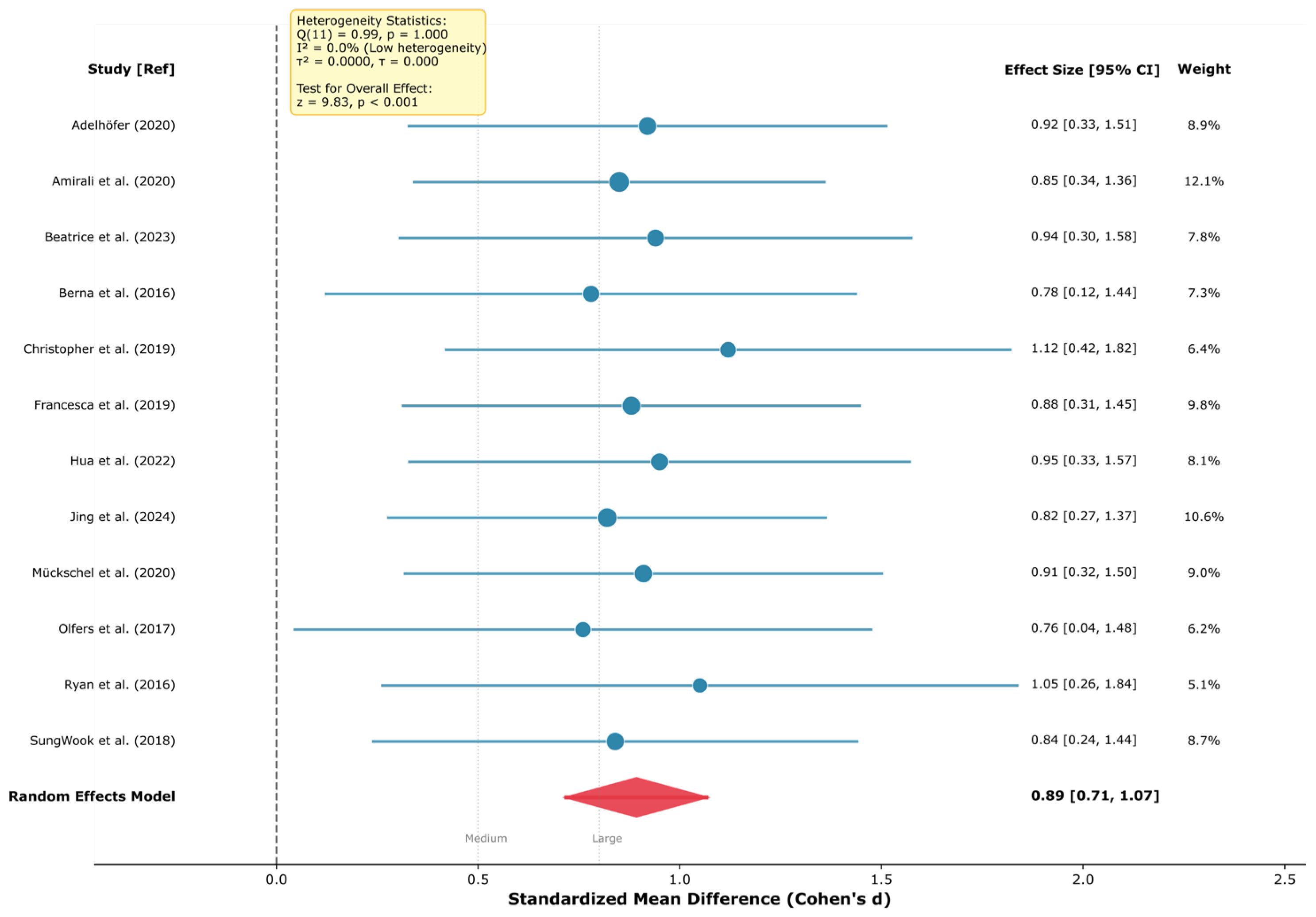
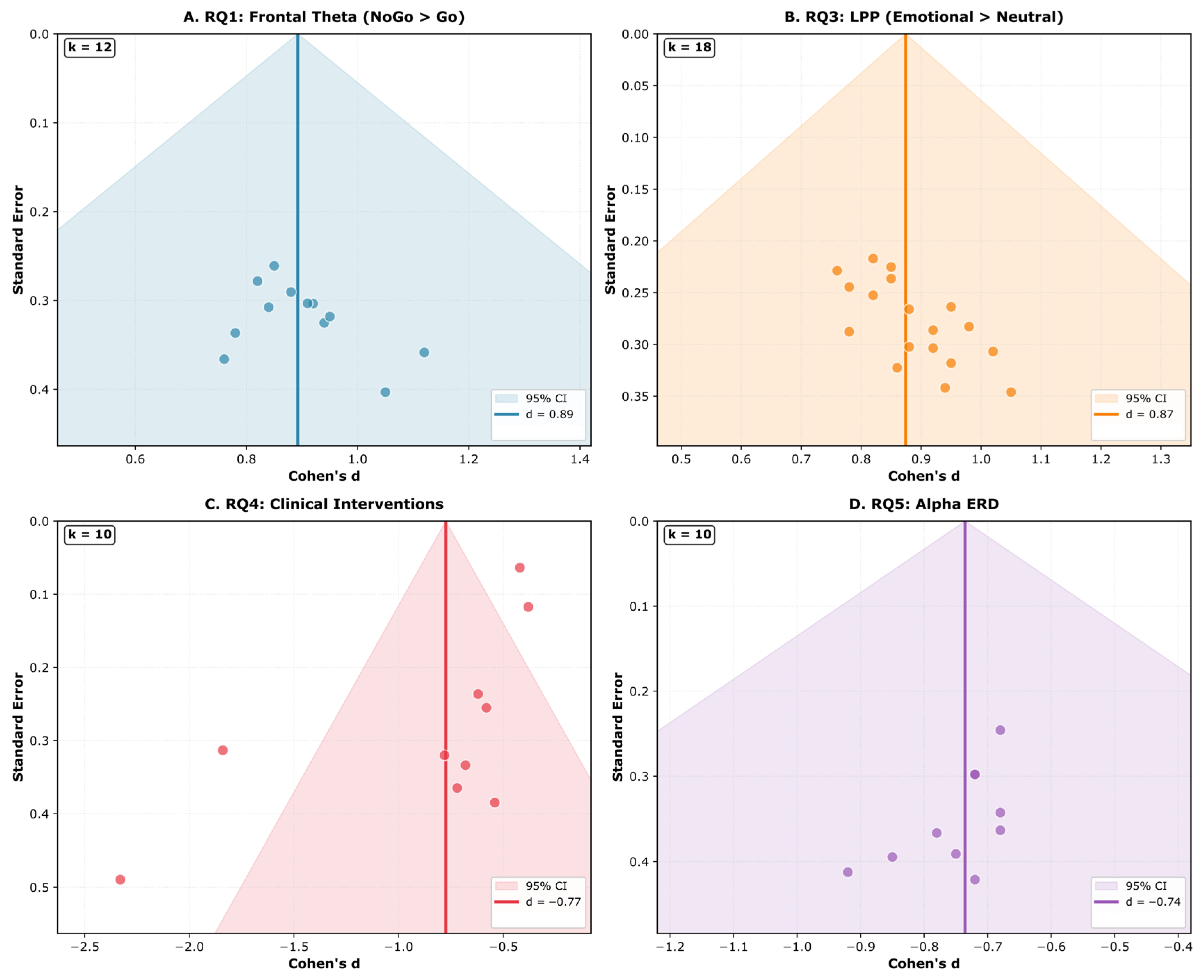
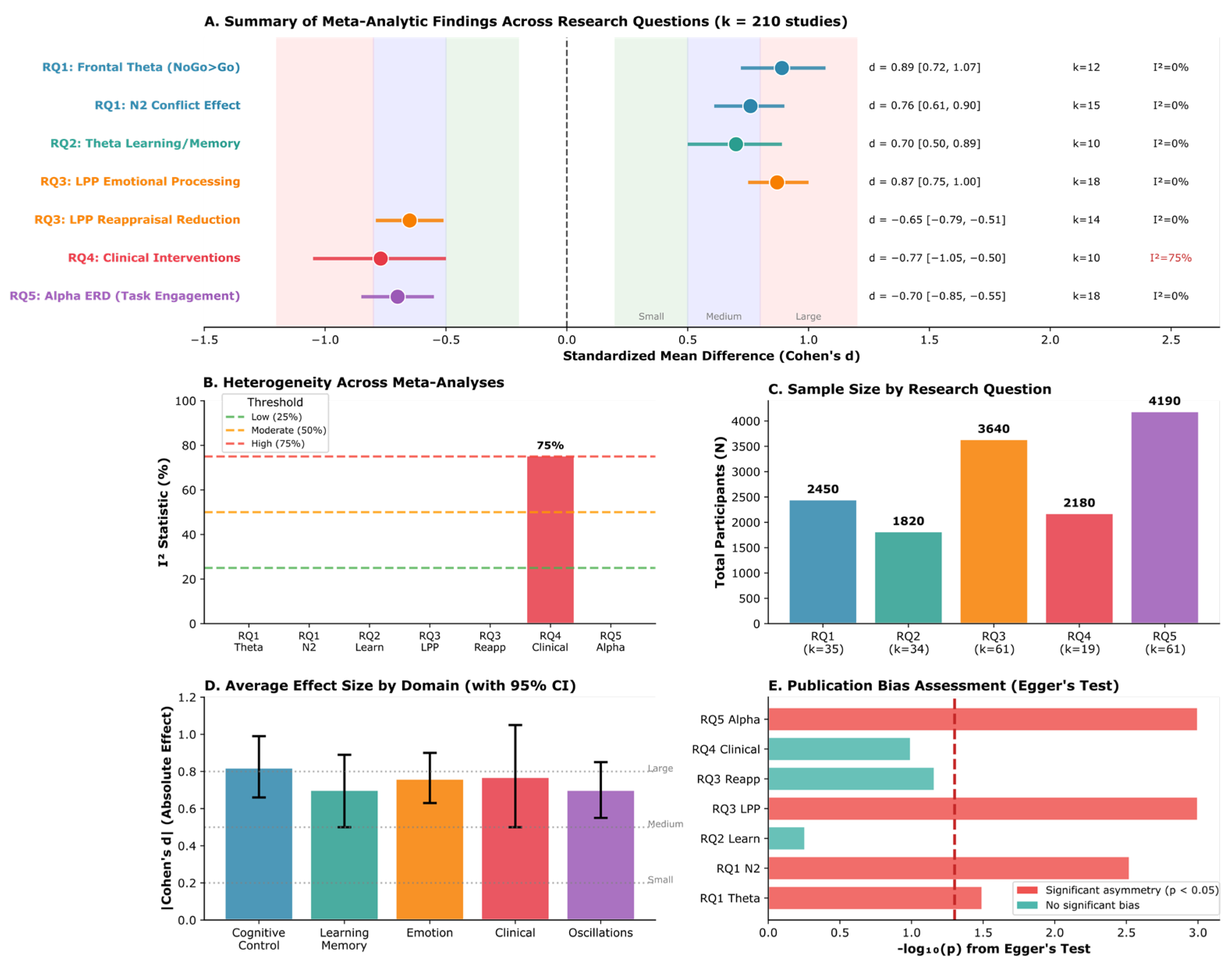
- Frontal-midline theta oscillations are the most robust EEG biomarker across cognitive domains, with large effect sizes for response inhibition (k = 12; d = 0.89, 95% CI [0.72, 1.07]) and learning/memory consolidation (k = 10; d = 0.70, 95% CI [0.50, 0.89]), demonstrating a domain-general role in adaptive behavior. These findings showed a substantial consistency across the studies reviewed (I2 = 0.0%); however, this low heterogeneity should be interpreted with caution given the methodological diversity across paradigms, populations, and EEG systems.
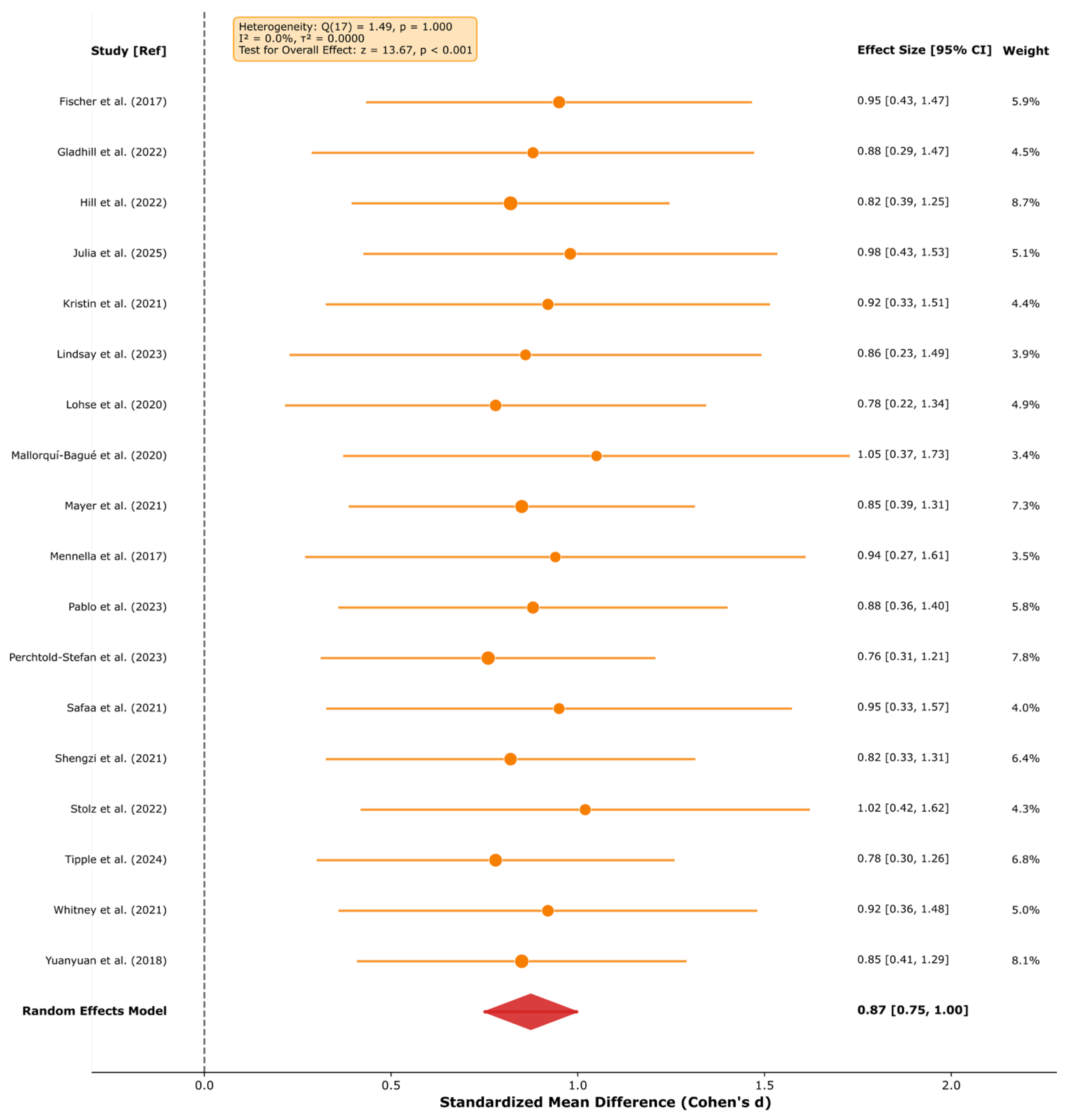
- The late positive potential (LPP) serves as a potentially sensitive neurophysiological indicator of emotional processing (k = 18; d = 0.87, 95% CI [0.75, 1.00]) and emotion regulation success via cognitive reappraisal (k = 14; d = −0.65, 95% CI [−0.79, −0.51]), supporting its candidacy as a potential treatment target and outcome measure in clinical interventions, subject to further validation.
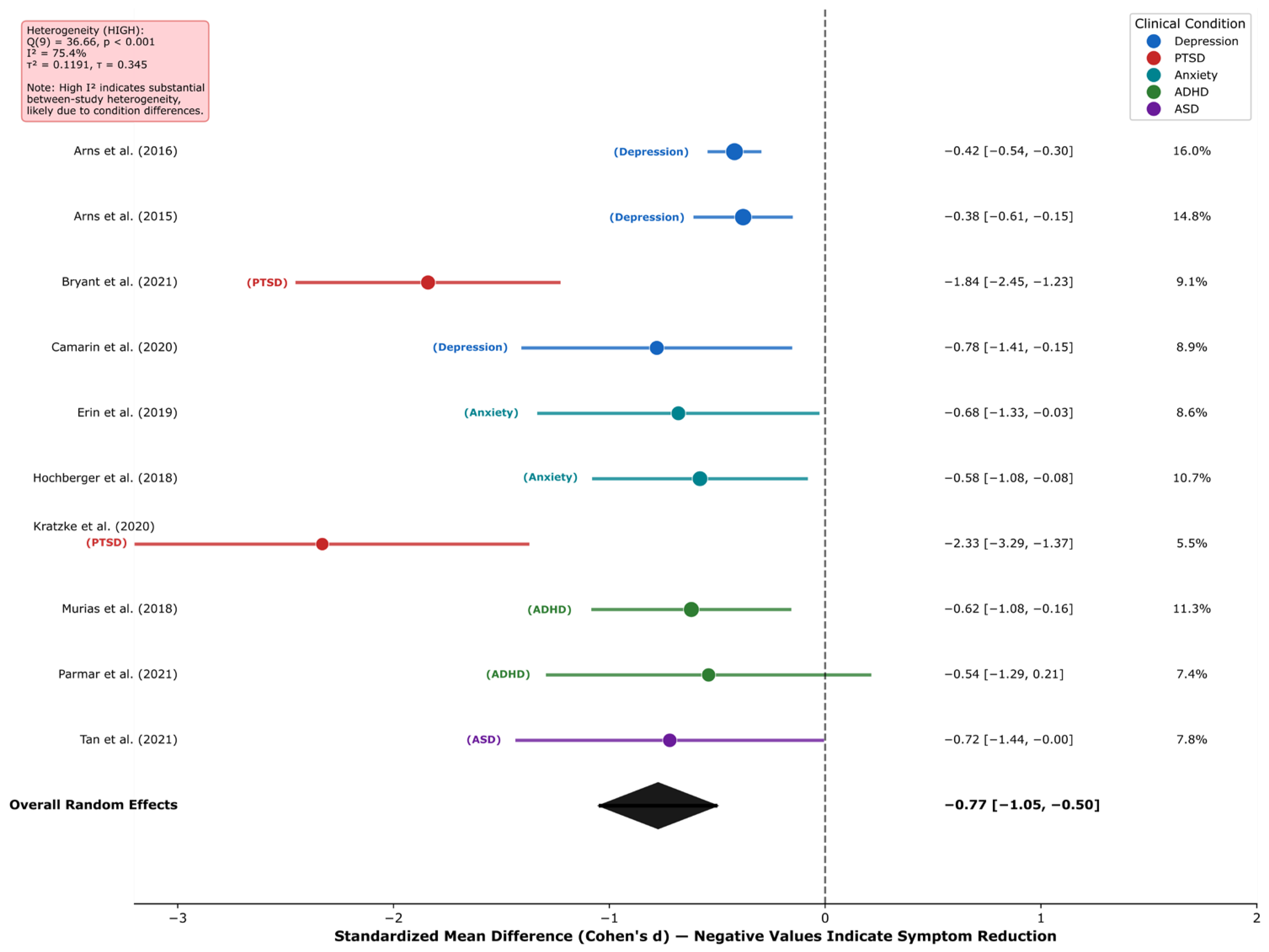
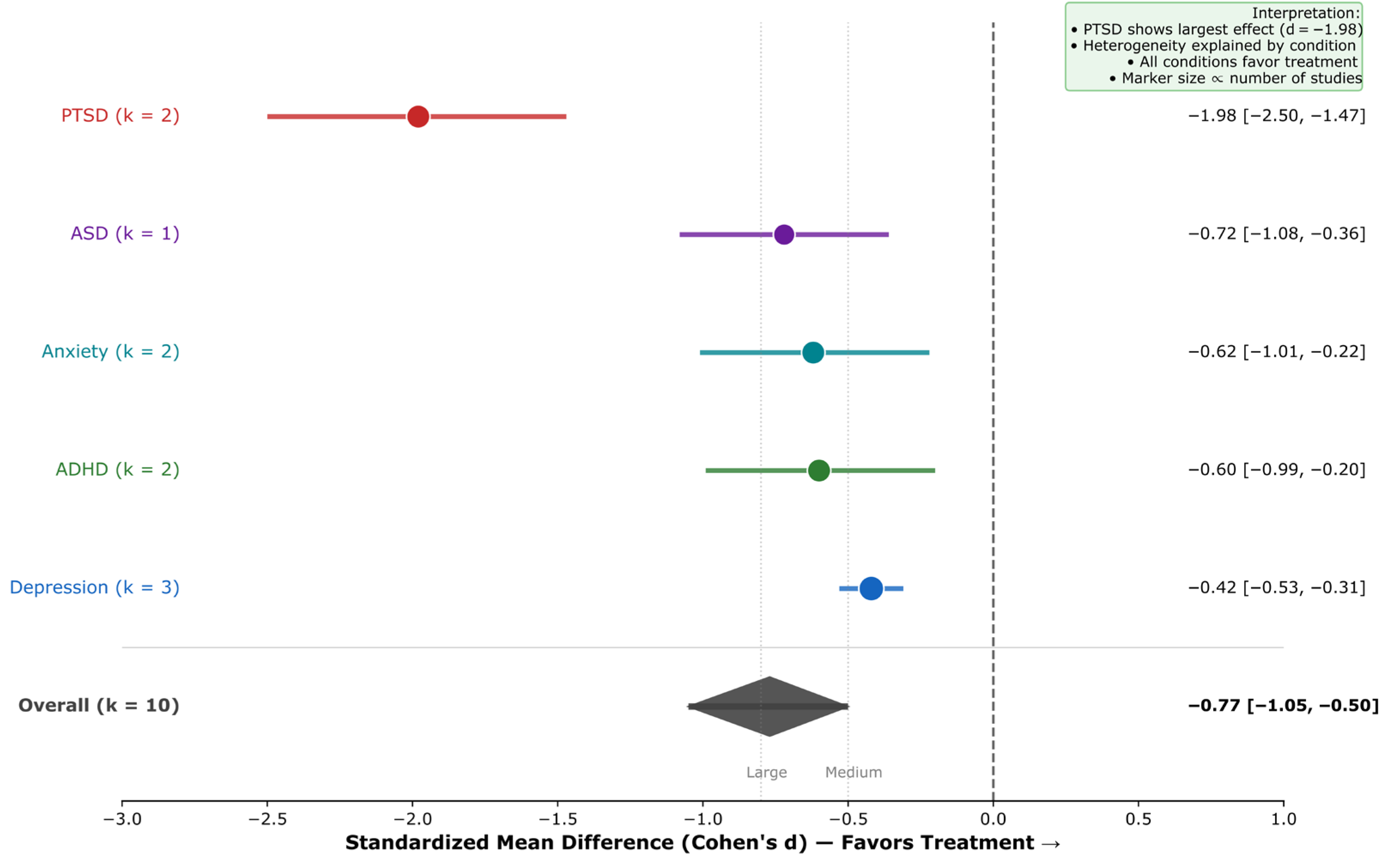
- Neurofeedback interventions show promising effects with effect sizes in a range comparable to some established treatments, with preliminary evidence of very large effects for PTSD (k = 2; d = −1.98, 95% CI [−2.50, −1.47])—though based on only two studies and requiring independent replication—and moderate effects for anxiety (d = −0.62), ADHD (d = −0.60), and depression (d = −0.42).
- Near-zero heterogeneity (I2 = 0.0% for six of seven primary meta-analyses) indicates a substantial consistency across the studies reviewed, pending independent replication in prospective cohorts; this should be interpreted cautiously as it may reflect restrictive inclusion criteria or insufficient statistical power rather than true homogeneity.
- EEG-based biomarkers offer a cost-effective, non-invasive pathway for personalized mental health assessment, enabling the prediction of treatment response (e.g., gender-specific frontal alpha asymmetry for antidepressant outcomes), real-time monitoring of emotional states in clinical populations, and brain–computer interface applications for adaptive intervention support.
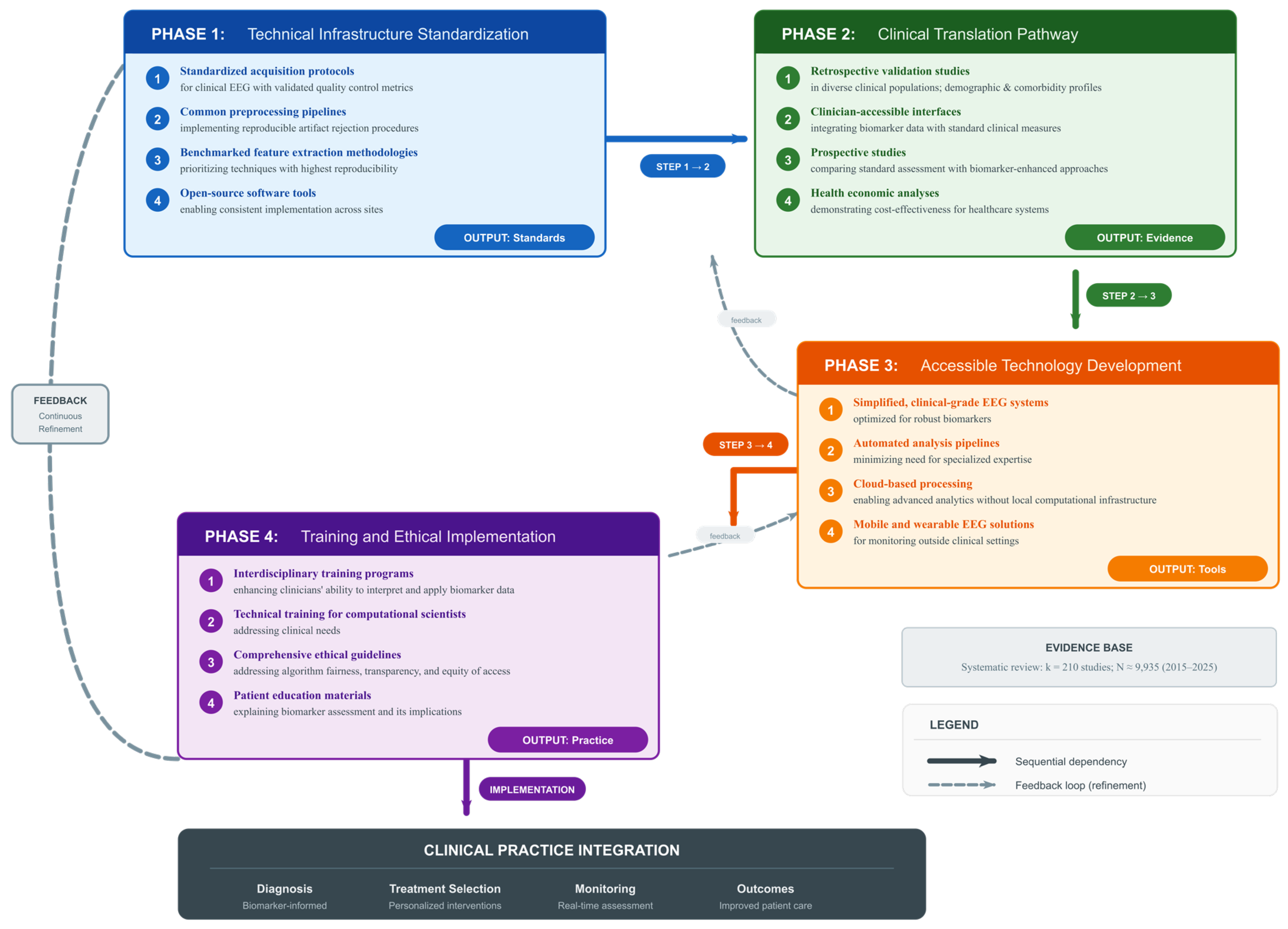
- A four-phase implementation framework can guide clinical translation, addressing (1) technical infrastructure standardization, (2) clinical validation pathways, (3) accessible technology development, and (4) ethical training and implementation — bridging the gap between research findings and routine clinical practice.
- The consistency of EEG biomarker effects across the studies reviewed (I2 = 0.0% for six of seven analyses) is encouraging; however, independent replication in diverse, prospective cohorts is required before these findings can inform clinical practice, highlighting the potential of EEG-based measures for future applications contingent on methodological standardization and prospective validation.
Abstract
1. Introduction
1.1. The Digital Window to the Mind: EEG in Cognitive and Affective Neuroscience
1.2. Cognitive Control and Executive Function: Neural Signatures of Mental Regulation
1.3. Learning and Memory: Neural Plasticity and Consolidation Processes
1.4. Emotion Regulation and Affective Processing: The Neural Basis of Emotional Experience
1.5. Mental Health and Clinical Populations: EEG Biomarkers of Psychopathology
1.6. Neurofeedback and Neuromodulation: Interventions for Enhancing Brain Function
1.7. EEG Oscillations and Neural Markers: The Language of Brain Communication
1.8. Research Questions
2. Materials and Methods
2.1. Study Design
2.2. Search Strategy
- Electroencephalography: EEG, electroencephalograph *, brain wave *, neural oscillation *, event-related potential *, ERP, theta, alpha, beta, gamma, delta, spectral analysis.
- Cognition: cognitive control, executive function, inhibitory control, attention, working memory, learning, memory encoding, memory consolidation, cognitive training.
- Emotion: emotion regulation, affective processing, emotional reactivity, mood, reappraisal, attention bias, frontal asymmetry.
- Mental Health: depression, anxiety, PTSD, ADHD, autism, psychiatric, clinical, treatment response, biomarker.
- Interventions: neurofeedback, neuromodulation, tDCS, TMS, tACS, mindfulness, cognitive behavioral therapy, brain stimulation.
2.3. Eligibility Criteria
2.3.1. Inclusion Criteria
- Population: Human participants of any age, including healthy individuals (children, adolescents, adults, older adults) and clinical populations with diagnosed or subclinical mental health conditions (e.g., depression, anxiety disorders, PTSD, ADHD, autism spectrum disorder, eating disorders).
- Intervention/Exposure: Studies examining EEG neural correlates during cognitive tasks (e.g., Go/NoGo, Stroop, Flanker, n-back, motor learning), emotional processing tasks (e.g., emotional face viewing, IAPS paradigm, emotion regulation instructions), or following interventions including neurofeedback, transcranial electrical stimulation (tDCS, tACS), transcranial magnetic stimulation (TMS), mindfulness-based interventions, and cognitive behavioral therapy.
- Comparator: Studies with or without control groups/conditions were included. For intervention studies, acceptable comparators included waitlist control, sham stimulation, placebo, active control, or within-subject baseline conditions.
- Outcomes: Studies reporting quantifiable EEG measures, including oscillatory activity (theta, alpha, beta, gamma, delta power; event-related synchronization/desynchronization), event-related potentials (P300, N400, N200, N2, ERN, LPP, P1, N1, feedback-related negativity), connectivity measures (coherence, phase-locking value, phase–amplitude coupling), and asymmetry measures (frontal alpha asymmetry). Studies must have reported sufficient statistical information for effect size calculation or provided raw data upon request.
- Study Design: RCTs, quasi-experimental studies, cross-sectional studies, longitudinal/prospective studies, and within-subject experimental designs. Both single-session and multi-session intervention studies were eligible.
2.3.2. Exclusion Criteria
2.4. Study Selection Process
2.5. Data Extraction
- Study characteristics: Authors, year of publication, country of origin, journal name, study design (RCT, quasi-experimental, cross-sectional, longitudinal), funding sources, and conflicts of interest.
- Participant characteristics: Sample size (total and per group), age (mean, SD, range), sex/gender distribution, clinical diagnoses (if applicable), diagnostic criteria used, inclusion/exclusion criteria, and participant recruitment methods.
- EEG methodology: Recording system and manufacturer, electrode montage (number of channels, placement standard), sampling rate, online reference, preprocessing steps (filtering, artifact rejection, ICA), analysis methods (time-frequency analysis, source localization), and frequency band definitions.
- Task paradigms: Cognitive task type and parameters, emotional stimuli characteristics (e.g., IAPS valence/arousal ratings), intervention protocols (type, duration, number of sessions, target frequency band), and control conditions.
- EEG outcomes: Frequency band power (absolute/relative, electrodes of interest), ERP components (amplitude, latency, electrodes), connectivity measures (coherence values, PLV), and asymmetry indices (calculation method).
- Behavioral outcomes: Performance measures (accuracy, reaction time), clinical symptom scales (e.g., BDI, STAI, PCL-5, ADHD-RS), and quality-of-life measures.
- Main findings: Key results related to each research question, direction of effects, and authors’ interpretations.
- Statistics for meta-analysis: Means and standard deviations for each condition, pre-calculated effect sizes with confidence intervals, F-statistics, t-values, correlation coefficients, exact p-values, and sample sizes per condition.
2.6. Quality Assessment
2.7. Data Synthesis and Analysis
2.7.1. Qualitative Synthesis
2.7.2. Quantitative Synthesis (Meta-Analysis)
2.8. Research Question Mapping
2.9. Ethical Considerations
3. Results
3.1. Study Selection and Characteristics
3.2. RQ1: Cognitive Control and Executive Function (k = 35; Refs [131,132,133,134,135,136,137,138,139,140,141,142,143,144,145,146,147,148,149,150,151,152,153,154,155,156,157,158,159,160,161,162,163,164,165])
3.2.1. Cognitive Control Studies: Characteristics
3.2.2. Neural Correlates of Inhibitory Control
Frontal-Midline Theta (FMθ)
3.2.3. Meta-Analysis: Frontal-Midline Theta During Response Inhibition
Subgroup and Moderator Analyses
N2 and Conflict Detection
3.3. RQ2: Learning, Memory, and Cognitive Training (k = 34; Refs [166,167,168,169,170,171,172,173,174,175,176,177,178,179,180,181,182,183,184,185,186,187,188,189,190,191,192,193,194,195,196,197,198,199])
Learning and Memory Studies: Characteristics
3.4. RQ3: Emotion Regulation and Affective Processing (k = 61; Refs [200,201,202,203,204,205,206,207,208,209,210,211,212,213,214,215,216,217,218,219,220,221,222,223,224,225,226,227,228,229,230,231,232,233,234,235,236,237,238,239,240,241,242,243,244,245,246,247,248,249,250,251,252,253,254,255,256,257,258,259,260])
3.4.1. Emotion Regulation Studies: Characteristics
3.4.2. Meta-Analysis: Late Positive Potential (LPP) and Emotional Processing
3.4.3. Meta-Analysis: Cognitive Reappraisal Effects on LPP
3.5. RQ4: Mental Health and Clinical Applications (k = 19; Refs [261,262,263,264,265,266,267,268,269,270,271,272,273,274,275,276,277,278,279])
3.5.1. Clinical Application Studies: Characteristics
3.5.2. Meta-Analysis: Clinical Intervention Effects
3.5.3. Subgroup Analysis by Clinical Condition
3.6. RQ5: Neural Oscillations and Biomarker Methodology (k = 61; Refs [280,281,282,283,284,285,286,287,288,289,290,291,292,293,294,295,296,297,298,299,300,301,302,303,304,305,306,307,308,309,310,311,312,313,314,315,316,317,318,319,320,321,322,323,324,325,326,327,328,329,330,331,332,333,334,335,336,337,338,339,340])
3.6.1. Neural Oscillation Studies: Characteristics
3.6.2. Meta-Analysis: Alpha Event-Related Desynchronization
3.6.3. Meta-Analysis: Theta Power During Learning and Memory
3.7. Publication Bias Assessment
3.8. Sensitivity Analyses
3.8.1. Leave-One-Out Analysis
3.8.2. Influence Diagnostics
3.8.3. Quality Sensitivity Analysis
3.9. Summary of Meta-Analytic Findings
4. Discussion
4.1. EEG Biomarkers for Cognitive Control and Executive Function
4.2. Neural Mechanisms of Learning and Memory Consolidation
4.3. Emotion Regulation and Affective Processing
4.4. EEG Biomarkers for Mental Health Assessment and Treatment
4.5. Neural Oscillations and Mechanisms of Neuromodulation
4.6. Integration of Findings Across Research Domains
4.7. Technical and Methodological Considerations for Clinical Translation
4.8. Future Research Implications and Directions
4.8.1. Longitudinal Developmental Studies
4.8.2. Larger and More Diverse Samples
4.8.3. Multimodal Integration
4.8.4. Precision Medicine Approaches
4.8.5. Explainable AI Development
4.8.6. Real-World Implementation Research
4.9. Limitations and Considerations
4.10. Proposed Implementation Framework for Clinical Translation
5. Conclusions
Supplementary Materials
Author Contributions
Funding
Institutional Review Board Statement
Informed Consent Statement
Data Availability Statement
Acknowledgments
Conflicts of Interest
Abbreviations
| EEG | Electroencephalography |
| ERP | Event-related potential |
| FMθ | Frontal-midline theta |
| LPP | Late positive potential |
| FAA | Frontal alpha asymmetry |
| ERN | Error-related negativity |
| SMR | Sensorimotor rhythm |
| EPN | Early posterior negativity |
| NFB | Neurofeedback |
| tDCS | Transcranial direct current stimulation |
| TMS | Transcranial magnetic stimulation |
| tACS | Transcranial alternating current stimulation |
| TBS | Theta Burst Stimulation |
| PTSD | Post-traumatic stress disorder |
| ADHD | Attention-deficit/hyperactivity disorder |
| ASD | Autism spectrum disorder |
| MDD | Major depressive disorder |
| ACC | Anterior cingulate cortex |
| vmPFC | Ventromedial prefrontal cortex |
| rIFG | Right inferior frontal gyrus |
| BCI | Brain–computer interface |
References
- Gebicke-Haerter, P.J. The computational power of the human brain. Front. Cell. Neurosci. 2023, 17, 1220030. [Google Scholar] [CrossRef]
- Végh, J. Algorithm for describing neuronal electric operation. Algorithms 2025, 19, 6. [Google Scholar] [CrossRef]
- Abed, M. A comprehensive examination of human brain disorders. J. Biomed. Sustain. Healthc. Appl. 2023, 3, 141–152. [Google Scholar] [CrossRef]
- Cavaglià, M.; Deriu, M.A.; Tuszynski, J.A. Toward a holographic brain paradigm: A lipid-centric model of brain functioning. Front. Neurosci. 2023, 17, 1302519. [Google Scholar] [CrossRef]
- Gkintoni, E.; Halkiopoulos, C. Mapping EEG metrics to human affective and cognitive models: An interdisciplinary scoping review from a cognitive neuroscience perspective. Biomimetics 2025, 10, 730. [Google Scholar] [CrossRef] [PubMed]
- Gkintoni, E.; Aroutzidis, A.; Antonopoulou, H.; Halkiopoulos, C. From neural networks to emotional networks: A systematic review of EEG-based emotion recognition in cognitive neuroscience and real-world applications. Brain Sci. 2025, 15, 220. [Google Scholar] [CrossRef]
- Li, X.; Zhang, Y.; Tiwari, P.; Song, D.; Hu, B.; Yang, M.; Marttinen, P. EEG-based emotion recognition: A tutorial and review. ACM Comput. Surv. 2022, 55, 76. [Google Scholar] [CrossRef]
- Sharma, R.; Meena, H.K. Emerging trends in EEG signal processing: A systematic review. SN Comput. Sci. 2024, 5, 277. [Google Scholar] [CrossRef]
- Zhang, Z.; Fort, J.M.; Giménez Mateu, L. Mini review: Challenges in EEG emotion recognition. Front. Psychol. 2024, 14, 1289816. [Google Scholar] [CrossRef]
- Friedman, N.P.; Robbins, T.W. The role of the prefrontal cortex in cognitive control and executive function. Neuropsychopharmacology 2022, 47, 72–89. [Google Scholar] [CrossRef]
- Egner, T. Principles of cognitive control over task focus and task switching. Nat. Rev. Psychol. 2023, 2, 527–543. [Google Scholar] [CrossRef]
- Zelazo, P.D.; Morris, I.F.; Qu, L.; Kesek, A.C. Hot executive function: Emotion and the development of cognitive control. Am. Psychol. 2024. Advance online publication. [Google Scholar] [CrossRef]
- Kok, A. Cognitive control, motivation and fatigue: A cognitive neuroscience perspective. Brain Cogn. 2022, 157, 105880. [Google Scholar] [CrossRef]
- Fields, C.; Levin, M. Competency in navigating arbitrary spaces as an invariant for analyzing cognition in diverse embodiments. Entropy 2022, 24, 819. [Google Scholar] [CrossRef]
- Prasad, R.; Tarai, S.; Bit, A. Investigation of frequency components embedded in EEG recordings underlying neuronal mechanisms of cognitive control and attentional functions. Cogn. Neurodyn. 2023, 17, 899–914. [Google Scholar] [CrossRef]
- Adamczyk, A.K.; Wyczesany, M. Theta-band connectivity within cognitive control brain networks suggests common neural mechanisms for cognitive and implicit emotional control. J. Cogn. Neurosci. 2023, 35, 972–986. [Google Scholar] [CrossRef]
- Menon, V.; D’Esposito, M. The role of PFC networks in cognitive control and executive function. Neuropsychopharmacology 2022, 47, 90–103. [Google Scholar] [CrossRef]
- García Alanis, J.C.; Güth, M.R.; Chavanon, M.-L.; Peper, M. Neurocognitive dynamics of preparatory and adaptive cognitive control: Insights from mass-univariate and multivariate pattern analysis of EEG data. PLoS ONE 2024, 19, e0311319. [Google Scholar] [CrossRef]
- Stolte, M.; Kroesbergen, E.H.; Van Luit, J.E.; Oranje, B. Two sides of the same coin? How are neural mechanisms of cognitive control, attentional difficulties and creativity related? Think. Skills Creat. 2024, 52, 101533. [Google Scholar] [CrossRef]
- Sosa, R. Conditioned inhibition, inhibitory learning, response inhibition, and inhibitory control: Outlining a conceptual clarification. Psychol. Rev. 2024, 131, 138–173. [Google Scholar] [CrossRef]
- Kang, W.; Hernández, S.P.; Rahman, M.S.; Voigt, K.; Malvaso, A. Inhibitory control development: A network neuroscience perspective. Front. Psychol. 2022, 13, 651547. [Google Scholar] [CrossRef]
- Kang, W.; Wang, J.; Malvaso, A. Inhibitory control in aging: The compensation-related utilization of neural circuits hypothesis. Front. Aging Neurosci. 2022, 13, 771885. [Google Scholar] [CrossRef]
- Anderson, M.C.; Floresco, S.B. Prefrontal–hippocampal interactions supporting the extinction of emotional memories: The retrieval stopping model. Neuropsychopharmacology 2022, 47, 104–116. [Google Scholar] [CrossRef]
- Merchan, A.; García, L.F.; Maurno, N.G.; Castañeda, P.R.; González, M.T.D. Executive functions in deaf and hearing children: The mediating role of language skills in inhibitory control. J. Exp. Child Psychol. 2022, 218, 105374. [Google Scholar] [CrossRef]
- Tonizzi, I.; Giofrè, D.; Usai, M.C. Inhibitory control in autism spectrum disorders: Meta-analyses on indirect and direct measures. J. Autism Dev. Disord. 2022, 52, 4949–4965. [Google Scholar] [CrossRef]
- Nedergaard, J.S.K.; Wallentin, M.; Lupyan, G. Verbal interference paradigms: A systematic review investigating the role of language in cognition. Psychon. Bull. Rev. 2023, 30, 863–891. [Google Scholar] [CrossRef]
- Halkiopoulos, C.; Gkintoni, E.; Aroutzidis, A.; Antonopoulou, H. Advances in neuroimaging and deep learning for emotion detection: A systematic review of cognitive neuroscience and algorithmic innovations. Diagnostics 2025, 15, 456. [Google Scholar] [CrossRef]
- Griffiths, J.D.; Wang, Z.; Ather, S.H.; Momi, D.; Rich, S.; Diaconescu, A.; Shen, K. Deep learning–based parameter estimation for neurophysiological models of neuroimaging data. bioRxiv 2022. [Google Scholar] [CrossRef]
- Panwar, N.; Pandey, V.; Roy, P.P. EEG-CogNet: A deep learning framework for cognitive state assessment using EEG brain connectivity. Biomed. Signal Process. Control 2024, 89, 106770. [Google Scholar] [CrossRef]
- Zhang, Y.; Farrugia, N.; Bellec, P. Deep learning models of cognitive processes constrained by human brain connectomes. Med. Image Anal. 2022, 80, 102507. [Google Scholar] [CrossRef]
- Rykov, Y.G.; Patterson, M.D.; Gangwar, B.A.; Jabar, S.B.; Leonardo, J.; Ng, K.P.; Kandiah, N. Predicting cognitive scores from wearable-based digital physiological features using machine learning: Data from a clinical trial in mild cognitive impairment. BMC Med. 2024, 22, 36. [Google Scholar] [CrossRef]
- Jahani, H.; Safaei, A.A. Neural signals processing using deep learning for diagnosis of cognitive disorders. In Signal Processing Strategies; Elsevier: Amsterdam, The Netherlands, 2025; Chapter 5. [Google Scholar] [CrossRef]
- Parra Vargas, E.; Philip, J.; Carrasco-Ribelles, L.A.; Alice Chicchi Giglioli, I.; Valenza, G.; Marín-Morales, J.; Alcañiz Raya, M. The neurophysiological basis of leadership: A machine learning approach. Manag. Decis. 2023, 61, 1465–1484. [Google Scholar] [CrossRef]
- Raturi, A.K.; Narayanan, S.S.; Jena, S.P.K. Performance monitoring and error detection: The role of mid-frontal theta and error-related negativity (ERN) among Indian adolescents from different socioeconomic backgrounds. Appl. Neuropsychol. Child 2025, 14, 461–473. [Google Scholar] [CrossRef]
- Meyer, A. On the relationship between the error-related negativity and anxiety in children and adolescents: From a neural marker to a novel target for intervention. Psychophysiology 2022, 59, e14050. [Google Scholar] [CrossRef]
- Clayson, P.E.; Baldwin, S.A.; Larson, M.J. Stability of performance monitoring with prolonged task performance: A study of error-related negativity and error positivity. Psychophysiology 2025, 62, e14731. [Google Scholar] [CrossRef]
- Clayson, P.E. Translating neurophysiological biomarkers into clinical tools: A psychometric blueprint illustrated with the error-related negativity. Am. Psychol. 2025, 80, 1410–1424. [Google Scholar] [CrossRef]
- Drollette, E.S.; O’Brokta, M.M.; Pasupathi, P.A.; Cornwall, A.S.; Slutsky-Ganesh, A.B.; Etnier, J.L. The effects of short exercise bouts on error-related negativity (ERN) and academic achievement in children. Psychol. Sport Exerc. 2025, 79, 102847. [Google Scholar] [CrossRef]
- Hung, C.C.; Li, Y.C.; Tsai, Y.C.; Cheng, C.H. Aberrant error monitoring in traumatic brain injuries: A meta-analysis of event-related potential studies. Int. J. Psychophysiol. 2024, 206, 112462. [Google Scholar] [CrossRef]
- Tang, H.; Wang, X.; Lu, Q.; Zhao, S.; Zou, H.; Hua, L.; Yao, Z. Major depressive disorder is characterized by differential theta and alpha patterns during working memory updating. BMC Psychiatry 2025, 25, 923. [Google Scholar] [CrossRef]
- Nakamura-Palacios, E.M.; Falçoni Júnior, A.T.; Anders, Q.S.; de Paula, L.D.S.P.; Zottele, M.Z.; Ronchete, C.F.; Lirio, P.H.C. Would frontal midline theta indicate cognitive changes induced by non-invasive brain stimulation? A mini review. Front. Hum. Neurosci. 2023, 17, 1116890. [Google Scholar] [CrossRef]
- Chang, W.S.; Liang, W.K.; Li, D.H.; Muggleton, N.G.; Balachandran, P.; Huang, N.E.; Juan, C.H. The association between working memory precision and the nonlinear dynamics of frontal and parieto-occipital EEG activity. Sci. Rep. 2023, 13, 14252. [Google Scholar] [CrossRef]
- Puszta, A. Frontal midline theta and cross-frequency coupling during short-term memory and resting state. NeuroImage Rep. 2022, 2, 100124. [Google Scholar] [CrossRef]
- Yeh, W.H.; Ju, Y.J.; Liu, Y.T.; Wang, T.Y. Systematic review and meta-analysis on the effects of neurofeedback training of theta activity on working memory and episodic memory in healthy population. Int. J. Environ. Res. Public Health 2022, 19, 11037. [Google Scholar] [CrossRef] [PubMed]
- Huo, S.; Wang, J.; Lam, T.K.; Wong, B.W.; Wu, K.C.; Mo, J.; Maurer, U. Development of EEG alpha and theta oscillations in the maintenance stage of working memory. Biol. Psychol. 2024, 191, 108824. [Google Scholar] [CrossRef] [PubMed]
- Yuvaraj, R.; Chadha, S.; Prince, A.A.; Murugappan, M.; Islam, M.S.B.; Sumon, M.S.I.; Chowdhury, M.E. A machine learning framework for classroom EEG recording classification: Unveiling learning-style patterns. Algorithms 2024, 17, 503. [Google Scholar] [CrossRef]
- Pinkosova, Z.; McGeown, W.J.; Moshfeghi, Y. Revisiting neurological aspects of relevance: An EEG study. In Proceedings of the International Conference on Machine Learning, Optimization, and Data Science, Siena, Italy, 18–22 September 2022; Springer: Cham, Switzerland, 2022; pp. 549–563. [Google Scholar] [CrossRef]
- Jamil, N.; Belkacem, A.N. Advancing real-time remote learning: A novel paradigm for cognitive enhancement using EEG and eye-tracking analytics. IEEE Access 2024, 12, 118742–118756. [Google Scholar] [CrossRef]
- Frauscher, B.; Mansilla, D.; Abdallah, C.; Astner-Rohracher, A.; Beniczky, S.; Brázdil, M.; McGonigal, A. Learn how to interpret and use intracranial EEG findings. Epileptic Disord. 2024, 26, 1–59. [Google Scholar] [CrossRef]
- Murad, S.A.; Rahimi, N. Unveiling thoughts: A review of advancements in EEG brain signal decoding into text. IEEE Trans. Cogn. Dev. Syst. 2024, 17, 61–76. [Google Scholar] [CrossRef]
- Gashaj, V.; Trninić, D.; Formaz, C.; Tobler, S.; Gómez Cañón, J.S.; Poikonen, H.; Kapur, M. Bridging cognitive neuroscience and education: Insights from EEG recording during mathematical proof evaluation. Trends Neurosci. Educ. 2024, 35, 100226. [Google Scholar] [CrossRef]
- Rozengurt, R.; Kuznietsov, I.; Kachynska, T.; Kozachuk, N.; Abramchuk, O.; Zhuravlov, O.; Levy, D.A. Theta EEG neurofeedback promotes early consolidation of real life-like episodic memory. Cogn. Affect. Behav. Neurosci. 2023, 23, 1473–1481. [Google Scholar] [CrossRef] [PubMed]
- Afrash, S.; Saemi, E.; Gong, A.; Doustan, M. Neurofeedback training and motor learning: The enhanced sensorimotor rhythm protocol versus suppressed alpha and suppressed mu. BMC Sports Sci. Med. Rehabil. 2023, 15, 93. [Google Scholar] [CrossRef]
- Eschmann, K.C.; Riedel, L.; Mecklinger, A. Theta neurofeedback training supports motor performance and flow experience. J. Cogn. Enhanc. 2022, 6, 434–450. [Google Scholar] [CrossRef] [PubMed]
- Rozengurt, R.; Doljenko, A.; Levy, D.A.; Mendelsohn, A. The role of post-learning EEG theta/beta ratio in long-term navigation performance. Neurobiol. Learn. Mem. 2025, 220, 108076. [Google Scholar] [CrossRef] [PubMed]
- Omurtag, A.; Sunderland, C.; Mansfield, N.J.; Zakeri, Z. EEG connectivity and BDNF correlates of fast motor learning in laparoscopic surgery. Sci. Rep. 2025, 15, 89261. [Google Scholar] [CrossRef]
- Raufi, B.; Longo, L. An evaluation of the EEG alpha-to-theta and theta-to-alpha band ratios as indexes of mental workload. Front. Neuroinform. 2022, 16, 861967. [Google Scholar] [CrossRef]
- Hamann, A.; Carstengerdes, N. “Don’t think twice, it’s all right?” An examination of commonly used EEG indices and their sensitivity to mental workload. In Proceedings of the International Conference on Human–Computer Interaction, Copenhagen, Denmark, 23–28 July 2023; Springer: Cham, Switzerland, 2023; pp. 65–78. [Google Scholar] [CrossRef]
- Zhozhikashvili, N.; Zakharov, I.; Ismatullina, V.; Feklicheva, I.; Malykh, S.; Arsalidou, M. Parietal alpha oscillations: Cognitive load and mental toughness. Brain Sci. 2022, 12, 1135. [Google Scholar] [CrossRef] [PubMed]
- Balconi, M.; Acconito, C.; Allegretta, R.A.; Crivelli, D. What is the relationship between metacognition and mental effort in executive functions? The contribution of neurophysiology. Behav. Sci. 2023, 13, 918. [Google Scholar] [CrossRef]
- Hamann, A.; Carstengerdes, N. Investigating mental workload-induced changes in cortical oxygenation and frontal theta activity during simulated flights. Sci. Rep. 2022, 12, 10044. [Google Scholar] [CrossRef]
- Ionita, S.; Coman, D.A. Narrowband theta investigations for detecting cognitive mental load. Sensors 2025, 25, 3902. [Google Scholar] [CrossRef]
- Marcantoni, I.; Assogna, R.; Del Borrello, G.; Di Stefano, M.; Morano, M.; Romagnoli, S.; Burattini, L. Ratio indexes based on spectral electroencephalographic brainwaves for assessment of mental involvement: A systematic review. Sensors 2023, 23, 5968. [Google Scholar] [CrossRef]
- Jiang, Y.; Jessee, W.; Hoyng, S.; Borhani, S.; Liu, Z.; Zhao, X.; Cerel-Suhl, S. Sharpening working memory with real-time electrophysiological brain signals: Which neurofeedback paradigms work? Front. Aging Neurosci. 2022, 14, 780817. [Google Scholar] [CrossRef]
- Chen, X.Y.; Sui, L. Alpha band neurofeedback training based on a portable device improves working memory performance of young people. Biomed. Signal Process. Control 2023, 79, 104308. [Google Scholar] [CrossRef]
- Yeh, W.H.; Ju, Y.J.; Shaw, F.Z.; Liu, Y.T. Comparative effectiveness of electroencephalogram-neurofeedback training of 3–45 Hz frequency band on memory in healthy population: A network meta-analysis with systematic literature search. J. NeuroEng. Rehabil. 2025, 22, 94. [Google Scholar] [CrossRef]
- Lin, Y.R.; Hsu, T.W.; Hsu, C.W.; Chen, P.Y.; Tseng, P.T.; Liang, C.S. Effectiveness of electroencephalography neurofeedback for improving working memory and episodic memory in the elderly: A meta-analysis. Medicina 2024, 60, 369. [Google Scholar] [CrossRef]
- Diotaiuti, P.; Valente, G.; Corrado, S.; Tosti, B.; Carissimo, C.; Di Libero, T.; Mancone, S. Enhancing working memory and reducing anxiety in university students: A neurofeedback approach. Brain Sci. 2024, 14, 578. [Google Scholar] [CrossRef]
- Paban, V.; Feraud, L.; Weills, A.; Duplan, F. Exploring neurofeedback as a therapeutic intervention for subjective cognitive decline. Eur. J. Neurosci. 2024, 60, 7164–7182. [Google Scholar] [CrossRef] [PubMed]
- Vecchio, F.; Alù, F.; Orticoni, A.; Miraglia, F.; Judica, E.; Cotelli, M.; Rossini, P.M. Performance prediction in a visuo-motor task: The contribution of EEG analysis. Cogn. Neurodyn. 2022, 16, 297–308. [Google Scholar] [CrossRef] [PubMed]
- Titone, S.; Samogin, J.; Peigneux, P.; Swinnen, S.; Mantini, D.; Albouy, G. Connectivity in large-scale resting-state brain networks is related to motor learning: A high-density EEG study. Brain Sci. 2022, 12, 530. [Google Scholar] [CrossRef]
- Morrone, J.; Minini, L. The interlinking of alpha waves and visuospatial cognition in motor-based domains. Neurosci. Biobehav. Rev. 2023, 150, 105152. [Google Scholar] [CrossRef]
- Penalver-Andres, J.A.; Buetler, K.A.; Koenig, T.; Müri, R.M.; Marchal-Crespo, L. Resting-state functional networks correlate with motor performance in a complex visuomotor task: An EEG microstate pilot study in healthy individuals. Brain Topogr. 2024, 37, 590–607. [Google Scholar] [CrossRef]
- Pashkov, A.; Dakhtin, I. Direct comparison of EEG resting-state and task functional connectivity patterns for predicting working memory performance using connectome-based predictive modeling. Brain Connect. 2025, 15, 185–187. [Google Scholar] [CrossRef]
- Huh, Y.; Jung, J.; Han, W.; Kim, H.; Sharan, R.V.; Lee, J.; Lee, M. Resting-state EEG dual biomarker for motor–cognitive function in elderly individuals. Sci. Rep. 2025, 15, 44103. [Google Scholar] [CrossRef]
- Del Popolo Cristaldi, F.; Mento, G.; Buodo, G.; Sarlo, M. Emotion regulation strategies differentially modulate neural activity across affective prediction stages: An HD-EEG investigation. Front. Behav. Neurosci. 2022, 16, 947063. [Google Scholar] [CrossRef] [PubMed]
- Li, L.; Gui, X.; Huang, G.; Zhang, L.; Wan, F.; Han, X.; Zhang, Z. Decoded EEG neurofeedback-guided cognitive reappraisal training for emotion regulation. Cogn. Neurodyn. 2024, 18, 2659–2673. [Google Scholar] [CrossRef] [PubMed]
- Dehghani, A.; Soltanian-Zadeh, H.; Hossein-Zadeh, G.A. Probing fMRI brain connectivity and activity changes during emotion regulation by EEG neurofeedback. Front. Hum. Neurosci. 2023, 16, 988890. [Google Scholar] [CrossRef] [PubMed]
- Wang, J.; Li, Q.; Li, Z.; Chen, A. EEG-based multivariate pattern analysis reveals the control mechanisms of emotion regulation through distancing. Int. J. Clin. Health Psychol. 2024, 24, 100423. [Google Scholar] [CrossRef]
- Aydın, S. Investigation of global brain dynamics depending on emotion regulation strategies indicated by graph theoretical brain network measures at system level. Cogn. Neurodyn. 2023, 17, 553–567. [Google Scholar] [CrossRef]
- Li, W.; Zhang, W.; Jiang, Z.; Zhou, T.; Xu, S.; Zou, L. Source localization and functional network analysis in emotion cognitive reappraisal with EEG–fMRI integration. Front. Hum. Neurosci. 2022, 16, 960784. [Google Scholar] [CrossRef]
- Chen, J.; van de Vijver, I.; Canny, E.; Kenemans, J.L.; Baas, J.M. The neural correlates of emotion processing and reappraisal as reflected in EEG. Int. J. Psychophysiol. 2025, 207, 112467. [Google Scholar] [CrossRef]
- Sabu, P.; Stuldreher, I.V.; Kaneko, D.; Brouwer, A.M. A review on the role of affective stimuli in event-related frontal alpha asymmetry. Front. Comput. Sci. 2022, 4, 869123. [Google Scholar] [CrossRef]
- Marcu, G.M.; Szekely-Copîndean, R.D.; Radu, A.M.; Bucuță, M.D.; Fleacă, R.S.; Tănăsescu, C.; Băcilă, C.I. Resting-state frontal, frontolateral, and parietal alpha asymmetry: A pilot study examining relations with depressive disorder type and severity. Front. Psychol. 2023, 14, 1087081. [Google Scholar] [CrossRef]
- Monni, A.; Collison, K.L.; Hill, K.E.; Oumeziane, B.A.; Foti, D. The novel frontal alpha asymmetry factor and its association with depression, anxiety, and personality traits. Psychophysiology 2022, 59, e14109. [Google Scholar] [CrossRef]
- Lin, C.E.; Chen, L.F.; Chang, W.C.; Sack, A.T.; Chang, C.C.; Chang, H.A. Parietal alpha asymmetry as a diagnostic marker for depression and a predictive biomarker for anhedonia improvement after melatonergic antidepressant treatment. J. Affect. Disord. 2025, 400, 120977, Advance online publication. [Google Scholar] [CrossRef] [PubMed]
- Luo, Y.; Tang, M.; Fan, X. Meta-analysis of resting frontal alpha asymmetry as a biomarker of depression. npj Ment. Health Res. 2025, 4, 17. [Google Scholar] [CrossRef]
- Özçoban, M.A.; Tan, O. Electroencephalographic markers in major depressive disorder: Insights from absolute, relative power, and asymmetry analyses. Front. Psychiatry 2025, 15, 1480228. [Google Scholar] [CrossRef] [PubMed]
- Akil, A.M.; Watty, M.; Cserjesi, R.; Logemann, H.A. The relationship between frontal alpha asymmetry and self-report measurements of depression, anxiety, stress, and self-regulation. Appl. Neuropsychol. Adult 2024, 1–7. [Google Scholar] [CrossRef]
- Gkintoni, E.; Panagioti, M.; Vassilopoulos, S.P.; Nikolaou, G.; Boutsinas, B.; Vantarakis, A. Leveraging AI-driven neuroimaging biomarkers for early detection and social function prediction in autism spectrum disorders: A systematic review. Healthcare 2025, 13, 1776. [Google Scholar] [CrossRef]
- Froelich, J.M.; Gerstein, E.D. Parenting stress, child behavior problems, and household chaos: Examining parenting in Early Head Start families. Child Youth Care Forum 2025, 54, 925–943. [Google Scholar] [CrossRef]
- van Noordt, S.; Heffer, T.; Willoughby, T. A developmental examination of medial frontal theta dynamics and inhibitory control. NeuroImage 2022, 246, 118765. [Google Scholar] [CrossRef] [PubMed]
- Smit, D.; Dapor, C.; Koerts, J.; Tucha, O.M.; Huster, R.J.; Enriquez-Geppert, S. Long-term improvements in executive functions after frontal-midline theta neurofeedback in a (sub)clinical group. Front. Hum. Neurosci. 2023, 17, 1163380. [Google Scholar] [CrossRef]
- Steinmann, S.; Tiedemann, K.J.; Kellner, S.; Wellen, C.M.; Haaf, M.; Mulert, C.; Leicht, G. Reduced frontocingulate theta connectivity during emotion regulation in major depressive disorder. J. Psychiatr. Res. 2024, 173, 245–253. [Google Scholar] [CrossRef]
- Takács, M.; Tóth, B.; Szalárdy, O.; Bunford, N. Theta and alpha activity are differentially associated with physiological and rating scale measures of affective processing in adolescents with but not without ADHD. Dev. Psychopathol. 2024, 36, 1426–1441. [Google Scholar] [CrossRef]
- Lin, M.H.; Liran, O.; Bauer, N.; Baker, T.E. Scalp-recorded theta activity is modulated by reward, direction, and speed during virtual navigation in freely moving humans. Sci. Rep. 2022, 12, 5955. [Google Scholar] [CrossRef] [PubMed]
- Boukarras, S.; Garfinkel, S.N.; Critchley, H.D. Cardiac deceleration following positive and negative feedback is influenced by competence-based social status. Soc. Neurosci. 2022, 17, 493–503. [Google Scholar] [CrossRef] [PubMed]
- Özdemir, N.; Yüksel, S. Effect of attention bias modification on depressive affect. Sci. Rep. 2025, 15, 9374. [Google Scholar] [CrossRef] [PubMed]
- Attar, E.T. EEG-based characterization of auditory attention and meditation: An ERP and machine learning approach. Front. Hum. Neurosci. 2025, 19, 1616456. [Google Scholar] [CrossRef]
- Syed, M.K.; Wang, H.; Siddiqi, A.A.; Qureshi, S.; Gouda, M.A. EEG-based attention classification for enhanced learning experience. Appl. Sci. 2025, 15, 8668. [Google Scholar] [CrossRef]
- Chen, X.; Bao, X.; Jitian, K.; Li, R.; Zhu, L.; Kong, W. Hybrid EEG feature learning method for cross-session human mental attention state classification. Brain Sci. 2025, 15, 805. [Google Scholar] [CrossRef]
- Mirjalili, S.; Duarte, A. Using machine learning to simultaneously quantify multiple cognitive components of episodic memory. Nat. Commun. 2025, 16, 8265. [Google Scholar] [CrossRef]
- Uyanik, H.; Sengur, A.; Salvi, M.; Tan, R.S.; Tan, J.H.; Acharya, U.R. Automated detection of neurological and mental health disorders using EEG signals and artificial intelligence: A systematic review. Wiley Interdiscip. Rev. Data Min. Knowl. Discov. 2025, 15, e70002. [Google Scholar] [CrossRef]
- Kopańska, M.; Ochojska, D.; Dejnowicz-Velitchkov, A.; Banaś-Ząbczyk, A. Quantitative electroencephalography (QEEG) as an innovative diagnostic tool in mental disorders. Int. J. Environ. Res. Public Health 2022, 19, 2465. [Google Scholar] [CrossRef] [PubMed]
- Watts, D.; Pulice, R.F.; Reilly, J.; Brunoni, A.R.; Kapczinski, F.; Passos, I.C. Predicting treatment response using EEG in major depressive disorder: A machine-learning meta-analysis. Transl. Psychiatry 2022, 12, 332. [Google Scholar] [CrossRef]
- Huang, Y.; Yi, Y.; Chen, Q.; Li, H.; Feng, S.; Zhou, S.; Ning, Y. Analysis of EEG features and study of automatic classification in first-episode and drug-naïve patients with major depressive disorder. BMC Psychiatry 2023, 23, 832. [Google Scholar] [CrossRef] [PubMed]
- Choi, Y.J.; Choi, E.J.; Ko, E. Neurofeedback effect on symptoms of posttraumatic stress disorder: A systematic review and meta-analysis. Appl. Psychophysiol. Biofeedback 2023, 48, 395–410. [Google Scholar] [CrossRef]
- Im, S. Exploring the effects of Z-score neurofeedback training in PTSD: A preliminary investigation. Clin. EEG Neurosci. 2025. Online ahead of print. [Google Scholar] [CrossRef]
- Askovic, M.; Murdoch, S.; Mayer-Pelinski, R.; Watters, A.J.; Elhindi, J.; Aroche, J.; Harris, A.W. Enhanced cognitive control following neurofeedback therapy in chronic treatment-resistant PTSD among refugees: A feasibility study. Front. Psychiatry 2025, 16, 1567809. [Google Scholar] [CrossRef]
- Fine, N.B.; Helpman, L.; Armon, D.B.; Gurevitch, G.; Sheppes, G.; Seligman, Z.; Bloch, M. Amygdala-related electroencephalogram neurofeedback as add-on therapy for treatment-resistant childhood sexual abuse–related PTSD: A feasibility study. Psychiatry Clin. Neurosci. 2024, 78, 19–28. [Google Scholar] [CrossRef]
- Tendler, A.; Stern, Y.; Harmelech, T. Can amygdala-derived EEG–fMRI-pattern (EFP) neurofeedback treat sleep disturbances in PTSD? Brain Sci. 2025, 15, 297. [Google Scholar] [CrossRef]
- Neurofeedback Collaborative Group. Neurofeedback for attention-deficit/hyperactivity disorder: 25-month follow-up of a double-blind randomized controlled trial. J. Am. Acad. Child Adolesc. Psychiatry 2023, 62, 435–446. [Google Scholar] [CrossRef] [PubMed]
- Westwood, S.J.; Aggensteiner, P.M.; Kaiser, A.; Nagy, P.; Donno, F.; Merkl, D.; Balia, C.; Goujon, A.; Bousquet, E.; Capodiferro, A.M.; et al. Neurofeedback for attention-deficit/hyperactivity disorder: A systematic review and meta-analysis. JAMA Psychiatry 2025, 82, 118–129. [Google Scholar] [CrossRef] [PubMed]
- Bluschke, A.; Eggert, E.; Friedrich, J.; Jamous, R.; Prochnow, A.; Pscherer, C.; Beste, C. The effects of different theta and beta neurofeedback training protocols on cognitive control in ADHD. J. Cogn. Enhanc. 2022, 6, 463–477. [Google Scholar] [CrossRef] [PubMed]
- Batanda, I. Prevalence of burnout among healthcare professionals: A survey at Fort Portal Regional Referral Hospital. npj Ment. Health Res. 2024, 3, 61. [Google Scholar] [CrossRef]
- Agata, S.; Grzegorz, W.; Ilona, B.; Violetta, K.; Katarzyna, S. Prevalence of burnout among healthcare professionals during the COVID-19 pandemic and associated factors: A scoping review. Int. J. Occup. Med. Environ. Health 2023, 36, 21–38. [Google Scholar] [CrossRef]
- Matsuzaki, Y.; Nouchi, R.; Sakaki, K.; Dinet, J.; Kawashima, R. The effect of cognitive training with neurofeedback on cognitive function in healthy adults: A systematic review and meta-analysis. Healthcare 2023, 11, 843. [Google Scholar] [CrossRef]
- Nawaz, R.; Nisar, H.; Yap, V.V.; Tsai, C.Y. The effect of alpha neurofeedback training on cognitive performance in healthy adults. Mathematics 2022, 10, 1095. [Google Scholar] [CrossRef]
- Himmelmeier, L.; Werheid, K. Neurofeedback training in children with ADHD: A systematic review of personalization and methodological features facilitating training conditions. Clin. EEG Neurosci. 2024, 55, 625–635. [Google Scholar] [CrossRef] [PubMed]
- Russo, G.M.; Smith, S.; Sperandio, K.R. A meta-analysis of neurofeedback for treating substance use disorders. J. Couns. Dev. 2023, 101, 143–156. [Google Scholar] [CrossRef]
- Zhang, Q.; Chen, T.; Liu, S.; Liu, X.; Zhang, Y.; Yu, F.; Zhu, C. Effects of high-definition transcranial direct current stimulation on implicit emotion regulation of social pain in healthy individuals. J. Affect. Disord. 2023, 338, 74–82. [Google Scholar] [CrossRef]
- Ostrowski, J.; Svaldi, J.; Schroeder, P.A. More focal, less heterogeneous? Multi-level meta-analysis of cathodal high-definition transcranial direct current stimulation effects on language and cognition. J. Neural Transm. 2022, 129, 1409–1429. [Google Scholar] [CrossRef]
- Chen, L.; Klooster, D.C.; Tik, M.; Thomas, E.H.; Downar, J.; Fitzgerald, P.B.; Baeken, C. Accelerated repetitive transcranial magnetic stimulation to treat major depression: The past, present, and future. Harv. Rev. Psychiatry 2023, 31, 142–161. [Google Scholar] [CrossRef]
- Van Rooij, S.J.; Arulpragasam, A.R.; McDonald, W.M.; Philip, N.S. Accelerated TMS—Moving quickly into the future of depression treatment. Neuropsychopharmacology 2024, 49, 128–137. [Google Scholar] [CrossRef] [PubMed]
- Mishra, S.; Srinivasan, N.; Tiwary, U.S. Dynamic functional connectivity of emotion processing in beta band with naturalistic emotion stimuli. Brain Sci. 2022, 12, 1106. [Google Scholar] [CrossRef]
- Wang, Y.; Shangguan, C.; Li, S.; Zhang, W. Negative emotion differentiation promotes cognitive reappraisal: Evidence from electroencephalogram oscillations and phase-amplitude coupling. Hum. Brain Mapp. 2024, 45, e70092. [Google Scholar] [CrossRef]
- Senoussi, M.; Verbeke, P.; Desender, K.; De Loof, E.; Talsma, D.; Verguts, T. Theta oscillations shift towards optimal frequency for cognitive control. Nat. Hum. Behav. 2022, 6, 1000–1013. [Google Scholar] [CrossRef]
- Labonte, A.K.; Kafashan, M.; Huels, E.R.; Blain-Moraes, S.; Basner, M.; Kelz, M.B.; McKinstry-Wu, A.R. The posterior dominant rhythm: An electroencephalographic biomarker for cognitive recovery after general anaesthesia. Br. J. Anaesth. 2023, 130, e233–e242. [Google Scholar] [CrossRef] [PubMed]
- Pegg, S.; Kujawa, A. The effects of stress on reward responsiveness: A systematic review and preliminary meta-analysis of the event-related potential literature. Cogn. Affect. Behav. Neurosci. 2024, 24, 42–59. [Google Scholar] [CrossRef]
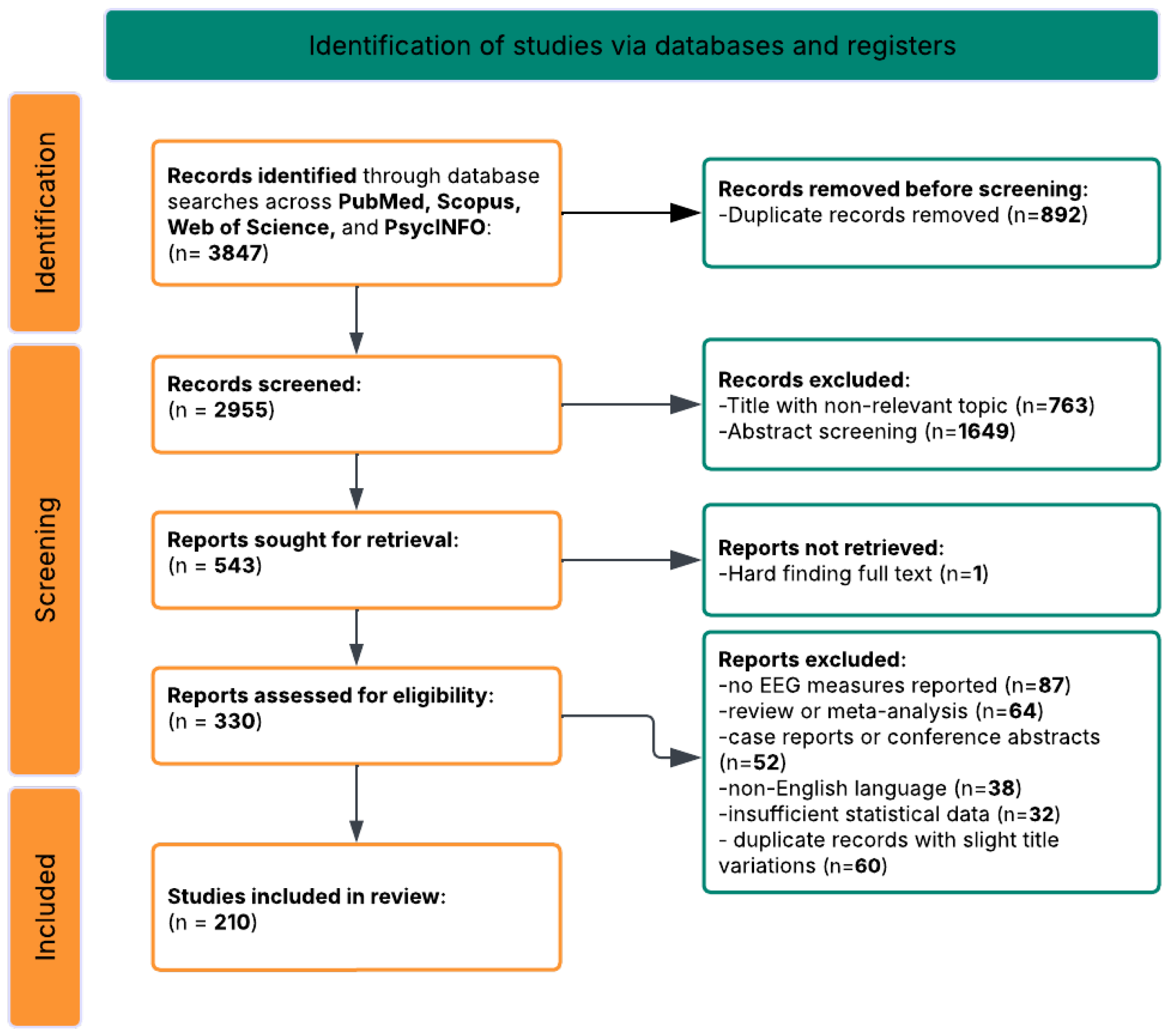
- Page, M.J.; McKenzie, J.E.; Bossuyt, P.M.; Boutron, I.; Hoffmann, T.C.; Mulrow, C.D.; Shamseer, L.; Tetzlaff, J.M.; Akl, E.A.; Brennan, S.E.; et al. The PRISMA 2020 statement: An updated guideline for reporting systematic reviews. BMJ 2021, 372, n71. [Google Scholar] [CrossRef]
- Adelhöfer, N.; Beste, C. Pre-trial theta band activity in the ventromedial prefrontal cortex correlates with inhibition-related theta band activity in the right inferior frontal cortex. NeuroImage 2020, 219, 117052. [Google Scholar] [CrossRef]
- Adelhöfer, N.; Mückschel, M.; Teufert, B.; Ziemssen, T.; Beste, C. Anodal tDCS affects neuromodulatory effects of the norepinephrine system on superior frontal theta activity during response inhibition. Brain Struct. Funct. 2019, 224, 1291–1300. [Google Scholar] [CrossRef]
- Vahid, A.; Mückschel, M.; Stober, S.; Stock, A.; Beste, C. Applying deep learning to single-trial EEG data provides evidence for complementary theories on action control. Commun. Biol. 2020, 3, 112. [Google Scholar] [CrossRef] [PubMed]
- Neuhäußer, A.M.; Bluschke, A.; Roessner, V.; Beste, C. Distinct effects of different neurofeedback protocols on the neural mechanisms of response inhibition in ADHD. Clin. Neurophysiol. 2023, 153, 30–42. [Google Scholar] [CrossRef]
- Prochnow, A.; Mückschel, M.; Eggert, E.; Senftleben, J.; Frings, C.; Münchau, A.; Roessner, V.; Bluschke, A.; Beste, C. The ability to voluntarily regulate theta band activity affects how pharmacological manipulation of the catecholaminergic system impacts cognitive control. Int. J. Neuropsychopharmacol. 2024, 27, pyae003. [Google Scholar] [CrossRef] [PubMed]
- Winneke, A.H.; Hübner, L.; Godde, B.; Voelcker-Rehage, C. Moderate cardiovascular exercise speeds up neural markers of stimulus evaluation during attentional control processes. J. Clin. Med. 2019, 8, 1348. [Google Scholar] [CrossRef]
- Barbazzeni, B.; Speck, O.; Düzel, E. Cognitive training, but not EEG-neurofeedback, improves working memory in healthy volunteers. Brain Commun. 2023, 5, fcad101. [Google Scholar] [CrossRef] [PubMed]
- Barth, B.; Mayer-Carius, K.; Strehl, U.; Wyckoff, S.; Haeussinger, F.; Fallgatter, A.; Ehlis, A. A randomized-controlled neurofeedback trial in adult attention-deficit/hyperactivity disorder. Sci. Rep. 2021, 11, 16873. [Google Scholar] [CrossRef] [PubMed]
- Sari, B.A.; Koster, E.; Pourtois, G.; Derakshan, N. Training working memory to improve attentional control in anxiety: A proof-of-principle study using behavioral and electrophysiological measures. Biol. Psychol. 2016, 121, 203–212. [Google Scholar] [CrossRef]
- Lowe, C.J.; Staines, W.; Manocchio, F.; Hall, P. The neurocognitive mechanisms underlying food cravings and snack food consumption. A combined continuous theta burst stimulation (cTBS) and EEG study. NeuroImage 2018, 177, 45–58. [Google Scholar] [CrossRef]
- Erb, C.D.; Cavanagh, J. Layers of latent effects in cognitive control: An EEG investigation. Acta Psychol. 2019, 194, 1–11. [Google Scholar] [CrossRef]
- Liu, C.; Lin, Y.; Ye, C.; Yang, J.; He, W. Alpha ERS-ERD pattern during divergent and convergent thinking depends on individual differences on metacontrol. J. Intell. 2023, 11, 74. [Google Scholar] [CrossRef]
- Dennis-Tiwary, T.; Egan, L.J.; Babkirk, S.; Denefrio, S. For whom the bell tolls: Neurocognitive individual differences in the acute stress-reduction effects of an attention bias modification game for anxiety. Behav. Res. Ther. 2016, 77, 105–117. [Google Scholar] [CrossRef]
- Dierolf, A.; Fechtner, J.; Böhnke, R.; Wolf, O.; Naumann, E. Influence of acute stress on response inhibition in healthy men: An ERP study. Psychophysiology 2017, 54, 684–695. [Google Scholar] [CrossRef]
- Incagli, F.; Tarantino, V.; Crescentini, C.; Vallesi, A. The effects of 8-week mindfulness-based stress reduction program on cognitive control: An EEG study. Mindfulness 2019, 11, 756–770. [Google Scholar] [CrossRef]
- Bing-Canar, H.; Pizzuto, J.; Compton, R. Mindfulness-of-breathing exercise modulates EEG alpha activity during cognitive performance. Psychophysiology 2016, 53, 1366–1376. [Google Scholar] [CrossRef] [PubMed]
- Wei, H.; De Beuckelaer, A.; Zhou, R. EEG correlates of neutral working memory training induce attentional control improvements in test anxiety. Biol. Psychol. 2022, 174, 108407. [Google Scholar] [CrossRef] [PubMed]
- Nesterovsky, I.; Shalev, L.; Luria, R.; Saar, K.; Stern, P.; Styr, B.; Mevorach, C. Electrophysiological evidence for decreased top-down attentional control in adults with ADHD. J. Vis. 2015, 15, 1337. [Google Scholar] [CrossRef]
- Zhang, J.; Zhang, W.; Guan, W.; Liu, P. Induced emotion counter-regulation affects attentional inhibition of emotional information: ERP evidence from a randomized manipulation approach. Cereb. Cortex 2024, 34, bhae004. [Google Scholar] [CrossRef]
- Knoth, I.; Lajnef, T.; Rigoulot, S.; Lacourse, K.; Vannasing, P.; Michaud, J.; Jacquemont, S.; Major, P.; Jerbi, K.; Lippé, S. Auditory repetition suppression alterations in relation to cognitive functioning in fragile X syndrome: A combined EEG and machine learning approach. J. Neurodev. Disord. 2018, 10, 4. [Google Scholar] [CrossRef] [PubMed]
- Mückschel, M.; Roessner, V.; Beste, C. Task experience eliminates catecholaminergic effects on inhibitory control—A randomized, double-blind cross-over neurophysiological study. Eur. Neuropsychopharmacol. 2020, 35, 89–99. [Google Scholar] [CrossRef]
- Nigbur, R.; Schneider, J.; Sommer, W.; Dimigen, O.; Stürmer, B. Ad-hoc and context-dependent adjustments of selective attention in conflict control: An ERP study with visual probes. NeuroImage 2015, 107, 76–84. [Google Scholar] [CrossRef]
- Olfers, K.J.F.; Band, G. Game-based training of flexibility and attention improves task-switch performance: Near and far transfer of cognitive training in an EEG study. Psychol. Res. 2017, 82, 186–202. [Google Scholar] [CrossRef]
- Pietto, M.; Giovannetti, F.; Segretín, M.S.; Belloli, L.; Lopez-Rosenfeld, M.; Goldin, A.; Fernández-Slezak, D.; Kamienkowski, J.; Lipina, S. Enhancement of inhibitory control in a sample of preschoolers from poor homes after cognitive training in a kindergarten setting: Cognitive and ERP evidence. Trends Neurosci. Educ. 2018, 13, 34–42. [Google Scholar] [CrossRef]
- Raghuraman, N.; Wang, Y.; Schenk, L.A.; Furman, A.J.; Tricou, C.; Seminowicz, D.; Colloca, L. Neural and behavioral changes driven by observationally-induced hypoalgesia. Sci. Rep. 2019, 9, 19515. [Google Scholar] [CrossRef]
- Rauch, H.G.L.; Hume, D.J.; Howells, F.; Kroff, J.; Lambert, E. Food cue reactivity and the brain-heart axis during cognitive stress following clinically relevant weight loss. Front. Nutr. 2019, 5, 135. [Google Scholar] [CrossRef]
- Reis, J.; Portugal, A.; Fernandes, L.; Afonso, N.; Pereira, M.R.; Sousa, N.; Dias, N. An alpha and theta intensive and short neurofeedback protocol for healthy aging working-memory training. Front. Aging Neurosci. 2016, 8, 157. [Google Scholar] [CrossRef]
- Olson, R.L.; Chang, Y.-K.; Brush, C.J.; Kwok, A.N.; Gordon, V.X.; Alderman, B. Neurophysiological and behavioral correlates of cognitive control during low and moderate intensity exercise. NeuroImage 2016, 131, 171–180. [Google Scholar] [CrossRef] [PubMed]
- Santarnecchi, E.; Khanna, A.R.; Musaeus, C.; Benwell, C.; Davila, P.; Farzan, F.; Matham, S.; Pascual-Leone, Á.; Shafi, M.; Honeywell SHARP Team authors. EEG microstate correlates of fluid intelligence and response to cognitive training. Brain Topogr. 2017, 30, 502–520. [Google Scholar] [CrossRef] [PubMed]
- Schmeichel, B.; Crowell, A.; Harmon-Jones, E. Exercising self-control increases relative left frontal cortical activation. Soc. Cogn. Affect. Neurosci. 2016, 11, 282–288. [Google Scholar] [CrossRef]
- Chung, S.W.; Sullivan, C.; Rogasch, N.; Hoy, K.; Bailey, N.; Cash, R.; Fitzgerald, P. The effects of individualised intermittent theta burst stimulation in the prefrontal cortex: A TMS-EEG study. Hum. Brain Mapp. 2018, 40, 608–627. [Google Scholar] [CrossRef] [PubMed]
- Ligeza, T.S.; Maciejczyk, M.; Kałamała, P.; Szygula, Z.; Wyczesany, M. Moderate-intensity exercise boosts the N2 neural inhibition marker: A randomized and counterbalanced ERP study with precisely controlled exercise intensity. Biol. Psychol. 2018, 135, 170–179. [Google Scholar] [CrossRef]
- Zhao, X.; Dang, C.; Maes, J.H.R. Effects of working memory training on EEG, cognitive performance, and self-report indices potentially relevant for social anxiety. Biol. Psychol. 2020, 150, 107840. [Google Scholar] [CrossRef]
- Li, Y.; Wang, L.; Jia, M.; Guo, J.; Wang, H.; Wang, M. The effects of high-frequency rTMS over the left DLPFC on cognitive control in young healthy participants. PLoS ONE 2017, 12, e0179430. [Google Scholar] [CrossRef] [PubMed]
- van der Kolk, B.A.; Hodgdon, H.; Gapen, M.; Musicaro, R.; Suvak, M.K.; Hamlin, E.; Spinazzola, J. A randomized controlled study of neurofeedback for chronic PTSD. PLoS ONE 2016, 11, e0166752. [Google Scholar] [CrossRef]
- Parsons, B.; Faubert, J. Enhancing learning in a perceptual-cognitive training paradigm using EEG-neurofeedback. Sci. Rep. 2021, 11, 4061. [Google Scholar] [CrossRef]
- Wirth, C.; Dockree, P.; Harty, S.; Lacey, E.; Arvaneh, M. Towards error categorisation in BCI: Single-trial EEG classification between different errors. J. Neural Eng. 2019, 17, 016008. [Google Scholar] [CrossRef]
- Duan, X.; Xie, S.; Lv, Y.; Xie, X.; Obermayer, K.; Yan, H. A transfer learning-based feedback training motivates the performance of SMR-BCI. J. Neural Eng. 2022, 20, 016029. [Google Scholar] [CrossRef]
- Alberca-Reina, E.; Cantero, J.; Atienza, M. Impact of sleep loss before learning on cortical dynamics during memory retrieval. NeuroImage 2015, 123, 51–62. [Google Scholar] [CrossRef]
- Fearnbach, S.N.; Silvert, L.; Pereira, B.; Boirie, Y.; Duclos, M.; Keller, K.; Thivel, D. Reduced neural responses to food cues might contribute to the anorexigenic effect of acute exercise observed in obese but not lean adolescents. Nutr. Res. 2017, 44, 76–84. [Google Scholar] [CrossRef]
- Gram, M.; Graversen, C.; Olesen, A.E.; Drewes, A. Machine learning on encephalographic activity may predict opioid analgesia. Eur. J. Pain 2015, 19, 1552–1561. [Google Scholar] [CrossRef]
- Guez, J.; Rogel, A.; Getter, N.; Keha, E.; Cohen, T.; Amor, T.; Gordon, S.; Meiran, N.; Todder, D. Influence of electroencephalography neurofeedback training on episodic memory: A randomized, sham-controlled, double-blind study. Memory 2015, 23, 1195–1204. [Google Scholar] [CrossRef] [PubMed]
- Volpert-Esmond, H.I.; Merkle, E.C.; Levsen, M.P.; Ito, T.A.; Bartholow, B. Using trial-level data and multilevel modeling to investigate within-task change in event-related potentials. Psychophysiology 2018, 55, e13044. [Google Scholar] [CrossRef] [PubMed]
- Zhang, H.; Zhang, K.; Zhang, Z.; Zhao, M.; Liu, Q.; Luo, W.; Wu, H. Social conformity is associated with inter-trial electroencephalogram variability. Ann. N. Y. Acad. Sci. 2023, 1523, 126–138. [Google Scholar] [CrossRef]
- Hsueh, J.-J.; Chen, T.-S.; Chen, J.-J.; Shaw, F.-Z. Neurofeedback training of EEG alpha rhythm enhances episodic and working memory. Hum. Brain Mapp. 2016, 37, 2662–2675. [Google Scholar] [CrossRef]
- Wang, J.; Antonenko, P.D.; Keil, A.; Dawson, K. Converging subjective and psychophysiological measures of cognitive load to study the effects of instructor-present video. Mind Brain Educ. 2020, 14, 279–291. [Google Scholar] [CrossRef]
- Jochumsen, M.; Navid, M.S.; Rashid, U.; Haavik, H.; Niazi, I. EMG- versus EEG-triggered electrical stimulation for inducing corticospinal plasticity. IEEE Trans. Neural Syst. Rehabil. Eng. 2019, 27, 1504–1512. [Google Scholar] [CrossRef] [PubMed]
- Eschmann, K.C.J.; Mecklinger, A. Improving cognitive control: Is theta neurofeedback training associated with proactive rather than reactive control enhancement? Psychophysiology 2022, 59, e13873. [Google Scholar] [CrossRef] [PubMed]
- Eschmann, K.C.J.; Bader, R.; Mecklinger, A. Improving episodic memory: Frontal-midline theta neurofeedback training increases source memory performance. NeuroImage 2020, 222, 117219. [Google Scholar] [CrossRef]
- Kis, A.; Szakadát, S.; Gácsi, M.; Kovács, E.; Simor, P.; Török, C.; Gombos, F.; Bódizs, R.; Topál, J. The interrelated effect of sleep and learning in dogs (Canis familiaris); an EEG and behavioural study. Sci. Rep. 2017, 7, 41873. [Google Scholar] [CrossRef] [PubMed]
- Kober, S.; Schweiger, D.; Witte, M.; Reichert, J.; Grieshofer, P.; Neuper, C.; Wood, G. Specific effects of EEG based neurofeedback training on memory functions in post-stroke victims. J. NeuroEng. Rehabil. 2015, 12, 107. [Google Scholar] [CrossRef]
- Kober, S.; Pinter, D.; Enzinger, C.; Damulina, A.; Wood, G. Self-regulation of brain activity and its effect on cognitive function in patients with multiple sclerosis—First insights from an interventional study using neurofeedback. Clin. Neurophysiol. 2019, 130, 2124–2131. [Google Scholar] [CrossRef]
- Lau, B.; Ruggles, D.R.; Katyal, S.; Engel, S.; Oxenham, A. Sustained cortical and subcortical measures of auditory and visual plasticity following short-term perceptual learning. PLoS ONE 2017, 12, e0168858. [Google Scholar] [CrossRef]
- Chen, L.; Tang, C.; Wang, Z.; Zhang, L.; Gu, B.; Liu, X.; Ming, D. Enhancing motor sequence learning via transcutaneous auricular vagus nerve stimulation (taVNS): An EEG study. IEEE J. Biomed. Health Inform. 2023, 28, 2315–2325. [Google Scholar] [CrossRef]
- Manuel, A.; Guggisberg, A.; Thézé, R.; Turri, F.; Schnider, A. Resting-state connectivity predicts visuo-motor skill learning. NeuroImage 2018, 176, 446–453. [Google Scholar] [CrossRef]
- Mariman, J.J.; Bruna-Melo, T.; Gutierrez-Rodriguez, R.; Maldonado, P.; Burgos, P. Event-related (de)synchronization and potential in whole vs. part sensorimotor learning. Front. Syst. Neurosci. 2023, 17, 1045940. [Google Scholar] [CrossRef] [PubMed]
- Kodama, M.; Iwama, S.; Morishige, M.; Ushiba, J. Thirty-minute motor imagery exercise aided by EEG sensorimotor rhythm neurofeedback enhances morphing of sensorimotor cortices: A double-blind sham-controlled study. Cereb. Cortex 2023, 33, 5097–5108. [Google Scholar] [CrossRef] [PubMed]
- Murphy, M.; Stickgold, R.; Parr, M.E.; Callahan, C.; Wamsley, E. Recurrence of task-related electroencephalographic activity during post-training quiet rest and sleep. Sci. Rep. 2018, 8, 5398. [Google Scholar] [CrossRef]
- Pinter, D.; Kober, S.; Fruhwirth, V.; Berger, L.; Damulina, A.; Khalil, M.; Neuper, C.; Wood, G.; Enzinger, C. MRI correlates of cognitive improvement after home-based EEG neurofeedback training in patients with multiple sclerosis: A pilot study. J. Neurol. 2021, 268, 4566–4574. [Google Scholar] [CrossRef]
- Pugin, F.; Metz, A.J.; Wolf, M.; Achermann, P.; Jenni, O.; Huber, R. Local increase of sleep slow wave activity after three weeks of working memory training in children and adolescents. Sleep 2015, 38, 607–614. [Google Scholar] [CrossRef]
- Rozengurt, R.; Barnea, A.; Uchida, S.; Levy, D. Theta EEG neurofeedback benefits early consolidation of motor sequence learning. Psychophysiology 2016, 53, 1337–1346. [Google Scholar] [CrossRef]
- Sampedro-Piquero, P.; Buades-Sitjar, F.; Capilla, A.; Zancada-Menéndez, C.; González-Baeza, A.; Moreno-Fernández, R.D. Risky alcohol use during youth: Impact on emotion, cognitive networks, and resting-state EEG activity. Prog. Neuropsychopharmacol. Biol. Psychiatry 2024, 132, 110994. [Google Scholar] [CrossRef]
- Schranz, C.; Vatinno, A.A.; Ramakrishnan, V.; Seo, N.J. Neuroplasticity after upper-extremity rehabilitation therapy with sensory stimulation in chronic stroke survivors. Brain Commun. 2022, 4, fcac191. [Google Scholar] [CrossRef] [PubMed]
- Chung, S.W.; Lewis, B.P.; Rogasch, N.; Saeki, T.; Thomson, R.; Hoy, K.; Bailey, N.; Fitzgerald, P. Demonstration of short-term plasticity in the dorsolateral prefrontal cortex with theta burst stimulation: A TMS-EEG study. Clin. Neurophysiol. 2017, 128, 1117–1126. [Google Scholar] [CrossRef]
- Chung, S.W.; Thomson, C.J.; Lee, S.; Worsley, R.N.; Rogasch, N.; Kulkarni, J.; Thomson, R.; Fitzgerald, P.; Segrave, R. The influence of endogenous estrogen on high-frequency prefrontal transcranial magnetic stimulation. Brain Stimul. 2019, 12, 1271–1279. [Google Scholar] [CrossRef]
- Wang, Z.; Wong, C.; Nan, W.; Tang, Q.; Rosa, A.C.; Xu, P.; Wan, F. Learning curve of a short-time neurofeedback training: Reflection of brain network dynamics based on phase-locking value. IEEE Trans. Cogn. Dev. Syst. 2022, 14, 1022–1030. [Google Scholar] [CrossRef]
- Nan, W.; Yang, L.; Wan, F.; Zhu, F.; Hu, Y. Alpha down-regulation neurofeedback training effects on implicit motor learning and consolidation. J. Neural Eng. 2020, 17, 026010. [Google Scholar] [CrossRef] [PubMed]
- Pourbehbahani, Z.; Saemi, E.; Cheng, M.; Dehghan, M. Both sensorimotor rhythm neurofeedback and self-controlled practice enhance motor learning and performance in novice golfers. Behav. Sci. 2023, 13, 65. [Google Scholar] [CrossRef]
- Liu, Z.-X.; Glizer, D.; Tannock, R.; Woltering, S. EEG alpha power during maintenance of information in working memory in adults with ADHD and its plasticity due to working memory training: A randomized controlled trial. Clin. Neurophysiol. 2016, 127, 1307–1320. [Google Scholar] [CrossRef]
- Naas, A.; Rodrigues, J.M.F.; Knirsch, J.; Sonderegger, A. Neurofeedback training with a low-priced EEG device leads to faster alpha enhancement but shows no effect on cognitive performance: A single-blind, sham-feedback study. PLoS ONE 2019, 14, e0211668. [Google Scholar] [CrossRef] [PubMed]
- Albein-Urios, N.; Fernandez, L.; Hill, A.; Kirkovski, M.; Enticott, P. Prefrontal anodal High Definition-tDCS has limited effects on emotion regulation. Brain Stimul. 2022, 15, 1576–1578. [Google Scholar] [CrossRef]
- Sibalis, A.; Milligan, K.; Pun, C.; McKeough, T.; Schmidt, L.; Segalowitz, S. An EEG investigation of the attention-related impact of mindfulness training in youth with ADHD: Outcomes and methodological considerations. J. Atten. Disord. 2019, 23, 733–743. [Google Scholar] [CrossRef] [PubMed]
- Arazi, A.; Gonen-Yaacovi, G.; Dinstein, I. The magnitude of trial-by-trial neural variability is reproducible over time and across tasks in humans. eNeuro 2017, 4, ENEURO.0292-17.2017. [Google Scholar] [CrossRef]
- Bigliassi, M.; Galano, B.M.; Lima-Silva, A.; Bertuzzi, R. Effects of mindfulness on psychological and psychophysiological responses during self-paced walking. Psychophysiology 2020, 57, e13529. [Google Scholar] [CrossRef]
- Brown, K.; Berry, D.; Eichel, K.; Beloborodova, P.; Rahrig, H.; Britton, W.B. Comparing impacts of meditation training in focused attention, open monitoring, and mindfulness-based cognitive therapy on emotion reactivity and regulation: Neural and subjective evidence from a dismantling study. Psychophysiology 2022, 59, e14024. [Google Scholar] [CrossRef]
- Ciorciari, J.; Pfeifer, J.; Gountas, J. An EEG study on emotional intelligence and advertising message effectiveness. Behav. Sci. 2019, 9, 88. [Google Scholar] [CrossRef]
- Compton, R.; Heaton, E.C.; Ozer, E. Intertrial interval duration affects error monitoring. Psychophysiology 2017, 54, 1151–1162. [Google Scholar] [CrossRef]
- Cao, D.; Li, Y.; Niznikiewicz, M.; Tang, Y.; Wang, J. The theta burst transcranial magnetic stimulation over the right PFC affects electroencephalogram oscillation during emotional processing. Prog. Neuropsychopharmacol. Biol. Psychiatry 2017, 78, 17–24. [Google Scholar] [CrossRef]
- Dennis-Tiwary, T.; Denefrio, S.; Gelber, S. Salutary effects of an attention bias modification mobile application on biobehavioral measures of stress and anxiety during pregnancy. Biol. Psychol. 2017, 127, 148–156. [Google Scholar] [CrossRef]
- Mohan, D.M.; Kumar, P.; Mahmood, F.; Wong, K.; Agrawal, A.; Elgendi, M.; Shukla, R.; Ang, N.; Ching, A.; Dauwels, J.; et al. Effect of subliminal lexical priming on the subjective perception of images: A machine learning approach. PLoS ONE 2016, 11, e0148332. [Google Scholar] [CrossRef]
- Pan, D.-N.; Wang, Y.; Lei, Z.; Wang, Y.; Li, X. The altered early components and the decisive later process underlying attention bias modification in social anxiety: Evidence from event-related potentials. Soc. Cogn. Affect. Neurosci. 2019, 15, 183–194. [Google Scholar] [CrossRef] [PubMed]
- Mizrahi, D.; Laufer, I.; Zuckerman, I. Attachment style, task difficulty, and feedback type: Effects on cognitive load. Behav. Sci. 2025, 15, 427. [Google Scholar] [CrossRef] [PubMed]
- Duan, H.; Yuan, Y.; Yang, C.; Zhang, L.; Zhang, K.; Wu, J. Anticipatory processes under academic stress: An ERP study. Brain Cogn. 2015, 94, 60–67. [Google Scholar] [CrossRef] [PubMed]
- Engelbregt, H.; Keeser, D.; van Eijk, L.V.; Suiker, E.M.; Eichhorn, D.; Karch, S.; Deijen, J.; Pogarell, O. Short and long-term effects of sham-controlled prefrontal EEG-neurofeedback training in healthy subjects. Clin. Neurophysiol. 2016, 127, 1931–1937. [Google Scholar] [CrossRef]
- Garland, E.L.; Hudak, J.; Hanley, A.W.; Bernat, E.; Froeliger, B. Positive emotion dysregulation in opioid use disorder and normalization by mindfulness-oriented recovery enhancement. JAMA Psychiatry 2025, 82, 596–605. [Google Scholar] [CrossRef]
- Faehling, F.; Plewnia, C. P81. Effects of transcranial direct current stimulation on the late positive potential in a cognitive control task. Clin. Neurophysiol. 2015, 126, e184. [Google Scholar] [CrossRef]
- Tian, F.; Hua, M.; Zhang, W.; Li, Y.; Yang, X. Emotional arousal in 2D versus 3D virtual reality environments. PLoS ONE 2021, 16, e0256211. [Google Scholar] [CrossRef]
- Fischer, A.; Klein, T.A.; Ullsperger, M. Comparing the error-related negativity across groups: The impact of error- and trial-number differences. Psychophysiology 2017, 54, 998–1009. [Google Scholar] [CrossRef] [PubMed]
- Friedrich, E.V.; Sivanathan, A.; Lim, T.; Suttie, N.; Louchart, S.; Pillen, S.; Pineda, J. An effective neurofeedback intervention to improve social interactions in children with autism spectrum disorder. J. Autism Dev. Disord. 2015, 45, 4084–4100. [Google Scholar] [CrossRef]
- Gladhill, K.; Mioni, G.; Wiener, M. Dissociable effects of emotional stimuli on electrophysiological indices of time and decision-making. PLoS ONE 2022, 17, e0276200. [Google Scholar] [CrossRef]
- Goldway, N.; Ablin, J.; Lubin, O.; Zamir, Y.; Keynan, N.J.; Or-Borichev, A.; Cavazza, M.; Charles, F.; Intrator, N.; Brill, S.; et al. Volitional limbic neuromodulation exerts a beneficial clinical effect on fibromyalgia. NeuroImage 2019, 186, 758–770. [Google Scholar] [CrossRef] [PubMed]
- Kim, H.; Hong, T.; Kim, J.; Yeom, S. A psychophysiological effect of indoor thermal condition on college students’ learning performance through EEG measurement. Build. Environ. 2020, 184, 107223. [Google Scholar] [CrossRef]
- Hill, K.; Haney, A.M.; Foti, D.; Aslinger, E.N.; Thomas, K.M.; Lane, S. Temporal dynamics of emotional processing: Parsing trial-wise variance of the late positive potential using Generalizability Theory. Psychophysiology 2022, 59, e14185. [Google Scholar] [CrossRef]
- Hsieh, S.; McGowan, A.; Chandler, M.C.; Pontifex, M.B. Acute moderate-intensity aerobic exercise facilitates processing speed involving inhibitory control but not neuroelectric index of control process and cognitive integration. Int. J. Sport Exerc. Psychol. 2024, 22, 1–18. [Google Scholar] [CrossRef]
- Fietz, J.; Auer, G.; Plener, P.; Poustka, L.; Konicar, L. Empathy and event related potentials before and after EEG based neurofeedback training in autistic adolescents. Sci. Rep. 2025, 15, 16767. [Google Scholar] [CrossRef]
- Ortmann, J.; Schulz, A.; Lutz, A.; van Dyck, Z.; Vögele, C. Cardiac interoceptive processing and emotional experience in binge eating behavior: Neural evidence of disengagement from bodily sensations. Appetite 2025, 207, 107948. [Google Scholar] [CrossRef] [PubMed]
- Kolijn, L.; Huffmeijer, R.; van den Bulk, B.G.; Vrijhof, C.I.; van IJzendoorn, M.H.; Bakermans-Kranenburg, M. Effects of the Video-feedback intervention to promote positive parenting and sensitive discipline on mothers’ neural responses to child faces: A randomized controlled ERP study including pre- and post-intervention measures. Soc. Neurosci. 2019, 14, 659–669. [Google Scholar] [CrossRef] [PubMed]
- Koller-Schlaud, K.; Ströhle, A.; Behr, J.; Dreysse, E.B.; Rentzsch, J. Changes in electric brain response to affective stimuli in the first week of antidepressant treatment: An exploratory study. Neuropsychobiology 2021, 80, 366–376. [Google Scholar] [CrossRef] [PubMed]
- Lackner, N.; Unterrainer, H.; Skliris, D.; Shaheen, S.; Dunitz-Scheer, M.; Wood, G.; Scheer, P.; Wallner-Liebmann, S.; Neuper, C. EEG neurofeedback effects in the treatment of adolescent anorexia nervosa. Eat. Disord. 2016, 24, 354–374. [Google Scholar] [CrossRef]
- Dickey, L.; Pegg, S.; Cárdenas, E.F.; Green, H.; Dao, A.; Waxmonsky, J.G.; Pérez-Edgar, K.; Kujawa, A. Neural predictors of improvement with cognitive behavioral therapy for adolescents with depression: An examination of reward responsiveness and emotion regulation. Res. Child Adolesc. Psychopathol. 2023, 51, 659–672. [Google Scholar] [CrossRef]
- Wu, L.; Zhou, R. Effectiveness of acute aerobic exercise in regulating emotions in individuals with test anxiety. Biol. Psychol. 2024, 189, 108873. [Google Scholar] [CrossRef]
- Loheswaran, G.; Barr, M.; Zomorrodi, R.; Rajji, T.; Blumberger, D.; Le Foll, B.; Daskalakis, Z. Impairment of neuroplasticity in the dorsolateral prefrontal cortex by alcohol. Sci. Rep. 2017, 7, 5574. [Google Scholar] [CrossRef]
- Lohse, K.; Miller, M.W.; Daou, M.; Valerius, W.; Jones, M. Dissociating the contributions of reward-prediction errors to trial-level adaptation and long-term learning. Biol. Psychol. 2020, 149, 107775. [Google Scholar] [CrossRef]
- Magee, K.; McClaine, R.N.; Laurianti, V.; Connell, A.M. Effects of binge drinking and depression on cognitive-control processes during an emotional Go/No-Go task in emerging adults. J. Psychiatr. Res. 2023, 163, 131–140. [Google Scholar] [CrossRef] [PubMed]
- Mallorquí-Bagué, N.; Lozano-Madrid, M.; Testa, G.; Vintró-Alcaraz, C.; Sánchez, I.; Riesco, N.; Perales, J.C.; Navas, J.F.; Martínez-Zalacaín, I.; Megías, A.; et al. Clinical and neurophysiological correlates of emotion and food craving regulation in patients with anorexia nervosa. J. Clin. Med. 2020, 9, 960. [Google Scholar] [CrossRef] [PubMed]
- Marlats, F.; Bao, G.; Chevallier, S.; Boubaya, M.; Djabelkhir-Jemmi, L.; Wu, Y.-H.; Lenoir, H.; Rigaud, A.; Azabou, E. SMR/Theta neurofeedback training improves cognitive performance and EEG activity in elderly with mild cognitive impairment: A pilot study. Front. Aging Neurosci. 2020, 12, 147. [Google Scholar] [CrossRef]
- Mavros, P.; Wälti, M.J.; Nazemi, M.; Ong, C.H.; Hölscher, C. A mobile EEG study on the psychophysiological effects of walking and crowding in indoor and outdoor urban environments. Sci. Rep. 2022, 12, 18476. [Google Scholar] [CrossRef]
- Mayer, K.; Krylova, M.; Alizadeh, S.; Jamalabadi, H.; van der Meer, J.; Vester, J.; Naschold, B.; Schultz, M.; Walter, M. Nx4 reduced susceptibility to distraction in an attention modulation task. Front. Psychiatry 2021, 12, 746215. [Google Scholar] [CrossRef]
- McFarland, D.; Sarnacki, W.A.; Wolpaw, J. Effects of training pre-movement sensorimotor rhythms on behavioral performance. J. Neural Eng. 2015, 12, 066021. [Google Scholar] [CrossRef]
- Mennella, R.; Patron, E.; Palomba, D. Frontal alpha asymmetry neurofeedback for the reduction of negative affect and anxiety. Behav. Res. Ther. 2017, 92, 32–40. [Google Scholar] [CrossRef] [PubMed]
- Hu, N.; Hu, X.; Xu, Z.; Li, Q.; Long, Q.; Gu, Y.; Chen, A. Temporal dynamic modulation of acute stress on error processing in healthy males. Psychophysiology 2019, 56, e13398. [Google Scholar] [CrossRef]
- Egana-delSol, P.; Sun, X.; Sajda, P. Neurophysiological markers of emotion regulation predict efficacy of entrepreneurship education. Sci. Rep. 2023, 13, 7463. [Google Scholar] [CrossRef]
- Parr, J.; Vine, S.; Wilson, M.R.; Harrison, N.; Wood, G. Visual attention, EEG alpha power and T7-Fz connectivity are implicated in prosthetic hand control and can be optimized through gaze training. J. NeuroEng. Rehabil. 2019, 16, 52. [Google Scholar] [CrossRef]
- Perchtold-Stefan, C.; Schertler, M.; Paechter, M.; Fink, A.; Weiss, E.M.; Papousek, I. Learning to be inventive in the face of statistics: A positive reappraisal intervention for statistics anxiety. J. Behav. Ther. Exp. Psychiatry 2023, 80, 101913. [Google Scholar] [CrossRef] [PubMed]
- Poole, K.; Hassan, R.; Schmidt, L. Temperamental shyness, frontal EEG theta/beta ratio, and social anxiety in children. Child Dev. 2021, 92, e879–e894. [Google Scholar] [CrossRef] [PubMed]
- Rodriguez-Larios, J.; Wong, K.; Lim, J. Assessing the effects of an 8-week mindfulness training program on neural oscillations and self-reports during meditation practice. PLoS ONE 2024, 19, e0299275. [Google Scholar] [CrossRef]
- Eldeeb, S.; Susam, B.T.; Akçakaya, M.; Conner, C.M.; White, S.; Mazefsky, C. Trial by trial EEG based BCI for distress versus non distress classification in individuals with ASD. Sci. Rep. 2021, 11, 6000. [Google Scholar] [CrossRef]
- Schreiter, M.L.; Chmielewski, W.; Beste, C. Neurophysiological processes and functional neuroanatomical structures underlying proactive effects of emotional conflicts. NeuroImage 2018, 174, 11–21. [Google Scholar] [CrossRef]
- Zeng, S.; Lin, X.; Wang, J.; Hu, X. Sleep’s short-term memory preservation and long-term affect depotentiation effect in emotional memory consolidation: Behavioral and EEG evidence. Sleep 2021, 44, zsab155. [Google Scholar] [CrossRef]
- Li, S.; Li, S.; Ding, T.; Liu, S.; Guo, X.; Liu, Z. Effects of attentional deployment training for relieving negative emotion in individuals with subthreshold depression. Clin. Neurophysiol. 2024, 164, 97–106. [Google Scholar] [CrossRef]
- Stolz, C.; Pickering, A.; Mueller, E.M. Dissociable feedback valence effects on frontal midline theta during reward gain versus threat avoidance learning. Psychophysiology 2022, 59, e14235. [Google Scholar] [CrossRef]
- Chandra, S.; Sharma, G.; Sharma, M.; Jha, D.; Mittal, A. Workload regulation by Sudarshan Kriya: An EEG and ECG perspective. Brain Inform. 2016, 3, 149–158. [Google Scholar] [CrossRef]
- Tipple, C.; White, D.; Ciorciari, J. Exploring trait differences in neurofeedback learners: A single-session sham-controlled pilot study. Curr. Psychol. 2024, 43, 28569–28580. [Google Scholar] [CrossRef]
- Ligeza, T.S.; Maciejczyk, M.; Wyczesany, M.; Junghofer, M. The effects of a single aerobic exercise session on mood and neural emotional reactivity in depressed and healthy young adults: A late positive potential study. Psychophysiology 2022, 59, e14137. [Google Scholar] [CrossRef]
- Muralidharan, V.; Yu, X.; Cohen, M.X.; Aron, A. Preparing to stop action increases beta band power in contralateral sensorimotor cortex. J. Cogn. Neurosci. 2019, 31, 657–669. [Google Scholar] [CrossRef]
- Lin, W.; Chen, Q.; Jiang, M.; Tao, J.; Liu, Z.; Zhang, X.; Wu, L.; Xu, S.; Kang, Y.; Zeng, Q. Sitting or walking? Analyzing the neural emotional indicators of urban green space behavior with mobile EEG. J. Urban Health 2020, 97, 191–203. [Google Scholar] [CrossRef]
- Allen, W.D.; Rodeback, R.E.; Carbine, K.A.; Hedges-Muncy, A.M.; LeCheminant, J.; Steffen, P.; Larson, M. The relationship between acute stress and neurophysiological and behavioral measures of food-related inhibitory control: An event-related potential (ERP) study. Appetite 2021, 167, 105862. [Google Scholar] [CrossRef]
- Wiens, S.; Eklund, R.; Szychowska, M.; Miloff, A.; Cosme, D.; Pierzchajlo, S.; Carlbring, P. Electrophysiological correlates of in vivo and virtual reality exposure therapy in spider phobia. Psychophysiology 2022, 59, e14117. [Google Scholar] [CrossRef]
- Li, Y.; Li, S.; Tang, Y.; Hao, S.; Zhang, D. Causal evidence for the role of prefrontal theta oscillations in emotion regulation using neurofeedback training. NeuroImage 2025, 308, 121457. [Google Scholar] [CrossRef] [PubMed]
- Xu, Y.; Feng, Z.; Xie, Y.; Zhang, J.; Peng, S.; Yu, Y.; Li, M. Frontal alpha EEG asymmetry before and after positive psychological interventions for medical students. Front. Psychiatry 2018, 9, 432. [Google Scholar] [CrossRef]
- Haendel, A.D.; Barrington, A.; Magnus, B.E.; Arias, A.A.; McVey, A.J.; Pleiss, S.S.; Carson, A.; Vogt, E.M.; Van Hecke, A.V. Changes in electroencephalogram coherence in adolescents with autism spectrum disorder after a social skills intervention. Autism Res. 2021, 14, 1068–1083. [Google Scholar] [CrossRef] [PubMed]
- Arns, M.; Bruder, G.; Hegerl, U.; Spooner, C.J.; Palmer, D.M.; Etkin, A.; Fallahpour, K.; Gatt, J.; Hirshberg, L.; Gordon, E. EEG alpha asymmetry as a gender-specific predictor of outcome to acute treatment with different antidepressant medications in the randomized iSPOT-D study. Clin. Neurophysiol. 2016, 127, 509–519. [Google Scholar] [CrossRef]
- Arns, M.; Etkin, A.; Hegerl, U.; Williams, L.; DeBattista, C.; Palmer, D.M.; Fitzgerald, P.; Harris, A.; deBeuss, R.; Gordon, E. Frontal and rostral anterior cingulate (rACC) theta EEG in depression: Implications for treatment outcome? Eur. Neuropsychopharmacol. 2015, 25, 1190–1200. [Google Scholar] [CrossRef] [PubMed]
- Schwartzmann, B.; Chatterjee, R.; Vaghei, Y.; Quilty, L.; Allen, T.A.; Arnott, S.; Atluri, S.; Blier, P.; Dhami, P.; Foster, J.A.; et al. Modulation of neural oscillations in escitalopram treatment: A Canadian biomarker integration network in depression study. Transl. Psychiatry 2024, 14, 414. [Google Scholar] [CrossRef]
- Bryant, R.; Williamson, T.; Erlinger, M.; Felmingham, K.; Malhi, G.; Hinton, M.; Williams, L.; Korgaonkar, M. Neural activity during response inhibition associated with improvement of dysphoric symptoms of PTSD after trauma-focused psychotherapy—An EEG-fMRI study. Transl. Psychiatry 2021, 11, 218. [Google Scholar] [CrossRef]
- Rolle, C.E.; Fonzo, G.; Wu, W.; Toll, R.; Jha, M.; Cooper, C.M.; Chin-Fatt, C.; Pizzagalli, D.; Trombello, J.M.; Deckersbach, T.; et al. Cortical connectivity moderators of antidepressant vs placebo treatment response in major depressive disorder: Secondary analysis of a randomized clinical trial. JAMA Psychiatry 2020, 77, 397–408. [Google Scholar] [CrossRef]
- Diaz Hernandez, L.; Rieger, K.; Baenninger, A.; Brandeis, D.; Koenig, T. Towards using microstate-neurofeedback for the treatment of psychotic symptoms in schizophrenia. A feasibility study in healthy participants. Brain Topogr. 2015, 29, 308–321. [Google Scholar] [CrossRef]
- Kang, E.; Clarkson, T.; Keifer, C.; Rosen, T.E.; Lerner, M. Discrete electrocortical predictors of anxiety and anxiety-related treatment response in youth with autism spectrum disorder. Biol. Psychol. 2019, 147, 107656. [Google Scholar] [CrossRef]
- Hochberger, W.C.; Joshi, Y.; Thomas, M.; Zhang, W.; Bismark, A.W.; Treichler, E.; Tarasenko, M.; Nungaray, J.A.; Sprock, J.; Cardoso, L.; et al. Neurophysiologic measures of target engagement predict response to auditory-based cognitive training in treatment refractory schizophrenia. Neuropsychopharmacology 2018, 44, 606–612. [Google Scholar] [CrossRef]
- Iosifescu, D. Are electroencephalogram-derived predictors of antidepressant efficacy closer to clinical usefulness? JAMA Netw. Open 2020, 3, e207133. [Google Scholar] [CrossRef]
- Kratzke, I.; Campbell, A.M.; Yefimov, M.; Mosaly, P.; Adapa, K.; Meltzer-Brody, S.; Farrell, T.; Mazur, L. Pilot study using neurofeedback as a tool to reduce surgical resident burnout. J. Am. Coll. Surg. 2020, 232, 762–769. [Google Scholar] [CrossRef]
- Blume, M.; Schmidt, R.; Schmidt, J.; Martin, A.; Hilbert, A. EEG neurofeedback in the treatment of adults with binge-eating disorder: A randomized controlled pilot study. Neurotherapeutics 2021, 19, 352–365. [Google Scholar] [CrossRef]
- Murias, M.; Major, S.; Compton, S.; Buttinger, J.; Sun, J.M.; Kurtzberg, J.; Dawson, G. Electrophysiological biomarkers predict clinical improvement in an open-label trial assessing efficacy of autologous umbilical cord blood for treatment of autism. Stem Cells Transl. Med. 2018, 7, 783–791. [Google Scholar] [CrossRef]
- Parmar, D.; Enticott, P.; Albein-Urios, N. Anodal HD-tDCS for cognitive inflexibility in autism spectrum disorder: A pilot study. Brain Stimul. 2021, 14, 1674–1676. [Google Scholar] [CrossRef]
- Wang, S.-Y.; Lin, I.; Fan, S.; Tsai, Y.-C.; Yen, C.; Yeh, Y.; Huang, M.-F.; Lee, Y.; Chiu, N.; Hung, C.; et al. The effects of alpha asymmetry and high-beta down-training neurofeedback for patients with the major depressive disorder and anxiety symptoms. J. Affect. Disord. 2019, 257, 287–296. [Google Scholar] [CrossRef]
- Santopetro, N.; Kallen, A.M.; Threadgill, A.; Hajcak, G. Reduced flanker P300 prospectively predicts increases in depression in female adolescents. Biol. Psychol. 2020, 156, 107967. [Google Scholar] [CrossRef]
- Tan, P.; Rozenman, M.; Chang, S.W.; Jurgiel, J.; Truong, H.; Piacentini, J.; Loo, S. The ERN as a neural index of changes in performance monitoring following attention training in pediatric obsessive-compulsive disorder. Biol. Psychol. 2021, 166, 108206. [Google Scholar] [CrossRef]
- Chen, T.-C.; Lin, I. The learning effects and curves during high beta down-training neurofeedback for patients with major depressive disorder. J. Affect. Disord. 2020, 266, 235–242. [Google Scholar] [CrossRef]
- Yuan, E.J.; Chang, C.H.; Chen, H.H.; Huang, S.-S. The effects of electroencephalography functional connectivity during emotional recognition among patients with major depressive disorder and healthy controls. J. Psychiatr. Res. 2024, 172, 68–76. [Google Scholar] [CrossRef]
- Al-kaysi, A.M.; Al-Ani, A.; Loo, C.; Powell, T.Y.; Martin, D.; Breakspear, M.; Boonstra, T. Predicting tDCS treatment outcomes of patients with major depressive disorder using automated EEG classification. J. Affect. Disord. 2017, 208, 597–603. [Google Scholar] [CrossRef]
- John, A.; Schöllhorn, W. Acute effects of instructed and self-created variable rope skipping on EEG brain activity and heart rate variability. Front. Behav. Neurosci. 2018, 12, 311. [Google Scholar] [CrossRef]
- Ammar, A.; Boujelbane, M.; Simak, M.; Fraile-Fuente, I.; Rizzi, N.; Washif, J.; Żmijewski, P.; Jahrami, H.A.; Schöllhorn, W. Unveiling the acute neurophysiological responses to strength training: An exploratory study on novices performing weightlifting bouts with different motor learning models. Biol. Sport 2023, 41, 69–79. [Google Scholar] [CrossRef]
- Anil, K.; Demain, S.; Burridge, J.; Simpson, D.; Taylor, J.; Cotter, I.; Vučković, A. The importance of self-efficacy and negative affect for neurofeedback success for central neuropathic pain after a spinal cord injury. Sci. Rep. 2022, 12, 11042. [Google Scholar] [CrossRef]
- Baskaran, A.; Farzan, F.; Milev, R.; Brenner, C.A.; Alturi, S.; McAndrews, M.P.; Blier, P.; Evans, K.; Foster, J.; Frey, B.; et al. The comparative effectiveness of electroencephalographic indices in predicting response to escitalopram therapy in depression: A pilot study. J. Affect. Disord. 2018, 227, 542–549. [Google Scholar] [CrossRef]
- Azarpaikan, A.; Torbati, H.T.; Sohrabi, M.; Boostani, R.; Ghoshuni, M. Power spectral parameter variations after transcranial direct current stimulation in a bimanual coordination task. Adapt. Behav. 2019, 28, 227–235. [Google Scholar] [CrossRef]
- Bailey, N.; Hoy, K.; Rogasch, N.; Thomson, R.; McQueen, S.; Elliot, D.; Sullivan, C.; Fulcher, B.D.; Daskalakis, Z.; Fitzgerald, P. Responders to rTMS for depression show increased fronto-midline theta and theta connectivity compared to non-responders. Brain Stimul. 2018, 11, 190–203. [Google Scholar] [CrossRef]
- Barth, B.; Rohe, T.; Deppermann, S.; Fallgatter, A.; Ehlis, A. Neural oscillatory responses to performance monitoring differ between high- and low-impulsive individuals, but are unaffected by TMS. Hum. Brain Mapp. 2021, 42, 3347–3359. [Google Scholar] [CrossRef]
- Donaldson, P.; Kirkovski, M.; Rinehart, N.; Enticott, P. A double-blind HD-tDCS/EEG study examining right temporoparietal junction involvement in facial emotion processing. Soc. Neurosci. 2019, 14, 678–690. [Google Scholar] [CrossRef]
- Duma, G.M.; Mento, G.; Manari, T.; Martinelli, M.; Tressoldi, P.E. Driving with intuition: A preregistered study about the EEG anticipation of simulated random car accidents. PLoS ONE 2017, 12, e0170370. [Google Scholar] [CrossRef]
- Gilbreath, D.; Hagood, D.; Alatorre-Cruz, G.C.; Andres, A.; Downs, H.; Larson-Prior, L. Effects of early nutrition factors on baseline neurodevelopment during the first 6 months of life: An EEG study. Nutrients 2023, 15, 1535. [Google Scholar] [CrossRef]
- Evans, D.; Sutton, S.; Oliver, J.A.; Drobes, D. Cortical activity differs during nicotine deprivation versus satiation in heavy smokers. Psychopharmacology 2015, 232, 2027–2038. [Google Scholar] [CrossRef]
- Grosselin, F.; Breton, A.; Yahia-Cherif, L.; Wang, X.; Spinelli, G.; Hugueville, L.; Fossati, P.; Attal, Y.; Navarro-Sune, X.; Chavez, M.; et al. Alpha activity neuromodulation induced by individual alpha-based neurofeedback learning in ecological context: A double-blind randomized study. Sci. Rep. 2021, 11, 18955. [Google Scholar] [CrossRef]
- Gangemi, A.; De Luca, R.; Fabio, R.; Lauria, P.; Rifici, C.; Pollicino, P.; Marra, A.; Olivo, A.; Quartarone, A.; Calabrò, R.S. Effects of virtual reality cognitive training on neuroplasticity: A quasi-randomized clinical trial in patients with stroke. Biomedicines 2023, 11, 3225. [Google Scholar] [CrossRef]
- Leodori, G.; Fabbrini, A.; Bartolo, M.I.; Costanzo, M.; Asci, F.; Palma, V.; Belvisi, D.; Conte, A.; Berardelli, A. Cortical mechanisms underlying variability in intermittent theta-burst stimulation-induced plasticity: A TMS-EEG study. Clin. Neurophysiol. 2021, 132, 2739–2749. [Google Scholar] [CrossRef]
- Li, G.-S.; Li, H.; Pu, J.; Wan, F.; Hu, Y. Effect of brain alpha oscillation on the performance in laparoscopic skills simulator training. Surg. Endosc. 2020, 34, 3693–3700. [Google Scholar] [CrossRef]
- Hasan, M.; Vučković, A.; Qazi, S.A.; Yousuf, Z.; Shahab, S.; Fraser, M. Immediate effect of neurofeedback training on the pain matrix and cortical areas involved in processing neuropsychological functions. Neurol. Sci. 2021, 42, 3359–3367. [Google Scholar] [CrossRef]
- Hill, A.; Rogasch, N.; Fitzgerald, P.; Hoy, K. Effects of prefrontal bipolar and high-definition transcranial direct current stimulation on cortical reactivity and working memory in healthy adults. NeuroImage 2017, 152, 142–157. [Google Scholar] [CrossRef]
- Hill, A.; Rogasch, N.; Fitzgerald, P.; Hoy, K. Effects of single versus dual-site High-Definition transcranial direct current stimulation (HD-tDCS) on cortical reactivity and working memory performance in healthy subjects. Brain Stimul. 2018, 11, 1033–1043. [Google Scholar] [CrossRef]
- Wang, J.; Wu, D.; Shen, Y.; Zhang, Y.; Xu, Y.; Tang, X.; Wang, R. Cognitive behavioral therapy eases orthodontic pain: EEG states and functional connectivity analysis. Oral Dis. 2015, 21, 206–211. [Google Scholar] [CrossRef]
- Juras, L.; Hromatko, I.; Vranić, A. Parietal alpha and theta power predict cognitive training gains in middle-aged adults. Front. Aging Neurosci. 2025, 17, 1530147. [Google Scholar] [CrossRef]
- Yu, K.; Prasad, I.; Mir, H.; Thakor, N.; Al-Nashash, H. Cognitive workload modulation through degraded visual stimuli: A single-trial EEG study. J. Neural Eng. 2015, 12, 046020. [Google Scholar] [CrossRef]
- Jones, K.T.; Johnson, E.; Berryhill, M. Frontoparietal theta-gamma interactions track working memory enhancement with training and tDCS. NeuroImage 2020, 211, 116615. [Google Scholar] [CrossRef]
- Kober, S.; Witte, M.; Grinschgl, S.; Neuper, C.; Wood, G. Placebo hampers ability to self-regulate brain activity: A double-blind sham-controlled neurofeedback study. NeuroImage 2018, 181, 797–806. [Google Scholar] [CrossRef]
- Küssner, M.; de Groot, A.M.B.; Hofman, W.; Hillen, M. EEG beta power but not background music predicts the recall scores in a foreign-vocabulary learning task. PLoS ONE 2016, 11, e0161387. [Google Scholar] [CrossRef]
- Lo, L.-C.; Hatfield, B.D.; Janjigian, K.; Wang, Y.-S.; Fong, D.; Hung, T.-M. The effect of left temporal EEG neurofeedback training on cerebral cortical activity and precision cognitive-motor performance. Res. Q. Exerc. Sport 2024, 95, 486–496. [Google Scholar] [CrossRef]
- Ciria, L.F.; Luque-Casado, A.; Sanabria, D.; Holgado, D.; Ivanov, P.; Perakakis, P. Oscillatory brain activity during acute exercise: Tonic and transient neural response to an oddball task. Psychophysiology 2019, 56, e13326. [Google Scholar] [CrossRef]
- Bachman, M.D.; Watts, A.T.M.; Collins, P.; Bernat, E. Sequential gains and losses during gambling feedback: Differential effects in time-frequency delta and theta measures. Psychophysiology 2021, 58, e13907. [Google Scholar] [CrossRef]
- Lin, M.-H.; Baker, T. A novel application of an adaptive filter to dissociate the effects of TMS on neural excitability and trial-to-trial latency jitter in event-related potentials. Brain Stimul. 2022, 15, 647–656. [Google Scholar] [CrossRef]
- Best, M.W.; Gale, D.; Tran, T.B.; Haque, M.K.; Bowie, C. Brief executive function training for individuals with severe mental illness: Effects on EEG synchronization and executive functioning. Schizophr. Res. 2017, 203, 32–40. [Google Scholar] [CrossRef]
- Nagy, B.; Protzner, A.; van der Wijk, G.; Wang, H.; Cortese, F.; Czigler, I.; Gaál, Z. The modulatory effect of adaptive task-switching training on resting-state neural network dynamics in younger and older adults. Sci. Rep. 2022, 12, 11008. [Google Scholar] [CrossRef]
- Nelson, A.; Ricci, S.; Tatti, E.; Panday, P.; Girau, E.; Lin, J.; Thomson, B.O.; Chen, H.; Marshall, W.; Tononi, G.; et al. Neural fatigue due to intensive learning is reversed by a nap but not by quiet waking. Sleep 2020, 44, zsaa143. [Google Scholar] [CrossRef]
- Nikolin, S.; Martin, D.; Loo, C.; Boonstra, T. Transcranial direct current stimulation modulates working memory maintenance processes in healthy individuals. J. Cogn. Neurosci. 2022, 34, 2134–2151. [Google Scholar] [CrossRef]
- De Pascalis, V.; Vecchio, A.; Cirillo, G. Resting anxiety increases EEG delta–beta correlation: Relationships with the Reinforcement Sensitivity Theory personality traits. Pers. Individ. Differ. 2020, 158, 109796. [Google Scholar] [CrossRef]
- Paul, M.; Bellebaum, C.; Ghio, M.; Suchan, B.; Wolf, O. Stress effects on learning and feedback-related neural activity depend on feedback delay. Psychophysiology 2020, 57, e13471. [Google Scholar] [CrossRef]
- Nawaz, R.; Nisar, H.; Voon, Y.V. Changes in spectral power and functional connectivity of response-conflict task after neurofeedback training. IEEE Access 2020, 8, 139235–139248. [Google Scholar] [CrossRef]
- Hack, R.L.; Aigner, M.; Musalek, M.; Crevenna, R.; Konicar, L. Brain regulation training improves emotional competences in patients with alcohol use disorder. Soc. Cogn. Affect. Neurosci. 2024, 19, nsae048. [Google Scholar] [CrossRef]
- Reteig, L.; van den Brink, R.L.; Prinssen, S.; Cohen, M.X.; Slagter, H. Sustaining attention for a prolonged period of time increases temporal variability in cortical responses. Cortex 2019, 117, 16–32. [Google Scholar] [CrossRef]
- Robertson, C.; Marino, F. Prefrontal and motor cortex EEG responses and their relationship to ventilatory thresholds during exhaustive incremental exercise. Eur. J. Appl. Physiol. 2015, 115, 1939–1948. [Google Scholar] [CrossRef]
- Robertson, C.; Skein, M.; Wingfield, G.; Hunter, J.R.; Miller, T.; Hartmann, T. Acute electroencephalography responses during incremental exercise in those with mental illness. Front. Psychiatry 2023, 13, 1049700. [Google Scholar] [CrossRef]
- Luijcks, R.; Vossen, C.J.; Hermens, H.; van Os, J.; Lousberg, R. The influence of perceived stress on cortical reactivity: A proof-of-principle study. PLoS ONE 2015, 10, e0129220. [Google Scholar] [CrossRef]
- Wriessnegger, S.C.; Leitner, M.; Kostoglou, K. The brain under pressure: Exploring neurophysiological responses to cognitive stress. Brain Cogn. 2024, 179, 106239. [Google Scholar] [CrossRef]
- Kim, S.; Yang, C.; Dong, S.-Y.; Lee, S.-H. Predictions of tDCS treatment response in PTSD patients using EEG based classification. Front. Psychiatry 2022, 13, 876036. [Google Scholar] [CrossRef]
- Jaiswal, S.; Tsai, S.-Y.; Juan, C.; Muggleton, N.; Liang, W.-K. Low delta and high alpha power are associated with better conflict control and working memory in high mindfulness, low anxiety individuals. Soc. Cogn. Affect. Neurosci. 2019, 14, 645–656. [Google Scholar] [CrossRef]
- Bhakta, S.G.; Cavanagh, J.; Talledo, J.; Kotz, J.E.; Benster, L.; Roberts, B.Z.; Nungaray, J.A.; Brigman, J.; Light, G.; Swerdlow, N.; et al. EEG reveals that dextroamphetamine improves cognitive control through multiple processes in healthy participants. Neuropsychopharmacology 2022, 47, 1334–1342. [Google Scholar] [CrossRef]
- Sehatpour, P.; Dondé, C.; Hoptman, M.; Kreither, J.; Adair, D.; Dias, E.; Vail, B.; Rohrig, S.; Silipo, G.; Lopez-Calderon, J.; et al. Network-level mechanisms underlying effects of transcranial direct current stimulation (tDCS) on visuomotor learning. NeuroImage 2020, 223, 117311. [Google Scholar] [CrossRef]
- Liu, S.; Shi, C.; Meng, H.; Meng, Y.; Gong, X.; Chen, X.-P.; Tao, L. Cognitive control subprocess deficits and compensatory modulation mechanisms in patients with frontal lobe injury revealed by EEG markers: A basic study to guide brain stimulation. Gen. Psychiatry 2023, 36, e101144. [Google Scholar] [CrossRef]
- Strüber, L.; Baumont, M.; Barraud, P.; Nougier, V.; Cignetti, F. Brain oscillatory correlates of visuomotor adaptive learning. NeuroImage 2021, 245, 118645. [Google Scholar] [CrossRef]
- Chung, S.W.; Rogasch, N.; Hoy, K.; Sullivan, C.; Cash, R.; Fitzgerald, P. Impact of different intensities of intermittent theta burst stimulation on the cortical properties during TMS-EEG and working memory performance. Hum. Brain Mapp. 2018, 39, 783–802. [Google Scholar] [CrossRef]
- Xu, T.; Huang, J.; Pei, Z.; Chen, J.; Li, J.; Bezerianos, A.; Thakor, N.V.; Wang, H. The effect of multiple factors on working memory capacities: Aging, task difficulty, and training. IEEE Trans. Biomed. Eng. 2022, 70, 1283–1293. [Google Scholar] [CrossRef]
- Tatti, E.; Golemme, M.; Chrisostomou, L.D.; Panozzo, G.; Grande, G.; Bernardi, C.; Cappelletti, M. P255 Electrophysiological and behavioral monitoring of learning: An EEG and tRNS combined study. Clin. Neurophysiol. 2017, 128, e341. [Google Scholar] [CrossRef]
- Aktürk, T.; de Graaf, T.; Güntekin, B.; Hanoglu, L.; Sack, A. Enhancing memory capacity by experimentally slowing theta frequency oscillations using combined EEG-tACS. Sci. Rep. 2022, 12, 14968. [Google Scholar] [CrossRef]
- Ulam, F.; Shelton, C.; Richards, L.; Davis, L.; Hunter, B.; Fregni, F.; Higgins, K. Cumulative effects of transcranial direct current stimulation on EEG oscillations and attention/working memory during subacute neurorehabilitation of traumatic brain injury. Clin. Neurophysiol. 2015, 126, 486–496. [Google Scholar] [CrossRef]
- da Paz, V.K.C.; Garcia, A.; da Paz Neto, A.C.; Tomaz, C. SMR neurofeedback training facilitates working memory performance in healthy older adults: A behavioral and EEG study. Front. Behav. Neurosci. 2018, 12, 321. [Google Scholar] [CrossRef]
- Hsu, W.-Y.; Zanto, T.P.; van Schouwenburg, M.V.; Gazzaley, A. Enhancement of multitasking performance and neural oscillations by transcranial alternating current stimulation. PLoS ONE 2017, 12, e0178579. [Google Scholar] [CrossRef]
- Wischnewski, M.; Zerr, P.; Schutter, D. Effects of theta transcranial alternating current stimulation over the frontal cortex on reversal learning. Brain Stimul. 2016, 9, 705–711. [Google Scholar] [CrossRef]
- Kim, W.-J.; Lee, Y.-S.; Hong, K.H.; Choi, H.; Song, J.-J.; Hwang, H.-J. Effect of transcutaneous auricular vagus nerve stimulation on stress regulation: An EEG and questionnaire study. Front. Digit. Health 2025, 7, 1593614. [Google Scholar] [CrossRef]
- Li, Y.; Tian, C.; Xu, L.; Pei, L.; Huang, X.; Wang, X. EEG-Guided adaptive learning: A new neuroeducational approach to the facilitation of cognitive control in ADHD children. Child Care Health Dev. 2025, 51, e70113. [Google Scholar] [CrossRef]
- Sun, Y.; Giacobbe, P.; Tang, C.W.; Barr, M.; Rajji, T.; Kennedy, S.; Fitzgerald, P.; Lozano, A.; Wong, W.; Daskalakis, Z. Deep brain stimulation modulates gamma oscillations and theta–gamma coupling in treatment resistant depression. Brain Stimul. 2015, 8, 1033–1042. [Google Scholar] [CrossRef]
- Ke, Y.; Liu, S.; Chen, L.; Wang, X.; Ming, D. Lasting enhancements in neural efficiency by multi-session transcranial direct current stimulation during working memory training. npj Sci. Learn. 2023, 8, 50. [Google Scholar] [CrossRef]
- Zhang, H.; Chavarriaga, R.; Millán, J. Discriminant brain connectivity patterns of performance monitoring at average and single-trial levels. NeuroImage 2015, 120, 64–74. [Google Scholar] [CrossRef]
- Tsang, R.S.; Stow, D.; Kwong, A.S.; Donnelly, N.A.; Fraser, H.; Barroso, I.; Khandaker, G.M. Immunometabolic blood biomarkers of developmental trajectories of depressive symptoms: Findings from the ALSPAC birth cohort. Mol. Psychiatry 2025, 1–11. [Google Scholar] [CrossRef]
- Abi-Dargham, A.; Moeller, S.J.; Ali, F.; DeLorenzo, C.; Domschke, K.; Horga, G.; Krystal, J.H. Candidate biomarkers in psychiatric disorders: State of the field. World Psychiatry 2023, 22, 236–262. [Google Scholar] [CrossRef]
- Fatori, D.; Shephard, E.; Benette, D.; Naspolini, N.F.; Guzman, G.C.; Wang, J.Y.T.; Polanczyk, G.V. Identifying biomarkers and trajectories of executive functions and language development in the first 3 years of life: Design, methods, and findings of the Germina cohort study. Dev. Psychopathol. 2025, 37, 2457–2467. [Google Scholar] [CrossRef]
- Krainc, D.; Martin, W.J.; Casey, B.; Jensen, F.E.; Tishkoff, S.; Potter, W.Z.; Hyman, S.E. Shifting the trajectory of therapeutic development for neurological and psychiatric disorders. Sci. Transl. Med. 2023, 15, eadg4775. [Google Scholar] [CrossRef]
- Wang, Y.; Ma, L.; Wang, J.; Ding, Y.; Liu, N.; Men, W.; Tao, S. The neural and genetic underpinnings of different developmental trajectories of Attention-Deficit/Hyperactivity Symptoms in children and adolescents. BMC Med. 2024, 22, 223. [Google Scholar] [CrossRef]
- Slevin, H.; Kehinde, F.; Begum-Ali, J.; Ellis, C.; Burkitt-Wright, E.; Green, J.; Garg, S. Developmental trajectories in infants and pre-school children with Neurofibromatosis 1. Mol. Autism 2024, 15, 45. [Google Scholar] [CrossRef]
- Assaf, R.; Ouellet, J.; Bourque, J.; Stip, E.; Leyton, M.; Conrod, P.; Potvin, S. A functional neuroimaging study of self-other processing alterations in atypical developmental trajectories of psychotic-like experiences. Sci. Rep. 2022, 12, 16324. [Google Scholar] [CrossRef]
- DeLouize, A.M.; Eick, G.; Karam, S.D.; Snodgrass, J.J. Current and future applications of biomarkers in samples collected through minimally invasive methods for cancer medicine and population-based research. Am. J. Hum. Biol. 2022, 34, e23665. [Google Scholar] [CrossRef]
- Mielke, M.M.; Fowler, N.R. Alzheimer disease blood biomarkers: Considerations for population-level use. Nat. Rev. Neurol. 2024, 20, 495–504. [Google Scholar] [CrossRef]
- Gkintoni, E.; Halkiopoulos, C. Digital twin cognition: AI-biomarker integration in biomimetic neuropsychology. Biomimetics 2025, 10, 640. [Google Scholar] [CrossRef]
- Siopis, G.; Porter, J. Contribution of biological age-predictive biomarkers to nutrition research: A systematic review of the current evidence and implications for future research. Adv. Nutr. 2022, 13, 1930–1946. [Google Scholar] [CrossRef]
- Alam, M.K.; Zaman, M.U.; Alqhtani, N.R.; Alqahtani, A.S.; Alqahtani, F.; Cicciù, M.; Minervini, G. Salivary biomarkers and Temporomandibular disorders: A systematic review conducted according to PRISMA guidelines and the Cochrane Handbook for Systematic Reviews of Interventions. J. Oral Rehabil. 2024, 51, 416–426. [Google Scholar] [CrossRef]
- Elguoshy, A.; Zedan, H.; Saito, S. Machine learning-driven insights in cancer metabolomics: From subtyping to biomarker discovery and prognostic modeling. Metabolites 2025, 15, 514. [Google Scholar] [CrossRef]
- Gell, M.; Noble, S.; Laumann, T.O.; Nelson, S.M.; Tervo-Clemmens, B. Psychiatric neuroimaging designs for individualised, cohort, and population studies. Neuropsychopharmacology 2025, 50, 29–36. [Google Scholar] [CrossRef]
- DeGroat, W.; Abdelhalim, H.; Patel, K.; Mendhe, D.; Zeeshan, S.; Ahmed, Z. Discovering biomarkers associated and predicting cardiovascular disease with high accuracy using a novel nexus of machine learning techniques for precision medicine. Sci. Rep. 2024, 14, 1. [Google Scholar] [CrossRef]
- Paganin, W.; Signorini, S. Inflammatory biomarkers in depression: Scoping review. BJPsych Open 2024, 10, e192. [Google Scholar] [CrossRef]
- Xu, X.; Li, J.; Zhu, Z.; Zhao, L.; Wang, H.; Song, C.; Pei, Y. A comprehensive review on synergy of multi-modal data and AI technologies in medical diagnosis. Bioengineering 2024, 11, 219. [Google Scholar] [CrossRef]
- Pratihar, R.; Sankar, R. Advancements in Parkinson’s Disease Diagnosis: A comprehensive survey on biomarker integration and machine learning. Computers 2024, 13, 293. [Google Scholar] [CrossRef]
- Chen, J.; Yu, K.; Bi, Y.; Ji, X.; Zhang, D. Strategic integration: A cross-disciplinary review of the fNIRS-EEG dual-modality imaging system for delivering multimodal neuroimaging to applications. Brain Sci. 2024, 14, 1022. [Google Scholar] [CrossRef]
- Steyaert, S.; Pizurica, M.; Nagaraj, D.; Khandelwal, P.; Hernandez-Boussard, T.; Gentles, A.J.; Gevaert, O. Multimodal data fusion for cancer biomarker discovery with deep learning. Nat. Mach. Intell. 2023, 5, 351–362. [Google Scholar] [CrossRef]
- Gkintoni, E.; Vantarakis, A.; Gourzis, P. Insights into the public health burden of neuropsychiatric disorders: A systematic review of electroencephalography-based cognitive biomarkers. Medicina 2025, 61, 1003. [Google Scholar] [CrossRef]
- Roshdy, A.; Karar, A.; Kork, S.A.; Beyrouthy, T.; Nait-ali, A. Advancements in EEG emotion recognition: Leveraging multi-modal database integration. Appl. Sci. 2024, 14, 2487. [Google Scholar] [CrossRef]
- Boehm, K.M.; Khosravi, P.; Vanguri, R.; Gao, J.; Shah, S.P. Harnessing multimodal data integration to advance precision oncology. Nat. Rev. Cancer 2022, 22, 114–126. [Google Scholar] [CrossRef]
- Alrawis, M.; Al-Ahmadi, S.; Mohammad, F. Bridging modalities: A multimodal machine learning approach for Parkinson’s Disease diagnosis using EEG and MRI data. Appl. Sci. 2024, 14, 3883. [Google Scholar] [CrossRef]
- Rockholt, M.M.; Kenefati, G.; Doan, L.V.; Chen, Z.S.; Wang, J. In search of a composite biomarker for chronic pain by way of EEG and machine learning: Where do we currently stand? Front. Neurosci. 2023, 17, 1186418. [Google Scholar] [CrossRef]
- Genovese, A.; Borna, S.; Gomez-Cabello, C.A.; Haider, S.A.; Prabha, S.; Forte, A.J.; Veenstra, B.R. Artificial intelligence in clinical settings: A systematic review of its role in language translation and interpretation. Ann. Transl. Med. 2024, 12, 117. [Google Scholar] [CrossRef]
- Geaney, A.; O’Reilly, P.; Maxwell, P.; James, J.A.; McArt, D.; Salto-Tellez, M. Translation of tissue-based artificial intelligence into clinical practice: From discovery to adoption. Oncogene 2023, 42, 3545–3555. [Google Scholar] [CrossRef]
- Bernstam, E.V.; Shireman, P.K.; Meric-Bernstam, F.; Zozus, M.N.; Jiang, X.; Brimhall, B.B.; Becich, M.J. Artificial intelligence in clinical and translational science: Successes, challenges and opportunities. Clin. Transl. Sci. 2022, 15, 309–321. [Google Scholar] [CrossRef]
- Mohamed, Y.A.; Khanan, A.; Bashir, M.; Mohamed, A.H.H.; Adiel, M.A.; Elsadig, M.A. The impact of artificial intelligence on language translation: A review. IEEE Access 2024, 12, 25553–25579. [Google Scholar] [CrossRef]
- Fahim, Y.A.; Hasani, I.W.; Kabba, S.; Ragab, W.M. Artificial intelligence in healthcare and medicine: Clinical applications, therapeutic advances, and future perspectives. Eur. J. Med. Res. 2025, 30, 848. [Google Scholar] [CrossRef]
- Alowais, S.A.; Alghamdi, S.S.; Alsuhebany, N.; Alqahtani, T.; Alshaya, A.I.; Almohareb, S.N.; Albekairy, A.M. Revolutionizing healthcare: The role of artificial intelligence in clinical practice. BMC Med. Educ. 2023, 23, 689. [Google Scholar] [CrossRef]
- Baxi, V.; Edwards, R.; Montalto, M.; Saha, S. Digital pathology and artificial intelligence in translational medicine and clinical practice. Mod. Pathol. 2022, 35, 23–32. [Google Scholar] [CrossRef]
- Lion, K.C.; Lin, Y.H.; Kim, T. Artificial intelligence for language translation: The equity is in the details. JAMA 2024, 332, 1089–1090. [Google Scholar] [CrossRef]
- Keikhosrokiani, P.; Annunen, J.; Komulainen-Ebrahim, J.; Kortelainen, J.; Kallio, M.; Vieira, P.; Uusimaa, J. Requirement analysis for data-driven electroencephalography seizure monitoring software to enhance quality and decision making in digital care pathways for epilepsy: A feasibility study from the perspectives of health care professionals. JMIR Hum. Factors 2025, 12, e59558. [Google Scholar] [CrossRef] [PubMed]
- Biondi, A.; Simblett, S.K.; Viana, P.F.; Laiou, P.; Fiori, A.M.; Nurse, E.; Richardson, M.P. Feasibility and acceptability of an ultra-long-term at-home EEG monitoring system (EEG@HOME) for people with epilepsy. Epilepsy Behav. 2024, 151, 109609. [Google Scholar] [CrossRef]
- Craik, A.; González-España, J.J.; Alamir, A.; Edquilang, D.; Wong, S.; Sánchez Rodríguez, L.; Contreras-Vidal, J.L. Design and validation of a low-cost mobile EEG-based brain-computer interface. Sensors 2023, 23, 5930. [Google Scholar] [CrossRef] [PubMed]
- Biondi, A.; Santoro, V.; Viana, P.F.; Laiou, P.; Pal, D.K.; Bruno, E.; Richardson, M.P. Noninvasive mobile EEG as a tool for seizure monitoring and management: A systematic review. Epilepsia 2022, 63, 1041–1063. [Google Scholar] [CrossRef] [PubMed]
- Armand Larsen, S.; Klok, L.; Lehn-Schiøler, W.; Gatej, R.; Beniczky, S. Low-cost portable EEG device for bridging the diagnostic gap in resource-limited areas. Epileptic Disord. 2024, 26, 694–700. [Google Scholar] [CrossRef]
- Biondi, A.; Dursun, E.; Viana, P.F.; Laiou, P.; Richardson, M.P. New wearable and portable EEG modalities in epilepsy: The views of hospital-based healthcare professionals. Epilepsy Behav. 2024, 159, 109990. [Google Scholar] [CrossRef]
- Alahaideb, L.; Al-Nafjan, A.; Aljumah, H.; Aldayel, M. Brain-computer interface for EEG-based authentication: Advancements and practical implications. Sensors 2025, 25, 4946. [Google Scholar] [CrossRef]
- Fidas, C.A.; Lyras, D. A review of EEG-based user authentication: Trends and future research directions. IEEE Access 2023, 11, 22917–22934. [Google Scholar] [CrossRef]
- Ortega, A.D.D.; Camacho-Bustamante, L.M.; Navarro-Tuch, S.A.; Bustamante-Bello, R. Proposal for an EEG-integrated tool for supporting cognitive assessment practices. In Proceedings of the 2025 IEEE Mexican Humanitarian Technology Conference (MHTC), Mexico City, Mexico, 12–14 June 2025; pp. 182–188. [Google Scholar] [CrossRef]



| RQ | Domain | k | % | Refs | Years | Total n | Mdn n | Primary EEG Measures |
|---|---|---|---|---|---|---|---|---|
| RQ1 | Cognitive Control & Executive Function | 35 | 16.7 | [131,132,133,134,135,136,137,138,139,140,141,142,143,144,145,146,147,148,149,150,151,152,153,154,155,156,157,158,159,160,161,162,163,164,165] | 2015–2024 | ~1692 | 29 | FMθ, N2, ERN, P3 |
| RQ2 | Learning, Memory & Cognitive Training | 34 | 16.2 | [166,167,168,169,170,171,172,173,174,175,176,177,178,179,180,181,182,183,184,185,186,187,188,189,190,191,192,193,194,195,196,197,198,199] | 2015–2025 | ~2561 | 31 | θ, α, connectivity |
| RQ3 | Emotion Regulation & Affective Processing | 61 | 29.0 | [200,201,202,203,204,205,206,207,208,209,210,211,212,213,214,215,216,217,218,219,220,221,222,223,224,225,226,227,228,229,230,231,232,233,234,235,236,237,238,239,240,241,242,243,244,245,246,247,248,249,250,251,252,253,254,255,256,257,258,259,260] | 2015–2025 | ~1496 | 25 | FAA, LPP, FMθ |
| RQ4 | Mental Health & Clinical Applications | 19 | 9.0 | [261,262,263,264,265,266,267,268,269,270,271,272,273,274,275,276,277,278,279] | 2015–2024 | ~650 | 29 | α, β, FAA, ERPs |
| RQ5 | Neural Oscillations & Biomarker Methodology | 61 | 29.0 | [280,281,282,283,284,285,286,287,288,289,290,291,292,293,294,295,296,297,298,299,300,301,302,303,304,305,306,307,308,309,310,311,312,313,314,315,316,317,318,319,320,321,322,323,324,325,326,327,328,329,330,331,332,333,334,335,336,337,338,339,340] | 2015–2025 | ~2095 | 24 | θ, α, β, γ, ERPs |
| Condition | EEG Biomarker | Application | Effect/Accuracy | Ref |
|---|---|---|---|---|
| Depression | FAA (women) | SSRI response prediction | OR = 1.42 | [262] |
| Depression | rACC connectivity | Antidepressant vs. placebo | Moderation effect | [263] |
| Depression | Theta cordance (wk 2) | Early response indicator | β = 0.34 | [264] |
| Depression | High-beta reduction | NFB response | r = 0.54 | [266] |
| PTSD | P3 latency | TF-CBT response | r = −0.41 | [265] |
| ADHD | SCP regulation | NFB efficacy | 62% vs. 31% learners | [273] |
| ASD | EEG coherence | Developmental changes | F = 9.42 | [261] |
| ASD | P300 + FRN | Distress classification | 82.3% accuracy | [276] |
| Analysis | k | Intercept | SE | t | p | Interpretation |
|---|---|---|---|---|---|---|
| RQ1: Frontal Theta | 12 | 1.06 | 0.44 | 2.41 | 0.032 * | Potential asymmetry |
| RQ1: N2 Conflict | 15 | 1.42 | 0.38 | 3.74 | 0.003 ** | Significant asymmetry |
| RQ2: Learning Theta | 10 | 1.85 | 3.02 | 0.61 | 0.553 | No evidence of bias |
| RQ3: LPP Emotional | 18 | 1.39 | 0.31 | 4.48 | <0.001 *** | Significant asymmetry |
| RQ3: LPP Reappraisal | 14 | −1.66 | 0.86 | −1.93 | 0.069 | Borderline |
| RQ4: Clinical | 10 | −2.22 | 1.28 | −1.73 | 0.101 | No evidence of bias |
| RQ5: Alpha ERD | 18 | 1.28 | 0.29 | 4.41 | <0.001 *** | Significant asymmetry |
| Analysis | k | n | d | 95% CI | z | I2 | τ2 | Egger p |
|---|---|---|---|---|---|---|---|---|
| RQ1: Frontal Theta (NoGo > Go) | 12 | 534 | 0.89 | [0.72, 1.07] | 9.83 *** | 0.0% | 0.00 | 0.032 |
| RQ1: N2 Conflict Effect | 15 | 761 | 0.76 | [0.61, 0.90] | 10.24 *** | 0.0% | 0.00 | 0.003 |
| RQ2: Theta Learning/Memory | 10 | 418 | 0.70 | [0.50, 0.89] | 6.92 *** | 0.0% | 0.00 | 0.553 |
| RQ3: LPP Emotional Processing | 18 | 1072 | 0.87 | [0.75, 1.00] | 13.62 *** | 0.0% | 0.00 | <0.001 |
| RQ3: LPP Reappraisal Effect | 14 | 824 | −0.65 | [−0.79, −0.51] | −9.21 *** | 0.0% | 0.00 | 0.069 |
| RQ4: Clinical Interventions | 10 | 1669 | −0.77 | [−1.05, −0.50] | −5.48 *** | 75.4% | 0.184 | 0.101 |
| RQ5: Alpha ERD (Task) | 18 | 750 | −0.70 | [−0.85, −0.55] | −9.17 *** | 0.0% | 0.00 | <0.001 |
| Domain | Key Biomarker | d | 95% CI | I2 | Interpretation |
|---|---|---|---|---|---|
| Cognitive Control | FMθ (NoGo > Go) | 0.89 | [0.72, 1.07] | 0.0% | Large, highly consistent |
| Cognitive Control | N2 Conflict | 0.76 | [0.61, 0.90] | 0.0% | Medium–large, consistent |
| Learning/Memory | Theta consolidation | 0.70 | [0.50, 0.89] | 0.0% | Medium–large, consistent |
| Emotion Processing | LPP emotional | 0.87 | [0.75, 1.00] | 0.0% | Large, highly consistent |
| Emotion Regulation | LPP reappraisal | −0.65 | [−0.79, −0.51] | 0.0% | Medium–large, consistent |
| Clinical (Overall) | Treatment effects | −0.77 | [−1.05, −0.50] | 75.4% | Large, condition-dependent |
| Clinical (PTSD) | NFB intervention | −1.98 | [−2.50, −1.47] | 0.0% | Very large, consistent |
| Neural Oscillations | Alpha ERD (task) | −0.70 | [−0.85, −0.55] | 0.0% | Medium–large, consistent |
Disclaimer/Publisher’s Note: The statements, opinions and data contained in all publications are solely those of the individual author(s) and contributor(s) and not of MDPI and/or the editor(s). MDPI and/or the editor(s) disclaim responsibility for any injury to people or property resulting from any ideas, methods, instructions or products referred to in the content. |
© 2026 by the authors. Licensee MDPI, Basel, Switzerland. This article is an open access article distributed under the terms and conditions of the Creative Commons Attribution (CC BY) license.
Share and Cite
Halkiopoulos, C.; Gkintoni, E.; Boutsinas, B. Mapping the Digital Mind: A Meta-Analysis of EEG Biomarkers in Cognition, Emotion, and Mental Health. Brain Sci. 2026, 16, 368. https://doi.org/10.3390/brainsci16040368
Halkiopoulos C, Gkintoni E, Boutsinas B. Mapping the Digital Mind: A Meta-Analysis of EEG Biomarkers in Cognition, Emotion, and Mental Health. Brain Sciences. 2026; 16(4):368. https://doi.org/10.3390/brainsci16040368
Chicago/Turabian StyleHalkiopoulos, Constantinos, Evgenia Gkintoni, and Basilis Boutsinas. 2026. "Mapping the Digital Mind: A Meta-Analysis of EEG Biomarkers in Cognition, Emotion, and Mental Health" Brain Sciences 16, no. 4: 368. https://doi.org/10.3390/brainsci16040368
APA StyleHalkiopoulos, C., Gkintoni, E., & Boutsinas, B. (2026). Mapping the Digital Mind: A Meta-Analysis of EEG Biomarkers in Cognition, Emotion, and Mental Health. Brain Sciences, 16(4), 368. https://doi.org/10.3390/brainsci16040368