Article

Similarities (and Differences) in the Learning Patterns of Single-Word Reading of an Alphabetic Orthography in Monolingual and Bilingual Primary School Children: A Cross-Sectional Study


by
Giuditta Smith
1,2,*,†,
Elisa Bassoli
2,†,
Yagmur Ozturk
3,
Emily Arteaga-Garcia
4,
Wanjing Anya Ma
4,
ROAR Developer Consortium
4,
I-ROAR Data Collector Consortium
2,
Jason D. Yeatman
4,
Marilina Mastrogiuseppe
3,5,* and
Sendy Caffarra
2,4,*
1
School of Health Sciences, University of East Anglia, Norwich NR4 7TJ, UK
2
Department of Biomedical, Metabolic, and Neural Sciences, University of Modena and Reggio Emilia, 41125 Modena, Italy
3
Department of Humanities, University of Trieste, 34123 Trieste, Italy
4
Graduate School of Education, Stanford University, Stanford, CA 94305, USA
5
National Research Council of Italy, Institute for Biomedical Research and Innovation, 98122 Messina, Italy
*
Authors to whom correspondence should be addressed.
These authors contributed equally to this work.
Brain Sci. 2026, 16(4), 356; https://doi.org/10.3390/brainsci16040356
Submission received: 16 February 2026 / Revised: 23 March 2026 / Accepted: 23 March 2026 / Published: 26 March 2026
(This article belongs to the Special Issue Generality and Specificity of Reading Processes)

Highlights

What are the main findings?
  • Monolinguals and bilinguals show similar developmental patterns in decoding.
  • A transient bilingual advantage is observed in the early stages of reading acquisition.
What are the implications of the main findings?
  • Monolingual and bilingual children show similar final outcomes in learning how to read.
  • Language-specific educational practices have a major impact on the early stages of reading acquisition.

Abstract

Background/Objectives: With growing waves of migration, children speaking a home language different from the language of school literacy have become increasingly common in Western education systems. In this context, understanding and monitoring bilinguals’ reading development is crucial to inform both educational and clinical practices and ensure equitable services. The present study contributes to the literature by investigating learning patterns in single-word reading across primary school grades. Monolingual and bilingual children learning to read in an alphabetic orthography were examined. Methods: The sample consisted of 565 typically developing monolingual and bilingual primary school children from grades 1–5 (bilinguals = 162). Participants completed a computerised Lexical Decision task (LDT) recording accuracy and response times, and standardised tests of reading and cognition. A parental questionnaire was used to gather socio-demographic and linguistic information. Results: Response bias-corrected accuracy rates in the LDT revealed an increase in sensitivity across school years after correcting for potential confounds (SES, vocabulary, nonverbal intelligence). No significant effect of bilingualism was observed. Response times for correct responses also decreased consistently across grades after controlling for the same confounds. Although no significant main effect of bilingualism emerged, an interaction with grade revealed a greater decrease in response times for second-grade bilinguals compared to monolingual peers. Conclusions: Monolingual and bilingual children showed comparable sensitivity rates and reading times, suggesting similar decoding skill acquisition. However, an earlier decrease in response times for bilinguals points to a facilitatory effect in the early stages of reading development, consistent with a bilingual advantage during skill learning.

1. Introduction

Given the increasing flux of migration, multilingualism has become a widespread phenomenon in Western societies and, consequently, in Western schools. Italian families with at least one family member with a citizenship other than Italian represent about 10% of families residing in the country [1], with 11% of children attending Italian schools having a different citizenship [2] (We use the word “citizenship” to align with the available census data. Since children born in Italy to parents/mother of a different nationality do not automatically obtain Italian citizenship at birth (which is obtained via ius sanguinis), this statistic roughly mirrors the number of children of non-Italian descent). These children typically experience exposure to a language at home (their home or heritage language) that is different from the societal language and the language of education, making them bilingual (adopting a broad definition of bilingualism [3,4,5]). Typically, bilingual children will enter the educational system having their heritage language as their dominant (or only) language and will only experience a shift in dominance to either a balanced proficiency or a more prominent proficiency in the societal language throughout the years [6]. When they enter the school system, they are often less proficient in the language of education compared to their monolingual peers, and show greater variability determined by individual differences in language exposure [7,8,9,10,11]. In this paper, we will be addressing the question of how bilingualism influences literacy learning patterns, particularly focusing on the acquisition of decoding of an alphabetic language across primary school.
Reading is a complex human activity that requires the integration of various skills, from ocular movements to phonological and orthographic abilities, as well as semantic integration. Decoding written alphabetic text relies on the ability to compare and connect visual (grapheme) and auditory (phoneme) representations and access their meaning. Models of reading (including the dual route cascaded (DRC) model [12], the connectionist dual process model (CDP ) [13], and the connectionist triangle model [14]) typically divide these operations into different decoding strategies: a serial process of single grapheme-to-phoneme conversion (GPC) (the ‘sublexical’ route in Coltheart and colleagues’ model [12]), and a process of parallel whole-word retrieval for words that have a representation in the orthographic lexicon (the ‘lexical’ route in DRC). While the two mechanisms operate in tandem, the sublexical route is essential for reading nonwords or novel words that have no semantic representation in the mental lexicon, and the lexical route is for quickly reading known words. In learning to read alphabetic orthographies such as Italian, children are taught GPC reading and initially apply it indistinctively to known and unknown words, while, as their orthographic lexicon grows, they increasingly recognise words more quickly through the lexical route [15,16,17]. These stages of development can be thought of as roughly corresponding to the pace of school grade teaching: in the first two years of school, initial GPC reading strategies are taught; between the second and third year, children increase speed and automaticity, relying on lexical access more and more [18].
Monolingual reading processes and outcomes have been widely studied, particularly in relation to prerequisites of reading that are associated with better literacy outcomes in beginner readers, such as rapid naming (RAN) and phonological awareness [19,20,21,22,23]. On the other hand, the literature on the developmental reading trajectories of bilingual learners is quite limited. Reading comprehension abilities have been proposed to be especially affected in bilingual speakers [24,25,26]. This effect has been particularly investigated in English, where measures of English language proficiency such as receptive vocabulary, morphological awareness, and oral language proficiency have been consistently found to predict present and future reading proficiency measures [27,28,29]. Importantly, differences in reading comprehension have been proposed not to be a result of poorer decoding abilities, but rather of overall weaker language proficiency [26,30,31]. In fact, similarities in decoding abilities in monolingual and bilingual children have been reported. In a study on Dutch fourth graders [32], early L2 speakers of the language were even better decoders than monolingual speakers in words and nonwords. In the longitudinal studies of Leasaux and colleagues [33] on bilingual English speakers and Nakamoto et al. [34] on English-Spanish bilinguals, decoding scores showed very comparable decoding skills compared to their monolingual peers (or normative data in the case of [34]) throughout the data collection period. If disadvantages in decoding are found, these are better explained by external factors such as socioeconomic status (SES), age of acquisition, and exposure to the language of education, rather than by bilingualism itself [31,35,36,37].
Another phenomenon that can impact bilingual reading acquisition is related to cross-linguistic transfer effects in cases of bilingual literacy. Studies focusing on the effects of cross-linguistic transfer in multi-literate bilinguals have explored how regularity differences in grapheme-to-phoneme mapping (i.e., a language’s orthographic depth) could intervene in reading strategies. Building on the literature identifying different reading strategies for different languages depending on the “grain size” of the language (i.e., minimal orthographic unit to be mapped onto phonology, [38,39]), theories of bilingual literacy propose that cross-linguistic transfer effects can appear depending on whether the two orthographies have similar or different orthographic depth. For instance, facilitatory transfer effects on reading acquisition can be observed in the case of two relatively transparent orthographies (such as Italian and Finnish) as compared to transparent–shallow pairs (Italian–English) (Grain Size Accommodation Hypothesis, GSA [40]).
Another factor that has been extensively discussed to have a facilitatory effect across language tasks for bilingual speakers is enhanced domain-general abilities (a phenomenon referred to as “bilingual advantage”). This effect is typically explained as the consequence of a consistent use of executive functions that bilingual individuals make during language monitoring and language switching, which would strengthen cognitive processes involving skills such as planning, attention, working memory, and the ability to switch between tasks (e.g., [41,42,43]), and it can be influenced by language and cultural characteristics [44]. The magnitude and specificity of these enhanced executive functions have been largely debated for decades (see [45,46] for a review of the literature). In relation to learning trajectories in particular, the question becomes whether domain-general executive functions are actively employed by bilingual children in a constant manner, or whether they operate within a time window. Domain-generality hypotheses build on the idea that bilingual language use engages cognitive functions any time the bilingual speaker uses one of their languages [41,47,48,49], as the non-target language needs to be actively inhibited by top-down cognitive processes. On the other hand, the skill-learning account applied to bilingualism [50,51,52] builds on the belief that cognition is essentially adaptive, predicting that top-down cognitive processes are highly employed during the problem-solving phase, and are substituted by automatic processes when the task is consolidated in long-term memory and automatised. Skill-learning theories, therefore, add a temporal dimension to the bilingual advantage. When applied to development, the predictions of these accounts are contrasting: while domain-generality accounts predict the bilingual advantage to be constant, i.e., not affected by age, skill-learning accounts predict a larger advantage for younger compared to older children (due to a larger employment of executive functions in the early stages of learning, for a comprehensive review see [53]). While mostly investigated around the advantage in language switching performance, we believe this debate can also be applied to reading, particularly in evaluating whether any facilitatory effect of bilingualism in decoding emerges, persists, or is confined to the early stages of learning.
In light of these considerations, the present study investigates learning patterns in bilingual and monolingual children’s acquisition of decoding. Firstly, we aim to contribute to the discussion on whether bilingualism has any effect on learning to decode an alphabetic language, after controlling for potential confounds such as SES, language exposure, nonverbal intelligence, and vocabulary. Our work will focus on the acquisition of an alphabetic, transparent language, adopting a cross-sectional methodology that embraces all primary school years. The relevance of this aim is both theoretical, since few studies investigating the process of single-word reading development from the first to the last year of primary school exist, and educational. In fact, the number of pupils learning to read in Italian schools while having a different language at home is ever-increasing, and research can inform the educational sector to maximise inclusion and participation. Secondly, we focus on the duration of any effect of bilingualism across school years, aiming to address the question of whether the effect is constant or limited to a specific phase of development. If early phases of learning to decode reflect differences in domain-general executive functions (as predicted by skill-learning accounts, [50,51,52], then we expect group differences between bilinguals and monolinguals to be most evident in the earlier years and to diminish with time and increased automatization. In other words, any bilingual effect in decoding accuracy and/or speed should be time-limited, emerging earlier and reducing or disappearing by the later phases of reading acquisition. If, instead, the difference due to bilingualism is constant over time, then differences should persist across primary school, rather than narrowing with age.

2. Materials and Methods

2.1. Participants

Children were recruited from six primary schools in Modena and eight in Trieste, both located in northern Italy. Italian primary education typically spans ages 6 to 11 and is structured in five grades. Participants included in the study were part of a larger data collection validating the lexical decision task (LDT) described in Section 2.3. For the present study, sample selection started from the 1515 children who completed at least 50% of the LDT task (described in Section 2.3) and whose performance was not indicative of a random response pattern (mean age = 8.82; age range = 6.2–11.5, SD = 1.29). Participants with no certified disability, neurodevelopmental disorder—including dyslexia—or reading difficulty, and whose parents completed the whole family questionnaire described in Section 2.3, were retained, leading to a final sample of 565 children (318 females; mean age = 8.7 years, range = 6.2–11.2, SD = 1.28) across all five primary school grades. Of these, 162 were bilingual (28.6%).
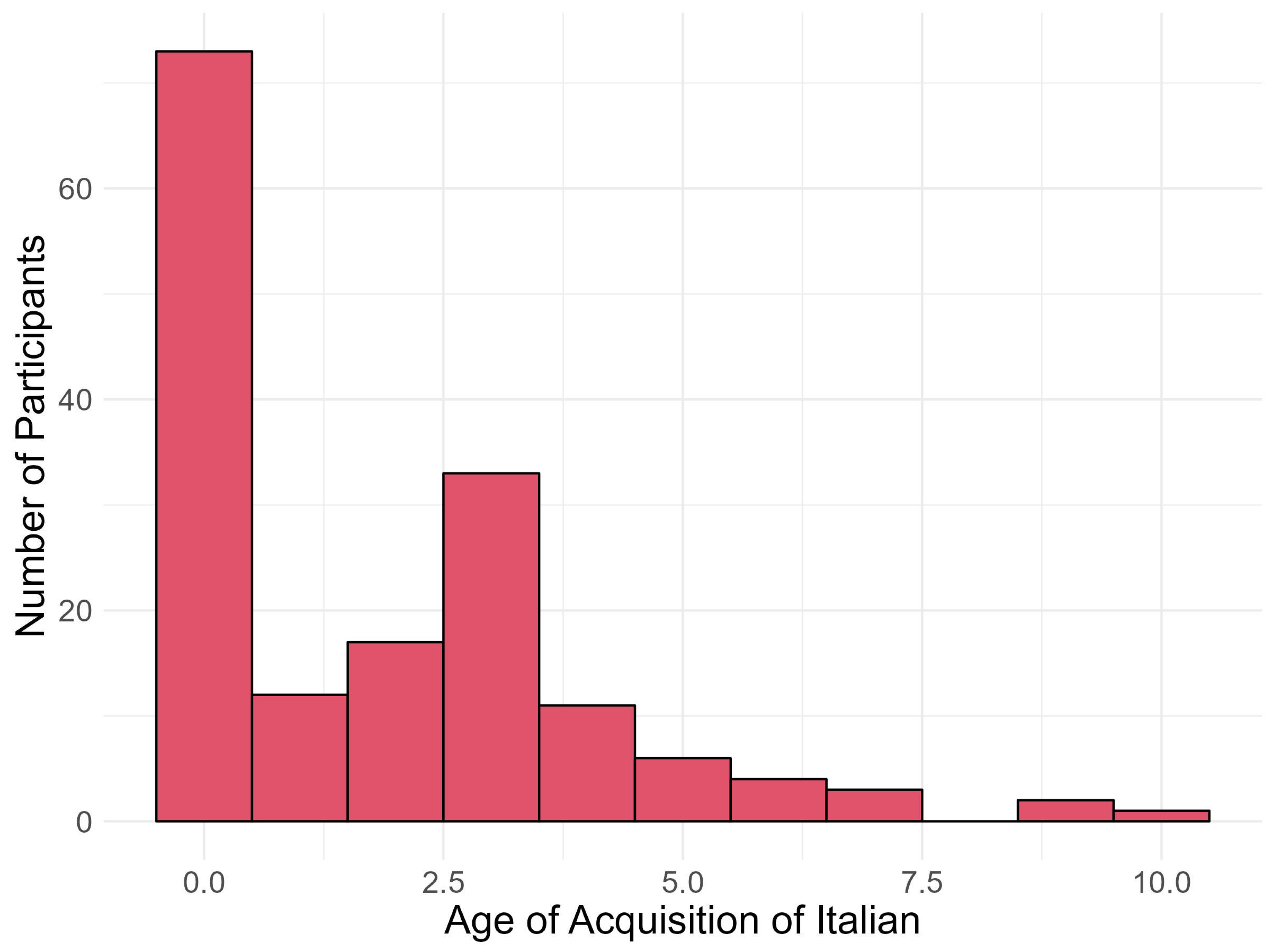
The bilingual children in the sample spoke a variety of languages other than Italian. The most common were Arabic (N = 31), English (28), Albanian (27), Romanian (19), and Tagalog (10). The majority of bilingual children were born in Italy (N = 140, 86%) and had attended all three years of nursery school in Italy (N = 119, 73%), having early exposure to Italian, as illustrated in Figure 1. Regarding exposure to languages other than Italian, most bilingual children were exposed to their home language within the family context (N = 136, 84%), and about half were learning/had learnt to read in another language (N = 74, 46%).

2.2. Background Tasks

A questionnaire was developed to gather information on the participants’ clinical profile, linguistic background, and socio-economic status. The questionnaire was developed on Google Forms and was available in Italian and English. The English translation was supervised by a first-language speaker. Printed copies were provided to the schools to distribute to parents who did not possess or did not regularly have access to computers.
Participants were administered standardised tasks measuring reasoning and vocabulary. For nonverbal reasoning, we adopted the Raven’s Coloured Progressive Matrices (CPM) [54]. In the task, participants are asked to complete a series of coloured puzzles, for a total of 36 items. Each puzzle is missing one piece, and the participant must select one of six alternatives. For vocabulary, we administered the Boston Naming Test (BNT) [55], where participants are shown a series of images and are asked to name them in Italian, for a total of 60 items. Table 1 presents the distribution of participants across grades and their average scores on the standardised measures of nonverbal reasoning (CPM) and vocabulary (BNT).

2.3. Experimental Tasks

An LDT was adopted to investigate the acquisition of single-word reading [56], in which participants are asked to decide whether a string of letters is a real word or not. LDTs have been utilised successfully in the literature to investigate decoding skills. The underlying mechanisms of the high correlation between lexical decision tasks and standardized reading scores are still not fully understood. However, potential explanations come from findings in cognitive psychology and neuroscience. In cognitive psychology, research studies suggest that some key cognitive processes at play when participants make a dual forced choice lexical decision are also at play during visual word recognition [57,58,59,60]. Moreover, recent neuroscientific models postulate that a crucial stage of natural reading is lexical categorization [57,58,61,62,63]. The task is the Italian adaptation of the LDT of the Rapid Online Assessment of Reading (ROAR) suite [64], a platform containing several online automated tests functioning as screening tools for reading abilities and reading prerequisites. The English and Spanish versions of the task have been shown to have high validity and reliability compared to available standardized tasks to screen decoding abilities [64,65,66], as well as the Italian adaptation employed here [56].
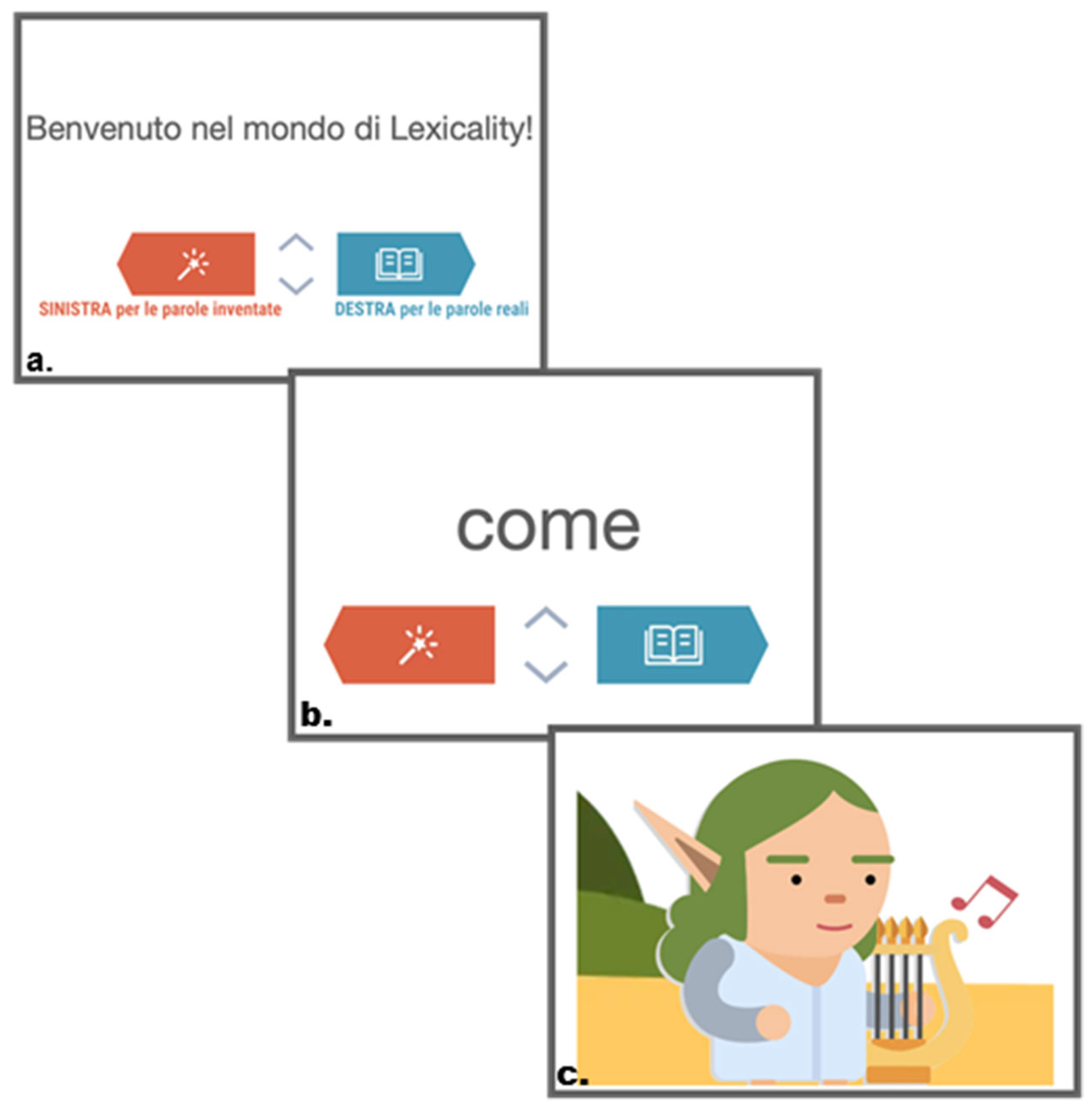
The LDT was self-administered online from a tablet or computer. A string of letters appeared on the screen, disappearing after 350 ms with no timeout. All stimuli were presented in lowercase, which is taught in Italian schools from the later stages of the first grade of primary school. Participants were instructed by a narrating voice to press a button to choose whether the string of letters is meaningful (a word) or not (a pseudoword). An acoustic feedback signalled the accuracy of the selection with a trill (accurate) or a thud (not accurate). Each participant saw a total of 170 words (50% words, 50% pseudowords) randomly selected from a pool of 286 items (143 word–pseudoword pairs). Examples of pseudowords are: accivista and pedre. The task was gamified to make it more engaging for children in the form of a story with different fantasy characters. Figure 2 shows an example of the screen as presented to the children.

2.4. Procedure

Participants were tested at school during regular school hours. Up to four children at a time were accompanied in a quiet room and were tested individually. This testing phase included three parts: (a) a tablet-based session, during which the children independently completed the ROAR task while wearing headphones and sitting apart from the rest of the group; (b) a one-on-one session with the researcher, during which standardised tests were administered, and (c) class administration of the reasoning task (CPM). This took place on a different day compared to (a) and (b) during regular school hours and was carried out by either the teachers or the researchers involved in the study. The individual sessions ((a) and (b)) took approximately 30–40 min. For the I-ROAR word, children were instructed to keep the tablet in the same position and respond as quickly and accurately as possible.

2.5. Data Analysis

In this study, we examined the differences in learning curves on a lexical decision task in monolingual and bilingual children, while controlling for potential confounds of SES, vocabulary size, nonverbal intelligence, and bilingual measures of exposure. SES was calculated using the Four Factor Index of Social Status, based on each parent’s education and occupation [67]. Parental educational level was assigned a score from 1 to 7, and occupational level a score from 1 to 9. SES scores for fathers and mothers were computed using the formula (educational level × 3) + (occupation × 5), and the child’s SES was derived as the mean of the two parental scores. Bilingual measures were age of acquisition of Italian (continuous variable, with 0 = since birth); years of nursery education in Italy (continuous variable); whether a parent spoke a language other than Italian at home (home language use, categorical variable); whether the child was mono- or biliterate (categorical variable: only Italian, or Italian + other languages). To test for collinearity issues, the variance inflation factor (VIF) was calculated, and all predictors with VIF < 2.5 were retained (conservative cut-off for a risk of instability of beta coefficients [68]).
To investigate bias-corrected accuracy, we computed d’ based on Signal Detection Theory [69]. d’ is a measure of sensitivity, i.e., the participant’s ability to distinguish real words from pseudowords independently of response bias. Higher d’ values indicate better discrimination. For each participant, we first calculated the number of hits (correctly identifying real words), misses (failing to identify real words), false alarms (incorrectly identifying pseudowords as real), and correct rejections (correctly identifying pseudowords as pseudo). To avoid infinite z-scores when hit or false alarm rates were 0 or 1, we applied the Hautus log-linear correction, adding 0.5 to each count and 1 to each denominator. Corrected hit and false alarm rates were then transformed into z-scores to compute d’. Finally, to examine predictors of lexical discrimination ability, a multiple linear regression model was fitted with d’ as the dependent variable, with fixed factors of language status and grade, as well as their interaction, and covariates for linguistic and cognitive factors to control for potential confounds (CPM, BNT, SES, age of acquisition, years of nursery, home language use, reading in other languages). To test the significance of fixed effects, we applied a Type II ANOVA using the car package 3.1.2 [70]. Effect sizes are reported as partial eta squared (ηp2) for all omnibus tests.
For each subject and stimulus type (word, pseudoword), only response times for correct responses of trials within 2 SD of the mean RT were retained. A linear mixed effect model was fitted using the lme4 package 1.1.33 in R to log-transformed response time data on correct trials [71]. The model included fixed factors of bilingualism and grade, and covariates of linguistic and cognitive factors to control for potential confounds. By-subject and by-item random intercepts were included. To test the significance of fixed effects, we applied a Type II ANOVA using the car’ package. Effect sizes for fixed effects are reported as ηp2. Model fit for the mixed model is described using marginal and conditional R2.

3. Results

3.1. Sensitivity

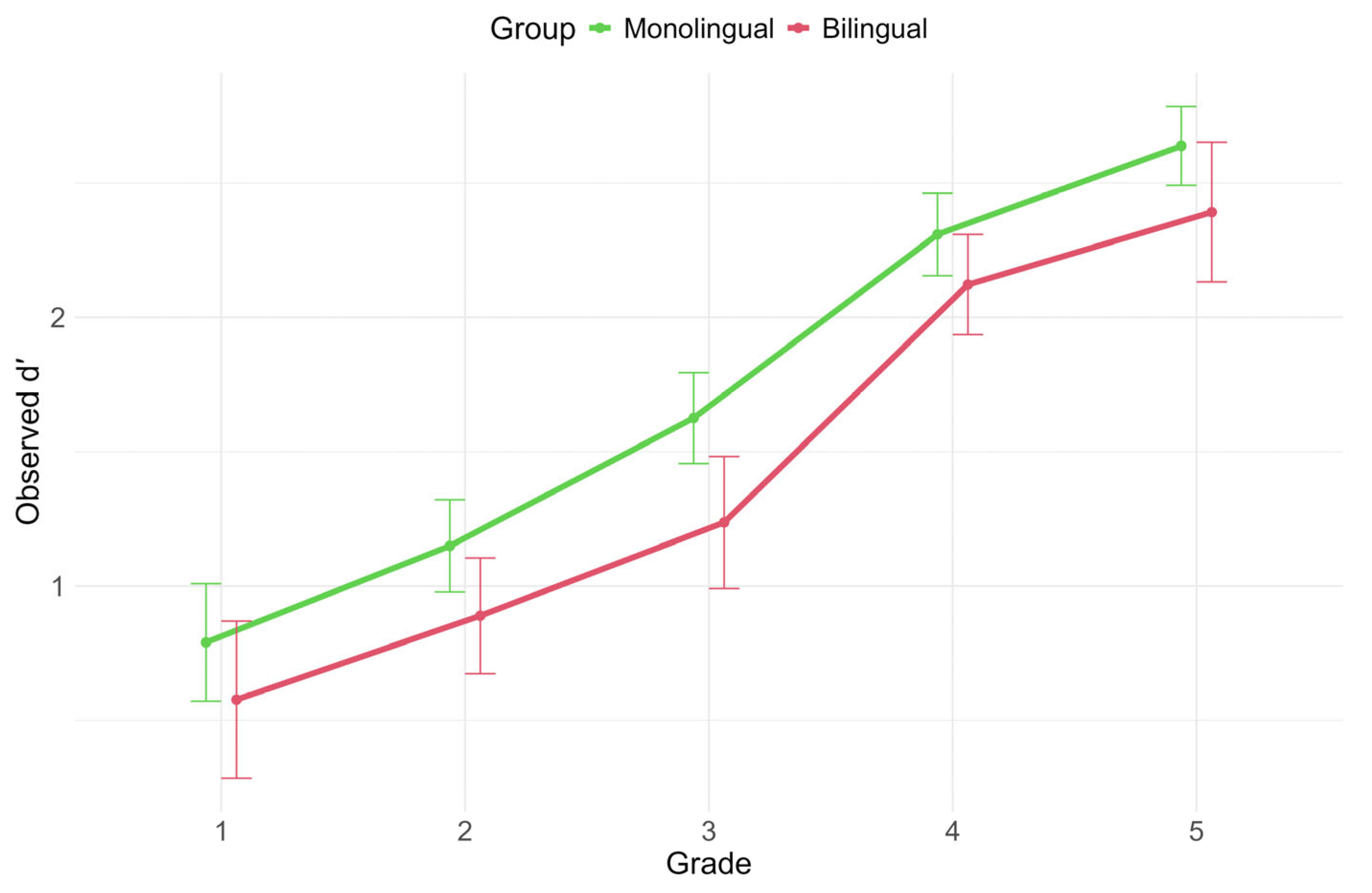
Observed results per grade and language group are shown in Figure 3. The model (multiple R2 = 0.54, adjusted R2 = 0.52) reveals a significant main effect of grade on d’ (F(4, 548) = 56.75, p < 0.001, ηp2 = 0.29), indicating that sensitivity varied across grade levels. In contrast, neither language status (F(1, 548) = 0.17, p = 0.683, ηp2 < 0.001) nor the interaction between language status and grade (F(4, 548) = 0.25, p = 0.9, ηp2 < 0.001) accounts for d’ changes after controlling for potential confounding variables.
Vocabulary size, as measured by the BNT score, is positively associated with d’, meaning a richer vocabulary leads to higher sensitivity (F(1, 548) = 41.25, p < 0.001, ηp2 = 0.07). The same effect and direction were reported for CPM (F(1, 548) = 17.93, p < 0.001, ηp2 = 0.03), indicating that higher nonverbal reasoning abilities produce higher levels of sensitivity. There is also a trend for SES (F(1, 548) = 3.67, p = 0.056, ηp2 < 0.001), indicating higher sensitivity in high-SES children.
Of the bilingual-specific variables, only the effect of home language exposure is significant (F(1, 548) = 5.65, p = 0.018, ηp2 = 0.01), showing that higher exposure to Italian at home is associated with higher sensitivity.

3.2. Response Times

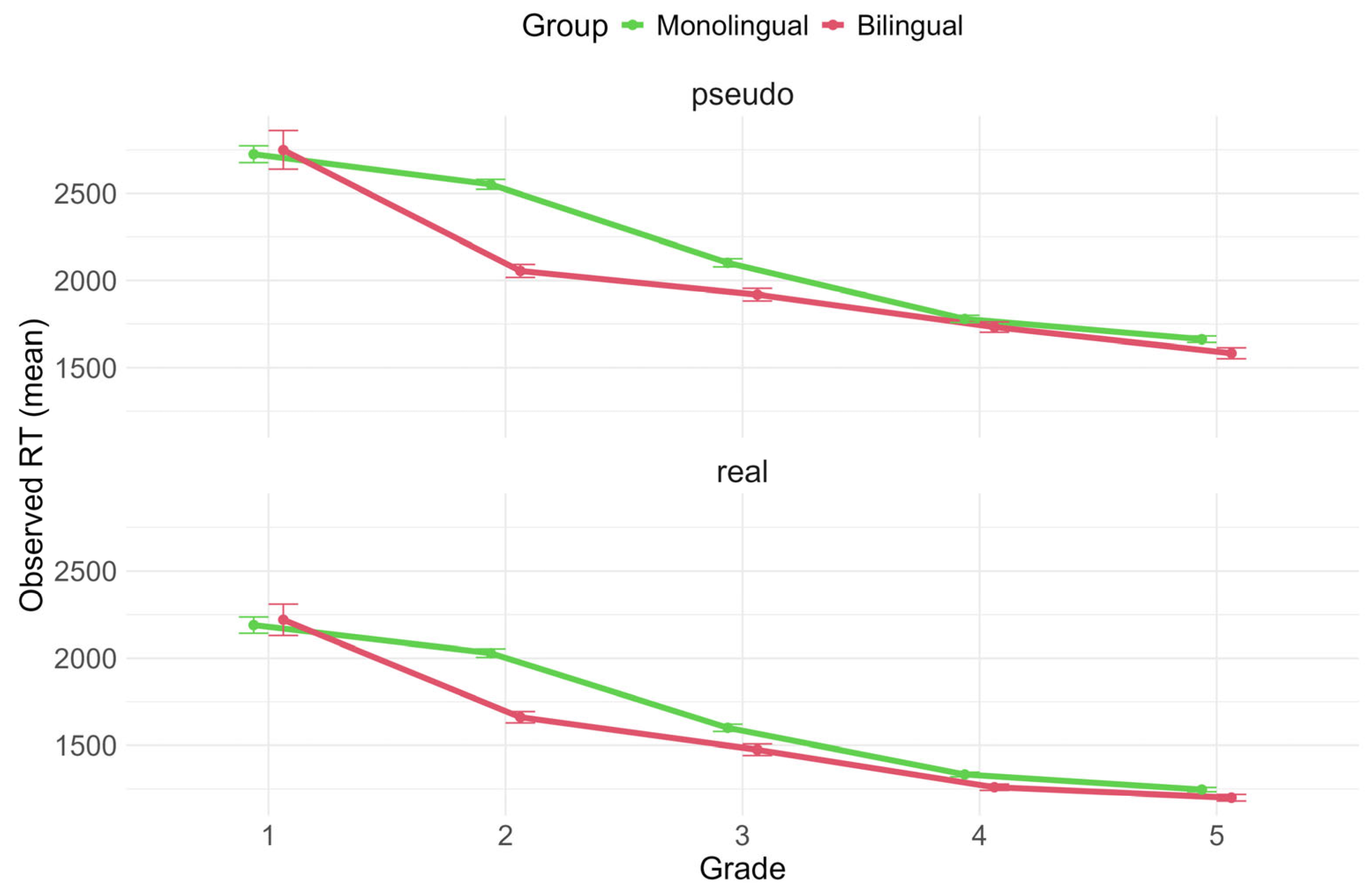
Response times for correct responses visualised by school grade are shown in Figure 4. The model (conditional R2 = 0.45, marginal R2 = 0.2) reveals a significant main effect of grade (F(4, 545.74) = 55.84, p < 0.001, ηp2 = 0.29), where response times progressively become faster over time. There is also a main effect of stimulus type (F(1, 272.43) = 984.97, p < 0.001, ηp2 = 0.21), with words being processed faster than pseudowords.
No simple main effect of language status emerges in this case. However, a significant interaction between language status and grade is reported (F(4, 546.16) = 3.70, p = 0.006, ηp2 = 0.03). Post hoc FDR-corrected statistics for the two-way interaction reveal that the effect of language status is only significant in second grade (estimated difference = −438 ms, 95% CI [75, 801], z = 3.96, p = 0.0002), meaning that second-grade bilinguals have faster response times than second-grade monolinguals after correcting for vocabulary, nonverbal intelligence, family SES, and bilingual variables. This result is further confirmed by a follow-up analysis on a subset group of second graders (N = 72, of which 36 were monolingual and 36 were bilingual) matched for CPM scores and SES (F(1, 64.94) = 4.21, p = 0.044, ηp2 = 0.06).
Looking at grade progression in the two groups, bilinguals in second grade differ significantly from bilinguals in first grade (estimated difference = −545 ms, 95% CI [73, 1017], z = 3.76, p = 0.0003), while monolinguals show a similar significant difference a year later, between second and third grade (estimated difference = −448 ms, 95% CI [217, 680], z = 6.32, p = 0.0001), confirming an earlier reduction in response times for bilinguals compared to monolinguals after correcting for potential confounds. Monolingual and bilingual children’s performance does not differ in fourth and fifth grade (zs < 1.5, ps > 0.1). No significant effects of the confounding variables were reported.

4. Discussion

The present study investigated the development of decoding skills in bilingual and monolingual children learning to read in an alphabetic, transparent orthography (Italian). Using a cross-sectional design, learning patterns of sensitivity and response times to an LDT were investigated from the first year in which children learn to read to the end of primary school (from 6 to 11 years of age). Two main questions guided the study: first, whether bilingualism exerts facilitatory effects in decoding acquisition above and beyond linguistic and contextual factors that are strongly associated with bilingual differences (namely, vocabulary, SES, and age of acquisition); and second, whether any effect of bilingualism is stable across development or restricted to a specific phase of learning. We acknowledge the following limitations of the study: first, while the cross-sectional design adopted gives us insight into learning patterns and processes, it cannot directly inform us on learning trajectories, for which a longitudinal design is necessary. Secondly, the bilingual children who took part in the study are mostly described as early bilinguals, with early exposure to Italian. Therefore, we cannot draw conclusions that generalise to all bilinguals, including late bilinguals. Lastly, although we find no general effect of biliteracy, at present, we do not investigate in depth potential transfer effects for the biliterate children in the sample.
Looking at overall progression across school grades, decoding performance showed a clear increase in sensitivity and an inverse trend for response times. Children became both more accurate and faster in determining whether a stimulus was a word or a pseudoword as school years progressed. This result is consistent with models of reading in children positing a shift from GPC decoding to more automatised and faster word recognition with increasing experience and exposure [15,16], as well as with longitudinal and cross-grade evidence showing that once a sufficient level of decoding accuracy is reached, subsequent development is characterised by increasing speed and efficiency (e.g., [72,73]). Crucially, we found these developmental patterns of decoding skills to be overall similar in monolingual and bilingual learners once factors that constitute sources of variance in bilinguals are controlled for. In fact, linguistic background was not found as a main effect in either response times or sensitivity, but the latter was modulated by both vocabulary size, nonverbal cognition, and SES. This finding contributes to the mixed results previously found in the literature, supporting accounts that do not posit systematically worse decoding abilities in bilingual students in word-level reading development, but rather comparable growth patterns modulated by other factors, most notably vocabulary knowledge, language exposure, and SES [31,35,36,37,74,75]. Future studies adopting a longitudinal design are needed to further strengthen the generalizability of this result to decoding developmental trajectories.
The association between decoding accuracy and vocabulary size, as well as socioeconomic status, is in line with evidence showing that SES-related differences in reading outcomes are largely mediated by variation in lexical knowledge, rather than decoding mechanisms per se [72,76]. For bilingual-specific variables, only home language exposure showed a modest but significant association with decoding sensitivity in our data, such that greater exposure to Italian at home was linked to higher sensitivity. This result is consistent with the previous literature, where greater exposure to the dominant language at home is linked to higher literacy outcomes in that language. Language exposure seems to affect multiple key skills of reading, such as visual word recognition, vocabulary, and text comprehension [77,78]. Although our focus here was on decoding, additional studies can provide a more nuanced overview of which subskills of reading are majorly affected by the bilingual experience, as well as a more nuanced conceptualization of home exposure as a cumulative, continuous variable [79,80].
Another strong predictor of word-reading outcomes in bilingual speakers found in the literature is earlier exposure to the language of schooling, with earlier exposure leading to stronger outcomes [31,81]. In the present study, the effect was not replicated. However, this is likely due to the low variability of this measure in our sample. In fact, as noted in the description of the bilingual participants, most of them were early bilinguals, having a similar early age of exposure to Italian and having been in the Italian pre-schooling system for 2–3 years before the start of primary school. More variability in language dominance and exposure will allow us to test for decoding differences in both sensitivity and response times. It is also worth mentioning that we do not find an effect related to whether the children are mono- or biliterate (i.e., the categorical variable of biliteracy was not significant for either sensitivity or response times). Future studies should explore cross-linguistic transfer given by specific orthographic pairs to expand the debate around the GSA with developmental data and examine whether the present findings generalize to bilingual populations in non-European contexts, where greater variability in orthographic systems and sociolinguistic environments may lead to different developmental trajectories.
A sensitive measure, such as response times, allowed us to identify a subtle difference in their learning patterns: while the main effect of language status was not significant, an interaction between language status and grade was significant for second graders, revealing that bilingual pupils in second grade were faster than their monolingual peers in single word recognition. This earlier drop in response times appears during a phase of reading acquisition where fluency and processing speed are consolidating. This stage marks a transition toward increasingly automatised word recognition [18], during which performance remains particularly sensitive to individual differences [72]. We interpret this drop at the transition stage in bilingual speakers as directly relevant to the debate over whether any potential facilitatory effect is constant over time or limited to a specific learning window. Specifically, by providing new insights from the domain of decoding acquisition, this work helps disentangle domain-general accounts [48,82] from skill-learning accounts of bilingualism [50,51,53]. Since we only find a facilitatory effect in the early phase of reading development (which is coherent with the onset of the automatization process), our data are in line with skill-learning accounts suggesting a transient efficiency effect during skill acquisition. This is compatible with a potential facilitatory effect of bilingualism during an intermediate stage of skill consolidation, followed by convergence across groups as decoding becomes increasingly automatised.

5. Conclusions

The present study investigated whether bilingual and monolingual children follow a similar developmental pattern in learning to decode written words in an alphabetic orthography. Overall, decoding accuracy and speed improved with grade in both groups, supporting the view that, when accounting for vocabulary, SES, and bilingual variables, word-level reading developmental patterns are largely shared across language backgrounds. This result has educational and clinical implications, particularly in the screening of decoding abilities throughout the school years. This practice is essential for monitoring individual developmental trajectories and for early detection of learners lagging behind their peers. Bilingual children with early exposure to Italian show a pattern of decoding development similar to that of monolingual peers, with a facilitatory effect in the early stages of reading acquisition.
Crucially, the only group difference observed was a transient advantage in decoding speed for bilingual children in the second grade. The second-grade-specific effect may suggest that executive control mechanisms support processing efficiency during an intermediate phase of decoding consolidation. However, their role diminishes as reading becomes increasingly automated. Future longitudinal studies should further confirm this finding. From an educational perspective, these findings highlight the importance of focusing on children’s language experience, vocabulary development, and stage of reading acquisition. Instructional practices should therefore prioritize supporting decoding fluency during transitional phases of learning—particularly in the early primary years—while recognizing that bilingual and monolingual learners ultimately converge in word-level reading outcomes.

Author Contributions

Conceptualization, G.S., E.B., Y.O., M.M. and S.C.; methodology, G.S., E.B., Y.O., M.M. and S.C.; software, E.A.-G., W.A.M., Roar Developer Consortium and J.D.Y.; formal analysis, G.S. and E.B.; investigation, J.D.Y., M.M. and S.C.; resources, Roar Developer Consortium, J.D.Y., M.M. and S.C.; data curation, G.S., E.B., Y.O., E.A.-G., W.A.M., Roar Developer Consortium, I-ROAR Data Collector Consortium, M.M. and S.C.; writing—original draft preparation, G.S. and E.B.; writing—review and editing, G.S., E.B., Y.O., E.A.-G., W.A.M., J.D.Y., M.M. and S.C.; visualization, G.S.; supervision, J.D.Y., M.M. and S.C.; project administration, J.D.Y., M.M. and S.C.; funding acquisition, M.M. and S.C. All authors have read and agreed to the published version of the manuscript.

Funding

This research was funded by the European Union—Next Generation EU, grant number PRIN PNRR P2022SMEJW.

Institutional Review Board Statement

This study was conducted in accordance with the Declaration of Helsinki and approved by the Institutional Ethics Committee of Area Vasta Emilia Nord (Aven, protocol code: AOU 0005678/23, date of approval: 22 February 2023).

Informed Consent Statement

Informed consent was obtained from all subjects involved in the study.

Data Availability Statement

The original data presented in the study are openly available in Zenodo at https://zenodo.org/records/18874035 (accessed on 22 March 2026).

Acknowledgments

This work would not have been possible without the help of the following interns, who helped with data collection: Gaja Garuti, Giulia Karantzounis, Davide Valente, and Chiara Varriale.

Conflicts of Interest

The authors declare no conflicts of interest.

Abbreviations

The following abbreviations are used in this manuscript:
DRCDual Route Cascade model
CDPConnectionist Dual Process model
GPCGrapheme-to-Phoneme Conversion
GSAGrain Size Accommodation
LDTLexical Decision Task

References

  1. Le Famiglie con Stranieri nei Censimenti Della Popolazione—Anno 2021. Available online: https://www.istat.it/comunicato-stampa/le-famiglie-con-stranieri-nei-censimenti-della-popolazione-anno-2021/ (accessed on 14 February 2026).
  2. Gli Alunni con Cittadinanza Non Italiana Anno Scolastico 2022/2023. Available online: https://www.mim.gov.it/pubblicazioni/-/asset_publisher/6Ya1FS4E4QJw/content/gli-alunni-con-cittadinanza-non-italiana-anno-scolastico-2022-2023 (accessed on 14 February 2026).
  3. Luk, G.; Bialystok, E. Bilingualism Is Not a Categorical Variable: Interaction between Language Proficiency and Usage. J. Cogn. Psychol. 2013, 25, 605–621. [Google Scholar] [CrossRef]
  4. Davies, A. Native Speakers and Native Users: Loss and Gain; Cambridge University Press: Cambridge, UK, 2013; ISBN 9780521119276. [Google Scholar]
  5. De Lamo White, C.; Jin, L. Evaluation of Speech and Language Assessment Approaches with Bilingual Children: SLT Assessment Approaches with Bilingual Children. Int. J. Lang. Commun. Disord. 2011, 46, 613–627. [Google Scholar] [CrossRef] [PubMed]
  6. Benmamoun, E.; Montrul, S.; Polinsky, M. Heritage Languages and Their Speakers: Opportunities and Challenges for Linguistics. Theor. Linguist. 2013, 39, 129–181. [Google Scholar] [CrossRef]
  7. Bedore, L.M.; Peña, E.D. Assessment of Bilingual Children for Identification of Language Impairment: Current Findings and Implications for Practice. Int. J. Biling. Educ. Biling. 2008, 11, 1–29. [Google Scholar] [CrossRef]
  8. Calvo, A.; Bialystok, E. Independent Effects of Bilingualism and Socioeconomic Status on Language Ability and Executive Functioning. Cognition 2014, 130, 278–288. [Google Scholar] [CrossRef]
  9. Hoff, E.; Core, C.; Place, S.; Rumiche, R.; Señor, M.; Parra, M. Dual Language Exposure and Early Bilingual Development. J. Child Lang. 2012, 39, 1–27. [Google Scholar] [CrossRef]
  10. Bellocchi, S.; Tobia, V.; Bonifacci, P. Predictors of Reading and Comprehension Abilities in Bilingual and Monolingual Children: A Longitudinal Study on a Transparent Language. Read. Writ. 2017, 30, 1311–1334. [Google Scholar] [CrossRef]
  11. de Bruin, A. Not All Bilinguals Are the Same: A Call for More Detailed Assessments and Descriptions of Bilingual Experiences. Behav. Sci. 2019, 9, 33. [Google Scholar] [CrossRef]
  12. Coltheart, M.; Rastle, K.; Perry, C.; Langdon, R.; Ziegler, J. DRC: A Dual Route Cascaded Model of Visual Word Recognition and Reading Aloud. Psychol. Rev. 2001, 108, 204–256. [Google Scholar] [CrossRef]
  13. Perry, C.; Ziegler, J.C.; Zorzi, M. Nested Incremental Modeling in the Development of Computational Theories: The CDP+ Model of Reading Aloud. Psychol. Rev. 2007, 114, 273–315. [Google Scholar] [CrossRef]
  14. Harm, M.W.; Seidenberg, M.S. Computing the Meanings of Words in Reading: Cooperative Division of Labor between Visual and Phonological Processes. Psychol. Rev. 2004, 111, 662–720. [Google Scholar] [CrossRef] [PubMed]
  15. Share, D.L. Phonological Recoding and Self-Teaching: Sine qua Non of Reading Acquisition. Cognition 1995, 55, 151–218; discussion 219–226. [Google Scholar] [CrossRef] [PubMed]
  16. Share, D.L. Phonological Recoding and Orthographic Learning: A Direct Test of the Self-Teaching Hypothesis. J. Exp. Child Psychol. 1999, 72, 95–129. [Google Scholar] [CrossRef] [PubMed]
  17. Perfetti, C.A. Reading Ability; Oxford University Press: Oxford, UK, 1985. [Google Scholar]
  18. Chall, J.S. Stages of Reading Development; McGraw-Hill Book Company: New York, NY, USA, 1983. [Google Scholar]
  19. Fowler, A.E. How Early Phonological Development Might Set the Stage for Phoneme Awareness. In Phonological Processes in Literacy; Routledge: London, UK, 2001. [Google Scholar]
  20. Goswami, U.C.; Bryant, P. Phonological Skills and Learning to Read; Essays in Developmental Psychology; Routledge: London, UK, 2016; ISBN 9781317441557. [Google Scholar]
  21. Vellutino, F.; Scanlon, D. Phonological Coding, Phonological Awareness, and Reading Ability: Evidence from a Longitudinal and Experimental Study. Merrill-Palmer Q. 1987, 33, 321–363. [Google Scholar]
  22. Nagy, W.E.; Anderson, R.C. Metalinguistic Awareness and Literacy Acquisition in Different Languages; University of Illinois at Urbana-Champaign: Champaign, IL, USA, 1995. [Google Scholar]
  23. Walley, A.C.; Metsala, J.L.; Garlock, V.M. Spoken Vocabulary Growth: Its Role in the Development of Phoneme Awareness and Early Reading Ability. Read. Writ. 2003, 16, 5–20. [Google Scholar] [CrossRef]
  24. Bonifacci, P.; Tobia, V. The Simple View of Reading in Bilingual Language-Minority Children Acquiring a Highly Transparent Second Language. Sci. Stud. Read. 2017, 21, 109–119. [Google Scholar] [CrossRef]
  25. Crosson, A.C.; Lesaux, N.K. Revisiting Assumptions about the Relationship of Fluent Reading to Comprehension: Spanish-Speakers’ Text-Reading Fluency in English. Read. Writ. 2010, 23, 475–494. [Google Scholar] [CrossRef]
  26. Melby-Lervåg, M.; Lervåg, A. Reading Comprehension and Its Underlying Components in Second-Language Learners: A Meta-Analysis of Studies Comparing First- and Second-Language Learners. Psychol. Bull. 2014, 140, 409–433. [Google Scholar] [CrossRef]
  27. Geva, E.; Farnia, F. Developmental Changes in the Nature of Language Proficiency and Reading Fluency Paint a More Complex View of Reading Comprehension in ELL and EL1. Read. Writ. 2012, 25, 1819–1845. [Google Scholar] [CrossRef]
  28. Davis, D.S.; Huang, B.; Yi, T. Making Sense of Science Texts: A Mixed-methods Examination of Predictors and Processes of Multiple-text Comprehension. Read. Res. Q. 2017, 52, 227–252. [Google Scholar] [CrossRef]
  29. Huang, B.H.; Bedore, L.M.; Niu, L.; Wang, Y.; Wicha, N.Y.Y. The Contributions of Oral Language to English Reading Outcomes among Young Bilingual Students in the United States. Int. J. Billing. 2021, 25, 40–57. [Google Scholar] [CrossRef]
  30. August, D.; Shanahan, T. Developing Reading and Writing in Second-Language Learners: Lessons from the Report of the National Literacy Panel on Language-Minority Children and Youth Published by Routledge for the American Association of Colleges for Teacher Education, 2nd ed.; Shanahan, T., August, D., Eds.; Routledge: London, UK, 2007; ISBN 9781135594114. [Google Scholar]
  31. Kovelman, I.; Baker, S.A.; Petitto, L.-A. Age of First Bilingual Language Exposure as a New Window into Bilingual Reading Development. Biling. Lang. Cogn. 2008, 11, 203–223. [Google Scholar] [CrossRef] [PubMed]
  32. Raudszus, H.; Segers, E.; Verhoeven, L. Lexical Quality and Executive Control Predict Children’s First and Second Language Reading Comprehension. Read. Writ. 2018, 31, 405–424. [Google Scholar] [CrossRef] [PubMed]
  33. Lesaux, N.K.; Rupp, A.A.; Siegel, L.S. Growth in Reading Skills of Children from Diverse Linguistic Backgrounds: Findings from a 5-Year Longitudinal Study. J. Educ. Psychol. 2007, 99, 821–834. [Google Scholar] [CrossRef]
  34. Nakamoto, J.; Lindsey, K.A.; Manis, F.R. A Longitudinal Analysis of English Language Learners’ Word Decoding and Reading Comprehension. Read. Writ. 2007, 20, 691–719. [Google Scholar] [CrossRef]
  35. Bonifacci, P.; Lombardo, G.; Pedrinazzi, J.; Terracina, F.; Palladino, P. Literacy Skills in Bilinguals and Monolinguals with Different SES. Read. Writ. Q. 2020, 36, 243–259. [Google Scholar] [CrossRef]
  36. Bonifacci, P.; Ferrara, I.C.; Pedrinazzi, J.; Terracina, F.; Palladino, P. Literacy Acquisition Trajectories in Bilingual Language Minority Children and Monolingual Peers with Similar or Different SES: A Three-Year Longitudinal Study. Brain Sci. 2022, 12, 563. [Google Scholar] [CrossRef]
  37. Cangelosi, M.; Barichello, C.; Dijkstra, T.; Palladino, P. How SES May Affect Reading Comprehension and Vocabulary in Language Minority Bilingual and Monolingual Children. Read. Writ. Q. 2024, 40, 170–190. [Google Scholar] [CrossRef]
  38. Ziegler, J.C.; Goswami, U. Reading Acquisition, Developmental Dyslexia, and Skilled Reading across Languages: A Psycholinguistic Grain Size Theory. Psychol. Bull. 2005, 131, 3–29. [Google Scholar] [CrossRef]
  39. Ziegler, J.C.; Perry, C.; Jacobs, A.M.; Braun, M. Identical Words Are Read Differently in Different Languages. Psychol. Sci. 2001, 12, 379–384. [Google Scholar] [CrossRef]
  40. Lallier, M.; Carreiras, M. Cross-Linguistic Transfer in Bilinguals Reading in Two Alphabetic Orthographies: The Grain Size Accommodation Hypothesis. Psychon. Bull. Rev. 2018, 25, 386–401. [Google Scholar] [CrossRef] [PubMed]
  41. Bialystok, E. The Bilingual Adaptation: How Minds Accommodate Experience. Psychol. Bull. 2017, 143, 233–262. [Google Scholar] [CrossRef] [PubMed]
  42. Namazi, M.; Thordardottir, E. A Working Memory, Not Bilingual Advantage, in Controlled Attention. Int. J. Biling. Educ. Biling. 2010, 13, 597–616. [Google Scholar] [CrossRef]
  43. Prior, A.; MacWhinney, B. A Bilingual Advantage in Task Switching. Biling. Lang. Cogn. 2010, 13, 253–262. [Google Scholar] [CrossRef]
  44. Bialystok, E.; McBride-Chang, C.; Luk, G. Bilingualism, Language Proficiency, and Learning to Read in Two Writing Systems. J. Educ. Psychol. 2005, 97, 580–590. [Google Scholar] [CrossRef]
  45. Gunnerud, H.L.; Ten Braak, D.; Reikerås, E.K.L.; Donolato, E.; Melby-Lervåg, M. Is Bilingualism Related to a Cognitive Advantage in Children? A Systematic Review and Meta-Analysis. Psychol. Bull. 2020, 146, 1059–1083. [Google Scholar] [CrossRef]
  46. Lehtonen, M.; Soveri, A.; Laine, A.; Järvenpää, J.; de Bruin, A.; Antfolk, J. Is Bilingualism Associated with Enhanced Executive Functioning in Adults? A Meta-Analytic Review. Psychol. Bull. 2018, 144, 394–425. [Google Scholar] [CrossRef]
  47. Green, D.W. Mental Control of the Bilingual Lexico-Semantic System. Biling. Lang. Cogn. 1998, 1, 67–81. [Google Scholar] [CrossRef]
  48. Green, D.W.; Abutalebi, J. Language Control in Bilinguals: The Adaptive Control Hypothesis. J. Cogn. Psychol. 2013, 25, 515–530. [Google Scholar] [CrossRef]
  49. Bialystok, E.; Craik, F.I.M. How Does Bilingualism Modify Cognitive Function? Attention to the Mechanism. Psychon. Bull. Rev. 2022, 29, 1246–1269. [Google Scholar] [CrossRef]
  50. Baum, S.; Titone, D. Moving toward a Neuroplasticity View of Bilingualism, Executive Control, and Aging. Appl. Psycholinguist. 2014, 35, 857–894. [Google Scholar] [CrossRef]
  51. Pliatsikas, C. Understanding Structural Plasticity in the Bilingual Brain: The Dynamic Restructuring Model. Biling. Lang. Cogn. 2020, 23, 459–471. [Google Scholar] [CrossRef]
  52. Jylkkä, J. Bilingual Language Switching and Executive Functions; Åbo Akademi University: Åbo, Finland, 2017. [Google Scholar]
  53. Lehtonen, M.; Fyndanis, V.; Jylkkä, J. The Relationship between Bilingual Language Use and Executive Functions. Nat. Rev. Psychol. 2023, 2, 360–373. [Google Scholar] [CrossRef]
  54. Raven, J.C. Manual for Raven’s Progressive Matrices and Vocabulary Scales. In Standard Progressive Matrices; H. K. Lewis & Co Ltd.: London, UK, 1983. [Google Scholar]
  55. Kaplan, E.; Goodglass, H.; Weintraub, S. Boston Naming Test; Lea & Febiger: Philadelphia, PA, USA, 1983. [Google Scholar]
  56. Bassoli, E.; Smith, G.; Ozturk, Y.; Garcia, E.A.; Ma, W.A.; ROAR Developer Consortium; I-ROAR Data Collector Consortium; Yeatman, J.D.; Mastrogiuseppe, M.; Caffarra, S. I-ROAR-Word: Validity of an Italian Lexical Decision Task for reading assessment. in preparation.
  57. Balota, D.A.; Chumbley, J.I. Are Lexical Decisions a Good Measure of Lexical Access? The Role of Word Frequency in the Neglected Decision Stage. J. Exp. Psychol. Hum. Percept. Perform. 1984, 10, 340–357. [Google Scholar] [CrossRef]
  58. Gagl, B.; Richlan, F.; Ludersdorfer, P.; Sassenhagen, J.; Eisenhauer, S.; Gregorova, K.; Fiebach, C.J. The Lexical Categorization Model: A Computational Model of Left Ventral Occipito-Temporal Cortex Activation in Visual Word Recognition. PLoS Comput. Biol. 2022, 18, e1009995. [Google Scholar] [CrossRef]
  59. Balota, D.A.; Yap, M.J.; Cortese, M.J. Visual Word Recognition: The Journey from Features to Meaning (a Travel Update). In Handbook of Psycholinguistics; Academic Press: Cambridge, MA, USA, 2006; pp. 285–375. [Google Scholar]
  60. Seidenberg, S.; Mcclelland, J.L.; Seidenberg, M.S. A Distributed, Developmental Model of Word Recognition 00 and Naming. Available online: https://psycnet.apa.org/journals/rev/96/4/523/ (accessed on 15 March 2026).
  61. Caffarra, S.; Karipidis, I.I.; Yablonski, M.; Yeatman, J.D. Anatomy and Physiology of Word-Selective Visual Cortex: From Visual Features to Lexical Processing. Brain Struct. Funct. 2021, 226, 3051–3065. [Google Scholar] [CrossRef]
  62. Lerma-Usabiaga, G.; Carreiras, M.; Paz-Alonso, P.M. Converging Evidence for Functional and Structural Segregation within the Left Ventral Occipitotemporal Cortex in Reading. Proc. Natl. Acad. Sci. USA 2018, 115, E9981–E9990. [Google Scholar] [CrossRef]
  63. White, A.L.; Palmer, J.; Boynton, G.M.; Yeatman, J.D. Parallel Spatial Channels Converge at a Bottleneck in Anterior Word-Selective Cortex. Proc. Natl. Acad. Sci. USA 2019, 116, 10087–10096. [Google Scholar] [CrossRef]
  64. Yeatman, J.D.; Tang, K.A.; Donnelly, P.M.; Yablonski, M.; Ramamurthy, M.; Karipidis, I.I.; Caffarra, S.; Takada, M.E.; Kanopka, K.; Ben-Shachar, M.; et al. Rapid Online Assessment of Reading Ability. Sci. Rep. 2021, 11, 6396. [Google Scholar] [CrossRef]
  65. Siebert, J.M.; Jimenez, M.; Ma, W.A.; Saavedra, A.; Townley-Flores, C.; Yeatman, J.D. A Fair Lexical Decision Task for Monolingual and Multilingual Spanish-Speakers. PsyArXiv 2024. [Google Scholar] [CrossRef]
  66. Ma, W.A.; Richie-Halford, A.; Burkhardt, A.K.; Kanopka, K.; Chou, C.; Domingue, B.W.; Yeatman, J.D. ROAR-CAT: Rapid Online Assessment of Reading Ability with Computerized Adaptive Testing. Behav. Res. Methods 2025, 57, 56. [Google Scholar] [CrossRef]
  67. Hollingshead, A.B. Four Factor Index of Social Status. Yale J. Sociol. 2011, 8, 21–51. [Google Scholar]
  68. Hair, J.; Anderson, R.; Tatham, R.Y.; Black, W. Multivariate Data Analysis with Readings; Prentice Hall: Hoboken, NJ, USA, 1998. [Google Scholar]
  69. Macmillan, N.A. Signal Detection Theory. In Stevens’ Handbook of Experimental Psychology: Methodology in Experimental Psychology; Wiley: Hoboken, NJ, USA, 2002; Volume 3, pp. 43–90. [Google Scholar]
  70. Fox, J.; Weisberg, S. An R Companion to Applied Regression, 3rd ed.; Sage: Thousand Oaks, CA, USA, 2019. [Google Scholar]
  71. Bates, D.; Mächler, M.; Bolker, B.; Walker, S. Fitting Linear Mixed-Effects Models Using Lme4. J. Stat. Softw. 2015, 67, 1–48. [Google Scholar] [CrossRef]
  72. Karageorgos, P.; Richter, T.; Haffmans, M.-B.; Schindler, J.; Naumann, J. The Role of Word-Recognition Accuracy in the Development of Word-Recognition Speed and Reading Comprehension in Primary School: A Longitudinal Examination. Cogn. Dev. 2020, 56, 100949. [Google Scholar] [CrossRef]
  73. Mommers, M.J.C.; Boland, T. The Development of Decoding Skills, Reading Comprehension and Spelling Skills in Dutch Primary Schools: A Longitudinal Investigation; ERIC Document Reproduction Service: Springfield, VA, USA, 1987. [Google Scholar]
  74. Pasquarella, A.; Chen, X.; Gottardo, A.; Geva, E. Cross-Language Transfer of Word Reading Accuracy and Word Reading Fluency in Spanish-English and Chinese-English Bilinguals: Script-Universal and Script-Specific Processes. J. Educ. Psychol. 2015, 107, 96–110. [Google Scholar] [CrossRef]
  75. Pasquarella, A.; Gottardo, A.; Grant, A. Comparing Factors Related to Reading Comprehension in Adolescents Who Speak English as a First (L1) or Second (L2) Language. Sci. Stud. Read. 2012, 16, 475–503. [Google Scholar] [CrossRef]
  76. Li, J.; Peng, P.; Ma, X.; Ding, N.; Zhao, J. How Does Family Socioeconomic Status Influence Children’s Reading Ability? Evidence from Meta-Analytic Structural Equation Modeling. Educ. Psychol. Rev. 2023, 35, 119. [Google Scholar] [CrossRef]
  77. Wagley, N.; Marks, R.A.; Bedore, L.M.; Kovelman, I. Contributions of Bilingual Home Environment and Language Proficiency on Children’s Spanish-English Reading Outcomes. Child Dev. 2022, 93, 881–899. [Google Scholar] [CrossRef]
  78. Kekejian, C.; Kraemer, R.; Sommer, C.; Mcfadden, M.; Yeh, C.-C. The Effects of Language Experience in Both Home and School Environments for Spanish-English Bilingual Children: A Preliminary Study. J. Latinos Educ. 2024, 23, 600–611. [Google Scholar] [CrossRef]
  79. De Cat, C. Predicting Language Proficiency in Bilingual Children. Stud. Second Lang. Acquis. 2020, 42, 279–325. [Google Scholar] [CrossRef]
  80. Carroll, S.E. Exposure and Input in Bilingual Development. Biling. Lang. Cogn. 2017, 20, 3–16. [Google Scholar] [CrossRef]
  81. Jasińska, K.K.; Petitto, L.-A. Age of Bilingual Exposure Is Related to the Contribution of Phonological and Semantic Knowledge to Successful Reading Development. Child Dev. 2018, 89, 310–331. [Google Scholar] [CrossRef]
  82. Blanco-Elorrieta, E.; Caramazza, A. A Common Selection Mechanism at Each Linguistic Level in Bilingual and Monolingual Language Production. Cognition 2021, 213, 104625. [Google Scholar] [CrossRef]
Figure 1. Barplot representing the age of acquisition of Italian in the bilingual sample (N = 162).
Brainsci 16 00356 g001
Figure 2. An example of the LDT screens presented to the child: (a) instructions (Welcome to Lexicality! Left button is for made-up words, right button is for real words); (b) an example of a real-word stimulus (come, “how”); (c) one of the characters of the gamified story.
Brainsci 16 00356 g002
Figure 3. Observed d’ values across grades, divided by group.
Brainsci 16 00356 g003
Figure 4. Observed RT values for correct responses across grades, divided by group and stimulus type.
Brainsci 16 00356 g004
Table 1. Descriptive statistics for the participants divided by grade: Sample size (N), mean age in years (with SDs in parentheses); mean raw scores (and SDs) and percentiles on reasoning (CPM); mean raw scores (and SDs) and z-scores on vocabulary size (BNT).
GradeN
(F, Bil)
AgeCPM ScoreCPM PercentileBNT ScoreBNT z-Score
154
(28, 15)
6.9
(0.29)
29.1
(4.81)
72.9
(30.61)
31.2
(8.6)
0.21
(1.22)
2138
(81, 37)
7.5
(0.33)
30.3
(4.3)
82.9
(24.06)
32.5
(9.66)
0.13
(1.36)
3116
(58, 35)
8.4
(0.32)
32.1
(3.51)
85.2
(19.29)
33.6
(8.83)
−0.6
(1.55)
4120
(75, 41)
9.4
(0.32)
33.4
(3.09)
85.1
(18.95)
37.4
(8.64)
−0.66
(1.53)
5137
(76, 34)
10.4
(0.3)
33.5
(2.89)
77
(24.51)
42.2
(8.36)
−0.35
(1.34)
Disclaimer/Publisher’s Note: The statements, opinions and data contained in all publications are solely those of the individual author(s) and contributor(s) and not of MDPI and/or the editor(s). MDPI and/or the editor(s) disclaim responsibility for any injury to people or property resulting from any ideas, methods, instructions or products referred to in the content.