Predictive and Reactive Control During Interception


Highlights
- Successful interception exhibits within-trial, speed-dependent shifts between predictive and reactive control in both gaze and manual trajectories.
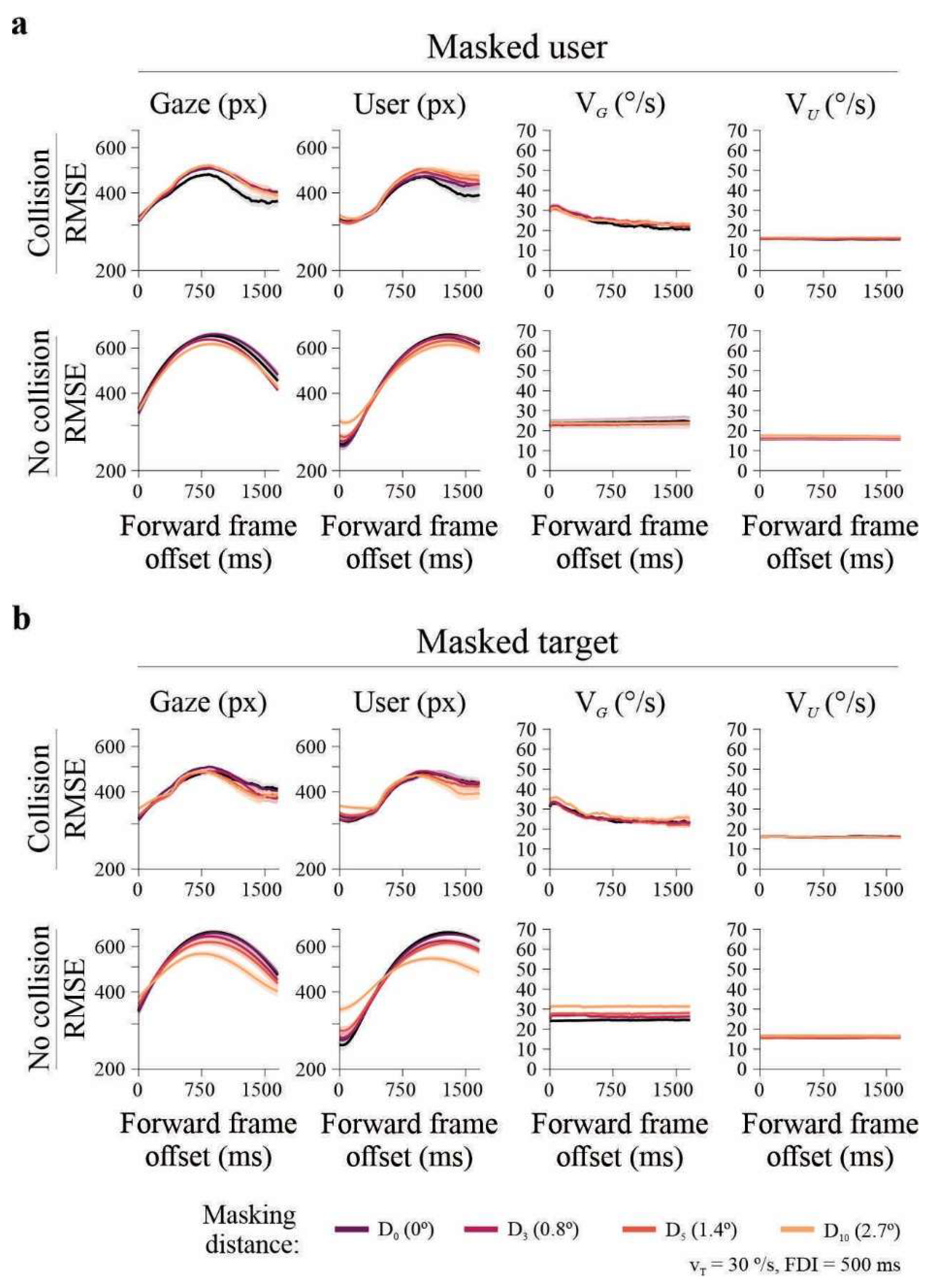
- Target occlusion reduces predictive alignment, whereas cursor occlusion has a limited impact, indicating strong reliance on internal state estimation.What are the implications of the main findings?
- Visuomotor interception is governed by continuous reweighting of anticipatory and feedback-driven control, not by a fixed predictive strategy.
- Gaze and manual control show partial dissociation in their predictive dynamics, supporting distributed and effector-specific contributions to sensorimotor control.
Abstract
1. Introduction
2. Materials and Methods
2.1. Participants
2.2. Visuomotor Task and Calibration Protocols
2.3. Gaze Tracking
2.4. Data Analysis
2.5. Statistical Analysis
3. Results
3.1. Speed-Dependent Visuomotor Coordination
3.2. Strategy Indices Reveal Dynamic Transitions Between Predictive and Reactive Control

3.3. Predictive Components in User and Gaze Trajectories During Interception
3.4. Impact of Visual Occlusion on RMSE Metrics
4. Discussion
5. Conclusions
Supplementary Materials
Author Contributions
Funding
Institutional Review Board Statement
Informed Consent Statement
Data Availability Statement
Conflicts of Interest
Abbreviations
| AR | Angular Range |
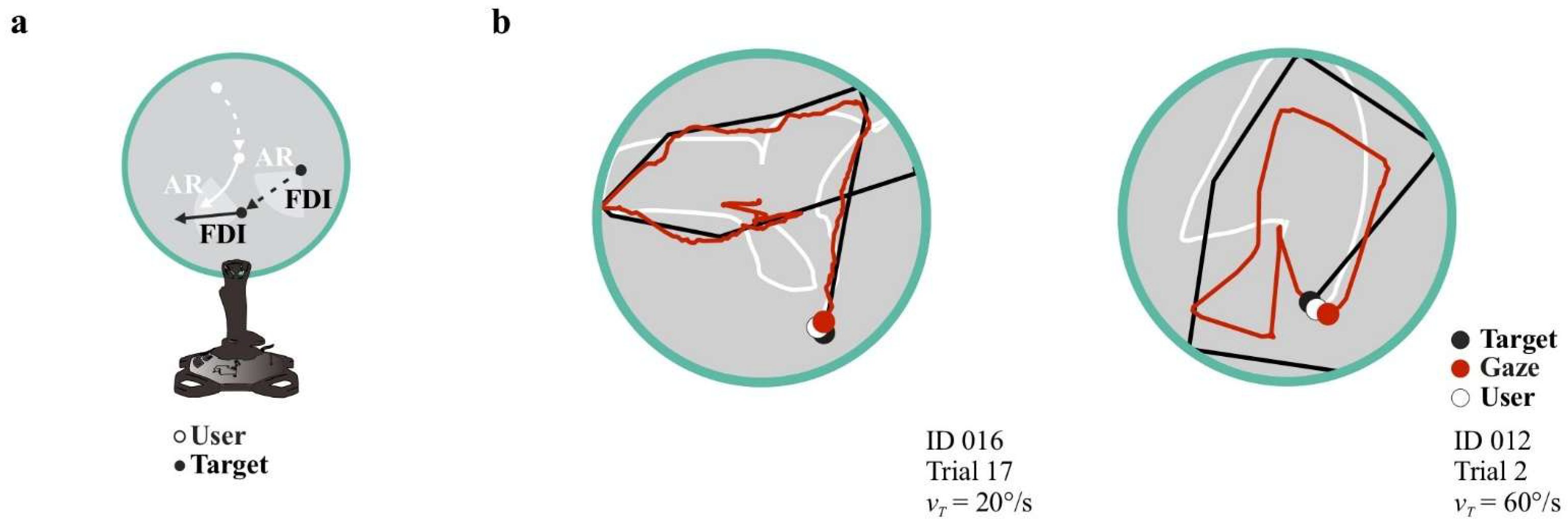
| FDI | Fixed-Direction Interval |
| GTD | Gaze-to-Target Distance |
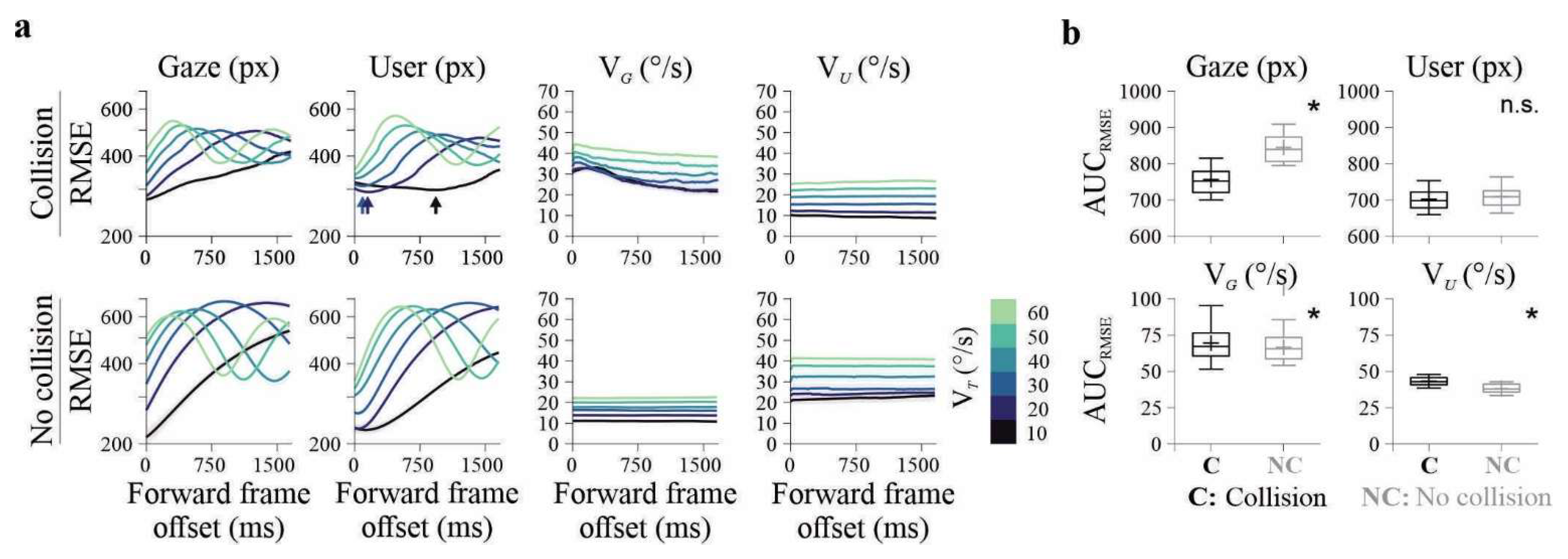
| RMSE | Root Mean Square Error |
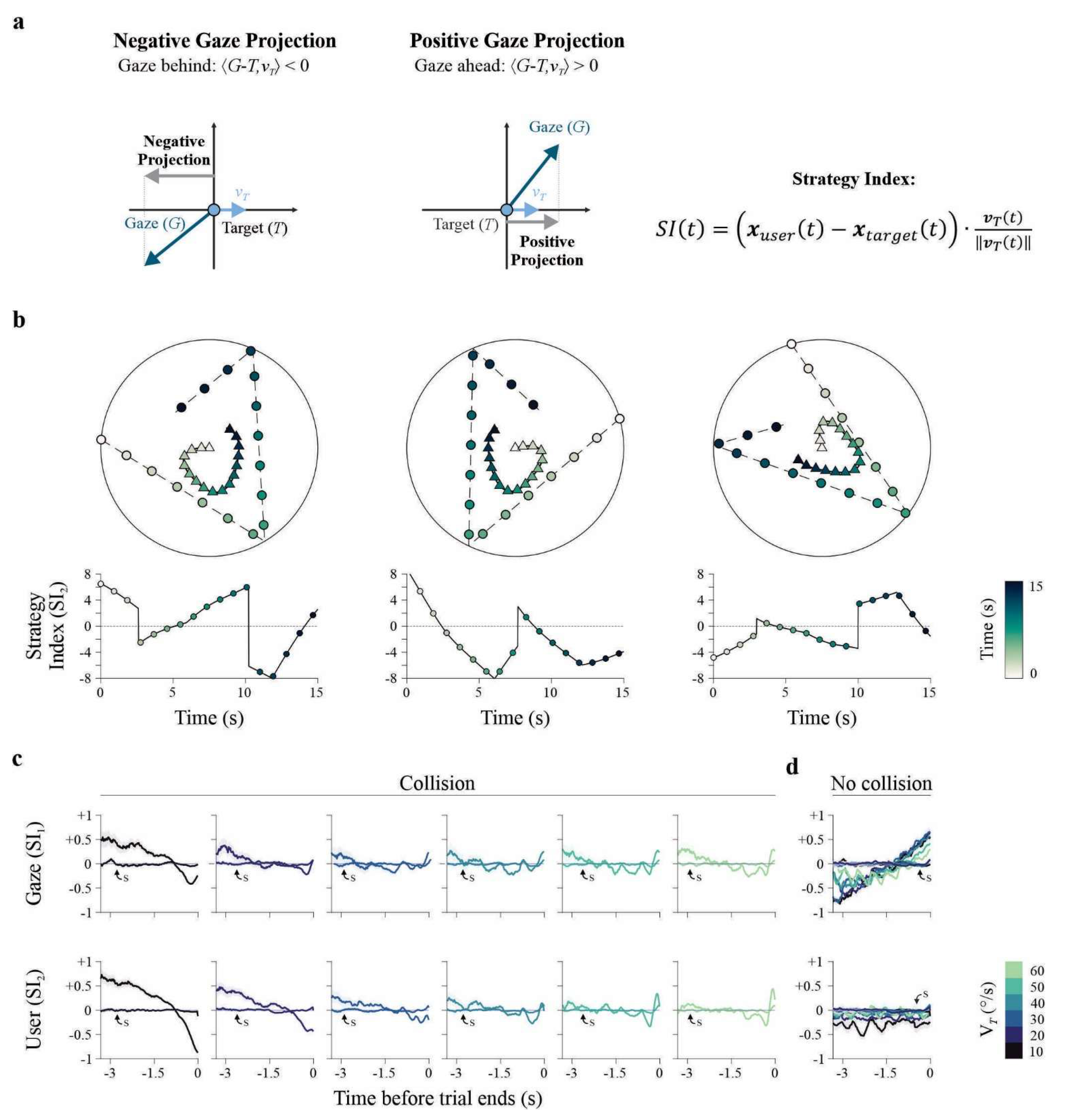
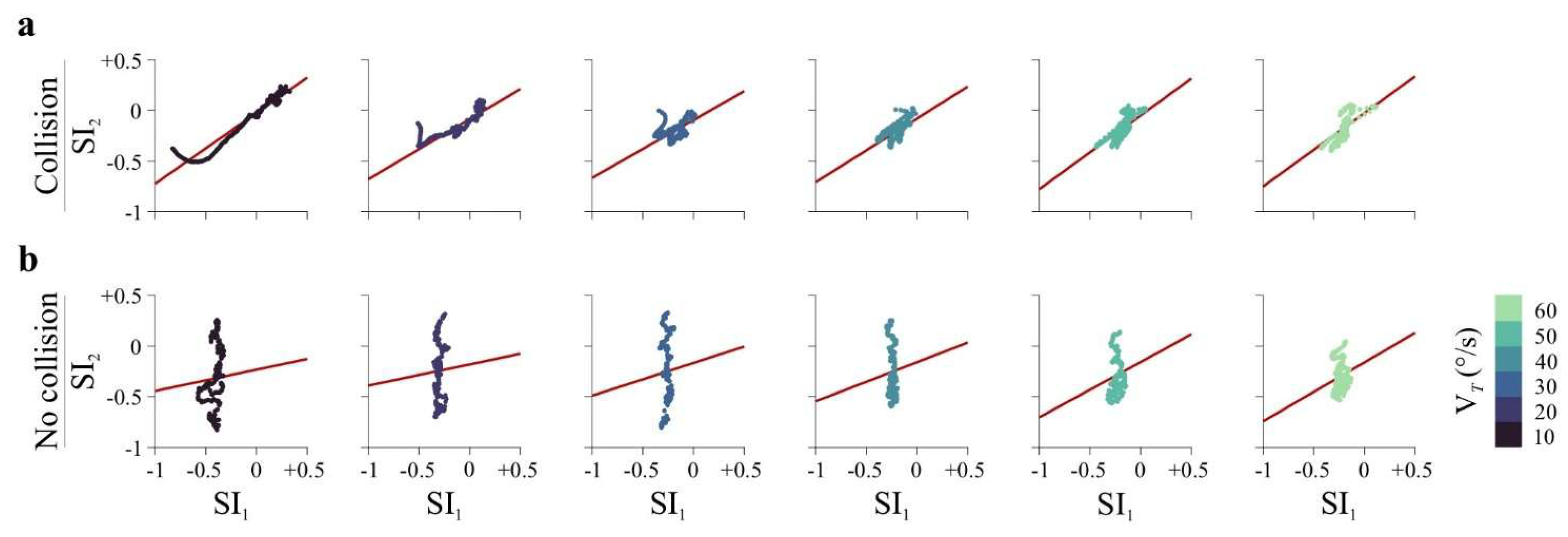
| SI1 | Strategy Index 1 (Gaze) |
| SI2 | Strategy Index 2 (User/Joystick) |
| UTD | User-to-Target Distance |
| vG | Gaze Velocity |
| vT | Target Speed |
| vU | User Speed |
References
- Wolpert, D.M.; Flanagan, J.R. Motor prediction. Curr. Biol. 2001, 11, R729–R732. [Google Scholar] [CrossRef]
- Wolpert, D.M.; Kawato, M. Multiple paired forward and inverse models for motor control. Neural Netw. 1998, 11, 1317–1329. [Google Scholar] [CrossRef] [PubMed]
- Franklin, D.W.; Wolpert, D.M. Computational mechanisms of sensorimotor control. Neuron 2011, 72, 425–442. [Google Scholar] [CrossRef] [PubMed]
- Márquez, I.; Lemus, L.; Treviño, M. A continuum from predictive to online feedback in visuomotor interception. Eur. J. Neurosci. 2024, 60, 7211–7227. [Google Scholar] [CrossRef] [PubMed]
- Saunders, J.A.; Knill, D.C. Humans use continuous visual feedback from the hand to control fast reaching movements. Exp. Brain Res. 2003, 152, 341–352. [Google Scholar] [CrossRef]
- Treviño, M.; Márquez, I. Entrainment of visuomotor responses to target speed during interception. Neuroscience 2025, 568, 364–376. [Google Scholar] [CrossRef]
- Knill, D.C.; Pouget, A. The Bayesian brain: The role of uncertainty in neural coding and computation. Trends Neurosci. 2004, 27, 712–719. [Google Scholar] [CrossRef]
- Shadmehr, R.; Krakauer, J.W. A computational neuroanatomy for motor control. Exp. Brain Res. 2008, 185, 359–381. [Google Scholar] [CrossRef]
- Port, N.L.; Pellizzer, G.; Georgopoulos, A.P. Intercepting real and path-guided apparent motion targets. Exp. Brain Res. 1996, 110, 298–307. [Google Scholar] [CrossRef]
- Fajen, B.R.; Warren, W.H. Visual guidance of intercepting a moving target on foot. Perception 2004, 33, 689–715. [Google Scholar] [CrossRef]
- Land, M.F.; McLeod, P. From eye movements to actions: How batsmen hit the ball. Nat. Neurosci. 2000, 3, 1340–1345. [Google Scholar] [CrossRef]
- Tresilian, J.R. Perceptual and cognitive processes in time-to-contact estimation: Analysis of prediction-motion and relative judgment tasks. Percept. Psychophys. 1995, 57, 231–245. [Google Scholar] [CrossRef] [PubMed]
- de la Malla, C.; Rushton, S.K.; Clark, K.; Smeets, J.B.J.; Brenner, E. The predictability of a target’s motion influences gaze, head, and hand movements when trying to intercept it. J. Neurophysiol. 2019, 121, 2416–2427. [Google Scholar] [CrossRef]
- Mrotek, L.A.; Soechting, J.F. Target Interception: Hand–Eye Coordination and Strategies. J. Neurosci. 2007, 27, 7297–7309. [Google Scholar] [CrossRef]
- Wolpert, D.M.; Miall, R.C. Forward Models for Physiological Motor Control. Neural Netw. 1996, 9, 1265–1279. [Google Scholar] [CrossRef]
- Beyeler, M.; Kasowski, J.; Akkaraju, A. Evidence for a hybrid model in moving target interception. J. Vis. 2023, 23, 5181. [Google Scholar] [CrossRef]
- Port, N.L.; Lee, D.; Dassonville, P.; Georgopoulos, A.P. Manual interception of moving targets. I. Performance and movement initiation. Exp. Brain Res. 1997, 116, 406–420. [Google Scholar] [CrossRef] [PubMed]
- Friston, K. The free-energy principle: A unified brain theory? Nat. Rev. Neurosci. 2010, 11, 127–138. [Google Scholar] [CrossRef]
- Yang, Z.; Diaz, G.J.; Fajen, B.R.; Bailey, R.; Ororbia, A. An active inference model of anticipation in locomotor interception. J. Vis. 2022, 22, 4027. [Google Scholar] [CrossRef]
- Lisberger, S.G. Visual guidance of smooth-pursuit eye movements: Sensation, action, and what happens in between. Neuron 2010, 66, 477–491. [Google Scholar] [CrossRef]
- Adams, R.A.; Shipp, S.; Friston, K.J. Predictions not commands: Active inference in the motor system. Brain Struct. Funct. 2013, 218, 611–643. [Google Scholar] [CrossRef] [PubMed]
- Treviño, M.; Medina-Coss Y León, R.; Támez, S.; Beltrán-Navarro, B.; Verdugo, J. Directional uncertainty in chase and escape dynamics. J. Exp. Psychol. Gen. 2024, 153, 418–434. [Google Scholar] [CrossRef]
- Treviño, M.; Márquez, I. Predictive fixations to target bounces in an interception task. J. Neurophysiol. 2025, 134, 1837–1852. [Google Scholar] [CrossRef] [PubMed]
- Márquez, I.; Treviño, M. Visuomotor predictors of interception. PLoS ONE 2024, 19, e0308642. [Google Scholar] [CrossRef] [PubMed]
- Mann, D.T.Y.; Williams, A.M.; Ward, P.; Janelle, C.M. Perceptual-cognitive expertise in sport: A meta-analysis. J. Sport. Exerc. Psychol. 2007, 29, 457–478. [Google Scholar] [CrossRef]
- Brainard, D.H. The Psychophysics Toolbox. Spat. Vis. 1997, 10, 433–436. [Google Scholar] [CrossRef]
- Pelli, D.G. The VideoToolbox software for visual psychophysics: Transforming numbers into movies. Spat. Vis. 1997, 10, 437–442. [Google Scholar] [CrossRef]
- Holmqvist, K.; Nyström, M.; Andersson, R.; Dewhurst, R.; Jarodzka, H.; Van de Weijer, J. Eye Tracking: A Comprehensive Guide to Methods and Measures; Oxford University Press: Oxford, UK, 2011; Available online: https://global.oup.com/academic/product/eye-tracking-9780199697083?cc=nl&lang=en& (accessed on 1 August 2025).
- Flanagan, J.R.; Johansson, R.S. Action plans used in action observation. Nature 2003, 424, 769–771. [Google Scholar] [CrossRef]
- Numasawa, K.; Miyamoto, T.; Kizuka, T.; Ono, S. Prediction error in implicit adaptation during visually- and memory-guided reaching tasks. Sci. Rep. 2024, 14, 8582. [Google Scholar] [CrossRef]
- Aoyama, C.; Goya, R.; Suematsu, N.; Kadota, K.; Yamamoto, Y.; Shimegi, S. Spatial Accuracy of Predictive Saccades Determines the Performance of Continuous Visuomotor Action. Front. Sports Act. Living 2021, 3, 775478. [Google Scholar] [CrossRef]
- Márquez, I.; Treviño, M. Pupillary responses to directional uncertainty while intercepting a moving target. R. Soc. Open Sci. 2024, 11, 240606. [Google Scholar] [CrossRef]
- Kim, N.; Li, H.E.; Hughes, R.N.; Watson, G.D.R.; Gallegos, D.; West, A.E.; Kim, I.H.; Yin, H.H. A striatal interneuron circuit for continuous target pursuit. Nat. Commun. 2019, 10, 2715. [Google Scholar] [CrossRef]
- Diaz, G.J.; Phillips, F.; Fajen, B.R. Intercepting moving targets: A little foresight helps a lot. Exp. Brain Res. 2009, 195, 345–360. [Google Scholar] [CrossRef] [PubMed]
- Brouwer, A.-M.; Brenner, E.; Smeets, J.B.J. Perception of acceleration with short presentation times: Can acceleration be used in interception? Percept. Psychophys. 2002, 64, 1160–1168. [Google Scholar] [CrossRef]
- Burr, D.C.; Ross, J. Direct Evidence That “Speedlines” Influence Motion Mechanisms. J. Neurosci. 2002, 22, 8661–8664. [Google Scholar] [CrossRef]
- Cross, K.P.; Cluff, T.; Takei, T.; Scott, S.H. Visual Feedback Processing of the Limb Involves Two Distinct Phases. J. Neurosci. 2019, 39, 6751–6765. [Google Scholar] [CrossRef] [PubMed]
- de Brouwer, S.; Missal, M.; Barnes, G.; Lefèvre, P. Quantitative analysis of catch-up saccades during sustained pursuit. J. Neurophysiol. 2002, 87, 1772–1780. [Google Scholar] [CrossRef] [PubMed]
- Tatler, B.W.; Hayhoe, M.M.; Land, M.F.; Ballard, D.H. Eye guidance in natural vision: Reinterpreting salience. J. Vis. 2011, 11, 5. [Google Scholar] [CrossRef]
- Shibasaki, H.; Hallett, M. What is the Bereitschaftspotential? Clin. Neurophysiol. 2006, 117, 2341–2356. [Google Scholar] [CrossRef]
- Badler, J.B.; Heinen, S.J. Anticipatory movement timing using prediction and external cues. J. Neurosci. 2006, 26, 4519–4525. [Google Scholar] [CrossRef]
- Limanowski, J.; Kirilina, E.; Blankenburg, F. Neuronal correlates of continuous manual tracking under varying visual movement feedback in a virtual reality environment. Neuroimage 2017, 146, 81–89. [Google Scholar] [CrossRef]
- Deecke, L.; Kornhuber, H.H. An electrical sign of participation of the mesial “supplementary” motor cortex in human voluntary finger movement. Brain Res. 1978, 159, 473–476. [Google Scholar] [CrossRef]
- Libet, B.; Gleason, C.A.; Wright, E.W.; Pearl, D.K. Time of conscious intention to act in relation to onset of cerebral activity (readiness-potential). The unconscious initiation of a freely voluntary act. Brain 1983, 106, 623–642. [Google Scholar] [CrossRef]


Disclaimer/Publisher’s Note: The statements, opinions and data contained in all publications are solely those of the individual author(s) and contributor(s) and not of MDPI and/or the editor(s). MDPI and/or the editor(s) disclaim responsibility for any injury to people or property resulting from any ideas, methods, instructions or products referred to in the content. |
© 2026 by the authors. Licensee MDPI, Basel, Switzerland. This article is an open access article distributed under the terms and conditions of the Creative Commons Attribution (CC BY) license.
Share and Cite
Treviño, M.; Martín, N.; Barrera, A.; Márquez, I. Predictive and Reactive Control During Interception. Brain Sci. 2026, 16, 322. https://doi.org/10.3390/brainsci16030322
Treviño M, Martín N, Barrera A, Márquez I. Predictive and Reactive Control During Interception. Brain Sciences. 2026; 16(3):322. https://doi.org/10.3390/brainsci16030322
Chicago/Turabian StyleTreviño, Mario, Nathaly Martín, Andrea Barrera, and Inmaculada Márquez. 2026. "Predictive and Reactive Control During Interception" Brain Sciences 16, no. 3: 322. https://doi.org/10.3390/brainsci16030322
APA StyleTreviño, M., Martín, N., Barrera, A., & Márquez, I. (2026). Predictive and Reactive Control During Interception. Brain Sciences, 16(3), 322. https://doi.org/10.3390/brainsci16030322