Neural Complexity of Implicit Attitudes Predicts Exercise Behavior in Hypertensive Patients: An EEG Entropy Study



Highlights
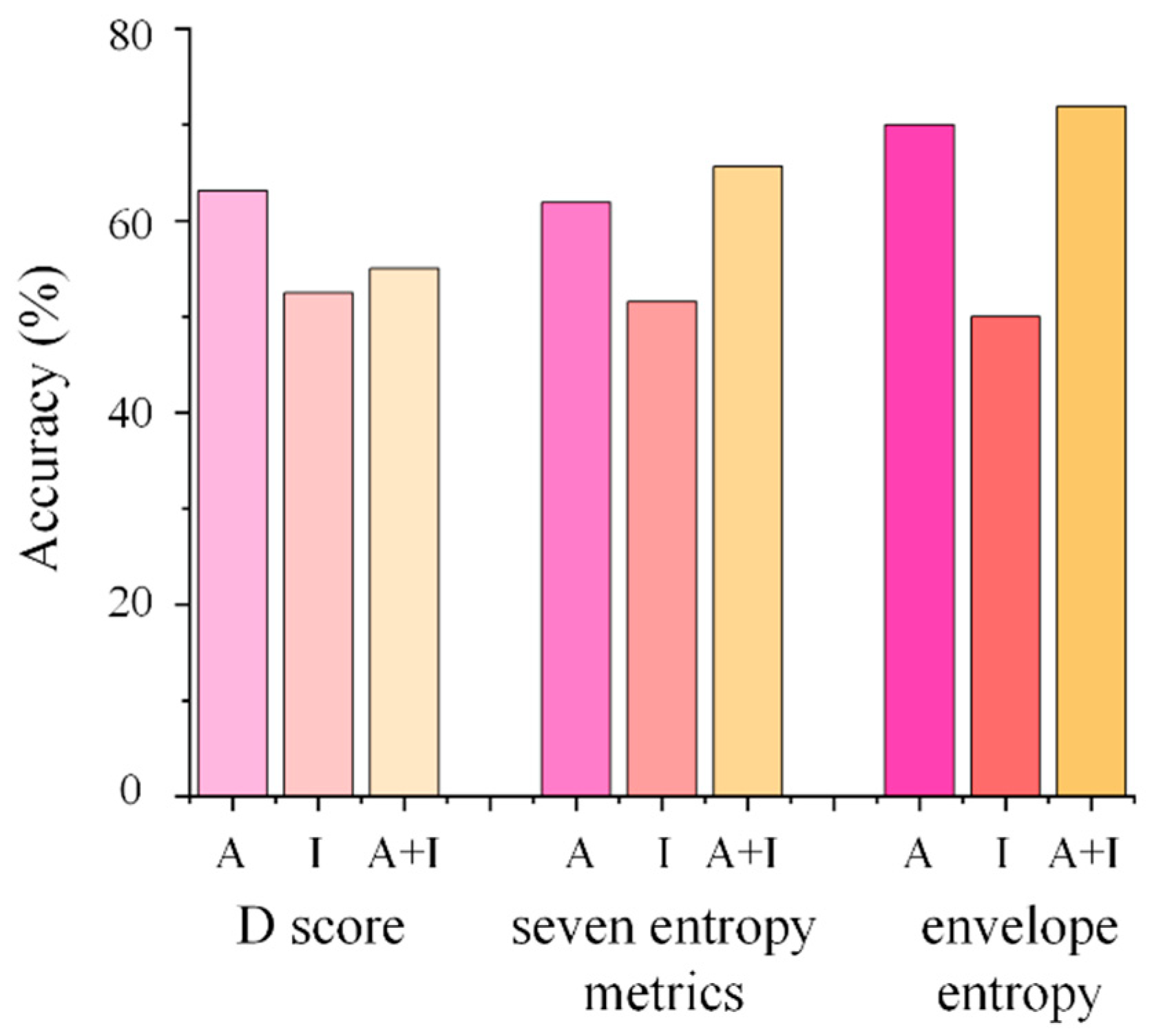
- EEG entropy during implicit attitude processing showed stronger discrimination of subsequent exercise behavior than traditional reaction time-based D-scores in patients with hypertension.
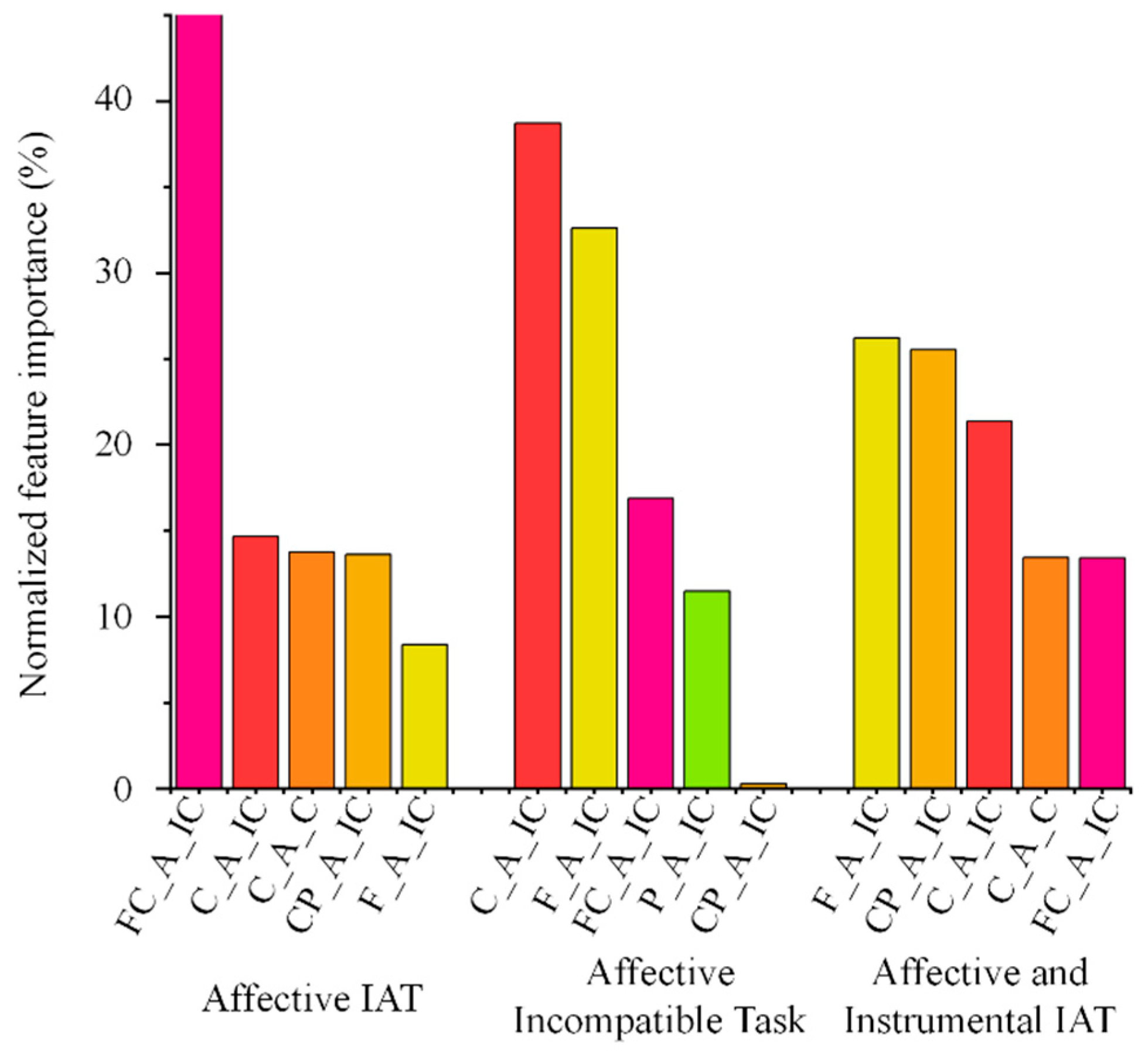
- Among different task conditions, envelope entropy features derived from affective incompatible IAT conditions demonstrated the most consistent differences between exercisers and non-exercisers.
- Neural complexity metrics provide a complementary and interpretable perspective for understanding implicit attitude processing underlying exercise behavior beyond behavioral reaction time measures.
- These findings highlight the potential value of incorporating neural complexity markers of implicit processing into future models of exercise behavior, while underscoring the need for validation in larger and more diverse samples.
Abstract
1. Introduction
2. Materials and Methods
2.1. Participants
2.2. Measurements
2.3. Procedure
2.4. Data Processing and Feature Extraction
2.4.1. D-Score Calculation from IAT Reaction Times
2.4.2. EEG Preprocessing
2.4.3. Entropy Feature Extraction
2.5. Data Analysis and Classification
3. Results
4. Discussion
5. Limitations
6. Conclusions
Author Contributions
Funding
Institutional Review Board Statement
Informed Consent Statement
Data Availability Statement
Conflicts of Interest
Abbreviations
| IAT | Implicit association test |
| EEG | Electroencephalography |
| RF | Random forest |
| KNN | K-nearest neighbors |
| SVM | Support vector machine |
| LDA | Linear discriminant analysis |
Appendix A

| Word Type | Included Words | |||||||
|---|---|---|---|---|---|---|---|---|
| Target | Exercise | Sport | Running | Jumping rope | Brisk walking | Cycling | ||
| Relevance | 8.38 | 7.81 | 7.75 | 7.44 | 7.38 | 7.38 | ||
| Affective attribute | Positive | Pleasure | Vitality | Enjoyment | Satisfaction | Happiness | Joy | |
| Relevance | 8.13 | 8.13 | 8.06 | 7.91 | 7.84 | 7.81 | ||
| Valence | 8.06 | 7.97 | 7.47 | 7.63 | 7.94 | 7.91 | ||
| Negative | Disgust | Awful | Boring | Fatiguing | Painful | Uninteresting | ||
| Relevance | 8.00 | 7.72 | 7.63 | 7.59 | 7.59 | 7.56 | ||
| Valence | 2.06 | 1.66 | 2.56 | 3.09 | 1.84 | 2.84 | ||
| Instrumental attribute | Positive | Beneficial | Useful | Advantageous | Healthy | Important | Valuable | |
| Relevance | 8.06 | 7.91 | 7.91 | 7.81 | 7.72 | 7.72 | ||
| Valence | 7.81 | 7.44 | 7.66 | 7.91 | 7.31 | 7.97 | ||
| Negative | Ineffective | Useless | Harmful | Worthless | Meaningless | Unimportant | ||
| Relevance | 7.91 | 7.88 | 7.81 | 7.59 | 7.50 | 7.25 | ||
| Valence | 2.22 | 2.25 | 1.81 | 1.88 | 1.88 | 3.34 | ||
Appendix B
References
- Barone Gibbs, B.; Hivert, M.F.; Jerome, G.J.; Kraus, W.E.; Rosenkranz, S.K.; Schorr, E.N.; Spartano, N.L.; Lobelo, F. Physical Activity as a Critical Component of First-Line Treatment for Elevated Blood Pressure or Cholesterol: Who, What, and How? A Scientific Statement From the American Heart Association. Hypertension 2021, 78, e26–e37. [Google Scholar] [CrossRef] [Scilit]
- Brawner, C.A.; Churilla, J.R.; Keteyian, S.J. Prevalence of Physical Activity Is Lower among Individuals with Chronic Disease. Med. Sci. Sports Exerc. 2016, 48, 1062–1067. [Google Scholar] [CrossRef] [Scilit]
- Mansyur, C.L.; Pavlik, V.N.; Hyman, D.J.; Taylor, W.C.; Goodrick, G.K. Self-efficacy and barriers to multiple behavior change in low-income African Americans with hypertension. J. Behav. Med. 2013, 36, 75–85. [Google Scholar] [CrossRef] [Scilit]
- Islam, F.M.A.; Hosen, M.A.; Islam, M.A.; Lambert, E.A.; Thompson, B.R.; Lambert, G.W.; Maddison, R. Knowledge of and Intention to Participate in Physical Activity Programs and Their Associated Sociodemographic Factors in People with High Blood Pressure in a Rural Area of Bangladesh: Initial Investigation from a Cluster Randomized Controlled Trial. Int. J. Environ. Res. Public Health 2021, 18, 9561. [Google Scholar] [CrossRef] [Scilit] [PubMed]
- Conner, M.; Norman, P. Understanding the intention-behavior gap: The role of intention strength. Front. Psychol. 2022, 13, 923464. [Google Scholar] [CrossRef] [Scilit] [PubMed]
- Rhodes, R.E.; McEwan, D.; Rebar, A.L. Theories of physical activity behaviour change: A history and synthesis of approaches. Psychol. Sport Exerc. 2019, 42, 100–109. [Google Scholar] [CrossRef] [Scilit]
- Evans, J.S.B.T. In two minds: Dual-process accounts of reasoning. Trends Cogn. Sci. 2003, 7, 454–459. [Google Scholar] [CrossRef] [Scilit] [PubMed]
- Brand, R.; Ekkekakis, P. Affective–Reflective Theory of physical inactivity and exercise: Foundations and preliminary evidence. Ger. J. Exerc. Sport Res. 2017, 48, 48–58. [Google Scholar] [CrossRef] [Scilit]
- Cheval, B.; Boisgontier, M.P. The Theory of Effort Minimization in Physical Activity. Exerc. Sport Sci. Rev. 2021, 49, 168–178. [Google Scholar] [CrossRef] [Scilit]
- Wang, Y.B.; Yang, L.; Mao, Z.X. To run or not to run? Differences in implicit attitudes towards running: An EEG study. Behav. Brain Res. 2023, 454, 114637. [Google Scholar] [CrossRef] [Scilit]
- Phipps, D.J.; Hannan, T.E.; Rhodes, R.E.; Hamilton, K. A dual-process model of affective and instrumental attitudes in predicting physical activity. Psychol. Sport Exerc. 2021, 54, 101899. [Google Scholar] [CrossRef] [Scilit]
- Phipps, D.J.; Rhodes, R.E.; Jenkins, K.; Hannan, T.E.; Browning, N.G.; Hamilton, K. A dual process model of affective and instrumental implicit attitude, self-monitoring, and sedentary behavior. Psychol. Sport Exerc. 2022, 62, 102222. [Google Scholar] [CrossRef] [Scilit]
- Karpinski, A.; Steinman, R.B. The single category implicit association test as a measure of implicit social cognition. J. Pers. Soc. Psychol. 2006, 91, 16–32. [Google Scholar] [CrossRef] [Scilit] [PubMed]
- Antoniewicz, F.; Brand, R. Learning to Like Exercising: Evaluative Conditioning Changes Automatic Evaluations of Exercising and Influences Subsequent Exercising Behavior. J. Sport Exerc. Psychol. 2016, 38, 138–148. [Google Scholar] [CrossRef] [Scilit]
- Mucke, M.; Ludyga, S.; Andra, C.; Gerber, M.; Herrmann, C. Associations between physical activity, basic motor competencies and automatic evaluations of exercise. J. Sports Sci. 2021, 39, 1903–1909. [Google Scholar] [CrossRef] [Scilit]
- Forrest, L.N.; Smith, A.R.; Fussner, L.M.; Dodd, D.R.; Clerkin, E.M. Using implicit attitudes of exercise importance to predict explicit exercise dependence symptoms and exercise behaviors. Psychol. Sport Exerc. 2016, 22, 91–97. [Google Scholar] [CrossRef] [Scilit]
- Endrighi, R.; Basen-Engquist, K.; Szeto, E.; Perkins, H.; Baum, G.; Cox-Martin, M.; MacIntyre, J.M.; Waters, A.J. Self-reported and automatic cognitions are associated with exercise behavior in cancer survivors. Health Psychol. 2016, 35, 824–828. [Google Scholar] [CrossRef] [Scilit]
- Pfeffer, I.; Strobach, T. Predicting Physical Activity Behavior by Automatic and Reflective Self-Regulatory Processes. Front. Psychol. 2021, 12, 714608. [Google Scholar] [CrossRef] [Scilit] [PubMed]
- Chevance, G.; Bernard, P.; Chamberland, P.E.; Rebar, A. The association between implicit attitudes toward physical activity and physical activity behaviour: A systematic review and correlational meta-analysis. Health Psychol. Rev. 2019, 13, 248–276. [Google Scholar] [CrossRef] [Scilit]
- Bosshard, S.; Koller, M.; Walla, P. Can Evaluative Conditioning Change Well-Established Attitudes Towards Popular Brands? Your Brain Says Yes Even Though Your Mouth Says No. Brain Sci. 2019, 9, 106. [Google Scholar] [CrossRef] [Scilit]
- Burberg, T.; Würth, S.; Amesberger, G.; Pannicke, B.; Finkenzeller, T. Semantic and affective processing of implicit associations are related to the regularity of running behaviour in young women: An ERP study. Int. J. Sport Exerc. Psychol. 2025, 1–25. [Google Scholar] [CrossRef] [Scilit]
- Cheval, B.; Tipura, E.; Burra, N.; Frossard, J.; Chanal, J.; Orsholits, D.; Radel, R.; Boisgontier, M.P. Avoiding sedentary behaviors requires more cortical resources than avoiding physical activity: An EEG study. Neuropsychologia 2018, 119, 68–80. [Google Scholar] [CrossRef] [Scilit]
- Cacciotti, A.; Pappalettera, C.; Miraglia, F.; Rossini, P.M.; Vecchio, F. EEG entropy insights in the context of physiological aging and Alzheimer’s and Parkinson’s diseases: A comprehensive review. Geroscience 2024, 46, 5537–5557. [Google Scholar] [CrossRef] [Scilit]
- Della Bella, G.A.; Zang, D.; Gui, P.; Mateos, D.M.; Sitt, J.D.; Bekinschtein, T.A.; Manasova, D.; Sarton, B.; Ferre, F.; Silva, S.; et al. Detection of EEG dynamic complex patterns in disorders of consciousness. Commun. Biol. 2025, 8, 1204. [Google Scholar] [CrossRef] [Scilit]
- Creel, W.T.; Hartman, R.E. EEG entropy modulation as a biomarker of emotion regulation and resilience. IBRO Neurosci. Rep. 2025, 19, 947–954. [Google Scholar] [CrossRef] [Scilit] [PubMed]
- Lahtinen, A.; Juvonen, K.; Lapveteläinen, A.; Kolehmainen, M.; Lindholm, M.; Tanila, H.; Kantanen, T.; Sinikallio, S.; Karhunen, L.; Närväinen, J. Metabolic state as a modulator of neural event-related potentials for food stimuli in an implicit association test. Physiol. Behav. 2019, 209, 112589. [Google Scholar] [CrossRef] [Scilit]
- Ohashi, M.M.; Sawaumi, T.; Iume, Y.; Togo, E. Factors determining implicit attitudes toward sports and exercise: Desirability and enjoyment. Discov. Psychol. 2023, 3, 10. [Google Scholar] [CrossRef] [Scilit]
- Trendel, O.; Werle, C.O.C. Distinguishing the affective and cognitive bases of implicit attitudes to improve prediction of food choices. Appetite 2016, 104, 33–43. [Google Scholar] [CrossRef] [Scilit] [PubMed]
- Bagheri, H.; Mahdavi, S.R.; Eyvazzadeh, N.; Neshaseh-Riz, A.; Rad, M.S.; Sadeghi, S.; Gerami, R.; Aval, M.A. A Comprehensive Assessment of EEG Entropy Measures for Bipolar Disorder Diagnosis Using Machine Learning. IEEE Access 2025, 13, 26527–26541. [Google Scholar] [CrossRef] [Scilit]
- Ando, M.; Nobukawa, S.; Kikuchi, M.; Takahashi, T. Identification of Electroencephalogram Signals in Alzheimer’s Disease by Multifractal and Multiscale Entropy Analysis. Front. Neurosci. 2021, 15, 667614. [Google Scholar] [CrossRef] [Scilit] [PubMed]
- Pappalettera, C.; Miraglia, F.; Cotelli, M.; Rossini, P.M.; Vecchio, F. Analysis of complexity in the EEG activity of Parkinson’s disease patients by means of approximate entropy. Geroscience 2022, 44, 1599–1607. [Google Scholar] [CrossRef] [Scilit]
- Zuo, X.; Zhang, C.; Hämäläinen, T.; Gao, H.; Fu, Y.; Cong, F. Cross-Subject Emotion Recognition Using Fused Entropy Features of EEG. Entropy 2022, 24, 1281. [Google Scholar] [CrossRef] [Scilit]
- Rhodes, L.J.; Borghetti, L.; Morris, M.B. Multiscale entropy in a 10-minute vigilance task. Int. J. Psychophysiol. 2024, 198, 112323. [Google Scholar] [CrossRef] [Scilit]
- Wan, W.; Cui, X.; Gao, Z.; Gu, Z. Frontal EEG-Based Multi-Level Attention States Recognition Using Dynamical Complexity and Extreme Gradient Boosting. Front. Hum. Neurosci. 2021, 15, 673955. [Google Scholar] [CrossRef] [Scilit]
- Wu, C.; Yao, B.; Zhang, X.; Li, T.; Wang, J.; Pu, J. The Application of Entropy in Motor Imagery Paradigms of Brain-Computer Interfaces. Brain Sci. 2025, 15, 168. [Google Scholar] [CrossRef] [Scilit] [PubMed]
- Batistić, L.; Lerga, J.; Stanković, I. Detection of motor imagery based on short-term entropy of time-frequency representations. Biomed. Eng. Online 2023, 22, 41. [Google Scholar] [CrossRef] [Scilit]
- Wang, C.H.; Tsai, C.L.; Tseng, P.; Yang, A.C.; Lo, M.T.; Peng, C.K.; Wang, H.Y.; Muggleton, N.G.; Juan, C.H.; Liang, W.K. The association of physical activity to neural adaptability during visuo-spatial processing in healthy elderly adults: A multiscale entropy analysis. Brain Cogn. 2014, 92c, 73–83. [Google Scholar] [CrossRef] [Scilit] [PubMed]
- Hosseini, M.P.; Hosseini, A.; Ahi, K. A Review on Machine Learning for EEG Signal Processing in Bioengineering. IEEE Rev. Biomed. Eng. 2021, 14, 204–218. [Google Scholar] [CrossRef] [Scilit] [PubMed]
- Candelori, B.; Bardella, G.; Spinelli, I.; Ramawat, S.; Pani, P.; Ferraina, S.; Scardapane, S. Spatio-temporal transformers for decoding neural movement control. J. Neural Eng. 2025, 22, 016023. [Google Scholar] [CrossRef] [Scilit]
- Rithwik, P.; Benzy, V.K.; Vinod, A.P. High accuracy decoding of motor imagery directions from EEG-based brain computer interface using filter bank spatially regularised common spatial pattern method. Biomed. Signal Process. Control 2022, 72, 103241. [Google Scholar] [CrossRef] [Scilit]
- Tiwari, S.; Goel, S.; Bhardwaj, A. MIDNN—A classification approach for the EEG based motor imagery tasks using deep neural network. Appl. Intell. 2022, 52, 4824–4843. [Google Scholar] [CrossRef] [Scilit]
- Craig, C.L.; Marshall, A.L.; Sjostrom, M.; Bauman, A.E.; Booth, M.L.; Ainsworth, B.E.; Pratt, M.; Ekelund, U.; Yngve, A.; Sallis, J.F.; et al. International physical activity questionnaire: 12-country reliability and validity. Med. Sci. Sports Exerc. 2003, 35, 1381–1395. [Google Scholar] [CrossRef] [Scilit]
- Delorme, A.; Makeig, S. EEGLAB: An open source toolbox for analysis of single-trial EEG dynamics including independent component analysis. J. Neurosci. Methods 2004, 134, 9–21. [Google Scholar] [CrossRef] [Scilit]
- Yao, B.; Wu, C.; Zhang, X.; Yao, J.; Xue, J.; Zhao, Y.; Li, T.; Pu, J. The EEG-Based Fusion Entropy-Featured Identification of Isometric Contraction Forces under the Same Action. Sensors 2024, 24, 2323. [Google Scholar] [CrossRef] [Scilit] [PubMed]
- He, Z.; Zhang, H.; Wang, J.; Jin, X.; Gao, S.; Pang, J. BP-AdaBoost algorithm based on variational mode decomposition optimized by envelope entropy for diagnosing the working conditions of a slideway seedling-picking mechanism. Appl. Eng. Agric. 2021, 37, 665–675. [Google Scholar] [CrossRef] [Scilit]
- Lu, X.; Wang, T.; Ye, M.; Huang, S.; Wang, M.; Zhang, J. Study on characteristic of epileptic multi-electroencephalograph base on Hilbert-Huang transform and brain network dynamics. Front. Neurosci. 2023, 17, 1117340. [Google Scholar]
- Huang, N.E.; Shen, Z.; Long, S.R.; Wu, M.C.; Shih, H.H.; Zheng, Q.; Yen, N.-C.; Tung, C.C.; Liu, H.H. The empirical mode decomposition and the Hilbert spectrum for nonlinear and non-stationary time series analysis. Proc. R. Soc. A Math. Phys. Eng. Sci. 1998, 454, 903–995. [Google Scholar] [CrossRef] [Scilit]
- Gu, C.; Chou, T.; Widge, A.S.; Dougherty, D.D. EEG complexity in emotion conflict task in individuals with psychiatric disorders. Behav. Brain Res. 2024, 467, 114997. [Google Scholar] [CrossRef] [Scilit]
- Kumar, T.R.; Mahalaxmi, U.; Bhatt, D. Optimization enabled deep residual neural network for motor imagery EEG signal classification. Biomed. Signal Process. Control 2023, 80, 104317. [Google Scholar] [CrossRef] [Scilit]
- Wang, Y.; Song, C.; Zhang, T.; Yao, Z.; Chang, Z.; Wang, D. Feature extraction of motor imagery EEG via discrete wavelet transform and generalized maximum fuzzy membership difference entropy: A comparative study. Electronics 2023, 12, 2207. [Google Scholar] [CrossRef] [Scilit]
- Choe, J.-P.; Lee, S.; Kang, M. Machine learning modeling for predicting adherence to physical activity guideline. Sci. Rep. 2025, 15, 5650. [Google Scholar] [CrossRef] [Scilit] [PubMed]
- Dixon, M.L.; Thiruchselvam, R.; Todd, R.; Christoff, K. Emotion and the prefrontal cortex: An integrative review. Psychol. Bull. 2017, 143, 1033–1081. [Google Scholar] [CrossRef] [Scilit] [PubMed]
- Badre, D.; Wagner, A.D. Selection, integration, and conflict monitoring; assessing the nature and generality of prefrontal cognitive control mechanisms. Neuron 2004, 41, 473–487. [Google Scholar] [CrossRef] [Scilit]
- Li, H.; Huang, G.; Lin, Q.; Zhao, J.L.; Lo, W.A.; Mao, Y.R.; Chen, L.; Zhang, Z.G.; Huang, D.F.; Li, L. Combining Movement-Related Cortical Potentials and Event-Related Desynchronization to Study Movement Preparation and Execution. Front. Neurol. 2018, 9, 822. [Google Scholar] [CrossRef] [Scilit] [PubMed]


| Variable | Category | Value (Mean ± SD or n [%]) |
|---|---|---|
| Gender | Male | 36 (63.2%) |
| Female | 21 (36.8%) | |
| Age (years) | 18~30 | 6 (10.5%) |
| 31~40 | 7 (12.3%) | |
| 41~50 | 22 (38.6%) | |
| 51~60 | 22 (38.6%) | |
| Duration of hypertension | <1 year | 8 (14.0%) |
| 1~5 years | 23 (40.4%) | |
| 6~10 years | 12 (21.1%) | |
| >10 years | 14 (24.6%) | |
| Hypertension grade | Grade 1 | 15 (26.3%) |
| Grade 2 | 24 (42.1%) | |
| Grade 3 | 18 (31.6%) | |
| Antihypertensive medication intake | Regular | 35 (61.4%) |
| Intermittent | 14 (24.6%) | |
| No medication | 8 (14.0%) | |
| Family history of hypertension | Yes | 47 (82.5%) |
| No | 10 (17.5%) | |
| Comorbidities | Diabetes | 5 (8.8%) |
| Hyperlipidemia | 8 (14.0%) | |
| Hyperuricemia | 1 (1.8%) | |
| BMI (kg/m2) | 26.99 ± 3.54 | |
| Current blood pressure (mmHg) | Systolic Blood Pressure | 131.07 ± 13.15 |
| Diastolic Blood Pressure | 88.61 ± 10.65 |
| Trial Count | Task Type | Response for “E” Key | Response for “I” Key | Stimulus Ratio (Exercise:Positive:Negative) |
|---|---|---|---|---|
| 24 | Practice | Positive attribute OR Exercise | Negative attribute | 7:7:10 |
| 72 | Compatible task | Positive attribute OR Exercise | Negative attribute | 7:7:10 |
| 24 | Practice | Positive attribute | Negative attribute OR Exercise | 7:10:7 |
| 72 | Incompatible task | Positive attribute | Negative attribute OR Exercise | 7:10:7 |
| Task Type | Brain Region | Entropy | ||||||
|---|---|---|---|---|---|---|---|---|
| Singular Spectrum | Approximate | Sample | Fuzzy | Permutation | Envelope | Log Energy | ||
| Compatible | Frontal | −1.541 | −1.191 | −1.141 | −1.008 | −0.475 | −0.525 | −0.358 |
| (0.818) | (0.818) | (0.818) | (0.818) | (0.818) | (0.818) | (0.818) | ||
| Fronto-central | −1.274 | −1.074 | −0.908 | −0.808 | −0.558 | −1.041 | −0.858 | |
| (0.818) | (0.818) | (0.818) | (0.818) | (0.818) | (0.818) | (0.818) | ||
| Central | −0.941 | −0.708 | −0.525 | −0.525 | −0.308 | −1.707 | −1.157 | |
| (0.818) | (0.818) | (0.818) | (0.818) | (0.818) | (0.818) | (0.818) | ||
| Centro-parietal | −0.658 | −0.208 | −0.375 | −0.558 | −0.258 | −1.341 | −1.058 | |
| (0.818) | (0.835) | (0.818) | (0.818) | (0.819) | (0.818) | (0.818) | ||
| Parietal | −0.508 | −0.341 | −0.291 | −0.641 | −0.375 | −0.541 | −1.341 | |
| (0.818) | (0.818) | (0.818) | (0.818) | (0.818) | (0.818) | (0.818) | ||
| Incompatible | Frontal | −1.990 | −1.824 | −2.057 | −1.707 | −1.207 | −3.472 | −0.758 |
| (0.274) | (0.284) | (0.274) | (0.308) | (0.345) | (0.012) | (0.507) | ||
| Fronto-central | −1.840 | −1.541 | −1.790 | −1.640 | −1.224 | −3.789 | −0.858 | |
| (0.284) | (0.328) | (0.284) | (0.321) | (0.345) | (0.000) | (0.467) | ||
| Central | −1.357 | −1.391 | −1.474 | −1.441 | −0.874 | −3.339 | −0.841 | |
| (0.332) | (0.332) | (0.328) | (0.328) | (0.467) | (0.012) | (0.467) | ||
| Centro-parietal | −0.908 | −1.041 | −1.108 | −1.307 | −0.558 | −2.390 | −1.341 | |
| (0.467) | (0.417) | (0.391) | (0.334) | (0.594) | (0.149) | (0.332) | ||
| Parietal | −0.675 | −0.691 | −0.908 | −1.274 | −0.375 | −1.474 | −1.507 | |
| (0.530) | (0.530) | (0.467) | (0.338) | (0.708) | (0.328) | (0.328) | ||
| Task Type | Brain Region | Entropy | ||||||
|---|---|---|---|---|---|---|---|---|
| Singular Spectrum | Approximate | Sample | Fuzzy | Permutation | Envelope | Log Energy | ||
| Compatible | Frontal | −1.058 | −0.608 | −0.924 | −1.357 | −0.791 | −0.824 | −0.508 |
| (0.783) | (0.783) | (0.783) | (0.783) | (0.783) | (0.783) | (0.783) | ||
| Fronto-central | −0.891 | −0.708 | −1.074 | −1.324 | −0.525 | −0.425 | −0.791 | |
| (0.783) | (0.783) | (0.783) | (0.783) | (0.783) | (0.783) | (0.783) | ||
| Central | −0.708 | −0.525 | −0.874 | −1.174 | −0.525 | −0.241 | −1.674 | |
| (0.783) | (0.783) | (0.783) | (0.783) | (0.783) | (0.848) | (0.783) | ||
| Centro-parietal | −0.441 | −0.192 | −0.458 | −1.091 | −0.291 | −0.525 | −1.557 | |
| (0.783) | (0.848) | (0.783) | (0.783) | (0.848) | (0.783) | (0.783) | ||
| Parietal | −0.192 | −0.858 | −0.275 | −1.041 | −0.425 | −1.124 | −1.307 | |
| (0.848) | (0.783) | (0.848) | (0.783) | (0.783) | (0.783) | (0.783) | ||
| Incompatible | Frontal | −1.091 | −0.741 | −0.891 | −1.324 | −0.691 | −0.425 | −0.625 |
| (0.745) | (0.745) | (0.745) | (0.745) | (0.745) | (0.771) | (0.745) | ||
| Fronto-central | −0.891 | −1.174 | −1.024 | −1.357 | −0.625 | −0.491 | −0.708 | |
| (0.745) | (0.745) | (0.745) | (0.745) | (0.745) | (0.771) | (0.745) | ||
| Central | −0.724 | −0.924 | −0.824 | −1.241 | −0.675 | −0.941 | −0.691 | |
| (0.745) | (0.745) | (0.745) | (0.745) | (0.745) | (0.745) | (0.745) | ||
| Centro-parietal | −0.408 | −0.325 | −0.675 | −1.108 | −0.458 | −0.874 | −0.475 | |
| (0.771) | (0.780) | (0.745) | (0.745) | (0.771) | (0.745) | (0.771) | ||
| Parietal | −0.325 | −0.924 | −0.591 | −1.074 | −0.308 | −0.924 | −0.208 | |
| (0.780) | (0.745) | (0.746) | (0.745) | (0.780) | (0.745) | (0.835) | ||
| Condition | Classifier Type | Accuracy | Sensitivity | Specificity | Precision | F1-Score | ||||||
|---|---|---|---|---|---|---|---|---|---|---|---|---|
| Mean | SD | Mean | SD | Mean | SD | Mean | SD | Mean | SD | |||
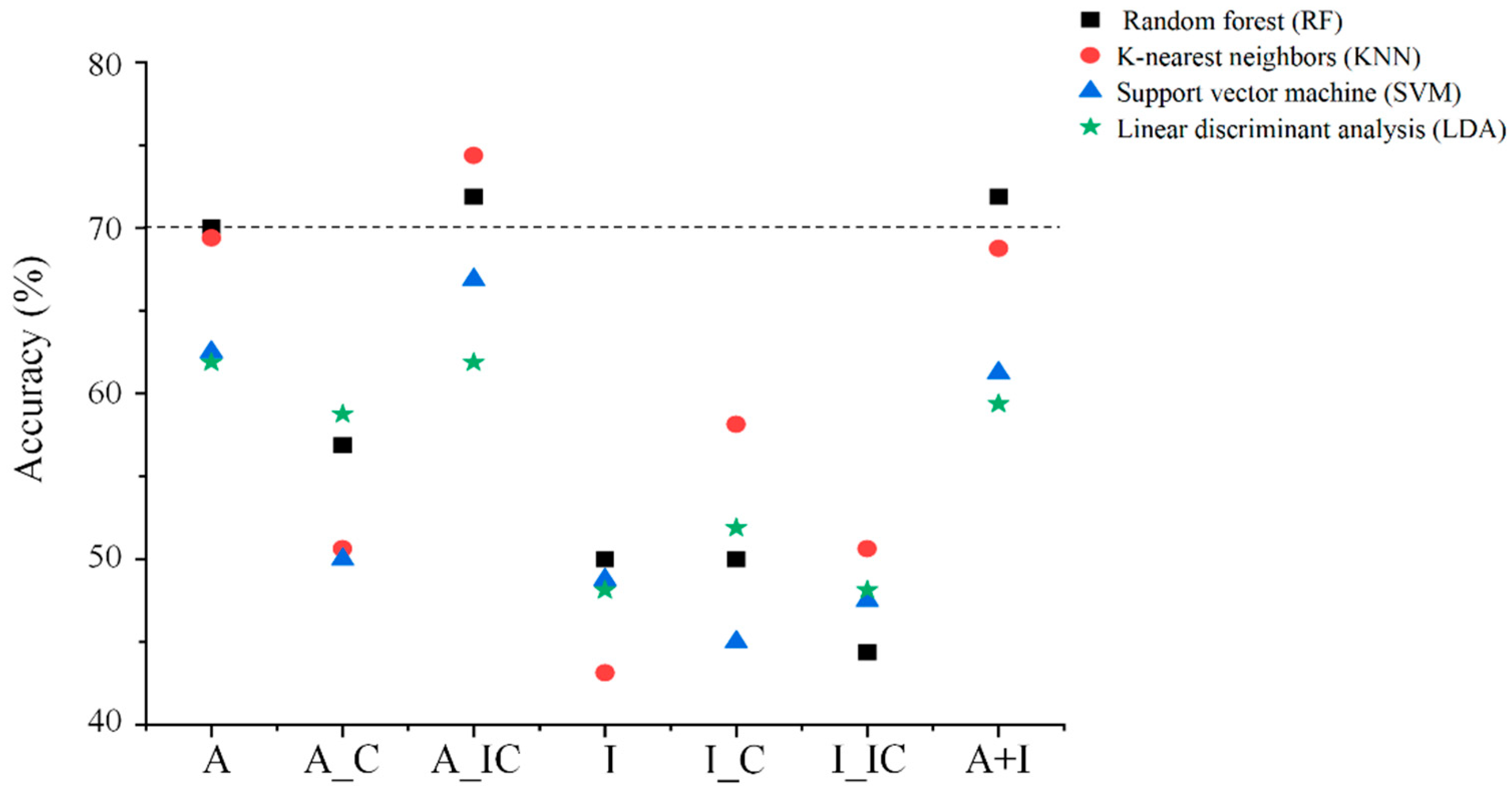
| Affective IAT | Compatible, incompatible | RF | 70.0 | 6.5 | 53.9 | 12.6 | 81.6 | 10.8 | 69.6 | 17.3 | 59.2 | 11.3 |
| KNN | 69.4 | 10.0 | 70.6 | 20.0 | 73.0 | 13.0 | 55.1 | 19.7 | 57.8 | 11.7 | ||
| SVM | 62.5 | 11.4 | 63.3 | 17.7 | 68.5 | 21.9 | 51.9 | 26.5 | 50.5 | 11.4 | ||
| LDA | 61.9 | 8.6 | 62.3 | 20.0 | 69.9 | 21.3 | 59.5 | 27.0 | 54.8 | 11.8 | ||
| Compatible | RF | 56.9 | 10.8 | 60.3 | 28.9 | 59.7 | 11.5 | 29.0 | 18.9 | 37.8 | 15.6 | |
| KNN | 50.6 | 15.7 | 29.2 | 24.3 | 57.6 | 17.3 | 24.8 | 24.5 | 25.0 | 21.2 | ||
| SVM | 50.0 | 5.9 | 11.7 | 12.9 | 56.5 | 10.5 | 8.7 | 16.4 | 24.4 | 7.7 | ||
| LDA | 58.8 | 10.7 | 52.9 | 36.2 | 61.8 | 9.5 | 33.8 | 22.1 | 49.2 | 13.6 | ||
| Incompatible | RF | 71.9 | 10.3 | 63.4 | 23.1 | 76.4 | 15.7 | 65.3 | 20.1 | 69.9 | 8.4 | |
| KNN | 74.4 | 8.6 | 66.4 | 17.7 | 81.8 | 12.2 | 73.6 | 18.5 | 67.1 | 11.5 | ||
| SVM | 66.9 | 5.9 | 64.1 | 17.4 | 72.3 | 15.2 | 56.2 | 23.2 | 55.4 | 10.3 | ||
| LDA | 61.9 | 12.7 | 73.4 | 21.7 | 60.2 | 16.1 | 41.1 | 16.9 | 49.5 | 12.4 | ||
| Instrumental IAT | Compatible, incompatible | RF | 50.0 | 10.6 | 32.3 | 16.8 | 59.4 | 11.5 | 27.0 | 16.5 | 31.3 | 13.2 |
| KNN | 43.1 | 10.4 | 28.5 | 32.5 | 49.5 | 10.3 | 14.6 | 14.3 | 30.7 | 10.7 | ||
| SVM | 48.8 | 8.2 | 13.3 | 11.5 | 51.8 | 10.7 | 4.2 | 9.0 | 20.2 | 2.9 | ||
| LDA | 48.1 | 8.4 | 33.5 | 10.7 | 56.3 | 13.6 | 25.1 | 15.5 | 26.0 | 9.3 | ||
| Compatible | RF | 50.0 | 16.1 | 33.1 | 23.9 | 56.0 | 17.0 | 32.4 | 22.8 | 40.5 | 17.3 | |
| KNN | 58.1 | 11.4 | 48.4 | 32.6 | 67.5 | 13.8 | 38.6 | 29.8 | 46.1 | 10.6 | ||
| SVM | 45.0 | 8.7 | 16.7 | 19.2 | 54.9 | 11.1 | 16.4 | 23.9 | 25.2 | 8.9 | ||
| LDA | 51.9 | 13.8 | 34.2 | 27.5 | 58.6 | 15.6 | 29.5 | 23.8 | 37.0 | 16.8 | ||
| Incompatible | RF | 44.4 | 9.5 | 22.2 | 13.5 | 53.7 | 11.5 | 21.7 | 18.6 | 25.4 | 9.2 | |
| KNN | 50.6 | 8.6 | 42.0 | 29.3 | 55.3 | 10.1 | 23.1 | 19.8 | 32.7 | 11.0 | ||
| SVM | 47.5 | 9.4 | 11.4 | 14.4 | 55.3 | 13.7 | 12.8 | 23.4 | 25.7 | 11.9 | ||
| LDA | 48.1 | 10.2 | 19.4 | 22.7 | 56.4 | 11.7 | 15.4 | 21.5 | 31.5 | 16.8 | ||
| Affective and instrumental IAT | Compatible, incompatible | RF | 71.9 | 7.9 | 66.3 | 17.7 | 75.1 | 11.2 | 58.5 | 15.9 | 59.9 | 13.1 |
| KNN | 68.8 | 6.6 | 64.6 | 17.6 | 72.0 | 8.8 | 53.1 | 13.5 | 56.3 | 9.9 | ||
| SVM | 61.3 | 10.1 | 66.3 | 22.8 | 63.3 | 14.2 | 42.0 | 25.5 | 49.4 | 14.4 | ||
| LDA | 59.4 | 12.2 | 57.9 | 27.1 | 61.5 | 14.4 | 42.2 | 21.7 | 45.6 | 18.8 | ||
Disclaimer/Publisher’s Note: The statements, opinions and data contained in all publications are solely those of the individual author(s) and contributor(s) and not of MDPI and/or the editor(s). MDPI and/or the editor(s) disclaim responsibility for any injury to people or property resulting from any ideas, methods, instructions or products referred to in the content. |
© 2026 by the authors. Licensee MDPI, Basel, Switzerland. This article is an open access article distributed under the terms and conditions of the Creative Commons Attribution (CC BY) license.
Share and Cite
Tang, X.; Wu, C.; Ma, H.; Yao, B.; Li, T.; Piao, M. Neural Complexity of Implicit Attitudes Predicts Exercise Behavior in Hypertensive Patients: An EEG Entropy Study. Brain Sci. 2026, 16, 244. https://doi.org/10.3390/brainsci16020244
Tang X, Wu C, Ma H, Yao B, Li T, Piao M. Neural Complexity of Implicit Attitudes Predicts Exercise Behavior in Hypertensive Patients: An EEG Entropy Study. Brain Sciences. 2026; 16(2):244. https://doi.org/10.3390/brainsci16020244
Chicago/Turabian StyleTang, Xingyi, Chengzhen Wu, Haoming Ma, Bo Yao, Ting Li, and Meihua Piao. 2026. "Neural Complexity of Implicit Attitudes Predicts Exercise Behavior in Hypertensive Patients: An EEG Entropy Study" Brain Sciences 16, no. 2: 244. https://doi.org/10.3390/brainsci16020244
APA StyleTang, X., Wu, C., Ma, H., Yao, B., Li, T., & Piao, M. (2026). Neural Complexity of Implicit Attitudes Predicts Exercise Behavior in Hypertensive Patients: An EEG Entropy Study. Brain Sciences, 16(2), 244. https://doi.org/10.3390/brainsci16020244