‘I Am No Longer Anxious When I Speak’: Experiences of People with Primary Progressive Aphasia Taking Part in a Biographic-Narrative Therapy (Cope PPA)
 , , , and
Abstract
1. Introduction
- How did PwPPA experience their participation in the biographic-narrative intervention (Cope PPA)?
- Which effects of the intervention have been observed by family members?
- Which indications can be drawn from the qualitative results regarding underlying mechanisms of actions?
2. Materials and Methods
2.1. Researcher’s Characteristics
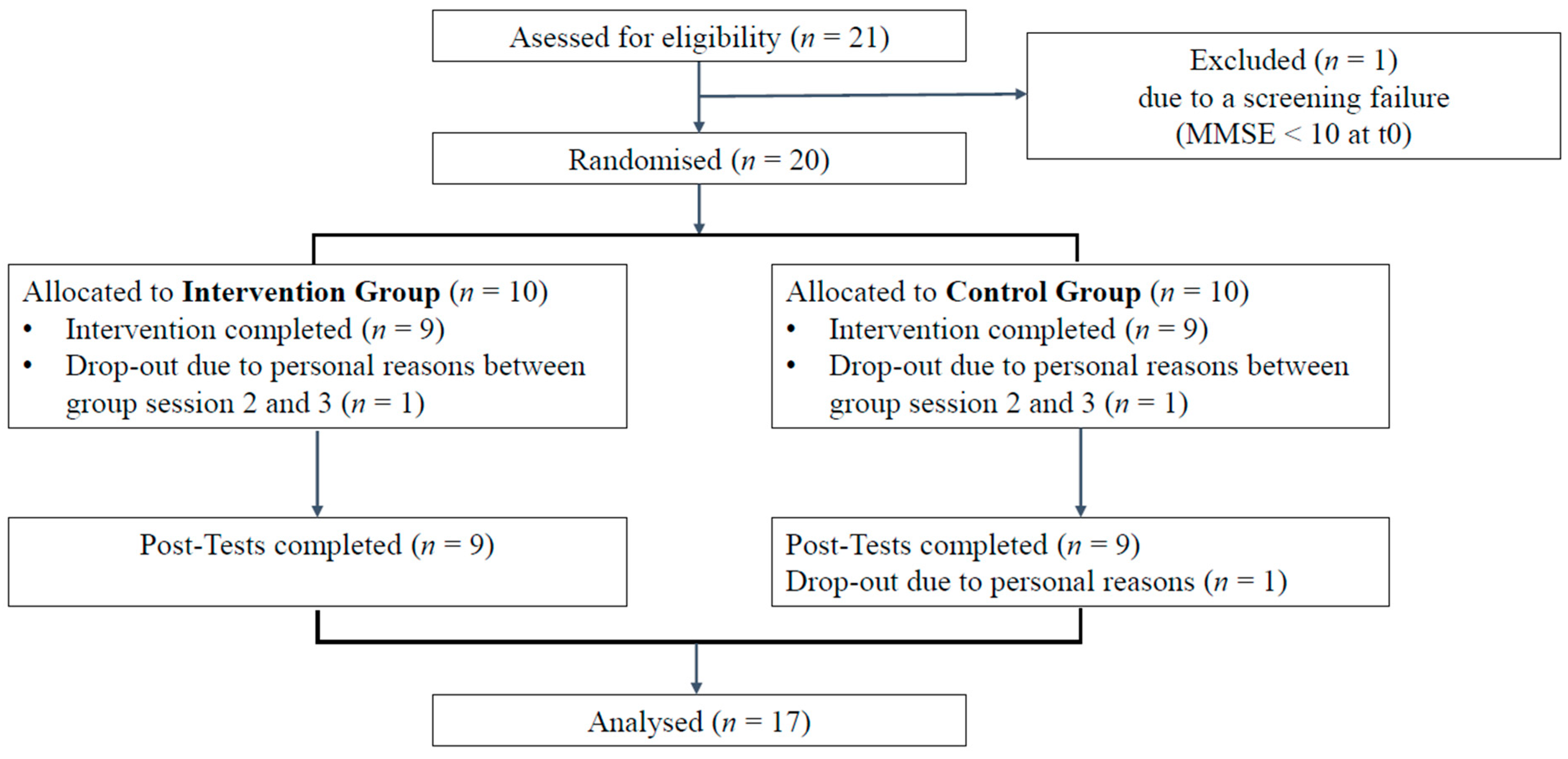
2.2. Inclusion and Exclusion Criteria
2.3. Informed Consent
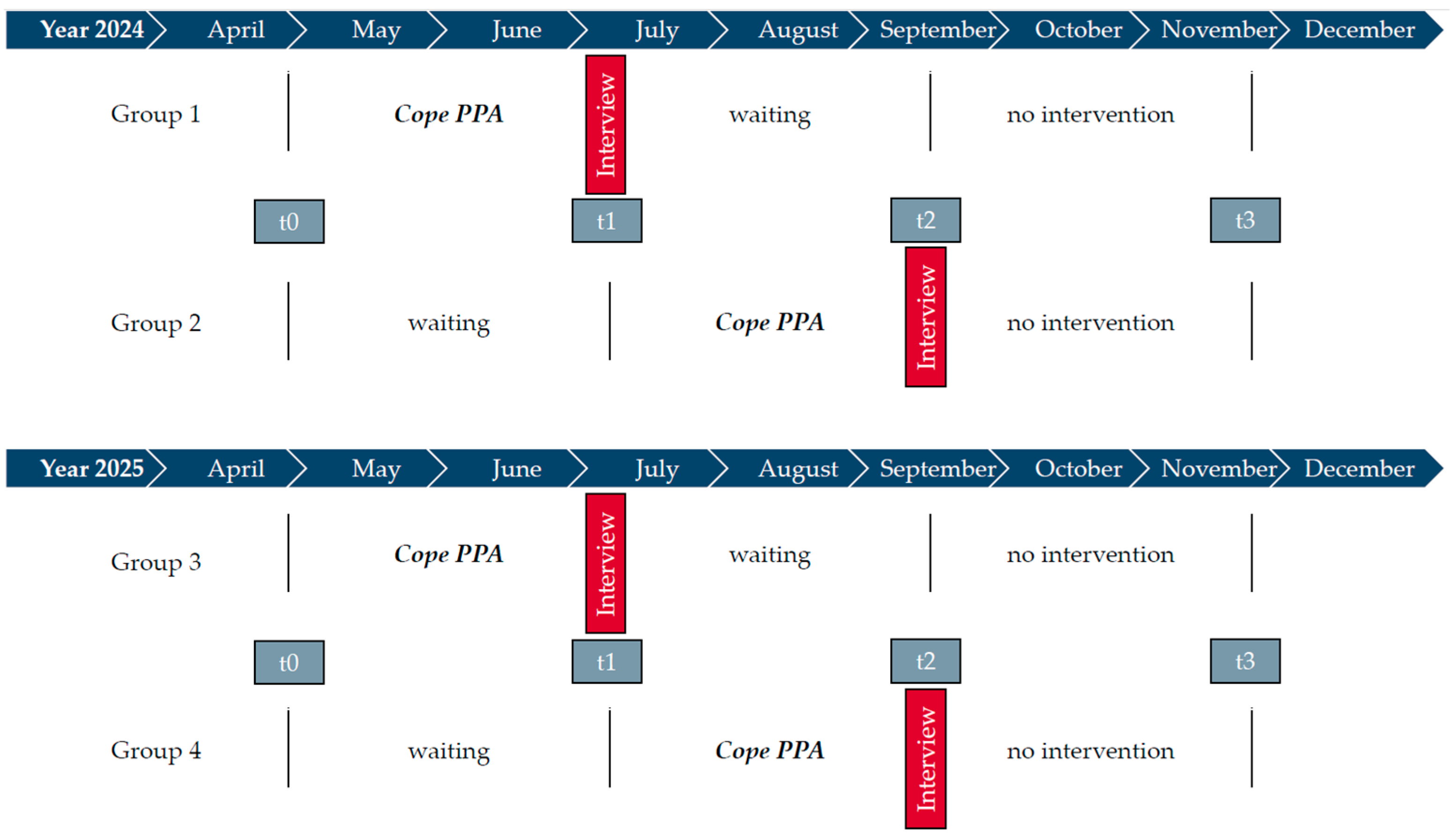
2.4. Clinical Trial Design
2.5. The Cope PPA Intervention
2.6. Data Collection
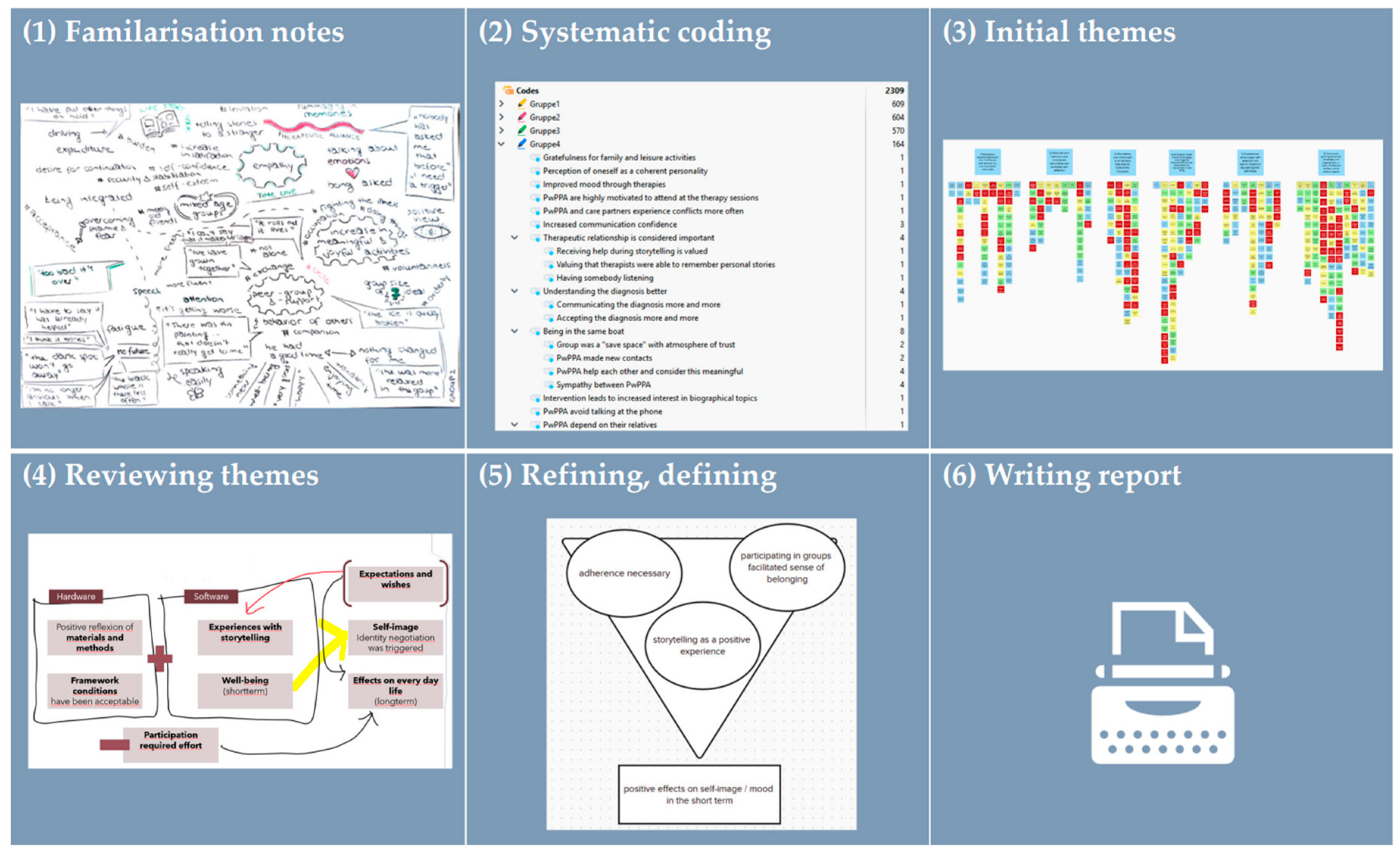
2.7. Data Analysis
3. Results
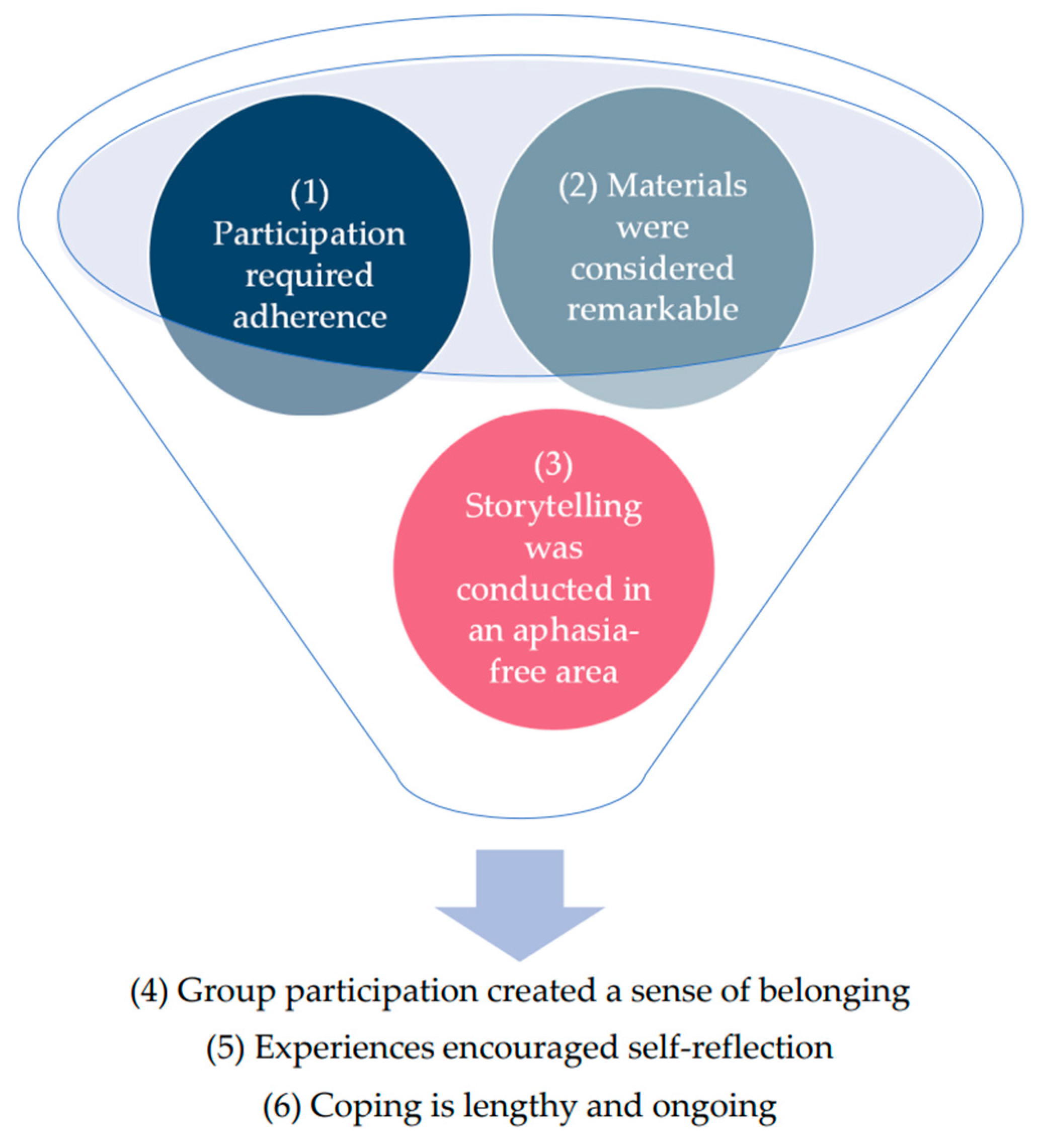
Themes
- Theme 1: Participation required adherence—PwPPA and their families considered the intervention to be meaningful and therefore accepted associated efforts.
“Yes, I also thought it was nice that [therapist’s name] would call if there were no appointments for a week. Yes, you had the feeling that these were people who cared about my husband, who… Yes, how should I put it… Such interest… I thought it was nice, yes. And that someone was simply interested and cared. So that was a nice feeling. At least for me. (laughs)”FM14, group 4
- Theme 2: Materials were considered remarkable—the methods used encouraged self-reflection.
P2: “There were certain things that I hadn’t used before. Like when it was just about taking a picture or something like that, right? I found that very interesting. I had never done that before, and I enjoyed it.
I: “Okay, so generally, if I understand correctly, you liked the concept of the group with the others, but you also liked the content that was created in the group?”
P2: “Well, to sing. I haven’t sung in ages. I don’t think the others have either. And that was just very, very nice.”
- Theme 3: Storytelling was conducted in an aphasia-free area—PwPPA described the atmosphere created by therapists as trustworthy.
“As soon as I get here to the parking slot and go in here, I hardly start stuttering. When I’m somewhere else, it’s there/it’s stronger.”P17, group 2
“(…) I had a few episodes where I said, oh yes, back then I did this and that. And then she (the therapist) asked, “Yes, what was that?” And so on. And that was/I thought that was quite good, because when I talk to someone else somewhere else, that’s how it is. It’s a bit more superficial. And THAT was actually good, yes. To follow up on that. How I was doing and how I had changed. From youth to today, you change, even without illness (laughs). Yes. And I thought that was good. And I also learned something about myself.”P17, group 2
- Theme 4: Group participation created a sense of belonging—being part of the group increased well-being in the short term.
“When I went back, I mostly walked, and there it was, I had a completely different, much better feeling. A physical feeling. And overall. So, I always walked the whole way, and I was always really happy. Yes.”P2, group 3
“It just made me realise that it would be unpleasant because we had such difficult cases in the group. I think when it comes to that, I’ll hide away somewhere in a retirement home.”P5, group 1
- Theme 5: Experiences encouraged self-reflection—lasting effects on the self-image have been described.
- Theme 6: Coping is lengthy and ongoing—PwPPA and their families wish to receive continuous support.
I: “(…) what’s stopping you from daring to speak up?”
P11: “That I stutter and don’t know what to say. Yes, word-finding difficulties and, um, then you feel so helpless and ashamed and, well… it’s… and, yes…”
I: “And these feelings you’re describing, haven’t they changed because of the study?”
P11: “It’s working inside me. I want to, yes.”
4. Discussion
Limitations
5. Conclusions
Supplementary Materials
Author Contributions
Funding
Institutional Review Board Statement
Informed Consent Statement
Data Availability Statement
Acknowledgments
Conflicts of Interest
Abbreviations
| AD | Alzheimer’s disease |
| FTLD | Frontotemporal lobar degeneration |
| lvPPA | Logopenic variant of PPA |
| MADRS | Montgomery–Åsberg-Depression Rating Scale |
| MMSE | Mini-Mental State Examination |
| nfvPPA | Nonfluent variant of PPA |
| PPA | Primary Progressive Aphasia |
| PwPPA | People with PPA |
| QoL | Quality of Life |
| ST | Scenario Test |
| svPPA | Semantic variant of PPA |
References
- Mesulam, M.-M.; Wieneke, C.; Thompson, C.; Rogalski, E.; Weintraub, S. Quantitative classification of primary progressive aphasia at early and mild impairment stages. Brain 2012, 135, 1537–1553. [Google Scholar] [CrossRef]
- Urso, D.; Giannoni-Luza, S.; Brayne, C.; Ray, N.; Logroscino, G. Incidence and Prevalence of Frontotemporal Dementia: A Systematic Review and Meta-Analysis. JAMA Neurol. 2025, 82, 1144. [Google Scholar] [CrossRef] [PubMed]
- Hardy, C.J.D.; Taylor-Rubin, C.; Taylor, B.; Harding, E.; Gonzalez, A.S.; Jiang, J.; Thompson, L.; Kingma, R.; Chokesuwattanaskul, A.; Walker, F.; et al. Symptom-based staging for logopenic variant primary progressive aphasia. Eur. J. Neurol. 2024, 31, e16304. [Google Scholar] [CrossRef] [PubMed]
- Hardy, C.J.D.; Taylor-Rubin, C.; Taylor, B.; Harding, E.; Gonzalez, A.S.; Jiang, J.; Thompson, L.; Kingma, R.; Chokesuwattanaskul, A.; Walker, F.; et al. Symptom-led staging for semantic and non-fluent/agrammatic variants of primary progressive aphasia. Alzheimer’s Dement. 2024, 20, 195–210. [Google Scholar] [CrossRef] [PubMed]
- Gorno-Tempini, M.L.; Hillis, A.E.; Weintraub, S.; Kertesz, A.; Mendez, M.; Cappa, S.F.; Ogar, J.M.; Rohrer, J.D.; Black, S.; Boeve, B.F.; et al. Classification of primary progressive aphasia and its variants. Neurology 2011, 76, 1006–1014. [Google Scholar] [CrossRef]
- Mesulam, M.-M.; Coventry, C.; Bigio, E.H.; Geula, C.; Thompson, C.; Bonakdarpour, B.; Gefen, T.; Rogalski, E.J.; Weintraub, S. Nosology of Primary Progressive Aphasia and the Neuropathology of Language. In Frontotemporal Dementias; Ghetti, B., Buratti, E., Boeve, B., Rademakers, R., Eds.; Springer International Publishing: Cham, Switzerland, 2021; pp. 33–49. [Google Scholar]
- Wauters, L.D.; Croot, K.; Dial, H.R.; Duffy, J.R.; Grasso, S.M.; Kim, E.; Schaffer Mendez, K.; Ballard, K.J.; Clark, H.M.; Kohley, L.; et al. Behavioral Treatment for Speech and Language in Primary Progressive Aphasia and Primary Progressive Apraxia of Speech: A Systematic Review. Neuropsychol. Rev. 2023, 34, 882–923. [Google Scholar] [CrossRef]
- Henry, M.L.; Hubbard, H.I.; Grasso, S.M.; Dial, H.R.; Beeson, P.M.; Miller, B.L.; Gorno-Tempini, M.L. Treatment for Word Retrieval in Semantic and Logopenic Variants of Primary Progressive Aphasia: Immediate and Long-Term Outcomes. J. Speech Lang. Hear. Res. 2019, 62, 2723–2749. [Google Scholar] [CrossRef]
- Henry, M.L.; Hubbard, H.I.; Grasso, S.M.; Mandelli, M.L.; Wilson, S.M.; Sathishkumar, M.T.; Fridriksson, J.; Daigle, W.; Boxer, A.L.; Miller, B.L.; et al. Retraining speech production and fluency in non-fluent/agrammatic primary progressive aphasia. Brain 2018, 141, 1799–1814. [Google Scholar] [CrossRef]
- Marshall, C.R.; Hardy, C.J.D.; Volkmer, A.; Russell, L.L.; Bond, R.L.; Fletcher, P.D.; Clark, C.N.; Mummery, C.J.; Schott, J.M.; Rossor, M.N.; et al. Primary progressive aphasia: A clinical approach. J. Neurol. 2018, 265, 1474–1490. [Google Scholar] [CrossRef]
- Riedl, L.; Last, D.; Danek, A.; Diehl-Schmid, J. Long-term follow-up in primary progressive aphasia: Clinical course and health care utilisation. Aphasiology 2014, 28, 981–992. [Google Scholar] [CrossRef]
- Diehl-Schmid, J.; Pohl, C.; Perneczky, R.; Hartmann, J.; Förstl, H.; Kurz, A. Frühsymptome, Überlebenszeit und Todesursachen—Beobachtungen an 115 Patienten mit Demenz auf der Grundlage frontotemporaler lobärer Degenerationen. Fortschr. Neurol. Psychiatr. 2007, 75, 708–713. [Google Scholar] [CrossRef] [PubMed]
- Lo, K.-C.; Bricker-Katz, G.; Ballard, K.; Piguet, O. The affective, behavioural, and cognitive reactions to a diagnosis of Primary Progressive Aphasia: A qualitative descriptive study. Dementia 2022, 21, 2476–2498. [Google Scholar] [CrossRef] [PubMed]
- Davies, K.; Howe, T.; Small, J.; Hsiung, G.-Y.R. “I used to be a storyteller”: The perspectives of people with primary progressive aphasia on the communication needs for themselves and their family members. Aphasiology 2024, 39, 710–731. [Google Scholar] [CrossRef]
- Pozzebon, M.; Douglas, J.; Ames, D. Facing the Challenges of Primary Progressive Aphasia: The Spousal Perspective. J. Speech Lang. Hear. Res. 2018, 61, 2292–2312. [Google Scholar] [CrossRef]
- Ruggero, L.; Nickels, L.; Croot, K. Quality of life in primary progressive aphasia: What do we know and what can we do next? Aphasiology 2019, 33, 498–519. [Google Scholar] [CrossRef]
- Morrow, C.B.; Leoutsakos, J.-M.S.; Onyike, C.U. Functional Disabilities and Psychiatric Symptoms in Primary Progressive Aphasia. Am. J. Geriatr. Psychiatry 2022, 30, 372–382. [Google Scholar] [CrossRef]
- Shadden, B. Aphasia as identity theft: Theory and practice. Aphasiology 2005, 19, 211–223. [Google Scholar] [CrossRef]
- Brinkman, R.; Neijenhuis, K.; Cardol, M.; Leget, C. Who am I now? A scoping review on identity changes in post-stroke aphasia. Disabil. Rehabil. 2024, 47, 1081–1099. [Google Scholar] [CrossRef]
- Davies, K.; Howe, T. Experiences of Living With Primary Progressive Aphasia: A Scoping Review of Qualitative Studies. Am. J. Alzheimer’s Dis. Other Dement. 2020, 35, 1533317519886218. [Google Scholar] [CrossRef]
- Corsten, S.; Schimpf, E.J.; Konradi, J.; Keilmann, A.; Hardering, F. The participants’ perspective: How biographic-narrative intervention influences identity negotiation and quality of life in aphasia: Biographic-narrative work and participants’ view. Int. J. Lang. Commun. Disord. 2015, 50, 788–800. [Google Scholar] [CrossRef]
- Shadden, B.B.; Hagstrom, F.; Koski, P.R. Neurogenic Communication Disorders: Life Stories and the Narrative Self; Plural Pub: San Diego, CA, USA, 2008. [Google Scholar]
- Attard, M.C.; Lanyon, L.; Togher, L.; Rose, M.L. Consumer perspectives on community aphasia groups: A narrative literature review in the context of psychological well-being. Aphasiology 2015, 29, 983–1019. [Google Scholar] [CrossRef]
- Gauch, M.; Spelter, B.; Geschke, K.; Köb, A.; Tüscher, O.; Heinrich, I.; Corsten, S. Influence of Speech and Language Therapy on Quality of Life in People With Primary Progressive Aphasia: A Scoping Review. Int. J. Lang. Commun. Disord. 2025, 60, e70129. [Google Scholar] [CrossRef] [PubMed]
- Pérez-Sáez, E.; Justo-Henriques, S.I.; Alves Apóstolo, J.L. Multicenter randomized controlled trial of the effects of individual reminiscence therapy on cognition, depression and quality of life: Analysis of a sample of older adults with Alzheimer’s disease and vascular dementia. Clin. Neuropsychol. 2022, 36, 1975–1996. [Google Scholar] [CrossRef] [PubMed]
- Kindell, J.; Wilkinson, R.; Keady, J. From conversation to connection: A cross-case analysis of life-story work with five couples where one partner has semantic dementia. Ageing Soc. 2019, 39, 2322–2345. [Google Scholar] [CrossRef]
- Gauch, M.; Feldmann, J.; Jochmann, J.; Geschke, K.; Köb, A.-L.; Tüscher, O.; Heinrich, I.; Corsten, S. “What do you need to talk about your life?”: Insights from people with primary progressive aphasia on biographic-narrative therapy. Aphasiology 2025, 1–26. [Google Scholar] [CrossRef]
- O’Brien, B.C.; Harris, I.B.; Beckman, T.J.; Reed, D.A.; Cook, D.A. Standards for Reporting Qualitative Research: A Synthesis of Recommendations. Acad. Med. 2014, 89, 1245–1251. [Google Scholar] [CrossRef]
- DGPPN. DGN S3-Leitlinie Demenzen—Living Guideline 2023; DGPPN: Berlin, Germany, 2025. [Google Scholar]
- Folstein, M.F.; Folstein, S.E.; McHugh, P.R. “Mini-mental state”: A practical method for grading the cognitive state of patients for the clinician. J. Psychiatr. Res. 1975, 12, 189–198. [Google Scholar] [CrossRef]
- Montgomery, S.A.; Åsberg, M. A New Depression Scale Designed to be Sensitive to Change. Br. J. Psychiatry 1979, 134, 382–389. [Google Scholar] [CrossRef]
- Haberstroh, J.; Tesky, V.A.; Pantel, J. Einwilligungsfähigkeit von Menschen mit Demenz: Einblicke in die S2k-AWMF-Leitlinie 108—001. Z. Gerontol. Geriatr. 2021, 54, 167–175. [Google Scholar] [CrossRef]
- Appelbaum, P.S. Consent in Impaired Populations. Curr. Neurol. Neurosci. Rep. 2010, 10, 367–373. [Google Scholar] [CrossRef]
- Appelbaum, P.S. Assessment of Patients’ Competence to Consent to Treatment. N. Engl. J. Med. 2007, 357, 1834–1840. [Google Scholar] [CrossRef] [PubMed]
- Dresing, T.; Pehl, T. Praxisbuch Interview, Transkription & Analyse: Anleitungen und Regelsysteme für Qualitativ Forschende, 8th ed.; Eigenverlag: Marburg, Germany, 2018. [Google Scholar]
- Braun, V.; Clarke, V. One size fits all? What counts as quality practice in (reflexive) thematic analysis? Qual. Res. Psychol. 2021, 18, 328–352. [Google Scholar] [CrossRef]
- Braun, V.; Clarke, V. Thematic Analysis: A Practical Guide; SAGE: Los Angeles, CA, USA; London, UK; New Delhi, India; Singapore; Washington, DC, USA; Melbourne, Australia, 2022. [Google Scholar]
- Braun, V.; Clarke, V. Successful Qualitative Research: A Practical Guide for Beginners, 1st ed.; SAGE: Los Angeles, CA, USA; London, UK; New Delhi, India, 2013. [Google Scholar]
- Nobis-Bosch, R.; Bruehl, S.; Krzok, F.; Jakob, H.; van der Meulen, I.; van de Sandt-Koenderman, W.M.E.; Van Gelder-Houthuizen, J.; Wiegers, J.; Wielaert, S. Szenario-Test: Testung Verbaler und Non-Verbaler Aspekte Aphasischer Kommunikation: Handbuch; ProLog: Köln, Germany, 2020. [Google Scholar]
- Van der Meulen, I.; Van De Sandt-Koenderman, W.M.E.; Duivenvoorden, H.J.; Ribbers, G.M. Measuring verbal and non-verbal communication in aphasia: Reliability, validity, and sensitivity to change of the Scenario Test. Int. J. Lang. Commun. Disord. 2010, 45, 424–435. [Google Scholar] [CrossRef] [PubMed]
- Beeson, P.M.; King, R.M.; Bonakdarpour, B.; Henry, M.L.; Cho, H.; Rapcsak, S.Z. Positive Effects of Language Treatment for the Logopenic Variant of Primary Progressive Aphasia. J. Mol. Neurosci. 2011, 45, 724–736. [Google Scholar] [CrossRef]
- Morhardt, D.J.; O’Hara, M.C.; Zachrich, K.; Wieneke, C.; Rogalski, E.J. Development of a Psycho-Educational Support Program for Individuals with Primary Progressive Aphasia and their Care-Partners. Dementia 2019, 18, 1310–1327. [Google Scholar] [CrossRef]
- Gauch, M.; Leinweber, J.; Plath, A.; Spelter, B.; Corsten, S. Quality of life outcomes from aphasia telepractice: A scoping review. Aphasiology 2022, 37, 1112–1136. [Google Scholar] [CrossRef]
- Kim, E.; Figeys, M.; Hubbard, H.; Wilson, C. The Impact of Aphasia Camp Participation on Quality of Life: A Primary Progressive Aphasia Perspective. Semin. Speech Lang. 2018, 39, 270–283. [Google Scholar] [CrossRef]
- Volkmer, A.; Hausmann, A.; Paplikar, A.; Battista, P.; Jokel, R.; On behalf of the International PPA SLT/P network. Group interventions for people with primary progressive aphasia and their care partners: Considerations for clinical practice. Neuropsychol. Rehabil. 2025, 35, 1254–1282. [Google Scholar] [CrossRef]
- Emblad, S.Y.M.; Mukaetova-Ladinska, E.B. Creative Art Therapy as a Non-Pharmacological Intervention for Dementia: A Systematic Review. J. Alzheimer’s Dis. Rep. 2021, 5, 353–364. [Google Scholar] [CrossRef]
- Fried-Oken, M.; Beukelman, D.R.; Hux, K. Current and Future AAC Research Considerations for Adults with Acquired Cognitive and Communication Impairments. Assist. Technol. 2012, 24, 56–66. [Google Scholar] [CrossRef]
- Murray, L.L. Longitudinal treatment of primary progressive aphasia: A case study. Aphasiology 1998, 12, 651–672. [Google Scholar] [CrossRef]
- Kindell, J.; Wilkinson, R.; Sage, K.; Keady, J. Combining music and life story to enhance participation in family interaction in semantic dementia: A longitudinal study of one family’s experience. Arts Health 2018, 10, 165–180. [Google Scholar] [CrossRef]
- Miller, B.L.; Boone, K.; Cummings, J.L.; Read, S.L.; Mishkin, F. Functional correlates of musical and visual ability in frontotemporal dementia. Br. J. Psychiatry 2000, 176, 458–463. [Google Scholar] [CrossRef] [PubMed]
- Hamauchi, A.; Hidaka, Y.; Kitamura, I.; Yatabe, Y.; Hashimoto, M.; Yonehara, T.; Fukuhara, R.; Ikeda, M. Emergence of artistic talent in progressive nonfluent aphasia: A case report. Psychogeriatrics 2019, 19, 601–604. [Google Scholar] [CrossRef] [PubMed]
- Doran, C.; Noonan, M.; Doody, O. Life-story work in long-term care facilities for older people: An integrative review. J. Clin. Nurs. 2019, 28, 1070–1084. [Google Scholar] [CrossRef] [PubMed]
- Stahl, B. Beyond Language Deficits: Working Alliance and Resources as Predictors of Recovery From Aphasia. Stroke 2023, 54, 2208–2212. [Google Scholar] [CrossRef]
- Wong, S.; Irish, M.; Husain, M.; Hodges, J.R.; Piguet, O.; Kumfor, F. Apathy and its impact on carer burden and psychological wellbeing in primary progressive aphasia. J. Neurol. Sci. 2020, 416, 117007. [Google Scholar] [CrossRef]
- Kindell, J. Interaction-Focussed Life Story Work in Semantic Dementia: A Mixed Methods Study. Ph.D. Thesis, University of Manchester, Manchester, UK, 2015. [Google Scholar]
- Braun, V.; Clarke, V. A critical review of the reporting of reflexive thematic analysis in Health Promotion International. Health Promot. Int. 2024, 39, daae049. [Google Scholar] [CrossRef]
- Braun, V.; Clarke, V. To saturate or not to saturate? Questioning data saturation as a useful concept for thematic analysis and sample-size rationales. Qual. Res. Sport Exerc. Health 2021, 13, 201–216. [Google Scholar] [CrossRef]
- Volkmer, A.; Cartwright, J.; Ruggero, L.; Beales, A.; Gallée, J.; Grasso, S.; Henry, M.; Jokel, R.; Kindell, J.; Khayum, R.; et al. Principles and philosophies for speech and language therapists working with people with primary progressive aphasia: An international expert consensus. Disabil. Rehabil. 2023, 45, 1063–1078. [Google Scholar] [CrossRef]



| Groups | PwPPA (n) | Partner/Other (n) | Age (Mean, SD) 1 | Age at Onset (Mean, SD) | Age at Diagnosis (Mean, SD) | Sex (F/M, n) | Variant (nfvPPA/svPPA/lvPPA/Mixed PPA, n) | Pathology (AD/FTLD) | MMSE (Mean, SD) | ST (Mean %) |
|---|---|---|---|---|---|---|---|---|---|---|
| 1 | 6 | 4/2 | 78.0 (7.2) | 71.0 (9.1) | 74.3 (8.9) | 3/3 | 1/2/3/0 | 3/3 | 21.0 (7.1) | 88.3% |
| 2 | 5 | 5/0 | 70.0 (10.4) | 66.2 (11.1) | 69.6 (10.2) | 3/2 | 2/0/2/1 | 4/1 | 21.8 (6.0) | 78.3% |
| 3 | 3 | 2/1 | 61.0 (12.8) | 54.0 (12.8) | 60.7 (12.9) | 2/1 | 1/1/1/0 | 1/2 | 19.3 (7.4) | 97.2% |
| 4 | 3 | 3/1 | 71.3 (7.5) | 67.7 (7.5) | 70.0 (6.1) | 0/3 | 0/2/0/1 | 3/0 | 21.3 (2.1) | 96.8% |
Disclaimer/Publisher’s Note: The statements, opinions and data contained in all publications are solely those of the individual author(s) and contributor(s) and not of MDPI and/or the editor(s). MDPI and/or the editor(s) disclaim responsibility for any injury to people or property resulting from any ideas, methods, instructions or products referred to in the content. |
© 2026 by the authors. Licensee MDPI, Basel, Switzerland. This article is an open access article distributed under the terms and conditions of the Creative Commons Attribution (CC BY) license.
Share and Cite
Gauch, M.; Köb, A.-L.; Tanase, J.; Feldmann, J.; Jochmann, J.; Geschke, K.; Klaus, H.; Tüscher, O.; Heinrich, I.; Corsten, S. ‘I Am No Longer Anxious When I Speak’: Experiences of People with Primary Progressive Aphasia Taking Part in a Biographic-Narrative Therapy (Cope PPA). Brain Sci. 2026, 16, 233. https://doi.org/10.3390/brainsci16020233
Gauch M, Köb A-L, Tanase J, Feldmann J, Jochmann J, Geschke K, Klaus H, Tüscher O, Heinrich I, Corsten S. ‘I Am No Longer Anxious When I Speak’: Experiences of People with Primary Progressive Aphasia Taking Part in a Biographic-Narrative Therapy (Cope PPA). Brain Sciences. 2026; 16(2):233. https://doi.org/10.3390/brainsci16020233
Chicago/Turabian StyleGauch, Mirjam, Anna-Lena Köb, Julia Tanase, Julia Feldmann, Johanna Jochmann, Katharina Geschke, Helen Klaus, Oliver Tüscher, Isabel Heinrich, and Sabine Corsten. 2026. "‘I Am No Longer Anxious When I Speak’: Experiences of People with Primary Progressive Aphasia Taking Part in a Biographic-Narrative Therapy (Cope PPA)" Brain Sciences 16, no. 2: 233. https://doi.org/10.3390/brainsci16020233
APA StyleGauch, M., Köb, A.-L., Tanase, J., Feldmann, J., Jochmann, J., Geschke, K., Klaus, H., Tüscher, O., Heinrich, I., & Corsten, S. (2026). ‘I Am No Longer Anxious When I Speak’: Experiences of People with Primary Progressive Aphasia Taking Part in a Biographic-Narrative Therapy (Cope PPA). Brain Sciences, 16(2), 233. https://doi.org/10.3390/brainsci16020233