Cochlear Implantation After Temporal Bone Fracture: A Systematic Review of Preoperative Predictors and Timing
 ,
,  ,
,
Highlights
- Cochlear implantation is a viable treatment option after temporal bone fractures when the cochlear nerve is anatomically intact.
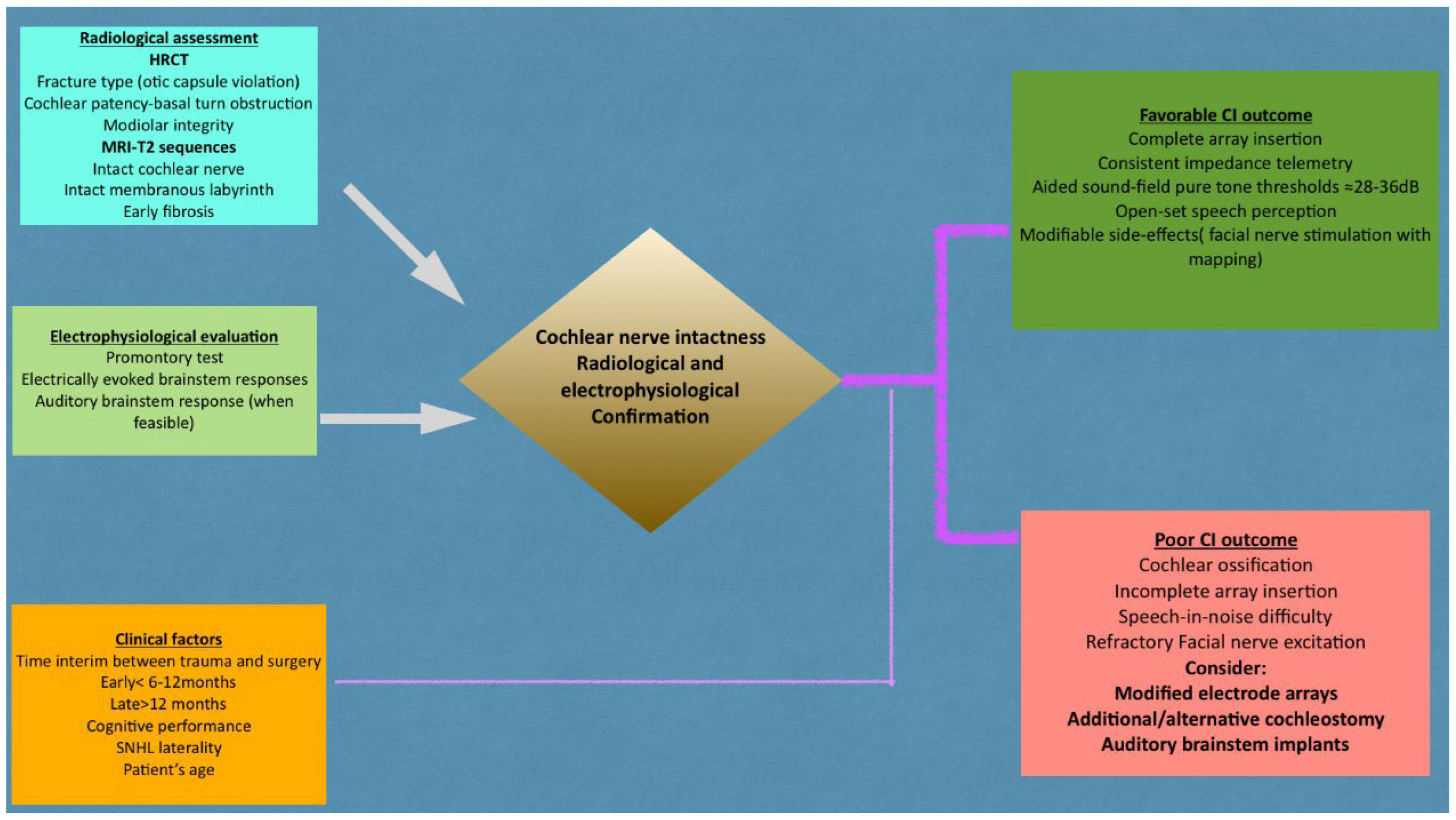
- Preoperative radiological and electrophysiological assessments are crucial for candidates’ detection and surgical strategy.
- Most included studies exhibit meaningful speech benefit.
- Timely implantation limits post-traumatic cochlear ossification and may result in improved outcomes.
- Trauma-related sequels are not so frequent and do not preclude successful placement and outcomes.
- Cochlear implantation, based on these limited observational data, is preferred over Auditory Brainstem Implantation.
Abstract
1. Introduction
2. Materials and Methods
- Outcome measures
- Risk-of-bias evaluation
3. Results
- Frequent complications of cochlear implants (Table 3)
- Audiological and speech perception outcome (Table 3)
4. Discussion
5. Limitations
6. Conclusions
Supplementary Materials
Author Contributions
Funding
Institutional Review Board Statement
Informed Consent Statement
Data Availability Statement
Acknowledgments
Conflicts of Interest
Abbreviations
| AB | Arthur Boothroyd |
| ABI | Auditory Brainstem |
| ABR | Auditory Brainstem Responses |
| BAHA | Bone-Anchored Hearing Aids |
| BERA | Brainstem-Evoked Response Audiometry |
| BKB | Bamford–Kowal–Bench |
| BWR | Bi-Syllabic Word Recognition |
| C | Common Phrases |
| CIs | Cochlear Implants |
| CID | Central Institute for the Deaf |
| CNC | Consonant Nucleus Consonant |
| CT | Computed Tomography |
| CUNY | City University of New York |
| ENG | Electronystagmography |
| FFTA | Free-Field Tonal Audiometry |
| FN | Facial Nerve |
| FNS | Facial Nerve Stimulation |
| HHIA | Hearing Handicap Inventory for Adults |
| HL | Hearing Loss |
| HRCT | High-Resolution Computed Tomography |
| JBI | Joanna Briggs Institute |
| MRI | Magnetic Resonance Imaging |
| NVA | Nederlandse Vereniging voor Audiologie |
| PTA | Pure-Tone Audiometry |
| SNHL | Sensorineural Hearing Loss |
| SNR | Signal-to-Noise Ratio |
| SR | Sentence Recognition |
| TEOAEs | Transmission-Evoked Otoacoustic Emissions |
| VI | Vowel Identification |
References
- Johnson, F.; Semaan, M.T.; Megerian, C.A. Temporal bone fracture: Evaluation and management in the modern era. Otolaryngol. Clin. N. Am. 2008, 41, 597–618. [Google Scholar] [CrossRef]
- Teunissen, E.; Caspers, C.; Kruyt, I.; Mylanus, E.; Hol, M. Long-Term Clinical Outcomes for Bone-Anchored Hearing Implants: 3-Year Comparison Between Minimally Invasive Ponto Surgery and the Linear Incision Technique with Tissue Preservation. Otol. Neurotol. 2025, 46, 161–169. [Google Scholar] [CrossRef]
- Lein, A.; Baumgartner, W.D.; Riss, D.; Gstöttner, W.; Landegger, L.D.; Liu, D.T.; Thurner, T.; Vyskocil, E.; Brkic, F.F. Early Results With the New Active Bone-Conduction Hearing Implant: A Systematic Review and Meta-Analysis. Otolaryngol. Head Neck Surg. 2024, 170, 1630–1647. [Google Scholar] [CrossRef] [PubMed]
- Puram, S.V.; Lee, D.J. Pediatric Auditory Brainstem Implant Surgery. Otolaryngol. Clin. N. Am. 2015, 48, 1117–1148. [Google Scholar] [CrossRef] [PubMed]
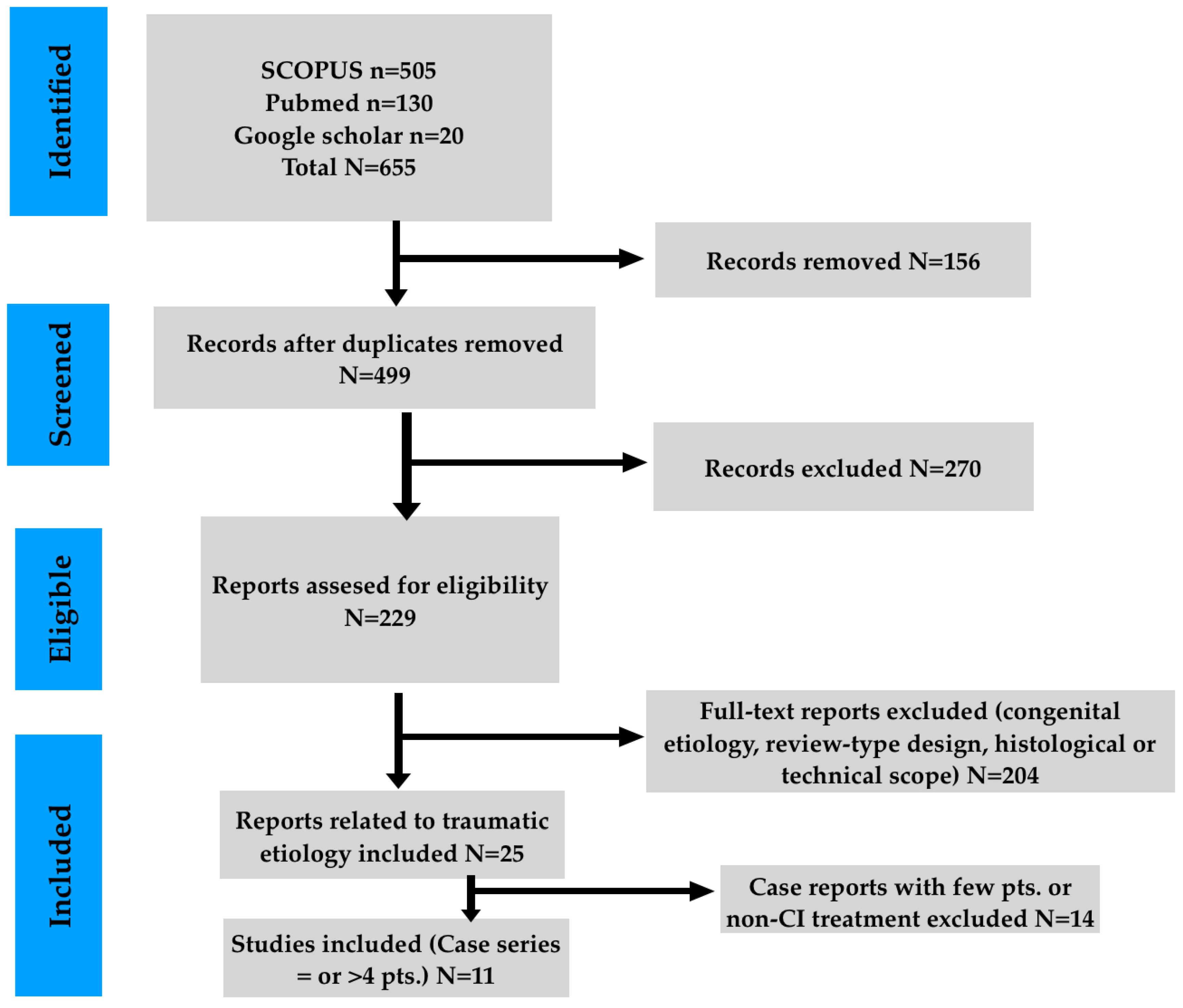
- Page, M.J.; McKenzie, J.E.; Bossuyt, P.M.; Boutron, I.; Hoffmann, T.C.; Murlow, C.D.; Shhamseer, L.; Tetzlafff, J.M.; Akl, E.A.; Brennan, S.E.; et al. The PRISMA 2020 statement: An updated guideline for reporting systematic reviews. BMJ 2021, 372, n71. [Google Scholar] [CrossRef]
- Eastwood, M.; Biggs, K.; Metcalfe, C.; Muzaffar, J.; Monksfield, P.; Bance, M. Outcomes of Cochlear Implantation in Patients With Temporal Bone Trauma: A Systematic Review and Narrative Synthesis. J. Int. Adv. Otol. 2021, 17, 162–174. [Google Scholar] [CrossRef] [PubMed]
- Lachowska, M.; Lukaszewicz-Moszynska, Z.; Mikolajewska, A.; Lachowska, L.; Morawski, K.; Niemczyk, K. Hearing Restoration with Cochlear Implantation in Patients Deafened after Blunt Head Trauma. J. Int. Adv. Otol. 2018, 14, 347–352. [Google Scholar] [CrossRef]
- Medina, M.; Di Lella, F.; Di Trapani, G.; Prasad, S.C.; Bacciu, A.; Aristegui, M.; Russo, A.; Sanna, M. Cochlear implantation versus auditory brainstem implantation in bilateral total deafness after head trauma: Personal experience and review of the literature. Otol. Neurotol. 2014, 35, 260–270. [Google Scholar] [CrossRef]
- Greenberg, S.L.; Shipp, D.; Lin, V.Y.; Chen, J.M.; Nedzelski, J.M. Cochlear implantation in patients with bilateral severe sensorineural hearing loss after major blunt head trauma. Otol. Neurotol. 2011, 32, 48–54. [Google Scholar] [CrossRef]
- Camilleri, A.E.; Toner, J.G.; Howarth, K.L.; Hampton, S.; Ramsden, R.T. Cochlear implantation following temporal bone fracture. J. Laryngol. Otol. 1999, 113, 454–457. [Google Scholar] [CrossRef]
- Hagr, A. Cochlear implantation in fractured inner ears. J. Otolaryngol. Head Neck Surg. 2011, 40, 281–287. [Google Scholar]
- Vermeire, K.; Brokx, J.P.L.; Dhooge, I.; Van de Heyning, P.H. Cochlear implantation in posttraumatic bilateral temporal bone fracture. ORL J. Otorhinolaryngol. Relat. Spec. 2012, 74, 52–56. [Google Scholar] [CrossRef]
- Serin, G.M.; Derinsu, U.; Sari, M.; Gergin, O.; Ciprut, A.; Akdaş, F.; Batman, C. Cochlear implantation in patients with bilateral cochlear trauma. Am. J. Otolaryngol. 2010, 31, 350–355. [Google Scholar] [CrossRef] [PubMed]
- Lubner, R.J.; Knoll, R.M.; Trakimas, D.R.; Bartholomew, R.A.; Lee, D.J.; Walters, B.; Nadol, J.B., Jr.; Remenschneider, A.K.; Kozin, E.D. Long-term cochlear implantation outcomes in patients following head injury. Laryngoscope Investig. Otolaryngol. 2020, 5, 485–496. [Google Scholar] [CrossRef]
- Glaas, M.F.; Brüsseler, M.; Volpert, S.; JJansen, N.; Schipper, J.; Kienzner, T. Auditory Rehabilitation via Cochlea Implant after Temporal Bone Fractures. Abstract- und Posterband. In Proceedings of the 90th Annual Meeting of the German Society of Otorhinolaryngology, Bonn, Germany, 29 May–1 June 2019. [Google Scholar]
- Khwaja, S.; Mawman, D.; Nichani, J.; Bruce, I.; Green, K.; Lloyd, S. Cochlear implantation in patients profoundly deafened after head injury. Otol. Neurotol. 2012, 33, 1328–1332. [Google Scholar] [CrossRef] [PubMed]
- Alves, M.; Martins, J.H.; Moura, J.E.; Ramos, D.; Alves, H.; Oliveira, G.; Magalhães, I.; Silva, L.; Ribeiro, C.; Paiva, A.D. Auditory rehabilitation after cochlear implantation in adults with hearing impairment after head trauma. Cochlear Implants Int. 2014, 15, 312–317. [Google Scholar] [CrossRef]
- Bergemalm, P.O. Progressive Hearing loss after closed head injury: A predictable outcome? Acta Otolaryngol. 2003, 123, 836–845. [Google Scholar] [CrossRef]
- Henry, K.S.; Heinz, M.G. Effects of sensorineural hearing loss on temporal coding of narrowband and broadband signals in the auditory periphery. Hear. Res. 2013, 303, 39–47. [Google Scholar] [CrossRef] [PubMed]
- Kozin, E.D.; Lubner, R.J.; Knoll, R.M.; Remenschneider, A.; Nadol, J.B., Jr. Are cochlear implants a viable option following temporal bone fracture? Laryngoscope 2020, 130, 1613–1615. [Google Scholar] [CrossRef]
- Moore, A.; Cheshire, I. Multichannel cochlear implantation in patients with a post-traumatic sensorineural hearing loss. J. Laryngol. Otol. Suppl. 1999, 24, 34–38. [Google Scholar] [CrossRef]
- Cushing, S.L.; Gordon, K.A.; Sokolov, M.; Papaioannou, V.; Polonenko, M.; Papsin, B.C. Etiology and therapy indication for cochlear implantation in children with single-sided deafness: Retrospective analysis. HNO 2019, 67, 750–759. [Google Scholar] [CrossRef] [PubMed]
- Arnoldner, C.; Baumgartner, W.D.; Gstoettner, W.; Hamzavi, J. Surgical considerations in cochlear implantation in children and adults: A review of 342 cases in Vienna. Arch. Otolaryngol. 2005, 125, 228–234. [Google Scholar] [CrossRef]
- Espahbodi, M.; Sweeney, A.D.; Lennon, K.J.; Wanna, G.B. Facial nerve stimulation associated with cochlear implant use following temporal bone fractures. Am. J. Otolaryngol. 2015, 36, 578–582. [Google Scholar] [CrossRef]
- Trakimas, D.R.; Knoll, R.M.; Ishai, R.; Lee, D.J.; Hung, D.H.H.; Nadol, J.B., Jr.; Remenschneider, A.K.; Kozin, E.D. Otopathology of Unilateral Cochlear Implantation in Patients With Bilateral Temporal Bone Fracture. Otol. Neurotol. 2019, 40, e14–e19. [Google Scholar] [CrossRef]
- Isaacson, B.; Booth, T.; Kutz, J.W., Jr.; Lee, K.H.; Roland, P.S. Labyrinthitis ossificans: How accurate is MRI in predicting cochlear obstruction? Otolaryngol. Head Neck Sur. 2009, 140, 692–696. [Google Scholar] [CrossRef] [PubMed]
- Malerbi, A.F.D.S.; Goffi-Gomez, M.V.S.; Tsuji, R.K.; Gomes, M.Q.T.; Brito Neto, R.V.; Bento, R.F. Auditory brainstem implant in postmeningitis totally ossified cochleae. Acta Otolaryngol. 2018, 138, 722–726. [Google Scholar] [CrossRef] [PubMed]
- Jwair, S.; Prins, A.; Wegner, I.; Stokroos, R.J.; Versnel, H.; Thomeer, H.G.M. Scalar translocation Comparison Between Lateral Wall and Perimodiolar Cochlear Implant Arrays—A Meta-Analysis. Laryngoscope 2021, 131, 1358–1368. [Google Scholar] [CrossRef]
- Uchiyama, M.; Monsanto, R.D.C.; Sancak, I.G.; Park, G.S.; Schachern, P.A.; Kobayashi, H.; Paparella, M.M.; Cureoglu, S. Temporal bone pathology secondary to head trauma: A human temporal bone study. Otol. Neurotol. 2021, 42, e1152–e1159. [Google Scholar] [CrossRef]
- Khan, A.A.; Marion, M.; Hinojosa, R. Temporal bone fractures: A histopathologic study. Otolaryngol. Head Neck Surg. 1985, 93, 177–186. [Google Scholar] [CrossRef]
- Gifford, R.H.; Shallop, J.K.; Peterson, A.M. Speech recognition materials and ceiling effects: Considerations for cochlear implant programs. Audiol. Neurootol. 2008, 13, 193–205. [Google Scholar] [CrossRef]
- Lorenzi, C.; Gilbert, G.; Carn, H.; Garnier, S.; Moore, B.C. Speech perception problems of the hearing impaired reflect inability to use temporal fine structure. Proc. Natl. Acad. Sci. USA 2006, 103, 18866–18869. [Google Scholar] [CrossRef]
- Colletti, L.; Shannon, R.V.; Colletti, V. The development of auditory perception in children after auditory brainstem implantation. Audiol. Neurootol. 2014, 19, 386–394. [Google Scholar] [CrossRef] [PubMed]
- Liberman, M.C.; Kujawa, S.G. Cochlear synnaptopathy in acquired sensorineural hearing loss: Manifestations and mechanisms. Hear. Res. 2017, 349, 138–147. [Google Scholar] [CrossRef]
- Bharadwaj, H.M.; Verhulst, S.; Shaheen, L.; Liberman, M.C.; Shinn-Cunningham, B.G. Cochlear neuropathy and the coding of supra-threshold sound. Front. Syst. Neurosc. 2014, 21, 26. [Google Scholar] [CrossRef]
- Müller, U.; Barr-Gillespie, P.G. New treatment options for hearing loss. Nat. Rev. Drug Discov. 2015, 14, 346–365. [Google Scholar] [CrossRef]
- McKay, C.M.; McDermott, H.J. Loudness perception with pulsatile electrical stimulation: The effect of interpulse intervals. J. Acoust. Soc. Am. 1998, 104, 1061–1074. [Google Scholar] [CrossRef]
- Eisenhut, F.; Lang, S.; Taha, L.; Hoelter, P.; Wiesmueller, M.; Uder, M.; Iro, H.; Doerfler, A.; Hornung, J. Identification of anatomic risk factors for scalar translocation in cochlear implant patients. Z. Med. Phys. 2021, 31, 254–264. [Google Scholar] [CrossRef] [PubMed]
- Weller, T.; Timm, M.E.; Lenarz, T.; Büchner, A. Cochlear coverage with lateral wall cochlear implant electrode arrays affects post-operative speech recognition. PLoS ONE 2023, 18, e0287450. [Google Scholar] [CrossRef]
- Widmann, G.; Dejaco, D.; Luger, A.; Schmutzhard, J. Pre-and post-operative imaging of cochlear implants: A pictorial review. Insights Imaging 2020, 11, 93. [Google Scholar] [CrossRef] [PubMed]
- Jaryszak, E.M.; Patel, N.A.; Camp, M.; Mancuso, A.A.; Antonelli, P.J. Cochlear nerve diameter in normal hearing ears using high-resolution magnetic resonance imaging. Laryngoscope 2009, 119, 2042–2045. [Google Scholar] [CrossRef]
- Fishman, A.J. Imaging and anatomy for cochlear implants. Otolaryngol. Clin. N. Am. 2012, 45, 1–24. [Google Scholar] [CrossRef] [PubMed]
- Jerosha, S.; Subramorian, S.G.; Mohanakrishnan, A.; Muralidharan, Y.; Natarajan, P. Preoperative assessment using CT and MRI scans of the temporal bone to determine the degree of difficulty in cochlear implant surgery. Cureus 2024, 16, e65196. [Google Scholar] [CrossRef]
- Shimura, T.; Alp, J.; Yilmaz, N.K.; Schuster, A.K.; Rajan, D.; Paparella, M.M.; Cureoglu, S.; da Costa Monsanto, R. Abnormalities of the facial nerve in temporal bones with inner ear malformations. Laryngoscope Investig. Otolaryngol. 2025, 10, e70146. [Google Scholar] [CrossRef] [PubMed]
- Colletti, V.; Carner, M.; Miorelli, V.; Guida, M.; Colleti, L.; Fiorino, F. Auditory brainstem implant (ABI): New frontiers in adults and children. Otolaryngol. Head Neck Surg. 2005, 133, 121–127. [Google Scholar] [CrossRef] [PubMed]



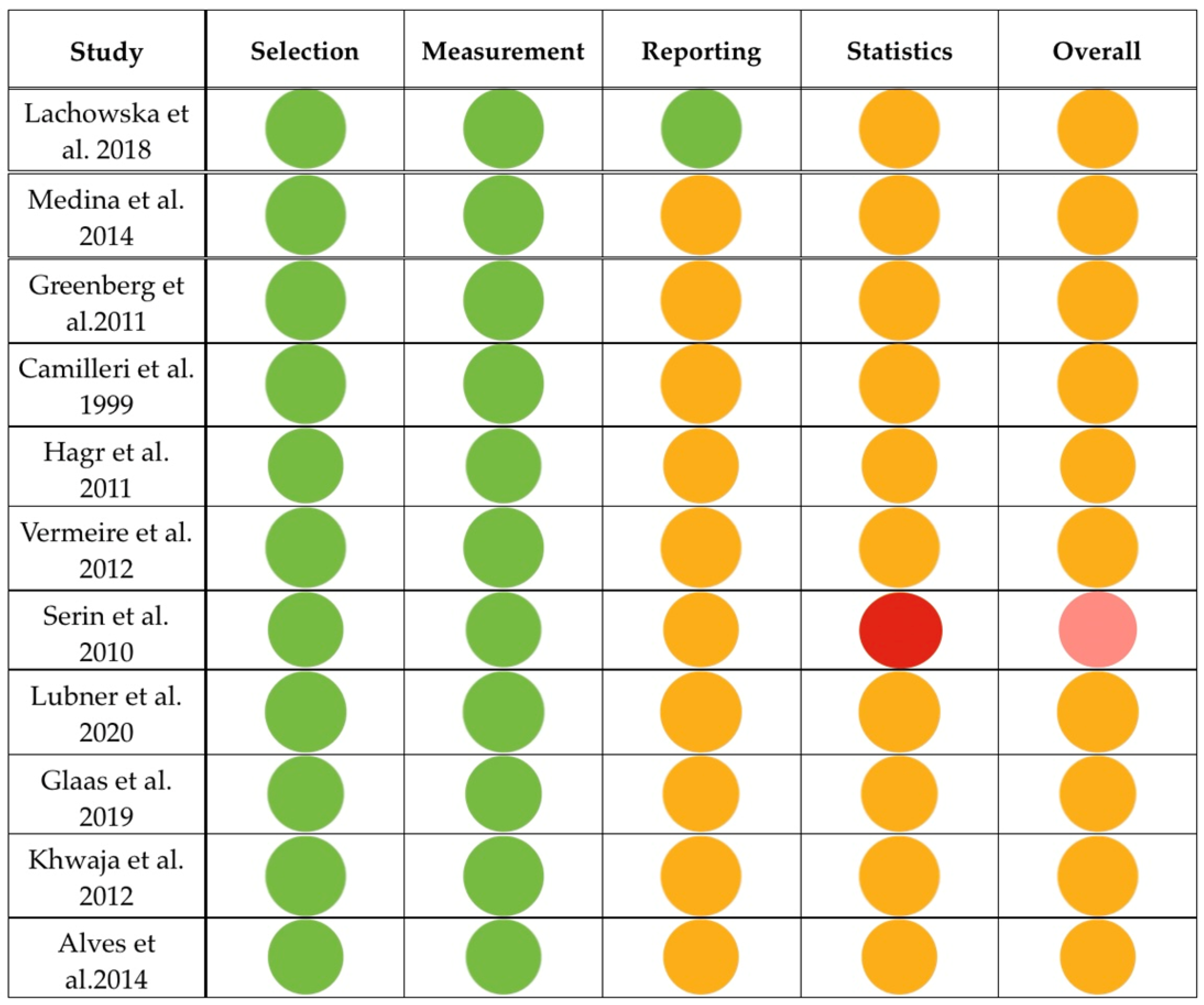
| Study | Q1 | Q2 | Q3 | Q4 | Q5 | Q6 | Q7 | Q8 | Q9 | Q10 | Overall | Risk |
|---|---|---|---|---|---|---|---|---|---|---|---|---|
| Lachowska et al. [7] |  | | |  | | | | | | | | Moderate |
| Medina et al. [8] | | | | | | | | | | | | Moderate |
| Greenberg et al. [9] | | | | | | | | | | | | Moderate |
| Camilleri et al. [10] | | | | | | | | | | | | Moderate |
| Hagr et al. [11] | | | | | | | | | | | | Moderate |
| Vermeire et al. [12] | | | | | | | | | | | | Moderate |
| Serin et al. [13] | | | | | | | | |  | |  | Moderate-high |
| Lubner et al. [14] | | | | | | | | | | | | Moderate |
| Glaas et al. [15] | | | | | | | | | | | | Moderate |
| Khwaja et al. [16] | | | | | | | | | | | | Moderate |
| Alves et al. [17] | | | | | | | | | | | | Moderate |
| Name | Number of PTs and CIs | Major Indications | Interval Between Trauma and Implantation | Follow-Up Intervals | Preoperative Assessment |
|---|---|---|---|---|---|
| Lachowska et al., 2018 [7] | 7 patients 7 CIs | Profound SNHL Intact cochlear nerve and patent cochlear duct | 5.77 months [0.8–6.73 months] | Upon the 1st and 12th months; then, annually up to 16 years | PTA, speech perception, ABR, and caloric testing CT and MRI (not always) |
| Medina et al., 2014 [8] | 11 patients 8 CIs 3 ABIs | Severe to profound SNL CI if cochlear nerve intact based on EABR ABI otherwise | Months to several years | From 1 to 10 years; initially at the 1st, 3rd, 6th and 12th months and then annually | PTA, speech perception, ABR and EABR Promontory test and ENG CT and MRI |
| Greenberg et al., 2011 [9] | 25 patients 11 CIs (unilateral) (7 bilateral and 4 unilateral TBFs) | Severe or profound SNHL Intact cochlear nerve | 1 month–9 years | Upon the 12th month; then, prolonged observation and, in some cases, up to 20 years | PTA, promontory test, and ENG CT |
| Camilleri et al., 1998 [10] | 7 patients with bilateral TBFs 7 CIs | Profound SNHL > 90 dB Intact cochlea | Months to a few years | Upon the 1st month and the 9th month; overall observation period was 9 months | PTA, speech audiometry, promontory test ABR (some patients) CT and MRI (some patients) |
| Hagr et al., 2011 [11] | 5 patients with bilateral TBFs 6 CIs | Severe to profound HL | 1–5 years | From 1 to 2 years | PTA, speech audiometry,; promontory test, and ABR (some patients with absent responses) CT and MRI |
| Vermeire et al., 2012 [12] | 4 patients with bilateral TBFs 4 CIs | Bilateral profound SNHL Patent cochlea and intact cochlear nerve | 4 months–12 years (median value: 1–2 years) | All of them up to 12 months, and then some patients up to 5 years | PTA–speech audiometry–promontory test and vestibular tests CT and MRI |
| Serin et al., 2010 [13] | 5 patients with bilateral TBFs 6 CIs | Bilateral profound hearing loss Intact cochlear nerve | 6–36 months | Upon the 6th month, and 1st, 2nd, 3rd, 4th, 5th and 7th year | Promontory test CT and MRI |
| Lubner et al. [14] | 12 trauma patients with TBFs 15 CIs 7 trauma patients without TBFs | Severe to profound SNHL with intact cochlear nerve | Months or years after the accident (mean value: 5.7 years) | 6.5-year longitudinal follow-up with frequent sessions | PTA, promontory test (3 cases) Vestibular tests (caloric tests and VEMP) CT and MRI |
| Glaas et al. [15] | 5 patients 6 CIs | Profound SNHL Patent cochlea and intact cochlear nerve | 2–139 months (33.6+/−20.4 months) | Upon the 3rd, 6th and 12th month | PTA, promontory test, BERA, and TEOAEs Caloric vestibular testing, CT, and MRI |
| Khwaja et al., 2012 [16] | 20 patients 16 CIs in TBF patients 6 CIs in non-TBF patients | Bilateral profound SNHL deafness Cochlear patency and intact cochlear nerve | Not reported | From 12 to 76 months (mean value: 3 yrs) | CT, MRI, and PTA Speech audiometry (BKB, CUNY, and AB tests) Promontory test Neurological/clinical examination |
| Alves et al., 2014 [17] | 14 patients with TBFs 14 CIs 231 non- trauma patients with 231 CIs | Profound SNHL Cochlear patency | Not reported | Not reported | CT, MRI, and PTA Neuro-otological examination |
| Name | Follow-Up Protocol | Reported Auditory Outcomes | Complications |
|---|---|---|---|
| Lachowska et al., 2018 [7] | PTA: threshold at 0.5, 1, 2 and 4 kHz Speech audiometry: One-syllable word perception: 83% Multisyllable word perception: 98% Sentence recognition: 100% Impedance: stable values Subjective performance: all patients benefited | Auditory benefit to all patients, with significantly improved speech perception | No complications referred |
| Medina et al., 2014 [8] | Primary CI group VI: 90–100%—BWR: 35–100%—SR: 74–100%—C: 65–100% ABI before CI Pat. A: VI-BWR-SR not assessable Pat. B. VI: 0-BWR: 0-SR: 30%-C: 0% Pat C. VI: 0-BWR: 0-SR: 20%- CI results after auditory brainstem implants Pat A. VI:90%-BWR:90%-SR:90% Pat B VI:100%-BWR:90%-SR:69%-C 70% Pat C VI: 100%-BWR: 55%-SR: 69%-C70% Impedance telemetry: stable results Device mapping: stable findings | Auditory benefit to most patients; one patient had limited post-procedural speech performance | No complications referred |
| Greenberg et al., 2011 [9] | Speech perception testing (open-set sentence) Patients with older devices CID scores: 16%, 22% and 73% Newer devices scores rated from 88 to 100% and CUNY to 92% Mean score (CID): 71% Absent calorics in 16/18 ears with TBF Device mapping Rehabilitation | Auditory benefit to several recipients; a subset revealed limited speech discrimination, and some patients were not suitable candidates | 2 cases of FNS (required reprogramming) |
| Camilleri et al., 1998 [10] | FFTA: 40–50 dB BKB sentence test in quiet: 71% VCV phoneme perception test: 67% Device mapping 6 patients benefited; 1 non-responder | Auditory benefit to most patients; variability in speech outcomes was noted | 1 patient had FNS (reimplantation) 1 patient suffered wound dehiscence 2 incomplete electrode placements 1 total occlusion and placement was impossible |
| Hagr et al., 2011 [11] | Speech perception (open set): 2 pts (70–80%), 2 pts < 30% and the rest one 40–50% Closed set: all pts. 89–100% Subjective tests, interactivity: all patients competent users of telephone Intensive mapping: stable in all Only one patient was non-responder | Auditory benefit to most patients; one patient had limited open-set speech performance | No complications referred |
| Vermeire et al. 2012 [12] | PTA: 0.5–4 kHz at approximately 28 dB Speech perception evaluation in quiet: NVA monosyllabic test 34–68% Plomp sentences: 38–76%. Closed-set consonant test: 66–76% Short-vowel test: 90–100% Long vowel test: 80–100% Speech in noise: Plomp adaptive SNR (50% threshold): extremely low, 30 dB SNR Self-perceived handicap: HHIA 26–70 Mapping: stable impedance Clinical examination: no deficits | Auditory benefit to all patients, with regular device use and speech outcomes comparable to standard adult CI recipients | No complications referred |
| Serin et al. 2010 [13] | Speech tests at 70 dB A-weighted at 1 meter distance Closed-set sentences: initial/final phoneme test: constant improvement Open-set sentence tests: monosyllabic: >80% correct for the majority Trisyllabic: > 90% correct for the majority telephone Speech: 4/5 competent users; 1/5 after reimplantation | Auditory benefit to all patients; good speech discrimination and regular device use | 1 transient facial paresis (resolved with cortisone); 1 reimplantation (fibrosis/ossification) |
| Lubner et al. [14] | Open-set speech perception: [CNC words]: perception was feasible Speech in noise testing: moderate improvement; worse outcomes in ossification Overall worse but insignificant outcomes for TBF cases Mapping sessions and impedance telemetry: stable values | Sustained auditory benefit at long-term follow-up; speech outcomes comparable to non-fracture recipients | 1 FNS (treated with reprogramming) 1 wound dehiscence 4 partial incomplete electrode placements, 1 due to ossification |
| Glaas et al. [15] | Freiburg monosyllabic test: 40% at 3 months; 67% at 12 months Freiburg numbers test: acceptable proportion Impedance verification: stable impedances | Auditory benefit to all recipients; speech discrimination improved over time | 1 FNS (reprogrammed successfully) |
| Khwaja S. et al., 2012 [16] | BKB: similar for both groups (to noise and silence) 68% at 9 months and 64% at the last control CUNY: similar for both groups 86% at 9 months and 83% at the last control AB: similar for both groups 59% at 9 months and 60% at last control. Impedance and stimulation control | Highly variable outcomes; auditory benefit to many patients, with a subset demonstrating poor speech discrimination or limited device use | 3 cases of FNS 1 reimplantation 1 partial insertion due to cochlear ossification Cognitive deficits hindered proper mapping |
| Alves M. et al., 2014 [17] | PTA: trauma pts: 33.3 ±6.85 dB at 500 Hz, 33 ± 5.36 dB at 1000 Hz, and 35.8 ± 2.88 dB Non-trauma pts: 500 Hz at 31.6 ± 8.11 dB, 1000 Hz at 31.4 ±7.74 dB, and 4000 Hz at 33.2 ± 6.62 dB Speech audiometry: similar to control group Consonant discrimination test: poorer outcome for TBF group (40% vs. 60%) 100-word open-set sentences test (face-to- face): no intergroup difference 100-word open-set sentences test (telephone): poorer for TBF group (35.8% vs. 60.7%) Monosyllable recognition test: poorer outcome in TBF group (52% vs. 67%) Rehabilitation | Significant auditory benefit to most post-traumatic recipients, although average speech scores were lower compared with non-trauma causes | None referred |
Disclaimer/Publisher’s Note: The statements, opinions and data contained in all publications are solely those of the individual author(s) and contributor(s) and not of MDPI and/or the editor(s). MDPI and/or the editor(s) disclaim responsibility for any injury to people or property resulting from any ideas, methods, instructions or products referred to in the content. |
© 2026 by the authors. Licensee MDPI, Basel, Switzerland. This article is an open access article distributed under the terms and conditions of the Creative Commons Attribution (CC BY) license.
Share and Cite
Antoniades, E.; Psillas, G.; Tsitsopoulos, P.P.; Magras, J.; Karkos, P.D. Cochlear Implantation After Temporal Bone Fracture: A Systematic Review of Preoperative Predictors and Timing. Brain Sci. 2026, 16, 227. https://doi.org/10.3390/brainsci16020227
Antoniades E, Psillas G, Tsitsopoulos PP, Magras J, Karkos PD. Cochlear Implantation After Temporal Bone Fracture: A Systematic Review of Preoperative Predictors and Timing. Brain Sciences. 2026; 16(2):227. https://doi.org/10.3390/brainsci16020227
Chicago/Turabian StyleAntoniades, Elias, George Psillas, Parmenion P. Tsitsopoulos, John Magras, and Petros D. Karkos. 2026. "Cochlear Implantation After Temporal Bone Fracture: A Systematic Review of Preoperative Predictors and Timing" Brain Sciences 16, no. 2: 227. https://doi.org/10.3390/brainsci16020227
APA StyleAntoniades, E., Psillas, G., Tsitsopoulos, P. P., Magras, J., & Karkos, P. D. (2026). Cochlear Implantation After Temporal Bone Fracture: A Systematic Review of Preoperative Predictors and Timing. Brain Sciences, 16(2), 227. https://doi.org/10.3390/brainsci16020227