Self-Perceptions of Aging in Older Adults: A Network Analysis of Clinical and Non-Clinical Samples
 , , , ,
Highlights
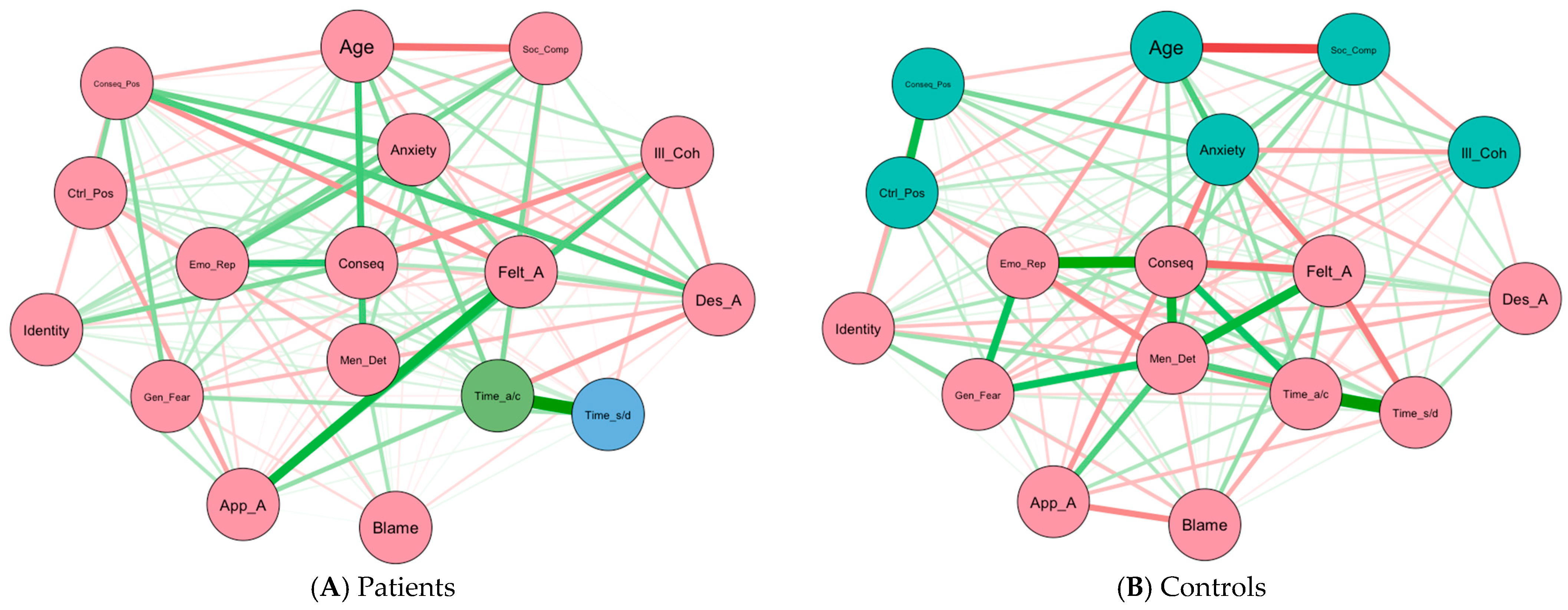
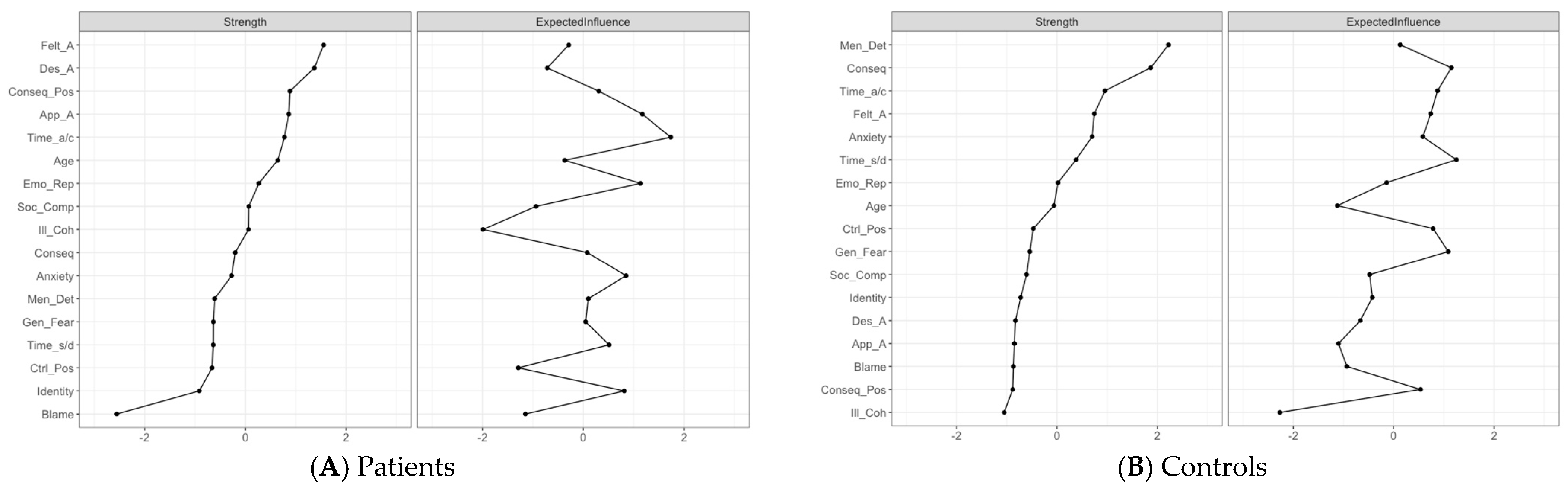
- Subjective age emerged as the most central node for patients, linking all psychosocial variables, whereas Mental deterioration is the one in the representational system in controls.
- Patients showed no cluster of self-perceptions of aging variables, while controls displayed a two-cluster structure separating negative emotional and threat-related variables from the positive views of aging.
- The central role of subjective age highlights that patients may rely more on external feedback to evaluate themselves, whereas controls may interpret their aging through socially shared negative stereotypes.
- The absence of clustering in patients may reflect the heterogeneity of their cognitive and pathological profiles, whereas the structured clustering in controls suggests that, outside a clinical context, representations of aging are more organized.
Abstract
1. Introduction
2. Materials and Methods
2.1. Sample
2.2. Procedure
2.3. Measures
2.3.1. Self-Perceptions of Memory Deficits

| Source | Variable Name | Description | Interpretation of Highest Score |
|---|---|---|---|
| Perceptions of memory complaints | |||
| Illness Perception Questionnaire-Memory (IPQ-M) [5] | Identity | Number of physical symptoms related to memory problems | More symptoms related to memory problems |
| Timeline acute/chronic | Expected duration of their memory problems | Memory problems will persist for a long time | |
| Timeline stability/decline | Perceived progression of memory | Memory problems will worsen over time | |
| Personal control (Helplessness) | Perceived ability to prevent/improve memory problems | Stronger perceived control over memory problems. | |
| Personal control (Blame) | Guilt about not doing enough to prevent memory problems | Stronger feeling of guilt | |
| Consequences | Negative impact of memory problems on one’s life | Memory problems have a negative impact on life. | |
| Treatment control | Memory problems can be managed with medical care | Medical treatment can help manage memory | |
| Emotional representation | Negative emotional response to memory problems | Stronger negative emotional reactions to memory problems. | |
| Illness coherence | Perceived understanding of one’s memory problems | Greater insight regarding memory problems | |
| Social comparison | Comparison of one’s memory with that of same-aged peers | Stronger perceptions of having a worse memory than same-aged peers | |
| Attitudes towards aging | |||
| Aging opinion survey [49] | Personal anxiety | Anxiety and negative emotions about one’s own aging | Greater anxiety toward aging |
| Aging Perceptions Questionnaire [29] | Consequences positives | Beneficial aspect of aging | More positive attitudes toward aging |
| Control positive | Positive aspects depend on their own actions | More positive attitudes toward aging | |
| Fear of Alzheimer’s Disease Scale [32] | Fear of developing Alzheimer’s disease (AD) | Concerns related to the possibility of developing Alzheimer’s disease | Stronger general fear of developing the disease |
| Stereotypes of older adults | |||
| Attitudes towards older people [50] | Mental deterioration | Negative stereotypical beliefs about age-related cognitive decline | Stronger endorsement of negative stereotypes about cognitive aging |
| Subjective age | |||
| Self-perceptions of aging [12] | Felt age | Age the person feels | A negative score indicates feeling younger than their chronological age, a positive score indicates feeling older |
| Desired age | Age the person wishes to have | ||
| Apparent age | Age the person believes others attribute to them | ||
2.3.2. Attitudes Towards Aging
2.3.3. Aging Stereotypes
2.3.4. Subjective Age
2.4. Statistical Analysis
2.5. Data Preparation
3. Results
3.1. Descriptive Statistics
| Patient Group (Hospital) n = 129 | Control Group (Laboratory) n = 84 | p-Value | η2 p | |||
|---|---|---|---|---|---|---|
| Mean (±SD) | Cronbach’s α | Mean (±SD) | Cronbach’s α | |||
| Self-perceptions of memory deficits | ||||||
| Identity | 8.04 (±4.37) | - | 6.79 (±4.54) | - | 0.048 | 0.02 |
| Timeline acute/chronic (Time_a/c) | 3.55 (±0.93) | 0.78 | 3.70 (±0.94) | 0.71 | 0.250 | 0.01 |
| Timeline stability/decline (Time_s/d) | 3.79 (±0.93) | 0.88 | 3.79 (±0.94) | 0.84 | 0.990 | 0.00 |
| Personal control (Blame) | 3.29 (±0.91) | 0.78 | 3.66 (±0.94) | 0.73 | 0.005 | 0.04 |
| Consequences (Conseq) | 2.85 (±0.89) | 0.58 | 2.08 (±0.90) | 0.72 | <0.001 | 0.15 |
| Emotional representation (Emo_Rep) | 3.31 (±1.15) | 0.86 | 2.45 (±1.15) | 0.83 | <0.001 | 0.12 |
| Illness coherence (Ill_Coh) | 2.68 (±1.03) | 0.59 | 3.51 (±1.04) | 0.72 | <0.001 | 0.13 |
| Social comparison (Soc_Comp) | 2.99 (±0.92) | 0.76 | 2.42 (±0.93) | 0.77 | <0.001 | 0.08 |
| Attitudes toward aging | ||||||
| Personal anxiety towards aging (Anxiety) | 2.89 (±0.75) | 0.73 | 2.71 (±0.75) | 0.57 | 0.091 | 0.01 |
| Consequences positive (Conseq_pos) | 3.63 (±0.85) | 0.68 | 3.57 (±0.86) | 0.76 | 0.641 | 0.00 |
| Control positive (Ctrl_pos) | 4.33 (±0.66) | 0.78 | 4.41 (±0.66) | 0.66 | 0.406 | 0.00 |
| General fear (Gen_Fear) | 2.86 (±0.97) | 0.65 | 2.48 (±0.99) | 0.66 | 0.008 | 0.04 |
| Stereotypes of older adults | ||||||
| Mental deterioration (Men_Det) | 2.44 (±0.58) | 0.84 | 2.44 (±0.59) | 0.84 | 0.994 | 0.00 |
| Subjective age | ||||||
| Felt age | 63.10 (±8.23) | - | 61.20 (±8.44) | - | 0.116 | 0.01 |
| Discrepancy score for Felt age (Felt_a) | −8.98 (±11.81) | - | −11.68 (±12.10) | - | 0.114 | 0.01 |
| Desired age | 47.60 (±14.54) | - | 45.40 (±14.39) | - | 0.288 | 0.00 |
| Discrepancy score for Desired age (Des_a) | −30.80 (±20.67) | - | −34.00 (±20.35) | - | 0.277 | 0.00 |
| Apparent age | 62.00 (±4.99) | - | 62.10 (±4.87) | - | 0.846 | 0.00 |
| Discrepancy score for Apparent age (App_a) | −10.06 (±7.16) | - | −9.76 (±6.97) | - | 0.766 | 0.00 |
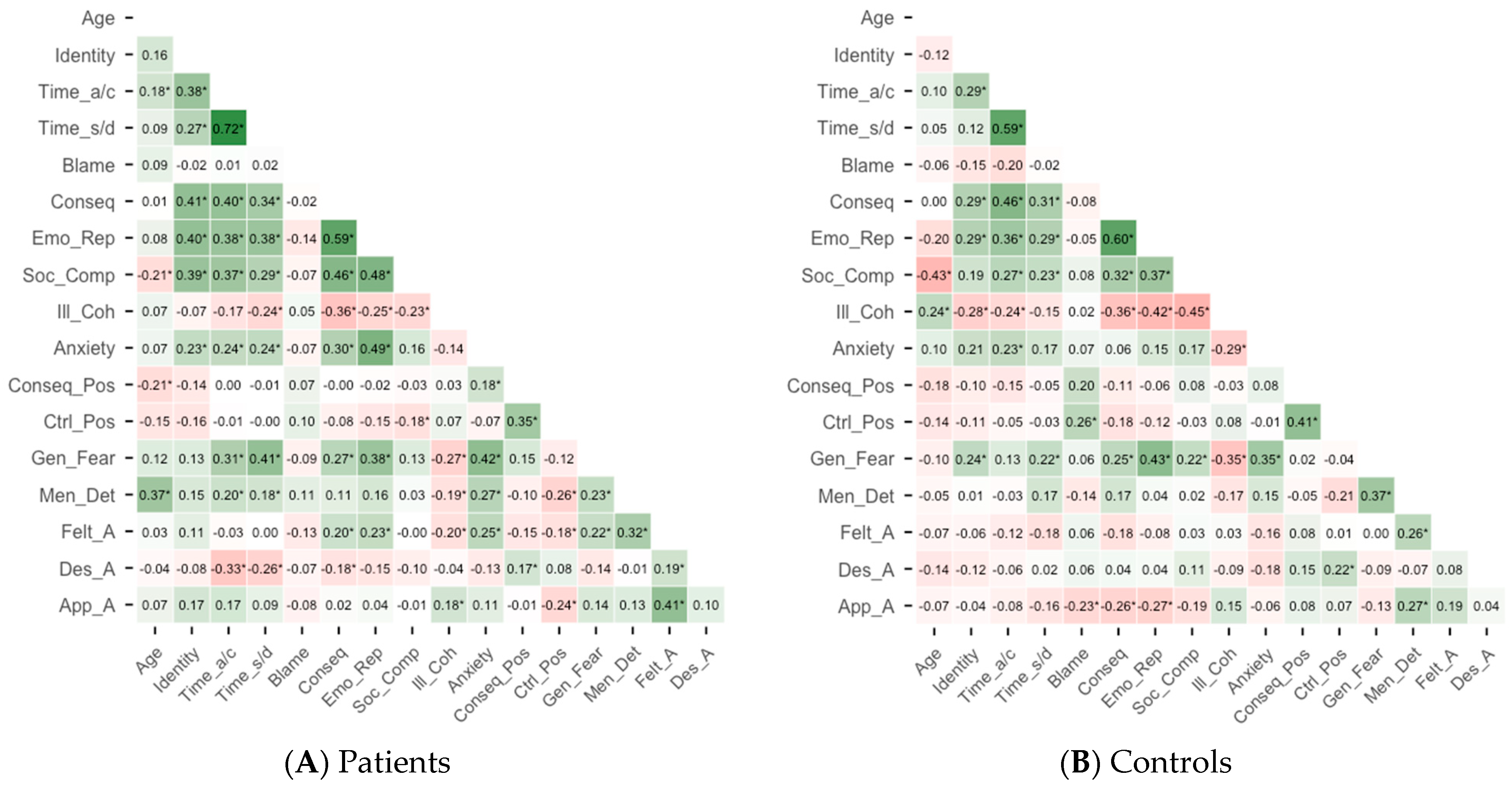
3.2. Correlation Matrix
3.3. Network Analysis
4. Discussion
4.1. Chronicity Beliefs and Subjective Age as Influencers of Emotional Distress in Patients
4.2. Internalizing Aging Stereotypes in the Control Sample
4.3. Illness Coherence as a Regulator of Emotional Distress Across Groups
4.4. Community Structure of Representational Networks
4.5. Clinical Impact of Subjective Age and Illness Coherence in Patients
4.6. Limitations
5. Conclusions
Supplementary Materials
Author Contributions
Funding
Institutional Review Board Statement
Informed Consent Statement
Data Availability Statement
Acknowledgments
Conflicts of Interest
Abbreviations
| MMSE | Mini Mental State Examination |
| QCC | Questionnaire of Cognitive Complaints |
| GDS | Geriatric Depression Scale |
| IADL | Instrumental Activities of Daily Living |
| NINCDS-ADRDA | National Institute of Neurological and Communicative Diseases and Stroke/Alzheimer’s Disease and Related Disorders Association |
| SPC | Socio-professional category |
| MG-CFA | Multi-Group Confirmatory Factor Analysis |
| IPQ-M | Illness Perceptions Questionnaire-Memory |
| AOS | Aging Opinion Survey |
| APQ | Aging Perceptions Questionnaire |
| FADS | Fear of Alzheimer’s Disease Scale |
| GGM | Gaussian Graphical Models |
| CS-coefficients | Correlation Stability Coefficients |
| MCAR | Missing Completely at Random |
| MICE | Multiple Imputation by Chained Equations |
| Time_a/c | Timeline acute/chronic |
| Time_s/d | Timeline stability/decline |
| Blame | Personal control (Blame) |
| Conseq | Consequences |
| Emo_Rep | Emotional representation |
| Ill_Coh | Illness coherence |
| Soc_Comp | Social comparison |
| Anxiety | Personal anxiety towards aging |
| Conseq_Pos | Consequences positive |
| Ctrl_Pos | Control positive |
| Gen_Fear | General fear; |
| Men_Det | Mental deterioration |
| Felt_A | Felt age |
| Des_A | Desired age |
| App_A | Apparent age |
| Age | Chronological age |
| EI | Expected Influence |
References
- Deary, I.J.; Corley, J.; Gow, A.J.; Harris, S.E.; Houlihan, L.M.; Marioni, R.E.; Penke, L.; Rafnsson, S.B.; Starr, J.M. Age-associated cognitive decline. Br. Med. Bull. 2009, 92, 135–152. [Google Scholar] [CrossRef]
- Corley, J.; Conte, F.; Harris, S.E.; Taylor, A.M.; Redmond, P.; Russ, T.C.; Deary, I.J.; Cox, S.R. Predictors of longitudinal cognitive ageing from age 70 to 82 including APOE e4 status, early-life and lifestyle factors: The Lothian Birth Cohort 1936. Mol. Psychiatry 2023, 28, 1256–1271. [Google Scholar] [CrossRef]
- Ekström, I.; Josefsson, M.; Bäckman, L.; Laukka, E.J. Predictors of cognitive aging profiles over 15 years: A longitudinal population-based study. Psychol. Aging 2024, 39, 467–483. [Google Scholar] [CrossRef]
- Ten Kate, M.; Dicks, E.; Visser, P.J.; Van Der Flier, W.M.; Teunissen, C.E.; Barkhof, F.; Scheltens, P.; Tijms, B.M.; Alzheimer’s Disease Neuroimaging Initiative. Atrophy subtypes in prodromal Alzheimer’s disease are associated with cognitive decline. Brain 2018, 141, 3443–3456. [Google Scholar] [CrossRef]
- Hurt, C.S.; Burns, A.; Brown, R.G.; Barrowclough, C. Perceptions of subjective memory complaint in older adults: The Illness Perception Questionnaire—Memory (IPQ-M). Int. Psychogeriatr. 2010, 22, 750–760. [Google Scholar] [CrossRef] [PubMed]
- Shinan-Altman, S.; Werner, P. Illness representations of dementia: A scoping review. Clin. Interv. Aging 2019, 14, 179–193. [Google Scholar] [CrossRef] [PubMed]
- Cosentino, S.; Devanand, D.; Gurland, B. A Link between Subjective Perceptions of Memory and Physical Function: Implications for Subjective Cognitive Decline. J. Alzheimer’s Dis. 2018, 61, 1387–1398. [Google Scholar] [CrossRef]
- García-García, L.; Fernandes-Pires, J.A.; Márquez-González, M.; Pedroso-Chaparro, M.D.S.; Benito-Rincón, C.; Pérez-Cardona, L.M.; Losada-Baltar, A. Self-perceptions of Aging and Distress in Middle-aged and Older Adults. The Role of Perceived Control and Pleasant Activities. Span. J. Psychol. 2025, 28, e8. [Google Scholar] [CrossRef] [PubMed]
- Levy, B. Stereotype Embodiment: A Psychosocial Approach to Aging. Curr. Dir. Psychol. Sci. 2009, 18, 332–336. [Google Scholar] [CrossRef]
- Barber, S.J. The applied implications of age-based stereotype threat for older adults. J. Appl. Res. Mem. Cogn. 2020, 9, 274–285. [Google Scholar] [CrossRef]
- Fernández-Ballesteros, R.; Bustillos, A.; Huici, C. Positive Perception of Aging and Performance in a Memory Task: Compensating for Stereotype Threat? Exp. Aging Res. 2015, 41, 410–425. [Google Scholar] [CrossRef]
- Kotter-Grühn, D.; Hess, T.M. The Impact of Age Stereotypes on Self-perceptions of Aging Across the Adult Lifespan. J. Gerontol. Ser. B 2012, 67, 563–571. [Google Scholar] [CrossRef]
- Wettstein, M.; Wahl, H.-W.; Drewelies, J.; Wurm, S.; Huxhold, O.; Ram, N.; Gerstorf, D. Younger Than Ever? Subjective Age Is Becoming Younger and Remains More Stable in Middle-Age and Older Adults Today. Psychol. Sci. 2023, 34, 647–656. [Google Scholar] [CrossRef]
- Hagger, M.S.; Orbell, S. The common-sense model of illness self-regulation: A conceptual review and proposed extended model. Health Psychol. Rev. 2022, 16, 347–377. [Google Scholar] [CrossRef]
- Petrie, K.J.; Jago, L.A.; Devcich, D.A. The role of illness perceptions in patients with medical conditions. Curr. Opin. Psychiatry 2007, 20, 163–167. [Google Scholar] [CrossRef]
- Lin, F.; Gleason, C.E.; Heidrich, S.M. Illness Representations in Older Adults with Mild Cognitive Impairment. Res. Gerontol. Nurs. 2012, 5, 195–206. [Google Scholar] [CrossRef] [PubMed]
- Perry-Young, L.; Owen, G.; Kelly, S.; Owens, C. How people come to recognise a problem and seek medical help for a person showing early signs of dementia: A systematic review and meta-ethnography. Dementia 2018, 17, 34–60. [Google Scholar] [CrossRef] [PubMed]
- Tyrrell, M.; Religa, D.; Fossum, B.; Hedman, R.; Skovdahl, K.; Hillerås, P. Embarking on a memory assessment voice of older persons living with memory impairment. Dementia 2021, 20, 717–733. [Google Scholar] [CrossRef] [PubMed]
- Visser, L.N.C.; Fruijtier, A.; Kunneman, M.; Bouwman, F.H.; Schoonenboom, N.; Staekenborg, S.S.; Wind, H.A.; Hempenius, L.; De Beer, M.H.; Roks, G.; et al. Motivations of patients and their care partners for visiting a memory clinic. A qualitative study. Patient Educ. Couns. 2023, 111, 107693. [Google Scholar] [CrossRef]
- Jiao, Y.-C.; Chang, J.; Liu, C.; Zhou, S.-Y.; Ji, Y.; Meng, Y. Factors influencing the help-seeking behavior in patients with mild cognitive impairment: A qualitative study. BMC Health Serv. Res. 2023, 23, 1345. [Google Scholar] [CrossRef]
- Régner, I.; Huguet, P. Age-based stereotype threat effects: From the laboratory to the clinical setting. Cortex 2025, 183, 261–273. [Google Scholar] [CrossRef] [PubMed]
- Barber, S.J.; Mather, M.; Gatz, M. How Stereotype Threat Affects Healthy Older Adults’ Performance on Clinical Assessments of Cognitive Decline: The Key Role of Regulatory Fit. J. Gerontol. Ser. B Psychol. Sci. Soc. Sci. 2015, 70, 891–900. [Google Scholar] [CrossRef][Green Version]
- Haslam, C.; Morton, T.A.; Haslam, S.A.; Varnes, L.; Graham, R.; Gamaz, L. “When the age is in, the wit is out”: Age-related self-categorization and deficit expectations reduce performance on clinical tests used in dementia assessment. Psychol. Aging 2012, 27, 778–784. [Google Scholar] [CrossRef] [PubMed]
- Mazerolle, M.; Régner, I.; Barber, S.J.; Paccalin, M.; Miazola, A.C.; Huguet, P.; Rigalleau, F. Negative Aging Stereotypes Impair Performance on Brief Cognitive Tests Used to Screen for Predementia. J. Gerontol. Ser. B Psychol. Sci. Soc. Sci. 2017, 72, 932–936. [Google Scholar] [CrossRef]
- Mazerolle, M.; Régner, I.; Rigalleau, F.; Huguet, P. Stereotype Threat Alters the Subjective Experience of Memory. Exp. Psychol. 2015, 62, 395–402. [Google Scholar] [CrossRef] [PubMed]
- Leventhal, H.; Meyer, D.; Nerenz, D. The Common Sense Model of Illness Representations. Med. Psychol. 1980, 2, 7–30. [Google Scholar]
- Hagger, M.S.; Orbell, S. A Meta-Analytic Review of the Common-Sense Model of Illness Representations. Psychol. Health 2003, 18, 141–184. [Google Scholar] [CrossRef]
- Hill, N.L.; Do, J.; Bratlee-Whitaker, E.; Turner, J.R.; Sillner, A.; Fishman, C.; Mogle, J. Views of Aging and Subjective Cognition in Middle-Aged and Older Adults: A Systematic Review. Gerontology 2024, 71, 49–70. [Google Scholar] [CrossRef]
- Barker, M.; O’Hanlon, A.; McGee, H.M.; Hickey, A.; Conroy, R.M. Cross-sectional validation of the Aging Perceptions Questionnaire: A multidimensional instrument for assessing self-perceptions of aging. BMC Geriatr. 2007, 7, 9. [Google Scholar] [CrossRef]
- Westerhof, G.J.; Nehrkorn-Bailey, A.M.; Tseng, H.-Y.; Brothers, A.; Siebert, J.S.; Wurm, S.; Wahl, H.-W.; Diehl, M. Longitudinal effects of subjective aging on health and longevity: An updated meta-analysis. Psychol. Aging 2023, 38, 147–166. [Google Scholar] [CrossRef]
- Klusmann, V.; Sproesser, G.; Wolff, J.K.; Renner, B. Positive Self-perceptions of Aging Promote Healthy Eating Behavior Across the Life Span via Social-Cognitive Processes. J. Gerontol. Ser. B 2019, 74, 735–744. [Google Scholar] [CrossRef]
- French, S.L.; Floyd, M.; Wilkins, S.; Osato, S. The Fear of Alzheimer’s Disease Scale: A new measure designed to assess anticipatory dementia in older adults. Int. J. Geriatr. Psychiatry 2012, 27, 521–528. [Google Scholar] [CrossRef]
- Westerhof, G.J.; Miche, M.; Brothers, A.F.; Barrett, A.E.; Diehl, M.; Montepare, J.M.; Wahl, H.-W.; Wurm, S. The influence of subjective aging on health and longevity: A meta-analysis of longitudinal data. Psychol. Aging 2014, 29, 793–802. [Google Scholar] [CrossRef]
- Klaiber, P.; Pauly, T. Daily Fluctuations in Subjective Age among Older Adults: Links with Stressors, Positive Events, and Emotional Reactions. Gerontology 2025, 71, 239–251. [Google Scholar] [CrossRef]
- Aftab, A.; Lam, J.A.; Thomas, M.L.; Daly, R.; Lee, E.E.; Jeste, D.V. Subjective age and its relationships with physical, mental, and cognitive functioning: A cross-sectional study of 1,004 community-dwelling adults across the lifespan. J. Psychiatr. Res. 2022, 152, 160–166. [Google Scholar] [CrossRef]
- Nelson, A.P.; O’Connor, M.G. Mild Cognitive Impairment: A Neuropsychological Perspective. CNS Spectr. 2008, 13, 56–64. [Google Scholar] [CrossRef]
- Delrieu, J.; Ceccaldi, M.; Epelbaum, S.; Gabelle, A.; Krolak-Salmon, P.; Paquet, C.; Vellas, B. La maladie d’Alzheimer au stade prodromal: Comment pouvons-nous la diagnostiquer et la prendre en charge? Devons-nous le faire? Année Gérontologique 2018, 32, 2–6. [Google Scholar]
- Delage, É.; Rouleau, I.; Akzam-Ouellette, M.-A.; Rahayel, S.; Filiatrault, M.; Joubert, S. Patterns of cortical thickness in MCI patients with and without semantic impairment. Brain Cogn. 2025, 184, 106258. [Google Scholar] [CrossRef] [PubMed]
- Epskamp, S.; Rhemtulla, M.; Borsboom, D. Generalized Network Psychometrics: Combining Network and Latent Variable Models. Psychometrika 2017, 82, 904–927. [Google Scholar] [CrossRef] [PubMed]
- Hevey, D. Network analysis: A brief overview and tutorial. Health Psychol. Behav. Med. 2018, 6, 301–328. [Google Scholar] [CrossRef] [PubMed]
- Folstein, M.F.; Folstein, S.E.; McHugh, P.R. “Mini-mental state”: A practical method for grading the cognitive state of patients for the clinician. J. Psychiatr. Res. 1975, 12, 189–198. [Google Scholar] [CrossRef]
- Thomas-Antérion, C.; Ribas, C.; Honoré-Masson, S.; Berne, G.; Rule, J.H.; Laurent, B. Le questionnaire de plainte cognitive (QPC): Un outil de recherche de plainte suspecte d’évoquer une maladie d’Alzheimer. Année Gérontologique 2003, 17, 56–65. [Google Scholar]
- Yesavage, J.A.; Brink, T.L.; Rose, T.L.; Lum, O.; Huang, V.; Adey, M.; Leirer, V.O. Development and validation of a geriatric depression screening scale: A preliminary report. J. Psychiatr. Res. 1982, 17, 37–49. [Google Scholar] [CrossRef]
- Dubois, B.; Touchon, J.; Portet, F.; Ousset, P.J.; Vellas, B.; Michel, B. «Les cinq mots» épreuve simple et sensible pour le diagnostic de la maladie d’Alzheimer. Presse Méd. 2002, 31, 1696–1699. [Google Scholar]
- Lawton, M.P.; Brody, E.M. Assessment of older people: Self-maintaining and instrumental activities of daily living. Gerontol. 1969, 9, 179–186. [Google Scholar] [CrossRef]
- Sawilowsky, S.S. New Effect Size Rules of Thumb. J. Mod. Appl. Stat. Methods 2009, 8, 597–599. [Google Scholar] [CrossRef]
- Gauthier, K.; Morand, A.; Dutheil, F.; Alescio-Lautier, B.; Boucraut, J.; Clarys, D.; Eustache, F.; Girard, N.; Guedj, E.; Mazerolle, M.; et al. Ageing stereotypes and prodromal Alzheimer’s disease (AGING): Study protocol for an ongoing randomised clinical study. BMJ Open 2019, 9, e032265. [Google Scholar] [CrossRef] [PubMed]
- Besozzi, A. Etude des Perceptions des Troubles Mnésiques au Cours de la Démarche Diagnostique en Consultation «Mémoire». Ph.D. Thesis, Université de Lorraine, Nancy, France, 2017. [Google Scholar]
- Kafer, R.A.; Rakowskl, W.; Lachman, M.; Hickey, T. Aging Opinion Survey: A Report on Instrument Development. Int. J. Aging Hum. Dev. 1980, 11, 319–333. [Google Scholar] [CrossRef]
- Tuckman, J.; Lorce, I. Attitudes towards old people. J. Soc. Psychol. 1953, 37, 249–260. [Google Scholar]
- Epskamp, S.; Borsboom, D.; Fried, E.I. Estimating psychological networks and their accuracy: A tutorial paper. Behav. Res. Methods 2018, 50, 195–212. [Google Scholar] [CrossRef] [PubMed]
- Constantin, M.A.; Schuurman, N.K.; Vermunt, J.K. A general Monte Carlo method for sample size analysis in the context of network models. Psychol. Methods 2023. advance online publication. [Google Scholar] [CrossRef]
- Jones, P.J.; Ma, R.; McNally, R.J. Bridge Centrality: A Network Approach to Understanding Comorbidity. Multivar. Behav. Res. 2021, 56, 353–367. [Google Scholar] [CrossRef]
- Costantini, G.; Epskamp, S.; Borsboom, D.; Perugini, M.; Mõttus, R.; Waldorp, L.J.; Cramer, A.O.J. State of the aRt personality research: A tutorial on network analysis of personality data in R. J. Res. Personal. 2015, 54, 13–29. [Google Scholar] [CrossRef]
- Pons, P.; Latapy, M. Computing communities in large networks using random walks. J. Graph Algorithms Appl. 2006, 10, 191–218. [Google Scholar] [CrossRef]
- Tavakol, M.; Dennick, R. Making sense of Cronbach’s alpha. Int. J. Med. Educ. 2011, 2, 53–55. [Google Scholar] [CrossRef] [PubMed]
- Burger, J.; Isvoranu, A.-M.; Lunansky, G.; Haslbeck, J.M.B.; Epskamp, S.; Hoekstra, R.H.A.; Fried, E.I.; Borsboom, D.; Blanken, T.F. Reporting standards for psychological network analyses in cross-sectional data. Psychol. Methods 2023, 28, 806–824. [Google Scholar] [CrossRef]
- Jamshidian, M.; Jalal, S. Tests of Homoscedasticity, Normality, and Missing Completely at Random for Incomplete Multivariate Data. Psychometrika 2010, 75, 649–674. [Google Scholar] [CrossRef] [PubMed]
- Le Carret, N.; Lafont, S.; Letenneur, L.; Dartigues, J.-F.; Mayo, W.; Fabrigoule, C. The Effect of Education on Cognitive Performances and Its Implication for the Constitution of the Cognitive Reserve. Dev. Neuropsychol. 2003, 23, 317–337. [Google Scholar] [CrossRef]
- Mitchell, U.A.; Ailshire, J.A.; Brown, L.L.; Levine, M.E.; Crimmins, E.M. Education and Psychosocial Functioning Among Older Adults: 4-Year Change in Sense of Control and Hopelessness. J. Gerontol. Ser. B Psychol. Sci. Soc. Sci. 2016, 73, 849–859. [Google Scholar] [CrossRef]
- Bunn, F.; Goodman, C.; Sworn, K.; Rait, G.; Brayne, C.; Robinson, L.; McNeilly, E.; Iliffe, S. Psychosocial Factors That Shape Patient and Carer Experiences of Dementia Diagnosis and Treatment: A Systematic Review of Qualitative Studies. PLoS Med. 2012, 9, e1001331. [Google Scholar] [CrossRef]
- Marquet, M.; Boutaayamou, M.; Schwartz, C.; Locquet, M.; Bruyère, O.; Croisier, J.-L.; Adam, S. Does negative information about aging influence older adults’ physical performance and subjective age? Arch. Gerontol. Geriatr. 2018, 78, 181–189. [Google Scholar] [CrossRef]
- Weiss, D.; Lang, F.R. “They” are old but “I” feel younger: Age-group dissociation as a self-protective strategy in old age. Psychol. Aging 2012, 27, 153–163. [Google Scholar] [CrossRef]
- Kellermann, M.; Wetterauer, C.; Kullak-Ublick, G.A.; Cheetham, M. The waiting room of uncertainty: Digital patient support for potentially bad news—A scoping review. Front. Digit. Health 2025, 7, 1706839. [Google Scholar] [CrossRef]
- Farina, F.R.; Regan, J.; Marquez, M.; An, H.; O’Loughlin, P.; Pavithra, P.; Taddeo, M.; Knight, R.C.; Bennett, M.; Lenaert, B.; et al. Reducing fear and avoidance of memory loss improves mood and social engagement in community-based older adults: A randomized trial. BMC Geriatr. 2023, 23, 786. [Google Scholar] [CrossRef]
- Fuente-Hernández, L.; De La Fuente-Ruiz, E.; Gracia-García, P.; Serrano-García, I.; Álvarez-Mon, M.Á.; Molina-Ruiz, R.M. Using social media-based positive education to challenge negative stereotypes of aging: A quasi-experimental approach. BMC Public Health 2025, 25, 533. [Google Scholar] [CrossRef]
- Knight, R.L.; Chalabaev, A.; McNarry, M.A.; Mackintosh, K.A.; Hudson, J. Do age stereotype-based interventions affect health-related outcomes in older adults? A systematic review and future directions. Br. J. Health Psychol. 2022, 27, 338–373. [Google Scholar] [CrossRef] [PubMed]
- Lutfian, L.; Wardika, I.J.; Mukminin, M.A.; Zamroni, A.H.; Rizanti, A.P.; Chandra, I.N.; Widyaningtyas, R.; Maressa, A.; Maulana, S. Effectiveness of health education in improving treatment adherence among patients with chronic communicable diseases: A systematic review and meta-analysis. Trop. Med. Int. Health 2025, 30, 598–612. [Google Scholar] [CrossRef]
- Miller, T. A Health literacy and adherence to medical treatment in chronic and acute illness: A meta-analysis. Patient Educ. Couns. 2016, 99, 1079–1086. [Google Scholar] [CrossRef] [PubMed]
- Ruth, N.; Tsigeman, E.; Likhanov, M.; Kovas, Y.; Müllensiefen, D. Personality and engagement with music: Results from network modeling in three adolescent samples. Psychol. Music 2023, 51, 1223–1242. [Google Scholar] [CrossRef]
- Likhanov, M.; Fillon, A.; Demolliens, M.; ROBERT, A.; Darnon, C.; Huguet, P.; Regner, I. Network analysis of anxiety-related traits in male and female vocational students: Identifying potential targets for educational interventions. PsyArXiv 2025. [Google Scholar] [CrossRef]
- Bulsari, S.; Hashim, N.I.; Pandya, K.; Kabir, R. A Comparative Analysis of Dementia Strategies of Fifteen European Countries in the Context of Glasgow Declaration and WHO’s Global Action Plan. medRxiv 2025. [Google Scholar] [CrossRef]
- Hu, L.; Bentler, P.M. Cutoff criteria for fit indexes in covariance structure analysis: Conventional criteria versus new alternatives. Struct. Equ. Model. Multidiscip. J. 1999, 6, 1–55. [Google Scholar] [CrossRef]
- Chen, F.F. Sensitivity of Goodness of Fit Indexes to Lack of Measurement Invariance. Struct. Equ. Model. Multidiscip. J. 2007, 14, 464–504. [Google Scholar] [CrossRef]
- André, S.; Maulana, R.; Helms-Lorenz, M.; Telli, S.; Chun, S.; Fernández-García, C.-M.; De Jager, T.; Irnidayanti, Y.; Inda-Caro, M.; Lee, O.; et al. Student Perceptions in Measuring Teaching Behavior Across Six Countries: A Multi-Group Confirmatory Factor Analysis Approach to Measurement Invariance. Front. Psychol. 2020, 11, 273. [Google Scholar] [CrossRef]
- Marsh, H.W.; Hau, K.-T.; Wen, Z. In Search of Golden Rules: Comment on Hypothesis-Testing Approaches to Setting Cutoff Values for Fit Indexes and Dangers in Overgeneralizing Hu and Bentler’s (1999) Findings. Struct. Equ. Model. Multidiscip. J. 2004, 11, 320–341. [Google Scholar] [CrossRef]
- Steenkamp, J.E.M.; Baumgartner, H. Assessing Measurement Invariance in Cross-National Consumer Research. J. Consum. Res. 1998, 25, 78–107. [Google Scholar] [CrossRef]


| Patient Group (Hospital) n = 130 | Control Group (Laboratory) n = 84 | p-Value | Cohen’s d | |
|---|---|---|---|---|
| Gender ratio (M/F) | 44/86 | 26/58 | 0.771 1 | -- |
| Age (years) (±SD) | 70.96 (±8.74) | 66.44 (±8.09) | <0.001 2 | 0.53 |
| [Age range] | [50–87] | [50–89] | - | -- |
| SPC ratio (low/med/high) | 44/49/37 | 21/30/33 | 0.202 1 | -- |
| Education years (±SD) | 12.27 (±3.38) | 14.44 (±2.86) | <0.001 2 | 0.68 |
| MMSE scores (±SD) | 27.45 (±1.74) | 28.14 (±1.61) | 0.0042 | 0.41 |
| QCC scores (±SD) | 5.10 (±1.33) | 3.16 (±1.57) | <0.001 2 | 1.36 |
| GDS scores (±SD) | 6.19 (±2.71) | 5.65 (±3.26) | 0.191 2 | 0.18 |
| 5-word test (±SD) | 9.95 (±0.26) | 10.00 (±0.00) | 0.058 2 | 0.27 |
| IADL scores (±SD) | 0.00 (±0.00) | 0.00 (±0.00) | - | -- |
Disclaimer/Publisher’s Note: The statements, opinions and data contained in all publications are solely those of the individual author(s) and contributor(s) and not of MDPI and/or the editor(s). MDPI and/or the editor(s) disclaim responsibility for any injury to people or property resulting from any ideas, methods, instructions or products referred to in the content. |
© 2026 by the authors. Licensee MDPI, Basel, Switzerland. This article is an open access article distributed under the terms and conditions of the Creative Commons Attribution (CC BY) license.
Share and Cite
Le Tirant, L.; Likhanov, M.; Mazerolle, M.; Morand, A.; Eustache, F.; Huguet, P.; AGING Consortium; Régner, I. Self-Perceptions of Aging in Older Adults: A Network Analysis of Clinical and Non-Clinical Samples. Brain Sci. 2026, 16, 204. https://doi.org/10.3390/brainsci16020204
Le Tirant L, Likhanov M, Mazerolle M, Morand A, Eustache F, Huguet P, AGING Consortium, Régner I. Self-Perceptions of Aging in Older Adults: A Network Analysis of Clinical and Non-Clinical Samples. Brain Sciences. 2026; 16(2):204. https://doi.org/10.3390/brainsci16020204
Chicago/Turabian StyleLe Tirant, Lysiane, Maxim Likhanov, Marie Mazerolle, Alexandrine Morand, Francis Eustache, Pascal Huguet, AGING Consortium, and Isabelle Régner. 2026. "Self-Perceptions of Aging in Older Adults: A Network Analysis of Clinical and Non-Clinical Samples" Brain Sciences 16, no. 2: 204. https://doi.org/10.3390/brainsci16020204
APA StyleLe Tirant, L., Likhanov, M., Mazerolle, M., Morand, A., Eustache, F., Huguet, P., AGING Consortium, & Régner, I. (2026). Self-Perceptions of Aging in Older Adults: A Network Analysis of Clinical and Non-Clinical Samples. Brain Sciences, 16(2), 204. https://doi.org/10.3390/brainsci16020204