Frontal Theta Oscillations in Perceptual Decision-Making Reflect Cognitive Control and Confidence



Abstract
1. Introduction
2. Materials and Methods
2.1. Dataset
2.2. Participants
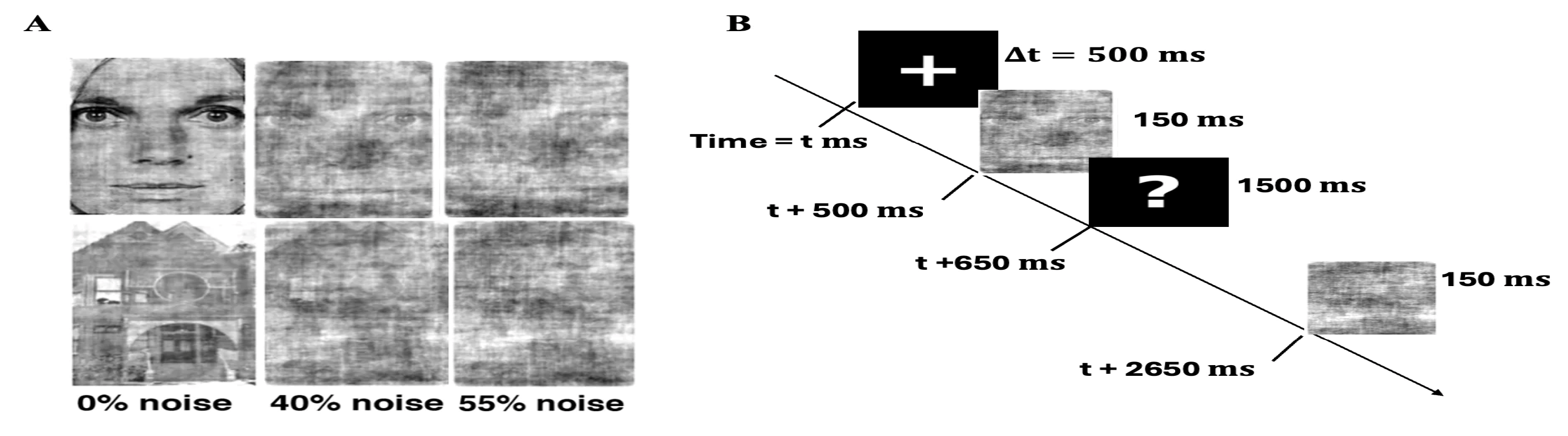
2.3. Stimuli
2.4. Experimental Design
2.5. Data Acquisition and Preprocessing
2.6. Software and Analysis Parameters
2.7. Data Analysis
2.7.1. EEG Recording and Initial Preprocessing
2.7.2. Epoching and High-Pass Filtering
2.7.3. Time-Frequency Analysis
2.7.4. Clarity Level Specification and Pooling
2.7.5. Current Source Density (CSD) Transformation
2.7.6. Functional Connectivity Analysis
2.7.7. Connectivity Decomposition: Phase-Locked vs. Induced Components
2.7.8. Decomposition of Oscillatory Activity
2.7.9. Statistical Analysis
3. Results
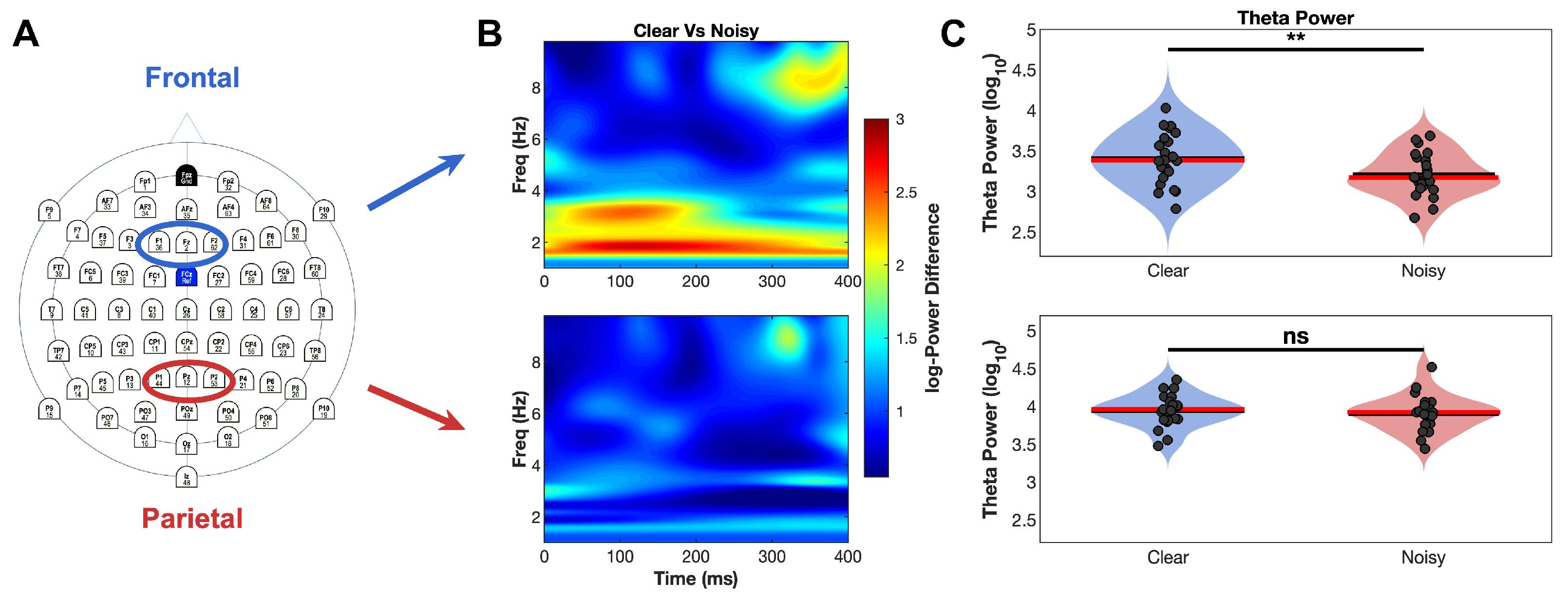
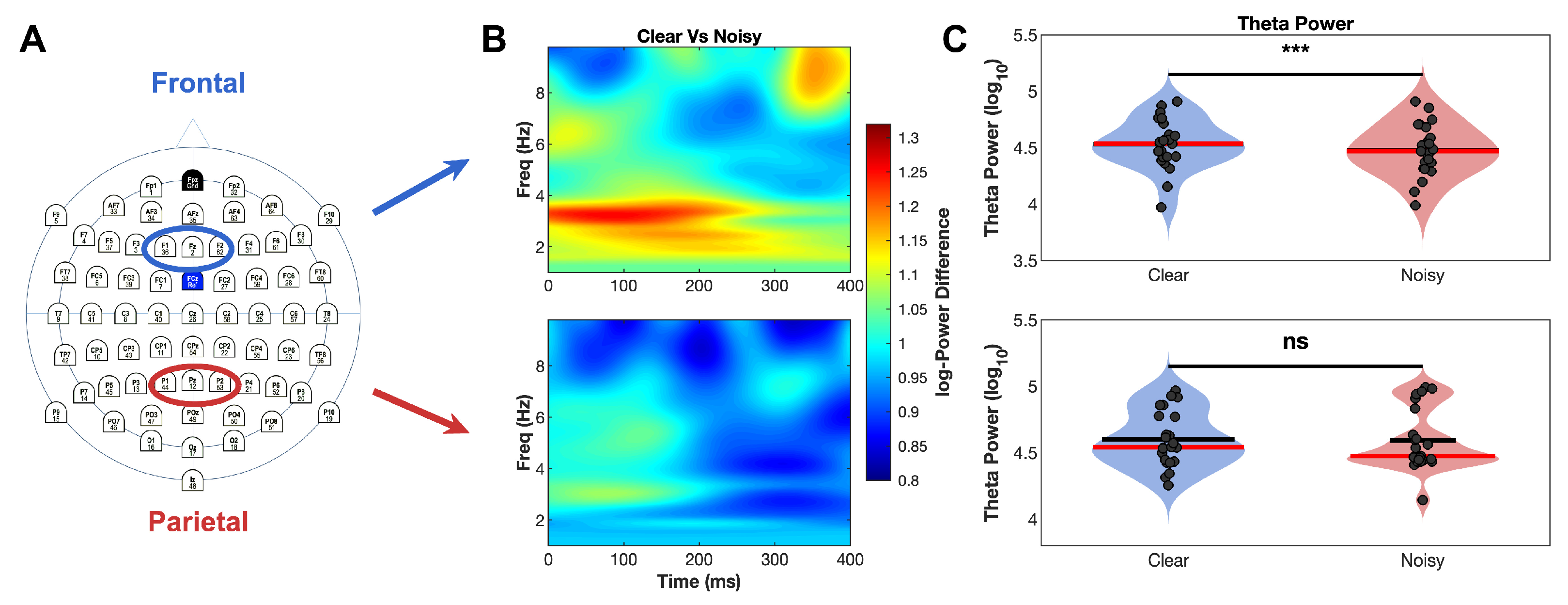
3.1. Theta Power Analysis
3.1.1. Method Comparison: ERP-Based vs. Single-Trial Analysis
3.1.2. Temporal Dynamics
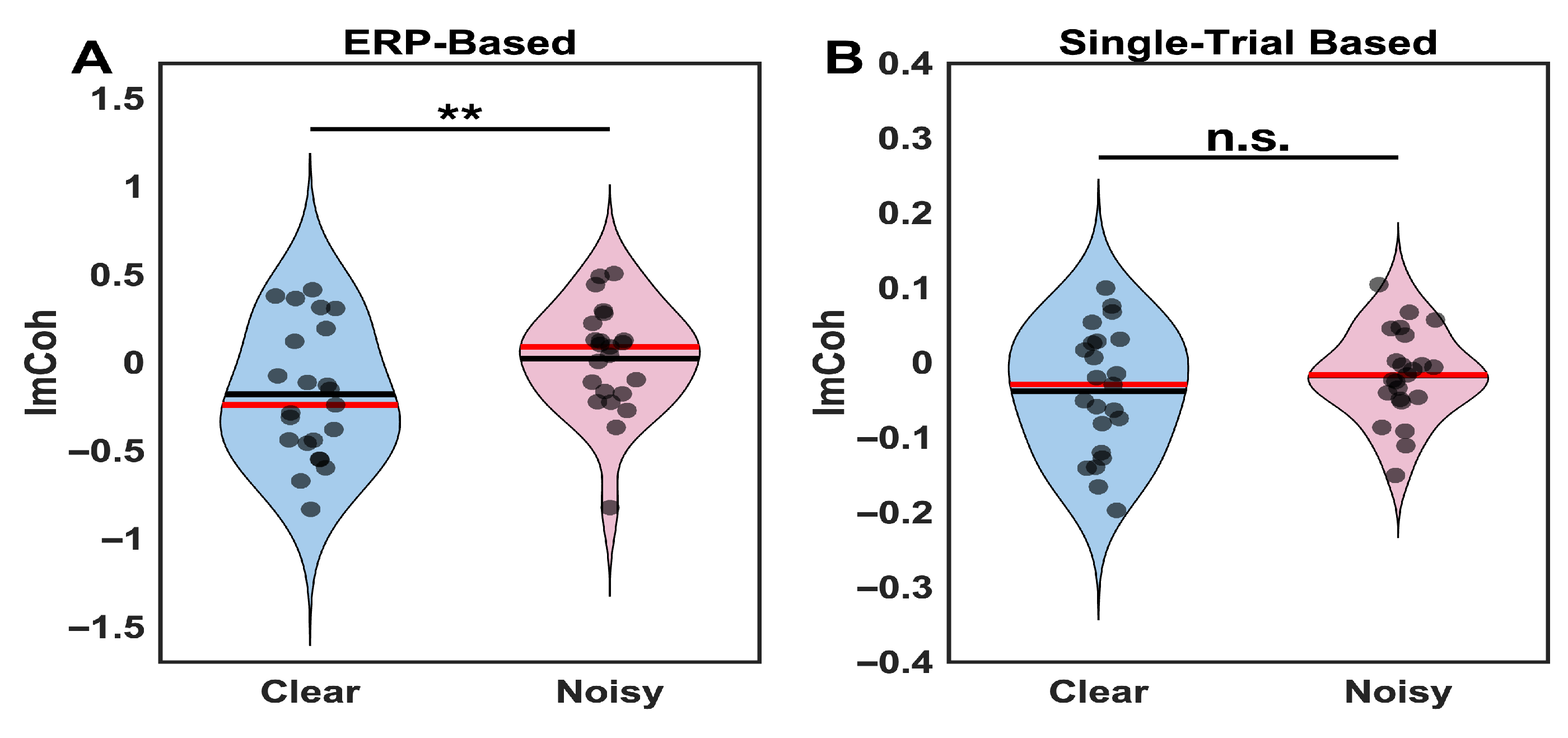
3.2. Frontal-Parietal Connectivity Analysis
3.2.1. Connectivity Decomposition: Evoked vs. Induced Components
3.3. Induced Oscillatory Activity
Induced Theta Power
4. Discussion
5. Conclusions
Supplementary Materials
Author Contributions
Funding
Institutional Review Board Statement
Informed Consent Statement
Data Availability Statement
Acknowledgments
Conflicts of Interest
References
- Green, N.; Heekeren, H.R. Perceptual decision making: A bidirectional link between mind and motion. Prog. Brain Res. 2009, 174, 207–218. [Google Scholar] [CrossRef]
- Maksimenko, V.A.; Kuc, A.; Frolov, N.S.; Khramova, M.V.; Pisarchik, A.N.; Hramov, A.E. Dissociating Cognitive Processes During Ambiguous Information Processing in Perceptual Decision-Making. Front. Behav. Neurosci. 2020, 14, 95. [Google Scholar] [CrossRef]
- Kelly, S.P.; O’Connell, R.G. Internal and external influences on the rate of sensory evidence accumulation in the human brain. J. Neurosci. 2013, 33, 19434–19441. [Google Scholar] [CrossRef]
- Stone, C.; Mattingley, J.B.; Bode, S.; Rangelov, D. Distinct neural markers of evidence accumulation index metacognitive processing before and after simple visual decisions. Cereb. Cortex 2024, 34, bhae179. [Google Scholar] [CrossRef] [PubMed]
- Heekeren, H.R.; Marrett, S.; Ungerleider, L.G. The neural systems that mediate human perceptual decision making. Nat. Rev. Neurosci. 2008, 9, 467–479. [Google Scholar] [CrossRef]
- Summerfield, C.; de Lange, F.P. Expectation in perceptual decision making: Neural and computational mechanisms. Nat. Rev. Neurosci. 2014, 15, 745–756. [Google Scholar] [CrossRef]
- Ratcliff, R.; McKoon, G. The diffusion decision model: Theory and data for two-choice decision tasks. Neural Comput. 2008, 20, 873–922. [Google Scholar] [CrossRef] [PubMed]
- Shin, S.; Oh, J.; Kim, S.K.; Lee, Y.-S.; Kim, S.J. Quantitative dynamics of neural uncertainty in sensory processing and decision-making during discriminative learning. Exp. Mol. Med. 2025, 57, 1078–1088. [Google Scholar] [CrossRef] [PubMed]
- Gold, J.I.; Shadlen, M.N. The neural basis of decision making. Annu. Rev. Neurosci. 2007, 30, 535–574. [Google Scholar] [CrossRef]
- Okazawa, G.; Kiani, R. Neural Mechanisms That Make Perceptual Decisions Flexible. Annu. Rev. Physiol. 2023, 85, 191–215. [Google Scholar] [CrossRef]
- Basar, E. Brain oscillations in neuropsychiatric disease. Dialogues Clin. Neurosci. 2013, 15, 291–300. [Google Scholar] [CrossRef] [PubMed]
- van Bree, S.; Levenstein, D.; Krause, M.R.; Voytek, B.; Gao, R. Processes and measurements: A framework for understanding neural oscillations in field potentials. Trends Cogn. Sci. 2025, 29, 448–466. [Google Scholar] [CrossRef]
- Fries, P. Rhythms for Cognition: Communication through Coherence. Neuron 2015, 88, 220–235. [Google Scholar] [CrossRef]
- Luo, Y.; Meng, X.; Zhou, G.; Zhou, J.; Luo, Y.-J.; Ai, H.; Zelano, C.; Chen, F.; Xu, P. Oscillatory mechanisms of intrinsic human brain networks. NeuroImage 2024, 298, 120773. [Google Scholar] [CrossRef]
- Kahana, M.J. The cognitive correlates of human brain oscillations. J. Neurosci. 2006, 26, 1669–1672. [Google Scholar] [CrossRef]
- Klimesch, W. EEG alpha and theta oscillations reflect cognitive and memory performance: A review and analysis. Brain Res. Brain Res. Rev. 1999, 29, 169–195. [Google Scholar] [CrossRef]
- Clayton, M.S.; Yeung, N.; Cohen Kadosh, R. The roles of cortical oscillations in sustained attention. Trends Cogn. Sci. 2015, 19, 188–195. [Google Scholar] [CrossRef] [PubMed]
- Guth, T.A.; Brandt, A.; Reinacher, P.C.; Schulze-Bonhage, A.; Jacobs, J.; Kunz, L. Theta-phase locking of single neurons during human spatial memory. Nat. Commun. 2025, 16, 7402. [Google Scholar] [CrossRef]
- Sauseng, P.; Klimesch, W. What does phase information of oscillatory brain activity tell us about cognitive processes? Neurosci. Biobehav. Rev. 2008, 32, 1001–1013. [Google Scholar] [CrossRef]
- Navi, F.F.T.; Heysieattalab, S.; Raoufy, M.R.; Sabaghypour, S.; Nazari, M.; Nazari, M.A. Adaptive closed-loop modulation of cortical theta oscillations: Insights into the neural dynamics of navigational decision-making. Brain Stimul. 2024, 17, 1101–1118. [Google Scholar] [CrossRef] [PubMed]
- Engel, A.K.; Fries, P.; Singer, W. Dynamic predictions: Oscillations and synchrony in top-down processing. Nat. Rev. Neurosci. 2001, 2, 704–716. [Google Scholar] [CrossRef]
- Martinovic, J.; Busch, N.A. High frequency oscillations as a correlate of visual perception. Int. J. Psychophysiol. 2011, 79, 32–38. [Google Scholar] [CrossRef]
- Sauseng, P.; Griesmayr, B.; Freunberger, R.; Klimesch, W. Control mechanisms in working memory: A possible function of EEG theta oscillations. Neurosci. Biobehav. Rev. 2010, 34, 1015–1022. [Google Scholar] [CrossRef] [PubMed]
- Herweg, N.A.; Solomon, E.A.; Kahana, M.J. Theta Oscillations in Human Memory. Trends Cogn. Sci. 2020, 24, 208–227. [Google Scholar] [CrossRef]
- Kapetaniou, G.E.; Vural, G.; Soutschek, A. Frontoparietal theta stimulation causally links working memory with impulsive decision making. Cortex 2025, 185, 240–249. [Google Scholar] [CrossRef] [PubMed]
- Lisman, J.E.; Jensen, O. The theta-gamma neural code. Neuron 2013, 77, 1002–1016. [Google Scholar] [CrossRef]
- Cavanagh, J.F.; Frank, M.J. Frontal theta as a mechanism for cognitive control. Trends Cogn. Sci. 2014, 18, 414–421. [Google Scholar] [CrossRef]
- Cavanagh, J.F.; Zambrano-Vazquez, L.; Allen, J.J. Theta lingua franca: A common mid-frontal substrate for action monitoring processes. Psychophysiology 2012, 49, 220–238. [Google Scholar] [CrossRef]
- Nigbur, R.; Ivanova, G.; Sturmer, B. Theta power as a marker for cognitive interference. Clin. Neurophysiol. 2011, 122, 2185–2194. [Google Scholar] [CrossRef] [PubMed]
- Rajan, A.; Siegel, S.N.; Liu, Y.; Bengson, J.; Mangun, G.R.; Ding, M. Theta Oscillations Index Frontal Decision-Making and Mediate Reciprocal Frontal-Parietal Interactions in Willed Attention. Cereb. Cortex 2019, 29, 2832–2843. [Google Scholar] [CrossRef]
- Siegel, M.; Donner, T.H.; Engel, A.K. Spectral fingerprints of large-scale neuronal interactions. Nat. Rev. Neurosci. 2012, 13, 121–134. [Google Scholar] [CrossRef]
- Martinez-Molina, M.P.; Valdebenito-Oyarzo, G.; Soto-Icaza, P.; Zamorano, F.; Figueroa-Vargas, A.; Carvajal-Paredes, P.; Stecher, X.; Salinas, C.; Valero-Cabre, A.; Polania, R.; et al. Lateral prefrontal theta oscillations causally drive a computational mechanism underlying conflict expectation and adaptation. Nat. Commun. 2024, 15, 9858. [Google Scholar] [CrossRef]
- Fleming, S.M.; Dolan, R.J. The neural basis of metacognitive ability. Philos. Trans. R. Soc. Lond. B Biol. Sci. 2012, 367, 1338–1349. [Google Scholar] [CrossRef] [PubMed]
- Cortese, A.; Amano, K.; Koizumi, A.; Kawato, M.; Lau, H. Multivoxel neurofeedback selectively modulates confidence without changing perceptual performance. Nat. Commun. 2016, 7, 13669. [Google Scholar] [CrossRef] [PubMed]
- Wokke, M.E.; Cleeremans, A.; Ridderinkhof, K.R. Sure I’m Sure: Prefrontal Oscillations Support Metacognitive Monitoring of Decision Making. J. Neurosci. 2017, 37, 781–789. [Google Scholar] [CrossRef]
- Wokke, M.E.; Achoui, D.; Cleeremans, A. Action information contributes to metacognitive decision-making. Sci. Rep. 2020, 10, 3632. [Google Scholar] [CrossRef] [PubMed]
- Tallon-Baudry, C.; Bertrand, O. Oscillatory gamma activity in humans and its role in object representation. Trends Cogn. Sci. 1999, 3, 151–162. [Google Scholar] [CrossRef]
- Cohen, M.X. Analyzing Neural Time Series Data: Theory and Practice; MIT Press: Cambridge, MA, USA, 2014. [Google Scholar]
- Chand, G.B.; Lamichhane, B.; Dhamala, M. Face or House Image Perception: Beta and Gamma Bands of Oscillations in Brain Networks Carry Out Decision-Making. Brain Connect. 2016, 6, 621–631. [Google Scholar] [CrossRef]
- Torrence, C.; Compo, G.P. A Practical Guide to Wavelet Analysis. Bull. Am. Meteorol. Soc. 1998, 79, 61–78. [Google Scholar] [CrossRef]
- Kayser, J.; Tenke, C.E. Principal components analysis of Laplacian waveforms as a generic method for identifying ERP generator patterns: II. Adequacy of low-density estimates. Clin. Neurophysiol. 2006, 117, 369–380. [Google Scholar] [CrossRef]
- Benjamini, Y.; Hochberg, Y. Controlling the False Discovery Rate: A Practical and Powerful Approach to Multiple Testing. J. R. Stat. Soc. Ser. B (Methodol.) 1995, 57, 289–300. [Google Scholar] [CrossRef]
- Ostrowski, J.; Rose, M. Increases in pre-stimulus theta and alpha oscillations precede successful encoding of crossmodal associations. Sci. Rep. 2024, 14, 7895. [Google Scholar] [CrossRef]
- Cooper, P.S.; Wong, A.S.; Fulham, W.R.; Thienel, R.; Mansfield, E.; Michie, P.T.; Karayanidis, F. Theta frontoparietal connectivity associated with proactive and reactive cognitive control processes. Neuroimage 2015, 108, 354–363. [Google Scholar] [CrossRef] [PubMed]
- Hajihosseini, A.; Holroyd, C.B. Frontal midline theta and N200 amplitude reflect complementary information about expectancy and outcome evaluation. Psychophysiology 2013, 50, 550–562. [Google Scholar] [CrossRef] [PubMed]
- Thatcher, R.W. Coherence, phase differences, phase shift, and phase lock in EEG/ERP analyses. Dev. Neuropsychol. 2012, 37, 476–496. [Google Scholar] [CrossRef]
- Arnau, S.; Liegel, N.; Wascher, E. Frontal midline theta power during the cue-target-interval reflects increased cognitive effort in rewarded task-switching. Cortex 2024, 180, 94–110. [Google Scholar] [CrossRef]
- Morales, S.; Buzzell, G.A. EEG time-frequency dynamics of early cognitive control development. Dev. Cogn. Neurosci. 2025, 73, 101548. [Google Scholar] [CrossRef] [PubMed]
- Bastos, A.M.; Schoffelen, J.M. A Tutorial Review of Functional Connectivity Analysis Methods and Their Interpretational Pitfalls. Front. Syst. Neurosci. 2015, 9, 175. [Google Scholar] [CrossRef]


Disclaimer/Publisher’s Note: The statements, opinions and data contained in all publications are solely those of the individual author(s) and contributor(s) and not of MDPI and/or the editor(s). MDPI and/or the editor(s) disclaim responsibility for any injury to people or property resulting from any ideas, methods, instructions or products referred to in the content. |
© 2026 by the authors. Licensee MDPI, Basel, Switzerland. This article is an open access article distributed under the terms and conditions of the Creative Commons Attribution (CC BY) license.
Share and Cite
Parajuli, R.; Flynn, E.; Dhamala, M. Frontal Theta Oscillations in Perceptual Decision-Making Reflect Cognitive Control and Confidence. Brain Sci. 2026, 16, 123. https://doi.org/10.3390/brainsci16020123
Parajuli R, Flynn E, Dhamala M. Frontal Theta Oscillations in Perceptual Decision-Making Reflect Cognitive Control and Confidence. Brain Sciences. 2026; 16(2):123. https://doi.org/10.3390/brainsci16020123
Chicago/Turabian StyleParajuli, Rashmi, Eleanor Flynn, and Mukesh Dhamala. 2026. "Frontal Theta Oscillations in Perceptual Decision-Making Reflect Cognitive Control and Confidence" Brain Sciences 16, no. 2: 123. https://doi.org/10.3390/brainsci16020123
APA StyleParajuli, R., Flynn, E., & Dhamala, M. (2026). Frontal Theta Oscillations in Perceptual Decision-Making Reflect Cognitive Control and Confidence. Brain Sciences, 16(2), 123. https://doi.org/10.3390/brainsci16020123