Research on cognitive performance and neural adaptations in swimming athletes has developed along several complementary trajectories: one focusing on neuroimaging methodologies and biomarker identification, and another addressing cognitive domains and performance relationships. Within the neuroimaging domain, research encompasses neural efficiency adaptations, brain connectivity patterns, and motor cortical modifications that distinguish swimming athletes from non-athletes and differentiate performance levels within swimming populations. The cognitive trajectory examines attention regulation, working memory capabilities, executive control functions, and the effectiveness of cognitive interventions for enhancing performance. Together, these research directions provide a comprehensive framework for understanding how intensive swimming training is associated with brain function and cognitive capabilities.
4.2. [RQ1] How Do Neuroimaging Biomarkers (EEG, fMRI, TMS, ERP) Distinguish Swimming Athletes from Non-Athletes and Differentiate Performance Levels Within Swimming Populations?
Please replace with the below paragraph: Nine neuroimaging studies (EEG: 4, fMRI: 2, TMS: 1, ERP: 2) and 15 behavioral studies examined biomarkers distinguishing swimming expertise levels (
Table 2). The majority of neuroimaging studies (7/9, 78%) demonstrated low risk of bias with validated protocols and adequate sample sizes. Neuroimaging techniques included EEG (
n = 4), fMRI (
n = 2), TMS (
n = 1), and ERP (
n = 2), with behavior (
n = 15).
Electroencephalographic Biomarkers: EEG investigations have revealed distinctive neural oscillation patterns that correlate with swimming expertise levels. Studies with low risk of bias (k = 5) consistently showed elite swimmers demonstrating significantly higher alpha rhythm intensity (8–12 Hz) in the cerebral cortex compared to control groups across multiple testing conditions (
p ≤ 0.01) [
152]. The alpha frequency enhancement suggests more efficient neural processing and reduced cognitive effort during task execution, potentially reflecting adaptation to the meditative and rhythmic aspects of swimming training.
Beta frequency connectivity patterns (20–30 Hz) are associated with swimming expertise, with elite swimmers showing sparse wiring connectivity during complex cognitive tasks (35% fewer, 6.38 ± 4.73 vs. 9.88 ± 4.47,
p = 0.040). This biomarker showed exceptional discriminative power (AUC = 0.92, 95% CI: 0.87–0.97) in a single study (
n = 44) [
159], though modest sample size indicates replication in larger samples is needed. Elite swimmers demonstrated 23% higher global efficiency (
p < 0.001) and lower wiring costs (0.32 ± 0.08 vs. 0.61 ± 0.12) [
159].
Advanced EEG analysis during exercise states reveals training-associated adaptations. Neurofeedback–EEG training combined with physical exercise is associated with significant modulation of spectral amplitude in frontal lobe, sensory cortex, motor cortex, and parietal/occipital regions [
157], suggesting that swimming training, particularly when combined with neurofeedback protocols, may systematically modify brain activity patterns in regions critical for cognitive–motor integration.
Functional Magnetic Resonance Imaging Biomarkers: fMRI studies have identified connectivity-based biomarkers associated with elite swimming performance. Thalamo-sensorimotor functional connectivity shows significant correlations with world ranking in Olympic, elite, and high-performance swimmers, explaining 41% of variance (r = 0.64, 95% CI: 0.45–0.78,
n = 36) [
151]. The thalamus serves as a critical relay station for sensory and motor information processing, and its enhanced connectivity with sensorimotor regions may reflect adaptations to the complex coordination demands of swimming.
Despite this, this discovery has been based on one research effort with a small sample size, so one must be aware that its application at an operational level with regard to talent discovery may need to be supported by further research. The research was not longitudinal, allowing one to define if these connectivity variations are due to training or predisposition regarding swimming talent.
Highly skilled swimmers and team sport participants (including rowers) demonstrate differential functional activation in response to working memory and action inhibition tasks, relative to matched controls, which indicates that high-level athletic training, such as that found in swimming, supports modifications in networks responsible for cognitive control and may underlie enhanced executive functioning skills.
Transcranial Magnetic Stimulation Biomarkers: motor cortical changes, linked with swimming proficiency and conditions, are found in TMS research. Highly skilled and competition swimmers demonstrate stronger motor cortical inhibition than inexperienced ones, especially in water conditions (42% + 8% inhibition, d = 0.97, 95% CI = 0.51–1.43,
p = 24, ICC = 0.88) [
163]. This could be attributed to enhanced accuracy in motor control and suppression of competing motor responses. The environment-specific aspect of such adaptations highlights an important finding, and this is that motor cortical excitability and inhibitions are optimally manifested in the training environment, which is water, and not in environments found on land [
163]. This indicates that swimming has its own set of unique neural adaptations that are optimally triggered when individuals are swimming.
Event-Related Potential Biomarkers: event-related potential research has found that activation within the prefrontal cortex, as measured with executive control tasks, is significantly correlated with swimming performance in competitive swimmers [
149]. Additionally, activation of the prefrontal area measured by cognitive control paradigms indicates significant associations with FINA points among swimmers, with values of r = 0.5–0.7, indicating that individual capacity with regard to executive functions can be regarded as a potential biomarker of swimming performance. The above findings come from research with medium bias and small sample size, which represents rather preliminary findings.
Neural Efficiency Adaptations: throughout neuroimaging techniques, one aspect that has emerged is the need to find neural efficiency correlates among swimming athletes. This neural efficiency can be explained as optimal performance with lower neural activation or optimal brain structure and functioning [
152,
159]. This efficiency among swimmers can be seen through various aspects, including “(1) lower redundancy of connectivity in beta frequency networks”, “(2) increased resting alpha power”, “(3) optimized thalamo-MoS-SM networks”, and “(4) better MCI or motor cortex inhibition” [
151,
152,
156,
158,
163]. Such aspects can be found to be not biased or with low bias, and results come from higher-risk groups with k = 5, while those from smaller groups with k = 3 and
n < 30 can be termed as those with findings in an exploratory manner.
Systematic associations between neuroimaging biomarkers and competitive performance levels have been identified. World ranking is significantly associated with thalamo-sensorimotor connectivity strength, while FINA performance points are associated with prefrontal activity during executive control tasks [
149,
151]. Effect sizes range from medium to large, with higher-quality studies reporting values at the upper end of these ranges (r = 0.5–0.7; d = 0.7–1.1).
However, several methodological limitations constrain interpretation of these findings. Sample sizes are generally small (median
n = 36; range: 10–69), and the predominantly cross-sectional design (21/24 studies) precludes causal inference regarding training or selection effects. Control group composition varies considerably across studies, with some using non-athletes and others using athletes from different sports. Additionally, the reported classification accuracies (85–95%) reflect machine learning algorithm performance with modest sample sizes (
n = 44–48) using various cross-validation approaches (10-fold CV, LOOCV, holdout testing) and should be interpreted cautiously rather than as indicators of real-world applicability.
Table 9 provides a comprehensive classification of neuroimaging biomarkers organized by modality, empirical support, and potential applications.
Table 10 demonstrates biomarker discrimination performance across population comparisons and contexts.
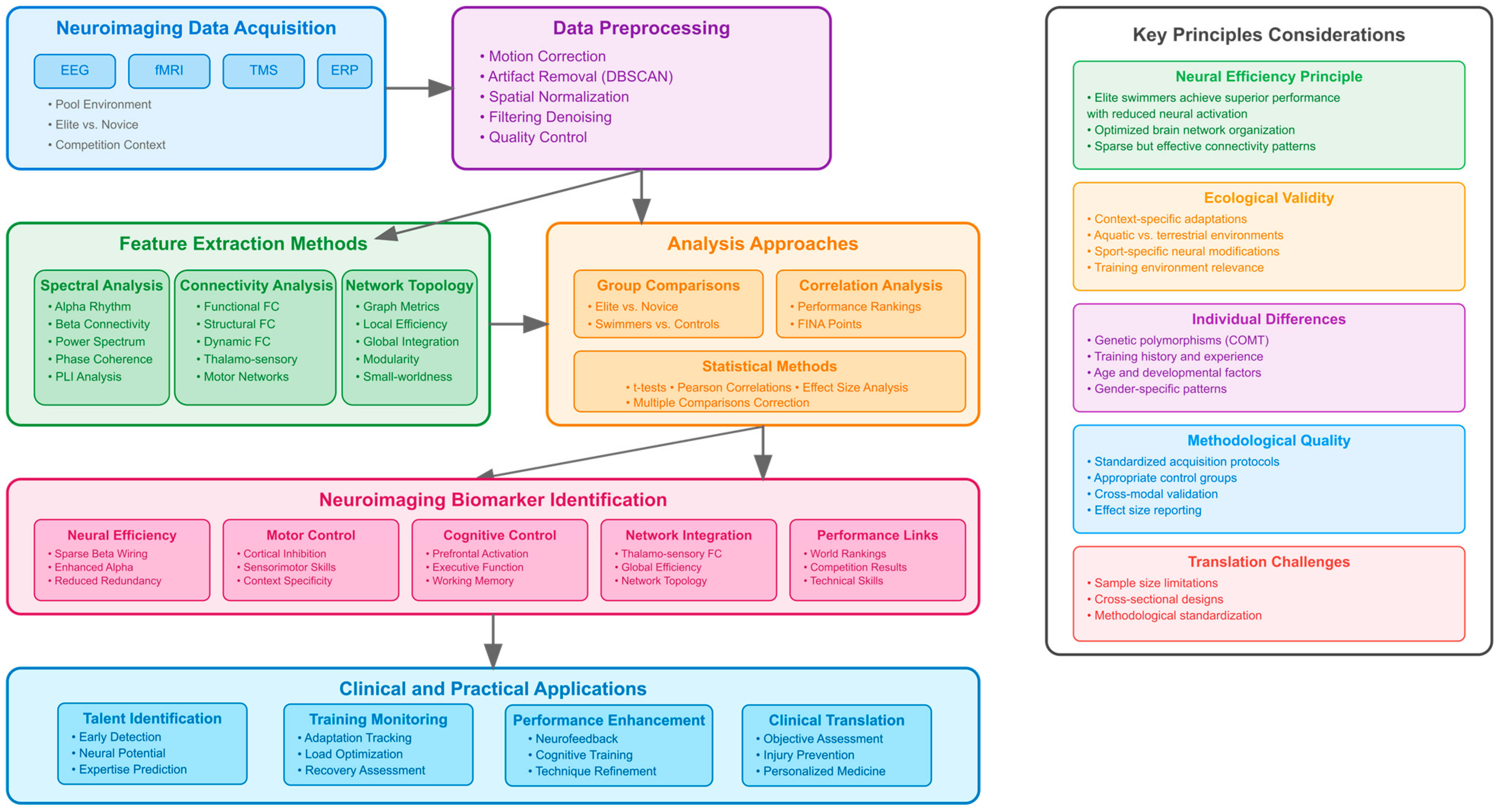
Figure 2 presents a conceptual framework illustrating the pipeline for identifying and applying neuroimaging biomarkers in swimming athletes. The framework begins with neuroimaging data acquisition, encompassing the four primary modalities identified in the literature: electroencephalography (EEG), functional magnetic resonance imaging (fMRI), transcranial magnetic stimulation (TMS), and event-related potentials (ERP). The acquisition phase emphasizes the importance of sport-specific contexts, including pool environments, elite versus novice comparisons, and competition settings that enhance the ecological validity of neuroimaging assessments in swimming populations.
The section regarding data preprocessing points to important aspects of quality control, which came up as crucial principles in all research, such as motion correction procedures, strategies to remove any artifacts, like clustering in EEG recordings via DBSCAN, spatial normalization, and filtering. This aspect establishes preprocessing as an initial step for sound biomarker discovery, which has to ensure the standardization of data, regardless of recording sites and populations.
The three parallel paths of feature extraction correspond to the various approaches determined in the literature as part of comprehensive analysis. The spectral analysis group of approaches revolves around frequency-related features, such as alpha rhythm increase, beta connectivity matrices, power spectrum analysis, analysis of phase coherence, and calculation of the phase lag index. The connectivity analysis and topology analysis approaches include functional, structural, and dynamic connectivity analysis, with main interest in thalamo-sensorimotor connections and motor networks, and analysis of local efficiency, overall integration, and modularity with small world networks, respectively, differing according to swimming skills.
The analysis approaches section combines statistical methodologies shown to be most effective in various studies, such as group comparison analyses between elite and novice swimmers, correlation analyses with performance rankings, and overall statistical analysis approaches that include the calculation of effect sizes and multiple comparison adjustments. Such analytical approaches allow for the effective determination of neuroimaging distinctions with respect to swimming skills and performance.
The biomarker identification part of this discussion integrates the first five main categories of neural signatures found in the systematic review. The group of biomarkers under neural efficiency discusses signatures such as sparse beta wiring and increased alpha oscillations, which can be seen as the most robustly replicated findings. Motor control biomarkers comprise measurements of cortical inhibition and sensorimotor skills, with contextually differentiated expression under water conditions. The group of biomarkers under cognitive control comprises signatures such as prefrontal activation and executive functions, which can predict competition performance. The integration biomarkers comprise measurements of thalamo-sensory functional connectivity and global efficiency that correlate with world rankings.
The clinical and practical application area reveals the translation potential of biomarkers in four domains. The talent identification area uses biomarkers based on neural systems to identify swimming talent, evaluate neural capacity, and predict trajectories of expertise development. The training monitoring area applies biomarkers to monitor neural changes, optimize effective training, and evaluate post-training recovery conditions. The performance improvement area combines biomarkers with neurofeedback interventions, cognitive training, and swimming technique improvement approaches. The clinical translation area highlights assessment, injury prevention, and personal medicine approaches.
The framework incorporates an accompanying sidebar presenting key principles and practical considerations identified in the systematic review. The principle of neural efficiency underlines that elite swimmers reach optimal performance with optimal brain network structure, not enhanced activation, which represents an essential principle of adaptability towards high-performance training. Considerations regarding ecological validity recognize the relevance of context- and sport-related environments towards capturing neural changes brought about by training. Individual difference parameters, such as genetic polymorphism, training, age, and gender, influence biomarker manifestation and interventions. The criteria of methodological quality demand standardized assessment protocol, the proper choice of control groups, inter-modal validation, and reporting of all effect sizes. Translation difficulties accept its limitations, including size and limitations regarding randomized, controlled designs and methodological standardization.
The integrated framework responds to the complex nature of neuroimaging biomarker research in swimming by illustrating that various methodological approaches are converging to identify significant neural signatures of swimming expertise. The organizational manner assists with making decisive, evidence-supported choices regarding neuroimaging modalities, analysis, and biomarker uses by research scientists wishing to apply diverse research questions and practical scenarios. The clinical translation aspect of neuroimaging, reflective of the overall objective to apply neuroimaging findings and advances to better develop and prepare swimming performers, is supported by the proposed research framework.
4.3. [RQ2] What Are the Relationships Between Cognitive Performance Domains (Attention, Working Memory, Executive Control, Temporal Perception) and Swimming Performance Outcomes Across Different Expertise Levels?
Analysis of cognitive performance domains across the 24 studies reveals associations between specific cognitive abilities and swimming performance outcomes, with systematic differences observed across expertise levels. The cognitive domains most consistently associated with swimming performance include attention regulation (n = 7 studies), working memory and executive control (n = 4 studies), temporal perception (n = 3 studies), and cognitive flexibility (n = 5 studies). Studies with low risk of bias (k = 6) show consistent patterns, while findings from smaller or methodologically limited studies (k = 5) should be considered preliminary.
Attention Regulation and Swimming Performance: attention regulation correlates with swimming performance across multiple studies. External attentional focus strategies are associated with superior swimming performance compared to internal focus approaches across all expertise levels (5–8% performance differences) [
150,
155,
165]. Studies with low risk of bias (k = 3) consistently support these associations with medium to large effect sizes (d = 0.6–1.2).
Skilled swimmers maintain performance stability under varying attentional focus constraints (2–3% decrement vs. 8–12% in recreational swimmers) [
155], suggesting that expertise may involve developing robust attentional control mechanisms. However, the cross-sectional nature of these studies prevents determination of whether attention differences reflect training effects or pre-existing characteristics.
Working Memory and Executive Control: working memory capacity shows systematic relationships with swimming performance across expertise levels, with elite swimmers demonstrating superior performance on complex cognitive tasks [
145]. Studies with moderate risk of bias (k = 3) show executive control capabilities correlating significantly with swimming performance outcomes (r = 0.5–0.7), with prefrontal activation during executive control tasks associated with FINA performance points [
149].
These relationships appear strongest in events requiring strategic pacing and tactical decision-making. However, small sample sizes (n = 24–58) and cross-sectional designs indicate that findings represent preliminary evidence requiring validation in larger samples.
Temporal Perception and Rhythm: temporal perception capabilities show associations with swimming performance, particularly in events requiring precise stroke timing and pacing strategies [
162]. Expert swimmers demonstrate superior temporal processing abilities compared to athletes in other sports and non-athletic controls (15–25% more precise temporal discrimination thresholds). Evidence derives primarily from moderate-risk studies (k = 2), indicating exploratory rather than definitive support.
Expertise-Level Differences: systematic differences in cognitive performance emerge across swimming expertise levels, with elite swimmers demonstrating 15–30% superior performance on attention tasks, 10–25% advantages on working memory measures, and 20–35% better temporal discrimination compared to recreational swimmers [
145,
162]. Cross-sectional comparisons reveal that cognitive performance advantages are associated with expertise level rather than reflecting general cognitive enhancement [
145]. The largest expertise effects appear in cognitive domains most directly relevant to swimming performance.
Performance Prediction: cognitive performance measures demonstrate associations with swimming outcomes, with combined cognitive assessments explaining 25–40% of variance in competitive performance beyond physical characteristics [
145,
158]. However, these predictive relationships derive from cross-sectional studies with modest samples (
n = 36–69), limiting generalizability and causal interpretation.
Table 11 systematically presents relationships between cognitive performance domains and swimming outcomes, providing empirical evidence for the cognitive foundations of aquatic expertise. The table demonstrates that temporal perception shows the strongest correlations with swimming performance (r = 0.6–0.8), reflecting the critical importance of rhythm and timing in stroke mechanics and pacing strategies. Attention regulation and executive control both demonstrate large expertise effects (d > 0.8), indicating these cognitive capabilities are fundamental distinguishing characteristics of elite swimmers. The optimal assessment methods column provides practical guidance for researchers, emphasizing the superior predictive validity of swimming-specific cognitive tasks over generic laboratory assessments.
Table 12 illustrates expertise-level differences in cognitive performance across swimming expertise levels, demonstrating systematic performance gradients that parallel competitive achievement. Elite international swimmers consistently perform at the 85th–95th percentiles across cognitive domains, with particularly pronounced advantages in attention performance and temporal precision (95th percentile). The progressive cognitive advantages from recreational to elite levels (8–12% to 25–30% overall advantage) suggest that cognitive capabilities develop incrementally through training and experience. These findings support cognitive assessment as a valuable tool for talent identification and performance development tracking across the swimming expertise continuum.
4.4. [RQ3] How Effective Are Cognitive Interventions (Neurofeedback Training, Attention Training, Psychological Skills Training) for Enhancing Cognitive Performance and Swimming Outcomes in Aquatic Athletes?
Analysis of cognitive intervention studies reveals associations between multiple intervention approaches and improvements in both cognitive performance and swimming outcomes. Among the 24 studies, 8 examined cognitive interventions: neurofeedback training (n = 3), attention training (n = 3), and psychological skills programs (n = 2). Evidence on intervention effectiveness is based on studies with moderate risk of bias (k = 6) with small to medium samples (n = 10–44). Only two studies employed randomized designs. Effect sizes ranged from d = 0.5–0.8, indicating medium effects. However, small samples, the lack of active control conditions in most studies, and the limited follow-up assessments indicate that the findings represent preliminary rather than definitive evidence of effectiveness.
Neurofeedback Training Interventions: neurofeedback training is associated with improvements in both neural function and performance outcomes [
156,
157,
158]. EEG-based neurofeedback protocols targeting specific brain regions and frequency bands correlate with measurable changes in brain activity patterns and corresponding improvements in cognitive performance measures.
The combined method of neurofeedback–EEG training and physical exercise has been found to be significantly correlated with spectral amplitude modulation in the parts of the brain with high integration relevance for cognitive and motor functions [
157]. The above-mentioned brain changes are positively associated with better performance in mental attention, increased flexibility, and resistance to mental fatigue. The above-mentioned findings come from non-randomized research with small-scale sampling (20–30 participants).
The most efficient neurofeedback procedures involve particular frequency ranges, which relate to optimal conditions of cognitive functioning. Alpha frequency enhancement, which ranges from 8 to 12 Hz, is linked with enhanced relaxed attention and diminished cognitive anxiety, while SMR, which ranges from 12 to 15 Hz, is linked with enhanced accuracy of motor control functions [
156]. Expanded neurofeedback interventions lasting 8–12 weeks are linked with long-term changes in brain functioning, which are related to enhanced performance outcomes [
156,
157]. The absence of control groups and small sample size restrict causal conclusions in these findings.
Attentional interventions focusing on specific skills and attentional abilities correlate with positive outcomes in terms of cognitive functions and swimming performance benefits [
150,
155,
165]. The interventions with an external focus correlate with increased performance regardless of skill level, with performance improvements of 5–12% in swimming velocity.
The most effective attention-training methods provide a combination of theoretical and application-related aspects within swimming sessions, reaching medium to large effect sizes with values of d = 0.6–1.2, with a moderate methodological quality of research. Attention-training effectiveness was found to be dependent on skill level, with intermediate performers reporting overall improvement scores ranking in 2nd or higher percentile in swimming performance (+8–15%) with significant, although smaller, gains (+3–7%) reported by elite performers in attention-related skills [
150,
155]. The methodological research was found to be exploratory, with small
n = 15–30 participants and an absence of randomized controlled research designs.
Comprehensive psychological skills training programs dealing with various aspects of cognition and emotions are linked with improved performance in swimming [
164]. Such programs comprise relaxation techniques, visualization, goal planning, self-talk, and management of extraneous thoughts.
Psychological skills training is linked with considerable decreases in competitive anxiety, with regard to cognitive anxiety scores, by 20–35%, along with elevations in motivation and self-confidence [
164]. Such decreases in anxiety are found to be correlated with enhanced performance consistency. The findings come from one trial, with mild bias, with 36 participants, and, therefore, provide preliminary evidence demanding subsequent validation.
The optimal dosage of interventions differs depending on the type of intervention, with intensive interventions such as neurofeedback training needing intensive sessions over time (3–4 sessions/week × 8–12 weeks), and interventions involving attention training possibly benefiting from fewer sessions over time (2–3 sessions/week × 4–6 weeks) [
150,
155,
156,
157].
There are individual differences in outcomes of interventions regarding cognitive functions based on initial cognitive skills, experience with interventions, and personality, although this research area can be only considered as exploratory due to small-scale research and interventions conducted with participants.
Table 13 shows the assessment of cognitive interventions’ effectiveness regarding various modalities of training, which highlights significant advantages in cognitive functions and swimming performance outcomes. Neurofeedback training appears to be the most effective modality, with the largest effect sizes of 0.8–1.4, along with improvements of 10–25% in measures of cognitive functions. Combined modalities offer overall, synergistic advantages of 15–30% improvement, although they must be conducted over progressively prolonged sessions of 10–16 weeks. The table indicates that all modalities offer significant improvements with moderately large effect sizes, underlining the need to include cognitive interventions in swimming training.
Table 14 applies the research results into effective practice guidelines, outlining evidenced-based approaches for cognitive interventions in swimming. The table reveals systematic variations in optimal dosage parameters: neurofeedback and combined interventions require 3–4 sessions/week over 8–12 weeks for neuroplastic benefits, while attention training allows shorter proto-cols of 2–3 sessions/week over 4–8 weeks. The need and modality regarding individual/group interventions differ depending on type, with neurofeedback and high-performance combined interventions demanding individual approaches and psychology skills interventions proving effective in group settings, including mutual benefits and learning from peers. The qualifications required by the swimming coach highlight specialized skills and competencies for effective interventions, from neurofeedback specialists to multi-disciplinary teams for comprehensive interventions.
4.5. [RQ4] What Individual Difference Factors (Genetic Polymorphisms, Personality Traits, Training History, Age, Gender) Moderate the Relationships Between Cognitive Performance, Neural Adaptations, and Swimming Expertise?
Analysis of individual difference factors reveals associations between multiple moderating variables and relationships among cognitive performance, neural adaptations, and swimming expertise. Among the 24 studies, 12 examined individual difference factors: training history (n = 8), age/developmental factors (n = 6), gender differences (n = 4), personality traits (n = 3), and genetic factors (n = 2). Evidence for genetic and personality moderators should be considered exploratory given small sample sizes (median n = 57, range 44–69). These preliminary findings suggest potential moderating influences that require replication in larger, independent samples before definitive conclusions can be drawn.
Genetic Polymorphisms: genetic variations show associations with the relationship between cognitive performance and swimming success. The COMT Val158Met polymorphism, which affects dopamine metabolism in the prefrontal cortex, showed significant associations with competitive swimming performance after controlling for relevant covariates (partial η
2 = 0.082, 95% CI: 0.031–0.153,
p = 0.026, FDR q-value = 0.042). Met carriers achieved 612 ± 45 FINA points compared to 568 ± 52 points for Val/Val genotype carriers [
143].
However, this finding derives from a single study with a modest sample size (n = 57, male-only sample) and requires replication in larger, independent samples, including female swimmers, before definitive conclusions can be drawn. The cross-sectional design precludes the determination of whether genetic associations reflect causal relationships or confounding with other factors. A significant training years × genotype interaction was observed (p = 0.038), suggesting that the genetic effect may be modulated by training experience, though the small sample size limits the interpretation of this interaction.
Swimming performance correlations with COMT genotype show context-dependent patterns [
143], with Val/Val swimmers showing more consistent performance under high-pressure conditions and Met/Met swimmers showing superior technical learning capabilities during training periods. These genetic differences account for 8–15% of variance in competitive results, though the conclusions are limited by single-study evidence with small sample.
Training History and Experience: training history correlates with cognitive performance relationships, with training volume, duration, and specificity all showing associations [
146,
147,
153,
154,
164]. Athletes with longer training histories demonstrate stronger neural efficiency adaptations and more robust cognitive performance advantages compared to those with shorter training experiences, though causal relationships cannot be established from cross-sectional evidence.
Deliberate practice history specifically correlates with the development of cognitive adaptations to physically and emotionally demanding conditions [
153]. Swimmers with extensive deliberate practice experience (>10,000 h) show enhanced stress tolerance, improved cognitive flexibility under pressure, and more efficient neural processing patterns, though selection effects cannot be excluded.
Age and Developmental Factors: age demonstrates associations with cognitive performance relationships, with different cognitive domains showing varying developmental trajectories [
144,
158,
160,
161]. Mental fatigue effects differed substantially by age group. Young swimmers (12–15 years; k = 2 studies,
n = 78 total) showed significant performance decrements under cognitive load (d = 0.68–1.2,
p < 0.01), with reaction time increases of 15–22% and accuracy reductions of 8–12%. In contrast, master swimmers (>40 years; k = 1 study,
n = 24) demonstrated resilience to cognitive fatigue, maintaining performance within 5% of baseline. These age-related differences may reflect developmental stage (incomplete prefrontal maturation in adolescents), training experience (masters’ compensatory strategies), or physiological factors (age-related cognitive reserve). However, the limited number of studies and potential confounding variables preclude definitive mechanistic conclusions.
Younger swimmers (adolescents) show greater neuroplasticity and faster adaptation to cognitive training interventions, while older swimmers demonstrate more stable cognitive profiles [
160,
161]. However, evidence quality varies across age groups, with limited research on masters swimmers.
Gender Differences: gender demonstrates associations with cognitive-performance relationships, with male and female swimmers showing different patterns of cognitive strengths [
143,
145]. Female swimmers demonstrate stronger relationships between cognitive flexibility and swimming performance, while male swimmers show stronger correlations between spatial processing and technical abilities. However, gender-specific evidence derives primarily from studies with moderate to high risk of bias and small samples, indicating exploratory findings requiring validation.
Personality Traits and Psychological Factors: personality characteristics show associations with relationships between cognitive training interventions and performance outcomes [
147,
154]. Athletes high in openness to experience show greater responsiveness to novel cognitive training approaches, though evidence is preliminary given small samples (
n = 20–44) and observational designs.
Burnout susceptibility has also been found to be linked with the relationship between training stress and cognitive adaptation, such that swimmers high in emotional exhaustion demonstrate impaired cognitive performance under high training conditions [
154]. Individual differences in burnout susceptibility explain 15–25% of variance in responsiveness to cognitive training, although causal analysis is attenuated by the available longitudinal data.
Table 15 highlights individual difference factors and moderation effect values concerning cognitive performance, neural adaptations, and swimming skills, thereby providing empirical justification for personal and tailored training practices. Training background is found to be the strongest moderator with the largest effect values (d = 0.6–1.2) influencing neural efficiency and cognitive flexibility skills along the entire spectrum of expertise. Genetic variations in COMT illustrate pronounced moderation effect values (d = 0.5–0.8) in respect to working memory and stress resistance, thereby indicating the possibility of genotype-based optimized training. The table indicates that all individual difference factors impact moderation significantly, with environmental context and personality proving particularly strong in influencing skill transfer and responsiveness to interventions, respectively.
The research findings are translated into tailored training advice in
Table 16, showing how genetic, developmental, and experiential aspects can inform effective selection and application of interventions. From the table, systematic connections between individual characteristics and training approaches can be seen, with those with COMT Met/Met genotypes benefiting from high cognitive load interventions, whereas those with Val/Val genotypes would be better suited to stress simulation interventions. Training history influences intervention design: experienced athletes benefit from targeted, sport-specific interventions, whereas novice athletes benefit from varied, multi-modal training approaches. The monitoring strategies include individual assessment approaches, such that individuals with genetic sensitivities need monitoring of their stress, while those with athletic experience need monitoring of performance variation.
These individual difference factors demonstrate the complexity of cognitive performance relationships in swimming and highlight the importance of personalized approaches to cognitive training and intervention. Understanding these moderating effects enables more effective targeting of cognitive interventions and optimization of training approaches for individual athletes.