Temporal Modulation of Corticospinal Excitability by Repetitive Peripheral Magnetic Stimulation in Healthy Young Adults


Abstract
1. Introduction
2. Materials and Methods
2.1. Subjects
Study Design and Procedures
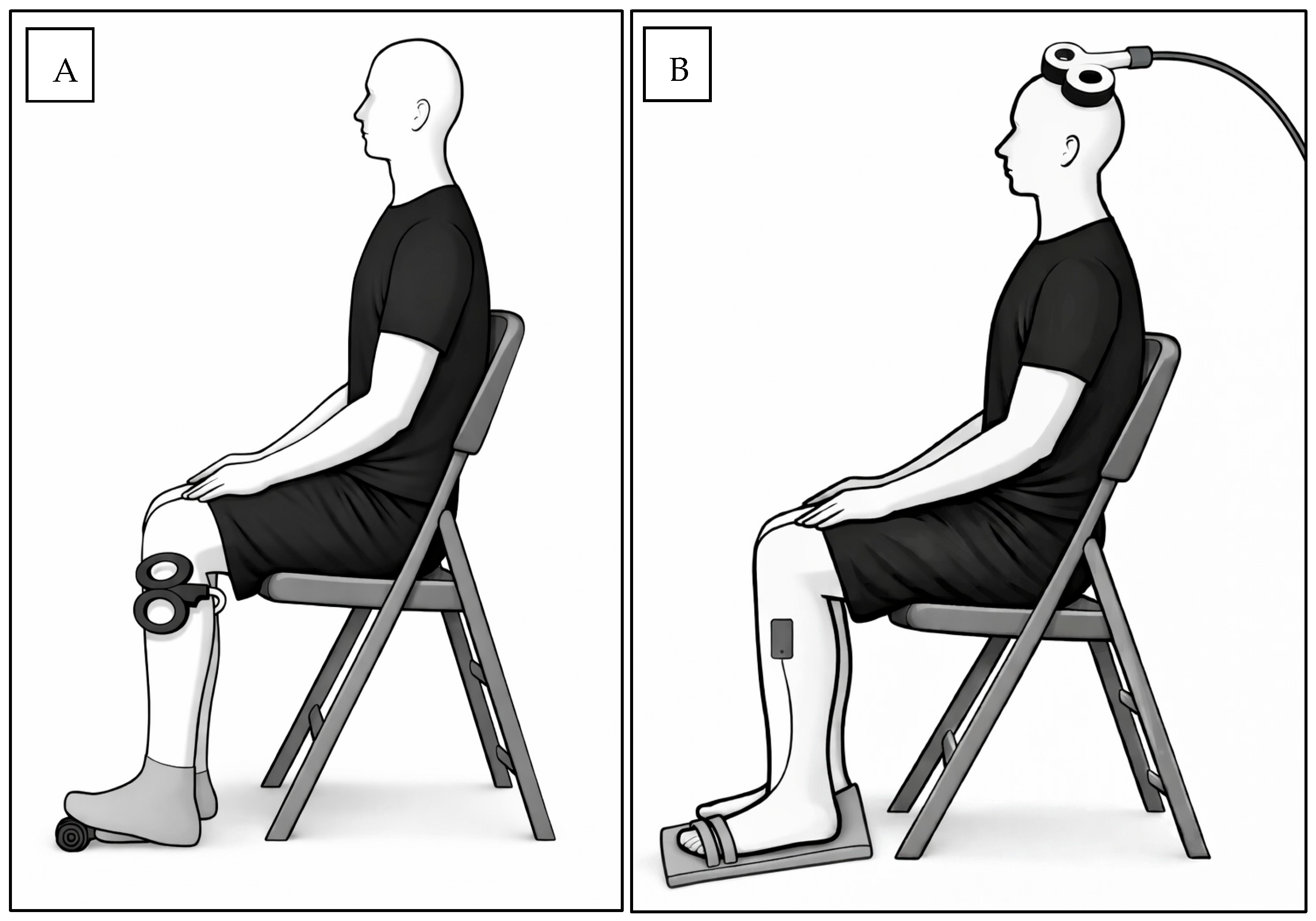
2.2. TMS Application
2.3. rPMS Application
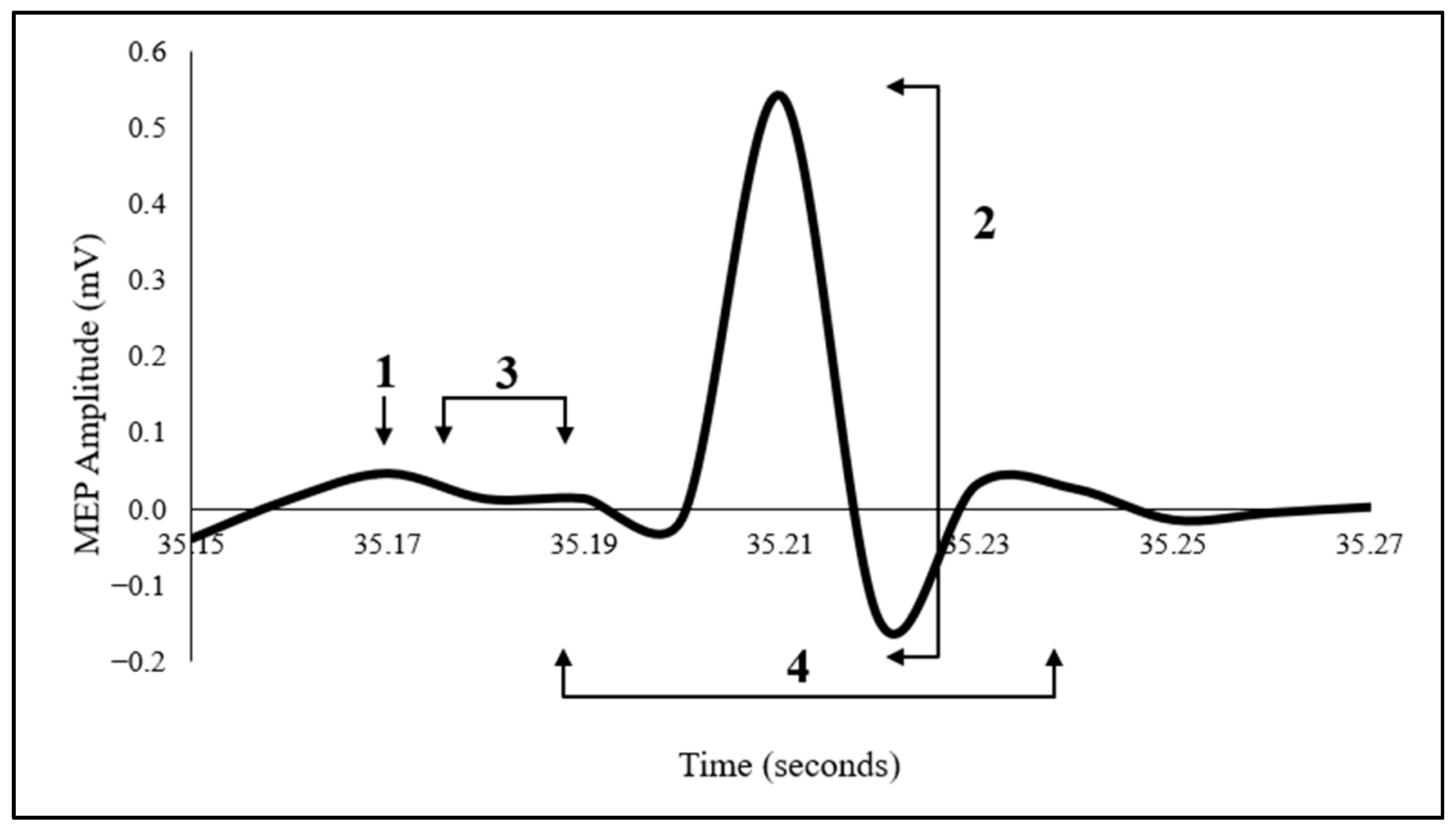
2.4. Outcome Measure
Corticospinal Excitability (CSE)
2.5. Data Analyses
2.6. Statistical Analyses
3. Results
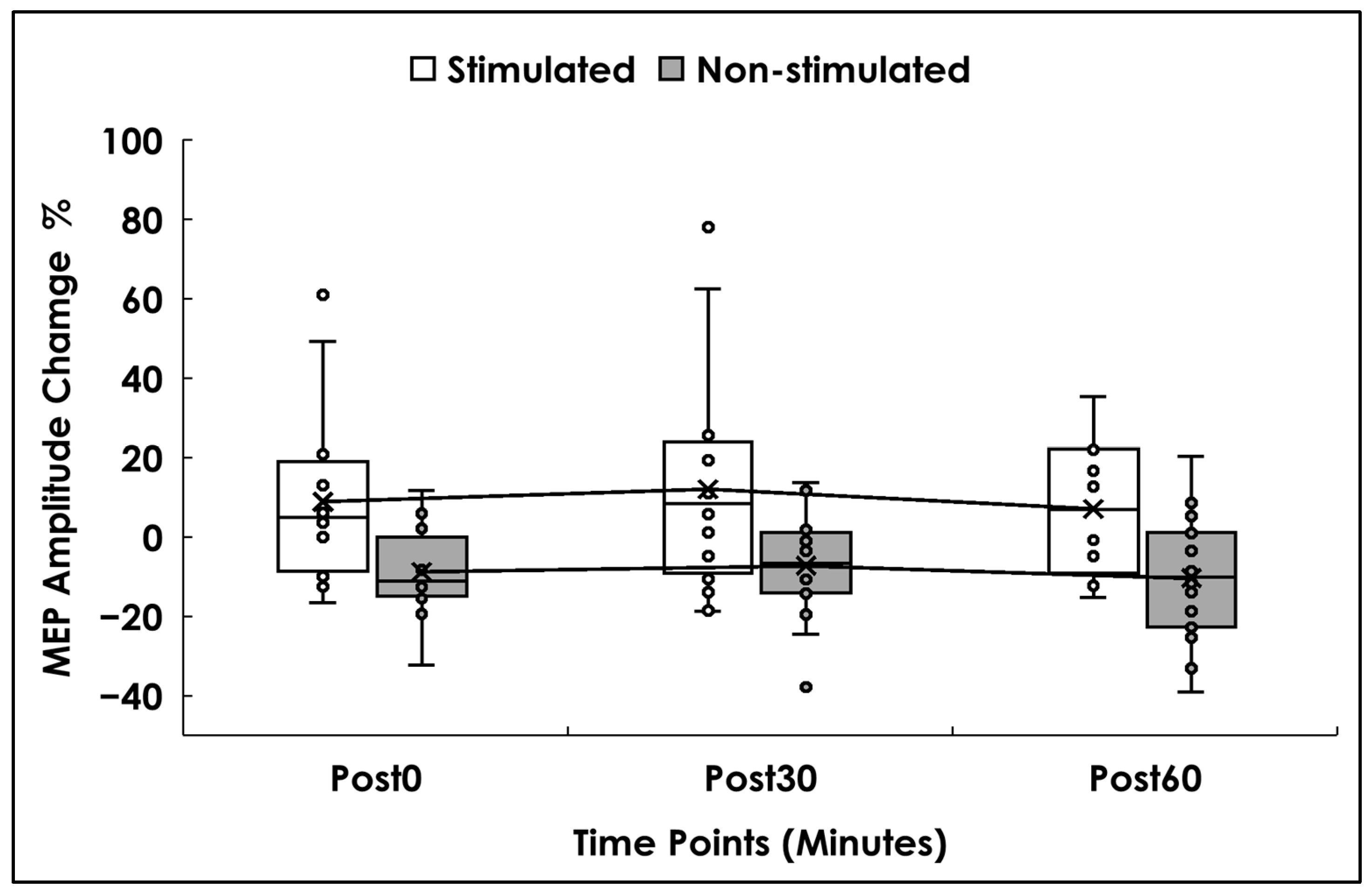
3.1. MEP Amplitude
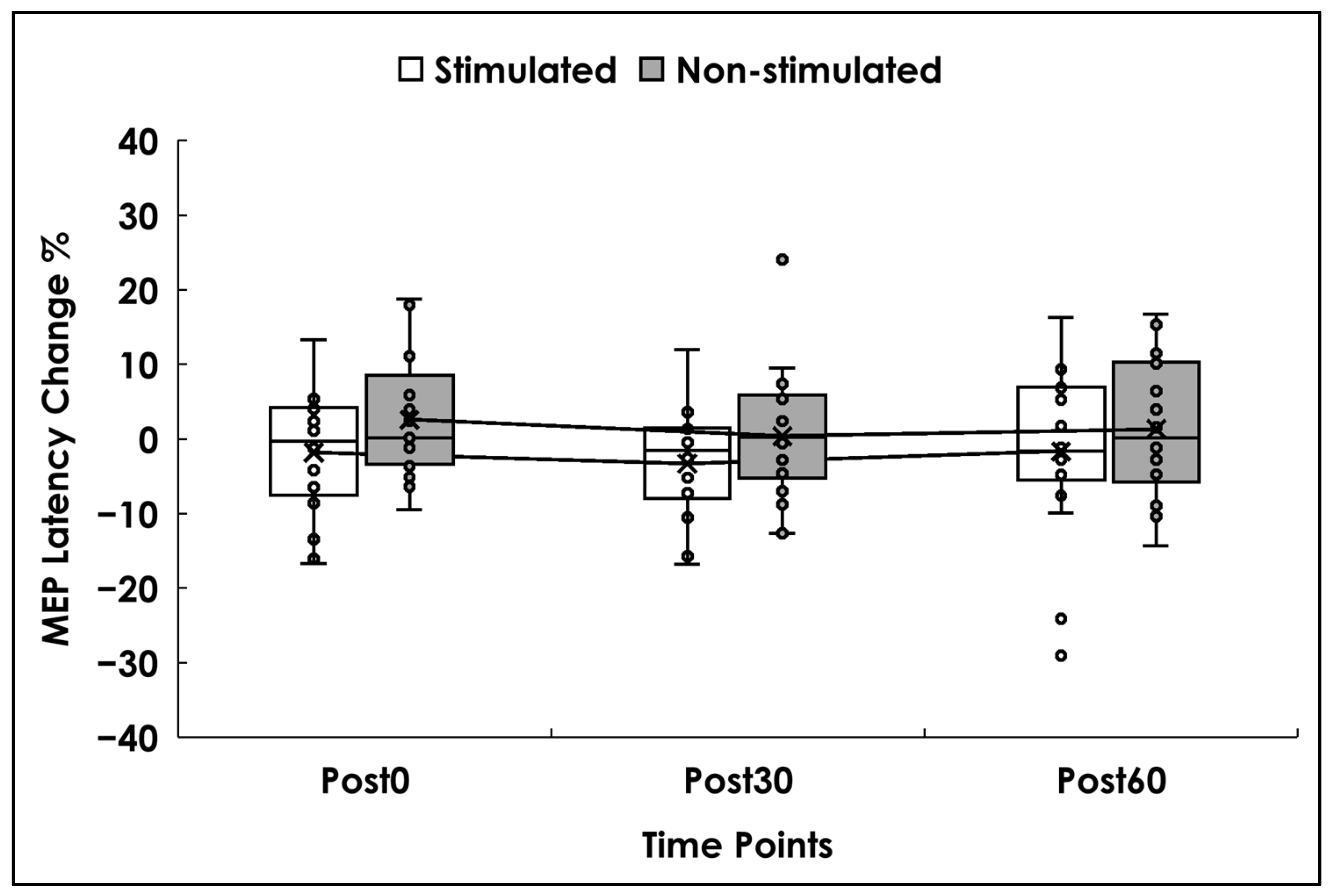
3.2. MEP Latency
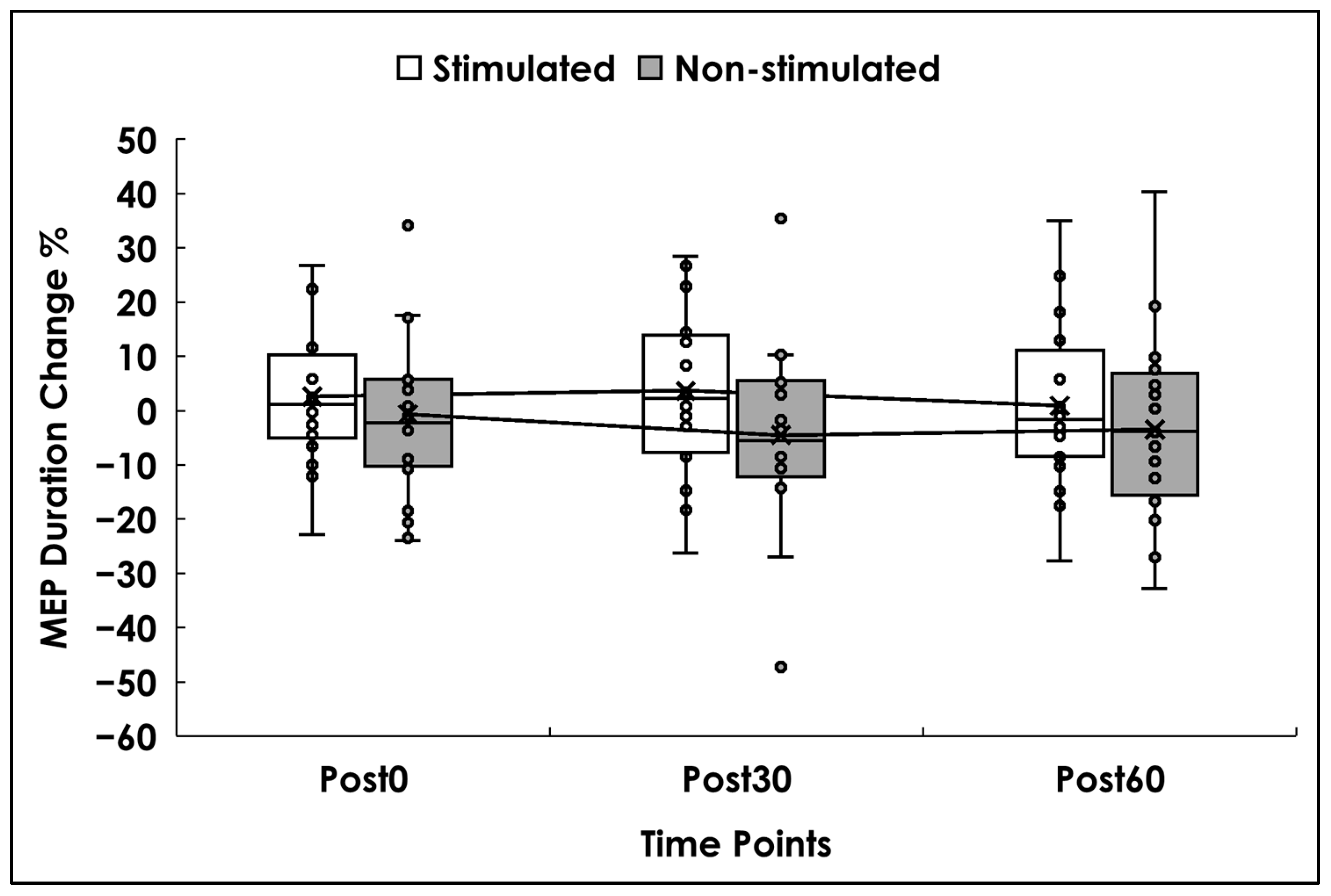
3.3. MEP Duration
4. Discussion
5. Conclusions
Author Contributions
Funding
Institutional Review Board Statement
Informed Consent Statement
Data Availability Statement
Acknowledgments
Conflicts of Interest
Abbreviations
| rPMS | Repetitive Peripheral Magnetic Stimulation |
| rTMS | Repetitive Transcranial Magnetic Stimulation |
| CSE | Corticospinal Excitability |
| LTP | Long-Term Potentiation |
| MEP | Motor Evoked Potential |
| APB | Abductor Pollicis Brevis |
| FCR | Flexor Carpi Radialis |
| ECR | Extensor Carpi Radialis |
| TA | Tibialis Anterior |
| TMS | Transcranial Magnetic Stimulation |
| MVC | Maximum Voluntary Contraction |
| EMG | Electromyography |
| M1 | Primary Motor Cortex |
| AMT | Active Motor Threshold |
| PAS | Paired Associative Stimulation |
References
- Barker, A.T.; Freeston, I.L.; Jalinous, R.; Jarratt, J.A. Magnetic stimulation of the human brain and peripheral nervous system: An introduction and the results of an initial clinical evaluation. Neurosurgery 1987, 20, 100–109. [Google Scholar] [CrossRef] [PubMed]
- Struppler, A.; Havel, P.; Müller-Barna, P. Facilitation of skilled finger movements by repetitive peripheral magnetic stimulation (RPMS)—A new approach in central paresis. NeuroRehabilitation 2003, 18, 69–82. [Google Scholar] [CrossRef] [PubMed]
- Barker, A.T.; Freeston, I.L.; Jalinous, R.; Jarratt, J.A. Clinical evaluation of conduction time measurements in central motor pathways using magnetic stimulation of the human brain. Lancet 1986, 327, 1325–1326. [Google Scholar] [CrossRef] [PubMed]
- Beaulieu, L.D.; Schneider, C. Repetitive peripheral magnetic stimulation to reduce pain or improve sensorimotor impairments: A literature review on parameters of application and afferents recruitment. Neurophysiol. Clin. 2015, 45, 223–237. [Google Scholar] [CrossRef] [PubMed]
- Gallasch, E.; Christova, M.; Kunz, A.; Rafolt, D.; Golaszewski, S. Modulation of sensorimotor cortex by repetitive peripheral magnetic stimulation. Front. Hum. Neurosci. 2015, 9, 804. [Google Scholar] [CrossRef] [PubMed]
- Jia, Y.; Liu, X.; Wei, J.; Li, D.; Wang, C.; Wang, X.; Liu, H. Modulation of corticomotor excitability by repetitive peripheral magnetic stimulation of the median nerve in healthy subjects. Front. Neural Circuits 2021, 15, 634454. [Google Scholar] [CrossRef] [PubMed]
- Nito, M.; Katagiri, N.; Yoshida, K.; Koseki, T.; Kudo, D.; Nanba, S.; Tanabe, S.; Yamaguchi, T. Repetitive peripheral magnetic stimulation of wrist extensors enhances cortical excitability and motor performance in healthy individuals. Front. Neurosci. 2021, 15, 632716. [Google Scholar] [CrossRef] [PubMed]
- Rossi, S.; Antal, A.; Bestmann, S.; Bikson, M.; Brewer, C.; Brockmöller, J.; Carpenter, L.L.; Cincotta, M.; Chen, R.; Daskalakis, J.D.; et al. Safety and recommendations for TMS use in healthy subjects and patient populations, with updates on training, ethical and regulatory issues: Expert guidelines. Clin. Neurophysiol. 2021, 132, 269–306. [Google Scholar] [CrossRef] [PubMed]
- Cacchio, A.; Paoloni, M.; Cimini, N.; Mangone, M.; Liris, G.; Aloisi, P.; Santilli, V.; Marrelli, A. Reliability of TMS-related measures of tibialis anterior muscle in patients with chronic stroke and healthy subjects. J. Neurol. Sci. 2011, 303, 90–94. [Google Scholar] [CrossRef] [PubMed]
- van Melick, N.; Meddeler, B.M.; Hoogeboom, T.J.; Nijhuis-van der Sanden, M.W.G.; van Cingel, R.E.H. How to determine leg dominance: The agreement between self-reported and observed performance in healthy adults. PLoS ONE 2017, 12, e0189876. [Google Scholar] [CrossRef] [PubMed]
- Sivaramakrishnan, A.; Tahara-Eckl, L.; Madhavan, S. Spatial localization and distribution of the TMS-related “hotspot” of the tibialis anterior muscle representation in the healthy and post-stroke motor cortex. Neurosci. Lett. 2016, 627, 30–35. [Google Scholar] [CrossRef] [PubMed]
- Luc, B.A.; Lepley, A.S.; Tevald, M.A.; Gribble, P.A.; White, D.B.; Pietrosimone, B.G. Reliability of Corticomotor Excitability in Leg and Thigh Musculature at 14 and 28 Days. J. Sport Rehabil. 2014, 23, 330–338. [Google Scholar] [CrossRef] [PubMed]
- Beaulieu, L.D.; Massé-Alarie, H.; Camiré-Bernier, S.; Ribot-Ciscar, É.; Schneider, C. After-effects of peripheral neurostimulation on brain plasticity and ankle function in chronic stroke: The role of afferents recruited. Neurophysiol. Clin. 2017, 47, 275–291. [Google Scholar] [CrossRef] [PubMed]
- Goldsworthy, M.R.; Hordacre, B.; Ridding, M.C. Minimum number of trials required for within- and between-session reliability of TMS measures of corticospinal excitability. Neuroscience 2016, 320, 205–219. [Google Scholar] [CrossRef] [PubMed]
- Sivaramakrishnan, A.; Madhavan, S. Stimulus intensity affects variability of motor evoked responses of the non-paretic, but not paretic tibialis anterior muscle in stroke. Brain Sci. 2020, 10, 297. [Google Scholar] [CrossRef] [PubMed]
- Cohen, J. Statistical Power Analysis for the Behavioral Sciences, 2nd ed.; Lawrence Erlbaum Associates: Hillsdale, NJ, USA, 1988. [Google Scholar]
- Aljuhni, R.; Sawa, C.; Kumar, S.; Madhavan, S. The Effect of Sensory-Based Priming Using Repetitive Peripheral Magnetic Stimulation on Motor Skill Performance in Individuals with Stroke. Appl. Sci. 2025, 15, 8129. [Google Scholar] [CrossRef]
- Ushio, R.; Tamura, K.; Fujikawa, S.; Ohsumi, C.; Sawai, S.; Yamamoto, R.; Nakano, H. Clinical application of repetitive peripheral magnetic stimulation in rehabilitation. In Neurological Disorders and Therapeutics; Soghomonian, J.J., Ed.; IntechOpen: London, UK, 2023; pp. 1–15. [Google Scholar]
- Behrens, M.; Mau-Möller, A.; Zschorlich, V.; Bruhn, S. Repetitive peripheral magnetic stimulation (15 Hz RPMS) of the human soleus muscle did not affect spinal excitability. J. Sports Sci. Med. 2011, 10, 39–44. [Google Scholar] [PubMed]
- Suppa, A.; Quartarone, A.; Siebner, H.; Chen, R.; Di Lazzaro, V.; Del Giudice, P.; Paulus, W.; Rothwell, J.C.; Ziemann, U.; Classen, J. The associative brain at work: Evidence from paired associative stimulation studies in humans. Clin. Neurophysiol. 2017, 128, 2140–2164. [Google Scholar] [CrossRef] [PubMed]
- Mrachacz-Kersting, N.; Stevenson, A.J.T. Paired associative stimulation targeting the tibialis anterior muscle using either mono- or biphasic transcranial magnetic stimulation. Front. Hum. Neurosci. 2017, 11, 197. [Google Scholar] [CrossRef] [PubMed]
- Cleland, B.; Pradhan, S.; Madhavan, S. A cognitive task, deep breathing, and static stretching reduce variability of motor evoked potentials during subsequent transcranial magnetic stimulation. Brain Res. 2023, 1798, 148151. [Google Scholar] [CrossRef] [PubMed]



| Demographics | Participants, n = 20 |
|---|---|
| Age (Years) | 25.5 (5.4) |
| Sex (Females/Males) | (11/9) |
| Race/Ethnicity | |
| White, not Hispanic or Latino | 9 (45%) |
| White, Hispanic or Latino | 0 (0%) |
| Asian American | 11 (55%) |
| African American | 0 (0%) |
| Dominant side (Right/Left) | (20/0) |
| Time Point | Side | Amplitude (mV) | Change % | Latency (ms) | Change % | Duration (ms) | Change % |
|---|---|---|---|---|---|---|---|
| Pre | Stimulated | 0.83 (0.4) | - | 24.1 (3.5) | - | 41.0 (8.1) | - |
| Non- stimulated | 0.76 (0.4) | - | 24.2 (1.6) | - | 39.8 (6.1) | - | |
| Post0 | Stimulated | 0.88 (0.4) | 8.9 (21.5) | 23.2 (3.0) | −1.8 (8.3) | 41.5 (6.9) | 2.6 (12.3) |
| Non- stimulated | 0.75 (0.3) | −8.7 (10.9) | 24.7 (2.2) | 2.6 (8.2) | 39.4 (7.5) | −0.6 (16.7) | |
| Post30 | Stimulated | 0.89 (0.3) | 12.0 (27.3) | 23.1 (3.1) | −3.3 (7.2) | 41.9 (8.0) | 3.6 (15.5) |
| Non- stimulated | 0.75 (0.3) | −7.2 (13.1) | 24.3 (2.6) | 0.4 (8.8) | 38.1 (8.9) | −4.5 (16.3) | |
| Post60 | Stimulated | 0.89 (0.3) | 7.1 (16.0) | 23.5 (3.4) | −1.6 (11.3) | 40.7 (7.8) | −0.9 (13.2) |
| Non- stimulated | 0.74 (0.3) | −10.4 (16.0) | 24.5 (2.6) | 1.3 (9.4) | 38.5 (9.2) | −3.4 (17.1) |
Disclaimer/Publisher’s Note: The statements, opinions and data contained in all publications are solely those of the individual author(s) and contributor(s) and not of MDPI and/or the editor(s). MDPI and/or the editor(s) disclaim responsibility for any injury to people or property resulting from any ideas, methods, instructions or products referred to in the content. |
© 2026 by the authors. Licensee MDPI, Basel, Switzerland. This article is an open access article distributed under the terms and conditions of the Creative Commons Attribution (CC BY) license.
Share and Cite
Aljuhni, R.; Kumar, S.; Sawa, C.; Madhavan, S. Temporal Modulation of Corticospinal Excitability by Repetitive Peripheral Magnetic Stimulation in Healthy Young Adults. Brain Sci. 2026, 16, 105. https://doi.org/10.3390/brainsci16010105
Aljuhni R, Kumar S, Sawa C, Madhavan S. Temporal Modulation of Corticospinal Excitability by Repetitive Peripheral Magnetic Stimulation in Healthy Young Adults. Brain Sciences. 2026; 16(1):105. https://doi.org/10.3390/brainsci16010105
Chicago/Turabian StyleAljuhni, Rehab, Srinivas Kumar, Christina Sawa, and Sangeetha Madhavan. 2026. "Temporal Modulation of Corticospinal Excitability by Repetitive Peripheral Magnetic Stimulation in Healthy Young Adults" Brain Sciences 16, no. 1: 105. https://doi.org/10.3390/brainsci16010105
APA StyleAljuhni, R., Kumar, S., Sawa, C., & Madhavan, S. (2026). Temporal Modulation of Corticospinal Excitability by Repetitive Peripheral Magnetic Stimulation in Healthy Young Adults. Brain Sciences, 16(1), 105. https://doi.org/10.3390/brainsci16010105