Abnormal MRI Features in Children with ADHD: A Narrative Review of Large-Scale Studies
Abstract
1. Introduction
2. Features of Gray Matter in Children with ADHD
2.1. Total Cortical Volume and Total Cortical Surface Area

| MRI Features | Main Findings | Sample Size and Age | |||
|---|---|---|---|---|---|
| ADHD | Control | Age | |||
| sMRI | Total Cortical Surface Area | Significantly reduced total cortical surface area [16] | 949 | 9787 | 9–10 |
| Significantly reduced total intracranial volume [12] | 1081 | 1048 | 4–14 | ||
| Prefrontal Cortex | Significantly reduced prefrontal cortical thickness [18] | 285 | 494 | 7–27 | |
| Significantly reduced surface area in the dorsolateral prefrontal cortex [13] | 244 | 277 | 8–12 | ||
| Hippocampus | Significantly reduced hippocampal volume [14] | 764 | 802 | 4–14 | |
| Basal Ganglia | Significantly reduced volumes in the amygdala, nucleus accumbens, caudate nucleus, and putamen [14] | 767 | 820 | 4–14 | |
| dMRI | Corpus Callosum | Reduced FA in the splenium and body of the corpus callosum [19] | 500 | 637 | 6–18 |
| Uncinate Fasciculus, Superior/Inferior Longitudinal Fasciculus | Reduced FA in the inferior longitudinal and left uncinate fasciculi [20] | 951 | 4884 | 6–18 | |
| Abnormal development of the superior longitudinal fasciculus [21] | 99 | 85 | 9–14 | ||
| Altered FA in the bilateral inferior longitudinal fasciculus [22] | 76 | 68 | 9–11 | ||
| Cingulum Angular Bundle | Lower FA in the right cingulum angular bundle was associated with higher hyperactivity–impulsivity symptom severity [23] | 258 | 322 | 7–28 | |
| fMRI | rs-fMRI | Aberrant resting-state functional connectivity in core hub regions of the DMN [24] | 227 | 227 | 7–18 |
| Increased resting-state functional connectivity between the striatum and temporal regions, as well as the supplementary motor area [25] | 1696 | 6737 | 6–18 | ||
| task-fMRI | Reduced activation in the DMN, dorsal attention network, and limbic network during the Go/No-Go task [26] | 224 | 232 | ≤18 | |
| Aberrant activation levels in frontoparietal regions associated with response inhibition during the stop-signal task [27] | 691 | 5110 | 9–11 | ||
2.2. Prefrontal Cortex
2.3. Basal Ganglia, Hippocampus, and Cingulate Cortex
3. Features of White Matter in Children with ADHD
3.1. Left Uncinate Fasciculus, Superior Longitudinal Fasciculus, and Inferior Longitudinal Fasciculus
3.2. Corpus Callosum
3.3. Internal Capsule and Corona Radiata
3.4. Developmental Impairment in Other White Matter Tracts
4. Features of the Functional Brain Network in Children with ADHD
4.1. Resting-State Functional Neuroimaging Studies

4.2. Task-Based Functional Neuroimaging Studies
5. Discussion
6. Conclusions
Author Contributions
Funding
Institutional Review Board Statement
Informed Consent Statement
Data Availability Statement
Conflicts of Interest
Abbreviations
| ADHD | Attention-Deficit/Hyperactivity Disorder |
| ADHD-C | ADHD combined subtype |
| ADHD-I | ADHD predominantly inattentive subtype |
| MRI | Magnetic resonance imaging |
| sMRI | Structural magnetic resonance imaging |
| dMRI | Diffusion magnetic resonance imaging |
| fMRI | Functional magnetic resonance imaging |
| rs-fMRI | resting-state functional magnetic resonance imaging |
| FA | Fractional anisotropy |
| MD | Mean diffusivity |
| DMN | Default mode network |
| ABCD | Adolescent Brain Cognitive Development study |
References
- Posner, J.; Polanczyk, G.V.; Sonuga-Barke, E. Attention-deficit hyperactivity disorder. Lancet 2020, 395, 450–462. [Google Scholar] [CrossRef] [Scilit]
- Koirala, S.; Grimsrud, G.; Mooney, M.A.; Larsen, B.; Feczko, E.; Elison, J.T.; Nelson, S.M.; Nigg, J.T.; Tervo-Clemmens, B.; Fair, D.A. Neurobiology of attention-deficit hyperactivity disorder: Historical challenges and emerging frontiers. Nat. Rev. Neurosci. 2024, 25, 759–775. [Google Scholar] [CrossRef] [Scilit] [PubMed]
- Salari, N.; Ghasemi, H.; Abdoli, N.; Rahmani, A.; Shiri, M.H.; Hashemian, A.H.; Akbari, H.; Mohammadi, M. The global prevalence of ADHD in children and adolescents: A systematic review and meta-analysis. Ital. J. Pediatr. 2023, 49, 48. [Google Scholar] [CrossRef] [Scilit]
- Song, P.; Zha, M.; Yang, Q.; Zhang, Y.; Li, X.; Rudan, I. The prevalence of adult attention-deficit hyperactivity disorder: A global systematic review and meta-analysis. J. Glob. Health 2021, 11, 04009. [Google Scholar] [CrossRef] [Scilit] [PubMed]
- Platania, N.M.; Starreveld, D.E.J.; Wynchank, D.; Beekman, A.T.F.; Kooij, S. Bias by gender: Exploring gender-based differences in the endorsement of ADHD symptoms and impairment among adult patients. Front. Glob. Womens Health 2025, 6, 1549028. [Google Scholar] [CrossRef] [Scilit]
- Liu, J.; Liu, Q.R.; Wu, Z.M.; Chen, Q.R.; Chen, J.; Wang, Y.; Cao, X.L.; Dai, M.X.; Dong, C.; Liu, Q.; et al. Specific brain imaging alterations underlying autistic traits in children with attention-deficit/hyperactivity disorder. Behav. Brain Funct. 2023, 19, 20. [Google Scholar] [CrossRef] [Scilit]
- Liu, Q.; Feng, Y.; Chen, W.; Zhu, Y.; Preece, D.A.; Gao, Y.; Luo, X.; Dang, C.; Wang, Y.; Sun, L.; et al. Emotion regulation strategy and its relationship with emotional dysregulation in children with attention-deficit/hyperactivity disorder: Behavioral and brain findings. Eur. Child. Adolesc. Psychiatry 2025, 34, 2241–2252. [Google Scholar] [CrossRef] [Scilit]
- Marek, S.; Tervo-Clemmens, B.; Calabro, F.J.; Montez, D.F.; Kay, B.P.; Hatoum, A.S.; Donohue, M.R.; Foran, W.; Miller, R.L.; Hendrickson, T.J.; et al. Reproducible brain-wide association studies require thousands of individuals. Nature 2022, 603, 654–660. [Google Scholar] [CrossRef] [Scilit]
- Turner, B.O.; Paul, E.J.; Miller, M.B.; Barbey, A.K. Small sample sizes reduce the replicability of task-based fMRI studies. Commun. Biol. 2018, 1, 62. [Google Scholar] [CrossRef] [Scilit] [PubMed]
- Zuo, X.N.; Xu, T.; Milham, M.P. Harnessing reliability for neuroscience research. Nat. Hum. Behav. 2019, 3, 768–771. [Google Scholar] [CrossRef] [Scilit]
- Button, K.S.; Ioannidis, J.P.; Mokrysz, C.; Nosek, B.A.; Flint, J.; Robinson, E.S.; Munafò, M.R. Power failure: Why small sample size undermines the reliability of neuroscience. Nat. Rev. Neurosci. 2013, 14, 365–376. [Google Scholar] [CrossRef] [Scilit]
- Hoogman, M.; Muetzel, R.; Guimaraes, J.P.; Shumskaya, E.; Mennes, M.; Zwiers, M.P.; Jahanshad, N.; Sudre, G.; Wolfers, T.; Earl, E.A.; et al. Brain Imaging of the Cortex in ADHD: A Coordinated Analysis of Large-Scale Clinical and Population-Based Samples. Am. J. Psychiatry 2019, 176, 531–542. [Google Scholar] [CrossRef] [Scilit] [PubMed]
- Shaw, P.; Eckstrand, K.; Sharp, W.; Blumenthal, J.; Lerch, J.P.; Greenstein, D.; Clasen, L.; Evans, A.; Giedd, J.; Rapoport, J.L. Attention-deficit/hyperactivity disorder is characterized by a delay in cortical maturation. Proc. Natl. Acad. Sci. USA 2007, 104, 19649–19654. [Google Scholar] [CrossRef] [Scilit]
- Hoogman, M.; Bralten, J.; Hibar, D.P.; Mennes, M.; Zwiers, M.P.; Schweren, L.S.J.; van Hulzen, K.J.E.; Medland, S.E.; Shumskaya, E.; Jahanshad, N.; et al. Subcortical brain volume differences in participants with attention deficit hyperactivity disorder in children and adults: A cross-sectional mega-analysis. Lancet Psychiatry 2017, 4, 310–319. [Google Scholar] [CrossRef] [Scilit] [PubMed]
- Giedd, J.N. The Enigma of Neuroimaging in ADHD. Am. J. Psychiatry 2019, 176, 503–504. [Google Scholar] [CrossRef] [Scilit]
- Bernanke, J.; Luna, A.; Chang, L.; Bruno, E.; Dworkin, J.; Posner, J. Structural brain measures among children with and without ADHD in the Adolescent Brain and Cognitive Development Study cohort: A cross-sectional US population-based study. Lancet Psychiatry 2022, 9, 222–231. [Google Scholar] [CrossRef] [Scilit]
- Mu, S.; Wu, H.; Zhang, J.; Chang, C. Structural Brain Changes and Associated Symptoms of ADHD Subtypes in Children. Cereb. Cortex 2022, 32, 1152–1158. [Google Scholar] [CrossRef] [Scilit]
- Usha Rupni, K.; Aruna Priya, P. Identification of Attention-Deficit-Hyperactivity Disorder Subtypes Based on Structural MRI Grey Matter Volume and Phenotypic Information. Curr. Med. Imaging 2023, 19, 1656–1664. [Google Scholar] [CrossRef] [Scilit]
- Parlatini, V.; Itahashi, T.; Lee, Y.; Liu, S.; Nguyen, T.T.; Aoki, Y.Y.; Forkel, S.J.; Catani, M.; Rubia, K.; Zhou, J.H.; et al. White matter alterations in Attention-Deficit/Hyperactivity Disorder (ADHD): A systematic review of 129 diffusion imaging studies with meta-analysis. Mol. Psychiatry 2023, 28, 4098–4123. [Google Scholar] [CrossRef] [Scilit] [PubMed]
- Sudre, G.; Norman, L.; Bouyssi-Kobar, M.; Price, J.; Shastri, G.G.; Shaw, P. A Mega-analytic Study of White Matter Microstructural Differences Across 5 Cohorts of Youths With Attention-Deficit/Hyperactivity Disorder. Biol. Psychiatry 2023, 94, 18–28. [Google Scholar] [CrossRef] [Scilit]
- Fuelscher, I.; Hyde, C.; Thomson, P.; Vijayakumar, N.; Sciberras, E.; Efron, D.; Anderson, V.; Hazell, P.; Silk, T.J. Longitudinal Trajectories of White Matter Development in Attention-Deficit/Hyperactivity Disorder. Biol. Psychiatry Cogn. Neurosci. Neuroimaging 2023, 8, 1103–1112. [Google Scholar] [CrossRef] [Scilit]
- Fuelscher, I.; Hyde, C.; Anderson, V.; Silk, T.J. White matter tract signatures of fiber density and morphology in ADHD. Cortex 2021, 138, 329–340. [Google Scholar] [CrossRef] [Scilit]
- Damatac, C.G.; Chauvin, R.J.M.; Zwiers, M.P.; van Rooij, D.; Akkermans, S.E.A.; Naaijen, J.; Hoekstra, P.J.; Hartman, C.A.; Oosterlaan, J.; Franke, B.; et al. White Matter Microstructure in Attention-Deficit/Hyperactivity Disorder: A Systematic Tractography Study in 654 Individuals. Biol. Psychiatry Cogn. Neurosci. Neuroimaging 2022, 7, 979–988. [Google Scholar] [CrossRef] [Scilit]
- Gao, Y.; Zhou, Z.; Bao, W.; Chen, Y.; Hu, X.; Li, H.; Zhang, L.; Gong, Q.; Huang, X. Multiscale functional connectivity reveals imbalanced interplay between higher- and lower-order brain networks in ADHD. Nat. Ment. Health 2025, 3, 1331–1341. [Google Scholar] [CrossRef] [Scilit]
- Norman, L.J.; Sudre, G.; Price, J.; Shaw, P. Subcortico-Cortical Dysconnectivity in ADHD: A Voxel-Wise Mega-Analysis Across Multiple Cohorts. Am. J. Psychiatry 2024, 181, 553–562. [Google Scholar] [CrossRef] [Scilit]
- Kim, S.J.; Tanglay, O.; Chong, E.H.N.; Young, I.M.; Fonseka, R.D.; Taylor, H.; Nicholas, P.; Doyen, S.; Sughrue, M.E. Functional connectivity in ADHD children doing Go/No-Go tasks: An fMRI systematic review and meta-analysis. Transl. Neurosci. 2023, 14, 20220299. [Google Scholar] [CrossRef] [Scilit]
- Lee, K.S.; Xiao, J.; Luo, J.; Leibenluft, E.; Liew, Z.; Tseng, W.L. Characterizing the Neural Correlates of Response Inhibition and Error Processing in Children With Symptoms of Irritability and/or Attention-Deficit/Hyperactivity Disorder in the ABCD Study®. Front. Psychiatry 2022, 13, 803891. [Google Scholar] [CrossRef] [Scilit]
- Albajara Sáenz, A.; Villemonteix, T.; Massat, I. Structural and functional neuroimaging in attention-deficit/hyperactivity disorder. Dev. Med. Child Neurol. 2019, 61, 399–405. [Google Scholar] [CrossRef] [Scilit] [PubMed]
- Rosch, K.S.; Thapaliya, G.; Plotkin, M.; Mostofsky, S.H.; Carnell, S. Shared and distinct alterations in brain morphology in children with ADHD and obesity: Reduced cortical surface area in ADHD and thickness in overweight/obesity. J. Psychiatr. Res. 2024, 180, 103–112. [Google Scholar] [CrossRef] [Scilit]
- Wang, Y.; Ma, L.; Wang, J.; Ding, Y.; Liu, N.; Men, W.; Tan, S.; Gao, J.H.; Qin, S.; He, Y.; et al. The neural and genetic underpinnings of different developmental trajectories of Attention-Deficit/Hyperactivity Symptoms in children and adolescents. BMC Med. 2024, 22, 223. [Google Scholar] [CrossRef] [Scilit]
- Ágrez, K.; Vakli, P.; Weiss, B.; Vidnyánszky, Z.; Bunford, N. Assessing the association between ADHD and brain maturation in late childhood and emotion regulation in early adolescence. Transl. Psychiatry 2025, 15, 185. [Google Scholar] [CrossRef] [Scilit]
- Caye, A.; Rocha, T.B.; Anselmi, L.; Murray, J.; Menezes, A.M.; Barros, F.C.; Gonçalves, H.; Wehrmeister, F.; Jensen, C.M.; Steinhausen, H.C.; et al. Attention-Deficit/Hyperactivity Disorder Trajectories From Childhood to Young Adulthood: Evidence From a Birth Cohort Supporting a Late-Onset Syndrome. JAMA Psychiatry 2016, 73, 705–712. [Google Scholar] [CrossRef] [Scilit]
- Moffitt, T.E.; Houts, R.; Asherson, P.; Belsky, D.W.; Corcoran, D.L.; Hammerle, M.; Harrington, H.; Hogan, S.; Meier, M.H.; Polanczyk, G.V.; et al. Is Adult ADHD a Childhood-Onset Neurodevelopmental Disorder? Evidence From a Four-Decade Longitudinal Cohort Study. Am. J. Psychiatry 2015, 172, 967–977. [Google Scholar] [CrossRef] [Scilit] [PubMed]
- Agnew-Blais, J.C.; Polanczyk, G.V.; Danese, A.; Wertz, J.; Moffitt, T.E.; Arseneault, L. Evaluation of the Persistence, Remission, and Emergence of Attention-Deficit/Hyperactivity Disorder in Young Adulthood. JAMA Psychiatry 2016, 73, 713–720. [Google Scholar] [CrossRef] [Scilit]
- Shamir, I.; Assaf, Y. Tutorial: A guide to diffusion MRI and structural connectomics. Nat. Protoc. 2025, 20, 317–335. [Google Scholar] [CrossRef] [Scilit]
- Lope-Piedrafita, S. Diffusion Tensor Imaging (DTI). Methods Mol. Biol. 2018, 1718, 103–116. [Google Scholar] [CrossRef] [Scilit]
- Cooper, M.; Thapar, A.; Jones, D.K. ADHD severity is associated with white matter microstructure in the subgenual cingulum. NeuroImage Clin. 2015, 7, 653–660. [Google Scholar] [CrossRef] [Scilit] [PubMed]
- Aoki, Y.; Cortese, S.; Castellanos, F.X. Research Review: Diffusion tensor imaging studies of attention-deficit/hyperactivity disorder: Meta-analyses and reflections on head motion. J. Child Psychol. Psychiatry 2018, 59, 193–202. [Google Scholar] [CrossRef] [Scilit]
- Chiang, H.L.; Wu, C.S.; Chen, C.L.; Tseng, W.I.; Gau, S.S. Machine-learning-based feature selection to identify attention-deficit hyperactivity disorder using whole-brain white matter microstructure: A longitudinal study. Asian J. Psychiatr. 2024, 97, 104087. [Google Scholar] [CrossRef] [Scilit]
- Zhang, K.; Fu, Z.; Lai, Q.; Zhao, Y.; Liu, J.; Cao, Q. The shared white matter developmental trajectory anomalies of attention-deficit/hyperactivity disorder and autism spectrum disorders: A meta-analysis of diffusion tensor imaging studies. Prog. Neuro-Psychopharmacol. Biol. Psychiatry 2023, 124, 110731. [Google Scholar] [CrossRef] [Scilit]
- Rubia, K. Cognitive Neuroscience of Attention Deficit Hyperactivity Disorder (ADHD) and Its Clinical Translation. Front. Hum. Neurosci. 2018, 12, 100. [Google Scholar] [CrossRef] [Scilit]
- Connaughton, M.; Whelan, R.; O’Hanlon, E.; McGrath, J. White matter microstructure in children and adolescents with ADHD. NeuroImage Clin. 2022, 33, 102957. [Google Scholar] [CrossRef] [Scilit] [PubMed]
- Zhou, R.; Dong, P.; Chen, S.; Qian, A.; Tao, J.; Zheng, X.; Cheng, J.; Yang, C.; Huang, X.; Wang, M. The long-range white matter microstructural alterations in drug-naive children with ADHD: A tract-based spatial statistics study. Psychiatry Res. Neuroimaging 2022, 327, 111548. [Google Scholar] [CrossRef] [Scilit]
- Cortese, S.; Imperati, D.; Zhou, J.; Proal, E.; Klein, R.G.; Mannuzza, S.; Ramos-Olazagasti, M.A.; Milham, M.P.; Kelly, C.; Castellanos, F.X. White matter alterations at 33-year follow-up in adults with childhood attention-deficit/hyperactivity disorder. Biol. Psychiatry 2013, 74, 591–598. [Google Scholar] [CrossRef] [Scilit] [PubMed]
- Fu, G.H.; Chen, W.; Li, H.M.; Wang, Y.F.; Liu, L.; Qian, Q.J. A potential association of RNF219-AS1 with ADHD: Evidence from categorical analysis of clinical phenotypes and from quantitative exploration of executive function and white matter microstructure endophenotypes. CNS Neurosci. Ther. 2021, 27, 603–616. [Google Scholar] [CrossRef] [Scilit] [PubMed]
- Chiang, H.L.; Tseng, W.I.; Tseng, W.L.; Tung, Y.H.; Hsu, Y.C.; Chen, C.L.; Gau, S.S. Atypical development in white matter microstructures in ADHD: A longitudinal diffusion imaging study. Asian J. Psychiatr. 2023, 79, 103358. [Google Scholar] [CrossRef] [Scilit] [PubMed]
- Cui, J.; Wang, Z.; Xu, Y.; Li, Y.; Yu, H.; Ping, L.; Jin, S.; Cheng, Y.; Xu, X.; Zhang, Y.; et al. Altered White Matter Integrity in ADHD Revealed by Meta-analysis of Tract-based Spatial Statistics. J. Atten. Disord. 2023, 27, 997–1008. [Google Scholar] [CrossRef] [Scilit]
- Tamon, H.; Fujino, J.; Itahashi, T.; Frahm, L.; Parlatini, V.; Aoki, Y.Y.; Castellanos, F.X.; Eickhoff, S.B.; Cortese, S. Shared and Specific Neural Correlates of Attention Deficit Hyperactivity Disorder and Autism Spectrum Disorder: A Meta-Analysis of 243 Task-Based Functional MRI Studies. Am. J. Psychiatry 2024, 181, 541–552. [Google Scholar] [CrossRef] [Scilit]
- Gao, Y.; Shuai, D.; Bu, X.; Hu, X.; Tang, S.; Zhang, L.; Li, H.; Hu, X.; Lu, L.; Gong, Q.; et al. Impairments of large-scale functional networks in attention-deficit/hyperactivity disorder: A meta-analysis of resting-state functional connectivity. Psychol. Med. 2019, 49, 2475–2485. [Google Scholar] [CrossRef] [Scilit]
- Norman, L.J.; Sudre, G.; Price, J.; Shastri, G.G.; Shaw, P. Evidence from “big data” for the default-mode hypothesis of ADHD: A mega-analysis of multiple large samples. Neuropsychopharmacology 2023, 48, 281–289. [Google Scholar] [CrossRef] [Scilit] [PubMed]
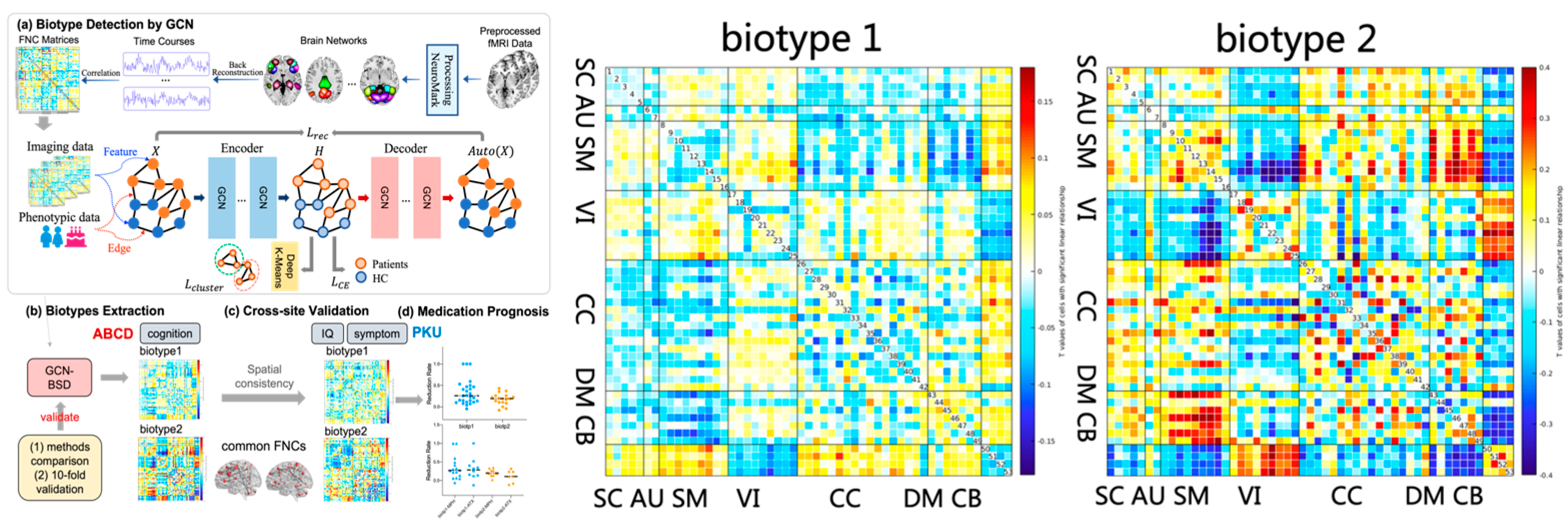
- Feng, A.; Zhi, D.; Feng, Y.; Jiang, R.; Fu, Z.; Xu, M.; Zhao, M.; Yu, S.; Stevens, M.; Sun, L.; et al. Functional imaging derived ADHD biotypes based on deep clustering: A study on personalized medication therapy guidance. EClinicalMedicine 2024, 77, 102876. [Google Scholar] [CrossRef] [Scilit]
- Menon, V. 20 years of the default mode network: A review and synthesis. Neuron 2023, 111, 2469–2487. [Google Scholar] [CrossRef] [Scilit] [PubMed]
- Weissman, D.H.; Roberts, K.C.; Visscher, K.M.; Woldorff, M.G. The neural bases of momentary lapses in attention. Nat. Neurosci. 2006, 9, 971–978. [Google Scholar] [CrossRef] [Scilit]
- Senkowski, D.; Ziegler, T.; Singh, M.; Heinz, A.; He, J.; Silk, T.; Lorenz, R.C. Assessing Inhibitory Control Deficits in Adult ADHD: A Systematic Review and Meta-analysis of the Stop-signal Task. Neuropsychol. Rev. 2024, 34, 548–567. [Google Scholar] [CrossRef] [Scilit]
- Kowalczyk, O.S.; Mehta, M.A.; O’Daly, O.G.; Criaud, M. Task-Based Functional Connectivity in Attention-Deficit/Hyperactivity Disorder: A Systematic Review. Biol. Psychiatry Glob. Open Sci. 2022, 2, 350–367. [Google Scholar] [CrossRef] [Scilit]
- van Ewijk, H.; Heslenfeld, D.J.; Zwiers, M.P.; Buitelaar, J.K.; Oosterlaan, J. Diffusion tensor imaging in attention deficit/hyperactivity disorder: A systematic review and meta-analysis. Neurosci. Biobehav. Rev. 2012, 36, 1093–1106. [Google Scholar] [CrossRef] [Scilit]
- Wang, Q.; Zhao, C.; Qiu, J.; Lu, W. Two neurosubtypes of ADHD different from the clinical phenotypes. Psychiatry Res. 2023, 328, 115453. [Google Scholar] [CrossRef] [Scilit] [PubMed]
- Luo, N.; Luo, X.; Zheng, S.; Yao, D.; Zhao, M.; Cui, Y.; Zhu, Y.; Calhoun, V.D.; Sun, L.; Sui, J. Aberrant brain dynamics and spectral power in children with ADHD and its subtypes. Eur. Child Adolesc. Psychiatry 2023, 32, 2223–2234. [Google Scholar] [CrossRef] [Scilit] [PubMed]
- Hu, L.F.; Zhong, Y.Y.; Wang, P.; Liu, L.; Cao, X.L.; Sun, L.; Cao, Q.J.; Yang, L.; Qian, Y.; Wang, Y.F.; et al. White matter microstructural subgroups of children with ADHD: Similar clinical presentations and distinct neuropsychological profiles. J. Psychiatr. Res. 2025, 183, 197–203. [Google Scholar] [CrossRef] [Scilit] [PubMed]
Disclaimer/Publisher’s Note: The statements, opinions and data contained in all publications are solely those of the individual author(s) and contributor(s) and not of MDPI and/or the editor(s). MDPI and/or the editor(s) disclaim responsibility for any injury to people or property resulting from any ideas, methods, instructions or products referred to in the content. |
© 2026 by the authors. Licensee MDPI, Basel, Switzerland. This article is an open access article distributed under the terms and conditions of the Creative Commons Attribution (CC BY) license.
Share and Cite
Wang, C.; Wang, S.; Sun, L.; Sui, J. Abnormal MRI Features in Children with ADHD: A Narrative Review of Large-Scale Studies. Brain Sci. 2026, 16, 104. https://doi.org/10.3390/brainsci16010104
Wang C, Wang S, Sun L, Sui J. Abnormal MRI Features in Children with ADHD: A Narrative Review of Large-Scale Studies. Brain Sciences. 2026; 16(1):104. https://doi.org/10.3390/brainsci16010104
Chicago/Turabian StyleWang, Chunyang, Shiyun Wang, Li Sun, and Jing Sui. 2026. "Abnormal MRI Features in Children with ADHD: A Narrative Review of Large-Scale Studies" Brain Sciences 16, no. 1: 104. https://doi.org/10.3390/brainsci16010104
APA StyleWang, C., Wang, S., Sun, L., & Sui, J. (2026). Abnormal MRI Features in Children with ADHD: A Narrative Review of Large-Scale Studies. Brain Sciences, 16(1), 104. https://doi.org/10.3390/brainsci16010104