Review

Integrating Augmented Reality in Spine Surgery: Redefining Precision with New Technologies

by
Manuel De Jesus Encarnacion Ramirez
1,*,
Gennady Chmutin
1,
Renat Nurmukhametov
1,
Gervith Reyes Soto
2,
Siddarth Kannan
3,
Gennadi Piavchenko
4,
Vladmir Nikolenko
5,
Ibrahim E. Efe
6,
Alberto Ramírez Romero
7,
Jeff Ntalaja Mukengeshay
8,
Keith Simfukwe
1,
Tshiunza Mpoyi Cherubin
8,
Federico Nicolosi
9,
Salman Sharif
10,
Juan Carlos Roa
11 and
Nicola Montemurro
12,*
1
Department of Neurosurgery, Russian People’s Friendship University, 117198 Moscow, Russia
2
Department of Head and Neck, Unidad de Neurociencias, Instituto Nacional de Cancerología, Mexico City 14080, Mexico
3
School of Medicine, University of Central Lancashire, Preston PR0 2AA, UK
4
Department of Human Anatomy and Histology, Sechenov University, 119911 Moscow, Russia
5
Department of Neurosurgery, I.M. Sechenov First Moscow State Medical University (Sechenov University), 119991 Moscow, Russia
6
Department of Neurosurgery, Charité—Universitätsmedizin Berlin, Corporate Member of Freie Universität Berlin, Humboldt-Universität zu Berlin, and Berlin Institute of Health, 10178 Berlin, Germany
7
Department of Neurosurgery, Hospital Angeles Universidad, Mexico City 03330, Mexico
8
Department Neurosurgery, Clinique Ngaliema, Kinshasa 3089, Democratic Republic of the Congo
9
Department of Medicine and Surgery, Neurosurgery, University of Milano-Bicocca, 20126 Milan, Italy
10
Department of Neurosurgery, Liaquat National Hospital and Medical College, Karachi 05444, Pakistan
11
Department of Pathology, School of Medicine, Pontificia Universidad Católica de Chile, Santiago 8330024, Chile
12
Department of Neurosurgery, Azienda Ospedaliero Universitaria Pisana (AOUP), 56100 Pisa, Italy
*
Authors to whom correspondence should be addressed.
Brain Sci. 2024, 14(7), 645; https://doi.org/10.3390/brainsci14070645

Submission received: 12 May 2024 / Revised: 4 June 2024 / Accepted: 11 June 2024 / Published: 27 June 2024
(This article belongs to the Special Issue New Trends and Technologies in Modern Neurosurgery)

Abstract

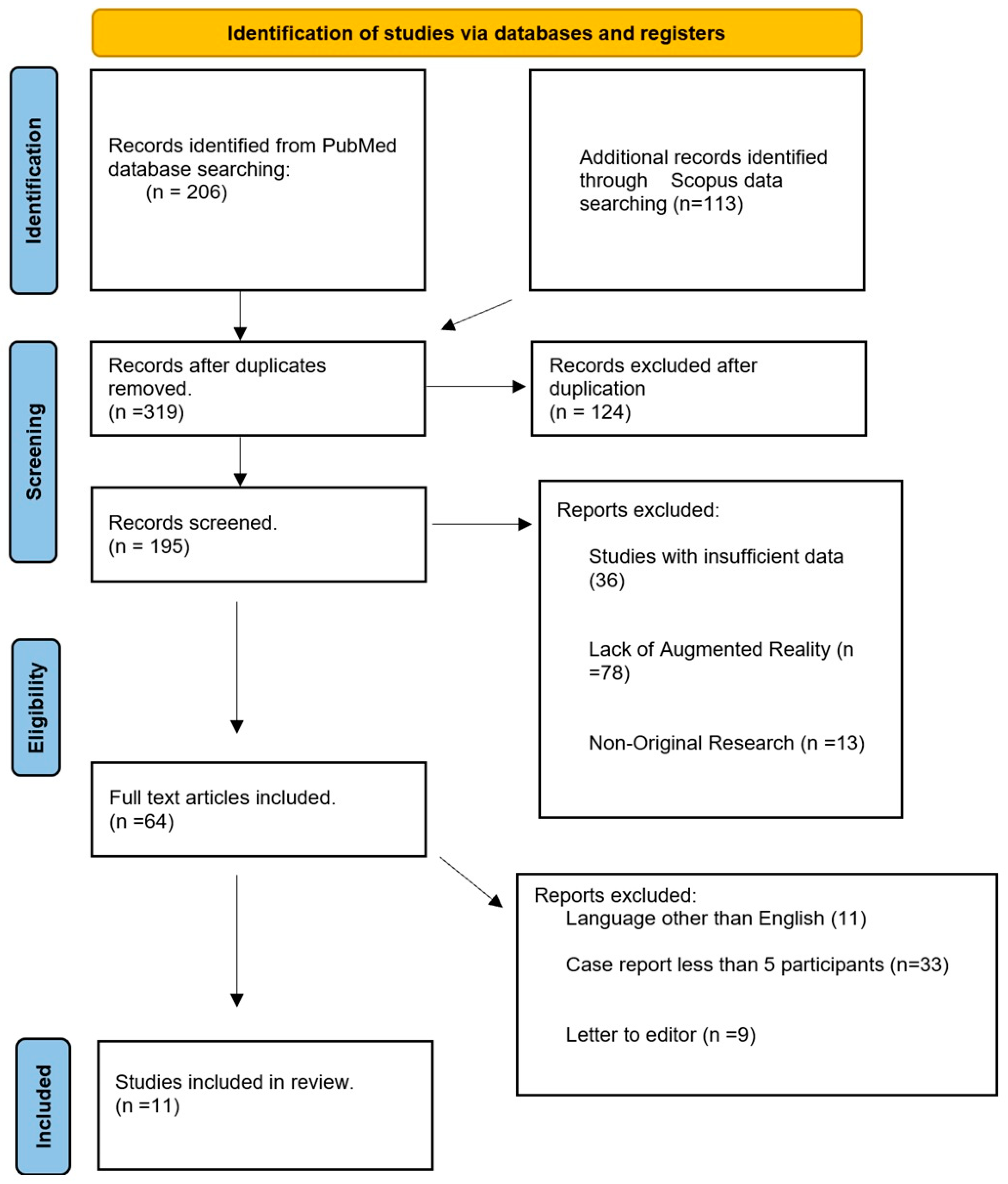
Introduction: The integration of augmented reality (AR) in spine surgery marks a significant advancement, enhancing surgical precision and patient outcomes. AR provides immersive, three-dimensional visualizations of anatomical structures, facilitating meticulous planning and execution of spine surgeries. This technology not only improves spatial understanding and real-time navigation during procedures but also aims to reduce surgical invasiveness and operative times. Despite its potential, challenges such as model accuracy, user interface design, and the learning curve for new technology must be addressed. AR’s application extends beyond the operating room, offering valuable tools for medical education and improving patient communication and satisfaction. Material and methods: A literature review was conducted by searching PubMed and Scopus databases using keywords related to augmented reality in spine surgery, covering publications from January 2020 to January 2024. Results: In total, 319 articles were identified through the initial search of the databases. After screening titles and abstracts, 11 articles in total were included in the qualitative synthesis. Conclusion: Augmented reality (AR) is becoming a transformative force in spine surgery, enhancing precision, education, and outcomes despite hurdles like technical limitations and integration challenges. AR’s immersive visualizations and educational innovations, coupled with its potential synergy with AI and machine learning, indicate a bright future for surgical care. Despite the existing obstacles, AR’s impact on improving surgical accuracy and safety marks a significant leap forward in patient treatment and care.
Keywords: cervical spine; laboratory; 3D model training; residents; neurosurgery cervical spine; laboratory; 3D model training; residents; neurosurgery