Article

Selective Stimulus Intensity during Hotspot Search Ensures Faster and More Accurate Preoperative Motor Mapping with nTMS


1
Academic Neurosurgery, Department of Neuroscience, University of Padova, 35128 Padova, Italy
2
Department of Neurosurgery, Padova University-Hospital, 35128 Padova, Italy
3
Clinical Neurophysiology, Department of Neuroscience, University of Padova, 35128 Padova, Italy
4
Unit of Neurology, Unit of Clinical Neurophysiology and Study Center of Neurodegeneration (CESNE), Department of Neuroscience, University of Padova, 35128 Padova, Italy
5
Department of Clinical Neurophysiology, Kuopio University Hospital, University of Eastern Finland, 70211 Kuopio, Finland
6
Padova Neuroscience Center (PNC), University of Padova, 35128 Padova, Italy
7
Department of Neuroscience, Venetian Institute of Molecular Medicine (VIMM), University of Padova, 35128 Padova, Italy
*
Author to whom correspondence should be addressed.
Brain Sci. 2023, 13(2), 285; https://doi.org/10.3390/brainsci13020285

Submission received: 3 January 2023 / Revised: 2 February 2023 / Accepted: 6 February 2023 / Published: 8 February 2023

Abstract

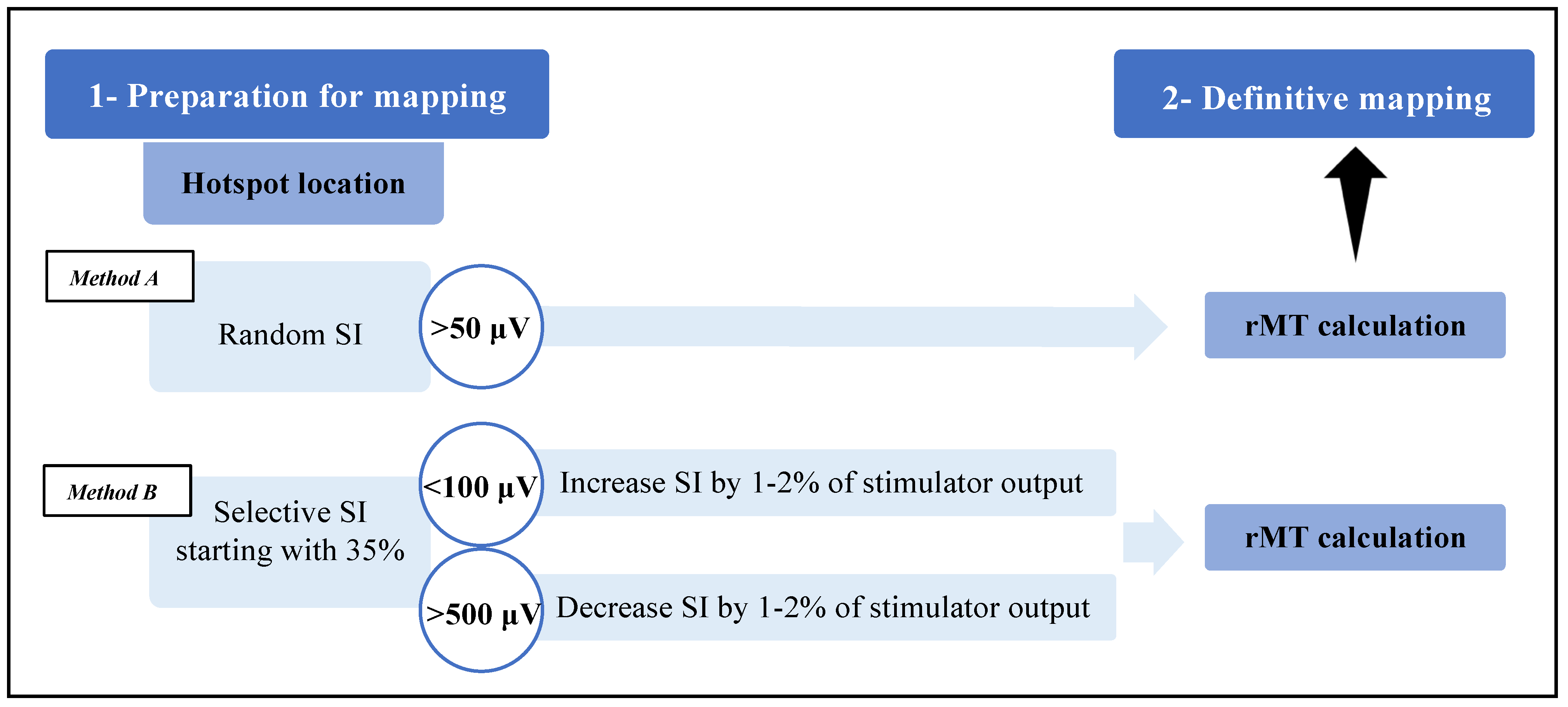
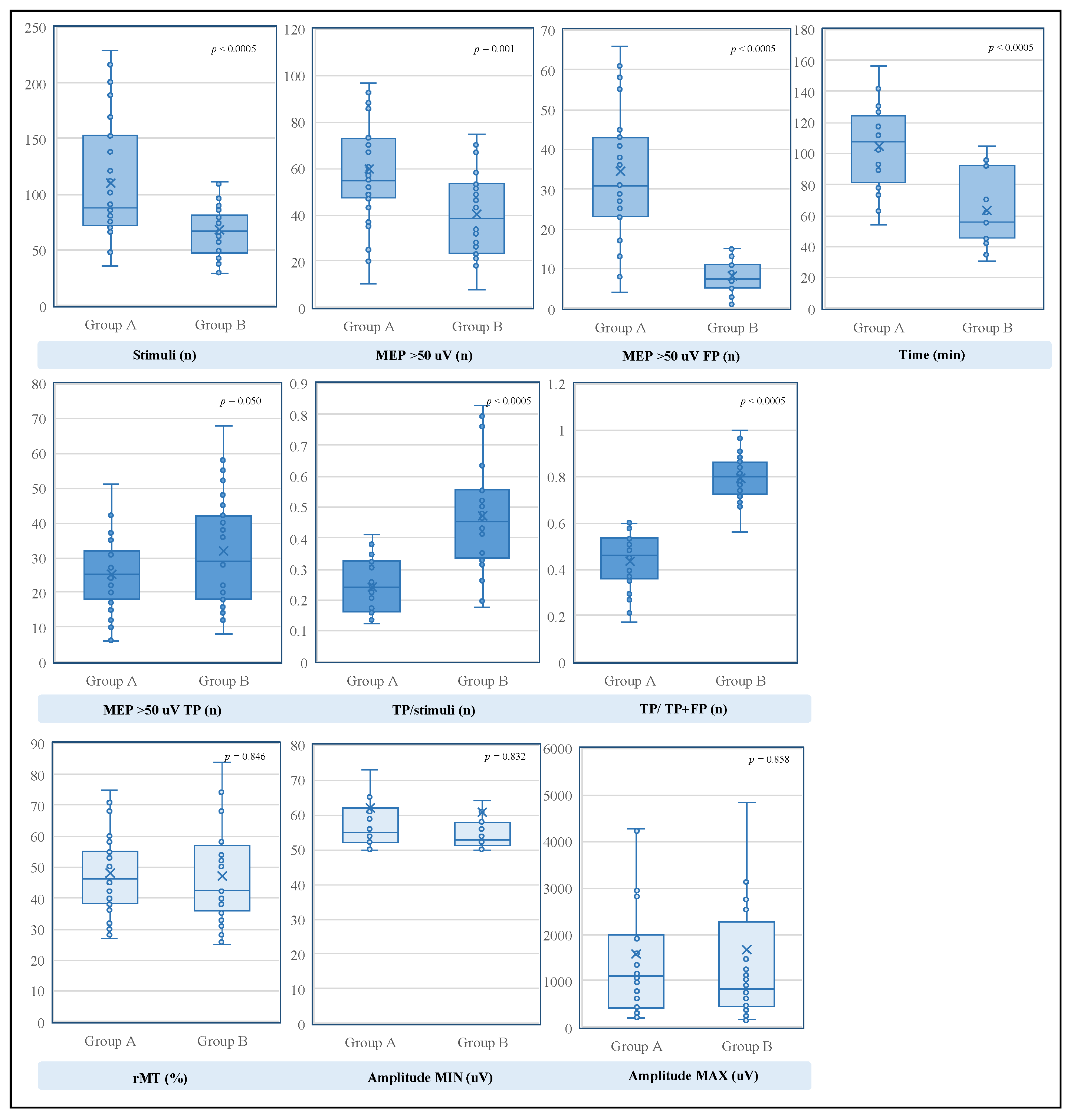
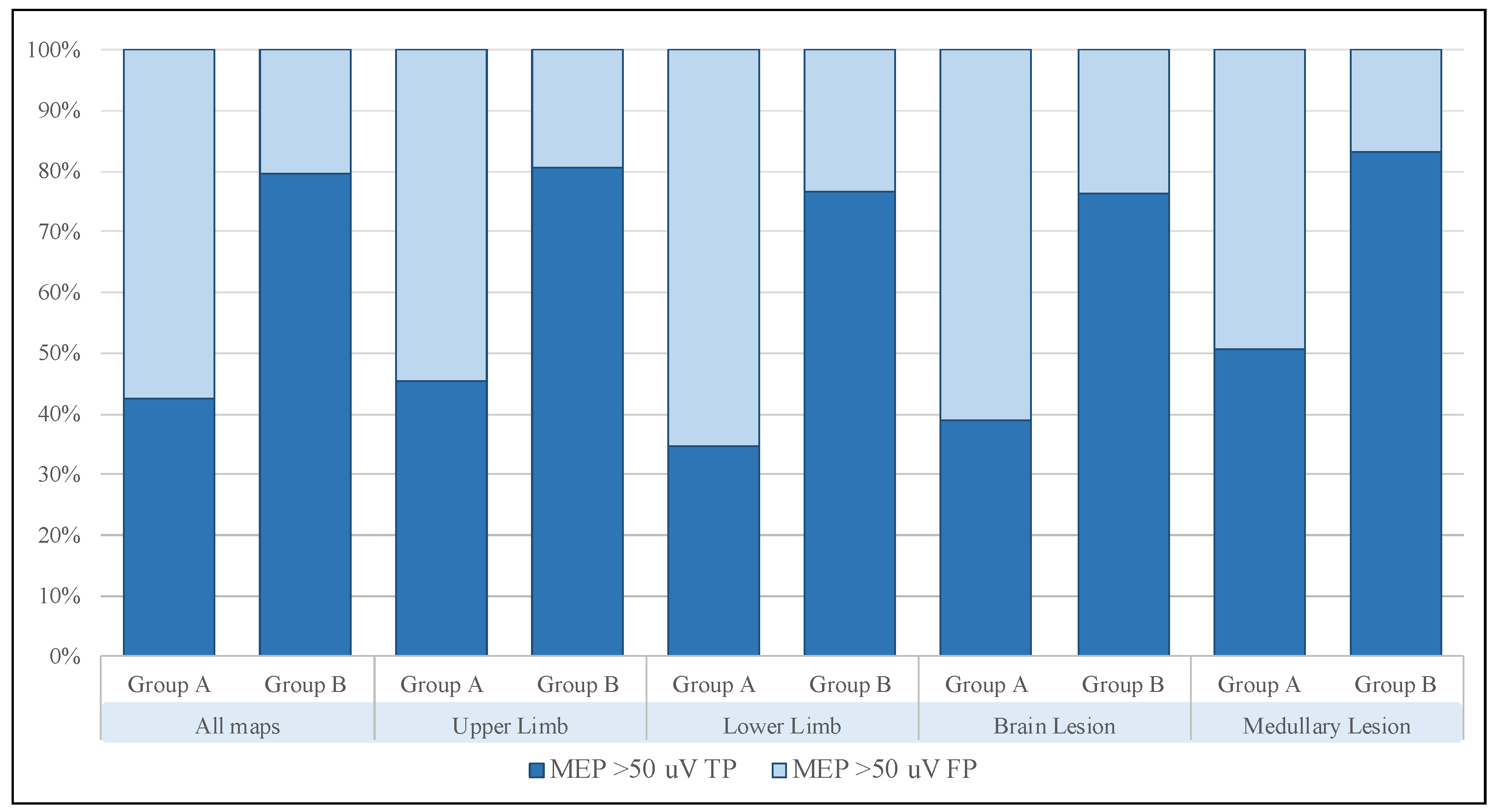
Introduction: Navigated transcranial magnetic stimulation (nTMS) has emerged as one of the most innovative techniques in neurosurgical practice. However, nTMS motor mapping involves rigorous steps, and the importance of an accurate execution method has not been emphasized enough. In particular, despite strict adherence to procedural protocols, we have observed high variability in map activation according to the choice of stimulation intensity (SI) right from the early stage of hotspot localization. We present a retrospective analysis of motor mappings performed between March 2020 and July 2022, where the SI was only chosen with rigorous care in the most recent ones, under the guide of an expert neurophysiologist. Materials and methods: In order to test the ability to reduce inaccurate responses and time expenditure using selective SI, data were collected from 16 patients who underwent mapping with the random method (group A) and 15 patients who underwent mapping with the proposed method (group B). The parameters considered were resting motor threshold (%), number of stimuli, number of valid motor evoked potentials (MEPs), number of valid MEPs considered true positives (TPs), number of valid MEPs considered false positives (FPs), ratio of true-positive MEPs to total stimuli, ratio of true-positive MEPs to valid MEPs, minimum amplitude, maximum amplitude and mapping time for each patient. Results: The analysis showed statistically significant reductions in total stimulus demand, procedural time and number of false-positive MEPs. Significant increases were observed in the number of true-positive MEPs, the ratio of true-positive MEPs to total stimuli and the ratio of true-positive MEPs to valid MEPs. In the subgroups analyzed, there were similar trends, in particular, an increase in true positives and a decrease in false-positive responses. Conclusions: The precise selection of SI during hotspot search in nTMS motor mapping could provide reliable cortical maps in short time and with low employment of resources. This method seems to ensure that a MEP really represents a functionally eloquent cortical point, making mapping more intuitive even in less experienced centers.
Keywords: navigated transcranial magnetic stimulation; nTMS; motor mapping; preoperative mapping; hotspot; motor evoked potential; brain stimulation navigated transcranial magnetic stimulation; nTMS; motor mapping; preoperative mapping; hotspot; motor evoked potential; brain stimulation