Review

Targeting NMDA Receptors in Emotional Disorders: Their Role in Neuroprotection

1
CAS Key Laboratory of Mental Health, Institute of Psychology, Chinese Academy of Sciences, Beijing 100101, China
2
Department of Psychology, University of Chinese Academy of Sciences, Beijing 100049, China
3
Wenzhou Institute, University of Chinese Academy of Sciences, Wenzhou 325001, China
*
Author to whom correspondence should be addressed.
Brain Sci. 2022, 12(10), 1329; https://doi.org/10.3390/brainsci12101329

Submission received: 1 September 2022 / Revised: 28 September 2022 / Accepted: 28 September 2022 / Published: 30 September 2022
(This article belongs to the Special Issue Neuropharmacological Research in Psychiatry)

Abstract

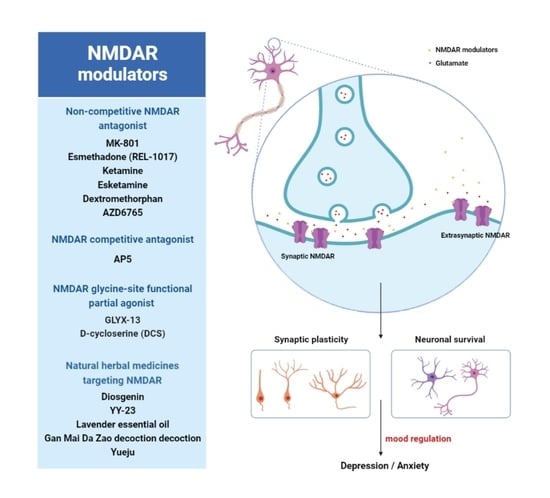
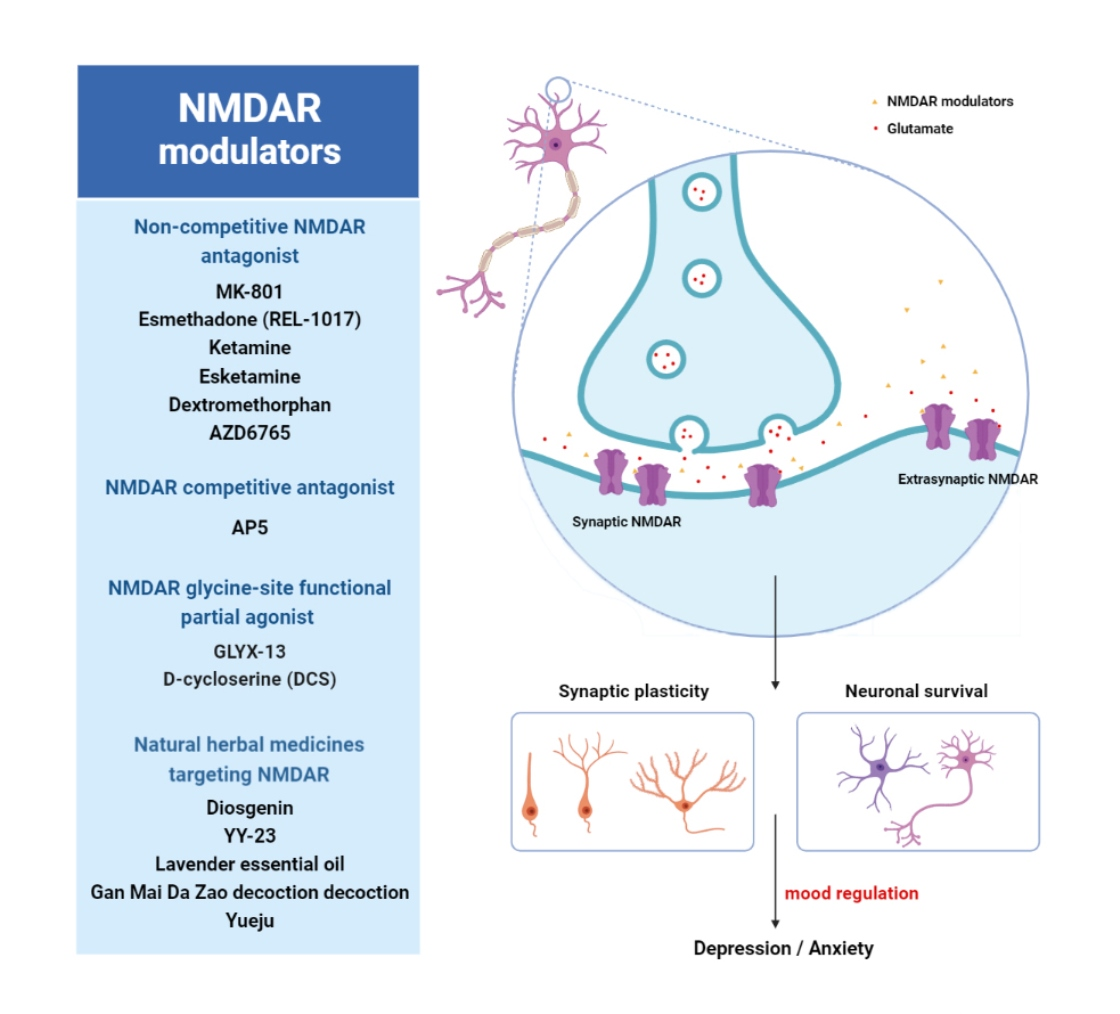
Excitatory glutamatergic neurotransmission mediated through N-methyl-D-Aspartate (NMDA) receptors (NMDARs) is essential for synaptic plasticity and neuronal survival. While under pathological states, abnormal NMDAR activation is involved in the occurrence and development of psychiatric disorders, which suggests a directional modulation of NMDAR activity that contributes to the remission and treatment of psychiatric disorders. This review thus focuses on the involvement of NMDARs in the pathophysiological processes of psychiatric mood disorders and analyzes the neuroprotective mechanisms of NMDARs. Firstly, we introduce NMDAR-mediated neural signaling pathways in brain function and mood regulation as well as the pathophysiological mechanisms of NMDARs in emotion-related mental disorders such as anxiety and depression. Then, we provide an in-depth summary of current NMDAR modulators that have the potential to be developed into clinical drugs and their pharmacological research achievements in the treatment of anxiety and depression. Based on these findings, drug-targeting for NMDARs might open up novel territory for the development of therapeutic agents for refractory anxiety and depression.
Keywords: NMDAR; depression; anxiety; neuroprotection NMDAR; depression; anxiety; neuroprotection
Graphical Abstract