Article

Perseverative Cognition in the Positive Valence Systems: An Experimental and Ecological Investigation

1
Department of Psychology, Sapienza University of Rome, 00185 Rome, Italy
2
Department of Social and Cognitive Computing, Institute of High Performance Computing, Agency for Science, Technology and Research, Singapore 138632, Singapore
3
Center for Depression, Anxiety and Stress Research, McLean Hospital, Belmont, MA 02478, USA
4
Department of Education, University of Roma Tre, 00185 Rome, Italy
5
Teachers College, Columbia University, New York, NY 10027, USA
6
Department of Psychiatry, Harvard Medical School, Belmont, MA 02115, USA
7
Neuroimaging Laboratory, IRCCS Santa Lucia Foundation, 00179 Rome, Italy
*
Authors to whom correspondence should be addressed.
Brain Sci. 2021, 11(5), 585; https://doi.org/10.3390/brainsci11050585

Submission received: 15 April 2021 / Revised: 28 April 2021 / Accepted: 28 April 2021 / Published: 30 April 2021
(This article belongs to the Special Issue Cognitive and Behavioral Patterns across Psychiatric Conditions)

Abstract

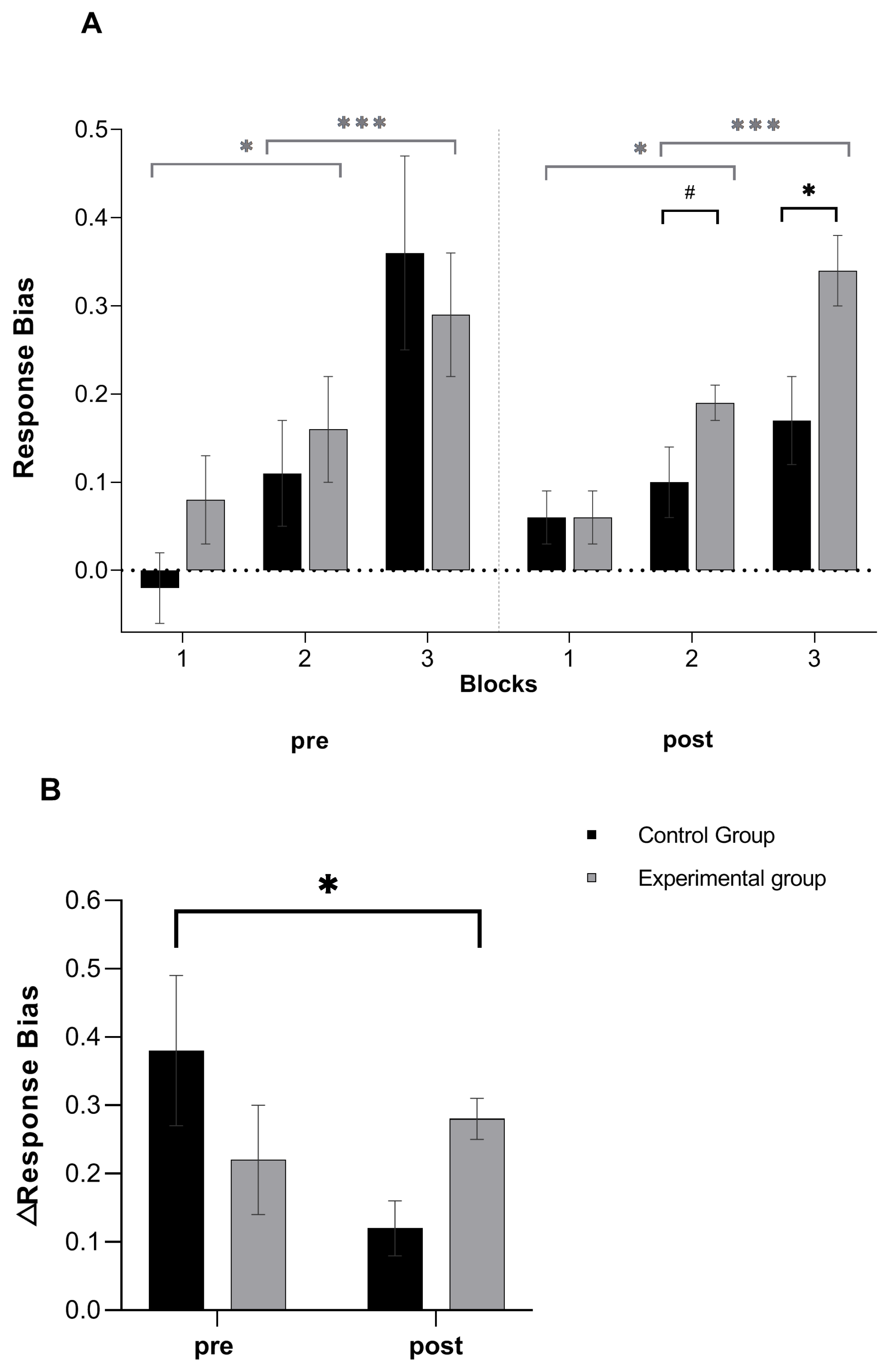
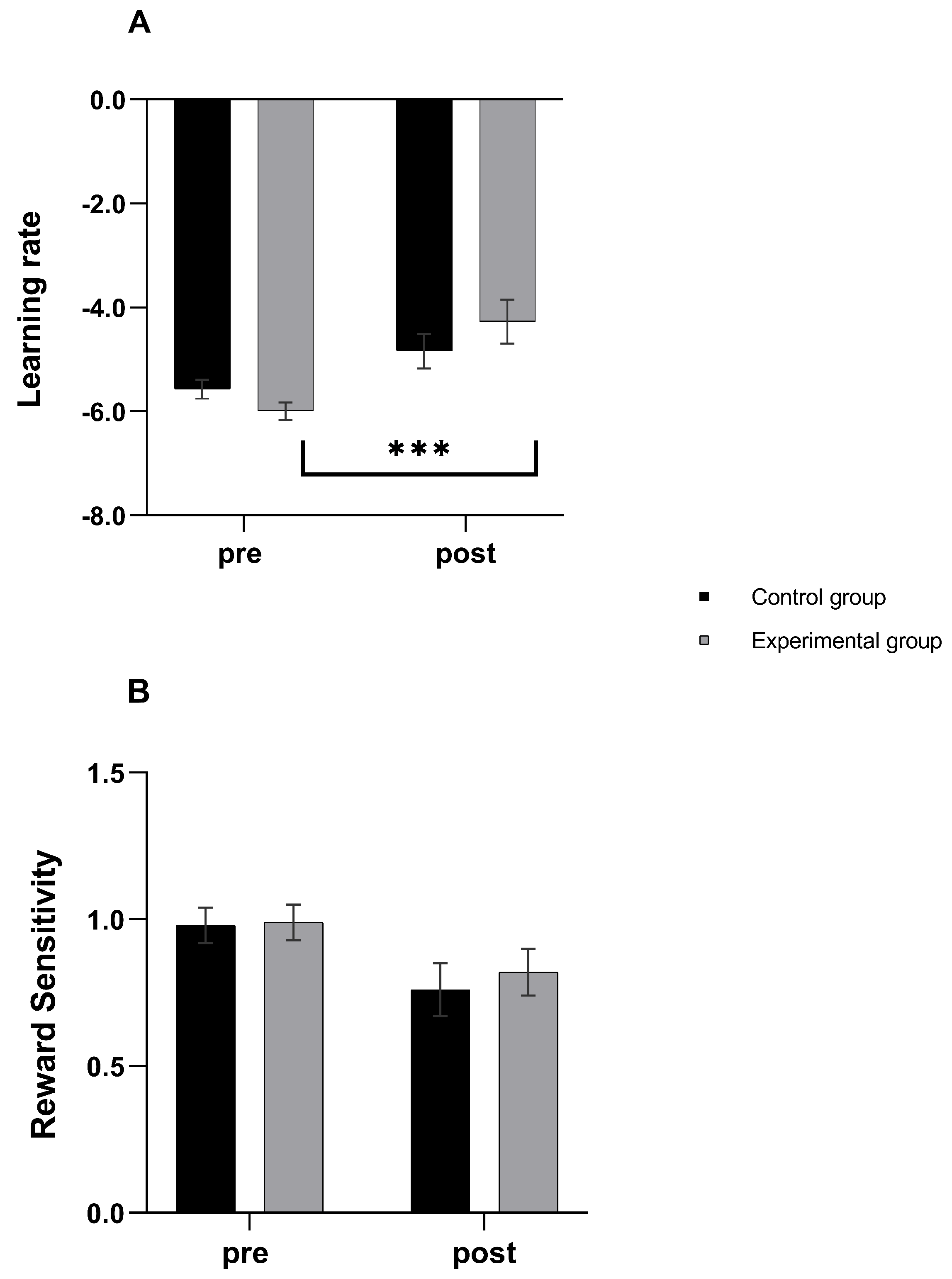
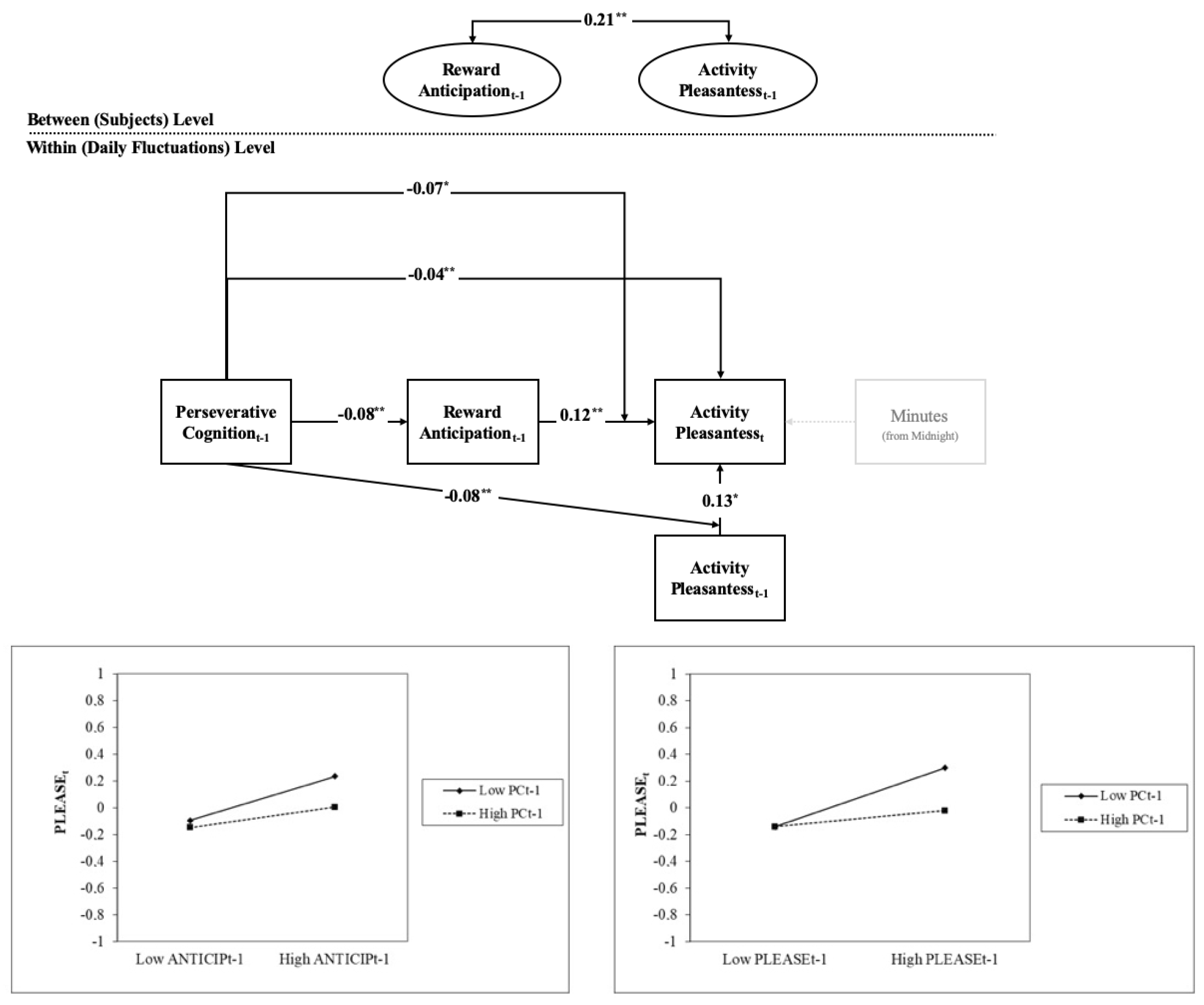
Perseverative cognition (PC) is a transdiagnostic risk factor that characterizes both hypo-motivational (e.g., depression) and hyper-motivational (e.g., addiction) disorders; however, it has been almost exclusively studied within the context of the negative valence systems. The present study aimed to fill this gap by combining laboratory-based, computational and ecological assessments. Healthy individuals performed the Probabilistic Reward Task (PRT) before and after the induction of PC or a waiting period. Computational modeling was applied to dissociate the effects of PC on reward sensitivity and learning rate. Afterwards, participants underwent a one-week ecological momentary assessment of daily PC occurrence, as well as anticipatory and consummatory reward-related behavior. Induction of PC led to increased response bias on the PRT compared to waiting, likely due to an increase in learning rate but not in reward sensitivity, as suggested by computational modeling. In daily-life, PC increased the discrepancy between expected and obtained rewards (i.e., prediction error). Current converging experimental and ecological evidence suggests that PC is associated with abnormalities in the functionality of positive valence systems. Given the role of PC in the prediction, maintenance, and recurrence of psychopathology, it would be clinically valuable to extend research on this topic beyond the negative valence systems.
Keywords: perseverative cognition; positive valence systems; RDoC; probabilistic reward task; ecological momentary assessment; reward prediction error, transdiagnostic psychiatry perseverative cognition; positive valence systems; RDoC; probabilistic reward task; ecological momentary assessment; reward prediction error, transdiagnostic psychiatry