


COVID-19 Related Traumatic Distress in Psychotherapy Patients during the Pandemic: The Role of Attachment, Working Alliance, and Therapeutic Agency

Abstract
1. Introduction
1.1. The Importance of Patients’ Attachment in Psychological Distress
1.2. Patients’ Experiences of the Collaborative Process in Therapy
1.3. Patient’s Attachment as a Moderator of the Process-Outcome Associations
2. Materials and Methods
2.1. Sample
2.2. Measures
2.3. Statistical Analyses
3. Results
3.1. Description of Sample Characteristics
3.2. Predictions of COVID-Related Post-Traumatic Distress
4. Discussion
5. Limitations
6. Conclusions
Supplementary Materials
Author Contributions
Funding
Institutional Review Board Statement
Informed Consent Statement
Data Availability Statement
Conflicts of Interest
Ethics Statements
References
- Li, W.; Yang, Y.; Liu, Z.-H.; Zhao, Y.-J.; Zhang, Q.; Zhang, L.; Cheung, T.; Xiang, Y.-T. Progression of Mental Health Services during the COVID-19 Outbreak in China. Int. J. Biol. Sci. 2020, 16, 1732–1738. [Google Scholar] [CrossRef] [Scilit]
- Mazza, C.; Ricci, E.; Biondi, S.; Colasanti, M.; Ferracuti, S.; Napoli, C.; Roma, P. A Nationwide Survey of Psychological Distress among Italian People during the COVID-19 Pandemic: Immediate Psychological Responses and Associated Factors. Int. J. Environ. Res. Public Health 2020, 17, 3165. [Google Scholar] [CrossRef] [Scilit]
- Qiu, J.; Shen, B.; Zhao, M.; Wang, Z.; Xie, B.; Xu, Y. A nationwide survey of psychological distress among Chinese people in the COVID-19 epidemic: Implications and policy recommendations. Gen. Psychiatry 2020, 33, e100213. [Google Scholar] [CrossRef] [Scilit]
- Wang, C.; Pan, R.; Wan, X.; Tan, Y.; Xu, L.; McIntyre, R.S.; Choo, F.N.; Tran, B.; Ho, R.; Sharma, V.K.; et al. A longitudinal study on the mental health of general population during the COVID-19 epidemic in China. Brain Behav. Immun. 2020, 87, 40–48. [Google Scholar] [CrossRef] [Scilit] [PubMed]
- Prout, T.A.; Zilcha-Mano, S.; Aafjes-van Doorn, K.; Békés, V.; Christman-Cohen, I.; Whistler, K.; Kui, T.; Di Giuseppe, M. Identifying Predictors of Psychological Distress During COVID-19: A Machine Learning Approach. Front. Psychol. 2020, 11, 3063. [Google Scholar] [CrossRef] [Scilit] [PubMed]
- Brooks, S.K.; Webster, R.K.; Smith, L.E.; Woodland, L.; Wessely, S.; Greenberg, N.; Rubin, G.J. The psychological impact of quarantine and how to reduce it: Rapid review of the evidence. Lancet 2020, 395, 912–920. [Google Scholar] [CrossRef] [Scilit]
- Fitzpatrick, K.M.; Harris, C.; Drawve, G. Living in the midst of fear: Depressive symptomatology among US adults during the COVID-19 pandemic. Depress. Anxiety 2020, 37, 957–964. [Google Scholar] [CrossRef] [Scilit] [PubMed]
- Salamin, V.; Rossier, V.; Joye, D.; Nolde, C.; Pierrehumbert, T.; Gothuey, I.; Guenot, F. Adaptations de la thérapie comportementale dialectique ambulatoire en période de pandémie COVID-19 et conséquences du confinement sur des patients souffrant d’un état-limite. Annales Médico-Psychologiques 2021, 179, 131–136. [Google Scholar] [CrossRef] [Scilit]
- Favreau, M.; Hillert, A.; Osen, B.; Gärtner, T.; Hunatschek, S.; Riese, M.; Hewera, K.; Voderholzer, U. Psychological consequences and differential impact of the COVID-19 pandemic in patients with mental disorders. Psychiatry Res. 2021, 302, 114045. [Google Scholar] [CrossRef] [Scilit]
- Quittkat, H.L.; Düsing, R.; Holtmann, F.-J.; Buhlmann, U.; Svaldi, J.; Vocks, S. Perceived impact of COVID-19 across different mental disorders: A study on disorder-specific symptoms, psychosocial stress and behavior. Front. Psychol. 2020, 11. [Google Scholar] [CrossRef] [Scilit]
- Schlegl, S.; Maier, J.; Meule, A.; Voderholzer, U. Eating disorders in times of the COVID-19 pandemic—Results from an online survey of patients with anorexia nervosa. Int. J. Eat. Disord. 2020, 53, 1791–1800. [Google Scholar] [CrossRef] [Scilit]
- Lewis, Y.D.; Elran-Barak, R.; Tov, R.G.-S.; Zubery, E. The abrupt transition from face-to-face to online treatment for eating disorders: A pilot examination of patients’ perspectives during the COVID-19 lockdown. J. Eat. Disord. 2021, 9, 1–11. [Google Scholar] [CrossRef] [Scilit]
- Bowlby, J. A Secure Base: Clinical Applications of Attachment Theory; Routledge: London, UK, 1988. [Google Scholar]
- Cicchetti, D.; Cummings, E.M.; Greenberg, M.T.; Marvin, R.S. An organizational perspective on attachment beyond infancy: Implications for theory, measurement and research. In Attachment in the Preschool Years: Theory, Research, and Intervention; Greenberg, M.T., Cicchetti, D., Cummings, E.M., Eds.; University of Chicago Press: Chicago, IL, USA, 1990; pp. 3–49. [Google Scholar]
- Feeney, B.C.; Cassidy, J.; Ramos-Marcuse, F. The generalization of attachment representations to new social situations: Predicting behavior during initial interactions with strangers. J. Pers. Soc. Psychol. 2008, 95, 1481–1498. [Google Scholar] [CrossRef] [Scilit] [PubMed]
- Groh, A.M.; Roisman, G.I.; Booth-LaForce, C.; Fraley, R.C.; Owen, M.T.; Cox, M.J.; Burchinal, M.R. Stability of attachment security from infancy to late adolescence. Monogr. Soc. Res. Child Dev. 2014, 79, 51–66. [Google Scholar] [CrossRef] [Scilit] [PubMed]
- Holland, A.S.; Roisman, G.I. Adult attachment security and young adults’ dating relationships over time: Self-reported, observational, and physiological evidence. Dev. Psychol. 2010, 46, 552–557. [Google Scholar] [CrossRef] [Scilit] [PubMed]
- Roisman, G.I. The role of adult attachment security in non-romantic, non-attachment-related first interactions between same-sex strangers. Attach. Hum. Dev. 2006, 8, 341–352. [Google Scholar] [CrossRef] [Scilit]
- Fraley, R.C.; Heffernan, M.E.; Vicary, A.M.; Brumbaugh, C.C. The experiences in close relationships—Relationship Structures Questionnaire: A method for assessing attachment orientations across relationships. Psychol. Assess. 2011, 23, 615–625. [Google Scholar] [CrossRef] [Scilit]
- Brennan, K.A.; Clark, C.L.; Shaver, P.R. Self-report measurement of adult attachment: An integrative overview. In Attachment Theory and Close Relationships; The Guilford Press: New York, NY, USA, 1998; pp. 46–76. [Google Scholar]
- Mikulincer, M.; Shaver, P.R.; Pereg, D. Attachment Theory and Affect Regulation: The Dynamics, Development, and Cognitive Consequences of Attachment-Related Strategies. Motiv. Emot. 2003, 27, 77–102. [Google Scholar] [CrossRef] [Scilit]
- Wei, M.; Russell, D.W.; Mallinckrodt, B.; Vogel, D.L. The Experiences in Close Relationship Scale (ECR)-short form: Reliability, validity, and factor structure. J. Personal. Assess. 2007, 88, 187–204. [Google Scholar] [CrossRef] [Scilit]
- Levy, K.N.; Kivity, Y.; Johnson, B.N.; Gooch, C.V. Adult attachment as a predictor and moderator of psychotherapy outcome: A meta-analysis. J. Clin. Psychol. 2018, 74, 1996–2013. [Google Scholar] [CrossRef] [Scilit]
- Fraley, R.C.; Hudson, N.W.; Heffernan, M.E.; Segal, N. Are Adult Attachment Styles Categorical or Dimensional? A Taxometric Analysis of General and Relationship-Specific Attachment Orientations. J. Personal. Soc. Psychol. 2015, 109, 354–368. [Google Scholar] [CrossRef] [Scilit]
- Dykas, M.J.; Cassidy, J. Attachment and the processing of social information across the life span: Theory and evidence. Psychol. Bull. 2011, 137, 19–46. [Google Scholar] [CrossRef] [Scilit] [PubMed]
- Hames, J.L.; Hagan, C.R.; Joiner, T.E. Interpersonal processes in depression. Annu. Rev. Clin. Psychol. 2013, 9, 355–377. [Google Scholar] [CrossRef] [Scilit] [PubMed]
- Lakey, B.; Orehek, E. Relational regulation theory: A new approach to explain the link between perceived social support and mental health. Psychol. Rev. 2011, 118, 482–495. [Google Scholar] [CrossRef] [Scilit] [PubMed]
- Williams, N.L.; Riskind, J.H. Adult romantic attachment and cognitive vulnerabilities to anxiety and depression: Examining the interpersonal basis of vulnerability models. J. Cogn. Psychother. 2004, 18, 7–24. [Google Scholar] [CrossRef]
- Békés, V.; Aafjes-van Doorn, K.; Spina, D.; Talia, A.; Perry, P.C. The relationship between defense mechanisms and attachment as measured by observer-rated methods in a sample of depressed patients: A pilot study. Front. Psychol. Sect. Psychopathol. 2021, in press. [Google Scholar] [CrossRef] [Scilit]
- Dagan, O.; Facompré, C.R.; Bernard, K. Adult attachment representations and depressive symptoms: A meta-analysis. J. Affect. Disord. 2018, 236, 274–290. [Google Scholar] [CrossRef] [Scilit]
- Borelli, J.L.; David, D.H.; Crowley, M.J.; Mayes, L.C. Links Between Disorganized Attachment Classification and Clinical Symptoms in School-Aged Children. J. Child. Fam. Stud. 2009, 19, 243–256. [Google Scholar] [CrossRef] [Scilit]
- Fonagy, P.; Leigh, T.; Steele, M.; Steele, H.; Kennedy, R.; Mattoon, G.; Target, M.; Gerber, A. The relation of attachment status, psychiatric classification, and response to psychotherapy. J. Consult. Clin. Psychol. 1996, 64, 22–31. [Google Scholar] [CrossRef]
- Ivarsson, T.; Granqvist, P.; Gillberg, C.; Broberg, A.G. Attachment states of mind in adolescents with Obsessive–Compulsive Disorder and/or depressive disorders: A controlled study. Eur. Child Adolesc. Psychiatry 2010, 19, 845–853. [Google Scholar] [CrossRef] [Scilit]
- Woodhouse, S.; Ayers, S.; Field, A.P. The relationship between adult attachment style and post-traumatic stress symptoms: A meta-analysis. J. Anxiety Disord. 2015, 35, 103–117. [Google Scholar] [CrossRef] [Scilit]
- Fraley, R.C.; Fazzari, D.A.; Bonanno, G.A.; Dekel, S. Attachment and psychological adaptation in high exposure survivors of the September 11th attack on the World Trade Center. Personal. Soc. Psychol. Bull. 2006, 32, 538–551. [Google Scholar] [CrossRef] [Scilit]
- Fraley, R.C.; Davis, K.E.; Shaver, P.R. Dismissing-avoidance and the defensive organization of emotion, cognition, and behavior. In Attachment Theory and Close Relationships; Simpson, J.A., Rholes, W.S., Eds.; The Guilford Press: New York, NY, USA, 1998; pp. 249–279. [Google Scholar]
- Tasca, G.A.; Ritchie, K.; Conrad, G.; Balfour, L.; Gayton, J.; Lybanon, V.; Bissada, H. Attachment scales predict outcome in a randomized controlled trial of two group therapies for binge eating disorder: An aptitude by treatment interaction. Psychother. Res. 2006, 16, 106–121. [Google Scholar] [CrossRef] [Scilit]
- An, M.; Hillman, J.W.; Kivlighan, D.M.; Hill, C.E. Changes in client attachment in relation to client distress: A response surface analysis. J. Couns. Psychol. 2021, 38, 149–159. [Google Scholar] [CrossRef] [Scilit]
- Lilliengren, P.; Falkenström, F.; Sandell, R.; Mothander, P.R.; Werbart, A. Secure attachment to therapist, alliance, and outcome in psychoanalytic psychotherapy with young adults. J. Couns. Psychol. 2015, 62, 1–13. [Google Scholar] [CrossRef] [Scilit] [PubMed]
- Flückiger, C.; Del Re, A.C.; Wampold, B.E.; Symonds, D.; Horvath, A.O. How central is the alliance in psychotherapy? A multilevel longitudinal meta-analysis. J. Couns. Psychol. 2012, 59, 10–17. [Google Scholar] [CrossRef] [Scilit]
- Jerome, L.W.; Zaylor, C. Cyberspace: Creating a therapeutic environment for telehealth applications. Prof. Psychol. Res. Pract. 2000, 31, 478–483. [Google Scholar] [CrossRef]
- Rees, C.S.; Stone, S. Therapeutic alliance in face-to-face versus videoconferenced psychotherapy. Prof. Psychol. Res. Pract. 2005, 36, 649. [Google Scholar] [CrossRef] [Scilit]
- Norwood, C.; Moghaddam, N.G.; Malins, S.; Sabin-Farrell, R. Working alliance and outcome effectiveness in videoconferencing psychotherapy: A systematic review and noninferiority meta-analysis. Clin. Psychol. Psychother. 2018, 25, 797–808. [Google Scholar] [CrossRef] [Scilit] [PubMed]
- Bouchard, S.; Allard, M.; Robillard, G.; Dumoulin, S.; Guitard, T.; Loranger, C.; Green-Demers, I.; Marchand, A.; Renaud, P.; Cournoyer, L.-G. Videoconferencing psychotherapy for panic disorder and agoraphobia: Outcome and treatment processes from a non-randomized non-inferiority trial. Front. Psychol. 2020, 11, 2164. [Google Scholar] [CrossRef] [Scilit]
- Watts, S.; Marchand, A.; Bouchard, S.; Gosselin, P.; Langlois, F.; Belleville, G.; Dugas, M.J. Telepsychotherapy for generalized anxiety disorder: Impact on the working alliance. J. Psychother. Integr. 2020, 30, 208. [Google Scholar] [CrossRef] [Scilit]
- Cataldo, F.; Chang, S.; Mendoza, A.; Buchanan, G. A Perspective on Client-Psychologist Relationships in Videoconferencing Psychotherapy: Literature Review. JMIR Ment. Health 2021, 8, e19004. [Google Scholar] [CrossRef] [Scilit]
- Diener, M.J.; Monroe, J.M. The relationship between adult attachment style and therapeutic alliance in individual psychotherapy: A meta-analytic review. Psychotherapy 2011, 48, 237–248. [Google Scholar] [CrossRef] [Scilit] [PubMed]
- Bernecker, S.; Levy, K.N.; Ellison, W. A meta-analysis of the relation between patient adult attachment style and the working alliance. Psychother. Res. 2012, 24, 12–24. [Google Scholar] [CrossRef] [Scilit]
- Huber, J.; Born, A.-K.; Claaß, C.; Ehrenthal, J.C.; Nikendei, C.; Schauenburg, H.; Dinger, U. Therapeutic agency, in-session behavior, and patient–therapist interaction. J. Clin. Psychol. 2019, 75, 66–78. [Google Scholar] [CrossRef] [Scilit] [PubMed]
- Mackrill, T. Constructing Client Agency in Psychotherapy Research. J. Humanist. Psychol. 2009, 49, 193–206. [Google Scholar] [CrossRef] [Scilit]
- Ford, M.E.; Thompson, R.A. Perceptions of Personal Agency and Infant Attachment: Toward a Life-Span Perspective on Competence Development. Int. J. Behav. Dev. 1985, 8, 377–406. [Google Scholar] [CrossRef] [Scilit]
- Hashworth, T.; Reis, S.; Grenyer, B.F.S. Personal Agency in Borderline Personality Disorder: The Impact of Adult Attachment Style. Front. Psychol. 2021, 12, 2224. [Google Scholar] [CrossRef] [Scilit] [PubMed]
- Williams, D.C.; Levitt, H.M. Principles for facilitating agency in psychotherapy. Psychother. Res. 2007, 17, 66–82. [Google Scholar] [CrossRef] [Scilit]
- Orlinsky, D.E.; Ronnestad, M.H.; Willutzki, U. Fifty years of psychotherapy process-outcome research: Continuity and change. In Bergin and Garfield’s Handbook of Psychotherapy and Behavior Change; Lambert, M.J., Ed.; Wiley: New York, NY, USA, 2004; Volume 5, pp. 307–389. [Google Scholar]
- Coleman, R.A.; Neimeyer, R.A. Assessment of subjective client agency in psychotherapy: A review. J. Constr. Psychol. 2015, 28, 1–23. [Google Scholar] [CrossRef] [Scilit]
- Huber, J.; Jennissen, S.; Nikendei, C.; Schauenburg, H.; Dinger, U. Agency and alliance as change factors in psychotherapy. J. Consult. Clin. Psychol. 2021, 89, 214–226. [Google Scholar] [CrossRef] [Scilit]
- Huber, J.; Nikendei, C.; Ehrenthal, J.C.; Schauenburg, H.; Mander, J.; Dinger, U. Therapeutic Agency Inventory: Development and psychometric validation of a patient self-report. Psychother. Res. 2019, 29, 919–934. [Google Scholar] [CrossRef] [Scilit]
- Zack, S.E.; Castonguay, L.G.; Boswell, J.F.; McAleavey, A.A.; Adelman, R.; Kraus, D.R.; Pate, G.A. Attachment history as a moderator of the alliance outcome relationship in adolescents. Psychotherapy 2015, 52, 258–267. [Google Scholar] [CrossRef] [Scilit]
- Munder, T.; Wilmers, F.; Leonhart, R.; Linster, H.W.; Barth, J. Working Alliance Inventory-Short Revised (WAI-SR): Psychometric properties in outpatients and inpatients. Clin. Psychol. Psychother. 2010, 17, 231–239. [Google Scholar] [CrossRef] [Scilit]
- Aafjes- van Doorn, K.; Békés, V.; Prout, T.A. Grappling with our therapeutic relationship and professional self-doubt during COVID-19: Will we use video therapy again? Couns. Psychol. Q. 2020, 1–12. [Google Scholar] [CrossRef] [Scilit]
- Zilcha-Mano, S. Is the alliance really therapeutic? Revisiting this question in light of recent methodological advances. Am. Psychol. 2017, 72, 311–325. [Google Scholar] [CrossRef] [Scilit]
- Levy, K.N.; Johnson, B.N. Attachment and psychotherapy: Implications from empirical research. Can. Psychol. Can. 2019, 60, 178–193. [Google Scholar] [CrossRef] [Scilit]
- Katz, M.; Hilsenroth, M.J. Is therapist evaluation of Social Anxiety/Avoidance traits associated with patient-reported attachment style? Psychiatry Res. 2017, 257, 526–532. [Google Scholar] [CrossRef] [Scilit] [PubMed]
- Hatcher, R.L.; Gillaspy, J.A. Development and validation of a revised short version of the working alliance inventory. Psychother. Res. 2006, 16, 12–25. [Google Scholar] [CrossRef] [Scilit]
- Falkenström, F.; Hatcher, R.L.; Holmqvist, R. Confirmatory factor analysis of the patient version of the Working Alliance Inventory–Short Form Revised. Assessment 2015, 22, 581–593. [Google Scholar] [CrossRef] [Scilit]
- Weiss, D.S.; Marmar, C.R. The Impact of Events Scale-Revised. In Assessing Psychological Trauma and PTSD; Wilson, J.P., Keane, T.M., Eds.; The Guildford Press: New York, NY, USA, 1997. [Google Scholar]
- Carmassi, C.; Foghi, C.; Dell’Oste, V.; Cordone, A.; Bertelloni, C.A.; Bui, E.; Dell’Osso, L. PTSD symptoms in healthcare workers facing the three coronavirus outbreaks: What can we expect after the COVID-19 pandemic. Psychiatry Res. 2020, 292, 113312. [Google Scholar] [CrossRef] [Scilit] [PubMed]
- Hao, F.; Tan, W.; Jiang, L.; Zhang, L.; Zhao, X.; Zou, Y.; Hu, Y.; Luo, X.; Jiang, X.; McIntyre, R.S.; et al. Do psychiatric patients experience more psychiatric symptoms during COVID-19 pandemic and lockdown? A case-control study with service and research implications for immunopsychiatry. Brain Behav. Immun. 2020, 87, 100–106. [Google Scholar] [CrossRef] [Scilit] [PubMed]
- Hsieh, F.Y.; Lavori, P.W.; Cohen, H.J.; Feussner, J.R. An Overview of Variance Inflation Factors for Sample-Size Calculation. Eval. Health Prof. 2003, 26, 239–257. [Google Scholar] [CrossRef] [Scilit] [PubMed]
- Goldfried, M.R.; Greenberg, L.; Marmar, C. Individual Psychotherapy: Process and Outcome. Annu. Rev. Psychol. 1990, 41, 659–688. [Google Scholar] [CrossRef] [PubMed]
- Gorlin, E.I.; Békés, V. Agency via Awareness: A Unifying Meta-Process in Psychotherapy. Front. Psychol. 2021, 12. [Google Scholar] [CrossRef] [Scilit] [PubMed]
- Grondin, F.; Lomanowska, A.M.; Békés, V.; Jackson, P.L. A methodology to improve eye contact in telepsychotherapy via videoconferencing with considerations for psychological distance. Couns. Psychol. Q. 2020, 1–14. [Google Scholar] [CrossRef] [Scilit]
- Békés, V.; Aafjes-van Doorn, K.; Roberts, K. Therapists’ experiences of the therapeutic relationship in online therapy during COVID-19: A qualitative examination. In preparation.
- Safran, J.D.; Muran, J.C. Has the Concept of the Therapeutic Alliance Outlived Its Usefulness? Psychother. Theory Res. Pract. Train. 2006, 43, 286–291. [Google Scholar] [CrossRef] [Scilit] [PubMed]
- Duschinsky, R. Cornerstones of Attachment Research, 1st ed.; Oxford University Press: Oxford, UK, 2020. [Google Scholar]
- Gelinas, L.; Pierce, R.; Winkler, S.; Cohen, I.G.; Lynch, H.F.; Bierer, B.E. Using Social Media as a Research Recruitment Tool: Ethical Issues and Recommendations. Am J Bioeth. 2017, 17, 3–14. [Google Scholar] [CrossRef] [Scilit] [PubMed]
- Hausmann, J.S.; Sufka, P.; Bhana, S.; Liew, J.W.; Machado, P.M.; Wallace, Z.S.; Costello, W.; Robinson, P.C.; Yazdany, J.; Grainger, R.; et al. Conducting research in a pandemic: The power of social media. Eur. J. Rheumatol. 2020, 7 (Suppl. S2), S85–S88. [Google Scholar] [CrossRef] [Scilit]

| Variable | N (%) | |
|---|---|---|
| Baseline | Follow-Up | |
| (N = 466) | (N = 121) | |
| Gender | ||
| Female | 354 (76.0) | 102 (84.3) |
| Male | 94 (20.2) | 10 (8.3) |
| Nonbinary | 18 (3.9) | 9 (7.4) |
| Ethnicity | ||
| White | 393 (84.3) | 107 (88.4) |
| Asian/Asian Indian/Pacific Islander | 40 (8.6) | 12 (9.9) |
| Hispanic/Latinx/Spanish | 21 (4.5) | 4 (3.3) |
| Black/African American | 11 (2.4) | 2 (1.7) |
| American Indian/Alaskan Native | 10 (2.1) | 2 (1.7) |
| Middle Eastern | 5 (1.1) | 2 (1.7) |
| Other | 19 (4.0) | 10 (8.2) |
| Location | ||
| USA | 364 (78.1) | 96 (79.3) |
| Europe | 34 (7.3) | 9 (7.4) |
| United Kingdom | 17 (3.6) | 7 (5.8) |
| Canada | 11 (2.4) | 4 (3.3) |
| Australia | 10 (2.1) | 2 (1.7) |
| India | 14 (3.0) | 2 (1.7) |
| Other | 16 (3.4) | 0 |
| Employment | ||
| Employed full time | 228 (48.9) | 50 (41.3) |
| Employed part time | 81 (17.4) | 26 (21.5) |
| Student | 132 (28.3) | 39 (32.2) |
| Unemployed/looking for work | 47 (10.1) | 10 (8.3) |
| Disabled | 24 (5.2) | 7 (5.8) |
| Retired | 4 (0.9) | 2 (1.7) |
| Other | 19 (4.1) | 5 (4.1) |
| Education | ||
| Less than high school or high school | 22 (4.7) | 3 (2.5) |
| Professional degree (e.g., trade school) | 28 (6.0) | 8 (6.6) |
| Some college | 104 (22.3) | 23 (19.0) |
| College | 164 (35.2) | 47 (38.8) |
| Master’s degree | 126 (27.0) | 32 (26.4) |
| Doctorate | 22 (4.7) | 8 (6.6) |
| Relationship status | ||
| Married/cohabiting | 184 (39.5) | 39 (32.2) |
| Single/never married | 258 (55.4) | 79 (65.3) |
| Widowed/divorced/separated | 21 (4.5) | 3 (2.5) |
| Mental health diagnosis * | ||
| Depression | 274 (58.8) | 73 (60.3) |
| PTSD | 121 (26.0) | 34 (28.1) |
| Anxiety | 311 (66.7) | 85 (70.2) |
| Bipolar | 37 (7.9) | 8 (6.6) |
| Attention Deficit Hyperactivity Disorder | 94 (20.2) | 22 (18.2) |
| Obsessive-Compulsive Disorder | 42 (9.0) | 10 (8.3) |
| Eating Disorder | 73 (15.7) | 20 (16.5) |
| Personality Disorder | 48 (10.3) | 10 (8.3) |
| Autism Spectrum Disorder | 25 (5.4) | 7 (5.8) |
| Substance-Use Disorder | 21 (4.5) | 5 (4.1) |
| Other | 41 (8.8) | 13 (10.7) |
| No diagnosis | 55 (11.8) | 18 (14.9) |
| Setting of therapy before the pandemic * | ||
| Private practice | 363 (77.9) | 100 (82.6) |
| Outpatient clinic | 62 (13.3) | 13 (10.7) |
| Hospital | 44 (9.4) | 2 (1.7) |
| Inpatient clinic | 26 (5.6) | 0 (0) |
| Online/by phone | 31 (6.7) | 6 (5.0) |
| Other | 25 (5.4) | 10 (8.3) |
| Time of completion baseline survey | ||
| April | 31 (6.9) | 10 (8.3) |
| May | 145 (32.1) | 55 (45.5) |
| June | 225 (49.8) | 46 (38.0) |
| July | 51 (11.3) | 10 (8.3) |
| Number of sessions with current therapist before the pandemic | ||
| Less than 5 | 69 (14.8) | 6 (5.0) |
| 10–5 | 68 (14.6) | 12 (9.9) |
| 19–10 | 67 (14.4) | 15 (12.4) |
| 20 or more | 246 (52.8) | 83 (68.6) |
| None, just started | 15 (3.2) | 5 (4.1) |
| Variables | N | Mean (SD) | 1 | 2 | 3 | 4 | 5. | 6 |
|---|---|---|---|---|---|---|---|---|
| 1. ECR-RS Avoidance | 117 | 2.74 (1.59) | -- | |||||
| 2. ECR-RS Anxiety | 117 | 3.00 (1.83) | 0.28 ** | -- | ||||
| 3. WAI-SR | 466 | 3.75 (0.84) | −0.43 ** | −0.06 | -- | |||
| 4. TAI | 466 | 3.68 (0.57) | −0.22 * | 0.10 | 0.57 ** | -- | ||
| 5. IES-R at baseline | 466 | 11.97 (5.45) | 0.01 | −0.01 | 0.05 | −0.13 * | -- | |
| 6. IES-R at follow-up | 121 | 10.59 (5.28) | −0.04 | 0.14 | 0.01 | −0.13 | 0.62 ** | -- |
| Direct Effects | Estimate | SE | t | p |
|---|---|---|---|---|
| Model 1 | ||||
| IES-R at baseline | 0.63 | 0.07 | 8.50 | <0.001 *** |
| Time of completion | 0.21 | 0.10 | 2.15 | 0.03 * |
| Model 2 | ||||
| IES-R at baseline | 0.64 | 0.07 | 8.70 | <0.001 *** |
| Time of completion | 0.15 | 0.11 | 1.44 | 0.15 |
| ECR-RS Anxiety | 0.20 | 0.08 | 2.59 | 0.01 * |
| ECR-RS Avoidance | −0.11 | 0.08 | −1.25 | 0.21 |
| TAI | −0.13 | 0.09 | −1.34 | 0.17 |
| WAI-SR | −0.01 | 0.10 | −0.14 | 0.89 |
| Attachment Anxiety | Coefficient | SE | t | p | LLCI | ULCI |
|---|---|---|---|---|---|---|
| ECR-RS Anxiety * WAI-SR | ||||||
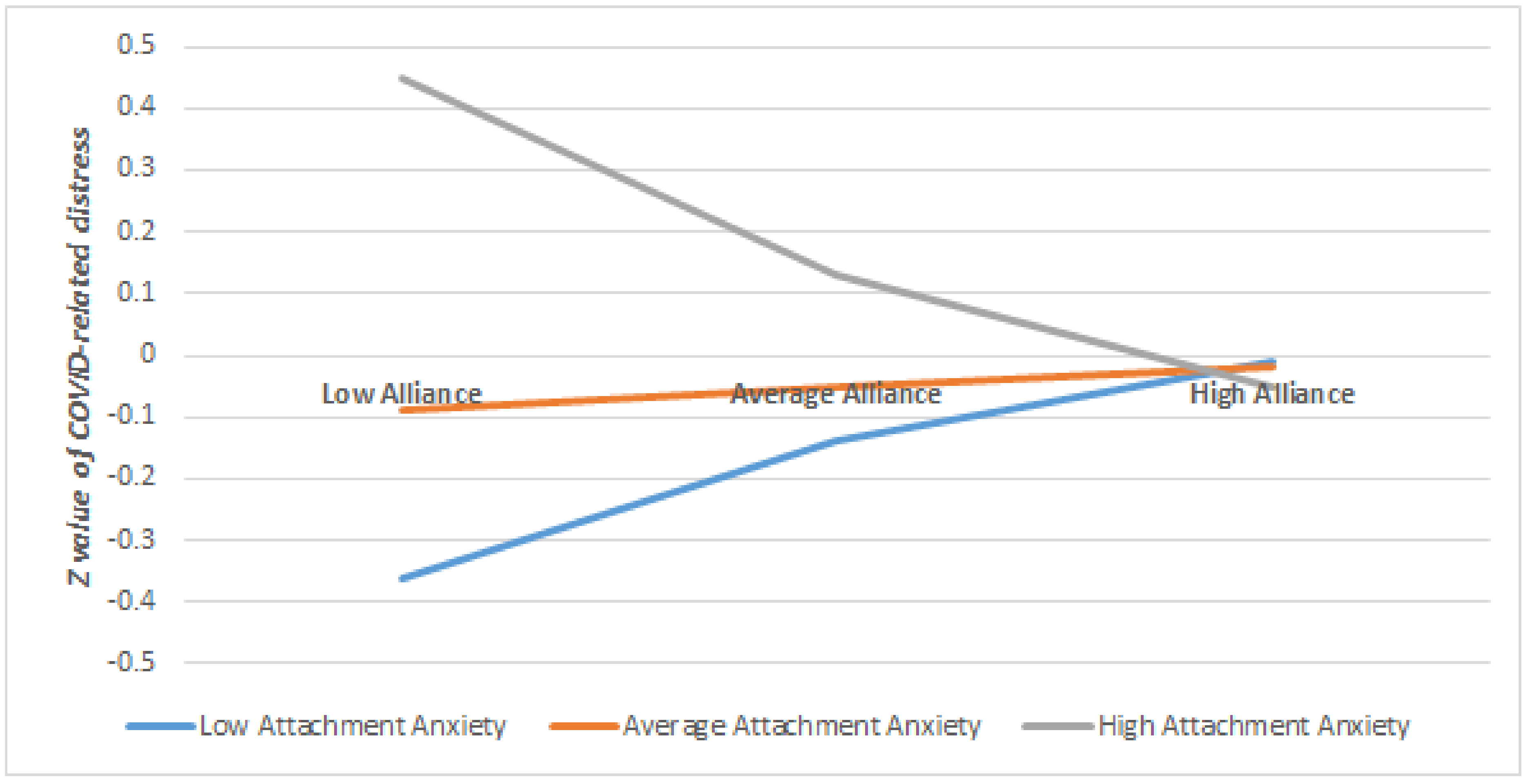
| ECR-RS Anxiety | 0.17 | 0.07 | 2.48 | 0.01 * | 0.04 | 0.31 |
| WAI-SR | −0.03 | 0.06 | −0.47 | 0.64 | −0.17 | 0.10 |
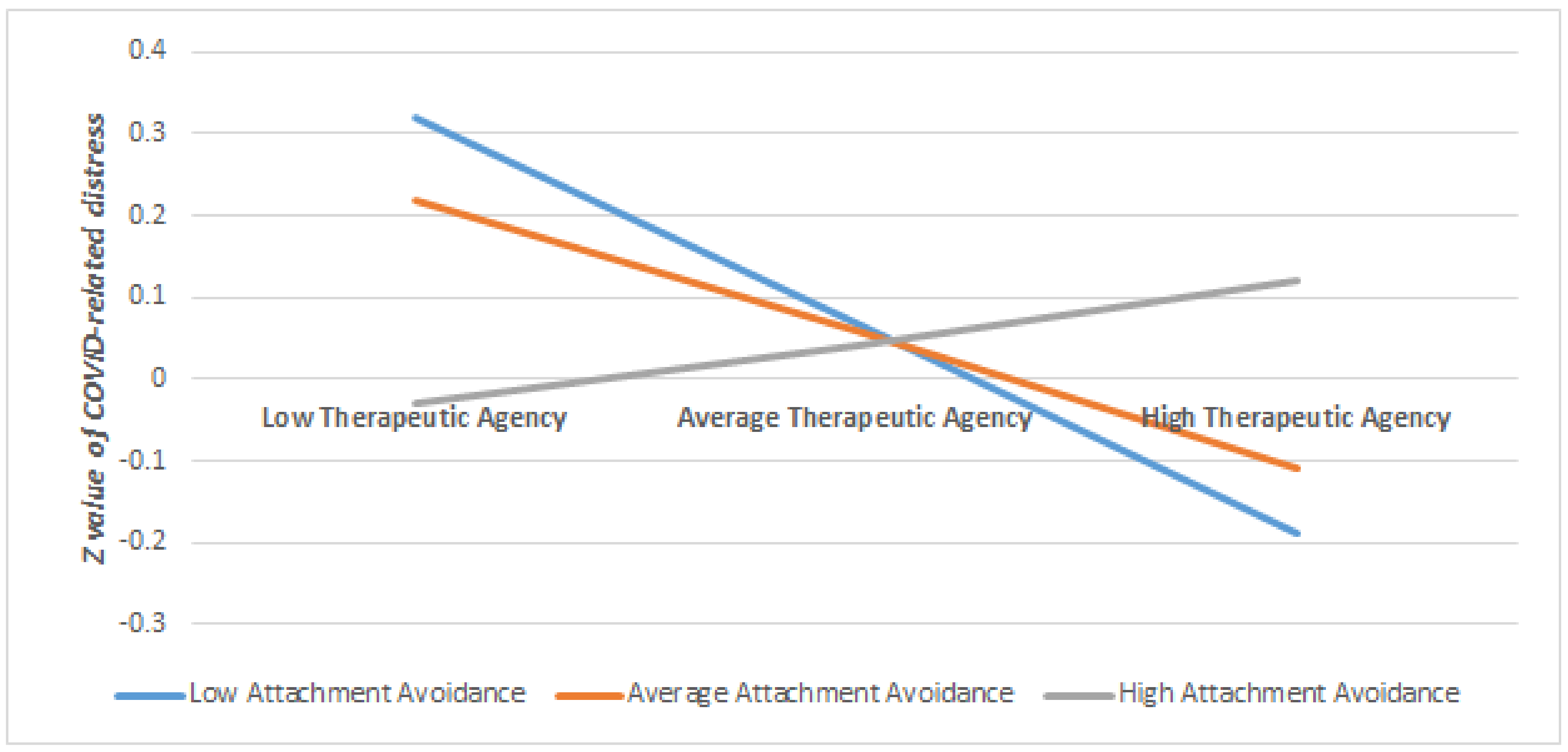
| Moderation: ECR-RS Anxiety X WAI-SR | −0.17 | 0.07 | −2.63 | 0.01 * | −0.31 | −0.04 |
| Covariate: time of completion | 0.23 | 0.09 | 2.47 | 0.02 * | 0.49 | 0.77 |
| Covariate: IES_T0 | 0.62 | 0.07 | 8.80 | 0.000 *** | 0.49 | 0.77 |
| Conditional Effects Value of the Moderator | ||||||
| ECR-RS Anxiety | WAI-SR | |||||
| −1 SD | 0.16 | 0.11 | 1.51 | 0.13 | −0.05 | 0.37 |
| 0 SD | −0.04 | 0.07 | −0.63 | 0.53 | −0.18 | 0.09 |
| 0.72 SD (cutoff) | −0.16 | 0.08 | −1.98 | 0.05 * | −0.32 | 0.00 |
| +1 SD | −0.22 | 0.09 | −2.31 | 0.02 * | −0.40 | −0.03 |
| Attachment Avoidance | ||||||
| ECR-RS Avoidance * TAI | ||||||
| ECR-RS Avoidance | −0.07 | 0.08 | −0.85 | 0.40 | −0.22 | 0.09 |
| TAI | −0.10 | 0.08 | −1.26 | 0.21 | −0.25 | 0.06 |
| Moderation: ECR-RS Avoidance X X TAI | 0.17 | 0.08 | 2.15 | 0.03 * | 0.01 | 0.32 |
| Covariate: time of completion | 0.14 | 0.10 | 1.38 | 0.17 | −0.06 | 0.35 |
| Covariate: IES_T0 | 0.61 | 0.07 | 8.39 | 0.000 *** | 0.47 | 0.76 |
| Conditional Effects Value of the Moderator | ||||||
| ECR-RS Avoidance | TAI | |||||
| −1 SD | −0.27 | 0.11 | −2.47 | 0.02 * | −0.50 | −0.06 |
| −0.40 SD (cutoff) | −0.16 | 0.08 | −1.98 | 0.05 * | −0.32 | 0.00 |
| 0 SD | −0.09 | 0.08 | −1.18 | 0.24 | −0.24 | 0.06 |
| +1 SD | 0.07 | 0.11 | 0.60 | 0.55 | −0.15 | 0.28 |
Publisher’s Note: MDPI stays neutral with regard to jurisdictional claims in published maps and institutional affiliations. |
© 2021 by the authors. Licensee MDPI, Basel, Switzerland. This article is an open access article distributed under the terms and conditions of the Creative Commons Attribution (CC BY) license (https://creativecommons.org/licenses/by/4.0/).
Share and Cite
Aafjes-van Doorn, K.; Békés, V.; Luo, X. COVID-19 Related Traumatic Distress in Psychotherapy Patients during the Pandemic: The Role of Attachment, Working Alliance, and Therapeutic Agency. Brain Sci. 2021, 11, 1288. https://doi.org/10.3390/brainsci11101288
Aafjes-van Doorn K, Békés V, Luo X. COVID-19 Related Traumatic Distress in Psychotherapy Patients during the Pandemic: The Role of Attachment, Working Alliance, and Therapeutic Agency. Brain Sciences. 2021; 11(10):1288. https://doi.org/10.3390/brainsci11101288
Chicago/Turabian StyleAafjes-van Doorn, Katie, Vera Békés, and Xiaochen Luo. 2021. "COVID-19 Related Traumatic Distress in Psychotherapy Patients during the Pandemic: The Role of Attachment, Working Alliance, and Therapeutic Agency" Brain Sciences 11, no. 10: 1288. https://doi.org/10.3390/brainsci11101288
APA StyleAafjes-van Doorn, K., Békés, V., & Luo, X. (2021). COVID-19 Related Traumatic Distress in Psychotherapy Patients during the Pandemic: The Role of Attachment, Working Alliance, and Therapeutic Agency. Brain Sciences, 11(10), 1288. https://doi.org/10.3390/brainsci11101288

