

Rebar Shape Time-Evolution During a Reinforced Concrete Corrosion Test: An Electrochemical Model

 , ,
, ,  and
and 
Abstract
1. Introduction
2. Materials and Methods
3. Rebar Shape Model
3.1. Initial Current Density
3.2. Current Density Time-Evolution
3.3. Rebar Shape Time-Evolution
4. Results
5. Conclusions
- Rebar-shape time-evolution during a forced corrosion test can be estimated.
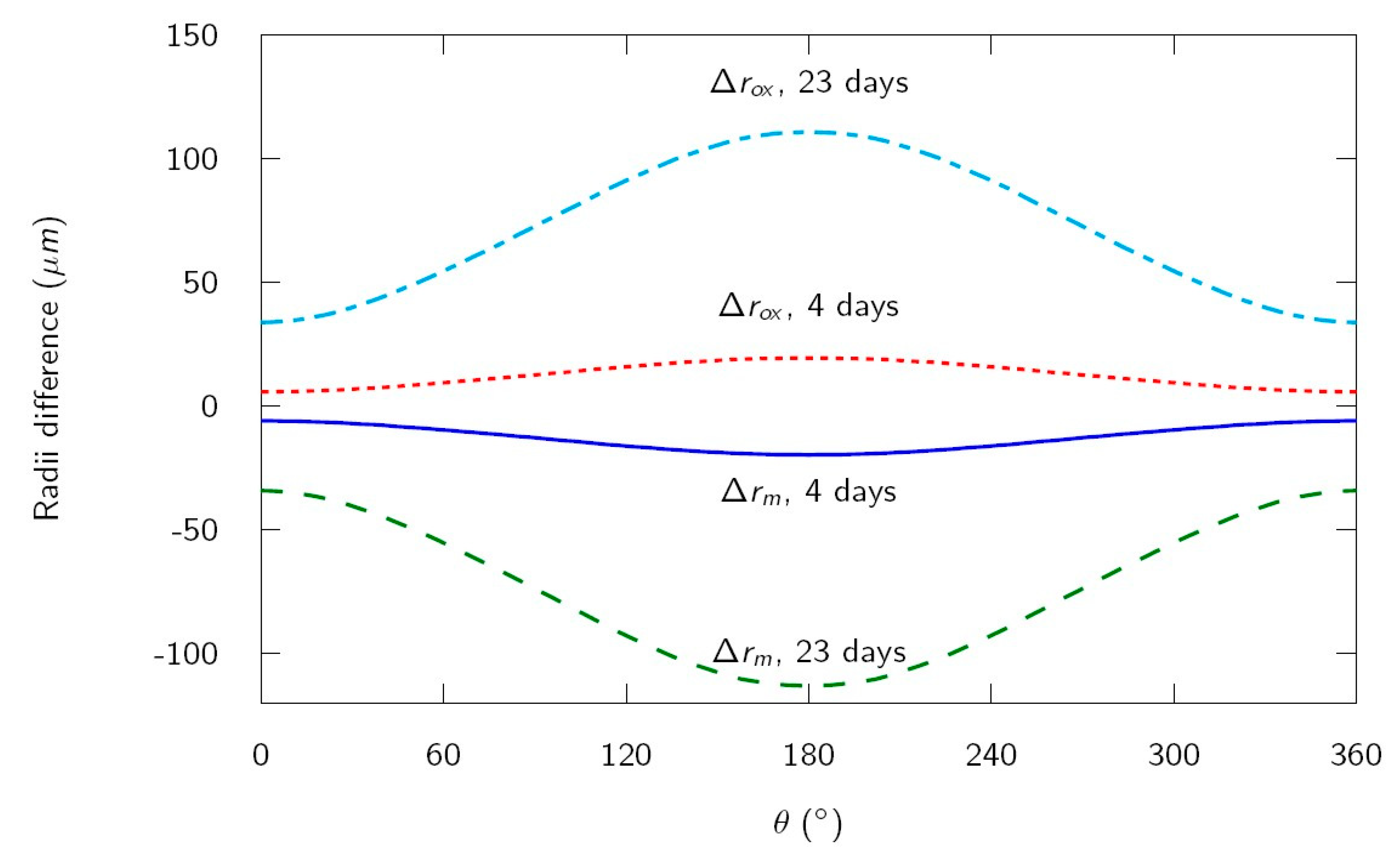
- The side of the rebar nearest to the cathode is the most affected by corrosion, suffering the highest current density, highest metal radius reduction, and highest volume increase due to corrosion product creation.
- When the first cracks appear, the rebar radius increases on the side nearest the mortar surface, which is about 6 m.
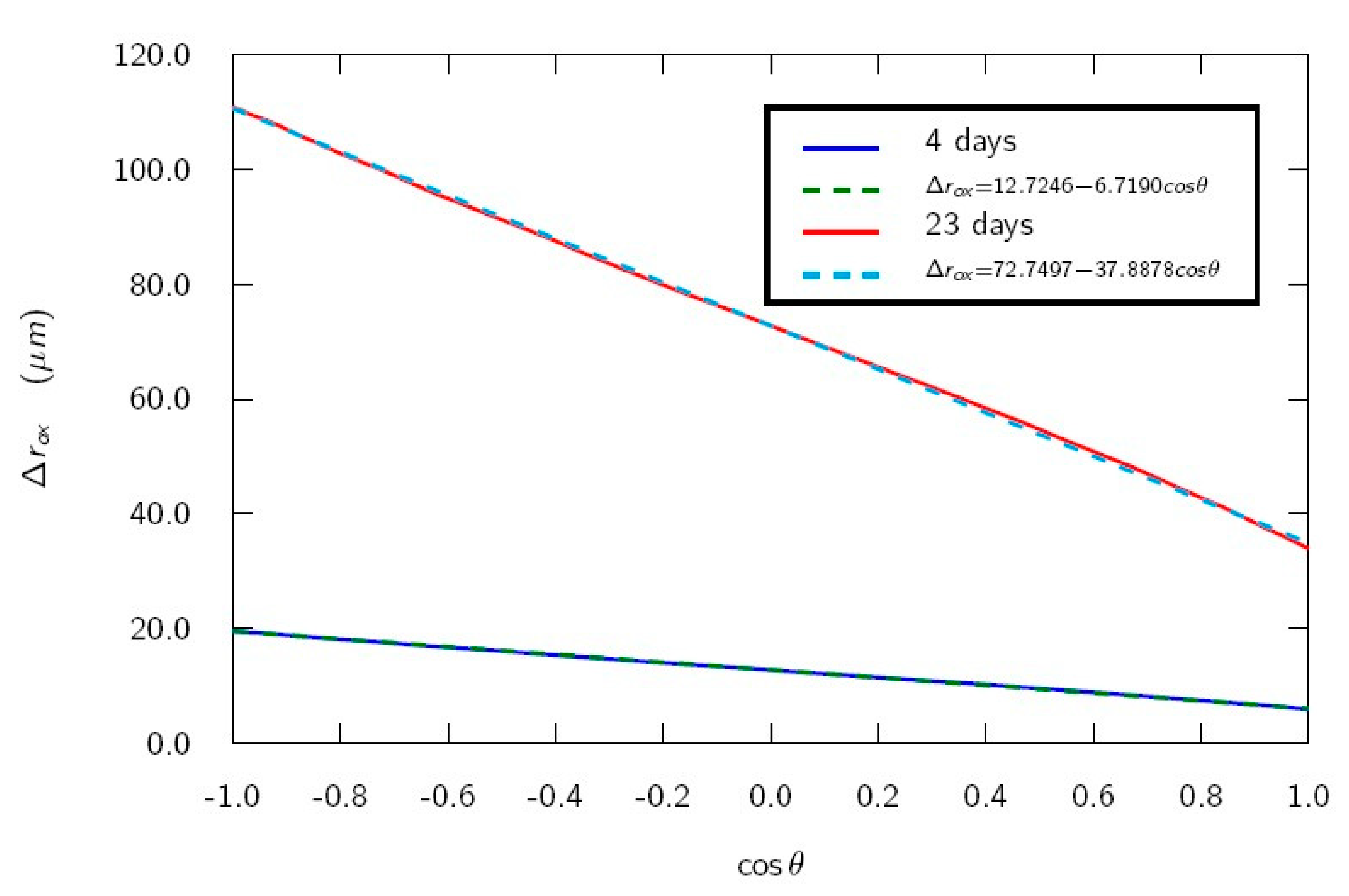
- Dependence of the expanded rebar radius along the rebar perimeter is approximately sinusoidal with a perimeter angle if corrosion time is not very long.
- The estimated rebar shape time-evolution could be used as input for a mechanical mortar cracking model in order to estimate crack evolution during the forced corrosion test.
Author Contributions
Funding
Acknowledgments
Conflicts of Interest
References
- ACI Committee 222R-96. Corrosion of Metals in Concrete; American Concrete Institute (ACI): Farmington Hills, MI, USA, 1996. [Google Scholar]
- Suda, K.; Misra, S.; Motohashi, K. Corrosion products of reinforcing bars embedded in concrete. Corros. Sci. 1993, 35, 1543–1549. [Google Scholar] [CrossRef] [Scilit]
- Alonso, C.; Andrade, C.; Rodríguez, J.; Díez, J.M. Factors controlling cracking of concrete affected by reinforcement corrosion. Mater. Struct. 1998, 31, 435–441. [Google Scholar] [CrossRef] [Scilit]
- Weyers, R.E.; Liu, Y. Modeling the time-to-corrosion cracking in chloride contaminated reinforced concrete structures. ACI Mater. J. 1998, 95, 675–681. [Google Scholar]
- Bertolini, L.; Elsener, B.; Pedeferri, P.; Polder, R. Corrosion of Steel in Concrete; Wiley-VCH: Weinheim, Germany, 2004. [Google Scholar]
- Uomoto, T.; Misra, S. Behaviour of concrete beams and columns in marine environment when corrosion of reinforcing bars takes place. In 2nd International Conference on Concrete in Marine Environment; ACI SP-109; American Concrete Institute (ACI): Farmington Hills, MI, USA, 1988; pp. 127–146. [Google Scholar]
- Ministerio de Fomento. EHE-08, Instrucción de Hormigón Estructural (EHE-08, Spanish Structural Concrete Code); Ministerio de Fomento: Madrid, Spain, 2010. (In Spanish) [Google Scholar]
- Jamali, A.; Angst, U.; Adey, B.; Elsener, B. Modeling of corrosion-induced concrete cover cracking: A critical analysis. Constr. Build. Mater. 2013, 42, 225–237. [Google Scholar] [CrossRef] [Scilit]
- Andrade, C.; Alonso, C.; Molina, F.J. Cover cracking as function of bar corrosion: Part 1—Experimental test. Mater. Struct. 1993, 26, 453–464. [Google Scholar] [CrossRef] [Scilit]
- Muthulingam, S.; Rao, B.N. Non-uniform corrosion states of rebar in concrete under chloride environment. Corros. Sci. 2015, 93, 267–282. [Google Scholar] [CrossRef] [Scilit]
- Cheng, X.; Su, Q.; Ma, F.; Liu, X.; Liang, X. Investigation on crack propagation of concrete cover induced by non-uniform corrosion of multiple rebars. Eng. Fract. Mech. 2018, 201, 366–384. [Google Scholar] [CrossRef] [Scilit]
- Qiao, D.; Nakamura, H.; Yamamoto, Y.; Miura, T. Crack patterns of concrete with a single rebar subjected to non-uniform and localized corrosion. Constr. Build. Mater. 2016, 116, 366–377. [Google Scholar] [CrossRef] [Scilit]
- Guzmán, S.; Gálvez, J.C. Modelling of concrete cover cracking due to non-uniform corrosion of reinforcing steel. Constr. Build. Mater. 2017, 155, 1063–1071. [Google Scholar] [CrossRef] [Scilit]
- Su, R.K.L.; Zhang, Y. A novel elastic-body-rotation model for concrete cover spalling caused by non-uniform corrosion of reinforcement. Constr. Build. Mater. 2019, 213, 549–560. [Google Scholar] [CrossRef] [Scilit]
- Zhang, Y.; Su, R.K.L. Concrete cover delamination model for non-uniform corrosion of reinforcements. Constr. Build. Mater. 2019, 223, 329–340. [Google Scholar] [CrossRef] [Scilit]
- Jin, L.; Zhang, R.; Du, X.; Li, Y. Investigation on the cracking behavior of concrete cover induced by corner located rebar corrosion. Eng. Fail. Anal. 2015, 52, 129–143. [Google Scholar] [CrossRef] [Scilit]
- Sola, E.; Ožbolt, J.; Balabanić, G.; Mir, Z.M. Experimental and numerical study of accelerated corrosion of steel reinforcement in concrete: Transport of corrosion products. Cem. Concr. Res. 2019, 120, 119–131. [Google Scholar] [CrossRef] [Scilit]
- Idrissi, H.; Limam, A. Study and characterization by acoustic emission and electrochemical measurements of concrete deterioration caused by reinforcement steel corrosion. NDTE Int. 2003, 36, 563–569. [Google Scholar] [CrossRef] [Scilit]
- Ye, H.; Jin, N.; Fu, C.; Jin, X. Rust distribution and corrosion-induced cracking patterns of corner located rebar in concrete cover. Constr. Build. Mater. 2017, 156, 684–691. [Google Scholar] [CrossRef] [Scilit]
- Dong, B.; Shi, G.; Dong, P.; Ding, W.; Teng, X.; Qin, S.; Liu, Y.; Xing, F.; Hong, S. Visualized tracing of rebar corrosion evolution in concrete with x-ray microcomputed tomography method. Cem. Concr. Compos. 2018, 92, 102–109. [Google Scholar] [CrossRef] [Scilit]
- Zhang, J.; Ling, X.; Guan, Z. Finite element modeling of concrete cover crack propagation due to non-uniform corrosion of reinforcement. Constr. Build. Mater. 2017, 132, 487–499. [Google Scholar] [CrossRef] [Scilit]
- Chernin, L.; Val, D.V.; Volokh, K.Y. Analytical modelling of concrete cover cracking caused by corrosion of reinforcement. Mater. Struct. 2010, 43, 543–556. [Google Scholar] [CrossRef] [Scilit]
- Guzmán, S.; Gálvez, J.C.; Sancho, J.M. Cover cracking of reinforced concrete due to rebar corrosion induced by chloride penetration. Cem. Concr. Res. 2011, 41, 893–902. [Google Scholar] [CrossRef] [Scilit]
- Climent, M.A.; de Vera, G.; Viqueira, E.; López, M.M. Generalization of the possibility of eliminating the filtration step in the determination of acid-soluble chloride content in cement and concrete by potentiometric titration. Cem. Concr. Res. 2004, 34, 2291–2295. [Google Scholar] [CrossRef]
- UNE-EN 197-1 (2011). “Cemento. Parte 1: Composición, Especificaciones y Criterios de Conformidad de los Cementos Comunes” (“Cement. Part 1: Composition, Specifications and Conformity Criteria for Common Cements”); Equivalent to the European Standard EN 197-1; Asociación Española de Normalización y Certificación: Madrid, Spain, 2000. (In Spanish)
- ASTM G 1-90—Standard Practice for Preparing, Cleaning and Evaluating Corrosion Test Specimens; American Society for Testing and Materials (ASTM): West Conshohocken, PA, USA, 1990.
- Climent, M.A.; Miró, M.; Carbajo, J.; Poveda, P.; de Vera, G.; Ramis, J. Use of non-linear ultrasonic techniques to detect cracks due to steel corrosion in reinforced concrete structure. Materials 2019, 12, 819. [Google Scholar] [CrossRef] [Scilit]
- Molina, F.J.; Alonso, C.; Andrade, C. Cover cracking as function of rebar corrosion: Part 2—Numerical model. Mater. Struct. 1993, 26, 532–548. [Google Scholar] [CrossRef] [Scilit]
- Carey, G.F.; Oden, J.T. Finite elements. Vol VI, Fluid Mechanics; Prentice-Hall: Upper Saddle River, NJ, USA, 1986. [Google Scholar]
- Zienkiewicz, O.C.; Taylor, R.L. The Finite Element Method. Vol. 1: The Basis; Butterworth-Heinemann: Oxford, UK, 2000. [Google Scholar]
- Matlab. Available online: http://www.mathworks.com/help/matlab/index.html (accessed on 20 June 2019).
- Matlab Online Documentation for Delaunay. Available online: https://es.mathworks.com/help/matlab/ref/delaunay.html?s_tid=gn_loc_drop (accessed on 20 June 2019).
- Handbook of Chemistry and Physics, 66th ed.; West, R.C., Ed.; CRC Press: Boca Raton, FL, USA, 1985. [Google Scholar]
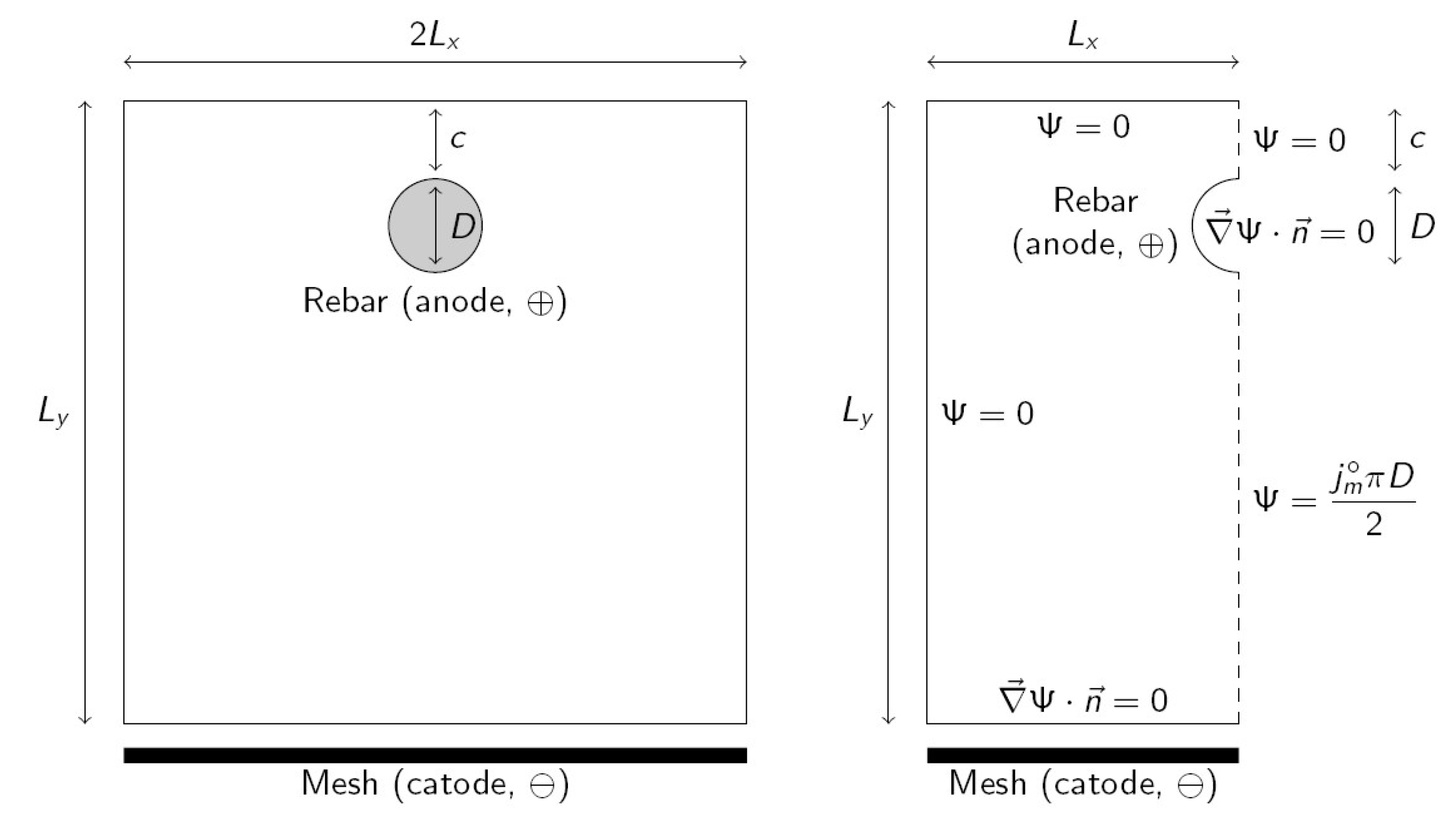
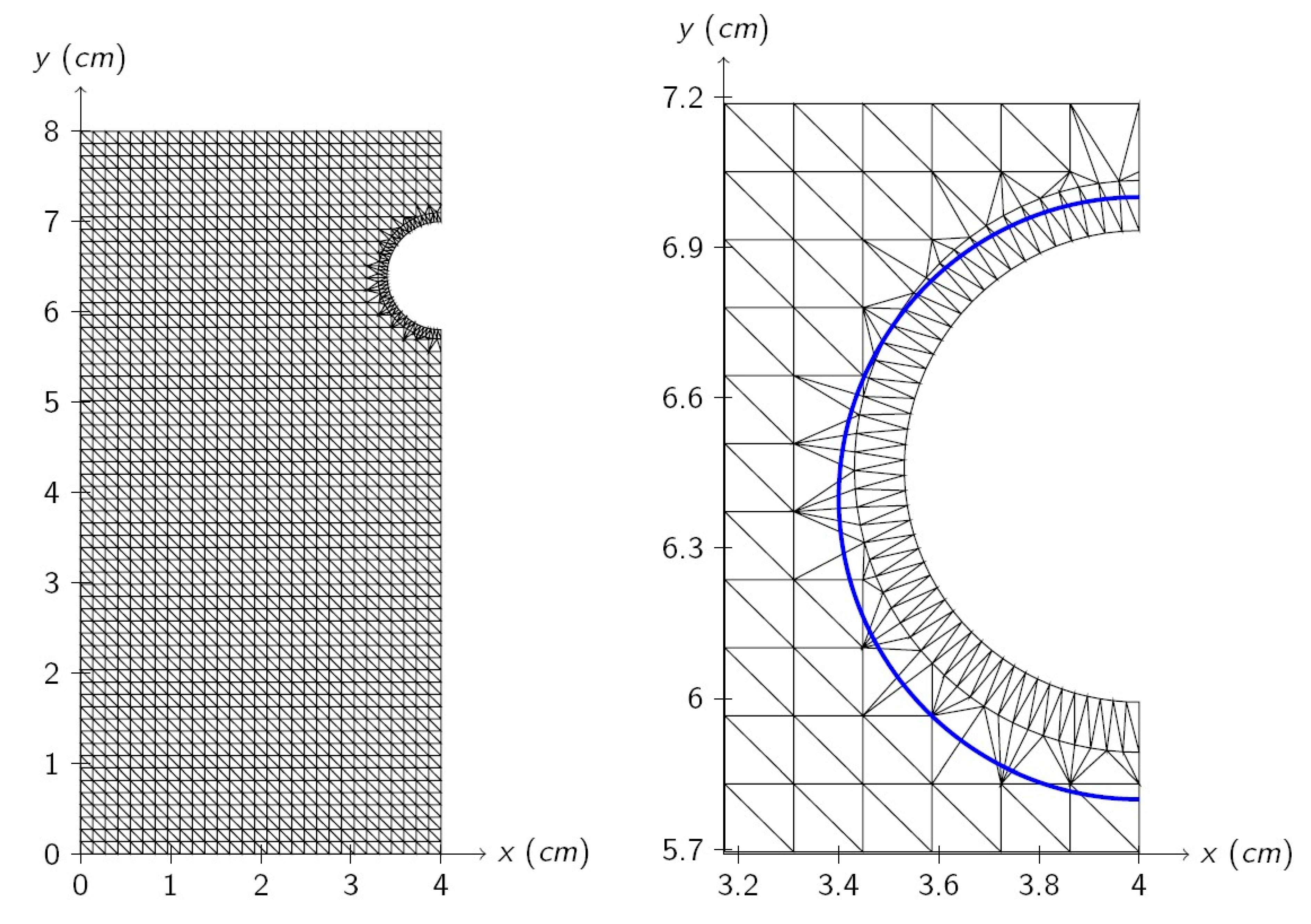
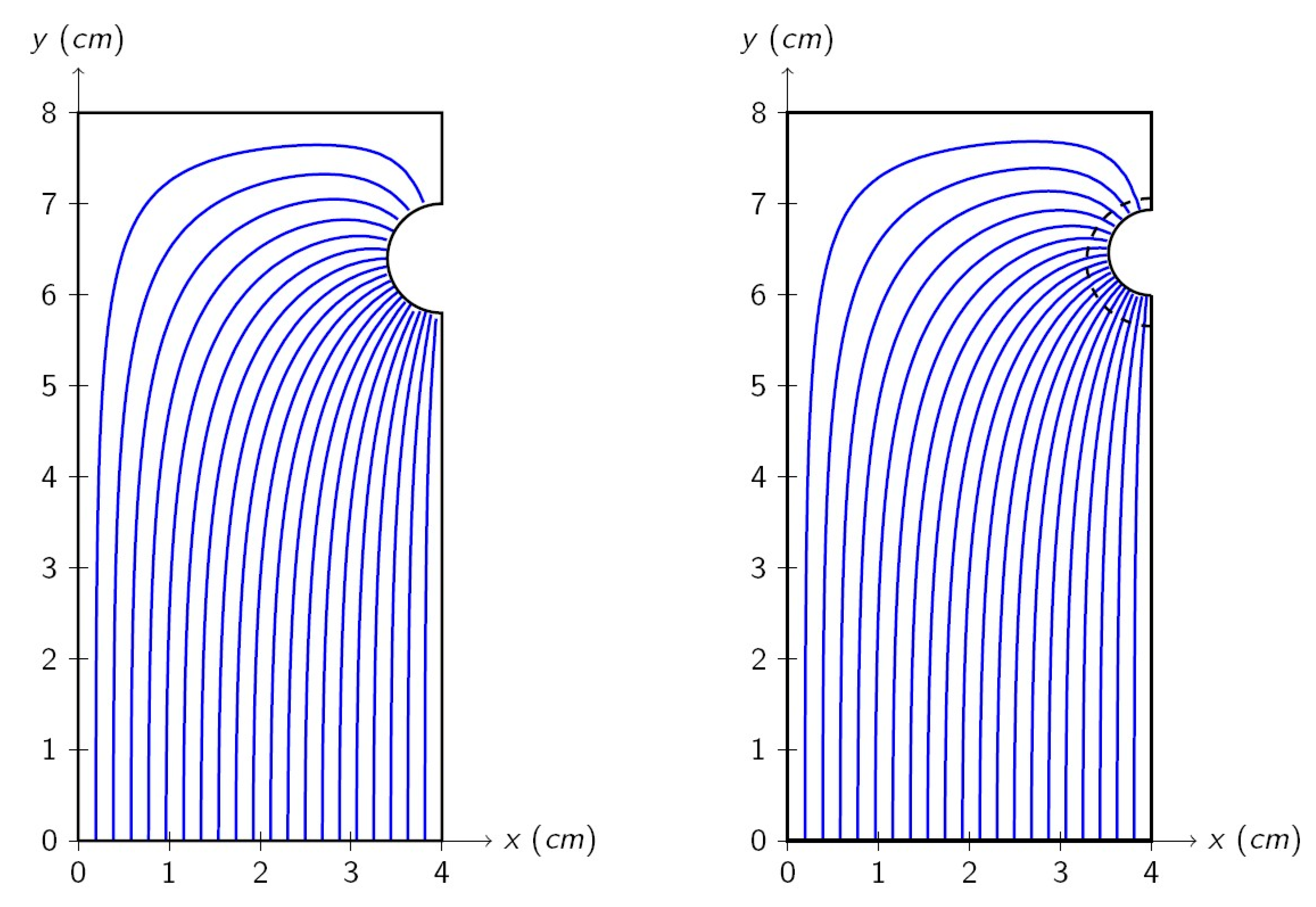
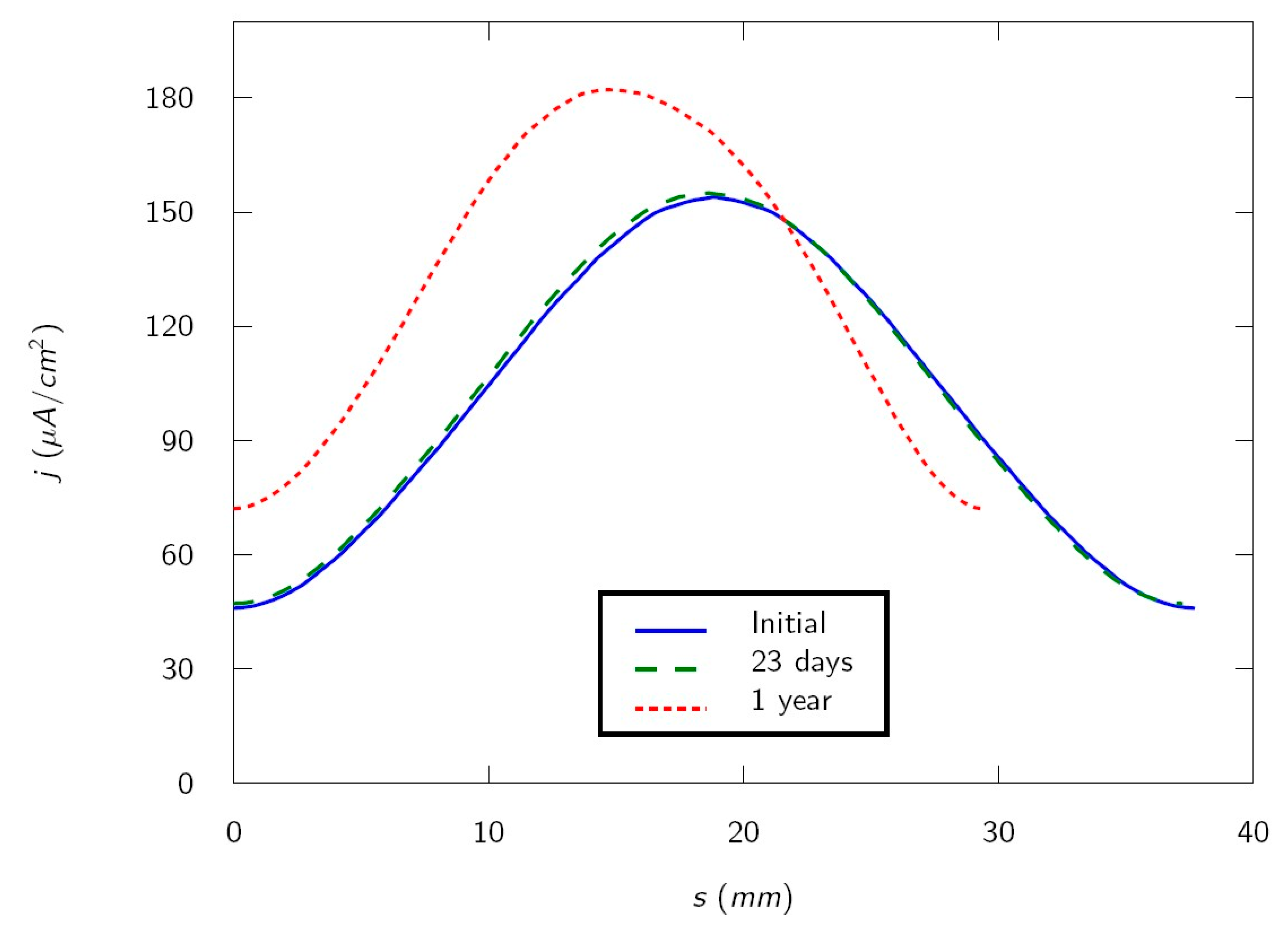

| Material | Amount (g) |
|---|---|
| Cement (CEM I 52.5 R SR (3)) [25] | 450 |
| Standard siliceous sand | 1350 |
| Deionized water | 225 (w/c = 0.5) |
| NaCl | 14.8 (2% relative to cement weight) |
| Parameters | ||
| Obtained mesh | ||
| Mesh | Nodes | Elements |
| Initial | 1855 | 3490 |
| After 1 year | 1868 | 3514 |
| Top | Bottom | Top | Bottom | |
|---|---|---|---|---|
| 4 days | - | −19.6 | 5.9 | 19.6 |
| 23 days | −34.7 | −113.2 | 33.9 | 111.1 |
| 1 year | −666.9 | −1932.1 | 599.8 | 1446.6 |
© 2019 by the authors. Licensee MDPI, Basel, Switzerland. This article is an open access article distributed under the terms and conditions of the Creative Commons Attribution (CC BY) license (http://creativecommons.org/licenses/by/4.0/).
Share and Cite
de Vera, G.; Miró, M.; Segovia, E.G.; Poveda, P.; Climent, M.Á. Rebar Shape Time-Evolution During a Reinforced Concrete Corrosion Test: An Electrochemical Model. Appl. Sci. 2019, 9, 3061. https://doi.org/10.3390/app9153061
de Vera G, Miró M, Segovia EG, Poveda P, Climent MÁ. Rebar Shape Time-Evolution During a Reinforced Concrete Corrosion Test: An Electrochemical Model. Applied Sciences. 2019; 9(15):3061. https://doi.org/10.3390/app9153061
Chicago/Turabian Stylede Vera, Guillem, Marina Miró, Enrique Gonzalo Segovia, Pedro Poveda, and Miguel Ángel Climent. 2019. "Rebar Shape Time-Evolution During a Reinforced Concrete Corrosion Test: An Electrochemical Model" Applied Sciences 9, no. 15: 3061. https://doi.org/10.3390/app9153061
APA Stylede Vera, G., Miró, M., Segovia, E. G., Poveda, P., & Climent, M. Á. (2019). Rebar Shape Time-Evolution During a Reinforced Concrete Corrosion Test: An Electrochemical Model. Applied Sciences, 9(15), 3061. https://doi.org/10.3390/app9153061

